Here’s How the Aid & Attendance Benefit Works for Veteran Families
Here's everything you need to know about the military's Aid and Attendance benefit: what it is, who qualifies, how much you get, and how to apply.

Free DIY tool
VA Claim Readiness Score
Is my VA claim ready to file? Answer 4 quick questions and get a readiness score with next steps.
Try the free toolIf you or a loved one served during a wartime period and now needs help with everyday activities, the Aid and Attendance (A&A) benefit could provide additional monthly financial support.
Aid and Attendance is not a separate VA benefit. Instead, it increases the amount of a qualifying VA Pension or Survivors Pension for veterans and surviving spouses who need regular help with daily activities, live in a nursing home, are largely bedridden, or meet certain eyesight requirements.
That additional money can help offset the cost of in-home care, assisted living, nursing care, and other expenses that often come with needing more support.
This guide explains who qualifies for Aid and Attendance, how much the benefit can provide, how the VA calculates your payment, and how to apply.
If you're trying to understand VA Pension more broadly, start with our complete VA Pension guide.
Want to become fluent in the language of benefits?Sign up for a free BenefitKarma.com account!
What is Aid and Attendance?
Aid and Attendance is an increased VA pension amount for eligible veterans and survivors who need another person's help with everyday activities or meet certain other medical requirements.
The benefit is added to your monthly VA Pension or Survivors Pension payment.
This is important because Aid and Attendance is different from VA disability compensation. VA disability compensation is generally tied to medical conditions caused or made worse by military service. VA Pension and Aid and Attendance are needs-based benefits with income and net-worth requirements.
Aid and Attendance is also different from VA Special Monthly Compensation, which can provide additional disability compensation to veterans with certain severe service-connected disabilities or care needs.
What can Aid and Attendance help pay for?
The VA does not restrict Aid and Attendance to one specific type of expense. The additional pension income can help cover costs associated with day-to-day care and living expenses.
That may include:
- In-home caregiving.
- Assisted living.
- Nursing home care.
- Adult day care.
- Help with bathing, dressing, eating, or other daily activities.
- Medical expenses and supplies.
- Transportation and other necessary living costs.
For families trying to keep a veteran at home rather than moving immediately into a care facility, the added income can be particularly valuable.
Who qualifies for Aid and Attendance?
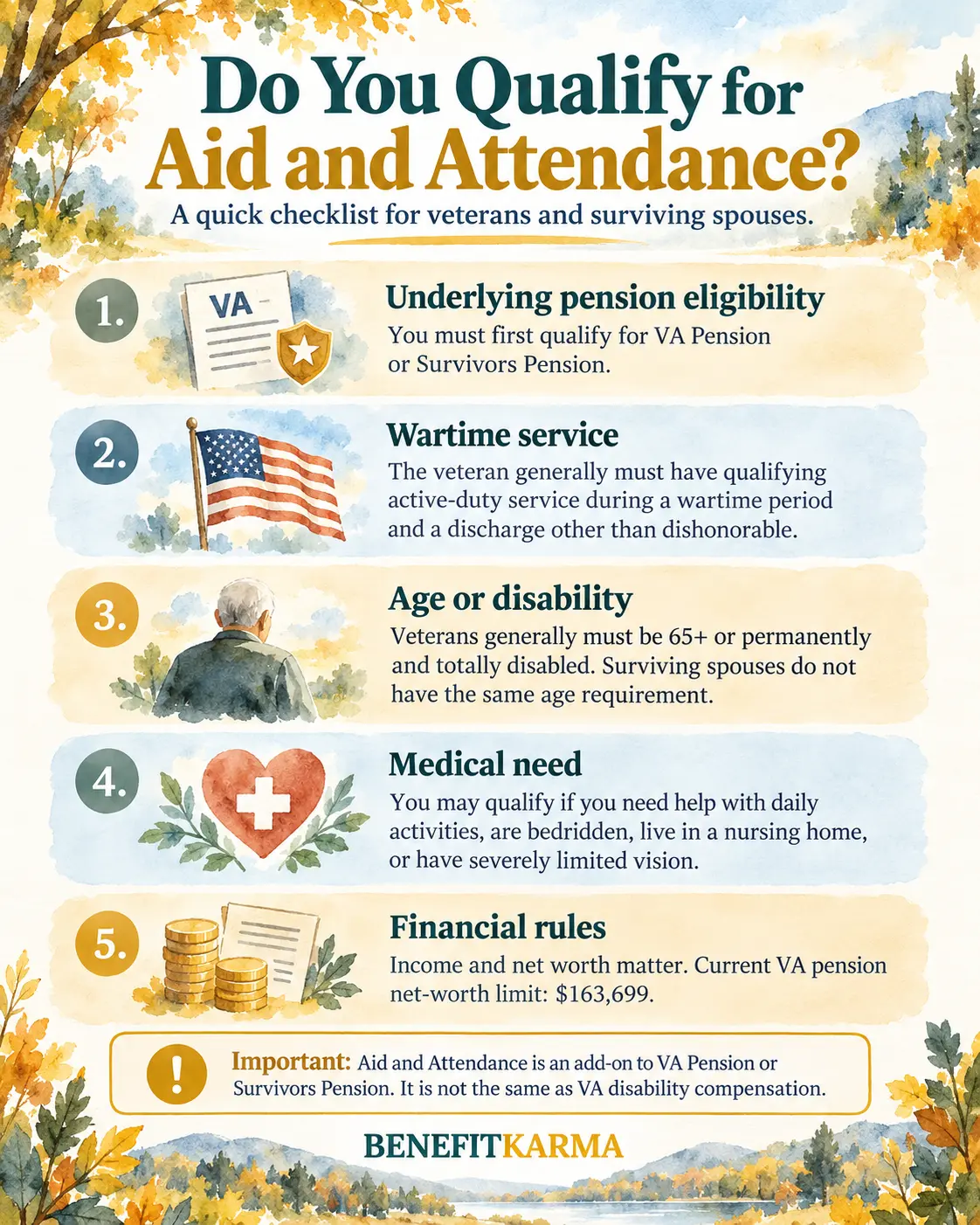
To receive Aid and Attendance through the VA pension system, you first need to qualify for VA Pension or Survivors Pension and then meet an additional medical-care requirement.
The rules involve three broad areas: military service, pension eligibility, and medical need.
Military service requirements
For veterans who entered active duty before Sept. 8, 1980, eligibility generally requires at least 90 days of active-duty service, including at least one day during a recognized wartime period.
For veterans who entered active duty after Sept. 7, 1980, the service requirement is generally 24 months or the full period for which they were called or ordered to active duty, with some exceptions, and at least one day must have fallen during a wartime period.
Different rules can apply to officers who began active duty after Oct. 16, 1981.
The veteran also generally cannot have received a dishonorable discharge.
You do not need to have served in combat. The service simply needs to include qualifying active duty during a recognized wartime period.
For a broader look at programs tied to military service, see our Veterans Benefits Guide.
Medical requirements for Aid and Attendance
In addition to qualifying for a pension, the veteran or survivor must meet at least one of the VA's Aid and Attendance medical requirements.
You may qualify if:
- You need another person's help with everyday activities such as bathing, dressing, eating, or using the bathroom.
- You are bedridden or must spend a large portion of the day in bed because of illness.
- You live in a nursing home because of a physical or mental disability.
- Your eyesight is severely limited, even with corrective lenses.
You don't necessarily need help with every activity of daily living. The VA considers the claimant's overall need for regular assistance.
Financial eligibility matters, too
Because Aid and Attendance is tied to the VA pension system, income and net worth matter.
For the current pension year, running from Dec. 1, 2025 through Nov. 30, 2026, the VA Pension net-worth limit is $163,699.
Net worth generally includes assets plus annual income for VA purposes.
However, the VA does not count everything you own. Your primary home, one vehicle, and many ordinary household belongings generally aren't included in the pension net-worth calculation.
The VA also uses a three-year look-back period for certain asset transfers. Giving away money or property simply to get below the pension limit can trigger a penalty period during which you cannot receive pension benefits.
How much does Aid and Attendance pay?
Aid and Attendance does not provide the same flat monthly payment to everyone.
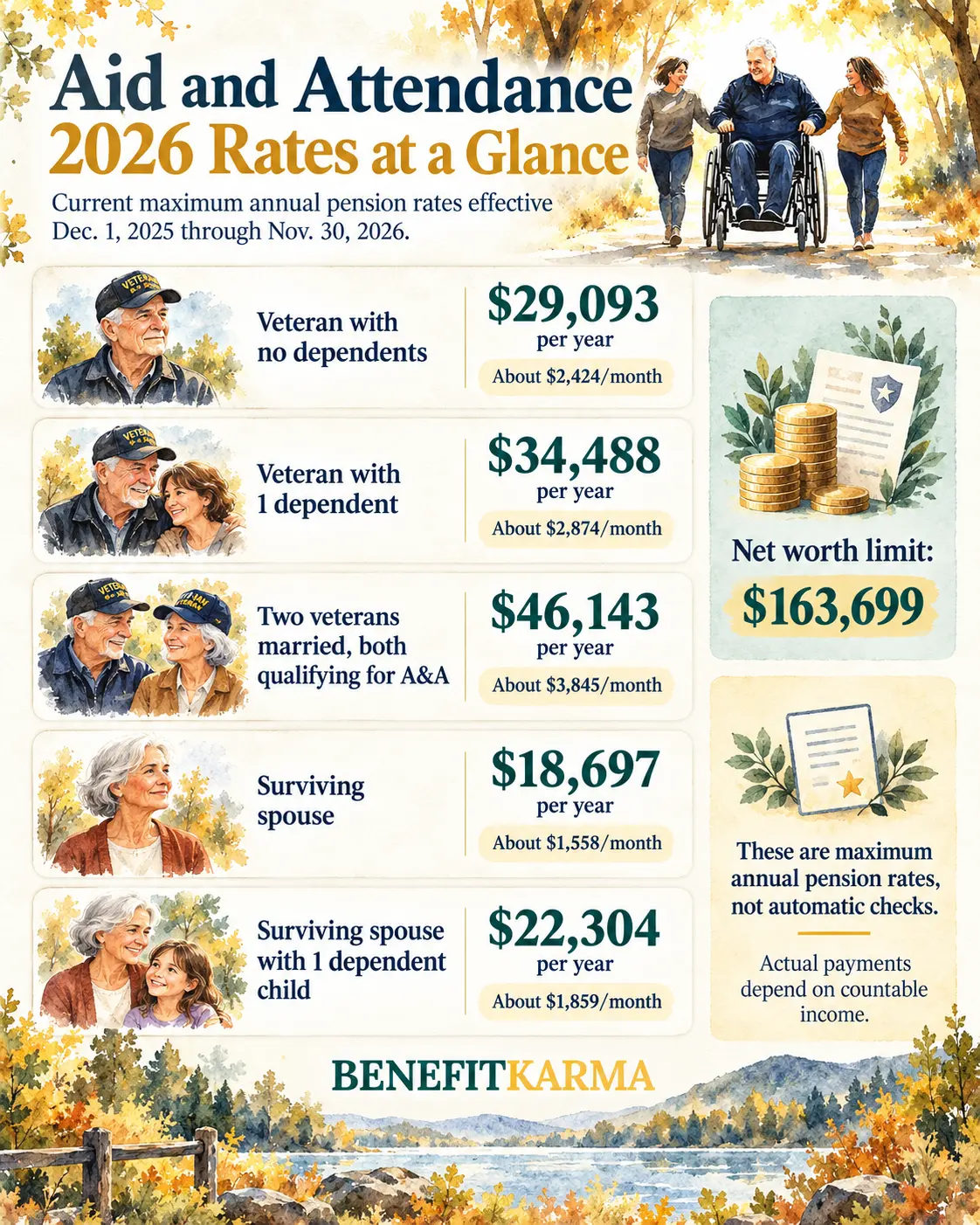
Instead, the VA uses a Maximum Annual Pension Rate (MAPR). Your MAPR depends on your family situation and whether you qualify for Aid and Attendance.
Current rates are effective from Dec. 1, 2025 through Nov. 30, 2026.
| Situation | Maximum Annual Pension Rate with Aid & Attendance |
|---|---|
| Veteran with no dependents | $29,093 |
| Veteran with 1 dependent | $34,488 |
| Two veterans married to each other, both qualifying for A&A | $46,143 |
| Surviving spouse with no dependent children | $18,697 |
| Surviving spouse with 1 dependent child | $22,304 |
These are maximum annual pension rates, not guaranteed annual payments.
Your actual pension depends on your income for VA purposes.
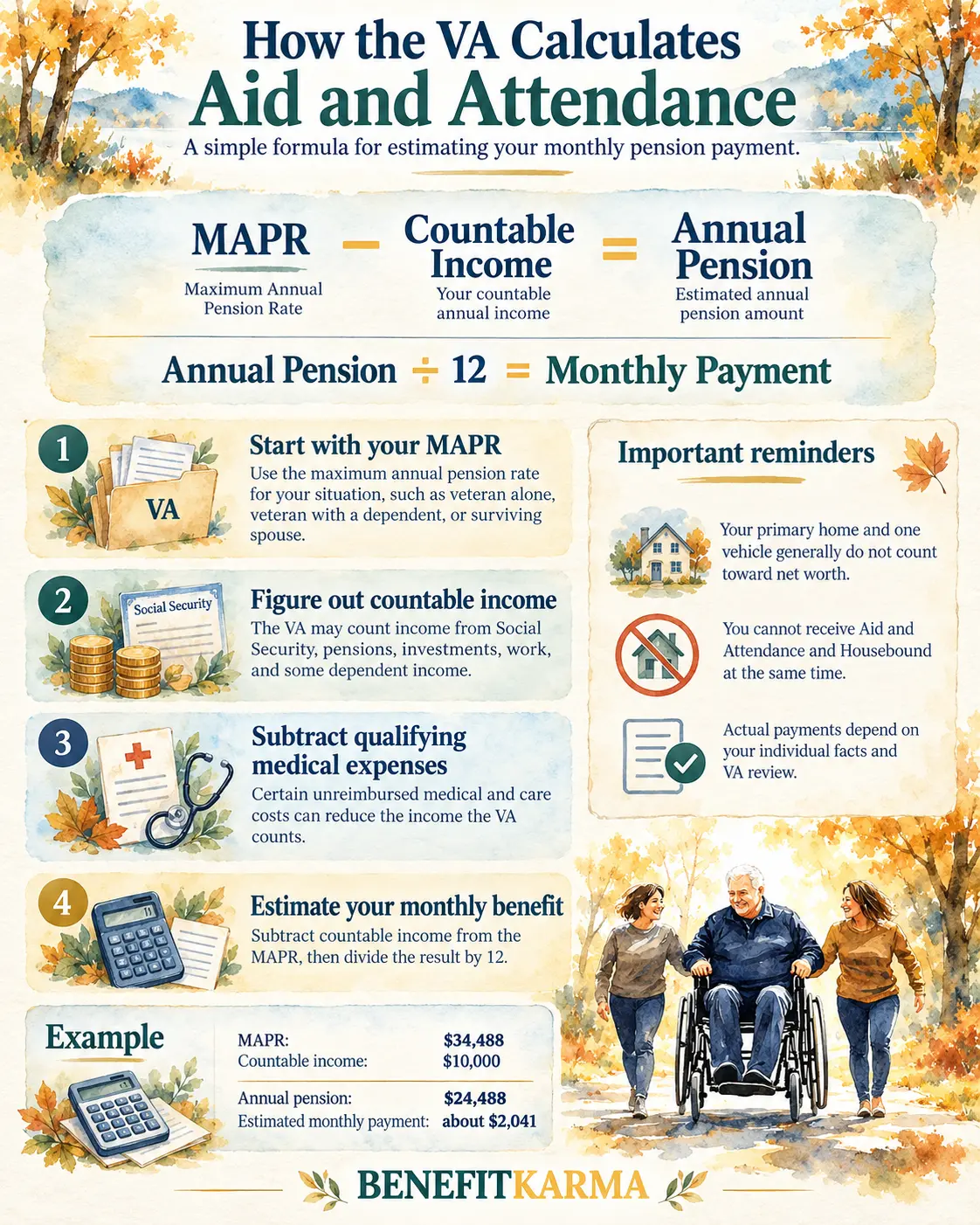
For example, suppose a veteran with one dependent qualifies for Aid and Attendance and has an applicable MAPR of $34,488.
If the VA determines that the household has $10,000 in countable annual income:
$34,488 MAPR − $10,000 countable income = $24,488 annual pension
That would equal about $2,041 per month.
What happens to Aid and Attendance rates in 2027?
VA pension rates are adjusted for cost-of-living increases.
Social Security's 2027 COLA is 3.6%, and the new VA pension rates are expected to take effect Dec. 1, 2026.
However, use the VA's official pension tables for your exact payment once the agency publishes the new Aid and Attendance MAPRs. The figures above remain the current official rates through Nov. 30, 2026.
How does the VA calculate your Aid and Attendance benefit?
The easiest way to understand the calculation is:
Free DIY tool
VA Claim Readiness Score
Is my VA claim ready to file? Answer 4 quick questions and get a readiness score with next steps.
Try the free toolYour MAPR − your countable income = your annual VA pension
Then divide that result by 12 to estimate your monthly payment.
But determining "countable income" is where things get more interesting.
The VA generally considers income such as:
- Social Security.
- Retirement and pension payments.
- Investment income.
- Employment income.
- Certain income received by dependents.
However, some expenses can reduce your income for VA purposes.
Medical expenses can make a big difference
Certain unreimbursed medical expenses can be deducted from your income when the VA calculates your pension.
That can include qualifying expenses for:
- Health insurance premiums.
- Doctors and medical care.
- Prescription medications.
- In-home caregivers.
- Assisted living.
- Nursing home care.
- Other eligible medical services.
Only qualifying expenses above the VA's applicable threshold are deductible.
This is why someone whose gross income appears too high for VA Pension may still qualify once substantial medical and caregiving expenses are taken into account.
Can you get Aid and Attendance and Housebound benefits together?
No.
The VA offers both Aid and Attendance and a Housebound allowance as increased pension amounts, but you cannot receive both at the same time.
Aid and Attendance generally applies when you need regular personal assistance or meet one of the other medical standards.
Housebound benefits generally apply when a disability substantially confines you to your home.
If you potentially meet both standards, the VA determines which increased pension level applies.
How do you apply for Aid and Attendance?
Aid and Attendance does not happen automatically just because you receive VA Pension.
You'll generally need to provide medical evidence showing why you need assistance.
For a veteran applying for pension, the main application is VA Form 21P-527EZ, Application for Veterans Pension.
A surviving spouse applying for Survivors Pension generally uses VA Form 21P-534EZ.
To request Aid and Attendance, you'll typically also submit VA Form 21-2680, Examination for Housebound Status or Permanent Need for Regular Aid and Attendance.
Your health care provider can use that form to document:
- Your diagnosis.
- Physical limitations.
- Ability to feed yourself.
- Ability to prepare meals.
- Whether you need help bathing or maintaining hygiene.
- Whether you need help managing medications.
- Mobility limitations.
- Other reasons you require assistance.
If you're living in a nursing home, the VA may also require VA Form 21-0779, Request for Nursing Home Information in Connection with Claim for Aid and Attendance.
You can apply through VA.gov, by mail, or with help from an accredited representative.
What documents should you gather?
Having your records ready can make the application easier.
Depending on your situation, that may include:
- Military discharge records such as a DD214.
- Marriage and dependent information.
- Income information.
- Bank and asset information.
- Medical records.
- Documentation of unreimbursed medical expenses.
- Caregiver expenses.
- Assisted-living or nursing-home statements.
- A completed VA Form 21-2680.
A free VA-accredited Veterans Service Organization (VSO) representative can help you prepare and submit a pension claim.
Be cautious with anyone who promises to qualify you by moving or hiding assets. VA pension has strict asset-transfer rules, and improper transfers can result in a penalty period.
How and when are Aid and Attendance benefits paid?
If approved, Aid and Attendance becomes part of your monthly VA pension payment.
The VA generally pays benefits by direct deposit.
Your payment amount can change if your:
- Income changes.
- Medical expenses change.
- Net worth changes.
- Number of dependents changes.
- Living arrangements change.
Report major changes to the VA promptly so you don't end up with an overpayment that you later have to repay.
Are Aid and Attendance benefits taxable?
VA pension benefits, including the increased amount you receive because of Aid and Attendance, are generally tax-free for federal income tax purposes.
That means the benefit itself generally isn't included in your taxable income.
Can a surviving spouse get Aid and Attendance?
Yes.
An eligible surviving spouse receiving Survivors Pension may qualify for a higher pension rate if they also meet the Aid and Attendance medical requirements.
The surviving spouse must separately meet Survivors Pension's marriage, income, net-worth, and other eligibility requirements.
For the current pension year, the Aid and Attendance MAPR for a surviving spouse with no dependent children is $18,697 per year. A surviving spouse with one dependent child has an A&A MAPR of $22,304.
Again, those are maximum pension rates. The actual payment is based on the recipient's income for VA purposes.
What this means for you
Aid and Attendance can significantly increase a VA Pension or Survivors Pension for someone who needs help with everyday life.
The key is understanding that the benefit has two layers of eligibility: you first need to qualify for the underlying pension, and then you need to meet the VA's medical requirements for Aid and Attendance.
Your income may not automatically disqualify you, either. Unreimbursed medical and caregiving expenses can reduce the income the VA counts and potentially increase your pension payment.
If you think you or a family member may qualify, gather your service records, financial information, medical documentation, and care expenses before applying. And if you're navigating several programs at once, our Veterans Benefits Guide can help you see where Aid and Attendance fits into the larger VA benefits system.
Not sure what you qualify for?
A quick conversation can help you understand your options.
Optional — no obligation, fees may apply
Want help figuring out your next step?
Optional — fees may apply depending on your situation.
Some people choose to talk to a professional before taking their next step.
This might sound familiar:
You're not sure what to do next
You want someone to walk through your options
The process feels overwhelming
If that sounds like you, this might be worth a quick look.
Takes less than a minute
We only share your info with a service provider if you say yes.
Recommended Tools
Take action with our free tools
Get More from BenefitKarma
Create a free account to unlock all features
- Access premium benefit tools
- Personalized benefit matching
- Your personalized dashboard
Common questions about this guide
Get more from BenefitKarma
Free tools, personalized dashboard & more
