Student Loan Forgiveness Programs: What You Need to Know
Student loan forgiveness still exists in 2026, but the rules have changed. Here's how PSLF, income-driven repayment, Teacher Loan Forgiveness and discharge programs work now, and what to do next.

If you've heard that student loan forgiveness is gone, you're not alone. Between court fights, a major new federal law and a brand-new repayment plan, 2026 has been one of the most confusing years ever for federal student loan borrowers.
Free DIY tool
Benefit Eligibility Screener
What benefits might I qualify for? Answer a few questions and see VA, disability, food, housing, and health programs that may fit you.
Try the free toolHere's the short version: forgiveness is still available. Public Service Loan Forgiveness (PSLF), income-driven repayment (IDR) forgiveness, Teacher Loan Forgiveness and several discharge programs are all still on the books and still canceling debt. But the path to get there looks different than it did a year ago, and in some cases it got longer or more expensive.
This guide walks through each program, who qualifies, what changed and what you can do right now to protect your progress.
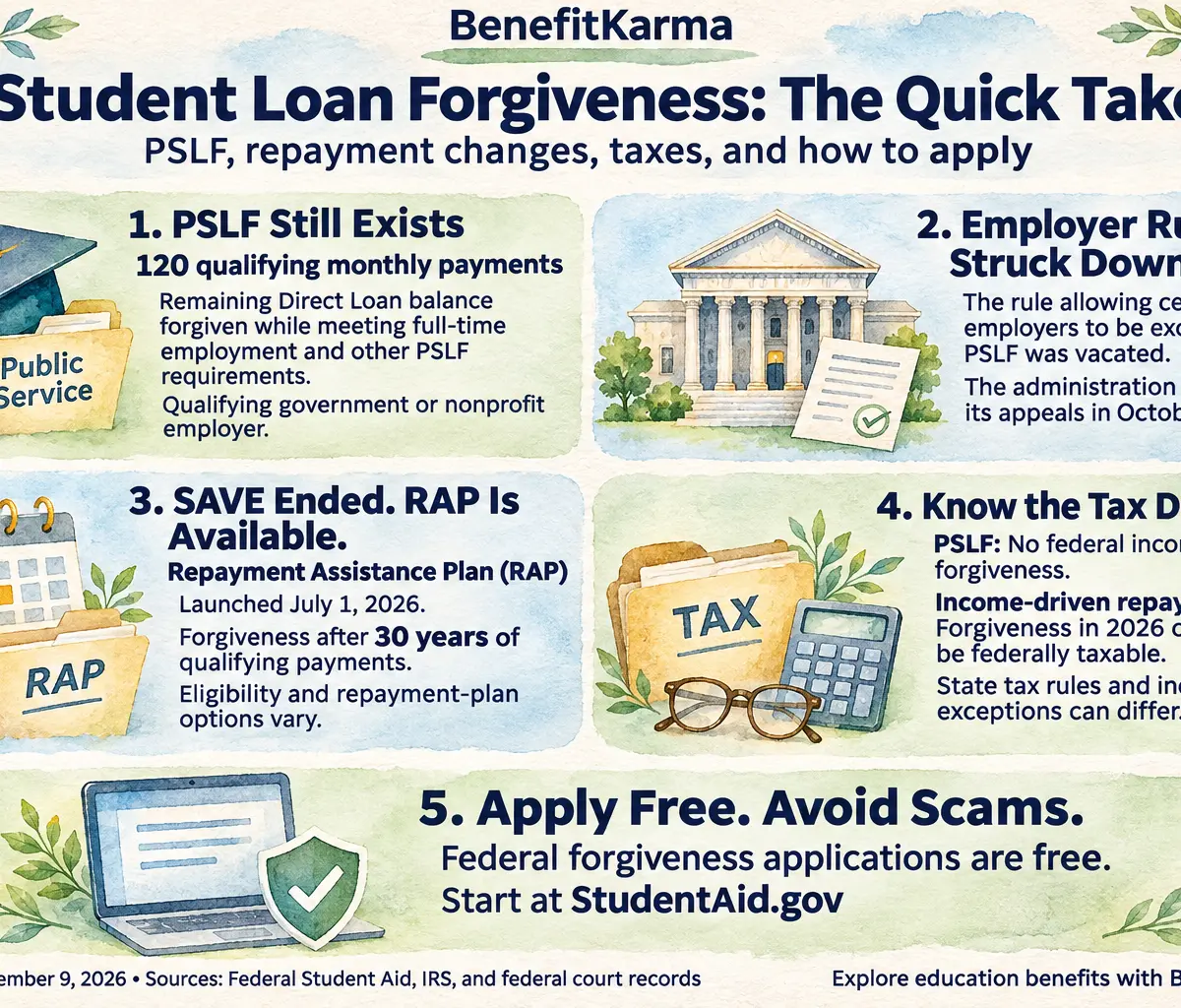
What changed in 2026
Most of this year's changes trace back to the One Big Beautiful Bill Act (OBBBA), the tax and spending law signed on July 4, 2025. It rewrote much of the federal student loan system for loans made on or after July 1, 2026. Here are the changes that matter most for forgiveness:
- The SAVE plan ended. SAVE, the Biden-era income-driven plan, was shut down by court order in March 2026 after a long legal battle. Borrowers who were on SAVE have had to move to another plan.
- A new income-driven plan arrived. The Repayment Assistance Plan (RAP) opened for enrollment on July 1, 2026. For anyone who takes out a new federal loan on or after that date, RAP and a new Tiered Standard Plan are the only two repayment options.
- Older IDR plans are winding down. PAYE and ICR closed to new enrollees on July 1, 2026, and will end entirely by July 1, 2028. Income-Based Repayment (IBR) remains available for loans made before July 1, 2026.
- Parent PLUS loans lost ground. Parent PLUS borrowers needed to consolidate into a Direct Consolidation Loan by June 30, 2026, to keep access to income-driven repayment and PSLF. New Parent PLUS loans made on or after July 1, 2026, have no path to IDR forgiveness or PSLF.
- IDR forgiveness became taxable again. A temporary federal tax break that covered forgiven student debt expired at the end of 2025 and wasn't renewed.
Public Service Loan Forgiveness (PSLF)
PSLF is still the most valuable forgiveness program for most borrowers who qualify. Congress created it in 2007, and it has canceled debt for more than 1 million public servants.
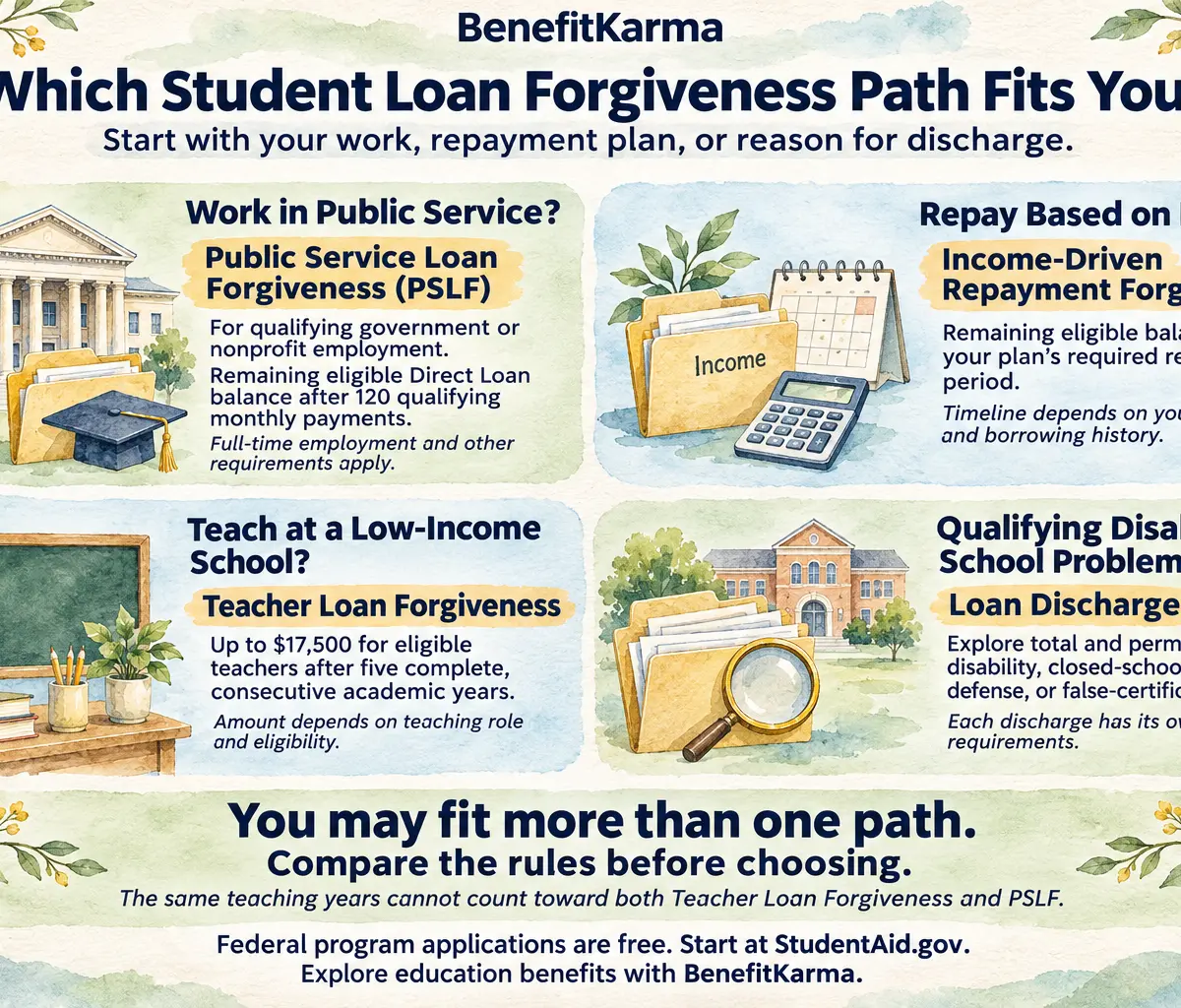
How it works: You work full time for a qualifying employer and make 120 qualifying monthly payments (10 years' worth) on an eligible repayment plan. Once you hit 120, your remaining federal Direct Loan balance is forgiven, and that forgiveness is not taxed by the federal government.
Who qualifies as an employer: Federal, state, local and tribal government agencies, including public schools and the military, plus 501(c)(3) nonprofits. You can look up an employer with the PSLF Help Tool at StudentAid.gov.
Which plans count: Payments under IBR, the new RAP plan and the 10-year Standard plan all count. (The Standard plan pays off your loan in 10 years, so there's usually little left to forgive.)
The employer rule that didn't happen
In October 2025, the Education Department finalized a rule that would have let the Secretary of Education disqualify employers found to have a "substantial illegal purpose," a category that covered activities such as aiding immigration-law violations and certain gender-related care for minors. More than 20 states, along with cities and nonprofits, sued.
On June 30, 2026, a day before the rule was set to take effect, federal judges in Massachusetts and Washington, D.C., struck it down. The department filed appeals in August, then dropped both appeals on Oct. 21, 2026. That means the rule is dead and the existing employer standards stay in place.
Problems PSLF borrowers are still facing
PSLF itself is intact, but processing has been rocky:
- Payment count reductions. In late summer 2026, some borrowers received notices that their qualifying payment counts had been lowered. The department has said it is correcting data problems in its systems. If this happened to you, keep records (screenshots of your payment tracker and copies of any notices).
- Buyback delays. PSLF Buyback lets you pay for past months spent in certain deferments or forbearances, such as the SAVE forbearance, so they count toward your 120. The Education Department reported a backlog of about 82,000 buyback requests as of October 2026, and many have waited close to a year. Months spent on RAP or the Tiered Standard Plan aren't eligible for buyback.
Tip: Before you wait on a buyback request, count how many qualifying payments you already have. Every regular payment you make shrinks the gap, and some borrowers reach 120 before their buyback is ever processed.
Income-driven repayment (IDR) forgiveness
Income-driven plans base your monthly bill on your income. After you've made payments for the full term of the plan, any remaining balance is forgiven.
| Plan | Time to forgiveness | Status |
|---|---|---|
| IBR (borrowed on or after July 1, 2014, with no earlier balance) | 20 years | Open for loans made before July 1, 2026 |
| IBR (older borrowers) | 25 years | Open for loans made before July 1, 2026 |
| PAYE | 20 years | Closed to new enrollees; ends by July 1, 2028 |
| ICR | 25 years | Closed to new enrollees; ends by July 1, 2028 |
| RAP (new) | 30 years | Open since July 1, 2026; the only IDR plan for new loans |
Is IDR forgiveness actually happening? Yes. After pauses in 2025 and early 2026, the Education Department agreed in a court settlement to keep processing forgiveness under IBR, ICR and PAYE. ICR and PAYE discharges restarted in March 2026, when about 21,200 borrowers had loans forgiven across the three plans. Discharges have continued in batches since.
Free DIY tool
Benefit Eligibility Screener
What benefits might I qualify for? Answer a few questions and see VA, disability, food, housing, and health programs that may fit you.
Try the free toolHow the new Repayment Assistance Plan works
RAP is now the main income-driven option. Key features:
- Payments range from 1% to 10% of your adjusted gross income, depending on how much you earn, with a $10 minimum monthly payment.
- Your payment drops by $50 a month for each dependent you claim.
- If your payment doesn't cover the month's interest, the unpaid interest is waived, so your balance won't grow as long as you pay on time.
- The government chips in up to $50 a month toward principal if your payment is small, so your balance goes down over time.
- Forgiveness comes after 360 qualifying payments, or 30 years.
- RAP payments count toward PSLF.
Should you switch to RAP? If you're on IBR and already close to your 20- or 25-year mark, switching could add years to your timeline, and the law doesn't guarantee you can switch back. If you're pursuing PSLF, the forgiveness clock is 10 years no matter which eligible plan you use, so the choice mostly comes down to which plan gives you the lowest payment. Use the Loan Simulator at StudentAid.gov to compare.
Teacher Loan Forgiveness
Teachers who work full time for five complete and consecutive academic years at a qualifying low-income school or educational service agency can get up to $17,500 forgiven on their Direct or FFEL Stafford loans.
- Up to $17,500: highly qualified secondary math and science teachers and special education teachers.
- Up to $5,000: other highly qualified teachers.
That amount is a lifetime cap. You also can't count the same years of teaching toward both Teacher Loan Forgiveness and PSLF, so if you're on track for PSLF, it may make more sense to put all 10 years toward that instead. You can check whether your school qualifies in the Teacher Cancellation Low Income (TCLI) Directory at StudentAid.gov.
Discharge programs
Discharges cancel your loans because of something outside your control rather than years of payments. These are still open in 2026:
- Total and Permanent Disability (TPD) discharge: For borrowers with a disability that severely limits their ability to work. You can qualify with documentation from the VA, the Social Security Administration or a medical professional, and many eligible borrowers are identified automatically through data matching.
- Closed school discharge: If your school closed while you were enrolled or shortly after you withdrew.
- Borrower defense to repayment: If your school misled you or broke certain laws related to your loans or education.
- False certification discharge: If your school falsely certified your eligibility for a loan, or someone took out a loan in your name through identity theft.
Will you owe taxes on forgiven loans?
It depends on the program:
- PSLF: Not taxed federally.
- IDR forgiveness (IBR, PAYE, ICR, RAP): The federal tax exemption that covered this forgiveness expired on Dec. 31, 2025. Balances forgiven in 2026 or later can be counted as taxable income. Borrowers who met the requirements for IDR forgiveness before the end of 2025 are protected under a court agreement, even if the actual discharge was processed later.
- State taxes: Rules vary by state, so check with a tax professional.
If you're within a few years of IDR forgiveness, talk to a tax preparer before your balance is forgiven so you can plan for a potential bill, which can run into the thousands of dollars.
What to do now
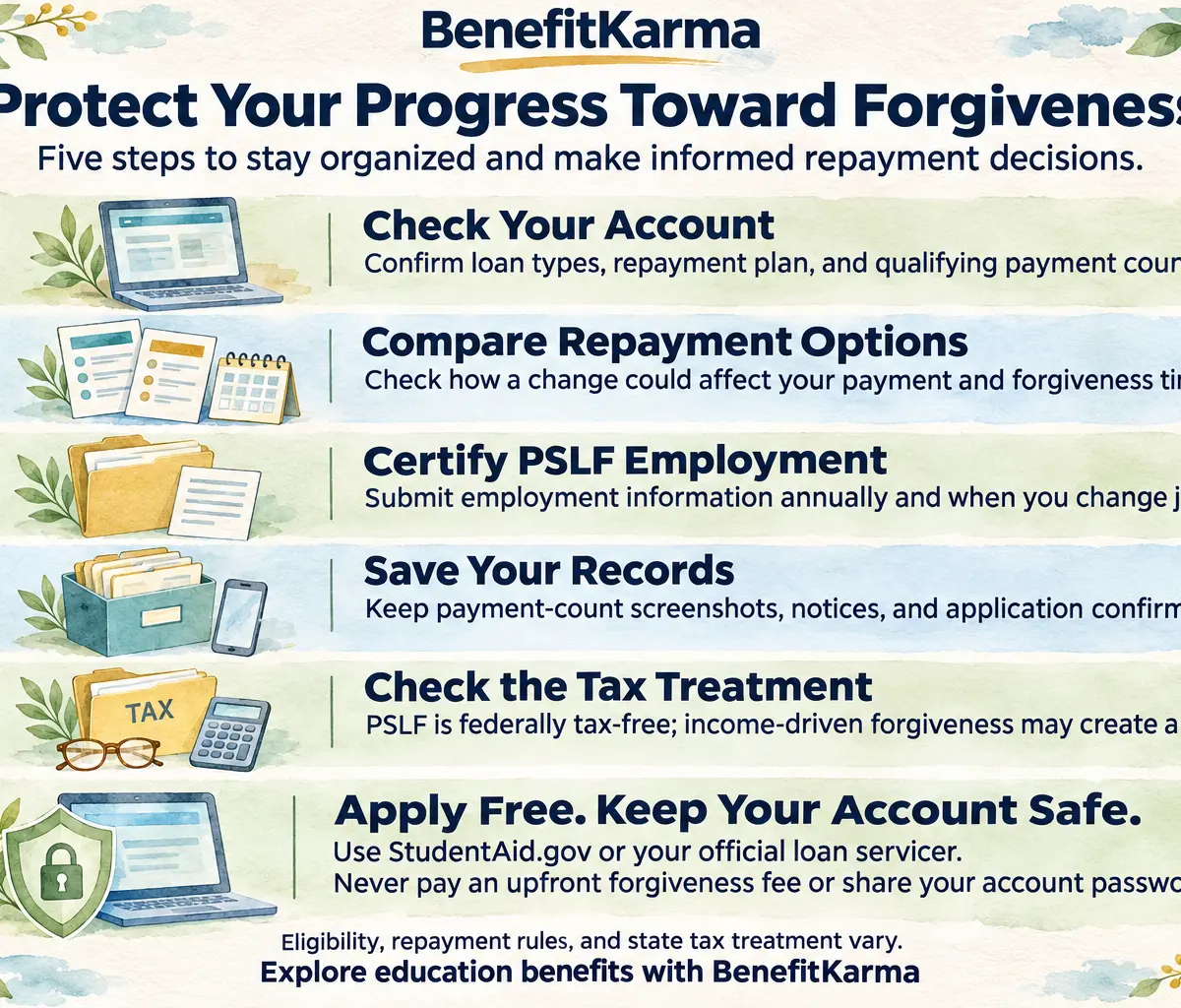
- Log in to StudentAid.gov. Confirm which loans you have, which plan you're on and your current payment count toward PSLF or IDR forgiveness.
- If you were on SAVE, make sure you're on a new plan. Compare IBR and RAP with the Loan Simulator.
- Certify your employment for PSLF every year (or whenever you change jobs) using the PSLF Help Tool. It keeps your count up to date and helps you catch errors early.
- Save your records. Screenshot your payment count regularly and keep copies of any notices from your servicer or the Education Department.
- Plan for taxes if you're getting close to IDR forgiveness.
- Check for discharge options if your school closed, misled you or if you have a qualifying disability.
Watch out for forgiveness scams
Big policy changes bring a wave of scams. Remember:
- Real federal forgiveness programs are free. Never pay an upfront fee to get your loans forgiven.
- Apply only through StudentAid.gov or your official loan servicer.
- Never share your StudentAid.gov username or password with a third party.
- Be suspicious of anyone promising "instant" or guaranteed forgiveness.
The bottom line
Student loan forgiveness hasn't disappeared, but it's no longer one-size-fits-all. PSLF remains the fastest and only tax-free route for public servants, and a recent court win kept its employer rules intact. For everyone else, income-driven forgiveness still exists but may take longer under the new RAP plan and could come with a tax bill. The best thing you can do is know exactly where you stand: check your account, keep your records and choose the plan that fits your goals.
This article is for informational purposes only and isn't legal, tax or financial advice. Student loan rules are changing frequently, so confirm details at StudentAid.gov.
Not sure what you qualify for?
A quick conversation can help you understand your options.
Optional — no obligation, fees may apply
Want help figuring out your next step?
Optional — fees may apply depending on your situation.
Some people choose to talk to a professional before taking their next step.
This might sound familiar:
You're not sure what to do next
You want someone to walk through your options
The process feels overwhelming
If that sounds like you, this might be worth a quick look.
Takes less than a minute
We only share your info with a service provider if you say yes.
Recommended Tools
Take action with our free tools
Get More from BenefitKarma
Create a free account to unlock all features
- Access premium benefit tools
- Personalized benefit matching
- Your personalized dashboard
Common questions about this guide
Get the latest benefit updates, straight to your inbox
Plain-English updates on SNAP, Medicaid, VA and Social Security — one email a week.
Get more from BenefitKarma
Free tools, personalized dashboard & more
