IRS Raises Earned Income Tax Credit to $8,231 for 2026: Who Can Qualify

Free DIY tool
Benefit Eligibility Screener
What benefits might I qualify for? Answer a few questions and see VA, disability, food, housing, and health programs that may fit you.
Try the free toolThe IRS has raised the maximum Earned Income Tax Credit for the 2026 tax year, giving eligible low- and moderate-income workers a slightly larger potential tax break.
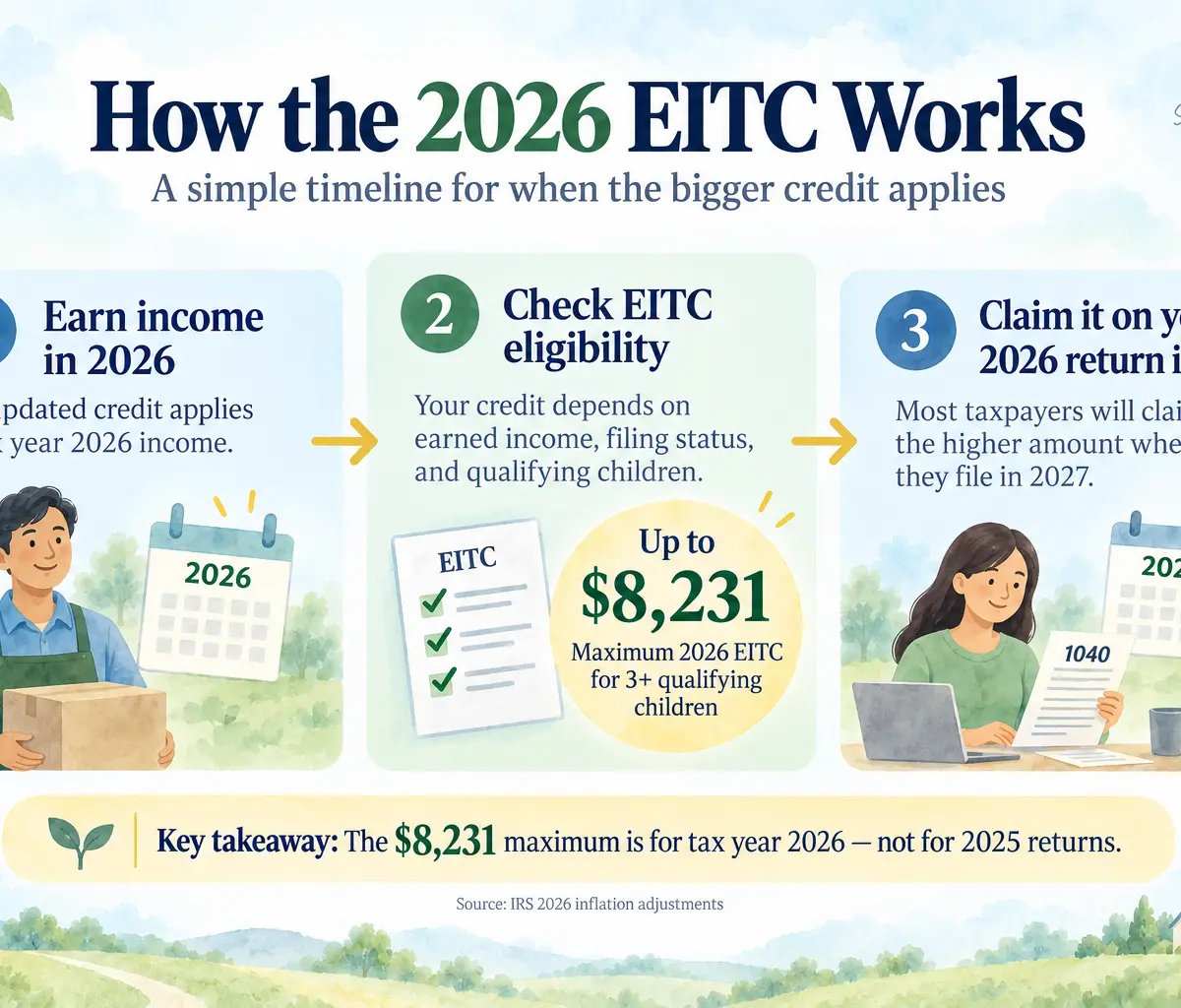
For taxpayers with three or more qualifying children, the maximum EITC will rise to $8,231 for 2026, up from $8,046 for 2025 — an increase of $185. The IRS also increased the maximum credit for households with fewer or no qualifying children as part of its annual inflation adjustments.
There is one timing detail worth emphasizing: the new $8,231 maximum applies to income earned during tax year 2026. Most taxpayers will claim it when they file their 2026 federal income tax return in 2027. People filing 2025 returns during the 2026 filing season are still subject to the 2025 EITC limits.
What is the Earned Income Tax Credit?
The Earned Income Tax Credit, or EITC, is a federal refundable tax credit designed primarily for workers with low to moderate incomes. Unlike a tax deduction, which reduces taxable income, a credit reduces the amount of tax owed.
Because the EITC is refundable, qualifying taxpayers may receive money back even if the credit reduces their federal income tax liability to zero.
The credit is significant. IRS data show that roughly 24 million workers and families received about $70 billion in EITC for tax year 2024.
How much is the EITC worth in 2026?
The maximum credit depends on the number of qualifying children.
| Qualifying children | Maximum 2026 EITC | Income limit: other eligible filing statuses | Income limit: married filing jointly |
|---|---|---|---|
| 0 | $664 | $19,540 | $26,820 |
| 1 | $4,427 | $51,593 | $58,863 |
| 2 | $7,316 | $58,629 | $65,899 |
| 3 or more | $8,231 | $62,974 | $70,244 |
These income limits are the points at which the credit is fully phased out. The IRS uses adjusted gross income — or earned income if it is higher — when applying the phaseout rules.
That means earning less than the listed limit does not automatically qualify someone for the maximum credit. The EITC first increases as earned income rises, reaches a maximum range, and then gradually phases out as income increases further.
For 2026, for example, the maximum-credit earned-income amount is $18,290 for taxpayers with two or three or more qualifying children, $13,020 for those with one qualifying child, and $8,680 for those with no qualifying children.
Who can qualify?
Income is only one part of EITC eligibility. Under IRS rules, taxpayers generally must have earned income from employment or self-employment, have a valid Social Security number by the tax-return due date, meet citizenship or residency requirements, and stay below the annual investment-income limit.
For tax year 2026, the investment-income ceiling rises to $12,200. A taxpayer whose applicable investment income exceeds that amount cannot claim the federal EITC.
Free DIY tool
Benefit Eligibility Screener
What benefits might I qualify for? Answer a few questions and see VA, disability, food, housing, and health programs that may fit you.
Try the free toolFamilies claiming children must also satisfy the EITC's qualifying-child rules, including relationship, age, residency and other requirements. Taxpayers without a qualifying child can still receive the credit, but additional eligibility rules apply.
How does 2026 compare with 2025?
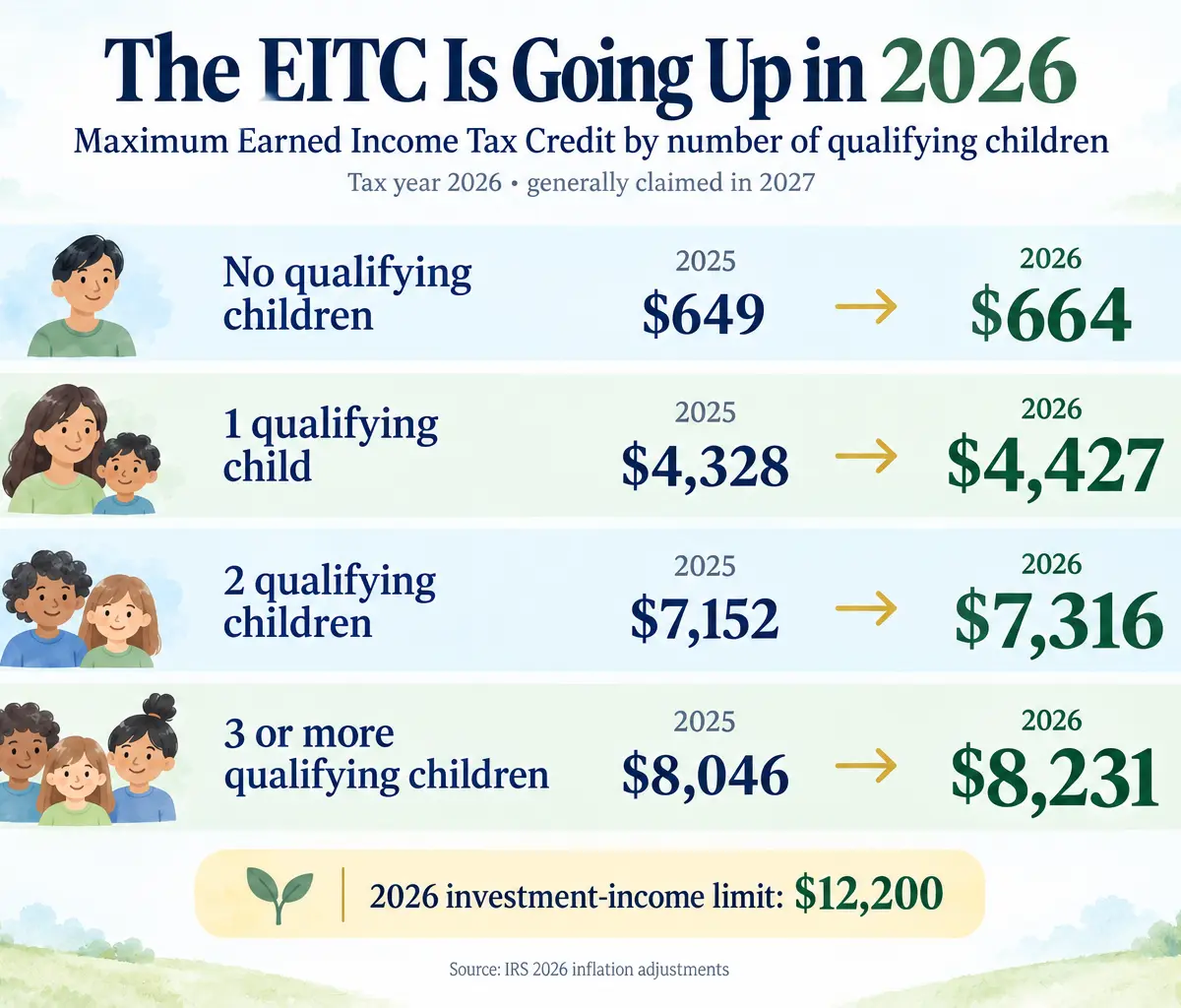
These are inflation adjustments rather than a new standalone tax benefit. The EITC itself is not new, and the increase does not mean every eligible household will receive an extra $185. The exact credit depends on earned income, adjusted gross income, filing status and family size.
Why this matters
The EITC is one of the largest refundable credits available to working households, but many eligible people still miss it.
The IRS estimates that about one in five taxpayers who qualify for the EITC do not claim it.
That can happen for several reasons. Some workers earn too little to otherwise be required to file a federal income tax return. Others may not realize that they can qualify without children, or may assume a change in income or family circumstances makes them ineligible.
Because the EITC can produce a refund, filing a return may be worthwhile even for an eligible worker who would not otherwise owe federal income tax.
What to do before filing
For now, the most important step is to know which tax year you're dealing with.
If you're filing a 2025 return, the maximum EITC is still $8,046. The $8,231 figure applies to the 2026 tax year and will generally matter when the 2027 filing season arrives.
Keep records of your earned income, make sure Social Security information for you and any qualifying children is accurate, and review the IRS EITC eligibility rules before filing. The IRS also offers an online EITC Assistant that can help taxpayers determine whether they qualify and estimate the credit.
The BenefitKarma takeaway
The headline number is bigger in 2026, but the most important takeaway isn't simply that the EITC “went up.”
Income limits rose too, meaning some workers and families who are close to the edge of eligibility may remain within the program as wages increase.
And because the EITC is refundable, checking eligibility can be especially important for workers who assume there's no reason to file because they owe little or no federal income tax.
Not sure what you qualify for?
A quick conversation can help you understand your options.
Optional — no obligation, fees may apply
Want help figuring out your next step?
Optional — fees may apply depending on your situation.
Some people choose to talk to a professional before taking their next step.
This might sound familiar:
You're not sure what to do next
You want someone to walk through your options
The process feels overwhelming
If that sounds like you, this might be worth a quick look.
Takes less than a minute
We only share your info with a service provider if you say yes.
Recommended Tools
Take action with our free tools
Get More from BenefitKarma
Create a free account to unlock all features
- Access premium benefit tools
- Personalized benefit matching
- Your personalized dashboard
Common questions about this guide
Get more from BenefitKarma
Free tools, personalized dashboard & more
