PSLF Borrowers Are Reaching 120 Payments — But Some Still Can’t Get Their Loans Forgiven
Free DIY tool
Benefit Eligibility Screener
What benefits might I qualify for? Answer a few questions and see VA, disability, food, housing, and health programs that may fit you.
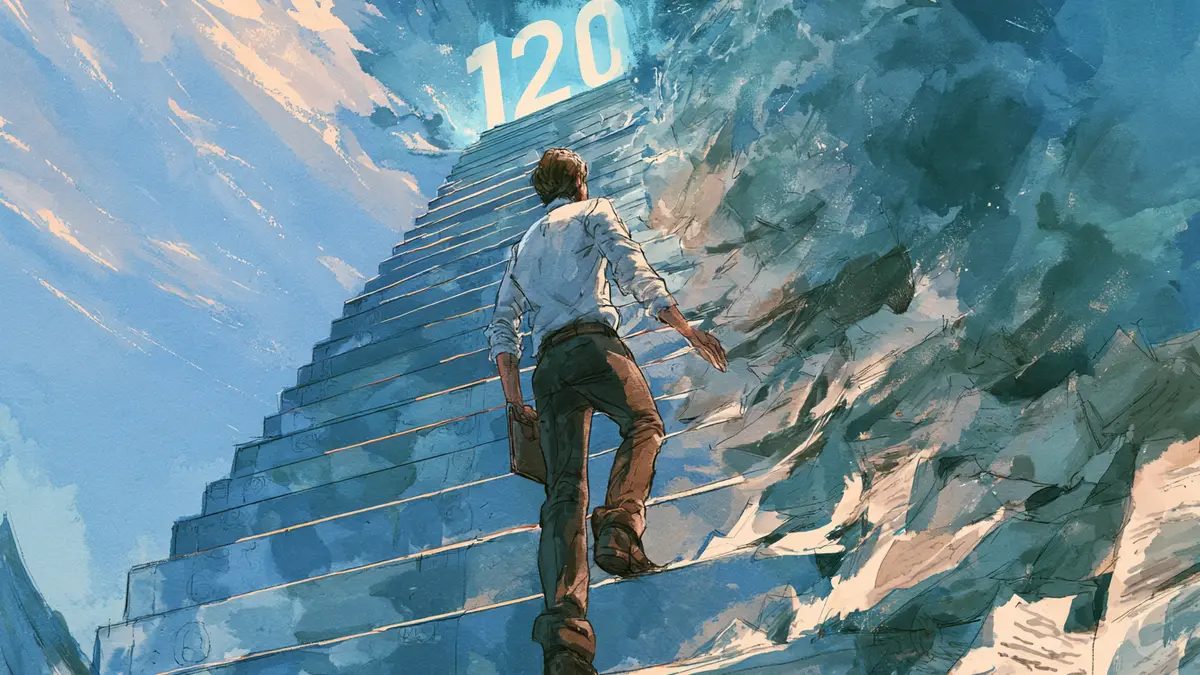
Try the free toolFor federal student loan borrowers pursuing Public Service Loan Forgiveness, reaching 120 qualifying payments is supposed to be the finish line.
For some borrowers this summer, however, the finish line has moved into administrative limbo.
Borrowers have reported making payments in July, August and September that either appeared late or did not appear at all in the Public Service Loan Forgiveness tracker on StudentAid.gov. That can be especially consequential for someone whose missing payment would bring their official total to 120 — the number required for PSLF forgiveness.
Business Insider reported Sept. 19 that some borrowers who had already made what should have been their 120th payment were still waiting for their Federal Student Aid payment counters to reflect it. The Education Department did not provide the publication with a timeline for resolving the delays, but said it remained committed to making sure every qualifying payment is correctly credited.
And the problem does not appear to have disappeared completely. As recently as Sept. 28, borrowers posting in the PSLF community on Reddit were still reporting accounts that showed no qualifying payments after June even though they had continued making payments. Other borrowers, however, have reported their missing payments eventually appearing, suggesting that the delays are not affecting every account in the same way.
For borrowers approaching forgiveness, that inconsistency matters.
How PSLF is supposed to work
Public Service Loan Forgiveness allows eligible borrowers with Direct Loans to have their remaining federal student loan balance forgiven after making the equivalent of 120 qualifying monthly payments while working full-time for an eligible government or nonprofit employer.
Borrowers periodically submit a PSLF form certifying their employment. Federal Student Aid then uses those certifications to update the number of qualifying payments displayed in the borrower’s StudentAid.gov account.
Once the borrower has reached 120 qualifying payments and submitted the necessary PSLF form, the Education Department conducts a final review. Federal Student Aid currently says that review takes about 60 business days.
But there is an important catch: the department needs its records to show those qualifying payments first.
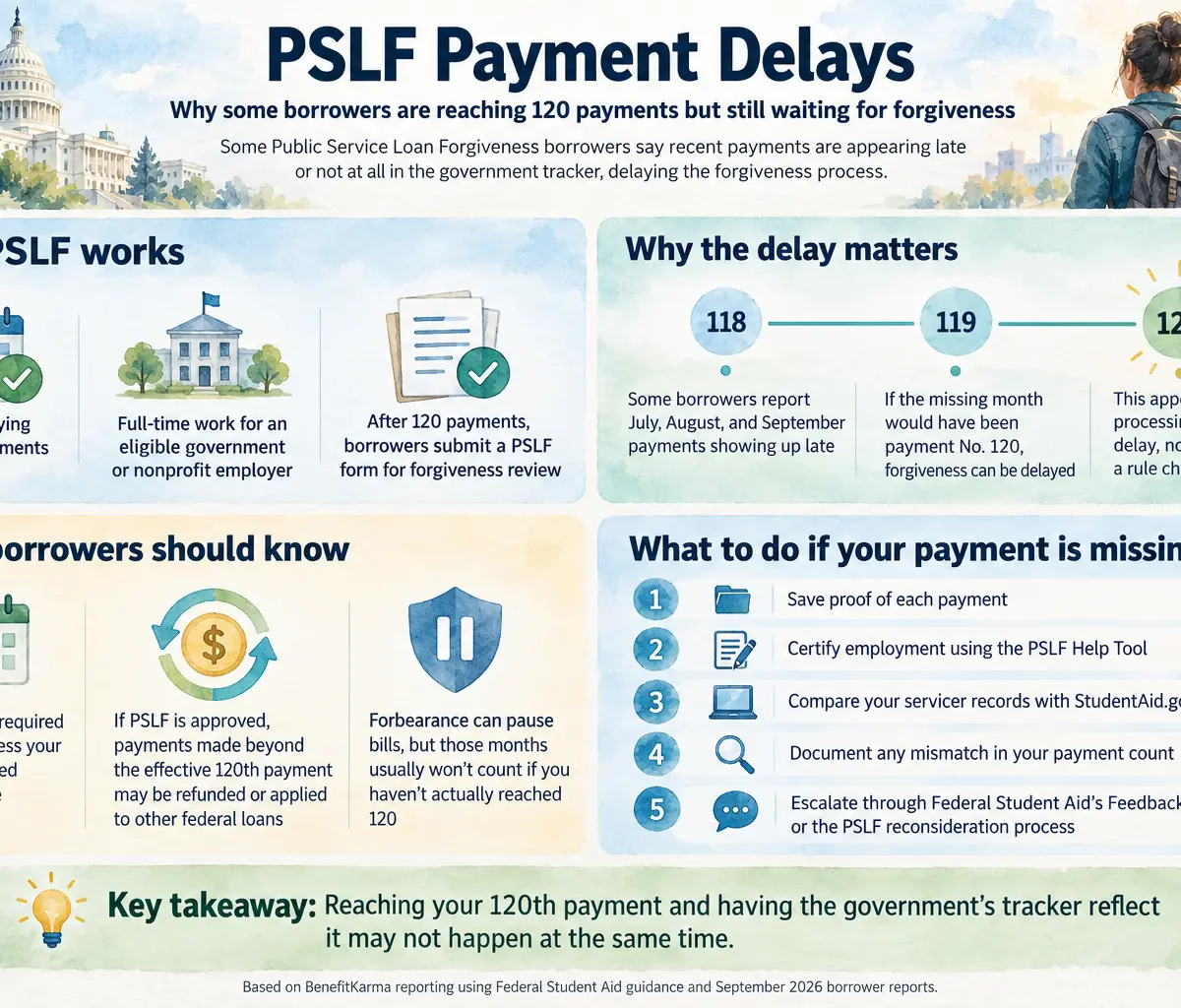
A borrower who knows they made payment No. 120 in August may still see only 118 or 119 qualifying payments in the PSLF tracker if recent payment information has not made its way into the system.
That can delay the forgiveness process before the final review even begins.
Missing payments don't necessarily mean the payment won't count
The current reports appear to involve a reporting or processing delay rather than a new rule eliminating those months from PSLF.
Federal Student Aid itself notes that qualifying-payment information may not update immediately after a PSLF form is processed. Borrowers can view their eligible and qualifying payments through the PSLF section of the My Aid dashboard on StudentAid.gov.
The College Investor, which has also been tracking the issue, reported that many borrowers have seen July and August payments fail to appear promptly in their PSLF counts. Its review characterized that problem as a data-posting delay rather than a policy change affecting whether properly made payments qualify.
That distinction is important.
There has been another, separate PSLF issue this summer in which some borrowers saw older qualifying-payment counts reduced as the Education Department corrected credits it says had previously been awarded incorrectly.
Free DIY tool
Benefit Eligibility Screener
What benefits might I qualify for? Answer a few questions and see VA, disability, food, housing, and health programs that may fit you.
Try the free toolA borrower whose July payment simply hasn't appeared is therefore dealing with a different problem than someone whose account suddenly lost several older months of PSLF credit.
The problem for borrowers who believe they've already reached 120
Federal Student Aid tells borrowers to continue making payments while their PSLF form is being processed unless their loans are placed in forbearance.
If a borrower is ultimately approved for PSLF, payments made beyond the effective 120th qualifying payment are supposed to be refunded or applied to other outstanding federal student loans.
That means one option is simply to keep paying while waiting for the tracker and forgiveness process to catch up.
But that can be a significant burden for someone who expected their student loan bill to disappear months ago.
Borrowers who believe they have already made 120 qualifying payments can also request forbearance while their PSLF application is reviewed. The PSLF application warns, however, that if the borrower turns out not to have reached 120 qualifying payments, those months of forbearance generally will not advance them toward PSLF.
Interest also generally continues to accrue during forbearance.
In other words, borrowers stuck at 118 or 119 payments on the government's tracker can face an uncomfortable choice: continue paying money they may ultimately get back, or seek temporary payment relief while accepting the possibility that the paused months might not count if their understanding of their PSLF status turns out to be wrong.
Your own records may matter more than usual
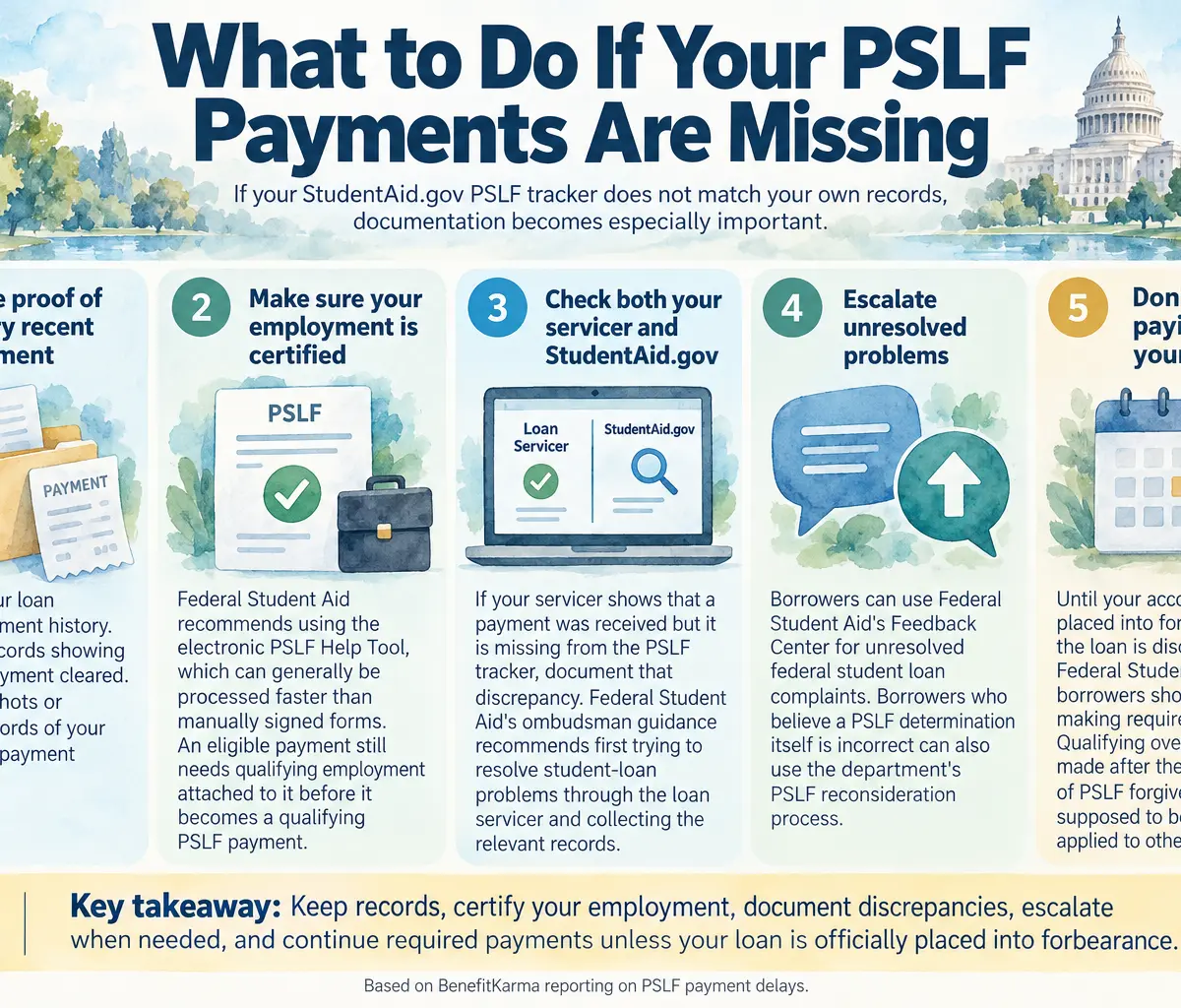
PSLF has always required borrowers to keep track of a decade's worth of employment and loan payments.
The current delays make that recordkeeping even more important.
Your loan servicer may show a payment that StudentAid.gov does not yet display. Your PSLF employment certification may have been processed even though the newest months have not appeared. And the number displayed today may change once additional loan data is processed.
For someone who still has 30 or 40 payments left before PSLF eligibility, a delayed summer payment may eventually become little more than an accounting annoyance.
For someone sitting at 118 or 119 payments, it can determine whether they are still receiving a student loan bill after completing a decade of public service.
The underlying PSLF benefit remains: 120 qualifying payments while meeting the program's other requirements can lead to forgiveness of the remaining eligible Direct Loan balance.
Right now, however, some borrowers are discovering that making the 120th payment and getting the government to recognize the 120th payment are not necessarily happening at the same time.
Not sure what you qualify for?
A quick conversation can help you understand your options.
Optional — no obligation, fees may apply
Want help figuring out your next step?
Optional — fees may apply depending on your situation.
Some people choose to talk to a professional before taking their next step.
This might sound familiar:
You're not sure what to do next
You want someone to walk through your options
The process feels overwhelming
If that sounds like you, this might be worth a quick look.
Takes less than a minute
We only share your info with a service provider if you say yes.
Recommended Tools
Take action with our free tools
Get More from BenefitKarma
Create a free account to unlock all features
- Access premium benefit tools
- Personalized benefit matching
- Your personalized dashboard
Common questions about this guide
Get more from BenefitKarma
Free tools, personalized dashboard & more
