TANF: How to Get and Use Temporary Assistance for Needy Families
Temporary Assistance for Needy Families (TANF) is designed to offer short-term financial support to low-income families. Here's how it works.

Temporary Assistance for Needy Families (TANF) provides short-term help to low-income families with children. Here's how it works.
Free DIY tool
Benefit Eligibility Screener
What benefits might I qualify for? Answer a few questions and see VA, disability, food, housing, and health programs that may fit you.
Try the free toolTANF is a key program that provides temporary cash assistance to families with children in the U.S. When you face a hard time, like losing a job or dealing with a medical emergency, TANF can help cover basic needs while you get back on your feet. Each state runs its own TANF program, so the rules and amounts depend on where you live.
Knowing how TANF works, who qualifies, and how to apply can help you get the support you need. This guide breaks down the basics to help you work toward a more stable future.
To learn more about all the benefits available to you and your family, sign up now for BenefitKarma!
What is TANF?
Temporary Assistance for Needy Families (TANF) is a federal program that helps families with children who are going through hard financial times. It was created in 1996 to replace an older program called Aid to Families with Dependent Children (AFDC).
The federal government gives each state a set amount of money each year, called a block grant. Each state then decides who qualifies, how much families get, and what services to offer. States often give their programs their own names, like CalWORKs in California or Family Investment Program in Iowa.
TANF aims to help families meet basic needs and become self-sufficient through work. TANF offers monthly cash help, plus job training and other services.
Good to know: Congress hasn't fully renewed TANF since 2005. Instead, it keeps the program running with short-term extensions. So far, this hasn't stopped families from receiving payments.
What can TANF benefits be used for?
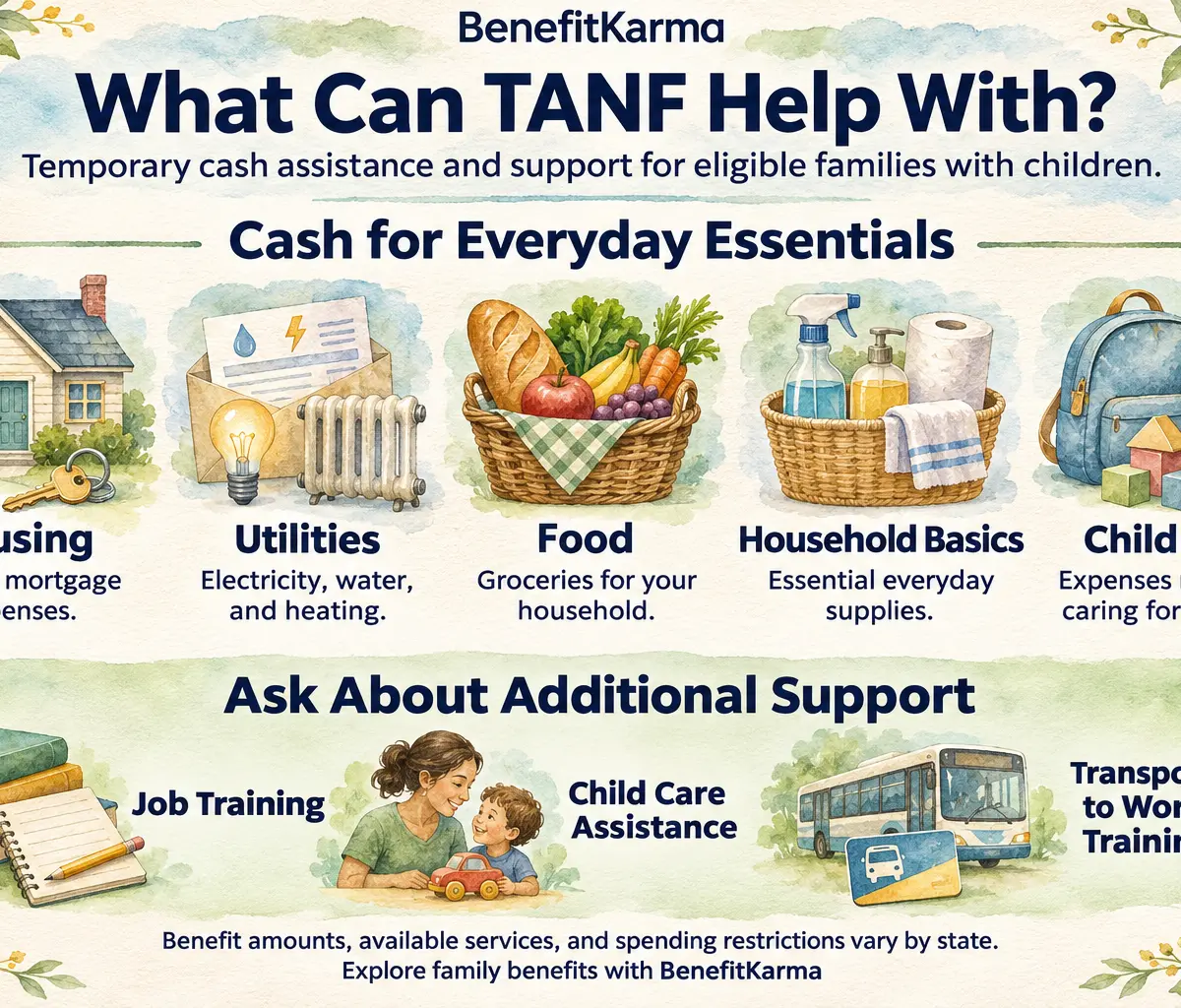
TANF cash is meant to help cover essential living expenses. Families commonly use it for:
- Housing assistance (rent or mortgage payments)
- Utilities (e.g., electricity, water, heating)
- Groceries and food
- Basic household items
- Childcare expenses
Note: Federal law bars using TANF cash cards (EBT) at liquor stores, casinos, and adult entertainment businesses, and some states add their own rules. You generally don’t have to turn in receipts showing how you spent your TANF cash.
Who is eligible for TANF?
Eligibility for TANF depends on several key factors:
- Children in the Home: You must have a child under 18 living with you (or up to 19 if they're still in high school). In many states, pregnant women can also qualify. Grandparents and other relatives raising a child may be able to get help for the child only.
- Low Income: Income limits vary a lot by state, and most are well below the federal poverty line. In many states, a family of three must earn less than about $1,000 a month, and in some states the limit is much lower.
- Limited Savings: Many states limit savings and other resources, often to somewhere between $1,000 and $10,000. Some states have no limit at all. Your home usually doesn't count.
- Citizenship or immigration status: You must be a U.S. citizen or a qualified immigrant. Most green card holders have to wait five years before they can get TANF, though some states use their own money to help sooner. Learn more about government benefits for immigrants.
- State residency: You must apply in the state where you live, following that state's specific rules.
Work Requirements
Most adults getting TANF must work or take part in work activities, like job searching, job training, or community service. Single parents usually need about 30 hours a week, or 20 hours if their youngest child is under 6. States may excuse some people, like those caring for a baby or a family member with a disability. If you don't meet the work rules without a good reason, your cash can be cut or stopped.
Most states also require you to help the state collect child support from the other parent, if there is one.
How do you complete the Temporary Assistance for Needy Families application?
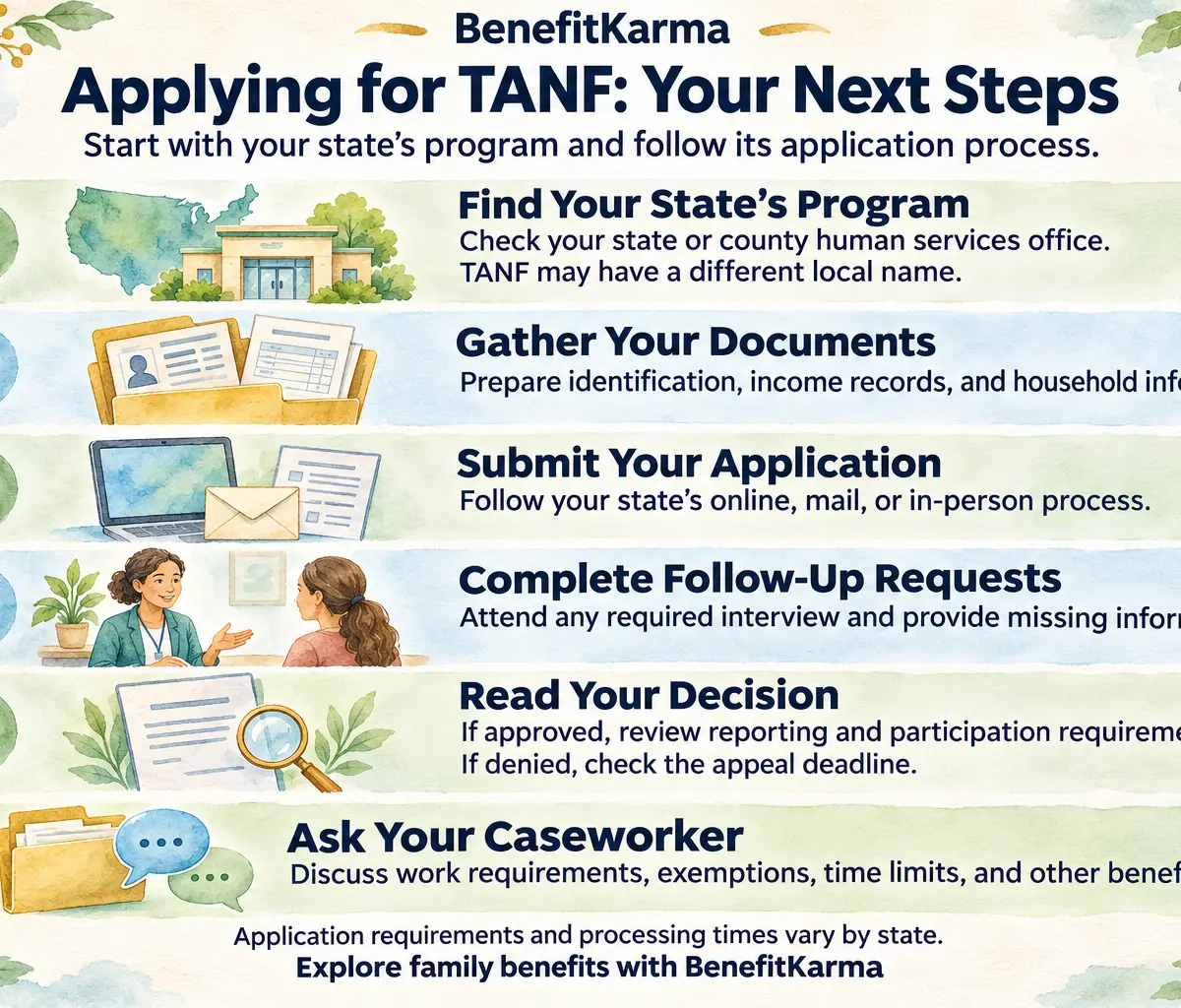
Applying for TANF involves a few key steps to ensure you meet the eligibility requirements:
- Contact your local TANF office or visit their website: Get details on the application process specific to your state.
- Gather necessary documents: Be prepared with proof of income, identification, and household details.
- Submit your application: This can typically be done online, by mail, or in person, depending on your state’s process.
- Attend an interview: Some states may require an interview to assess your eligibility.
- Consult a caseworker: You typically get assigned a TANF caseworker after your application is submitted. Once your application is processed and reviewed, the caseworker will help you with the next steps, including providing additional information, addressing any issues, and managing your benefits.
- Wait for approval: After your application is reviewed, you'll get a decision, and if approved, benefits will follow your state’s guidelines. Approval typically takes a few days to a few weeks, depending on your state and how fast you submit the required documents.
How much financial assistance can you get?
The amount of TANF you can get depends on where you live and how many people are in your family. Each state sets its own maximum benefit, and the differences are big. For a family of three:
Free DIY tool
Benefit Eligibility Screener
What benefits might I qualify for? Answer a few questions and see VA, disability, food, housing, and health programs that may fit you.
Try the free tool- Lowest: Arkansas pays a maximum of $204 per month.
- Highest: Minnesota pays up to $1,430 per month.
- Typical: The median maximum benefit across states is about $583 per month.
These are maximum amounts. If your family has other income, your monthly payment will usually be lower. Check your state’s TANF guidelines to see how much you might qualify for.
How long can you receive TANF benefits?
TANF is meant to be short-term. Federal law limits most adults to 60 months (5 years) of TANF cash over their lifetime. These months don't have to be in a row.
Some states set shorter limits. For example, Arizona and Arkansas limit TANF to 12 months, and several others use limits of 24 to 48 months. A few states use their own money to keep helping some families after 60 months.
There are some exceptions:
- Hardship Exemptions: States can extend help for some families facing hardship, like domestic violence or a disability.
- Child-Only Cases: When only the child gets TANF (for example, a child living with a grandparent), the time limit usually doesn't apply.
If you're nearing your limit, ask your caseworker about extensions, job training, and other programs, like SNAP, Medicaid, or SSI if someone in your family has a disability.
What does TANF provide beyond financial assistance?
TANF provides more than just financial support; it also offers a range of services to help families achieve independence:
- Job training: Programs to build skills and improve employability. You may also qualify for free training through WIOA.
- Childcare assistance: Help with paying for childcare to enable parents to work or attend training.
- Transportation support: Assistance with transportation costs to access work or training.
These services are designed to address immediate needs while equipping families with tools for long-term success.
Can you receive TANF and other benefits at the same time?
Yes, you can receive TANF alongside other benefits, but it might affect how much you get from those programs. Here’s how TANF interacts with some common benefits:
- SNAP (food stamps): TANF income may lower the amount of SNAP benefits you receive.
- Medicaid: TANF benefits typically do not affect your Medicaid eligibility.
- Housing assistance: TANF may reduce the amount of housing aid you qualify for.
- Utility assistance: TANF might impact the level of support you get for utility bills.
- Tax Refunds: Federal tax refunds, like the Earned Income Tax Credit, usually don't count against TANF for 12 months after you get them.
Understanding these interactions helps ensure you maximize the support available to you.
What if your TANF application is denied?
If your TANF application is denied, don’t worry — you can appeal the decision. First, look over the denial notice to see why you were denied. Then, you can file an appeal by providing more documentation or fixing any errors in your application.
Make sure to act quickly, as there are often strict deadlines for appeals. You might also want to consult with a legal expert who specializes in public assistance to help guide you through the process.
How should you report changes to your TANF case?
If there are significant changes in your life, like getting a new job or changes in your household size, you need to report them to your assigned TANF caseworker right away. Keeping your information up-to-date helps ensure that your benefits are accurate and prevents any issues.
- New job: Changes in employment status or income.
- Household size: Additions or removals of household members.
- Income changes: Variations in wages, benefits, or other sources of income.
- Living situation: Moves to a new address or changes in housing arrangements.
- Health changes: Significant health issues that affect your ability to work or care for dependents.
Not sure what you qualify for?
TANF can be a big help during hard times, but every state's program is different. Here are a few tips:
- Contact your state or county human services office to learn your state's rules and how to apply.
- Call 211 to find local help with food, housing, and bills in your area.
- Ask about other programs too, like SNAP, Medicaid, WIC, and child care help.
To learn more about all the benefits available to you and your family, sign up now for BenefitKarma!
Not sure what you qualify for?
A quick conversation can help you understand your options.
Optional — no obligation, fees may apply
Want help figuring out your next step?
Optional — fees may apply depending on your situation.
Some people choose to talk to a professional before taking their next step.
This might sound familiar:
You're not sure what to do next
You want someone to walk through your options
The process feels overwhelming
If that sounds like you, this might be worth a quick look.
Takes less than a minute
We only share your info with a service provider if you say yes.
Recommended Tools
Take action with our free tools
Get More from BenefitKarma
Create a free account to unlock all features
- Access premium benefit tools
- Personalized benefit matching
- Your personalized dashboard
Common questions about this guide
Get the latest benefit updates, straight to your inbox
Plain-English updates on SNAP, Medicaid, VA and Social Security — one email a week.
Get more from BenefitKarma
Free tools, personalized dashboard & more
