Millions Qualify for Federal Rental Assistance. Most Never Receive It.

Free DIY tool
Benefit Eligibility Screener
What benefits might I qualify for? Answer a few questions and see VA, disability, food, housing, and health programs that may fit you.
Try the free toolFor millions of Americans struggling to afford rent, qualifying for federal housing assistance is only the first hurdle.
A newly updated Congressional Research Service report shows just how difficult actually receiving that help can be: only about one in four potentially eligible households receives federal rental assistance.
That leaves roughly three out of four without federal rental aid — even though many meet the income standards that could make them eligible.
The finding, highlighted in an Aug. 17 report from Legis1, reflects a longstanding problem with programs such as Section 8 Housing Choice Vouchers: unlike many other federal benefits, rental assistance generally isn't guaranteed to everyone who qualifies. Funding limits mean local housing agencies frequently have long waiting lists — and some stop accepting applications altogether.
For renters already spending a large share of their income on housing, that can mean waiting months or years for help.
At BenefitKarma, we want to make benefits easier to understand and find. Here's what the numbers mean — and what you can do if you need help paying rent.
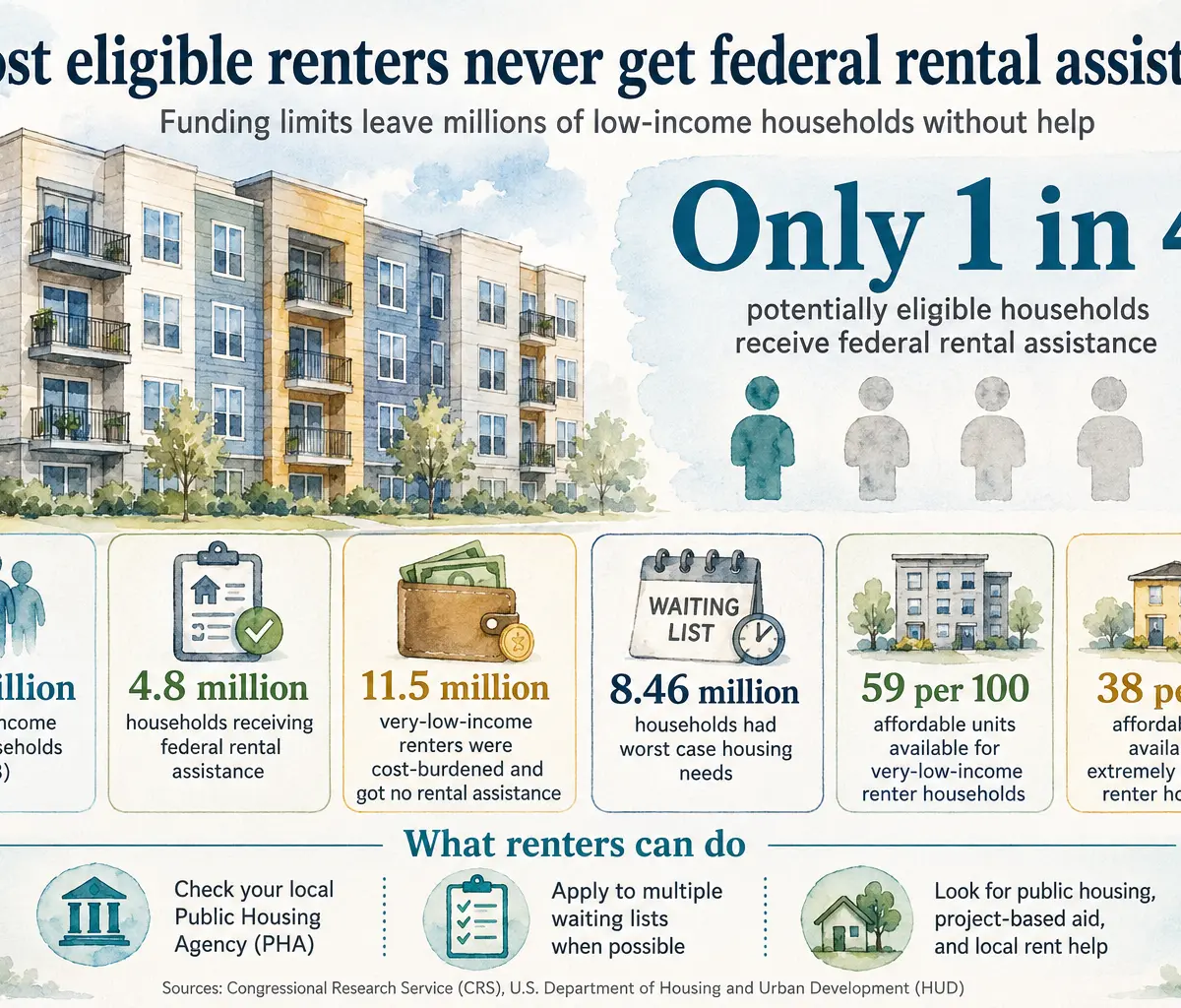
How big is the rental-assistance gap?
In 2023, the U.S. had approximately 19.14 million very-low-income renter households, compared with about 4.8 million households receiving federal rental assistance, according to the CRS figures.
That works out to roughly one assisted household for every four potentially eligible households. CRS cautions that the comparison isn't an exact eligibility calculation because some housing programs serve households at different income levels and not every very-low-income household necessarily meets all program requirements.
Still, it illustrates the enormous gap between need and available assistance.
About half of U.S. renter households are considered cost-burdened, generally meaning they spend more than 30% of their income on housing. In 2023 alone, 11.5 million very-low-income renter households were cost-burdened and weren't receiving rental assistance, according to the federal figures.
The situation is even more serious for renters at the lowest income levels.
HUD's latest Worst Case Housing Needs report found 8.46 million renter households had what the agency calls "worst case housing needs" in 2023. That generally means a very-low-income household receives no government housing assistance and either spends more than half its income on rent, lives in severely inadequate housing, or both.
HUD also found that only 59 affordable rental units were available for every 100 very-low-income renter households. Among extremely-low-income renters, the supply dropped to just 38 units for every 100 households.
Isn't Section 8 supposed to help low-income renters?
It does — but there aren't enough vouchers for everyone who may qualify.
The Housing Choice Voucher Program, commonly called Section 8, is the federal government's largest rental-assistance program and currently helps more than 2.3 million families.
Instead of requiring someone to live in a particular public housing development, a Housing Choice Voucher generally allows a household to rent an eligible home or apartment in the private market. A local Public Housing Agency, or PHA, pays part of the rent directly to the landlord.
The household typically contributes around 30% of its adjusted monthly income toward rent and utilities, although the amount can sometimes be higher depending on the property and program rules.
The problem is capacity.
Federal rental-assistance programs supported about 4.9 million households in 2025, at a federal cost of approximately $68 billion, according to the CRS data. Housing Choice Vouchers alone accounted for about $38.3 billion and 2.3 million households.
Free DIY tool
Benefit Eligibility Screener
What benefits might I qualify for? Answer a few questions and see VA, disability, food, housing, and health programs that may fit you.
Try the free toolThat's substantial, but still far short of the number of lower-income Americans who may need help.
What happens when more people qualify than there are vouchers?
Usually, you wait.
HUD acknowledges that demand is so high that applicants may encounter long waiting lists and may need to apply through more than one Public Housing Agency.
Some housing agencies periodically close their waiting lists when the number of people already waiting becomes too large. When a list reopens, applicants may have only a limited window to submit an application.
And getting onto a waiting list does not mean a voucher is immediately available.
HUD says how quickly an applicant reaches the top can depend on the number of available vouchers, when the person applied and whether the local agency gives preference to certain applicants, such as veterans or people with disabilities.
What should you do if you need rental assistance?
The biggest takeaway from the new numbers is simple: don't assume you're ineligible simply because assistance isn't immediately available.
If you're struggling with rent, start by contacting your local Public Housing Agency. That's generally where you'll apply for a Housing Choice Voucher or public housing. HUD maintains a directory of local agencies and also operates its Public and Indian Housing Customer Service Center at 800-955-2232.
And don't necessarily stop with the agency closest to you.
HUD specifically notes that because of high demand and long waiting lists, applicants may want to apply to multiple PHA waiting lists. You generally don't have to live in a housing authority's jurisdiction when you apply, although moving rules can apply once assistance begins.
It's also worth checking for more than one type of housing assistance. Depending on where you live and your circumstances, options may include:
- Housing Choice Vouchers, or Section 8
- Public housing
- Project-based subsidized apartments
- Housing programs specifically serving veterans
- Housing for older adults or people with disabilities
- State and local rent-assistance programs
Eligibility, openings and waiting-list rules can vary considerably by location.
The bottom line
Federal rental assistance provides significant help to millions of Americans — but it isn't an entitlement program where everyone who qualifies automatically receives benefits.
That's an important distinction.
The latest federal figures suggest roughly 75% of potentially eligible households are not receiving federal rental assistance, even as millions of renters devote an unsustainable share of their income to housing.
So if you believe your income may qualify you for housing assistance, an unavailable voucher today shouldn't necessarily end your search.
Check your local housing authority, look for additional PHA waiting lists nearby and explore other subsidized housing programs available in your area. With demand dramatically exceeding supply, getting onto the right waiting list can be just as important as determining whether you qualify in the first place.
BenefitKarma reporting based in part on an Aug. 17, 2026 report from Legis1 and federal data from the Congressional Research Service and U.S. Department of Housing and Urban Development.
Not sure what you qualify for?
A quick conversation can help you understand your options.
Optional — no obligation, fees may apply
Want help figuring out your next step?
Optional — fees may apply depending on your situation.
Some people choose to talk to a professional before taking their next step.
This might sound familiar:
You're not sure what to do next
You want someone to walk through your options
The process feels overwhelming
If that sounds like you, this might be worth a quick look.
Takes less than a minute
We only share your info with a service provider if you say yes.
Recommended Tools
Take action with our free tools
Get More from BenefitKarma
Create a free account to unlock all features
- Access premium benefit tools
- Personalized benefit matching
- Your personalized dashboard
Common questions about this guide
Get more from BenefitKarma
Free tools, personalized dashboard & more
