Head Start Rule Changes: What Happens Next and What It Could Mean for Your Family

The federal government wants to rewrite the rulebook for Head Start, the free preschool and family-support program for low-income children. If you have a child enrolled, or you're thinking about applying, the proposal could change what paperwork you need, how big your child's class is, what language your child is taught in and how the program handles behavior problems.
Free DIY tool
Benefit Eligibility Screener
What benefits might I qualify for? Answer a few questions and see VA, disability, food, housing, and health programs that may fit you.
Try the free toolNothing has changed yet. The proposal is still a proposal, and the current rules stay in force until a final rule is published and takes effect. Here's what's on the table, who it affects and what you can do now.
What changed?
On Aug. 7, 2026, the Administration for Children and Families (ACF), part of the U.S. Department of Health and Human Services (HHS), published a proposed rule called Reducing Federal Burden for Head Start Programs in the Federal Register.
It would throw out the current Head Start Program Performance Standards, which run more than 100 pages, and replace them with a much shorter set of rules. Many decisions that are now set by the federal government would move to states and to the roughly 1,600 local organizations that run Head Start programs.
The public comment period closed Oct. 6, 2026, and no final rule has been published yet.
HHS says the changes would cut paperwork and costs enough to preserve or add up to 236,000 slots for children by 2031. Critics, including early education groups, two dozen state attorneys general and nearly 200 members of Congress, have asked HHS to withdraw it, arguing it would lower quality and make programs less consistent from place to place.
When could changes take effect?
Not right away, and possibly not for a while. A proposed rule has to clear several steps before it changes anything at your child's program.
HHS has to finish reviewing comments. The proposal drew more than 40,000 public comments, EdSource reports, far more than earlier Head Start proposals. ACF hasn't given a timeline, and some observers expect a final decision between December and April. Advocates say they expect the final version to look much like the proposal.
A final rule would set its own effective date. Programs would likely get time to adjust after that.
Lawsuits could delay it. Critics argue parts of the proposal conflict with the Head Start Act. The American Civil Liberties Union (ACLU) and some state attorneys general have signaled they could sue if the final rule closely follows the proposal. A court could pause a rule while a case is decided.
Congress could step in. Lawmakers can pass a law overturning a rule or barring funds from being used to carry it out. Like any bill, that would need to pass both chambers and be signed by the president or survive a veto.
For families, the practical takeaway is that the rules in place today are the ones that apply when you apply or enroll now.
Who does this affect?
Head Start serves roughly 700,000 children nationwide. It includes:
- Head Start preschool for children ages 3 to 5
- Early Head Start for pregnant women, infants and toddlers up to age 3
- Programs for migrant and seasonal farmworker families and for American Indian and Alaska Native families
Families usually qualify in one of these ways:
- Household income at or below the federal poverty level. For 2026, that's $27,320 a year for a family of three and $33,000 for a family of four in the 48 contiguous states, according to the HHS poverty guidelines. Alaska and Hawaii have higher limits.
- Receiving public assistance, such as Temporary Assistance for Needy Families (TANF) or Supplemental Security Income (SSI)
- Being in foster care or experiencing homelessness
ACF says households receiving SNAP still count as eligible through public assistance under its guidance.
Programs can also fill some seats with families whose income is a bit above the poverty line. Those flexibilities come from the Head Start Act itself, and ACF says they would remain even though the proposal removes them from the regulations.
Children with disabilities are also guaranteed a share of seats. By law, at least 10% of a program's enrollment must go to children eligible for special education services, and the proposal doesn't change that. If your child gets SSI for a disability, Head Start can be a useful place to get early support alongside that benefit.
The biggest changes for families
The proposal touches almost every part of the program. These are the changes most likely to matter to a parent.
More proof needed to enroll
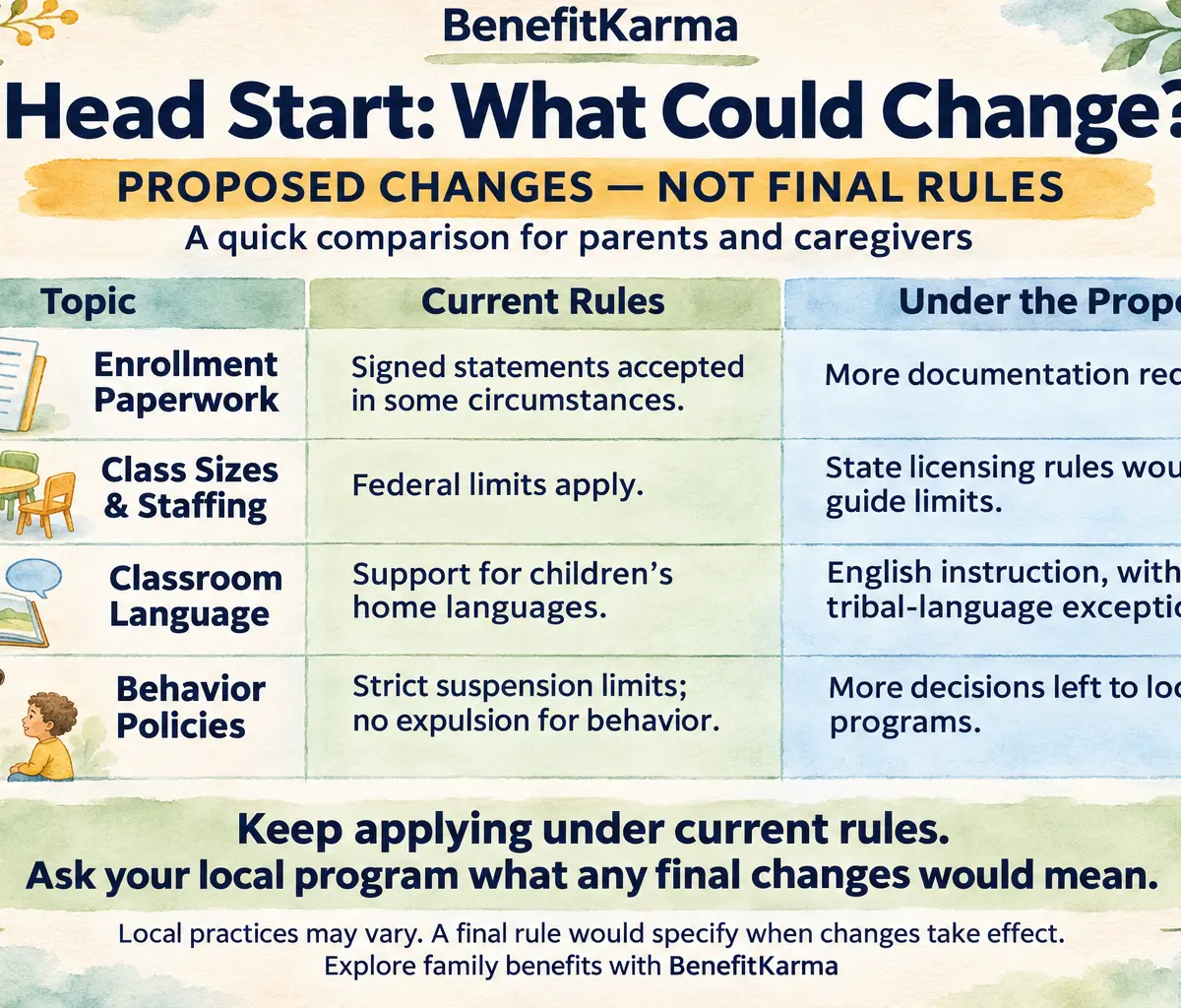
Right now, programs can sometimes accept a parent's signed statement of income or circumstances, called self-attestation, when documents aren't available. The proposal would end that. You'd need actual documentation, such as income records or proof that you receive public assistance.
The same goes for families experiencing homelessness. Under the Head Start Act, those children can still start while the family gathers documents within a reasonable time. But a signed statement alone would no longer establish eligibility.
ACF also proposes removing the option to enroll a child without proof of age when a family can't provide it.
Class sizes and staffing set by your state
Federal limits on class size and on how many children each teacher can supervise would go away. Instead, programs would follow their state's child care licensing rules and post their ratios and group sizes where parents can see them.
Free DIY tool
Benefit Eligibility Screener
What benefits might I qualify for? Answer a few questions and see VA, disability, food, housing, and health programs that may fit you.
Try the free toolACF says the current federal limits are stricter than those in nearly all states, so in many places programs could legally have larger classes or more children per adult. Programs could choose to keep their current ratios.
English-only instruction
All teaching would be done in English. For children who don't speak English, the priority would be learning it. Current rules that support a child's home language would be removed. Tribal programs would be exempt when a Native language is part of the Tribe's heritage.
Some protections in the law itself would remain. For example, programs would still need to reach parents in a language they understand.
Fewer limits on suspension and expulsion
Current rules strictly limit suspending a Head Start child and bar expelling one for behavior. They also require programs to bring in a mental health professional first. The proposal would remove those limits and let each program set its own discipline policy within state licensing rules.
New health and activity requirements
The proposal adds a federal requirement for physical activity: at least 30 minutes for every three and a half hours a child is in the program, outdoors when the weather allows. Meals and snacks would be treated as learning opportunities, and family-style meals are encouraged.
Health, developmental and other screenings are required by the Head Start Act, so they would continue. But programs would get more flexibility on timelines and processes.
Home visits, parent groups and program budgets
- Federal rules on how often and how long home-based visits happen would be removed.
- Parent committees would become optional. Each program's Policy Council, which includes parents, is required by law and would remain.
- The share of a program's budget allowed for administrative costs would drop from 15% to 5%. HHS says this frees money for more children. Critics say it could squeeze staffing and oversight.
What stays the same
Head Start is still free for eligible families. Its funding comes from Congress, which set it at about $12.4 billion for fiscal year 2026, and the proposed rule doesn't cut that funding or close programs.
Many core features are written into the Head Start Act, not the regulations, so they don't depend on this rule. Those include income eligibility, categorical eligibility for foster children and families receiving public assistance, health screenings, parent involvement in governance and civil rights protections.
HHS has also said that nothing in the proposal forces a program to change practices that are working. So even if the rule is finalized, your local program may keep its current class sizes, bilingual approach or discipline policies.
Could I qualify for Head Start?
You may qualify if your child is under age 5 (or you're pregnant, for Early Head Start) and your family meets at least one of these:
- Income at or below the poverty line for your household size
- You receive TANF or SSI, or another qualifying public benefit
- Your child is in foster care
- Your family is experiencing homelessness
Even if your income is somewhat above the line, ask anyway. Programs can enroll a limited number of families above the cutoff, and local programs decide how to rank applicants.
What should I do next?
Apply now if you're interested. The current rules are still in effect, and many programs have waiting lists. Use the Head Start locator on the official Head Start site to find programs near you, or call 1-866-763-6481, Monday through Friday, 8 a.m. to 6 p.m. Eastern. You apply directly with the local program, not online through the federal government.
Gather documents ahead of time. Because the proposal would end self-attestation, it's smart to have paperwork ready either way:
- Your child's birth certificate or other proof of age
- Recent pay stubs, a W-2 or your most recent tax return
- Benefit letters showing you receive TANF, SSI or SNAP
- Foster care placement paperwork, if it applies
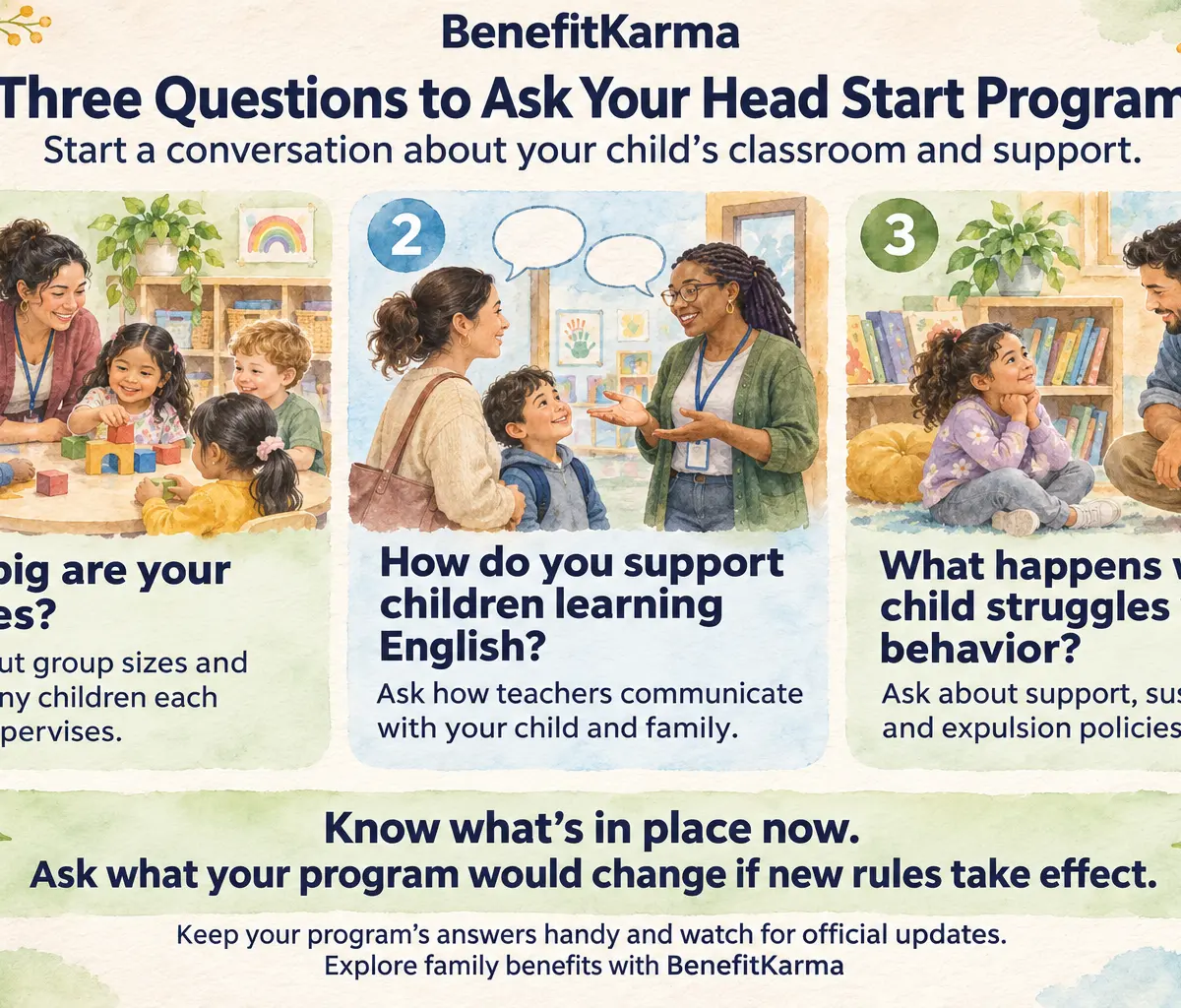
Ask your program three questions. If your child is already enrolled, ask:
- What are your class sizes and teacher-to-child ratios?
- How do you support children who are learning English?
- What is your policy on suspension and expulsion?
The answers tell you what's in place now, and you'll know what to watch for if a final rule passes.
Watch for the final rule. If HHS finalizes the proposal, it will appear in the Federal Register with an effective date. Your program should tell you about any changes that affect your family.
Line up backup options. If you can't get a Head Start seat, other help exists:
- The Child Care and Development Fund (CCDF) helps low-income working families pay for child care through state subsidy programs.
- The Child and Dependent Care Tax Credit can offset some child care costs at tax time.
- WIC provides food and nutrition support for pregnant women and children under 5.
- SNAP helps with groceries for eligible households.
The bottom line
The Trump administration has proposed the biggest rewrite of Head Start's rules in decades. It would hand states and local programs control over class sizes, language, discipline and more, and it would require firmer proof of eligibility. But it isn't final, a decision may not come until next spring, and lawsuits or Congress could slow it further. For now, Head Start is operating under the same rules as before. If your family could use Head Start, apply now, keep your eligibility documents handy and ask your local program how it plans to respond if the rule is finalized.
Not sure what you qualify for?
A quick conversation can help you understand your options.
Optional — no obligation, fees may apply
Want help figuring out your next step?
Optional — fees may apply depending on your situation.
Some people choose to talk to a professional before taking their next step.
This might sound familiar:
You're not sure what to do next
You want someone to walk through your options
The process feels overwhelming
If that sounds like you, this might be worth a quick look.
Takes less than a minute
We only share your info with a service provider if you say yes.
Recommended Tools
Take action with our free tools
Get More from BenefitKarma
Create a free account to unlock all features
- Access premium benefit tools
- Personalized benefit matching
- Your personalized dashboard
Common questions about this guide
Get the latest benefit updates, straight to your inbox
Plain-English updates on SNAP, Medicaid, VA and Social Security — one email a week.
Get more from BenefitKarma
Free tools, personalized dashboard & more
