GI Bill 48-Month Rule: VA Now Counts Continuous Service. Here's What Changed
The VA was told to provide up to 48 months of GI Bill benefits. But some veterans are still being denied, sparking a new lawsuit supported by all 50 states.

If you served long enough to earn both the Montgomery GI Bill and the Post-9/11 GI Bill, you may be entitled to more education benefits than the Department of Veterans Affairs (VA) first told you — up to 48 months instead of 36.
Free DIY tool
VA Disability Pay Calculator
How much could my VA rating pay each month? Enter your ratings and family details to see your combined rating and estimated pay.
Try the free toolFor two years after a 2024 Supreme Court ruling, the VA said that extra time was only for veterans with separate periods of service. Veterans who served one long, unbroken stretch were often turned away. In February 2026, the VA reversed course. Here's what changed, who may qualify, and what to do if you were denied.
The 48-month rule, explained
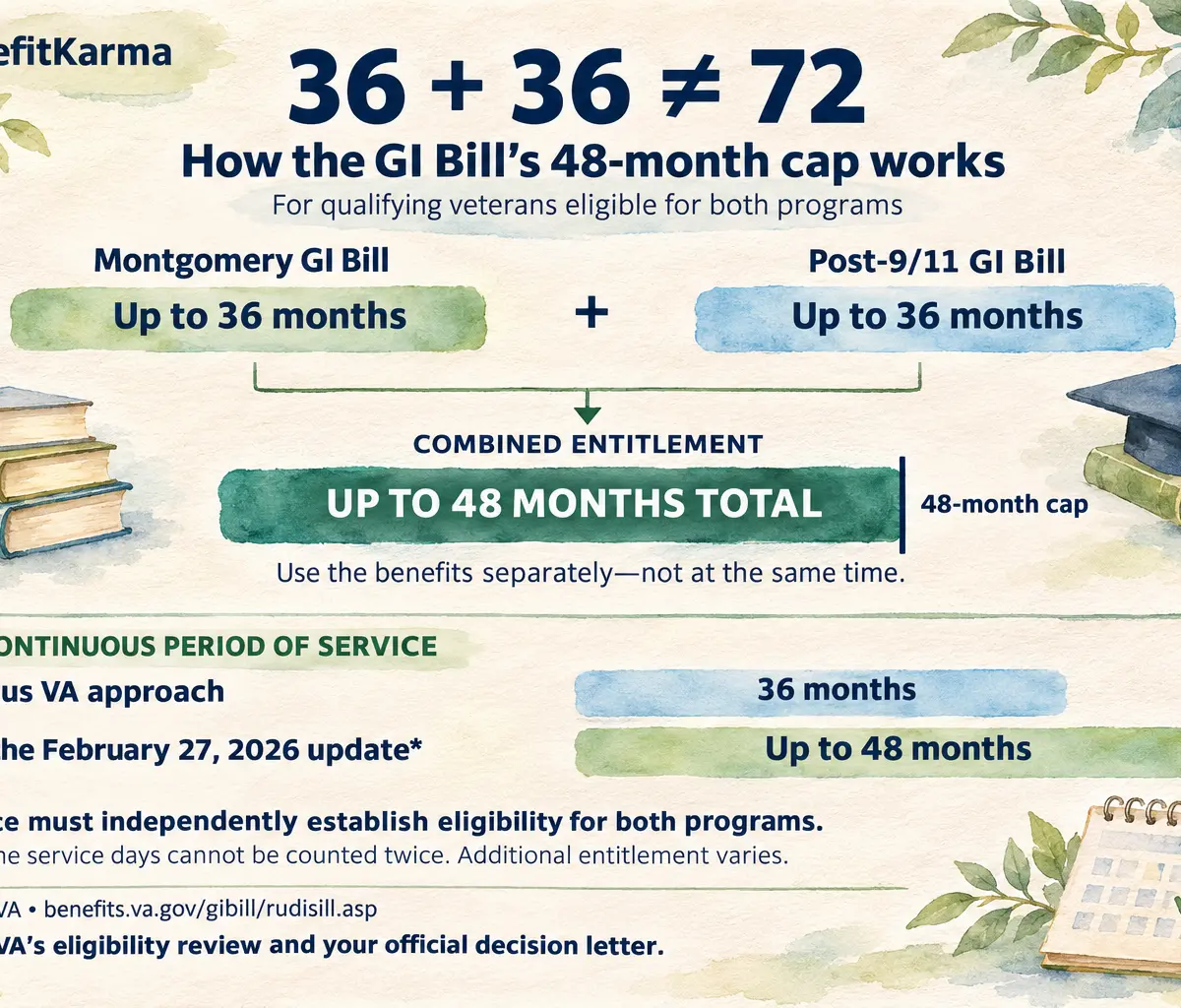
The GI Bill helps veterans pay for college, trade school, apprenticeships and certification tests. The two main programs each pay up to 36 months of benefits. Federal law caps the total you can use across both at 48 months.
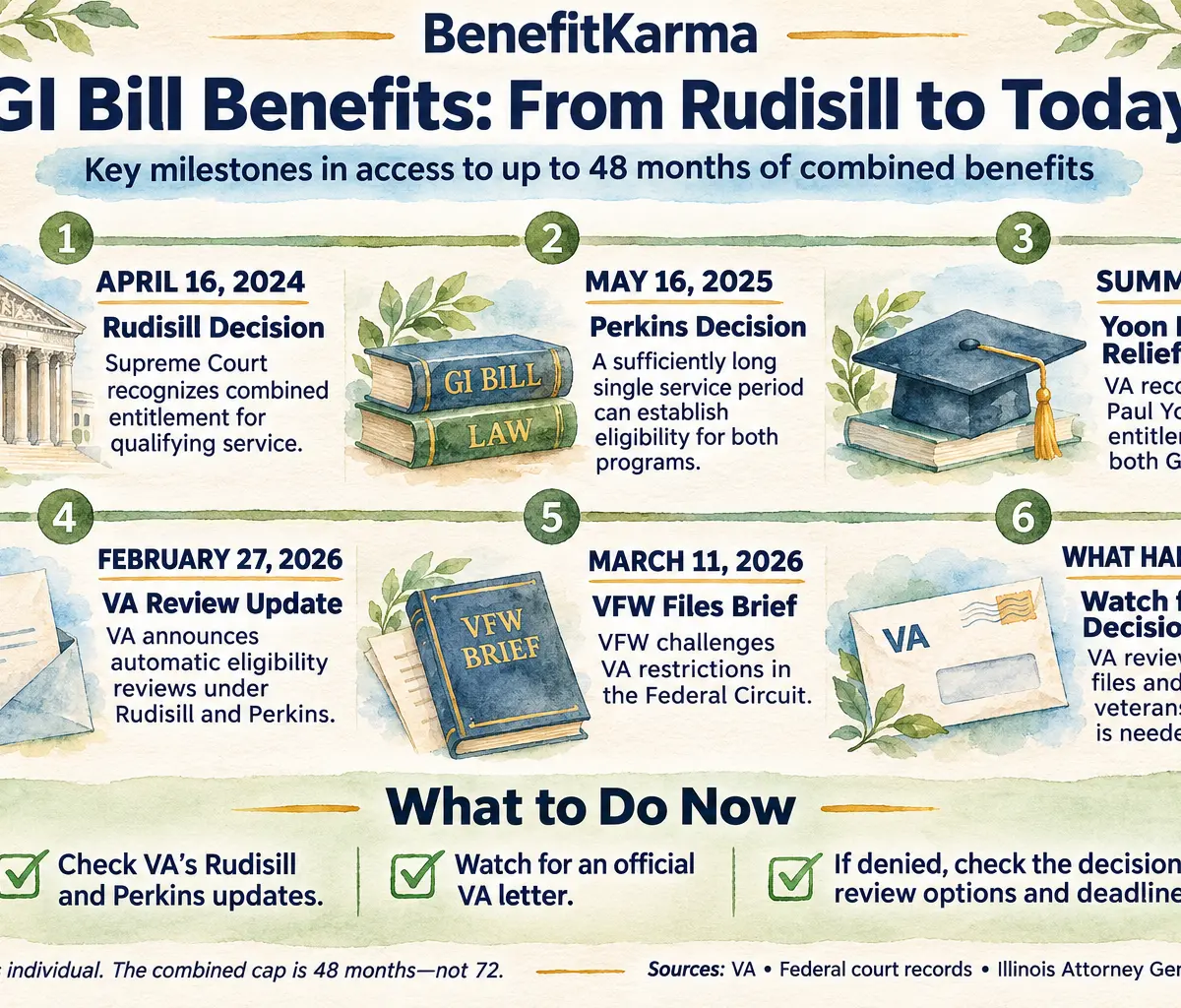
In April 2024, the Supreme Court ruled in Rudisill v. McDonough that a veteran who separately earns both benefits can use both, up to that 48-month cap. In practice, that can mean a full extra year of school.
The catch came in how the VA applied the ruling. It treated "separately earned" as requiring two distinct periods of service, such as leaving the military and coming back. A veteran who served 20 or 30 years without a break could still be limited to 36 months.
Why some veterans were still denied
Lt. Col. Paul Yoon, a retired Army officer, became the face of the problem. After nearly 24 years of continuous service, he tried to transfer his remaining benefits to his daughter, a law student. The VA said his single stretch of service counted for only one program.
Attorneys general from all 50 states, Washington, D.C., and the Northern Mariana Islands backed him in court. In the summer of 2025, a VA regional office recognized that Yoon was entitled to benefits under both GI Bills.
The bigger turning point came in a separate case. In May 2025, the U.S. Court of Appeals for Veterans Claims ruled in Perkins v. Collins that one period of service can count for both programs, as long as no time is counted twice. The court said Rudisill turned on how long you served, not how many separate stints you had.
What the VA changed in 2026
The VA decided not to appeal the Perkins ruling. On February 27, 2026, it announced that it would apply both decisions, and it estimated that up to 1.2 million more veterans could get as many as 12 additional months of benefits.
The VA said it will:
Free DIY tool
VA Disability Pay Calculator
How much could my VA rating pay each month? Enter your ratings and family details to see your combined rating and estimated pay.
Try the free tool- Stop requiring veterans to request an eligibility review under Rudisill or Perkins.
- Review first the files of veterans who are enrolled, or were enrolled in the past six months, and have fewer than three months of benefits left.
- Update its systems to review every veteran's file automatically. That work was still underway when the VA made the announcement.
- Notify each veteran of the result once their review is done.
The VA has also dropped its earlier 2030 deadline to apply for the extra benefits. Your normal benefit time limits still apply: Montgomery GI Bill benefits generally expire 10 years after you separate, and Post-9/11 benefits don't expire if your service ended on or after January 1, 2013.
What's still unresolved
Not every question is settled. A group of veterans, the Veterans of Foreign Wars (VFW), Iraq and Afghanistan Veterans of America and the Commonwealth of Virginia have asked a federal appeals court to strike down language in VA rules they say still requires a break in service. Their brief also argues the VA hasn't considered reimbursing veterans who paid for school out of pocket while they were wrongly denied.
Questions about transferred benefits for spouses and children are also still being worked out. If you transferred Post-9/11 benefits to a family member, ask the VA how the 48-month rule applies to your situation.
Who may qualify
You may be eligible for extra months if:
- You earned the Montgomery GI Bill (usually by paying $1,200 into it early in your service) and also served on active duty after September 10, 2001.
- Your total service is long enough to qualify for both programs without counting the same time twice. Many career service members, including officers and retirees, fall into this group.
- You used or gave up some of your Montgomery benefits and later switched to the Post-9/11 GI Bill.
Reservists using the separate Montgomery GI Bill–Selected Reserve program should check with the VA, since different rules apply.
What you should do now
- Check your benefits. Sign in at VA.gov to see how many months you've used and how many remain.
- Watch for a VA letter. The VA says most veterans don't need to file anything, and it will contact you after it reviews your file.
- Don't pause school. If you're enrolled and running low on benefits, the VA says it reviews your file automatically before you run out.
- Ask the VA directly. Use Ask VA or call 1-888-442-4551, and see the VA's Rudisill and Perkins page.
- Appeal an old denial. If the VA denied you before February 2026, you can ask for a new decision. Our guide to appealing a benefits decision explains the options, and a free veterans service organization can help you file.
If you have a service-connected disability, also look at Veteran Readiness and Employment (Chapter 31), a separate program that helps veterans with service-connected disabilities pay for training and find work. Family members of veterans rated permanently and totally disabled may qualify for Chapter 35 education benefits.
The bottom line
If you served a long, unbroken career and were told you could only get 36 months of GI Bill benefits, that answer may have changed. The VA now says one period of service can earn both programs, up to 48 months. Most veterans don't need to do anything but watch for a VA notice, but if you were denied in the past or you're close to running out of benefits, contact the VA now. For more on what you've earned, see our guide to veterans and military benefits.
Not sure what you qualify for?
A quick conversation can help you understand your options.
Optional — no obligation, fees may apply
Want help figuring out your next step?
Optional — fees may apply depending on your situation.
Some people choose to talk to a professional before taking their next step.
This might sound familiar:
You're not sure what to do next
You want someone to walk through your options
The process feels overwhelming
If that sounds like you, this might be worth a quick look.
Takes less than a minute
We only share your info with a service provider if you say yes.
Recommended Tools
Take action with our free tools
Get More from BenefitKarma
Create a free account to unlock all features
- Access premium benefit tools
- Personalized benefit matching
- Your personalized dashboard
Common questions about this guide
Get the latest benefit updates, straight to your inbox
Plain-English updates on SNAP, Medicaid, VA and Social Security — one email a week.
Get more from BenefitKarma
Free tools, personalized dashboard & more
