Healthcare and Disability Benefits: Help With Medical Costs and Lost Income
Explore the various healthcare and disability benefits available to you, highlighting the resources available to provide the care and support you need.

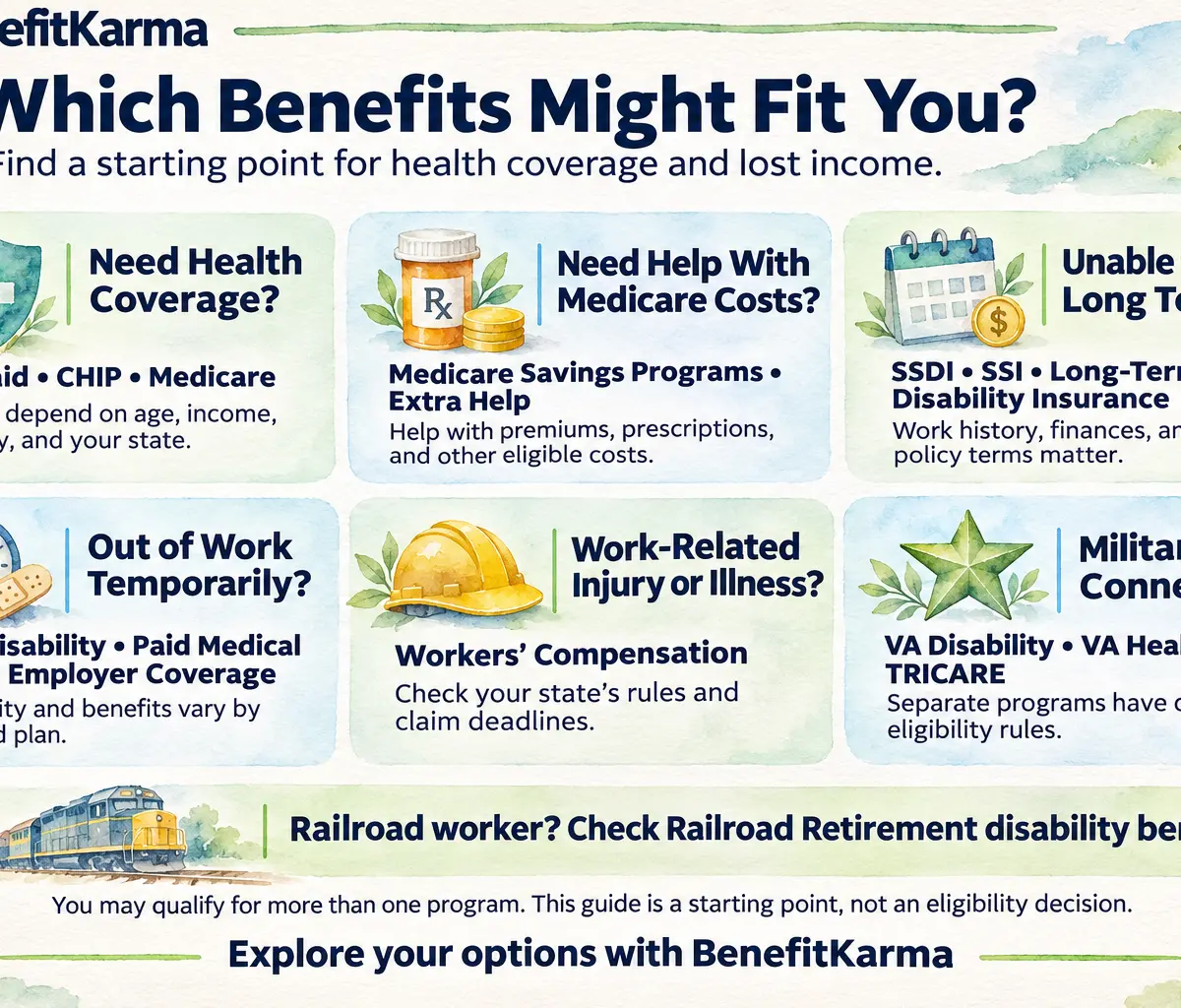
Medical expenses and time away from work can strain your finances. Depending on your income, age, work history, military service, and health needs, you may qualify for help covering care or replacing lost earnings.
Free DIY tool
Benefit Eligibility Screener
What benefits might I qualify for? Answer a few questions and see VA, disability, food, housing, and health programs that may fit you.
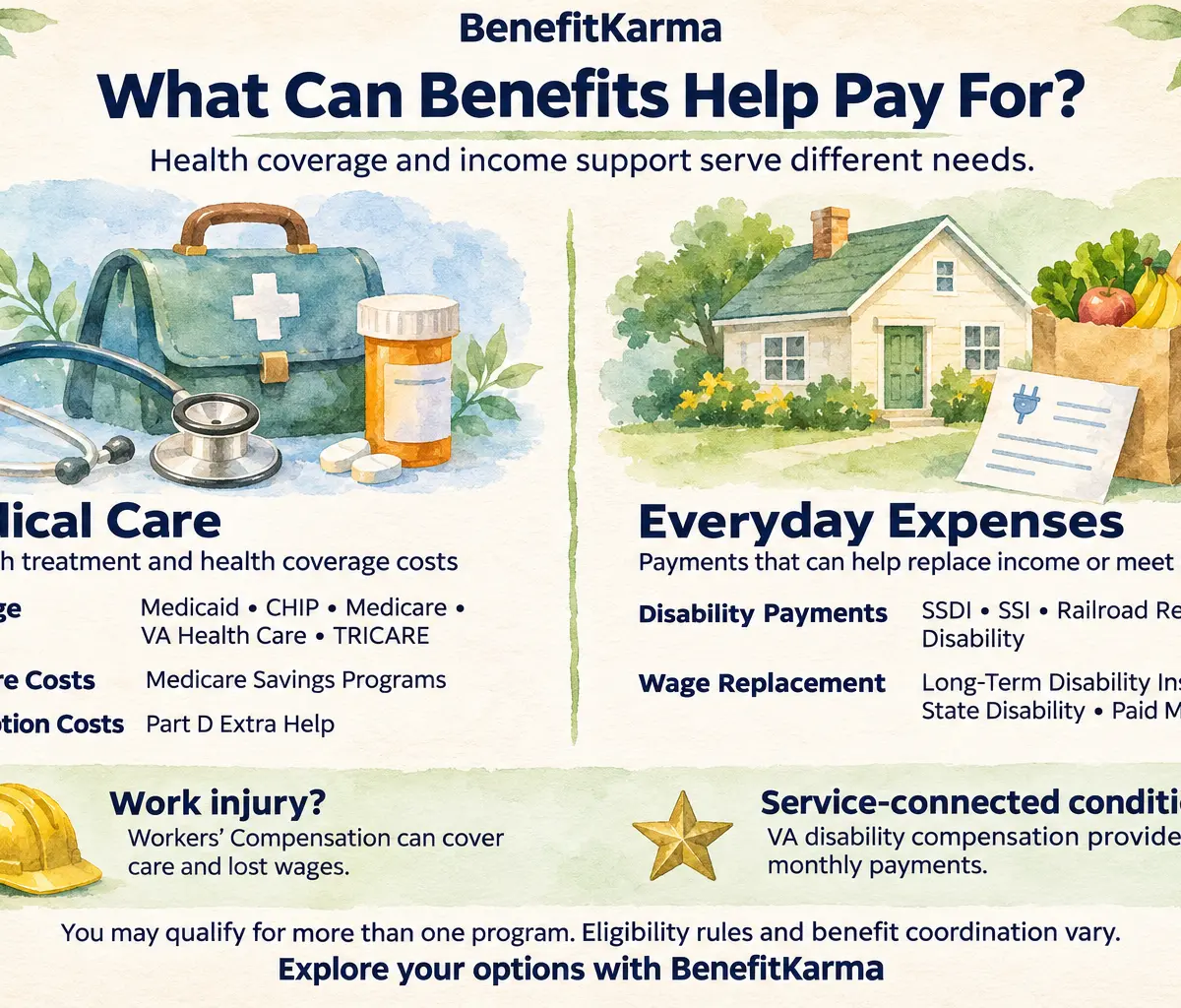
Try the free toolHealth coverage and disability payments serve different purposes. Some programs pay medical bills; others provide income for everyday expenses. You may qualify for both, although benefits can affect one another.
To explore benefits that may fit you and your family, sign up for BenefitKarma.
Medicaid
Medicaid covers eligible people with limited income, including children, pregnant people, older adults, and people with disabilities. Services can include doctor visits, hospital care, prescriptions, and long-term care.
Income limits vary by state and eligibility category. Disability-based and long-term care coverage may also have resource limits.
The 2025 federal budget law introduced changes for certain expansion adults and waiver populations:
- Work requirements: Generally begin January 1, 2027, with exemptions for qualifying medical frailty, caregiving, and other circumstances.
- Earlier starts: Nebraska began May 1, 2026; Montana began July 1; Iowa begins December 1 for new applicants.
- Renewals: Most expansion adults move to six-month eligibility reviews beginning with renewals scheduled in 2027.
- Other changes: Coverage narrowed for some noncitizens beginning October 1, 2026. Provider-financing restrictions also phase in, with effects depending on state decisions.
Check CMS’s implementation guidance and your state’s notices. If a health condition limits work, ask about exemptions and documentation.
Children’s Health Insurance Program (CHIP)
CHIP provides affordable coverage for eligible children whose families earn too much for Medicaid. Benefits include checkups, immunizations, prescriptions, dental care, and vision care.
CHIP income thresholds vary by state, with CMS describing levels ranging roughly from 170% to 400% of the federal poverty level. Check your state’s current chart for your household size and child’s age. Applications are accepted year-round.
Medicare
Medicare mainly covers people age 65 or older and certain younger people with disabilities.
- Part A: Hospital insurance.
- Part B: Medical and outpatient services.
- Part C: Medicare Advantage, a private-plan alternative for receiving A/B benefits, usually including drug coverage.
- Part D: Prescription drug coverage.
Medicare generally begins after 24 months of SSDI benefit entitlement, not after applying. The waiting period is waived for ALS; ESRD has separate coverage-start rules.
Key 2026 Medicare costs include:
| Cost | Amount |
|---|---|
| Standard Part B premium | $202.90 monthly |
| Part B deductible | $283 annually |
| Part A hospital deductible | $1,736 per benefit period |
| Part D covered-drug out-of-pocket cap | $2,100 annually |
The drug cap excludes premiums and uncovered drugs. It rises to $2,400 in 2027.
Income-related surcharges, called IRMAA, generally begin above $109,000 for individual filers or $218,000 jointly, usually based on 2024 income. Separate-filer rules differ.
Medicare Savings Programs and Extra Help
Medicare Savings Programs help eligible people pay Medicare premiums; some also cover deductibles and other cost sharing. Apply through your state Medicaid agency.
Part D Extra Help lowers prescription coverage costs, including for qualifying Medicare Advantage drug-plan members. People receiving SSI, full Medicaid, or state assistance with Part B premiums generally qualify automatically. Others can apply through SSA. Territorial residents have different assistance options.
Social Security Disability Insurance (SSDI)
SSDI supports people with sufficient covered work history whose condition prevents substantial work and is expected to last at least 12 months or result in death.
Payments depend on earnings history. SSA estimated an average of $1,630 monthly for disabled workers in January 2026, following a 2.8% COLA. See the SSDI pay chart for more.
For 2026, monthly substantial gainful activity thresholds are $1,690 for non-blind workers and $2,830 for statutory blindness ($1,770 and $2,950 in 2027). Earnings above $1,210 ($1,270 in 2027) generally count toward a trial work month.
These are earnings thresholds, not payment amounts. Eligible recipients can test working during nine trial months within five years while retaining benefits. Special work rules apply, including for self-employment. Check your personalized benefit estimate through SSA.
Supplemental Security Income (SSI)
SSI helps eligible adults and children with disabilities or blindness, and adults 65 or older, who have limited income and resources. No covered work history is required.
Maximum federal payments are $994 monthly for an individual and $1,491 for an eligible couple. Some states supplement payments.
Countable-resource limits remain $2,000/$3,000. Your main home and one transportation vehicle generally do not count.
Income exclusions generally include the first $20 of most monthly income, the first $65 of earnings, and half the remaining earnings. Unused portions of the $20 exclusion can apply to wages.
Since September 30, 2024, food provided by others no longer counts as in-kind support and maintenance. SSA also expanded rental-subsidy exceptions and its public-assistance household definition. Shelter assistance can still reduce payments.
Looking ahead: SSA announced a 3.6% COLA for 2027. SSI maximums become $1,029/$1,544, with January payments issued December 31, 2026. Social Security increases begin with January benefits.
Long-Term Disability Insurance
Employer or individual long-term disability insurance replaces part of your earnings when you meet the policy’s disability definition.
Payments, waiting periods, caps, and duration vary. For example, Washington’s public employee plan offers employee-paid coverage at 50% or 60% of covered earnings, subject to limits and offsets. Ask HR or your insurer how SSDI affects payments.
Temporary Disability Insurance
Traditional temporary disability programs cover eligible workers’ own non-work-related illnesses or injuries in five states and Puerto Rico:
- California: State Disability Insurance, up to 52 weeks.
- Hawaii: Temporary Disability Insurance, up to 26 weeks.
- New Jersey: Temporary Disability Insurance, up to 26 weeks.
- New York: Disability Benefits, up to 26 weeks.
- Rhode Island: Temporary Disability Insurance, up to 30 weeks.
- Puerto Rico: SINOT, up to 26 weeks.
Eligibility, payment formulas, and actual duration differ. Other states offer paid medical leave; employer short-term disability coverage may also help.
VA Disability Compensation
VA provides tax-free payments for qualifying service-connected conditions. 2026 basic rates, effective December 1, 2025, range from $180.42 monthly at 10% to $3,938.58 at 100%, without dependents.
Dependent increases generally begin at 30%, and special monthly compensation can increase payments. New annual rates take effect December 1, 2026.
The PACT Act expanded toxic-exposure benefits. Current presumptive conditions include certain bladder, ureter, and related cancers; qualifying service requirements still apply.
VA Health Care and TRICARE
VA health care requires separate enrollment from disability compensation. VA uses eight priority groups based on service, disability, income, and other factors. Ratings of at least 50% generally qualify for group 1; 30%–40% for group 2.
TRICARE covers eligible service members, retirees, and qualifying families. Medicare-eligible retirees generally need Part B to retain TRICARE.
Workers’ Compensation
Workers’ Compensation covers qualifying job-related injuries and illnesses. Benefits can include medical treatment, partial wage replacement, permanent disability payments, and rehabilitation.
Most claims follow state rules; certain workers use federal programs. Report injuries promptly and check claim deadlines.
Railroad Retirement Disability
Eligible railroad workers may receive RRB disability annuities for total disability or inability to perform their regular railroad occupation. Age, service, and other requirements differ.
Sign up for BenefitKarma to explore your options and find your next step toward applying.
Not sure what you qualify for?
A quick conversation can help you understand your options.
Optional — no obligation, fees may apply
Want help figuring out your next step?
Optional — fees may apply depending on your situation.
Some people choose to talk to a professional before taking their next step.
This might sound familiar:
You're not sure what to do next
You want someone to walk through your options
The process feels overwhelming
If that sounds like you, this might be worth a quick look.
Takes less than a minute
We only share your info with a service provider if you say yes.
Recommended Tools
Take action with our free tools
Get More from BenefitKarma
Create a free account to unlock all features
- Access premium benefit tools
- Personalized benefit matching
- Your personalized dashboard
Common questions about this guide
Get the latest benefit updates, straight to your inbox
Plain-English updates on SNAP, Medicaid, VA and Social Security — one email a week.
Get more from BenefitKarma
Free tools, personalized dashboard & more
