Some Immigrants Could Lose Part of Their Tax Refund Under New Proposal

Free DIY tool
Benefit Eligibility Screener
What benefits might I qualify for? Answer a few questions and see VA, disability, food, housing, and health programs that may fit you.
Try the free toolA new Treasury Department and IRS proposal could change who is allowed to receive the cash-refund portion of several major federal tax credits — and the impact would not be limited to undocumented immigrants.
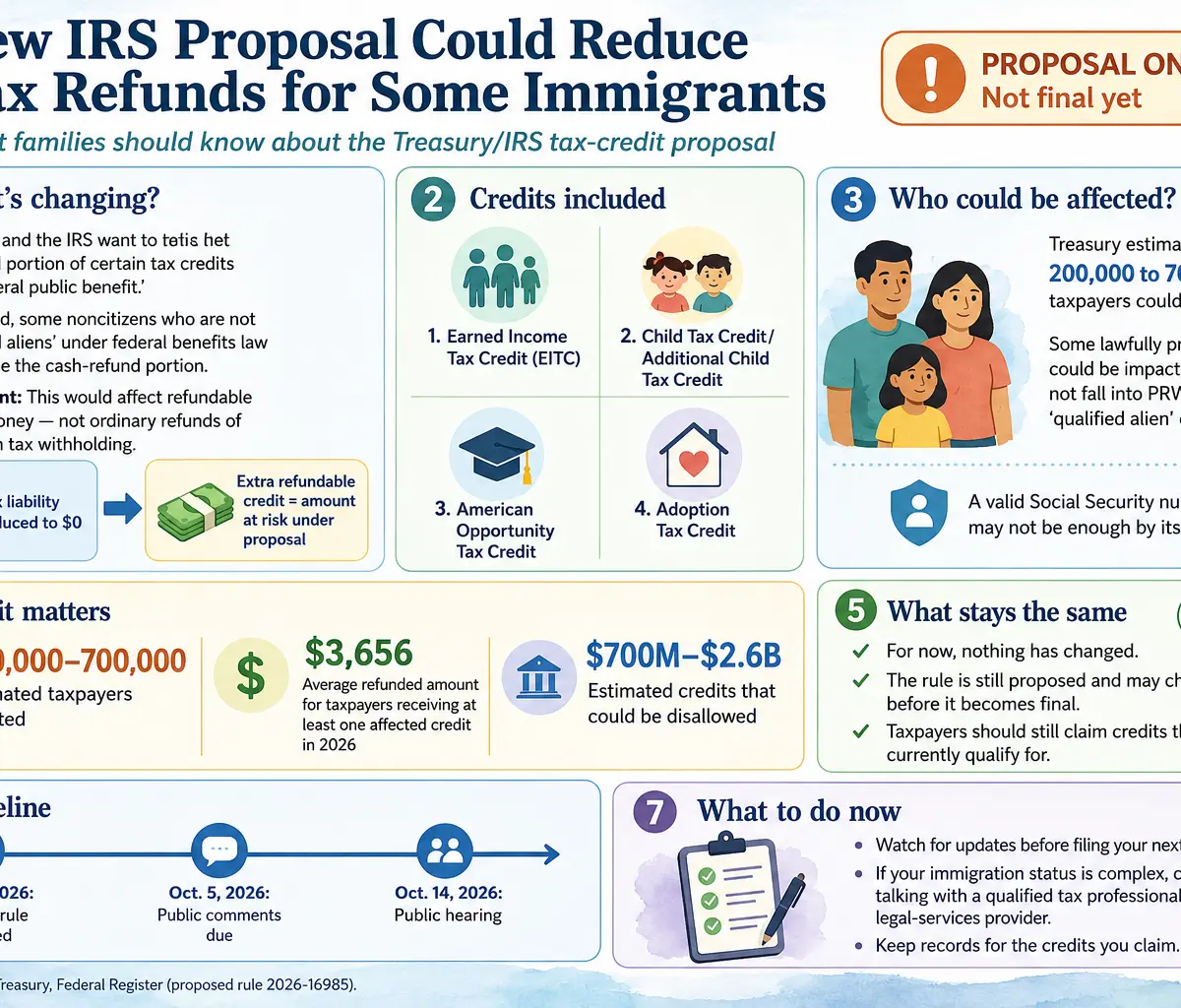
Under proposed regulations announced Aug. 19, 2026, the government would treat the refunded portion of four tax credits as a “federal public benefit” under a 1996 welfare law. That would make the cash-back portion unavailable to taxpayers who are not U.S. citizens, U.S. nationals or “qualified aliens” under that law, even in some cases where a taxpayer is legally present in the U.S., has a Social Security number and is authorized to work.
The proposal is not final. But Treasury estimates that roughly 200,000 to 700,000 taxpayers could become ineligible for part of their tax refunds if the rule takes effect.
Here’s what families need to know.
Four tax credits are included
The proposed rule would apply to the refunded portion of four credits:
- Earned Income Tax Credit (EITC)
- Child Tax Credit, including its refundable Additional Child Tax Credit portion
- American Opportunity Tax Credit for higher-education expenses
- Adoption Tax Credit
Treasury and the IRS are not proposing to eliminate these credits entirely for affected taxpayers. The key word is “refunded.”
Refundable tax credits can do more than reduce a person’s federal income tax bill to zero. In some cases, the remaining credit can be paid to the taxpayer as part of a refund.
Treasury wants to treat only that excess amount as a federal public benefit.
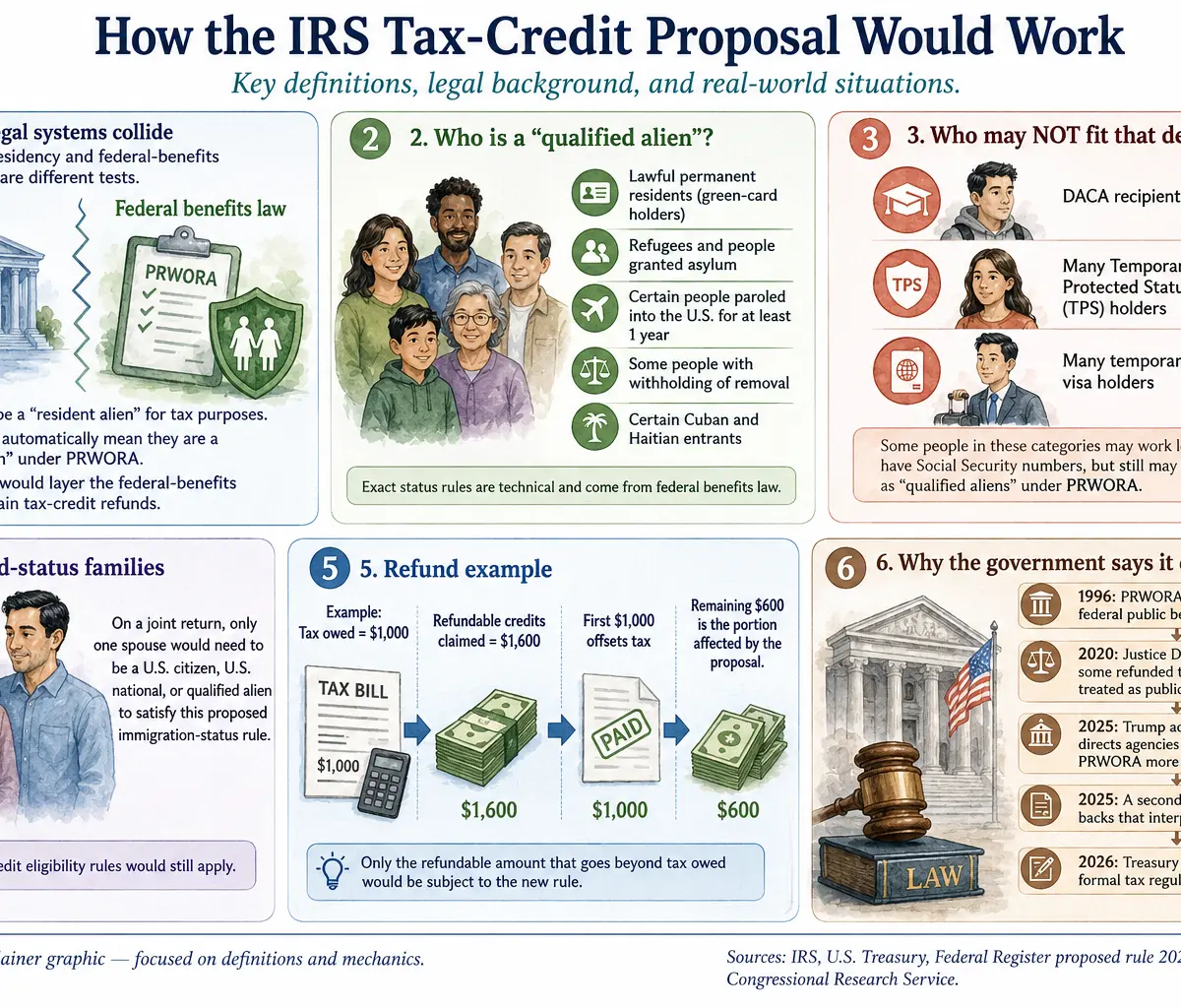
For example, imagine an otherwise eligible taxpayer has $1,000 in federal income tax liability and qualifies for $1,600 in affected refundable credits. In a simplified example, $1,000 could be used to reduce the tax liability, while the remaining $600 would be the refunded portion potentially subject to the new restriction.
That also means this proposal is not a blanket rule allowing the IRS to keep ordinary refunds of taxes already withheld from a paycheck. The proposed regulation specifically distinguishes a payment generated by refundable tax credits from an ordinary refund returning a taxpayer’s own overpaid taxes.
A Social Security number may no longer settle the question
This is where the proposal gets complicated.
Federal tax law already has identification and residency requirements for these credits. The EITC, for example, generally requires a valid Social Security number and requires the taxpayer to be a U.S. citizen or resident alien for the year.
But “resident alien” under federal tax law is not the same thing as “qualified alien” under federal benefits law.
The IRS can treat some noncitizens as U.S. residents for tax purposes because they have a green card or meet the agency’s substantial-presence test based on the amount of time they have lived in the country.
Under the proposed rule, receiving the refunded portion of the affected credits would also require the taxpayer to fit the narrower immigration categories laid out under the Personal Responsibility and Work Opportunity Reconciliation Act, or PRWORA.
Those categories include lawful permanent residents, refugees, people granted asylum, certain people paroled into the U.S. for at least one year, some people with withholding of removal, certain Cuban and Haitian entrants and other specifically defined groups.
Congressional Research Service guidance notes that other groups — including DACA recipients, Temporary Protected Status holders and many nonimmigrant visa holders — are not considered “qualified aliens” under PRWORA, even though some may be legally authorized to live or work in the country.
That creates the unusual possibility that someone could be authorized to work, have a valid Social Security number and be treated as a U.S. resident for federal tax purposes, yet still fall outside the immigration-status definition Treasury wants to apply to the cash-refund portion of these credits.
There is an important protection for some mixed-status married couples: under the proposal, only one spouse on a joint return would need to be a U.S. citizen, U.S. national or qualified alien to satisfy this particular requirement, provided the couple otherwise qualifies for the credit.
Treasury says 200,000 to 700,000 taxpayers could be affected
Treasury and the IRS estimate that about 49 million federal returns will claim at least one of the four affected credits for tax year 2026. About 24 million are expected to include a refunded portion that would be treated as a federal public benefit under the proposal.
Free DIY tool
Benefit Eligibility Screener
What benefits might I qualify for? Answer a few questions and see VA, disability, food, housing, and health programs that may fit you.
Try the free toolThe agencies acknowledge they do not have direct data showing exactly which taxpayers meet PRWORA’s qualified-alien definition.
Using Social Security Administration, immigration and historical Department of Homeland Security data, they produced a rough estimate that 200,000 to 700,000 taxpayers could become ineligible for the refunded portion.
Treasury estimates that taxpayers receiving the refunded portion of at least one affected credit will receive an average of $3,656 in 2026. Applying that figure to its estimated affected population produces roughly $700 million to $2.6 billion in potentially disallowed credits.
Those figures are estimates — not a count of people who have improperly claimed credits.
In fact, this proposal represents a change in how Treasury and the IRS would interpret existing federal law. The agencies acknowledge that before 2018, they had not treated tax benefits, including refundable tax credits, as federal public benefits under PRWORA.
Why is this happening now?
The legal argument behind the proposal has been developing for several years.
In 2020, the Justice Department’s Office of Legal Counsel concluded that the refunded portions of the EITC, Child Tax Credit and American Opportunity Tax Credit could reasonably be treated as federal public benefits under PRWORA.
President Donald Trump then issued an executive order in February 2025 directing federal agencies to ensure federally funded programs complied with PRWORA. Treasury subsequently asked the Justice Department to revisit the tax-credit question.
A second Justice Department opinion issued in November 2025 concluded that treating the refunded portions of these credits as federal public benefits represented the best interpretation of the law.
The new Treasury and IRS proposal would formally put that interpretation into federal tax regulations. The Adoption Tax Credit was added after Congress made part of that credit refundable beginning in 2025.
When could the change take effect?
For now, nothing has changed for taxpayers.
The proposal was published in the Federal Register on Aug. 20. Public comments are due Oct. 5, 2026, and a public hearing is scheduled for Oct. 14.
The proposed regulations say they would apply to tax years ending on or after the date the final regulations are published.
That timing is important.
If Treasury finalizes the regulations before the end of 2026 without changing that language, the new restrictions could apply to 2026 calendar-year tax returns filed in 2027. If the final rule arrives after 2026, the affected tax year could shift.
There is also no guarantee the final regulation will be identical to the proposal. Treasury and the IRS can make changes after reviewing public comments, and a final rule could potentially face court challenges.
What should taxpayers do now?
There is no reason to stop claiming a tax credit you currently qualify for simply because this rule has been proposed.
But noncitizen taxpayers who rely on the EITC, refundable Child Tax Credit, American Opportunity Tax Credit or refundable Adoption Tax Credit should watch the rule closely over the next few months — particularly those with DACA, TPS, certain temporary visas or other immigration classifications that may fall outside PRWORA’s definition.
The biggest takeaway is that a valid Social Security number or permission to work may not, by itself, guarantee access to the refunded portion of these credits if the proposal becomes final.
Because federal tax residency and immigration-benefit classifications use different rules, anyone who thinks they may be affected should consider working with a tax professional or qualified legal-services organization familiar with both tax and immigration issues before filing.
For now, though, this remains a proposal — not a current IRS ban on these refunds.
Not sure what you qualify for?
A quick conversation can help you understand your options.
Optional — no obligation, fees may apply
Want help figuring out your next step?
Optional — fees may apply depending on your situation.
Some people choose to talk to a professional before taking their next step.
This might sound familiar:
You're not sure what to do next
You want someone to walk through your options
The process feels overwhelming
If that sounds like you, this might be worth a quick look.
Takes less than a minute
We only share your info with a service provider if you say yes.
Recommended Tools
Take action with our free tools
Get More from BenefitKarma
Create a free account to unlock all features
- Access premium benefit tools
- Personalized benefit matching
- Your personalized dashboard
Common questions about this guide
Get more from BenefitKarma
Free tools, personalized dashboard & more