All 50 States Qualify for New Medicaid Drug-Pricing Model
Free DIY tool
Benefit Eligibility Screener
What benefits might I qualify for? Answer a few questions and see VA, disability, food, housing, and health programs that may fit you.
Try the free toolEvery state Medicaid program has now applied to participate in a federal drug-pricing experiment that could lower what Medicaid pays for hundreds of brand-name medications.
The Centers for Medicare & Medicaid Services announced Sept. 18 that all 50 states, Washington, D.C., and Puerto Rico had applied to join the GENEROUS Model — short for GENErating cost Reductions fOr U.S. Medicaid. President Donald Trump highlighted the nationwide interest as part of his administration’s broader effort to tie U.S. prescription-drug prices to prices paid in other wealthy countries.
There is one important distinction: applying is not the same as having a final agreement in place.
CMS said 40 states and Puerto Rico had signed participation agreements as of Sept. 18. The remaining applicants have until Sept. 30, 2026, to complete their agreements.
If the model works as intended, the biggest immediate savings would go to state and federal Medicaid programs rather than directly into beneficiaries’ pockets. But lower drug costs could also influence which medications states cover and how easily Medicaid patients can access them.
What is the GENEROUS Model?
GENEROUS is a voluntary, five-year CMS Innovation Center model that began in January 2026. It is designed to give participating state Medicaid programs access to lower net prices on certain brand-name outpatient drugs.
Instead of setting a target price based only on the U.S. market, CMS uses international prices as a benchmark.
For drugs included in the model, participating manufacturers report net prices from eight countries: Canada, Denmark, France, Germany, Italy, Japan, Switzerland and the United Kingdom. CMS uses the second-lowest reported net price, after rebates and discounts, and adjusts it using a purchasing-power calculation.
If Medicaid’s existing net price is higher, participating manufacturers provide an additional rebate intended to bring the Medicaid price down to the model’s international benchmark. Those supplemental rebates operate alongside the rebates Medicaid already receives through the federal Medicaid Drug Rebate Program.
Medicaid already gets big drug discounts
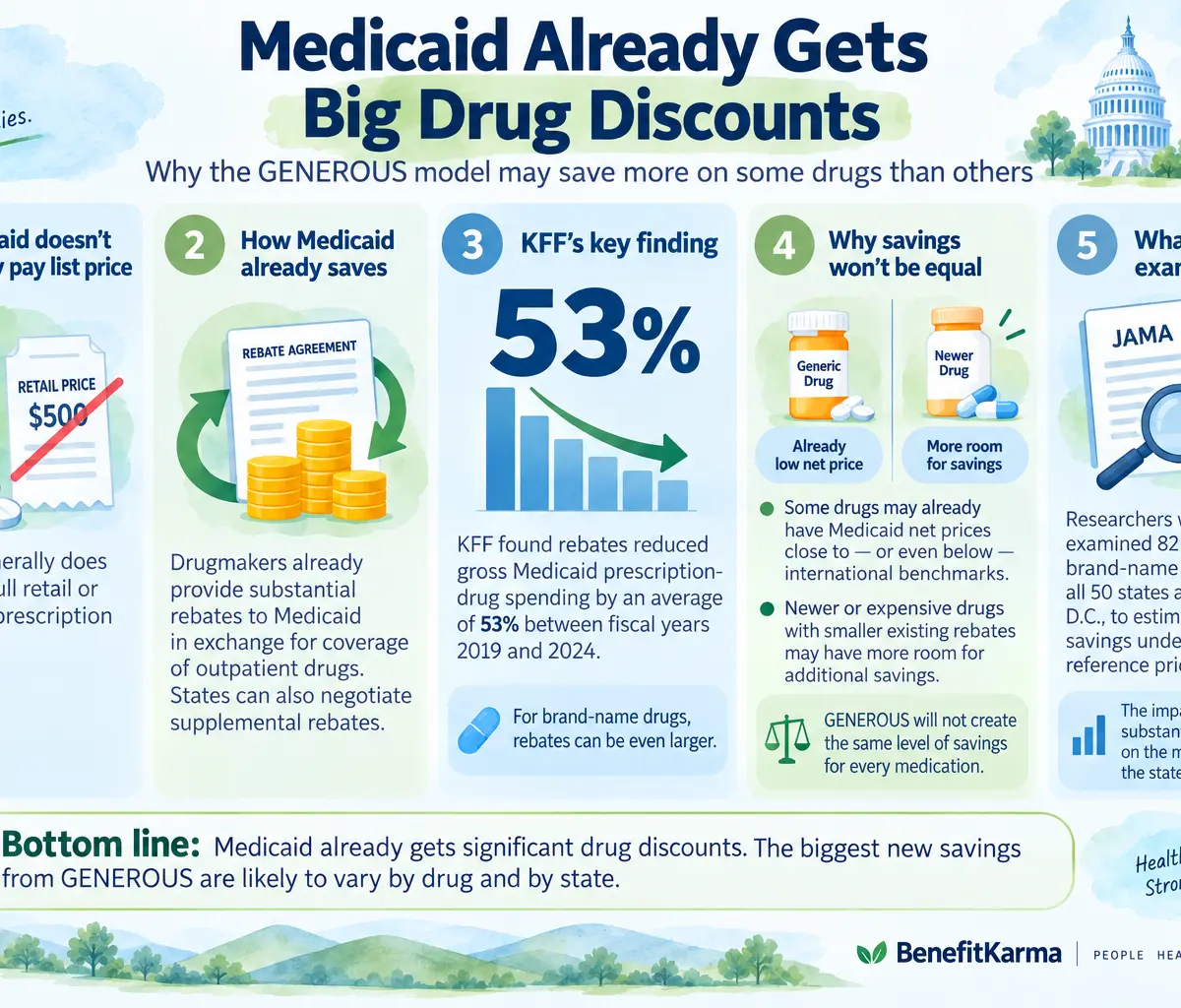
One thing that can get lost in discussions about U.S. drug prices is that Medicaid is not generally paying the retail or list price for prescription medications.
Under existing federal rules, pharmaceutical manufacturers already provide substantial rebates to Medicaid in exchange for having their covered outpatient drugs included in the program. States can negotiate additional supplemental rebates as well.
KFF found that rebates reduced gross Medicaid prescription-drug spending by an average of 53% between fiscal years 2019 and 2024. For brand-name drugs, rebates can be even larger.
That means GENEROUS will not necessarily create the same level of savings for every medication.
Some drugs may already have Medicaid net prices close to — or even below — international benchmarks. Other expensive drugs, particularly newer products for which states have obtained smaller rebates, could have considerably more room for additional savings.
Researchers writing in JAMA in July examined 82 high-spending brand-name drugs across all 50 states and Washington, D.C., to estimate the potential for additional savings under international reference pricing. Their analysis illustrates why the effect can differ substantially depending on the medication and the state’s existing rebates.
The administration projects $64.3 billion in Medicaid savings
CMS estimates the policy could generate $64.3 billion in taxpayer savings over 10 years.
According to Reuters, the White House Council of Economic Advisers estimates about $36.6 billion of those savings would go to the federal government and $27.6 billion to states.
Those figures are projections, not savings that have already occurred.
There is also an important timing wrinkle: CMS says the GENEROUS demonstration itself runs for five years, while the administration's headline savings estimate covers a 10-year period. KFF has noted that the assumptions behind the administration's savings estimate have not been fully disclosed, making the precise total difficult to independently evaluate.
Free DIY tool
Benefit Eligibility Screener
What benefits might I qualify for? Answer a few questions and see VA, disability, food, housing, and health programs that may fit you.
Try the free toolWhat could this mean for Medicaid patients?
For most people with Medicaid, GENEROUS probably should not be thought of as a straightforward reduction in their pharmacy copay.
Medicaid already limits prescription-drug cost sharing, and many beneficiaries pay little or nothing for medications. KFF says the GENEROUS Model therefore is not expected to directly change out-of-pocket prescription costs for Medicaid enrollees.
The potentially bigger issue for beneficiaries is access.
CMS and participating manufacturers negotiate standardized coverage criteria for drugs included in the model. To receive the model's lower price for a particular medication, states must agree to the applicable coverage rules, which can include tools such as prior authorization or step therapy.
Depending on the final criteria, those rules could make some medications easier to obtain in states that currently impose tighter restrictions. But they could also be more restrictive than the rules a particular state currently uses.
KFF says the overall effect on patient access remains difficult to determine because important coverage terms and manufacturer pricing information have not been made public.
Which drugs could be affected?
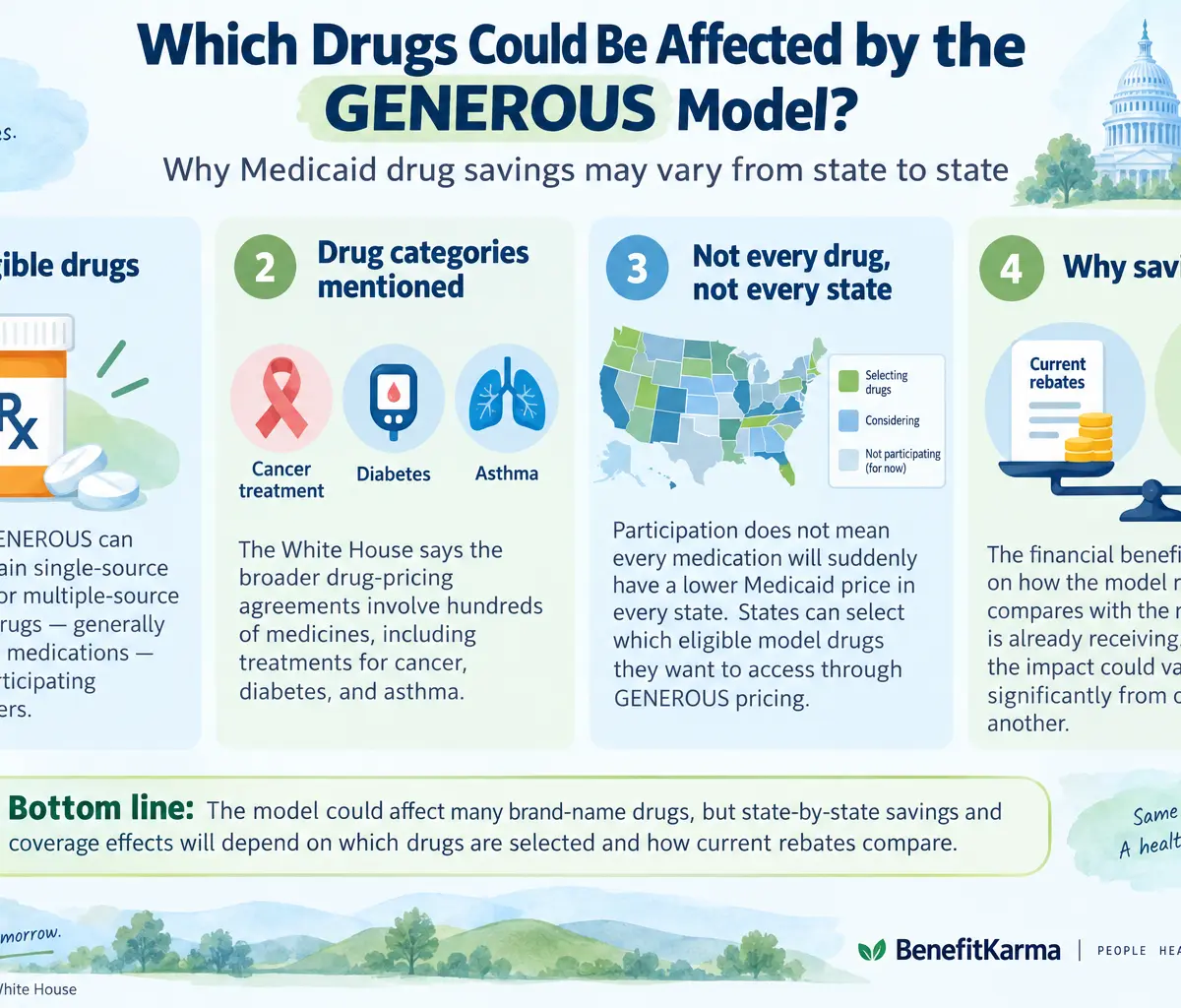
CMS says GENEROUS can include certain single-source and innovator multiple-source outpatient drugs — generally brand-name medications — made by participating manufacturers.
The White House says the broader drug-pricing agreements involve hundreds of medicines across areas including cancer, diabetes and asthma treatment.
But participation does not necessarily mean every medication will suddenly have a lower Medicaid price in every state.
States can select eligible model drugs for which they want to access GENEROUS pricing. The financial benefit then depends on how the model rebate compares with the rebates that state is already receiving.
That is one reason the effects could vary significantly from one state to another.
What happens next?
The immediate date to watch is Sept. 30, when states that applied but had not yet completed participation agreements as of the Sept. 18 CMS announcement face the deadline to finalize them.
After that, some of the most useful measures of the program will be practical ones: which drugs states select, how much additional savings the rebates actually generate, what coverage requirements accompany those prices and whether access changes for Medicaid beneficiaries.
For people already enrolled in Medicaid, there is no separate GENEROUS application to complete. The model operates between CMS, state Medicaid agencies and participating pharmaceutical manufacturers.
Over time, a beneficiary could instead notice changes in which medications are preferred, whether prior authorization is required, or how a particular drug is covered by their state's Medicaid program.
The bottom line
All 50 states, Washington, D.C., and Puerto Rico have applied for the GENEROUS Model, but as of the federal government's Sept. 18 announcement, 40 states and Puerto Rico had finalized participation agreements. The remaining applicants had until Sept. 30 to sign.
For Medicaid recipients, this is not primarily an across-the-board prescription discount program. Its central mechanism is reducing what state and federal Medicaid programs ultimately pay for certain brand-name drugs through additional manufacturer rebates.
Whether the model ultimately produces the administration's projected savings — and whether beneficiaries see broader access to expensive medications — will depend on the final participating states, the medications included, existing Medicaid rebates and the coverage rules negotiated for those drugs.
Not sure what you qualify for?
A quick conversation can help you understand your options.
Optional — no obligation, fees may apply
Want help figuring out your next step?
Optional — fees may apply depending on your situation.
Some people choose to talk to a professional before taking their next step.
This might sound familiar:
You're not sure what to do next
You want someone to walk through your options
The process feels overwhelming
If that sounds like you, this might be worth a quick look.
Takes less than a minute
We only share your info with a service provider if you say yes.
Recommended Tools
Take action with our free tools
Get More from BenefitKarma
Create a free account to unlock all features
- Access premium benefit tools
- Personalized benefit matching
- Your personalized dashboard
Common questions about this guide
Get more from BenefitKarma
Free tools, personalized dashboard & more