PSLF Buyback: How to Turn Forbearance Months Into Credit Toward Student Loan Forgiveness

Free DIY tool
Benefit Eligibility Screener
What benefits might I qualify for? Answer a few questions and see VA, disability, food, housing, and health programs that may fit you.
Try the free toolIf you have spent 10 years working in public service but your student loan tracker says you are still short of the 120 payments required for Public Service Loan Forgiveness, there may be a way to fill some of those gaps.
It is called PSLF Buyback.
The program allows certain borrowers to make retroactive payments for months their federal student loans were in deferment or forbearance. Those months can then count toward the 120 qualifying payments required for Public Service Loan Forgiveness, potentially allowing the borrower to receive forgiveness sooner.
But PSLF Buyback is not available to everyone who has missing payments.
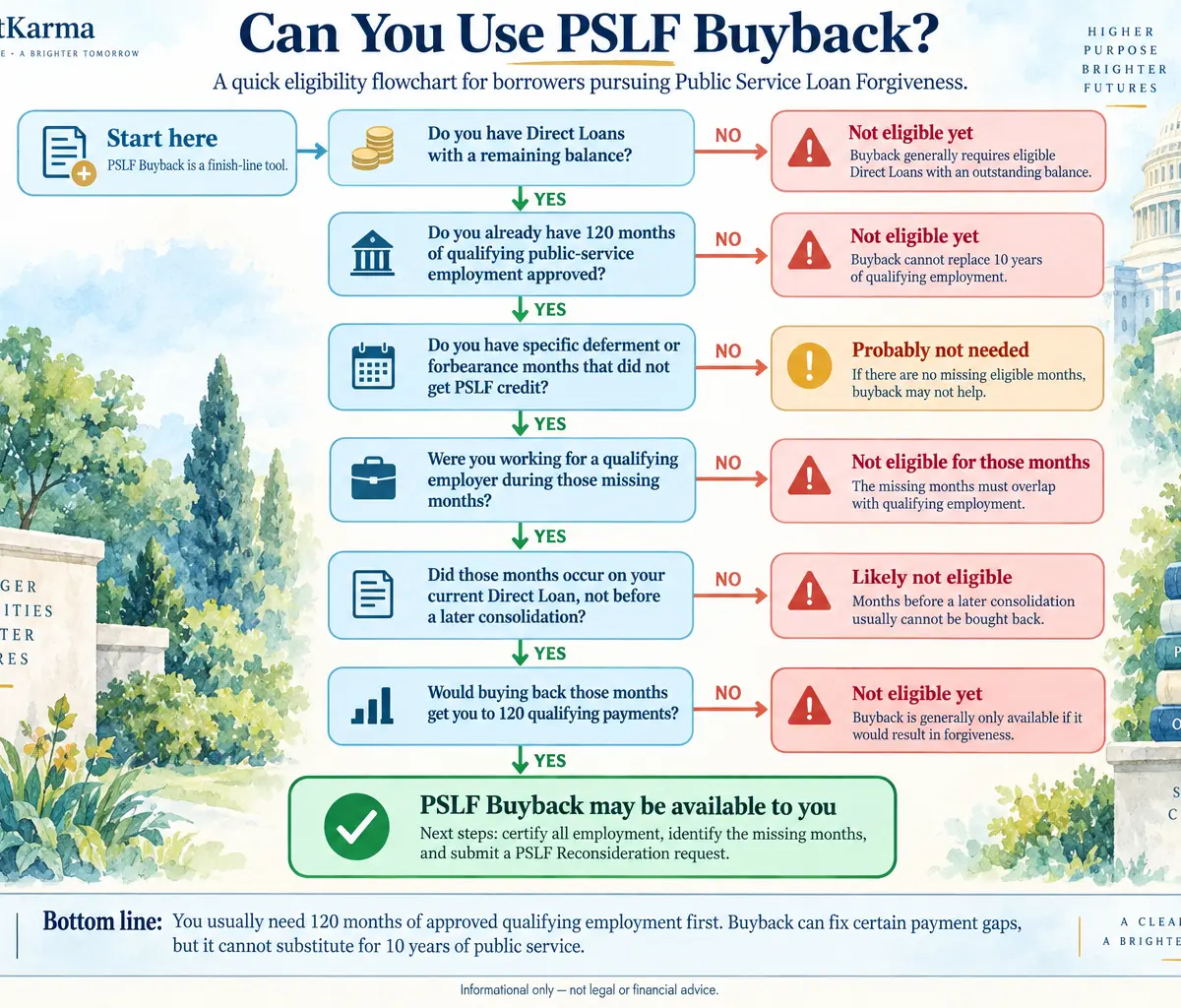
The most important rule is this: You generally need to already have 120 months of qualifying public-service employment, and buying back the missing months must be enough to get you to forgiveness.
In other words, buyback can repair certain gaps in your payment history. It cannot substitute for 10 years of qualifying employment.
Here is how the program works and how to use it.
First, understand what PSLF Buyback actually does
Normally, PSLF requires a borrower with eligible Direct Loans to accumulate the equivalent of 120 qualifying monthly payments while working full time for an eligible public-service employer.
Certain periods of deferment or forbearance do not count as qualifying payments.
PSLF Buyback creates a way to go back and make an additional payment for some of those months. Federal regulations allow borrowers to receive credit for otherwise nonqualifying deferment or forbearance months if they were working full time for a qualifying employer and pay at least what they would have owed under an applicable qualifying repayment plan at the time.
If the borrower would have qualified for a $0 income-driven repayment payment, that month can potentially be credited without an additional payment.
Think of buyback as repairing a hole in an otherwise complete PSLF history.
For example, imagine a teacher has accumulated 120 months of qualifying employment but only 112 qualifying PSLF payments because eight months were spent in an eligible forbearance.
If those eight months qualify for buyback, the teacher may be able to make the required retroactive payment for them and reach 120.
But if that same teacher has only worked for a qualifying employer for 112 months total, buyback cannot turn those 112 months into 120 months of public service.
Who can use PSLF Buyback?
There are several important requirements.
First, you must have a Direct Loan with an outstanding balance.
Second, you must have approved qualifying employment covering the months you want to buy back.
Third, you must already have accumulated at least 120 months of qualifying employment.
Finally, buying back the eligible deferment or forbearance months must result in you reaching the 120-payment requirement for PSLF or Temporary Expanded Public Service Loan Forgiveness.
MOHELA's current PSLF guidance summarizes the rule plainly: buyback is available only when a borrower already has 120 months of qualifying employment and purchasing the eligible months would result in forgiveness.
That means borrowers who are several years away from PSLF cannot purchase future credit or buy their way closer to 120.
Buyback is essentially a finish-line tool.
Which months can you buy back?
Generally, PSLF Buyback applies to otherwise nonqualifying months when your Direct Loans were in deferment or forbearance while you were working in qualifying public service.
The months must correspond with qualifying employment and must be attached to the Direct Loan on which you are seeking forgiveness.
Some deferments and forbearances already receive PSLF credit under federal rules, so there is no reason to buy those months back. Current regulations automatically count several specific circumstances, including certain cancer-treatment, economic-hardship, military-service and administrative deferments or forbearances.
Buyback is designed for deferment or forbearance periods that otherwise would not count.
One especially important group consists of borrowers who spent time in SAVE-related forbearance while legal challenges prevented payments under the Saving on a Valuable Education repayment plan. Current consumer guidance from Massachusetts' student-loan assistance program specifically identifies the SAVE forbearance as a period that may be eligible for PSLF Buyback.
Some months cannot be bought back
There are several exclusions borrowers should check before applying.
Federal Student Aid guidance has identified the following loan statuses as ineligible for buyback:
- In-school or in-origination status
- A post-school grace period
- Default
- Bankruptcy
- Total and permanent disability monitoring
You also cannot use buyback on a loan that is not a Direct Loan or one that has already been paid in full, forgiven or discharged.
There is another major restriction involving consolidation.
If you combined older federal loans into a Direct Consolidation Loan, you generally cannot buy back deferment or forbearance months that occurred on the original loans before that consolidation.
You can only buy back eligible periods associated with the current consolidation loan after its first disbursement date. Massachusetts' student-loan assistance office similarly warns that borrowers who consolidated cannot buy back months from before the consolidation.
That makes your loan history especially important before submitting a request.
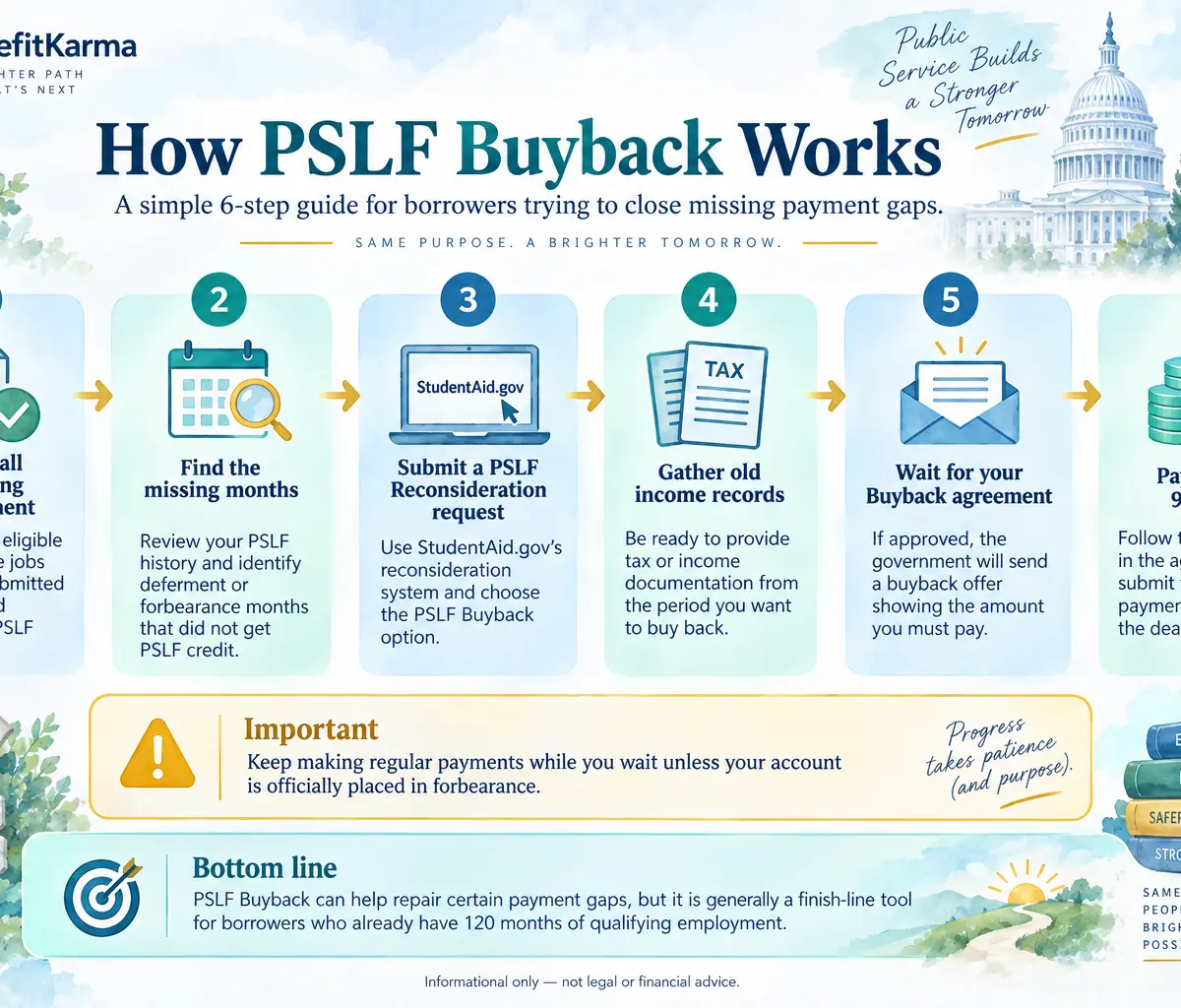
Step 1: Make sure all of your public-service employment has been certified
Before applying for buyback, make sure Federal Student Aid knows about all of your qualifying employment.
If you have periods of government or nonprofit employment that have never been certified, submit a PSLF form through the PSLF Help Tool first.
The goal is to get your StudentAid.gov account to reflect at least 120 months of approved qualifying employment.
This is different from having 120 qualifying payments.
You might have 120 months of qualifying employment while your payment counter shows only 110 or 115 payments. That difference is exactly where buyback may become useful.
Do not submit a buyback request simply because you believe you have worked 10 years in public service. Make sure those employment periods have actually been submitted and approved.
Step 2: Identify exactly which months are missing
Next, review your PSLF payment history on StudentAid.gov.
Look for months when all three of these things were true:
- You were working for a qualifying PSLF employer.
- Your current Direct Loan was in a deferment or forbearance.
- The month is not already receiving qualifying PSLF credit.
Write down the specific months.
You should also check whether the loan was consolidated after the period you want to buy back. If so, those earlier months may not be eligible.
Free DIY tool
Benefit Eligibility Screener
What benefits might I qualify for? Answer a few questions and see VA, disability, food, housing, and health programs that may fit you.
Try the free toolThis step can prevent a lot of unnecessary waiting. PSLF Buyback is not a general appeal for every missing payment. You are trying to identify particular deferment or forbearance periods that could bring your qualifying-payment total to 120.
Step 3: Submit a PSLF Reconsideration request
PSLF Buyback does not have a completely separate application.
Instead, borrowers apply through the Department of Education's PSLF Reconsideration system on StudentAid.gov.
The current online process includes PSLF Buyback as a reconsideration type. Borrowers are asked to confirm that they already have 120 months of qualifying employment.
This is important because older instructions circulating online tell borrowers to type a particular statement into the reconsideration form.
The online tool has since been updated to specifically identify buyback requests, so follow the instructions presented in the current Federal Student Aid form rather than relying solely on old screenshots or application tutorials.
Save your confirmation after submitting the request.
Step 4: Be prepared to provide old income information
The Education Department may need information about your income and family size during the period you want to buy back.
That is because the buyback amount is tied to what you would have been required to pay during those months — not simply your current student-loan payment.
Borrowers have reported being asked to provide tax or income documentation from years corresponding with the requested buyback period.
So if you are considering buyback, it is worth locating old tax returns or IRS transcripts now rather than waiting until the Department asks for them.
Federal regulations specify that the additional payment must generally equal or exceed what the borrower would have paid at the time under an applicable qualifying repayment plan.
Step 5: Don't assume your old SAVE payment determines the cost
This is particularly important in 2026.
In March, the Education Department changed the way it calculates buyback amounts associated with SAVE-era periods, according to reporting from NerdWallet and student-loan specialists.
The Department is no longer using the SAVE formula for those calculations. Current estimates may instead rely on other income-driven repayment formulas such as Income-Based Repayment, Pay As You Earn or Income-Contingent Repayment, depending on the borrower's circumstances.
That matters because SAVE generally produced lower monthly payments than older income-driven plans.
A borrower therefore should not look at a former $100 SAVE payment, multiply it by 12 and assume a year of buyback will cost $1,200.
Wait for the official buyback agreement.
The Department will determine the amount that must be paid.
Step 6: If you're approved, pay attention to the 90-day deadline
If Federal Student Aid determines that you qualify, it will send you a PSLF Buyback agreement.
The agreement tells you how much you must pay and provides instructions for submitting the payment.
You then have 90 days from the date the agreement is sent to pay the required amount in full.
If Federal Student Aid does not receive the full required payment during that window, current guidance says you will need to submit a new buyback request.
That makes the email containing the agreement particularly important.
Make sure the email address connected to your StudentAid.gov account is current, watch your inbox and spam folder, and keep copies of the agreement and payment confirmation.
Step 7: Keep making regular payments while you wait unless your account is placed in forbearance
Submitting a buyback request does not mean your existing monthly student-loan obligation disappears.
This is especially important because buyback processing is currently slow.
As of April 30, 2026, the Education Department reported approximately 88,000 pending PSLF Buyback requests. The Department processed 6,870 requests during April while receiving 4,790 new ones. Officials estimated that 18,000 to 19,000 of the pending requests were duplicates.
There is no dependable short processing timeline borrowers can count on.
The College Investor reported in August that some readers were experiencing waits of roughly 20 to 24 months, although that figure is based on borrower reports rather than an official Education Department processing estimate.
That delay creates an unusual situation: some borrowers may accumulate enough new qualifying payments to reach 120 normally before their buyback request is processed.
Unless you have been placed into an appropriate forbearance, continue following your normal repayment requirements while the request is pending.
Should you use PSLF Buyback?
For the right borrower, buyback can be extremely valuable.
Suppose you have already completed 10 years of qualifying public service and have a substantial student-loan balance remaining, but 10 months of otherwise eligible employment were lost because your loans were sitting in a nonqualifying forbearance.
Paying several thousand dollars to purchase those months could potentially unlock forgiveness of a much larger remaining balance.
But buyback makes less sense as a strategy for someone who has not yet accumulated 120 months of qualifying employment — because that borrower is not eligible yet.
It is also worth comparing the potential buyback cost with the cost of simply continuing to make qualifying payments, particularly given the current processing backlog.
A simple PSLF Buyback checklist
Before you submit a request, confirm all of the following:
- You have an outstanding balance on eligible Direct Loans.
- You have at least 120 months of approved qualifying PSLF employment.
- You have specific deferment or forbearance months that are not already receiving PSLF credit.
- You worked for a qualifying employer during those months.
- The months occurred on your current Direct Loan rather than on loans that were later consolidated.
- Buying back those months would get you to the 120-payment requirement and forgiveness.
- The months were not in-school, grace, default, bankruptcy or another excluded status.
If you cannot check every box, buyback may not yet be available to you.
The bottom line
PSLF Buyback does something unusually helpful in the federal student-loan system: it recognizes that a borrower can complete 10 years of qualifying public service without accumulating 120 qualifying payments because of deferments or forbearances along the way.
For eligible borrowers, those lost months do not necessarily have to stay lost.
The process is to certify all qualifying employment, identify eligible missing months, submit a PSLF Buyback request through the reconsideration system, provide any requested income documentation, review the government's buyback offer and pay the required amount within 90 days.
The biggest thing to remember is that buyback is not a shortcut around the public-service requirement.
You need the 120 months of qualifying employment first.
But if you already have the decade of service and a handful of deferment or forbearance months are standing between you and forgiveness, PSLF Buyback may provide a way to finally close the gap.
This article is for informational purposes only and is not legal or financial advice.
Not sure what you qualify for?
A quick conversation can help you understand your options.
Optional — no obligation, fees may apply
Want help figuring out your next step?
Optional — fees may apply depending on your situation.
Some people choose to talk to a professional before taking their next step.
This might sound familiar:
You're not sure what to do next
You want someone to walk through your options
The process feels overwhelming
If that sounds like you, this might be worth a quick look.
Takes less than a minute
We only share your info with a service provider if you say yes.
Recommended Tools
Take action with our free tools
Get More from BenefitKarma
Create a free account to unlock all features
- Access premium benefit tools
- Personalized benefit matching
- Your personalized dashboard
Common questions about this guide
Get more from BenefitKarma
Free tools, personalized dashboard & more