PSLF Borrowers Are Reaching 120 Payments — Then Getting Stuck in Processing Delays

Free DIY tool
Benefit Eligibility Screener
What benefits might I qualify for? Answer a few questions and see VA, disability, food, housing, and health programs that may fit you.
Try the free toolFor borrowers pursuing Public Service Loan Forgiveness, making the 120th qualifying payment is supposed to be the finish line.
Right now, some borrowers are reaching it only to discover that the federal system has not caught up.
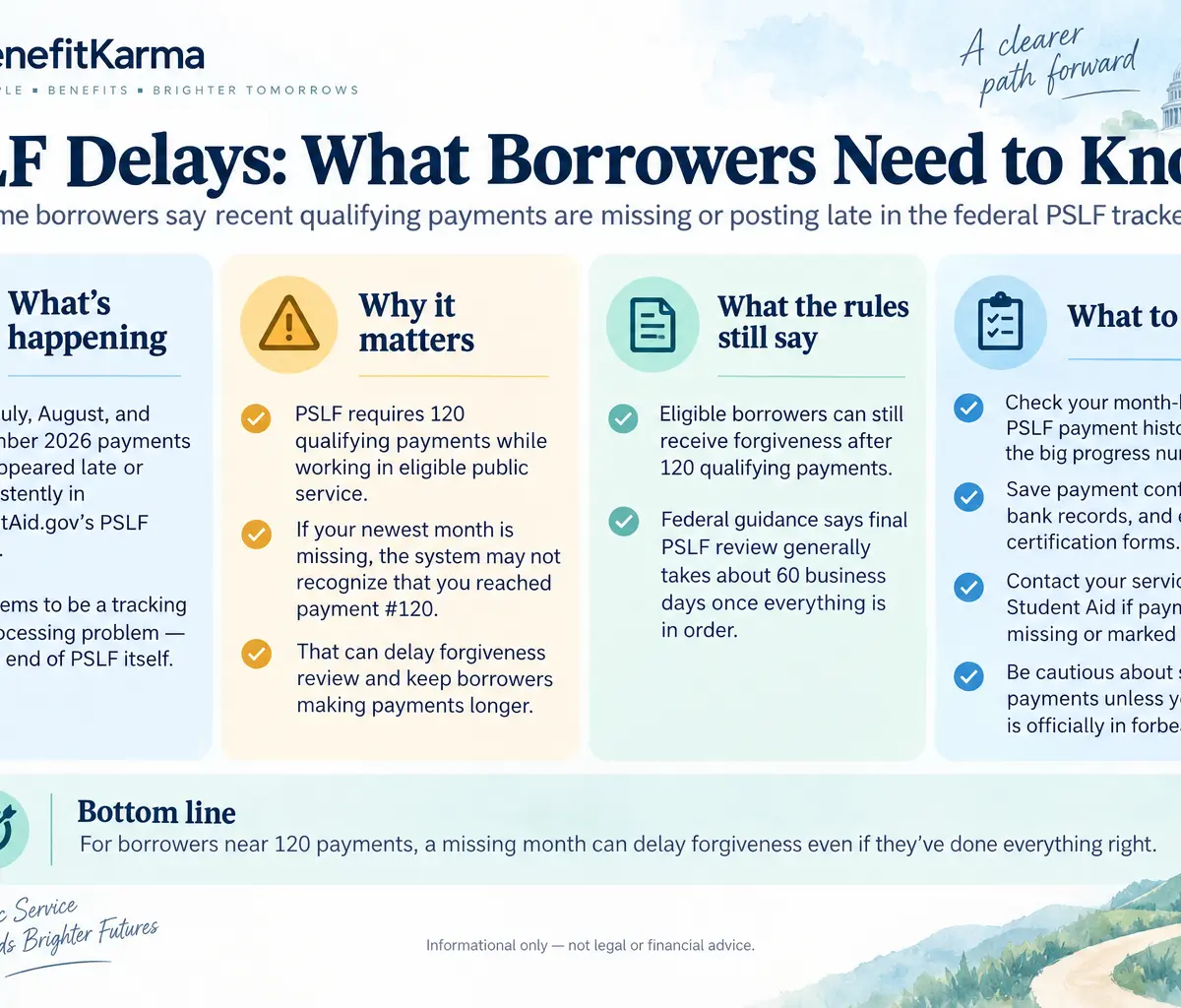
In recent weeks, borrowers have reported that payments made in July, August and September 2026 are missing from or arriving late in the Public Service Loan Forgiveness (PSLF) tracker on StudentAid.gov. For someone years away from forgiveness, a delayed update may be mostly an administrative headache. For someone whose missing month is payment No. 120, it can prevent the U.S. Department of Education from formally recognizing that the borrower qualifies for cancellation.
The problem does not mean PSLF has been eliminated. Federal Student Aid still says eligible borrowers can receive forgiveness of the remaining balance on their Direct Loans after 120 qualifying monthly payments while meeting the program’s employment and repayment requirements.
But if recent payments are not appearing in the federal system, a borrower can wind up in an awkward position: they may have made the payments required by the program, while the government’s own tracker still says they have not.
What’s happening with PSLF payment counts?
PSLF works by counting qualifying months toward a total of 120. Borrowers submit a PSLF form so the Education Department can verify qualifying employment and update their payment counts.
Federal Student Aid says that once a borrower reaches 120 qualifying payments and submits the necessary form, the department conducts a final review. Its current guidance says that review generally takes about 60 business days.
But that process depends on the underlying payment history being accurate and up to date.
Forbes first highlighted the worsening problem Sept. 18, citing borrowers who said July, August and September payments were not showing correctly in their PSLF trackers even after they had paid and submitted employment certification.
Independent borrower reports show a messier picture than a complete shutdown. Some borrowers saw July and August finally appear in September. Others continued to report one or more missing months as recently as Sept. 20, including people who said September should have been their 120th qualifying payment.
The College Investor also reported Sept. 20 that borrowers are dealing with two separate payment-count problems at once: delays in posting some recent payments and, for some accounts, reductions in older qualifying-payment totals as the Education Department corrects what it says were earlier counting errors.
That distinction matters. A recent month that simply has not appeared yet is different from a month that appears but is labeled ineligible. Borrowers near forgiveness should look not only at the headline number on the PSLF dashboard, but at the month-by-month payment history.
Why this becomes a serious problem at 119 or 120 payments
For a borrower with 80 qualifying payments, a recent month arriving late may eventually become a minor inconvenience.
For someone sitting at 119, it can stop the forgiveness process.
Federal Student Aid says borrowers should continue making payments while a PSLF form is being processed unless their loans are in forbearance. Its PSLF form also gives borrowers who believe they qualify for forgiveness the option to request that payments be postponed while their application is reviewed.
The catch is that forbearance can create problems if the borrower turns out to be short of 120 qualifying payments. The PSLF form warns that months spent in forbearance generally do not count toward the 120-payment requirement.
That puts borrowers with missing payment records in a difficult spot. They may believe they have completed the program, but if the federal tracker shows only 118 or 119 qualifying payments, stopping payments could add another nonqualifying month if the dispute is not resolved in their favor.
Continuing to make payments can also be frustrating — and expensive — after a decade of qualifying public service. But Federal Student Aid says payments made after the effective date of PSLF forgiveness can be applied to other outstanding federal student loans or refunded if there are no other loans remaining.
In other words, borrowers should not assume that reaching what they believe is payment No. 120 automatically means they can safely stop paying. The account status and forbearance decision matter.
The delays come amid broader strains at Federal Student Aid
The PSLF tracker problem is not happening in a vacuum.
Free DIY tool
Benefit Eligibility Screener
What benefits might I qualify for? Answer a few questions and see VA, disability, food, housing, and health programs that may fit you.
Try the free toolThe Education Department announced a large reduction in force in March 2025. The department said at the time that core federal student-aid functions, including student-loan servicing, would continue.
A June 2026 review by the Education Department’s Office of Inspector General found that at least 1,579 employees had left the department through layoffs and other separation programs during the period it examined.
The Government Accountability Office has also documented a steep reduction specifically within Federal Student Aid. GAO reported that FSA staffing fell from 1,433 employees in January 2025 to 777 by December 2025. It also found that the agency stopped some quarterly reviews of loan-servicer accuracy and call quality because officials said they lacked sufficient staff capacity.
Those findings do not establish that staffing cuts caused the current PSLF payment-count delays. But they show that the office responsible for the federal student-loan system has been operating with substantially fewer employees while simultaneously managing major changes to repayment and forgiveness programs.
As of Sept. 19, Business Insider reported that the Education Department had not provided a timeline for resolving the recent PSLF count problems.
What should you do if your PSLF payments are missing?
If you are close to 120 qualifying payments, start by checking more than the large progress number on your StudentAid.gov dashboard.
Open your PSLF payment history and compare the qualifying months against your own records. Look for months that are completely absent as well as months that appear but are marked ineligible. Federal Student Aid allows borrowers to view both eligible and qualifying payments within their StudentAid.gov accounts.
Then preserve your documentation. That can include monthly billing statements, payment confirmations, bank records, PSLF forms, employer certifications and messages from your loan servicer or Federal Student Aid.
If you believe your qualifying-payment count or PSLF determination is wrong, Federal Student Aid has a reconsideration process, and borrowers can use its feedback system to report problems involving federal loans, servicers or Education Department processes.
It may also be worth contacting your loan servicer if a payment appears correctly in the servicer’s records but is missing from the PSLF tracker. The servicer and StudentAid.gov do not necessarily update at the same time.
Most importantly, be cautious about simply stopping payments because your own records say you have reached 120. Federal guidance says borrowers should continue paying while their PSLF request is being processed unless the account is in forbearance.
What about PSLF Buyback?
Some borrowers who have 120 months of qualifying public-service employment but are short of 120 qualifying payments may have another option: PSLF Buyback.
The program allows certain borrowers to make a payment to receive PSLF credit for eligible months spent in deferment or forbearance that otherwise would not count.
There are important limits. Federal Student Aid guidance says you must already have 120 months of qualifying employment, and buying back the eligible months must result in forgiveness.
Buyback is not a solution for every missing-payment problem. A payment that was actually made but has not appeared in the tracker is fundamentally a recordkeeping issue, not necessarily a month that needs to be bought back.
And buyback itself has faced reports of long processing times, so borrowers should not assume it will provide an immediate workaround.
The bottom line
The current PSLF problem is less about a change in who qualifies for forgiveness than about whether the federal system can accurately and promptly recognize borrowers who have already reached the finish line.
For people at 118, 119 or 120 qualifying payments, a missing month is not just a website glitch. It can mean another bill, another employment certification, another complaint or reconsideration request, and more time waiting for a benefit they have spent years working toward.
For now, borrowers close to forgiveness should keep their own records, verify their payment history month by month, submit employment certification, challenge incorrect counts through the available federal channels and make any decision about stopping payments or requesting forbearance carefully.
If you eventually receive PSLF and made payments beyond your effective forgiveness date, Federal Student Aid says those excess payments can be refunded or applied to other federal student-loan debt.
This article is for informational purposes only and is not legal or financial advice.
Not sure what you qualify for?
A quick conversation can help you understand your options.
Optional — no obligation, fees may apply
Want help figuring out your next step?
Optional — fees may apply depending on your situation.
Some people choose to talk to a professional before taking their next step.
This might sound familiar:
You're not sure what to do next
You want someone to walk through your options
The process feels overwhelming
If that sounds like you, this might be worth a quick look.
Takes less than a minute
We only share your info with a service provider if you say yes.
Recommended Tools
Take action with our free tools
Get More from BenefitKarma
Create a free account to unlock all features
- Access premium benefit tools
- Personalized benefit matching
- Your personalized dashboard
Common questions about this guide
Get more from BenefitKarma
Free tools, personalized dashboard & more