The ACA Subsidy Cliff Is Back in 2026 — and Self-Employed Workers Need to Watch Their Income
Freelancers and small-business owners can lose thousands of dollars in ACA premium assistance if their household income crosses a hard limit. Here's how the 2026 rules work — and why tracking your income matters.

Free DIY tool
Benefit Eligibility Screener
What benefits might I qualify for? Answer a few questions and see VA, disability, food, housing, and health programs that may fit you.
Try the free toolFor millions of Americans who buy their own health insurance, an old Affordable Care Act problem has returned in 2026: the ACA subsidy cliff.
The enhanced Premium Tax Credits that made Marketplace coverage cheaper between 2021 and 2025 expired on Dec. 31, 2025. That means the original income ceiling for receiving federal premium assistance is back.
For self-employed workers, freelancers and sole proprietors, that can be especially important.
Unlike most salaried workers, people who work for themselves may not know exactly how much they'll earn until late in the year. A strong quarter, an unexpectedly large contract or a year-end payment can push household income over the ACA's subsidy cutoff.
And in 2026, crossing that line can mean losing the Premium Tax Credit completely.
What is the ACA subsidy cliff?
The Premium Tax Credit helps eligible households pay monthly premiums for health insurance purchased through the ACA Marketplace.
From 2021 through 2025, temporary enhanced subsidies did two big things: they increased the amount of help available to many Marketplace customers, and they eliminated the ACA's old upper-income limit for receiving a subsidy.
Those enhancements have now expired.
Under the IRS rules in effect for 2026, households generally must have income no higher than 400% of the federal poverty level to qualify for the Premium Tax Credit.
For 2026 Marketplace coverage in the 48 contiguous states and Washington, D.C., that works out to approximately:
$62,600 for one person, $84,600 for a two-person household, $106,600 for three people and $128,600 for a family of four.
Those figures come from the 2025 federal poverty guidelines used to determine subsidy eligibility for 2026 coverage. Alaska and Hawaii have higher thresholds.
And unlike a gradual phaseout, 400% of poverty is a cliff.
Consider a single self-employed person whose household income finishes just below $62,600. They may qualify for a federal tax credit that substantially lowers their Marketplace premium.
If their qualifying household income instead finishes above $62,600, they generally no longer qualify for a Premium Tax Credit at all.
That makes a relatively small income difference capable of producing a much larger change in health insurance costs.

The subsidy cliff matters especially for self-employed workers
For an employee earning a fixed salary, estimating annual income may be relatively straightforward.
Self-employment is different.
A freelance designer might earn $3,000 one month and $8,000 the next. A contractor might receive a large payment in December for work that was expected to be paid in January. A small-business owner's profit can change considerably depending on expenses and year-end sales.
HealthCare.gov specifically tells self-employed applicants to estimate their net self-employment income, meaning business income after deductible business expenses, when applying for Marketplace coverage. It also recommends updating that estimate if income changes during the year. HealthCare.gov explains the self-employment income rules here.
That matters because Marketplace assistance is based on the income you ultimately report for the year — not simply the estimate you made when enrolling.
BenefitKarma's guide to ACA subsidies explains the broader calculation and how premium assistance reduces the amount consumers pay for Marketplace coverage.
It's MAGI — not simply your business revenue — that matters
One misconception worth clearing up: the ACA does not look at the total amount your business brings in.
Marketplace subsidy eligibility is generally determined using Modified Adjusted Gross Income, or MAGI, for your tax household.
For many people, ACA MAGI is their adjusted gross income from their federal tax return plus certain types of otherwise untaxed income, including tax-exempt interest, nontaxable Social Security benefits and excluded foreign income.
HealthCare.gov's MAGI guide explains the calculation.
For someone who files Schedule C, legitimate business expenses already reduce the net business profit that flows into the income calculation. Other allowable deductions can also affect adjusted gross income.
That means a freelancer with $90,000 in gross business revenue does not necessarily have $90,000 in ACA household income.
But it also means self-employed people near the 400% cutoff should pay attention to the number that actually matters long before tax filing season arrives.
Some pretax contributions can affect the calculation
This is where year-end planning can become important.
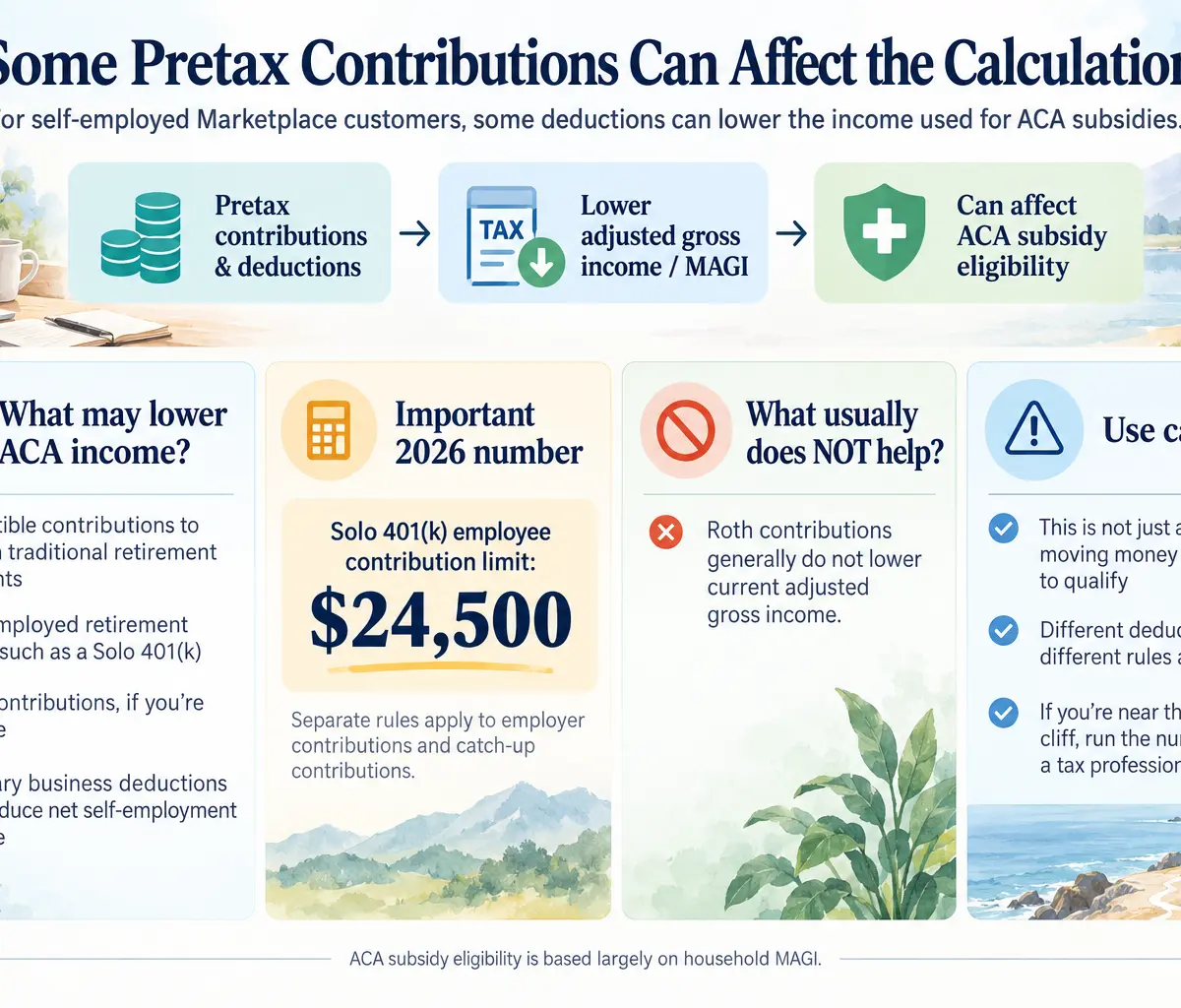
Because Marketplace eligibility is tied largely to adjusted gross income, some legitimate tax deductions can reduce the income used in the subsidy calculation.
For example, deductible contributions to certain traditional retirement accounts or self-employed retirement plans may lower adjusted gross income. The IRS says the basic employee contribution limit for a 401(k), including a one-participant or Solo 401(k), is $24,500 in 2026, with separate rules governing employer contributions and catch-up contributions. See the IRS's 2026 retirement contribution limits.
BenefitKarma also has a guide to retirement plans available to small-business owners.
Health Savings Account contributions may also be deductible when you are eligible to contribute to an HSA. And ordinary, legitimate business deductions reduce net self-employment income in the first place.
Free DIY tool
Benefit Eligibility Screener
What benefits might I qualify for? Answer a few questions and see VA, disability, food, housing, and health programs that may fit you.
Try the free toolBut this is not as simple as moving money around to “qualify for Obamacare.”
Different deductions have different eligibility requirements and deadlines, and Roth retirement contributions generally do not reduce current adjusted gross income. A contribution should make financial sense on its own, not merely be made to chase a subsidy.
If you're within a few thousand dollars of the ACA cutoff, this is one situation where running the numbers with a tax professional before the end of the year can be worthwhile.
There's another wrinkle: the self-employed health insurance deduction
Self-employed taxpayers may also be eligible to deduct some or all of the cost of health insurance for themselves and their families.
But there is a catch when the same taxpayer also receives a Premium Tax Credit.
The self-employed health insurance deduction and the Premium Tax Credit can affect each other's calculations. The IRS has special worksheets and even an iterative calculation method for people eligible for both. IRS Publication 974 explains how the two interact.
In other words, this is an area where seemingly simple online advice such as “just deduct your premiums to get below the ACA cliff” can become misleading.
The final calculation can be considerably more complicated.
The loss of enhanced subsidies is already showing up in 2026
The subsidy cliff isn't only a tax-planning issue. The broader expiration of enhanced ACA assistance has already changed the Marketplace.
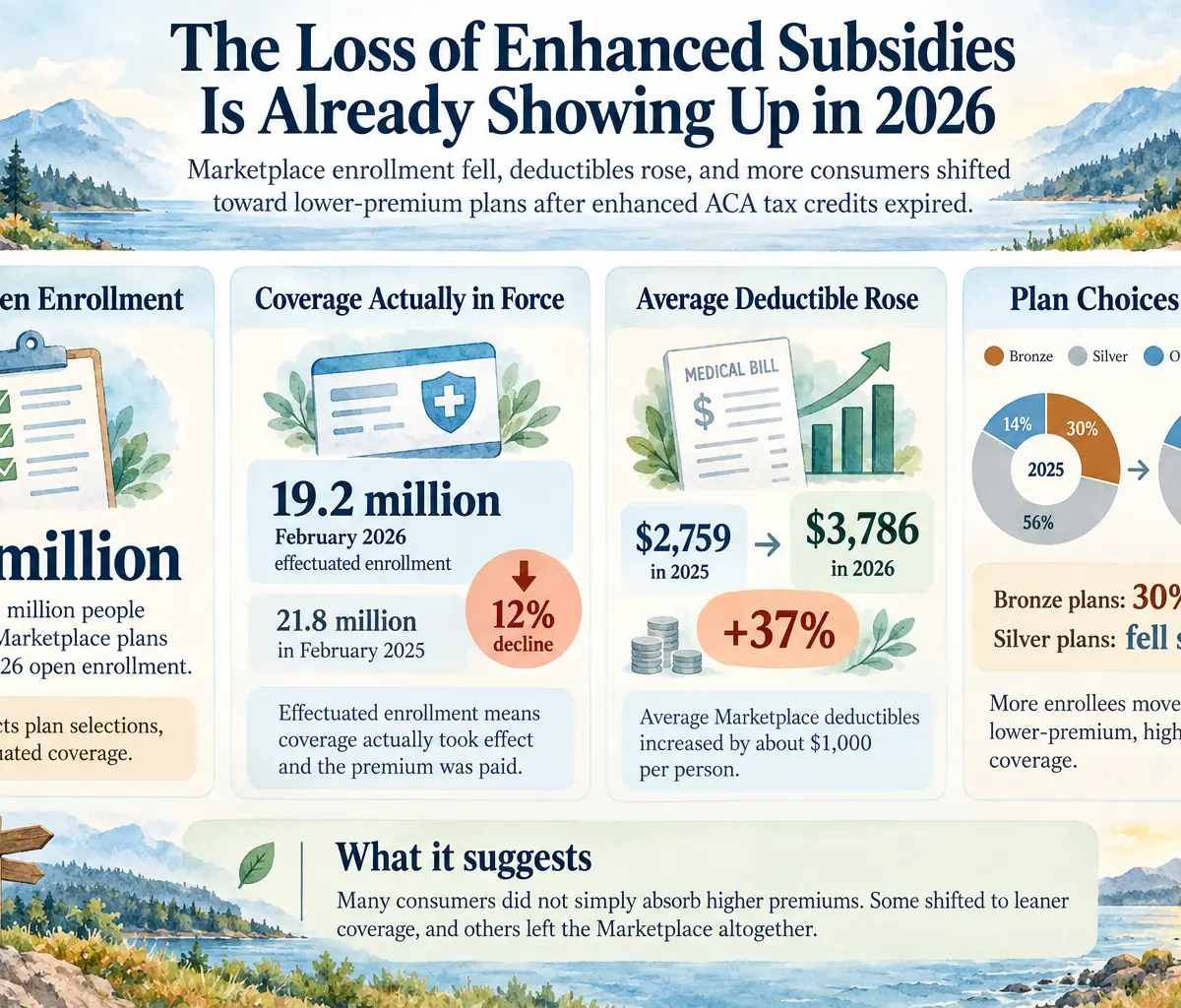
Nearly 23 million people selected Marketplace plans during the 2026 open-enrollment period, according to CMS.
But signing up for a plan and actually maintaining coverage are different things.
KFF's analysis of federal enrollment data found that 19.2 million people had effectuated Marketplace coverage in February 2026, down from 21.8 million a year earlier — a 12% decline. An effectuated enrollee is someone whose coverage actually took effect and whose required premium was paid. KFF's state-by-state enrollment analysis found declines in every state except New Mexico.
BenefitKarma previously examined why Medicaid and ACA enrollment has been falling in 2026, including the role of expiring financial assistance and other federal policy changes.
Costs changed, too.
KFF found that the average Marketplace deductible increased 37%, from $2,759 in 2025 to $3,786 in 2026. Enrollment also shifted toward lower-premium Bronze plans: Bronze selections grew from 30% to 40% of Marketplace enrollment, while Silver plan selections fell sharply.
Those numbers suggest many consumers didn't simply absorb higher premiums. Some changed the kind of coverage they purchased — and others left the Marketplace altogether.
People below the cliff still get less help than they did in 2025
The return of the 400% income cutoff gets much of the attention, but it isn't the only change.
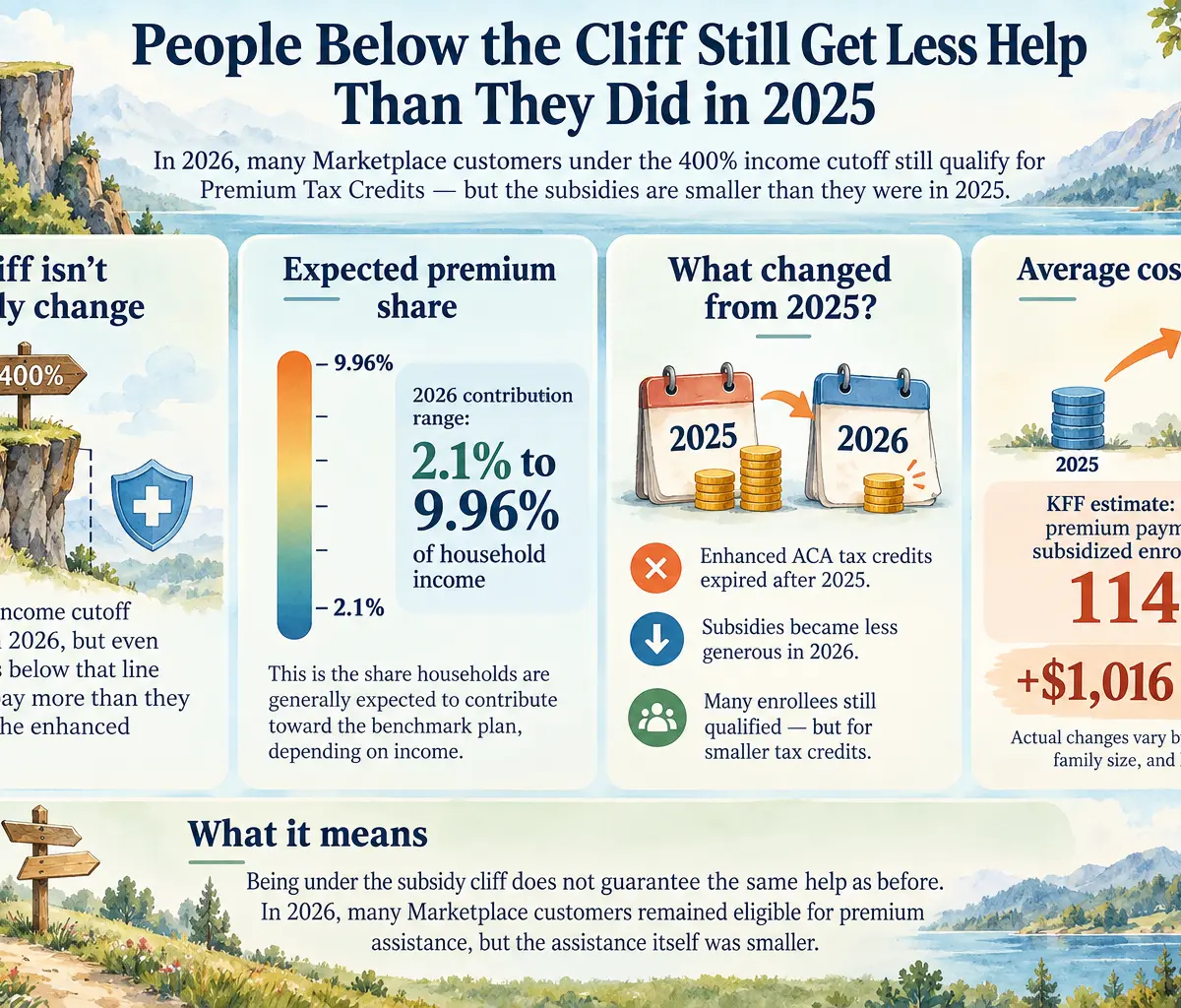
People who remain below the subsidy cliff can still qualify for Premium Tax Credits, but the enhanced subsidy formula used through 2025 is gone.
For 2026, the IRS contribution table generally expects subsidy-eligible households to contribute between 2.1% and 9.96% of household income toward the benchmark Marketplace plan, depending on income. The IRS published the 2026 contribution percentages here.
That means many people under the cliff are paying more, too.
KFF estimated that the expiration of the enhanced credits would increase average premium payments among subsidized Marketplace enrollees by 114%, or about $1,016 annually. The actual amount varies enormously based on age, income, family size and location. KFF offers a calculator for estimating the 2026 impact.
What should self-employed Marketplace customers do?
The most important step is not waiting until tax season to figure out what your income was.
Keep your books current and periodically estimate your full-year household income, especially if you're anywhere near the 400% federal poverty level.
If business improves or a large payment changes your expected income, update your Marketplace application rather than continuing to rely on an outdated estimate. HealthCare.gov warns that people who receive more advance Premium Tax Credit than they ultimately qualify for may have to repay excess assistance when filing their federal return.
You can also review whether you're claiming legitimate business deductions and whether retirement or HSA contributions that already fit your financial plans could change your adjusted gross income.
And don't automatically assume the plan you used in 2026 will remain your best choice next year.
Marketplace insurers are currently proposing a median 15% premium increase for 2027, according to KFF's analysis of filings from insurers nationwide, although final changes will vary by insurer and location. KFF's analysis of proposed 2027 rates.
Open enrollment is therefore worth treating as an active shopping period rather than simply allowing a plan to renew.
BenefitKarma's step-by-step ACA Marketplace enrollment guide can help you compare coverage and understand how the process works.
The bottom line
The ACA subsidy cliff has returned in 2026, and self-employed workers have a particular reason to pay attention.
For households near 400% of the federal poverty level, a relatively small change in annual income can determine whether they receive thousands of dollars in Marketplace premium assistance or no federal Premium Tax Credit at all.
That does not mean freelancers should try to suppress income just to qualify for a subsidy. Earning more money is generally a good problem to have.
It does mean that income, taxes and health insurance are now more tightly connected for self-employed Marketplace customers than they were during the enhanced-subsidy years.
Knowing your projected income before Dec. 31 — rather than discovering it when you prepare your taxes months later — can help you understand that tradeoff while you still have time to make legitimate financial decisions.
Not sure what you qualify for?
A quick conversation can help you understand your options.
Optional — no obligation, fees may apply
Want help figuring out your next step?
Optional — fees may apply depending on your situation.
Some people choose to talk to a professional before taking their next step.
This might sound familiar:
You're not sure what to do next
You want someone to walk through your options
The process feels overwhelming
If that sounds like you, this might be worth a quick look.
Takes less than a minute
We only share your info with a service provider if you say yes.
Recommended Tools
Take action with our free tools
Get More from BenefitKarma
Create a free account to unlock all features
- Access premium benefit tools
- Personalized benefit matching
- Your personalized dashboard
Common questions about this guide
Get more from BenefitKarma
Free tools, personalized dashboard & more
