Can Getting Married Cost You Government Benefits? The Marriage Penalty Explained

Free DIY tool
Benefit Eligibility Screener
What benefits might I qualify for? Answer a few questions and see VA, disability, food, housing, and health programs that may fit you.
Try the free toolFor most people, getting married changes their taxes, insurance and household finances. For some Americans who depend on government benefits, however, marriage can also reduce monthly assistance — or, in a few cases, end a benefit altogether.
That is what advocates usually mean by the “marriage penalty” in public benefits. But the phrase can be misleading because there is no single government-wide marriage penalty. Different programs use different rules, and some benefits are not affected by marriage at all.
The clearest example is Supplemental Security Income (SSI), where federal rules explicitly pay an eligible couple less than two eligible individuals could receive separately.
SSI Has a Built-In Couple Reduction
SSI provides monthly payments to people who are 65 or older, blind or disabled and who have limited income and resources.
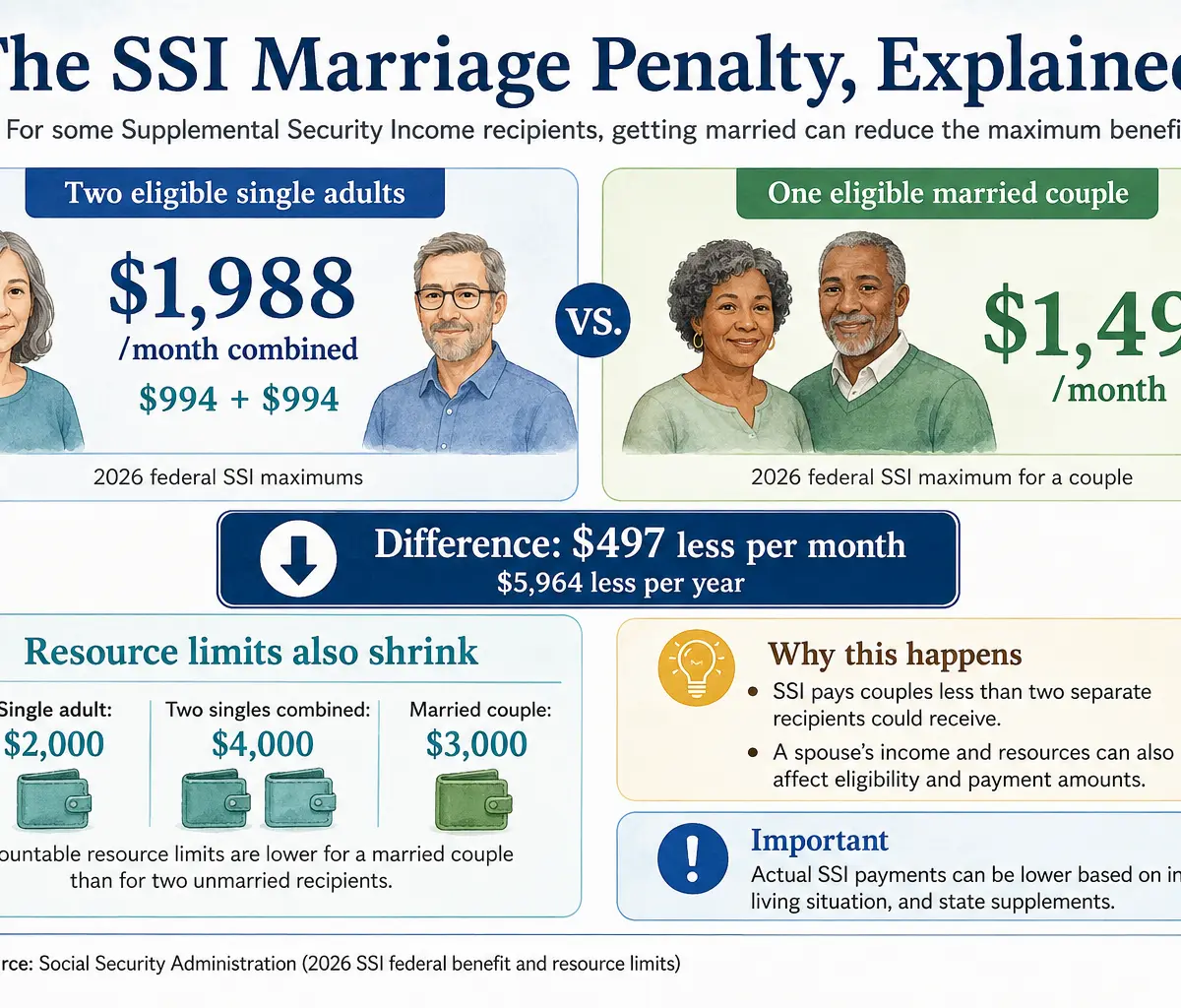
In 2026, the maximum federal SSI payment is $994 per month for an individual. Two eligible individuals could therefore receive up to $1,988 combined, assuming no other reductions apply.
The maximum for an eligible married couple, however, is $1,491.
That is $497 less per month — exactly 25% below the combined maximum for two individuals.
The resource limits work similarly. An individual can generally have no more than $2,000 in countable resources and remain eligible for SSI, while a couple is limited to $3,000. Two unmarried individuals could potentially have $4,000 between them; a married SSI couple gets only 75% of that combined limit. Those federal resource limits have not increased since 1989.
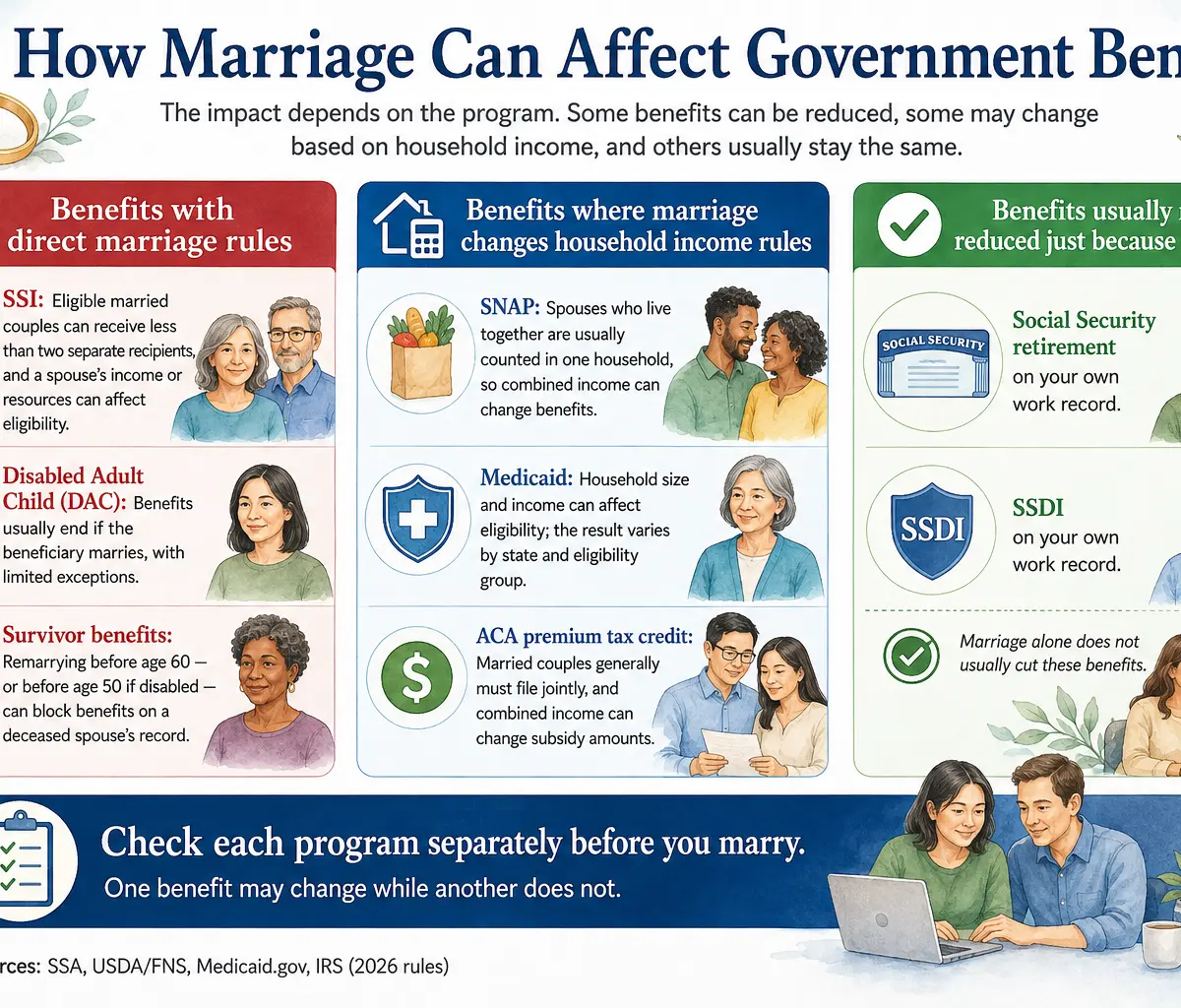
Marriage can matter even when only one spouse receives SSI. Social Security uses a process called “deeming,” under which some income and resources belonging to a spouse who does not receive SSI can be treated as available to the SSI recipient. Exclusions and allowances apply, so Social Security does not simply count every dollar a spouse earns. But depending on the household’s finances, deeming can reduce the SSI payment or make the recipient ineligible.
There is another wrinkle: avoiding a marriage license does not always guarantee that two people will be treated as single for SSI. Social Security can treat two people living together as a married couple if they “hold themselves out” to the community as married. Current SSA guidance says that if both people say they are not holding themselves out as married and there is no evidence to the contrary, further investigation is not necessary.
Some Disabled Adult Child Benefits Can End After Marriage
A separate marriage issue affects some people receiving Social Security benefits as a Disabled Adult Child, or DAC.
DAC benefits are paid on a parent’s Social Security record to an adult whose qualifying disability began before age 22. Unlike SSI, this is a Social Security benefit based on the parent’s work history.
But marital status matters. Social Security says that in most cases, DAC benefits end if the beneficiary marries. There are exceptions, including some marriages to another Social Security beneficiary, so the exact circumstances matter.
That can make the financial stakes much larger than the loss of a monthly check alone. DAC entitlement can also provide access to Medicare, and federal Medicaid rules provide special protections for certain people who lost SSI after becoming eligible for DAC benefits.
Survivor Benefits Have Remarriage Rules, Too
Social Security survivor benefits can also be affected by remarriage.
Generally, a surviving spouse or surviving divorced spouse who remarries before age 60 cannot receive survivor benefits on the prior spouse’s record while that marriage continues. Different rules apply to disabled surviving spouses beginning at age 50. Remarriage at or after the applicable age generally does not block survivor benefits.
Free DIY tool
Benefit Eligibility Screener
What benefits might I qualify for? Answer a few questions and see VA, disability, food, housing, and health programs that may fit you.
Try the free toolBy contrast, Social Security retirement benefits and SSDI benefits based on your own work record normally do not change simply because you get married.
That distinction is important: saying “Social Security has a marriage penalty” is too broad. Some Social Security-related benefits have marriage rules; others do not.
SNAP, Medicaid and ACA Subsidies Work Differently
Other safety-net programs can create a financial downside to marriage without imposing a fixed marriage penalty.
For SNAP, spouses who live together must generally be included in the same SNAP household even if they buy and prepare food separately. Eligibility and benefit amounts then depend on the household’s combined circumstances, including income, allowable deductions and household size. A larger household gets higher income limits, but combining two adults’ income can still reduce or eliminate benefits in some cases.
One important distinction: an unmarried couple that already lives together and buys and prepares food together is generally already considered one SNAP household. So marriage itself will not necessarily change anything.
Medicaid can be similar. For most children, parents and working-age adults whose eligibility is determined using Modified Adjusted Gross Income, or MAGI, household composition and taxable income matter. Federal Medicaid guidance says a married person living with a spouse generally includes that spouse in the Medicaid household. Because Medicaid income limits vary by state and eligibility group, marriage can result in a loss of coverage for one person in some households, while making little or no difference in others. Different rules apply to many people qualifying for Medicaid on the basis of age, disability or long-term-care needs.
Marketplace health-insurance subsidies also use tax-family income. Married couples generally must file a joint federal tax return to qualify for the Premium Tax Credit, with limited exceptions such as certain cases involving domestic abuse or spousal abandonment. Combining income can change the size of the subsidy — and therefore what a household pays for coverage.
In other words, these programs are better understood as household-income effects than automatic penalties for saying “I do.”
Congress Has Proposals to Change the Disability Marriage Rules
The issue has attracted bipartisan attention in Congress, although the major proposals have not become law.
The Eliminating the Marriage Penalty in SSI Act, introduced as S. 73 and H.R. 1757, would prevent marriage from reducing SSI for certain adults with intellectual or developmental disabilities by changing how marital status and a spouse’s income and resources are treated. The Senate version was introduced by Sens. Jerry Moran, R-Kan., and Chris Van Hollen, D-Md.; the House version by Reps. David Valadao, R-Calif., and Susie Lee, D-Nev.
A separate proposal, the Marriage Equality for Disabled Adults Act (H.R. 1389), would address marriage-related rules for Disabled Adult Child beneficiaries.
As of September 2026, those bills have not become law, so current benefit rules still apply.
Check the Numbers Before Changing Your Marital Status
For anyone receiving a means-tested or dependent benefit, it is worth checking how marriage would affect each program separately before getting married.
That means looking beyond the monthly cash benefit. A change in SSI or DAC eligibility can potentially affect health coverage, while a new household-income calculation can change SNAP, Medicaid or Marketplace assistance at the same time.
And because these programs use different definitions of income, resources, spouses and households, one benefit may change while another does not.
The “marriage penalty” is therefore both real and more complicated than the name suggests. For some SSI recipients and disabled adults receiving benefits on a parent’s record, marriage can trigger a direct financial loss. For many other benefit recipients, the effect depends on household income and program-specific rules — and for people receiving Social Security retirement or SSDI on their own work record, marriage may have no effect on the benefit at all.
Not sure what you qualify for?
A quick conversation can help you understand your options.
Optional — no obligation, fees may apply
Want help figuring out your next step?
Optional — fees may apply depending on your situation.
Some people choose to talk to a professional before taking their next step.
This might sound familiar:
You're not sure what to do next
You want someone to walk through your options
The process feels overwhelming
If that sounds like you, this might be worth a quick look.
Takes less than a minute
We only share your info with a service provider if you say yes.
Recommended Tools
Take action with our free tools
Get More from BenefitKarma
Create a free account to unlock all features
- Access premium benefit tools
- Personalized benefit matching
- Your personalized dashboard
Common questions about this guide
Get more from BenefitKarma
Free tools, personalized dashboard & more