2027–28 FAFSA Changes: What Students and Families Need to Know

Students planning to attend college, career school or trade school during the 2027–28 academic year can already apply for federal financial aid.
The Free Application for Federal Student Aid (FAFSA) for 2027–28 opened to the public on Sept. 23, 2026, more than a week ahead of the federal Oct. 1 deadline. The form covers students attending school between July 1, 2027, and June 30, 2028.
That earlier start matters because FAFSA is used for much more than federal student loans. It can help determine eligibility for grants, work-study, state aid and financial aid offered by colleges themselves. Some of those programs have limited funding, so filing early can improve a student’s chances of receiving aid before certain pools of money run out.
This year’s form also includes several changes meant to make the process faster and easier to understand. And outside the form itself, a major expansion of Pell Grant eligibility could make federal aid available for some short-term workforce training programs that previously did not qualify.
Here’s what students and families need to know.
The 2027–28 FAFSA opened on Sept. 23
The U.S. Department of Education opened the 2027–28 FAFSA to everyone on Sept. 23 after a summer beta-testing period.
Students who submitted the form during the beta period do not need to file it again.
The federal government is emphasizing speed this year. Federal Student Aid says people typically complete their own section of the online FAFSA in about 12 minutes or less, although the total process can take longer when a parent, spouse or other contributor must complete a separate section.
The FAFSA is free. Students can start the official form at StudentAid.gov.
What can FAFSA help pay for?
Completing the FAFSA does not guarantee that a student will receive financial aid, but it is the main application used to determine eligibility for several kinds of assistance.
That can include the Federal Pell Grant, which generally does not need to be repaid, as well as federal student loans and the Federal Work-Study program.
States and colleges also use FAFSA information when awarding some of their own grants, scholarships and other assistance.
Students who are still comparing their options can also review BenefitKarma’s broader guide to education benefits and tuition assistance programs.

What changed on the 2027–28 FAFSA?
The biggest changes are designed to reduce confusion and cut down on repetitive steps.
Federal Student Aid says the 2027–28 form uses clearer language in several places, including questions about a student’s school plans, high school completion and homelessness. The “Personal Circumstances” section is now called “Background,” and the signature area has been renamed “Review & Sign.”
The agency has also changed the contributor invitation process.
A student who needs information from a parent or spouse can now send an invitation by text message in addition to email. The online form can generate a QR code that opens a customized text invitation, making it easier to get the right person connected to the application.
Later this fall, returning students are also expected to see more information pre-populated from a previous FAFSA. Federal Student Aid says parents with more than one child applying for aid will be able to reuse information across applications rather than entering the same details over and over.
Those changes may sound small, but they address some of the most common friction points in a process that often requires several people to complete separate parts of the same application.
You’ll use 2025 tax information
For the 2027–28 FAFSA, students and families generally report income and tax information from 2025.
The online form can obtain most federal tax information directly from the Internal Revenue Service (IRS). That automatic transfer is not new this year, but it remains one of the most important parts of the process.
Students and required contributors must give consent for their federal tax information to be transferred. Federal Student Aid says a student generally cannot receive federal student aid if a required contributor refuses to provide that consent, even if the family could otherwise type some tax information into the form manually.
Students should still have access to their 2025 tax records in case the FAFSA asks for information that is not transferred automatically.
One important detail: the FAFSA asks for marital status as of the day the form is completed, even though it uses 2025 income information. That can create extra steps for families whose household situation has changed since filing that tax return.
Federal Student Aid provides instructions for completing the 2027–28 form, including how to handle contributors and tax information.
What if your income has dropped since 2025?
Using older tax information can make a family’s finances look very different from what they are today.
A parent may have lost a job. A household may have experienced a divorce, a reduction in hours or major unreimbursed medical expenses. A student may also have experienced a significant financial change.
In those situations, students should still complete the FAFSA using the information the form requests.
After the FAFSA is submitted, the student can contact the financial aid office at the school they plan to attend and ask whether the school can review the change in circumstances. Financial aid administrators can sometimes adjust FAFSA data when a family’s current financial situation is not accurately reflected by the required tax year.
Do not simply substitute 2026 or 2027 income for the requested 2025 tax information on the FAFSA.

Some family assets still do not have to be reported
Rules introduced with the 2026–27 FAFSA continue to affect the way certain family assets are treated.
Under current federal rules, families generally do not report the net worth of a family-owned business with 100 or fewer full-time employees, a farm where the family lives, or a family-owned commercial fishing business and related expenses.
Those exclusions can matter because FAFSA information is used to calculate the Student Aid Index (SAI), a number colleges use when determining a student’s financial need.
The SAI is not a bill and it is not the amount a family is expected to write a check for. In general, a lower SAI signals greater financial need.
Families with larger businesses, investment property or other reportable assets may still need to provide asset information.
Workforce Pell opens a new door for short-term training
One of the biggest financial-aid developments affecting this FAFSA cycle is happening outside the form itself.
The new Workforce Pell Grant program took effect July 1, 2026. It allows eligible students to use Pell Grant funding for certain approved short-term workforce programs tied to high-skill, high-wage or in-demand jobs.
Eligible programs can be much shorter than a traditional degree. Under the federal rules, they generally run at least eight weeks but less than 15 weeks and include at least 150 but fewer than 600 clock hours of instruction, or the credit-hour equivalent.
Not every short-term certificate program qualifies. The program itself must meet federal requirements and go through the required approval process.
There is also an unusual exception for some students who already have a bachelor’s degree. A bachelor’s degree normally makes someone ineligible for Pell Grant funding, but otherwise-eligible students can receive Pell for an approved workforce program as long as they have not earned a graduate credential and are not enrolled in a graduate program.
That could make the FAFSA more relevant to career changers and adults returning to school for short-term training. BenefitKarma also has a guide to grants for adult learners for people comparing other funding options.
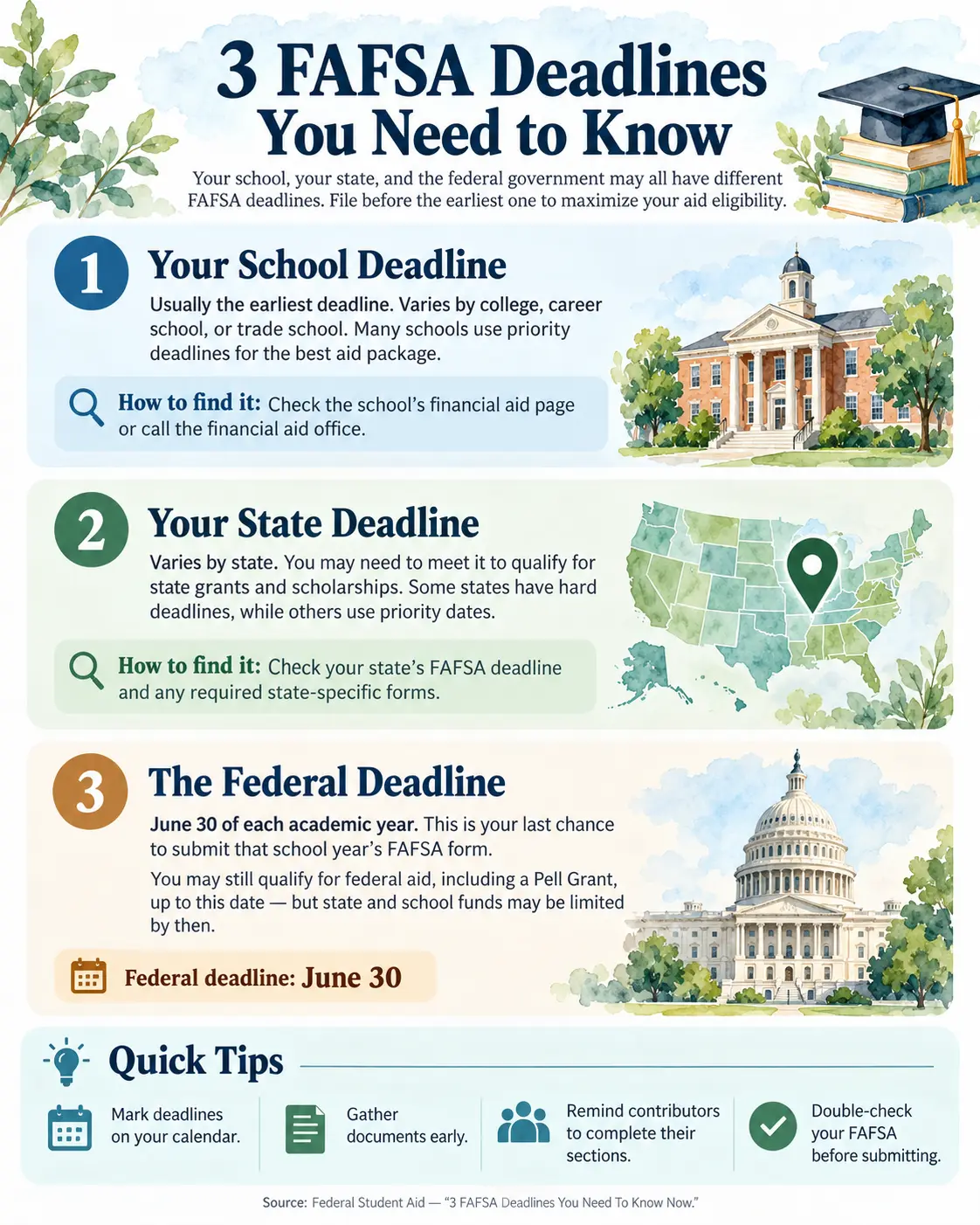
Don’t wait for the federal deadline
The federal FAFSA deadline for the 2027–28 academic year is June 30, 2028.
But treating that as the real deadline can cost students money.
States and schools often have much earlier priority deadlines, and some aid is awarded only while funding remains available. Federal Student Aid recommends checking all three deadlines: the school deadline, the student’s state deadline and the federal deadline.
Its FAFSA deadline guide explains how the three types of deadlines work.
Students do not need to know exactly where they will enroll before filing. They can list schools they are considering and update the FAFSA later.
What students should do before starting
A little preparation can prevent the FAFSA from stalling halfway through.
Students should make sure they have their own StudentAid.gov account and confirm which parent, spouse or other contributor may need to participate. Each required contributor needs a separate account.
It also helps to have 2025 tax records available, even though most federal tax information will transfer automatically.
Students should make a list of schools they are considering and check state and college priority deadlines before assuming they have months to decide.
Families expecting to borrow after grants and scholarships should also understand the difference between student debt and loans taken out by parents. BenefitKarma’s guide to Parent PLUS loans explains how those loans work and who is legally responsible for repayment.
Students from low-income families or families with limited experience navigating college can also look for Federal TRIO programs, which may provide free advising and college-preparation support.
And students looking for additional ways to cover education costs may want to explore the AmeriCorps Education Award, which can be earned after completing qualifying national service.
The bottom line
The 2027–28 FAFSA is already open, and students planning to attend school between July 1, 2027, and June 30, 2028, do not need to wait until next year to apply for aid.
The form itself is becoming easier to navigate, with clearer wording, new ways to invite contributors and less repeated data entry for some returning families.
At the same time, the expansion of Pell funding to approved short-term workforce programs means FAFSA may now matter to some students who would not have thought of federal financial aid as an option before.
The most important move is still the simplest one: file early, use the official FAFSA website, and pay attention to the earliest state or school deadline that applies to you.
Not sure what you qualify for?
A quick conversation can help you understand your options.
Optional — no obligation, fees may apply
Natural-sounding narration — pause, scrub, or speed up anytime.
Want help figuring out your next step?
Optional — fees may apply depending on your situation.
Some people choose to talk to a professional before taking their next step.
This might sound familiar:
You're not sure what to do next
You want someone to walk through your options
The process feels overwhelming
If that sounds like you, this might be worth a quick look.
Takes less than a minute
We only share your info with a service provider if you say yes.
Recommended Tools
Take action with our free tools
Get More from BenefitKarma
Create a free account to unlock all features
- Access premium benefit tools
- Personalized benefit matching
- Your personalized dashboard
Common questions about this guide
Get more from BenefitKarma
Free tools, personalized dashboard & more