What Is SSI? Supplemental Security Income Explained for 2027
We'll share the basics, essentials, and FAQs regarding SSI: eligibility, applying, payment schedules, benefit amounts, and more.

Free DIY tool
Benefit Eligibility Screener
What benefits might I qualify for? Answer a few questions and see VA, disability, food, housing, and health programs that may fit you.
Try the free toolSupplemental Security Income (SSI) is a federal program that provides monthly cash payments to people with very limited income and resources who are age 65 or older, blind, or have a qualifying disability.
SSI is administered by the Social Security Administration (SSA), but it is not the same as Social Security retirement benefits or Social Security Disability Insurance (SSDI). You do not need a work history to qualify, and SSI is funded through general federal revenues rather than Social Security payroll taxes.
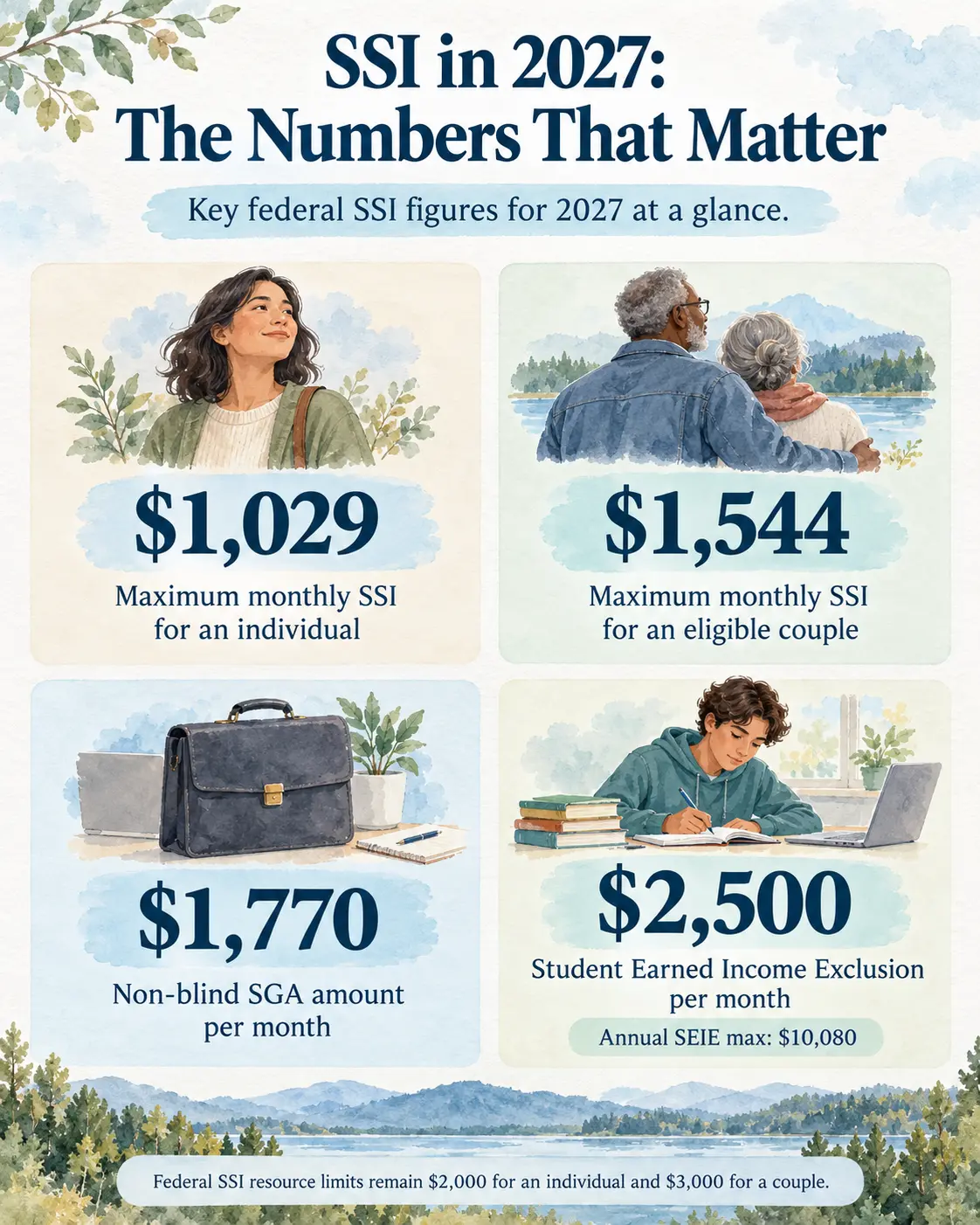
For 2027, the maximum federal SSI payment is $1,029 per month for an individual and $1,544 for an eligible couple. Those amounts reflect the 3.6% cost-of-living adjustment for 2027.
Your actual payment can be lower because of other income, household circumstances or help you receive with shelter costs. Some states also add their own supplemental payment.
Want help figuring out which benefits you may qualify for? Sign up for a free BenefitKarma account.
What Is SSI?
SSI is a needs-based benefit for people who meet both a personal eligibility test and a financial test.
You may qualify because you:
- Are age 65 or older.
- Meet Social Security's definition of blindness.
- Have a qualifying disability.
SSI for children also provides benefits based on disability, although SSA uses a different standard for children.
Because SSI is based on financial need, SSA also looks at your income, resources and, in some cases, the finances of a spouse or parent.
SSI vs. SSDI: What Is the Difference?
SSI vs. SSDI can be confusing because both programs can pay benefits to people with disabilities, but they use different rules.
The simplest distinction is:
- SSDI is insurance earned through your work history.
- SSI is based on financial need.
SSDI generally requires enough work credits from jobs covered by Social Security. SSI does not require work credits.
Some people qualify for both programs at the same time. These are known as concurrent benefits.
For example, someone with a qualifying disability and a small SSDI payment may still receive SSI if their countable income and resources remain within SSI's rules. The SSDI payment generally counts as unearned income when SSA calculates SSI.
Our guide to SSDI, SSI and Medicaid explains how these programs can overlap.
Who Qualifies for SSI?
To receive SSI, you generally must meet an age, blindness or disability category and satisfy the program's financial and residency requirements.
Age 65 or older
People age 65 or older can qualify without proving they have a disability. They still have to meet SSI's income and resource rules.
Blindness
SSA generally considers someone blind if central visual acuity is 20/200 or worse in the better eye with correction, or the visual field in the better eye is limited to no more than 20 degrees.
Disability for adults
For adults under age 65, SSI disability generally requires a medically determinable physical or mental condition that prevents substantial work and has lasted or is expected to last at least 12 months, or is expected to result in death.
At the application stage, SSA also considers Substantial Gainful Activity (SGA).
For 2027:
| Applicant | 2027 SGA amount |
|---|---|
| Non-blind | $1,770/month |
| Blind | $2,950/month |
Disability for children
A child under 18 can qualify if a medically determinable impairment causes marked and severe functional limitations and meets SSA's duration requirement.
When a child lives with parents, SSA may use deeming, which means some parental income and resources are treated as belonging to the child.
Citizenship and residency
SSI is available to U.S. citizens and nationals who meet the other requirements, and some noncitizens can qualify under specific immigration categories.
You generally must live in one of the 50 states, the District of Columbia or the Northern Mariana Islands.
SSI Income Limits Are Not One Simple Number
A common question is: How much can I make and still get SSI?
There is no single answer.
SSA treats wages, SSDI, pensions, unemployment benefits and income from a spouse or parent differently.
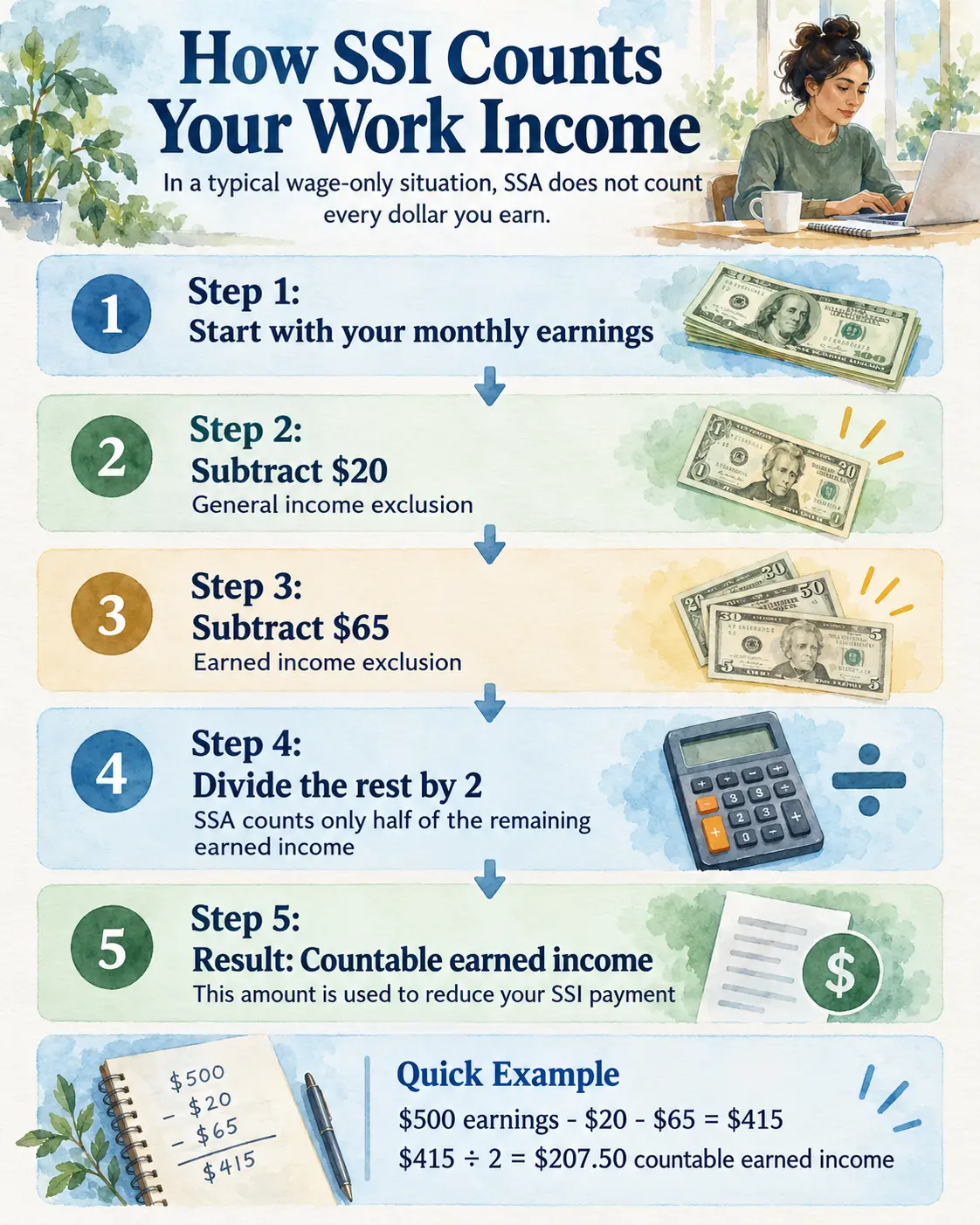
In general, SSA excludes the first $20 of most income each month.
For earned income from work, SSA also generally excludes the first $65 of earnings and then counts only half of the remaining earned income.
That means working does not usually reduce your SSI payment dollar for dollar.
Marriage can also matter. If you live with a spouse, some of your spouse's income and resources may be counted as yours.
For children, some parental income and resources can also be deemed to the child.
The important number is your countable income after exclusions and deeming rules, not simply your gross income.
SSI Resource Limits in 2027
Unlike the monthly SSI payment, the federal resource limits did not increase with the 2027 COLA.
They remain:
| Household | 2027 resource limit |
|---|---|
| Individual | $2,000 |
| Couple | $3,000 |
Cash, bank accounts, stocks, bonds and property you do not live in may count.
Your primary home generally does not. One vehicle used for transportation is generally excluded, along with household goods and personal belongings.
Certain burial funds, qualifying special-needs trusts and eligible ABLE accounts may also be excluded.
How Much Does SSI Pay in 2027?
The maximum federal SSI payment for 2027 is:
- $1,029 per month for one eligible person
- $1,544 per month for an eligible couple
- $516 per month for an essential person
For comparison:
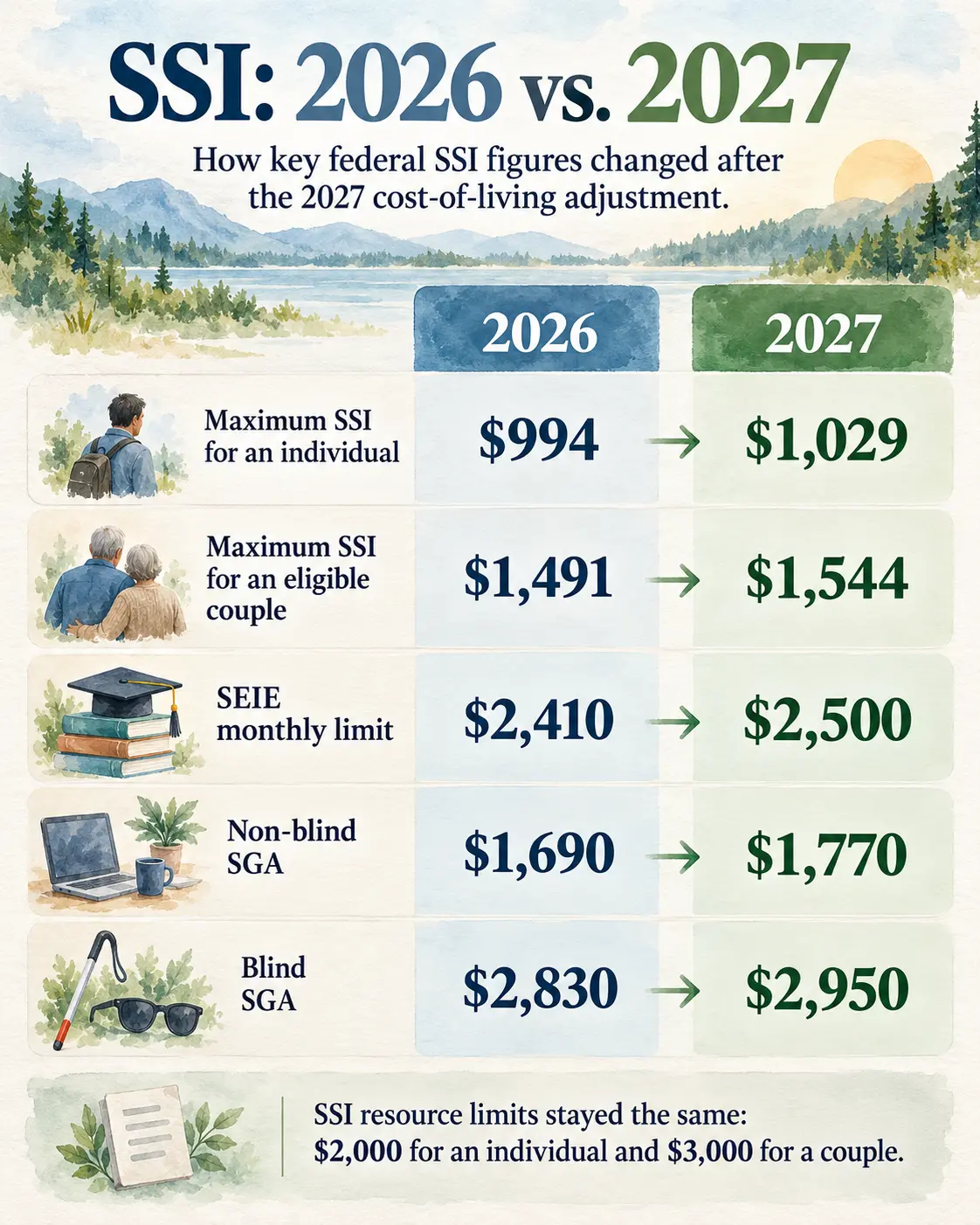
| Recipient | 2026 | 2027 |
|---|---|---|
| Individual | $994 | $1,029 |
| Eligible couple | $1,491 | $1,544 |
| Essential person | $498 | $516 |
These are maximum federal amounts, not guaranteed checks.
SSA reduces the federal payment based on your countable income and may also adjust it based on certain living arrangements.
When Does the 2027 SSI Increase Start?
The 3.6% COLA applies to January 2027 SSI benefits.
Because January 1, 2027 is a federal holiday, the January payment will instead be issued on December 31, 2026.
You do not need to apply for the increase. SSA adjusts eligible payments automatically.
Can Help With Housing Reduce SSI?
Sometimes.
Free DIY tool
Benefit Eligibility Screener
What benefits might I qualify for? Answer a few questions and see VA, disability, food, housing, and health programs that may fit you.
Try the free toolIf someone else pays some or all of your shelter costs, SSA may treat some of that help as in-kind support and maintenance.
Shelter expenses can include rent, mortgage payments, property taxes, utilities and other housing costs.
One important rule changed in 2024: food provided by another person no longer counts as in-kind support and maintenance.
So if a relative buys groceries for you, that help no longer reduces SSI under the old food-related rule. Help with shelter can still affect your payment.
State SSI Supplements
Some states add a supplemental payment on top of federal SSI.
The amount and eligibility rules vary by state and sometimes by living arrangement.
That means some recipients can receive more than the federal maximum of $1,029 for an individual or $1,544 for a couple.
How to Apply for SSI
If you think you may qualify, it is usually better to start promptly because SSI generally does not pay benefits for months before your application.
You can begin through SSA's SSI application system, call 1-800-772-1213, or contact a local Social Security office.
SSA may ask for information about:
- Identity and age
- Citizenship or qualifying immigration status
- Bank accounts and resources
- Wages and other income
- Household members
- Living arrangements
For disability claims, be ready to provide details about medical conditions, doctors, treatment, medications, tests and recent work.
Do not wait until every record is in your hands before contacting SSA. Starting promptly can help protect your filing date.
If approved, your notice will explain your monthly payment, the date eligibility began and whether you are owed past-due benefits.
SSI does not have the five-month waiting period used for SSDI.
Can You Work While Receiving SSI?
Yes.
Working does not automatically end SSI.
In a typical wage-only situation, SSA can:
- Apply the $20 general income exclusion.
- Apply the $65 earned-income exclusion.
- Count only half of the remaining earnings.
Student Earned Income Exclusion
For 2027, qualifying students under age 22 who regularly attend school can exclude up to:
- $2,500 of earnings per month
- $10,080 for the calendar year
That is up from $2,410 per month and $9,730 per year in 2026.
The Student Earned Income Exclusion is applied before the standard SSI earned-income exclusions, making it especially useful for younger recipients taking a part-time job, internship or summer position.
Other work incentives may also apply.
A Plan to Achieve Self-Support can allow certain income or resources to be set aside for an approved work goal. Ticket to Work can help recipients explore employment and training.
Under Section 1619(b), some people whose earnings become too high for an SSI cash payment can continue receiving Medicaid if they meet the program's requirements.
If you receive SSI and work, report your wages. Unreported earnings can create an SSA overpayment.
What Other Benefits Can Come With SSI?
In most states, SSI recipients may also qualify for Medicaid.
In many states, SSI eligibility is connected directly to Medicaid eligibility. Other states require a separate application.
SSI recipients may also qualify for the Supplemental Nutrition Assistance Program (SNAP).
SSI generally counts as income when the SNAP agency determines eligibility and benefit amounts.
Does Social Security Review SSI After Approval?
Yes.
An SSI redetermination checks financial and nonmedical eligibility, including income, resources and living arrangements.
A Continuing Disability Review (CDR) checks whether someone receiving SSI because of disability still meets Social Security's medical requirements.
Children also face an important transition at age 18, when SSA generally reevaluates disability using the adult standard.
What Changes Do You Need to Report?
Because SSI depends on income, resources and living arrangements, report important changes promptly.
These can include:
- Starting or stopping work
- Changes in wages
- Changes in bank balances or other resources
- Receiving an inheritance or settlement
- Marriage or divorce
- Moving
- Changes in who pays shelter costs
- Relevant changes in a spouse's or parent's income
Prompt reporting can reduce the risk of an SSI overpayment.
What If Your SSI Application Is Denied?
You have the right to appeal most SSI decisions.
The process generally moves through reconsideration, a hearing before an administrative law judge, Appeals Council review and, if necessary, federal district court.
In general, you have 60 days after receiving a notice to request the next level of appeal.
Shorter deadlines can apply if you are already receiving SSI and want payments to continue during certain appeals, so read the notice carefully.
Common Questions About SSI
Can I get SSI if I have never worked?
Yes. SSI does not require Social Security work credits.
Can I receive SSI and SSDI at the same time?
Yes. Some people qualify for both. SSDI generally counts as income for SSI, so the SSI payment may be reduced.
Can I own a home or car and still get SSI?
Usually, yes. Your primary home generally does not count toward the SSI resource limit, and one vehicle used for transportation is generally excluded.
Will someone buying food for me reduce my SSI?
No, not under the old food-related in-kind support rule. Since September 30, 2024, SSA no longer counts food provided by other people when determining in-kind support and maintenance.
Is SSI taxable?
No. SSI payments are not taxable for federal income-tax purposes.
The Bottom Line
SSI is a federal safety-net program for older adults and people with disabilities or blindness who have very limited income and resources.
For 2027, the maximum federal SSI payment rises to $1,029 per month for an individual and $1,544 for an eligible couple because of the 3.6% COLA.
Other important 2027 changes include:
- Non-blind SGA: $1,770 per month
- Blind SGA: $2,950 per month
- Student Earned Income Exclusion: $2,500 per month and $10,080 per year
- SSI resource limits: unchanged at $2,000 for an individual and $3,000 for a couple
Your actual SSI payment depends on countable income, household circumstances, living arrangements and any state supplement.
If you think you may qualify, start with Social Security rather than trying to calculate every rule before applying. Because SSI generally cannot pay benefits for months before your application, delaying the process can cost you benefits.
Need help with your disability claim?
Talk to a specialist who handles disability claims like yours.
SSDI has strict filing windows — delays can affect your benefits start date.
Optional — no obligation, fees may apply
Want help figuring out your next step?
Optional — fees may apply depending on your situation.
Some people choose to talk to a professional before taking their next step.
This might sound familiar:
You're not sure what to do next
You want someone to walk through your options
The process feels overwhelming
If that sounds like you, this might be worth a quick look.
Takes less than a minute
We only share your info with a service provider if you say yes.
Recommended Tools
Take action with our free tools
Get More from BenefitKarma
Create a free account to unlock all features
- Access premium benefit tools
- Personalized benefit matching
- Your personalized dashboard
Common questions about this guide
Get more from BenefitKarma
Free tools, personalized dashboard & more
