Report: Trump Admin Drafts Plan to Pay Some Stay-at-Home Parents

Free DIY tool
Benefit Eligibility Screener
What benefits might I qualify for? Answer a few questions and see VA, disability, food, housing, and health programs that may fit you.
Try the free toolA new Trump administration proposal could eventually allow some married families to receive federal child care assistance even when one parent stays home to care for their own children — a major shift for a program historically designed to help lower-income parents work, attend school, or complete job training.
The New York Times first reported the draft proposal on Sept. 5, based on a document reviewed by reporter Coral Davenport and conversations with people familiar with the administration’s discussions. The proposal has not been formally published, and no new benefit is available yet.
If the plan moves forward, however, it could change who qualifies for billions of dollars distributed through the Child Care and Development Fund, or CCDF.
What the proposed benefit would do
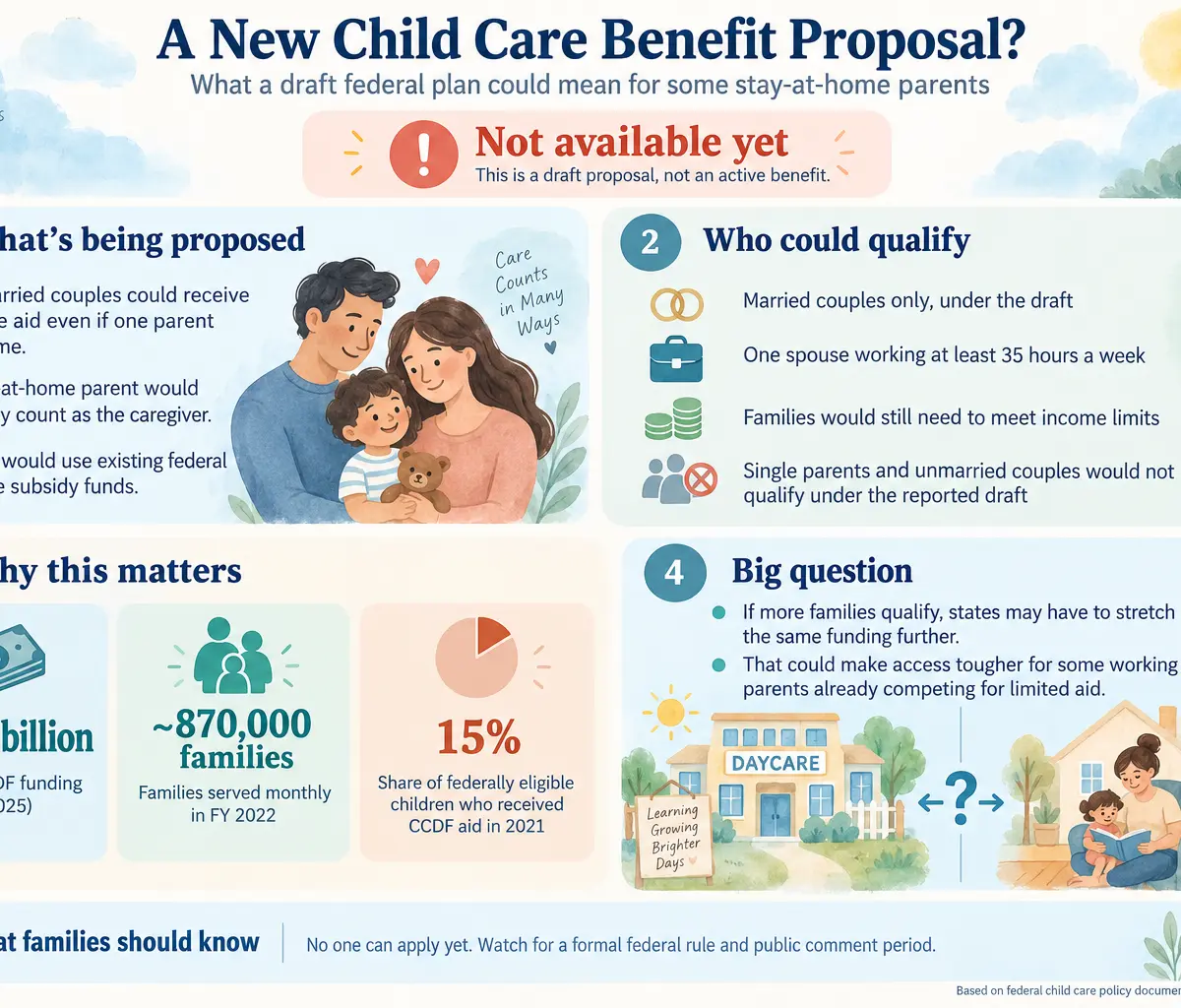
According to the Times, the draft would create a new category called “parent-based child care.” A married couple could potentially receive CCDF assistance when one spouse stays home to care for the couple’s child and the other works at least 35 hours per week.
The stay-at-home parent would effectively be treated as the child care provider, allowing the family to receive money that is currently generally used to pay a child care center, family child care home, relative, or other eligible provider.
The draft described by The Times would apply only to married couples. Unmarried couples with one stay-at-home parent would not qualify under the version reported, and single parents who are not working would remain ineligible.
Those details are important because the draft itself is not yet public. Until the Department of Health and Human Services formally releases a proposed rule, eligibility limits, payment amounts, start dates, and other requirements could still change.
Where the money would come from
The proposal would not create an entirely new federal family benefit. Instead, it would draw from the existing Child Care and Development Fund, administered by HHS through the Administration for Children and Families.
Federal records show that CCDF received about $12.3 billion in federal funding for fiscal year 2025. The program served more than 1.4 million children in roughly 870,000 families each month in fiscal year 2022, the latest nationwide figures cited by HHS in a January 2026 Federal Register notice.
That distinction matters because CCDF funding is limited. It is not an entitlement like Social Security retirement benefits, where everyone who meets the statutory requirements is automatically guaranteed payment. States receive federal grants and make decisions about eligibility, priorities, and enrollment within federal rules and available funding.
A 2025 Government Accountability Office report found that only about 15% of children eligible under federal rules received CCDF subsidies in 2021.
So if a new group of stay-at-home parents becomes eligible without Congress adding substantially more money to the program, states could face a larger pool of families competing for the same assistance.
That does not mean current recipients would automatically lose their benefits. Exactly how states would implement the change — and whether additional funding would accompany it — is not yet known.
Who qualifies for CCDF now?
Current federal regulations generally require a child to be younger than 13, live in a family earning no more than 85% of the state median income, and live with a parent or parents who are working or attending a job-training or educational program. Children receiving or needing protective services can also qualify under separate provisions.
Free DIY tool
Benefit Eligibility Screener
What benefits might I qualify for? Answer a few questions and see VA, disability, food, housing, and health programs that may fit you.
Try the free toolStates can impose lower income limits, so actual eligibility varies considerably depending on where you live.
The existing work-or-school language is also one reason the legal details of the administration’s proposal will be worth watching. Federal law itself defines an eligible child using similar language about residing with a parent or parents who are working or attending job training or an educational program.
A future HHS rule would therefore need to explain how the new “parent-based child care” category fits within that statute. Until the actual rule is published, it is difficult to evaluate the administration’s legal reasoning.
The Times also reported that some HHS lawyers involved in the discussions have already raised legal questions about another part of the proposal: limiting the new benefit specifically to married couples.
This idea did not come out of nowhere
The policy has roots in proposals that predate the current draft.
Project 2025, the Heritage Foundation policy blueprint published before President Trump returned to office, specifically called for prioritizing home-based child care. It proposed that federal funding go to parents either to help offset the cost of staying home with a child or to pay for family-based, in-home care.
Former Sen. Marco Rubio, now Secretary of State, also introduced the Respect Parents’ Childcare Choices Act in 2024. The legislation proposed expanding federal recognition of in-home and relative caregivers within the Child Care and Development Block Grant program, although it did not become law.
And the administration has continued emphasizing family choice in child care policy. Earlier this year, Administration for Children and Families officials urged states to make greater use of existing flexibility to support married two-parent families and families that choose to have a parent remain home with young children.
The potential audience is significant. Pew Research Center found that 18% of U.S. parents did not work for pay in 2021. Fathers represented about 18% of stay-at-home parents, meaning mothers made up the large majority.

What families should do now
For now, there is nothing to apply for.
The proposal reported by The New York Times is still a draft. If the White House approves it for publication, HHS would generally publish a proposed rule and open a public-comment period before issuing a final regulation. The details could be revised substantially during that process.
Families currently receiving child care assistance should continue following the rules of their existing state program. Families with a stay-at-home parent should not assume they will qualify for a federal payment in 2027 or make employment decisions based on the proposal yet.
But this is one to watch closely.
If finalized in anything close to its reported form, it would represent a fundamental change in federal child care policy: using the country’s largest child care subsidy program not only to help parents pay someone else for care, but potentially to pay some parents for providing that care themselves.
BenefitKarma will continue tracking the proposal if and when HHS publishes it, including who qualifies, how much families could receive, and how the change might affect people already receiving child care assistance.
Not sure what you qualify for?
A quick conversation can help you understand your options.
Optional — no obligation, fees may apply
Want help figuring out your next step?
Optional — fees may apply depending on your situation.
Some people choose to talk to a professional before taking their next step.
This might sound familiar:
You're not sure what to do next
You want someone to walk through your options
The process feels overwhelming
If that sounds like you, this might be worth a quick look.
Takes less than a minute
We only share your info with a service provider if you say yes.
Recommended Tools
Take action with our free tools
Get More from BenefitKarma
Create a free account to unlock all features
- Access premium benefit tools
- Personalized benefit matching
- Your personalized dashboard
Common questions about this guide
Get more from BenefitKarma
Free tools, personalized dashboard & more
