New Bipartisan Bill Could Expand the Child Tax Credit for 3.5 Million Working Families

Free DIY tool
Benefit Eligibility Screener
What benefits might I qualify for? Answer a few questions and see VA, disability, food, housing, and health programs that may fit you.
Try the free toolA bipartisan bill newly introduced in the House could make the federal Child Tax Credit more valuable for millions of lower-income working families by letting the refundable portion of the credit begin with the first dollar a parent earns.
The Stronger Start for Working Families Act was introduced Sept. 3 by Reps. Carol Miller, R-W.Va.; Steven Horsford, D-Nev.; María Elvira Salazar, R-Fla.; and Chris Pappas, D-N.H. Newsweek brought fresh attention to the House proposal over Labor Day weekend, but the legislation has actually been building for months: Sens. Maggie Hassan, D-N.H., and Todd Young, R-Ind., introduced a Senate version back in January.
The change itself is small enough to fit in a few lines of legislative text. Its impact could be much larger.
How the Child Tax Credit works now
For 2026, the federal Child Tax Credit is worth up to $2,200 per qualifying child under age 17. But that does not mean every eligible family receives $2,200.
For households with little or no federal income-tax liability, part of the credit can be paid as a refund through the Additional Child Tax Credit, or ACTC. The IRS says the refundable portion is capped at $1,700 per qualifying child for 2026.
There is another limitation: families currently need at least $2,500 in earned income before the refundable credit begins building. Above that threshold, the refundable amount generally phases in at 15 cents for each additional dollar earned, subject to the other limits that apply.
That structure is why some of the families with the lowest earnings receive a smaller credit than families earning more.
The Center on Budget and Policy Priorities estimates that about 19 million children under age 17 will receive less than the full $2,200 credit in 2026 — or no credit at all — because their families’ incomes are too low.
What the new bill would change
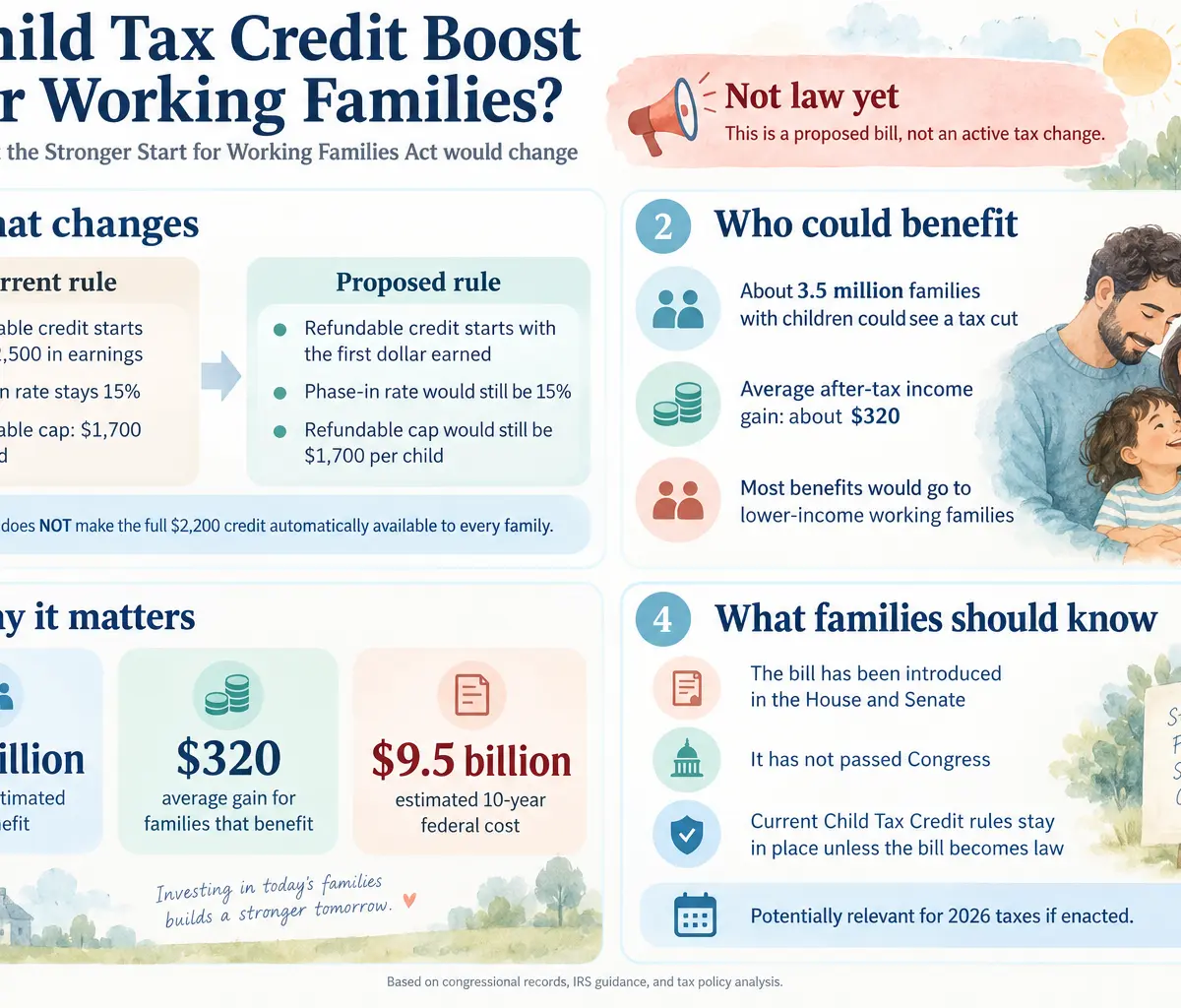
The Stronger Start for Working Families Act would effectively lower the $2,500 earnings threshold to $1.
In practical terms, a qualifying family could begin building a refundable Child Tax Credit almost as soon as it has earned income instead of having the first $2,500 of earnings excluded from the calculation.
That is an important distinction from saying the bill would give every working family the full $2,200 Child Tax Credit.
It would not.
The existing 15% phase-in would remain, as would the $1,700 cap on the refundable portion. Families would still have to satisfy the Child Tax Credit’s other eligibility requirements.
Tax Policy Center researchers estimate that the change would lower taxes for about 3.5 million families with children. Among families that benefit, after-tax income would rise by about $320 on average, according to its April analysis.
The gains would also be heavily concentrated among lower-income households: the Tax Policy Center estimates that families in the bottom 20% of the income distribution would receive 85% of the proposal’s total benefits.
What would not change
This is a targeted expansion rather than a recreation of the much broader Child Tax Credit temporarily available in 2021.
Free DIY tool
Benefit Eligibility Screener
What benefits might I qualify for? Answer a few questions and see VA, disability, food, housing, and health programs that may fit you.
Try the free toolThe proposal does not make the CTC fully refundable. It does not eliminate the connection between the refundable credit and earned income, and it does not raise the $1,700 refundable maximum.
It also would not erase the other eligibility rules surrounding the Child Tax Credit.
Generally, a qualifying child must be under 17 at the end of the tax year and meet the IRS relationship, residency and dependent requirements. The full credit also begins phasing out at higher incomes — currently $200,000 for most individual filers and $400,000 for married couples filing jointly.
The bill also does not reverse the Social Security number requirements currently attached to the credit.
So “all working families” is best understood as shorthand for removing the current minimum-earnings barrier. It does not mean every household with a worker and a child would automatically qualify for a payment.
A bipartisan proposal now has bills in both chambers
The House version, H.R. 10282, was referred to the House Ways and Means Committee after its Sept. 3 introduction. Its original sponsor group includes two Republicans and two Democrats.
The Senate companion, S. 3596, was introduced Jan. 8 by Hassan and Young and referred to the Senate Finance Committee. Sen. Catherine Cortez Masto, D-Nev., later announced that she had joined the legislation.
That bipartisan lineup does not guarantee passage, but it gives the proposal a different profile from many recent Child Tax Credit fights, which have often divided Congress over whether the credit should be tied to work and how refundable it should be.
The Stronger Start proposal preserves the connection to earned income while making the first dollars of work count toward the refundable credit.
What would it cost?
The Tax Policy Center estimates that the change would reduce federal revenue by about $9.5 billion over 10 years.
That is considerably more limited than proposals to make the entire Child Tax Credit fully refundable.
Researchers at the center note that even with the Stronger Start change, many lower-income households would continue receiving less than the full $2,200-per-child credit because of the 15% phase-in and $1,700 refundability cap.
In other words, the bill would narrow one gap in the current CTC rather than eliminate all of them.
Could this affect your 2026 taxes?
Potentially — but not yet.
The text of both the House and Senate bills says the change would apply to tax years beginning after Dec. 31, 2025. If Congress ultimately passes the legislation in its current form and the president signs it, that language could make the new calculation applicable to 2026 income, which most taxpayers would report on returns filed in 2027.
For now, however, the existing rules remain in place.
Families should not calculate an expected refund using the proposed $1 threshold unless the legislation becomes law and the IRS updates its guidance.
BenefitKarma will be watching this one closely. A change of only $2,499 in the tax code’s earnings threshold sounds technical, but for millions of families near the bottom of the income scale, it could mean a larger refund — and for some workers with very low earnings, access to a refundable Child Tax Credit that currently starts at zero.
Not sure what you qualify for?
A quick conversation can help you understand your options.
Optional — no obligation, fees may apply
Want help figuring out your next step?
Optional — fees may apply depending on your situation.
Some people choose to talk to a professional before taking their next step.
This might sound familiar:
You're not sure what to do next
You want someone to walk through your options
The process feels overwhelming
If that sounds like you, this might be worth a quick look.
Takes less than a minute
We only share your info with a service provider if you say yes.
Recommended Tools
Take action with our free tools
Get More from BenefitKarma
Create a free account to unlock all features
- Access premium benefit tools
- Personalized benefit matching
- Your personalized dashboard
Common questions about this guide
Get more from BenefitKarma
Free tools, personalized dashboard & more
