Child Care Assistance in 2026: How Child Care Subsidies Work
Child care subsidies can cover a big share of daycare costs for working families. Here's who qualifies for child care assistance, what changed in 2026 and how to apply.

Updated November 2026 to reflect the 2026 CCDF final rule, new federal child care guidance and 2026 tax changes for working parents.
Free DIY tool
Benefit Eligibility Screener
What benefits might I qualify for? Answer a few questions and see VA, disability, food, housing, and health programs that may fit you.
Try the free toolChild care can cost as much as rent, and for many families it's the single biggest monthly bill after housing. That's where child care assistance comes in. Child care subsidies help low- and moderate-income families pay for care so parents can work, go to school or train for a new job.
Below, we'll explain how child care subsidies work, who qualifies, how much help you can expect, what changed in 2026 and how to apply in your state. If you're not sure what else your family might qualify for, our free Benefit Eligibility Screener can give you a quick read in a few minutes.
What is child care assistance?
Child care assistance (often called a child care subsidy or child care voucher) is financial help that covers part of what you pay a child care provider. It's one of several family and education benefit programs designed to make it easier for parents to keep working.
Most subsidies are paid for by the Child Care and Development Fund (CCDF), the main federal program dedicated to helping working families with low incomes afford child care. Congress enacted $12.381 billion in CCDF funding for federal fiscal year 2026, which is distributed by formula to states, territories and tribes. Each state then runs its own subsidy program under its own name and rules. (For a quick definition, see our glossary entry on CCDF.)
Some states also add their own money, and some move part of their TANF block grant into child care. Federal law lets states transfer up to 30% of their TANF funds into CCDF.
How do child care subsidies work?
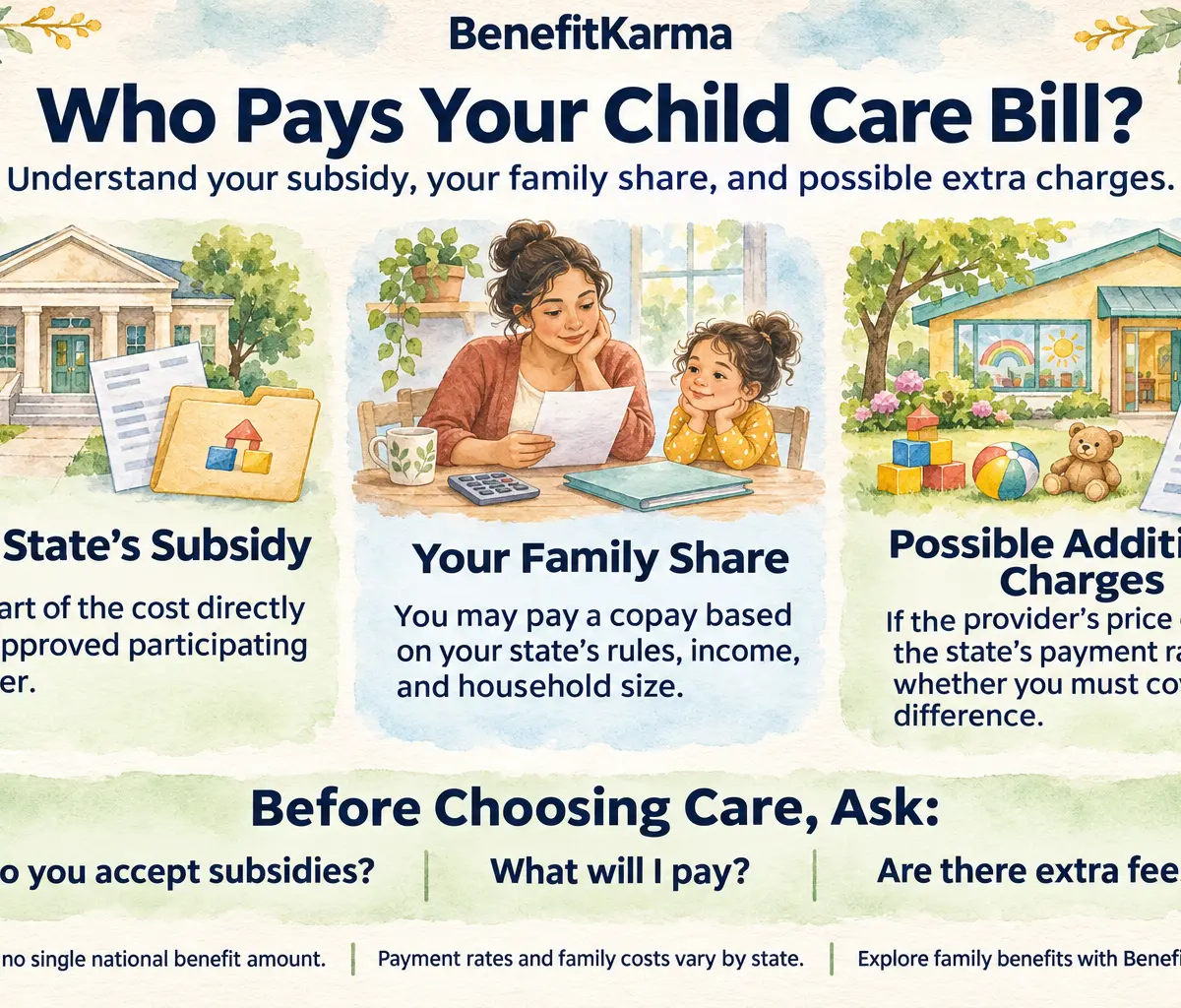
Once you're approved, your state usually gives you a certificate or voucher. You choose a provider who accepts subsidies, and the state pays part of the bill directly to that provider. You pay the rest, called a copayment (or "family share"), which is generally based on your income and family size.
Some states also contract directly with providers to hold a set number of subsidized slots, which can help in areas where infant care or rural care is hard to find.
You can typically use your subsidy with:
- Licensed child care centers, including daycares and preschools
- Family child care homes, smaller programs run out of a provider's home
- Faith-based programs, such as church-run preschools, if they meet your state's CCDF requirements
- Family, friend and neighbor care, such as a grandparent or neighbor, in states that allow license-exempt or in-home care
Every provider must meet your state's health and safety standards, including background checks. States are also required to spend at least 12% of their CCDF funds on improving child care quality, such as training and inspections.
Who is eligible for child care assistance?
Each state sets its own rules within federal limits. In general, you'll need to meet these requirements:
- Income: Federal rules cap eligibility at 85% of your state's median income, but most states set their limits lower. Some states measure income against the federal poverty level instead.
- Work, school or training: Parents usually need to be working, looking for work, attending school or enrolled in job training. Programs like SNAP Employment & Training and WIOA often count.
- Child's age: Children generally must be under 13. Children up to age 19 can qualify if they have a disability that keeps them from caring for themselves or are under court supervision.
- Residency and citizenship: You must live in the state where you apply. The child receiving care must be a U.S. citizen or qualified immigrant, even if a parent isn't.
- Family size: Larger households have higher income limits.
Many states give priority to families with very low incomes, children with special needs, families experiencing homelessness and children in foster care. Some states have waiting lists, so it's worth applying as soon as you know you'll need care.
How much child care assistance can I get?
There's no single national amount. What you'll receive depends on:
Free DIY tool
Benefit Eligibility Screener
What benefits might I qualify for? Answer a few questions and see VA, disability, food, housing, and health programs that may fit you.
Try the free tool- Your income and family size: Lower-income families pay smaller copays. Some states waive copays entirely for families below the poverty line.
- The cost of care where you live: States set maximum payment rates based on local market prices, and rates are usually higher for infants and toddlers.
- The type of care: Center care, home-based care and relative care are often paid at different rates.
- How many children are in care: Families with more than one child in care generally receive more total help.
One thing to watch: if your provider charges more than your state's maximum rate, you may have to pay the difference on top of your copay. Ask providers upfront whether they charge extra for subsidy families.
What changed for child care subsidies in 2026?
2026 brought several federal changes. Most of them affect how states run their programs, so the impact on your family will depend on what your state decides to do.
- The 7% copay cap is no longer required. A 2024 federal rule required states to keep family copays at or below 7% of household income. A new final rule that took effect July 13, 2026, removed that requirement. States can still keep the cap, but they're no longer required to, so your copay could change at your next renewal.
- Payments to providers can be based on attendance. States are no longer required to pay providers in advance or base payments on a child's enrollment instead of attendance. Expect your provider to track sign-ins and sign-outs closely.
- More flexibility for home-based and faith-based care. In May 2026, federal officials encouraged states to let parents use subsidies with relatives, neighbors and faith-based providers.
- Possible help for stay-at-home parents. The administration has drafted a plan to let some married stay-at-home parents receive child care funds. It is not in effect yet, and details could change.
- Tighter verification. After fraud allegations involving providers in Minnesota, federal officials began requiring states to submit more attendance and administrative data. Some families may be asked for extra documentation.
Policies are still shifting, so follow our Benefits in the News for updates.
How do I apply for a child care subsidy?
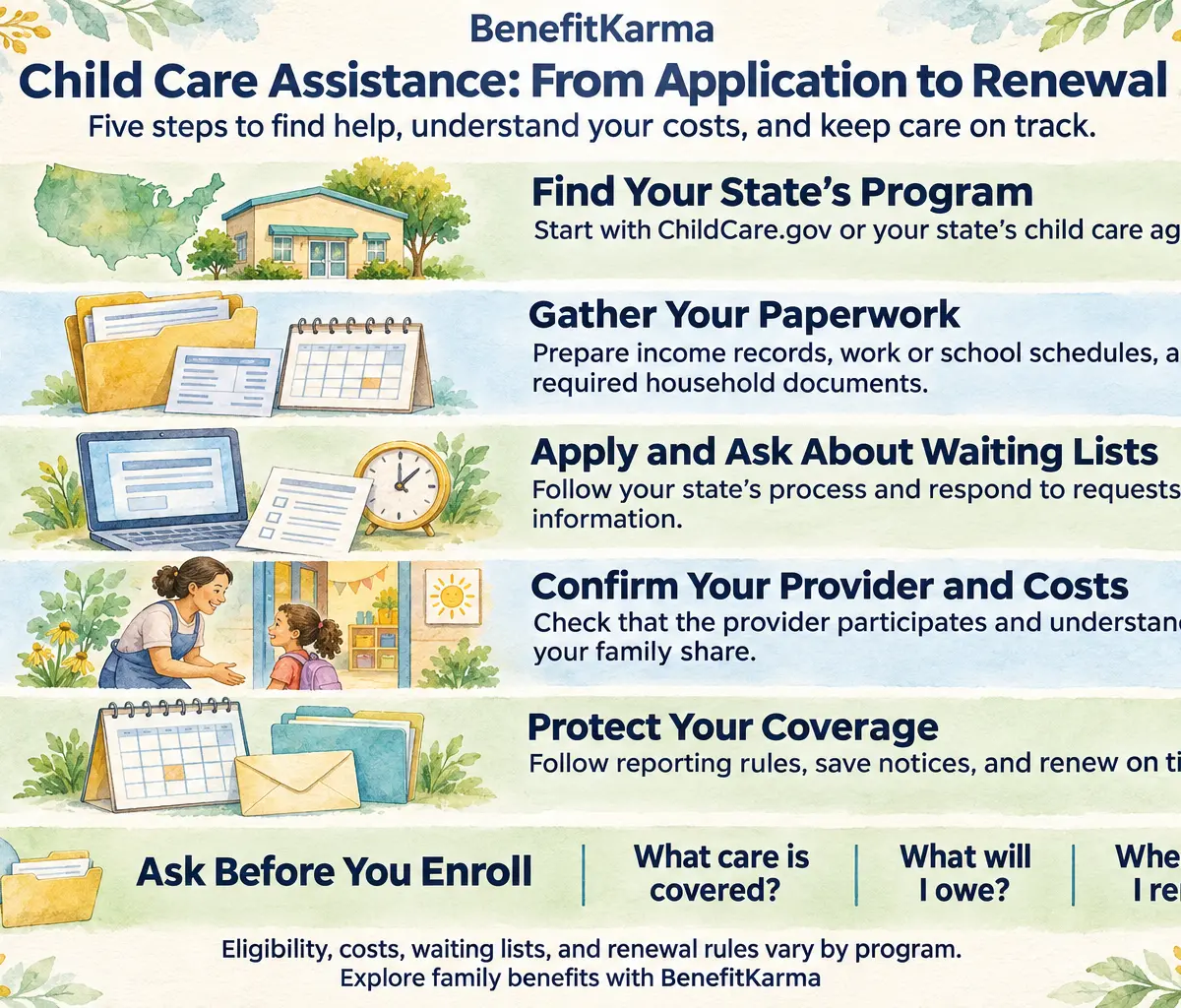
- Find your state's child care agency. Agency names vary, such as Office of Child Care, Department of Early Learning, Division of Child Development or Department of Human Services. Our state resources page can point you to the right place, or you can search ChildCare.gov for your state's program.
- Gather your documents. You'll typically need proof of identity, income (pay stubs or tax returns), work or school schedule, residency and your child's age and citizenship.
- Submit your application. Many states accept applications online. Some combine child care with applications for SNAP or TANF.
- Choose a provider. Pick a provider that accepts subsidies. Your state's child care resource and referral agency can share a list of participating providers.
- Keep your eligibility current. Report major changes as your state requires and renew on time so your care isn't interrupted.
How often do I need to renew?
Federal rules guarantee at least 12 months of eligibility once you're approved, even if your income rises a bit or your work hours change temporarily, as long as your income stays under 85% of state median income. After that, you'll need to recertify. Mark your renewal date and send requested paperwork promptly to avoid a gap in care.
Do child care subsidies affect taxes or other benefits?
Child care subsidies are generally not counted as taxable income. However, you can only claim tax breaks for what you actually pay. That means your out-of-pocket copay may count toward the Child and Dependent Care Tax Credit, but the portion your state pays does not.
Receiving child care assistance generally won't reduce your SNAP, WIC or TANF benefits, and child care costs you pay yourself can sometimes increase your SNAP amount through the dependent care deduction. Try our SNAP Benefit Calculator to see how it adds up. Rules vary by state, so check with your caseworker. A tax professional can also help with your specific situation.
What other child care help is available?
If you don't qualify for a subsidy, or need more help, look into these programs:
- Head Start, Early Head Start and pre-K: Free early learning programs for eligible children from birth to age 5. Learn more in our Head Start glossary entry.
- Child and Dependent Care Tax Credit: Starting with the 2026 tax year, the maximum credit rate rises from 35% to 50% of up to $3,000 in care expenses for one child or $6,000 for two or more, depending on your income. This change, along with the bigger FSA limit below, came from H.R. 1, the One Big Beautiful Bill Act.
- Dependent care FSAs: If your employer offers one, you can now set aside up to $7,500 a year pretax for child care (up from $5,000). See our glossary entry on dependent care FSAs and our coverage of a new IRS rule that could make them easier to offer. You can't use the same expenses for both the FSA and the tax credit.
- Child Tax Credit and EITC: These don't pay for care directly, but they can put more money in your pocket. See our guides to the Child Tax Credit in 2026 and the 2026 Earned Income Tax Credit.
- After-school and summer programs: Title I schools often offer after-school programs, and the Child and Adult Care Food Program helps child care providers serve healthy meals.
- Early intervention and special education: If your child has a developmental delay or disability, early intervention programs and services under IDEA may help.
- Student parent help: If you're in college, Pell Grants can help cover living costs, and many campuses offer child care for student parents.
- Employer benefits: Some employers offer on-site care, backup care or child care stipends. Check your workplace benefits.
Families with young children may also qualify for health coverage through the Children's Health Insurance Program (CHIP) and nutrition help through WIC.
The bottom line
Child care assistance can lower one of the biggest costs a working family faces. Eligibility and copays vary by state, and 2026 rule changes give states more room to change how their programs work, so check your state's current rules before you apply and again when you renew.
Want to see every program your family may qualify for? Start with our Find Benefits tool, and subscribe to BenefitKarma for updates on child care and family benefits.
Not sure what you qualify for?
A quick conversation can help you understand your options.
Optional — no obligation, fees may apply
Want help figuring out your next step?
Optional — fees may apply depending on your situation.
Some people choose to talk to a professional before taking their next step.
This might sound familiar:
You're not sure what to do next
You want someone to walk through your options
The process feels overwhelming
If that sounds like you, this might be worth a quick look.
Takes less than a minute
We only share your info with a service provider if you say yes.
Recommended Tools
Take action with our free tools
Get More from BenefitKarma
Create a free account to unlock all features
- Access premium benefit tools
- Personalized benefit matching
- Your personalized dashboard
Common questions about this guide
Get the latest benefit updates, straight to your inbox
Plain-English updates on SNAP, Medicaid, VA and Social Security — one email a week.
Get more from BenefitKarma
Free tools, personalized dashboard & more
