A New IRS Rule Could Make Dependent Care FSAs Easier to Offer

Free DIY tool
Benefit Eligibility Screener
What benefits might I qualify for? Answer a few questions and see VA, disability, food, housing, and health programs that may fit you.
Try the free toolPaying for child care is expensive enough without having to understand the tax rules behind it.
But a proposed change from the Internal Revenue Service (IRS) could make one workplace benefit — the Dependent Care Flexible Spending Account — easier for employers to offer at its new, higher limit.
The IRS and Treasury Department have proposed new rules for the nondiscrimination testing employers must perform on dependent care assistance programs. The biggest change is surprisingly simple: when employers run one of the most difficult tests, they would no longer have to count employees who received $0 in dependent care benefits.
That could make it easier for some workplace plans to pass the test — and potentially make employers more comfortable offering the full $7,500 dependent care FSA limit now available in 2026.
For workers, nothing changes immediately about how you use a dependent care FSA. But the proposal could remove one obstacle that has made these benefits harder for employers to administer.
First, what is a Dependent Care FSA?
A Dependent Care FSA lets workers set aside money from their paycheck before federal income taxes are taken out and use it for qualifying care expenses that allow them — and usually their spouse — to work or look for work.
Eligible expenses can include things like:
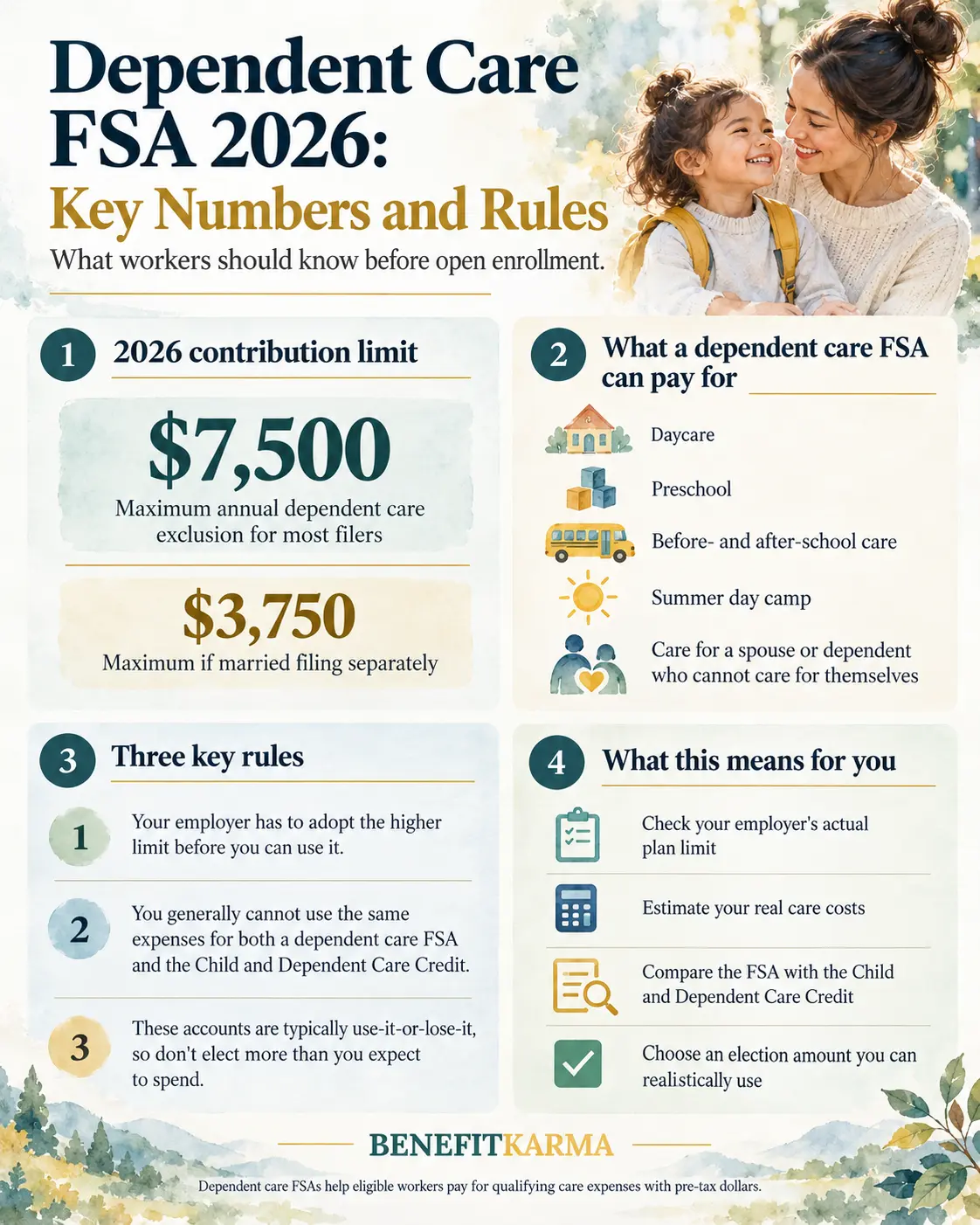
- Daycare.
- Preschool.
- Before- and after-school care.
- Summer day camps.
- Care for a spouse or dependent who cannot care for themselves.
Beginning in 2026, the maximum amount that can generally be excluded from income through a dependent care assistance program increased from $5,000 to $7,500 per year. For a married employee filing separately, the maximum increased from $2,500 to $3,750.
The IRS notes that an employer's plan has to actually adopt the higher limit before employees can use it. Your workplace could still have a lower maximum.
Dependent care FSAs are just one way families can get help with care costs. Depending on your situation, you may also want to look into child care subsidies or the federal Child and Dependent Care Tax Credit.
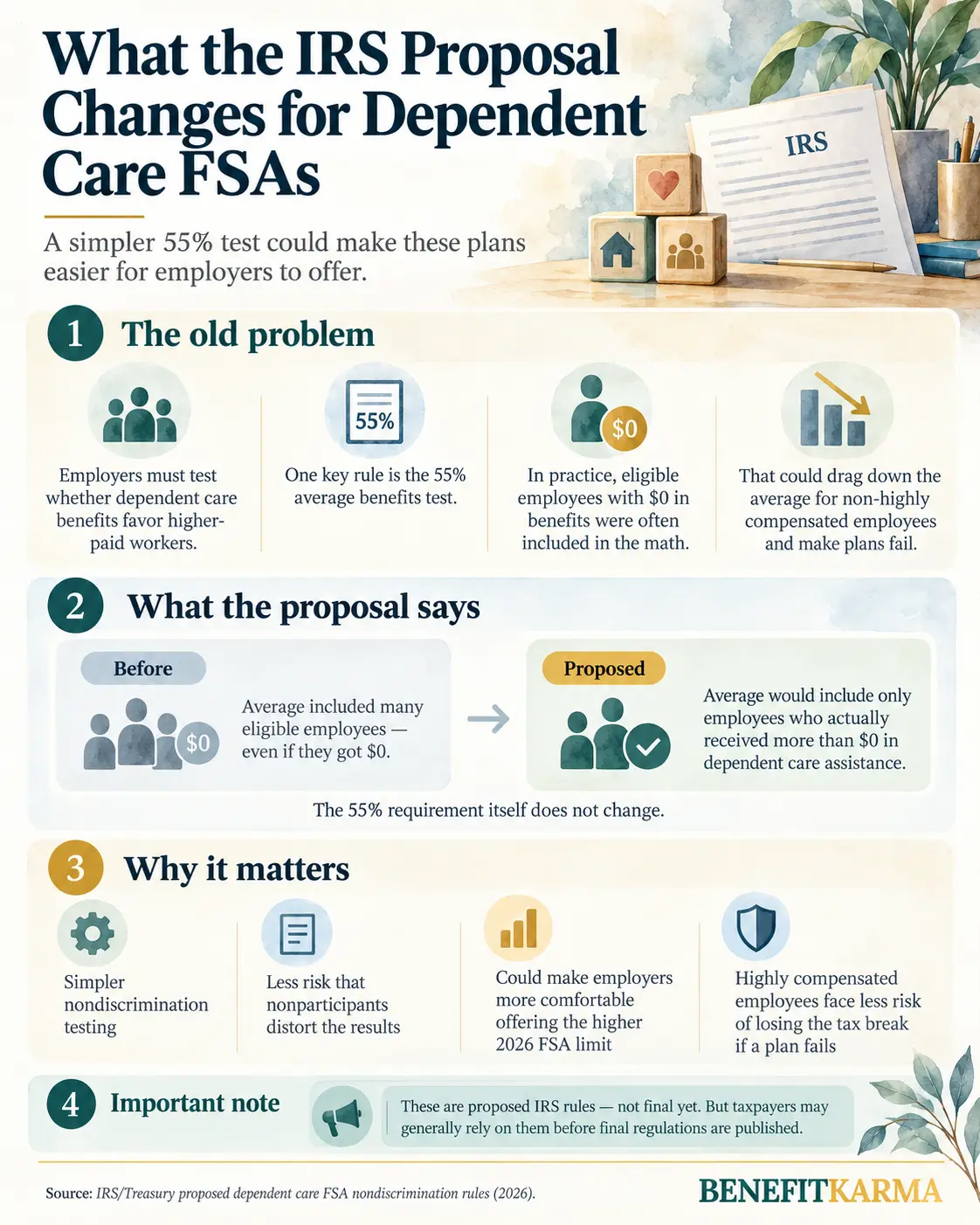
Why employers have to test these plans
The tax break attached to a dependent care FSA comes with a condition: employers generally can't design the program mainly to benefit higher-paid workers.
That's why a Dependent Care Assistance Program has to pass several nondiscrimination tests.
One of those is known as the 55% average benefits test.
Under federal law, the average dependent care benefits received by non-highly compensated employees must be at least 55% of the average benefits received by highly compensated employees.
That sounds fairly straightforward.
The problem has been deciding exactly which employees belong in that calculation.
The problem with counting people who received nothing
In practice, employers and benefits administrators have often included eligible employees who didn't use the benefit at all.
Those workers effectively went into the calculation with a $0 benefit.
That can matter because participation in dependent care FSAs is rarely evenly distributed across a workforce.
Imagine a company has hundreds of lower-paid employees who are technically eligible for the benefit but don't enroll. Maybe they don't have children, don't have qualifying care expenses, can't afford to reduce their paycheck, or simply don't know enough about the benefit to use it.
Meanwhile, a smaller group of highly compensated employees participates heavily.
Loading all those zero-dollar employees into the calculation can drag down the average benefit for non-highly compensated employees and make the plan fail the 55% test.
And when a plan fails, the consequences generally fall on the highly compensated employees: their dependent care benefits may become taxable.
That testing risk has made dependent care FSAs more complicated for employers to manage.
The IRS says employers may stop counting the zeros
The proposed IRS rules take a different approach.
For purposes of the 55% average benefits test, an employee would be included in the average only if they actually received more than $0 in dependent care assistance during the plan year.
In other words, the test would compare:
Average benefits among participating non-highly compensated employees
with
Average benefits among participating highly compensated employees.
Employees who were eligible but received nothing would no longer lower the average simply because they didn't participate.
The 55% requirement itself is not changing. What changes is who gets included in the calculation.
An example of why that matters
Imagine an employer has:
Free DIY tool
Benefit Eligibility Screener
What benefits might I qualify for? Answer a few questions and see VA, disability, food, housing, and health programs that may fit you.
Try the free tool- 10 highly compensated employees using an average of $7,000 in dependent care benefits.
- 40 non-highly compensated employees actually using an average of $4,500.
- Another 100 lower-paid employees who are eligible but don't use the FSA.
Looking only at employees who received benefits:
$4,500 ÷ $7,000 = about 64%
That would clear the 55% requirement.
But if the 100 nonparticipants were included with $0 benefits, the average for the non-highly compensated group would collapse.
The proposed rule essentially says those zero-benefit employees shouldn't be part of this particular average.
Importantly, that doesn't mean employers can simply ignore lower-paid employees. Separate nondiscrimination rules still govern who is eligible for the program.
Why the new $7,500 limit makes this more important
The timing is notable because Congress already increased the maximum dependent care exclusion for 2026.
Workers can now potentially set aside $7,500 tax-free, up from $5,000.
But an employer doesn't necessarily have to raise its own plan maximum to $7,500.
Some employers may hesitate to increase the limit if they worry that higher-paid employees will elect larger amounts and cause the plan to fail nondiscrimination testing.
The new IRS interpretation could reduce that concern.
It doesn't guarantee that every employer will move to $7,500, and plans still have to pass several other tests. But by removing nonparticipants from the average-benefits calculation, the proposal could make the higher limit easier to administer.
If you're reviewing your workplace benefits during open enrollment, our guide to worker and employee benefits covers FSAs and other employer-sponsored programs worth checking.
These rules aren't final yet
This is still a proposed regulation, not a final one.
Treasury and the IRS issued the proposal in August 2026, and the agencies held a public hearing on Oct. 15.
However, the proposal says taxpayers may generally rely on the proposed rules before final regulations are published.
The final regulations could still change.
Once finalized, the new regulations would apply to plan years beginning on or after the date the final rules are published in the Federal Register.
Does this change anything for workers right now?
For most employees, the immediate answer is not much.
The proposal doesn't:
- Increase the $7,500 federal limit again.
- Automatically raise your employer's FSA limit.
- Change which dependent care expenses qualify.
- Guarantee that your employer offers a Dependent Care FSA.
- Eliminate the "use it or lose it" nature of these accounts.
What it could do is make it easier for employers to operate their plans without penalizing highly compensated employees simply because large numbers of other eligible workers don't participate.
Over time, that could encourage more employers to adopt the higher limit.
Don't forget the Child and Dependent Care Credit
One other wrinkle is important if you're deciding how much to put into a dependent care FSA.
You generally cannot use the same care expenses twice — once for the FSA exclusion and again for the Child and Dependent Care Credit.
For the credit, the IRS currently allows up to $3,000 in qualifying expenses for one qualifying person or $6,000 for two or more.
Employer-provided dependent care benefits generally reduce the expenses available to calculate that credit.
So putting the full $7,500 into an FSA may be a great tax move for one family and less useful for another.
Your income, number of dependents, eligible expenses and tax situation all matter.
What this means for you
If your employer offers a Dependent Care FSA, the most important change for 2026 is still the larger $7,500 maximum federal exclusion.
The new IRS proposal happens behind the scenes, but it could make that increase easier for employers to actually use.
If you're considering the benefit:
- Check whether your employer has raised its plan limit to $7,500.
- Estimate how much you'll actually spend on qualifying care.
- Compare the FSA tax savings with the Child and Dependent Care Credit.
- Don't elect more than you reasonably expect to use.
For families paying thousands of dollars a year for child care or dependent care, a Dependent Care FSA can already provide meaningful tax savings. Making the benefit simpler for employers to administer could help more workers actually get access to the full amount.
Not sure what you qualify for?
A quick conversation can help you understand your options.
Optional — no obligation, fees may apply
Want help figuring out your next step?
Optional — fees may apply depending on your situation.
Some people choose to talk to a professional before taking their next step.
This might sound familiar:
You're not sure what to do next
You want someone to walk through your options
The process feels overwhelming
If that sounds like you, this might be worth a quick look.
Takes less than a minute
We only share your info with a service provider if you say yes.
Recommended Tools
Take action with our free tools
Get More from BenefitKarma
Create a free account to unlock all features
- Access premium benefit tools
- Personalized benefit matching
- Your personalized dashboard
Common questions about this guide
Get more from BenefitKarma
Free tools, personalized dashboard & more
