New SSI Bill Could Raise Benefits by Hundreds a Month

Free DIY tool
Benefit Eligibility Screener
What benefits might I qualify for? Answer a few questions and see VA, disability, food, housing, and health programs that may fit you.
Try the free toolA proposal in Congress could make one of the biggest changes to Supplemental Security Income in decades, potentially raising monthly benefits, allowing recipients to keep more savings, and easing several rules that can reduce or eliminate eligibility.
But there is an important catch: none of these changes are law yet.
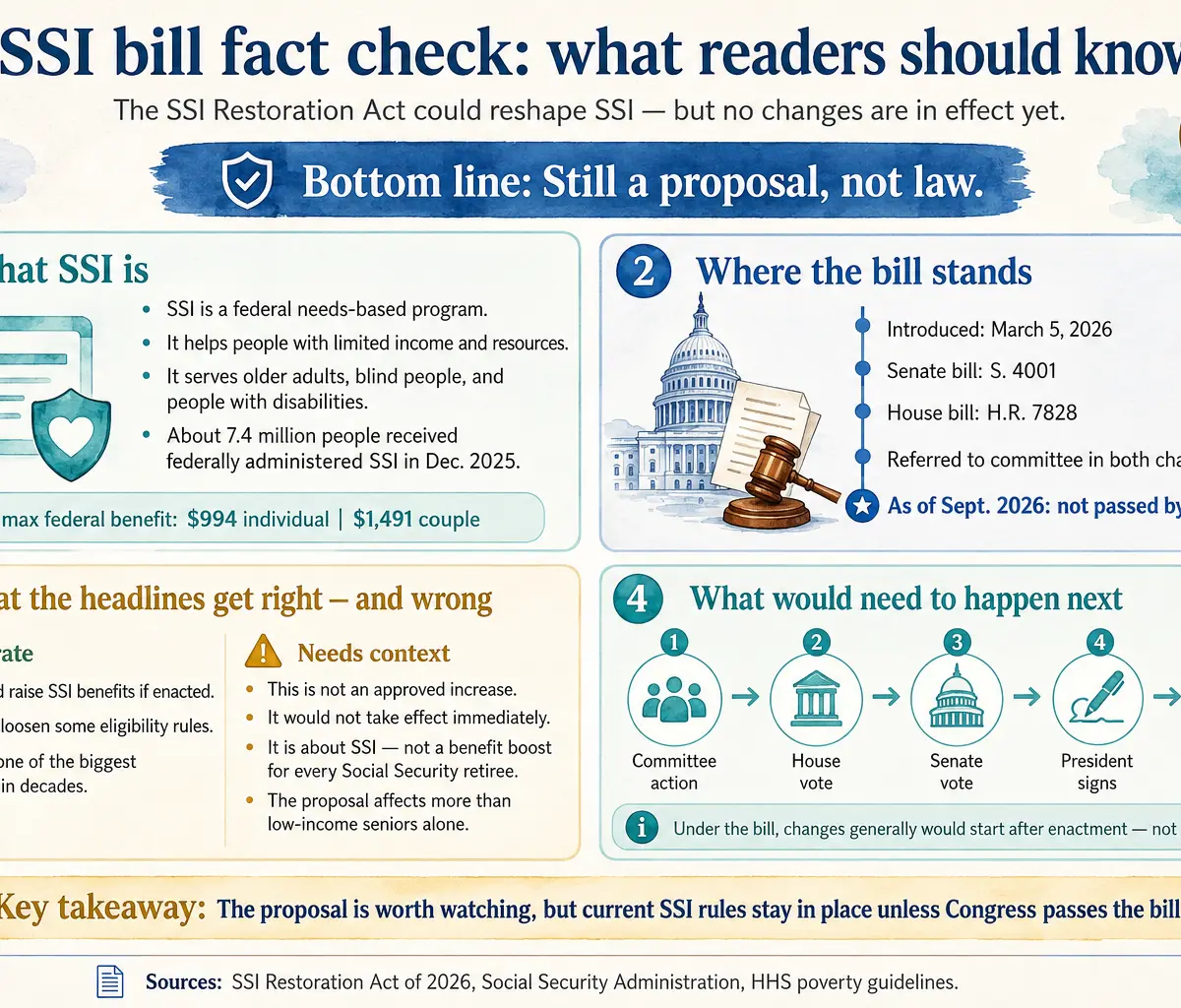
The Supplemental Security Income Restoration Act of 2026 was introduced in both the Senate and House on March 5. The Senate version, S. 4001, was referred to the Senate Finance Committee, while the House version, H.R. 7828, went to the House Ways and Means Committee. As of September 2026, neither bill has advanced beyond that stage.
That means SSI recipients should not expect a new increase beyond the regular cost-of-living adjustment unless Congress takes further action.
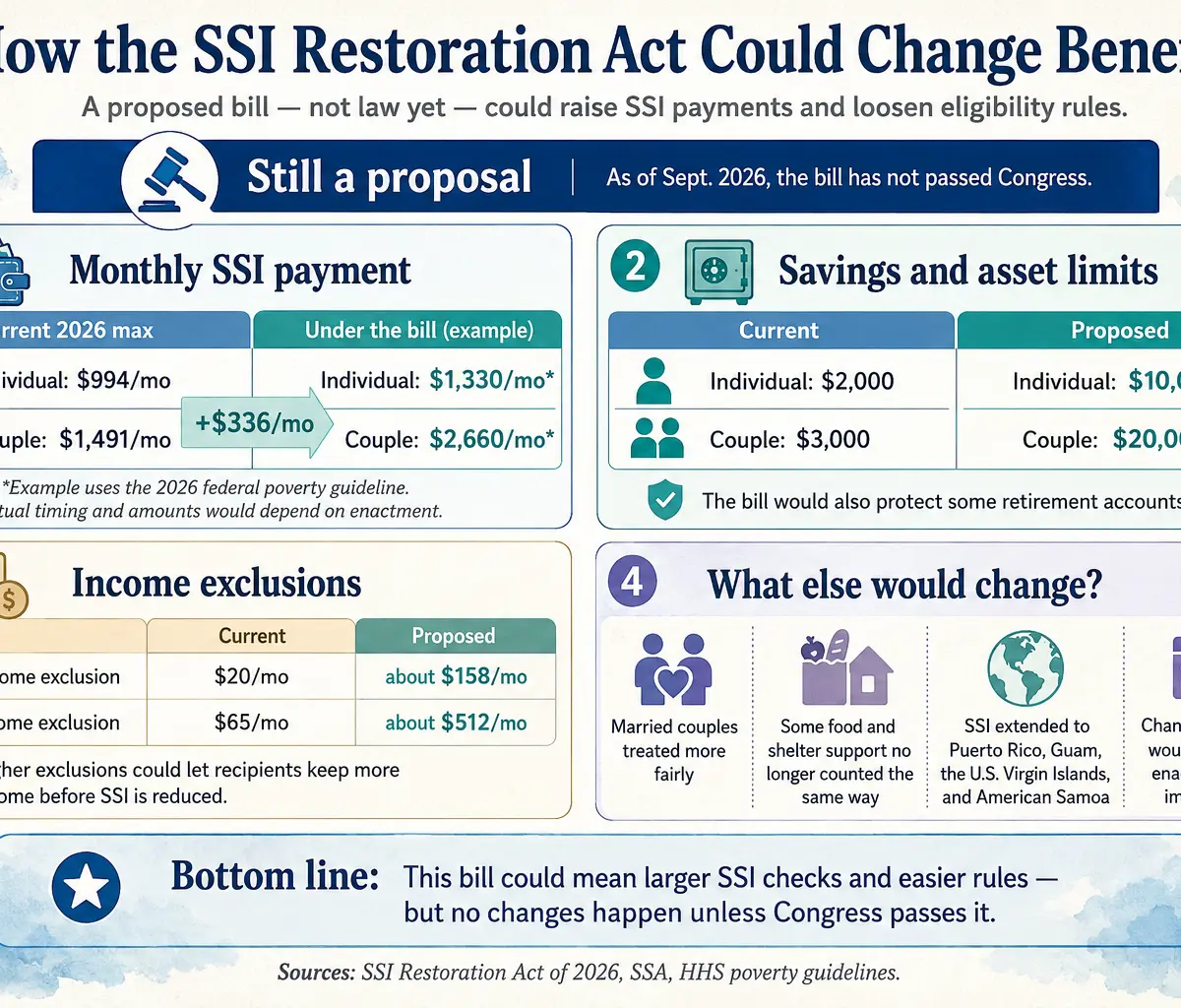
How Much Could SSI Benefits Increase?
For 2026, the maximum federal SSI payment is $994 per month for an individual and $1,491 for an eligible couple. Those amounts reflect this year's 2.8% Social Security cost-of-living adjustment.
The proposed law would replace the current benefit formula beginning after 2026 with one tied to the annual poverty guideline published by the Department of Health and Human Services.
For an individual, the bill says the annual SSI benefit would equal the poverty guideline for a one-person household from the preceding year, before reductions for countable income.
The 2026 poverty guideline for one person in the 48 contiguous states and Washington, D.C., is $15,960 — equivalent to $1,330 per month. If that figure were used under the bill's formula, it would be $336 more per month than the current 2026 maximum of $994, an increase of about 34%.
Couples could see an even larger change. The bill would set the benefit for an eligible couple at twice the individual rate, effectively eliminating SSI's current "marriage penalty." Using the same 2026 guideline as an example, that would equal $2,660 per month before countable-income reductions, compared with the current maximum of $1,491.
Those numbers are useful illustrations, but they are not guaranteed future payment amounts. The legislation says its benefit changes apply after 2026, and the bill also contains a general effective-date provision delaying changes until the first month beginning more than one year after enactment. The actual starting amount would therefore depend on when, or whether, the legislation becomes law.
The Bill Would Also Raise SSI's Asset Limits
For many SSI recipients, the proposal's changes to savings rules could be nearly as significant as the higher monthly benefit.
Current SSI rules generally limit countable resources to $2,000 for an individual and $3,000 for a couple. Those limits have not changed since 1989, according to the Social Security Administration.
The Restoration Act would raise the limits to $10,000 for an individual and $20,000 for a couple. The new amounts would then be adjusted for inflation using the Consumer Price Index for the Elderly, or CPI-E.
That could allow recipients to maintain a larger emergency fund without automatically losing SSI eligibility. A home used as a primary residence and generally one vehicle already do not count toward the existing SSI resource limit, but cash, bank accounts, stocks and other resources may count.
Retirement accounts would get new protection, too. The bill would exclude qualified retirement plans and eligible deferred-compensation plans from countable SSI resources.
Free DIY tool
Benefit Eligibility Screener
What benefits might I qualify for? Answer a few questions and see VA, disability, food, housing, and health programs that may fit you.
Try the free toolIncome Rules Could Become More Generous
SSI benefits are reduced when recipients have certain other income, but the program currently disregards small amounts before reductions begin.
The bill would substantially increase those exclusions. It would raise the general income exclusion from $240 per year — effectively $20 per month — to $1,892 per year, or about $158 per month.
The earned-income exclusion would rise from $780 per year, or $65 per month, to $6,149 per year, or roughly $512 per month. Those amounts would also be indexed for inflation in later years.
The legislation includes several other changes, including removing certain in-kind food and shelter support from countable income, changing rules involving past-due benefits, and extending SSI to Puerto Rico, the U.S. Virgin Islands, Guam and American Samoa.
This Is Not a Social Security Retirement Increase
Despite the bill's potential impact, it would not give every retiree a larger Social Security check.
SSI is a separate, needs-based federal program for people with limited income and resources who are age 65 or older, blind, or have a qualifying disability. Social Security retirement benefits are based primarily on a worker's earnings record.
The distinction matters because SSI serves a much broader population than seniors alone.
According to SSA's latest annual statistical report, about 7.4 million people received federally administered SSI payments in December 2025. About 34% were age 65 or older, while 84% of recipients qualified on the basis of blindness or disability. The average monthly SSI payment was $715.
Where the SSI Restoration Act Stands Now
The proposal has support in both chambers, and the House version includes Republican Rep. James Moylan of Guam among its cosponsors, giving that version bipartisan sponsorship.
But it is still at the beginning of the legislative process.
Neither S. 4001 nor H.R. 7828 has received a committee vote, passed either chamber, or been sent to the president. The last official action listed for both bills remains their introduction and committee referral on March 5, 2026.
Until Congress acts, today's SSI rules remain in place.
For recipients, the most important takeaway is that this is a potentially major overhaul, not an upcoming benefit increase that has already been approved.
If Congress eventually passes it, the effects could extend well beyond a larger monthly check. Higher asset limits, more generous income exclusions, retirement-account protections and changes to how married couples are treated could all affect who qualifies and how much assistance they receive.
For now, however, the 2026 maximum federal SSI benefit remains $994 per month for an individual and $1,491 for an eligible couple.
Not sure what you qualify for?
A quick conversation can help you understand your options.
Optional — no obligation, fees may apply
Want help figuring out your next step?
Optional — fees may apply depending on your situation.
Some people choose to talk to a professional before taking their next step.
This might sound familiar:
You're not sure what to do next
You want someone to walk through your options
The process feels overwhelming
If that sounds like you, this might be worth a quick look.
Takes less than a minute
We only share your info with a service provider if you say yes.
Recommended Tools
Take action with our free tools
Get More from BenefitKarma
Create a free account to unlock all features
- Access premium benefit tools
- Personalized benefit matching
- Your personalized dashboard
Common questions about this guide
Get more from BenefitKarma
Free tools, personalized dashboard & more