Why Medicaid and ACA Enrollment Is Falling — And What Changes Are Still Ahead

Free DIY tool
Benefit Eligibility Screener
What benefits might I qualify for? Answer a few questions and see VA, disability, food, housing, and health programs that may fit you.
Try the free toolMillions of Americans are no longer enrolled in Medicaid, the Children’s Health Insurance Program (CHIP), or Affordable Care Act Marketplace plans compared with a year ago.
But there’s an important catch: the declines are not all happening for the same reason.
ACA Marketplace enrollment has fallen sharply in 2026 after enhanced federal premium subsidies expired at the end of 2025, leaving many people with higher monthly costs. Medicaid and CHIP enrollment is also falling, but many of the biggest eligibility changes approved by Congress last year have not fully taken effect yet.
That means some of the most significant Medicaid changes may still be ahead.
How Much Has Enrollment Fallen?
The most recent figures show substantial declines in both programs.
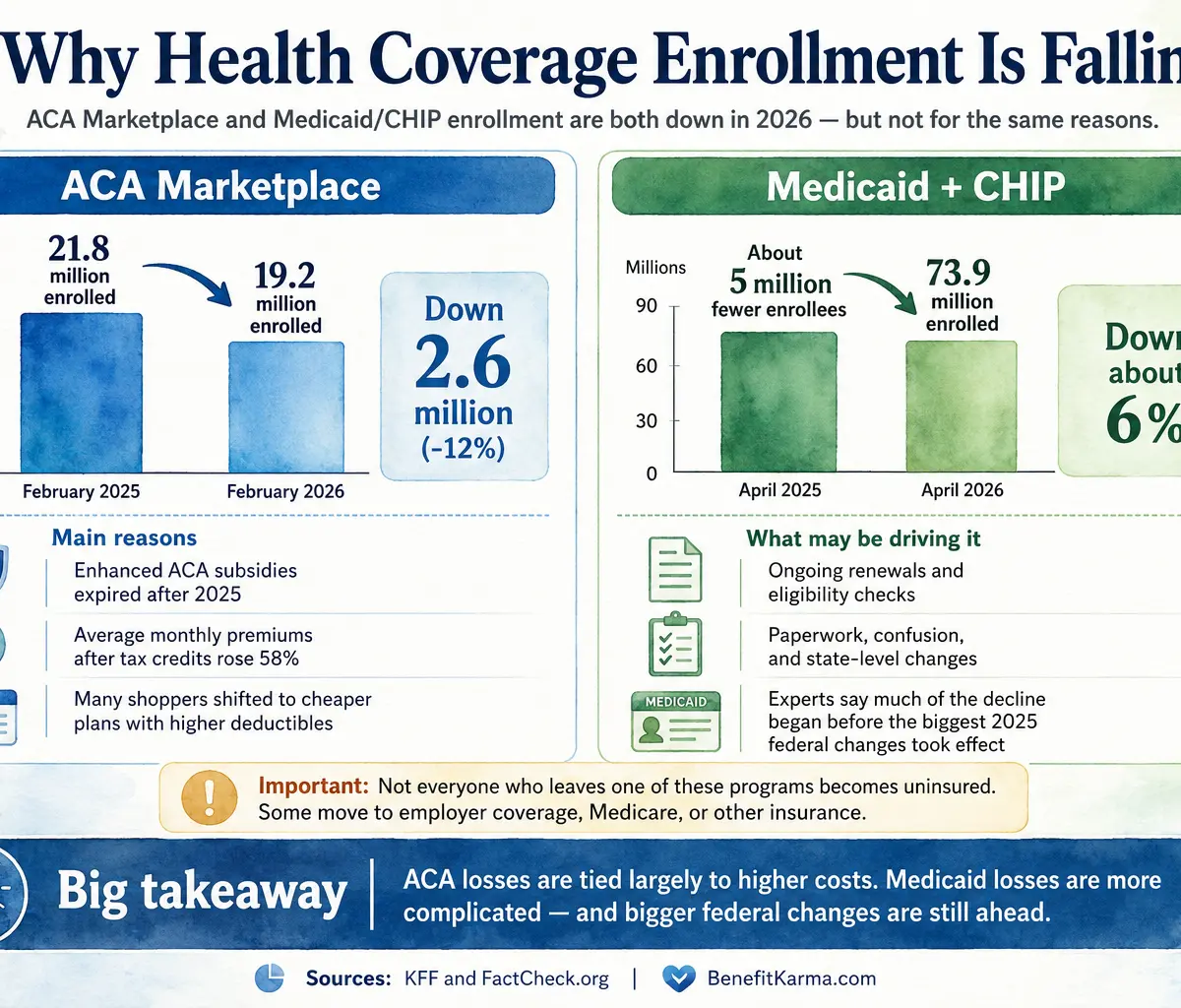
KFF reports that 19.2 million people had effectuated ACA Marketplace coverage in February 2026, meaning they had selected a plan and paid their premium. That was down from 21.8 million in February 2025, a decrease of about 2.6 million people, or 12%.
Medicaid and CHIP have seen an even larger numerical decline. KFF’s Medicaid enrollment tracker shows enrollment fell by roughly 5 million people, or 6%, between April 2025 and April 2026. About 73.9 million people remained enrolled nationwide as of April.
Those numbers should not simply be added together to estimate how many Americans became uninsured. Some people who leave Medicaid or an ACA plan may move to employer coverage, Medicare, another public program, or a different source of insurance.
Still, the trend is clear: fewer people are enrolled in two of the country’s largest sources of health coverage than they were a year ago.
Why Did ACA Enrollment Fall?
For ACA Marketplace coverage, cost appears to be a major part of the answer.
Enhanced premium tax credits first enacted in 2021 made Marketplace plans significantly cheaper for millions of people. Congress later extended those enhanced subsidies through the end of 2025, but they expired on December 31.
Without them, many enrollees faced much higher premiums in 2026.
KFF found that average monthly premium payments after tax credits rose 58% among people who enrolled in Marketplace coverage for 2026. Enrollment subsequently fell in every state except New Mexico, which replaced the expired federal assistance with its own state-funded subsidies.
Some people also responded to higher premiums by choosing less expensive plans with larger deductibles. KFF found that the average Marketplace deductible rose by more than $1,000 in 2026 as enrollment shifted toward Bronze plans.
Why Is Medicaid Enrollment Falling?
The Medicaid story is more complicated.
President Trump signed the 2025 reconciliation law, commonly called the One Big Beautiful Bill Act, on July 4, 2025. The law includes major Medicaid eligibility and financing changes, and the Congressional Budget Office estimates its Medicaid provisions will reduce federal deficits by about $887 billion over 10 years.
However, most of the law’s major Medicaid eligibility changes had not taken effect during much of the period in which enrollment was already falling.
Free DIY tool
Benefit Eligibility Screener
What benefits might I qualify for? Answer a few questions and see VA, disability, food, housing, and health programs that may fit you.
Try the free toolFactCheck.org reported in July that experts pointed to several possible reasons for the earlier Medicaid decline, including problems during eligibility renewals, state-level policy changes, reduced enrollment assistance, confusion about changing rules and fears among some immigrant families about interacting with government agencies. Researchers cautioned that there is not yet enough detailed data to determine exactly how much each factor contributed.
That distinction matters. It is accurate to say Medicaid enrollment is already declining. It is not accurate to say that millions of people have already lost Medicaid specifically because of the new federal work requirements.
What Medicaid Changes Are Coming Next?
One of the biggest changes is scheduled for 2027.
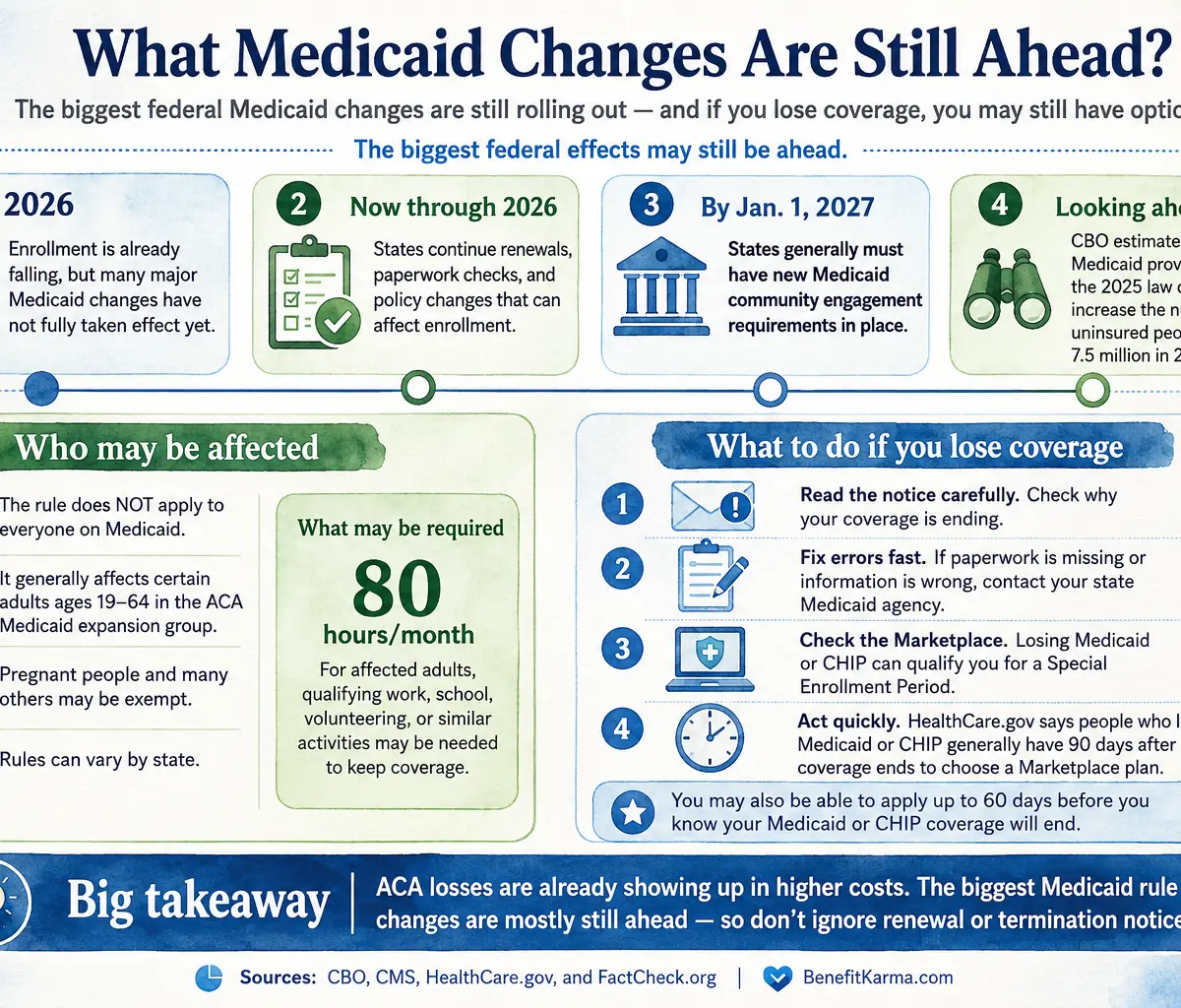
Under the new federal law, states generally must begin applying a Medicaid “community engagement” requirement no later than January 1, 2027, although some states have started early.
For adults who are subject to the rule, CMS says eligibility can generally be maintained by completing at least 80 hours per month of qualifying activities, which can include employment, community service, certain work programs or a combination of activities. Enrollment in an educational program at least half time can also satisfy the requirement.
The rule does not apply to everyone on Medicaid. It generally affects certain non-pregnant adults ages 19 through 64 in the ACA Medicaid expansion group and certain demonstration programs, and there are numerous exemptions, including for some caregivers and other qualifying groups.
Even so, the Congressional Budget Office estimates the Medicaid provisions of the 2025 law will increase the number of people without health insurance by 7.5 million in 2034.
In other words, the enrollment declines happening now may not represent the full effect of the changes already enacted.
What Should You Do If You Lose Medicaid or CHIP?
If your state tells you that your Medicaid or CHIP coverage is ending, don’t assume you have to remain uninsured.
First, check the reason for the termination. If your income, household information or other circumstances were reported incorrectly — or if the state is missing paperwork — you may still qualify for Medicaid. Follow the instructions included with your eligibility notice and contact your state Medicaid agency if something appears incorrect.
If you are no longer eligible, check the ACA Marketplace quickly. Losing Medicaid or CHIP can qualify you for a Special Enrollment Period. HealthCare.gov says people who lose Medicaid or CHIP generally have 90 days after their coverage ends to select a Marketplace plan. You can also apply as early as 60 days before you know your Medicaid or CHIP coverage will end, which can help prevent a gap.
Families should also check children’s eligibility separately. A parent may no longer qualify for Medicaid even when a child can still qualify for Medicaid or CHIP.
If you have access to job-based insurance, losing Medicaid can also create an opportunity to enroll through an employer plan. Those deadlines may be different, so contact the employer’s benefits administrator promptly.
The Bottom Line
Health coverage enrollment is moving in the wrong direction, but the reasons differ depending on the program.
For ACA Marketplace customers, the expiration of enhanced subsidies has already made coverage more expensive and contributed to a substantial enrollment decline. Medicaid enrollment is also falling, but much of that decline began before the biggest provisions of the 2025 law took effect.
The next major date to watch is January 1, 2027, when states generally must have the new Medicaid work and community engagement requirements in place.
For anyone who receives a Medicaid renewal notice, termination letter or unexpectedly large Marketplace premium, the most important thing is not to ignore it. Coverage options may still be available, but enrollment and appeal deadlines can be short.
BenefitKarma will continue tracking Medicaid and ACA changes as states roll out the new rules, including what they mean for eligibility, premiums and your next steps.
Not sure what you qualify for?
A quick conversation can help you understand your options.
Optional — no obligation, fees may apply
Want help figuring out your next step?
Optional — fees may apply depending on your situation.
Some people choose to talk to a professional before taking their next step.
This might sound familiar:
You're not sure what to do next
You want someone to walk through your options
The process feels overwhelming
If that sounds like you, this might be worth a quick look.
Takes less than a minute
We only share your info with a service provider if you say yes.
Recommended Tools
Take action with our free tools
Get More from BenefitKarma
Create a free account to unlock all features
- Access premium benefit tools
- Personalized benefit matching
- Your personalized dashboard
Common questions about this guide
Get more from BenefitKarma
Free tools, personalized dashboard & more
