Some Public Service Loan Forgiveness Counts Are Being Reduced

Free DIY tool
Benefit Eligibility Screener
What benefits might I qualify for? Answer a few questions and see VA, disability, food, housing, and health programs that may fit you.
Try the free toolSome public-service workers are logging into their federal student loan accounts and finding an unwelcome surprise: months — and in some cases years — of progress toward Public Service Loan Forgiveness have disappeared.
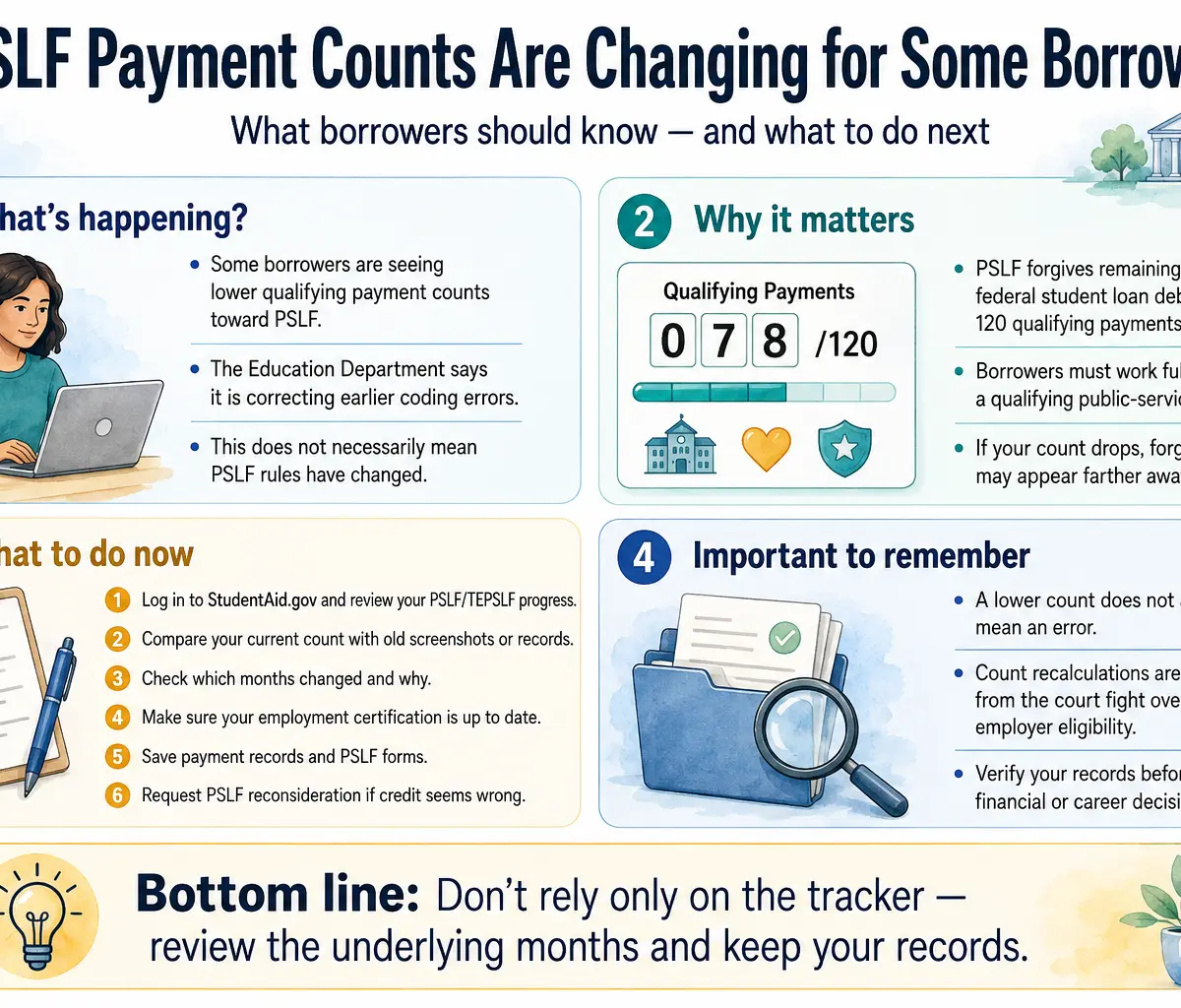
The U.S. Department of Education has confirmed that it is reevaluating some borrowers’ PSLF payment histories and correcting what it describes as earlier “coding errors.” The result is that qualifying-payment totals are changing for an unknown number of borrowers, including some who believed they were only a few payments away from having their remaining federal student debt canceled.
The important part: This is not a new PSLF rule that automatically wipes out previously earned credit. But if your count has changed, you shouldn’t assume the new number is correct either.
Why PSLF payment counts matter so much
Public Service Loan Forgiveness cancels the remaining balance on eligible Direct Loans after a borrower makes the equivalent of 120 qualifying monthly payments while working full time for a qualifying government or nonprofit employer.
That count is effectively the program’s clock.
If a borrower has 118 qualifying payments, for example, they may expect to be only two months from forgiveness. If the government later changes that count to 95, the borrower could suddenly appear to have more than two additional years of qualifying payments left.
That’s why recent reports have alarmed borrowers. CNBC’s Annie Nova reported Aug. 20, 2026 that some borrowers had seen their counts fall substantially, including one person who said their total dropped from nearly 120 payments to 94.
The Education Department told the outlet that it was correcting “coding errors” that resulted in inaccurate payment counts for some borrowers and said qualifying payments should still receive proper credit.
So far, however, the department has not publicly said how many borrowers are affected or clearly identified which earlier payment-counting changes produced the errors.
This comes after years of PSLF payment-count fixes
The latest recalculation is especially confusing because the federal government has spent several years trying to fix the opposite problem: borrowers not receiving credit they should have received.
PSLF was created in 2007, but the program became notorious for denials and administrative problems. The Government Accountability Office previously found problems with how borrowers were informed about which payments qualified, while another GAO review found broader weaknesses in federal tracking of payments toward income-driven forgiveness.
Beginning in 2021, the Education Department made a series of changes that allowed many borrowers to receive retroactive credit for periods that previously would not have counted. Federal Student Aid still notes that some past periods of repayment, deferment and forbearance may count toward PSLF because of those payment-count adjustments.
Those changes dramatically expanded forgiveness.
By January 2026, more than 1.2 million borrowers had received about $90.6 billion in PSLF forgiveness, according to a Brookings Institution analysis. The average discharged balance was nearly $75,000.
Now, the Education Department says at least some payment totals produced during that broader period of account corrections were inaccurate.
A lower count doesn’t necessarily mean you did something wrong
There are legitimate reasons why a particular month might not qualify for PSLF.
Federal Student Aid says periods may be excluded because a borrower was in certain deferment or forbearance statuses, was enrolled in an ineligible repayment plan, did not make an eligible payment, or had employment that did not qualify for the entire period.
Free DIY tool
Benefit Eligibility Screener
What benefits might I qualify for? Answer a few questions and see VA, disability, food, housing, and health programs that may fit you.
Try the free toolBut the problem now is that affected borrowers may not be receiving a clear explanation showing which individual months changed and why.
Higher-education expert Mark Kantrowitz told CNBC that without that information, borrowers have little ability to determine whether a change is accurate. The Student Loan Servicing Alliance, an industry group representing servicers, told CNBC the adjustments stem from technical accounting problems rather than a new PSLF policy — and said some borrowers could actually see their counts increase after corrections are completed.
That means a changed number shouldn’t automatically be treated as either right or wrong. Borrowers need to look underneath it.
What to do if your PSLF count changed
Start by checking your detailed payment history.
Log in to StudentAid.gov, choose My Aid, then find the PSLF/TEPSLF Payment Progress section. Federal Student Aid lets borrowers view payment counts for individual loans and review previous months by their qualifying status.
Then:
- Save screenshots or copies of your current count. If you have an older screenshot, compare the two and identify which months changed.
- Gather your own payment records. Bank statements, loan-servicer records and prior correspondence can help establish when payments were made.
- Check your employment certifications. Make sure the public-service employment corresponding with disputed months has been certified.
- Keep copies of your PSLF forms. Federal Student Aid recommends submitting a PSLF form annually as well as when you change employers.
If you believe qualifying credit was removed incorrectly, you can also submit a PSLF reconsideration request through StudentAid.gov. The federal reconsideration process was created specifically to allow borrowers to challenge PSLF and Temporary Expanded PSLF determinations.
And if you’re close to 120 payments, it may be worth verifying the underlying months before making a major financial or career decision based solely on the large progress number displayed on your account.
There’s another PSLF fight happening — but it’s separate
Adding to the confusion, PSLF is simultaneously caught in a separate legal battle over which employers can qualify for the program.
The Trump administration adopted regulations that would have allowed the Education Department to exclude certain organizations from PSLF eligibility based on their activities. Federal courts blocked those restrictions before they were scheduled to take effect July 1, 2026.
As of Aug. 28, the Education Department has appealed those decisions, but the restrictions remain blocked for now.
That legal fight is separate from the disappearing-payment issue.
The recent payment-count recalculations have instead been described by the Education Department as corrections to account data rather than the implementation of a new PSLF eligibility policy.
The bottom line
A PSLF payment count is much more than a number on a website.
For borrowers who have structured a decade of career and financial decisions around public-service forgiveness, every credited month can determine how long they remain in qualifying employment and when tens of thousands of dollars in student debt can finally disappear.
The Education Department says it is correcting inaccurate counts, and some borrowers may ultimately benefit from those corrections. But the department has not yet provided a full public accounting of how many people are affected or exactly why individual months are being removed.
Until there’s more clarity, don’t rely solely on the number displayed in your PSLF tracker.
Check the individual months. Save your records. Keep your employment certifications current. And if the federal government’s history doesn’t match yours, use the PSLF reconsideration process to challenge it.
Not sure what you qualify for?
A quick conversation can help you understand your options.
Optional — no obligation, fees may apply
Want help figuring out your next step?
Optional — fees may apply depending on your situation.
Some people choose to talk to a professional before taking their next step.
This might sound familiar:
You're not sure what to do next
You want someone to walk through your options
The process feels overwhelming
If that sounds like you, this might be worth a quick look.
Takes less than a minute
We only share your info with a service provider if you say yes.
Recommended Tools
Take action with our free tools
Get More from BenefitKarma
Create a free account to unlock all features
- Access premium benefit tools
- Personalized benefit matching
- Your personalized dashboard
Common questions about this guide
Get more from BenefitKarma
Free tools, personalized dashboard & more