How to Use the Veterans Crisis Line — and When You Should Call

Free DIY tool
VA Claim Readiness Score
Is my VA claim ready to file? Answer 4 quick questions and get a readiness score with next steps.
Try the free toolIf you’re a Veteran going through a difficult moment, you don’t have to decide whether your situation is “bad enough” before asking for help.
The Veterans Crisis Line is a free, confidential service available 24 hours a day, seven days a week for Veterans, service members and people who are worried about them. You don’t need to be enrolled in VA health care or receiving VA benefits to use it.
And despite the word crisis, the service isn’t only for someone who is in a dire mental health situation.
The Department of Veterans Affairs encourages Veterans to reach out for thoughts of suicide or self-harm, but also when warning signs such as hopelessness, severe anxiety, agitation, increasing substance use or risky behavior begin to appear. Major life problems — including the end of a relationship, job loss, housing instability or a loss of purpose — can also develop into a crisis.
Here’s how the Veterans Crisis Line works, when you might use it and what to expect after you reach out.
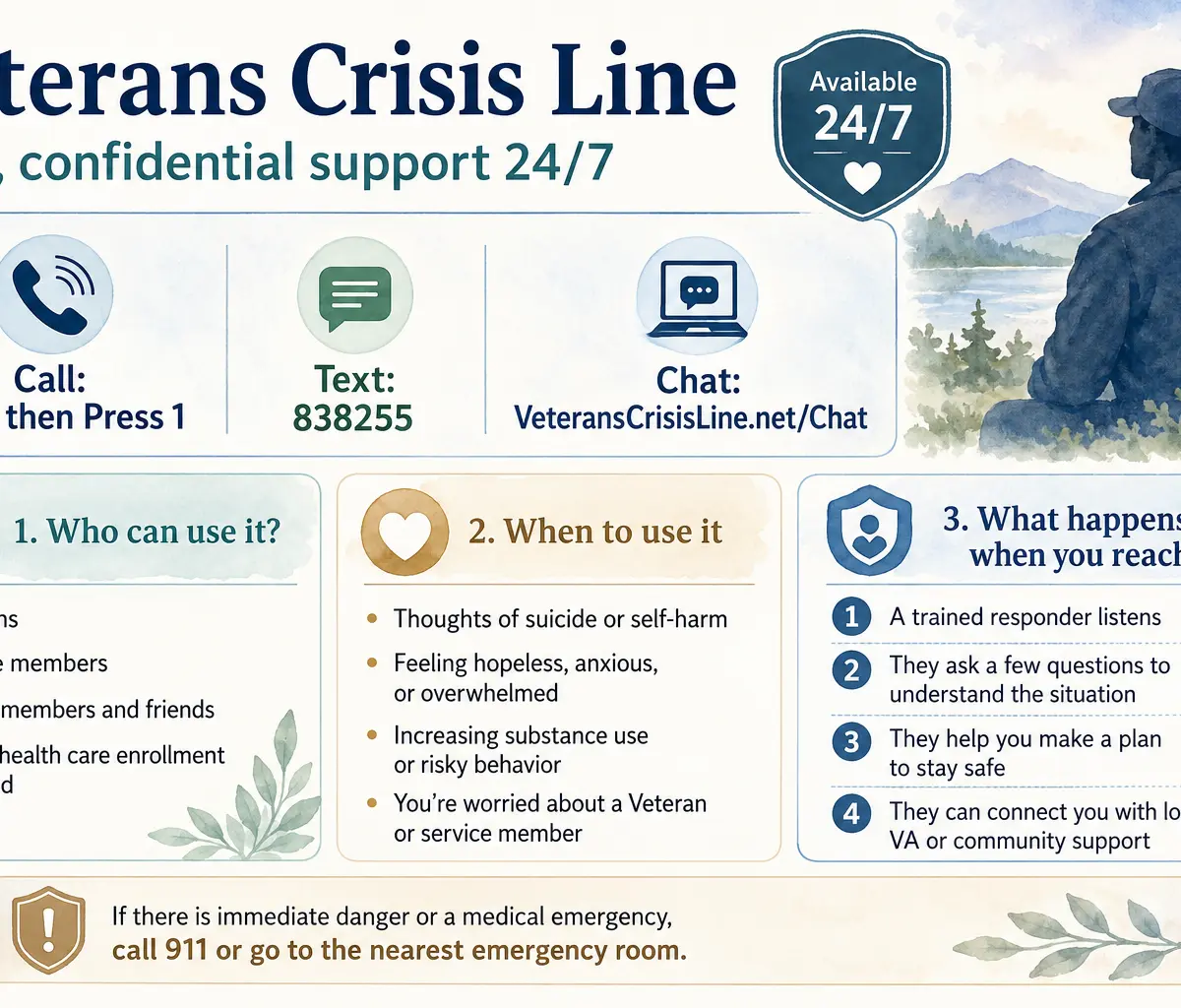
How to contact the Veterans Crisis Line
There are three main ways to connect with a trained responder:
- Call: Dial 988, then Press 1
- Text: Send a text to 838255
- Chat: Use the Veterans Crisis Line’s confidential online chat
All three are available 24/7. Veterans and service members who are deaf or hard of hearing can use their preferred relay service or dial 711, then 988. VA also provides separate calling numbers for Veterans and service members stationed or living overseas.
Who can use it?
The Veterans Crisis Line serves a broader group than many people may realize.
VA says the service is available to Veterans regardless of when or where they served, their discharge status or whether they are enrolled in VA benefits or health care. The related Military Crisis Line also serves current service members, including members of the National Guard and Reserve.
Family members, friends and other supporters can reach out, too.
If you’re worried about a Veteran or service member, you don’t have to wait for that person to make the first call. You can contact the line yourself, explain what you’re seeing and speak with a responder about the situation.
That can be especially useful when you know something is wrong but aren’t sure what to say or what kind of help the person needs.
What happens when you call, text or chat?
There’s no required script and you don’t have to know exactly what to say.
When you call, a recording confirms that you’ve reached the Veterans Crisis Line before connecting you with a qualified responder. If you text 838255, you can begin with as much or as little information as you’re comfortable sharing. Online chat similarly connects you with a responder after asking for a first name or nickname.
The responder will ask questions to understand what’s happening and determine whether you — or the Veteran you’re concerned about — may be in immediate danger or at risk for suicide.
You don’t need a perfect explanation.
Something as simple as, “I’m having a really hard time and need someone to talk to,” is enough to begin.

Do you have to give your name?
No. VA says you decide how much personal information you want to share.
Free DIY tool
VA Claim Readiness Score
Is my VA claim ready to file? Answer 4 quick questions and get a readiness score with next steps.
Try the free toolCalls, texts and chats are free and confidential. The Veterans Crisis Line says personal information and phone numbers are used for referrals to local care with your permission, in an emergency or when required by law.
If you choose to provide contact information and want continued help, a responder may connect you with a suicide prevention coordinator at the VA medical center nearest you. VA says that coordinator may contact you by the next business day.
Calling doesn't automatically mean an emergency response
This may be one of the biggest reasons someone hesitates to call a crisis line: fear that reaching out automatically means an ambulance or law enforcement will show up.
VA's published process makes an important distinction.
If you’re experiencing a crisis but aren’t at imminent risk of injury or suicide, the responder can listen, offer support and work with you on a plan to stay safe. The responder can also help connect you with appropriate VA or community resources.
If you are in immediate danger, the responder can help address the immediate crisis and connect you with emergency or follow-up services.
And if your life or health is in immediate danger and you need emergency medical attention, VA advises calling 911 or going to the nearest emergency room.
What if you aren't enrolled in VA health care?
You can still use the Veterans Crisis Line.
This is one of the most important things to know about the service: VA enrollment isn't required to call, text or chat with a responder.
There is also a separate federal protection for Veterans experiencing an acute suicidal crisis. Under the Veterans Comprehensive Prevention, Access to Care, and Treatment Act, better known as the COMPACT Act, eligible Veterans may receive certain emergency suicide care at VA or qualifying non-VA facilities even if they aren't enrolled in VA health care.
That emergency-care benefit has its own eligibility and coverage requirements, so it shouldn't be confused with the Veterans Crisis Line itself.
But you don't have to figure out those rules before reaching out for help.

When is it time to use the Veterans Crisis Line?
Some situations require immediate attention: thinking about suicide, talking about death or suicide, looking for ways to harm yourself or engaging in dangerous self-destructive behavior.
But VA also identifies warning signs that can appear earlier, including persistent sadness, hopelessness, anxiety, sleeplessness, rage, withdrawal from family and friends, increased alcohol or drug misuse, reckless behavior, loss of interest in normal activities and intense feelings of guilt, shame or failure.
You don't need to check every box, and you don't need to wait until there's imminent danger.
The Veterans Crisis Line gives Veterans — and the people who care about them — somewhere to turn when a situation feels overwhelming, including when they aren't yet sure what kind of help they need.
Keep this information somewhere easy to find
For Veterans, family members and anyone who regularly supports Veterans, it may be worth saving the contact information before it's needed:
Dial 988, then Press 1. Text 838255. Or use the Veterans Crisis Line's online chat.
There is no VA health care enrollment requirement and no application to complete before reaching out.
The first step can simply be starting the conversation.
Need help with your VA benefits?
Connect with someone who handles VA cases every day — no obligation.
VA claims filed sooner can mean earlier effective dates and more back pay.
Optional — no obligation, fees may apply
Want help with your VA disability claim?
Optional — fees may apply depending on your situation.
Some people choose to talk to a professional before taking their next step.
This might sound familiar:
You're not sure what your VA options are
Your VA rating feels lower than it should be
You want someone to walk through it with you
If that sounds like you, this might be worth a quick look.
Takes less than a minute
We only share your info with a service provider if you say yes.
Recommended Tools
Take action with our free tools
Get More from BenefitKarma
Create a free account to unlock all features
- Access premium benefit tools
- Personalized benefit matching
- Your personalized dashboard
Common questions about this guide
Get more from BenefitKarma
Free tools, personalized dashboard & more
