2027 Social Security COLA Is 3.6%: What It Means for Your Benefits
For the average retired worker, SSA estimates the monthly benefit will increase by about $75, from roughly $2,095 before the COLA to about $2,170 afterward.

Free DIY tool
Benefit Eligibility Screener
What benefits might I qualify for? Answer a few questions and see VA, disability, food, housing, and health programs that may fit you.
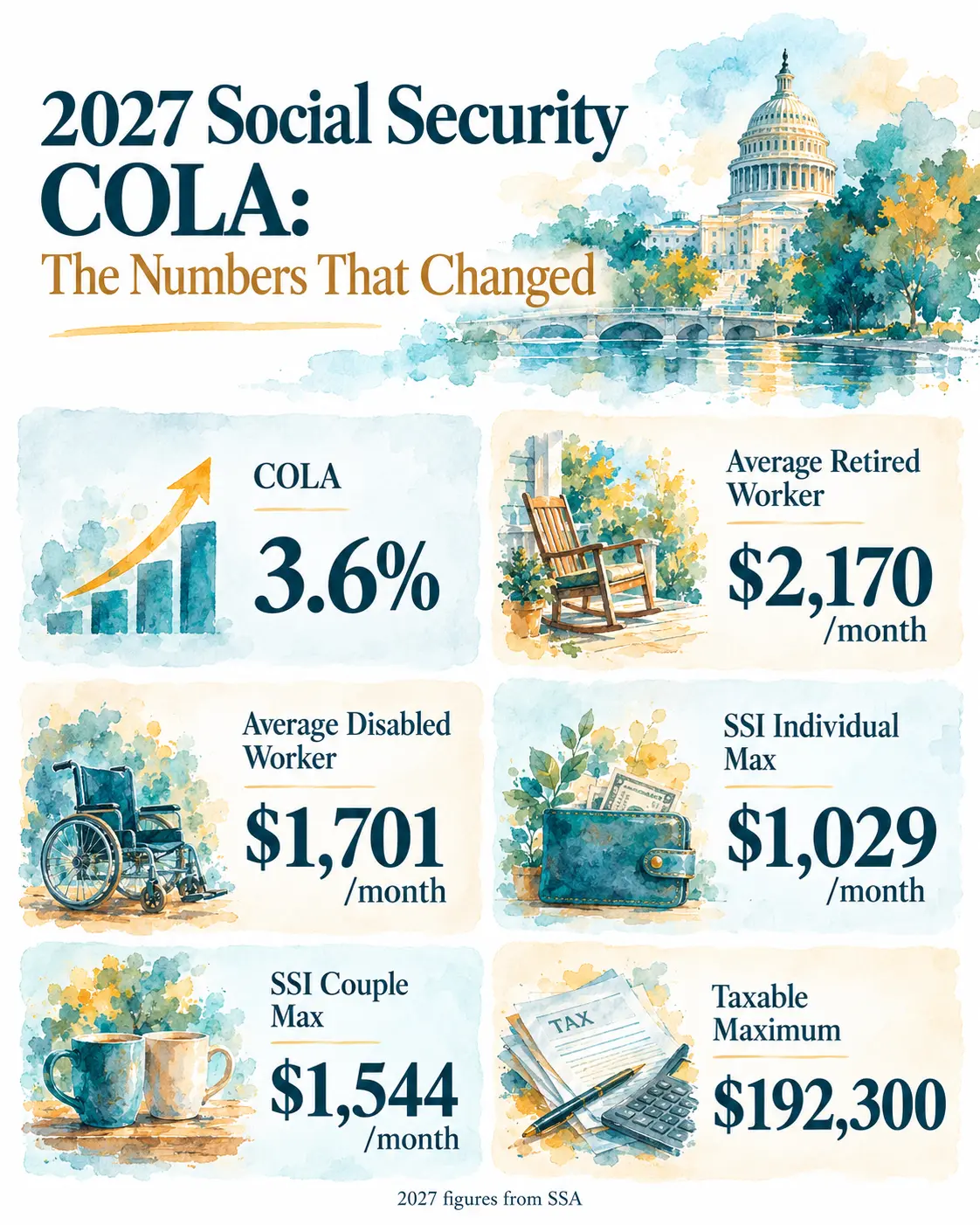
Try the free toolThe Social Security Administration (SSA) has officially announced a 3.6% cost-of-living adjustment (COLA) for 2027, increasing benefits for about 76 million Americans.
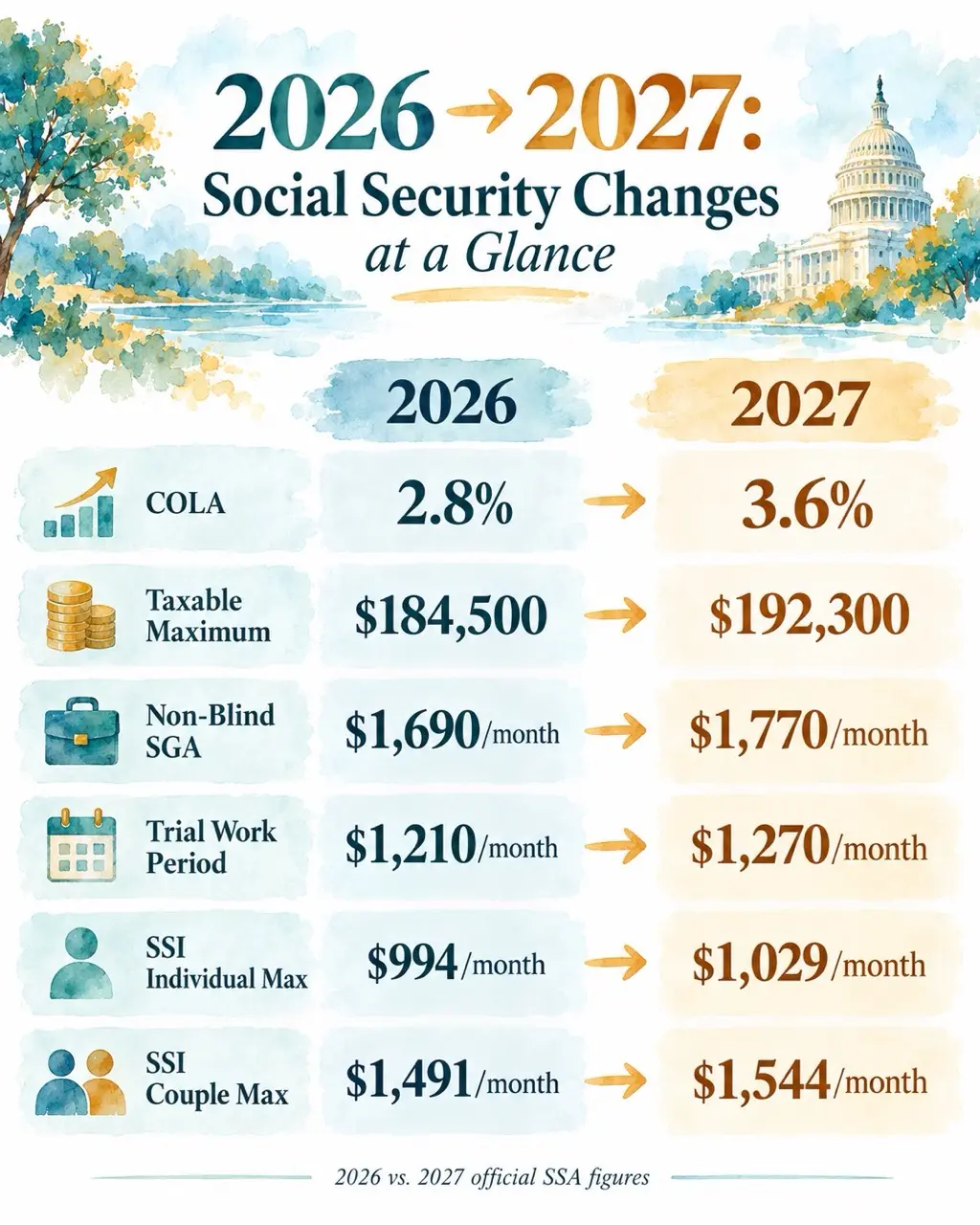
The increase is larger than the 2.8% COLA beneficiaries received for 2026. Nearly 72 million people receiving Social Security will see the higher amount beginning with January 2027 payments, while about 7.3 million Supplemental Security Income recipients will receive their first increased payment on December 31, 2026.
For the average retired worker, SSA estimates the monthly benefit will increase by about $75, from roughly $2,095 before the COLA to about $2,170 afterward.
But the annual COLA announcement changes more than one monthly payment. Several Social Security earnings limits, disability thresholds and tax figures are changing for 2027 too.
Want to stay ahead of changes to Social Security, Medicare and other benefits? Sign up for a free BenefitKarma account.
2027 Social Security COLA at a glance
| 2027 change | Amount |
|---|---|
| Social Security COLA | 3.6% |
| Average retired-worker benefit | About $2,170/month |
| Average increase for retired worker | About $75/month |
| Average disabled-worker benefit | About $1,701/month |
| Maximum federal SSI — individual | $1,029/month |
| Maximum federal SSI — couple | $1,544/month |
| Social Security taxable maximum | $192,300 |
| Earnings limit under full retirement age | $25,560/year |
| Maximum benefit at full retirement age | $4,188/month |
| First increased Social Security payments | January 2027 |
| First increased SSI payment | December 31, 2026 |
What Is the Social Security COLA for 2027?
The 2027 Social Security COLA is 3.6%.
SSA announced the increase on October 14, 2026. It applies to Social Security retirement, survivor and disability benefits as well as federal Supplemental Security Income payments.
COLA is not a bonus or a one-time payment. It permanently raises the benefit amount used going forward, although future annual COLAs can be larger, smaller or even zero depending on inflation.
If you currently receive Social Security, you do not need to apply for the increase. SSA adjusts eligible benefits automatically.
For a deeper look at how retirement benefits work outside the annual COLA, see our guide to Social Security retirement benefits.
How Does SSA Calculate the COLA?
Social Security's annual COLA is based on the Consumer Price Index for Urban Wage Earners and Clerical Workers (CPI-W).
SSA compares the average CPI-W for July, August and September with the average from the same three months used to determine the previous COLA.
If that average rises, Social Security benefits increase by the same percentage.
For 2027, the calculation produced a 3.6% increase.
SSA has used automatic cost-of-living adjustments since 1975 to help benefits keep pace with inflation.
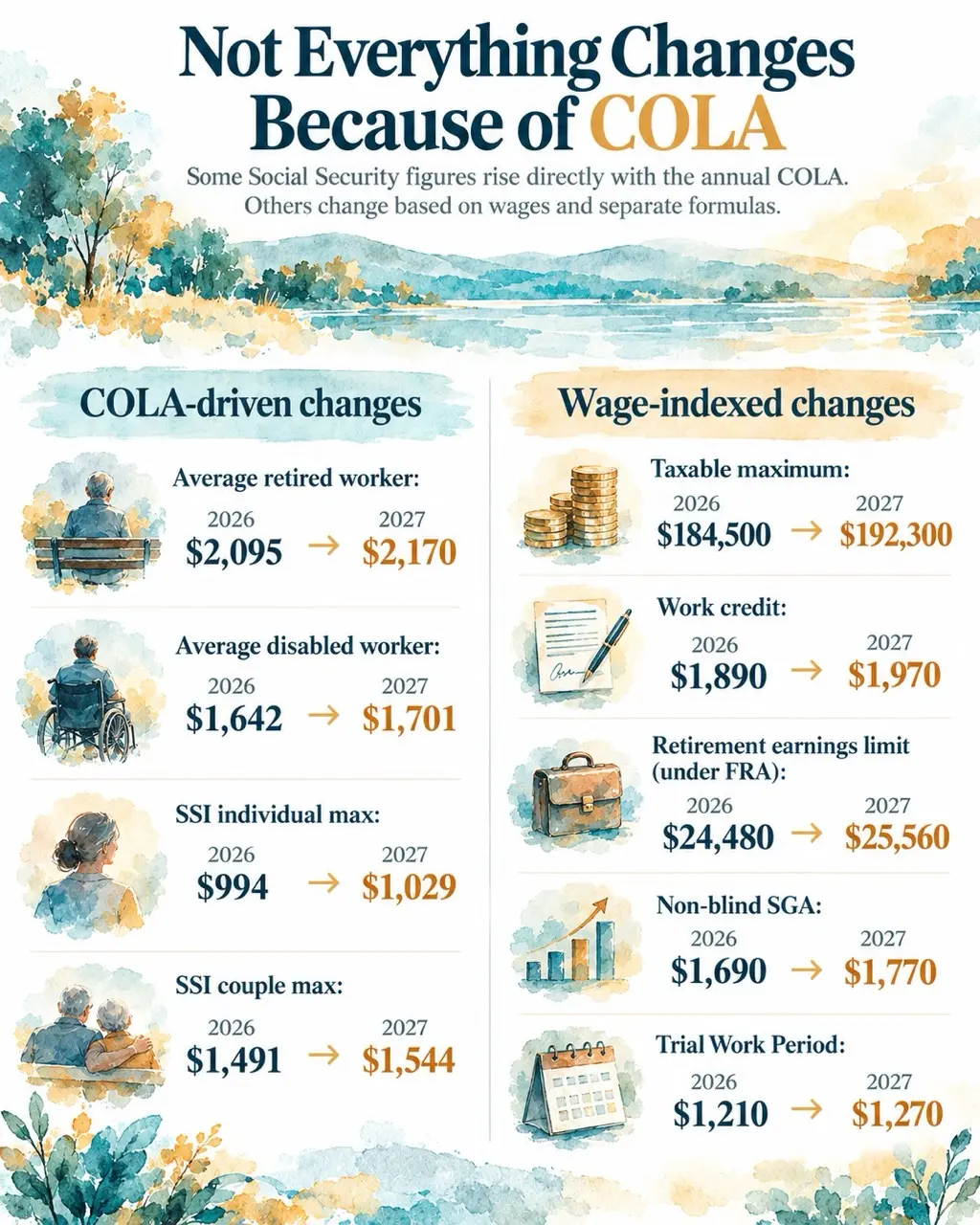
It is important to separate the COLA from several other annual Social Security changes. Some figures, including the taxable wage maximum, work-credit threshold and certain disability limits, are based on changes in national wages rather than simply multiplying last year's amount by 3.6%.
How Much Will Social Security Checks Increase in 2027?
Your individual increase depends on your current benefit.
A 3.6% COLA does not add the same dollar amount to every check.
For example:
- A $1,500 benefit would increase by about $54 before rounding and deductions.
- A $2,000 benefit would increase by about $72.
- A $2,500 benefit would increase by about $90.
SSA estimates these average monthly changes:
| Benefit group | Before 2027 COLA | After 2027 COLA | Approx. increase |
|---|---|---|---|
| Retired worker | $2,095 | $2,170 | $75 |
| Retired couple, both receiving | $3,238 | $3,355 | $117 |
| Aged widow(er) alone | $1,936 | $2,005 | $69 |
| Disabled worker | $1,642 | $1,701 | $59 |
| Disabled worker, spouse and children | $2,970 | $3,077 | $107 |
These are estimated averages, not guaranteed payment amounts.
Your actual benefit depends on your own earnings record and benefit type.
What Changes for SSDI in 2027?
Social Security Disability Insurance (SSDI) receives the same 3.6% COLA.
SSA estimates the average disabled-worker benefit will increase from about $1,642 to $1,701 per month.
Several disability-related work thresholds are changing too:
| SSDI threshold | 2026 | 2027 |
|---|---|---|
| Non-blind SGA | $1,690/month | $1,770/month |
| Blind SGA | $2,830/month | $2,950/month |
| Trial Work Period threshold | $1,210/month | $1,270/month |
These figures matter for people applying for disability or testing their ability to work while receiving benefits.
They are not all calculated directly from the 3.6% COLA. Some annual Social Security thresholds change based on national wage growth.
For the detailed disability-payment calculations, work rules and 2027 figures, see our SSDI pay chart guide and earnings-limits guide.
How Much Will SSI Pay in 2027?
Supplemental Security Income (SSI) also increases by 3.6%.
The maximum federal payment rises to:
- $1,029 per month for an eligible individual
- $1,544 per month for an eligible couple
- $516 per month for an essential person
These are maximum federal amounts. Other income, living arrangements and state supplements can change the actual payment.
One number that did not rise with the COLA is SSI's federal resource limit. It remains $2,000 for an individual and $3,000 for a couple.
SSI recipients will receive the January 2027 payment on December 31, 2026, because January 1 is a federal holiday.
Our full SSI guide explains the 2027 SSI payment, income and resource rules in more detail.
The Social Security Taxable Maximum Rises to $192,300
The amount of wages subject to Social Security tax will increase substantially in 2027.
The maximum taxable earnings amount rises from:
- $184,500 in 2026
- to $192,300 in 2027
Employees continue paying the 6.2% Social Security portion of payroll tax on earnings up to that limit, with employers paying an equal amount.
The Medicare payroll tax does not have the same wage ceiling.
This increase is based on changes in the national average wage index, not the 3.6% COLA itself.
Social Security Work Credits Get More Expensive in 2027
The earnings required to earn one Social Security work credit also increase.
In 2027, you earn one work credit for every $1,970 in covered earnings, up from $1,890 in 2026.
You can earn a maximum of four credits per year, so earning $7,880 during 2027 gives you all four.
Free DIY tool
Benefit Eligibility Screener
What benefits might I qualify for? Answer a few questions and see VA, disability, food, housing, and health programs that may fit you.
Try the free toolWork credits can affect eligibility for programs including SSDI and Social Security retirement benefits, but earning more than four credits in one year does not give you extra credits for that year.
Social Security Earnings Limits Also Rise
If you receive retirement benefits before reaching full retirement age and continue working, Social Security's retirement earnings test may temporarily withhold some benefits when your earnings exceed the annual limit.
For 2027:
- If you are under full retirement age all year, the earnings limit is $25,560.
- If you reach full retirement age during 2027, the higher limit is $67,920 for earnings before the month you reach full retirement age.
- Beginning with the month you reach full retirement age, there is no retirement earnings limit.
These limits increased from $24,480 and $65,160 in 2026.
If you are under full retirement age all year, SSA generally withholds $1 in benefits for every $2 earned above the limit. During the year you reach full retirement age, SSA generally withholds $1 for every $3 above the higher limit until the month you reach full retirement age.
What Is the Maximum Social Security Benefit in 2027?
SSA lists $4,188 per month as the maximum benefit for a worker retiring at full retirement age in 2027.
That figure is useful context, but it is easy to misunderstand.
It is not the maximum check every Social Security recipient can receive, and it is not a number you can simply reach by applying for benefits at a certain age.
Retirement benefits depend on your lifetime earnings and when you begin claiming them.
Someone retiring at age 62 receives a reduced benefit. Someone who delays retirement can receive a larger monthly amount.
Because BenefitKarma already has a full guide to Social Security retirement benefits, we would use that page rather than turning this COLA update into a separate retirement-benefit calculator.
When Will the 2027 COLA Show Up?
For Social Security retirement, survivor and disability benefits, the increase begins with benefits payable in January 2027.
Your usual payment schedule does not change because of the COLA.
Most beneficiaries receiving Social Security based on their birthday continue to be paid on the second, third or fourth Wednesday of the month.
SSI is different. Because the January 1 payment date falls on a federal holiday, the January SSI payment will arrive December 31, 2026.
There is no need to call SSA or file a form to receive the increase.
When Will You Get Your 2027 COLA Notice?
SSA will make personalized COLA notices available online to most beneficiaries through their my Social Security accounts beginning in late November or early December.
The notice shows your actual new benefit amount rather than the national averages in this article.
People receiving mailed notices should receive them during December.
If you use a my Social Security account, make sure your contact information and notification preferences are current.
Your personalized notice is especially useful because your net deposit may differ from the simple 3.6% calculation.
Medicare Can Affect the Increase You Actually See
If you receive Social Security and have Medicare, your Medicare Part B premium may be deducted directly from your Social Security benefit.
That means your gross Social Security benefit may rise 3.6% while the increase that reaches your bank account is smaller after Medicare deductions.
As of October 21, 2026, CMS has not yet announced the final standard Medicare Part B premium for 2027.
The annual Social Security COLA and Medicare premium are calculated separately, so you should wait for the official Medicare amount and your personalized COLA notice before calculating your exact net increase.
Does the COLA Affect VA Benefits Too?
Many veterans' benefits receive an annual cost-of-living increase tied to Social Security's COLA.
That includes VA disability compensation and certain survivor benefits.
The 3.6% COLA therefore has implications beyond Social Security itself, although each benefits program has its own payment tables and effective-date rules.
If you receive benefits from more than one program, check each program separately rather than assuming every payment simply increases 3.6% on the same date.
What Should You Do Before the 2027 Increase?
You do not have to do anything to activate the COLA.
But there are a few useful things to check:
- Review your COLA notice. Compare the new gross benefit with your current amount.
- Check deductions. Medicare premiums or voluntary tax withholding can affect the deposit you actually receive.
- Verify your earnings record. Your Social Security benefit is based on your reported earnings history, so errors can matter.
- Update your contact and banking information. Make sure SSA can reach you and your direct deposit is correct.
- Revisit income-based benefits. A higher Social Security payment can sometimes affect programs that use income to determine eligibility or benefit amounts.
Frequently Asked Questions
Do I need to apply for the 2027 COLA?
No. SSA automatically applies the 3.6% increase to eligible Social Security and SSI benefits.
When will I receive the higher Social Security amount?
Social Security beneficiaries begin receiving the increased amount with January 2027 payments.
SSI recipients receive their January payment on December 31, 2026.
Will my check increase by exactly 3.6%?
Your gross benefit is adjusted using the COLA, but rounding and deductions can affect the final payment deposited into your account.
Does the taxable wage maximum increase because of COLA?
Not directly. The taxable maximum rises from $184,500 to $192,300 for 2027, but that adjustment is based on national wage growth rather than the COLA calculation.
Will Medicare take away my whole COLA?
Not necessarily.
Medicare Part B premiums can reduce the amount of the increase you see in your net Social Security payment. The final 2027 standard Part B premium had not yet been announced as of October 21, 2026.
The Bottom Line
The 2027 Social Security COLA is 3.6%, raising benefits for about 76 million Americans.
The average retired-worker benefit is expected to rise to about $2,170 per month, an increase of roughly $75. The average disabled-worker benefit rises to about $1,701, while maximum federal SSI payments rise to $1,029 for an individual and $1,544 for a couple.
At the same time, several other Social Security numbers are changing: the taxable wage maximum rises to $192,300, retirement earnings limits increase, disability work thresholds rise and a work credit requires $1,970 in earnings.
Your personalized COLA notice is the best source for your exact 2027 benefit.
And remember: the annual COLA is only one piece of your benefits picture. The amount you actually receive can still depend on Medicare premiums, taxes, other income and the rules of any additional benefits programs you use.
Not sure what you qualify for?
A quick conversation can help you understand your options.
Optional — no obligation, fees may apply
Want help figuring out your next step?
Optional — fees may apply depending on your situation.
Some people choose to talk to a professional before taking their next step.
This might sound familiar:
You're not sure what to do next
You want someone to walk through your options
The process feels overwhelming
If that sounds like you, this might be worth a quick look.
Takes less than a minute
We only share your info with a service provider if you say yes.
Recommended Tools
Take action with our free tools
Get More from BenefitKarma
Create a free account to unlock all features
- Access premium benefit tools
- Personalized benefit matching
- Your personalized dashboard
Common questions about this guide
Get more from BenefitKarma
Free tools, personalized dashboard & more
