SSA has confirmed the 2027 COLA at 3.6%. See the confirmed figures and payment dates →
Social Security COLA 2027 Is Now Projected at 3.6%
Many people count on Social Security. See what the 2027 COLA may be and what that means for your income.

Free DIY tool
Benefit Eligibility Screener
What benefits might I qualify for? Answer a few questions and see VA, disability, food, housing, and health programs that may fit you.
Try the free toolSocial Security beneficiaries could be headed for a larger cost-of-living adjustment in 2027 than experts expected earlier this year.
The Senior Citizens League (TSCL) now projects that the 2027 Social Security cost-of-living adjustment, or COLA, will be about 3.6%. That would be higher than the 2.8% COLA beneficiaries received for 2026 and would make it the largest annual increase since 2023.
That is a meaningful change from earlier forecasts.
At the beginning of the year, projections generally clustered closer to the high-2% or low-3% range, and the Congressional Budget Office had estimated a roughly 3.1% adjustment. Those forecasts were based on the inflation picture available at the time.
Since then, inflation has proved more stubborn than expected.
TSCL says the CPI-W — the inflation measure used to calculate Social Security COLAs — has been rising at an annual rate above 3% since the February 2026 data. Its latest model now points to a 3.6% adjustment.
But there’s one important thing to remember: 3.6% is still a projection. The official 2027 COLA has not been announced yet.
At BenefitKarma, we’re tracking the numbers as they come in so you know what they could mean for your monthly benefit.
Why the COLA Forecast Has Gone Up
Social Security COLAs are tied directly to inflation.
The Social Security Administration uses the Consumer Price Index for Urban Wage Earners and Clerical Workers, or CPI-W, to calculate the annual adjustment.
Specifically, the government compares the average CPI-W during July, August and September with the average from those same three months one year earlier.
That means we’ve now entered the three-month period that actually determines the 2027 COLA.
July’s CPI-W was 3.4% higher than a year earlier. TSCL’s model expects inflation to rise slightly during the remaining two months, producing its current 3.6% forecast.
Inflation has also been unusually volatile this year. According to TSCL, annual CPI-W inflation started 2026 at 2.2%, climbed as high as 4.4% in May, then dropped to 3.5% in June before July’s 3.4% reading.
That helps explain why earlier forecasts were lower.
They weren’t guarantees. They were estimates based on the economic data available at the time — and as inflation changed, the COLA forecast changed with it.
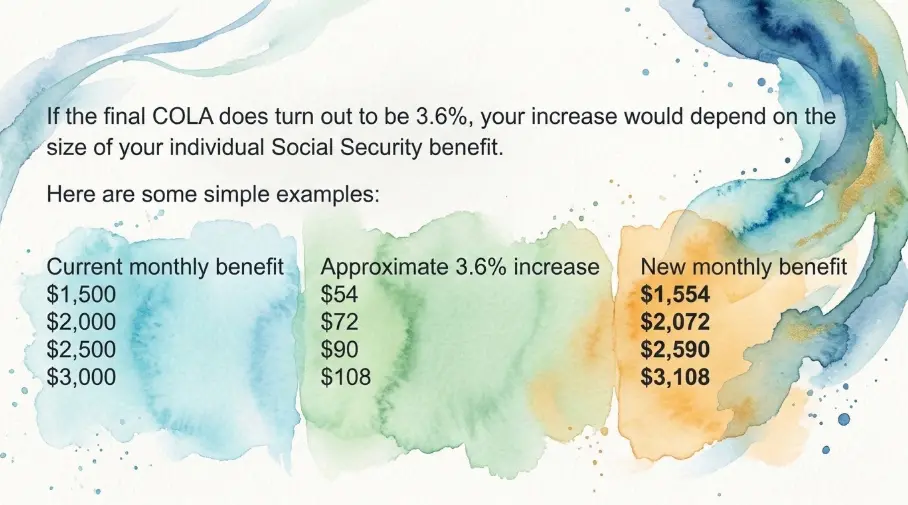
How Much Could a 3.6% COLA Add to Your Check?
If the final COLA comes in at 3.6%, the amount you receive would depend on your current Social Security benefit.
Here are a few examples:
| Current monthly benefit | Approximate increase | New monthly benefit |
|---|---|---|
| $1,500 | $54 | $1,554 |
| $1,900 | $68.40 | $1,968.40 |
| $2,000 | $72 | $2,072 |
| $2,500 | $90 | $2,590 |
| $3,000 | $108 | $3,108 |
These figures are estimates before Medicare or other deductions.
TSCL says the average monthly Social Security benefit was about $1,938 as of June 2026. At that level, a 3.6% COLA would add roughly $70 per month, or about $837 over a full year.
For retired workers specifically, TSCL reports an average monthly benefit of about $2,084, which would translate to an increase of approximately $75 per month if the 3.6% estimate holds.
How Does 3.6% Compare With Recent COLAs?
A 3.6% increase would be larger than beneficiaries have received in any of the past three years:
- 2024: 3.2%
- 2025: 2.5%
- 2026: 2.8%
- 2027 projected: 3.6%
The unusually large 8.7% increase in 2023 came during the inflation surge that followed the COVID-19 pandemic.
So while a 3.6% COLA would be noticeable, it would still be well below the increases beneficiaries received during the peak inflation years.
And a larger COLA isn’t necessarily a financial windfall.
Social Security increases because prices have already gone up. The COLA is designed to help benefits keep pace with inflation, not to give beneficiaries additional purchasing power beyond those rising costs.
Why Some Seniors Still Feel COLAs Don’t Keep Up
One longstanding criticism of the Social Security COLA is the inflation measure it uses.
The CPI-W is designed around the spending patterns of urban workers, not retirees.
Older Americans often devote a larger share of their budgets to expenses such as:
- Housing
- Healthcare
- Prescription medications
- Insurance
- Utilities
TSCL argues that this difference can cause Social Security benefits to lose purchasing power over time. Its latest analysis estimates that the average Social Security benefit has lost about 13.7% of its buying power since 2010.
One alternative that has been discussed for years is the Consumer Price Index for the Elderly, or CPI-E, which gives greater weight to expenses such as housing and medical care.
TSCL calculates that the CPI-E would have produced a higher COLA than the CPI-W in seven of the past 10 years.
However, Congress has not changed the formula.
Free DIY tool
Benefit Eligibility Screener
What benefits might I qualify for? Answer a few questions and see VA, disability, food, housing, and health programs that may fit you.
Try the free toolUnless federal law changes, Social Security COLAs will continue to be calculated using the CPI-W.
Don’t Forget About Medicare Premiums
Even if Social Security benefits rise 3.6%, you may not see that entire increase in your bank account.
That’s because many beneficiaries have their Medicare Part B premium deducted directly from their Social Security benefit.
If Medicare premiums rise for 2027, part of your COLA could effectively be absorbed by that increase.
The 2027 Medicare Part B premium has not yet been finalized, so beneficiaries won’t know their true net increase until both numbers are available.
That’s an important distinction when planning your 2027 budget.
For example, if your Social Security benefit rises by $72 per month but your Medicare premium also increases, your actual monthly deposit may rise by less than $72.
When Will the Official 2027 COLA Be Announced?
We don’t have much longer to wait.
The Social Security Administration is expected to announce the official 2027 COLA on Oct. 14, 2026, after September inflation data is released.
At that point, all three months used in the calculation — July, August and September — will be available.
SSA confirms that the next COLA will be announced in October 2026.
If the final number is 3.6%, higher Social Security benefits would generally begin with benefits payable in January 2027.
You Don’t Need to Apply for the COLA
If you already receive Social Security benefits, the annual COLA is automatic.
You do not need to submit an application, call Social Security or pay anyone to receive it.
SSA will calculate your new benefit amount once the COLA becomes official.
That also means you should be cautious of anyone claiming they can help you “claim” your COLA in exchange for money or personal information.
What You Can Do Now
Because we’re only two months away from the final calculation, this estimate is becoming much more useful for planning.
Here are a few things you can do now:
1. Estimate your possible increase
Take your current gross Social Security benefit and multiply it by 0.036.
For example:
$2,000 × 0.036 = $72
That would give you an estimated new benefit of about $2,072 per month.
Just remember that 3.6% is not official yet.
2. Watch Medicare costs
Keep an eye on the 2027 Medicare Part B premium announcement. That number will help determine how much of your Social Security increase actually reaches your bank account.
3. Review other assistance you may qualify for
If Social Security isn’t keeping up with your household costs, you may qualify for programs such as:
- Medicare Savings Programs
- Supplemental Nutrition Assistance Program (SNAP)
- Low-Income Home Energy Assistance Program (LIHEAP)
- Extra Help with Medicare prescription drug costs
Benefit eligibility varies based on income, household size and where you live, so it’s worth checking rather than assuming you don’t qualify.
The Bottom Line
Earlier forecasts suggested Social Security’s 2027 COLA might land somewhere around the high-2% to low-3% range.
The outlook has changed.
With inflation remaining higher than anticipated, The Senior Citizens League now projects a 3.6% COLA for 2027, which would be the largest Social Security increase in four years.
But the number is not final.
July was only the first of the three months used in the official calculation. August and September inflation data still have to come in, and the Social Security Administration is expected to announce the final COLA on October 14, 2026.
For now, 3.6% gives beneficiaries a much better idea of what next year could look like — but don’t build your 2027 budget around it until the official number arrives.
BenefitKarma will continue tracking the COLA, Medicare premiums and other benefit changes so you know what’s changing, when it takes effect and what it means for your household.
Not sure what you qualify for?
A quick conversation can help you understand your options.
Optional — no obligation, fees may apply
Want help figuring out your next step?
Optional — fees may apply depending on your situation.
Some people choose to talk to a professional before taking their next step.
This might sound familiar:
You're not sure what to do next
You want someone to walk through your options
The process feels overwhelming
If that sounds like you, this might be worth a quick look.
Takes less than a minute
We only share your info with a service provider if you say yes.
Recommended Tools
Take action with our free tools
Get More from BenefitKarma
Create a free account to unlock all features
- Access premium benefit tools
- Personalized benefit matching
- Your personalized dashboard
Common questions about this guide
Get more from BenefitKarma
Free tools, personalized dashboard & more
