Can You Get Social Security Disability for Bipolar Disorder?
Bipolar disorder is evaluated under Blue Book Listing 12.04. You can qualify by meeting that listing, or through SSA's Residual Functional Capacity (RFC) assessment instead.

Bipolar disorder can qualify for Social Security Disability Insurance (SSDI) or Supplemental Security Income (SSI) if the condition meets Social Security's disability rules and you meet the program's other requirements. The Social Security Administration (SSA) looks at how your symptoms affect your ability to sustain work over time. A record that shows flare-ups and periods of improvement can help explain the full pattern.
Free DIY tool
SSDI Benefit Estimator
How much could SSDI pay me each month? Get a ballpark estimate based on your work history.
Try the free toolFor 2027, the standard monthly substantial gainful activity amount is $1,770 for nonblind applicants. Earnings and work activity are evaluated under SSA's rules. The agency can consider factors such as certain disability-related work expenses. The medical standard generally requires a condition expected to last at least 12 months or result in death.
Bipolar disorder is one of the more common mental health conditions in disability claims, but approval isn't automatic. Because symptoms often come and go, the strength of your medical record and how clearly it shows your limits over time usually make the difference.
At a glance
- Bipolar disorder can qualify for SSDI, SSI, or both.
- SSA uses Listing 12.04 for bipolar and depressive disorders, but you can qualify without meeting the listing.
- The 2027 substantial gainful activity (SGA) limit is $1,770 a month for nonblind applicants.
- The 2027 maximum federal SSI payment is $1,029 a month for an individual and $1,544 for a couple.
- Benefits rise 3.6% in 2027 because of the cost-of-living adjustment.
What's the difference between SSDI and SSI?
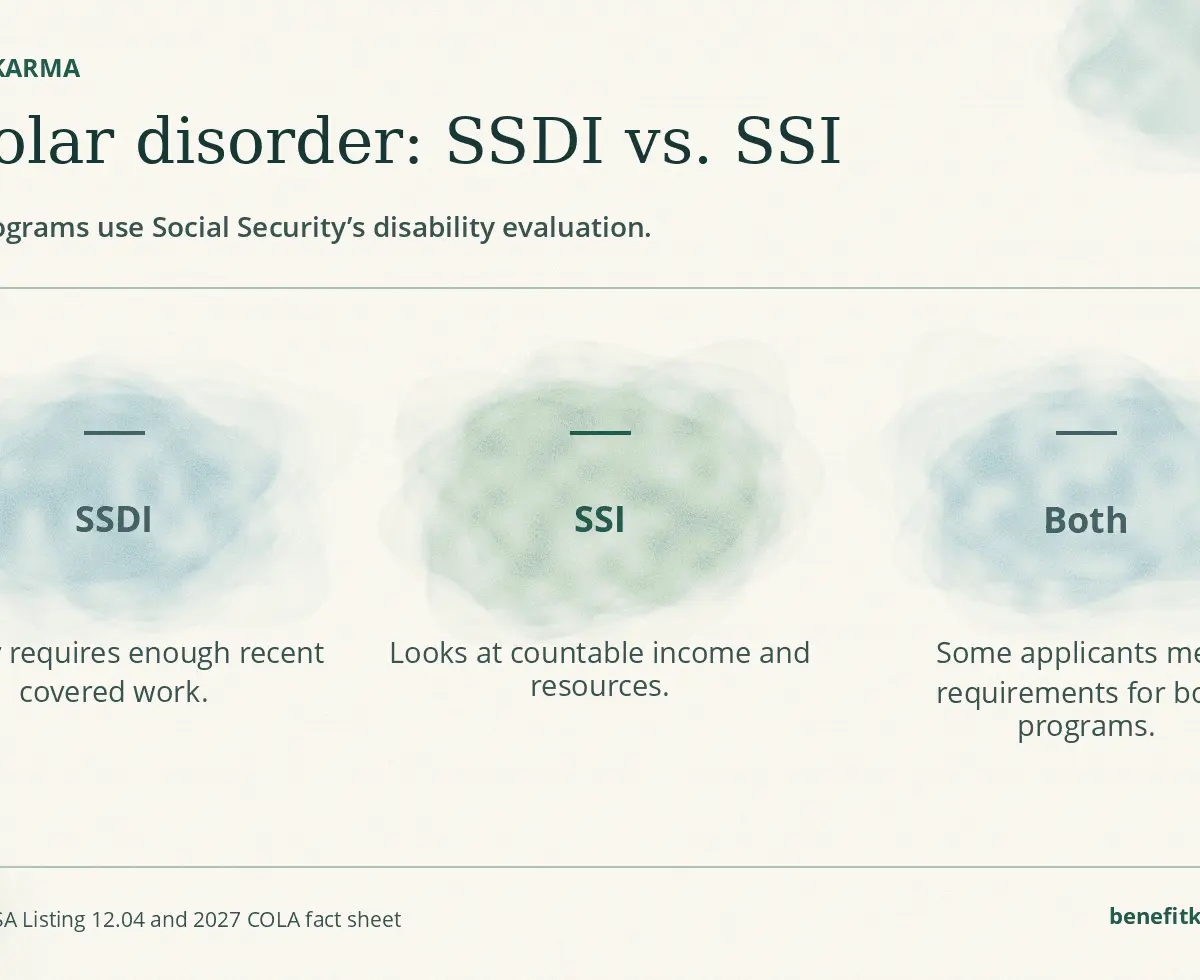
SSDI generally requires enough work credits, including recent work for many adults. SSI is needs-based, so Social Security looks at income and resources rather than requiring prior covered work. Some people qualify for both. Use the BK SSDI benefit estimator to understand a possible payment range if you qualify. For coverage and program differences, see how SSDI, SSI, and Medicaid work together.
| SSDI | SSI | |
|---|---|---|
| Based on | Your work history and Social Security taxes paid | Financial need |
| Resource limit | None | $2,000 for an individual, $3,000 for a couple |
| 2027 payment | Based on your earnings record | Up to $1,029 a month federally, plus any state supplement |
| Waiting period | Five full months after disability begins | None after approval |
| Health coverage | Medicare after 24 months of SSDI entitlement | Medicaid in most states |
SSDI payments also get the 3.6% cost-of-living adjustment (COLA) for 2027. SSI payments reflecting the COLA begin Dec. 31, 2026, and SSDI payments reflecting it begin in January 2027.
How does Social Security evaluate bipolar disorder?
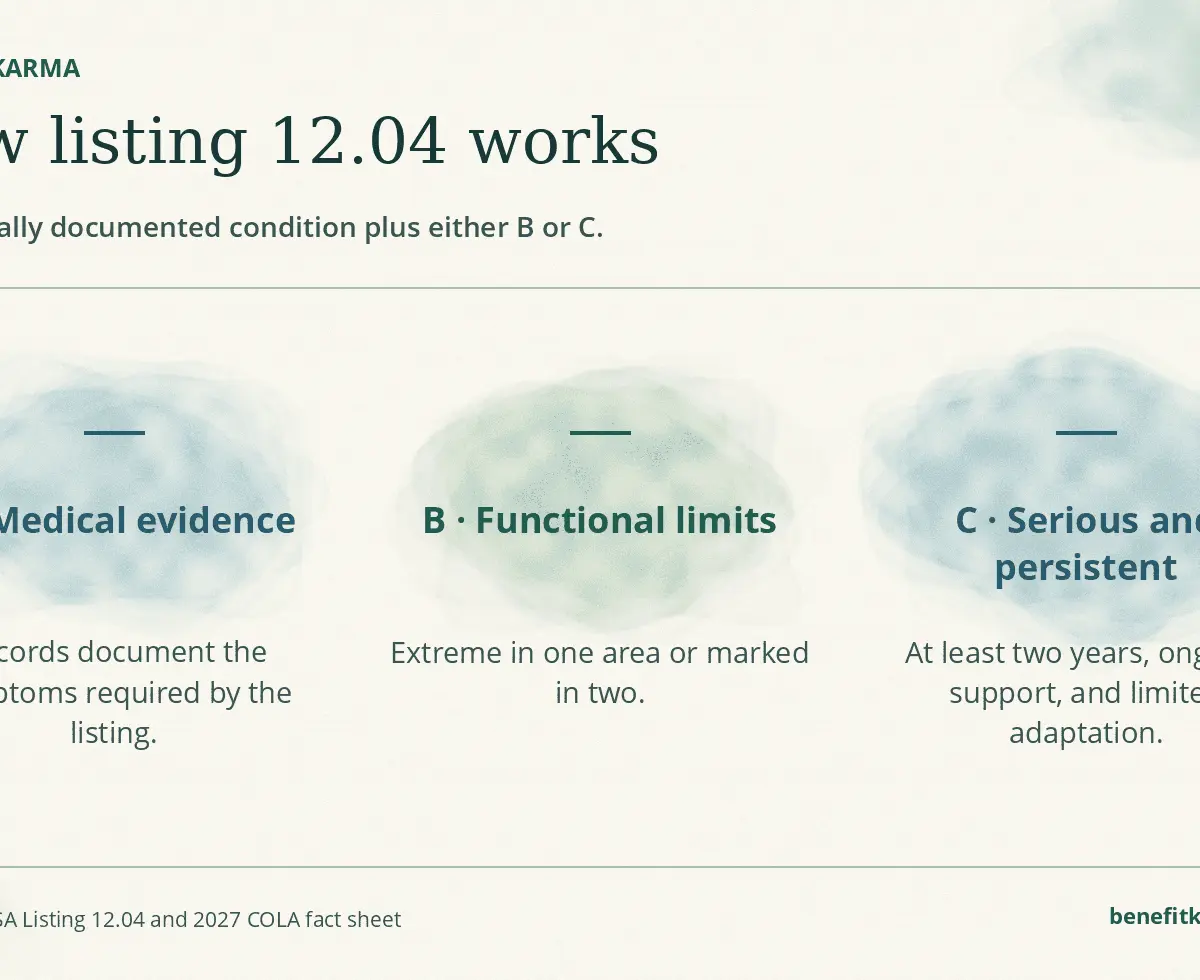
Listing 12.04 provides one path. It calls for medical documentation under paragraph A and either the functional limits in paragraph B or the serious-and-persistent criteria in paragraph C.
- Paragraph B: an extreme limitation in one area or marked limitations in two. The areas involve understanding and applying information, interacting with others, concentrating and maintaining pace, and managing yourself.
- Paragraph C: a medically documented history of at least two years, with ongoing treatment or structured support that reduces symptoms and a minimal ability to adapt to new demands or changes.
Paragraph A asks for documentation of bipolar symptoms, such as pressured speech, flight of ideas, decreased need for sleep, distractibility, risky behavior, or increased activity. A diagnosis from an acceptable medical source, such as a psychiatrist or licensed psychologist, carries the most weight.
Someone who does not meet or equal the listing may still qualify. SSA considers their remaining ability to work, past work, age, education, and other factors under its disability evaluation rules.
This second route uses what SSA calls your residual functional capacity, or RFC. For mental conditions, the RFC describes what you can still do on a sustained basis, such as following simple instructions, working around others, keeping a regular schedule, and handling routine changes. If your limits rule out your past work and other jobs that exist in the economy, you may be found disabled even without meeting the listing. Age plays a role, too. SSA's rules are generally more favorable for applicants 50 and older.
What evidence helps Social Security understand your limits?
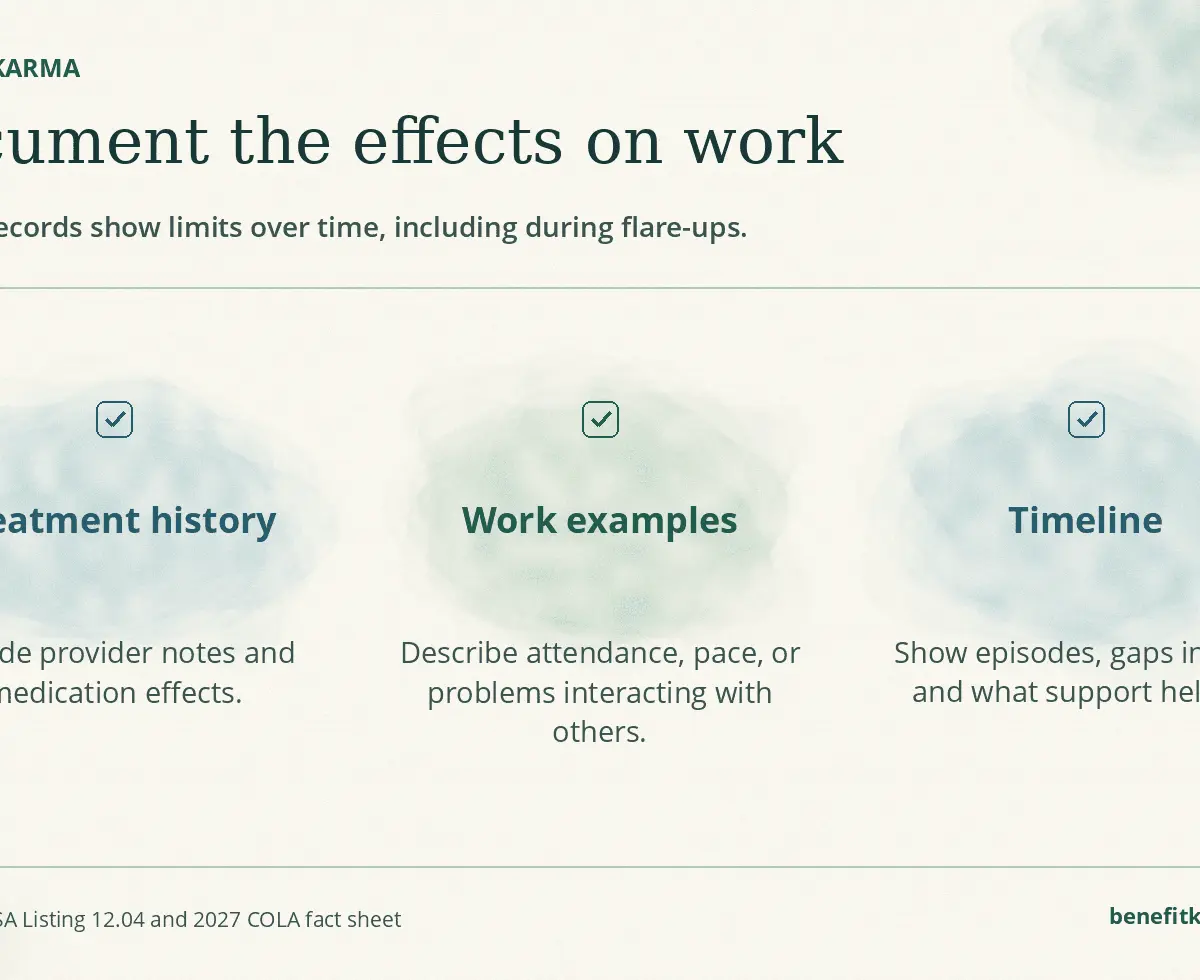
Gather treatment notes, medication history and documented side effects, hospital or crisis records if applicable, and examples of how symptoms affected attendance, pace, judgment, or interactions at work. Bipolar I and II can present differently. A timeline helps SSA see how often symptoms interrupt work, whether you recover between episodes, and what support keeps you functioning. If you had gaps in care, explain barriers such as cost, access, or symptoms.
Other evidence that can help includes:
- A medical source statement from your psychiatrist or therapist describing specific limits, not just the diagnosis.
- Records showing how well medication works, including side effects such as fatigue, tremors, or slowed thinking.
- Statements from family members, friends, or former supervisors describing what they observed.
- Work records showing missed days, warnings, accommodations, or job losses.
- Evidence of how much support you need at home, such as help with bills, reminders to take medication, or supervision during episodes.
Treatment consistency matters, and so does honesty about substance use, since SSA must consider it. SSA may ask whether you followed prescribed treatment. If you stopped a medication because of side effects or cost, make sure your records explain why.
Free DIY tool
SSDI Benefit Estimator
How much could SSDI pay me each month? Get a ballpark estimate based on your work history.
Try the free toolApply for disability benefits through SSA. If you're denied, read the notice and review the appeal instructions promptly. The notice gives the deadline and tells you how to respond.
Most denials can be appealed in stages: reconsideration, a hearing before an administrative law judge, review by the Appeals Council, and federal court. You generally have 60 days from receiving a notice to appeal. Many approvals for mental health conditions happen at the hearing level, where you can explain your symptoms in your own words.
Tips for a stronger application
Applying while managing bipolar symptoms can feel overwhelming. A few practical steps can make the process easier and the record clearer:
- Start a symptom journal. Note mood changes, sleep, hospital visits, missed work, and medication changes. Even short entries help show patterns over months.
- List every provider. Include psychiatrists, therapists, primary care doctors, emergency rooms, and crisis services, with dates and contact information. SSA requests records from the sources you list.
- Describe your worst days and your typical days. SSA needs to understand how often episodes happen and how long recovery takes, not just how you feel on the day you fill out the forms.
- Answer the function report carefully. This form asks about daily activities, such as cooking, shopping, handling money, and getting along with others. Be specific about help you need and tasks you can't finish.
- Go to any consultative exam. If SSA schedules an exam with an independent doctor, attend and be honest about your symptoms.
- Ask someone you trust for help. A family member, friend, or advocate can help you keep track of forms, deadlines, and appointments.
Some applicants work with a disability attorney or advocate, especially at the hearing level. Fees are generally limited by law and paid from past-due benefits only if you win. Free help may also be available from legal aid organizations or your state's protection and advocacy agency. Before you sign anything, ask how the representative communicates with you, who will attend your hearing, and what costs you might owe if your claim is denied. A good representative can help gather records, prepare you to testify, and question vocational experts at the hearing.
Frequently asked questions
Is bipolar disorder on the Compassionate Allowances list?
No. Compassionate Allowances mostly cover severe conditions such as certain cancers and rare diseases. Bipolar claims go through the standard review process.
Do I need to be hospitalized to qualify?
No. Hospitalization records can help show severity, but many people qualify based on outpatient treatment records and documented functional limits.
Can I get benefits if I also have another condition?
Yes. SSA considers all of your conditions together. Anxiety, depression, substance use history, or physical conditions can affect the decision, so list them all.
Will SSA review my case again later?
Usually, yes. SSA conducts continuing disability reviews to check whether you still qualify. Keeping up with treatment and records makes those reviews easier.
Can you work while receiving benefits?
Possibly. SSA has work incentives that let some beneficiaries test their ability to work without immediately losing benefits. SSDI includes a trial work period, and SSI reduces payments gradually as earnings rise rather than stopping them all at once. Because bipolar symptoms often cycle, these rules can matter. Report all work and earnings to SSA promptly. Our guide to SSDI, SSI, and Medicaid explains how working can affect coverage.
The bottom line
Bipolar disorder can qualify for Social Security disability, but the decision depends on documented limits over time, not the diagnosis alone. Keep up with treatment, ask your providers to describe your functional limits in writing, and track how symptoms affect your work and daily life. If you're denied, appeal quickly, because many claims that are denied at first are approved later in the process. For more on the basics, see our SSDI glossary entry and SSI glossary entry.
Need help with your disability claim?
Talk to a specialist who handles disability claims like yours.
SSDI has strict filing windows — delays can affect your benefits start date.
Optional — no obligation, fees may apply
Want help figuring out your next step?
Optional — fees may apply depending on your situation.
Some people choose to talk to a professional before taking their next step.
This might sound familiar:
You're not sure what to do next
You want someone to walk through your options
The process feels overwhelming
If that sounds like you, this might be worth a quick look.
Takes less than a minute
We only share your info with a service provider if you say yes.
Recommended Tools
Take action with our free tools
Get More from BenefitKarma
Create a free account to unlock all features
- Access premium benefit tools
- Personalized benefit matching
- Your personalized dashboard
Common questions about this guide
Get the latest benefit updates, straight to your inbox
Plain-English updates on SNAP, Medicaid, VA and Social Security — one email a week.
Get more from BenefitKarma
Free tools, personalized dashboard & more
