SSA Compassionate Allowances in 2027: How Fast-Track Disability Claims Work
Compassionate Allowances (CAL) is SSA's system for fast-tracking disability claims for conditions severe enough that they clearly meet SSA's disability standard. It currently covers over 300 conditions, mostly aggressive cancers, adult brain disorders, and rare diseases that primarily affect children.

Compassionate Allowances (CAL) let the Social Security Administration (SSA) quickly identify disability claims involving conditions that are likely to meet its medical standards. The process is available for both Social Security Disability Insurance (SSDI) and Supplemental Security Income (SSI). It can speed up the decision when records establish the qualifying diagnosis and other required details.
Free DIY tool
Social Security COLA Calculator
How much will my check go up in 2027? Enter your monthly Social Security or SSI benefit to see your new amount with the 3.6% COLA.
Try the free toolThere's no separate CAL application. Start the regular disability application and list the exact diagnosis, including the subtype, stage, or test result if relevant. A complete submission can help SSA route the claim and find the needed records.
Standard disability claims can take many months to decide, and many are denied at first. For people with the most serious conditions, that wait can be a real hardship. Compassionate Allowances are SSA's way of moving those claims to the front of the line when the medical evidence is clear.
At a glance
- Compassionate Allowances speed up decisions for certain severe medical conditions.
- There's no separate form. You apply for SSDI or SSI as usual, and SSA flags qualifying claims.
- SSA added 14 conditions to the list in August 2026.
- Faster approval doesn't remove other rules, such as SSDI work credits, SSI financial limits, or the SSDI five-month waiting period.
- For 2027, the maximum federal SSI payment is $1,029 a month for an individual, and benefits rise 3.6% with the cost-of-living adjustment.
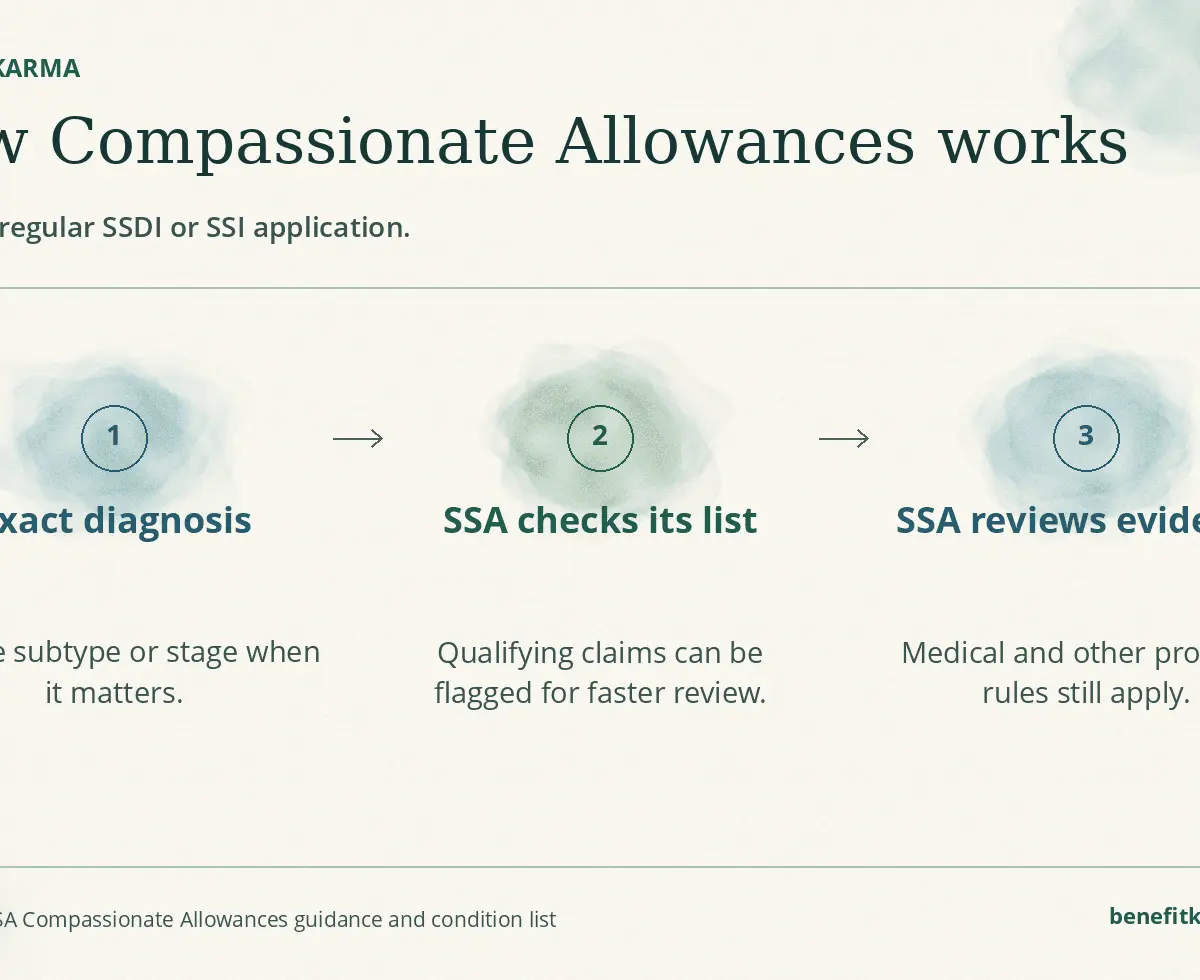
How Compassionate Allowances work
SSA uses software to scan new disability applications for diagnoses on the CAL list. When it finds a match, the claim is flagged for faster handling by the state agency that makes medical decisions for SSA, usually called Disability Determination Services.
A flagged claim still needs proof. SSA must confirm the diagnosis with acceptable medical evidence, such as a pathology report or genetic test, and must check that you meet the nonmedical rules for the program. Because the condition is already known to be severe, SSA generally doesn't need as much detail about your day-to-day limits as it would in a standard claim.
Which conditions qualify for fast-track review?
Check the current SSA Compassionate Allowances list. The list includes certain advanced cancers, rare genetic disorders, and other severe conditions. The name and qualifying details matter. Some entries describe a particular stage, progression, or proof rather than every diagnosis in a broad category.
SSA added 14 conditions in August 2026. If you last checked the list before then, check it again for the diagnosis as written in your medical records.
Examples of the kinds of conditions on the list include:
- Certain cancers that are inoperable, recurrent, or have spread, such as some forms of pancreatic, lung, esophageal, and liver cancer.
- Amyotrophic lateral sclerosis (ALS) and other progressive neurological diseases.
- Early-onset Alzheimer's disease and some other forms of dementia.
- Rare genetic and metabolic disorders, many of which affect children.
- Certain conditions that require organ transplants or involve end-stage organ failure.
Each entry on SSA's website includes a summary of the condition and the evidence SSA usually looks for. Reading that page before you apply can help you gather the right records the first time.
What should you submit?
- Give the diagnosis clearly. Use the clinician's wording, including a subtype if the listing specifies one.
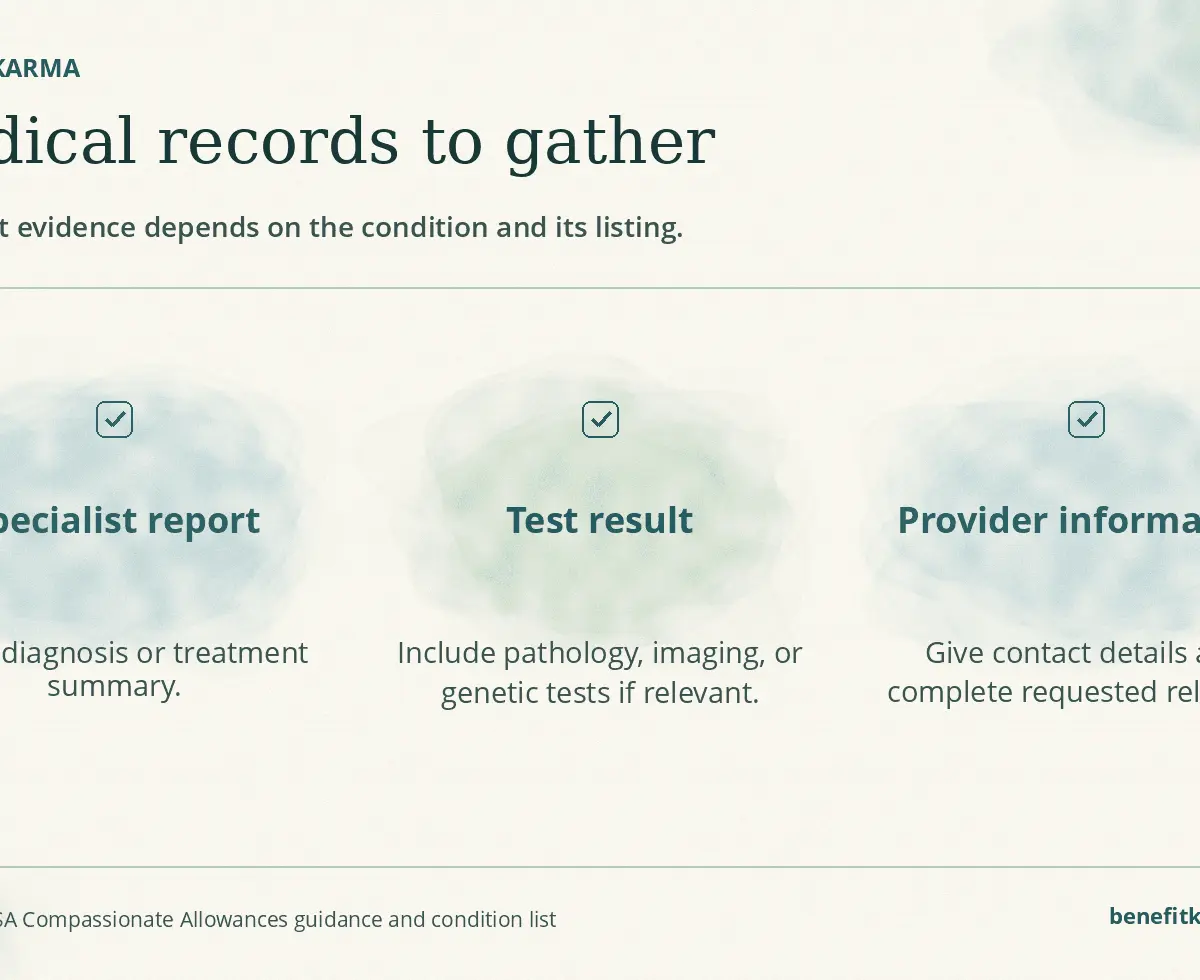
- Identify the records that confirm it. Depending on the condition, a pathology report, imaging, genetic test, specialist note, or hospital discharge summary may help.
- List the people and places that treated you. Include current contact information and complete the releases SSA requests.
- Follow up on missing records. Keep your application confirmation and respond promptly if SSA needs clarification.
Start at SSA's disability application page. If the condition is listed and you have a pending application, ask SSA whether the claim has been flagged and whether it is waiting for records.
A few extra steps can help:
- Ask your doctor's office to send key records directly to SSA, or bring copies to your appointment.
- Use the exact name of the condition as it appears on the CAL list, if that matches your diagnosis.
- Name a trusted person who can answer SSA's questions if you're too sick to respond quickly.
- If you're applying for a child, apply for SSI and include the child's specialist records.
Does faster approval mean faster payment?
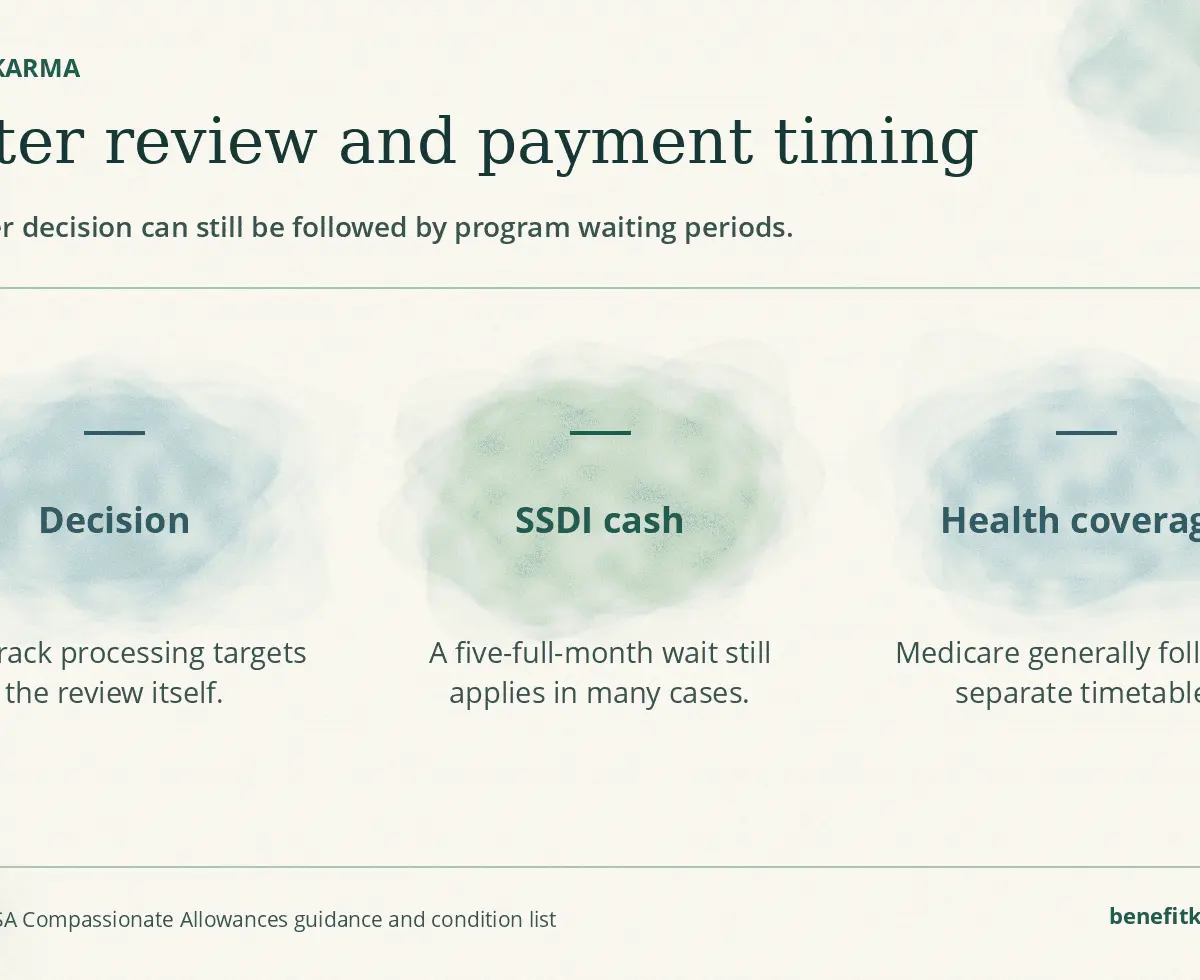
The initiative speeds the decision. The usual nonmedical rules still apply, including SSDI insured status or SSI financial eligibility. Many SSDI recipients still have a five-full-month waiting period from the established disability onset date, with exceptions such as qualifying ALS claims. Medicare generally has its own waiting-period rules. See how disability payments and health coverage start and SSA's benefit timing guidance.
If your diagnosis is absent from the list, SSA can still evaluate it through the standard disability process. Alternative expedited procedures may apply in some cases. Submit the strongest available evidence when you apply.
Free DIY tool
Social Security COLA Calculator
How much will my check go up in 2027? Enter your monthly Social Security or SSI benefit to see your new amount with the 3.6% COLA.
Try the free toolHere's what payment usually looks like after approval:
| SSDI | SSI | |
|---|---|---|
| Who qualifies | Workers with enough work credits | People with limited income and resources |
| Waiting period | Five full months after onset, except ALS | None |
| 2027 amount | Based on your earnings record | Up to $1,029 a month federally, plus any state supplement |
| Health coverage | Medicare after 24 months, or right away for ALS | Medicaid in most states |
You can estimate a possible SSDI payment with our SSDI benefit estimator.
Other ways SSA can speed up a claim
Compassionate Allowances aren't the only fast-track option. SSA also uses:
- Quick Disability Determinations, which use software to flag claims with a high chance of approval based on the evidence.
- Terminal illness cases, sometimes called TERI cases, which get priority handling when a condition is expected to be terminal. Tell SSA if you're receiving hospice care.
- Dire need cases, which may get priority when someone lacks food, medicine, or shelter.
- Wounded Warrior and veteran cases, which may be expedited for military service members disabled on active duty on or after Oct. 1, 2001, and for veterans with a 100% permanent and total VA disability rating.
If one of these applies to you, say so when you apply and when you speak with SSA staff.
What if a CAL claim is denied or delayed?
Being on the list doesn't guarantee approval. Claims flagged for Compassionate Allowances can still be denied or slowed down, often for reasons that have nothing to do with how sick you are. Common problems include:
- Missing proof of diagnosis. If SSA can't get the pathology report, imaging, or genetic test it needs, the claim may sit or be decided without it.
- A diagnosis that doesn't match the listing. Some entries require a certain stage or type. An early-stage cancer, for example, may not qualify for fast-track review even if a later stage would.
- Nonmedical problems. For SSDI, you need enough recent work credits. For SSI, income and resources must be under the limits. A medical approval doesn't fix a nonmedical denial.
- Work activity. If you're still earning more than the 2027 substantial gainful activity level, $1,770 a month for nonblind applicants, SSA generally won't find you disabled.
Delays can also happen when a medical provider is slow to respond to SSA's records request. If weeks pass without word, call SSA or your state's Disability Determination Services office and ask what's outstanding. You can often speed things up by getting the records yourself and submitting them directly. If you have a representative, they can track down records and check the claim's status for you.
If you're denied, read the notice carefully to see why. You generally have 60 days from receiving it to ask for reconsideration. If the problem was missing records, send them with your appeal. If your condition has worsened and now matches a CAL listing, tell SSA and provide updated records.
Frequently asked questions
Can I ask SSA to add my condition to the list?
SSA adds conditions based on public input, research, and medical expert advice. You can't request fast-track treatment for an unlisted condition on your own claim, but you can still apply through the standard process, and other expedited procedures may apply.
Does a CAL approval mean I'll never be reviewed again?
Not necessarily. SSA may schedule continuing disability reviews, though people with conditions unlikely to improve are generally reviewed less often.
Can children qualify?
Yes. Many conditions on the list affect children. Children can qualify for SSI if their condition meets SSA's rules and the household meets the financial limits, which count part of the parents' income and resources.
Will I get back pay?
You may. SSDI can pay back benefits from your established onset date, after the waiting period, and for up to 12 months before your application. SSI generally pays from the month after you apply.
The bottom line
If you have a serious diagnosis on SSA's Compassionate Allowances list, you may get a disability decision in weeks rather than months. You don't need a separate application, but you do need clear medical proof and to meet the program's other rules. Check the updated list, use your doctor's exact wording, and respond quickly to SSA's requests. For related guides, see how SSDI, SSI, and Medicaid work together and bipolar disorder and SSDI.
Not sure what you qualify for?
A quick conversation can help you understand your options.
Optional — no obligation, fees may apply
Want help figuring out your next step?
Optional — fees may apply depending on your situation.
Some people choose to talk to a professional before taking their next step.
This might sound familiar:
You're not sure what to do next
You want someone to walk through your options
The process feels overwhelming
If that sounds like you, this might be worth a quick look.
Takes less than a minute
We only share your info with a service provider if you say yes.
Recommended Tools
Take action with our free tools
Get More from BenefitKarma
Create a free account to unlock all features
- Access premium benefit tools
- Personalized benefit matching
- Your personalized dashboard
Common questions about this guide
Get the latest benefit updates, straight to your inbox
Plain-English updates on SNAP, Medicaid, VA and Social Security — one email a week.
Get more from BenefitKarma
Free tools, personalized dashboard & more
