SSI Back Pay: How You Get It, How It Impacts You
SSI back pay covers the period from the month after you applied until your approval date, at your current monthly benefit rate. If it exceeds three times the maximum monthly amount, it’s paid in up to three installments, unless you have a financial hardship.

Free DIY tool
Benefit Eligibility Screener
What benefits might I qualify for? Answer a few questions and see VA, disability, food, housing, and health programs that may fit you.
Try the free toolSSI back pay can be a vital safety net for people who spend months waiting for Supplemental Security Income (SSI) approval. It covers past months when you were eligible for SSI but had not yet received the benefits you were owed.
Because a disability claim can take months — and sometimes much longer — that past-due balance can add up. Back pay can help cover overdue rent, medical expenses, debt, transportation costs, and other bills that piled up while your claim was pending.
But SSI back pay comes with rules that don't apply to every type of Social Security benefit. Large payments may arrive in installments, special resource protections last for a limited time, and children receiving large awards may need dedicated accounts.
This guide explains how SSI back pay is calculated, the 2027 installment rules, when you can ask for more money sooner, and how to protect your payment without accidentally jeopardizing ongoing SSI or other benefits.
If you're still getting familiar with the program itself, start with our full guide to Supplemental Security Income.
Want to become fluent in the language of benefits?Sign up for a free BenefitKarma.com account!
SSI Back Pay vs. SSDI Back Pay
SSI and Social Security Disability Insurance (SSDI) can both provide disability benefits, but their past-due payment rules are very different.
If you're unsure which program you're dealing with, our SSI vs. SSDI glossary explains the distinction.
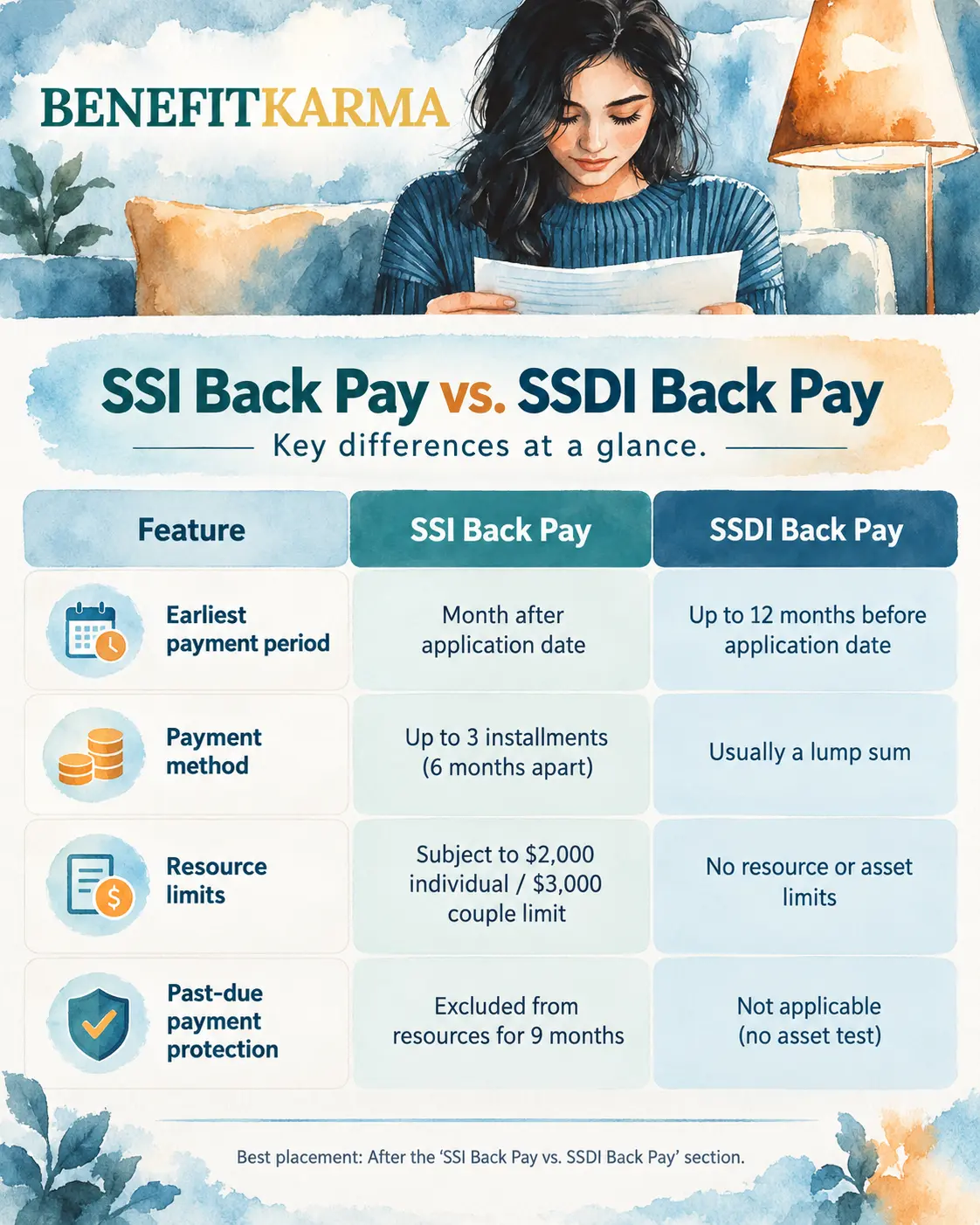
| Feature | SSI Back Pay | SSDI Back Pay |
|---|---|---|
| Earliest payment period | Generally begins with the first eligible month after your application or protective filing date | Can include up to 12 months before the application date if eligibility requirements are met |
| Payment method | Large awards may be split into as many as three installments | Usually paid as a lump sum |
| Resource limits | SSI has a $2,000 individual / $3,000 couple resource limit | SSDI has no asset or resource limit |
| Past-due payment protection | Unspent retroactive benefits are generally excluded from SSI resources for nine months after the month received | No SSDI asset test |
You can also read our glossary definition of back pay for a quick overview of how past-due benefits work.
How Is SSI Back Pay Calculated?
Your SSI back pay depends on which months Social Security determines you were eligible and how much SSI you should have received during each of those months.
The important dates and numbers include:
- Your application or protective filing date: SSI generally cannot pay benefits for months before you applied.
- The months you actually met SSI eligibility rules: Income, resources and living arrangements can affect whether you qualified and how much you were due.
- When regular payments began: Past-due benefits generally cover eligible months that were not paid on time.
- Your monthly SSI amount: This can change from month to month depending on income and other circumstances.
Unlike SSDI, SSI generally does not provide retroactive benefits for months before your application.
For example, if you applied on March 15 and met all eligibility requirements, the earliest SSI payment would generally be for April. If your claim was not approved until months later, Social Security would calculate what you should have received for those eligible months.
The maximum federal SSI benefit also changes over time. For 2027, the maximum federal payment is $1,029 per month for an individual and $1,544 for an eligible couple, following the 3.6% cost-of-living adjustment. You can see the broader annual changes in our 2027 Social Security COLA guide.
Your actual SSI amount can be lower than the federal maximum.
What Can Reduce Your Total Back Pay?
Your back-pay award isn't always simply the maximum SSI payment multiplied by the number of months you waited.
Several things can reduce the amount you are ultimately owed.
Income you received
SSI is needs-based, so earned and unearned income during the months covered by your award can reduce your monthly SSI amount.
Living arrangements and support
Help with housing or certain other living expenses can affect SSI calculations. Social Security looks at your circumstances for each month in the back-pay period.
Interim assistance from a state
If a state provided certain cash assistance while you waited for SSI, Social Security may reimburse the state from your past-due benefits before paying the remaining amount to you.
Representative fees
If an attorney or other appointed representative handled your disability claim, Social Security may withhold an approved fee from your past-due benefits.
Under SSA's current fee-agreement process, the fee is generally limited to the lesser of 25% of past-due benefits or $9,200.
If you are receiving both programs, the interaction between SSDI, SSI and Medicaid can also make the final calculation more complicated.
The SSI Back Pay Installment Rule
Large SSI back-pay awards usually aren't released all at once.
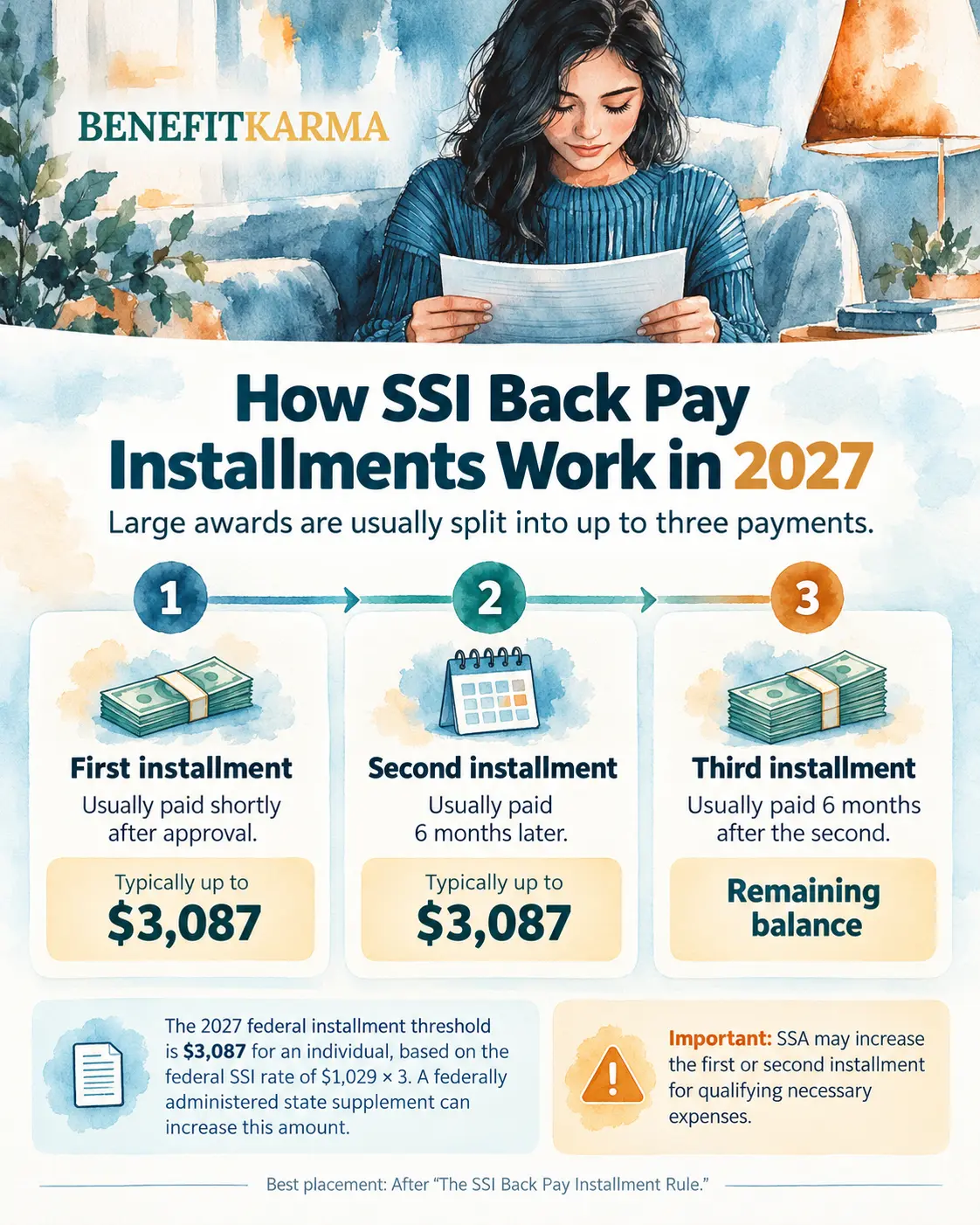
Under Social Security's installment rules, installment payments are generally required when your remaining past-due SSI equals or exceeds three times the applicable federal benefit rate, plus any federally administered state supplement.
For an individual using only the federal SSI rate, the 2027 threshold is $3,087:
$1,029 × 3 = $3,087
So if your qualifying past-due benefits meet or exceed that amount, you may receive them in installments.
Generally:
- First installment: Usually limited to three times the applicable monthly benefit rate.
- Second installment: Usually arrives about six months later and is subject to a similar limit.
- Third installment: Usually arrives about six months after the second and pays the remaining balance.
Federally administered state supplements can change the exact threshold and installment amount.
Why this doesn't immediately violate the SSI resource limit
SSI still has a resource limit of $2,000 for an individual and $3,000 for a couple in 2027.
But receiving an SSI back-pay installment does not mean that money immediately counts against the resource limit.
Each installment gets its own temporary resource exclusion, which gives you time to decide how to use or preserve the money.
Can You Get More SSI Back Pay Sooner?
Sometimes.
If you have certain debts or necessary expenses, Social Security can increase the amount of your first or second installment.
Qualifying needs can include expenses for:
- Food.
- Clothing.
- Housing or shelter.
- Medically necessary services, supplies or equipment.
- Other necessary expenses approved under SSA rules.
For example, if you're facing eviction and the normal installment isn't enough to pay overdue rent, you can ask Social Security to release a larger amount.
Contact your local Social Security office and be prepared to document the debt or expense.
When can the entire balance be paid at once?
This rule is narrower than the hardship exception.
SSA can generally pay all remaining past-due SSI in a lump sum in situations such as:
- You have a medical condition expected to result in death within 12 months.
- You become ineligible for SSI and are likely to remain ineligible for at least 12 months.
So an urgent bill can justify increasing an installment, but it doesn't automatically mean Social Security must release the entire award.
Free DIY tool
Benefit Eligibility Screener
What benefits might I qualify for? Answer a few questions and see VA, disability, food, housing, and health programs that may fit you.
Try the free toolThe 9-Month SSI Back Pay Resource Exclusion
One of the most important protections is the nine-month resource exclusion.
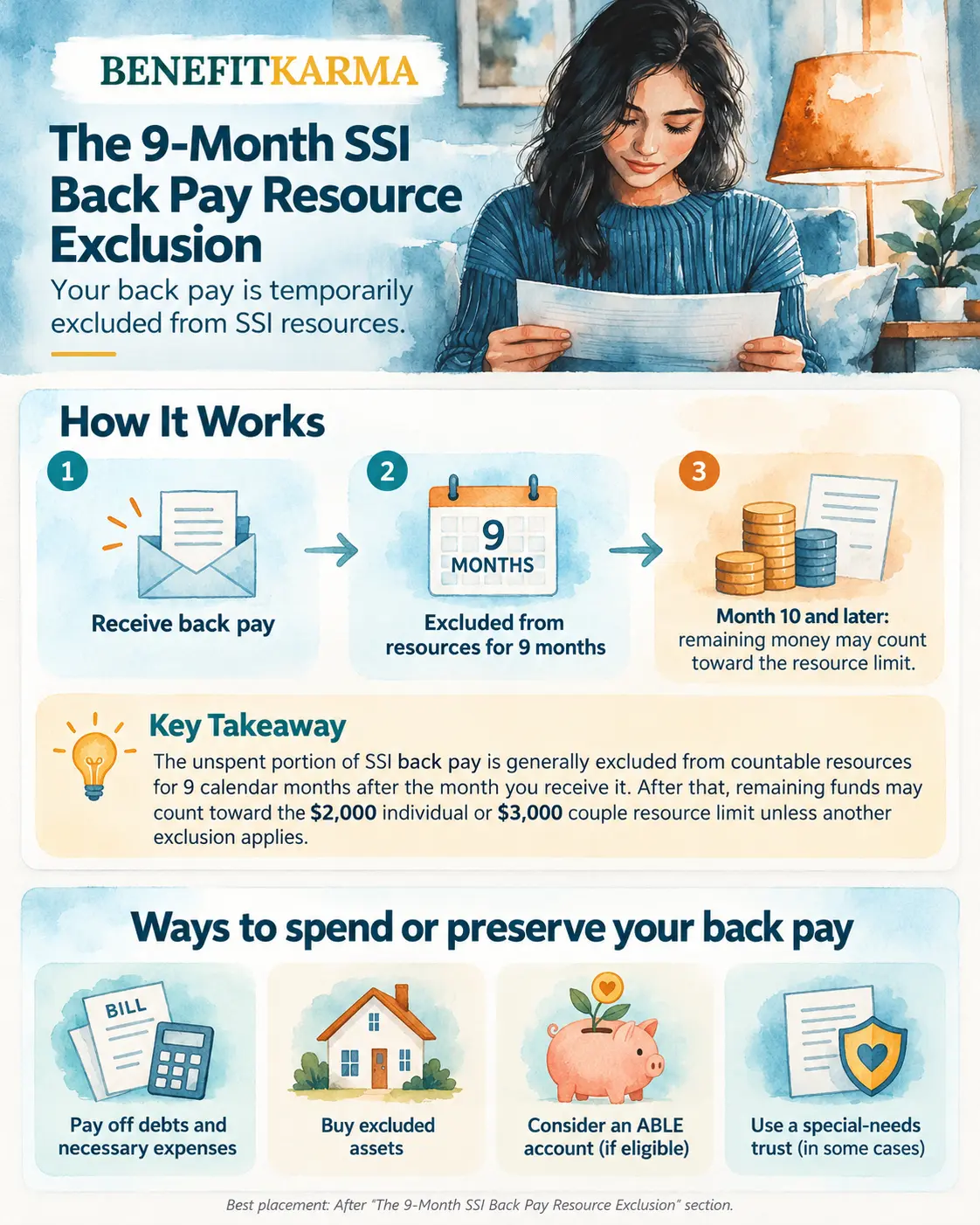
The unspent portion of retroactive SSI benefits is generally excluded from your countable resources for the nine calendar months after the month you receive the payment.
For example, suppose you have $500 in other savings and receive a $3,000 SSI back-pay installment.
Normally, $3,500 in countable resources would put an individual over SSI's $2,000 limit. But the qualifying back-pay funds are temporarily excluded.
If you still have some of that money after the nine-month exclusion expires, the remaining amount can become a countable resource unless another exclusion applies.
Each separate installment generally receives its own nine-month exclusion period.
Keeping records showing where the back pay went — and keeping the funds easy to identify — can make it much easier to explain your resources to Social Security later.
Ways to Spend or Preserve SSI Back Pay
You don't necessarily need to spend every dollar immediately. The goal is to understand which assets count and which strategies may allow you to use or save the money without hurting your eligibility.
Pay debts and necessary expenses
You may use back pay for expenses such as:
- Back rent or mortgage payments.
- Medical bills.
- Credit-card debt.
- Transportation.
- Household needs.
- Home repairs.
Buy resources that SSI doesn't count
Some property is excluded under SSI resource rules. For example, the home you live in and generally one vehicle used for transportation do not count toward the standard SSI resource limit.
Consider an ABLE account
An ABLE account can allow eligible people with disabilities to save money for qualified disability expenses without having the account treated like an ordinary bank account for SSI purposes.
Beginning in 2026, the disability must have begun before age 46, rather than before age 26.
ABLE accounts have separate contribution, eligibility and spending rules, so don't assume that every SSI recipient can simply move an unlimited back-pay award into one.
Consider a special-needs trust
For larger amounts, a special-needs trust may be another option in some circumstances.
Trust rules are considerably more complicated than simply spending down a bank balance, so professional legal guidance can be valuable before transferring SSI funds into a trust.
How SSI Back Pay Is Paid
SSI payments are now generally made electronically.
The two primary options are:
- Direct deposit: Funds go directly into a checking or savings account.
- Direct Express®: A prepaid debit card that can receive federal benefit payments for people who don't use a traditional bank account.
Federal benefit payments are generally required to be electronic. Paper checks are now limited to unusual cases where Treasury grants an exception.
Special Rules for SSI Back Pay for Children
Large SSI back-pay awards for children can have another layer of rules.
If a child under 18 has a representative payee and the past-due award is more than six times the applicable federal benefit rate plus any federally administered state supplement, the money generally must be deposited into a separate dedicated account.
Using only the 2027 federal individual rate:
$1,029 × 6 = $6,174
So a federal-only past-due amount greater than $6,174 can trigger the dedicated-account requirement.
Dedicated-account money has stricter spending rules. It generally must be used for expenses that benefit the child, such as medical treatment, education, job-skills training, therapy, rehabilitation, special equipment or other disability-related needs allowed by SSA.
Funds properly held in a dedicated account receive special resource protection.
Representative Payees for Adults
Social Security may also appoint a representative payee for an adult if SSA determines the beneficiary cannot adequately manage their benefits.
The payee receives and manages the person's SSI payments and must use the money in the beneficiary's best interests.
Having a representative payee does not change whether you are entitled to back pay, but it changes who receives and manages those funds.
How SSI Back Pay Can Affect Other Benefits
SSI doesn't exist in isolation, so it's worth considering how a large past-due payment interacts with other programs.
Federal income taxes
SSI benefits, including retroactive SSI payments, are not subject to federal income tax.
Medicaid
Many SSI recipients also receive Medicaid.
Because Medicaid eligibility rules vary by state, don't automatically assume the SSI nine-month exclusion works identically for every Medicaid recipient. In states where Medicaid eligibility is directly tied to SSI rules, the SSI resource treatment can be especially important.
SNAP
A retroactive SSI payment generally isn't treated the same way as ordinary monthly income for SNAP, but resource treatment can depend on the household and state rules.
If a large payment will remain in your account, check how your state SNAP agency treats it rather than assuming SSI's nine-month rule automatically controls SNAP eligibility.
Concurrent SSI and SSDI benefits
If you are approved for both SSI and SSDI covering some of the same months, Social Security can apply the windfall offset rules.
The goal is to prevent you from receiving more retroactive benefits than you would have received if both programs had been paid on time.
What This Means for You
SSI back pay can provide significant financial relief after a long wait, but the rules become especially important when the payment is large.
For 2027, remember these numbers:
- Maximum federal SSI payment: $1,029 per month for an individual.
- Individual installment threshold: generally $3,087 before any applicable federally administered state supplement.
- Individual resource limit: $2,000.
- Couple resource limit: $3,000.
- Back-pay resource exclusion: nine calendar months after the month each payment is received.
- Child dedicated-account threshold: generally more than $6,174 using the federal rate alone.
If you're newly approved, read your award notice closely before making major financial decisions. Pay particular attention to the amount of your past-due benefits, any representative fee or state reimbursement deducted, when your next installment is expected, and when each nine-month resource exclusion expires.
And if your back pay is large enough that preserving long-term eligibility is a concern, it's worth learning about ABLE accounts and other excluded-resource options before the temporary nine-month protection runs out.
Not sure what you qualify for?
A quick conversation can help you understand your options.
Optional — no obligation, fees may apply
Want help figuring out your next step?
Optional — fees may apply depending on your situation.
Some people choose to talk to a professional before taking their next step.
This might sound familiar:
You're not sure what to do next
You want someone to walk through your options
The process feels overwhelming
If that sounds like you, this might be worth a quick look.
Takes less than a minute
We only share your info with a service provider if you say yes.
Recommended Tools
Take action with our free tools
Get More from BenefitKarma
Create a free account to unlock all features
- Access premium benefit tools
- Personalized benefit matching
- Your personalized dashboard
Common questions about this guide
Get more from BenefitKarma
Free tools, personalized dashboard & more
