VA Is Using More Automation for Disability Claims — Which is Raising Concerns
Free DIY tool
VA Claim Readiness Score
Is my VA claim ready to file? Answer 4 quick questions and get a readiness score with next steps.
Try the free toolThe Department of Veterans Affairs is increasingly using automation and artificial intelligence to speed up disability claims — but a federal watchdog says the technology needs strong oversight to make sure faster decisions don't come at the expense of accurate ones.
In testimony before Congress on July 13, 2026, the Government Accountability Office (GAO) highlighted longstanding weaknesses in the VA's disability claims system, including problems with contracted medical exams, employee training, technology planning, and performance monitoring. At the same time, VA is exploring ways to use AI for more parts of the claims process.
That matters to millions of people. In fiscal year 2025, the Veterans Benefits Administration distributed more than $195 billion in compensation to more than 6.9 million veterans and their families, according to GAO.
For veterans filing for disability benefits, the takeaway isn't that an AI system is suddenly going to decide whether you qualify. It's that more of the work surrounding those decisions is becoming automated — and federal watchdogs want safeguards to keep pace.
At BenefitKarma, we track changes like these so you know what's happening behind the scenes with the benefits you depend on.
What is the VA changing?
VA has been working for years to make disability claims processing faster and more digital.
The Veterans Benefits Management System, or VBMS, began development in 2009 as part of an effort to move the claims system away from paper. The 2022 PACT Act later required VA to develop a plan to improve both the speed and accuracy of claims processing.
Now AI is becoming a bigger part of that modernization effort.
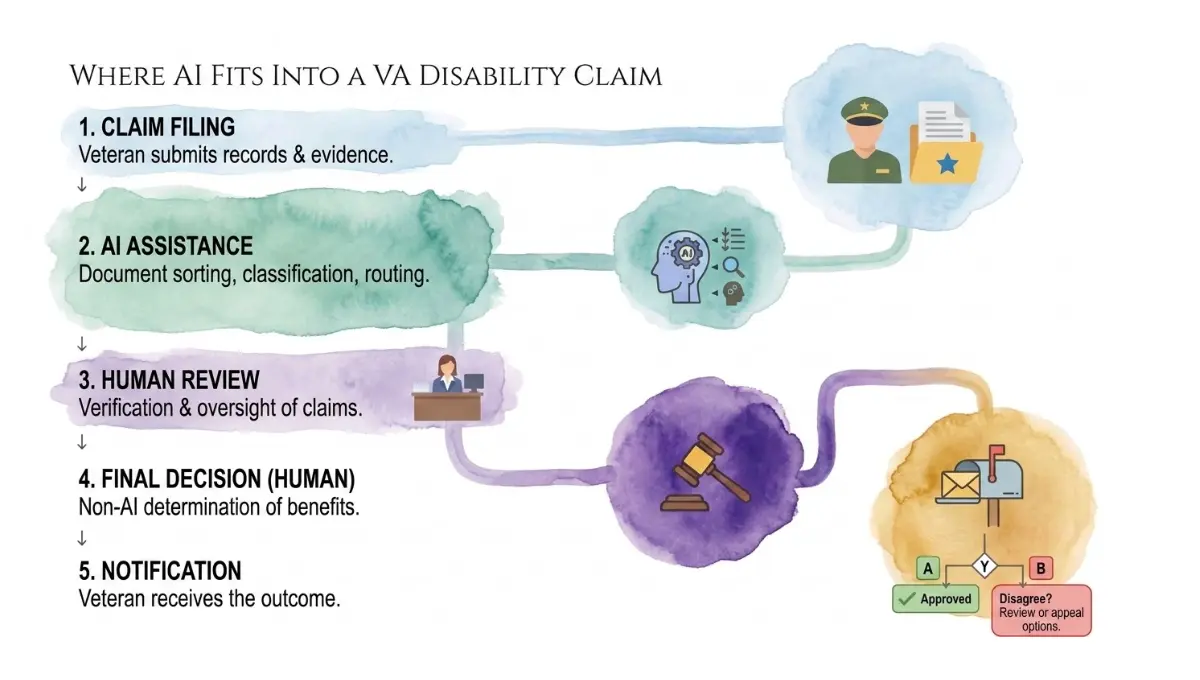
VA says AI could eventually help automate tasks such as:
- Receiving and organizing documents
- Classifying information in a claim
- Pulling relevant information from records
- Preparing claims for review
- Assisting with preliminary adjudication
VA has described a goal of using automation to help move toward delivering some benefits in "minutes not months."
But there's an important distinction: VA has not announced that generative AI will independently make final disability benefit decisions.
The focus is currently on automating or assisting with parts of the process, while humans remain responsible for oversight and final determinations.
GAO says VA still has unresolved problems
GAO's concern isn't simply that VA is using AI. It's that the agency is adding new technology while some existing problems with the disability claims program remain unresolved.
Since 2021, GAO has made 43 recommendations related to VA disability compensation. VA has fully implemented 28 of them.
That leaves 15 recommendations that had not been fully implemented as of July 2026, although GAO acknowledged that VA had taken steps toward addressing some of them.
Those recommendations involve areas including employee training, oversight of medical examinations, technology management and measuring how well systems actually work.
For example, GAO previously found weaknesses in how VA manages training for the employees responsible for processing disability claims. It has recommended a more comprehensive training plan and better systems for incorporating feedback.
GAO has also raised concerns about oversight of disability medical examinations performed by contractors.
Those exams can be critical because their results may help determine whether a veteran has a service-connected disability and how severe that disability is.
Automation has already caused some problems
Concerns about automated claims processing aren't entirely theoretical.
In April 2026, the VA Office of Inspector General reviewed automated decisions involving certain Dependency and Indemnity Compensation (DIC) claims — benefits generally available to eligible survivors of veterans whose deaths were connected to military service.
The inspector general identified legal or procedural problems in automated rating decisions and notification letters it reviewed and recommended that VA strengthen and monitor the system to ensure automated decisions comply with applicable requirements.
VA subsequently implemented the OIG's recommendations, which were listed as closed by July 8, 2026.
That example is important because it shows both sides of the issue: automation may help VA process claims faster, but automated systems also need monitoring so mistakes don't simply happen more quickly.
Free DIY tool
VA Claim Readiness Score
Is my VA claim ready to file? Answer 4 quick questions and get a readiness score with next steps.
Try the free toolWhy AI makes oversight especially important
Traditional automation generally follows predefined rules.
More advanced AI — particularly generative AI — can be harder to evaluate because it may not always be obvious why a system produced a particular result.
GAO has warned that some AI systems can function like a "black box," making mistakes, bias or misuse more difficult to detect.
For a benefits system, that creates an obvious concern.
If technology is helping sort evidence, summarize records or prepare a preliminary determination, veterans need confidence that important information isn't being overlooked or interpreted incorrectly.
GAO has developed an AI Accountability Framework to help federal agencies evaluate issues such as governance, data quality, performance and monitoring when adopting AI.
The agency has also stressed the importance of keeping people involved in consequential AI-assisted decisions.
In the context of disability benefits, that means AI should be a tool for claims workers — not an unchecked replacement for them.
Could AI actually improve VA disability claims?
Potentially, yes.
VA processes enormous amounts of paperwork and medical information. AI tools could help employees find relevant information more quickly, reduce repetitive administrative work and route claims to the right place.
VA has already used AI and automation in narrower administrative functions. For example, the department previously used an AI system to help process incoming claims mail, reducing reported processing time from about 10 days to one.
Newer systems could potentially go much further.
In 2026, VA published a privacy assessment for an Artificial Intelligence Claims Evaluation System, or AICES, designed to integrate technologies including AI and natural language processing into disability claims processing.
The challenge is making sure those efficiency gains don't introduce new errors or make it harder for veterans to understand how decisions were made.
What this means if you're filing a VA disability claim
For now, veterans shouldn't expect a completely automated claims process.
But you may increasingly interact with a system in which automation is working behind the scenes — organizing records, extracting information, moving documents or helping VA employees evaluate a claim.
That makes the fundamentals of filing a strong claim just as important as ever.
Make sure your application contains accurate information, submit relevant medical evidence, attend required Compensation and Pension exams, and carefully review any decision letter you receive.
If VA makes a decision you believe is incorrect, existing review and appeal options remain available. Automation does not eliminate your right to challenge a VA benefits decision.
The bottom line
VA believes AI and automation could dramatically reduce the amount of time it takes to process disability claims. For veterans waiting months for benefits, that's a potentially meaningful improvement.
But GAO's July 2026 testimony makes clear that speed isn't the only measure that matters.
VA still has 15 unresolved GAO recommendations involving the management of its disability compensation program, and a separate inspector general investigation has already shown that automated processing can create legal and procedural problems when safeguards aren't strong enough.
The goal shouldn't simply be faster claims.
It should be faster, accurate and explainable claims — with people still accountable for the decisions that affect veterans' benefits.
For more information about VA disability benefits and other government programs you may qualify for, visit BenefitKarma.com.
Need help with your VA benefits?
Connect with someone who handles VA cases every day — no obligation.
VA claims filed sooner can mean earlier effective dates and more back pay.
Optional — no obligation, fees may apply
Want help with your VA disability claim?
Optional — fees may apply depending on your situation.
Some people choose to talk to a professional before taking their next step.
This might sound familiar:
You're not sure what your VA options are
Your VA rating feels lower than it should be
You want someone to walk through it with you
If that sounds like you, this might be worth a quick look.
Takes less than a minute
We only share your info with a service provider if you say yes.
Recommended Tools
Take action with our free tools
Get More from BenefitKarma
Create a free account to unlock all features
- Access premium benefit tools
- Personalized benefit matching
- Your personalized dashboard
Common questions about this guide
Get more from BenefitKarma
Free tools, personalized dashboard & more
