


VA Disability Help: VSOs, Agents, Attorneys, and Medical Evidence Services Compared
Most Veterans do not need to pay anyone to file an initial VA disability claim. Here is what each kind of help actually does, what it can charge, and when it may make sense.
Updated
📚 What you'll learn
- ✓The three kinds of help available for VA disability claims
- ✓What free accredited VSOs do — and when they are enough
- ✓What VA-accredited attorneys and claims agents can legally charge
- …and 2 more
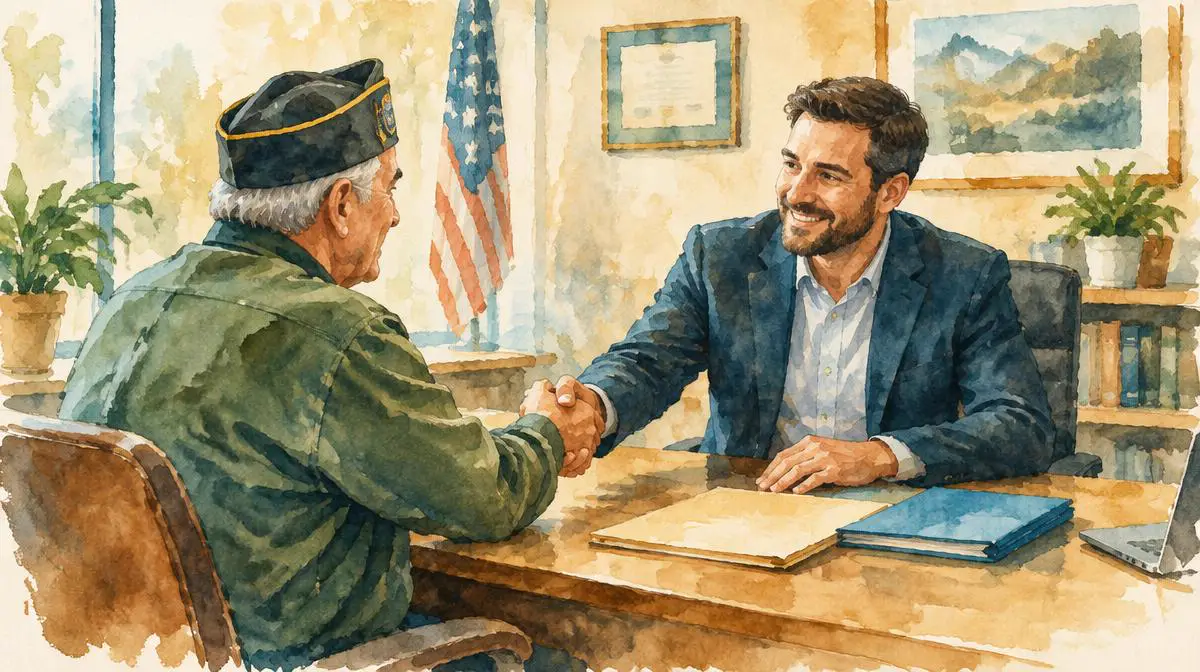
Most Veterans do not need to pay anyone to file an initial VA disability claim. Accredited Veterans Service Officers (VSOs) help Veterans prepare and submit claims at no cost. Depending on where you are in the process, you may also benefit from a VA-accredited attorney, an accredited claims agent, or a medical evidence service that helps develop supporting medical documentation. Each serves a different role, and understanding those differences can help you choose the right kind of assistance.
One of the biggest misconceptions about VA disability claims is that you have to choose between a free VSO or a paid lawyer.
In reality, those are only two pieces of a much larger picture.
Some professionals help Veterans prepare claims.
Others provide legal representation during appeals.
Still others help develop the medical evidence that supports a disability claim.
Understanding those distinctions can save time, money, and frustration—and help you avoid paying for services you may not need.
The three kinds of help available
Most VA disability claims involve one or more of these three categories of assistance.
1. Claims assistance
Claims assistance focuses on helping Veterans understand the VA claims process, gather records, complete paperwork, and submit claims.
For most Veterans filing an initial claim, this is all the help they need.
The most common source of claims assistance is an accredited Veterans Service Officer (VSO).
VSOs work for recognized Veterans Service Organizations, state agencies, tribal organizations, or county Veterans Service Offices. They help Veterans navigate the VA system at no cost.
2. Legal representation
Legal representation becomes more important after VA has issued a decision, particularly when a Veteran disagrees with the outcome or needs to pursue an appeal.
Legal representatives help interpret VA regulations, prepare legal arguments, respond to unfavorable decisions, and represent Veterans throughout the appeals process.
Only VA-accredited attorneys and VA-accredited claims agents are authorized to provide this type of representation before VA.
3. Medical evidence support
Medical evidence is often the foundation of a successful disability claim.
Even when a Veteran clearly served in the military and has a current medical condition, VA still evaluates whether the available medical evidence supports service connection and the claimed level of disability.
Medical evidence support is different from legal representation.
Organizations that specialize in medical evidence services may help Veterans:
- organize medical records;
- identify missing medical documentation;
- coordinate independent medical evaluations when appropriate;
- obtain Disability Benefits Questionnaires (DBQs) or independent medical opinions from qualified healthcare professionals when appropriate; and
- assemble medical documentation that may strengthen the evidentiary record.
These organizations do not represent Veterans before VA unless they also employ an accredited representative acting in that accredited capacity.
Likewise, VA-accredited attorneys and claims agents generally are not medical experts. While they may work closely with physicians and rely heavily on medical evidence, they do not diagnose conditions or provide independent medical opinions.
For many claims, medical evidence and legal advocacy complement one another rather than compete.
Comparing your options
| Type of help | Typical cost | What they do | Best for |
|---|---|---|---|
| Accredited Veterans Service Officer (VSO) (DAV, VFW, American Legion, state and county Veterans Service Offices, and other recognized organizations) | Free | Explain the claims process, gather evidence, prepare and submit claims, communicate with VA after appointment, and assist throughout the claims process. | Most initial disability claims, claim increases, supplemental claims, and general benefits questions. |
| VA-accredited claims agent | May charge fees only when permitted under VA regulations, generally after an initial decision and in connection with an appeal or review. | Represent Veterans before VA, analyze claims, develop legal strategy, prepare appeals, and advocate throughout the appeals process. | Appeals, complex claims, and procedural issues. |
| VA-accredited attorney | May charge fees only when permitted under VA regulations, generally after an initial decision and in connection with an appeal or review. | Provide legal representation before VA, prepare appeals, develop legal arguments, and represent Veterans before the Board of Veterans' Appeals and, where appropriate, the U.S. Court of Appeals for Veterans Claims. | Complex appeals, Board hearings, long-denied claims, and cases involving significant legal issues. |
| Independent medical evidence services | Varies by provider. Some charge flat fees, while others offer different pricing models depending on the services provided. | Help organize medical records, coordinate independent medical evaluations, identify documentation gaps, facilitate independent medical opinions or DBQs from qualified healthcare professionals when appropriate, and help Veterans develop stronger medical documentation. They do not provide legal representation before VA unless separately accredited to do so. | Veterans whose claims depend on stronger medical evidence, clearer documentation, or additional medical opinions. |
| Educational consultants or claim coaches | Varies | Provide education, coaching, and organizational support. Unless accredited by VA, they cannot represent claimants before VA or act as their legal representative. | Veterans seeking educational resources or organizational assistance who understand the limitations of these services. |
Want help with this?
Talk to someone who handles cases like yours — no obligation.
Optional — fees may apply
Medical evidence and legal representation solve different problems
This is one of the most misunderstood aspects of the VA disability system.
Many Veterans assume they need to choose between hiring an attorney or obtaining stronger medical evidence.
In reality, these services address different needs.
A legal representative helps navigate VA laws, regulations, procedures, deadlines, and appeals.
Medical evidence helps establish the facts of the claim.
Depending on the circumstances, that evidence may include:
- VA medical records
- Private treatment records
- Diagnostic testing
- Disability Benefits Questionnaires (DBQs)
- Independent medical opinions
- Nexus opinions when medically appropriate
- Functional assessments
- Other supporting clinical documentation
Some claims succeed using only existing VA medical records.
Others require additional medical evidence because the existing record does not fully document the diagnosis, severity, functional impairment, or relationship between military service and the current condition.
Neither legal advocacy nor medical evidence is inherently more important.
Strong claims often rely on both.
Think of it this way:
VA Disability Claim
Claims Assistance
- • Accredited VSO
- • County Veterans Service Office
- • State Veterans Agency
+
Medical Evidence
- • VA treatment records
- • Private physicians
- • DBQs
- • Independent medical opinions
- • Medical evidence services
+
Legal Representation
- • VA-accredited claims agent
- • VA-accredited attorney
=
A complete disability claim
Not every Veteran needs every type of assistance.
The goal is to identify where you need support—not to hire the most expensive professional available.
If you are building the evidence side of your claim, our evidence checklist guide walks through what VA typically looks for, and our VA disability calculator shows how combined ratings work.
What “VA-accredited” actually means
“VA-accredited” has a specific legal meaning.
The Department of Veterans Affairs accredits eligible attorneys, claims agents, and representatives of recognized Veterans Service Organizations through the VA Office of General Counsel (OGC).
Accreditation authorizes these individuals to represent claimants before VA.
To become accredited, representatives must satisfy VA requirements, complete required training, comply with continuing education requirements, and follow VA's standards of conduct.
Before working with anyone who says they can represent you before VA, verify their accreditation through VA's official Office of General Counsel Accreditation Search.
Accreditation matters because it helps ensure representatives understand VA's rules, ethics requirements, and responsibilities to claimants.
What representatives can legally charge
Federal law places important limits on when accredited attorneys and accredited claims agents may charge fees.
Initial claims
For most initial disability compensation claims, accredited attorneys and claims agents may not charge for services provided before VA issues its initial decision, subject to the limited exceptions established by law and regulation.
That is one reason many Veterans begin with a free accredited VSO.
Appeals
After VA has issued an initial decision, Veterans may choose to hire an accredited attorney or accredited claims agent.
Many work under contingency-style fee agreements tied to any retroactive benefits awarded as a result of the representation, although fee structures vary.
VA regulations require fee agreements to be filed with VA and establish standards governing fee review and reasonableness.
Before signing any agreement, ask:
- When do fees begin?
- How are fees calculated?
- Are costs billed separately?
- Will the fee agreement be filed with VA?
- What happens if the appeal is unsuccessful?
If you are weighing an appeal, our VA appeals guide explains the review options and deadlines.
Want help with this?
Talk to someone who handles cases like yours — no obligation.
Optional — fees may apply
Warning signs
Most accredited representatives provide valuable assistance.
However, Veterans should exercise caution if someone:
Charges upfront to file an initial disability claim
For most initial claims, free accredited assistance is available through VSOs.
Guarantees a disability rating
No one can promise a specific disability percentage or guarantee approval.
Claims special influence with VA
Decisions are based on the evidence and applicable law—not personal relationships.
Cannot be found in VA's accreditation database
If someone says accreditation doesn't matter or refuses to provide information that allows you to verify their status, proceed carefully.
Blurs the line between medical evidence and legal representation
Be cautious of organizations that suggest they can “do everything” without clearly explaining whether they are providing legal representation, medical evidence support, educational services, or some combination of those roles.
Understanding exactly what services you are purchasing is an important part of making an informed decision.
When paying for help makes sense
Many Veterans never need paid representation.
Others find that professional assistance becomes valuable when:
- a claim has been denied multiple times;
- the appeal involves complicated legal or medical issues;
- significant retroactive benefits are at stake;
- a Board hearing is approaching;
- the medical evidence is incomplete or conflicting; or
- specialized medical opinions may be necessary to fully document the claim.
Paying for assistance is not a sign that a claim is stronger or weaker.
The question is whether specialized expertise adds value for your particular circumstances.
How to find a VSO near you
If you're filing an initial claim, a VSO is often the best place to begin.
You can locate accredited representatives through VA's official Accredited Representative Search, which includes:
- Accredited Veterans Service Organization representatives
- Accredited claims agents
- Accredited attorneys
You can also contact:
- your county Veterans Service Office;
- your state Department of Veterans Affairs;
- a recognized Veterans Service Organization; or
- a Tribal Veterans Service Officer, where available.
These organizations can explain your options and help you decide whether additional legal or medical evidence assistance may be appropriate.
Want help with this?
Talk to someone who handles cases like yours — no obligation.
Optional — fees may apply
Frequently Asked Questions
Sources
- U.S. Department of Veterans Affairs — Office of General Counsel Accreditation Program: va.gov/OGC/accreditation.asp
- VA Office of General Counsel — Accreditation Search: va.gov/ogc/apps/accreditation/index.asp
- 38 CFR § 14.636 — Payment of fees for representation by agents and attorneys: ecfr.gov/current/title-38/section-14.636
- 38 U.S.C. § 5904 — Recognition of agents and attorneys generally: uscode.house.gov — 38 U.S.C. § 5904
- VA — Find an Accredited Representative: va.gov/get-help-from-accredited-representative/
Quick note
BenefitKarma provides educational information only. We don't make eligibility decisions. Our tools are self-serve and meant to make processes easier to understand. You choose what to do next.
Want help with your VA medical evidence?
Optional — fees may apply depending on your situation.
Some people choose to talk to a professional before taking their next step.
This might sound familiar:
Something feels missing from your VA records
Your VA rating feels lower than it should be
You want stronger evidence before moving forward
If that sounds like you, this might be worth a quick look.
Takes less than a minute
We only share your info with a service provider if you say yes.
Ready to take the next step?
Use BenefitKarma's free tools to move forward.
Self-serve tools. You control what happens next.
Ready to take the next step?
Use our free tools to help you navigate the process with confidence.
