DOJ SNAP Fraud Crackdown: What the $42 Million Enforcement Surge Means for Recipients

Free DIY tool
Benefit Eligibility Screener
What benefits might I qualify for? Answer a few questions and see VA, disability, food, housing, and health programs that may fit you.
Try the free toolFederal prosecutors announced on October 21, 2026, that a seven-week nationwide crackdown had produced cases against more than 40 people accused of stealing or illegally trading food assistance benefits. According to the U.S. Department of Justice, the schemes involved about $45 million in intended losses, and nearly $42 million of that came from the Supplemental Nutrition Assistance Program (SNAP).
The cases range from card skimming crews and identity thieves to store owners accused of swapping benefits for cash. Most of the alleged losses didn't come from people lying on applications. They came from criminals draining benefits from real households, often without the cardholder knowing until the balance hit zero.
If you get SNAP, the announcement doesn't change your eligibility, your benefit amount or how you use your card. It does show how organized benefit theft has become, and it's a good moment to check how well your own account is protected. That matters more now because, in most states, stolen SNAP benefits still aren't replaced.
What the Justice Department announced
The Justice Department's announcement describes a "National USDA Benefits and Program Fraud Enforcement Surge" that ran from Sept. 1 through Oct. 21, 2026. It was led by DOJ's National Fraud Enforcement Division, the U.S. Department of Agriculture (USDA) and the USDA Office of Inspector General (OIG), with 13 U.S. Attorney's Offices and the Utah Attorney General's Office bringing cases.
Investigators from several other agencies took part, including the FBI, Homeland Security Investigations (HSI), IRS Criminal Investigation, the Social Security Administration's inspector general, the U.S. Postal Inspection Service and the U.S. Secret Service.
Attorney General Todd Blanche said the schemes "siphoned millions from taxpayers and robbed struggling Americans." Agriculture Secretary Brooke Rollins said, "Every instance of SNAP fraud has two victims: families in dire need and taxpayers."
DOJ's announcement also emphasized that some defendants were foreign nationals, including members of one theft crew it described as unlawfully present in the United States. The release does not state the immigration status of most defendants.
Keep in mind that most of these cases are charges, not convictions. Everyone charged is presumed innocent unless proven guilty in court. A few cases in the announcement involve guilty pleas or sentencings.
The types of SNAP fraud investigators found
The cases fall into a few patterns, and several of them involve people who did nothing wrong having their benefits stolen.
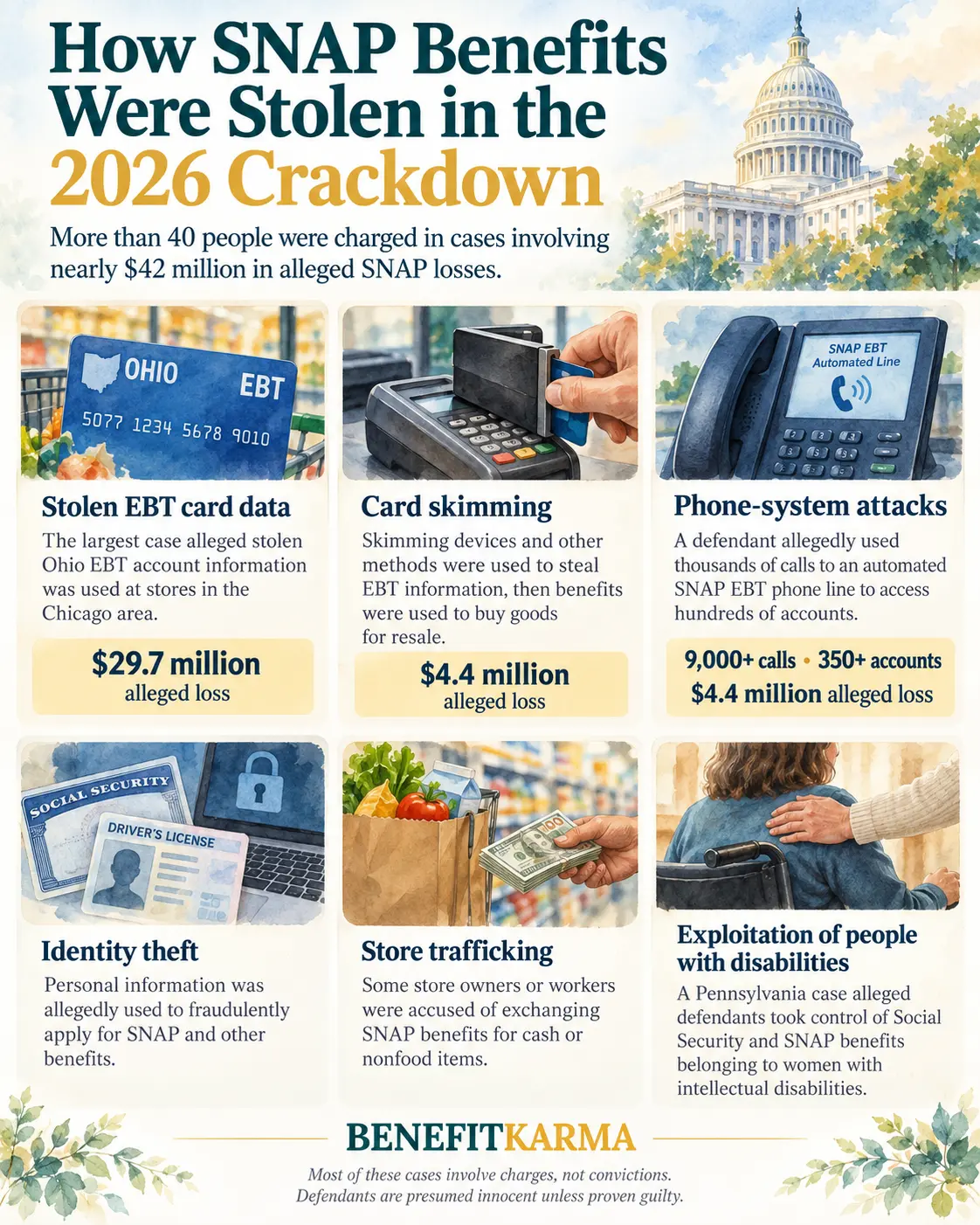
- Stolen card data used across state lines. The largest case, in the Southern District of Ohio, alleges that two men used stolen Ohio EBT account information at stores in the Chicago area, with an estimated loss of $29.7 million.
- Skimming. In an Oregon case, a crew allegedly used skimming devices and other methods to steal SNAP account information, then bought infant formula with the stolen benefits and shipped it for resale. Prosecutors put the intended loss at $4.4 million.
- Phone-system attacks. A Georgia defendant is accused of placing more than 9,000 calls to a state's automated SNAP EBT phone line to access more than 350 accounts, with an alleged loss of $4.4 million.
- Identity theft. A Michigan case alleges that two people used the personal information of more than 650 victims to apply for SNAP benefits. A Massachusetts case alleges a man used a stolen identity to get SNAP, MassHealth and Section 8 housing benefits.
- Store trafficking. Cases in Michigan, Ohio and Utah accuse store owners or workers of trading SNAP benefits for cash or nonfood items, often at a steep discount. "Trafficking" is the legal term for buying or selling benefits.
- Abuse of people with disabilities. A 39-count indictment in Pennsylvania alleges that defendants took control of the Social Security and SNAP benefits of women with intellectual disabilities.
One case in Florida wasn't about SNAP at all. A farmer pleaded guilty to filing false crop insurance claims.
Why benefit theft hits recipients so hard
When a debit or credit card is skimmed, federal consumer protection law usually limits how much the cardholder loses. SNAP households don't have that protection. As a 2025 Government Accountability Office report noted, Congress excluded SNAP from the Electronic Fund Transfer Act's protections in 1996.
From late 2022 through 2024, a temporary federal program let states replace skimmed benefits with federal money. That authority ended on December 20, 2024, and Congress hasn't renewed it, according to USDA's Food and Nutrition Administration (FNA), which runs SNAP and was renamed from the Food and Nutrition Service in 2026. Its stolen benefits page confirms the sunset. We explain what that change means in our guide to stolen SNAP benefits and reimbursement.
The scale of the problem is large. USDA's inspector general projected that about $233 million in food assistance may have been lost to theft over two years, much of it through skimming, according to reporting by OPB. The federal government replaced more than $320 million in stolen benefits while the replacement program ran.
Chip cards appear to help. California began issuing chip-enabled EBT cards in February 2025, and the state reported in January 2026 that EBT theft had fallen about 83% compared with January 2024. Most states still use magnetic-stripe cards, though.
Free DIY tool
Benefit Eligibility Screener
What benefits might I qualify for? Answer a few questions and see VA, disability, food, housing, and health programs that may fit you.
Try the free toolState budgets could slow those upgrades. Under the One Big Beautiful Bill Act, the federal share of SNAP administrative costs drops from 50% to 25% starting in fiscal year 2027, which began October 1, 2026, according to USDA guidance. States now pay the other 75%. We cover the law's other SNAP changes in our explainer on how the new SNAP rules affect you.
What this means if you get SNAP
For most recipients, nothing about the rules has changed. Your eligibility and benefit amount are set the same way they were before the announcement. Our guide to how SNAP works walks through eligibility and benefits if you need a refresher.
A few points are worth knowing:
- Being a victim isn't fraud. If someone skims your card or steals your identity, you're the victim. Report it right away so your state has a record.
- Honest mistakes are handled differently from fraud. If you were paid too much because of an error, your state may ask you to repay the overpayment. A finding of intentional fraud is a separate process with tougher penalties.
- Penalties for intentional fraud are serious. Under federal SNAP rules, a person found to have intentionally broken program rules loses benefits for 12 months for a first violation, 24 months for a second and permanently for a third. A court conviction for trafficking $500 or more in benefits brings a permanent ban on the first offense.
- Selling your benefits is trafficking. Trading SNAP benefits for cash, even with a store you trust, is illegal for both you and the store.
If you're a veteran or have a disability
Many people who receive disability benefits also rely on SNAP, and the Pennsylvania case is a reminder that people with disabilities can be targeted by those who control their money. If someone manages your Social Security or SSI payments as a representative payee, that person must use the money for your needs and keep records. You or a family member can report suspected misuse to Social Security's inspector general.
Veterans who get SNAP face the same skimming risks as other households, and the same steps below apply.
How to protect your EBT card now
The FNA's tips and the lessons from these cases point to a few simple habits:
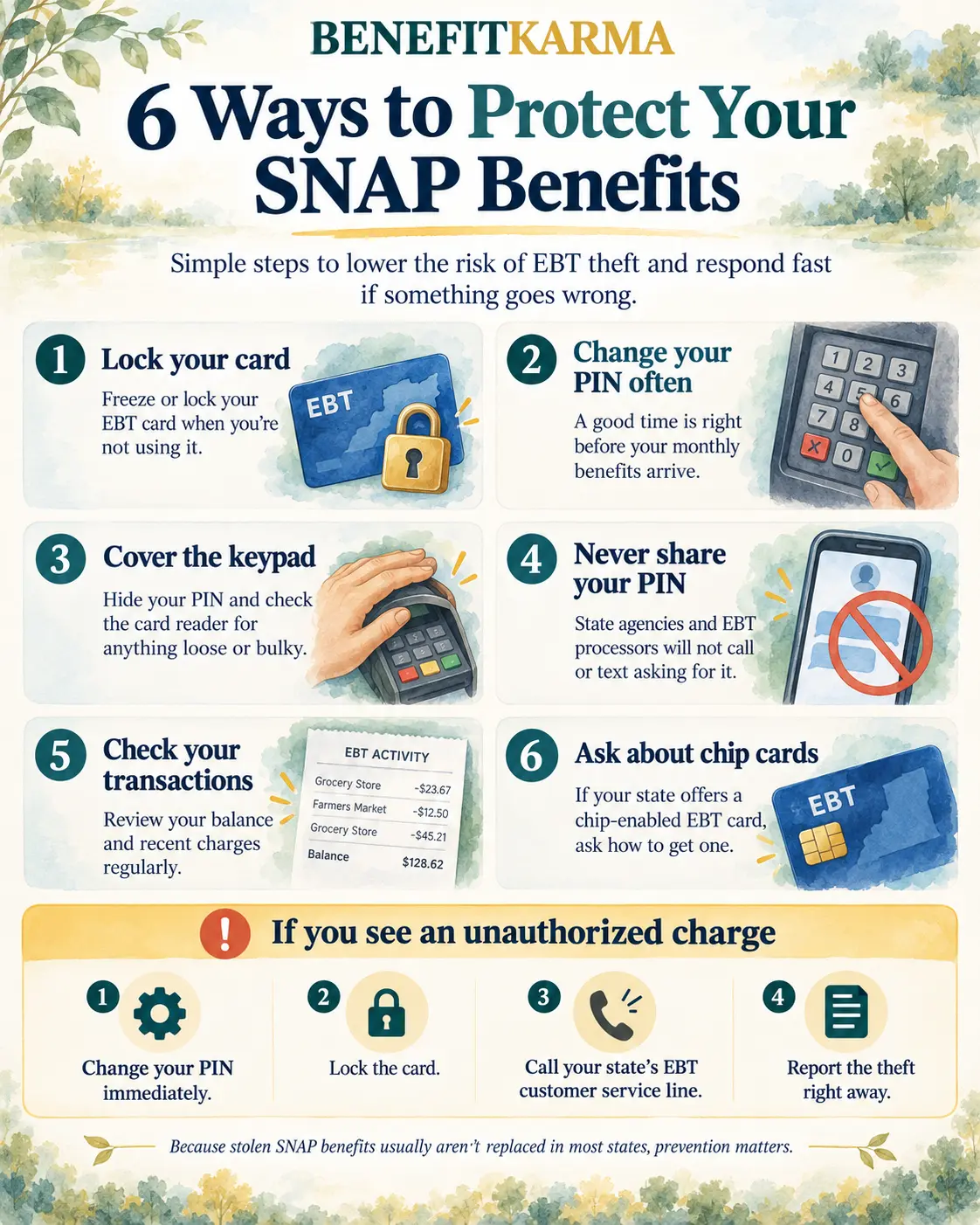
- Lock or freeze your card when you're not using it. Many states let you do this through their EBT app or website. Unlock it only when you shop.
- Change your PIN often. A good time is right before your monthly benefits arrive. Avoid simple PINs like 1111 or 1234.
- Cover the keypad when you enter your PIN, and check card readers for loose or bulky parts before you swipe.
- Never give your PIN or card number by phone or text. State agencies and EBT processors won't call or text to ask for it.
- Check your balance and transactions regularly. If you see a charge you didn't make, change your PIN and call your state's EBT customer service line right away.
- Ask about a chip card if your state offers one.
What to do if your benefits are stolen or you suspect fraud
If your benefits disappear, act quickly:
- Call your state's EBT customer service number (on the back of your EBT card) to report the theft, lock the card and request a replacement.
- Contact your local SNAP office and ask whether your state offers any replacement of stolen benefits with its own funds. Most states don't.
- Keep records of your report, the date and any case number you receive.
- Find food help in the meantime. Food banks and programs like TEFAP can help fill the gap.
To report fraud by someone else:
- A household or individual abusing benefits: Report it to the state agency where it happened. The FNA's fraud reporting page links to each state.
- Skimmers, store trafficking, criminal rings or multistate schemes: Report them to the USDA OIG hotline or by phone at (202) 690-1622. You can report anonymously.
If money is tight and you're not sure which programs you could qualify for, our Benefit Eligibility Screener can help you check.
The bottom line
The federal crackdown targets criminals who steal from SNAP, and most of the money involved was taken from real households, not obtained through false applications. Your benefits and eligibility haven't changed. But with federal replacement of stolen benefits gone in most states, your best protection is prevention: lock your card when you're not using it, change your PIN before each deposit and report any unauthorized charges to your state right away.
Not sure what you qualify for?
A quick conversation can help you understand your options.
Optional — no obligation, fees may apply
Want help figuring out your next step?
Optional — fees may apply depending on your situation.
Some people choose to talk to a professional before taking their next step.
This might sound familiar:
You're not sure what to do next
You want someone to walk through your options
The process feels overwhelming
If that sounds like you, this might be worth a quick look.
Takes less than a minute
We only share your info with a service provider if you say yes.
Recommended Tools
Take action with our free tools
Get More from BenefitKarma
Create a free account to unlock all features
- Access premium benefit tools
- Personalized benefit matching
- Your personalized dashboard
Common questions about this guide
Get more from BenefitKarma
Free tools, personalized dashboard & more
