Medicare Open Enrollment Is Coming: 5 Rules That Could Save You Money

Free DIY tool
Benefit Eligibility Screener
What benefits might I qualify for? Answer a few questions and see VA, disability, food, housing, and health programs that may fit you.
Try the free toolMedicare Open Enrollment begins Oct. 15, 2026, but you don’t have to wait until then to start paying attention to your coverage.
In fact, some of the most important Medicare decisions happen before Open Enrollment even begins. Missing an enrollment deadline can trigger penalties that may last for years — or even for life. Staying in the same Medicare Advantage or Part D plan without reviewing next year’s changes can also leave you paying more than necessary.
And with plans allowed to change their premiums, drug formularies, provider networks, copays, and other coverage details from year to year, automatically renewing your current plan may not always be the best choice.
Here are five Medicare Open Enrollment rules and deadlines worth knowing now.
1. Missing your initial Medicare enrollment period can get expensive
For most people, Medicare eligibility begins around age 65.
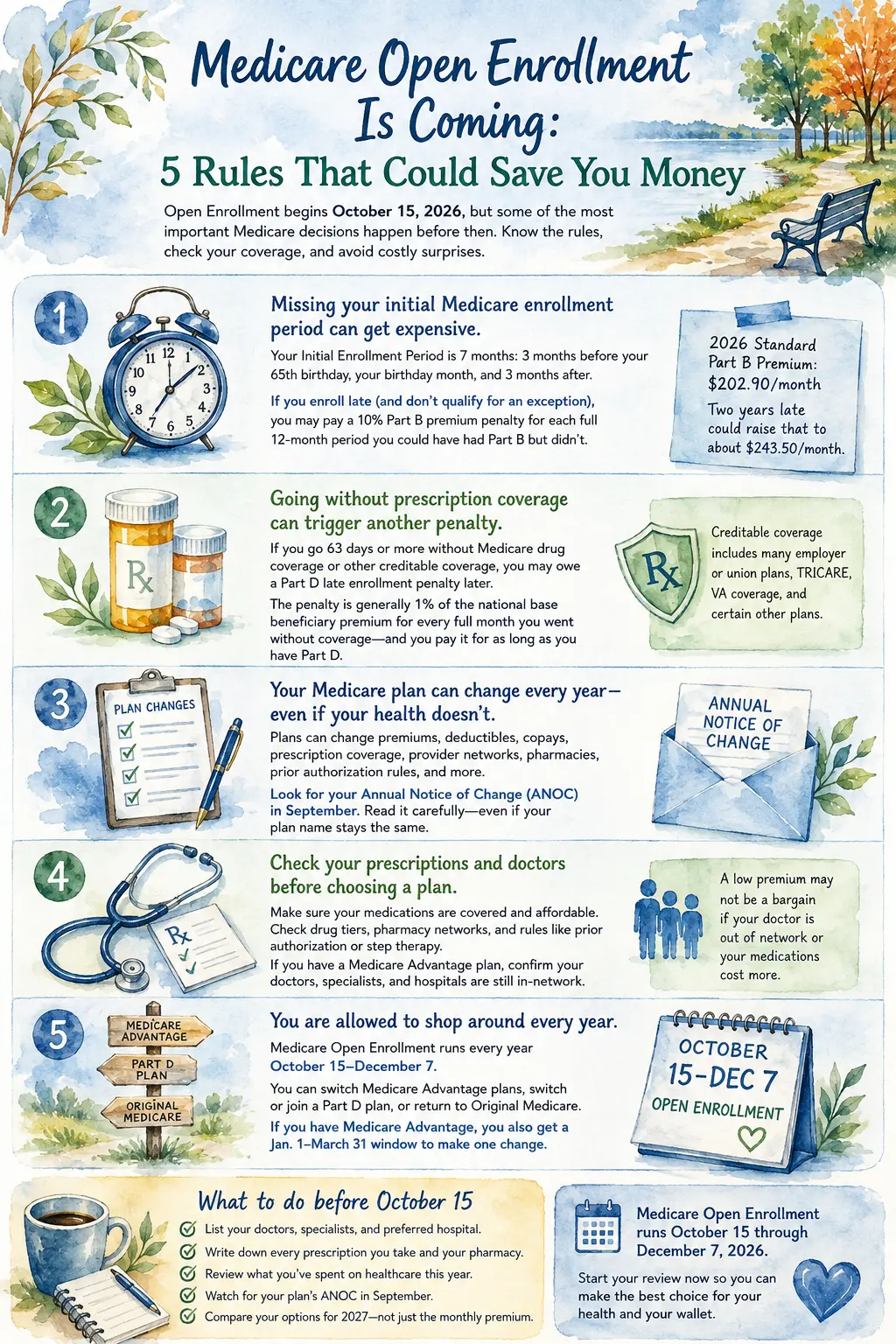
Your Initial Enrollment Period generally lasts seven months: the three months before the month you turn 65, your birthday month, and the three months afterward.
If you don’t enroll in Medicare Part B when you’re supposed to — and you don’t qualify for a Special Enrollment Period — you may face a late enrollment penalty.
The penalty is generally 10% of the standard Part B premium for each full 12-month period you could have had Part B but didn’t enroll. In many cases, that higher premium continues for as long as you have Part B.
That can add up.
For example, Medicare says the standard Part B premium is $202.90 per month in 2026. Someone who delayed enrollment for two full years without qualifying for an exception could face a 20% penalty, bringing the monthly cost to about $243.50 in 2026.
There are important exceptions, particularly for people who continue to have qualifying employer coverage after age 65. So don’t assume everyone must enroll the moment they turn 65.
2. Going without prescription coverage can trigger another penalty
Medicare Part D has its own late enrollment rules.
If you go 63 consecutive days or more without Medicare drug coverage or another form of “creditable” prescription coverage after becoming eligible, you may owe a Part D late enrollment penalty later.
Creditable coverage generally means drug coverage expected to pay at least as much as standard Medicare Part D coverage. Employer or union plans, TRICARE, VA coverage, and certain other plans may qualify.
The Part D penalty is generally calculated as 1% of the national base beneficiary premium for every full month you went without qualifying drug coverage.
And unlike a one-time late fee, the penalty is usually added to your Part D premium for as long as you have Medicare drug coverage.
That means even someone who takes few or no medications should think carefully before deciding to skip drug coverage entirely.
3. Your Medicare plan can change every year — even if your health doesn’t
One of the easiest Medicare mistakes is assuming that because a plan worked well this year, it will work equally well next year.
Medicare Advantage and Part D plans can change from one year to another.
That can include changes to:
- Monthly premiums
- Deductibles
- Copays and coinsurance
- Prescription drug coverage
- Drug tiers
- Provider networks
- Pharmacies
- Prior authorization requirements
- Other benefits
Your plan should send you an Annual Notice of Change, or ANOC, in the fall explaining changes taking effect in January. Medicare says beneficiaries generally receive this notice in September.
Free DIY tool
Benefit Eligibility Screener
What benefits might I qualify for? Answer a few questions and see VA, disability, food, housing, and health programs that may fit you.
Try the free toolDon’t throw it away.
Even if your plan name stays exactly the same, the costs or benefits underneath it may have changed.
4. Check your prescriptions and doctors before choosing a plan
Medicare Open Enrollment is not just about comparing premiums.
For prescription drugs, check whether every medication you regularly take will remain on your plan’s formulary and what tier each drug falls into. Plans may also impose rules such as prior authorization, quantity limits, or step therapy on certain medications.
Also check the pharmacies you use. Part D costs can vary depending on whether a pharmacy is preferred, standard, mail-order, or outside the plan’s network.
If you have Medicare Advantage, take a similar look at your doctors, specialists, hospitals, and other providers.
Medicare Advantage plans commonly use provider networks, and those networks can change. Medicare recommends checking with both your plan and your provider to confirm participation.
A plan with a low premium may not be much of a bargain if your specialist is out of network or one of your expensive medications costs substantially more.
5. You are allowed to shop around every year
You are not locked into the same Medicare Advantage or Part D plan forever.
Medicare Open Enrollment runs every year from Oct. 15 through Dec. 7. Changes made during this period generally take effect Jan. 1.
Depending on your current coverage, you may be able to:
- Switch from one Medicare Advantage plan to another.
- Move from Original Medicare to Medicare Advantage.
- Leave Medicare Advantage and return to Original Medicare.
- Join, drop, or switch Medicare Part D plans.
There is also a separate Medicare Advantage Open Enrollment Period from Jan. 1 through March 31 for people who are already enrolled in Medicare Advantage. During that period, beneficiaries can generally make one change to another Medicare Advantage plan or return to Original Medicare and, if needed, join a drug plan.
One caution: If you're considering leaving Medicare Advantage for Original Medicare and buying a Medigap policy, don't assume you'll automatically be able to get the Medigap plan you want. Federal guaranteed-issue protections are strongest during certain enrollment periods, and eligibility rules outside those periods can vary.
What to do before October 15
You don't need to choose a new Medicare plan today.
But you can make Open Enrollment much easier by getting organized now.
- Write down your current doctors and specialists, your preferred hospital or health system, every prescription you regularly take, the pharmacy you use, and what you've actually spent on healthcare this year.
- Then watch for your plan's Annual Notice of Change in September.
- When Medicare's 2027 plan information becomes available, compare your existing coverage against the alternatives instead of looking only at the monthly premium.
The goal isn't necessarily to switch plans every year. It's to make sure staying put is an intentional decision rather than an automatic one.
The bottom line
Medicare can save retirees significant healthcare costs, but the rules around enrollment, prescription coverage, plan networks, and annual changes matter.
Missing an enrollment deadline can create long-term penalties. Ignoring your plan's annual changes can leave you paying more for prescriptions or losing convenient access to a doctor. And failing to compare plans during Open Enrollment could mean missing a better fit.
Medicare Open Enrollment runs Oct. 15 through Dec. 7, 2026. Starting your review now gives you time to understand what you have — and what may be changing — before you have to make a decision.
Not sure what you qualify for?
A quick conversation can help you understand your options.
Optional — no obligation, fees may apply
Want help figuring out your next step?
Optional — fees may apply depending on your situation.
Some people choose to talk to a professional before taking their next step.
This might sound familiar:
You're not sure what to do next
You want someone to walk through your options
The process feels overwhelming
If that sounds like you, this might be worth a quick look.
Takes less than a minute
We only share your info with a service provider if you say yes.
Recommended Tools
Take action with our free tools
Get More from BenefitKarma
Create a free account to unlock all features
- Access premium benefit tools
- Personalized benefit matching
- Your personalized dashboard
Common questions about this guide
Get more from BenefitKarma
Free tools, personalized dashboard & more
