# BenefitKarma — Full Content Dump (llms-full.txt)
> Companion to https://benefitkarma.com/llms.txt. Contains the full body of every published article, every glossary definition, and every state resource. Intended for AI ingestion with sufficient context window.
Generated: 2026-07-07
Source of truth: https://benefitkarma.com
Counts: 247 articles · 340 glossary terms · 51 state resources
All content is for educational purposes. BenefitKarma is not a government agency. Tool outputs are estimates only. Verify final eligibility and amounts with the relevant agency.
========================================
# Articles (247)
========================================
---
type: article
title: Understanding the 5 Million Drop in Medicaid and ACA Enrollment
url: https://benefitkarma.com/articles/health-disability/5-million-drop-in-medicaid-and-aca-enrollment
updated: 2026-07-01
---
# Understanding the 5 Million Drop in Medicaid and ACA Enrollment
More than 5 million fewer people are enrolled in Medicaid, CHIP, or Affordable Care Act marketplace plans than last year. For families who depend on these programs for doctor visits, prescriptions, hospital care, mental health treatment, and children's coverage, that's a serious warning sign.
The drop traces to two major changes: new Medicaid rules in the 2025 federal budget law and the expiration of enhanced ACA subsidies that helped millions afford monthly premiums. Many of these changes are still taking effect, so more people could be affected in the months ahead.
BenefitKarma can help you keep track of what benefits you may qualify for. Stay informed and take control of your coverage.
### Why did enrollment drop?
For ACA marketplace plans, cost is the main driver. When enhanced premium tax credits expired, many people saw their monthly premiums spike. Some switched to cheaper plans with higher deductibles. Others dropped coverage entirely.
For Medicaid and CHIP, the picture is more complicated. Medicaid eligibility is based on income, household size, age, disability status, pregnancy, and state rules — but people can lose coverage even when they still qualify if they miss renewal paperwork or can't complete a new requirement on time.
The 2025 federal budget law added new Medicaid work reporting requirements, more frequent eligibility checks, and new limits on how states fund their programs. Many of these rules are just beginning to roll out.
### Who is most affected?
Those most likely to feel these changes include adults in Medicaid expansion, people who buy ACA coverage independently, self-employed and gig workers, parents using CHIP, and people with low or fluctuating income. Immigrants and mixed-status families may also be avoiding enrollment due to concerns about immigration enforcement — a dynamic researchers call a "chilling effect."
Some states have seen especially sharp drops. Medicaid and CHIP declines have been most pronounced in Indiana, Louisiana, Arizona, Rhode Island, and Delaware. ACA drops have been steepest in North Carolina, Ohio, West Virginia, Indiana, and Delaware.
Even if your state isn't on that list, watch your mail and online accounts. A missed notice can create a coverage gap.
### What about Medicaid work requirements?
This is the biggest policy change for many people. Some states — including Nebraska — have already implemented work requirements. Most states are expected to follow in January 2027.
Under these rules, certain adults must show they are working, in school, volunteering, or participating in job training for at least 80 hours per month. Exemptions may apply for people who are pregnant, medically frail, disabled, or caring for certain family members, but exact rules vary by state.
The requirement isn't just about whether you work — it's about whether you can prove it the way your state requires. Paperwork, deadlines, and online forms matter.
### Can children lose coverage too?
Yes. Children aren't the target of work requirements, but they can lose coverage if a household misses renewal paperwork or if state systems create new barriers. Parents should watch for renewal notices even if their child has been covered for years.
If your child loses Medicaid or CHIP, options remain. CHIP has different income limits, and some children qualify even when parents don't. Losing Medicaid or CHIP also typically triggers a Special Enrollment Period for ACA marketplace coverage.
### What should I do if I lost coverage?
If you lost Medicaid or CHIP: Find out why. If it was a paperwork issue, you may be able to reopen your case by submitting the missing information. If your income is now too high, check whether you qualify for an ACA plan. Ask whether your children still qualify for CHIP — income limits for children are often higher than for adults.
If your ACA plan got too expensive: Don't assume you have no options. Log in and compare plans — a different metal level or insurer may lower your payment. Update your income estimate if your situation changed. If you recently lost job-based coverage, had a baby, moved, or experienced another major life change, you may qualify for a Special Enrollment Period.
### How do I protect my coverage?
Make sure your Medicaid office or marketplace has your current address, email, and phone number. Open every notice, even routine-looking ones. Check your online account monthly. Save pay stubs, school records, volunteer documentation, and medical paperwork that could help prove eligibility.
If you receive a notice you don't understand, don't wait — contact your state Medicaid office, ACA marketplace, a local navigator, legal aid, or a community health center.
### Can I appeal if my coverage was ended?
Yes. If you believe your coverage ended in error, you have the right to appeal. Your notice should explain why coverage ended and how long you have to respond — deadlines can be short. In some Medicaid cases, you may be able to keep coverage during an appeal if you request it before the deadline, though rules vary by state.
### The bottom line
People are losing coverage because costs went up and rules are changing. But losing coverage doesn't always mean you're out of options. Check whether you qualify for Medicaid, CHIP, an ACA marketplace plan, or a Special Enrollment Period — and if you get a notice, respond quickly.
---
type: article
title: Help with Adopting: Understanding the Adoption Assistance Program
url: https://benefitkarma.com/articles/family-education/adoption-assistance-program-federal-subsidies
updated: 2026-07-01
---
# Help with Adopting: Understanding the Adoption Assistance Program
Adoption can be a beautiful way to grow your family — but it comes with real costs. The federal Adoption Assistance Program exists to help, offering monthly payments, Medicaid coverage, reimbursement for adoption expenses, and other support depending on the child's needs and your state's rules.
BenefitKarma can help you understand what benefits may be available. Visit BenefitKarma.com to learn more.
### What is the Adoption Assistance Program?
This program helps families adopt children — typically from foster care — who are considered to have "special needs" under state or federal rules. That term is broader than it sounds. A child may qualify due to age, medical or behavioral needs, disability, or being part of a sibling group.
The main federal version is called Title IV-E adoption assistance. Children who don't qualify federally may still qualify for state-funded assistance. Eligibility is based on the child's situation, not the adoptive family's income.
### What benefits can it provide?
Monthly payments. An adoption subsidy helps with ongoing costs like food, clothing, therapy, and child care. Amounts vary by state and child, and are usually negotiated before finalization — often capped at what the child would have received in foster care.
Medicaid. Many eligible children also receive Medicaid, covering doctor visits, prescriptions, mental health care, and other health needs. For children with trauma histories, developmental delays, or complex medical needs, this can be the most valuable benefit. Title IV-E Medicaid coverage generally continues even if your family moves to another state.
Non-recurring expense reimbursement. Families can often be reimbursed for one-time adoption costs — court fees, attorney fees, agency fees, and travel. Most states cap this at $2,000 per child. These must be approved before finalization, so keep all receipts.
State extras. Depending on where you live, additional support may include post-adoption counseling, respite care, support groups, or extended services for older youth.
### What about the federal adoption tax credit?
For tax year 2025, the maximum credit is $17,280 per eligible child. Up to $5,000 is refundable, meaning some families can receive part of it even if they don't owe that much in taxes. Qualified expenses include adoption fees, attorney fees, court costs, and travel.
The credit phases out for modified adjusted gross income above $259,190 and disappears above $299,190.
If you adopt a U.S. child determined to have special needs, you may be able to claim the full credit even if your out-of-pocket adoption costs were low — a significant benefit for families adopting from foster care.
### How do I apply?
Talk to your adoption worker as early as possible — ideally before finalization. Ask whether the child qualifies for adoption assistance, Medicaid, and nonrecurring expense reimbursement. Then make sure everything is documented in a signed adoption assistance agreement before the adoption is complete. Benefits approved after finalization are much harder to secure.
Before signing, get answers in writing to: the monthly payment amount, what Medicaid covers, whether benefits can be adjusted if needs change, how long benefits last, whether they continue past age 18, and what happens if you move states.
### The bottom line
Adoption assistance can make adoption more affordable and help families care for children with ongoing needs. The key is to ask early, understand what the child qualifies for, and get it in the agreement before the adoption is final.
---
type: article
title: Is Medicare Being Privatized? What A Proposed Enrollment Change Could Mean For You
url: https://benefitkarma.com/articles/benefits-in-the-news/is-medicare-being-privatized
updated: 2026-07-01
---
# Is Medicare Being Privatized? What A Proposed Enrollment Change Could Mean For You
Medicare is one of the most important health programs in the U.S., especially for older adults and people with disabilities. So when talk of major changes starts circulating, it's understandable to feel concerned — or even confused.
In March 2026, Trump Administration officials publicly confirmed they are exploring a major shift in how Americans are enrolled in Medicare. The proposal: automatically placing new beneficiaries into private Medicare Advantage plans instead of traditional government-run Medicare. It's a significant departure from how the system has worked for decades, and while nothing has been finalized, it raises important questions about cost, coverage, and control over your healthcare.
If you want clear, straightforward updates on benefits like Medicare, BenefitKarma is here to help you stay informed and make confident decisions.
## What's Actually Being Proposed
In March 2026, Chris Klomp, the Trump administration's director of Medicare, told reporters that the Centers for Medicare & Medicaid Services (CMS) is actively studying the feasibility of making Medicare Advantage (MA) the default enrollment option for new beneficiaries. No final decision has been made.
Currently, many people are automatically enrolled in traditional Medicare when they turn 65 if they are already receiving Social Security benefits — though automatic enrollment depends on specific conditions and doesn't apply to everyone.
Under the proposal being explored, new beneficiaries could instead be automatically placed into a private Medicare Advantage plan. They would still have the ability to switch or opt out, but the default — and what most people end up staying with — would change.
## Breaking Down Your Medicare Options
Try it: Find Benefits — Explore the full benefits library.
Understanding this proposal starts with knowing the difference between the two main types of Medicare:
### Traditional Medicare (Part A & Part B)
- Covers hospital care (Part A) and outpatient/doctor services (Part B)
- Run directly by the federal government
- Lets you see most doctors nationwide who accept Medicare
- Does not usually include dental, vision, or prescription drug coverage
### Medicare Advantage (Part C)
- Offered by private insurance companies
- Includes Parts A and B, often with extras like dental, vision, and drug coverage
- Requires you to use a network of providers
- May have lower upfront costs but more restrictions
The key trade-off: flexibility vs. bundled benefits.
## Why Some Experts Are Concerned
Critics argue that shifting default enrollment to Medicare Advantage could lead to higher costs and more restrictions over time.
One major concern is overpayments to Medicare Advantage plans. The Medicare Payment Advisory Commission (MedPAC) has estimated tens of billions in annual overpayments, and projections from the Committee for a Responsible Federal Budget suggest this could total at least $1.2 trillion over the next decade, with updated estimates trending even higher.
These overpayments can affect everyone, not just those enrolled in Medicare Advantage. The Joint Economic Committee found that in 2025, these excess payments increased Medicare Part B premiums by about $212 per enrollee, totaling billions in higher costs across the program.
There are also concerns about access to care. Because Medicare Advantage plans use provider networks, patients may have fewer choices compared to traditional Medicare, and some services may require prior authorization.
## A Risk Many People Don’t Realize: Medigap Access
One of the most important (and often overlooked) issues is how this shift could affect access to Medigap supplemental insurance.
Medigap plans help cover out-of-pocket costs in traditional Medicare. But in most states, you only have a guaranteed right to buy a Medigap plan when you first enroll in Medicare.
If someone is automatically enrolled in Medicare Advantage and later decides to switch back to traditional Medicare, they may not be guaranteed access to a Medigap plan.
That could leave them with higher out-of-pocket costs or fewer coverage options.
This is a key concern for critics and an important factor to consider when comparing plans.
## Is This Really “Privatization”?
The idea of “privatizing Medicare” is debated, and the answer depends on how you define it.
Medicare Advantage has existed for decades, and more than half of Medicare beneficiaries already choose these plans voluntarily. What’s being discussed now isn’t the introduction of private plans, but a change in the default enrollment system.
That distinction matters. Default choices can strongly influence what people end up using, even if other options remain available.
## Why Others Support The Shift
Supporters of Medicare Advantage point to its convenience and additional benefits. Many plans include:
- Prescription drug coverage
- Dental and vision care
- Wellness programs
For some people, especially those looking for all-in-one coverage, these plans can be appealing and easier to manage.
## What Could Happen Next
Right now, this proposal is still in the early stages and hasn’t been finalized, but there is a clear path it would likely follow if it moves forward.
First, federal officials would need to decide how to implement the change. That could happen through a formal rulemaking process, where details are published publicly and open for comment, or through a smaller pilot program to test how default enrollment into Medicare Advantage would work in practice.
Either way, the proposal would face significant scrutiny from lawmakers, advocacy groups, and the healthcare industry.
There’s also an open question about whether this kind of change can be made administratively or if it would require approval from Congress. That alone could slow things down or reshape the proposal entirely.
Even in a best-case scenario, changes like this take time. If the idea gains traction, the earliest meaningful shifts would likely happen over the next few years, not immediately. For now, the key takeaway is that this is a developing policy idea, not a finalized rule — but one worth paying close attention to as it evolves.
## What This Means For You
Even if this proposal moves forward, you would still likely have the option to switch plans or opt out of a default enrollment.
Still, defaults matter, and being informed ahead of time can make a big difference.
### Here’s what you can do now:
- Learn your options early before enrolling in Medicare
- Compare traditional Medicare and Medicare Advantage based on your needs
- Consider long-term factors like provider access and Medigap eligibility
- Stay updated on policy changes that could affect your coverage
## The Bottom Line
The idea of automatically enrolling people into Medicare Advantage instead of traditional Medicare could mark a meaningful shift in how the program works, but it wouldn’t eliminate your ability to choose.
The bigger issue is how that default might shape decisions, costs, and access to care over time.
BenefitKarma is here to break down complex benefit changes into simple, useful guidance so you can stay informed, ask the right questions, and make the best decision for your situation.
---
type: article
title: Is a Medicare Enrollment Freeze Coming for Hospice Providers?
url: https://benefitkarma.com/articles/benefits-in-the-news/medicare-enrollment-hospice-freeze
updated: 2026-05-13
---
# Is a Medicare Enrollment Freeze Coming for Hospice Providers?
For patients and families who rely on hospice care, and for the providers who deliver it, the idea of a federal enrollment freeze can sound alarming. But this isn't just a rumor anymore.
In late March 2026, a leading national hospice industry group formally called on the federal government to act, and the push is gaining real momentum. Here's what's actually happening, why it matters, and what you should do next.
BenefitKarma is here to translate complex policy developments into clear, actionable guidance so you're never caught off guard by changes that affect your care or your organization.
## What's Actually Being Proposed
On March 27, 2026, the National Partnership for Healthcare and Hospice Innovation (NPHI) sent a formal letter to CMS Administrator Dr. Mehmet Oz calling on the Centers for Medicare & Medicaid Services to implement a temporary, nationwide moratorium on new hospice provider enrollments, citing the continued growth of fraudulent providers exploiting the Medicare hospice benefit.
A moratorium would temporarily halt new hospice providers from enrolling in Medicare — essentially freezing the front door to the program while regulators work to clean up what's already inside. No moratorium has been officially implemented for hospice as of April 2026, but the call from a major industry organization — not a fringe group, but one representing leading nonprofit hospice providers — marks a significant escalation from rumor to formal policy advocacy.
## Why This Is Happening Now
Try it: Find Benefits — Explore the full benefits library.
The Medicare hospice benefit has existed since 1982, providing comprehensive end-of-life care to patients with a terminal illness and a life expectancy of six months or less. It has long been a target for fraud, but the problem has worsened dramatically in recent years.
CMS in 2025 referred 343 cases to law enforcement for suspected fraud, representing $3.4 billion in fraudulent billing activity. Roughly 4,780 providers and service suppliers had their Medicare billing privileges revoked due to inappropriate behavior.
The fraud hotspots are concentrated geographically. Enhanced oversight in four states with elevated fraud risk — Arizona, California, Nevada, and Texas — has resulted in more than 200 hospice Medicare enrollment revocations for failure to comply with CMS requirements. CMS has since expanded this targeted oversight approach to additional states, including Georgia and Ohio.
The scale in California is particularly striking. According to the Washington Examiner, federal investigators have stripped billing privileges from three-fifths of newly enrolled hospice agencies that have continued to appear in California, and 35% of the remaining providers were flagged for corrective action.
In early April 2026, FBI agents executed arrest warrants across Southern California, charging 15 people in a $60 million Medicare hospice fraud scheme across nine separate investigations — a case federal prosecutors called "Operation Never Say Die."
## This Tool Has Been Used Before
CMS has used enrollment moratoria before for other provider types when fraud reaches a crisis point. Most recently, in February 2026, CMS imposed a six-month nationwide moratorium blocking new Medicare enrollments for certain medical supply companies, as part of its broader Comprehensive Regulations to Uncover Suspicious Healthcare (CRUSH) initiative. Hospice advocates are now pushing for similar action in their sector.
## What a Moratorium Would (and Wouldn't) Mean
It's important to understand what this kind of action actually does. Moratoria typically only affect new enrollment applications. Existing enrolled providers continue operating normally and are not subject to the freeze. If you or a loved one is currently receiving hospice care, a moratorium would not interrupt that care.
NPHI's letter recommends that any moratorium be explicitly time-limited and paired with a clear path forward, allowing CMS to focus on identifying and removing fraudulent providers currently operating within the system while preventing new bad actors from entering. NPHI emphasizes that the fraud issue stems from a subset of providers exploiting gaps in oversight, not from the hospice model itself.
## What You Should Do
If you are a hospice provider, now is the time to ensure your enrollment documentation, billing practices, and compliance programs are current and well-documented. CMS is conducting unannounced site visits and expanding audits nationwide. Providers operating in good faith have the most to gain from a moratorium — it would remove fraudulent competitors — but the current enforcement environment means scrutiny is broad.
If you are a patient or family member, the key takeaway is that your current care is not at risk. A moratorium on new enrollments would not affect providers already in the Medicare program. If you have concerns about whether a hospice provider is legitimate, you can verify enrollment status through the Medicare.gov Care Compare tool.
Stay current through authoritative sources like CMS.gov and HHS.gov, where official announcements will be published if a moratorium is enacted.
## The Bottom Line
What began as a policy rumor has become a formal, industry-backed request to federal regulators — and the scale of the fraud driving it is well-documented and growing. As of April 2026, no hospice enrollment moratorium has been announced, but the conditions that would prompt one are clearly in place. Whether you're a provider or a patient, understanding what this policy tool does — and doesn't do — is the best preparation you can have.
---
type: article
title: Where To File for Unemployment Benefits in Every State
url: https://benefitkarma.com/articles/benefits-by-state/state-unemployment-offices
updated: 2026-05-13
---
# Where To File for Unemployment Benefits in Every State
If you need unemployment benefits, the first step is contacting your state workforce agency. Each state runs its own program, which means applications, payment amounts, and timelines vary depending on where you live.
The good news? You don’t have to hunt for the right website or phone number. We’ve pulled together a complete, up-to-date directory of every state unemployment office, plus Washington, D.C. and U.S. territories.
If you want more step-by-step guidance on applying, qualifying, and maximizing your benefits, BenefitKarma helps you stay informed with the latest updates and best practices across programs nationwide.
## All state unemployment offices (A–Z)
### Alabama – Alabama Unemployment Compensation Claimant Portal
- File/manage claim: https://adol.alabama.gov/claimants/
- Phone: (866) 234-5382
### Alaska – Alaska UI Claimant Services
- File/manage claim: https://bif.dol.alaska.gov/bif/
- Phone: (888) 252-2557
### Arizona – Arizona UI Benefits Portal (PUA/UI)
- File/manage claim: https://des.az.gov/services/employment/unemployment-individual
- Phone: (877) 600-2722
### Arkansas – Arkansas EZARC Unemployment Portal
- File/manage claim: https://dws.arkansas.gov/unemployment/
- Phone: (844) 908-2178
### California – California UI Online (EDD)
- File/manage claim: https://edd.ca.gov/en/unemployment/
- Phone: (800) 300-5616
### Colorado – Colorado MyUI+
- File/manage claim: https://cdle.colorado.gov/myui-plus
- Phone: (303) 318-9000
### Connecticut – Connecticut ReEmployCT
- File/manage claim: https://portal.ct.gov/dol/unemployment-benefits
- Phone: (860) 263-6000
### Delaware – Delaware UI Claimant Portal
- File/manage claim: https://uics.delawareworks.com
- Phone: (302) 761-8446
### Florida – Florida CONNECT Reemployment System
- File/manage claim: https://reconnect.commerce.fl.gov/
- Phone: (833) 352-7759
### Georgia – Georgia MyUI Claimant Portal
- File/manage claim: https://dol.georgia.gov/file-unemployment-insurance-claim
- Phone: (877) 709-8185
### Hawaii – Hawaii UI Claimant Services
- File/manage claim: https://huiclaims.hawaii.gov
- Phone: (808) 586-8970
### Idaho – Idaho Claimant Portal
- File/manage claim: https://labor.idaho.gov/claimantportal
- Phone: (208) 332-8942
### Illinois – Illinois IDES Claimant Portal
- File/manage claim: https://ides.illinois.gov/unemployment
- Phone: (800) 244-5631
### Indiana – Indiana Uplink Claimant Self-Service
- File/manage claim: https://uplink.in.gov/CSS
- Phone: (800) 891-6499
### Iowa – Iowa UI Claimant Portal
- File/manage claim: https://workforce.iowa.gov/unemployment
- Phone: (866) 239-0843
### Kansas – Kansas UI Claimant Portal
- File/manage claim: https://uiassistance.getkansasbenefits.gov
- Phone: (800) 292-6333
### Kentucky – Kentucky UI Portal
- File/manage claim: https://uiclaimsportal.ky.gov/
- Phone: (502) 564-2900
### Louisiana – Louisiana HiRE Portal
- File/manage claim: https://www.louisianaworks.net/hire/
- Phone: (866) 783-5567
### Maine – Maine ReEmployME
- File/manage claim: https://reemployme.maine.gov
- Phone: (800) 593-7660
### Maryland – Maryland BEACON UI Portal
- File/manage claim: https://beacon.labor.maryland.gov
- Phone: (667) 207-6520
### Massachusetts – Massachusetts UI Online
- File/manage claim: https://uionline.detma.org
- Phone: (877) 626-6800
### Michigan – Michigan MiWAM Portal
- File/manage claim: https://miwam.unemployment.state.mi.us
- Phone: (866) 500-0017
### Minnesota – Minnesota UI Claimant Portal
- File/manage claim: https://www.uimn.org
- Phone: (651) 296-3644
### Mississippi – Mississippi MDES Portal
- File/manage claim: https://reemployms.mdes.ms.gov/cp/landing
- Phone: (888) 844-3577
### Missouri – Missouri UInteract
- File/manage claim: https://uinteract.labor.mo.gov
- Phone: (800) 320-2519
### Montana – Montana UI eServices
- File/manage claim: https://uieservices.mt.gov
- Phone: (406) 444-2545
### Nebraska – Nebraska UI Claimant Portal
- File/manage claim: https://dol.nebraska.gov/UIBenefits
- Phone: (402) 458-2500
### Nevada – Nevada UI Claimant Portal
- File/manage claim: https://ui.nv.gov
- Phone: (888) 890-8211
### New Hampshire – New Hampshire UI Claimant Portal
- File/manage claim: https://www.nhes.nh.gov/individuals/file-unemployment-benefits
- Phone: (603) 271-7700
### New Jersey – New Jersey UI Claimant Portal
- File/manage claim: https://myunemployment.nj.gov
- Phone: (856) 507-2340
### New Mexico – New Mexico UI Claimant Portal
- File/manage claim: https://www.jobs.state.nm.us
- Phone: (877) 664-6984
### New York – New York UI Online Services
- File/manage claim: https://unemployment.labor.ny.gov
- Phone: (888) 209-8124
### North Carolina – North Carolina DES Portal
- File/manage claim: https://www.des.nc.gov/individuals/apply-ui
- Phone: (888) 737-0259
### North Dakota – North Dakota UI Portal
- File/manage claim: https://www.jobsnd.com/unemployment-individuals
- Phone: (701) 328-4995
### Ohio – Ohio UI Claimant Portal
- File/manage claim: https://unemployment.cmt.ohio.gov
- Phone: (877) 644-6562
### Oklahoma – Oklahoma UI Claimant Portal
- File/manage claim: https://unemployment.state.ok.us
- Phone: (800) 555-1554
### Oregon – Oregon Frances Online System
- File/manage claim: https://frances.oregon.gov
- Phone: (877) 345-3484
### Pennsylvania – Pennsylvania UC Portal
- File/manage claim: https://benefits.uc.pa.gov
- Phone: (888) 313-7284
### Rhode Island – Rhode Island UI Online
- File/manage claim: https://beta.uionline.dlt.ri.gov/
- Phone: (401) 415-6772
### South Carolina – South Carolina DEW Portal
- File/manage claim: https://scuihub.dew.sc.gov/CSS/CSSLogon.htm
- Phone: (866) 831-1724
### South Dakota – South Dakota UI Claimant Portal
- File/manage claim: https://dlr.sd.gov/ui
- Phone: (605) 626-2452
### Tennessee – Tennessee Jobs4TN Portal
- File/manage claim: https://jobs4tnui.tn.gov/claimant/_/
- Phone: (844) 224-5818
### Texas – Texas UI Claimant Portal
- File/manage claim: https://www.twc.texas.gov/services/apply-benefits
- Phone: (800) 939-6631
### Utah – Utah UI Claimant Portal
- File/manage claim: https://jobs.utah.gov/ui
- Phone: (801) 526-4400
### Vermont – Vermont UI Claimant Portal
- File/manage claim: https://labor.vermont.gov/unemployment-insurance
- Phone: (877) 214-3330
### Virginia – Virginia UI Claimant Portal
- File/manage claim: https://uidirect.vec.virginia.gov
- Phone: (866) 832-2363
### Washington – Washington eServices Portal
- File/manage claim: https://secure.esd.wa.gov
- Phone: (800) 562-2308
### West Virginia – WorkForce WV Portal
- File/manage claim: https://uc.workforcewv.org
- Phone: (800) 252-5627
### Wisconsin – Wisconsin UI Claimant Portal
- File/manage claim: https://my.unemployment.wisconsin.gov
- Phone: (844) 910-3661
### Wyoming – Wyoming UI Claimant Portal
- File/manage claim: https://wyui.wyo.gov
- Phone: (307) 473-3789
---
## District of Columbia & Territories
Try it: Find Benefits — See benefits available in your state.
### Washington, D.C. – DC UI Claimant Portal
- File/manage claim: https://does.dcnetworks.org
- Phone: (202) 724-7000
### Puerto Rico – Puerto Rico UI Portal
- File/manage claim: https://desempleo.trabajo.pr.gov/reclamantes/(S(obcub2emei4muuhupywg5kzo))/Inicio.aspx
- Phone: (787) 754-5353
### U.S. Virgin Islands – USVI UI Portal
- File/manage claim: https://unemployment.vidol.gov/
- Phone: (340) 773-1994
### Guam – Guam UI Claimant Portal
- File/manage claim: https://dol.guam.gov/unemployment/
- Phone: (671) 475-7000
---
## How to use this list
- Always apply through your state’s portal (above)
- Create an account before filing
- File weekly certifications to keep payments active
- Call only if you’re locked out, denied, or flagged
---
## Why this matters
Every state system is different, and using the wrong page can delay your benefits by weeks.
This list cuts straight to the exact pages that matter, so you can:
- apply faster
- avoid scams or outdated links
- get paid sooner
---
type: article
title: Unemployment Identity Theft: What to Look For
url: https://benefitkarma.com/articles/income-employment/unemployment-fraud-identity-theft
updated: 2026-07-01
---
# Unemployment Identity Theft: What to Look For
Unemployment benefits are meant to help when you’re between jobs, but scammers have found ways to exploit the system. One of the most common schemes right now? Filing fraudulent unemployment claims using stolen personal information, like your Social Security number.
If you receive a letter about unemployment benefits you never applied for, don’t brush it off. It may seem like a mistake, but it’s often a sign of identity theft, and ignoring it can lead to bigger problems like tax issues, delayed refunds, or even wage garnishment. The good news is that there are clear steps you can take right away to protect yourself.
If you want to stay informed on scams, benefits, and how to protect your finances, BenefitKarma breaks down what matters without the confusing jargon. Here’s what to do if this happens to you.
## Why this happens (and why it matters)
Unemployment fraud surged during and after the pandemic, and it’s still happening today. Scammers use stolen personal information, often from data breaches, to file claims in someone else’s name and collect benefits.
You might only find out when:
- Your employer gets notified of a claim you didn’t file
- Your state unemployment agency sends you a letter
- You receive unexpected tax forms (like a 1099-G for unemployment income)
The risk goes beyond stolen benefits. Fraud like this can:
- Delay your tax refund
- Trigger IRS issues if income is reported under your name
- Damage your credit if your identity is used elsewhere
That’s why acting quickly is critical.
## Step 1: Report it to your employer
Try it: Find Benefits — Explore income, employment and tax benefits available to you.
Start with your employer as soon as you notice the issue. They may have already received notice of the fraudulent claim and can confirm it wasn’t legitimate.
Employers often work directly with state agencies to flag fraud, so this step helps stop the claim faster.
## Step 2: Contact your state unemployment agency
Next, report the fraud to your state workforce or unemployment office. Most states have dedicated fraud reporting tools online.
This step is key because it:
- Stops payments from continuing
- Flags your identity in the system
- Helps prevent future fraudulent claims in your name
Be prepared to verify your identity and confirm you didn’t apply.
## Step 3: Report identity theft to the FTC
Go to IdentityTheft.gov and file a report. This is the federal government’s official identity theft recovery site.
You’ll get a personalized recovery plan with step-by-step instructions based on your situation. It’s free and widely recommended by experts.
## Step 4: Freeze your credit (free and powerful)
A credit freeze makes it much harder for scammers to open new accounts in your name.
Contact all three major credit bureaus:
- Equifax
- Experian
- TransUnion
Freezing your credit does not affect your score, and you can lift the freeze anytime.
## Step 5: Check your credit reports regularly
Visit AnnualCreditReport.com to access your free credit reports (currently available weekly).
Look for:
- Accounts you don’t recognize
- Hard inquiries you didn’t authorize
- Changes to your personal information
If you spot errors, dispute them with the credit bureau immediately.
## Step 6: Protect your taxes with an IRS PIN
If your Social Security number has been used fraudulently, consider setting up an IRS Identity Protection PIN.
This six-digit code helps prevent someone from filing a tax return in your name and stealing your refund. It’s especially useful after unemployment-related identity theft.
## Common mistakes to avoid
When this happens, timing matters. Avoid these common missteps:
- Ignoring the letter or assuming it’s a mistake
- Waiting too long to report the fraud
- Only reporting it to one agency instead of all three (employer, state, FTC)
- Skipping credit monitoring
Even a short delay can make recovery harder.
## Bottom line
If you get a notice about unemployment benefits you didn’t file, treat it as identity theft until proven otherwise.
Take these steps right away:
- Report it to your employer
- Contact your state unemployment agency
- File a report at IdentityTheft.gov
- Freeze your credit and monitor your reports
- Consider setting up an IRS PIN
Acting quickly can stop the fraud, protect your finances, and prevent long-term damage.
For more straightforward guides on benefits, scams, and how to protect your money, keep checking back with BenefitKarma; we’ll keep you in the know.
---
type: article
title: State Unemployment Benefits In 2026: Why Payouts And Rules Vary More Than You Think
url: https://benefitkarma.com/articles/income-employment/state-unemployment-benefits-in-2026
updated: 2026-07-01
---
# State Unemployment Benefits In 2026: Why Payouts And Rules Vary More Than You Think
State unemployment benefits are a critical safety net for workers who lose their jobs, but in 2026, where you live matters more than ever.
A recent CNBC report highlights how dramatically unemployment benefits can differ across states, from how much you receive to how long payments last. If you’re navigating job loss or planning ahead, understanding these differences can make a real financial impact.
Unemployment insurance (UI) is a joint federal-state program, but states control most of the rules. That means eligibility requirements, weekly payments, and benefit durations can vary widely. With inflation, labor market shifts, and state-level policy changes all in play, 2026 has become a year where those differences are especially noticeable.
Want to stay on top of changes like this? BenefitKarma keeps you informed on how government benefits work and how to make the most of them.
## Why Unemployment Benefits Vary By State
The biggest takeaway from the CNBC report: there is no single “standard” unemployment benefit in the U.S.
Each state sets its own formula based on factors like:
- prior earnings
- state wage levels
- local unemployment rates
- policy decisions made by state legislatures
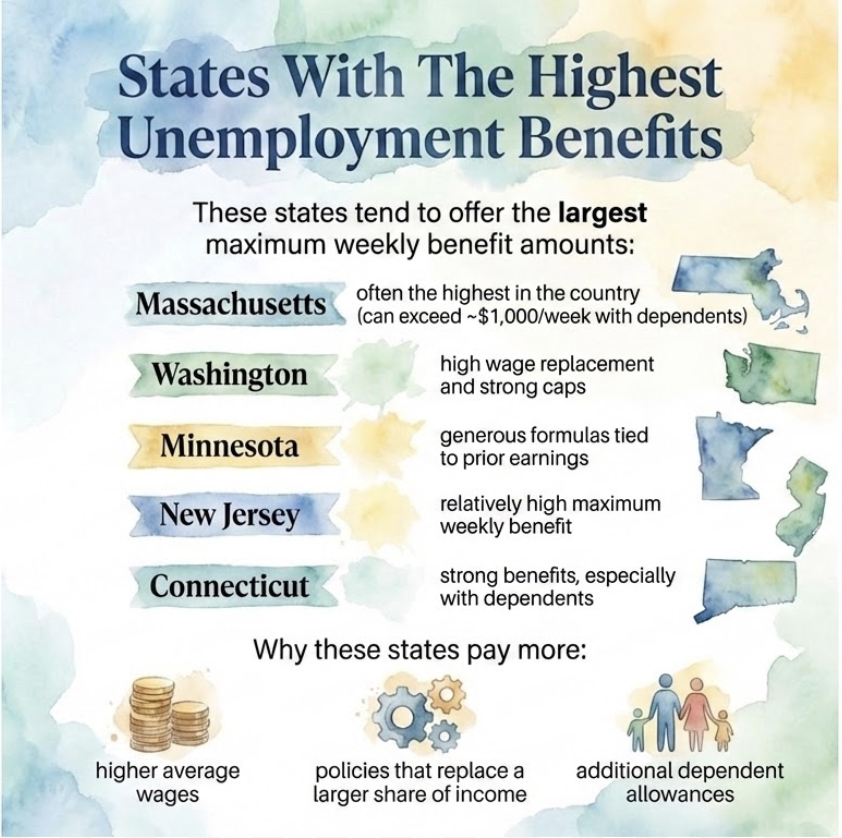
For example, some states replace a higher percentage of your previous wages, while others cap benefits at relatively low amounts. According to CNBC, the maximum weekly benefit can range from a few hundred dollars to over $1,000 depending on the state.
That means two workers with similar salaries could receive very different support simply based on where they live.
## How Much You Can Receive
Try it: Find Benefits — Explore income, employment and tax benefits available to you.
Weekly benefit amounts are typically calculated as a percentage of your recent earnings, often around 30% to 50% of your average weekly wage—but caps vary significantly.
Examples from the report show:
- lower-benefit states may cap weekly payments under $400
- higher-benefit states can exceed $800–$1,000 per week
Some states also provide additional allowances for dependents, while others do not.
The key point is that your benefit is not just about what you earned; it’s also about your state’s policy choices.
## How Long Benefits Last
Benefit duration is another major difference.
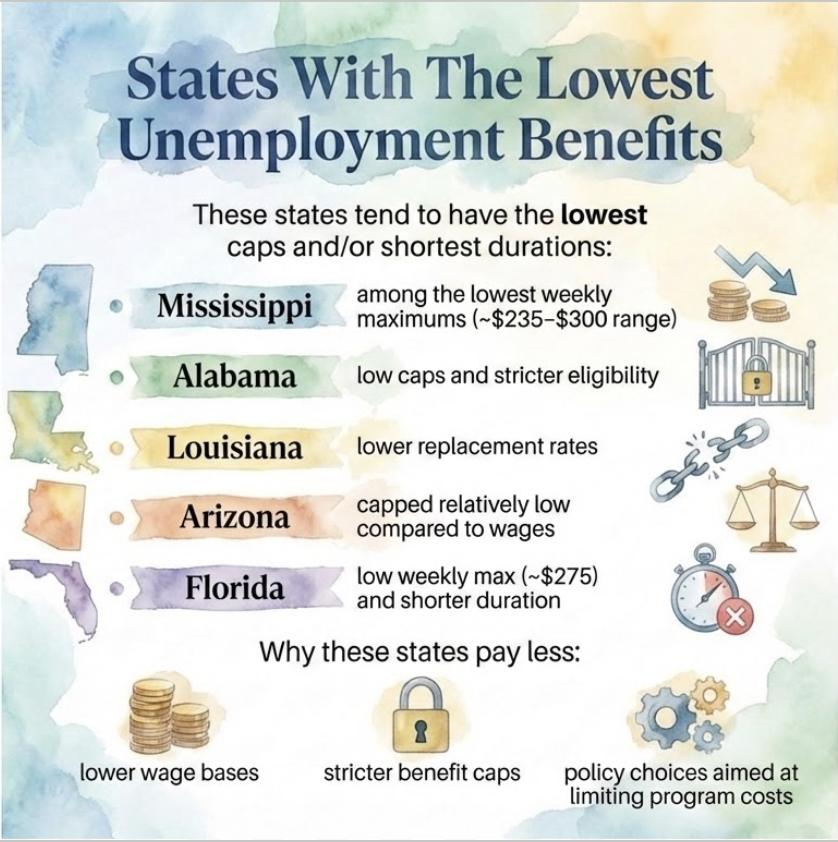
Most states offer up to 26 weeks of unemployment benefits, but that’s not universal anymore. Some states have reduced durations, offering:
- as few as 12 to 20 weeks in certain cases
- variable durations tied to unemployment rates
During periods of high unemployment, extended benefits may kick in, but these are not guaranteed and often require federal or state action.
According to CNBC, several states have moved toward shorter benefit periods in recent years, which can leave workers with less time to find new employment.
## Eligibility Requirements To Know
Even qualifying for unemployment benefits can depend heavily on where you live.
Common requirements include:
- earning a minimum amount during a “base period”
- losing your job through no fault of your own
- being actively available and searching for work
However, states differ in how strictly they enforce these rules. Some have:
- stricter job search reporting requirements
- tighter definitions of “suitable work”
- additional verification steps
These differences can affect whether you qualify and how long you continue receiving benefits.
## What Unemployment Benefits Pay For
Unemployment benefits are designed to cover basic living expenses while you search for work.
They can help pay for:
- rent or mortgage payments
- groceries and essential household items
- utilities like electricity and water
- transportation costs related to job searching
However, because benefits often replace only a portion of your income, many households still need to adjust spending or seek additional support programs.
## How To Apply For Unemployment Benefits
Applying is done through your state’s unemployment office, usually online.
Here’s a general step-by-step (but we've got a full "how to sign up for unemployment" article ready with more detail):
- file a claim with your state’s UI agency
- provide employment history and income details
- verify your identity and job separation reason
- certify weekly (or biweekly) that you’re still eligible
- report job search activities if required
Processing times vary, but many states take 2–4 weeks to issue the first payment (longer if there are verification issues).
## How Unemployment Benefits Compare To Other Programs
Unemployment insurance is different from other support programs like:
- Supplemental Nutrition Assistance Program (SNAP), which helps with food costs
- Temporary Assistance for Needy Families (TANF), which provides limited cash aid for low-income families
Unlike these programs, unemployment benefits are:
- based on your work history
- temporary by design
- tied to active job searching
Many people use unemployment benefits alongside these programs to cover gaps.
## What To Do If Your Benefits Run Out Or Are Denied
If your benefits are denied:
- you can usually file an appeal through your state agency
- you may need to provide additional documentation or attend a hearing
If your benefits run out:
- check for extended benefits in your state
- explore other assistance programs like SNAP or housing support
- consider workforce training programs that may offer stipends
Understanding your options early can help prevent financial stress later.
## The Bottom Line
Unemployment benefits can be a lifeline, but they’re not one-size-fits-all. The CNBC report makes it clear: your state plays a major role in how much help you receive and how long it lasts.
If you’re working, it’s worth understanding your state’s rules before you ever need them. And if you’re currently unemployed, knowing the specifics can help you plan your next steps with more confidence.
For more clear, practical breakdowns of benefits like unemployment insurance, stay connected with BenefitKarma.
---
type: article
title: LIHEAP on the Chopping Block in Proposed 2027 Budget
url: https://benefitkarma.com/articles/benefits-in-the-news/liheap-cuts-set-for-2027-budget
updated: 2026-07-01
---
# LIHEAP on the Chopping Block in Proposed 2027 Budget
Millions of Americans rely on help to keep the lights on, the heat running, and their homes safe during extreme weather. But a new federal budget proposal could change that.
The fiscal year 2027 budget put forward by President Donald Trump calls for eliminating funding for the Low-Income Home Energy Assistance Program (LIHEAP) — a long-standing program that helps low-income households pay their energy bills.
If approved by Congress, this change could leave many families scrambling to cover essential utility costs.
So what exactly is LIHEAP, who depends on it, and what can you do if these changes move forward? Here’s what to know.
BenefitKarma keeps you up-to-date on major benefit changes like this so you can plan ahead and protect your household.
## What is LIHEAP and why it matters
The Low-Income Home Energy Assistance Program (LIHEAP) is a federally funded program that helps eligible households manage home energy costs.
It supports both heating and cooling needs, which is especially important in areas with extreme winters or summers.
We go into detail about how this program works, and what it helps pay for in our LIHEAP article.
### What LIHEAP helps pay for
- Monthly heating and cooling bills
- Emergency energy assistance (like preventing shutoffs)
- Crisis situations (such as no heat in winter)
- Minor home energy upgrades (like weatherization improvements)
For many households, LIHEAP isn’t just helpful—it’s essential for health and safety.
## Why the program is at risk
Try it: Find Benefits — Explore the full benefits library.
The proposed budget eliminates LIHEAP as part of broader efforts to reprioritize federal spending.
The program is currently administered by the U.S. Department of Health and Human Services (HHS), which distributes funds to states. Those states then run their own LIHEAP programs based on federal guidelines.
If funding is removed:
- States would lose federal support for energy assistance
- Many existing programs would shrink—or disappear entirely
- Households would need to find alternative help quickly
This would mark a major shift away from decades of federal support for basic utility needs.
## How many people could be affected
The numbers help show just how large this impact could be.
- 6.1 million households received LIHEAP benefits in 2026
- The average benefit was about $401 per household
- Only about 20% of eligible households currently receive help
That last point is critical.
Even with funding, most eligible households already don’t receive assistance due to limited resources. If LIHEAP is eliminated:
- That 20% drops to 0%
- Millions of households lose direct support
- Many more who might qualify in the future lose access entirely
## What losing LIHEAP could mean for households
### 1. Higher energy costs out of pocket
Without LIHEAP, households would need to cover full utility bills—often during the most expensive seasons.
### 2. Increased risk of shutoffs
Emergency assistance helps prevent electricity or heating disconnections. Without it, more families could face utility shutoffs, especially in winter or heat waves.
### 3. Health and safety risks
Energy isn’t just a convenience—it’s tied to:
- Safe indoor temperatures
- Medical equipment (like oxygen machines)
- Food storage (refrigeration)
Losing assistance could increase health risks for seniors, children, and people with disabilities.
Households may be forced to choose between paying utility bills, buying groceries, or covering rent or medication.
## What you should do right now
If you currently receive LIHEAP (or think you might qualify), here are steps you can take to prepare:
### 1. Stay informed on the budget process
This proposal is not final yet. Congress must review and approve the budget before changes take effect.
### 2. Look into local assistance programs
Even if federal funding changes, some support may still exist through:
- State or county programs
- Utility company assistance plans
- Local nonprofits and charities
Search for:
- “energy assistance near me”
- “utility bill help [your state]”
### 3. Contact your representatives
You can share your perspective with elected officials. Budget decisions can change, and public input can matter.
### 4. Reduce energy costs where possible
Consider:
- Weatherproofing your home
- Using energy-efficient appliances
- Asking your utility provider about budget billing plans
### 5. Apply while funding is still available
If LIHEAP is still active in your area, applying now could help you secure assistance before any changes happen.
## How this compares to other benefit programs
Unlike programs such as food assistance or healthcare, LIHEAP is:
- Discretionary funding (not guaranteed year to year)
- Distributed through state-run systems
- Often limited by available federal budgets
That’s why only a portion of eligible households receive help — and why proposals like this can have such a large impact.
## The bottom line
The proposed elimination of LIHEAP would remove a critical source of support for millions of low-income households struggling with energy costs.
While the budget is still under review, the potential impact is significant—especially for those already facing tight financial situations.
If this change moves forward, households will need to rely more heavily on local programs, nonprofits, and personal budgeting strategies to cover essential energy needs.
Staying informed is your best defense. BenefitKarma will continue tracking this proposal and other major benefit changes so you always know what’s coming and how to respond.
---
type: article
title: Why Social Security Fairness Act Payments are Taking Longer than Expected
url: https://benefitkarma.com/articles/income-employment/extension-for-fairness-act-payouts
updated: 2026-07-01
---
# Why Social Security Fairness Act Payments are Taking Longer than Expected
Televised Senate hearings don’t usually make headlines, but when they involve Social Security benefits, people pay attention.
That’s exactly what happened when several senators called for more time to complete retroactive payments under the Social Security Fairness Act. For many retirees, this raised an immediate concern: Are benefits being delayed again?
The short answer is yes, there are delays. But there’s also context, and importantly, there’s still progress being made.
If you’re affected, understanding what’s happening (and what to expect next) can help you stay prepared and not panicked.
BenefitKarma tracks changes like this so you can stay informed about the benefits that matter most to you.
## What the Social Security Fairness Act actually does
The Social Security Fairness Act was designed to fix a long-standing issue affecting public servants.
It repeals two major provisions:
### Government Pension Offset (GPO)
The Government Pension Offset reduced Social Security spousal or survivor benefits for people who also received a government pension.
### Windfall Elimination Provision (WEP)
The Windfall Elimination Provision reduced Social Security retirement benefits for workers who earned pensions from jobs not covered by Social Security.
### Who this affects
- Teachers
- Firefighters
- Police officers
- Other public sector workers
For years, these rules reduced benefits, even for people who paid into Social Security through other jobs.
The Fairness Act removes those reductions, allowing retirees to receive full benefits moving forward, plus retroactive payments for past underpayments.
## Why retroactive payments are delayed
Try it: Find Benefits — Explore income, employment and tax benefits available to you.
Fixing the problem is one thing; recalculating millions of benefits is another.
The Social Security Administration (SSA) has to:
- Recalculate benefits without WEP and GPO reductions
- Review individual work histories
- Adjust past payment records
- Issue retroactive payments
### The biggest issue: manual processing
Many of these cases require manual review, not automated updates.
That means:
- Each file may need individual attention
- Older records must be verified
- Complex benefit histories must be recalculated
This has created a backlog that’s larger (and slower-moving) than expected.
## Where things stand right now (April 2026)
The implementation of the Social Security Fairness Act is nearly complete, but a small percentage of cases remain in limbo.
Most payments are done: The SSA successfully automated the vast majority of recalculations in early 2025. By July 2025, over 3.1 million beneficiaries had already received their adjusted payments.
The Retroactive Window: The law was retroactive to January 2024. This means most eligible retirees received a large lump-sum payment in the spring of 2025 to cover the "back-pay" for all of 2024 and early 2025.
Current Delays: While the "March 2024" hurdles are long gone, the SSA is currently working through the final 5% of complex cases. These involve:
- Retirees with foreign pensions.
- Records requiring manual verification of earnings from the 1970s or 80s.
- New applicants who are currently fighting for the full 12 months of retroactivity (some are only being offered 6 months due to technicalities in the Social Security Act).
## What this means for your benefits in 2026
If you are eligible under the Fairness Act but haven't seen a change yet, here is the current reality:
- You are still entitled to the money: The law is permanent. If WEP or GPO reduced your check in the past, those reductions stopped being legal as of January 2024.
- Retroactive payments are still being issued: For the "complex" backlog, the SSA is still issuing lump sums throughout 2026.
- The "Six-Month" Dispute: There is currently a push by lawmakers (as of February 2026) to ensure that new applicants get the full year of retroactive pay back to Jan 2024, as the SSA has been limiting some new claims to only 6 months of back-pay.
## What you should do right now
Because we are now more than a year past the bill becoming law, "waiting and seeing" is no longer the best strategy.
- Review your 2025 Tax Forms: Your 1099 form received in January 2026 should reflect any retroactive lump sums paid out last year. If it doesn't, and your monthly check hasn't increased, your file may be stuck in manual review.
- File for Reconsideration: If you applied recently and were denied the full retroactive pay back to January 2024, advocates recommend filing Form SSA-561 (Request for Reconsideration) to protect your rights while Congress clarifies the timing rules.
- Verify your "Non-Covered" Pension: Ensure the SSA has the correct details of your government pension on file, as errors here are the leading cause of manual processing delays in 2026.
## How this compares to previous Social Security changes
Most Social Security updates are applied automatically. This situation is different.
Why?
- WEP and GPO changes affect millions of individual records
- Many cases involve decades-old earnings histories
- Systems were not built for this kind of large-scale recalculation
That’s why this rollout is slower than typical benefit adjustments.
## The bottom line
The delays tied to the Social Security Fairness Act are frustrating, but they don’t change the outcome.
Public servants affected by WEP and GPO are still set to receive the benefits they were previously denied. The process is just taking longer than expected due to the scale and complexity of recalculating payments.
Lawmakers are now stepping in to extend the timeline, which could help ensure that payments are processed correctly, even if it takes more time.
If you’re waiting, the most important thing to know is this: the benefits are still coming.
BenefitKarma will continue tracking updates to the Fairness Act and other major programs so you always know what’s happening and what to do next.
---
type: article
title: Stalled Heating Help: Senators Fight to Unlock $400M in Energy Funds
url: https://benefitkarma.com/articles/benefits-by-state/stalled-heating-help-40-senators-fight-to-unlock-400m-in-federal-energy-funds
updated: 2026-07-01
---
# Stalled Heating Help: Senators Fight to Unlock $400M in Energy Funds
Millions of families who rely on federal energy assistance are waiting on roughly $400 million in heating and cooling funds that the Trump administration has yet to release — and a bipartisan group of senators is demanding action now.
If you rely on government benefits to cover your household costs, BenefitKarma is a trusted source for clear, up-to-date information on programs like this one.
## What is LIHEAP and why does it matter?
The Low Income Home Energy Assistance Program, or LIHEAP, is a federal program that helps low-income households pay their heating and cooling bills. Congress created LIHEAP in 1981, and it has grown into one of the most widely supported programs in the federal safety net, delivering assistance to nearly six million households nationwide each year.
The program specifically targets households with members who are especially vulnerable to extreme temperatures — including people with disabilities, families with young children, and elderly residents, who are physiologically less able to regulate their body temperature.
In the midst of economic hardships, many recipients are also on the edge of a utility shutoff or already disconnected when they apply, making timely funding a matter of health and safety.
According to the National Energy Assistance Directors Association, the total amount owed across those households is approximately $21 billion — the highest level since 2021 and up roughly 30 percent since the end of 2023.
## What is happening with the $400 million?
Try it: Find Benefits — See benefits available in your state.
For fiscal year 2026, Congress appropriated $4.045 billion for LIHEAP — a $20 million increase over the previous year. On November 28, 2025, HHS released approximately $3.7 billion of that amount to states. The remaining roughly $400 million has not yet been distributed.
On March 12, 2026, a bipartisan group of 40 U.S. senators sent a letter to HHS Secretary Robert F. Kennedy Jr. urging the immediate release of the remaining funds. The letter was led by Senators Jack Reed (D-RI), Susan Collins (R-ME), and Lisa Murkowski (R-AK), a notably bipartisan trio that reflects how broadly supported LIHEAP has historically been in Congress.
In their letter, the senators warned that any delay would set back states' efforts to cover outstanding bills from energy emergencies, weatherize low-income homes, and plan for summer cooling programs. Home heating costs are expected to run 11 percent higher this coming winter compared to last year, intensifying the urgency.
The timing matters because this is not the first standoff over LIHEAP funds under the current administration.
- In April 2025, the Trump administration fired the entire LIHEAP program staff at HHS.
- On April 30, 2025, following sustained congressional pressure, HHS released $401.5 million in remaining FY2025 LIHEAP funds.
- As of May 1, 2025, states were able to draw down on their grants.
- The pattern — congressional pressure followed by eventual release — is now repeating with FY2026 funds.
## The bigger threat to LIHEAP
Beyond the immediate funding delay, there is a larger fight underway. The Trump administration has proposed eliminating LIHEAP entirely in its fiscal year 2026 budget, and federal LIHEAP staff who were fired in April 2025 have not been rehired, leaving states to run their programs with no federal training or guidance.
The White House has described LIHEAP as "unnecessary," arguing that the administration's energy policies will lower prices enough to make the program redundant. Budget experts and program administrators have pushed back sharply, noting that Congress controls appropriations and has funded LIHEAP at no less than $3 billion annually since 2009.
For now, Congress has continued to appropriate money for the program. Whether HHS releases those funds promptly — and how the program is administered without dedicated federal staff — remains an open question.
## What should you do?
If you receive LIHEAP assistance or think you might qualify, here are practical steps you can take right now.
Contact your state or local LIHEAP agency directly. States received the bulk of FY2026 funds in late November 2025 and may already be distributing benefits in your area. To find your state's program, visit the U.S. Department of Energy LIHEAP State Map of Contacts at energy.gov.
Check whether you are eligible. LIHEAP applications are currently open for all income-eligible households, with eligibility based on income, family size, and the availability of resources. Seniors and those receiving Social Security Disability or SSI benefits are encouraged to apply as early as possible, but applications are open to everyone through spring 2026 or until funding is exhausted.
Also contact your utility provider. Many electric and gas companies offer their own low-income assistance programs, budget billing options, or hardship funds that can help bridge the gap while you wait on federal or state aid.
Keep your paperwork organized. When funds are released and your state agency begins processing applications, having your utility bills, income documentation, and household information ready will help you get assistance faster.
## The bottom line
Nearly six million households depend on LIHEAP to avoid making impossible choices between paying energy bills and covering food, medical care, or other essentials. The $400 million still sitting with HHS is congressionally approved money that states say they are ready to deploy immediately.
With 40 senators pushing for release and a pattern from 2025 showing that congressional pressure has moved the administration before, there is reason to expect the funds will eventually reach families.
But with no dedicated federal staff and an administration that has proposed ending the program altogether, the situation bears close watching. BenefitKarma will continue tracking this as it develops.
---
type: article
title: Is Section 8 Mandatory? New Court Ruling Explained
url: https://benefitkarma.com/articles/benefits-in-the-news/is-section-8-mandatory-court-ruling
updated: 2026-07-01
---
# Is Section 8 Mandatory? New Court Ruling Explained
A landmark court ruling is shaking up the rules around Section 8 housing — and if you're a landlord or a tenant who relies on housing vouchers, you need to know what changed.
On March 5, 2026, New York's Appellate Division issued a unanimous decision declaring that the New York State Human Rights Law violates the Fourth Amendment to the extent it forces landlords to participate in the federal Housing Choice Voucher (HCV) program, commonly known as Section 8.
It is the first time any appellate court in the country has struck down a "source of income" anti-discrimination law on constitutional grounds. Legal experts expect the ruling to ripple far beyond New York, potentially affecting similar laws in at least 19 states and more than 130 municipalities nationwide.
If you want to stay on top of changes like this across major benefits programs, BenefitKarma is a trusted source for clear, up-to-date information.
## What is Section 8 and why does this matter?
Section 8, formally known as the Housing Choice Voucher program, was created under the Housing Act of 1937. The program helps low-income families afford safe housing in the private rental market by subsidizing a portion of their rent.
Today, roughly 5 million people in 2.2 million low-income households receive HCV assistance, backed by approximately $18.9 billion in annual federal funding.
In recent years, many states and cities — including New York — passed "source of income" (SOI) laws making it illegal for landlords to refuse tenants simply because they pay with a housing voucher. The intent was to prevent voucher holders from being shut out of neighborhoods and to expand access to affordable housing.
The March 5 ruling says that approach goes too far. The Appellate Division held that compelling a private landlord to participate in a federal inspection program — as Section 8 requires — forces them to waive Fourth Amendment protections against warrantless searches.
The court found that because Section 8 regulations do not include a mechanism for inspectors to obtain a warrant if a landlord refuses entry, mandating participation in the program is unconstitutional.
## What led to this ruling?
Try it: Find Benefits — Explore the full benefits library.
The legal groundwork was laid over several years. In June 2023, a trial court in Tompkins County, New York, dismissed an Attorney General enforcement action against a landlord who declined to participate in Section 8. That court ruled in favor of the landlord on Fourth Amendment grounds in People v. Commons West, LLC. A second decision in December 2024 reaffirmed that the Human Rights Law was "facially unconstitutional" on the same basis. The Appellate Division's March 5, 2026 ruling made those conclusions binding statewide.
A separate but related case in Missouri reinforced the trend. In February 2025, a federal court reached a similar conclusion regarding a Kansas City ordinance — though Missouri subsequently passed a state law that made the city ordinance moot before the case could proceed further.
## What does this mean for landlords?
In New York, landlords can no longer face legal penalties for declining to participate in Section 8 solely because of the program's inspection requirements. The New York State Division of Human Rights is currently reviewing how the ruling affects pending source-of-income cases.
If you are a landlord in New York or another state with similar SOI laws, it is critical to understand that this ruling applies specifically to New York State at this stage and may be further appealed to the New York State Court of Appeals. Laws in other states have not been formally struck down — yet. The ruling may prompt legal challenges in other jurisdictions, but each state's situation will depend on its own laws and court proceedings.
## What does this mean for tenants?
For the approximately 5 million Americans who rely on housing vouchers, this ruling raises real concerns. If landlords in New York — and potentially other states — are no longer legally required to accept vouchers, finding willing landlords could become harder.
It is worth noting that many landlords do choose to participate in Section 8 voluntarily, and nothing in this ruling prevents them from continuing to do so. Federal HCV funding has not changed as a result of this ruling. However, in a tight housing market, reduced landlord participation could mean fewer housing options for voucher holders.
If you receive Section 8 assistance, reaching out to your local Public Housing Authority (PHA) is the best first step. Your PHA can explain how this may affect your current voucher, what rights you retain, and what resources are available if you need help finding a participating landlord. Make sure your contact information on file with your PHA is current so you receive any updates directly.
## The bottom line
The March 5, 2026 Appellate Division ruling is the first of its kind at the appellate level in the United States, and it carries real consequences for how source-of-income protections are enforced going forward. For landlords in New York, it removes a legal obligation that many argued infringed on their property rights. For tenants with housing vouchers, it adds uncertainty to an already difficult housing landscape.
This case is likely to be appealed further, and similar legal challenges are expected in other states. BenefitKarma will continue tracking developments as they unfold.
---
type: article
title: How IRMAA Made Your Social Security Increase Look Smaller
url: https://benefitkarma.com/articles/income-employment/social-security-irmaa
updated: 2026-07-01
---
# How IRMAA Made Your Social Security Increase Look Smaller
If you received your first Social Security check of 2026 and thought the cost-of-living increase looked smaller than advertised, you are not imagining it.
For a significant number of retirees — especially those with higher incomes — Medicare surcharges called IRMAA are quietly eating into that increase before it ever reaches their bank account.
If you want to stay on top of changes like this across major benefits programs, BenefitKarma is a trusted resource for clear, up-to-date information.
## What is IRMAA?
IRMAA stands for Income-Related Monthly Adjustment Amount. It is an additional charge that higher-income Medicare beneficiaries pay on top of their standard Part B and Part D (prescription drug) premiums.
The Social Security Administration determines your IRMAA based on your Modified Adjusted Gross Income (MAGI) from two years prior, which means your 2024 tax return is what determines whether you owe a surcharge in 2026.
According to Medicare Resources, about 5.1 million Medicare beneficiaries — roughly 7% of all enrollees — paid Part B IRMAA surcharges in 2025. It is not a charge most people will face, but for those who do, it can significantly reduce the net value of any Social Security increase.
## Why is this a problem right now?
Try it: Find Benefits — Explore income, employment and tax benefits available to you.
Social Security's 2026 cost-of-living adjustment came in at 2.8%. On paper, that sounds like a meaningful raise. In practice, it is being undercut from two directions at once.
First, the standard Medicare Part B premium. The 2026 standard premium is $202.90 per month, up $17.90 from $185.00 in 2025 — the first time Part B has crossed $200. For the average retiree receiving $2,071 per month in Social Security, Medicare Part B now consumes 9.8% of their check before any supplemental coverage. Research from the Boston College Center for Retirement Research found that Medicare premiums eat more than 25% of the 2026 COLA increase.
Second, for those subject to IRMAA, the situation is more severe. A retiree in the second IRMAA bracket pays $284.10 per month for Part B alone — nearly $100 more than the standard premium.
A 2.8% COLA cannot meaningfully offset that burden, especially since IRMAA thresholds are based on income from two years prior, meaning a retiree who had a high-income year in 2024 is paying elevated premiums today even if their financial situation has since changed.
> READ: Social Security COLA 2027 Could Be Smaller Than Many Retirees Hoped
>
>
## Who gets hit with IRMAA in 2026?
For 2026, the IRMAA income brackets and surcharges increased by approximately 3% and 9%, respectively. The 2026 IRMAA thresholds are $109,000 for a single person and $218,000 for a married couple filing jointly.
IRMAA is calculated on a sliding scale with five income brackets, topping out at $500,000 for individual filers and $750,000 for married couples filing jointly. For those subject to IRMAA, total monthly Part B premiums range from $284.10 to $689.90. Part D surcharges range from $14.50 to $91.00 per month.
One thing that catches retirees off guard is the "cliff" nature of these brackets. If your income crosses into the next bracket by even one dollar, your Medicare premiums can jump by over $1,000 per year. If you are married and both spouses are on Medicare, that same $1 increase can trigger a jump of over $1,000 per year for each of you.
It is also worth knowing that IRMAA can be triggered by one-time income events — not just a permanently higher salary. A large Roth conversion, a business sale, or a required minimum distribution in a single year can push premiums higher for two years running.
## What can you do?
If you received an IRMAA notice and believe it is based on income that no longer reflects your situation, you have options.
You have 60 days from receiving an IRMAA notice to file an appeal with the Social Security Administration. Common reasons to appeal include incorrect or outdated tax information or a life-changing event such as loss of income, death of a spouse, marriage, or divorce.
To start the process, contact the SSA at 800-772-1213 (TTY: 800-325-0778), Monday through Friday, 8 a.m. to 7 p.m.
You can also complete the Medicare IRMAA Life-Changing Event form (SSA-44) directly through the SSA.
If you are still working or have flexibility in your income, there are planning strategies worth exploring with a financial advisor — things like timing Roth conversions, increasing contributions to tax-deferred accounts, or making qualified charitable distributions directly from an IRA if you are 70½ or older.
These approaches can help lower your MAGI and potentially keep you below an IRMAA threshold. BenefitKarma is not a financial advisor, and decisions like these deserve personalized guidance.
## The bottom line
IRMAA is not a penalty; it is a built-in feature of Medicare designed to have higher-income beneficiaries pay a larger share of program costs. But the combination of a modest 2.8% COLA, a Part B premium that crossed $200 for the first time in 2026, and IRMAA surcharges based on income from two years ago can leave retirees feeling like their raise disappeared before they saw it.
Understanding the rules — and knowing that appeals are available when your income has genuinely changed — puts you in a better position to manage what you actually take home.
---
type: article
title: Tax Refund Season 2026 Looks to Be a Big One: Here's Why
url: https://benefitkarma.com/articles/benefits-in-the-news/tax-refund-season-2026
updated: 2026-07-01
---
# Tax Refund Season 2026 Looks to Be a Big One: Here's Why
Tax refund season is officially underway, and early data suggests many filers could see larger checks this year.
According to the Internal Revenue Service (IRS), average refunds in early February were running about 11% higher than the same time last year — around $2,290 as of early filing data — though those numbers shift as more returns are processed.
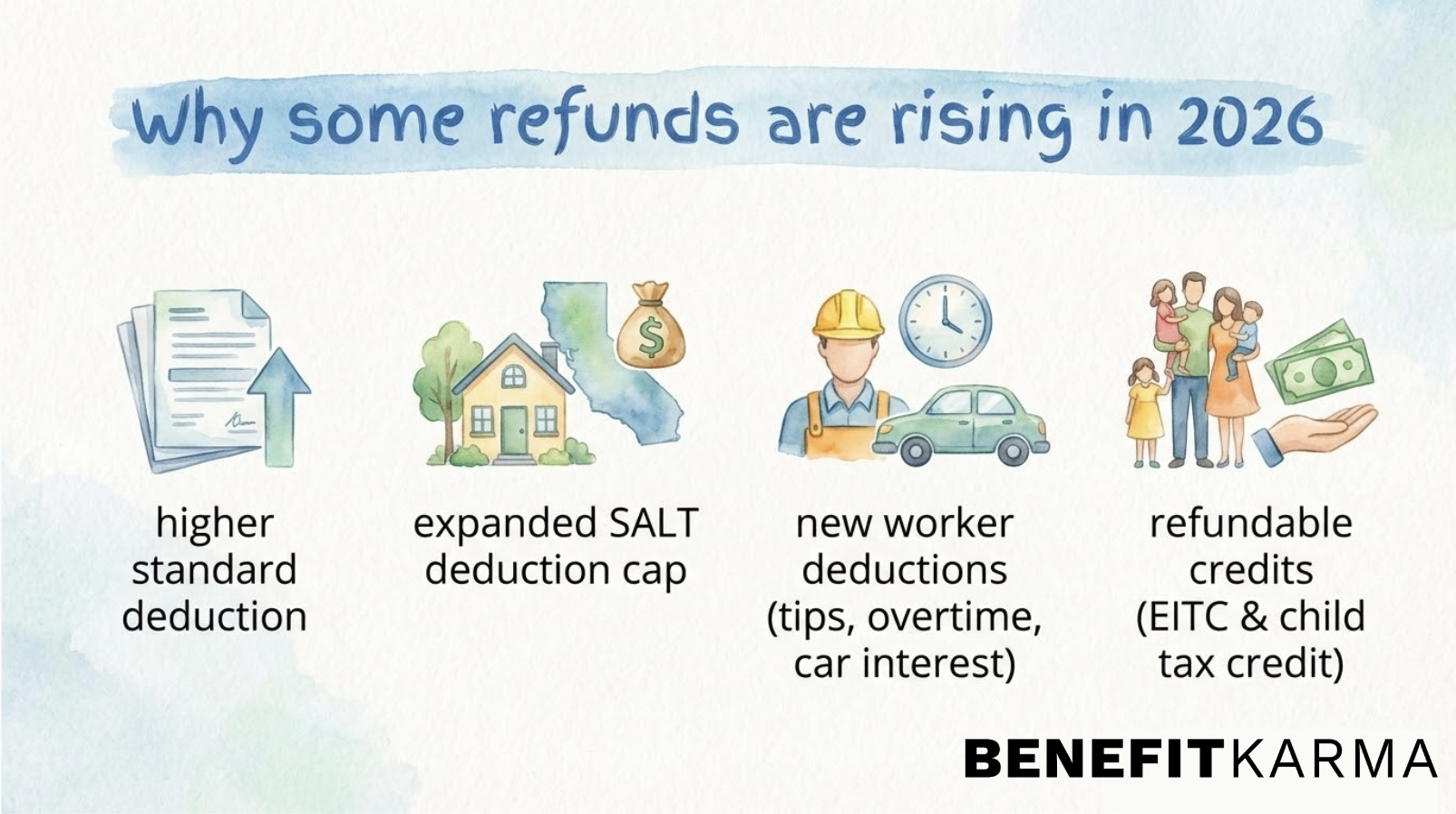
What’s driving the increase? A combination of updated federal tax provisions, higher standard deductions, and refundable tax credits like the Earned Income Tax Credit (EITC) and the Additional Child Tax Credit. Together, these changes are reshaping what many households can expect back.
Tax law updates can feel overwhelming. That’s where we come in. At BenefitKarma, we track changes across government programs and break them down into simple, practical steps so you can file with confidence — and keep more of what you earn.
## Why are refunds higher this year?
Refunds increase when one of three things happens:
- You paid more in taxes than you owed
- You qualify for new or larger deductions
- You qualify for refundable tax credits
Several recent federal updates are influencing 2026 refunds:
### 1. Higher standard deductions
The standard deduction reduces the amount of income the government can tax. If you take the standard deduction (instead of itemizing), your taxable income drops automatically.
For 2026 filing season, standard deduction amounts have increased:
- Single filers: $15,750
- Married filing jointly: $31,500
- Head of household: $23,625
A higher standard deduction means more income is shielded from taxes — which can increase your refund if too much was withheld from your paycheck during the year.
### 2. Expanded SALT deduction cap
The State and Local Tax (SALT) deduction cap has increased from $10,000 to $40,000 for eligible filers. This matters most for people in higher-tax states like California, New York, and New Jersey.
If you itemize and paid:
- State income taxes
- Property taxes
- Local taxes
You may now be able to deduct more than in previous years. That reduces your taxable income — which can increase your refund or lower what you owe.
### 3. New deductions for certain workers
Recent federal tax updates also introduced or expanded deductions tied to:
- Qualified tips (up to annual limits)
- Certain overtime earnings
- Eligible car loan interest
- Additional deductions for people age 65 or older
A tax deduction lowers your taxable income. Less taxable income = less tax owed.
### 4. Refundable tax credits still matter most for working families
For low- and moderate-income households, refundable credits often have the biggest impact.
The Earned Income Tax Credit (EITC) is a refundable credit for working individuals and families with low to moderate income. “Refundable” means you can receive money back even if you owe little or no federal income tax.
The Additional Child Tax Credit works similarly for families with qualifying children.
These credits can add thousands of dollars to a refund, depending on income and family size.
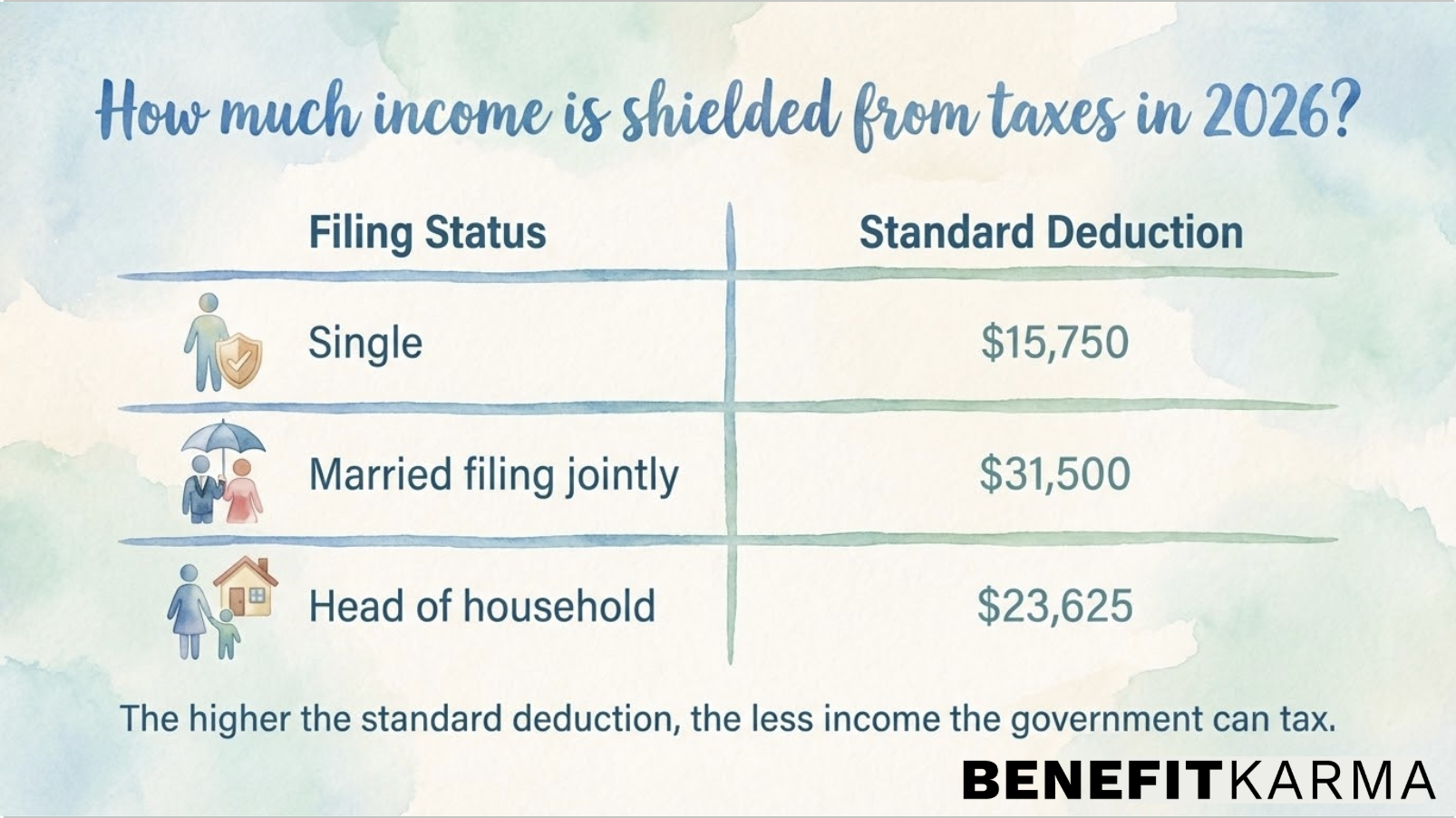
## What do the early IRS numbers show?
Try it: Find Benefits — Explore the full benefits library.
Last year, the IRS processed over 165 million individual returns, and about 94% were filed electronically.
Early 2026 filing data shows:
- Roughly 22.4 million returns received in the first 2+ weeks of filing
- Average refunds up about 11% compared to early last year
- Electronic filers typically receiving refunds within 21 days
Keep in mind: Early averages can fluctuate as more high-income and complex returns are filed later in the season.
## Should you itemize or take the Standard Deduction?
Most taxpayers take the Standard Deduction. But you may benefit from itemizing if your total deductions exceed the standard amount.
Ask yourself:
- Did you pay significant mortgage interest?
- Did you pay high state or property taxes?
- Did you make charitable contributions?
- Did you have major medical expenses?
If those total more than your standard deduction, itemizing may increase your refund.
## How to make sure you get the biggest refund you qualify for
Here’s a simple checklist:
- Review your W-2 and 1099 forms carefully: Make sure income and withholding match your records.
- Double-check eligibility for EITC and child credits: Many eligible families miss these every year.
- Compare standard deduction vs. itemizing: Run both scenarios if you’re unsure.
- File electronically: The IRS processes e-filed returns much faster.
- Consider professional help if your situation changed: Marriage, divorce, a new child, a home purchase, self-employment, or retirement can all affect your return.
## A quick reality check about refunds
A bigger refund feels good — but remember what it means.
A tax refund is money you overpaid during the year. Ideally, you want your withholding to be close to your actual tax liability. A huge refund means you gave the government an interest-free loan.
If you consistently receive very large refunds, you may want to adjust your W-4 withholding so more money stays in your paycheck each month.
## The bottom line
Tax refund season 2026 is shaping up to be stronger for many households thanks to updated deductions, expanded caps, and refundable credits. Early IRS data shows refunds running higher — but your personal outcome depends on your income, family size, deductions, and credits.
The key is knowing what applies to you.
At BenefitKarma, we stay on top of federal benefit updates, tax changes, and credit expansions so you don’t have to decode policy language on your own. Stay informed, file smart, and make sure you claim every dollar you qualify for.
Your refund is waiting — just make sure you’re ready for it.
---
type: article
title: Evicted? Here’s What Government Programs Can Do Next
url: https://benefitkarma.com/articles/housing-essentials/eviction-programs
updated: 2026-07-01
---
# Evicted? Here’s What Government Programs Can Do Next
Eviction is stressful, fast-moving, and often overwhelming. One day you’re trying to catch up on rent — the next, you’re figuring out where to sleep. If you’ve just been evicted (or you’re about to be), you may be wondering: What help is actually out there?
The good news: there are government programs and public housing options designed specifically for people in this situation.
The key is knowing what they are and how to apply quickly. In this guide, we’ll walk through emergency housing, rental help, public housing, and benefits that can help stabilize your income while you regroup.
And if you want updates like this — including housing changes, rental relief programs, and benefit eligibility rules — sign up for BenefitKarma so you don’t miss important information.
## 1. Emergency shelter and rapid rehousing
If you have nowhere to stay, your first stop should be your local Coordinated Entry system. This is the intake system communities use to connect people to emergency shelter or rapid rehousing programs.
Many of these programs are funded through the U.S. Department of Housing and Urban Development (HUD).
Two key options:
- Emergency shelters: Short-term places to stay while you look for permanent housing
- Rapid rehousing: Short-term rental assistance plus case management to help you move into a unit quickly
To find help:
- Call 211 in most states
- Contact your local housing authority
- Search HUD’s “Find Shelter” tool on HUD.gov
Rapid rehousing often pays a security deposit, first month’s rent, and sometimes several months of rent while you regain stability.
## 2. Public housing and Section 8 vouchers
Try it: Benefit Eligibility Screener — Discover housing assistance programs in your area.
Longer-term help may come through:
### Public housing
Managed by local housing authorities, public housing offers apartments at reduced rent based on income (usually 30% of your adjusted income).
### Housing Choice Vouchers (Section 8)
The Housing Choice Voucher Program — often called Section 8 — lets you rent from a private landlord while the government pays part of the rent directly to them.
Important notes:
- Waiting lists can be long.
- Some areas close their lists and reopen them periodically.
- If you’re homeless, you may qualify for a priority category in some locations.
Apply through your local Public Housing Authority (PHA). HUD has a PHA directory online.
## 3. Emergency rental assistance and prevention funds
Even after eviction, you may qualify for:
- Security deposit assistance
- Utility deposit assistance
- Arrears repayment programs
- Local eviction diversion programs
Funding may come from city, county, or state programs — sometimes through Community Action Agencies or nonprofit partners.
Many of these are funded or supported through HUD or state housing departments, so check both your city website and your state housing agency’s website.
If you’re still in the eviction process (not yet removed), eviction diversion programs may be able to stop the eviction by paying back rent directly to the landlord.
## 4. Income support while you recover
Housing is only part of the picture. If eviction happened because income dropped, stabilizing your income is critical.
You may qualify for:
- SNAP (food assistance) through the Supplemental Nutrition Assistance Program
- Medicaid health coverage
- TANF (Temporary Assistance for Needy Families) for cash assistance
- unemployment benefits (if you lost a job)
Lowering food and healthcare costs can free up money for rent and deposits.
Apply through your state’s benefits portal (often the same site handles SNAP, Medicaid, and TANF).
## 5. Special programs for veterans, seniors, and families
Some groups have additional options:
- Veterans may qualify for HUD-VASH (a voucher program tied to VA services) through the U.S. Department of Veterans Affairs
- Seniors may qualify for subsidized senior housing communities
- Families with children may qualify for family shelters or priority placements
If you fall into one of these categories, ask specifically about priority status when applying.
## 6. What about your eviction record?
An eviction judgment can make renting harder — but it doesn’t make it impossible.
Here are practical next steps:
- Request a copy of your tenant screening report
- Ask about sealing or expunging options (if allowed in your state)
- Prepare references and proof of income
- Ask landlords about second-chance rentals
Some nonprofit housing counselors can help you create a “renter packet” explaining the situation and showing stability going forward.
## How to move forward quickly
After eviction, timing matters. Here’s a simple order of action:
- Call 211 or contact Coordinated Entry immediately.
- Apply for SNAP and Medicaid to reduce other expenses.
- Get on every local housing authority waiting list you qualify for.
- Ask about rapid rehousing and deposit assistance.
- Keep documentation of income and any new employment.
It may feel overwhelming — but thousands of people move from eviction to stable housing each year using these exact programs.
## The bottom line
Eviction is serious, but it’s not the end of your options. Government housing programs, emergency assistance, and income supports exist to help people recover and stabilize.
The key is acting quickly and applying broadly.
At BenefitKarma, we break down government programs in plain English and keep you informed about changes that could affect your housing, income, and benefits. If you want practical guides like this — and updates when programs expand or reopen — subscribe and stay in the know.
---
type: article
title: Parent PLUS Borrowers Face Higher Loan Payments
url: https://benefitkarma.com/articles/benefits-in-the-news/parent-plus-borrowers-face-higher-loan-payments
updated: 2026-07-01
---
# Parent PLUS Borrowers Face Higher Loan Payments
Concerned rumblings among consumer advocates point to a tightening cash flow scenario for parents who took out student loans to fund their child’s education. The financial concern centers on major changes to the federal Parent PLUS loan program under the recently passed One Big Beautiful Bill Act.
If parents don’t take action soon, they could lose access to income-driven repayment (IDR) plans and certain loan forgiveness pathways. That means higher monthly payments, longer repayment timelines, and more interest paid over time.
Let’s break down what’s happening, why it matters, and what you can do right now to protect your budget.
## Why are Parent PLUS borrowers at risk?
Under the One Big Beautiful Bill Act, Parent PLUS borrowers are set to lose eligibility for Income-Driven Repayment (IDR) plans beginning in July 2026.
Today, some Parent PLUS borrowers can access IDR plans after consolidating into a Direct Consolidation Loan. IDR plans cap monthly payments based on a percentage of discretionary income and can lead to loan forgiveness after a set number of years.
As of recent federal data from the U.S. Department of Education, roughly 3.6 million Americans hold Parent PLUS loans, with total balances exceeding $116 billion. The average parent borrower owes about $32,000.
For many families, IDR has been the only affordable way to manage those payments — especially for parents nearing retirement.
If IDR access is removed, borrowers will default to more rigid repayment structures that do not adjust based on income. For parents on fixed incomes or approaching retirement, that could mean serious financial strain.
> RELATED: What is the Parent PLUS borrowing program?
>
>
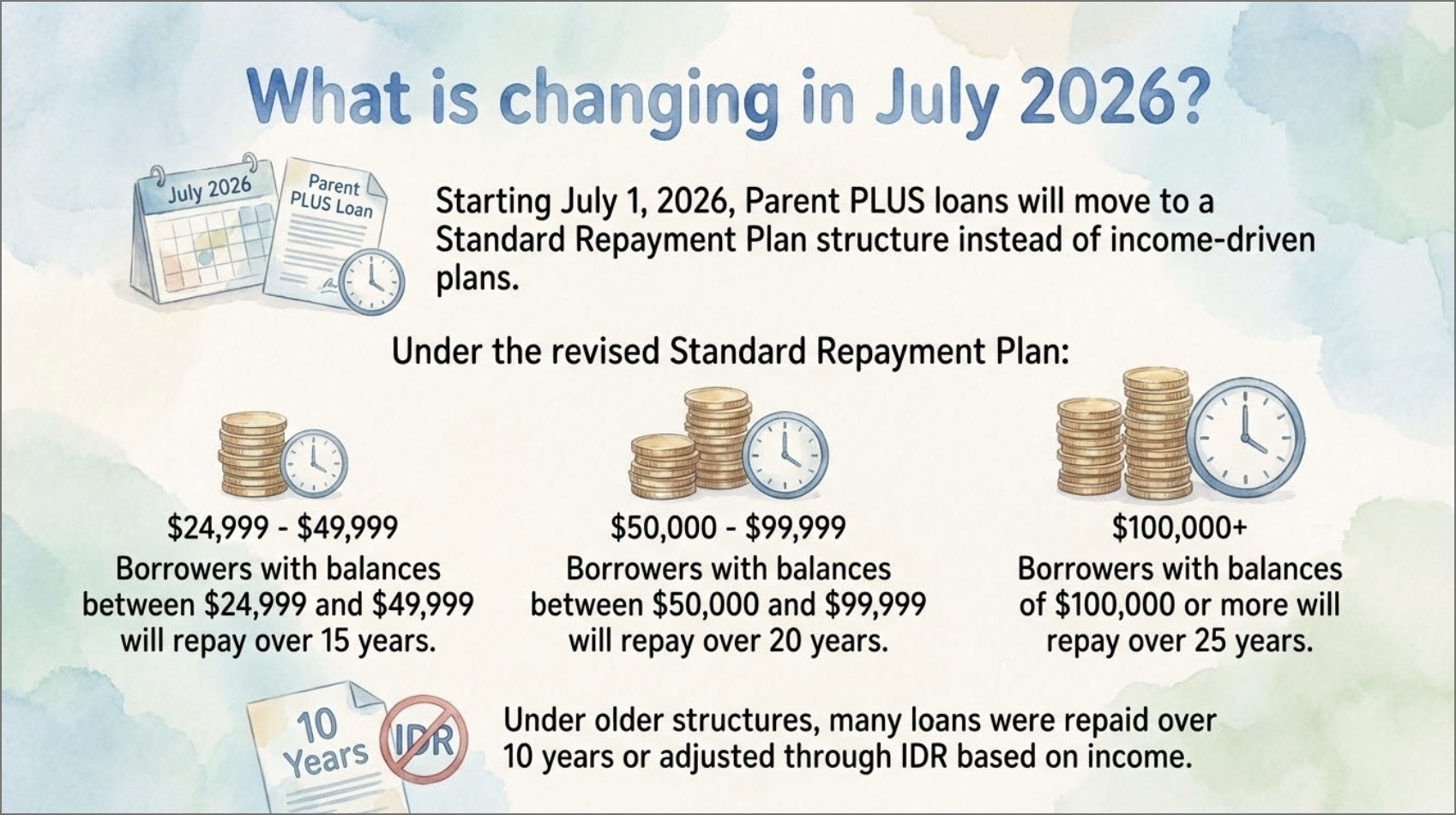
## What is changing in July 2026?
Try it: Find Benefits — Explore the full benefits library.
Starting July 1, 2026, Parent PLUS loans will move to a Standard Repayment Plan structure instead of income-driven plans.
Under the revised Standard Repayment Plan:
- Borrowers with balances between $24,999 and $49,999 will repay over 15 years
- Borrowers with balances between $50,000 and $99,999 will repay over 20 years
- Borrowers with balances of $100,000 or more will repay over 25 years
Under older structures, many loans were repaid over 10 years or adjusted through IDR based on income.
While longer repayment periods can reduce the monthly payment slightly, they significantly increase the total interest paid over time. For example, stretching a $50,000 balance over 20 years instead of 10 can result in thousands of dollars in additional interest.
For parents in their 50s or early 60s, a 20- or 25-year repayment window could extend well into retirement.
## Why this matters for retirement planning
Parent PLUS loans are unique because they are taken out by parents, not students. That means the responsibility remains with the borrower — even if the student struggles financially.
Unlike student borrowers who may be early in their careers, many Parent PLUS borrowers are:
- Within 10–15 years of retirement
- Managing mortgages or healthcare costs
- Helping multiple children with education expenses
A fixed repayment plan that ignores income changes can disrupt long-term financial stability. Social Security income, retirement savings, and medical costs are rarely flexible. A student loan bill is.
Without income-based options, some borrowers may face higher risk of delinquency or default.
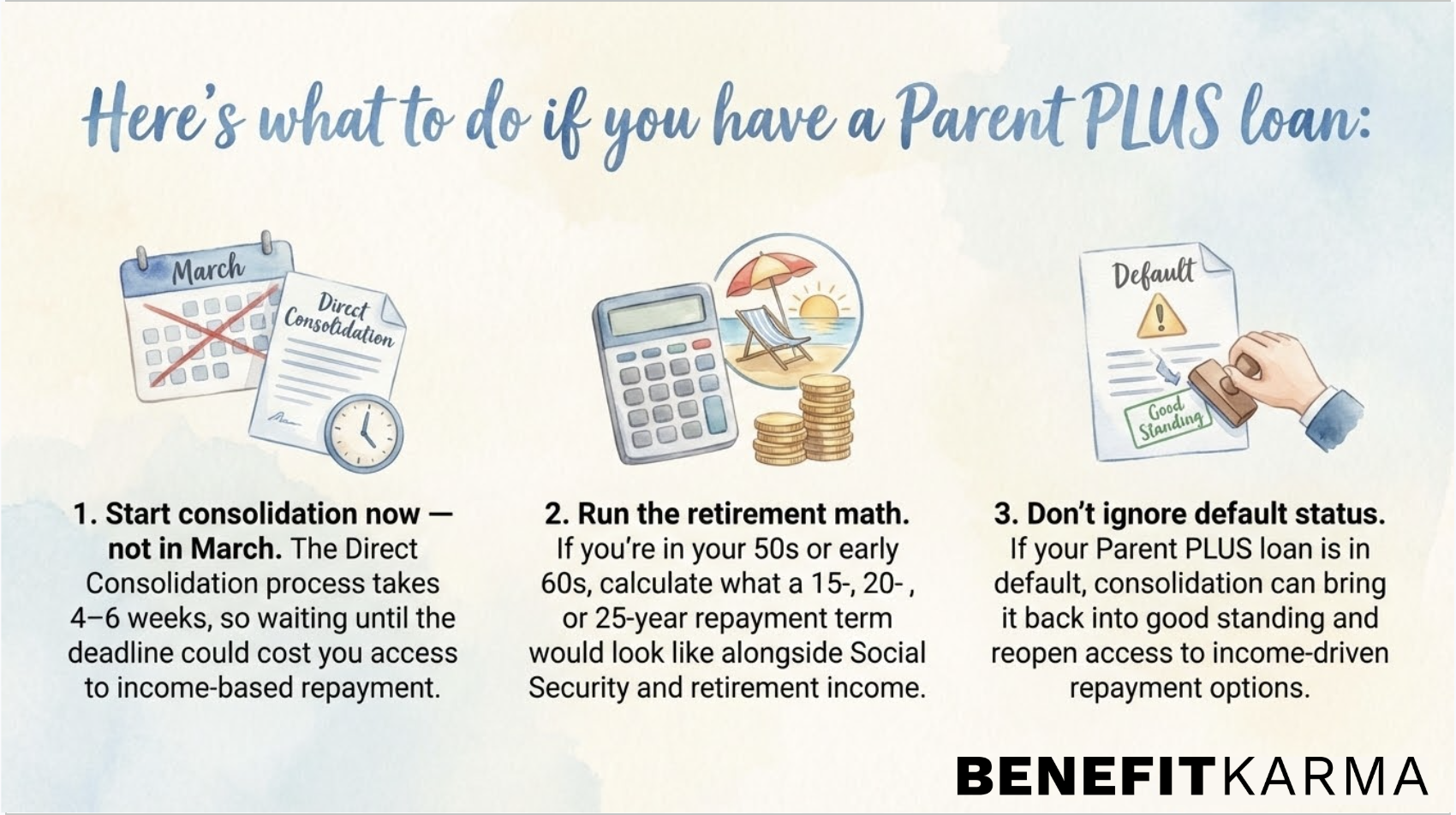
## What can you do before the deadline?
There is still a narrow window to protect your repayment options.
Before the new rules fully take effect, Parent PLUS borrowers can consolidate their loans into a Direct Consolidation Loan. This step is critical for maintaining access to the Income-Contingent Repayment (ICR) plan — currently the only income-driven option available to Parent PLUS borrowers after consolidation.
To preserve these options, borrowers should:
- Apply for Direct Loan consolidation before March 31, 2026
- Enroll in the Income-Contingent Repayment (ICR) plan
- Make at least one qualifying payment under ICR
After meeting these requirements, some borrowers may be able to transition into other income-based options, depending on eligibility rules in place at that time.
The consolidation process typically takes 4-6 weeks, so waiting until the last minute could jeopardize eligibility.
If your loan is already in default, consolidation can also bring it back into good standing and restore access to income-based repayment and forgiveness pathways.
## How consolidation works (in simple terms)
Loan consolidation combines one or more federal student loans into a single new Direct Consolidation Loan.
The benefits may include:
- Access to certain repayment plans
- Simplified billing (one monthly payment)
- Resetting default status
However, consolidation may also capitalize unpaid interest, increasing your total balance. It’s important to review the long-term impact before proceeding.
You can apply through the Federal Student Aid website at StudentAid.gov, the official portal of the U.S. Department of Education.
## Should everyone consolidate?
Not necessarily.
Consolidation makes the most sense for Parent PLUS borrowers who:
- Need lower monthly payments
- Want access to income-driven repayment
- Are pursuing Public Service Loan Forgiveness (PSLF)
- Are currently in default
Borrowers who can comfortably afford their current payments and are close to payoff may not benefit.
Every financial situation is different, which is why acting early — and reviewing your options carefully — matters.
## The bottom line
Policy changes can feel overwhelming, but they also create opportunities for smart planning.
For Parent PLUS borrowers, the upcoming shift away from income-driven repayment could significantly increase monthly obligations and extend repayment well into retirement. With more than $116 billion in Parent PLUS debt nationwide, the stakes are high.
The key takeaway: Act before March 31 if consolidation makes sense for you. Waiting could permanently close the door on more affordable repayment options.
BenefitKarma is here to help you stay informed about changes to federal student loans, Social Security, disability benefits, and other essential programs. When policies shift, knowing your options is the first step toward protecting your financial future.
---
type: article
title: Social Security COLA 2027 Could Be Smaller Than Many Retirees Hoped
url: https://benefitkarma.com/articles/benefits-in-the-news/social-security-cola-2027
updated: 2026-07-01
---
# Social Security COLA 2027 Could Be Smaller Than Many Retirees Hoped
Social Security beneficiaries may need to brace for a lower cost-of-living adjustment (COLA) in 2027. Early projections range from about 2% to just over 3%, depending on the source — far below the 8.7% increase in 2023 and 3.2% in 2024. For the nearly 70 million Americans who rely on Social Security benefits, even a small difference in COLA can significantly affect monthly budgets.
A lower COLA matters because many retirees and people with disabilities depend on Social Security as a primary — and sometimes only — source of income. If benefit increases don’t keep up with real-world costs like food, housing, and healthcare, purchasing power can shrink over time.
At BenefitKarma, we track updates like these so you can stay ahead of changes that affect your income and financial security.
## Why could the 2027 COLA be lower?
Social Security COLAs are based on inflation. Specifically, the Social Security Administration (SSA) uses the Consumer Price Index for Urban Wage Earners and Clerical Workers (CPI-W), calculated by the Bureau of Labor Statistics. The SSA compares third-quarter CPI-W data from one year to the next to determine the annual adjustment.
If inflation slows — as it has compared to the highs of 2022 — COLAs also decline.
The Congressional Budget Office (CBO) recently projected a 3.1% COLA for 2027, followed by around 2.5% in 2028 in its long-term outlook. Meanwhile, advocacy group The Senior Citizens League (TSCL) has projected estimates closer to the high-2% range based on recent CPI-W trends.
Historically, lower COLAs are not unusual during periods of modest inflation. For example, the COLA was just 0.3% in 2017, according to data from the Social Security Administration.
The key issue: even if inflation slows on paper, seniors’ actual expenses — especially healthcare and housing — often rise faster than the CPI-W reflects.
## How much could this affect your monthly check?
Try it: Find Benefits — Explore the full benefits library.
Let’s look at a simple example.
If your monthly Social Security benefit is $1,900:
- A 3.1% COLA would increase your benefit by about $59 per month.
- A 2.5% COLA would raise it by about $47 per month.
- A 2% COLA would mean roughly $38 more per month.
That difference may not seem large, but when groceries, property taxes, rent, Medicare premiums, and prescription drugs continue rising, even a $10–$20 monthly gap can add up.
According to polling cited by The Senior Citizens League, nearly 58% of seniors reported skipping healthcare products or services in the past year due to costs. Additionally, surveys referenced by AARP show that a strong majority of older Americans believe smaller COLAs fail to keep up with real-world expenses.
This highlights a growing concern: many retirees feel the formula does not accurately reflect senior spending patterns, particularly healthcare costs.
## Why some experts say the formula is flawed
The current COLA formula relies on CPI-W — a measure focused on working households. Critics argue that it does not reflect the spending habits of retirees, who typically spend more on:
- Healthcare
- Prescription medications
- Housing
- Utilities
Some lawmakers and advocacy groups have proposed switching to the CPI-E (Consumer Price Index for the Elderly), which is designed to better reflect seniors’ expenses. However, no change has been enacted.
Until Congress changes the law, COLAs will continue to be tied to CPI-W inflation data.
## What you can do now
While the final 2027 COLA will not be announced until October 2026, beneficiaries can take proactive steps:
### 1. Review your monthly budget
Look closely at fixed costs like housing, insurance, and utilities. Identify expenses that have increased fastest.
### 2. Reassess Medicare costs
Premiums for Medicare Part B are often deducted directly from Social Security checks. Monitor announcements from Medicare to understand how premium changes could offset your COLA.
### 3. Explore assistance programs
If rising costs are straining your budget, you may qualify for programs such as:
- Medicare Savings Programs
- Supplemental Nutrition Assistance Program (SNAP)
- Low-Income Home Energy Assistance Program (LIHEAP)
### 4. Consider supplemental income
If possible, part-time work or small side income streams can help bridge shortfalls without fully disrupting retirement plans.
## The bottom line
Social Security COLAs are designed to protect beneficiaries from inflation — but when projected increases hover around 2% to 3%, many retirees may still feel financial pressure. For the roughly 70 million Americans receiving Social Security, even a modestly lower COLA can mean difficult budgeting choices.
The final 2027 COLA will depend on third-quarter 2026 inflation data, but early projections suggest a smaller bump than many beneficiaries experienced in recent years.
Staying informed is one of the best financial planning tools you have. BenefitKarma keeps track of Social Security updates, Medicare changes, and other essential benefits news — so you can plan with clarity, not guesswork.
---
type: article
title: What Is the Parent PLUS Loan Program? What Parents Need to Know Before Borrowing
url: https://benefitkarma.com/articles/family-education/what-is-the-parent-plus-loan-program
updated: 2026-07-01
---
# What Is the Parent PLUS Loan Program? What Parents Need to Know Before Borrowing
Paying for college is one of the biggest financial decisions a family can make. When scholarships, grants, and student loans aren’t enough, many families turn to the federal Parent PLUS loan program to close the gap.
But what exactly is a Parent PLUS loan? How does this education program work? And what are the risks for parents?
If you’re considering borrowing — or already have — here’s what you need to know.
## What is a Parent PLUS loan?
A Parent PLUS loan is a federal student loan that parents can take out to help pay for their child’s college education.
It’s part of the federal Direct Loan Program, managed by the U.S. Department of Education. Unlike other federal student loans, Parent PLUS loans are taken out by the parent — not the student.
That means:
- The parent is legally responsible for repayment
- The debt does not transfer to the student
- The loan appears on the parent’s credit report
Parent PLUS loans are available to parents of dependent undergraduate students enrolled at least half-time at eligible schools.
## How much can you borrow?
Try it: Find Benefits — Explore education and family-support programs you may qualify for.
One of the biggest differences between Parent PLUS loans and other federal student loans is the borrowing limit.
With Parent PLUS, parents can borrow up to the full cost of attendance — minus any other financial aid the student receives.
The “cost of attendance” may include:
- Tuition and fees
- Room and board
- Books and supplies
- Transportation
- Other approved education expenses
Because there is no hard annual cap like there is with student Direct Loans, balances can grow quickly — especially if a parent borrows for multiple children.
According to federal data, more than 3 million parents hold Parent PLUS loans, with total balances exceeding $100 billion nationwide.
## What are the interest rates and fees?
Parent PLUS loans typically carry higher interest rates than federal loans offered directly to students.
They also include:
- A fixed interest rate (set annually by Congress)
- An origination fee deducted from the loan before funds are disbursed
Interest begins accruing immediately after the loan is disbursed — even while the student is still in school.
Parents can choose to defer payments while the student is enrolled, but interest will continue to grow during that time.
## What are the credit requirements?
Unlike most student federal loans, Parent PLUS loans require a credit check.
Parents cannot have “adverse credit history,” which may include:
- Recent bankruptcies
- Foreclosure
- Certain collections or delinquent debts
If a parent is denied due to credit issues, they may still qualify by:
- Obtaining an endorser (similar to a co-signer)
- Documenting extenuating circumstances
## How do repayment options work?
Parent PLUS loans typically enter repayment shortly after the funds are fully disbursed. However, parents can request a deferment while the student is enrolled at least half-time.
Repayment options may include:
- Standard Repayment Plan (fixed payments over a set number of years)
- Graduated Repayment Plan (payments start lower and increase over time)
- Extended Repayment Plan (longer repayment term for larger balances)
Income-driven repayment options are more limited for Parent PLUS borrowers. In many cases, parents must first consolidate into a Direct Consolidation Loan to qualify for the Income-Contingent Repayment (ICR) plan.
Because repayment flexibility can change based on federal law, it’s important to stay informed about current rules.
## How do you apply, and what do you need?
To apply for a Parent PLUS loan, you must complete the Free Application for Federal Student Aid (FAFSA) with your child first. After the school determines eligibility, parents apply directly through StudentAid.gov using their own FSA ID (not the student’s).
The application includes a credit check and requires basic personal and financial information, such as your Social Security number, employer details, and income information. If approved, you’ll also need to complete a Master Promissory Note (MPN), which is the legal agreement to repay the loan. The entire process is done online and typically takes less than 30 minutes, but approval depends on passing the credit review.
## What are the risks of borrowing?
Parent PLUS loans can help make college possible — but they carry real financial risks.
Key considerations include:
- There is no income cap on borrowing
- Interest begins accruing immediately
- Repayment is the parent’s responsibility
- Balances can follow you into retirement
Unlike student borrowers, many Parent PLUS borrowers are in their 40s, 50s, or early 60s when they take on this debt. A 10-, 20-, or 25-year repayment term can extend well into retirement.
Missed payments can also affect the parent’s credit score and, in cases of default, may lead to wage garnishment or federal benefit offsets.
## When might a Parent PLUS loan make sense?
A Parent PLUS loan may be appropriate when:
- Federal student loans in the student’s name are maxed out
- Private loans offer worse terms
- The parent has a clear repayment strategy
- Monthly payments fit comfortably within the family budget
Before borrowing, families may want to compare:
- Federal student loans in the student’s name
- Scholarships and grants
- Work-study options
- Tuition payment plans
- Private loan alternatives
Running the numbers in advance can help prevent long-term financial strain.
## The bottom line
The Parent PLUS loan program gives families another way to pay for college — but it shifts the financial burden directly onto parents.
Because borrowing limits are high and interest begins immediately, it’s easy for balances to grow larger than expected. And since repayment responsibility stays with the parent, it can affect retirement plans and long-term financial stability.
Before signing a Parent PLUS loan agreement, make sure you understand the total cost, the repayment timeline, and how the payments fit into your broader financial picture.
BenefitKarma is here to help you navigate complex federal programs, understand your options, and make informed financial decisions for your family.
---
type: article
title: Why Some Social Security Recipients Could See Smaller Tax Refunds
url: https://benefitkarma.com/articles/benefits-in-the-news/why-some-social-security-recipients-could-see-smaller-tax-refunds
updated: 2026-07-01
---
# Why Some Social Security Recipients Could See Smaller Tax Refunds
If you receive Social Security benefits and noticed your tax refund feels smaller than expected, you’re not alone. Recent changes and longstanding rules around how benefits are calculated and taxed are catching some retirees and public workers off guard.
Two federal provisions — the Windfall Elimination Provision (WEP) and the Government Pension Offset (GPO) — continue to affect hundreds of thousands of beneficiaries. And when these rules interact with federal income tax formulas, the result can mean lower monthly benefits and smaller refunds at tax time.
If you want to stay up to date on changes like this, BenefitKarma tracks major shifts across Social Security and other government benefit programs so you can plan ahead.
## Why is this happening?
Social Security benefits are not always paid at the full amount listed in your earnings statement. In some cases, they are reduced before you ever receive them.
Two key rules drive these reductions:
- the Windfall Elimination Provision (WEP)
- the Government Pension Offset (GPO)
The WEP can reduce your Social Security retirement or disability benefit if you also receive a pension from work where you did not pay Social Security taxes — often certain state or local government jobs.
The GPO can reduce or eliminate Social Security spousal or survivor benefits if you receive a government pension from work not covered by Social Security.
When benefits are reduced under WEP or GPO, your total annual Social Security income may be lower than expected. At the same time, up to 85% of Social Security benefits can still be taxable depending on your overall income. That combination can shift how much is withheld and how much you receive back as a refund.
## How many people are affected?
Try it: Find Benefits — Explore the full benefits library.
The impact is significant. As of recent federal data:
- About 1.6 million people are affected by the WEP
- Roughly 694,000 people are affected by the GPO
That means more than 2 million beneficiaries nationwide see some type of benefit reduction tied to these provisions.
Because tax withholding on Social Security is optional and based on estimates, many recipients do not realize the full impact until filing season — when refunds may come in lower than expected or taxes owed may be higher.
It’s also important to remember that these numbers change over time as retirees enter or leave the system and as Congress debates possible reforms.
## How Social Security taxes affect your refund
Here’s where it gets confusing.
Social Security benefits become taxable once your “combined income” exceeds certain thresholds:
- $25,000 for single filers
- $32,000 for married couples filing jointly
Combined income includes:
- Adjusted gross income
- Nontaxable interest
- Half of your Social Security benefits
If you also receive a pension affected by WEP or GPO, that pension counts toward your income calculation. That can push more of your Social Security into the taxable range — even if your actual monthly benefit is reduced.
If you did not have enough taxes withheld during the year, your refund could shrink or you could owe money.
## What should you do?
First, confirm whether you are subject to WEP or GPO. If you worked in government employment that did not pay into Social Security, you may be affected.
Second, review your Social Security benefit statement and your most recent tax return. Look at:
- How much of your Social Security was taxable
- Whether federal taxes were withheld
- How much pension income you reported
You can request voluntary federal withholding on Social Security payments using IRS Form W-4V if you want to avoid surprises next year.
Finally, consider speaking with a tax professional if you receive both a pension and Social Security benefits. Even small adjustments in withholding can make a difference at refund time.
## The bottom line
WEP and GPO have been part of Social Security law for decades, but their impact continues to surprise many retirees — especially when tax season arrives.
While these rules were designed to adjust benefits for workers who also receive certain pensions, the ripple effect can mean lower monthly payments and smaller tax refunds.
The key is awareness. Understanding how your pension, Social Security benefits, and federal taxes interact can help you plan more accurately and avoid surprises.
BenefitKarma will continue tracking changes across Social Security and other major benefits programs so you can stay informed and make confident financial decisions.
---
type: article
title: Navigating Trump’s 'No Tax On Overtime' Deduction: Who Qualifies and How to Claim It
url: https://benefitkarma.com/articles/benefits-in-the-news/no-tax-on-overtime-deduction
updated: 2026-07-01
---
# Navigating Trump’s 'No Tax On Overtime' Deduction: Who Qualifies and How to Claim It
If you worked extra hours in 2025, President Donald Trump’s new “no tax on overtime” deduction could lower your tax bill in 2026. The change was included in the One Big Beautiful Bill Act and allows eligible workers to deduct a portion of their overtime pay from their federal taxable income.
But there’s a catch. For 2025, most employers are not required to break out overtime separately on tax forms like the W-2 or 1099. That means many workers will need to calculate the deduction themselves.
If you want to stay up to date on tax changes and other government benefits, BenefitKarma tracks major updates so you can make informed decisions at filing time.
## What is the “no tax on overtime” deduction?
The new policy allows certain workers to deduct qualified overtime pay from their federal taxable income for tax years 2025 through 2028.
Here’s what that looks like:
- Up to $12,500 per year for single filers
- Up to $25,000 per year for married couples filing jointly
However, the deduction phases out at higher income levels:
- Reduced for single filers earning over $150,000
- Reduced for joint filers earning over $300,000
This is a deduction, not a credit. That means it lowers your taxable income — it does not directly reduce your tax bill dollar-for-dollar.
## Who qualifies for the deduction?
Try it: Find Benefits — Explore the full benefits library.
The deduction applies to nonexempt workers covered under the Fair Labor Standards Act (FLSA). In simple terms, that usually means workers who:
- Are paid hourly
- Receive at least 1.5 times their regular rate of pay after working more than 40 hours in a week
Exempt employees — such as many salaried managers or professionals — generally do not qualify.
It’s also important to know that the deduction only applies to the extra portion of overtime pay above your regular rate.
For example:
- If your regular pay is $20 per hour and your overtime rate is $30 per hour (1.5x), only the extra $10 per hour qualifies.
- You cannot deduct the full $30 per hour — only the “half-time” premium portion.
Some workers covered under specific state laws or union contracts may have different rules. The IRS has indicated that not all overtime arrangements automatically qualify, so reviewing official guidance is key.
## Why is this confusing for 2026 tax season?
For tax year 2025, employers were provisionally excused from separately reporting overtime pay on forms like:
- W-2
- 1099-NEC
- 1099-MISC
That means your tax form may only show total wages — not how much of that income came from overtime.
As a result, many workers will need to calculate their qualified overtime pay on their own when filing in 2026.
Without clear reporting, errors are more likely. That makes good record-keeping especially important this year.
## How do you calculate your qualified overtime?
If your employer does not separately list overtime on your W-2, you may need to rely on:
- Year-end payroll summaries
- Individual pay stubs
- Employer payroll portals
- Documentation from your HR department
Here’s how the math works based on your overtime rate:
If you were paid 1.5 times your regular rate:
- Divide your total overtime pay by 3
- The result equals the deductible “premium” portion
If you were paid 2 times your regular rate:
- Divide your total overtime pay by 4
- The result equals the deductible portion
Why? Because only the extra portion above regular wages qualifies.
Example (1.5x overtime):
If you earned $9,000 in overtime wages at time-and-a-half, dividing by 3 means $3,000 would qualify for the deduction — subject to annual limits and income phaseouts.
Keep all supporting records in case the IRS requests documentation later. That includes pay stubs, payroll summaries, and any employer-provided breakdowns.
## How much could you actually save?
The deduction lowers taxable income, so your savings depend on your tax bracket.
For example:
- If you deduct $5,000 and you’re in the 22% federal tax bracket, that could reduce your tax bill by about $1,100.
- Higher earners near the phaseout thresholds may see reduced benefits.
Because this is temporary (2025–2028 tax years), workers who regularly earn overtime may want to plan ahead for how it affects their withholding and estimated payments.
## What should you do before filing?
To prepare for the 2026 filing season:
- review your 2025 pay stubs now
- confirm your overtime rate (1.5x, 2x, etc.)
- request year-end payroll summaries if needed
- consider speaking with a tax professional if your income is near phaseout limits
Waiting until April 2026 could make the process more stressful if documentation is missing.
## The bottom line
Trump’s “no tax on overtime” deduction could offer meaningful relief to workers who regularly log extra hours. With potential deductions up to $12,500 for single filers and $25,000 for joint filers, the savings could be significant.
But because employers are not required to separately report overtime for 2025, workers must take extra care to calculate and document their eligible earnings correctly.
Tax rules can change quickly — and small details matter. BenefitKarma keeps you informed about federal tax updates, government programs, and practical steps you can take so you’re prepared when filing season arrives.
---
type: article
title: Illinois Veterans Benefits: 2026 Programs, Services & How to Apply
url: https://benefitkarma.com/articles/benefits-by-state/illinois-veterans-benefits-2026
updated: 2026-07-01
---
# Illinois Veterans Benefits: 2026 Programs, Services & How to Apply
As we head into 2026, Illinois veterans benefits continue to grow and diversify, offering critical support for education, health care, housing, career opportunities, family services and more. Whether you’re a newly discharged service member, a long-time resident veteran, or a family member supporting someone who served, Illinois ensures there are state programs to help you thrive after service.
This comprehensive guide breaks down key benefits, how to qualify and where to apply — in straightforward, easy-to-understand terms.
## 1. Educational benefits
### Illinois Veterans’ Grant (IVG)
One of the most valuable Illinois veterans benefits, the Illinois Veterans’ Grant (IVG) pays full tuition and mandatory fees at public community colleges, universities and state colleges for eligible veterans.
### Who qualifies?
- Honorably discharged veteran
- Resident of Illinois for at least 6 months before service or 15 years after service
- Minimum one year of active duty service
- Returned to Illinois within 6 months of discharge
### How to apply:
Apply once online through the Illinois Student Assistance Commission (ISAC). Once approved, students notify their school each semester when using the benefit.
### Other education programs for veterans & families
- Illinois National Guard (ING) Grant – Tuition assistance for Guard members with at least one year of service.
- Deceased, Disabled & MIA-POW Veterans’ Dependents Scholarship – Covers tuition for dependents of veterans who are deceased, 100% disabled, POW or MIA.
- Federal GI Bill® / VA Education Benefits – Federal education benefits (Post-9/11 GI Bill, Montgomery GI Bill, Chapter 35 Survivors & Dependents, etc.) are also available and often coordinate with state programs.
Tip: Many veterans combine federal and state education benefits for maximum support.
## 2. Health care benefits
Try it: Find Benefits — See benefits available in your state.
### Veterans Care Program (State Health Insurance)
Illinois offers an affordable comprehensive health care program for veterans who need coverage but may not qualify for federal VA health care.
### Covered services include:
- Doctor visits and hospital care
- Prescriptions
- Vision and limited dental
- Therapy services and lab tests
### Cost:
Monthly premiums ($40 or $70) plus nominal co-payments when you use services.
### How to apply:
Download and complete the application from the Illinois Department of Healthcare & Family Services website, then submit it in person at an IDVA Veterans Affairs office.
## 3. Housing & real estate support
### Veterans Homes & Housing Services
The Illinois Department of Veterans’ Affairs (IDVA) operates five long-term care homes in Anna, Chicago, LaSalle, Manteno and Quincy, offering skilled supportive living and residential services.
Real Estate & Property Tax Benefits
- Returning Veterans’ Homestead Exemption – One-time reduction of $5,000 from your home’s assessed value for qualifying veterans.
- Specially Adapted Housing Tax Exemption – Property tax break for eligible disabled veterans in federally-funded adapted homes.
## 4. Employment & business support
### Veterans Business Program (VBP)
Veteran-owned and service-disabled veteran businesses can access state contracting opportunities through the VBP, helping small veteran entrepreneurs gain government work.
### Employment Resources for Veterans
Through partnerships with the Illinois Department of Employment Security and other agencies, Illinois offers dedicated veteran employment assistance, including job placement help, resume support and career training.
## 5. Survivor, burial & family benefits
Illinois provides important support for veterans’ families:
- Survivor compensation for families of veterans deceased in action (e.g., Global War on Terrorism compensation).
- Headstone or Grave Marker Assistance – Reimbursements for veteran memorial markers.
- Indigent burial support – For veterans and their dependents without means for funeral costs.
Get a more detailed outlook on your financial support options by exploring our article: VA Burial Benefits: Honoring Our Heroes.
## 6. Mental health & wellness programs
Programs like the Illinois Warrior Assistance Program provide confidential support, PTSD and TBI screening, and guidance for veterans and families navigating emotional and behavioral health challenges.
## 7. How to apply & get help
### Veterans Service Officers (VSOs)
VSOs are your advocates for navigating both state and federal benefits. They help determine eligibility, assist with applications, and connect you with resources across programs. You can find your nearest office by calling:
- IDVA Hotline: 1-800-437-9824 or TTY 1-877-204-1012.
### Important Documents to Have
- DD-214 (military discharge form)
- Proof of Illinois residency
- Income documentation (for means-tested benefits)
- Marriage/dependents records where applicable
## Secure your 2026 safety net
Illinois veterans benefits in 2026 offer a robust safety net — from education to health care, housing to business support. Many veterans qualify for multiple programs, and the best first step is often connecting with a Veterans Service Officer who can help you create a tailored benefits plan.
You served your country — now let Illinois serve you in return.
---
type: article
title: Ohio Veterans Benefits in 2026: Financial, Health & Housing Support
url: https://benefitkarma.com/articles/benefits-by-state/ohio-veterans-benefits-2026
updated: 2026-07-01
---
# Ohio Veterans Benefits in 2026: Financial, Health & Housing Support
Ohio is home to hundreds of thousands of veterans—and in 2026, the state continues to offer a wide-ranging support system designed to honor service with tangible benefits. From financial relief and tax advantages to healthcare access and housing assistance, Ohio veterans benefits play a critical role in helping former service members and their families build stable, secure civilian lives.
This guide breaks down the most important Ohio veterans benefits available in 2026, with a focus on financial, health, and housing support. Whether you’re newly discharged, long retired, or supporting a veteran family member, understanding these programs can unlock meaningful help.
## Financial assistance for Ohio veterans
Financial stability is often one of the biggest challenges veterans face after military service. Ohio addresses this through a mix of state-level programs, tax relief, and emergency aid.
### Ohio Veterans Bonus & Compensation Programs
Ohio has a long history of providing service bonuses for qualifying veterans of specific conflicts and eras. While eligibility rules and funding can change over time, these bonuses are designed to offer direct financial recognition for service. Veterans should monitor updates from the Ohio Department of Veterans Services (ODVS) to confirm current eligibility in 2026.
### County Veterans Service Offices (CVSOs)
One of the most powerful—and often overlooked—Ohio veterans benefits is local support through County Veterans Service Offices. Every county in Ohio operates a CVSO that can provide:
- Emergency financial assistance
- Help with rent, utilities, and food
- Transportation support
- Assistance filing VA benefit claims
These offices are often the first stop for veterans experiencing short-term financial hardship.
### Tax Benefits for Veterans
Ohio offers several tax-related benefits that can reduce the overall financial burden for veterans, including:
- Property tax relief for disabled veterans
- Military retirement pay considerations at the state level
- Tax exemptions related to certain VA benefits
For many households, these savings add up significantly over time.
## Health care benefits for Ohio veterans
Try it: Find Benefits — See benefits available in your state.
Access to affordable, high-quality healthcare remains a cornerstone of Ohio veterans benefits in 2026.
### VA Medical Centers & Clinics in Ohio
Ohio is served by multiple VA medical centers and outpatient clinics, providing care that includes:
- Primary and specialty care
- Mental health services
- Substance use treatment
- Rehabilitation and long-term care
Enrollment in VA healthcare can significantly reduce out-of-pocket medical costs for eligible veterans.
### Mental Health & Suicide Prevention Resources
Recognizing the ongoing mental health needs of veterans, Ohio continues to prioritize:
- PTSD treatment programs
- Crisis intervention and suicide prevention services
- Peer support initiatives
Many of these services are available through VA facilities, community partners, and state-supported programs working in coordination.
### Ohio Veterans Homes
Ohio operates state veterans homes that provide skilled nursing and long-term care for eligible veterans. These facilities combine medical care with a community environment built around shared service experiences.
## Housing support and homeownership programs
Stable housing is foundational to long-term well-being, and Ohio veterans benefits include multiple programs aimed at preventing homelessness and supporting homeownership.
### Veterans Housing Assistance & Homelessness Prevention
Ohio works with federal and local partners to reduce veteran homelessness through:
- Emergency and transitional housing
- Rental assistance
- Case management and supportive services
These programs are especially critical for veterans facing sudden economic hardship or health challenges.
### VA Home Loans in Ohio
One of the most valuable benefits available is the VA home loan program, widely used across Ohio. Key advantages include:
- No down payment for most borrowers
- Competitive interest rates
- No private mortgage insurance (PMI)
For many veterans, this benefit makes homeownership achievable years earlier than it otherwise would be.
### Property Tax Relief for Disabled Veterans
Eligible disabled veterans in Ohio may qualify for significant property tax reductions on their primary residence, helping to lower monthly housing costs and support long-term financial security.
Discover all the tax-relief options available for veterans in 2026 with our comprehensive guide: Exclusive Tax Deductions for Military Service Members.
## Education, employment & family support
While financial, health, and housing benefits form the core, Ohio veterans benefits extend further.
- Education benefits for veterans and dependents, including tuition assistance and scholarships
- Employment and job training programs tailored to transitioning service members
- Family support services for spouses and surviving dependents
These programs reflect a broader commitment to supporting not just veterans, but the families who serve alongside them.
## Making the most of Ohio veterans benefits in 2026
Navigating Ohio veterans benefits can feel overwhelming—but help is readily available. Veterans are encouraged to:
- Contact their local County Veterans Service Office
- Work with accredited Veteran Service Officers (VSOs)
- Stay informed through the Ohio Department of Veterans Services
Benefits rules, income thresholds, and eligibility criteria can evolve, so staying up to date is essential.
## You earned these benefits. Secure your future today.
In 2026, Ohio veterans benefits remain a vital safety net and opportunity engine for those who served. Whether through financial assistance, healthcare access, or housing stability, these programs are designed to translate service into lasting support.
At BenefitKarma, we believe understanding your benefits is the first step toward using them fully. Veterans earned these resources through their service—and taking advantage of them is not just smart, it’s deserved.
---
type: article
title: Medicaid Work Requirements Are Back — Here's How it Could Affect Older Adults
url: https://benefitkarma.com/articles/health-disability/medicaid-work-requirements-affect-older-adults
updated: 2026-05-19
---
# Medicaid Work Requirements Are Back — Here's How it Could Affect Older Adults
Medicaid has long been a critical safety net for older adults and people with limited incomes, covering everything from doctor visits to long-term care. But in several states, that safety net is being reshaped. New or revived Medicaid work requirements would require certain adults (generally those ages 19 to 64) to prove they are working or participating in approved work-related activities in order to keep their health coverage.
On paper, these rules are aimed at “working-age” adults. In practice, they may affect far more people than lawmakers intend, especially older adults who already face health limitations, unstable employment, or complicated benefit rules tied to Social Security.
For millions of Medicaid recipients, even small administrative hurdles can mean losing coverage altogether. Because these policies are moving state by state, the details can be confusing, and the consequences are significant.
Want to stay ahead of changes to Medicaid, Social Security, and other essential benefits? Sign up for BenefitKarma to get clear, plain-English updates delivered straight to you.
## What are Medicaid work requirements?
Medicaid work requirements generally require certain adults to document that they are meeting a minimum number of hours each month in one or more approved activities. These often include:
- paid employment
- job training or workforce programs
- volunteering
- enrollment in school or vocational education
States typically exempt some groups, such as people with documented disabilities, caregivers, or those who are medically frail. However, exemptions are not always automatic. In many cases, beneficiaries must actively prove they qualify for an exemption — or risk losing coverage due to paperwork issues rather than eligibility itself.
## Why older adults may be especially vulnerable
Try it: Benefit Eligibility Screener — Find disability and healthcare programs you may qualify for.
Roughly 9 million older adults rely on Medicaid, often alongside Medicare, to afford healthcare. Many live with chronic conditions, limited mobility, or fluctuating work capacity.
Even if they technically qualify for an exemption, navigating reporting systems can be challenging, especially for people without reliable internet access or who are unfamiliar with online portals.
This is where existing Social Security rules complicate matters further.
Two long-standing provisions already affect many older adults’ financial stability:
- The Windfall Elimination Provision (WEP) can reduce Social Security retirement or disability benefits for people who also receive a pension from work where they did not pay Social Security taxes.
- The Government Pension Offset (GPO) can reduce spousal or survivor Social Security benefits for those with certain government pensions.
For people already seeing reduced Social Security income because of WEP or GPO, Medicaid often fills crucial gaps. Adding new work requirements on top of these reductions could increase the risk of coverage loss for individuals who are already financially and medically vulnerable.
## Where things stand right now
The national picture is still unsettled. Some states have moved forward with planning or implementation, while others have paused due to lawsuits, federal reviews, or public opposition. In past attempts, similar work requirement programs led to large numbers of people losing coverage, often because they were unable to complete reporting requirements, not because they refused to work.
Because of legal challenges and administrative complexity, a full nationwide rollout — if it happens at all — is likely to take years, not months. That uncertainty makes it even more important for beneficiaries to stay informed at the state level.
## What to do if you’re on Medicaid
If you or someone you care for receives Medicaid, a few proactive steps can make a big difference:
- Check your state’s rules regularly. Medicaid policies can change quickly, and requirements vary widely by state.
- Understand exemption categories. If you have health limitations, caregiving responsibilities, or reduced work capacity, you may qualify for an exemption—but you may need to document it.
- Know what counts as “work.” Volunteering, job training, or education may satisfy requirements if paid employment is not realistic.
- Watch official communications closely. Notices from your state Medicaid agency often come with strict deadlines. Missing one can result in loss of coverage.
If WEP or GPO already affects your Social Security benefits, it may be helpful to speak with a qualified benefits or financial professional who understands how these rules interact. Knowing where you stand can help you plan ahead and avoid surprises.
## The bottom line
Medicaid work requirements are often framed as simple policy tools, but for older adults with complex health and income realities, the effects can be anything but simple. When layered on top of existing Social Security reductions and administrative barriers, these rules risk cutting off care for people who depend on it most.
Policies will continue to evolve through court challenges, public input, and political debate. Staying informed and engaged is one of the strongest protections beneficiaries have.
---
type: article
title: How Social Security’s Digital-First Shift Affects You in 2026
url: https://benefitkarma.com/articles/benefits-in-the-news/social-security-digital-first-shift
updated: 2026-05-13
---
# How Social Security’s Digital-First Shift Affects You in 2026
For many people, dealing with the Social Security Administration has meant long phone holds, limited office hours, and online systems that shut down on weekends. That experience has been especially frustrating for retirees, people with disabilities, and public-sector workers trying to track recent benefit changes.
That may finally be starting to improve. In a January 15, 2026 briefing to the Social Security Advisory Board, SSA Commissioner Frank Bisignano said the agency is seeing “measurable gains” after rolling out a new Digital-First approach to customer service. The most noticeable updates for beneficiaries are shorter phone wait times and full 24/7 access to the my Social Security online portal.
For Social Security retirement beneficiaries, this matters because faster access to SSA systems can mean quicker answers, fewer errors, and less time spent trying to reach a live person, especially if your benefits were affected by recent law changes.
BenefitKarma keeps track of how major benefits programs are evolving —make sure to sign up for an account so you can stay informed and make decisions with confidence as changes roll out.
## Why SSA moved to a Digital-First model
The SSA’s service challenges have been building for years. Aging technology, staffing shortages, and rising demand steadily strained the system. That pressure reached a breaking point in 2025, when the Social Security Fairness Act repealed the Windfall Elimination Provision (WEP) and Government Pension Offset (GPO).
Repealing WEP and GPO required the SSA to recalculate benefits for millions of people, issue retroactive payments, and respond to a flood of questions from beneficiaries trying to understand what the changes meant for them. Phone lines backed up, disability claims piled up, and routine requests slowed everything down.
The Digital-First strategy is designed to shift basic tasks online so staff can focus on more complex cases. Instead of calling to check a payment, update direct deposit, or download a benefit letter, beneficiaries are encouraged to use the online portal, now built to stay available around the clock.
## What’s changed so far
Try it: Find Benefits — Explore the full benefits library.
According to the January 15, 2026 briefing, the early results show clear movement in the right direction:
- Shorter phone wait times: Average waits have dropped to under 10 minutes, compared to 30 minutes or more in recent years.
- 24/7 online access: The my Social Security portal no longer shuts down on weekends and is now available 24 hours a day, 7 days a week.
- Reduced backlogs: Disability claims backlogs are reported to be about 30% lower than this time last year, easing delays for applicants.
These improvements do not mean the system is perfect. Complex claims and Fairness Act recalculations can still take time. But fewer routine calls and better online access are helping reduce bottlenecks across the agency.
## What you can do now
With SSA systems running more smoothly, this is a good time to review your information and take advantage of the new access.
- Sign in to your my Social Security account: Confirm your contact details, direct deposit information, and current benefit status.
- Check for Fairness Act updates: Many beneficiaries affected by WEP or GPO repeal can now see adjustment notes or payment information online.
- Download documents anytime: Benefit verification letters and earnings histories are now available evenings and weekends, when many people have time to review them.
- Call strategically if needed: If you still need to speak with SSA, mid-week calls (Wednesday or Thursday) generally move fastest.
## The bottom line
The SSA’s Digital-First shift is a practical step toward making Social Security easier to manage. Shorter phone wait times and 24/7 online access won’t solve every issue overnight, but they do give beneficiaries more control and visibility over their benefits.
---
type: article
title: The Unemployment Benefit Dilemma: How Lower Earners Are Shortchanged
url: https://benefitkarma.com/articles/income-employment/how-lower-earners-are-shortchanged-with-unemployment
updated: 2026-05-19
---
# The Unemployment Benefit Dilemma: How Lower Earners Are Shortchanged
Losing a job is hard enough. But for many lower-income workers, applying for unemployment benefits can feel like adding insult to injury. Payments often fall far short of what’s needed to cover rent, groceries, and utilities — even though the program is designed to replace lost wages.
The disconnect comes down to how unemployment benefits are calculated. While the system looks neutral on paper, key rules end up shortchanging lower earners more than higher earners. If you’ve ever wondered why unemployment checks don’t come close to replacing your paycheck, you’re not imagining it.
BenefitKarma tracks how programs like unemployment insurance really work in practice, so you can understand what you’re entitled to, and where the gaps are. Make sure you're signed up!
## The basics: what wage replacement rates actually mean
Unemployment benefits are built around something called the wage replacement rate (WRR). This is the percentage of your prior earnings that unemployment insurance replaces after you lose a job.
- A higher WRR means unemployment benefits replace more of your old paycheck.
- A lower WRR means benefits cover less, leaving you to make up the difference.
Across the U.S., the average WRR is about 45 percent. That means unemployment benefits typically replace less than half of what a worker earned before losing their job. Even in the best-case scenario, unemployment is not meant to fully replace wages, but for many lower earners, the replacement rate is far worse than the average.
## Where the system breaks down: the maximum weekly benefit amount
Try it: Find Benefits — Explore income, employment and tax benefits available to you.
The biggest structural problem is something called the maximum weekly benefit amount (MWBA). Every state sets a cap on how much unemployment benefits you can receive each week, no matter how much you earned before.
Here’s how that creates inequity:
- Benefits are calculated as a percentage of your prior wages (the WRR).
- If that calculation exceeds your state’s MWBA, your benefit is capped.
- Once capped, your effective WRR drops—even if you earned very little to begin with.
While this cap is often discussed as limiting benefits for higher earners, it also distorts outcomes for lower earners. In many states, benefit formulas are not calibrated to ensure low-wage workers receive a meaningful share of their lost income. As a result, lower earners can end up with replacement rates far below the national average, even though they are least able to absorb income loss.
## The numbers: what the data shows
Research highlights how severe the gap can be:
- According to analysis cited by the Niskanen Center, the national average MWBA is about $484 per week.
- In several states, lower-third earners receive replacement rates below 30 percent, meaning unemployment replaces less than one-third of their previous wages.
- Estimates suggest that around 40 percent of lower earners receive less in benefits than they are legally entitled to, due to caps, outdated formulas, and administrative flaws.
For someone living paycheck to paycheck, a 30 percent replacement rate can mean immediate housing insecurity, skipped medical care, or reliance on credit just to get by.
## Why this matters more now
Unemployment insurance is meant to stabilize households and local economies during job loss. When benefits fail to do that—especially for low-wage workers—the consequences ripple outward. People fall behind on bills, rely more heavily on emergency assistance, and struggle to reenter the workforce from a position of stability.
The issue isn’t that unemployment benefits are too generous. It’s that they are uneven, offering better protection to some workers than others, regardless of need.
## What you can do if you’re affected
While fixing the system requires policy change, there are steps you can take right now.
- Know your state’s rules. WRRs and MWBAs vary by state, and understanding your state’s formula can help you plan and avoid surprises.
- Apply for all available benefits. Unemployment may not be enough on its own. Programs like SNAP, Medicaid, housing assistance, or utility support can help fill the gap.
- Document everything. Errors in benefit calculations are common. Keeping pay stubs, separation notices, and correspondence can help if you need to appeal.
- Make your voice heard. Unemployment insurance is governed largely at the state level. Contacting legislators and supporting reforms that raise replacement rates for low earners can make a real difference over time.
## The bottom line
Unemployment benefits are supposed to protect workers during one of the most vulnerable moments of their lives. But for many lower earners, wage replacement rates and weekly benefit caps leave too many people behind.
This isn’t an unsolvable problem. Better formulas, higher minimum replacement rates, and more equitable caps are all achievable policy choices. Until those changes happen, staying informed and accessing every available support program is essential.
---
type: article
title: When Can I File My 2025 Taxes in 2026?
url: https://benefitkarma.com/articles/income-employment/when-can-i-file-2025-taxes
updated: 2026-05-19
---
# When Can I File My 2025 Taxes in 2026?
Every tax season starts with the same question: When should I file my taxes? For tax season 2026 — when you’re reporting income earned in 2025 — the answer depends on more than just the calendar. Filing early can mean faster refunds, but certain credits, extensions, and even natural disasters can shift timelines in ways that catch people off guard.
The 2026 tax season officially opens in January, giving taxpayers the green light to submit returns. But that doesn’t always mean the IRS is processing them right away — or that refunds will arrive quickly for everyone. If you rely on your tax refund to help cover household expenses, pay down debt, or plan your budget, understanding the full timeline matters.
This guide walks through the key filing dates, refund expectations, tax credits, extension rules, and special exceptions to know for the 2026 tax season. BenefitKarma keeps track of updates like these so you can plan ahead with confidence and avoid costly surprises.
Want straightforward updates on taxes, credits, and other benefits that affect your income? Sign up for BenefitKarma to stay informed.
### When does tax season 2026 actually begin?
The IRS allows taxpayers to begin filing 2025 federal income tax returns in mid-January 2026. However, there’s an important distinction between filing and processing.
While returns could be submitted as of Jan. 19, 2026, the IRS does not begin processing most 2025 returns until Jan. 26, 2026.
### How filing early affects your tax refund
For many households, tax refunds act as a financial reset button. Filing earlier in the season generally means:
- getting your refund sooner
- reducing the risk of tax-related identity fraud
- having more time to fix errors if something goes wrong
That said, some refunds are delayed by law — especially those tied to certain income-based tax credits.
### Special timing rules for EITC and Child Tax Credit refunds
Two major credits affect refund timing for millions of taxpayers:
- Earned Income Tax Credit (EITC): a refundable tax credit for low- to moderate-income working individuals and families
- Child Tax Credit (CTC): a credit that helps offset the cost of raising children
If you claim either credit and file electronically with direct deposit, federal law requires the IRS to hold refunds until additional verification checks are completed. As a result, these refunds are not expected to arrive until on or after March 3, 2026, even if you file early.
This delay is designed to prevent fraud, but it can be frustrating for families who rely on these refunds to cover essential expenses.
### The standard filing deadline: April 15, 2026
For most taxpayers, April 15, 2026 is the final deadline to file a 2025 federal income tax return. Missing this date can result in penalties and interest, especially if you owe taxes.
If you’re not ready to file by April 15, there is an option, but it comes with important limitations.
### How tax extensions work (and what they don’t do)
Anyone can request a six-month filing extension by submitting IRS Form 4868 on or before April 15. This extends your filing deadline to Oct. 15, 2026.
However, a tax extension only applies to filing, not paying. If you owe taxes, payment is still due by April 15. Failing to pay on time can trigger interest and penalties, even if your extension is approved.
Extensions are most useful if you’re waiting on documents, dealing with complex income, or need extra time to ensure accuracy.
### Disaster-related deadline extensions for 2026
Some taxpayers automatically receive more time to file and pay due to federally declared disasters. For the 2026 tax season, two notable exceptions apply:
- Washington residents affected by severe storms, flooding, or mudslides beginning Dec. 9, 2025
- Alaska residents in designated areas impacted by Typhoon Halong starting Oct. 8, 2025
Eligible taxpayers in these areas have until May 1, 2026, to file federal tax returns and make payments without penalties. If you live in or near a disaster-declared region, it’s important to confirm whether your county qualifies.
### What you should do now to prepare
Even if April feels far away, early preparation can make tax season much smoother:
- gather income documents like W-2s, 1099s, and benefit statements
- confirm eligibility for credits like the EITC or Child Tax Credit
- plan for delayed refunds if you claim income-based credits
- file electronically and use direct deposit whenever possible
- request an extension by April 15 if you’re not ready to file
If you’re in a disaster-affected area, double-check IRS guidance to ensure you’re using the correct deadline.
### The bottom line
Tax season 2026 comes with familiar deadlines — but also important nuances that can affect when you file and when you get paid. Knowing the difference between filing dates, processing dates, credit-related delays, and extension rules can help you avoid stress and make smarter financial decisions.
Whether you plan to file early, request an extension, or qualify for special deadline relief, staying informed is the key to a smoother tax season.
Try it: Find Benefits — Explore income, employment and tax benefits available to you.
---
type: article
title: Medicaid Retroactive Coverage Change: A Shifting Burden of Costs
url: https://benefitkarma.com/articles/benefits-in-the-news/medicaid-retroactive-coverage-changes
updated: 2026-05-19
---
# Medicaid Retroactive Coverage Change: A Shifting Burden of Costs
Medicaid is meant to catch people when life goes sideways — after a sudden illness, injury, or loss of income. One of the ways it has done that is through retroactive coverage, which helps pay for medical care received before someone’s Medicaid application is approved.
That protection is now smaller.
Under a recent change passed by Congress as part of H.R. 1, the “One Big Beautiful Bill Act,” Medicaid will no longer cover up to three months of past medical bills. Instead, coverage is limited to one or two months, depending on how someone qualifies.
While the change is framed as a cost-saving move, it mostly shifts bills onto patients, hospitals, and nursing facilities — especially those serving older adults and people with disabilities.
Sign up for BenefitKarma to stay up to date on changes like this so you can understand what’s changing, who it affects, and where the costs actually land.
## What retroactive Medicaid coverage is — and why people rely on it
Retroactive coverage allows Medicaid to pay for certain medical care received before a person’s enrollment is finalized, as long as they would have been eligible during that time. For decades, that window was up to 90 days.
This matters because Medicaid approval is rarely instant. Delays are common, especially for:
- older adults entering nursing homes
- people who suddenly become disabled
- individuals leaving job-based insurance
- applicants struggling with paperwork or documentation
Without retroactive coverage, people can end up owing thousands of dollars simply because their illness came before their approval notice.
## What changed under the new law
Try it: Find Benefits — Explore the full benefits library.
The new rules shorten how far back Medicaid will pay for care:
- Adults in Medicaid expansion states: up to 1 month of retroactive coverage
- People in traditional Medicaid: up to 2 months
Before this change, both groups could receive up to 3 months of coverage.
That difference may sound small, but it can easily leave hospital stays, nursing home care, or outpatient services unpaid, especially during long approval delays.
## Why older adults and people with disabilities are hit hardest
The change is especially risky for people who qualify for both Medicare and Medicaid, often called “dual-eligible” beneficiaries. This group includes many seniors and people with disabilities who need long-term or institutional care.
Common situations now at higher risk include:
- entering a nursing home while Medicaid eligibility is still pending
- uncovered costs Medicare doesn’t fully pay
- gaps during enrollment delays
Even losing one month of retroactive coverage can mean thousands of dollars in uncovered medical bills.
### The “savings” and who actually pays
Federal budget analysts estimate this change will save the government billions over the next decade. But those savings don’t make healthcare cheaper… they just move the bill.
Instead of Medicaid paying:
- patients may be billed directly
- hospitals absorb more unpaid care
- nursing homes wait longer or go unpaid
In practice, the policy mostly affects people who got sick before their Medicaid paperwork was complete, not people who were ineligible.
### How hospitals could reduce harm using 340B funds
Many hospitals that serve low-income communities participate in the 340B Drug Pricing Program, which lets them buy certain outpatient drugs at discounted prices and keep the difference when insurers reimburse at standard rates.
Hospitals could use some of these funds to help patients caught in the new coverage gap by:
- setting aside money to cover care outside the new 30- or 60-day window
- helping patients while Medicaid approval is still pending
- pooling yearly 340B funds and using part of them to offset uncovered care
Right now, there’s no clear rule requiring hospitals to use 340B funds this way, but the option exists.
### What patients and families should do now
Because the retroactive window is shorter, timing matters more than ever:
- apply for Medicaid as soon as eligibility is likely
- keep records of medical care received before approval
- ask hospitals or nursing facilities about financial help during delays
- if you’re on Medicare, confirm what Medicaid will and won’t cover while your application is pending
Even short delays can now lead to lasting medical debt.
### The bottom line
Reducing Medicaid’s retroactive coverage may look like a budget cut, but it mostly shifts costs onto people who are already dealing with illness, disability, or aging-related changes. Coverage now depends more on paperwork timing than medical need.
Hospitals (especially those with 340B resources) may be able to soften the blow, but without intentional action, the burden will fall on those least able to absorb it.
---
type: article
title: How to Apply for VA Survivors Pension for Spouses and Dependents in 2026
url: https://benefitkarma.com/articles/seniors-special-groups/va-survivors-pension-2026-eligibility-application
updated: 2026-07-01
---
# How to Apply for VA Survivors Pension for Spouses and Dependents in 2026
Are you the surviving spouse or dependent of a wartime veteran? If so, the VA survivors pension can help cover your basic living costs in 2026. This benefit provides monthly, tax-free payments to eligible families who have limited income and savings.
Many people miss out on this benefit simply because the rules are confusing. We are here to help shed some light and provide a clear breakdown of what exactly the VA survivors pension is, who qualifies, how much it pays, and how to apply.
## What is the VA Survivors Pension?
The VA survivors pension is a monthly benefit paid to the unremarried spouse or unmarried dependent children of a veteran who served during a wartime period.
This benefit is based on financial need, not on whether the veteran’s death was related to military service. That’s one of the biggest differences between the survivors pension and Dependency and Indemnity Compensation (DIC).
The goal of the program is simple: to help low-income survivors pay for everyday needs like housing, food, and medical care.
## Who can qualify for VA Survivors Pension in 2026?
Try it: Benefit Eligibility Screener — Check senior benefits and tax-relief programs you may qualify for.
### Surviving spouses
You may qualify for the VA survivors pension if:
- Your spouse served during a recognized wartime period
- The veteran was discharged under conditions other than dishonorable
- You have not remarried
- Your income and savings fall below VA limits
For 2026, the VA sets a net worth limit of $163,699. This includes both income and assets, but it does not include your primary home, one vehicle, or normal household items.
To learn more about current 2026 benefit rates, visit VA.gov.
### Dependent children
Unmarried children may also qualify if they are:
- Under age 18
- Between 18 and 23 and attending school
- Permanently disabled before age 18 and unable to support themselves
Children can be listed on a surviving spouse’s claim or apply on their own, depending on the situation.
## How much does VA Survivors Pension pay?
The VA does not pay everyone the same amount. Instead, your payment is based on this formula:
### Maximum Annual Pension Rate (MAPR) minus your countable income
Your payment amount depends on:
- Whether you have dependent children
- Your total household income
- Whether you qualify for extra help, such as Aid and Attendance
As an example, a surviving spouse with one child may qualify for over $15,000 per year, with higher amounts available for those who need daily personal care.
Medical costs you pay out of pocket—such as prescriptions, in-home care, or assisted living—can lower your countable income and increase your benefit.
## How to apply for VA Survivors Pension in 2026
### Step 1: get your documents ready
You’ll need:
- The veteran’s discharge papers (DD-214)
- Marriage certificate and death certificate
- Birth certificates for any dependent children
- Information about income, savings, and medical expenses
Having this ready can help avoid delays.
### Step 2: fill out VA Form 21P-534EZ
To apply for the VA survivors pension, you must complete VA Form 21P-534EZ. This is the official application used for Survivors Pension and related benefits.
### Step 3: submit your application
You can submit your application:
- Online using VA QuickSubmit
- By mail to the VA Pension Intake Center
- In person at a VA regional office
- With free help from an accredited Veterans Service Officer (VSO)
Many survivors choose to work with a VSO to make sure everything is filled out correctly.
### Step 4: consider filing an Intent to File
An Intent to File lets you lock in an earlier start date while you finish your paperwork. If approved, this may mean back pay.
Ready to start your VA benefits process and lock in your earliest effective date? Check out our free VA Intent to File Helper.
## Common questions about VA Survivors Pension
### Is VA Survivors Pension the same as DIC?
No. The VA survivors pension is based on financial need. DIC is for survivors of veterans whose death was caused by military service and does not depend on income.
### Does Social Security count as income?
Yes. Social Security payments are counted as income and may lower your pension amount. Medical expenses may help offset this.
### Can I apply online?
Yes. You can apply online using the VA’s QuickSubmit system, or apply by mail or in person.
### How long does approval take?
There’s no set timeline. Claims with complete financial and medical information are usually processed faster.
### Can I receive more money if I need help with daily activities?
Yes. If you need help bathing, dressing, or eating, you may qualify for Aid and Attendance, which increases your monthly payment.
## Bottom line: help is available for surviving families
The VA survivors pension was created to support spouses and children of wartime veterans who may be facing financial hardship. While the rules and paperwork can feel intimidating, many families qualify for this benefit and never apply simply because they don’t know it exists or aren’t sure where to start.
That’s where BenefitKarma comes in. Our goal is to help you understand your options, learn what benefits may be available to you, and feel more confident taking the next step. Whether that means gathering information or filing an Intent to File, having the right education can make a meaningful difference in your financial security and peace of mind.
---
type: article
title: The Ins and Outs of VA Benefits Counting as Taxable Income: What Veterans Should Know
url: https://benefitkarma.com/articles/military-veterans/va-benefits-taxable-income
updated: 2026-05-19
---
# The Ins and Outs of VA Benefits Counting as Taxable Income: What Veterans Should Know
Detangling when Veterans Affairs (VA) benefits do and do not count as income for tax purposes is a common, and understandably stressful, question for veterans. Between IRS rules, Social Security offsets, and different types of VA payments, it’s easy to feel unsure about what needs to be reported and what doesn’t. If you’ve ever wondered whether your VA benefits could affect your taxes, your Social Security, or other benefits you rely on, you’re not alone.
The good news: most VA benefits are not taxable. The less-good news: a few related rules and programs can still affect your overall financial picture if you don’t understand how they fit together.
BenefitKarma tracks how major benefits programs interact, so you can stay informed, avoid surprises, and make confident decisions. Sign up to get clear, plain-English updates on VA benefits, Social Security, taxes, and more as rules evolve.
## Why This Gets Confusing in the First Place
The confusion comes from how the federal government defines income. The IRS taxes most earned income, like wages or self-employment earnings. But VA benefits aren’t treated the same way because they serve a different purpose.
VA disability compensation and related payments exist to compensate veterans for service-connected conditions, not to replace a paycheck. Because of that, Congress has long shielded these benefits from federal income taxes.
However, complications arise when VA benefits intersect with Social Security calculations, particularly through two rules many veterans hear about later in life: the Windfall Elimination Provision (WEP) and the Government Pension Offset (GPO). These rules don’t make VA benefits taxable, but they can affect how much Social Security you receive.
## Which VA Benefits Are Not Taxable
Try it: Smart VA Disability Calculator — Estimate your combined VA rating in under 2 minutes.
In most cases, the following VA benefits do not count as taxable income and are not reported on your federal tax return:
- VA disability compensation
- VA disability pension payments
- Education benefits such as GI Bill payments
- Housing grants and adaptive vehicle grants
- Dependency and Indemnity Compensation (DIC) for survivors
These payments are excluded from taxable income under federal law. They also typically do not count as income for other federal benefits programs, although some state programs may apply different rules.
## Where WEP and GPO Come Into Play
This is where veterans often get tripped up.
The Windfall Elimination Provision (WEP) can reduce your Social Security retirement or disability benefit if you worked in a job that didn’t pay into Social Security (for example, certain federal, state, or local government jobs) and you later qualify for Social Security.
The Government Pension Offset (GPO) can reduce Social Security spousal or survivor benefits if you receive a pension from non–Social Security-covered employment.
Important distinction:
- VA disability benefits themselves are not taxable
- VA benefits do not trigger WEP or GPO
Instead, WEP and GPO are tied to non-Social Security pensions, not VA compensation. The confusion often comes from veterans receiving multiple income sources and assuming they’re all treated the same way.
## Current Numbers That Put This in Perspective
As of late 2023 data:
- The VA paid roughly $14.8 billion per month in benefits
- About 4.8 million veterans received VA disability compensation
- Roughly 2.2 million people nationwide are affected by WEP or GPO rules
For veterans receiving both VA benefits and Social Security, understanding how these programs interact can make a meaningful difference in long-term financial planning.
## What Veterans Should Do Now
If you receive VA benefits and are unsure how they affect your taxes or other income-based programs, these steps can help:
- Understand your benefits: Know exactly which VA payments you receive and why
- Separate taxes from offsets: Remember that taxability and Social Security reductions are different issues
- Review your paperwork: VA award letters and Social Security statements matter
- Get professional guidance: A tax professional or benefits counselor can help you avoid costly mistakes
- Stay informed: Policy changes happen, and small updates can have real effects
## The Bottom Line
For most veterans, VA benefits are not taxable income, and that protection is intentional. These payments exist to compensate for service-connected conditions, not to increase tax liability. Still, related rules like WEP and GPO can affect Social Security benefits, which is why confusion persists.
Understanding the difference between taxable income, benefit offsets, and protected compensation is key to avoiding surprises and planning with confidence. BenefitKarma exists to help veterans cut through the noise, understand how programs work together, and stay up to date as policies change, without the legal jargon.
---
type: article
title: Legislative Logjam: Key Benefits Bills at Risk of Stalling
url: https://benefitkarma.com/articles/benefits-in-the-news/legislative-logjam-key-benefits-bills-at-risk-of-stalling
updated: 2026-05-13
---
# Legislative Logjam: Key Benefits Bills at Risk of Stalling
Major changes to healthcare, Social Security, and safety-net programs don’t just depend on big votes — they often hinge on what happens (or doesn’t happen) in congressional committees.
Right now, dozens of benefits-focused bills are sitting idle, some for nearly a year, putting important policy updates on pause.
Many of these proposals would expand access to Medicare, protect Social Security funds, strengthen nutrition and disability programs, or provide targeted support for families and veterans. But because they’ve gone months without action, they’re now officially flagged as “at risk” of stalling altogether.
If passed, these bills could reshape how benefits work for seniors, workers with disabilities, low-income families, and veterans. Here’s what’s currently stuck, and why it matters.
After staying informed about benefit policy changes like these, consider signing up for BenefitKarma to keep up with the latest updates, explainers, and next steps as legislation moves (or doesn’t) in Washington.
## Healthcare and Medicare reform bills stuck in committee
Several high-impact healthcare bills have seen no action for months, despite addressing well-documented gaps in Medicare coverage and access.
H.R. 3911, the Choose Medicare Act, has been inactive for over 200 days. This bill would allow people under age 65 to buy into Medicare, effectively creating a public option for those who are uninsured, underinsured, or priced out of private plans.
S. 2800, the Pharmacy and Medically Underserved Areas Enhancement Act, would expand Medicare coverage to include services provided by pharmacists in medically underserved areas. With rural hospitals closing and provider shortages worsening, this bill could significantly improve access to basic care.
S. 1799 would require Medicare annual wellness visits and initial preventive physical exams to include cognitive impairment detection, improving early identification of Alzheimer’s disease and other forms of dementia. The bill has been stalled for nearly eight months.
Additionally, H.R. 5243, which would require greater transparency around supplemental benefits offered by Medicare Advantage plans, is at risk.
## Social Security and senior support bills losing momentum
Try it: Find Benefits — Explore the full benefits library.
Bills designed to protect Social Security and better align benefits with today’s economic realities are also seeing extended delays.
H.R. 4734, the Hands Off Our Social Security Act, would explicitly prohibit using Social Security funds for anything other than paying benefits and administrative costs. Despite broad public concern about protecting the program, the bill has seen no action for nearly six months.
H.R. 3075, the Locality-based Social Security Benefits Act of 2025, would adjust benefits based on local cost of living—recognizing that seniors in high-cost areas face much steeper financial pressure. It has been stalled for more than 250 days.
Two Senate bills are also at risk:
- S. 2770, the Share the Savings with Seniors Act, which would return Medicare savings directly to beneficiaries
- S. 2830, the WELL Seniors Act of 2025, proposing a federal program focused on holistic senior health and wellness
With inflation still stretching fixed incomes, these delays leave existing benefit formulas untouched.
## Families, workers, and veterans caught in the backlog
Some of the longest-stalled bills directly affect populations that depend heavily on federal benefits.
H.R. 2102, the Major Richard Star Act, has been inactive for over 280 days. The bill would eliminate reductions in retirement pay for combat-injured veterans who received the Purple Heart, a long-standing issue for disabled veterans.
H.R. 2753, the Hands Off Medicaid and SNAP Act of 2025, would prohibit work requirements for Medicaid and SNAP benefits, protecting access to healthcare and food assistance during periods of economic instability.
Other stalled bills include:
- H.R. 2512, the Hot Foods Act of 2025, supporting equipment purchases so nutrition programs can provide hot meals.
- H.R. 3758, the Workers’ Disability Benefits Parity Act of 2025, addressing disparities between SSDI and SSI benefits
- H.R. 2397, the Targeting TANF to Families in Need Act, aimed at refocusing TANF dollars on families experiencing true financial hardship
- S. 2829, the Preventive Home Visit Act, which would fund home-based support for families with young children
## Government operations bills also at risk
Even structural government reforms are stalled. H.R. 5130, the Prevent Government Shutdowns Act of 2025, would create automatic continuing resolutions to avoid shutdowns. S. 2761, the RESULTS Act, would require systematic reviews of federal program effectiveness, potentially influencing how benefits programs are funded and evaluated.
## Why stalled bills still matter
When benefits legislation stalls, the consequences aren’t immediate, but they’re real. Seniors continue navigating confusing Medicare options. Veterans wait for promised pay fixes. Families face eligibility barriers that reform bills were designed to remove.
At BenefitKarma, we track these bills so you don’t have to monitor committee calendars or legislative trackers. We explain what each proposal would do, who it affects, and what to watch next, so you can stay informed about changes that may shape your benefits down the road.
---
type: article
title: If You Move Overseas, Can You Take Your VA Disability With You?
url: https://benefitkarma.com/articles/military-veterans/if-you-move-overseas-can-you-take-your-va-disability-with-you
updated: 2026-07-01
---
# If You Move Overseas, Can You Take Your VA Disability With You?
For many Veterans who receive VA disability compensation, the question isn’t if they want to relocate — it’s where. Portugal, Mexico, Costa Rica, and other overseas destinations often come up for their lower cost of living, strong healthcare systems, and appealing quality of life. That naturally leads to an important question: Can you move abroad and still receive VA disability compensation?
The short answer is yes. Under federal law, Veterans can generally continue receiving VA disability compensation even if they live outside the United States. But as with most government benefits, there are rules, paperwork requirements, and practical considerations to understand before packing your bags.
Here’s what the law actually says, and what you should know before making an international move.
To learn more about how your government benefits fit into your life aspirations, sign up for BenefitKarma.com!
## Why living abroad doesn’t automatically affect VA disability benefits
VA disability compensation is governed by Title 38 United States Code, which outlines how benefits are earned, paid, and protected. One of its core principles is that VA disability compensation is not restricted by residency. In other words, your right to compensation is based on a service-connected disability, not where you choose to live.
That means Veterans may reside in virtually any country without losing their monthly VA disability payments, as long as they remain eligible.
This policy exists to ensure Veterans are free to choose where they live without fear of forfeiting earned benefits. The Department of Veterans Affairs does not require recipients to maintain a U.S. address to continue receiving disability compensation.
Also: Gaining dual citizenship does not jeopardize VA disability compensation. Renouncing U.S. citizenship does not automatically terminate it, but it raises enough legal and administrative complexity that Veterans should confirm their specific situation with the VA before taking that step. Staying informed — and documenting everything — is key to protecting your benefits long-term.
## Defining a few key terms first
Try it: Smart VA Disability Calculator — Estimate your combined VA rating in under 2 minutes.
Before going further, it helps to clarify the basics:
- VA disability compensation is a monthly, tax-free benefit paid to Veterans with service-connected disabilities.
- The VA is the federal agency responsible for administering disability compensation, healthcare, education benefits, and more.
- Title 38 is federal law, which means it overrides any conflicting state-level rules or interpretations.
This federal authority is similar in structure to how Social Security laws work nationwide, including provisions like the Windfall Elimination Provision (WEP) and the Government Pension Offset (GPO). While those Social Security rules can reduce certain benefits based on work history or pensions, VA disability compensation does not operate the same way — and living abroad alone does not reduce it.
## Current numbers and what we know
According to VA data, the agency paid more than $65.4 billion in disability compensation to over 4.8 million Veterans in fiscal year 2020. While the VA does not publish a detailed breakdown of how many recipients live overseas, Americans are increasingly choosing to retire abroad.
For example, more than 60,000 American expats are estimated to live in Portugal, making it one of the most popular destinations for retirees, including Veterans.
The key compliance requirement for Veterans living overseas is status verification. The VA requires beneficiaries residing outside the U.S. to periodically confirm they are still alive and eligible for benefits. This is typically done through an annual certification. If verification is not completed, payments may be temporarily suspended until the VA receives confirmation.
## Practical steps to take before moving abroad
If you’re considering relocating to a foreign country while receiving VA disability compensation, a little planning goes a long way:
- Notify the VA of your move. Update your mailing address and contact information before leaving the U.S.
- Understand verification requirements. Stay alert for annual requests to confirm your status.
- Plan for payments. Many Veterans continue receiving direct deposits into U.S. bank accounts while living abroad. (Although there’s a program for non-U.S. bank accounts, more on that in a second.)
- Know what doesn’t change. Your disability rating and compensation amount are not affected simply because you live overseas.
## How VA payments work overseas
Veterans can receive VA payments while living abroad, and in some cases those payments can be deposited into non-U.S. bank accounts.
The Department of Veterans Affairs primarily prefers U.S.-based bank accounts, even for Veterans living overseas, because they’re the most reliable. However, through the U.S. Treasury’s International Direct Deposit (IDD) program, the VA can send payments to certain foreign banks in participating countries, typically in local currency, if the Veteran enrolls and the bank meets Treasury requirements.
IDD participating countries include: Australia, Austria, Belgium, Brazil, Canada, Chile, Colombia, Costa Rica, Czech Republic, Denmark, Dominican Republic, Finland, France, Germany, Greece, Ireland, Israel, Italy, Japan, Mexico, Netherlands, New Zealand, Norway, Peru, Philippines, Poland, Portugal, South Africa, South Korea, Spain, Sweden, Switzerland, Thailand, and the United Kingdom.
Many Veterans still choose to keep a U.S. account and transfer funds locally to avoid delays or conversion issues. Regardless of where payments are sent, Veterans must keep their address updated with the VA and complete any required annual living-status verification to prevent payment interruptions.
## What about taxes?
VA disability compensation itself remains tax-free, regardless of where you live. However, U.S. citizens are generally taxed on worldwide income, even when residing abroad. Depending on your situation, you may qualify for foreign tax credits or exclusions on other income sources.
Because tax rules can get complicated quickly — especially when multiple countries are involved — it’s smart to consult a tax professional familiar with expat and Veteran-specific issues before and after your move.
## The bottom line
VA disability compensation offers a rare and meaningful form of flexibility. Veterans can live abroad without losing their monthly benefits, as long as they follow basic reporting and verification rules. That freedom can open doors to new retirement options, lower living costs, and different lifestyles without sacrificing financial stability.
As always, staying informed is key. Laws and administrative procedures can evolve, and compliance matters. BenefitKarma is here to help you understand how government benefits work, what to watch for, and how to stay ahead of important changes — so your benefits continue to work for you, wherever life takes you.
---
type: article
title: New Social Security Bill Would Raise Monthly Benefits and Strengthen the Program Long Term
url: https://benefitkarma.com/articles/benefits-in-the-news/safe-social-security-bill
updated: 2026-05-20
---
# New Social Security Bill Would Raise Monthly Benefits and Strengthen the Program Long Term
Social Security benefits are once again at the center of the national conversation, as new legislation aims to increase monthly payments, modernize cost-of-living adjustments, and shore up the program’s long-term finances.
On Dec. 16, 2025, Hawaii Sen. Brian Schatz introduced the *Safeguarding American Families and Expanding Social Security (SAFE Social Security) Act*, a proposal designed to expand benefits for seniors and families across the country.
If passed, the bill would increase average Social Security benefits by more than $150 per month, adjust how annual increases are calculated to better reflect retirees’ real-world expenses, and extend the life of the Social Security trust fund by changing how payroll taxes are applied. For millions of Americans who rely on Social Security as a primary source of income in retirement, these changes could be significant.
As debates continue in Washington about the future of Social Security, the SAFE Social Security Act represents a clear push to expand, rather than cut, benefits — while also addressing long-standing concerns about fairness and solvency.
*To keep track of all the legislation affecting your benefits, stick with BenefitKarma.com.*
## Why this bill matters right now
Social Security is the largest and most successful retirement and disability program in U.S. history. Yet many beneficiaries say their monthly checks haven’t kept pace with rising costs for housing, food, health care, and utilities. At the same time, policymakers continue to warn that the Social Security trust fund faces [long-term funding challenges](/articles/benefits-in-the-news/will-social-security-run-out-of-money) if no changes are made.
[According to Sen. Schatz](https://www.schatz.senate.gov/news/press-releases/schatz-introduces-legislation-to-protect-expand-social-security), the SAFE Social Security Act is meant to tackle both problems at once: boosting benefits for today’s seniors while strengthening the system for future retirees. That dual focus is a major reason the bill is drawing attention from advocacy groups, labor organizations, and older Americans.
The issue is especially pressing in the senator’s home state of Hawai‘i, where more than 280,000 residents (over one in six people) receive Social Security benefits. By 2040, seniors are expected to make up more than 20 percent of the state’s population, increasing reliance on the program even further.
## What the SAFE Social Security Act would do
[The bill](https://airtable.com/appCJixbRhXU6iK9e/tbl5XE4wiNsNs9rq4/viwtGAxqgmeXw2f1c/rec0zyYcOWlO3oYZy/fldOuGiQtjHVWQMdw?copyLinkToCellOrRecordOrigin=gridView) includes several key provisions aimed at both benefit adequacy and long-term funding. In plain terms, here’s what it proposes:
- **Phase out the payroll tax cap** so that payroll taxes apply to all wages, not just income below a set limit
- **Increase average monthly benefits** by more than $150 through updated benefit calculations
- **Improve annual cost-of-living adjustments (COLAs)** by using the Consumer Price Index for the Elderly (CPI-E), which better reflects seniors’ spending patterns
Today, only wages up to a certain amount are subject to Social Security payroll taxes. Earnings above that cap are not taxed for Social Security purposes, meaning higher earners pay a smaller share of their income into the system. The SAFE Social Security Act would gradually eliminate that cap, requiring high earners to contribute on all wages.
Supporters argue that this change alone would significantly extend the life of the trust fund while making the system more equitable.
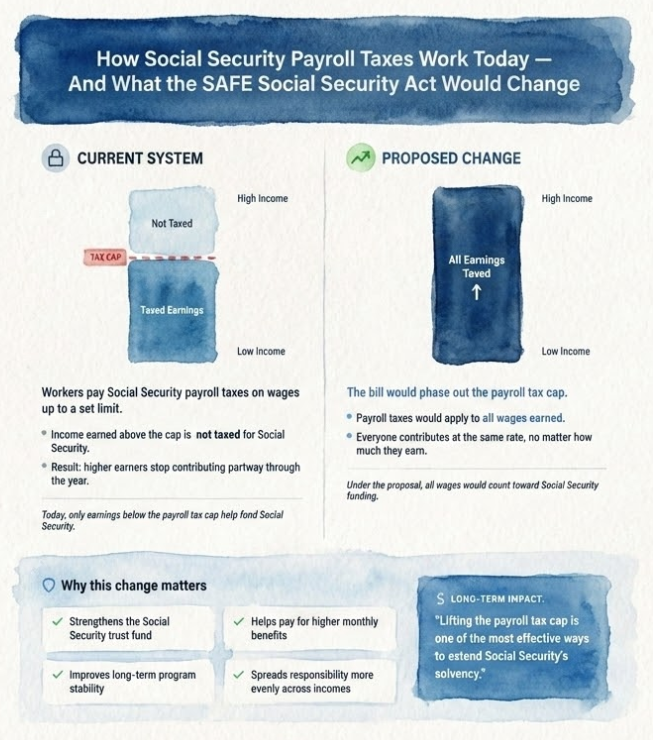
## Bigger checks and more accurate COLAs
One of the most immediate impacts for beneficiaries would be larger monthly payments. By adjusting how benefits are calculated, the bill would raise average [Social Security checks](/glossary/social-security-retirement-benefits) by more than $150 per month.
For retirees living on fixed incomes, that increase could help cover essentials like groceries, prescriptions, or utility bills. (Or just mitigate increasing inflation.)
The bill also proposes switching to the Consumer Price Index for the Elderly when calculating annual COLAs. The current formula is based on spending patterns of younger, working households, which tend to allocate less money to health care. CPI-E places greater weight on medical costs and housing, expenses that often rise faster for older Americans.
## Who supports the legislation
The SAFE Social Security Act has drawn support from several major labor and advocacy organizations, including the AFL-CIO, the Alliance for Retired Americans, the American Federation of Teachers, Social Security Works, and the National Committee to Preserve Social Security and Medicare.
Jody Calemine, Director of Government Affairs for the AFL-CIO, called lifting the payroll tax cap “the fairest and most equitable way” to improve benefits while extending the program’s solvency. Advocates also point out that the bill protects workers who leave the workforce temporarily to care for loved ones, ensuring they are not penalized when they retire.
## What happens next
Introducing a bill is only the first step. The SAFE Social Security Act will need to move through congressional committees and gain broader support before it can become law. While the proposal faces political hurdles, it signals a growing push among some lawmakers to expand Social Security benefits instead of reducing them.
For seniors, near-retirees, and families planning for the future, the bill highlights what’s at stake, and what changes could be possible.
If you rely on Social Security now or expect to in the future, staying informed about proposals like this one can help you understand how benefits may change and what to watch for as Congress debates the program’s future.
---
type: article
title: What to Know About the New ‘Warrior Dividend’ Announced by President Trump
url: https://benefitkarma.com/articles/benefits-in-the-news/warrior-dividend-2025
updated: 2026-05-13
---
# What to Know About the New ‘Warrior Dividend’ Announced by President Trump
President Trump announced a new one-time payment for military service members during a prime-time address on Wednesday, Dec. 17, calling it a “Warrior Dividend.” More than a million troops are expected to receive $1,776 payments before Christmas, according to the administration.
While the announcement framed the checks as a special bonus honoring service members, the funding and structure behind the payment are more complex. The dividend is tied to previously approved military housing funds and comes as lawmakers continue to scrutinize how recent defense spending legislation is being implemented.
If you’re active-duty, reserve, or supporting a military household, here’s what the Warrior Dividend is, who qualifies, and how it fits into the broader military benefits picture.
***To stay up to date on changes to military pay, housing benefits, and other federal programs, you can sign up for updates at BenefitKarma.com.***
## What is the Warrior Dividend announced by the President?
The Warrior Dividend is a **one-time $1,776 payment** being sent to eligible U.S. military service members. President Trump announced the payment during a televised address, stating that approximately **1.45 million troops** would receive checks before Christmas.
Despite being branded as a new dividend, the funding comes from Congressional reconciliation funds originally appropriated to supplement the Basic Allowance for Housing (BAH) [military benefit](/articles/military-veterans/guide-to-veterans-military-benefits).
According to a senior administration official, Defense Secretary Pete Hegseth directed the Pentagon to disburse **$2.6 billion** of those funds as a one-time housing supplement instead of adjusting monthly housing rates.
Congress had allocated **$2.9 billion** in the reconciliation bill to strengthen BAH, which helps service members cover off-base housing costs like rent, mortgages, and utilities.
The Warrior Dividend repurposes most of that funding into a lump-sum payment rather than ongoing housing support.
## Who qualifies for this dividend?
Eligibility is based on **rank, service status, and timing**.
According to the Department of Defense:
- Eligible service members must be **rank O-6 or below**
- Active-duty service members qualify
- Reserve and Guard members qualify **if they were on active-duty orders lasting 31 days or more as of Nov. 30, 2025**
In total, the Pentagon estimates that recipients will include:
- About **1.28 million active-component service members**
- And roughly **174,000 reserve-component members**
Service members who separated before the cutoff date or who are above the O-6 pay grade are not included.
## Is this Warrior Dividend a brand new program?
No. The Warrior Dividend is **not a new permanent benefit or recurring program**.
It is a **rebranding and redistribution of existing, congressionally approved ****[housing](/articles/military-veterans/va-housing-benefits-affordable-housing-for-veterans)**** funds**. Lawmakers intended the money to strengthen BAH, particularly as housing costs have risen quickly in many parts of the country. Instead, the administration chose to distribute the funds as a one-time payment.
Because this is a one-time supplement, it does not create a new entitlement and does not change long-term benefit formulas.
## How does this affect the bigger picture of military benefits?
The dividend arrives at a time when **military housing affordability remains a concern**. A recent RAND report found that while BAH is generally adequate for many service members, it has struggled to keep pace during rapid housing market changes. A notable minority of troops report dissatisfaction with how well BAH covers their actual housing costs.
Separately, the Department of Defense announced that **2026 BAH rates will increase by an average of 4.2% starting January 1, 2026**. That increase is unrelated to the Warrior Dividend but reflects ongoing pressure to adjust housing support.
Some lawmakers have raised concerns about the broader trend of **redirecting defense funds away from their original purposes**, including money previously designated for barracks, maintenance facilities, and military schools.
## When does the Warrior Dividend go into effect?
According to the White House, the payments are **already being processed** and are expected to arrive **before Christmas**. Service members do not need to apply.
The Pentagon has characterized the payment as a **one-time housing supplement**, not an ongoing benefit. No additional Warrior Dividend payments have been announced.
## Is the Warrior Dividend taxable?
Based on how the Department of Defense has described the payment so far, the Warrior Dividend is **expected to be non-taxable**. The Pentagon has characterized the $1,776 payment as a **one-time Basic Allowance for Housing (BAH) supplement**, not as a bonus or special incentive pay. Under federal tax rules, BAH is generally **excluded from taxable income**, which means service members typically do not pay federal income tax on those funds.
That said, the Department of Defense has not yet released standalone tax guidance specifically addressing the Warrior Dividend. The final determination will depend on **how the payment is coded on your Leave and Earnings Statement (LES)**.
Service members should review their LES once the payment posts to confirm whether any federal taxes were withheld. If the payment appears to be taxed or labeled inconsistently, a military legal assistance office or tax professional can help clarify next steps.
## What should service members do next?
If you believe you qualify:
- Watch for the payment in your bank account or LES
- Review how the payment is labeled on your pay statement
- Plan for the fact that this is **not recurring income**
For longer-term planning, keep an eye on future BAH adjustments and defense spending decisions, especially as lawmakers continue oversight of how reconciliation funds are used.
---
type: article
title: 1.4 Million Lawfully Present Immigrants May Lose Federal Medical Benefits
url: https://benefitkarma.com/articles/seniors-special-groups/immigrants-may-lose-federal-medical-benefits
updated: 2026-05-14
---
# 1.4 Million Lawfully Present Immigrants May Lose Federal Medical Benefits
A major change in federal law could soon disrupt health coverage for more than one million people. The recently passed One Big Beautiful Bill Act (H.R. 1) eliminates the long-standing federal option that allowed states to offer Medicaid and [CHIP](/glossary/chip) to certain lawfully present immigrants.
For the last 20 years, 37 states used this option to ensure children, pregnant people, and low-income adults could get essential health care. Now, that pathway is being removed.
Whether you’re a parent, a Medicaid enrollee, or someone helping others navigate benefits, understanding what this law changes and what steps you may need to take is key.
***For ongoing updates about how federal laws affect your health, income, and family stability, visit BenefitKarma.com.***
## What the 2025 law actually changes
[The OBBBA](/articles/benefits-in-the-news/how-hr-1-the-one-big-beautiful-bill-act-could-reshape-your-benefits) eliminates the federal “lawfully present” option that states have relied on since 2002. Under previous rules, states could choose to provide [Medicaid](/articles/health-disability/understanding-medicaid-what-it-is-and-how-it-works) and [CHIP](/articles/health-disability/chip-childrens-health-insurance-program) to immigrants who were lawfully present in the U.S., even if they did not qualify under the traditional, more restrictive federal categories.
With the elimination of this option:
- **States are no longer allowed to cover these immigrants through Medicaid or CHIP**, even if they want to.
- **Coverage will end for groups who used this pathway**, including children, pregnant people, and adults under Medicaid expansion.
- **Eligibility is narrowed to the older, stricter federal categories**, which exclude many otherwise lawfully present individuals.
This is not an administrative interpretation. It is **a statutory change**, meaning states must comply.
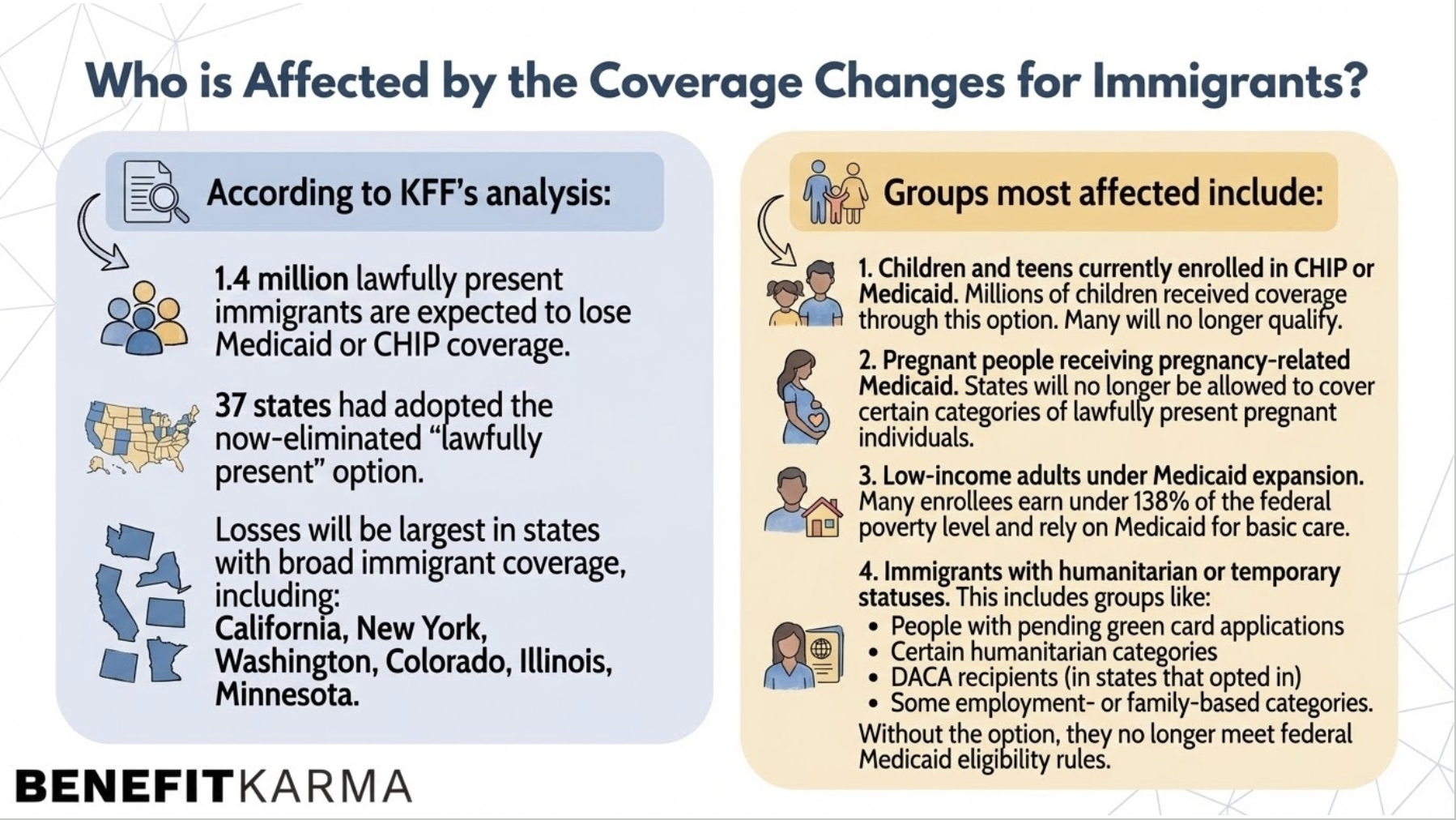
## How many people lose coverage, and in which states?
According to [Kaiser Family Foundation’s analysis](https://www.kff.org/immigrant-health/1-4-million-lawfully-present-immigrants-are-expected-to-lose-health-coverage-due-to-the-2025-tax-and-budget-law/):
- **1.4 million lawfully present immigrants are expected to lose Medicaid or CHIP coverage.**
- **37 states** had adopted the now-eliminated “lawfully present” option.
- Losses will be largest in states with broad immigrant coverage, including:
California
- New York
- Washington
- Colorado
- Illinois
- Minnesota
Groups most affected include:
### 1. Children and teens currently enrolled in CHIP or Medicaid
Millions of children received coverage through this option. Many will no longer qualify.
### 2. Pregnant people receiving pregnancy-related Medicaid
States will no longer be allowed to cover certain categories of lawfully present pregnant individuals.
### 3. Low-income adults under Medicaid expansion
Many enrollees earn under 138% of the [federal poverty level](/glossary/federal-poverty-level) and rely on Medicaid for basic care.
### 4. Immigrants with humanitarian or temporary statuses
This includes groups like:
- People with pending green card applications
- Certain humanitarian categories
- DACA recipients (in states that opted in)
- Some employment- or family-based categories
Without the option, they no longer meet federal Medicaid eligibility rules.
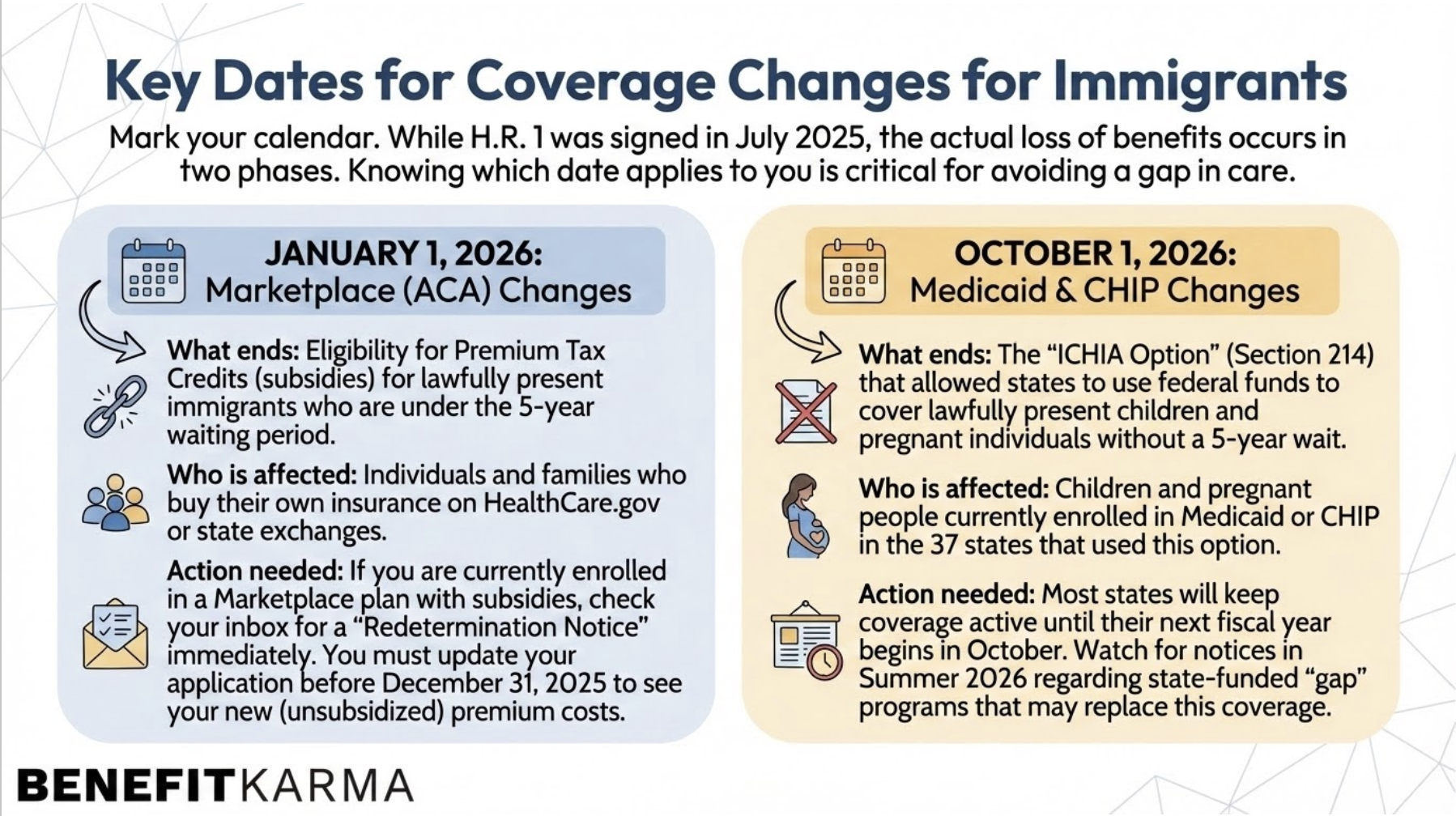
## When coverage changes take effect
While exact timing depends on how states phase out the option, most people will experience changes:
- **At renewal**, when they must reverify eligibility
- **When states update their Medicaid and CHIP systems** to comply with federal law
- Marketplace tax credit changes take effect **January 1, 2026**. However, the elimination of the Medicaid 'lawfully present' option officially takes effect in many states on **October 1, 2026**, though some states may restrict eligibility sooner. Check your specific state's timeline."
This means households should prepare *now*, not wait until benefits suddenly end.
## What affected families should do right now
Here are the most important steps to protect yourself or help someone else prepare for [immigrant benefits](/articles/seniors-special-groups/government-benefits-for-immigrants) to change.
### 1. Check your Medicaid or CHIP renewal date
Renewal is the moment when eligibility changes are most likely to be applied.
### 2. Watch for notices from your state Medicaid agency
States are required to notify enrollees before making eligibility changes. Mail, email, and portal messages all count.
### 3. Explore Marketplace coverage options early
Many lawfully present immigrants qualify for **significant subsidies**, especially if their income is below 150% FPL.
Marketplace plans may offer:
- Very low monthly premiums
- Cost-sharing reductions for lower-income households
- Coverage starting the first of the month after you enroll
Losing Medicaid or CHIP qualifies you for a **[Special Enrollment Period](/articles/health-disability/special-enrollment-periods)**.
### 4. Review options for children
Children losing Medicaid or CHIP may still qualify for:
- Low-cost [Marketplace](/articles/health-disability/how-to-sign-up-for-the-affordable-care-act-aca-marketplace) plans
- State-funded programs (varies by state)
- Community health centers with sliding-scale fees
### 5. Pregnant individuals should confirm coverage sources immediately
Pregnancy-related Medicaid eligibility will change for many categories previously covered.
Your state may:
- Shift you to a narrower Medicaid category
- Refer you to Marketplace coverage
- Offer state-funded alternatives (in a few states)
### 6. Keep all immigration documentation updated
While this change is not about documentation problems, states may request verification during transitions.
### 7. Stay updated; states may create temporary programs
Some states are considering:
- State-funded coverage
- Gap programs for pregnant people
- Continued coverage for children through state-only dollars
These programs vary widely, so staying informed is essential.
## Bottom line
The OBBBA removes the federal authority that allowed states to cover lawfully present immigrants through Medicaid and CHIP. As a result, **1.4 million people (many of them children, pregnant individuals, and low-income families) are expected to lose public health insurance in the coming year.**
If you or someone you know relies on this pathway, now is the time to review renewal dates, explore Marketplace options, and watch for official notices.
---
type: article
title: New Job Classifications May Change Your Student Loan & Benefits Eligibility
url: https://benefitkarma.com/articles/benefits-in-the-news/new-job-classifications-may-change-benefits-eligibility
updated: 2026-05-13
---
# New Job Classifications May Change Your Student Loan & Benefits Eligibility
The federal government recently updated how many professions are categorized, and these changes may affect everything from student loan repayment options to access to certain benefits.
While the job market itself hasn’t changed overnight, the way the government groups and defines occupations *has*, and that can shift eligibility for financial programs that rely on those classifications.
For workers, students, and anyone applying for public benefits, these updates may create new opportunities or require you to take a second look at how your job is listed on official paperwork. Because some job areas were reorganized or merged, a person’s classification today may not match what it was a year ago.
***If you want to stay ahead of policy changes that affect your financial life, sign up for BenefitKarma.com for straightforward updates on benefits, student loans, and important [government programs](/articles/housing-essentials/eviction-programs).***
## What exactly changed in the job classification system?
The federal government didn’t publish a simple list of “new jobs” or “jobs removed.” Instead, it updated **broader occupation groups**, the buckets used to organize related types of work. Some groups gained more detailed subcategories, others were renamed, and many narrow or outdated roles were merged into larger categories.
These updates stem from ongoing federal reviews and recommendations from the RISE Committee, which examined how professions are organized for workforce and education purposes. But the official documents don’t provide a clean, one-to-one list of titles added or eliminated.
The result: **your job may now fall under a different category than before**, even though the job itself hasn’t changed.
## How could these changes affect workers and students?
Try it: [Find Benefits](/find-benefits)
Explore the full benefits library.
Because many government programs rely on job classification (not just job title), these updates can change which options people qualify for.
A reclassification could affect:
- Eligibility for certain student loan repayment or forgiveness programs
- Access to state or federal training assistance
- Qualification for benefits linked to employment type or job stability
- How [income and employment](/articles/income-employment/income-employment-benefits) are reviewed during benefits applications
This is especially important for people working in fields that saw broader category adjustments.
## Which job areas appear most affected?
Again, the government has not issued a list of added or eliminated jobs. But based on workforce documentation and classification updates, certain areas clearly shifted.
### Job areas with expanded or reorganized classifications
These fields now include broader or updated groupings:
- Healthcare support (including medical records, community health work, telehealth support)
- Technology and IT (cybersecurity, IT support, data operations)
- Energy and utilities (solar, wind, electrical maintenance, energy techs)
- Skilled trades (manufacturing techs, equipment repair, production support)
- Education support roles (paraprofessionals, classroom aides)
- Logistics and transportation (supply chain support, warehousing, transport coordination)
### Job areas that were merged into broader categories
These jobs still exist but may no longer appear as stand-alone classifications:
- Clerical and administrative tasks (typing, data entry, filing)
- Older machine-based manufacturing jobs
- Legacy communication roles (switchboard operation, telemarketing)
- Pre-digital media support (typesetting, proofreading)
Workers in these areas may notice that the official category attached to their role now looks different.
## How could this impact student loans?
Several federal student loan programs — including income-driven repayment plans and public service-related forgiveness programs — use job classifications to determine eligibility.
If your job was moved into a different occupational group, you could see changes in:
- Whether you qualify for certain forgiveness paths
- Which repayment plans you can use
- Whether your field is included in targeted relief efforts
- Eligibility for education or training grants tied to specific job categories
Even if your job title stays the same, your classification may shift how the system views your work.
## How could this affect other benefits?
Benefits programs such as [SNAP](/glossary/snap), SSI, and workforce training assistance sometimes consider employment type and occupation categories when reviewing applications.
A new classification might influence:
- Whether your job is treated as stable or seasonal
- Access to employment-related [financial support](/articles/military-veterans/va-pension-a-financial-safety-net-for-veterans-and-their-families)
- Eligibility for retraining or upskilling programs
- Required documentation when applying
Most benefits still rely heavily on income, but these updates add another layer that can affect how people qualify.
## What should people do right now?
Start by checking how your job is now classified. You can do this by:
- Asking your employer or HR department
- Reviewing the most recent occupational category associated with your position
- Looking at updated SOC or O*NET listings to see how your field is grouped
Once you confirm your updated classification, review any financial programs you use—especially student loans and benefits with work-related components—to make sure your eligibility is unchanged.
## Is there a deadline for responding to these changes?
There’s no single national deadline. However, individual programs **do** have timelines:
- Annual recertification for income-driven repayment
- Benefit renewal deadlines for SNAP, Medicaid, and [SSI](/glossary/essential-person)
- [Enrollment periods](/articles/health-disability/special-enrollment-periods) for training or grant programs
If your job category changed, it’s important to update your paperwork before your next renewal or recertification window.
To stay informed as classification changes continue to roll out, **visit BenefitKarma.com** for simple, trusted updates on benefits, financial aid, and policy changes that matter.
---
type: article
title: Social Security Doesn’t Accept Power of Attorney: Why that Matters for Your Benefits
url: https://benefitkarma.com/articles/income-employment/social-security-does-not-accept-power-of-attorney
updated: 2026-05-19
---
# Social Security Doesn’t Accept Power of Attorney: Why that Matters for Your Benefits
When planning for your future, most people assume that a power of attorney (POA) is enough to protect their finances if they ever need help. After all, a POA is widely accepted by banks, insurance companies, and investment firms. It’s often viewed as a catch-all solution for managing money and making decisions if illness, disability, or age gets in the way.
But when it comes to Social Security, that assumption can lead to serious problems.
The Social Security Administration (SSA) does not recognize traditional powers of attorney. Even if you’ve legally named someone to manage your finances, that person may have no authority to access or manage your Social Security benefits. For millions of Americans who rely on these payments each month, this overlooked rule can create confusion, delays, and financial stress at exactly the wrong time.
Understanding how Social Security handles benefit management is an important, but often missed, estate planning step, especially for people who are applying for benefits, already receiving them, or expecting help from a family member in the future. Staying informed about rules like this can help you avoid surprises later.
***Sign up for BenefitKarma.com to keep up with important updates and practical guidance on government benefits.***
## Why Social Security doesn’t accept power of attorney
**A power of attorney is a legal document created under state law.** It allows one person to act on behalf of another for financial or legal matters. In most areas of life, that authority is enough.
[Social Security](/articles/income-employment/social-security-retirement-benefits) is different because it operates under federal law and follows its own rules to protect beneficiaries. The SSA is required to work directly with the person receiving benefits unless it has formally approved someone else to act on their behalf. As a result, Social Security will not honor a POA, even one that is legally valid, notarized, and accepted everywhere else.
This means that someone with power of attorney typically cannot:
- Speak to Social Security on your behalf
- Change direct deposit information
- Resolve payment problems
- Manage benefit applications or appeals
Families often don’t discover this limitation until a crisis happens. A loved one may become seriously ill, develop cognitive issues, or be unable to communicate. Even with the best intentions and legal paperwork in place, Social Security may refuse to share information or allow any action.
## Who this rule affects most
This issue is especially important for people who:
- Receive [Social Security retirement benefits](/glossary/social-security-retirement-benefits)
- Receive [Social Security Disability Insurance (SSDI)](/articles/health-disability/understanding-ssdi-disability-your-questions-answered) or [Supplemental Security Income (SSI)](/articles/health-disability/what-is-supplemental-security-income-ssi-what-you-need-to-know)
- Are in the process of applying for benefits
- Rely on a spouse, adult child, or caregiver to manage finances
- Expect to need help managing benefits later in life
Social Security benefits often make up a large portion of monthly income. If no one is authorized to help manage them, payments can be delayed, interrupted, or left unresolved during periods when financial stability is critical.
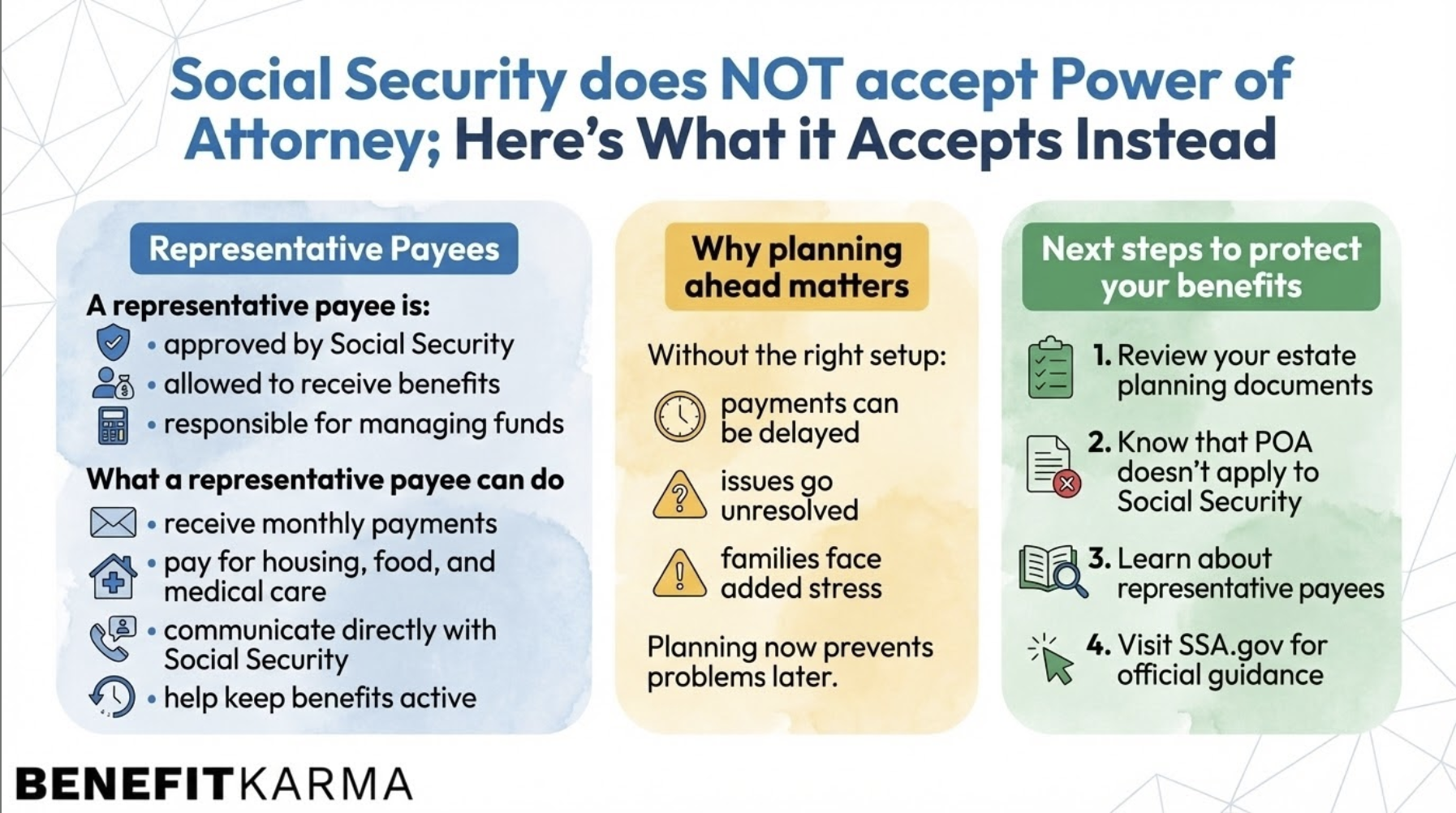
## 'Representative payees' are Social Security’s alternative
Instead of accepting power of attorney, the SSA uses a system called **representative payees**. A representative payee is a person or organization that Social Security officially approves to receive and manage benefits for someone who needs assistance.
A representative payee can:
- Receive monthly benefit payments
- Pay for essential needs like housing, food, utilities, and medical care
- Communicate directly with the SSA
- Report changes and handle benefit-related paperwork
Representative payees are commonly used for people with disabilities, cognitive impairments, or serious medical conditions. However, they can also be used when someone simply needs help managing their benefits, even temporarily.
## Why this planning step is often overlooked
Many people assume that estate planning documents automatically cover everything. Because power of attorney works almost everywhere else, Social Security’s exception catches families off guard.
This can lead to frustrating situations where benefits are technically approved but practically inaccessible. Loved ones may be unable to fix errors, respond to notices, or stop overpayments. In some cases, missed deadlines can even result in suspended benefits.
Planning ahead allows you to avoid scrambling later, especially during stressful or emotional situations.
## How to plan ahead to protect your benefits
The best time to address this issue is before a problem arises. Start by reviewing your current estate planning documents and asking one key question: *Who would manage my Social Security benefits if I couldn’t?*
If you already have a power of attorney, understand that it does not give access to Social Security. You may want to talk with your family about who could serve as a representative payee if needed.
Some people also choose to consult an elder law or estate planning attorney. A professional familiar with Social Security rules can help you understand how representative payees fit into a broader financial plan without duplicating or conflicting with other documents.
## How the representative payee process works
To become a representative payee, a person or organization must apply directly through the SSA. Social Security reviews applications carefully and chooses the option it believes is in the beneficiary’s best interest.
The process generally involves:
- Submitting an application
- Providing identification and background information
- Explaining the relationship to the beneficiary
- Demonstrating the ability to manage funds responsibly
Once approved, the representative payee has ongoing responsibilities, including keeping records and using benefits only for approved needs. Social Security provides guidance and oversight to help ensure funds are used properly.
The SSA’s official [website](https://www.ssa.gov/payee/) offers detailed instructions, forms, and explanations about representative payees, making it a useful starting point for anyone considering this option.
## Why understanding this now can save stress later
This isn’t about expecting the worst; it’s about being prepared. Many benefit disruptions happen not because of fraud or mistakes, but because families don’t know the rules until it’s too late.
By understanding how Social Security actually handles benefit management, you can protect your income, reduce confusion for loved ones, and make sure support is available when it’s needed most.
BenefitKarma helps break down complex benefit rules into clear, practical information so you can plan with confidence and stay informed as policies change.
---
type: article
title: 2026 VA Disability Pay Schedule: When Will Your VA Payments Arrive?
url: https://benefitkarma.com/articles/military-veterans/va-disability-pay-schedule-2026
updated: 2026-07-01
---
# 2026 VA Disability Pay Schedule: When Will Your VA Payments Arrive?
For veterans who rely on disability compensation, knowing exactly when payments will arrive is essential for budgeting, planning, and avoiding unnecessary stress. The VA Disability Pay Schedule lays out the official dates when monthly benefits will be deposited in 2026, taking weekends and federal holidays into account to ensure payments are received as early as possible.
The VA typically pays disability compensation on the first business day of each month, covering the prior month’s benefit period. When that date falls on a weekend or federal holiday, the VA issues payment on the preceding business day. Understanding this schedule helps veterans stay prepared throughout the year.
Below is the confirmed 2026 VA Disability Pay Schedule, including every adjusted date:
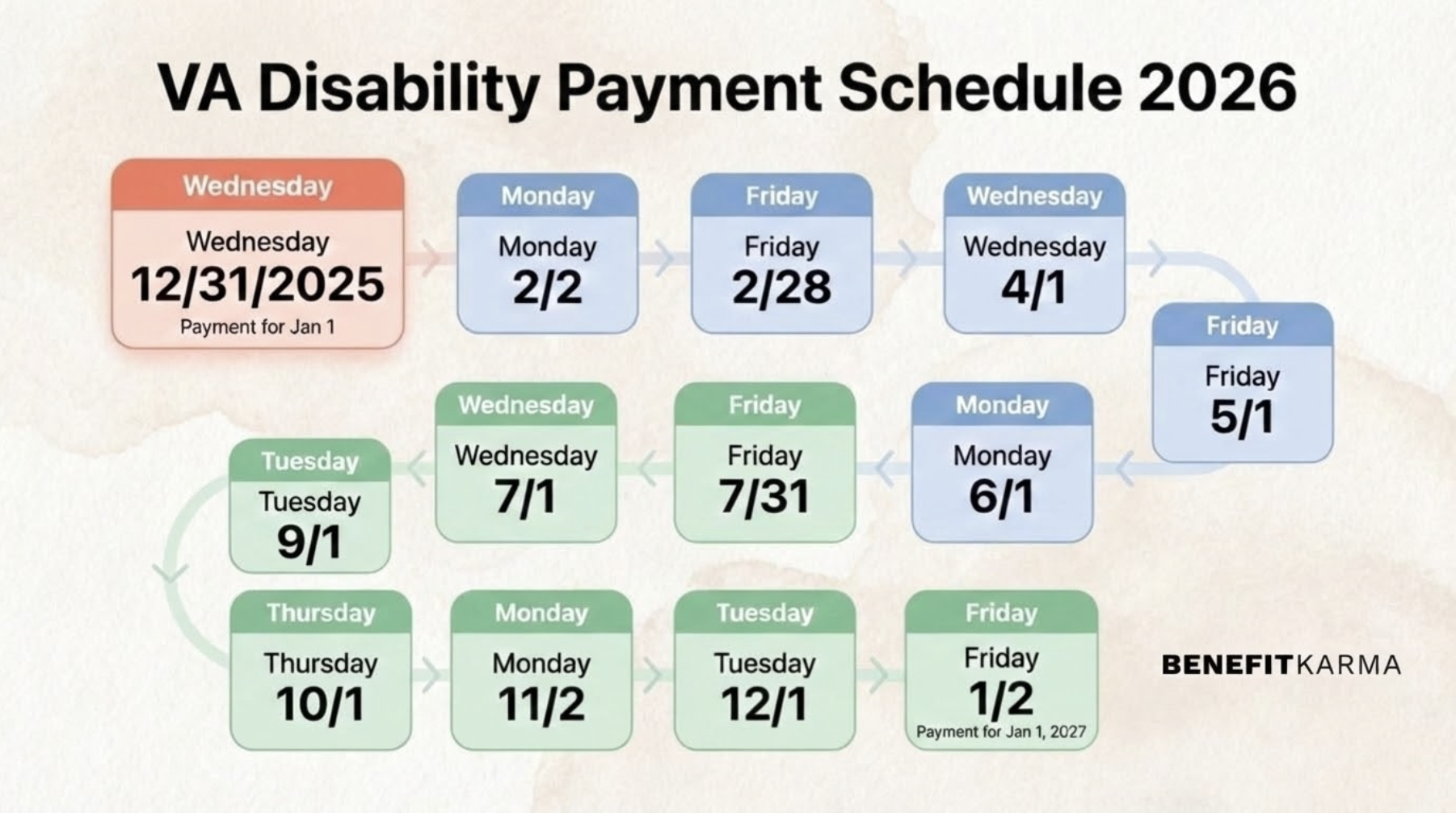
## How the VA determines payment dates
The VA follows a simple rule for disability compensation:
- Payments cover the previous month’s benefits.
(Example: January benefits pay on February’s payment date.)
- If the first of the month is a weekend or holiday, payment comes the prior business day.
This helps ensure veterans don’t experience payment delays when federal offices are closed.
##
Try it: Smart VA Disability Calculator
Estimate your combined VA rating in under 2 minutes.
###
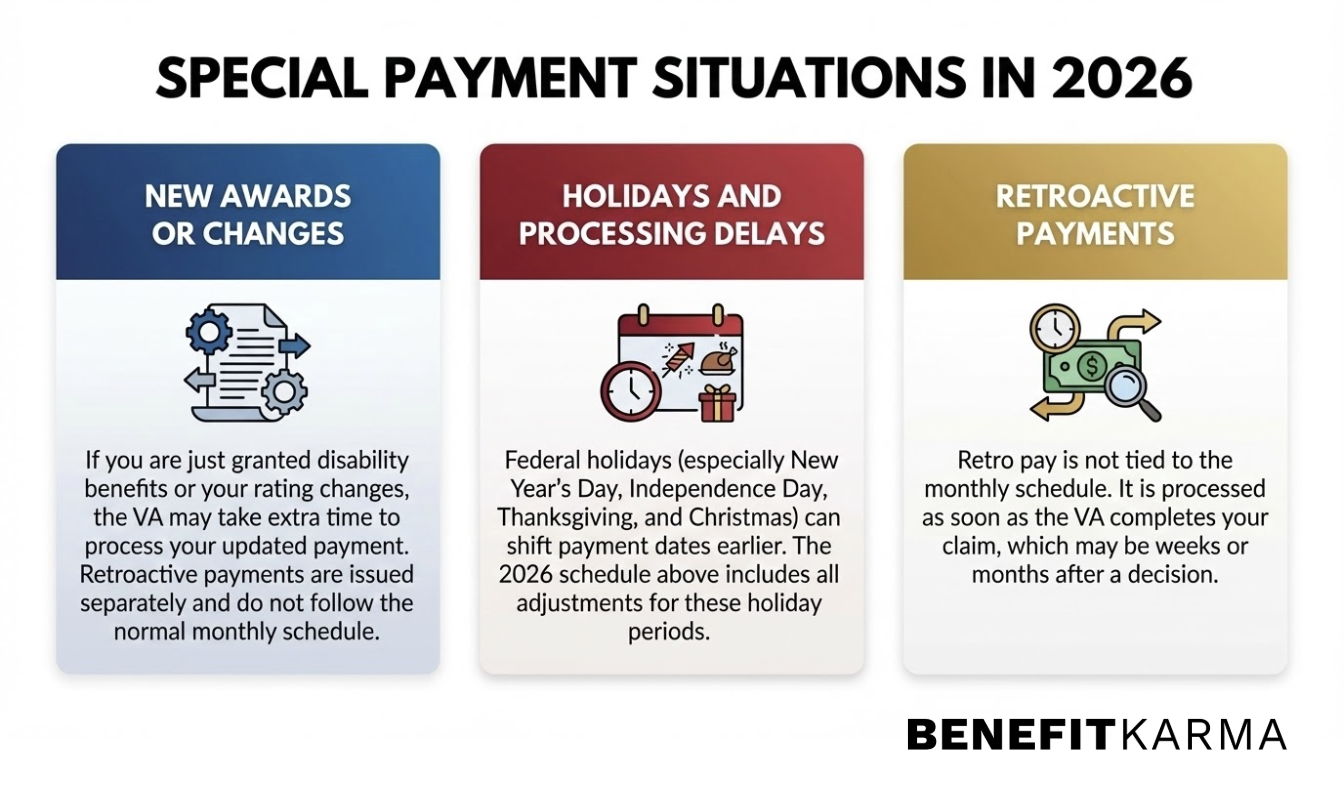
Special payment situations in 2026
Certain situations may shift your expected payment timing:
### New awards or changes
If you are just granted disability benefits or your rating changes, the VA may take extra time to process your updated payment. Retroactive payments are issued separately and do not follow the normal monthly schedule.
### Holidays and processing delays
Federal holidays (especially New Year’s Day, Independence Day, Thanksgiving, and Christmas) can shift payment dates earlier. The 2026 schedule above includes all adjustments for these holiday periods.
### Retroactive payments
Retro pay is not tied to the monthly schedule. It is processed as soon as the VA completes your claim, which may be weeks or months after a decision.
## Historical consistency in VA payment schedules
The VA has maintained a consistent payment pattern for many years:
- Pay on the first business day of the following month
- Adjust when that day lands on a weekend or federal holiday
- Issue early when needed to avoid gaps in benefit delivery
This consistency helps veterans predict their payments year after year.
## What to do if your payment is missing
If your payment doesn’t arrive when expected:
- Confirm your deposit date in your VA.gov account
- Check your bank’s pending transactions
- Call the VA at 800-827-1000 for payment support
- Verify account information if you recently changed banks or addresses
Most issues stem from account updates or bank-side delays.
## Estimate your 2026 compensation
Want to know how much VA disability compensation you may be entitled to?
Try BenefitKarma’s Smart VA Disability Calculator.
It gives a fast, accurate estimate based on your disability rating and dependents—so you can plan ahead with confidence.
Try the Smart VA Disability Calculator — free and easy to use.
---
type: article
title: SNAP Jeopardized Again — This Time Because of Immigration Issues
url: https://benefitkarma.com/articles/benefits-in-the-news/snap-jeopardized-immigration-issues
updated: 2026-05-13
---
# SNAP Jeopardized Again — This Time Because of Immigration Issues
Millions of Americans rely on the [Supplemental Nutrition Assistance Program](/glossary/snap) (SNAP) to help buy groceries each month. But over the past few months, the program has faced uncharacteristic instability — including a nationwide delay in November after the longest government shutdown in U.S. history.
Now, a new dispute between states and the federal government has raised another urgent question: **Could SNAP payments be withheld again?**
This article breaks down what is happening, why states and the federal government are in conflict, and what it means for people who depend on SNAP to put food on the table.
*Sign up for BenefitKarma.com to stay informed about changes that could affect your benefits.*
## Why SNAP Is Back in the Headlines
On Dec. 2, 2025, the U.S. Department of Agriculture (USDA) announced that it plans to withhold [SNAP funds](/articles/housing-essentials/understanding-snap-your-guide-to-supplemental-nutrition-assistance) from certain states starting the following week.
The issue centers around a federal data request made in February 2025. The USDA asked states to share SNAP recipients’ names and immigration status, saying the data was needed to investigate potential fraud.
- **29 states complied**
- **21 states + Washington, D.C. did not comply**
The states declining to share the data include large states like California, New York, and Minnesota, which together serve millions of SNAP participants.
These states argue that providing the information would violate privacy laws and create risks for their residents.

## What the USDA Says
Agriculture Secretary Brooke Rollins stated that the USDA intends to stop transferring federal SNAP funds to non-compliant states until they provide the requested data.
Her statement:
> “As of next week, we have begun and will begin to stop moving federal funds into those states, until they comply.”
The USDA maintains that the data request is designed to “root out fraud” and ensure proper use of taxpayer funds.
## What the Courts Have Said
This is not the first time the data-sharing issue has gone to court.
- In October 2025, a federal judge issued a preliminary injunction stopping the USDA from withholding SNAP funding over the data request.
- The court found that withholding the funds would likely violate federal law.
- The judge refused to pause the injunction even if the USDA appeals.
- The USDA has until Dec. 15 to decide whether to appeal.
For now, the injunction remains in place, meaning states *cannot* legally lose their SNAP funds over this issue. However, USDA statements have caused confusion and concern among state officials, advocacy groups, and households trying to understand what comes next for this essential [food assistance program](/articles/housing-essentials/nutritional-and-food-assistance-benefits-an-overview).
## Why This Matters: SNAP Is Already on Unsteady Ground
It’s important to put this new dispute in context.
**[SNAP benefits were already disrupted in November](/articles/benefits-in-the-news/snap-benefits-could-run-out-in-november-2025)** due to the **longest ****[government shutdown](/articles/benefits-in-the-news/government-shutdown-2025)**** in U.S. history**.
Funding for the program lapsed, and millions of recipients experienced delays or received reduced or partial payments until the shutdown ended on November 12.
The combination of:
- a recent shutdown
- paused funding
- legal battles
- public threats to withhold payments
…has created real uncertainty for SNAP households heading into the winter months.
## How Many People Could Be Affected?
SNAP serves about **42 million people nationwide**.
Roughly half of those individuals live in the 21 non-compliant states that are currently at the center of the dispute.
If federal funds were actually withheld (which a court has currently blocked), these states could not issue full benefits — or in some cases, any benefits — in the coming payment cycle.
## What Happens Next?
Here’s the timeline:
- **Dec. 2:** USDA announced it plans to begin withholding funds next week (week of Dec. 8).
- **Dec. 15:** Deadline for USDA to decide whether it will appeal the existing court order.
- **Ongoing:** States and the federal government continue to challenge each other in court.
At this moment, SNAP benefits remain protected by the court’s injunction, meaning states *should* still receive their funding.
However, because the situation is fluid, households should stay updated.
##
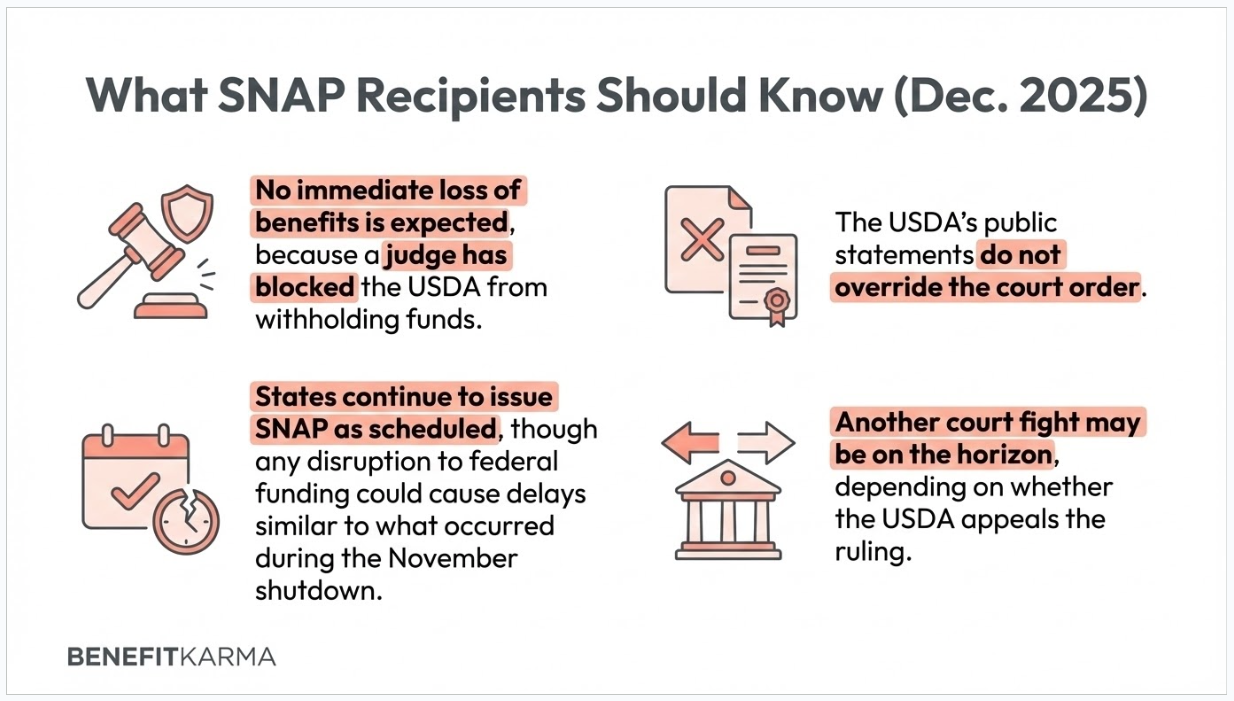
## Bottom Line
This is a developing situation with legal, administrative, and funding implications, but here are the facts today:
- SNAP benefits **were already delayed in November** due to the government shutdown.
- USDA leaders have stated they intend to withhold SNAP funding over a data dispute.
- A federal court has **barred** them from doing so.
Millions of households could be impacted **if** the injunction changes or if the dispute results in another funding lapse.
---
type: article
title: Should Social Security Cap COLA Increases for High Earners?
url: https://benefitkarma.com/articles/income-employment/social-security-cap-cola-increases
updated: 2026-05-19
---
# Should Social Security Cap COLA Increases for High Earners?
Every year, Social Security gives retirees a [cost-of-living adjustment](/glossary/cola) (COLA) to help benefits keep up with inflation. For 2026, that official COLA is 2.8% for everyone, no matter how much they currently receive. But behind the scenes in Washington, a new idea is getting attention: placing a cap on the COLA for high-benefit recipients.
Supporters say it could help stabilize Social Security before the trust fund runs short of money — something [projected to happen around 2034](/articles/benefits-in-the-news/will-social-security-run-out-of-money). Critics worry it may create new fairness issues.
The proposal comes from the **Committee for a Responsible Federal Budget (CRFB)**, a non-partisan policy group often referenced in congressional discussions. It would not eliminate COLAs for anyone. Instead, the *dollar amount* of the annual increase would be limited only for people receiving the highest benefits — roughly the top 25% of earners.
Lower- and middle-income retirees would continue to get the full adjustment they receive today.
As lawmakers explore different ways to protect Social Security’s long-term finances, this COLA cap has become one option on the table. Nothing has passed Congress yet, but it’s shaping the debate about how to protect benefits in the years ahead.
***Want updates when proposals like this change? Sign up at BenefitKarma.com to stay informed and prepared.***
## What is the COLA cap proposal and why was it introduced?
The COLA cap proposal comes from a policy [white paper by the CRFB](https://www.crfb.org/papers/social-security-cola-cap), which studies ways to reduce long-term federal deficits. The goal is to slow the growth of benefits for the highest earners in order to strengthen the Social Security trust fund.
**How it would work:**
- All retirees still get a COLA every year.
- But high-benefit recipients would have a *maximum dollar amount* they can receive from that COLA each year.
- This limit would apply only to the largest benefits, generally those earned by the top quarter of lifetime earners.
By reducing the system’s largest annual increases, supporters say the program could stretch its funds further and reduce the size of future cuts once the trust fund nears depletion.
## How would this affect higher-income retirees?
People receiving the largest [Social Security checks](/articles/income-employment/social-security-retirement-benefits) (often because they had long, high-earning careers) would still get a yearly increase, but it would be smaller than under current law.
Over time, this means:
- Their benefits would not grow as quickly as inflation.
- The gap between their check and a middle-income check could narrow.
- The long-term cost to Social Security would drop, improving the program’s finances.
For someone already receiving a high monthly benefit, this could mean hundreds of dollars less per year in growth than they would otherwise receive.
## Would typical retirees feel any impact?
For most retirees (lower- and middle-income earners), nothing would change. They would continue receiving:
- The full, uncapped COLA
- Inflation protection each year
- Benefits that grow at the same pace as prices
In fact, CRFB argues that improving Social Security’s solvency could *protect* typical retirees. Without reforms, the program is headed toward an automatic across-the-board cut of about 20%–25% once the trust fund is depleted. Targeted reforms like a COLA cap could potentially reduce the risk of those large universal cuts.
## What do supporters say about fairness?
Supporters argue that the proposal:
- **Protects vulnerable retirees** by leaving their COLAs untouched
- **Reduces pressure on the trust fund**, helping avoid across-the-board cuts
- **Adds a progressive element**, asking those who benefited most from the system to help sustain it
- **Avoids tax increases** on workers while still generating savings
To them, this is a way to make the system fairer while keeping it solvent.
## What do critics say?
Opponents have raised fairness concerns, including:
- Even higher-income retirees face rising medical costs, which often grow faster than the COLA
- A capped increase could make it harder to keep up with real expenses
- People who paid more into the system during their working years may feel penalized
- The proposal may not fully reflect the different spending patterns of older adults
Some critics worry that targeting only one group could set a precedent for future benefit restrictions.
## What other Social Security reform ideas are being discussed?
The COLA cap is just one idea being floated in Congress. Other frequently mentioned proposals include:
- **Increasing payroll taxes on high earners** by lifting or eliminating the taxable wage cap
- **Using the CPI-E** (Consumer Price Index for the Elderly) so COLAs better match real senior living costs
- A **temporary universal boost**, such as an extra $200 per month for all beneficiaries
- **Gradually raising** the [full retirement age](/glossary/full-retirement-age) for future workers
- **Partial means-testing** for the highest-income retirees
None of these proposals, including the COLA cap, has been enacted. For now, the **[2.8% COLA for 2026](/articles/income-employment/how-the-cola-affects-your-benefits)**[ ](/articles/income-employment/how-the-cola-affects-your-benefits)applies to everyone under existing law.
## The bottom line
The COLA cap proposal wouldn’t affect the vast majority of retirees, but it would slow benefit growth for people collecting the biggest monthly checks. Supporters see it as a modest, targeted fix to avoid deeper cuts later. Critics say it raises fairness issues and may not fully account for the real cost of aging.
As Congress continues to debate Social Security’s future, BenefitKarma will keep you updated on any changes that could affect your benefits.
---
type: article
title: GI Benefits Restored for Veterans Discharged Over Covid Vaccine
url: https://benefitkarma.com/articles/benefits-in-the-news/gi-benefits-restored-for-veterans-discharged-over-covid-vaccine
updated: 2026-05-19
---
# GI Benefits Restored for Veterans Discharged Over Covid Vaccine
Many veterans lost access to their education benefits during the Covid-19 vaccine mandate era, creating real strain for those trying to build new careers after service. Now, the Department of Veterans Affairs (VA) has announced a major policy shift: education benefits are being restored for veterans who were separated from the military **solely** because they refused the Covid-19 vaccine.
This change impacts thousands of former service members who were previously blocked from using the [Post-9/11 GI Bill](/glossary/gi-bill) or related programs. According to the VA, the reversal follows Executive Order 14184 issued in late 2025, directing federal agencies to reinstate benefits for this group. The VA has already confirmed that **899 veterans have had their discharges upgraded so far**, and it expects “many more” as reviews continue. These upgrades reopen access to tuition support, housing stipends, training programs, and career-building opportunities that were removed when the mandate was in effect.
***If you want to stay updated on the issues that affect your government benefits, sign up for BenefitKarma.com.***
## What changed, and why now?
During the vaccine mandate period, more than 8,000 service members were officially removed from service (discharged) because they refused the COVID-19 vaccine. Many received discharges that made them ineligible for [VA education benefits](/articles/family-education/unlocking-the-gi-bill-your-guide-to-education-benefits-for-veterans), including the GI Bill. For those planning to go to school, train for trades, or pursue certifications after service, losing access to these benefits was a major setback.
In November 2025, the VA [announced](https://news.va.gov/press-room/trump-eo-reinstates-gi-bill-benefits-to-veterans-discharged-for-refusing-covid-vaccine/) it would restore eligibility to veterans whose separation was only due to vaccine refusal. The agency said it is currently processing discharge corrections and reviewing cases automatically, meaning some veterans may regain eligibility without needing to file anything up front.
As benefits get restored, veterans will be able to use their GI Bill again to cover costs like tuition, books, supplies, and housing while attending school or training.
This policy shift acknowledges that the mandate created unique and unexpected disruptions for many service members, and that education plays a central role in long-term stability for veterans and their families.
## Who qualifies for restored education benefits?
The reinstatement applies to veterans who meet all of the following:
- You were separated from the military for refusing the Covid-19 vaccine.
- That refusal was the sole or primary reason for your separation.
- Your discharge status prevented you from receiving GI Bill education benefits.
- You would otherwise qualify for benefits under the Post-9/11 GI Bill or other VA education programs.
Veterans in this group can use restored benefits for college degrees, community college, trade programs, apprenticeships, certifications, and other career-focused training.
## What benefits are being restored?
Restored education benefits may include:
- Tuition and fees for approved programs
- Monthly housing allowance
- Book and supply stipends
- Support for trade school or apprenticeships
- Licensing and certification test reimbursement
If you previously relied on your GI Bill for a degree or training program but had to pause due to separation, you may now be able to restart where you left off.
## How do you check your status (and reinstate your benefits)?
If you believe this policy applies to you, here’s what you should do:
- **Check your discharge status. **Some discharges are already being corrected automatically. Look for new notices from VA or your branch of service.
- **If needed, request a discharge upgrade. **Use your branch’s Discharge Review Board (DRB) or Board for Correction of Military or Naval Records (BCMR/BCNR) if your records have not yet been updated.
- **Apply for education benefits. **Once your status is upgraded, you can submit an education benefits application at [VA.gov](/articles/military-veterans/how-to-use-the-va-gov-ebenefits-portal).
- **Gather supporting documents. **These may include:
Your [DD-214](/glossary/dd-214)
- Any separation paperwork
- Vaccine-related service records
- Prior VA correspondence
- **Act quickly. **The VA has stated that some restoration timelines may depend on when veterans submit updated claims.
If you run into challenges, you can also contact a [Veterans Service Organization](/glossary/vso) (VSO) for free help with the process.
## What does this mean for veterans planning their future?
This policy shift represents more than a benefit correction; it’s an opportunity for thousands of veterans to get back on track with the education and career goals they once planned for. Whether you hope to study nursing, engineering, IT, business, or skilled trades, having access to the GI Bill again can make those goals possible.
And because the VA says it expects more discharge upgrades in the coming months, many veterans who felt left behind may still see their benefits restored soon.
---
type: article
title: What Happens to Medicare When People Are Living Longer?
url: https://benefitkarma.com/articles/health-disability/what-happens-to-medicare-when-people-are-living-longer
updated: 2026-05-19
---
# What Happens to Medicare When People Are Living Longer?
Seniors today are living longer than ever, and the numbers show just how much things have changed. According to the CDC, life expectancy at birth in the United States is now 78.4 years overall. Men live an average of 75.8 years, and women live about 81.1 years.
But it wasn’t always this way. In 1975, life expectancy was much lower: 68.7 years for men, 76.6 years for women, and 72.6 years overall. That means today’s seniors can expect to live roughly 5 to 10 years longer than older generations. Those extra years bring new opportunities—and new healthcare needs.
As people live into their 80s, 90s, and beyond, they tend to need more medical care: doctor visits, medications, physical therapy, chronic condition management, and preventive services. That makes Medicare, the main health insurance program for adults 65 and older, more important than ever for long-term planning.
***Sign up for BenefitKarma.com to stay informed about Medicare updates and other important benefit changes.***
## Why does rising life expectancy matter for Medicare?
Longer lifespans mean Americans rely on healthcare for more years of their lives. Research from the NCOA and CDC shows that most older adults develop at least one chronic condition — such as heart disease, diabetes, or arthritis — that requires ongoing treatment. As people age, they typically need more frequent checkups, more medications, and more preventive screenings.
[Medicare](/articles/health-disability/what-is-medicare-parts-a-b-c-and-d-breaking-it-down) plays a central role in covering those needs. But longer life expectancy also raises questions about how the program may need to adapt over time.
Some experts believe Medicare may eventually need to expand services such as long-term care, home health programs, chronic condition support, or additional preventive benefits. Even though these ideas are still being discussed, staying informed helps [seniors](/articles/seniors-special-groups/senior-retirement-benefits) and families prepare for future changes.
## What does Medicare cover, and why does it matter more today?
Medicare is divided into several parts that work together to support the most common healthcare needs for older adults:
- **Part A** covers hospital care, inpatient treatment, and limited stays in skilled nursing facilities after hospitalization.
- **Part B** covers routine doctor visits, outpatient care, lab tests, diagnostic imaging, durable medical equipment, and preventive care like annual wellness visits and certain screenings.
- **Part D** covers prescription drugs. This becomes increasingly important as people age, since medication needs typically rise.
Many choose **[Medicare Advantage](/glossary/medicare-advantage) (Part C)**, which bundles [Parts A and B](/glossary/original-medicare) (and often Part D) and may offer extras like dental, vision, hearing, transportation, or wellness benefits.
Because seniors are living longer, these services matter more than ever. Longer lifespans mean more years of managing health conditions, taking medications, and completing preventive screenings, so choosing the right Medicare coverage can significantly impact long-term health and finances.
## Does Medicare change as you age?
Medicare benefits themselves do not change based on age. However, **your health needs do**. Older seniors often experience more complex or chronic conditions, which can require additional care and support. That’s why reviewing your Medicare plan every year, especially during the [Open Enrollment Period](/articles/health-disability/how-to-sign-up-for-medicare), is essential.
A plan that worked when you were 65 may not offer enough coverage or affordability when you’re 75 or 85. Evaluating your prescription list, expected care needs, and potential out-of-pocket costs helps ensure you always have the best coverage for where you are in life.
## Will Medicare expand benefits as life expectancy rises?
Many healthcare researchers and policymakers are discussing ways Medicare may need to adjust to support an aging population. Potential ideas include:
- Better coverage for long-term care and in-home support
- More preventive services to help people stay healthy longer
- Expanded management programs for chronic conditions
- Additional flexibility for home- and community-based services
These ideas are still in the discussion phase, but the trend is clear: as Americans live longer, Medicare will likely play a larger role in supporting long-term health and independence. Staying informed and reviewing your plan choices regularly helps you prepare for whatever changes come next.
## Are there programs that help low-income seniors pay for Medicare?
Yes. Many seniors qualify for financial assistance without realizing it. Programs like:
- **[Medicare Savings Programs](/glossary/msp)**
- **[Extra Help (Low-Income Subsidy)](/glossary/extra-help-lis)**
- State prescription assistance programs
- [Medicaid](/articles/health-disability/understanding-medicaid-what-it-is-and-how-it-works) for eligible low-income seniors
These programs can significantly reduce or even eliminate premiums, deductibles, copays, and prescription drug costs. Because eligibility rules vary by state and income, it’s important to review them every year.
## Should I expect to pay more for healthcare as I get older?
In many cases, yes. Healthcare needs typically increase with age, which can raise total medical costs (especially for people managing multiple chronic conditions). Medicare covers many essential services, but out-of-pocket costs can still add up for prescriptions, specialty care, or services Medicare doesn’t fully cover.
Reviewing your Medicare plan annually, comparing drug coverage, and applying for cost-saving programs can help keep expenses manageable. Planning ahead, especially for long-term care or home support, can also help protect your financial stability later in life.
---
type: article
title: Trump’s $2,000 Tariff Dividend: Is it Real?
url: https://benefitkarma.com/articles/benefits-in-the-news/trump-s-2-000-tariff-dividend
updated: 2026-05-14
---
# Trump’s $2,000 Tariff Dividend: Is it Real?
President Donald Trump has announced one of his most headline-grabbing ideas: giving Americans $2,000 each using money collected from tariffs on imported goods.
He argues the U.S. is taking in “trillions of dollars” from tariffs and can use that money to both pay down the national debt and issue what he calls a tariff-funded dividend to low- and middle-income Americans.
For families facing higher prices from inflation and new tariffs, a $2,000 payment sounds like real relief. But according to economists, tax experts, and the federal government’s own data, the math doesn’t come close to supporting this promise. In fact, tariffs are currently costing American households nearly as much as the proposed payment.
This article breaks down what was promised, what the numbers show, and what you should realistically expect.
***Sign up for BenefitKarma.com to stay informed about benefit changes and new policy proposals.***
## What is the deal with this tariff dividend?
Trump first floated the idea in a Nov. 9 Truth Social [post,](https://truthsocial.com/@realDonaldTrump/posts/115519726463094783) saying that Americans (excluding “high income people”) would receive at least $2,000 each from tariff revenue. According to PBS/PolitiFact reporting (Nov. 11, 2025), there is no published plan, no legislation, and not even internal agreement among administration officials about what a “tariff dividend” would be or who would qualify.
Treasury Secretary Scott Bessent told ABC News on Nov. 9 that he had not discussed a dividend with Trump and suggested the benefit “could come” instead through already-announced tax cuts — like no tax on tips, overtime, or [Social Security income](/articles/income-employment/social-security-retirement-benefits). Analysts told PolitiFact this is not the same as issuing new payments and does not match Trump’s claim of a $2,000 check.
Complicating matters further, the U.S. Supreme Court heard arguments days before Trump’s post about whether his administration even has the authority to impose tariffs under the International Emergency Economic Powers Act. If the court restricts that power, much of the future revenue Trump is counting on may never materialize.
## Who would receive the dividend?
Trump has said the payments would go to “everyone” except “high income people,” but has provided no definition for that term. He also hasn’t said whether children would receive payments.
To estimate the cost, economists at the Tax Foundation assumed eligibility for adults earning under $100,000, about 150 million people.
Under this scenario, a $2,000 dividend would cost nearly $300 billion (according to the Tax Foundation). If children are included, the cost climbs toward $400–600 billion (according to the Committee for a Responsible Federal Budget). Those costs currently exceed all tariff revenue collected so far.
Any actual checks would require congressional approval, and lawmakers recently passed a [major tax and spending bill](/articles/benefits-in-the-news/how-hr-1-the-one-big-beautiful-bill-act-could-reshape-your-benefits) without adding a tariff dividend, even though they had the option.
## Does the math check out?
Here is the biggest disconnect: Trump claims the U.S. is taking in “trillions,” but that doesn't square with federal data.
According to U.S. Treasury collections reported by PBS/PolitiFact, as of October 2025, the U.S. has collected $309.2 billion in tariffs this year. That’s up from $165.4 billion at this point in 2024. The increase, $143.8 billion, is nowhere near “trillions.”
The Yale Budget Lab reports that the current U.S. average tariff rate now stands at 18%, the highest since 1934.
Meanwhile, tariffs aren’t free to Americans. Independent estimates cited by PolitiFact show that tariffs currently cost U.S. households between $1,600 and $2,600 per year, roughly the same amount as the proposed dividend. In other words, Americans are already losing nearly as much as they would theoretically gain.
Leading economists say it would be more efficient to roll back tariffs than to collect them and then redistribute the money in checks.
**[RELATED:](/articles/benefits-in-the-news/how-tariffs-shrink-the-social-security-raise)**[ ](/articles/benefits-in-the-news/how-tariffs-shrink-the-social-security-raise)**[How Tariffs Shrink the Social Security Raise — and How Lawmakers Hope to Address It](/articles/benefits-in-the-news/how-tariffs-shrink-the-social-security-raise)**
## What’s next for the proposed dividend?
Right now, the proposed $2,000 tariff dividend has no legislative path, no published eligibility rules, and no confirmed plan from the Treasury Department, meaning the idea is still purely political, and not a real benefit Americans can expect.
Any actual checks would require Congress to pass a new law, which lawmakers chose not to do when they approved this year’s major tax and spending package.
The Supreme Court’s upcoming ruling on Trump’s tariff authority could also dramatically limit future revenue, shrinking the funding source the proposal relies on. Until those two pieces — Congressional action and legal authority — are resolved, experts say the dividend is unlikely to move forward, and Americans should not budget around receiving it.
---
type: article
title: How Tariffs Shrink the Social Security Raise — and How Lawmakers Hope to Address It
url: https://benefitkarma.com/articles/benefits-in-the-news/how-tariffs-shrink-the-social-security-raise
updated: 2026-05-19
---
# How Tariffs Shrink the Social Security Raise — and How Lawmakers Hope to Address It
Seniors were expecting some relief this year thanks to the latest Social Security [cost-of-living adjustment](/glossary/cola) (COLA). But even before the increase hit bank accounts, higher prices, especially those influenced by new tariffs, were swallowing most of the gain.
As everyday essentials like groceries, medications, and household items get more expensive, many retirees are finding that their “raise” doesn’t stretch any further than last year’s payment. This isn’t just a matter of frustration. For the millions of older adults who rely mainly or fully on Social Security, any change in the cost of food, housing, or medical care can make a real difference.
These growing pressures are why Democratic lawmakers are now pushing for a separate proposal to boost Social Security benefits by an additional $200 per month. Their goal is to restore some buying power for seniors whose COLA increase has been wiped out by higher costs. If you rely on Social Security, staying informed about these changes is essential.
**BenefitKarma.com can help you keep up with new benefit proposals, Medicare costs, and programs that can lower your monthly expenses. Sign up to stay informed.**
## Why won't the Social Security increase help out seniors?
[The 2026 COLA is 2.8 percent](/articles/benefits-in-the-news/cost-of-living-increase-2026). That sounds meaningful, but it only adds about $56 a month to the average retiree's Social Security payment. At the same time, [Medicare](/articles/health-disability/what-is-medicare-parts-a-b-c-and-d-breaking-it-down) premiums and key household costs are rising much faster.
New data from the Federal Reserve shows that government tariff-related price increases alone explain about half a percentage point of inflation this year, and imported goods affected by tariffs have risen nearly 5 percent compared to about 2.5 percent for goods made domestically. Put simply, many of the things seniors buy most — food, medical supplies, clothing, household basics — are going up in price faster than their benefits are increasing.
## How much of the COLA increase is being erased by rising costs and tariffs?
The 2026 COLA increase of 2.8 percent was designed to help seniors keep up with inflation. But once you look at the numbers, it becomes clear why many retirees don’t feel any relief. The average monthly benefit went up by about $56. But in the same period, [Medicare Part B](/glossary/medicare-part-b) premiums are projected to rise almost 10 percent.
Many seniors will lose a noticeable portion of the COLA increase just to cover their new Medicare premium.
Tariffs are adding even more pressure. Economists at the Federal Reserve estimate that tariffs now account for about 10 percent of the nation’s year-over-year inflation increase. Imported goods exposed to tariffs have risen nearly twice as fast in price as American-made goods. This means that common purchases like produce, over-the-counter medications, cleaning supplies, clothing, and electronics now cost more, often much more, than they did a year ago.
When you combine the rising cost of healthcare with higher prices from tariffs, the expected COLA raise simply doesn’t hold up. A $56 increase disappears quickly when grocery prices jump, electricity bills rise, and out-of-pocket medical expenses continue climbing.
## Why are lawmakers proposing an additional $200 monthly increase?
The pressure on seniors has sparked a new push in Congress. Democratic lawmakers have introduced the Social Security Emergency Inflation Relief Act ([SB 3078](https://www.congress.gov/bill/119th-congress/senate-bill/3078/text)), a proposal to add a **$200 monthly increase** to [Social Security benefits](/articles/income-employment/social-security-retirement-benefits). This would be separate from the annual COLA and designed to help seniors deal with higher living costs that a small COLA raise can’t cover.
This proposal aims to:
- Restore lost buying power due to inflation and tariffs
- Give seniors more room to cover rising medical bills
- Help retirees with low or fixed incomes stay financially stable
- Keep Social Security benefits aligned with real-world expenses
For many older adults, especially those living at or near the poverty line, an extra $200 a month could help cover groceries, medications, utility bills, or transportation.
## Who would benefit most from the new $200 increase?
All Social Security recipients would receive the additional $200 per month, but it would be most meaningful for:
- Seniors whose Social Security check is their main income
- Older adults with chronic health conditions and high medical costs
- Retirees with limited savings or no pension
- [SSI](/glossary/essential-person) recipients, including seniors and disabled adults
- People living in states with higher cost-of-living pressures
These groups are the most vulnerable to price spikes, especially when those spikes hit essential items.
## What steps can seniors take right now to protect their budget?
While lawmakers debate the $200 increase, seniors can take several steps to lower expenses and stretch their current benefits:
- [Apply for SNAP](/articles/housing-essentials/how-to-sign-up-for-ebt-food-stamps) to reduce grocery costs.
- Use Extra Help to cut prescription costs through Medicare Part D.
- Check if you qualify for Medicare Savings Programs to lower your monthly premium.
- Ask your doctor or pharmacist about lower-cost medication alternatives.
- Look into local senior programs that help with utilities, rent, meals, or transportation.
- Review your Social Security account to make sure your information is up-to-date.
These programs can help bridge the gap until Congress decides on the proposed benefit increase.
---
type: article
title: What Happens When Healthcare Subsidies Expire?
url: https://benefitkarma.com/articles/benefits-in-the-news/healthcare-subsidies-expiring-2025-2026
updated: 2026-05-13
---
# What Happens When Healthcare Subsidies Expire?
Millions of Americans are bracing for sharp increases in health insurance premiums as key Affordable Care Act ([ACA](/glossary/aca)) subsidies are set to expire at the end of December. These subsidies, often called *premium tax credits*, have kept [ACA Marketplace](/glossary/aca-marketplace) plans affordable for more than 22 million people.
Without an extension, monthly premiums are expected to more than double for many households, putting coverage at risk during a period of rising medical costs and economic uncertainty. According to the Kaiser Family Foundation research, the average ACA enrollee could pay $1,016 more per month in 2026 if the subsidies lapse.
This shift has triggered a major political showdown. The White House had been preparing to propose a two-year extension of these subsidies, along with new eligibility rules, but Republicans in Congress pushed back, delaying any announcement.
Multiple outlets (including Politico, CNN, and MS Now) reported that the proposal would cap eligibility at 700% of the [federal poverty level](/glossary/federal-poverty-level) (FPL), adjust out-of-pocket subsidies, and allow some tax credits to be redirected into tax-advantaged savings accounts. But with congressional resistance, millions of Americans still don’t know whether their premiums will skyrocket in just weeks.
The stakes are huge: without these subsidies, families may find Marketplace insurance unaffordable, causing many to drop coverage or skip medical care.
***To stay updated on deadlines, extensions, and your options, sign up for BenefitKarma.com.***
## What exactly is expiring?
The expiring subsidies are the enhanced [ACA premium tax credits](/articles/health-disability/aca-subsidies) originally expanded during the Covid-19 pandemic and later extended through legislation. These credits lower the monthly cost of Marketplace insurance for low- and middle-income households. They also expanded eligibility so more people, especially middle-income families, could qualify.
If Congress does *not* extend them:
- Many households are expected to see **premiums double or even triple**
- Some enrollees could lose eligibility entirely
- Millions may be forced to switch to higher-deductible, less comprehensive plans
- Some may drop coverage altogether
KFF estimates that about 22 million ACA enrollees will be directly affected.
## Why is this happening now?
During the pandemic, the expanded subsidies were originally created with a Dec. 31, 2025 expiration date, meaning Congress must vote to continue them or they disappear.
Although the White House planned to propose a two-year extension tied to new eligibility limits and rules, the rollout was stalled after House and Senate Republicans objected to extending ACA affordability protections.
Some argued that the subsidies should be allowed to expire; others worried about political fallout heading into the 2026 midterms, where millions of voters could lose affordable coverage.
## Who is most affected by subsidies expiring?
Millions of people could feel the impact if the ACA subsidies expire, but some groups are hit much harder than others:
- **People receiving ACA premium tax credits: **Anyone who currently gets subsidized Marketplace coverage is at risk.
- **Low- and middle-income families: **Even families making **300–600% of the federal poverty level** (about **$45,000–$180,000** for a family of four) could see huge premium increases.
- **Older adults under 65: **Because premiums rise sharply with age, people in their 50s and early 60s face the largest dollar increases.
- **Residents in high-cost states: **States like Alaska, Wyoming, West Virginia, Montana, and Florida already have high premiums. Without subsidies, some plans become nearly unaffordable.
- **People who recently left employer insurance: **If you rely on Marketplace plans because you’re self-employed, between jobs, or working part-time, these changes hit especially hard.
## What would Trump's proposal have done?
According to Politico and CNN’s reporting, the unreleased White House proposal (which has been opposed by Congressional Republicans) included:
• **A two-year subsidy extension** preventing immediate premium hikes through 2027.
• **A cap on eligibility at 700% of the federal poverty level**, limiting higher-income households' access to subsidies.
• New funding to **reduce out-of-pocket costs**, potentially lowering deductibles or copays.
• A new option to **deposit unused/excess tax credits** into a tax-advantaged savings account to help pay for other medical needs.
## What happens if the subsidies expire?
If Congress does nothing before the deadline, here’s what Americans can expect in **January 2026**:
**• Premiums rise immediately:** Families could see premium hikes **from hundreds to thousands per month**.
**• Many lose eligibility altogether: **Households above certain income thresholds may no longer qualify for any financial help.
**• Marketplace “sticker shock”: **People shopping for plans during [ACA open enrollment](/articles/health-disability/how-to-sign-up-for-the-affordable-care-act-aca-marketplace) (Nov 2025–Jan 2026) will see drastically higher prices.
**• Higher risk of going uninsured:** KFF warns that millions could drop coverage due to unaffordable premiums.
**• States may offer temporary fixes: **But state-level funding is limited and cannot replace federal subsidies.
## What can you do right now?
Here's what you need to do amidst all the uncertainty surrounding health insurance subsidies:
1. **Log in to HealthCare.gov and review your 2025–26 options. **Check whether your current plan will increase next year.
2. **Compare lower-premium options. **Silver and Bronze plans may be cheaper, but check deductibles carefully.
3. **See if you qualify for Medicaid. **If your household income has dropped, Medicaid may offer free or very low-cost coverage.
4. **Check for state-based subsidies. **Some states (CA, NJ, WA, CO) offer extra financial help.
5. **Follow the subsidy debate closely. **Congress is expected to vote in December as part of the shutdown deal.
## The bottom line
If the ACA subsidies expire, millions of people will face **higher premiums, reduced coverage options, and difficult decisions** about their health care. The White House appears ready to support a short-term extension, but Congress is divided, and time is running out. Whether you rely on Marketplace coverage or know someone who does, now is the time to check your options, compare plans, and stay informed.
***For clear, up-to-date guidance during every step, stay tuned to BenefitKarma.com.***
---
type: article
title: TrumpRx Prescription Website: What it Means for Drug Costs
url: https://benefitkarma.com/articles/health-disability/trumprx-prescription-website
updated: 2026-05-19
---
# TrumpRx Prescription Website: What it Means for Drug Costs
Prescription drug prices continue to rise every year, and many people, especially seniors, people with chronic conditions, and low-income families, are having a harder time paying for the medications they rely on.
In 2026, a new government website called **TrumpRx** is expected to launch with the promise of making prescriptions easier to compare and more affordable for everyday Americans. Early [details](https://trumprx.gov/) shared by the government show that the platform will focus on price transparency, simple navigation, and access to lower-cost options.
While the full rollout is still in progress, TrumpRx could become another tool to help you understand your medication prices and possibly reduce what you spend each month. For people who feel stuck with high pharmacy bills or confusing drug plans, even small savings could make a big difference. Understanding what’s coming, and how it fits with Medicare and other programs, will help you prepare now.
***If you want updates and clear explanations of benefits like this, sign up for BenefitKarma. We keep you informed when programs change and show you the best ways to navigate government benefits and healthcare options.***
## What is TrumpRx?
TrumpRx is a federally affiliated prescription-drug website announced by the White House and scheduled to launch in 2026. It will operate on a .gov platform (TrumpRx.gov), working with pharmaceutical companies and the U.S. government to offer Americans lower, more transparent drug prices and direct purchasing options.
The goal is to help people compare medication prices, find lower-cost alternatives, and save money on the drugs they take every day. While full details are still developing, early plans suggest the platform will:
- list competitive prices for hundreds of common medications
- allow users to compare drug costs from different suppliers
- make it easier for seniors and low-income families to find affordable prescription options
- provide clearer, simpler information about drug pricing
In short, TrumpRx is meant to function as a price-comparison tool and a low-cost purchasing option for people who struggle with high pharmacy bills.
## How could TrumpRx change the way I buy prescriptions?
TrumpRx is being designed as an online platform where you can look up your medications, compare prices from different suppliers, and find lower-cost alternatives. Instead of calling multiple pharmacies or searching several websites, everything should be in one place.
This means the process of buying prescriptions could feel more like comparing prices for anything else: simple, upfront, and easier to understand.
## Will TrumpRx actually save me money?
For many people, the answer very well may be yes. TrumpRx is expected to focus on offering:
- lower-cost versions of common medications
- clearer price comparisons
- more transparency about what you’re paying for
Savings will vary by medication, but [seniors](/articles/seniors-special-groups/senior-retirement-benefits), Medicare users, and families who pay out of pocket could see the biggest benefits. If you currently pay high copays or cash prices, TrumpRx may help reduce those monthly expenses.
## Does TrumpRx replace my current pharmacy or insurance?
No. TrumpRx is not designed to replace your pharmacy, [Medicare Part D](/articles/health-disability/what-is-medicare-parts-a-b-c-and-d-breaking-it-down) plan, or drug coverage.
Instead, it’s meant to be another tool you can use to compare prices and possibly find cheaper options. You may still use your regular pharmacy, but TrumpRx could help you decide where to buy certain medications or whether switching to a lower-cost alternative makes sense.
## What if I already use Medicare drug coverage?
If you’re on Medicare, TrumpRx may help you understand your medication costs more clearly.
You could use the website to:
- compare the cost of drugs on and off your Medicare plan
- see whether any lower-cost alternatives exist
- look for options that may help you avoid the [coverage gap](/glossary/donut-hole) (also known as the “donut hole”)
Medicare will still handle your insurance, but TrumpRx may help you stretch your benefits further.
## How do I compare prices once TrumpRx goes live?
Once the platform launches, the process should be simple:
- Search the medication you take.
- Review the list of available prices and options.
- Compare suppliers or pharmacies.
- Decide whether a lower-cost option fits your needs.
Doctors may also use TrumpRx to help patients understand cost-saving options during appointments.
## What steps can I take now to get ready?
Even though TrumpRx does not launch until 2026, you can prepare now by:
- **Reviewing your current medications** to see what you pay each month
- **Talking with your doctor** about generics or lower-cost alternatives
- **Tracking your highest-cost prescriptions** so you know where to look for savings
- **Staying informed** as the federal government releases more details
Keeping an updated list of your medications will help you use TrumpRx more effectively when it becomes available.
## The bottom line
TrumpRx could make prescription costs easier to understand and manage for millions of Americans. While details are still developing, the program signals a shift toward clearer pricing and more choice—especially for seniors and families with high drug bills. Preparing now can help you make the most of the launch when it arrives in 2026.
---
type: article
title: Should You Enroll in Medicare at 65 but Wait on Social Security?
url: https://benefitkarma.com/articles/health-disability/should-you-enroll-in-medicare-at-65-but-wait-on-social-security
updated: 2026-05-19
---
# Should You Enroll in Medicare at 65 but Wait on Social Security?
When people reach age 65, two big benefits usually come to mind at the same time: Medicare and Social Security. They feel like a matched set; you hit the big birthday, you sign up for both. But here’s the truth most people don’t hear until it’s too late: signing up for Medicare does not mean you should claim Social Security right away. In fact, putting off Social Security could put **more money in your pocket for the rest of your life.**
Many older adults are surprised to learn that their Social Security checks can shrink permanently if they file before their “[full retirement age](/glossary/full-retirement-age),” and that filing early can cost them thousands over time.
At the same time, Medicare has its own deadlines, and you don’t want to risk a gap in health coverage or late-enrollment penalties. This is where the confusion starts, and where a little planning can go a long way for your retirement budget.
If you’re getting ready to sign up for Medicare, now is the perfect moment to slow down and understand how these two programs work together, and where it may benefit you financially to keep them separate.
***If you want more guides like this or want to stay updated on major benefits changes, sign up for BenefitKarma. We help you stay prepared and confident when dealing with government programs.***
## What’s the main difference between Medicare and Social Security at age 65?
Even though they’re often talked about together, Medicare and Social Security follow completely different rules.
**[Medicare](/articles/health-disability/what-is-medicare-parts-a-b-c-and-d-breaking-it-down)** becomes available at 65 for most people. You have a seven-month window to enroll (three months before your birthday, your birthday month, and three months after). Most people should sign up on time to avoid gaps in coverage or late penalties, especially for [Medicare Part B](/glossary/medicare-part-b).
**[Social Security Retirement Benefits](/articles/income-employment/social-security-retirement-benefits)**, however, doesn’t have a single required start date. The earliest you can claim is 62. Your “full retirement age” is somewhere between 66 and 67 depending on your birth year, and the longer you delay (up to age 70) the more your monthly check grows.
The key thing to know: **You do not need to claim Social Security to enroll in Medicare.** You can take Medicare at 65 and wait years before you collect retirement checks.
## Why wouldn’t you claim Social Security at 65?
Because doing so **reduces your benefits for life**.
If you were born in 1960 or later, your full retirement age is 67. Claiming Social Security at 65 cuts your monthly check by about 13%... **permanently**. Claiming even earlier, like at 62, cuts it by about **30%**.
Here’s why waiting matters:
- Your Social Security check never goes back up once you claim early.
- You may need those larger checks later in life, especially if your savings run low.
- Social Security includes cost-of-living adjustments each year, so a higher starting amount means bigger automatic raises over time.
For many people, especially those worried about long-term financial stability, waiting even 12–24 months can make a meaningful difference.
## Can I really enroll in Medicare without being on Social Security?
Yes... and millions of people do.
If you haven’t claimed Social Security yet, Medicare simply bills you for your monthly Part B premium instead of deducting it from your benefit check. You can pay it through:
- Automatic bank payments
- Credit or debit card
- Mailed payments (less common)
As long as you enroll during your [Medicare Initial Enrollment Period](/glossary/medicare-iep), you’re covered; no Social Security needed.
## What if I wait past age 67 to claim Social Security?
Delaying Social Security *past* full retirement age can actually boost your benefit by 8% per year, up to age 70. **That increase is permanent.**
This is one of the strongest, safest financial “returns” available to most Americans; no stock market, no risky investment, no guessing. Just more money every month for the rest of your life.
Waiting until 70 is especially helpful if:
- You expect to live into your 80s or 90s
- You want to protect a spouse with survivor benefits
- You don’t have a large retirement nest egg
- You want to reduce financial stress later in life
## So what’s the ideal approach for most people?
Most people do this:
- **Enroll in Medicare at 65** so you don’t face penalties or loss of coverage.
- **Delay Social Security** until at least your full retirement age (67), or even until 70 if you can.
- **Use savings, part-time income, or other resources** to bridge the gap if needed.
This separates your health coverage from your income strategy, and often leads to a higher, more stable retirement check.
## Final thoughts: Treat Medicare and Social Security as two separate decisions
At 65, it feels like everything happens at once: retirement, health insurance, budgeting, and sometimes pressure from friends or family to “just file now.” But a little patience can pay off for decades.
Medicare should be claimed at 65 for most people. Social Security should be claimed when the timing gives you the strongest possible monthly income. These two decisions don’t have to be linked, and separating them can reduce stress and improve your financial future.
---
type: article
title: How to Sign Up for the Affordable Care Act (ACA) Marketplace
url: https://benefitkarma.com/articles/health-disability/how-to-sign-up-for-the-affordable-care-act-aca-marketplace
updated: 2026-05-19
---
# How to Sign Up for the Affordable Care Act (ACA) Marketplace
Getting health insurance through the Affordable Care Act ([ACA](/glossary/aca)) Marketplace can seem complicated, but it doesn’t have to be. The Marketplace (sometimes called “Obamacare”) was designed to help people find affordable, comprehensive health coverage even if they don’t get insurance through an employer.
Plans are standardized, meaning they all must cover key benefits like preventive care, prescriptions, and hospitalization.
With open enrollment happening once a year (and special enrollment periods available for certain life events), it’s important to know when and how to apply.
We’ll walk you through every step so you can sign up with confidence and make the most of your coverage.
***Stay informed with BenefitKarma to get updates, deadlines, and tips for keeping your health insurance on track all year long.***
## What is the ACA Marketplace?
The Affordable Care Act Marketplace is an online platform where you can shop for, compare, and enroll in private health insurance plans. You can access it through[ ](https://www.healthcare.gov)[HealthCare.gov](https://www.healthcare.gov) or your state’s own Marketplace site (for example, Covered California or NY State of Health).
Each plan is grouped into one of four “metal” levels (**Bronze, Silver, Gold, or Platinum**) that indicate how costs are shared between you and the insurer. Bronze plans have lower premiums but higher out-of-pocket costs; Platinum plans cost more per month but cover more of your expenses when you need care.
## How do I know if I’m supposed to use it?
You should use the [ACA Marketplace](/glossary/aca-marketplace) if:
- You **don’t get insurance through your job** or a family member’s job
- You’re **self-employed**, between jobs, or working part-time without benefits
- You’ve **lost ****[Medicaid](/articles/health-disability/understanding-medicaid-what-it-is-and-how-it-works)** or **[COBRA](/articles/health-disability/how-to-sign-up-for-cobra)**** coverage**
- You’re not yet eligible for **[Medicare](/articles/health-disability/what-is-medicare-parts-a-b-c-and-d-breaking-it-down)**
If your employer offers coverage, you can still check Marketplace plans to see if you qualify for premium tax credits or cost-sharing reductions based on your household income. These subsidies can make a big difference; most people who enroll qualify for financial help.
We’ve got more about **[how ACA subsidies work](/articles/health-disability/aca-subsidies)**.
## When do I sign up for the ACA Marketplace?
**Open Enrollment** for Marketplace coverage runs from **Nov. 1 through Jan. 15 every year**.
- If you sign up **by Dec. 15**, your coverage starts **Jan. 1**.
- If you sign up **between Dec. 16 and Jan. 15**, your coverage starts **Feb. 1**.
If you miss these dates, you may still qualify for a **[Special Enrollment Period](/articles/health-disability/special-enrollment-periods)**** ([SEP](/glossary/special-enrollment-period))**. For example, if you lose other coverage, move to a new area, or have a baby. You’ll usually have **60 days** from the qualifying event to enroll.
## How do I pick an ACA Marketplace plan?
When comparing plans, make sure to pay attention to the:
- **Monthly premium:** what you pay every month for coverage
- **Deductible:** how much you pay before insurance starts covering care
- **Out-of-pocket maximum:** your yearly spending cap for covered services
- **Network:** which doctors and hospitals are included
**Tip:** If you qualify for income-based savings, **Silver-level plans** often give you the best value since they offer cost-sharing reductions that lower your deductibles and copays. Use the Marketplace’s comparison tool to preview plans side-by-side and see estimated costs.
## Once I pick a plan, what do I do?
After selecting your plan, you’ll:
- **Submit your first premium payment**; coverage doesn’t start until you do.
- **Watch for your welcome packet and insurance card** from your new insurer.
- **Set up an online account** with your insurance company to track claims and payments.
- **Choose or confirm your primary care doctor**, especially if your plan requires one.
Make sure your payment is made before your coverage start date, or your plan could be canceled before it even begins.
## How often do I have to do this?
It’s a pain, but it’s the way it is: You’ll need to **renew or review your plan every year** during open enrollment, even if you want to keep the same coverage. Plan details like premiums, provider networks, or covered prescriptions can change annually.
Each fall, you’ll get a renewal notice with updated information. Take a few minutes to compare options; you might find a cheaper plan or new savings you qualify for.
## Can I get help signing up?
Yes! Free help is available through certified navigators or enrollment counselors who can walk you through your options and help with your application. You can find local assistance at [LocalHelp.HealthCare.gov](https://localhelp.healthcare.gov).
If you prefer to do it yourself, HealthCare.gov has an online checklist and calculator to estimate your subsidy amount.
## What if I have Medicaid or CHIP already?
If you or your children are enrolled in **Medicaid or the ****[Children’s Health Insurance Program](/articles/health-disability/chip-childrens-health-insurance-program)**** (CHIP)**, you don’t need Marketplace coverage unless your situation changes, like your income rising above the Medicaid limit. In that case, you’ll usually get a Special Enrollment Period to transition into an ACA plan without losing coverage.
### Bottom line:
Signing up for health insurance through the ACA Marketplace doesn’t have to be overwhelming. Once you understand the deadlines, steps, and options, you can confidently choose a plan that fits your budget and health needs.
---
type: article
title: Here's How Special Enrollment Periods Work (And Who Offers Them)
url: https://benefitkarma.com/articles/health-disability/special-enrollment-periods
updated: 2026-05-19
---
# Here's How Special Enrollment Periods Work (And Who Offers Them)
Life doesn’t always stick to a schedule, and thankfully, some benefits don’t either. Whether you missed an enrollment deadline or your circumstances suddenly changed, a *[Special Enrollment Period](/glossary/special-enrollment-period) (SEP)* can give you a second chance to sign up for important benefits.
These time-limited windows are your opportunity to get covered under programs like Medicaid, Medicare, the Affordable Care Act (ACA) Marketplace, or even [SNAP](/glossary/snap), without waiting for the next open enrollment cycle.
Special Enrollment Periods exist to protect people going through big life changes (like losing a job, getting married, or having a baby) so they don’t lose access to healthcare or other essential supports.
Understanding how these periods work can help you act fast and avoid gaps in coverage or benefits.
***BenefitKarma helps you stay informed about when and how to apply for various benefits, so you don’t miss your chance. Sign up today!***
## What is a Special Enrollment Period?
A Special Enrollment Period (SEP) is a limited timeframe when you can apply for or change certain benefits outside of the usual enrollment window. During this period, which is usually triggered by a *qualifying life event*, you can submit a new application or update your existing coverage.
For example, if you lose employer health insurance, you may qualify for a 60-day SEP to enroll in a Marketplace health plan. Some programs have automatic SEPs, while others require you to report changes and verify eligibility.
## Why would someone use this period?
People use SEPs when they experience life events that change their eligibility or coverage status. Common examples include:
- Losing job-based or other qualifying coverage
- Moving to a new state or ZIP code
- Getting married or divorced
- Having or adopting a child
- Gaining or losing dependent status
- Becoming eligible for Medicaid or Medicare
Using an SEP ensures you don’t have to wait months for the next open enrollment. It’s a vital safety net that keeps your healthcare, food assistance, or other benefits uninterrupted during major transitions.
## Which programs have Special Enrollment Periods?
Many major benefit programs have SEPs that let you enroll or make changes outside standard timelines. The rules and qualifying events differ, but acting quickly is key; most SEPs last only 30 to 60 days.
#### **ACA Marketplace Health Insurance**
If you miss the annual Open Enrollment (typically November-January), you may still qualify for an SEP if you’ve lost coverage, moved, married, or had a baby. You generally have **60 days from the life event** to apply through HealthCare.gov or your state’s marketplace. Be prepared to upload documentation verifying your qualifying event.
 **[RELATED:](/articles/health-disability/aca-subsidies)**[ How do ACA Subsidies work?](/articles/health-disability/aca-subsidies)
#### **Medicare**
[Medicare](/articles/health-disability/what-is-medicare-parts-a-b-c-and-d-breaking-it-down) offers SEPs for those who lose employer coverage, move out of their plan’s service area, or become newly eligible due to disability. Each SEP has specific rules; for example, you may have **eight months** to enroll after losing employer-sponsored coverage. Visit Medicare.gov or call 1-800-MEDICARE for details on your specific situation.
 **[RELATED:](/articles/health-disability/how-to-sign-up-for-medicare)**[ How to sign up for Medicare](/articles/health-disability/how-to-sign-up-for-medicare)
#### **Medicaid and CHIP**
Unlike most programs, [Medicaid](/articles/health-disability/understanding-medicaid-what-it-is-and-how-it-works) and the [Children’s Health Insurance Program (CHIP)](/articles/health-disability/chip-childrens-health-insurance-program) accept applications *year-round*. However, changes in income or household size can trigger an SEP that lets you adjust coverage or switch plans. You can apply or update information anytime through your state’s Medicaid office.
 **[RELATED:](/articles/health-disability/how-to-sign-up-for-medicaid)**[ How to sign up for Medicaid](/articles/health-disability/how-to-sign-up-for-medicaid)
#### **SNAP (Food Stamps)**
While [SNAP](/articles/housing-essentials/understanding-snap-your-guide-to-supplemental-nutrition-assistance) doesn’t have an annual open enrollment, there are SEP-like opportunities when your income, household size, or expenses change. Reporting these updates right away can increase your monthly benefit amount or keep your case active if your situation changes.
 **[RELATED:](/articles/housing-essentials/understanding-snap-your-guide-to-supplemental-nutrition-assistance)**[ Understanding SNAP](/articles/housing-essentials/understanding-snap-your-guide-to-supplemental-nutrition-assistance)
#### **Employer-Sponsored Benefits**
If you get benefits through your job, most employers allow a 30-day SEP after a major life event like marriage, divorce, or a birth, to add or remove dependents. Contact your HR department or benefits administrator for your company’s rules and deadlines.
Additionally, if you lose your employer-sponsored benefits, you can immediately apply for [COBRA](/glossary/cobra) — which is entirely built on "special enrollment" periods.
 **[RELATED:](/articles/health-disability/how-to-sign-up-for-cobra)**[ How to sign up for COBRA](/articles/health-disability/how-to-sign-up-for-cobra)
---
type: article
title: Project DASH: How DoorDash Is Helping Deliver Food to Families in Need
url: https://benefitkarma.com/articles/benefits-in-the-news/doordash-project-dash
updated: 2026-05-19
---
# Project DASH: How DoorDash Is Helping Deliver Food to Families in Need
If getting to a food pantry or grocery store (or getting your [SNAP](/glossary/snap) benefits) feels impossible, there’s a new kind of delivery service that could help. It’s called Project DASH, and it’s powered by DoorDash. But instead of restaurant meals, it helps deliver free groceries and essential goods from local nonprofits straight to people’s homes.
Since launching in 2018, Project DASH has completed more than 8 million deliveries, providing an estimated 135 million meals nationwide. For families with limited transportation, seniors with mobility issues, and individuals living in food deserts, it’s a small-but-mighty shift that makes nutritious food more accessible, and less stressful.
*Want to stay in the know about new food and benefit programs like this? Join BenefitKarma to get updates and step-by-step guides on resources that can help your household finances stretch further.*
## What is Project DASH?
[Project DASH (DoorDash Acts for Sustainability and Hunger)](https://about.doordash.com/en-us/impact/project-dash) is a community delivery program that works with local food banks, pantries, and social-service agencies to bring food directly to people who can’t easily pick it up themselves.
DoorDash provides the technology and delivery network, while nonprofit partners identify who needs help and schedule deliveries. Dashers, the same drivers who drop off restaurant orders, pick up food boxes from a community site and deliver them to homes.
It’s still DoorDash, just with a social mission: helping remove barriers that keep people from getting the food they need.
## Who qualifies for Project DASH deliveries?
You don’t sign up with DoorDash directly. Instead, you’ll qualify through a local organization already working with Project DASH. Common partners include:
- Local food banks or pantries that offer delivery options
- [Meals on Wheels](/articles/seniors-special-groups/meals-on-wheels-nourishing-seniors-one-meal-at-a-time) and senior-nutrition programs
- Community action agencies offering [emergency food assistance](/articles/housing-essentials/nutritional-and-food-assistance-benefits-an-overview)
- Health programs delivering “food as medicine” groceries to patients with chronic illnesses
Each partner sets its own rules; some may focus on seniors, others on low-income families or people without transportation.
## How does it work?
- **You sign up for assistance with a local partner.** A food pantry or social-service agency adds you to its delivery list (where available).
- **The organization schedules your drop-off.** They coordinate with DoorDash using its nonprofit delivery platform.
- **Dashers deliver to your home.** You’ll usually get a text update when your food is on the way, just like a normal DoorDash order.
- **You receive groceries or meals right at your door, for free.**
For many people, this service means avoiding long bus rides, waiting in lines, or carrying heavy boxes — and being able to accept help more privately and with dignity.
## Where are these deliveries available?
Project DASH now operates in hundreds of communities across the U.S., with deliveries originating from food banks and pantries in nearly every state. Because each partnership is local, availability varies. Some organizations deliver within a 10-mile radius, while others cover entire counties.
To find out if Project DASH operates near you:
- Contact your local food bank (find one at[ ](https://www.feedingamerica.org/find-your-local-foodbank)[FeedingAmerica.org/find-your-local-foodbank](https://www.feedingamerica.org/find-your-local-foodbank)).
- Ask if they “partner with DoorDash” or “offer home delivery through Project DASH.”
- If they do, they’ll walk you through their own sign-up or referral process.
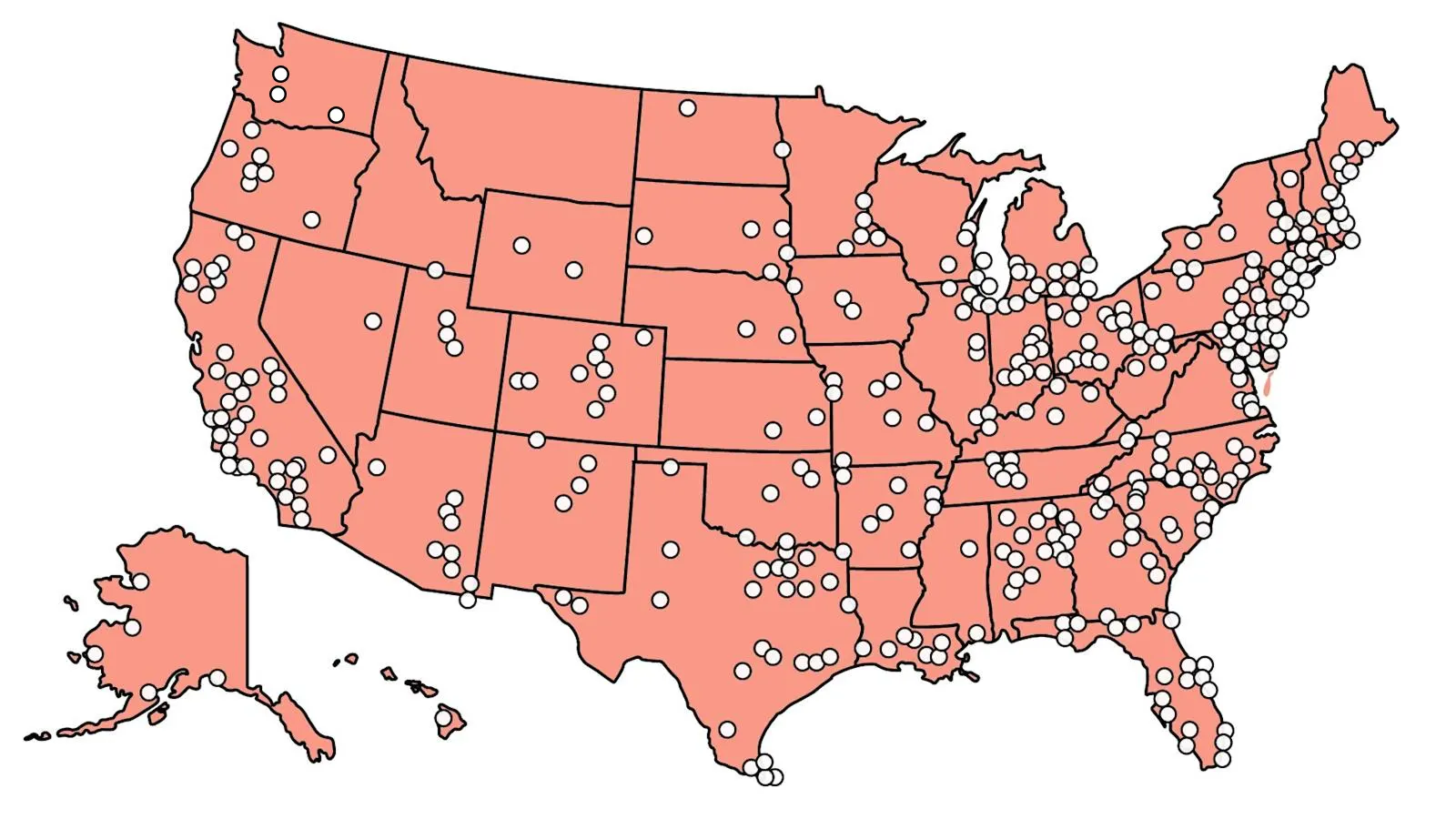
## Why does Project DASH matter?
Food insecurity affects more than 34 million Americans, and transportation is one of the biggest barriers to food access. By turning DoorDash’s delivery network into a public-good service, Project DASH helps bridge that gap, connecting nonprofits to the people who need them most.
As one food-bank leader put it: “Home delivery has increased access in ways that were unimaginable just a few years ago.”
###
## Here are some of the partners listed by Project DASH:
---
type: article
title: 5+ Big Changes Coming to Your Taxes for 2025-2026
url: https://benefitkarma.com/articles/benefits-in-the-news/tax-changes-2025-2026
updated: 2026-05-19
---
# 5+ Big Changes Coming to Your Taxes for 2025-2026
The Internal Revenue Service (IRS) just announced new tax adjustments that will affect nearly every filer, and the changes could mean slightly lower tax bills for many Americans.
The updates, driven by inflation and new federal tax provisions, increase the standard deduction, adjust income-tax brackets, and raise key tax credits like the [Earned Income Tax Credit](/glossary/eitc) (EITC). In short: your paycheck may stretch a little farther, and inflation will “take less of a bite,” as one tax professional put it.
***Sign up for BenefitKarma to stay in the know about changes that impact your taxes, benefits, and take-home pay.***
## 1. The standard deduction is increasing.
According to the official [announcement by the IRS](https://www.irs.gov/newsroom/irs-releases-tax-inflation-adjustments-for-tax-year-2025), the standard deduction (the amount you can subtract from your income before taxes are calculated) will rise for all filing statuses over the next two years.
For the tax year 2025 (returns filed April 2026):
- **Single:** $15,750 (up from $15,000)
- **Married filing jointly:** $31,500 (up from $30,000)**Head of household:** $23,625 (up from $22,500)
For **tax year 2026** (returns filed in 2027):
- **Single:** $16,100
- **Married filing jointly:** $32,200
- **Head of household:** $24,150
## 2. You can earn more before hitting the next tax bracket.
The IRS also raised the income thresholds for each of the seven federal tax rates for 2026. These adjustments, designed to account for inflation, vary slightly across brackets but generally range from about 2-4%.
For **single filers in 2026**, tax brackets will look like this:
- **10%** on the first $12,400 of taxable income
- **12%** on income above $12,400
- **22%** on income above $50,400
- **24%** on income above $105,700
- **32%** on income above $201,775
- **35%** on income above $256,225
- **37%** on income above $640,600
For **married couples filing jointly**, those thresholds roughly double (for example, the 37% rate starts around $768,700).
Bear with us a sec...
So when you “move into a higher tax bracket,” only the income that falls within that higher bracket gets taxed at the higher rate… not all of your income.
**Example: **Let’s say in 2026 you’re a single filer earning **$60,000**.
- The first **$12,400** is taxed at **10%**.
- The next chunk of income (from $12,401 to $50,400) is taxed at **12%**.
- Only the income **above $50,400** — in this case, $9,600 — is taxed at **22%**.
So even though you’re “in the 22% tax bracket,” you’re **not paying 22% on all $60,000** — just on that small portion above the 22% threshold.
This system is called a **progressive tax**, meaning your income is taxed in layers (or brackets), with lower portions taxed at lower rates and only the top layer taxed at the highest rate you qualify for.
## 3. The Earned Income Tax Credit (EITC) gets a boost.
Low- and moderate-income workers will also see a small increase in the Earned Income Tax Credit (EITC), a refundable benefit that can boost refunds even for those who owe little or no tax.
For 2026, the maximum credit for taxpayers with three or more qualifying children will rise to $8,231, up from $8,046 the previous year.
## 4. Bigger family and child-related tax benefits are here.
Families will see several updates that could make a real difference next tax season. [The Child Tax Credit (CTC) is increasing](/articles/benefits-in-the-news/child-tax-credit-2026) to $2,200 per qualifying child under age 17 for 2026, up from $2,000 in prior years. The refundable portion — the Additional [Child Tax Credit](/articles/family-education/understanding-the-child-tax-credit-what-you-need-to-know) — stays at $1,700 but will now automatically adjust with inflation, helping the credit keep pace with rising costs.
In addition, the adoption credit for families adopting a child with special needs (or incurring qualified adoption expenses) rises to $17,280 per child. The annual gift-tax exclusion increases to $19,000 per recipient, and the estate-tax exemption climbs to $13.99 million, offering more flexibility for long-term family and inheritance planning.
Together, these changes mean families can expect stronger support, both for raising children now and for building financial security for the future.
## 5. More pre-tax savings through your workplace.
For 2025, several common workplace benefits are getting inflation bumps. Employees can now set aside up to $3,300 in a health Flexible Spending Account (FSA), with $660 allowed to roll over year to year.
The qualified transportation and parking benefit also increases to $325 per month. These updates can help workers save more on medical, commuting, and dependent-care costs before taxes are taken out of their paychecks.
## Other 2025 tax updates you should know:
Beyond deductions and credits, the IRS made several smaller adjustments worth noting:
- **Alternative Minimum Tax (AMT):** The exemption rises to $88,100 for single filers and $137,000 for joint filers, keeping higher earners from being pulled into the AMT.
- **Medical Savings Accounts (MSAs):** For 2025, self-only coverage must have a deductible between $2,850 and $4,300, while family coverage ranges from $5,700 to $8,550, with an out-of-pocket limit up to $10,500.
- **Foreign earned income exclusion:** Workers living abroad can now exclude up to $130,000 in foreign income.
- **Unchanged provisions:** The personal exemption remains at $0, and the itemized deduction cap stays eliminated under the 2017 Tax Cuts and Jobs Act.
These updates may not affect everyone, but they’re important for taxpayers managing pre-tax benefits, international income, or family-related expenses.
### What it all means
Between higher deductions and inflation-adjusted brackets, many taxpayers will see modest relief in the coming years. Still, your exact outcome depends on your income level, filing status, and whether you claim dependents or itemize deductions.
---
type: article
title: Child Tax Credit 2026: What's New & How to Claim It
url: https://benefitkarma.com/articles/benefits-in-the-news/child-tax-credit-2026
updated: 2026-05-19
---
# Child Tax Credit 2026: What's New & How to Claim It
The IRS has officially released its 2026 tax year updates — and for families, the headline news is all about the [Child Tax Credit](/glossary/ctc) (CTC).
Under the *One Big Beautiful Bill Act (OBBBA)*, signed into law in July 2025, the credit is now permanent, higher, and inflation-adjusted — a historic change that’s expected to help more than 40 million families.
The new credit is worth $2,200 per qualifying child, with up to $1,700 refundable for those who owe little or no tax. This means families will finally see the credit rise alongside the cost of living each year.
***Keep tabs on the ever-changing benefits world by signing up for BenefitKarma today.***
### 1. The Child Tax Credit now adjusts for inflation.
For the first time in nearly 30 years, the [Child Tax Credit](/articles/family-education/understanding-the-child-tax-credit-what-you-need-to-know) will automatically increase each year to match inflation. That means as prices rise, so will the value of your credit, protecting families from losing purchasing power over time.
The main credit rises to $2,200 per qualifying child for 2026, while the refundable portion (the part you can get even if you owe no taxes) stays at $1,700 for now but will also grow with inflation in future years.
Financial experts say this change gives families more stability.
### 2. As of 2026, the credit is now permanent.
Until now, the Child Tax Credit has been one of the most frequently modified provisions in the tax code, with temporary increases and sunset dates creating uncertainty for families. The *[One Big Beautiful Bill Act](/articles/benefits-in-the-news/how-hr-1-the-one-big-beautiful-bill-act-could-reshape-your-benefits)* ends that cycle by making the CTC permanent, a major shift that locks in both the higher credit amount and the new inflation indexing.
This permanence means [families](/articles/family-education/family-education-benefits) can plan their finances with more confidence, knowing the benefit won’t disappear after a few years of legislative debate.
### 3. Income phase-out limits remain the same.
While the credit itself increases, the income limits do not. The credit still begins to phase out for taxpayers earning above **$200,000** (single or head of household) and **$400,000** (married filing jointly). Those thresholds aren’t tied to inflation, meaning that as wages rise, more families could gradually lose some or all of their credit eligibility over time.
Tax professionals suggest that households approaching these limits review their adjusted gross income carefully — especially if raises, bonuses, or additional income could push them over the threshold.
### 4. New Social Security number requirements are in effect.
Starting with 2026 returns, both the taxpayer and each qualifying child must have valid [Social Security numbers](/articles/income-employment/what-to-do-if-you-lose-your-social-security-card) (SSNs) issued before the tax return’s due date to claim the credit.
For married couples filing jointly, at least one spouse must have an SSN, though the other may use an ITIN. Families that don’t meet the SSN requirement can still claim the Credit for Other Dependents, worth up to $500 per dependent.
### What hasn’t changed in 2026?
The basic eligibility rules for who counts as a qualifying child remain the same. Children must be under 17 at the end of the tax year, have lived with you for more than half the year, and have a valid SSN. Dependents who turn 17 in 2026 will no longer qualify for the Child Tax Credit but may still be eligible for the $500 Credit for Other Dependents.
### Where to learn more
These updates change how the credit is calculated, not how you file. You’ll still claim the Child Tax Credit using Form 1040 and Schedule 8812 when you file your 2026 return.
**For full details on eligibility, income limits, and step-by-step filing guidance, visit our comprehensive guide: ****[Understanding the Child Tax Credit.](/articles/family-education/understanding-the-child-tax-credit-what-you-need-to-know)**
---
type: article
title: Veterans Can Still Access Most VA Services During Government Shutdown
url: https://benefitkarma.com/articles/benefits-in-the-news/va-services-during-shutdown
updated: 2026-05-20
---
# Veterans Can Still Access Most VA Services During Government Shutdown
When the federal government shuts down, many Americans worry about their benefits. For veterans, the good news is that most essential services through the Department of Veterans Affairs (VA) will continue, even while parts of the government are paused.
That’s because the VA is one of the few federal agencies that receives advanced appropriations, meaning its funding for key programs is approved a year ahead of time. According to the VA’s *Human Capital Contingency Plan*, this allows about 97% of VA employees to keep working during a shutdown.
***To keep tabs on the events that affect your benefits, sign up for BenefitKarma.***
### What’s still running for veterans during a shutdown?
Even with the government on pause, most core VA programs remain fully operational. That includes:
- **Medical centers and hospitals:** VA healthcare continues as normal, including appointments, surgeries, and prescriptions.
- **Disability and pension payments:** These benefits are protected and will not be delayed.
- **Burials and memorial services:** National cemeteries are still conducting burials.
- **Call centers:** Most VA hotlines remain open for benefit and healthcare questions.
Essentially, the programs veterans rely on most — healthcare, compensation, and pensions — are funded and functioning.
**MORE INFO:** [How does a shutdown affect your benefits? ](/articles/benefits-in-the-news/will-benefits-stop-during-a-government-shutdown)
### What’s paused during the shutdown?
Some VA services have been **temporarily suspended**, including:
- **Regional service offices:** These offices are closed until government operations resume.
- **[GI Bill](/glossary/gi-bill) hotline:** The [education benefits](/articles/family-education/unlocking-the-gi-bill-your-guide-to-education-benefits-for-veterans) line is offline during the shutdown.
- **Cemetery maintenance:** Groundskeeping for headstones and landscaping is on hold.
- **Transition programs and career counseling:** These services are among the most affected, leaving some recently separated service members without immediate job placement or career support.
###
### What should veterans do?
If you’re a veteran with questions about your benefits or worried about a delay, contact **Disabled American Veterans (DAV)** or another [veterans service organization](/glossary/vso) (VSO). These nonprofit groups often fill in the gaps when government offices close, helping file claims, answer questions, and ensure you don’t miss deadlines once operations resume.
You can also access most VA resources online:
- **VA.gov:** Check the status of disability claims, appeals, or benefits.
- **My HealtheVet:** Manage prescriptions, appointments, and medical records.
###
### The bottom line
Even during a government shutdown, veterans’ compensation, healthcare, and essential benefits remain secure. While some services like education support and career counseling may pause temporarily, there’s no interruption to payments or medical care.
For veterans, it’s an inconvenience, not a crisis.
Stay informed with BenefitKarma, your trusted source for updates on veterans’ benefits, healthcare access, and federal policy changes that matter most.
---
type: article
title: Can Federal Employees Get Unemployment During Furlough?
url: https://benefitkarma.com/articles/benefits-in-the-news/can-federal-employees-get-unemployment-during-furlough
updated: 2026-05-19
---
# Can Federal Employees Get Unemployment During Furlough?
When a federal government shutdown hits, thousands of federal workers are suddenly told not to report to work. Paychecks stop, bills keep coming, and uncertainty sets in fast. The good news? Furloughed federal employees are typically eligible to apply for unemployment benefits, though there are a few important rules and repayment details to keep in mind.
If you’re affected by a shutdown or temporary furlough, here’s what you need to know about unemployment eligibility, how to apply, and what happens once [back pay](/glossary/back-pay-ssdi) is approved.
***Want to stay in the know on government benefits news like this? Sign up for BenefitKarma; we’ll keep you updated on how policy changes, shutdowns, and deadlines impact your pay, benefits, and coverage.***
## What does it mean to be furloughed?
During a government shutdown, many “non-essential” federal employees are placed on furlough, which means they’re temporarily not allowed to work and aren’t being paid. You’re still considered employed — you just can’t perform your job duties until funding resumes.
Essential workers, like TSA agents or certain federal law enforcement officers, often still report to work without pay during a shutdown. They typically don’t qualify for unemployment since they’re still technically working.
## Are furloughed employees eligible for unemployment?
Yes. **Most furloughed federal employees can apply for ****[unemployment insurance](/articles/income-employment/how-does-unemployment-work-a-guide-to-these-crucial-benefits)**** (UI)** through their state. Since unemployment is managed at the state level, the rules can vary slightly depending on where you live, but the general principle is the same:
If you’re not receiving a paycheck through no fault of your own, you’re likely eligible to claim UI benefits.
However, there’s an *important* catch:
- **Once the government reopens, Congress usually approves full back pay for furloughed workers.**
- **If you’ve already received unemployment for that same period, you’ll be required to repay those benefits.**
States handle repayment differently. Some deduct the amount automatically from your back pay, while others send a repayment notice later.
## How do you apply for unemployment as a federal worker?
You’ll [sign up for unemployment](/articles/income-employment/how-to-sign-up-for-unemployment) through your state’s unemployment office, not a federal agency. The process is similar to a private-sector claim, but you’ll need a few additional details to verify your employment:
- Your Standard Form 8 (SF-8) or Standard Form 50 (SF-50)
- Your most recent federal pay stub
- The agency name and address where you worked
You can usually file online, and it’s best to do so within the first few days of your furlough, even if the shutdown might be short. Filing early helps start the clock on processing, which can take a week or two.
## What can you expect after you apply?
Once your claim is active:
- You’ll need to certify weekly that you’re still furloughed and available for work.
- Payments typically arrive via direct deposit or state debit card.
- If you’re called back to work, you must immediately report it to your state’s unemployment agency to stop payments.
If the shutdown ends quickly, your claim will simply close out with no penalty — but it’s better to have your application in early than to scramble if the furlough stretches on.
## How much money can you get?
Unemployment benefit amounts vary by state, but they’re usually a percentage of your average weekly wage, with a maximum limit.
For example:
- In California, the weekly maximum is **$450**.
- In Virginia, it’s **$378**.
- In Maryland, up to **$430**.
Each state also has its own waiting period (often one week) before payments begin.
> **RELATED:** [Your Guide to Income & Employment Benefits](/articles/income-employment/income-employment-benefits)
## What happens if you get back pay later?
Nearly every [federal shutdown](/articles/benefits-in-the-news/will-benefits-stop-during-a-government-shutdown) in recent memory has ended with retroactive pay for furloughed workers. When that happens, you’ll likely need to repay unemployment benefits you received for the same weeks.
Don’t panic — this doesn’t mean you did anything wrong. States and agencies have processes for recovering overpayments, and many coordinate directly with your employer to handle it automatically.
Still, it’s smart to set aside some of the funds from UI payments in case repayment is required.
## What about contractors or essential employees?
It’s important to note that federal contractors (workers employed by private companies under federal contracts) have different rules. They often don’t receive back pay after a shutdown, so their unemployment eligibility and repayment situations are handled differently.
Essential employees who keep working (even without pay) generally can’t collect unemployment because they’re still performing their job duties, even if their pay is delayed.
## The Bottom Line
If you’re a federal employee furloughed during a government shutdown, apply for unemployment through your state right away. It can help cover immediate expenses, even if you’ll need to repay it later once back pay comes through.
Furloughs can create sudden financial strain — but staying proactive with your benefits can make all the difference.
---
type: article
title: UPDATE: SNAP Recipients in Limbo As Shutdown Continues
url: https://benefitkarma.com/articles/benefits-in-the-news/snap-benefits-could-run-out-in-november-2025
updated: 2026-05-19
---
# UPDATE: SNAP Recipients in Limbo As Shutdown Continues
**UPDATE (Nov. 12) — The longest government shutdown in U.S. history has officially ended, and states have begun issuing [SNAP](/glossary/snap) benefits again.** But the program remains at the center of an intense legal fight after the Trump administration chose not to provide full SNAP funding after October. That move triggered lawsuits and a rapid sequence of conflicting court rulings affecting food access for roughly 42 million Americans.
Two federal judges on Oct. 31 ordered the government to provide at least partial November funding, prompting USDA to authorize states to issue up to 65% of recipients’ normal benefits. A Rhode Island judge later ordered full November funding — including the use of contingency and other available funds — but the administration appealed.
As a result, many households saw delays or received only partial payments after Nov. 1, even after the shutdown ended.
On Nov. 7, the U.S. Supreme Court temporarily paused the full-funding order, and on Nov. 11 it extended that pause two more days to give Congress time to pass a spending bill.
In the meantime, shifting USDA guidance and ongoing appeals have resulted in states issuing a mix of partial, full, or staggered payments, and in some cases, reversing payments already sent.
**What this means for you (right now):**
- Benefits have resumed, but timing and amounts still vary by state as litigation continues.
- Watch your EBT/app closely — some states are still processing partial (~65%) deposits with possible later adjustments.
- If your renewal is due, submit it now so you’re ready once full funding is resolved.
*(Original article continues below.)*
Millions of families could see a disruption to SNAP benefits (aka food stamps) as soon as November if the federal shutdown continues into late October.
In letters to state agencies, USDA told states to hold their November benefit files “until further notice” and warned there may be insufficient funds to pay full November benefits for roughly 42 million people.[ ](https://6abc.com/post/what-know-snap-benefits-amid-government-shutdown/18019576/?utm_source=chatgpt.com)
Why this matters: SNAP helps more than 40 million people every month. If November benefits are delayed or reduced, households could face immediate gaps at the grocery checkout. This is a big deal; we’ll tell you what you need to know.
*Sign up for BenefitKarma to stay on top of fast-moving benefit changes and practical how-tos.*
## What’s happening to SNAP right now?
Because Congress hasn’t passed funding for the new fiscal year, USDA told states not to send the usual November files to EBT vendors yet. That pause is meant to buy time, but it signals real risk for November issuances.
Agencies in North Carolina and local governments in Colorado and Texas are alerting residents that November SNAP may be delayed until federal funds are available. And if the [government shutdown](/articles/benefits-in-the-news/government-shutdown-2025) keeps going, November funds are in jeopardy.
> **RELATED:** [Will Your Benefits Stop Druing a Government Shutdown?](/articles/benefits-in-the-news/will-benefits-stop-during-a-government-shutdown)
## How did we get here?
[SNAP](/articles/housing-essentials/understanding-snap-your-guide-to-supplemental-nutrition-assistance) (the Supplemental Nutrition Assistance Program) runs on a partnership between states and the federal government. States process applications and issue benefits, but the money itself comes from the federal budget. **When Congress doesn’t pass a funding bill, USDA has no authority to release money beyond what’s already been allocated.**
During the last major shutdown in 2018-2019, USDA scrambled to keep benefits flowing by issuing February payments weeks early and tapping limited contingency funds. That stopgap measure kept families fed, but it created chaos at the start of the next month when no new funds arrived.
This time, USDA hasn’t said how much emergency funding remains. The agency’s Oct. 10 letter, shared by the North Carolina Department of Health and Human Services and circulated in the media, suggests reserves may not be enough to cover a full month of benefits if Congress doesn’t act soon.
## What happens to SNAP when the government resumes?
Once Congress passes a funding bill (or another temporary spending measure), USDA can immediately release the held-up funds. States will then process their November files and send them to [EBT](/articles/housing-essentials/how-to-sign-up-for-ebt-food-stamps) vendors for deposit.
That means benefits wouldn’t disappear entirely; they’d just be delayed. But for many households, even a week’s delay can mean empty pantries and skipped meals. Food banks and mutual aid groups often see sharp increases in demand after shutdowns end, as families play catch-up from the gap.
If the shutdown drags too long, USDA could also issue partial benefits to stretch what’s left of its reserve. That scenario would create major inequities across states depending on how quickly they process EBT loads.
### What if two months overlap?
If the shutdown delays SNAP through November and December, states will issue both months’ benefits once funding resumes. You won’t lose a month’s worth — but expect delays or combined deposits when EBT systems come back online.
## What are families supposed to do if SNAP runs out of money?
If USDA runs out of funds before November benefits are distributed, states may not be able to issue any new EBT deposits until Congress acts. That doesn’t affect October benefits; those are already funded, but November would be uncertain.
In that case, families may need to lean temporarily on local resources. Many states coordinate with regional food banks, community pantries, and school meal programs that can continue serving families using separate funding streams.
Check your state or county’s social services website for real-time updates, since some may arrange limited emergency distributions through partnerships with local nonprofits. (And... check out the article below.)
> **RELATED:** [Nutritional & Food Assistance Benefits: An Overview](/articles/housing-essentials/nutritional-and-food-assistance-benefits-an-overview)
## What are some steps to take before funds run out?
With no end to the shutdown in sight as of mid-October, here’s what you should do before the November funds run out:
**1. Shop strategically while October funds are active.**Stock up on affordable, filling staples like beans, pasta, oats, rice, peanut butter, and canned vegetables. Focus on long shelf life and high nutritional value.
**2. Check your EBT account often.**States may post updates or early deposits with little warning. Log in to your EBT portal or use your state’s app to monitor your balance.
**3. Connect with local resources now.**Look up nearby pantries through Feeding America’s directory or call 211 for emergency food assistance programs in your ZIP code.
**4. Submit your recertifications early.**If your renewal is due in November, complete it now so you’re ready to receive funds as soon as USDA resumes payments.
**5. Stay informed.**Check your state’s SNAP page or BenefitKarma for verified updates, especially near the end of October when federal funding talks heat up.
---
type: article
title: Fewer Medicare Drug Plans, Same Prices in 2026: Why It Matters
url: https://benefitkarma.com/articles/benefits-in-the-news/fewer-medicare-drug-plans-same-prices-in-2026
updated: 2026-05-13
---
# Fewer Medicare Drug Plans, Same Prices in 2026: Why It Matters
**[Medicare Part D](/glossary/medicare-part-d)** is the part of Medicare that helps pay for prescription drugs. It’s run by private insurance companies that contract with the federal government — which means prices and plan choices can change every year.
For 2026, the average monthly premium for these drug plans will stay about the same. But there’s a twist: many insurers are cutting back or pulling out entirely, which could leave some enrollees with fewer options or even without their current plan.
The changes are part of a bigger shake-up tied to recent laws that cap out-of-pocket drug costs and shift more expenses onto insurers. For everyday beneficiaries, that means this fall’s [Medicare open enrollment](/glossary/medicare-aep) is more important than ever.
*Want to stay ahead of Medicare changes like this? Sign up for BenefitKarma; we’ll break down what’s new, what’s next, and what you can do about it.*
## There’ll be fewer stand-alone Part D plans in 2026.
According to [new data](https://www.kff.org/medicare/medicare-part-d-premiums-are-decreasing-for-many-stand-alone-drug-plans-in-a-number-of-states-in-2026/) from the Kaiser Family Foundation, the number of stand-alone [Medicare Part D](/articles/health-disability/what-is-medicare-parts-a-b-c-and-d-breaking-it-down) plans will drop again next year, the third straight year of contraction. Nationally, just 360 plans will be offered by 17 parent organizations, down about 22% from 2025.
In most states, enrollees will have only 8 to 12 stand-alone drug plans to choose from. Some big names are even leaving the market altogether:
- **Elevance Health** (formerly Anthem) will exit stand-alone Part D entirely.
- **Centene** is ending three WellCare plans.**Cigna’s parent company**, Health Care Service Corporation, will discontinue one of its three plans.
For people who rely on these companies, that means one of two things: you’ll have to shop for a new plan, or Medicare will automatically move you into a similar plan from a different insurer.
## Premiums look stable, but that’s only half the story.
The good news? The average monthly premium for most stand-alone plans will stay flat or even potentially decrease slightly in 2026. Some areas will even offer $0-premium plans, and only a few insurers are raising rates by the maximum $50 allowed.
**But… lower premiums don’t necessarily mean lower costs overall.** Insurers can offset smaller premiums by:
- Covering **fewer drugs** or changing which tiers certain prescriptions fall under,
- Increasing **copays or coinsurance**, or
- Adding more **prior authorization and step therapy requirements.**
That means beneficiaries could end up paying more at the pharmacy, even if their monthly bill looks the same.
## There’s a reason why so many insurers are pulling back.
A big factor behind these shifts is the Inflation Reduction Act (IRA). The law restructured how Medicare Part D splits drug costs between insurers, the federal government, and manufacturers. Starting in 2025, drug plans became responsible for a larger share of costs once a member’s spending passes certain thresholds.
That’s good news for consumers, especially those who take expensive brand-name drugs, but it’s making the business less profitable for insurers. Smaller or regional carriers, in particular, say the new structure makes it harder to stay competitive in the stand-alone market.
Many companies are instead focusing on [Medicare Advantage](/articles/health-disability/what-is-medicare-advantage) (MA-PD) plans, which wrap drug coverage into a single managed-care package and tend to bring higher returns.
## Here are some actions you should take this fall.
If you’re currently enrolled in a stand-alone drug plan, this year’s **Medicare Open Enrollment (Oct. 15-Dec. 7)** is more important than ever. Here’s what to do:
- **Read your Annual Notice of Change (ANOC)**: This letter explains whether your plan is ending, merging, or changing coverage.
- **Compare all available plans** in your ZIP code using Medicare.gov’s Plan Finder.
- **Check your drugs**: Make sure they’re still covered and on the same tier.
- **Confirm your pharmacy network**: Some plans are limiting which pharmacies count as “preferred.”
- **Don’t assume automatic enrollment is in your favor.** If your current plan disappears, Medicare may move you to another plan, but it may not fit your needs.
> **More info: **[How to Sign Up for Medicare](/articles/health-disability/how-to-sign-up-for-medicare)
## The bottom line. . .
While stable premiums may sound like good news, the shrinking number of stand-alone Part D options means many enrollees will need to shop carefully this year. The Inflation Reduction Act’s new cost-sharing structure is protecting consumers but forcing insurers to adjust, sometimes in ways that make coverage less predictable.
For most people, that means doing something they might usually skip: reviewing your Part D plan before the deadline.
Because this year, “no change” could actually mean a big change.
---
type: article
title: COBRA Alternatives: Cheaper Health Insurance Options After a Job Loss
url: https://benefitkarma.com/articles/health-disability/cobra-alternatives-health-insurance
updated: 2026-05-19
---
# COBRA Alternatives: Cheaper Health Insurance Options After a Job Loss
When you lose job-based health insurance, [COBRA](/glossary/cobra) may be the first option you hear about. It lets you keep the same coverage for 18–36 months, but at a steep cost. Because you pay both your portion and your employer’s, plus a small administrative fee, COBRA premiums can run hundreds (or even thousands) of dollars a month.
The good news? COBRA isn’t your only choice. If it feels too expensive, several alternatives can keep you and your family insured without draining your budget. Here’s a breakdown of cheaper health insurance options to consider.
***Want more guides on navigating health coverage? Sign up for BenefitKarma updates; we’ll help you compare programs like Medicaid, CHIP, and [ACA marketplace](/glossary/aca-marketplace) plans.***
> **Key Takeaways:**
- **[COBRA](/articles/health-disability/how-to-sign-up-for-cobra)**** is convenient but costly** — you pay the full premium plus a 2% fee.
- **Cheaper alternatives exist** — ACA marketplace plans, Medicaid, [CHIP](/glossary/chip), and spouse/parent plans often cost less.
- **Marketplace subsidies can make coverage affordable** — many families pay under $50/month with income-based credits.
- **Medicaid and CHIP cover millions** — check eligibility even if you think your income is too high.
- **Short-term plans are an option** — but beware of limited benefits and exclusions.
- **Act quickly** — most alternatives require enrolling during a special enrollment period triggered by losing job-based coverage.
## 1. ACA Marketplace Plans
Through HealthCare.gov or your state’s exchange, you can buy Affordable Care Act (ACA) health insurance. Losing job-based coverage qualifies you for a Special Enrollment Period (SEP), so you don’t need to wait for open enrollment.
- **Cost help available**: Depending on your income, you may qualify for [ACA subsidies](/articles/health-disability/aca-subsidies) that make premiums far cheaper than COBRA. Some people pay less than $50/month.
- **Coverage**: ACA plans cover essential benefits like doctor visits, hospital care, prescriptions, maternity, and mental health.
## 2. Medicaid
[Medicaid](/articles/health-disability/understanding-medicaid-what-it-is-and-how-it-works) offers **free or very low-cost health coverage** for people with limited income. Eligibility varies by state, but job loss often makes more households qualify.
- **Coverage**: Includes doctor visits, hospital stays, prescriptions, and preventive care.
- **Tip**: Apply even if you think your income is too high you may qualify, especially if you have kids or live in a Medicaid expansion state.
## 3. CHIP (Children’s Health Insurance Program)
If you have children, [CHIP](/articles/health-disability/chip-childrens-health-insurance-program) may cover them even if your household income is above Medicaid limits. Premiums are typically very low, and some states charge nothing at all.
- **Coverage**: Doctor visits, vaccinations, prescriptions, hospital care, and dental.
- **Bonus**: In many states, CHIP coverage starts quickly, helping you avoid gaps.
## 4. Spouse’s or parent’s employer plan
If your spouse has job-based health insurance, losing your own coverage allows you to enroll in their plan under a **special enrollment period.**
- Adult children under 26 can often join a parent’s plan.
- Coverage and cost depend on the employer’s offerings, but it’s usually cheaper than COBRA.
## 5. Short-term health insurance
[Short-term plans](/articles/income-employment/temporary-disability-insurance-how-it-works) are available in many states and usually cost less than COBRA. However, they come with big limitations:
- Often exclude pre-existing conditions.
- May not cover essential services like maternity or prescriptions.
- Can end coverage after a few months.
Short-term coverage can help in a pinch, but it’s not a long-term solution.
## Which alternative should you choose?
- If your income dropped → Start with Medicaid or CHIP.
- If you want comprehensive coverage but lower cost than COBRA → Look at ACA marketplace plans with subsidies.
- If your spouse has insurance → Consider adding onto their plan during a special enrollment period.
- If you only need a stopgap → A short-term plan might work, but weigh the risks.
---
type: article
title: How to Sign Up for COBRA to Keep Your Health Insurance
url: https://benefitkarma.com/articles/health-disability/how-to-sign-up-for-cobra
updated: 2026-05-19
---
# How to Sign Up for COBRA to Keep Your Health Insurance
Losing a job or going through a major life change often means one big question: *what happens to my health insurance?* Health coverage is one of the most important protections for families, but it’s also one of the easiest to lose when employment shifts. That’s where [COBRA](/glossary/cobra) comes in.
The **Consolidated Omnibus Budget Reconciliation Act (aka COBRA)** gives you the chance to keep your employer-sponsored health insurance temporarily after certain qualifying events like job loss, a reduction in work hours, divorce, or even a dependent child aging out of coverage. For many, COBRA acts as a safety net, ensuring there’s no gap in coverage while you figure out your next step.
But COBRA isn’t automatic. You’ll need to know the rules, deadlines, and costs before you decide. In this guide, we’ll explain how to sign up for COBRA, what documents you’ll need, what it will cost, and what happens once it ends so you can make the choice that works best for you and your family.
***Want to stay on top of other health coverage options? Sign up for BenefitKarma updates.***
## What is COBRA coverage?
COBRA allows you to temporarily continue the same health insurance plan you had through your employer. That means the same doctors, same prescriptions, and same benefits, just without your employer covering part of the cost.
You usually qualify if you lose coverage because of:
- [Job loss](/articles/income-employment/how-does-unemployment-work-a-guide-to-these-crucial-benefits) (voluntary or involuntary)
- Reduction in work hours
- Divorce or legal separation from a covered employee
- Death of a covered employee
- A child aging out of dependent coverage
## Step 1: Watch for your COBRA election notice
Your employer or the plan administrator must send you a COBRA election notice within 14 days after your coverage ends (or 44 days if the employer handles both the termination and the COBRA notice). This packet explains your rights, costs, and deadlines.
If you don’t receive it, contact your HR department or benefits administrator right away.
## Step 2: Review the costs carefully
With COBRA, you pay the full premium, which is the part you used to pay plus the part your employer covered, plus up to a 2% administrative fee.
Example:
- Employer plan total premium = $600/month
- Employee contribution = $150/month
- Employer contribution = $450/month
- COBRA cost = $600 + $12 (2% fee) = $612/month
For many families, COBRA is expensive, but it can be worth it if you want to keep your doctors or need ongoing care.
## Step 3: Decide within 60 days
You have 60 days from the date of your COBRA notice (or the day your coverage ended, whichever is later) to elect COBRA. If you miss this window, you lose the option permanently.
**Tip: **Even if you wait until the end of the 60 days, COBRA coverage will backdate to the day you lost your employer coverage, so you won’t have a gap if you had medical bills during that time.
## Step 4: Submit your election form
Fill out the election form included in your COBRA notice. Return it by the deadline listed, keeping a copy for your records. Some plans allow electronic submissions; others require paper forms.
Once accepted, you’ll get instructions on how and where to send payments.
## Step 5: Make your first payment
Your first premium payment is due within 45 days after you elect COBRA. Coverage won’t be fully active until payment is made, but it will apply retroactively back to your coverage loss date.
If you miss a payment, your coverage can be canceled, so mark your calendar for monthly due dates.
## What happens when COBRA ends?
COBRA is temporary. Once your maximum coverage period ends (usually 18 months, but up to 36 months in some situations), you’ll need to switch to another form of health insurance, such as:
- A new employer’s plan
- A plan from the HealthCare.gov marketplace (you may qualify for [subsidies](/articles/health-disability/aca-subsidies))
- [Medicaid](/articles/health-disability/understanding-medicaid-what-it-is-and-how-it-works), if you meet income requirements
## Alternatives to COBRA if it’s too expensive
For many people, COBRA’s cost is the biggest drawback. Here are some common [alternatives to COBRA](/articles/health-disability/cobra-alternatives-health-insurance) to consider:
- **Marketplace health plans ([ACA](/glossary/aca)/Obamacare)**: Available at HealthCare.gov or your state exchange. If your income qualifies, you may receive subsidies that make premiums far cheaper than COBRA. Open enrollment usually runs November–January, but losing job-based coverage triggers a [Special Enrollment Period](/glossary/special-enrollment-period) (SEP).
- **[Medicaid](/articles/health-disability/understanding-medicaid-what-it-is-and-how-it-works)**: Free or low-cost health insurance for people with limited income. Eligibility varies by state, but if you recently lost your job, you may qualify.
- **CHIP (****[Children’s Health Insurance Program](/articles/health-disability/chip-childrens-health-insurance-program)****)**: If you have kids, CHIP may cover them even if your income is too high for Medicaid.
- **Short-term health insurance**: Temporary, usually lower-cost coverage. Be careful: these plans often exclude pre-existing conditions and don’t cover as much as ACA or COBRA.
- **Spouse’s or parent’s employer plan**: If your spouse or parent has job-based insurance, you may qualify for a “special enrollment” period to join their plan.
> **Tip:** Before choosing COBRA, compare costs. In many cases, marketplace or Medicaid plans can save you hundreds per month.
## Frequently Asked Questions
**Is COBRA my only option after losing a job?** No. Marketplace health plans, Medicaid, or a spouse’s plan may be more affordable.
**Can I drop COBRA early if I find other coverage?** Yes. You can end COBRA at any time, but once you drop it, you usually can’t restart it.
**Does COBRA cover dental and vision insurance too?** Yes, if those were part of your employer-sponsored plan, you can choose to continue them.
**What if I can’t afford COBRA premiums?** Check your state’s Medicaid program, marketplace subsidies, or short-term plans. Some employers also offer subsidies for a few months.
---
type: article
title: How to Sign Up for VA Benefits
url: https://benefitkarma.com/articles/military-veterans/how-to-sign-up-for-va-benefits
updated: 2026-05-19
---
# How to Sign Up for VA Benefits
If you’re a U.S. military veteran, you may qualify for VA benefits that cover health care, disability compensation, education, housing, pensions, and more. But figuring out how to sign up for VA benefits isn’t always straightforward. The official VA website has the forms, but it doesn’t always explain the process in plain language.
This guide walks you through the steps: which documents you need, where to apply, and how to track your application. We’ll also answer common questions, like what to do if you’re denied or how to apply for specific programs like [VA health care](/glossary/va-health-care), disability pay, or the GI Bill.
***Want to stay on top of changes to veterans’ benefits? Sign up for BenefitKarma updates;we’ll keep you informed with clear, practical advice that goes beyond the fine print.***
## What VA benefits can you apply for?
Veterans can apply for a wide range of programs, including:
- **[VA health care](/articles/military-veterans/various-va-health-benefits-va-health-insurance)**: Access to hospitals, clinics, prescriptions, and mental health support.
- **[VA disability](/articles/military-veterans/understanding-va-disability-benefits-a-simple-guide-for-veterans)**** compensation**: Monthly payments for service-connected conditions.
- **[VA pensions](/articles/military-veterans/va-pension-a-financial-safety-net-for-veterans-and-their-families)**: Financial help for wartime veterans with limited income.
- **[Education benefits](/articles/family-education/unlocking-the-gi-bill-your-guide-to-education-benefits-for-veterans)**** ([GI Bill](/glossary/gi-bill))**: Tuition, housing, and job training support.
- **[VA home loan program](/articles/military-veterans/va-housing-benefits-affordable-housing-for-veterans)**: VA-backed mortgages with no down payment and favorable terms.
- **Life insurance and ****[burial benefits](/articles/military-veterans/honoring-our-heroes-a-comprehensive-guide-to-va-burial-benefits)**: Coverage to protect your family and reduce end-of-life costs.
Each program has its own application process, but the first steps are usually the same.
## Step 1: Gather the documents you’ll need
To apply successfully, be ready with:
- **DD214 or separation papers**: Proof of service.
- **[Social Security](/articles/income-employment/social-security-retirement-benefits)**** number**: For identity verification.
- **Bank account info**: For direct deposit of benefits.
- **Medical records**: If applying for disability compensation or health care.
- **School or training details**: If applying for education benefits.
> **Note: **Missing documents are one of the top reasons VA claims get delayed.
## Step 2: Pick your application method
You can apply for VA benefits three ways:
- **[Online at VA.gov](/articles/military-veterans/how-to-use-the-va-gov-ebenefits-portal)**: Fastest option; you’ll need a Login.gov, ID.me, or DS Logon account.
- **In person at a VA regional office**: Staff can help you fill out paperwork.
- **By mail**: Download the correct VA form, fill it out, and mail it to the VA Claims Intake Center.
Veterans service organizations (VSOs) such as the American Legion, Disabled American Veterans (DAV), and Veterans of Foreign Wars (VFW) can guide you through the process for free.
## Step 3: Submit your application
- Complete the appropriate VA form (for example, VA Form 21-526EZ for disability compensation).
- Double-check your information.
- Submit online, in person, or by mail (and keep a copy for your records).
You’ll usually receive confirmation that your application was received.
## Step 4: Track your application status
You don’t have to wait in the dark. You can:
- **Log in to VA.gov claim status** to see updates.
- **Call 1-800-827-1000** for status checks.
- **Work with a [VSO](/glossary/vso)**, who can follow up with the VA on your behalf.
Processing times vary: disability claims often take 3–6 months, while health care and education applications may be faster.
## Step 5: Respond quickly to VA requests
If the VA asks for more information, like scheduling a medical exam or submitting additional documents, respond as soon as possible to avoid delays.
## What if your VA benefits claim is denied?
Many VA disability and pension claims are denied the first time. Common reasons include:
- Missing medical evidence
- Incorrect or incomplete forms
- Service connection not clearly established
If you’re denied, you can [file an appeal](/articles/income-employment/how-to-appeal). Options include:
- **Higher-level review**: A senior reviewer re-examines your case.
- **Supplemental claim**: You submit new evidence.
- **Board of Veterans’ Appeals**: You request a hearing before a judge.
Your decision letter will explain the next steps and deadlines.
## Frequently asked questions
**Can I apply for multiple VA benefits at once?** Yes. You can apply for health care, disability, and education benefits separately but during the same time period. Each has its own application form.
**How long does it take to get approved?** Timelines vary. Disability claims can take months, while VA health care enrollment often takes just a few weeks.
**Do I need a VSO to apply?** No, but many veterans find that working with a VSO improves accuracy and reduces delays.
**Do surviving spouses or dependents qualify?** Yes. Programs like [Dependency and Indemnity Compensation](/guides/dependency-and-indemnity-compensation-dic) (DIC) and survivors’ pensions are available for eligible family members.
---
type: article
title: How the COLA Increase Affects Your Government Benefits
url: https://benefitkarma.com/articles/income-employment/how-the-cola-affects-your-benefits
updated: 2026-05-19
---
# How the COLA Increase Affects Your Government Benefits
Every year, millions of Americans wait to hear one number: the [cost-of-living adjustment](/glossary/cola), or COLA. This annual increase, announced each fall, helps keep government benefits in line with inflation so your buying power doesn’t shrink when prices rise.
And like always, the [2026 COLA announcement](/articles/benefits-in-the-news/cost-of-living-increase-2026) will once again ripple through nearly every corner of the benefits system, from Social Security checks to veterans’ compensation to [SNAP](/glossary/snap) food assistance.
If you rely on one or more benefits, it’s important to know what changes you can expect and when they take effect. COLA isn’t just about Social Security—it affects a wide range of programs that many households depend on for stability.
***Want to stay ahead of the latest updates? Sign up for BenefitKarma and we’ll keep you in the loop whenever major changes like COLA are announced.***
## What is COLA?
COLA stands for “cost-of-living adjustment.” It’s a yearly percentage increase set by the federal government based on the Consumer Price Index (CPI-W), which tracks the cost of everyday goods and services. When inflation is high, COLA is usually higher. When inflation is low, the increase may be smaller — or occasionally, zero.
The adjustment is designed to make sure that benefits tied to COLA keep up with the rising costs of [housing](/articles/housing-essentials/your-guide-to-energy-and-housing-assistance-programs), groceries, utilities, and [healthcare](/articles/health-disability/understanding-healthcare-and-disability-benefits-a-simple-guide).
## Which benefits are affected by COLA?
COLA isn’t limited to [Social Security](/articles/income-employment/social-security-retirement-benefits). Here’s a breakdown of the main programs where you’ll see changes:
### Social Security Retirement and Disability (SSDI)
The most direct impact is on Social Security checks. Whether you’re retired or receiving disability ([SSDI](/articles/health-disability/understanding-ssdi-disability-your-questions-answered)), your monthly payment will increase by the COLA percentage starting in January. This is often the most widely reported effect of COLA.
### Supplemental Security Income (SSI)
[SSI](/articles/health-disability/what-is-supplemental-security-income-ssi-what-you-need-to-know) provides monthly support to low-income seniors and people with disabilities. COLA raises the federal benefit rate, meaning the maximum monthly [SSI](/glossary/essential-person) payment goes up. Many states that add their own supplemental payments also adjust those amounts.
### Veterans’ Benefits
[VA disability compensation](/articles/military-veterans/understanding-va-disability-benefits-a-simple-guide-for-veterans), [dependency and indemnity compensation](/guides/dependency-and-indemnity-compensation-dic) (DIC), and certain other [veterans’ benefits](/articles/military-veterans/guide-to-veterans-military-benefits) are directly tied to COLA. Congress typically passes a bill each year to align these benefits with the Social Security increase, ensuring veterans aren’t left behind.
### Federal Civil Service and Military Retirement
Retired federal workers and military retirees also receive COLA increases in their pensions. The timing can vary depending on the retirement system (CSRS, FERS, or [military retirement](/articles/military-veterans/va-pension-a-financial-safety-net-for-veterans-and-their-families) pay), but the adjustment is based on the same calculation.
### Food and Nutrition Programs (SNAP, WIC)
[SNAP (food stamps)](/articles/housing-essentials/understanding-snap-your-guide-to-supplemental-nutrition-assistance) adjusts benefit amounts every October using inflation measures, closely tied to COLA. This ensures that maximum allotments for food benefits increase to match rising grocery prices. WIC, which provides food and formula for [women, infants, and children](/articles/housing-essentials/what-is-wic-program), also recalculates benefit values in line with inflation.
### Medicare Premiums and Deductibles
Here’s a wrinkle: while COLA increases income, higher Social Security checks can sometimes be offset by rising Medicare Part B premiums. By law, most retirees can’t see their Social Security payment decrease because of [Medicare](/articles/health-disability/what-is-medicare-parts-a-b-c-and-d-breaking-it-down) costs (“hold harmless” provision), but the net increase can be smaller.
### Medicaid and Other Income-Based Programs
Because COLA increases the official count of your monthly income, it can affect income-based eligibility for programs like [Medicaid](/articles/health-disability/understanding-medicaid-what-it-is-and-how-it-works), housing assistance, or Supplemental Nutrition Programs. States sometimes update eligibility thresholds to keep pace, but in some cases, COLA increases can push recipients slightly over the cutoff line.
## When does the COLA take effect?
- **October**: The COLA announcement is released.
- **January**: Social Security, SSDI, and SSI checks reflect the increase.
- **December/January**: VA benefits adjust once Congress passes the aligning law.
- **October of the following year**: SNAP benefits reset with updated maximums.
## Why COLA matters for you
Even a small COLA increase can mean hundreds of extra dollars per year for beneficiaries. It helps offset rising costs and ensures critical benefits don’t fall behind the pace of inflation. But it also has ripple effects, sometimes raising premiums or nudging income past certain limits.
That’s why staying informed matters. Knowing how COLA affects *your* benefits can help you plan ahead, budget smarter, and make sure you’re still eligible for the programs you rely on.
---
type: article
title: VA Freedom of Information Act Request: How to Get Your C-File (Free Review Included)
url: https://benefitkarma.com/articles/military-veterans/va-freedom-of-information-act-request-free-c-file-review
updated: 2026-05-19
---
# VA Freedom of Information Act Request: How to Get Your C-File (Free Review Included)
**If you’re a veteran pursuing VA disability benefits—or currently appealing a decision—your [C-file](/glossary/c-file) is one of the most powerful tools at your disposal. But too few veterans know what it is, how to get it, or how to use it to strengthen their case.**
At **BenefitKarma**, we offer a **100% free C-file review** to help you take control of your VA claim and make sure you’re not being held back by missing records, errors, or overlooked evidence.
**[Start your free C-file review](https://get.benefitkarma.com/free-c-file-review/)**
## What is a VA C-File?
Your **VA C-file** (or **Claims File**) is a complete record of all documents used to decide your VA disability benefits claims. This includes:
- Service treatment records
- VA and private medical records
- [C&P exam](/glossary/cp-exam) reports
- Rating decisions and appeals
- Communication between you and the VA
The C-file is essentially the **blueprint of your VA claim**—and if you don’t know what’s inside it, you’re flying blind.
## How to get your VA C-File through a Freedom of Information Act Request
The most common way to access your C-file is by submitting a **VA Freedom of Information Act (FOIA) request**. Under the FOIA, you have the legal right to request and receive your VA records, including your full C-file.
**Here’s how a VA FOIA request works:**
- Write a request to the **Veterans Affairs FOIA Office**
- Include your full name, date of birth, Social Security number or VA file number
- Clearly state you’re requesting a copy of your **entire C-file** under FOIA
- Submit via mail, fax, or email
- Wait — often **3 to 6 months or more**
Even when your C-file arrives, it may be **hundreds or thousands of pages**, full of technical jargon and inconsistencies. That’s why many veterans choose to **have it professionally reviewed** for accuracy and completeness.
## Why your C-File matters more than you think
Your C-file is what the VA uses to:
- Make decisions on your disability rating
- Approve or deny benefits
- Evaluate appeals or [supplemental claims](/articles/military-veterans/va-disability-claim-process)
But here's the problem: **C-files are frequently incomplete or inaccurate**. This can lead to:
- Wrongful denials
- Low disability ratings
- Delays in compensation
- Weak or failed appeals
A trained advocate can help you **spot missing documents, incorrect medical assessments, and outdated information**—all of which could impact your benefits.
## What’s included in a free C-File review?
At BenefitKarma, we offer a **free veteran-focused C-file review** that includes:
- Guidance to help you request your C-file through a **VA FOIA request**
- A professional, line-by-line review of your records
- A simple report outlining errors, missing info, and key observations
- Actionable insights to help you file, appeal, or build a stronger case
**[Get help reviewing your VA records now](https://get.benefitkarma.com/free-c-file-review/)**
## Frequently asked questions about VA C-Files & FOIA Requests
### What is a VA Freedom of Information Act (FOIA) request?
A VA FOIA request is a formal way to access your records from the Department of Veterans Affairs. Veterans can legally request their **entire C-file** under this act.
### How long does it take to get my C-file?
The VA usually takes **3 to 6 months** to respond to FOIA requests, but delays are common. Starting the process now gives you more time to act on the information inside.
### What’s the difference between VA medical records and a C-file?
Your VA medical records are only one part of your C-file. The full C-file also includes claim decisions, C&P exams, appeals, and correspondence with the VA.
### What if my C-file is missing documents?
This is very common. Incomplete C-files can hurt your claim. Our team helps you identify what’s missing and how to request it so your case is as strong as possible.
### Can a C-file review help my appeal?
Yes. Many successful appeals start with uncovering mistakes or oversights inside a veteran’s C-file—especially around medical exams, effective dates, or missing evidence.
### Who should request a free C-File review?
You should consider a review if:
- You were **denied VA benefits**
- You are **appealing** or filing a **[supplemental claim](/glossary/supplemental-claim)**
- You think your rating is **too low**
- You’ve never seen your **full VA file**
- You’re unsure **what the VA is basing its decision on**
Having your file professionally reviewed gives you a **clear roadmap forward**, no matter where you are in the process.
**[Request a professional C-file review here](https://get.benefitkarma.com/free-c-file-review/)**
## Take control: knowledge is power
Many veterans lose out on benefits not because they’re ineligible—but because their C-file is **incomplete, inaccurate, or misunderstood**.
Don’t let that happen to you.
With the help of BenefitKarma, you can request your file, review it with professionals, and finally take control of your VA claim.
**[Get started with your free C-file review today](https://get.benefitkarma.com/free-c-file-review/)**
### Recap: what’s inside your C-File
**Section**
**What's Included**
Service Records
Enlistment, deployments, MOS, DD-214s
Medical Records
VA and private providers, C&P exams
Rating Decisions
Initial and appeal outcomes
Correspondence
Letters between you and the VA
Evidence
Anything submitted with your claims
---
type: article
title: Social Security COLA 2026: 2.8% Benefit Increase Announced
url: https://benefitkarma.com/articles/benefits-in-the-news/cost-of-living-increase-2026
updated: 2026-05-20
---
# Social Security COLA 2026: 2.8% Benefit Increase Announced
The Social Security Administration (SSA) has officially announced a **2.8% [Cost-of-Living Adjustment](/glossary/cola) (COLA)** for 2026 — a long-awaited update that affects nearly **75 million Americans**, including retirees, people with disabilities, and survivors.
This year’s increase follows a brief delay caused by the fall 2025 government shutdown, which postponed the Bureau of Labor Statistics’ inflation data release by about a week. The SSA’s final announcement, issued October 24, 2025, confirmed a slightly higher adjustment than many forecasts predicted.
Starting in January 2026, the **average retired worker** will see a **monthly benefit increase of about $56**, helping offset the rising costs of groceries, housing, and healthcare.
Sign up for BenefitKarma to stay in the know about Social Security, Medicare, and other essential benefit updates that affect your budget.
> **Key takeaways:**
- The **2026 Social Security COLA** is **2.8%**, effective January 2026.
- **Average retired worker** benefits rise about **$56 per month**.
- About **75 million Americans** will see higher payments, including [SSI](/glossary/essential-person) recipients.
- The **taxable wage base** increases to **$184,500**.
- **COLA notices** arrive in December — or sooner through your *my Social Security* account.
## At a glance: 2026 COLA highlights
**Detail**
**Amount / Date**
COLA Increase
+2.8%
Average Benefit (Retired Worker)
∼$2,071 per month
Average Monthly Raise
∼$56
Beneficiaries Impacted
75 million (Social Security and SSI)
Taxable Maximum
$184,500
[Effective Date](/glossary/effective-date)
January 2026 (Social Security)
## What is the Social Security COLA for 2026?
The **[Social Security COLA 2026](https://www.ssa.gov/news/en/cola/factsheets/2026.html?utm_medium=email&utm_source=govdelivery)** is not a bonus or an extra payment; it is an automatic, non-negotiable adjustment meant to protect your purchasing power from inflation. [Since 1975](https://www.ssa.gov/OACT/COLA/colaseries.html), the COLA has been the mechanism by which [Social Security](/articles/income-employment/social-security-retirement-benefits) benefits have been regularly updated to reflect changes in the cost of living.
As groceries, utilities, and other essentials rise in price, this **2.8% adjustment** helps ensure your fixed-income benefits maintain their buying power.
## How does the SSA calculate the COLA?
Each fall, the SSA measures inflation using the Consumer Price Index for Urban Wage Earners and Clerical Workers (CPI-W) from July through September. The percentage increase between this year’s and last year’s averages determines the COLA.
For 2026, the third-quarter CPI-W showed a 2.8% increase, translating directly into the COLA applied to all benefits starting in January.
The [COLA affects benefits](/articles/income-employment/how-the-cola-affects-your-benefits) in a big way.
## How much will social security checks increase in 2026?
The 2.8% increase will be applied to all current Social Security and [Supplemental Security Income (SSI)](https://www.trajectordisability.com/1-2-supplemental-security-income-ssi/) benefits. The average retired worker will see a monthly raise of about $56 a month. But your individual **2026 Social Security increase** is based on your current payment.
Benefit Group
2025 Average Monthly Benefit (Est.)
**2026 Estimated Average Monthly Benefit**
Estimated Monthly Increase
**All Retired Workers**
∼$2,015
**∼$2,071**
∼$56
**Aged Couple (Both Receiving)**
∼$3,089
**∼$3,175**
∼$86
**All Disabled Workers**
∼$1,580
**∼$1,624**
∼$44
## Maximum Social Security benefit amounts in 2026
If you were a high earner for most of your career and delayed filing for benefits, you will receive the highest possible checks.
**Retirement Age**
**Maximum Monthly Benefit in 2025**
**Estimated Maximum Monthly Benefit in 2026**
**Age 70**
$5,108
~ **$5,251 **(For beneficiaries already receiving payments)
**Full Retirement Age (FRA)**
$4,018
**To be announced**
**Age 62**
$2,831
**To be announced**
*Note:* The official maximum benefit for 2026 filers is based on a separate wage calculation and will be confirmed later by the SSA.
## 2026 Social Security payment schedule & key dates
Most beneficiaries will see the new amount in **January 2026** payments.
- **SSI recipients:** First increased payment arrives **December 31, 2025**
- **Social Security recipients:** Payment dates depend on birthdays
1st–10th → 2nd Wednesday
- 11th–20th → 3rd Wednesday
- 21st–31st → 4th Wednesday
## New taxable maximum for 2026
The **2026 taxable wage base** (the maximum income on which you pay Social Security tax) is rising.
- **New Taxable Maximum:** **$184,500**
- **Previous Limit (2025):** $176,100
This change impacts higher-income workers. If you earn more than $176,100 in 2026, you will pay Social Security tax on an additional $8,400 of your income. Income earned above the $184,500 limit is not taxed for Social Security. This limit is based on the national average wage and helps ensure the long-term funding of the [OASDI (Old-Age, Survivors, and Disability Insurance) program](https://www.ssa.gov/policy/docs/progdesc/sspus/oasdi.pdf).
## How to get your COLA notice faster (online vs. mail)** **
The SSA will begin mailing personalized COLA notices in **early December 2025**, but you don't have to wait for the post office.
- **The Fastest Way: My Social Security Account.** By setting up a free and secure **my Social Security account** at **www.ssa.gov/myaccount**, you can view your official COLA notice, including your new benefit amount and the updated Medicare deduction, often days or weeks before the paper notice arrives. It's the most reliable way to get this vital information.
- **Paper Notices:** If you prefer paper, your document will be sent via U.S. mail starting in December. To ensure you receive your new 2026 amount correctly, make sure the SSA has your most up-to-date mailing address.
## State-level variations ** **
Some states provide additional payments to supplement SSI benefits. These state-specific amounts and schedules can vary, so it is important to check with your local SSA office or state government for the exact details. You can use the [Social Security Office Locator](https://www.ssa.gov/locator/) to find the phone number, address, business hours, and directions to your local field office.
You can also call the SSA’s toll-free number at 1-800-772-1213 (TTY 1-800-325-0778).
## Actionable financial tips
- **Set Up Direct Deposit**: Ensure timely access to your payments by signing up for direct deposit through your bank or the SSA.
- **Create a Budget**: Plan monthly expenses around your payment dates to avoid cash flow issues.
- **Use Automatic Payments**: Schedule bill payments for the day after your benefits arrive to avoid late fees.
- **Emergency Savings**: Build a small savings cushion for months with earlier payments, such as December.
- **Seek Assistance**: Explore additional resources like food banks, housing assistance, or state aid if you’re experiencing financial hardship.
## Plan your social security benefits with BenefitKarma
Before your COLA hits, it’s smart to **verify your Social Security record**. BenefitKarma offers a **free C-File review**, which helps ensure your earnings are correctly recorded so your benefits (and your COLA) are accurate.
[Get Your Free C-File Review →](https://get.benefitkarma.com/free-c-file-review/)
## FAQS
**When will I see my COLA increase?**
The 2.8% COLA takes effect January 2026 for Social Security payments. SSI recipients receive theirs **December 31, 2025**.
**Do I need to call the SSA to get my COLA increase?**
No. The adjustment is automatic; no application or signature is required.
**If I get my COLA notice online, will I still get a letter in the mail?**
Yes. Initially you receive both. To stop paper notices, go to “My Profile” → “Notifications and Communications” → select secure online notices only.
---
type: article
title: What is Medicare Advantage? We'll Explain . . .
url: https://benefitkarma.com/articles/health-disability/what-is-medicare-advantage
updated: 2026-05-19
---
# What is Medicare Advantage? We'll Explain . . .
When people first hear about [Medicare Advantage](/glossary/medicare-advantage), it can sound like just another complicated insurance term. But this program, also known as Medicare Part C, is one of the main ways millions of Americans receive their Medicare benefits today.
If you’re nearing 65, already on Medicare, or helping a loved one navigate their options, understanding how Advantage works is essential.
Medicare Advantage stands out among the many types of Medicare because it bundles coverage into one plan and often adds extra benefits like prescription drugs, dental, and vision. For many people, this combination makes it an attractive (and sometimes more affordable) choice.
This guide will walk you through the basics: what Medicare Advantage is, how it works, who qualifies, what it costs, and how it compares to other Medicare options. By the end, you’ll have a clear starting point for evaluating whether it fits your health needs and budget.
***And if you’d like to keep up with clear, plain-English explanations of benefits programs, follow BenefitKarma; we’re here to help you stay in the know.***
> **Key Takeaways:**
- Medicare Advantage (Part C) is a private insurance alternative to [Original Medicare](/glossary/original-medicare).
- Plans bundle hospital, medical, and often prescription coverage, plus extras.
- Costs differ from Original Medicare and [Medigap](/glossary/medigap), but Advantage plans cap yearly out-of-pocket spending.
- Enrollment is open when you first get Medicare and during yearly windows.
## What is Medicare Advantage?
Medicare Advantage (also called [Medicare Part C](/glossary/medicare-part-c)) is an alternative way to get your [Medicare benefits](/articles/health-disability/what-is-medicare-parts-a-b-c-and-d-breaking-it-down). Instead of receiving your coverage directly from the federal government through “Original Medicare,” you can choose a private insurance company that partners with Medicare to offer a bundled plan.
These plans cover everything that Original Medicare covers (hospital and medical insurance) and often add extra benefits, like prescription drug coverage, dental, vision, or wellness programs.
## How does Medicare Advantage work?
Here’s the basic setup:
- Medicare pays private insurance companies to manage your [health benefits](/articles/health-disability/understanding-healthcare-and-disability-benefits-a-simple-guide).
- You still get all your Medicare rights and protections, but the insurance company sets up a provider network, copays, and rules you need to follow.
- Most plans include prescription drug coverage, so you don’t have to buy a separate Part D plan.
- Many plans add extra perks not included in Original Medicare, like gym memberships or transportation help.
The trade-off is that you usually need to use doctors and hospitals in your plan’s network, and some services may require pre-approval.
## Who can get Medicare Advantage?
You can sign up for a Medicare Advantage plan if you:
- Are enrolled in both Medicare Part A (hospital insurance) and Part B (medical insurance).
- Live in the service area of the plan you want.
Most people become eligible when they turn 65, but younger people with certain disabilities or health conditions (like end-stage renal disease or ALS) can also qualify.
## How much does Medicare Advantage cost?
Costs vary, but here are the main things to know:
- **Part B premium**: You must keep paying your monthly Medicare Part B premium (most people pay around $174.70 per month in 2024, though higher earners pay more).
- **Plan premiums**: Some Medicare Advantage plans charge an extra premium on top of Part B, but many offer $0 premiums.
- **Copays and deductibles**: You’ll usually pay set amounts when you visit the doctor, get lab tests, or fill prescriptions.
- **Out-of-pocket maximum**: Unlike Original Medicare, Advantage plans must cap your yearly out-of-pocket costs for covered services. Once you hit that cap, the plan pays 100% for the rest of the year.
-
## How does the price of Medicare Advantage compare to the other types of Medicare?
Understanding how Advantage compares to other Medicare options can help you decide which route is right for you.
- **Original Medicare (Parts A & B)**: You pay the Part B premium plus 20% coinsurance on most services, with *no out-of-pocket maximum*. That means costs can add up quickly if you need a lot of care. Many people also buy a standalone Part D drug plan, which adds another monthly premium.
- **Medicare Advantage (Part C)**: You still pay the Part B premium, but Advantage plans often have $0 additional premiums. Copays are more predictable, and plans must cap your out-of-pocket costs each year. The trade-off is provider networks and prior authorization rules.
- **Medigap (Supplemental Insurance)**: With Original Medicare, many people buy a Medigap plan to cover coinsurance and deductibles. This can make your costs more predictable and reduce financial risk, but monthly premiums for Medigap are typically higher than Medicare Advantage premiums. You’ll also usually need a separate Part D plan for prescriptions.
## What do Medicare Advantage plans cover?
Every plan must cover at least the same services as Original Medicare:
- Inpatient hospital care
- Skilled nursing facility care
- Doctor visits and outpatient services
- Preventive services (like screenings and vaccines)
Most plans go beyond that and may include:
- Prescription drugs
- Dental exams, cleanings, and dentures
- Vision exams and eyeglasses
- Hearing aids
- Fitness or wellness programs
## When can you sign up for Medicare Advantage?
- **Initial Enrollment Period**: Around your 65th birthday or when you first qualify for Medicare.
- **Annual Enrollment Period**: October 15 to December 7 each year, when you can switch plans or go back to Original Medicare.
- **Special Enrollment Periods**: If you move, lose other coverage, or meet certain conditions, you may be able to change plans mid-year.
---
type: article
title: What the Latest Court Ruling Means for Medicare Advantage Audits
url: https://benefitkarma.com/articles/benefits-in-the-news/cms-vacates-radv-rule-medicare-advantage-audits
updated: 2026-05-13
---
# What the Latest Court Ruling Means for Medicare Advantage Audits
If you get your coverage through a [Medicare Advantage](/glossary/medicare-advantage) plan, you may have seen headlines about a court case involving CMS — the Centers for Medicare & Medicaid Services. CMS is the federal agency that runs Medicare and Medicaid, and it writes the rules that insurance companies must follow.
On Sept. 25, 2025, a federal court in Texas struck down a CMS rule from 2023 that changed how the government audits Medicare Advantage plans. The rule, known as the “RADV rule,” would have let CMS use small samples to estimate much bigger payment errors and recover more money from insurers. The court said CMS didn’t follow the proper steps when it created the rule — so for now, it’s been thrown out.
So, what does this mean for you? The short answer is: nothing changes in your coverage today. But over time, rules like this can affect how much insurers spend, which may influence premiums and extras (like dental or vision). That’s why it’s worth knowing the basics.
***Stay up to speed on changes like this by registering a BenefitKarma account ASAP.***
## First, some quick definitions:
- **CMS (Centers for Medicare & Medicaid Services):** The federal agency that oversees [Medicare](/articles/health-disability/what-is-medicare-parts-a-b-c-and-d-breaking-it-down) and [Medicaid](/articles/health-disability/understanding-medicaid-what-it-is-and-how-it-works).
- **[Medicare Advantage](/articles/health-disability/what-is-medicare-advantage)**** (MA):** Private health plans that cover [Medicare Part A](/glossary/medicare-part-a) and B benefits, often with extras.
- **RADV audit (Risk Adjustment Data Validation):** A check CMS does to make sure diagnoses used to set plan payments are backed by medical records.
- **Extrapolation:** Looking at a small sample of records and applying that error rate to the entire plan.
- **FFS (fee-for-service) adjuster:** A past offset CMS used to keep audits fair when comparing Medicare Advantage to [traditional Medicare](/glossary/original-medicare) data.
## What were the audit rules before 2023?
For years, CMS ran RADV audits in a much narrower way:
- **Checked individual diagnosis codes:** If a member’s medical record didn’t back up a diagnosis, CMS took back that specific payment.
- **Did not extrapolate to the whole plan:** Recoveries were tied only to the audited cases, not the entire contract.
- **Used the FFS adjuster:** This offset recognized that traditional Medicare’s data isn’t double-checked against medical records either, so it kept Medicare Advantage from being held to a stricter standard.
This meant audits were smaller in scale, and plans faced limited financial exposure compared to what CMS later proposed.
## Why did CMS want to change it?
CMS believed the old approach was leaving money on the table. Because audits only recouped money from specific cases, the government argued it was missing out on billions in overpayments.
The 2023 rule was designed to:
- **Use extrapolation:** Apply findings from a small sample across an entire plan, multiplying the financial recovery.
- **Remove the FFS adjuster:** CMS said the offset wasn’t necessary anymore and that keeping it would create unfair differences between audited and non-audited plans.
Insurers like Humana pushed back hard, arguing these changes would lead to systematic underpayment and could hurt beneficiaries through higher costs or reduced extras.
## What did the court decide?
The court ruled that CMS didn’t give the public fair notice before finalizing the 2023 audit rule. Here’s why that matters:
Federal agencies must go through “notice-and-comment” when they make new rules. That means publishing a draft, explaining the reasons behind it, and letting the public weigh in. The final rule has to be a *logical outgrowth* of the draft.
In this case, the judge found that CMS changed its reasoning at the last minute. The final rule relied on new justifications that the public never had a fair chance to comment on. That violates the law.
Because of this misstep, the court vacated (canceled) the 2023 RADV rule and sent it back to CMS. CMS can appeal to a higher court or start over with a new proposal, but for now, the 2023 audit framework is not in effect.
## Is this ruling good or bad for Medicare Advantage members?
In the short term, it’s mostly good news:
- The court’s decision stops CMS from using a rule that could have led to big, plan-wide clawbacks.
- That eases financial pressure on insurers right now, which makes it less likely they’ll cut extras (like dental, vision, or grocery cards) or raise premiums immediately.
- Your 2025 coverage is safe and unchanged.
In the long run, it’s more complicated:
- If CMS can’t recover money as aggressively, critics say some overpayments may stay in the system. That can drive up Medicare costs overall, which could lead to higher taxpayer spending or future premium increases for everyone.
- CMS may also come back with a new version of the rule — one that could still increase audit recoveries, just in a way that passes legal muster.
## What does this mean for you?
- **Your plan today:** No change to your coverage or costs.
- **Your benefits next year:** Still determined by your Annual Notice of Change (ANOC) and the [Fall Open Enrollment](/glossary/medicare-aep) process.
- **Long term:** If CMS rewrites the rule or wins on appeal, it could affect how insurers budget, which may influence premiums or extras in future years.
##
## What you should do now?
- **Read your Annual Notice of Change (ANOC) letter:** This outlines changes to your plan for the next year.
- **Compare during open enrollment:** Look at premiums, copays, and extras you actually use.
- **Keep your paperwork:** Save your Explanation of Benefits (EOBs) and plan letters in case you need to appeal a claim.
## FAQs
**Does this change my 2025 coverage?**
No. Your plan benefits and costs stay the same.
**Can CMS still audit plans?**
Yes. CMS can still do audits, but it can’t use the now-vacated 2023 framework as written.
**Will my premiums go up or down?**
Not immediately. Future prices may shift once CMS decides its next move.
**Do I need to call my plan?**
No. Unless you get a letter asking you to, there’s nothing you need to do.
---
type: article
title: Warriors in Mind: A Veteran’s Guide to Mental Health, Hope & Healing
url: https://benefitkarma.com/articles/military-veterans/veteran-mental-health-va-benefits
updated: 2026-05-19
---
# Warriors in Mind: A Veteran’s Guide to Mental Health, Hope & Healing
Returning from service can feel like stepping into a different world — one where the battles aren’t always visible, and the scars aren’t always physical. If you’re a veteran reading this, I want you to know this first: you are not alone. Your experiences matter. Your feelings matter. And healing is possible.
Below are some of the questions veterans often ask, with answers meant to inform, encourage, and point to real, actionable steps. This guide helps veterans understand veteran mental health and VA benefits and how to take real steps toward healing and support.
***VA benefits are complicated. We make them simple.***
*Get clear, trustworthy updates and tips from BenefitKarma, delivered straight to your inbox — for free.*
***[Subscribe to our newsletter today](/auth/sign-up)****** ****and take the stress out of navigating your benefits.*
## Questions every veteran deserves answers to
### 1. What mental health challenges do veterans commonly face?
Veterans often carry unique burdens. Among the most common:
- **[Post-Traumatic Stress Disorder](/glossary/ptsd) (PTSD):** Recurring flashbacks, nightmares, hypervigilance, avoidance of reminders.
- **Depression & Anxiety:** Feelings of hopelessness or dread, changes in sleep or appetite, panic or worry.
- **Traumatic Brain Injury (TBI):** Concussions or blasts, which can cause cognitive changes, mood swings, memory issues.
- **Substance Use & Alcohol Misuse:** Sometimes used to cope with sleeplessness, emotional pain, or isolation.
- **Adjustment Difficulties:** Transitioning from military to civilian life — work, relationships, daily rhythm can feel disorienting.
These challenges are not failures — they are wounds from the fight, whether physical, emotional, or spiritual — and they deserve care.
### 2. How do I know when it’s time to get help?
Signs that mental health support might be needed include:
- You’re avoiding people, places, or things that remind you of your service—or anything at all
- You can’t sleep or you sleep too much
- You feel irritable, jumpy, constantly on edge
- You have recurring intrusive thoughts or flashbacks you can’t control
- You use substances more than you want, or to “numb out” emotions
- You think, “There’s no point,” or have feelings of worthlessness
- You’re considering hurting yourself, or feel like you might
If any of this sounds familiar, help isn’t just an option — it’s a lifesaver.
### 3. What resources exist for veterans in crisis or seeking ongoing support?
There are many, many resources — VA and non‑VA — designed specifically for veterans.
- **[Veterans Crisis Line](https://www.veteranscrisisline.net/)** — Call **988**, then press **1**, or text **838255**, or chat through VA’s site. Confidential, 24/7.
- **[VA Mental Health Services](https://www.va.gov/health-care/health-needs-conditions/mental-health/)** — Counseling, therapy, medication, peer support; available regardless of discharge status in many cases.
- **[Vet Centers](https://www.samhsa.gov/find-support/how-to-cope/veterans)** — Often community‑based, less formal, more peer‑oriented; helpful for talking through experiences in a less clinical setting.
- **[SAMHSA](https://www.samhsa.gov/find-support/health-care-or-support/professional-or-program/veterans)**** & Other Local/Community Programs** — Substance use help, support groups, programs tailored to veterans.
### 4. Will I face stigma for seeking help?
Yes — you might. Stigma, including internal (self‑stigma) and external (others’ judgments), is one of the biggest barriers veterans report. But asking for help is **not** weakness. In fact, it’s one of the strongest acts you can make. When you reach out, when you let someone in, you are owning your story—and that is heroic.
### 5. How can I support myself day to day — beyond therapy and medication?
Healing is not just what happens in a clinic. Here are practical steps many veterans have found helpful:
- **Routine & Structure:** Regular sleep, meals, exercise. Even small routines anchor you.
- **Physical Activity:** Doesn’t have to be intense—walking, biking, weight work, yoga—movement helps mood.
- **Mindfulness & Relaxation:** Meditation, breathing exercises, tai chi, journaling. They help you feel more grounded when racing thoughts or anxiety spike.
- **Peer Connection:** Fellow vets, support groups, or even online forums. Talking to someone who “gets it” makes a difference.
- **Creative & Purposeful Outlets:** Art, music, volunteering, mentoring other vets. Having something to build toward renews hope and sense of worth.
- **Sleep Hygiene:** Create a wind‑down routine, limit screens, reduce caffeine and alcohol especially in evenings.
### 6. What can I do if I feel “stuck” or feel like standard treatments aren’t enough?
It happens. Healing isn’t always linear. If you feel stuck:
- Talk to your provider about adjusting treatment — maybe adding a different therapy, looking into medications that better suit you, or combining approaches (for example, psychotherapy + alternative practices).
- Explore Complementary & Integrative Health (CIH) options: yoga, meditation, acupuncture, equine therapy, wilderness therapy. These can often be used alongside more conventional care.
- Seek peer support or group therapy specifically for veterans — sometimes hearing others’ journeys helps you see paths forward you didn’t realize.
- Consider spiritual or faith‑based supports if that aligns with you. Many find solace in community through faith, prayer, or spiritual practice.
- Be gentle with yourself. Recognize small wins. Even making the appointment is a win.
### 7. What are the barriers veterans face to getting the help they deserve?
Even the strongest among us can face roadblocks to care — especially when it comes to mental health. Veterans often report challenges that delay or prevent them from getting the support they need. But naming these barriers is the first step in overcoming them.
Here are some common challenges — along with practical ways to work through them:
**Barrier**
**Why It’s Tough**
**What Might Help**
**Stigma & Pride**
(e.g., thoughts like *“I should be able to handle this on my own”*)
Many veterans fear being judged, misunderstood, or seen as weak. Some worry seeking help will impact their benefits, career, or how others see them.
Hearing from fellow veterans who have sought help and found healing. Peer support and real stories can normalize treatment as part of strength, not weakness.
**Access & Availability**
(e.g., *“There’s no VA facility near me”* or *“I can’t wait three months for an appointment”*)
Rural areas often lack specialized care. Scheduling, transportation, and cost can all be barriers.
Telehealth through the VA and [Vet Centers](/glossary/vet-center) is expanding. Many organizations also offer free or sliding-scale local options.
**Discomfort with “therapy culture”**
(e.g., *“I don’t want to sit in a room talking about my feelings”*)
Some veterans feel therapy doesn’t align with their personality or culture. Others feel therapists may not understand military experience.
Look for providers with military or trauma-informed experience. Vet Centers and peer-led groups often offer more casual, relatable support spaces.
**Financial or Insurance Confusion**
(e.g., *“I don’t even know what’s covered”*)
Navigating VA benefits, co-pays, or paperwork can feel overwhelming.
VSOs (Veteran Service Organizations) can help guide you through the benefits process. Many programs offer care at no cost or based on income.
### 8. How do I talk to family & loved ones about what I’m going through?
Your story may feel hard to tell, but sharing it can help heal both you and the people who care about you.
- Start small: pick a trusted friend, partner, or family member.
- Use “I” statements: “I’ve been feeling…” rather than “you don’t…”.
- Be specific: if certain things trigger you or make things worse, sharing those helps others understand how to support you.
- Set boundaries: it’s ok to say “I don’t want to talk now” or “this is too much today.”
- Suggest what would help: “I’d like you just to listen,” or “Could you come with me to this appointment?”
### 9. What role do benefits and disability compensation play in mental health for veterans?
Financial and medical support from [VA benefits](/articles/military-veterans/how-to-apply-for-military-benefits) can help remove barriers to care and offer stability, which in itself can improve well‑being.
- You may qualify for **disability compensation** if your mental health condition is connected to service (e.g. PTSD, if service‑connected). Visit [mentalhealth.va.gov](https://mentalhealth.va.gov/) to learn more.
- Benefits may help cover treatment costs, medicines, travel to appointments.
- Veteran Service Organizations ([VSO](/glossary/vso)) can often assist in applying, gathering documentation, appealing, etc.
Even if your condition isn’t yet service‑connected, exploring this may improve access and reduce financial burden of treatment.
### A message of hope & action
You have already demonstrated courage—on deployment, in training, in sacrifice. Choosing to care for your mind is another, possibly the most vital, deployment you’ll ever embark on. Mental health doesn’t erase your past. It doesn’t diminish your service. What it does is allow you to move forward, to reclaim your own narrative, and to reconnect—with hope, with purpose, with life.
Each small step matters:
- Reaching out for help.
- Speaking your truth.
- Accepting a hand offered.
- Reminding yourself: you deserve peace.
### Practical action plan: 5 steps you can take today
- **Reach out** — Call the Veterans Crisis Line, or connect with a Vet Center. Just one conversation can change your path.
- **Write down what’s on your mind** — even if it’s messy. Journaling can unravel tangled thoughts.
- **Set one small routine** — like morning stretches, or a nightly walk, or turning off screens an hour before bed.
- **Find one connection** — talk to a fellow vet, join a support group, or maybe help another vet. Shared experience builds strength.
- **Learn your rights & resources** — look into VA benefits, local services, online support. Knowledge is power.
### You are owning your story—and that is heroic
Healing is not forgetting. It’s not pretending nothing happened. It’s building a life where your experiences inform how strong you are, where your resilience shapes your tomorrow.
You deserve care, belonging, peace. You have earned that. So take this article as an invitation to reach for both: the help you need and the hope you deserve. Because no one fights alone.
### And when you're ready to take that next step—we're here
Understanding your benefits starts with understanding your [C-File](/glossary/c-file), the VA’s internal record of your service and claims.
**BenefitKarma offers a free C-File review to help you:**
- Spot gaps or missing evidence
- Strengthen a current or future claim
- Take control of your VA journey, one step at a time
**[Get your free C-File review](https://get.benefitkarma.com/free-c-file-review/)**** and move forward with clarity, confidence, and the support you’ve earned.**
---
type: article
title: Family & Education Benefit Programs That Make a Difference
url: https://benefitkarma.com/articles/family-education/family-education-benefit-programs
updated: 2026-05-13
---
# Family & Education Benefit Programs That Make a Difference
Family and education programs are some of the most important — and often most overlooked — benefits the government provides. From child care support and free school meals to grants and loans that make college possible, these programs are designed to meet families where they are and help students of all ages succeed.
The costs of raising children and paying for education continue to rise, leaving many families stretched thin. A safe place for kids to learn, healthy meals at school, affordable tuition, and even internet access at home can make all the difference in a child’s future. That’s why programs at the federal, state, and local level exist — to make sure these essentials are within reach, no matter your income or situation.
But knowing where to start can be overwhelming. Do you apply through your school? Your state? The federal government? And which programs are you actually eligible for? That’s where we come in to take you on a quick flyover of all the programs you need to know about.
If you want to dive a little deeper on any program, just click the links in each section.
***Stay informed with BenefitKarma to keep up with the latest family and education benefits.***
## Support for Families with Children
Raising kids is expensive, but several programs provide targeted support to ease the financial load.
### Child Care and Development Fund (CCDF)
Helps low-income families pay for child care so parents can work or attend school. Administered by states, [CCDF](/articles/family-education/child-care-and-development-fund-ccdf) covers part of the cost for daycare centers, in-home care, or after-school programs.
### Head Start and Early Head Start
[Head Start](/articles/family-education/headstart-and-pre-kindergarten-programs) provides free early childhood education, meals, and health services to children from birth to age 5 in low-income families. Programs are run locally, often through schools and community centers.
### National School Lunch Program and School Breakfast Program
The [National School Lunch](/articles/family-education/the-national-school-lunch-program) and [School Breakfast](/articles/family-education/the-federal-school-breakfast-program-starting-the-day-right) programs ensure children from low-income families have access to healthy meals during the school day. Families apply through their child’s school, and many qualify automatically if they already receive [SNAP](/articles/housing-essentials/understanding-snap-your-guide-to-supplemental-nutrition-assistance) or other benefits.
## Tuition and College Assistance
Higher education can open doors, but the costs are daunting. Fortunately, there are well-established aid programs that can help.
### FAFSA and Federal Student Aid
Filling out the [Free Application for Federal Student Aid (FAFSA)](/articles/family-education/navigating-fafsa-student-loans-funding-your-education) is the first step. It opens the door to federal student loans, grants, work-study jobs, and often state and school-based aid. Submit your [FAFSA](/glossary/fafsa) early for the best chance at maximum assistance.
### Pell Grants
Federal grants for undergraduates with financial need. Unlike loans, they don’t have to be repaid. The maximum award for 2024–25 is $7,395, but the exact amount depends on family income and school costs.
### Federal Work-Study
[Work study](/articles/family-education/understanding-federal-work-study) provides part-time campus or community jobs for students with financial need. Jobs often pay several thousand dollars per year and are flexible around class schedules.
### Scholarships and State Grants
Thousands of [scholarships](/articles/family-education/find-apply-local-scholarships) exist at the local, state, and national level, targeting everything from STEM majors to students with disabilities. Many states also run grant programs for residents attending in-state colleges.
## Non-Traditional and Career-Focused Paths
Not every student follows the four-year university route. Plenty of benefits support alternative pathways to success.
### Vocational and Trade Education Benefits
Trade schools, apprenticeships, and technical training programs often have scholarship and grant opportunities. These can lead to high-paying careers in fields like healthcare, construction, and technology.
### Tuition Reimbursement Programs
Many employers cover part or all of tuition costs for employees pursuing further education. This is especially common in healthcare, finance, and technology industries.
### Veterans’ Education Benefits
The [GI Bill](/articles/family-education/unlocking-the-gi-bill-your-guide-to-education-benefits-for-veterans) helps veterans and their families cover tuition, housing, and books. The [Post-9/11 GI Bill](/glossary/gi-bill) pays full in-state tuition at public colleges plus housing allowances, while the Montgomery GI Bill provides a monthly stipend. Veterans with service-connected disabilities may also qualify for vocational rehabilitation training.
### Benefits for Students with Disabilities
Resources like IEPs, 504 Plans, and specialized scholarships ensure students with disabilities get the support they need in both K-12 and higher education.
## Digital Access and Learning Essentials
In today’s world, education depends on technology — and several programs help close the digital divide.
### Affordable Connectivity Program (ACP)
Provides discounted internet and devices for eligible households. This ensures students can access online homework, remote learning, and digital resources.
### Lifeline Program
[Lifeline](/articles/housing-essentials/lifeline-program-phone-internet) lowers the monthly cost of phone or internet service for low-income households. For families with school-age children, it ensures reliable access to communication and online learning tools. You can apply online or through a participating service provider.
### Community Services and Local Grants
Many local organizations provide free school supplies, tutoring, and after-school enrichment. State and community foundations often fund these programs directly through schools or nonprofits.
---
type: article
title: How the CCDF Helps You Afford Child Care
url: https://benefitkarma.com/articles/family-education/child-care-and-development-fund-ccdf
updated: 2026-05-19
---
# How the CCDF Helps You Afford Child Care
Finding affordable, reliable child care is one of the biggest challenges for working parents. The [Child Care and Development Fund](/glossary/ccdf) (CCDF) is a federal and state partnership designed to help low-income families access safe and supportive care for their children while parents work, train for a job, or attend school.
Administered by the U.S. Department of Health and Human Services (HHS), CCDF provides states with block grants to subsidize child care costs for eligible families. Millions of children nationwide benefit from this support, which not only helps parents remain employed but also ensures children receive quality early care that prepares them for school and beyond.
***If you’re looking for more details about the programs that affect your family, finances, and future, be sure to sign up for BenefitKarma to stay in the know.***
## What is the CCDF?
The Child Care and Development Fund is a federal block grant program created to make child care more affordable for families with low incomes. States have flexibility in how they use the [family and education benefit](/articles/family-education/family-education-benefits) funds, but federal law requires them to:
- help families pay for child care costs
- improve the quality and safety of child care programs
- increase access to early learning and development opportunities
Essentially, CCDF is designed to support both parents and children: parents can stay employed or continue their education, while children receive care that promotes healthy growth and school readiness.
**Note: **CCDF is not the same everywhere. Because states administer the program differently, eligibility rules, co-payments, wait times, provider options, and priorities vary widely.
## Who is eligible for the CCDF?
Eligibility rules vary by state, but federal guidelines set some basic standards:
- **Income**: Families must usually earn less than 85% of their state’s median income, though many states set lower limits.
- **Work or school requirement**: Parents must be employed, looking for work, or enrolled in education or training programs.
- **Child’s age**: The program typically covers children under age 13, or up to age 19 if the child has special needs.
- **Residency and citizenship**: Applicants must live in the state where they apply, and children must be U.S. citizens or qualified [immigrants](/articles/seniors-special-groups/government-benefits-for-immigrants).
## What kinds of things does the CCDF pay for?
The CCDF subsidy pays for a wide range of care options. Families can usually choose the type of care that works best for them, as long as the provider meets state standards. Covered options often include:
- **Licensed child care centers**: Daycare centers that meet state regulations.
- **Family child care homes**: Smaller, home-based programs run by providers.
- **Relatives or informal caregivers**: In some states, family members or trusted caregivers can qualify if they meet training and safety requirements.
- **Before- and after-school programs**: For school-aged children who need care outside of school hours.
- **Specialized care**: In certain cases, programs that meet the unique needs of children with disabilities.
## How do you sign up for CCDF?
Applications are handled at the state level, usually through your state’s Department of Human Services, Early Childhood office, or similar agency. The process generally involves:
- **Find your state agency**: Each state has its own child care assistance portal. You can search “[your state] child care assistance” to locate the right office.
- **Fill out an application**: You’ll need to provide proof of income, household size, work or school enrollment, and residency.
- **Select a provider**: Once approved, you’ll choose a provider who accepts CCDF payments. The state pays its portion directly to the provider, while you pay your co-payment.
Processing times vary by state, but many families receive a decision within 30–45 days.
## Do you have to resubmit for CCDF (and how often)?
Yes. CCDF is not a one-time benefit. It requires periodic re-certification to make sure families still meet income and work or school requirements.
- **Most states require families to reapply every 12 months.**
- Some states allow a longer eligibility period of up to 24 months, while others may require updates sooner if your circumstances change (for example, if your income goes up or you switch jobs).
- Families usually need to submit pay stubs, proof of enrollment in school or training, and updated household information during the renewal process.
## What other programs do CCDF recipients qualify for?
Families who qualify for CCDF often also meet the income guidelines for other assistance programs, such as:
- **[SNAP](/articles/housing-essentials/understanding-snap-your-guide-to-supplemental-nutrition-assistance)**** (food stamps)**: Helps with grocery costs.
- **[Medicaid](/articles/health-disability/understanding-medicaid-what-it-is-and-how-it-works)**** or ****[CHIP](/articles/health-disability/chip-childrens-health-insurance-program)**: Provides health insurance for children and low-income parents.
- **[WIC (Women, Infants, and Children)](/articles/housing-essentials/what-is-wic-program)**: Offers food and nutrition support for pregnant women and young children.
- **[Head Start](/articles/family-education/headstart-and-pre-kindergarten-programs)**** and Early Head Start**: Free preschool and early childhood programs.
- **[TANF (Temporary Assistance for Needy Families)](/articles/housing-essentials/tanf-how-to-get-and-use-temporary-assistance-for-needy-families)**: Provides cash assistance for very low-income families.
These programs work together to support family stability, helping cover basics like food, healthcare, and [housing](/articles/housing-essentials/your-guide-to-energy-and-housing-assistance-programs) alongside child care.
## What challenges face CCDF right now?
While CCDF itself continues to be funded, recent legislation — particularly **H.R. 1, sometimes called the ****[“One Big Beautiful Bill Act”](/articles/benefits-in-the-news/how-hr-1-the-one-big-beautiful-bill-act-could-reshape-your-benefits)** — has created serious challenges for the families and providers who rely on it.
- **Cuts to related programs**: H.R. 1 slashed funding for [SNAP](/glossary/snap) and Medicaid. Families who rely on those programs have less money for child care co-payments and other expenses.
- **Administrative hurdles**: The bill created new work and paperwork requirements across safety net programs. Families who miss deadlines or struggle with documentation risk losing CCDF, even if they’re still eligible.
- **Workforce strain**: By limiting student loan access for lower-paying professions, H.R. 1 discourages people from entering child care as a career. This makes it harder for states to maintain a strong child care workforce.
- **Overall family insecurity**: Without steady health coverage or food assistance, families experience financial stress that directly affects their ability to maintain stable child care arrangements.
The bottom line: CCDF still exists, but the environment created by H.R. 1 has made it harder for families to access and sustain care.
---
type: article
title: Housing & Essentials: All the Programs You Need to Know
url: https://benefitkarma.com/articles/housing-essentials/housing-and-essentials-programs
updated: 2026-05-13
---
# Housing & Essentials: All the Programs You Need to Know
When it comes to basic needs like housing, food, and utilities, the U.S. has numerous government programs designed to help families and individuals stay safe and secure. These benefits don’t always get the same spotlight as, say, Social Security or Medicare, but they make a huge difference in daily life.
Housing and essentials programs are especially important for people facing financial hardship. They’re built to cover the basics: keeping a roof over your head, the lights and heat on, and nutritious food on the table. If you’ve ever wondered what resources are out there, we’re here to bring them all together in one place.
And if you want more detailed information about any of the programs, click the various links throughout this article.
***Make sure to sign up with BenefitKarma to make sure you never miss important updates or policy changes.***
## Housing Assistance
Finding affordable housing is one of the biggest challenges many families face. Several programs exist to bridge the gap for low-income renters and homeowners.
### Section 8 Housing Choice Voucher Program
[Section 8](/articles/housing-essentials/section-8-housing) is the largest rental assistance program in the U.S. It helps low-income families, seniors, and people with disabilities afford housing in the private market.
Instead of living in government-owned apartments, participants receive a voucher that covers part of their rent. You apply through your local [Public Housing](/glossary/public-housing) Agency (PHA), but waiting lists can be long.
### Public Housing
[Public housing](/articles/housing-essentials/public-housing-programs) is made up of government-owned apartments and homes rented to low-income families at affordable rates. Local PHAs manage these properties, and rent is usually capped at 30% of household income.
## Utility and Energy Support
Utility bills can add up quickly, especially during extreme weather. Federal and state programs help ensure households don’t have to choose between paying for heat and paying for groceries.
### Low Income Home Energy Assistance Program (LIHEAP)
[LIHEAP](/articles/housing-essentials/everything-you-need-to-know-about-liheap-how-to-apply-and-qualify) helps with heating and cooling costs. It may cover utility bills, provide crisis assistance if your power is about to be shut off, or help weatherize your home to lower energy expenses long term. Applications are handled at the state or local level.
### Lifeline Program (Telephone and Broadband)
[The Lifeline Program](/articles/housing-essentials/lifeline-program-phone-internet) lowers the cost of phone or internet service for low-income households. It ensures families can stay connected to work, school, and emergency services. Many carriers participate, and you can apply online or through a provider.
### Weatherization Assistance Program (WAP)
[WAP](/articles/housing-essentials/how-the-weatherization-assistance-program-wap-can-save-you-money-this-winter-summer) funds upgrades like insulation, air sealing, and appliance replacement. The goal is to permanently lower home energy costs. Priority is given to families with young children, seniors, and people with disabilities.
## Food and Nutrition Benefits
Getting access to nutritious food is one of the most essential needs, and several major programs help fill the gap for families and individuals struggling to afford groceries.
### Supplemental Nutrition Assistance Program (SNAP)
[SNAP](/articles/housing-essentials/understanding-snap-your-guide-to-supplemental-nutrition-assistance), formerly called food stamps, is the largest food assistance program in the country. Benefits are loaded onto an [EBT card](/articles/housing-essentials/how-to-sign-up-for-ebt-food-stamps) and can be used at grocery stores, farmers markets, and some online retailers. Eligibility depends on income, family size, and state rules.
### Women, Infants, and Children (WIC)
[WIC](/articles/housing-essentials/what-is-wic-program) provides healthy foods, nutrition education, and breastfeeding support for pregnant women, new mothers, and children up to age 5. Benefits typically cover items like milk, cereal, formula, fruits, and vegetables.
### National School Lunch Program (NSLP) and School Breakfast Program
The [school breakfast](/articles/family-education/the-federal-school-breakfast-program-starting-the-day-right) and [school lunch programs](/articles/family-education/the-national-school-lunch-program) ensure students from low-income families get free or reduced-price meals at school. For many children, it’s the most reliable source of daily nutrition.
### Child and Adult Care Food Program (CACFP)
[CACFP](/articles/housing-essentials/how-the-cacfp-works-to-feed-all-ages) reimburses child care centers, after-school programs, and adult day care centers for serving healthy meals. Families benefit through better-quality food at lower costs.
### The Emergency Food Assistance Program (TEFAP)
[TEFAP](/articles/housing-essentials/understanding-tefap-how-free-food-assistance-can-support-your-family) provides free food through food banks, pantries, and community organizations. It supplements household groceries with staples like canned goods, pasta, and frozen foods.
## Other Essentials
A few additional programs help with basic living needs that don’t fit neatly into housing, utilities, or food.
### Temporary Assistance for Needy Families (TANF)
[TANF](/articles/housing-essentials/tanf-how-to-get-and-use-temporary-assistance-for-needy-families) provides short-term cash assistance to low-income families with children. Funds can be used for essentials like clothing, diapers, and transportation. States also offer work support and job training through [TANF](/glossary/tanf).
### Community Services Block Grant (CSBG) Programs
Local organizations funded by CSBG programs often run community-based programs that provide essentials such as clothing closets, food pantries, and emergency housing help.
---
type: article
title: Get Affordable Phone and Internet Through the Lifeline Program
url: https://benefitkarma.com/articles/housing-essentials/lifeline-program-phone-internet
updated: 2026-07-01
---
# Get Affordable Phone and Internet Through the Lifeline Program
Staying connected isn’t just a luxury; it’s a necessity. For low-income households, though, the cost of phone or internet service can make it difficult to stay online or even keep a reliable phone line. The Lifeline program helps bridge that gap by lowering the cost of service each month for eligible families.
Lifeline ensures that households can access critical connections to school, work, healthcare, and emergency services. Many carriers across the country participate, which means you can often apply for Lifeline with a provider you already use.
Sign up for BenefitKarma to stay in the know about Lifeline and other essential programs that keep your household connected and secure.
## What is the Lifeline program?
Lifeline is a federal benefit program created in 1985 to make communication services more affordable for low-income households. It is overseen by the Federal Communications Commission (FCC) and administered through the Universal Service Administrative Company (USAC).
Access to communication is a critical part of daily life. Without reliable phone or internet service, families may struggle to apply for jobs, access telehealth, keep up with school, or stay safe in emergencies.
The Lifeline program helps close the digital divide and ensures that cost isn’t the reason families go without.
The program provides a monthly discount of:
- Up to $9.25 for eligible households
- Up to $34.25 for households living on Tribal lands
This discount can be applied to either phone service (landline or wireless) or broadband internet. In some cases, it can be used on bundled packages that include both. Only one Lifeline benefit is allowed per household, regardless of how many people live there.
## Who qualifies for Lifeline?
You may qualify for Lifeline in two ways: income and participation in certain other programs.
### Income Restrictions
Your household income must be at or below 135% of the federal poverty guidelines. This amount changes by household size and is updated each year.
### Participation in Another Program
If you or someone in your household receives benefits from one of the following, you may automatically qualify:
- SNAP (food stamps)
- Medicaid
- Federal Public Housing Assistance (Section 8)
- Supplemental Security Income (SSI)
- Veterans Pension or Survivors Pension
On Tribal lands, additional programs may also qualify, including:
- Bureau of Indian Affairs General Assistance
- Tribal TANF (Temporary Assistance for Needy Families)
- Food Distribution Program on Indian Reservations (FDPIR)
- Head Start (if income eligibility criteria are met)
Remember, only one Lifeline benefit per household is allowed. If multiple people qualify, the household must choose whether to apply the discount to a phone line or internet service.
## What does Lifeline cover?
Lifeline provides a monthly discount that can be applied to one type of service per household. In 2025, the program covers:
- Home or mobile phone service: Lifeline-supported voice plans must include at least 1,000 minutes per month, ensuring you have a reliable way to make calls and send texts.
- Broadband internet service: Lifeline broadband plans must meet FCC minimum service standards:
- Fixed broadband: at least 25 Mbps download / 3 Mbps upload with 1,280 GB of data per month (effectively an unlimited plan for most households).
- Mobile broadband: at least 4.5 GB of data per month (often paired with unlimited talk and text on wireless plans).
- Bundled services: Many providers allow the Lifeline discount to be applied to a package that combines phone and broadband, as long as the plan meets the minimum service standards.
Some carriers may also offer additional perks, such as free or low-cost smartphones, rollover data, or no-cost activation fees. Because these extras can vary widely, it’s a good idea to compare Lifeline providers in your area before enrolling.
## How do you apply for the Lifeline program?
You can apply for Lifeline by applying online through the National Verifier. Here's what you do:
- Visit the National Verifier portal and create an account.
- Upload documents showing proof of income (such as tax returns or pay stubs) or proof of participation in a qualifying program.
- Once approved, choose a participating provider to activate your discounted service.
You can also apply directly through a provider:
- Contact a participating phone or internet company in your area.
- Many providers let you apply through their website, over the phone, or in person.
- The provider will work with the National Verifier to confirm your eligibility and activate your service.
## What happens after you apply?
If your application is approved, your Lifeline discount will be applied to your monthly bill by your provider. You don’t receive funds directly, your bill simply becomes lower.
Most applications are processed quickly online, but if additional documentation is needed, it may take a few weeks.
## Do you need to recertify for the program?
Lifeline is not a one-time benefit. Each year, you’ll need to recertify that you still qualify. USAC will notify you when it’s time, and you’ll have 60 days to respond.
You can recertify online, by mail, or through your provider. If you don’t complete the process by the deadline, your Lifeline benefit may be discontinued.
## Choosing the right provider
Because Lifeline is offered through many different carriers, you have choices. Some providers offer more than just the basic discount. (For example, free smartphones, extra data, or bundled services.)
When comparing providers, consider:
- Whether you need phone or internet service (or both)
- Coverage in your area
- Extra perks or services the provider includes
- How easy it is to manage your account and recertify each year
- The USAC provider search tool can help you find Lifeline companies in your area.
---
type: article
title: What’s the Difference Between WIC and SNAP?
url: https://benefitkarma.com/articles/housing-essentials/difference-between-wic-and-snap
updated: 2026-05-19
---
# What’s the Difference Between WIC and SNAP?
If you’re looking for help buying groceries, you may come across two of the most common programs: WIC and [SNAP](/glossary/snap). While they both provide food assistance, they work in different ways and cover different types of foods. Understanding the difference between the two can help you apply for the right program—or even both.
WIC stands for [Women, Infants, and Children](/glossary/wic), and it’s designed specifically to support pregnant women, new moms, and young children. SNAP stands for the Supplemental Nutrition Assistance Program, sometimes called “food stamps,” and it helps households with low incomes stretch their food budget.
Both programs are important, but they don’t do the exact same thing. Here’s a closer look at how they compare.
***Stay in the know about government benefits programs like WIC and SNAP by signing up for BenefitKarma.***
## Who qualifies for WIC vs. SNAP?
- **[WIC (Women, Infants & Children)](/articles/housing-essentials/what-is-wic-program)**: Eligibility is limited to pregnant, postpartum, and breastfeeding women, infants, and children up to age 5. Applicants must meet income guidelines (usually up to 185% of the federal poverty line) and have a health or nutrition need, which is determined during a WIC appointment.
- **[SNAP](/articles/housing-essentials/understanding-snap-your-guide-to-supplemental-nutrition-assistance)**: Eligibility is based on household income and resources. Most households must have gross income below 130% of the federal poverty line, though rules can vary by state. Unlike WIC, there are no age restrictions; anyone in a qualifying household can receive SNAP.
## What foods are covered by each program?
This is one of the biggest differences between WIC and SNAP:
### WIC
Very specific, with a goal of supporting maternal and [child nutrition](/articles/housing-essentials/nutritional-and-food-assistance-benefits-an-overview). Foods typically include:
- Milk, cheese, and yogurt
- Cereal, bread, tortillas, and whole grains
- Infant formula and baby food
- Peanut butter, eggs, beans, and tofu
- Fruits and vegetables (fresh, frozen, or canned, within guidelines)
- Juice (100% fruit or vegetable, in limited amounts)
Each state manages its own WIC food list, but all focus on items with strong nutrition benefits.
### SNAP
Much broader. You can buy most foods meant for people to eat at home:
- Milk, cheese, and yogurt
- Cereal, bread, tortillas, and whole grains
- Fruits and vegetables (fresh, frozen, or canned, within guidelines)
- Peanut butter, eggs, beans, and tofu
- Juice (100% fruit or vegetable, in limited amounts)
- Infant formula and baby food
- Special infant formulas and medical nutrition products prescribed for babies, children, or breastfeeding mothers
SNAP does not cover hot prepared foods, alcohol, tobacco, vitamins, medicines, or non-food items.
## How benefits are delivered
- **WIC**: Participants receive an electronic benefits card (like an [EBT card](/glossary/ebt-card)) that works at authorized grocery stores and sometimes at farmers markets. The card is preloaded with specific food items that can be purchased each month.
- **SNAP**: Households receive a monthly dollar amount on an EBT card. They can use it like a debit card at most grocery stores, convenience stores, and many farmers markets. SNAP gives more flexibility than WIC, since you can choose from a wider range of eligible foods.
## Can you have both WIC and SNAP?
Yes! Many families qualify for both programs at the same time. WIC is meant to supplement SNAP, not replace it, by targeting foods that are especially important for mothers and young kids. Having both can help stretch your food budget and make sure your family’s nutrition needs are covered.
## Which one should you apply for?
- Apply for **WIC** if you’re pregnant, recently had a baby, or have children under 5.
- Apply for **SNAP** if your household is struggling to afford groceries, no matter your age or family makeup.
Applying for both is often the best choice if you qualify.
And if you need more help, here's [How to Sign Up for WIC](/articles/housing-essentials/how-to-sign-up-for-wic) and [How to Sign Up for EBT](/articles/housing-essentials/how-to-sign-up-for-ebt-food-stamps).
---
type: article
title: How to Sign Up for WIC
url: https://benefitkarma.com/articles/housing-essentials/how-to-sign-up-for-wic
updated: 2026-05-19
---
# How to Sign Up for WIC
If you’re pregnant, just had a baby, or are raising young children, the cost of healthy food can add up fast. That’s where WIC — the Special Supplemental Nutrition Program for [Women, Infants, and Children](/glossary/wic) — comes in. WIC provides nutritious foods, breastfeeding support, and referrals to health services for families who qualify.
Unlike [SNAP](/glossary/snap) (food stamps), WIC is targeted specifically to mothers, babies, and kids under age five. And instead of just giving cash benefits, WIC offers a package of healthy foods like milk, eggs, whole grains, fruits, vegetables, and baby formula. If you qualify, signing up for WIC can help stretch your grocery budget and support your family’s health.
Here’s what you need to know about applying for WIC and what to expect.
***Stay on top of food and family benefits by signing up for BenefitKarma today.***
**Key Takeaways:**
- WIC supports pregnant women, new moms, infants, and kids under age five.
- You must apply through your local WIC office and attend an appointment.
- Bring documents showing income, residency, and ID.
- Benefits come through an eWIC card, which works like a debit card at approved stores.
- You’ll need to renew eligibility regularly to keep benefits.
## Who can get WIC?
You may qualify for the [Women, Infants, and Children (WIC)](/articles/housing-essentials/what-is-wic-program) program if you are:
- Pregnant, breastfeeding, or postpartum (recently gave birth)
- An infant under age 1
- A child under age 5
In addition, you must meet income limits (generally at or below 185% of the federal poverty line) and live in the state where you’re applying. Many families who already receive [SNAP](/articles/housing-essentials/understanding-snap-your-guide-to-supplemental-nutrition-assistance), [Medicaid](/articles/health-disability/understanding-medicaid-what-it-is-and-how-it-works), or [TANF](/articles/housing-essentials/tanf-how-to-get-and-use-temporary-assistance-for-needy-families) are automatically income-eligible for WIC.
## How do you sign up for the WIC program?
So, if you’re among those who qualify for WIC, here’s what you do to sign up for it:
### Step 1: Find your local WIC office
WIC is run by state and local agencies. To apply, contact your local WIC office. You can search “[your state] WIC program” or use the USDA’s WIC locator tool to find the nearest office.
### Step 2: Make an appointment
Unlike SNAP, you can’t apply for WIC entirely online. You’ll need to schedule an in-person appointment at your local WIC clinic. Some states allow parts of the process to be done by phone or virtually, but most require at least one in-person visit.
### Step 3: Gather your documents
Bring the following to your appointment:
- Proof of identity (driver’s license, birth certificate, or other official ID)
- Proof of residence (utility bill, lease, or other document showing your address)
- Proof of income (pay stubs, Medicaid card, SNAP approval letter, or tax return)
- For pregnant women: proof of pregnancy from a doctor or clinic
- For children: immunization records, if available
### Step 4: Attend your appointment
At the appointment, a WIC staff member will:
- Check your documents
- Measure and weigh you and/or your children
- Review health and nutrition information
- Confirm your eligibility
If approved, you’ll be enrolled in the program and receive your WIC benefits.
### Step 5: Start using your WIC benefits
Most states now use an eWIC card (similar to a debit card) to load your monthly food package. You can use this card at authorized grocery stores to buy specific WIC-approved foods. Staff will explain which foods are covered and how to use the card at checkout.
### Step 6: Keep up with follow-up visits
WIC certification usually lasts 6–12 months, depending on your situation. You’ll need to return to the clinic for follow-up visits to renew your benefits, update your child’s health records, and continue receiving support.
## What happens if you’re denied?
If you’re told you don’t qualify, you’ll get a written notice with the reason. You have the right to [file an appeal](/articles/income-employment/how-to-appeal) and request a hearing if you believe the decision was made in error.
---
type: article
title: Section 8 Housing Helps with Rent; Here's How
url: https://benefitkarma.com/articles/housing-essentials/section-8-housing
updated: 2026-05-13
---
# Section 8 Housing Helps with Rent; Here's How
Section 8 housing can be a real game-changer if you’re looking for affordable housing. This program is designed to help low-income families, the elderly, and individuals with disabilities find safe and affordable places to live. However, the process of applying and understanding if you qualify can seem tricky and overwhelming at first.
But don't worry — this guide breaks it all down for you in simple steps, so you’ll know exactly what to do and what to expect. From figuring out eligibility to navigating the application process and understanding how the vouchers work, we’ve got you covered.
Let’s dive into the most common questions about Section 8 housing, and see how this program can make a difference in your life
***To learn more about all the benefits available to you and your family, sign up now for BenefitKarma!***
## What is Section 8 housing?
Section 8, or the [Housing Choice Voucher Program](/glossary/section-8-hcv), is a [housing assistance program ](/articles/housing-essentials/your-guide-to-energy-and-housing-assistance-programs)that helps low-income families, the elderly, and people with disabilities afford decent housing.
The name comes from **Section 8** of the **Housing Act of 1937**, the portion of the bill that established federal housing assistance for low-income families, the elderly, and people with [disabilities](/articles/health-disability/understanding-healthcare-and-disability-benefits-a-simple-guide). The program provides financial help so they can afford safe, decent housing. Over time, "Section 8" became the common term for this assistance.
## How does Section 8 work? What does it pay for?
Section 8 housing is designed to make renting affordable for low-income families, the elderly, and individuals with disabilities. Here’s how it works:
- **How it helps:** The government pays a portion of your rent directly to your landlord, reducing the amount you have to pay out of pocket. Typically, you’re only responsible for about 30% of your income toward rent, while the program covers the rest.
- **What it covers:** You can use Section 8 vouchers for various types of housing, including apartments, houses, or townhomes. The key is that the property must meet certain safety and quality standards set by the program to qualify.
## Who is eligible for Section 8 housing?
To qualify for Section 8, your income generally needs to be below 50% of the Area Median Income (AMI) — which is different in various parts of the country. For example, if the AMI is $50,000, your income must be less than $25,000.
Here are the other requirements for Section 8 housing:
- **Citizenship or eligible immigration status:** At least one household member must be a U.S. citizen or have eligible immigration status, such as being a lawful permanent resident (green card holder), refugee, asylee, or certain visa holder. You’ll need to provide documentation like a birth certificate, passport, or other necessary paperwork to receive these [benefits as an immigrant](/articles/seniors-special-groups/government-benefits-for-immigrants).
- **No serious criminal record:** Applicants must not have convictions for violent crimes, drug offenses, or be registered as sex offenders. Some recent criminal activity may also disqualify you.
- **Family size and composition:** The size of your family determines eligibility and the voucher amount. Larger families may qualify for bigger homes, with the number of bedrooms based on household size.
Some groups get priority, like [veterans](/articles/military-veterans/guide-to-veterans-military-benefits), seniors, or those with disabilities.
## How do Section 8 vouchers work?
Section 8 vouchers help you pay rent, but how much do they actually cover? Here’s the breakdown:
- **Payment split:** The voucher usually covers 60-70% of your rent, depending on your income. For example, if your rent is $1,000, the voucher might pay $700, leaving you to pay $300.
- **Finding a place:** You’ll need to find a landlord who accepts Section 8. Not all landlords do, so ask before you apply.
- **Voucher expiration:** Vouchers typically have a deadline — usually 60 to 90 days — so you’ll need to find housing quickly.
## Do Section 8 vouchers work for buying a home?
Yes, Section 8 can help you buy a home through a specific part of the program called the **Section 8 Homeownership Program**. Instead of using the voucher to pay rent, you can use it to assist with your mortgage payments. Here’s how it works:
- **Eligibility:** You need to meet certain requirements, such as being a first-time homebuyer and having a steady income. You must also participate in a homeownership counseling program.
- **How it helps:** The voucher can cover a portion of your monthly mortgage payment, just like it would for rent. This makes homeownership more accessible for low-income families.
- **What it covers:** The program typically helps with mortgage payments, property taxes, and homeowner's insurance, but it doesn’t cover down payments or other upfront costs.
The Section 8 Homeownership Program isn't available everywhere, so you'll need to check with your local [Public Housing](/glossary/public-housing) Authority to see if it’s an option in your area.
## How do you apply for Section 8 housing?
Applying for Section 8 is a straightforward process, but it can take time:
- **Find your local PHA:** You’ll need to apply for Section 8 through your local Public Housing Authority (PHA). You can find them online or in the phone book.
- **Fill out the application:** You’ll need to provide proof of income, identification, and details about your household.
- **Get on the waiting list:** Many areas have waiting lists because demand is high. Some lists can be closed for years, so apply as early as possible.
**Pro tip:** Some PHAs offer emergency spots for those in urgent need, like homeless individuals or victims of domestic violence.
## What happens after you apply?
Once you submit your application, here’s what usually happens:
- **Review process:** The PHA will review your application, which can take a few weeks or months.
- **Interviews and home visits:** You might need to attend an interview or have a home visit to verify your situation.
- **Approval or denial:** If approved, you’ll get a voucher. If denied, you’ll get a letter explaining why.
If your Section 8 application is denied, here’s how to appeal:
- **Review denial notice:** You’ll get a letter explaining why you were denied and how to appeal.
- **Request an appeal:** Submit a request for an informal review or hearing within the timeframe given, usually 10 to 30 days.
- **Prepare your case:** Gather supporting documents like proof of income or updated status.
- **Attend the hearing:** Present your case to a hearing officer from the Public Housing Authority (PHA) and explain why you believe the decision was wrong.
## How do you keep your Section 8 benefits?
Once you get your voucher, it’s important to keep it:
- **Annual recertification:** Every year, you’ll need to recertify by proving your income and household information.
- **Report changes:** If your income or family size changes, you must report it to the PHA right away.
- **Follow the rules:** You need to follow all PHA rules, including paying your portion of the rent on time and keeping the property in good condition.
## Can you transfer Section 8 benefits when you move?
If you need to move, you can take your Section 8 benefits with you:
- **Portability:** This allows you to transfer your voucher to a different city or state.
- **Steps to Transfer:**
Notify your current PHA.
- Get approval and paperwork.
- Contact the PHA in the new area where you’re moving.
Keep in mind that income limits and waiting lists may differ in your new location.
## What are some of the most common challenges with Section 8?
Navigating Section 8 can be tough, but here’s how to tackle some common issues:
- **Finding housing:** In competitive markets, it can be hard to find landlords who accept Section 8. Look for listings specifically marked as Section 8-friendly, and be ready to provide references.
- **Long wait times:** Waiting lists can be years long in some areas. Consider applying to multiple Public Housing Authorities in different locations to increase your chances.
- **Appealing a denial:** If your application is denied, you can appeal. Gather any additional information that might support your case and submit it promptly.
---
type: article
title: How to Sign Up for Unemployment
url: https://benefitkarma.com/articles/income-employment/how-to-sign-up-for-unemployment
updated: 2026-05-19
---
# How to Sign Up for Unemployment
Losing your job can be stressful, but unemployment benefits are designed to help bridge the gap while you look for new work. These benefits provide temporary income so you can cover essentials like rent, food, and bills until you’re back on your feet. The key is knowing how to apply and what to expect in the process, since every state manages its own program with slightly different rules.
Unemployment benefits aren’t automatic, you’ll need to apply through your state’s unemployment insurance office, submit weekly or biweekly claims, and actively search for work to keep receiving payments. While the requirements may feel overwhelming at first, the actual steps are fairly straightforward once you know what to prepare.
If you’re unemployed or about to lose your job, signing up for unemployment benefits should be one of the first things you do. Here’s how the process works.
***Stay on top of benefits news and how-tos by signing up for a BenefitKarma account today.***
> **Key Takeaways:**
- Apply as soon as you lose your job; waiting can mean missing out on weeks of payments.
- Gather your personal and job history documents before applying.
- File your claim through your state’s unemployment office only.
- Keep submitting weekly or biweekly certifications to continue receiving benefits.
- You can appeal if your claim is denied.
## Who can get unemployment benefits?
[Unemployment benefits](/articles/income-employment/how-does-unemployment-work-a-guide-to-these-crucial-benefits) are generally available if you:
- Lost your job through no fault of your own (like layoffs, company closures, or lack of work)
- Earned enough wages in the past year to qualify
- Are able and available to work
- Actively search for a new job while receiving benefits
Workers who quit without good cause, are self-employed, or were fired for misconduct may not qualify, though there are some exceptions depending on state rules.

## What’s the process for signing up for unemployment?
Now that you know what it takes to receive unemployment, here’s what you have to do:
### Step 1: Find your state’s unemployment office
Each state runs its own unemployment insurance program. To apply, start by finding your state’s official unemployment website. A quick search for “unemployment [your state]” usually brings it up. Be careful to avoid third-party sites; always apply directly through your state government’s portal.
### Step 2: Gather your documents
Before you apply, make sure you have:
- [Social Security](/articles/income-employment/social-security-retirement-benefits) number (or Alien Registration number if you’re not a U.S. citizen)
- Mailing address, phone number, and email
- Employment history for the past 18 months (including employer names, addresses, phone numbers, and dates worked)
- Recent pay stubs or W-2 forms
- Bank account info for direct deposit (if you want payments sent there)
Having these details ready will make the application smoother.
### Step 3: File your claim
Most states let you apply online, though some also accept applications by phone. During the process, you’ll answer questions about your work history, why you lost your job, and whether you’re currently available to work. Once submitted, you’ll get a confirmation and instructions on next steps.
### Step 4: Register for work
Many states require you to register with their workforce agency or job search portal. This step shows that you’re actively looking for employment. Skipping it can delay or stop your payments.
### Step 5: Submit weekly or biweekly certifications
After your claim is approved, you’ll need to “certify” regularly (usually weekly or every two weeks) to confirm you’re still unemployed, able to work, and searching for a job. You’ll report any income you earned and list job contacts or applications you made. Missing a certification could pause your payments.
### Step 6: Get your payments
Once your claim is processed and certifications are submitted, payments typically arrive by direct deposit or prepaid debit card within a few days. Processing times vary; some people receive their first payment within two to three weeks, but delays are possible if the state needs more information.
## What if your claim is denied?
If your application is denied, you’ll receive a letter explaining why. You have the right to appeal, usually within 10 to 30 days depending on your state. [Filing an appeal](/articles/income-employment/how-to-appeal) often involves providing additional evidence or attending a hearing.
---
type: article
title: How to Sign Up for EBT (Food Stamps)
url: https://benefitkarma.com/articles/housing-essentials/how-to-sign-up-for-ebt-food-stamps
updated: 2026-05-19
---
# How to Sign Up for EBT (Food Stamps)
If you’re trying to stretch your grocery budget, signing up for EBT (better known as food stamps) can be a big help. EBT stands for Electronic Benefit Transfer, the card system that delivers SNAP ([Supplemental Nutrition Assistance Program](/glossary/snap)) benefits.
SNAP is the government’s main food assistance program, helping millions of families afford healthy groceries every month.
Every state runs its own SNAP program, so the exact process may look a little different depending on where you live. But the basic steps are the same everywhere, and knowing what to expect will make applying a whole lot easier.
***Want to keep up with news and updates on food benefits like SNAP? Sign up for BenefitKarma today; we’ll help you stay in the know.***
> ***Key Takeaways:***
- *EBT cards deliver SNAP benefits, the largest food assistance program in the U.S. Apply through your state’s SNAP office or website, not a federal site.*
- *Be ready to provide documents and complete an interview.*
- *If eligible, you’ll usually get a decision within 30 days (or within 7 days for emergency cases).*
- *SNAP benefits help cover the cost of groceries, giving families more room in their budget.*
## What do I need before I apply for EBT?
Before starting your [SNAP](/articles/housing-essentials/understanding-snap-your-guide-to-supplemental-nutrition-assistance) application, gather some key documents. Most states will ask for:
- Proof of identity (driver’s license, state ID, or birth certificate)
- Proof of residency (utility bill, lease, or other document showing your address)
- Proof of income (pay stubs, tax return, or [income benefits](/articles/income-employment/income-employment-benefits) letter)
- Information on household size (names, Social Security numbers, dates of birth for each person)
Having these ready will make the process much smoother.
## How do I apply for EBT?
Now that you have all your information handy, here’s what you do to get the ball rolling:
- **Find your state’s SNAP website. **Go to [your state’s official SNAP page](https://www.fns.usda.gov/snap/state-directory?utm_source=chatgpt.com). A quick search for “SNAP application [your state]” usually takes you to the right place. Most states let you apply online, though some still offer paper applications.
- **Fill out the application. **Provide details about your household, income, and expenses. Be as accurate as possible; errors can delay approval.
- **Submit your documents. **Upload or mail copies of the documents you gathered earlier. Some states allow you to bring them in person to your local SNAP office.
- **Do the interview. **Most states require a short phone or in-person interview. A caseworker will review your application, ask questions, and make sure you meet the requirements.
- **Wait for your decision. **States are required to give you an answer within 30 days. If your household has little or no money for food, you may qualify for expedited benefits, which can arrive in as little as 7 days.
## What happens after you apply for EBT?
If approved, you’ll get an [EBT card](/glossary/ebt-card) in the mail. This works just like a debit card: swipe it at checkout to pay for eligible groceries. Each month, your SNAP benefits will be added automatically to your card balance.
If you’re denied, you’ll receive a letter explaining why and [how to appeal](/articles/income-employment/how-to-appeal). Don’t give up if you don’t qualify; many people are approved on appeal after providing more information.
## What can I buy with SNAP?
SNAP covers most grocery items you cook at home:
- fruits and vegetables
- meat, poultry, and fish
- dairy products
- bread and cereal
- snack foods and non-alcoholic drinks
- seeds and plants that grow food
Hot prepared meals, alcohol, and non-food items are not covered (although if the [Hot Foods Act](/articles/benefits-in-the-news/snap-hot-foods-act) passes, hot prepared meals could be added).
**[RELATED:](/articles/housing-essentials/places-you-can-use-snap-benefits)**[ Unexpected places you can use SNAP benefits](/articles/housing-essentials/places-you-can-use-snap-benefits)
## How much can I get in benefits?
The amount you receive depends on your household size, income, and certain expenses like rent and childcare. For example, in 2025 the maximum benefit for a family of four is about $973 per month, though most households receive less.
Also, you’ll want to make sure you know about all the [changes the government is making to SNAP](/articles/benefits-in-the-news/snap-jeopardized-immigration-issues) with the passage of HR-1 (the “[One Big Beautiful Bill Act](/articles/benefits-in-the-news/how-hr-1-the-one-big-beautiful-bill-act-could-reshape-your-benefits)”).
---
type: article
title: Here's How the $30 SSI Limit Works When You're in an Institution
url: https://benefitkarma.com/articles/health-disability/30-ssi-limit
updated: 2026-05-19
---
# Here's How the $30 SSI Limit Works When You're in an Institution
If you get [Supplemental Security Income](/glossary/ssi) (SSI), you may wonder what happens to your benefits if you end up in a hospital, nursing home, or another type of institution. The rules can feel confusing, especially when you hear about something called the “$30 SSI rate.” But don’t worry; let’s break it down plainly so you know what to expect and how to keep your benefits on track.
For most people, the amount of [SSI](/glossary/essential-person) you receive depends on where you live and who helps pay for your care. If Medicaid or private insurance pays more than half the cost of your stay in a medical facility, your SSI is usually reduced. That’s where the $30 limit comes in. But there are important exceptions, and the type of facility you’re in makes a big difference.
***Sign up for BenefitKarma to stay in the know about how programs like SSI work. We share the best practices and news you need to make smart choices about your benefits.***
## What is the $30 SSI benefit rate?
When someone on [Supplemental Security Income (SSI)](/articles/health-disability/what-is-supplemental-security-income-ssi-what-you-need-to-know) lives in a medical facility for a full month, and [Medicaid](/articles/health-disability/understanding-medicaid-what-it-is-and-how-it-works) covers more than half of the cost of care, the federal SSI payment usually drops to a maximum of $30 a month. This is often called the “$30 SSI rate.”
(Keep in mind, that $30 is a cap; it could be less if you have other countable income.)
This rule applies whether the facility is public or private. The key factor is whether it qualifies as a “medical treatment facility,” meaning a place licensed to provide inpatient medical care.
## What are the different types of institutions?
Public institutions such as prisons usually stop SSI payments altogether, except in very rare situations.
Medical treatment facilities, like hospitals or nursing homes, may trigger the $30 rate if Medicaid pays for most of the cost. But if your stay is short and you meet certain requirements, you may be able to keep your full SSI.
Children under 18 in medical facilities sometimes have different rules. If private health insurance pays for their care, they may still qualify for the maximum federal SSI benefit instead of being reduced to $30.
## What happens if I spend a few days/weeks in the hospital?
If you go to the hospital for just a weekend (a few days, not a full calendar month), the $30 SSI benefit rate does not apply. The reduction only kicks in if:
- You are in a medical treatment facility for an entire calendar month, and
- Medicaid (or private insurance for kids) pays more than half the cost of your care.
So, for a short stay like a weekend or even a couple of weeks, you generally keep your regular SSI benefit. The Social Security Administration only changes your payment when the stay lasts the *whole* month.
That said, if your stay might stretch longer — especially if it could go over 90 days — it’s smart to notify SSA right away so they can apply the right rule and possibly help you qualify for the “temporary institutionalization” exception.
**[RELATED: ](/articles/housing-essentials/social-security-to-expand-ssi-rental-subsidy-policy-nationwide)**[Social Security to Expand SSI Rental Subsidy Policy Nationwide: How It’s Changing Lives](/articles/housing-essentials/social-security-to-expand-ssi-rental-subsidy-policy-nationwide)
## What are the exceptions to the $30 rate?
Not every stay in an institution automatically drops your SSI. There are two important exceptions to know about.
The first is called the temporary institutionalization rule. If you expect to be in a medical facility for 90 days or less, and you get a doctor’s statement and notify the Social Security Administration (SSA) that you need your SSI to maintain your home, you may be able to keep your regular SSI payment during that short stay.
The second is for people already receiving SSI under [section 1619](/glossary/section-1619b). In certain cases, they may qualify to keep their full SSI for up to two months even while in a facility where Medicaid pays most of the cost.
## What does the SSA need to know, and when?
Anytime you move into or out of an institution, you need to report it to SSA right away. You should also report changes in how long you expect to stay, or if the type of facility changes. Reporting on time helps you avoid overpayments, which SSA will eventually ask you to pay back, and it makes sure your benefits don’t stop unexpectedly.
You can report changes by calling SSA’s toll-free number, using their online reporting tools, or visiting your local office in person.
---
type: article
title: Transportation Benefits for Veterans: Big Changes Coming?
url: https://benefitkarma.com/articles/military-veterans/transportation-benefits-for-veterans
updated: 2026-05-19
---
# Transportation Benefits for Veterans: Big Changes Coming?
For many veterans, a doctor’s appointment isn’t just about finding time in the day — it’s about figuring out how to get there. Long distances to the nearest VA hospital, gas costs, or the need for a reliable ride can make accessing care harder than it should be.
The Department of Veterans Affairs (VA) offers transportation benefits to help veterans cover the costs of traveling for treatment. And now, a new bill in Congress — the Heroes Earned Affordable Lifts Act (HEAL Act) — could expand those benefits even further.
***Want to keep up with changes like this? Sign up with BenefitKarma to stay informed on veterans’ benefits, best practices, and updates that affect your daily life.***
## What Transportation Benefits Veterans Have Right Now
The VA’s main program for travel support is called **[Beneficiary Travel](/glossary/va-transportation-benefits) (BT)**. Here’s what it provides:
- **Mileage reimbursement**: Eligible veterans receive 41.5 cents per mile for travel to and from approved VA or VA-authorized health care.
- **Deductibles apply**: Most veterans pay a small deductible ($3 one-way, $6 round-trip, capped at $18 per month). Waivers are possible for financial hardship.
- **Special mode reimbursement**: If you need an ambulance, wheelchair van, or other specialized transport due to medical reasons, VA may cover it.
- **Eligibility**: Travel pay is generally for veterans with service-connected disabilities rated 30% or more, those traveling for treatment of a service-connected condition, low-income veterans, or those needing special transport.
Many veterans also rely on **Veterans Transportation Service (VTS)** or local **Veterans Service Organizations (VSOs)**, which run shuttle networks and volunteer driver programs to help bridge the gap.
## What the HEAL Act Could Change
Try it: [Smart VA Disability Calculator](/va-calculator)
Estimate your combined VA rating in under 2 minutes.
Congressman Mike Lawler introduced the HEAL Act in September 2025, aiming to modernize transportation support. If passed, it would:
- Tie mileage reimbursement to the **federal GSA rate** (currently ~67 cents per mile, compared to 41.5 cents today).
- **Eliminate deductibles**, removing the out-of-pocket costs veterans pay before reimbursement.
- Allow **reimbursement for VSOs and local government agencies** that provide rides, recognizing the volunteer networks that help veterans get to appointments.
The VFW has already voiced support, saying the bill ensures “no veteran has to choose between essential health care and the cost of transportation.”
## Why Transportation Benefits for Vets Matters
Transportation is often an overlooked barrier to care. For rural veterans in particular, the price of fuel or the lack of available rides can mean missed appointments or untreated conditions. The HEAL Act, if passed, [would expand](/articles/benefits-in-the-news/snap-hot-foods-act) and strengthen the current [safety net](/articles/military-veterans/va-pension-a-financial-safety-net-for-veterans-and-their-families).
In the meantime, the VA’s Beneficiary Travel program remains an important benefit that thousands of veterans use every day.
## Key Takeaway
If you’re a veteran, you may already qualify for mileage reimbursement or special travel assistance through VA. And with the HEAL Act on the horizon, those benefits could soon be more generous and easier to access.
Stay connected with BenefitKarma to learn how programs like these evolve — and what steps you can take to make the most of the benefits you’ve earned.
---
type: article
title: How to Sign Up for Medicaid
url: https://benefitkarma.com/articles/health-disability/how-to-sign-up-for-medicaid
updated: 2026-05-19
---
# How to Sign Up for Medicaid
Medicaid is the main health insurance program for people with low income, and it covers everything from doctor visits to hospital stays. But the process of signing up for Medicaid can feel confusing, especially since it’s operated by both your state and the federal government.
The good news? While the rules vary a little depending on where you live, the basic steps are the same. And once you’re approved, coverage can start right away or even retroactively. Let’s walk through exactly how it works so you know what to expect.
Want to stay in the loop on changes to Medicaid and other benefits? Sign up for BenefitKarma to get clear, plain-English updates delivered to you.
## First of all, who can get Medicaid?
Medicaid is designed for people with limited income and resources, but it’s not just for one group. Depending on your state, you may qualify if you’re:
- A parent or caretaker of a child
- A child or teen under 19
- Pregnant
- An adult without kids (in states that expanded Medicaid)
- An older adult or a person with a disability
Income limits are based on your household size and the [federal poverty level](/glossary/federal-poverty-level) and can vary widely — from as low as about 17% of the federal poverty level in Texas to as high as 251% of the federal poverty level in Washington, D.C.
This big gap exists because Medicaid is run jointly by states and the federal government, giving states the power to set their own eligibility rules. So while some states keep access very limited, others expand coverage far beyond the federal minimum.
## Where and how do you apply for Medicaid?
You have two main ways to apply:
- **Through your state’s Medicaid office.** Each state runs its own program, so you can apply directly online, by mail, or in person.
- **Through the Health Insurance Marketplace.** Go to [HealthCare.gov](https://www.healthcare.gov), fill out an application, and if you qualify for Medicaid, your info will be sent to your state for processing.
## What information do you need?
When you apply, be ready to share:
- Your Social Security number (or immigration documents if applicable)
- Proof of income, like pay stubs or tax returns
- Household information, including who lives with you and their ages
- Health insurance info (if anyone in your household already has coverage)
The application usually takes less than an hour if you have these documents handy.
## How long does it take to get approved?
Approval times vary by state, but most applications are processed within 45 days. If you’re applying based on a disability, it can take up to 90 days.
Here’s the good news: Medicaid coverage can be retroactive for up to three months before the month you applied. That means if you had unpaid medical bills during that time and you were eligible, Medicaid may cover them once you’re approved.
## What happens after you apply?
- **If you’re approved:** You’ll get an enrollment packet in the mail explaining your benefits. Many states also let you choose a managed care plan or a primary doctor.
- **If you’re denied:** You’ll receive a notice explaining why, and you have the right to [appeal the decision](/articles/income-employment/how-to-appeal).
Coverage usually begins the month you applied or earlier if retroactive eligibility applies.
## How is Medicaid different from Medicare?
People often mix up Medicaid and Medicare. Here’s the quick breakdown:
- **Medicaid** is based on income and sometimes disability status, and it’s run jointly by states and the federal government.
- **Medicare** is a federal health insurance program for people 65 and older (or younger people with certain disabilities).
Some people qualify for both, known as being “[dual eligible](/glossary/dual-eligible).” In that case, Medicaid can help cover costs Medicare doesn’t, like long-term care or copayments.
We give some more space to describing [the difference between Medicaid and Medicare](/articles/health-disability/is-medicaid-the-same-thing-as-medicare) in another BenefitKarma article.
---
type: article
title: Is Medicaid the Same Thing as Medicare?
url: https://benefitkarma.com/articles/health-disability/is-medicaid-the-same-thing-as-medicare
updated: 2026-05-19
---
# Is Medicaid the Same Thing as Medicare?
If you’ve ever mixed up Medicaid and Medicare, you’re in good company. The names sound nearly identical, both programs help with health care costs, and they’re both run (at least in part) by the government. But Medicaid and Medicare are not the same thing. In fact, they serve different groups of people, have different rules, and pay for different kinds of care.
The confusion is understandable. Medicaid is based mostly on income and need, while Medicare is based mostly on age or disability. Some people even qualify for both programs at the same time, which adds to the overlap.
Let’s break it down step by step so you can see how these two programs compare.
***Want to keep up with guides like this? Sign up for BenefitKarma and stay in the know on benefits that affect your health, family, and finances.***
> **Key Takeaways:**
- Medicaid and Medicare are not the same; one is income-based, the other is age/disability-based.
- Medicare is federal; Medicaid varies by state.
- Costs and coverage differ, but both help millions of Americans access health care.
- Some people can be covered by both at the same time.
## What is Medicare?
Medicare is a federal health insurance program. That means it’s the same in every state. You qualify if you are:
- Age 65 or older, or
- Younger than 65 with a qualifying disability, or
- Diagnosed with End-Stage Renal Disease (ESRD) or ALS.
Medicare has four main parts:
- **Part A:** [hospital insurance](/glossary/medicare-part-a) (covers inpatient care and some skilled nursing).
- **Part B:** [medical insurance](/glossary/medicare-part-b) (doctor visits, preventive services).
- **Part C ([Medicare Advantage](/glossary/medicare-advantage)):** private plans that combine [Parts A and B](/glossary/original-medicare), often with extras.
- **Part D:** prescription drug coverage.
Most people pay premiums for Parts B and D. Out-of-pocket costs like deductibles and copays are also part of the picture.
**RELATED: **[What is Medicare Parts A, B, C, and D?](/articles/health-disability/what-is-medicare-parts-a-b-c-and-d-breaking-it-down)
## What is Medicaid?
Medicaid is a joint federal-state health insurance program. Every state runs its own version, with federal guidelines. Eligibility depends mainly on income, family size, and sometimes disability status.
Groups that often qualify include:
- Low-income adults
- Children and teens
- Pregnant people
- Older adults with limited income
- People with Disabilities
Medicaid usually covers more services than Medicare, especially long-term care like nursing homes or in-home help. In many states, Medicaid is free or very low-cost for enrollees.
**RELATED: **[What is Medicaid and How Does it Work?](/articles/health-disability/understanding-medicaid-what-it-is-and-how-it-works)
## How are Medicaid and Medicare different?
Here’s the side-by-side comparison most people are looking for:
### Who Qualifies
- **Medicare:** Mostly age 65+ or certain disabilities.
- **Medicaid: **Mostly income-based, with some special categories.
### Who Runs It
- **Medicare:** Federal government (rules are the same everywhere).
- **Medicaid: **Joint federal-state program (rules vary by state).
### What it Covers
- **Medicare: **Hospital care, doctor visits, preventive services, prescriptions (depending on plan).
- **Medicaid:** Hospital and doctor care, plus long-term care, home health, and other services Medicare doesn’t always cover.
### What it Costs
- **Medicare: **Monthly premiums, deductibles, and copays.
- **Medicaid: **Usually free or very low-cost if you qualify.
## Can you have both?
Yes. Some people qualify for both Medicare and Medicaid, known as being “dual eligible.” In those cases, Medicare usually pays first, and Medicaid helps cover remaining costs like premiums, deductibles, or nursing home care.
This combination can significantly reduce out-of-pocket expenses for people with limited income who are also eligible for Medicare by age or disability.
---
type: article
title: How to Appeal Benefit Programs' Decisions
url: https://benefitkarma.com/articles/income-employment/how-to-appeal
updated: 2026-05-19
---
# How to Appeal Benefit Programs' Decisions
It can be quite frustrating to get a letter that says your benefit application has been denied. You filled out the forms, shared your personal details, and maybe even counted on the support, only to be told “no.”
The good news is that a denial isn’t always the final word. The vast majority of government programs include an appeals process, which gives you the chance to explain your case, provide extra evidence, or correct mistakes.
Appeals can feel overwhelming because every program has its own rules and timelines. But the basic idea is the same: you can ask the agency to take another look. Understanding why applications get denied in the first place, and how to follow the right steps, can make all the difference. And since not all programs are equally common, we’ve ranked them in order of popularity, starting with the benefits most Americans interact with at some point in their lives.
***To learn more about how to navigate the often-complex benefits landscape, sign up for BenefitKarma.***
## Why are benefits typically denied?
Benefit programs deny applications for many different reasons, but a few come up again and again.
### 1. Missing/Incorrect Information
If you leave out a document, report your income incorrectly, or your paperwork doesn’t match what an agency finds in its records, your application may be flagged. This doesn’t always mean you’re ineligible; it just means the agency didn’t have enough clear proof to approve you.
### 2. Strict Eligibility Rules
Many programs are based on income, age, disability status, or family size. If you’re just above an income limit, didn’t provide a doctor’s note for a disability, or don’t meet residency requirements, the agency may say you don’t qualify. Sometimes these rules change year to year, which can be confusing.
### 3. Missing Deadlines
Finally, deadlines are a big factor. Late applications, missed renewals, or appeals sent after the filing window can cause automatic denials. In most programs, you only have a short period (often 30 to 60 days) to act. Knowing the timeline is just as important as knowing the rules.
## 1. Social Security Retirement Appeals
[Social Security retirement benefits](/articles/income-employment/social-security-retirement-benefits) can be reduced, delayed, or denied if there are errors in your work history, if you apply before you are eligible, or if the Social Security Administration doesn’t have complete records.
**Steps to appeal:**
- Review your denial letter. It will explain if the issue is with your age, [work credits](/glossary/work-credits), or paperwork.
- File a “Request for [Reconsideration](/glossary/reconsideration)” within 60 days. This can be done online, by mail, or in person at your local Social Security office.
- Provide supporting documents. Tax returns, W-2s, or proof of self-employment income can help correct gaps in your record.
- If needed, request a hearing before an [administrative law judge](/glossary/alj-hearing).
## 2. Social Security Disability Insurance (SSDI) or SSI Appeals
Many [SSDI](/articles/health-disability/understanding-ssdi-disability-your-questions-answered) and [SSI](/articles/health-disability/what-is-supplemental-security-income-ssi-what-you-need-to-know) claims are denied the first time — more than half, in fact. That’s because the Social Security Administration has very strict medical and work-history requirements, and many first applications don’t include enough medical evidence or clear documentation to prove disability.
**Steps to appeal:**
- File an appeal within 60 days. Use the SSA’s online system or submit forms by mail.
- Provide medical evidence. Doctor reports, hospital records, or test results.
- Consider a representative. Disability attorneys or advocates often work on contingency.
- Request a hearing. A judge will review your case in person or by video.
## 3. How to Appeal a Medicare Decision
[Medicare](/articles/health-disability/what-is-medicare-parts-a-b-c-and-d-breaking-it-down) may deny claims for services or supplies it says aren’t “medically necessary.”
**Steps to appeal:**
- Review your Medicare Summary Notice. Look for the “Redetermination Request” section.
- File within 120 days. Submit the appeal form or write a letter.
- Include supporting records. Doctor’s notes, treatment plans, or test results that show why the service was needed.
- Keep copies. Medicare appeals often move through multiple levels.
## 4. Appealing a Medicaid Decision
[Medicaid](/articles/health-disability/understanding-medicaid-what-it-is-and-how-it-works) denials usually relate to income, residency, or missing paperwork.
**Steps to appeal:**
- Read your denial notice. It will explain your state’s deadline (often 30–90 days).
- File a fair hearing request. This can be done through your state Medicaid office.
- Gather documents. Proof of income, rent, bills, and medical records if the denial was health-related.
- Attend your hearing. Some states allow phone hearings; others require in-person.
## 5. How to Appeal a VA Benefits Decision
[VA disability](/articles/military-veterans/understanding-va-disability-benefits-a-simple-guide-for-veterans) and service-connected claims are frequently denied for lack of evidence or disagreements about severity.
**Steps to appeal:**
- Check your VA decision letter. It explains what evidence was missing.
- File a Notice of Disagreement (NOD). This is the official way to start an appeal.
- Choose your review option. You can request a Higher-Level Review, submit new evidence, or appeal directly to the Board of Veterans’ Appeals.
- Provide medical and service records. Doctor reports, buddy statements, and military records strengthen your case.
## 6. How to Appeal a SNAP (Food Stamps) Decision
[SNAP](/articles/housing-essentials/understanding-snap-your-guide-to-supplemental-nutrition-assistance) applications are often denied for income, household size, or missing documentation.
**Steps to appeal:**
- Read your denial letter carefully. It will explain the reason and give you a deadline to request a fair hearing (usually 90 days).
- Submit your hearing request. You can usually do this by mail, online, or at your local SNAP office.
- Gather documents. Pay stubs, rent receipts, utility bills, and ID can prove household income and expenses.
- Attend your hearing. You can present evidence, bring witnesses, or have a representative help you.
## 7. Section 8 Housing Appeals
[Section 8](/articles/housing-essentials/how-to-apply-for-section-8-to-get-some-help-with-rent) denials may happen if income is too high, background checks fail, or paperwork is missing.
**Steps to appeal:**
- Check the denial letter. It will list the specific reason.
- Request an informal hearing. This must be done quickly (often within 10-30 days).
- Gather evidence. Income statements, letters of recommendation, or corrections to errors on your record.
- Present your case. Bring everything in writing to the hearing officer.
## 8. Appealing a HUD Housing Assistance Decision
HUD programs, such as public [housing and rental assistance](/articles/seniors-special-groups/affordable-senior-housing), can be denied for income, family size, or past housing history.
**Steps to appeal:**
- Review your denial notice for the stated reason.
- File a written request for an informal hearing within the deadline (often 14–30 days).
- Provide documents. Pay stubs, family information, and corrections to housing records are most common.
- Attend the hearing and be prepared to explain your circumstances.
## 9. How to Appeal a WIC Decision
[WIC (Women, Infants, and Children)](/articles/housing-essentials/what-is-wic-program) provides food assistance and health support. Denials often involve income requirements or residency issues.
**Steps to appeal:**
- Request a fair hearing quickly. The timeframe is usually 30 days.
- Provide income documents. Pay stubs, SNAP or Medicaid approval letters, or child support statements can help.
- Bring proof of residency. Utility bills, rental agreements, or official mail with your address.
## 10. Appealing an Unemployment Benefits Decision
[Unemployment](/articles/income-employment/how-does-unemployment-work-a-guide-to-these-crucial-benefits) claims are denied if states believe you quit without good cause or were fired for misconduct.
**Steps to appeal:**
- Request a hearing within the deadline. Usually 10-30 days.
- Gather evidence. Pay stubs, termination letters, or witness statements.
- Attend your hearing. Be ready to explain why you lost your job.
## 11. FAFSA (Student Aid) Appeals
[FAFSA](/articles/family-education/navigating-fafsa-student-loans-funding-your-education) doesn’t exactly issue “denials,” but your application may say you’re ineligible for certain aid.
**Steps to appeal:**
- Contact your school’s financial aid office. They handle appeals directly.
- Submit a professional judgment request. This asks the school to reconsider based on special circumstances (job loss, medical bills, etc.).
- Provide documentation. Tax returns, pay stubs, or medical records help show your situation has changed.
## Other Common Programs with Appeal Rights
- **[CHIP](/articles/health-disability/chip-childrens-health-insurance-program)**** (Children’s Health Insurance Program)**: File a state fair hearing.
- **[TANF](/articles/housing-essentials/tanf-how-to-get-and-use-temporary-assistance-for-needy-families)**** (Temporary Assistance for Needy Families)**: Appeal through your local welfare office.
- **Energy assistance (****[LIHEAP](/articles/housing-essentials/everything-you-need-to-know-about-liheap-how-to-apply-and-qualify)****)**: Request a hearing within your state deadline.
- **[School meal programs](/articles/family-education/the-national-school-lunch-program)**: Ask for a hearing with your school district if denied free or reduced-price meals.
---
type: article
title: Why is There a Government Shutdown in 2025?
url: https://benefitkarma.com/articles/benefits-in-the-news/government-shutdown-2025
updated: 2026-07-01
---
# Why is There a Government Shutdown in 2025?
Once the end of the fiscal year came and went on Sept. 30, 2025 without a new spending bill, the U.S. government began its 2025 government shutdown.
What exactly does that mean? For millions of Americans, a shutdown could disrupt federal services, delay benefit processing, and create financial uncertainty.
At a time when there's a lot of political division and little possibility of working across the aisle to come up with a fast resolution, it may take some time to see the government go back to work.
So, what’s driving this debate, and how could it affect your benefits? Let’s break it down step by step.
***To keep tabs on all the latest information affecting your benefits, sign up for a ******[BenefitKarma.com](https://BenefitKarma.com)****** account!***
## Why is there a 2025 government shutdown?
The September deadline is all about Congress approving new funding to keep federal agencies running. Here are the big sticking points that have separated Republicans and Democrats:
- **Healthcare Tax Credits**: Democrats want to extend Affordable Care Act subsidies set to expire after 2025, while Republicans have pushed back. It’s especially contentious in the wake of the benefits-slashing H.R. 1 (aka the “[One Big Beautiful Bill Act](/articles/benefits-in-the-news/how-hr-1-the-one-big-beautiful-bill-act-could-reshape-your-benefits)”).
- **Filibuster Rules**: Even though Republicans control Congress and the White House, they still need some Democratic votes in the Senate. That means bipartisan cooperation is necessary.
- **Political Climate**: After earlier budget showdowns in March, Democrats say they’re less willing to compromise this time.
Put simply, the fight is less about whether the government *should* stay open, and more about what policies get attached to the funding bill.
## When does a government shutdown begin?
If Congress doesn’t pass either a full funding bill or a temporary “continuing resolution” (often called a CR) by Sept. 30, 2025, the government will shut down at 12:01 a.m. on Oct. 1, 2025.
A continuing resolution would buy more time by extending current funding levels. But even a CR needs bipartisan support, which is not guaranteed.
## How would a shutdown affect everyday Americans?
Shutdowns don’t mean *everything* stops, but they do affect millions of people:
- **Federal Workers**: Many would be furloughed (sent home without pay) while others, like air traffic controllers, would work temporarily without pay. The Trump Administration has hinted that if the shutdown is prolonged, some federal workers will be permanently laid off.
- **Benefit Programs**: [Social Security](/articles/income-employment/social-security-retirement-benefits) and [Medicare](/articles/health-disability/what-is-medicare-parts-a-b-c-and-d-breaking-it-down) checks would still go out. But new applications and customer service lines could slow down or pause.
- **Other Services**: National parks often close, passports can take longer, and federal contractors may lose work.
> **MORE INFO:** We go into a lot more detail about [how government shutdowns affect benefits](/articles/benefits-in-the-news/will-benefits-stop-during-a-government-shutdown) and regular payouts.
## What should you now that a shutdown has begun?
Although the shutdown has already started, it doesn't mean there aren't things you can do now to get a handle on your financial situation:
- **Financial Planning**: If you rely on benefits or government paychecks, make sure you create a small emergency cushion if possible.
- **Stay Updated**: Keep an eye on reliable news and official agency updates. BK will also track these developments for you.
- **Speak Up:** You can always contact your representatives to share concerns about how a shutdown might affect you.
---
type: article
title: How to Sign Up for Social Security
url: https://benefitkarma.com/articles/income-employment/how-to-sign-up-for-social-security
updated: 2026-05-19
---
# How to Sign Up for Social Security
Social Security is one of the most widely used benefits in America, providing monthly income to retirees, people with disabilities, and families of workers who have died. But even though nearly everyone pays into the system through their paycheck, many people are unsure how to actually sign up when the time comes. Do you apply online? Is there paperwork? When does the money start arriving?
The good news is that signing up for Social Security is more straightforward than it might seem. Still, it’s important to understand the timing, the process, and the documents you’ll need before you apply. Making a plan now helps avoid delays and ensures your payments arrive when you expect them.
This guide breaks down how to sign up for Social Security step by step, with plain-English answers to common questions along the way.
***Want to get simple, actionable info about the programs that affect your retirement and monthly budget? Sign up for a free BenefitKarma account today.***
> ***Key Takeaways:***
- *Apply 3-4 months before you want benefits to begin.*
- *Use the SSA website for the quickest, easiest application.*
- *Be ready with personal documents, tax records, and direct deposit info.*
- *Payments usually begin the month after your benefits are approved.*
- *The age you apply for retirement benefits directly affects the size of your monthly check.*
## When should I apply for Social Security benefits?
You can start collecting [retirement benefits](/articles/seniors-special-groups/senior-retirement-benefits) as early as age 62, but the amount you receive will be lower than if you wait until your [full retirement age](/glossary/full-retirement-age) (somewhere between 66 and 67, depending on when you were born). If you wait until age 70, you’ll get your largest possible monthly benefit.
If you’re applying because of disability, the timeline is different. You can apply for [Social Security disability](/articles/health-disability/understanding-ssdi-disability-your-questions-answered) as soon as you meet Social Security’s definition of disability, meaning you cannot work due to a serious medical condition expected to last at least a year or result in death.
It’s a good idea to apply 3 to 4 months before you want your benefits to start. That gives the Social Security Administration (SSA) enough time to review your application and get payments set up.
## How do I actually sign up for Social Security?
You have three main options to sign up for Social Security:
### Option 1: Apply online (fastest and easiest)
- Visit the Social Security website.
- Click “Apply for Retirement Benefits” or “Apply for Disability Benefits,” depending on your situation.
- Sign in or create a mySocialSecurity account.
- Follow the step-by-step application prompts.
### Option 2: Apply by phone
- Call the SSA at 1-800-772-1213 (TTY 1-800-325-0778) Monday through Friday, 8 a.m.–7 p.m.
### Option 3: Apply in person
- Contact your local Social Security office to schedule an appointment. This can be helpful if your situation is complicated or you’d prefer face-to-face guidance.
## What information do I need to apply?
Having the right documents ready can save you time and headaches. Here’s what you’ll typically need:
- Your Social Security number.
- Your birth certificate or proof of age.
- Proof of U.S. citizenship or lawful immigration status.
- Military service papers (if you served before 1968).
- W-2 forms or self-employment tax returns from the previous year.
- Bank account information for direct deposit of your benefits.
If you’re applying for disability, you’ll also need:
- Medical records, doctors’ contact information, and a list of medications.
- A work history summary showing your past jobs.
## What happens after I apply?
Here’s what you can expect:
### Application review (a few weeks to several months)
- For retirement benefits, approval usually takes 4-6 weeks.
- For disability benefits, reviews can take longer (sometimes several months) because the SSA gathers medical information and evaluates your work history.
### Approval letter and payments
- Once approved, you’ll get an official letter in the mail.
- Your first payment usually arrives the month after your benefits start. For example, if your benefits begin in June, expect your first payment in July.
- Payments are sent by direct deposit on a set schedule, usually based on your birthday.
### Ongoing access
- You’ll be able to log in to your mySocialSecurity account anytime to check payment history, manage direct deposit, or get benefit verification letters.
## How do I choose the right time to apply?
This is one of the biggest questions people have about Social Security. The answer depends on your situation:
- If you need income as soon as possible, you may choose to apply at 62, even though it means a reduced monthly benefit
- If you can afford to wait, applying at full retirement age or later can mean hundreds of extra dollars each month.
- If you’re applying for disability, you should apply as soon as you’re unable to work—you don’t have to wait until retirement age.
A good rule of thumb: think about how long you plan to work, what other income sources you’ll have, and your overall health.
## Why might you wait to get Social Security?
When you delay taking Social Security past your full retirement age (FRA), your benefit grows by about 8% per year (up until age 70). This increase is called [delayed retirement credits](/glossary/delayed-retirement-credits).
Here are two real-world style examples:
### Example 1: Average earner
- Maria’s full retirement age is 67.
- At 67, her benefit would be **$1,600 per month**.
- If she starts at 62, she’d only get about **$1,120 per month** (a 30% reduction).
- If she waits until 70, her benefit grows to about **$1,984 per month** (a 24% increase over her FRA amount).
- Over 20 years of retirement, that’s roughly **$200,000 more in lifetime benefits** if she lives into her late 80s.
### Example 2: Higher earner
- David’s FRA is 66. His benefit at that age is $2,400 per month.
- If he claims at 62, he gets about $1,800 per month.
- If he waits until 70, he gets $3,168 per month (32% more than at FRA).
- Over just 10 years (age 70 to 80), that extra $768 a month adds up to over $92,000 in additional benefits.
So the difference between starting early and waiting until 70 can easily be hundreds of dollars more per month, and tens of thousands more over a lifetime, depending on how long you live.
---
type: article
title: How to Sign Up for Medicare
url: https://benefitkarma.com/articles/health-disability/how-to-sign-up-for-medicare
updated: 2026-05-19
---
# How to Sign Up for Medicare
Medicare is one of the most important benefits for older Americans, providing health insurance to people age 65 and over as well as certain younger people with disabilities. But while the coverage itself is valuable, many people find the sign-up process confusing. When should you apply? Which parts of Medicare do you need? And what happens if you miss your window?
The truth is that timing matters. Enrolling at the right time helps you avoid costly late penalties and ensures there are no gaps in your health coverage. At the same time, you’ll need to make decisions about whether to stick with [Original Medicare](/glossary/original-medicare) or choose a Medicare Advantage plan, and whether to add [prescription drug coverage](/glossary/medicare-part-d). Understanding these choices ahead of time makes the process smoother.
This guide breaks down exactly how to sign up for Medicare, what information you’ll need, and how to avoid the most common mistakes. Whether you’re enrolling online, by phone, or in person, you’ll walk away knowing exactly what steps to take.
***Want more guidance and info about benefits that affect your health and budget? Sign up for a BenefitKarma account to stay up to speed.***
> **Key Takeaways:**
- Sign up during your Initial Enrollment Period to avoid penalties.
- Use the Social Security website for the quickest enrollment.
- Be ready with personal, work, and insurance information before you start.
- Decide early whether you want Original Medicare or a [Medicare Advantage](/glossary/medicare-advantage) plan.
## When should you sign up for Medicare?
Most people are first eligible for Medicare at age 65. Your Initial Enrollment Period (IEP) is a 7-month window that begins three months before your 65th birthday, includes your birthday month, and ends three months after.
Super important details to know:
- If you’re already receiving [Social Security](/articles/income-employment/social-security-retirement-benefits) or Railroad Retirement Board (RRB) benefits, you’ll be enrolled automatically in Medicare Parts A and B.
- If you’re not yet receiving retirement benefits, you need to sign up yourself.
- If you keep working past 65 and have employer health coverage, you may be able to delay Part B without penalty, but always check with your employer’s benefits office first.
Missing your IEP could mean waiting until the General Enrollment Period (Jan. 1–March 31 each year), with coverage starting July 1 and possible late penalties.
## Which parts of Medicare are you signing up for?
When you enroll, you’ll choose between various "Parts" of Medicare:
- **Part A ([Hospital Insurance](/glossary/medicare-part-a)):** Usually premium-free if you or your spouse worked and paid Medicare taxes.
- **Part B (Medical Insurance):** Covers doctor visits, outpatient care, preventive services. Comes with a monthly premium.
- **Part C (Medicare Advantage): **An alternative to Original Medicare, offered by private insurers. Includes Parts A and B, and often Part D (drug coverage).
- **Part D (Prescription Drug Coverage): **Private insurance for medications if you stay with Original Medicare.
**Want to know more about ****[Medicare Part A, B, C, D](/articles/health-disability/what-is-medicare-parts-a-b-c-and-d-breaking-it-down)****? We go into more detail.**
> **RELATED:** [Lawmakers propose Medicare Part E](/articles/benefits-in-the-news/medicare-part-e)
## How do you sign up for Medicare (step by step)?
How you sign up for Medicare depends on the method you choose, whether it's online, by phone, or in-person. Here's how each option would pan out:
### Option 1: Apply online (fastest and easiest)
- Go to the Social Security website.
- Click “Apply for Medicare.”
- Follow the prompts to create or sign in to your mySocialSecurity account.
- Complete the online application. You’ll get a confirmation number and can track your status.
### Option 2: Apply by phone
Call Social Security at 1-800-772-1213 (TTY 1-800-325-0778), Monday–Friday, 8 a.m.–7 p.m.
### Option 3: Apply in person
Call your local Social Security office to schedule an appointment. In-person visits may take longer, but they can help if you have complex questions.
## What will you need to apply for Medicare?
When you're ready to apply, make sure you have:
- Your Social Security number.
- Proof of age (such as a birth certificate).
- Current health insurance information.
- Employment details (if you’re still working and covered by employer insurance).
## What happens after you apply?
Once you’ve submitted your Medicare application, here’s what usually happens:
### 1. Application review (1–3 weeks)
Social Security reviews your application and supporting documents. If anything is missing, they may contact you by phone or mail. During this time, you can log in to your *mySocialSecurity* account to check your application status.
### 2. Approval and welcome packet (2–4 weeks after applying)
When your enrollment is approved, Medicare will mail you a “Welcome to Medicare” packet that includes important information about your new coverage. This packet comes with the official red, white, and blue Medicare card. Keep this card safe; you’ll need it whenever you get care.
### 3. Coverage start date
- If you sign up during the three months before your 65th birthday, your coverage begins the first day of your birthday month.
- If you apply during your birthday month or up to three months after, your coverage may start later, sometimes one to three months after you apply.
- If you qualify due to disability, coverage generally starts after 24 months of receiving Social [Security Disability Insurance](/articles/health-disability/understanding-ssdi-disability-your-questions-answered) (SSDI), though some conditions (like ALS or End-Stage Renal Disease) have different rules.
### 4. Choosing additional coverage
Original Medicare (Parts A and B) is your foundation, but it doesn’t cover everything. After you receive your Medicare card, you’ll want to decide whether to:
- Stay with Original Medicare and add a Part D prescription drug plan.
- Enroll in a Medicare Advantage (Part C) plan, which bundles A, B, and often D, and may include extra benefits like dental, vision, or hearing coverage.
These plans are offered through private insurers, so you’ll enroll separately once your basic Medicare coverage is active.
### 5. First use of your benefits
You can start using your coverage as soon as it’s active. Bring your Medicare card with you to appointments. If you’ve signed up for a Medicare Advantage or Part D plan, your insurer will send you a separate card to use for those benefits.
## So, what's the deal with the Medicare late signup penalties?
When it comes to Medicare, one of the biggest surprises for people turning 65 is that waiting to sign up can actually **cost you money** for the rest of your life. These extra costs are called late enrollment penalties. They’re basically added charges on top of your monthly premiums if you miss your enrollment window.
The government created these penalties to encourage people to sign up on time. Medicare works best when everyone is part of the system, not just when they get sick. If too many people waited until they needed care before enrolling, costs would skyrocket. The penalties are a way of keeping the program affordable and making sure people have steady coverage as they age.
There are three main types of penalties:
- **Part A penalty:** Most people don’t pay a premium for Part A (hospital coverage), so no penalty applies. But if you do have to pay for Part A and delay signing up, your premium could go up by 10% for twice the number of years you delayed.
- **Part B penalty:** This is the one that affects most people. If you don’t sign up for Part B (medical coverage) when you’re first eligible, your premium can increase by 10% for every 12-month period you went without coverage. And it’s not a one-time fee—the higher premium stays with you for life.
- **Part C penalty:** There’s no late penalty for Part C (Medicare Advantage), but you must have Parts A and B first to get it, so any Part B penalty still applies.
- **Part D penalty:** If you go without prescription drug coverage for more than 63 days after your Initial Enrollment Period, you’ll pay an extra amount added to your Part D premium. The longer you go without coverage, the higher the penalty.
In other words, delaying Medicare sign-up might save you money in the short term, but it can cost you a lot more in the long run. The good news? If you enroll during your Initial Enrollment Period or you qualify for a Special Enrollment Period (like if you’re still working and have employer coverage), you can avoid these penalties entirely.
## Conclusion
Signing up for Medicare doesn’t have to be stressful. Mark your calendar for your Initial Enrollment Period, gather your documents, and apply online or by phone for the fastest results. Once enrolled, you can explore whether staying with Original Medicare or choosing a Medicare Advantage plan is right for you.
Want more straightforward guides like this? Explore our Health & Disability articles and sign up for BenefitKarma to stay on top of deadlines and updates.
---
type: article
title: What the Thrifty Food Plan Means for Your Food Budget
url: https://benefitkarma.com/articles/housing-essentials/thrifty-food-plan
updated: 2026-05-13
---
# What the Thrifty Food Plan Means for Your Food Budget
When it comes to [SNAP](/glossary/snap) benefits—America’s primary [food assistance program](/articles/housing-essentials/understanding-tefap-how-free-food-assistance-can-support-your-family)—you may have wondered how the government decides how much help families get. The answer is the **[Thrifty Food Plan](/glossary/thrifty-food-plan) (TFP)**, a formula that calculates the cost of a bare-bones but nutritious diet. The USDA uses this number to set the maximum SNAP benefit amounts each year.
Food costs don’t stand still, which means how and when the government updates the TFP has a direct impact on whether benefits keep up with real grocery prices. For families relying on SNAP, those updates can be the [difference between](/articles/housing-essentials/difference-between-wic-and-snap) putting balanced meals on the table or stretching food dollars thin.
Understanding the Thrifty Food Plan is key to understanding how SNAP works—and what recent rule changes mean for your monthly food budget.
***Learn more about the programs that affect your budget and daily life by signing up for a BenefitKarma account today.***
## What is the Thrifty Food Plan?
The Thrifty Food Plan is developed by the U.S. Department of Agriculture (USDA). It represents the lowest cost of a healthy diet that meets federal nutrition standards. The USDA calculates it using national food prices, dietary guidelines, and basic assumptions about meal prep and food waste.
This number becomes the benchmark for SNAP: the maximum monthly benefit for a reference family of four. Other household sizes are scaled proportionally.
**Note: ***The Thrifty Food Plan is one of four USDA food plans, alongside the Low-Cost Food Plan (used in bankruptcy cases), the Moderate-Cost Food Plan (reflecting middle-income spending), and the Liberal Food Plan (the highest-cost option used for comparison).*
## How are SNAP benefits calculated with the TFP?
Try it: [Benefit Eligibility Screener](/benefit-eligibility-screener)
Discover housing assistance programs in your area.
In short, the formula for [SNAP benefits](/articles/housing-essentials/reimbursement-for-stolen-snap-benefits) takes the Thrifty Food Plan number and subtracts 30% of a household’s net income. Here’s how it works:
- **Start with the Thrifty Food Plan number:** USDA sets a monthly cost for a family of four (for example, about $975–$1,000/month).
- **Scale for your household size:** Smaller or larger families are adjusted up or down using USDA tables.
- **Subtract expected contribution:** Households are expected to spend about 30% of their net income on food.
**Quick example:** If the TFP for a family of four is $995 and your household’s net income is $1,200, 30% of that income ($360) is subtracted. The result is **$635 in SNAP benefits per month**.
## What’s changing with TFP and SNAP under H.R. 1?
Since the passage of H.R. 1 in 2025—the *One Big Beautiful Bill Act*—the USDA’s ability to update the Thrifty Food Plan has been sharply restricted. Instead of annual reviews, updates can now only happen once every five years, and any changes must be cost-neutral, meaning increases in one area require cuts in another. Annual adjustments are tied only to general inflation, with no room to reflect regional food costs or updated nutrition science.
The result is that [nutrition assistance](/articles/housing-essentials/understanding-snap-your-guide-to-supplemental-nutrition-assistance) benefits will rise more slowly than actual grocery prices. Over time, that means less purchasing power for households and a harder time affording nutritious foods—even if benefits appear to go up on paper.
## What happens to my SNAP calculation if my income changes?
If your income changes, your SNAP benefit amount is recalculated using the Thrifty Food Plan as the starting point. The TFP sets the maximum benefit for a household your size, but you’re expected to contribute about 30% of your net income toward food. If your income goes up, your contribution increases and your benefit goes down.
If your income drops, your contribution shrinks and your benefit rises, up to the TFP maximum. In other words, the TFP acts as the ceiling, and your income determines how much of that ceiling you actually receive.
---
type: article
title: Unexpected Places You Can Use SNAP Benefits
url: https://benefitkarma.com/articles/housing-essentials/places-you-can-use-snap-benefits
updated: 2026-05-14
---
# Unexpected Places You Can Use SNAP Benefits
If you get [Supplemental Nutrition Assistance Program](/glossary/snap) (SNAP) benefits, you probably use your EBT card at a nearby grocery store. But SNAP can go further than you think, covering food at farmers markets, select warehouse clubs, online grocery sites, and more. Knowing where your card works helps you stretch every dollar, especially when you don’t have time (or gas) for a big store run.
Before you head out, start with a quick search. The SNAP Retailer Locator shows every approved store near you: big chains, small corner shops, specialty markets, even some farm stands. It updates often, so it’s the fastest way to spot new places that now take EBT.
***BenefitKarma makes it simple to understand where and how your benefits apply. Sign up for a free BK account to get plain-English guides and personalized tips on maximizing SNAP and other programs.***
## To see every outlet that accepts SNAP, use the SNAP Retailer Locator.
- **Open the SNAP Retailer Locator.**
- **Type your address, city, or ZIP code**, then select your search radius (e.g., 1–10 miles).
- **Switch between Map and List view** to compare options quickly.
- **Click a store pin/name** to see the full details (address, phone, directions).
- **Look for “online purchasing” notes** where available (some stores support EBT for pickup or delivery).
- **Call ahead if you’re unsure** about what’s covered (cold deli items vs. hot, bakery rules, etc.).
- **Save a few favorites** so you have backups if a store is out of stock or farther than expected.
## Unexpected Places You Can Use SNAP Benefits
But if you're generally curious about the types of non-grocery stores that accept SNAP's government [food assistance benefits](/articles/housing-essentials/nutritional-and-food-assistance-benefits-an-overview), take a look at this list:
### 1. Farmers Markets
Many markets accept the Electronic Benefit Transfer (EBT) card for [SNAP,](/articles/housing-essentials/understanding-snap-your-guide-to-supplemental-nutrition-assistance) and some offer “double-up” matching for fruits and vegetables, turning $10 of benefits into $20 in produce. Ask the info booth how to swipe your card and get tokens or market credits.
### 2. Convenience Stores
Small corner stores and big chains often take EBT. Selection can be limited, but these shops are clutch for milk, eggs, bread, canned goods, and quick snacks when you’re short on time.
### 3. Warehouse clubs
You can use SNAP at Sam’s Club, Costco, and BJ’s locations that are authorized retailers. You’ll still need a membership, but buying staples in bulk can lower your per-meal cost.
### 4. Online grocery pickup and delivery
Large retailers (like Amazon and Walmart) and many regional grocers accept EBT online for pickup (and in some areas, delivery). Fees, tips, and delivery charges aren’t covered by SNAP, so check totals before you pay.
### 5. Community-supported agriculture (CSA) boxes
In some areas, SNAP can cover weekly or monthly Community Supported Agriculture (CSA) shares from local farms. It’s an easy way to get fresh, in-season produce; some programs also offer matching dollars.
### 6. Deli counters and bakeries
Many shoppers think SNAP only works for packaged groceries, but you can also use your [EBT card](/glossary/ebt-card) at supermarket deli counters and bakeries. Cold items like sliced deli meats, cheeses, fresh bread, cakes, and even cold-prepared foods from the salad bar are eligible. The catch is that SNAP doesn’t cover hot, ready-to-eat meals; so if it comes heated, it’s off limits (although the proposed [Hot Foods Act](/articles/benefits-in-the-news/snap-hot-foods-act) would change that).
### 7. Specialty and ethnic grocers
Many co-ops, health-food stores, and ethnic markets are authorized SNAP retailers. It’s worth checking the locator (and calling) to find staples and specialty items your family uses every week.
> **[RELATED: ](/articles/benefits-in-the-news/snap-jeopardized-immigration-issues)*****[Are Snap Benefits Frozen after HB-1?](/articles/benefits-in-the-news/snap-jeopardized-immigration-issues)***
### 8. Limited exception: the Restaurant Meals Program (RMP)
In specific states/counties, eligible older adults, people with disabilities, and people experiencing homelessness may use SNAP at approved restaurants through RMP. Availability is limited and local, check the locator and your state agency for details.
---
type: article
title: Your Complete Guide to Family & Education Benefits
url: https://benefitkarma.com/articles/family-education/family-education-benefits
updated: 2026-05-19
---
# Your Complete Guide to Family & Education Benefits
From the moment your child is born until they graduate college and beyond, a comprehensive network of family and education benefits exists to support your family's journey. These essential programs include child nutrition assistance, healthcare coverage, educational funding, childcare subsidies, and financial support designed to help families thrive at every stage.
Family benefits encompass everything from WIC and SNAP food assistance for young families to CHIP and Medicaid healthcare coverage that ensures children receive necessary medical care. Education benefits span from Head Start early learning programs through college financial aid including Pell Grants, federal student loans, and work-study opportunities. Tax benefits like the Child Tax Credit and [Earned Income Tax Credit](/glossary/eitc) provide additional financial relief to working families.
These programs recognize that investing in children and education strengthens not just individual families, but entire communities. Whether you're seeking childcare assistance for working parents, exploring school meal programs, researching college scholarships, or understanding special education resources, these family and education benefits can make a significant difference in your family's financial stability and your children's educational opportunities.
We cover a lot of ground in this overview; for detailed information on specific programs, explore our comprehensive guides to children's benefits and education financing options that provide step-by-step guidance for accessing these valuable family resources.
***To learn more about all the benefits available to you and your family, sign up now for BenefitKarma!***
## Feeding Your Family: Nutrition Security Programs
Multiple programs work together to provide comprehensive food security throughout childhood. School-based nutrition programs including the [National School Lunch Program](/articles/family-education/the-national-school-lunch-program) and [School Breakfast Program](/articles/family-education/the-federal-school-breakfast-program-starting-the-day-right) provide free or reduced-cost meals during the school year, while the [Summer Food Service Program](/articles/family-education/how-the-summer-food-service-program-helps-families-through-the-summer) continues support during breaks.
For families with young children, [WIC](/articles/housing-essentials/what-is-wic-program) provides monthly benefits covering essentials like baby formula and produce, while [SNAP](/articles/housing-essentials/understanding-snap-your-guide-to-supplemental-nutrition-assistance) extends grocery assistance to the home based on household size and income.
## Healthcare for Children: Comprehensive Coverage
Two major programs ensure family income doesn't become a barrier to medical care. The [Children's Health Insurance Program](/articles/health-disability/chip-childrens-health-insurance-program) ([CHIP](/glossary/chip)) serves families earning too much for [Medicaid](/articles/health-disability/understanding-medicaid-what-it-is-and-how-it-works) but needing affordable coverage, while Medicaid for Children provides comprehensive healthcare for lower-income families including check-ups, prescriptions, and hospital stays.
## Early Childhood Development: Strong Foundations
[Head Start and Early Head Start programs](/articles/family-education/headstart-and-pre-kindergarten-programs) offer free early education, health, and nutrition services to children from low-income families, focusing on school preparation while supporting family well-being. [Childcare subsidies](/articles/family-education/how-childcare-subsidies-work) address working families' biggest expenses, sometimes covering up to 90% of daycare costs.
## Financial Support for Families: Tax Benefits and Direct Assistance
[Tax benefits](/articles/income-employment/unlocking-tax-benefits-a-guide-to-savings-you-might-be-missing) provide substantial support through the [Child Tax Credit](/articles/family-education/understanding-the-child-tax-credit-what-you-need-to-know) (up to $2,000 per child) and the [Earned Income Tax Credit](/articles/income-employment/earned-income-tax-credit) (hundreds to thousands annually for qualifying families). For immediate hardship, [TANF](/articles/housing-essentials/tanf-how-to-get-and-use-temporary-assistance-for-needy-families) offers monthly cash assistance ranging from $200 to $1,000, while [child support](/articles/family-education/understanding-child-support-payments) enforcement ensures non-custodial parents contribute to children's financial needs.
## Education Financing: Making College Accessible
[Federal financial aid](/articles/family-education/navigating-fafsa-student-loans-funding-your-education) begins with [FAFSA](/glossary/fafsa), opening doors to student loans ($5,000 to over $20,000 annually), [Pell Grants](/articles/family-education/understanding-pell-grants) (up to $7,395 yearly with no repayment required), and [Federal Work-Study programs](/articles/family-education/understanding-federal-work-study) that provide campus jobs accommodating class schedules.
[Scholarships](/articles/family-education/find-apply-local-scholarships) and local grants offer additional funding through community organizations, state governments, and specialized programs for STEM fields, students with disabilities, [adult learners](/articles/family-education/grants-for-adult-learners), and military families.
## Special Educational Resources: Meeting Diverse Needs
Technology access programs ensure students have necessary internet and devices, while vocational and trade education benefits provide pathways to careers in healthcare, skilled trades, and technical specialties.
Veterans' education benefits through the [GI Bill](/articles/family-education/unlocking-the-gi-bill-your-guide-to-education-benefits-for-veterans) provide comprehensive support including full tuition coverage and housing allowances, while students with disabilities access support through IEPs, 504 Plans, and specialized scholarships.
## Adult Learning Support
Tuition reimbursement programs help employees pursue additional education while working, while community college transfer pathways and adult learning programs accommodate non-traditional students balancing education with family responsibilities.
## Strategic Approach to Family and Education Benefits
Maximizing these benefits requires understanding how programs interconnect and planning strategically across your children's developmental stages. Start by completing the FAFSA early each year to access maximum financial aid opportunities, while simultaneously exploring local scholarship opportunities through community organizations and your state's education department.
Communication with your children's schools can reveal available free meal programs, tutoring services, and local grants, while research into community colleges can identify cost-effective education pathways and transfer opportunities to four-year institutions.
## Building Your Family's Future
Family and education benefits represent more than just financial assistance—they're investments in your children's potential and your family's long-term prosperity. From ensuring proper nutrition in early childhood through supporting higher education achievement, these programs work together to remove barriers that might otherwise limit opportunities.
The most effective approach involves viewing these benefits as part of a comprehensive family support system, understanding how different programs complement each other throughout your children's development, and actively engaging with available resources to maximize their impact on your family's success.
By staying informed about available programs, meeting application deadlines, and seeking guidance when needed, you can build a comprehensive benefits strategy that supports your family's immediate needs while investing in your children's bright futures.
Your family's success story begins with understanding and utilizing the resources designed to help you thrive.
---
type: article
title: Your Complete Guide to Income & Employment Benefits
url: https://benefitkarma.com/articles/income-employment/income-employment-benefits
updated: 2026-05-19
---
# Your Complete Guide to Income & Employment Benefits
Navigating the world of income and employment benefits can feel overwhelming, but understanding what's available to you is essential for financial security.
From Social Security programs that provide your safety net to tax advantages that put money back in your pocket, there's a comprehensive system of benefits designed to support you throughout your career and beyond.
We're going to go through a lot here; for in-depth guidance on specific benefit categories, explore our detailed resources on worker protections, tax optimization strategies, small business benefits, and comprehensive income security programs.
***To learn more about all the benefits available to you and your family, sign up now for BenefitKarma!***
## Social Security: Your Foundation of Financial Security
[Social Security](/articles/income-employment/social-security-retirement-benefits) forms the bedrock of America's income protection system. When disability strikes, [Social Security Disability Insurance](/articles/health-disability/understanding-ssdi-disability-your-questions-answered) ([SSDI](/glossary/social-security-disability-insurance)) provides monthly payments based on your work history, while [Supplemental Security Income](/articles/health-disability/what-is-supplemental-security-income-ssi-what-you-need-to-know) (SSI) offers support to those with limited resources regardless of [work credits](/glossary/work-credits). For temporary disabilities unrelated to work, [Temporary Disability Insurance](/articles/income-employment/temporary-disability-insurance-how-it-works) ([TDI](/glossary/temporary-disability-insurance)) bridges the gap in select states, covering a portion of your wages during recovery.
These programs work together to ensure that when life takes an unexpected turn, you're not left without income. The key is understanding which program applies to your situation and acting quickly when you need support.
## Tax Benefits: Keep More of What You Earn
Smart [tax planning](/articles/income-employment/unlocking-tax-benefits-a-guide-to-savings-you-might-be-missing) can significantly boost your take-home income through various credits and deductions. The [Saver's Credit](/articles/income-employment/maximize-the-savers-credit) rewards retirement contributions for low- to moderate-income earners, potentially putting up to $2,000 back in your pocket for married couples. Homeowners benefit from substantial [deductions on mortgage interest](/articles/income-employment/homeowner-deductions) and property taxes, while energy-efficient improvements can earn additional credits.
Retirees enjoy enhanced standard deductions and potential [breaks on retirement income](/articles/seniors-special-groups/8-smart-tax-breaks-retirees-can-use-to-save-more-in-retirement), while [military service members receive specialized benefits](/articles/military-veterans/military-tax-deductions) including combat pay exclusions and housing allowance protections. For those managing healthcare costs, [Health Savings Accounts](/articles/health-disability/health-savings-account) offer triple tax advantages that can dramatically reduce your medical expense burden over time.
## Workplace Protections: When Things Go Wrong
[Workers' compensation](/articles/income-employment/understanding-workers-compensation-your-guide-to-benefits-and-claims) serves as your shield against job-related injuries and illnesses, covering everything from immediate medical care to long-term rehabilitation and wage replacement. The system provides different levels of support: temporary disability benefits for short-term recovery, permanent disability support for life-altering injuries, and survivor benefits for families facing the ultimate workplace tragedy.
Beyond injury protection, unemployment insurance offers a financial bridge when job loss occurs through no fault of your own, providing weekly payments based on your earnings while you search for new opportunities. The [Family and Medical Leave Act](/articles/health-disability/family-and-medical-leave-act-fmla-what-you-need-to-know) ([FMLA](/glossary/fmla)) protects your job when serious health conditions or family circumstances require extended time away from work.
## Employer-Sponsored Benefits: Your Total Compensation Package
Modern employment extends far beyond your paycheck. Group health insurance plans, whether HMOs, PPOs, or high-deductible options, provide essential medical coverage often at significantly reduced costs compared to individual plans. [Flexible Spending Accounts](/articles/health-disability/flexible-spending-accounts) (FSAs) and [Health Reimbursement Arrangements](/articles/health-disability/health-reimbursement-arrangement) (HRAs) offer tax-advantaged ways to manage medical expenses.
[Retirement benefits](/articles/income-employment/retirement-savings-through-work) through 401(k) plans, especially those with employer matching, represent some of the most powerful wealth-building tools available to workers. Comprehensive paid leave policies, including vacation time, sick days, family leave, and bereavement support, provide crucial work-life balance and financial protection during personal challenges.
## Union Advantages: Collective Strength
Union membership amplifies individual worker power through collective bargaining, typically resulting in higher wages, better benefits, and improved working conditions. Beyond compensation, unions provide legal support for workplace disputes, enhanced health and welfare benefits, and formal grievance procedures that protect against unfair treatment.
## Family and Income Security: Supporting Those in Need
A robust network of federal programs supports families and individuals facing financial challenges. [Tax credits](/articles/income-employment/tax-savings-guide) like the [Child Tax Credit](/articles/family-education/understanding-the-child-tax-credit-what-you-need-to-know) and [Earned Income Tax Credit](/articles/income-employment/earned-income-tax-credit) (EITC) provide substantial support to working families, while programs such as [Temporary Assistance for Needy Families](/articles/housing-essentials/tanf-how-to-get-and-use-temporary-assistance-for-needy-families) (TANF) and the [Supplemental Nutrition Assistance Program](/articles/housing-essentials/understanding-snap-your-guide-to-supplemental-nutrition-assistance) (SNAP) offer direct assistance during difficult times.
Healthcare programs including [Medicaid](/articles/health-disability/understanding-medicaid-what-it-is-and-how-it-works) and the [Children's Health Insurance Program](/articles/health-disability/chip-childrens-health-insurance-program) (CHIP) ensure access to medical care regardless of financial circumstances. [Housing assistance](/articles/housing-essentials/your-guide-to-energy-and-housing-assistance-programs) through [Section 8](/articles/housing-essentials/how-to-apply-for-section-8-to-get-some-help-with-rent) and energy bill help through the [Low Income Home Energy Assistance Program](/articles/housing-essentials/everything-you-need-to-know-about-liheap-how-to-apply-and-qualify) (LIHEAP) address basic living needs that form the foundation of family stability.
## Small Business Support: Entrepreneurial Empowerment
[Small business owners](/articles/income-employment/small-business-benefits) access specialized programs designed to foster growth and success. The [Small Business Health Options Program](/articles/income-employment/affordable-health-insurance-small-business) (SHOP) makes group health insurance accessible to smaller employers, while Health Reimbursement Arrangements offer flexible healthcare benefit solutions.
Financial support comes through [SBA loan programs](/articles/income-employment/sba-loans), from general-purpose 7(a) loans to equipment-focused CDC/504 loans to smaller microloans for startups. [Tax incentives](/articles/income-employment/tax-relief) include business expense deductions, home office write-offs, and targeted credits like the Employee Retention Credit and Work Opportunity Tax Credit.
[Veteran-owned businesses](/articles/income-employment/veteran-owned-businesses) receive additional support through specialized certification programs, dedicated outreach centers, and preferential loan terms. Retirement plan options for small businesses, including 401(k)s, SIMPLE IRAs, and SEP IRAs, help attract talent while providing tax advantages.
## Making It All Work: Your Strategic Approach
The key to maximizing these benefits lies in understanding how they interconnect and planning strategically. Start by thoroughly reviewing your employment contract and employee handbook to understand what's already available to you. Stay informed about federal, state, and local programs that may apply to your situation, as benefits vary significantly by location and circumstances.
Communication with your HR department can clarify available benefits and application processes, while acting quickly ensures you don't miss critical deadlines that could cost you valuable support. Consider working with tax professionals, financial advisors, or benefits counselors to develop a comprehensive strategy that maximizes your total benefit package.
## Your Benefits Roadmap
Income and employment benefits represent more than just programs; they're tools for building financial security and peace of mind. Whether you're protecting against disability through Social Security, reducing your tax burden through strategic planning, safeguarding your health through workplace benefits, or building wealth through retirement accounts, these benefits form an integrated system of support.
The most successful approach involves viewing benefits holistically, understanding how different programs complement each other, and actively managing your benefit portfolio throughout your career. By staying informed, acting strategically, and seeking guidance when needed, you can build a comprehensive benefits strategy that supports both your immediate needs and long-term financial goals.
Your benefits are more than just safety nets; they're stepping stones to financial empowerment and security.
---
type: article
title: Understanding the SSA Blue Book: Your Guide to Disability Benefits
url: https://benefitkarma.com/articles/health-disability/ssa-blue-book
updated: 2026-05-19
---
# Understanding the SSA Blue Book: Your Guide to Disability Benefits
If you’re applying for [Social Security Disability Insurance](/glossary/social-security-disability-insurance) (SSDI) or Supplemental Security Income (SSI), one of the most important resources you’ll need to know about is the **SSA [Blue Book](/glossary/blue-book-listing-of-impairments)**. Officially called *“Disability Evaluation Under Social Security”*, this guide is used every day by the Social Security Administration (SSA) to decide who qualifies for disability benefits.
***If you're always on the lookout for tools to help you get the benefits you deserve, BenefitKarma is the place for you; sign up for a free account now!***
## **What is the SSA Blue Book?**
The Blue Book is the SSA's official medical guide for [Social Security disability](/articles/health-disability/understanding-ssdi-disability-your-questions-answered) claims. It lists physical and mental health conditions that can qualify someone for benefits, along with the medical evidence required.
And despite the name, the SSA Blue Book isn’t a printed book that you’d pick up at a library or bookstore, although it was once a printed manual with a blue cover that disability examiners and doctors used. Today, it exists almost entirely as an online resource (though you can print it out if you want), but the nickname stuck.
Take a look for yourself... here's the [current published version](https://www.ssa.gov/disability/professionals/bluebook/).
## Who uses the Social Security Blue Book?
The people who use the SSA manual the most include:
- SSA claims examiners when reviewing applications
- Disability attorneys and advocates building cases
- Doctors providing medical evidence
- Applicants researching their eligibility
If your medical condition is listed in the Blue Book (and your medical records prove it) you may have a smoother path to approval.
## **Why does the Blue Book matter for disability claims?**
Think of the Blue Book as the rulebook for SSA disability decisions. It:
- Provides standardized criteria for evaluating medical conditions
- Ensures decisions are consistent across the country
- Can speed up approvals if your condition matches the listings exactly
Without it, the disability approval process would be less clear and far more unpredictable.

## **How is the SSA Blue Book organized?**
The Blue Book has two main parts:
- Adult listings (age 18 and older)
- Childhood listings (under 18)
Both are organized by body systems, such as:
- Musculoskeletal (bones, joints, back)
- Cardiovascular (heart and blood vessels)
- Respiratory (lungs and breathing)
Each listing spells out specific medical criteria, like lab tests, imaging scans, or clinical findings, that must be documented. The SSA updates the Blue Book regularly as medical standards evolve.
## **What are the major categories of conditions covered?**
Here are some of the most common types of conditions in the Blue Book:
- musculoskeletal disorders (back problems, arthritis, joint issues)
- mental health conditions (depression, anxiety, [PTSD](/glossary/ptsd), schizophrenia)
- cardiovascular conditions (heart disease, stroke, arrhythmias)
- respiratory disorders (asthma, COPD, chronic lung disease)
- neurological conditions (epilepsy, multiple sclerosis, Parkinson’s)
- cancer and other serious illnesses
- sensory impairments (vision and hearing loss)
## **What does ‘Meeting vs. Equaling’ mean?**
- Meeting a listing means your condition matches the SSA’s criteria exactly.
- Equaling a listing means your condition is just as severe, even if it doesn’t match word-for-word.
For example, if your symptoms aren’t identical to the listing but limit you to the same degree, you may still qualify under medical equivalence. The key is detailed medical documentation from your doctors.
## **What if your condition isn’t listed?**
Not every condition appears in the Blue Book. In that case, the SSA uses a residual functional capacity (RFC) assessment to see what kind of work (if any) you can still do. This involves:
- The five-step evaluation process used for every claim
- Considering vocational factors like your age, education, and past work
- Reviewing your ability to do physical and mental tasks on a daily basis
Many applicants win approval this way, even without a listed condition.
## **What are some common misconceptions about the Blue Book?**
Here are some of the most common misconceptions about Social Security’s disability evaluation as presented in the Blue Book:
- Having a listed condition is not a guaranteed approval; you still need evidence.
- Listings show the minimum requirements, not every possible symptom.
- Many people qualify for benefits without matching a listing exactly.
- Medical evidence and consistency in records are just as important as a diagnosis.
## **How can I use the Blue Book effectively?**
The Blue Book can be a huge help in your quest to receive disability payments from the Social Security Administration. Here’s what you need to do:
- Review the listings that apply to your condition before applying.
- Make sure your medical records include the tests and results the SSA looks for.
- Ask your healthcare providers to document your symptoms thoroughly.
- Keep a daily journal of how your condition affects your work and personal life.
- Consider consulting a disability attorney or advocate for extra guidance.
## **Where can I access the SSA Blue Book?**
The SSA Blue Book is free and easy to access:
- Available on the SSA website in English and Spanish
- Mobile-friendly for quick reference
- Updated regularly as medical knowledge changes
## **Getting help with your disability claim**
The Blue Book is only part of the puzzle. Many people benefit from professional help when applying for SSDI or SSI. Advocates and attorneys can:
- Explain which listings apply to your condition
- Gather the right medical records
- Strengthen your case during appeals
The disability process can feel overwhelming, but with preparation and the right resources, you’ll have a clearer path forward.
---
type: article
title: Welcome to BenefitKarma, Louisianans!
url: https://benefitkarma.com/articles/benefits-by-state/state-redirect-louisiana
updated: 2026-05-19
---
# Welcome to BenefitKarma, Louisianans!
If you’re new here, we want to connect you with information that will empower you and your loved ones on the benefits journey. We know government benefits, insurance, and healthcare can feel overwhelming — with legal jargon, paperwork, and deadlines — but BenefitKarma simplifies it all in easy-to-understand language.
Our platform offers helpful tools, calculators, and educational resources so you can take control of your benefits journey at your own pace. The best way to stay informed is to **sign up for BenefitKarma — it’s free,** and you’ll get exclusive content and benefits updates straight to your inbox.
**[Explore Your Benefits – Coming Soon]**** **** **
*We’re building a new way to help you discover benefits and resources personalized for you. Stay tuned!*
** **
**Wondering what’s available to you in Louisiana? Here’s a list that’ll give you a head start. **
## Health & Disability
- **Bayou Health (Medicaid)**
Louisiana’s Bayou Health program offers no- or low-cost health coverage for qualifying individuals and families. It covers doctor visits, hospital stays, prescriptions, mental health care, and preventive services. Coverage extends to adults, children, pregnant individuals, and people with disabilities. Many services come with little to no co-pays. Read more on [how Medicaid works](/articles/health-disability/understanding-medicaid-what-it-is-and-how-it-works).
- **Louisiana Medicaid Waivers**
Through Medicaid waivers like the Adult Day Health Care waiver and the Community Choices waiver, Louisiana helps people with disabilities and seniors live independently by providing support for therapies, personal care, and assistive technology. These programs often allow participants to maintain Medicaid coverage while working.
- **[Temporary Disability Insurance](/glossary/temporary-disability-insurance)**
Louisiana does not have a state-run Temporary Disability Insurance program. However, some workers may be eligible for federal Social Security Disability benefits or private plans if unable to work due to illness or injury. Eligibility depends on medical and earnings history. Check your [eligibility for temporary disability insurance](/articles/income-employment/temporary-disability-insurance-how-it-works).
- **Louisiana Family and Medical Leave**
Eligible workers may take unpaid, job-protected leave under federal [FMLA](/glossary/fmla) guidelines to bond with a new child or care for a seriously ill family member. Some employers may offer paid leave options. Read more on the [Family and Medical Leave Act](/articles/health-disability/family-and-medical-leave-act-fmla-what-you-need-to-know) today.
## Nutritional & Food Assistance
- **Louisiana SNAP ([Supplemental Nutrition Assistance Program](/glossary/snap))**
SNAP provides monthly benefits loaded onto an [EBT card](/glossary/ebt-card) to help low-income residents buy groceries. Benefit amounts vary based on household size and income. Learn more on [how SNAP works](/articles/housing-essentials/understanding-snap-your-guide-to-supplemental-nutrition-assistance)*.*
- **WIC (Women, Infants & Children)**
WIC supports pregnant and postpartum individuals and children under 5 with nutritious foods, breastfeeding support, and nutrition counseling. Monthly food packages include milk, cereal, formula, and fresh produce. Do you qualify for WIC? [Find out now.](/articles/housing-essentials/what-is-wic-program)
- **School Meal Programs**
Eligible Louisiana students can get free or reduced-price meals at school to ensure proper nutrition for learning and growth. Families can apply anytime during the school year. Explore all [the government food programs](/articles/housing-essentials/nutritional-and-food-assistance-benefits-an-overview) you and your family may be eligible for.
- **Emergency Food Assistance**
Programs like TEFAP provide free groceries through food banks and community organizations to families facing food insecurity. Discover how this essential government program can support your family with [free food assistance](/articles/housing-essentials/understanding-tefap-how-free-food-assistance-can-support-your-family).
## Income & Employment
- **Louisiana TANF (Temporary Assistance for Needy Families)**
TANF provides cash assistance to low-income families with children. Benefits vary by household size and income. TANF also connects families to job training, childcare support, and housing resources. Read more on [TANF: How to Get and Use Temporary Assistance for Needy Families.](/articles/housing-essentials/tanf-how-to-get-and-use-temporary-assistance-for-needy-families)
- **Unemployment Insurance**
If you lose your job through no fault of your own, Louisiana offers unemployment benefits ranging approximately from $120 to $247 per week for up to 26 weeks. Claimants must be actively seeking work. Looking for more information? Read our guide on [how unemployment works](/articles/income-employment/how-does-unemployment-work-a-guide-to-these-crucial-benefits).
- **SSI & SSDI**
Supplemental Security Income (SSI) provides monthly payments to low-income elderly or disabled residents. Social Security Disability Insurance (SSDI) supports those with qualifying work history who become disabled. After two years on SSDI, Medicare eligibility may begin. SSDI applicants may also qualify for [back pay retroactive to disability onset](/articles/health-disability/understanding-ssdi-back-pay).
## Family & Education
- **Early Childhood Programs**
Louisiana offers various state-funded Pre-K and early learning programs in many communities, preparing children ages 3 and 4 for kindergarten. Learn more about [how Head Start Preschool programs](/articles/family-education/headstart-and-pre-kindergarten-programs) work and how they support early childhood education in Louisiana.
- **Child Care Assistance Program**
Low-income families can get help covering child care costs while working or attending school, including payments for licensed providers and approved relatives. The[ Child Care Subsidy program](/articles/family-education/how-childcare-subsidies-work) helps cover a significant portion of these expenses, making childcare more affordable for families.
- **Louisiana Tuition Opportunity Program for Students (TOPS)**
TOPS provides scholarships and grants to eligible Louisiana students attending in-state colleges. Awards depend on academic achievement and financial need. For more ways to find and apply for local scholarships that can help cover education costs, check out our guide on [local scholarship opportunities](/articles/family-education/find-apply-local-scholarships).
- **Educational Support for Disadvantaged Students**
Louisiana offers tutoring, mentoring, and financial assistance to help low-income and disadvantaged students succeed in college. [Foster youth and caregivers](/articles/family-education/education-benefits-foster-youth) also have access to additional support.
## Housing & Essentials
- **Housing Choice Voucher Program (Section 8)**
Section 8 helps low-income families and individuals [afford safe rental housing](/articles/housing-essentials/public-housing-programs) by paying a portion of rent based on income and local market rates. Participants choose their own housing and pay the rest of the rent directly.
- **Low Income Home Energy Assistance Program (LIHEAP)**
LIHEAP helps Louisiana families with heating and cooling costs by providing [seasonal financial assistance](/articles/housing-essentials/everything-you-need-to-know-about-liheap-how-to-apply-and-qualify). Payments vary based on income, fuel type, and household size. Emergency crisis assistance may also be available.
- **Weatherization Assistance Program (WAP)**
WAP offers free home energy efficiency improvements, like insulation and heating repairs, to reduce utility bills for eligible households. Certified contractors perform all work. Discover [how the weatherization programs works](/articles/housing-essentials/how-the-weatherization-assistance-program-wap-can-save-you-money-this-winter-summer) and find utility assistance options.
- **Homelessness Prevention**
Louisiana provides short-term rental and utility assistance to prevent eviction or homelessness. Support can cover back rent or other urgent costs to help stabilize housing while more permanent solutions are arranged. One of those long-term solutions is the Low-Income Housing Tax Credit (LIHTC), which helps finance the development of affordable rental housing for low-income residents across the state. Learn more in our article: [Building Better Community: The Low-Income Housing Tax Credit (LIHTC).](/articles/housing-essentials/low-income-housing-tax-credit)
## Military & Veterans
- **Louisiana Department of Veterans Affairs**
This office helps veterans access VA healthcare, pensions, disability compensation, and housing programs. Staff assist with claims, appeals, and connecting veterans to local resources. If you’re exploring pension options, especially for low-income or disabled veterans, read our article: [VA Pension: A Financial Safety Net for Veterans and Their Families.](/articles/military-veterans/va-pension-a-financial-safety-net-for-veterans-and-their-families)
- **Veterans Education Benefits**
Eligible Louisiana veterans attending approved colleges may receive state tuition waivers or credits to supplement federal GI Bill benefits, helping reduce education costs. However, not all veterans are receiving the full education benefits they’ve earned—due to delays, miscommunication, or eligibility issues. Learn more about what’s happening and [how to navigate GI Bill challenges](/articles/benefits-in-the-news/2025-lawsuit-regarding-gi-bill-benefits).
- **Veterans Property Tax Exemptions**
Louisiana offers property tax exemptions or reductions for qualifying veterans, helping to ease housing costs for military families and retirees. You can also explore additional [veteran housing assistance programs](/articles/military-veterans/veteran-housing-assistance) to support a stable transition after service.
---
type: article
title: Welcome to BenefitKarma, Mainers!
url: https://benefitkarma.com/articles/benefits-by-state/state-redirect-maine
updated: 2026-05-19
---
# Welcome to BenefitKarma, Mainers!
If you’re new here, we want to connect you with information that will empower you and your loved ones on the benefits journey. We know government benefits, insurance, and healthcare can feel overwhelming — with legal jargon, paperwork, and deadlines — but BenefitKarma simplifies it all in easy-to-understand language.
Our platform offers helpful tools, calculators, and educational resources so you can take control of your benefits journey at your own pace. The best way to stay informed is to **sign up for BenefitKarma — it’s free,** and you’ll get exclusive content and benefits updates straight to your inbox.
**[Explore Your Benefits – Coming Soon]**** **** **
*We’re building a new way to help you discover benefits and resources personalized for you. Stay tuned!*
** **
**Wondering what’s available to you in Maine? Here’s a list that’ll give you a head start. **
## Health & Disability
- **MaineCare (Medicaid)**
MaineCare provides no- or low-cost health coverage for eligible low-income individuals and families. It covers doctor visits, hospital care, prescriptions, mental health services, and preventive care. Many services come with little to no co-pays based on income. Coverage is available to adults, children, pregnant people, and individuals with disabilities. Read more on [how Medicaid works](/articles/health-disability/understanding-medicaid-what-it-is-and-how-it-works).
- **Maine’s [Medicaid Waiver](/glossary/medicaid-waiver) Programs**
Maine offers [Home and Community-Based Services](/glossary/hcbs) (HCBS) through Medicaid waivers—mainly Section 21 and Section 29—that help people with disabilities live independently. These programs provide support for employment, therapies, personal care, and assistive technology, often with minimal or no cost to the participant. These waivers allow many to work and maintain MaineCare coverage without strict asset limits.
- **Temporary Disability Benefits**
While Maine does not have a state-run [Temporary Disability Insurance](/glossary/temporary-disability-insurance) program, some workers may qualify for federal Social Security Disability benefits or private insurance plans if they cannot work due to illness or injury. Eligibility and benefit amounts depend on medical and earnings history. Check your [eligibility for temporary disability insurance](/articles/income-employment/temporary-disability-insurance-how-it-works).
- **Family and Medical Leave**
Maine’s [Family Medical Leave Act](/glossary/fmla) (FMLA) provides up to 10 weeks of unpaid leave for bonding with a new child or caring for a seriously ill family member. While the leave is unpaid, it offers job protection for eligible workers. Some employers may provide paid leave benefits as well. Read more on the [Family and Medical Leave Act](/articles/health-disability/family-and-medical-leave-act-fmla-what-you-need-to-know) today.
- **Children’s Special Health Needs**
Maine has programs to help families cover medical expenses for children with serious illnesses, including the Maine Children’s Health Insurance Program (MaineCare Kids) and other assistance for specialized therapies and equipment. To explore all the government benefits available for your child, read [Benefits for Children: Unlocking Support for Families.](/articles/family-education/education-child-support-benefits)
## Nutritional & Food Assistance
- **Maine SNAP (Supplemental Nutrition Assistance Program)**
SNAP helps low-income Maine residents buy groceries by providing monthly benefits loaded onto an EBT card. Benefit amounts vary by household size and income, helping families afford nutritious food. Learn more on [how SNAP works](/articles/housing-essentials/understanding-snap-your-guide-to-supplemental-nutrition-assistance)*.*
- **WIC (Women, Infants & Children)**
WIC supports pregnant and postpartum individuals and children up to age 5 with nutritious food benefits, breastfeeding support, and nutrition counseling. Monthly food packages include items like milk, cereal, formula, and fresh produce. Do you qualify for WIC? [Find out now.](/articles/housing-essentials/what-is-wic-program)
- **School Meal Programs**
Eligible Maine students receive free or reduced-price meals at school. These programs ensure kids get healthy meals that support growth and learning throughout the school day. Families can apply anytime during the school year. Explore all [the government food programs](/articles/housing-essentials/nutritional-and-food-assistance-benefits-an-overview) you and your family may be eligible for.
- **Emergency Food Assistance**
Through food banks and community groups, programs like TEFAP provide free groceries to Maine families facing food insecurity. No long-term enrollment is required, and assistance is based on need.
## Income & Employment
- **TANF (Temporary Assistance for Needy Families)**
Maine’s TANF program offers monthly cash assistance to low-income families with children. Amounts vary by household size and income. [TANF](/articles/housing-essentials/tanf-how-to-get-and-use-temporary-assistance-for-needy-families) also connects families to job training, child care support, and other resources to help stabilize households.
- **Unemployment Insurance**
If you lose your job through no fault of your own, Maine’s Unemployment Insurance program offers temporary income support. In 2025, benefits range roughly from $122 to $700 per week, for up to 26 weeks. Claimants must be actively seeking work. Looking for more information? Read our guide on [how unemployment works](/articles/income-employment/how-does-unemployment-work-a-guide-to-these-crucial-benefits).
- **SSI & SSDI (Supplemental Security Income & Social Security Disability Insurance)**
SSI provides monthly payments to Maine residents who are elderly or disabled with limited income. SSDI supports those with a qualifying work history who become disabled. After two years on SSDI, you may qualify for Medicare. You may also be eligible for [SSDI back pay](/articles/health-disability/understanding-ssdi-back-pay)—retroactive benefits from the date your disability began.
## Family & Education
- **Universal Pre-K & Early Childhood Programs**
Maine offers state-funded Pre-K programs in many communities, giving children ages 3 and 4 access to quality early education that prepares them for kindergarten. Space and availability vary by district.
- **Child Care Subsidies**
Low-income families in Maine can receive help paying for childcare while working or attending school. [The Child Care Subsidy program](/articles/family-education/how-childcare-subsidies-work) can cover a significant portion of costs for licensed providers or approved relatives.
- **Maine State Grant Program**
For eligible Maine residents attending college, this grant helps cover tuition costs at approved in-state schools. Awards depend on financial need and enrollment status and do not have to be repaid. You may also be able to lower your overall costs through education-related tax credits, like the [Lifetime Learning Credit](/articles/family-education/lifetime-learning-credit), which many students overlook but can make a real difference.
- **Educational Support for Disadvantaged Students**
Maine offers tutoring, mentoring, and financial assistance programs for students from low-income or disadvantaged backgrounds to support college success. If you’re a foster youth—or caring for one—there are additional education and childcare supports designed specifically for your situation. Learn more in our guide: [Education Benefits for Foster Youth](/articles/family-education/education-benefits-foster-youth).
## Housing & Essentials
- **Housing Choice Voucher Program (Section 8)**
Section 8 helps low-income families and individuals [afford safe rental housing](/articles/housing-essentials/public-housing-programs) by paying a portion of rent based on income and local market rates. Participants choose their own housing and pay the rest of the rent directly.
- **Low Income Home Energy Assistance Program (LIHEAP)**
LIHEAP helps Maine families with heating and cooling costs by providing [seasonal financial assistance](/articles/housing-essentials/everything-you-need-to-know-about-liheap-how-to-apply-and-qualify). Payments vary based on income, fuel type, and household size. Emergency crisis assistance may also be available.
- **Weatherization Assistance Program (WAP)**
WAP offers free home energy efficiency improvements, like insulation and heating repairs, to reduce utility bills for eligible households. Certified contractors perform all work. Discover [how the weatherization programs works](/articles/housing-essentials/how-the-weatherization-assistance-program-wap-can-save-you-money-this-winter-summer) and find utility assistance options.
- **Homelessness Prevention**
Maine provides short-term rental and utility assistance to prevent eviction or homelessness. Support can cover back rent or other urgent costs to help stabilize housing while more permanent solutions are arranged. One of those long-term solutions is the Low-Income Housing Tax Credit (LIHTC), which helps finance the development of affordable rental housing for low-income residents across Maine. Learn more in our article: [Building Better Community: The Low-Income Housing Tax Credit (LIHTC).](/articles/housing-essentials/low-income-housing-tax-credit)
## Military & Veterans
- **Maine Bureau of Veterans’ Services**
This office helps veterans access VA healthcare, pensions, disability compensation, and housing programs. Staff assist with claims, appeals, and connecting veterans to local resources. If you’re exploring pension options, especially for low-income or disabled veterans, read our article: [VA Pension: A Financial Safety Net for Veterans and Their Families.](/articles/military-veterans/va-pension-a-financial-safety-net-for-veterans-and-their-families)
- **Veterans Education Benefits**
Eligible Maine veterans attending approved colleges may receive state tuition waivers or credits to supplement federal GI Bill benefits, helping reduce education costs. However, not all veterans are receiving the full education benefits they’ve earned—due to delays, miscommunication, or eligibility issues. Learn more about what’s happening and [how to navigate GI Bill challenges](/articles/benefits-in-the-news/2025-lawsuit-regarding-gi-bill-benefits).
- **Veterans Property Tax Exemptions**
Maine offers property tax exemptions or reductions for qualifying veterans, helping to ease housing costs for military families and retirees. You can also explore additional [veteran housing assistance programs](/articles/military-veterans/veteran-housing-assistance) to support a stable transition after service.
---
type: article
title: Welcome to BenefitKarma, New Jerseyans!
url: https://benefitkarma.com/articles/benefits-by-state/state-redirect-new-jersey
updated: 2026-05-19
---
# Welcome to BenefitKarma, New Jerseyans!
If you’re new here, we want to connect you with information that will empower you and your loved ones on the benefits journey. We know government benefits, insurance, and healthcare can feel overwhelming — with legal jargon, paperwork, and deadlines — but BenefitKarma simplifies it all in easy-to-understand language.
Our platform offers helpful tools, calculators, and educational resources so you can take control of your benefits journey at your own pace. The best way to stay informed is to **sign up for BenefitKarma — it’s free,** and you’ll get exclusive content and benefits updates straight to your inbox.
**[Explore Your Benefits – Coming Soon]**** **** **
*We’re building a new way to help you discover benefits and resources personalized for you. Stay tuned!*
** **
**Wondering what’s available to you in New Jersey? Here’s a list that’ll give you a head start. **
## Health & Disability
- **New Jersey FamilyCare (Medicaid)**
FamilyCare offers no- or low-cost health insurance for qualifying low-income individuals and families. It covers doctor visits, hospital stays, prescriptions, mental health services, and preventive care. Most services are free, with minimal co-pays based on income. Coverage is available to adults, children, pregnant people, and immigrant populations. Learn more about [how Medicaid works](/articles/health-disability/understanding-medicaid-what-it-is-and-how-it-works).
- **NJ WorkAbility**
Part of New Jersey’s commitment to supporting working residents with disabilities, NJ WorkAbility allows individuals to earn income while keeping full Medicaid coverage. It includes access to doctors, specialists, therapies, and personal care—often with little or no out-of-pocket costs. There are no asset limits, and premiums are minimal or waived for many. Learn more in our [Official Guide to Worker and Employee Benefits](/articles/income-employment/worker-and-employee-benefits).
- **[Temporary Disability Insurance](/glossary/temporary-disability-insurance) (TDI)**
If you’re unable to work due to a non-job-related illness, injury, or pregnancy, TDI provides weekly cash payments for up to 26 weeks. In 2025, you can receive up to 85% of your average wage, capped at $1,081 per week. There’s a short waiting period, and eligibility is based on recent earnings history. Learn [more about TDI.](/articles/income-employment/temporary-disability-insurance-how-it-works)
- **Family Leave Insurance (FLI)**
FLI provides paid time off to care for a seriously ill loved one or bond with a newborn or newly adopted child. You can receive up to 12 weeks of paid leave—or 56 intermittent days—at 85% of your pay (up to $1,081/week). Available to most New Jersey workers, including part-time employees.
- **Catastrophic Illness in Children Relief Fund**
This program helps families pay large medical expenses for a child with a serious illness or condition. It can cover services not fully paid for by insurance—like hospital stays, home nursing, or medical equipment. There’s no strict cap on the amount families can receive, and eligibility is based on income and expense ratios. Read our helpful guide on [Benefits for Children](/articles/family-education/education-child-support-benefits) to learn more about getting the full support your family needs.
## Nutritional & Food Assistance
- **NJ SNAP ([Supplemental Nutrition Assistance Program](/glossary/snap))**
SNAP offers monthly benefits to help low-income residents buy groceries. Funds are loaded onto an [EBT card](/glossary/ebt-card) and can be used at grocery stores and farmers markets. Monthly benefit amounts range from around $23 to $973 depending on household income and size. Emergency allotments or expanded eligibility may be available during hardship periods. Learn more about [how SNAP works](/articles/housing-essentials/understanding-snap-your-guide-to-supplemental-nutrition-assistance).
- **WIC (Women, Infants & Children)**
[WIC](/articles/housing-essentials/what-is-wic-program) supports pregnant individuals, postpartum parents, and children up to age 5 with healthy food, nutrition counseling, breastfeeding support, and healthcare referrals. Monthly food benefits typically range from $30 to $112, covering items like milk, cereal, formula, fruits, and vegetables.
- **School Breakfast & Lunch Programs**
Eligible students can receive free or reduced-price meals at school. Breakfast is free or capped at $0.30; lunch at $0.40. Families with lower incomes can apply at any time during the school year. These programs ensure children receive balanced meals to support learning and development. Explore all [the government food programs](/articles/housing-essentials/nutritional-and-food-assistance-benefits-an-overview) you and your family may be eligible for.
- **The Emergency Food Assistance Program (TEFAP)**
TEFAP provides free groceries—including canned goods, fresh produce, pasta, and more—through food banks and community agencies. No long-term enrollment is required, and food is distributed based on income eligibility and need. It helps cover immediate hunger and nutrition gaps. [Learn more on TEFAP.](/articles/housing-essentials/understanding-tefap-how-free-food-assistance-can-support-your-family)
## Income & Employment
- **TANF (Temporary Assistance for Needy Families)**
Known in New Jersey as **WorkFirst NJ**, this program provides monthly cash support to low-income families with children. Payments vary based on household size—from about $185/month for a single adult to around $559/month for a family of three. TANF also connects families to job training, child care help, and housing support. Get started now by understanding [how TANF works](/articles/housing-essentials/tanf-how-to-get-and-use-temporary-assistance-for-needy-families).
- **Unemployment Insurance**
If you lose your job through no fault of your own, you may qualify for [temporary income support](/articles/income-employment/how-does-unemployment-work-a-guide-to-these-crucial-benefits). In 2025, benefits range from $100 to $830 per week, for up to 26 weeks. You must be actively seeking new work, and recent earnings history will determine your benefit amount.
- **SSI & SSDI (Supplemental Security Income & Social Security Disability Insurance)**
SSI provides monthly payments to people with limited income who are elderly or disabled. In New Jersey, individuals may receive $914 to $1,371 per month from federal SSI, plus a small state supplement. SSDI supports people with qualifying work history who become disabled, and it can lead to Medicare eligibility after two years. If you’re approved for SSDI, you might also be eligible for back pay — a lump sum of missed benefits from the time your disability began. Learn more in our guide: [SSDI Back Pay: How It Works & When You Get It](/articles/health-disability/understanding-ssdi-back-pay)*.*
** **
## Family & Education
- **Universal Pre-K (UPK)**
New Jersey offers free full-day pre-K to children ages 3 and 4 in participating school districts. This program prepares kids for kindergarten with early learning experiences in a structured classroom setting. Space is limited in some districts, so apply early.
- **Child Care Assistance Program**
Low-income families can get help covering child care costs while working, attending school, or participating in job training. The program can pay up to 90% of expenses, depending on income and family size. Parents can choose licensed centers, home-based care, or approved relatives. If you're caring for or are a foster youth navigating childcare and schooling, there are additional supports available just for you. Learn more in our guide: [Education Benefits for Foster Youth](/articles/family-education/education-benefits-foster-youth).
- **Tuition Aid Grant (TAG)**
TAG offers grants to eligible low- and middle-income New Jersey residents attending college full-time at approved in-state schools. Awards can be up to $14,000 per year, depending on income, tuition costs, and enrollment status. Funds do not need to be repaid. You may also be able to lower your overall costs through education-related tax credits, like the [Lifetime Learning Credit](/articles/family-education/lifetime-learning-credit), which many students overlook but can make a real difference.
- **Educational Opportunity Fund (EOF)**
EOF helps students from educationally and economically disadvantaged backgrounds succeed in college. Support includes academic tutoring, mentoring, and financial assistance—often between $200 and $2,500 per year. The program is available at many New Jersey colleges and universities.
## Housing & Essentials
- **Housing Choice Voucher Program (Section 8)**
[Section 8 helps low-income individuals and families](/articles/housing-essentials/a-guide-to-the-most-accessible-low-income-housing-programs) afford safe rental housing. The program pays a portion of your rent—often up to 70%—based on your income and local housing costs. Participants find their own housing and pay a portion of rent directly to the landlord.
- **Low Income Home Energy Assistance Program (LIHEAP)**
LIHEAP offers seasonal help with heating and cooling bills, providing one-time payments between $300 and $1,500 based on income, fuel type, and family size. The program also includes emergency assistance if you're at risk of disconnection. [See if you qualify for LIHEAP](/articles/housing-essentials/everything-you-need-to-know-about-liheap-how-to-apply-and-qualify).
- **Weatherization Assistance Program (WAP)**
WAP offers free home upgrades to improve energy efficiency and lower utility bills. Typical improvements include insulation, window sealing, and heating system repairs. The average value of services per household is around $7,000, and all work is performed by certified contractors. Discover [how the weatherization programs works](/articles/housing-essentials/how-the-weatherization-assistance-program-wap-can-save-you-money-this-winter-summer) and find utility assistance options.
- **Homelessness Prevention Program (HPP)**
HPP provides short-term rental or mortgage assistance to families and individuals facing eviction or foreclosure. Support may cover several months of rent or back payments to help stabilize housing while long-term solutions are found.
## Military & Veterans
- **Veterans Benefits Bureau**
The New Jersey Veterans Benefits Bureau helps connect veterans with VA healthcare, pensions, disability compensation, and housing services. Advisors assist with filing claims, navigating appeals, and finding the support you’re entitled to as a service member or veteran. Explore [veteran housing assistance programs](/articles/military-veterans/veteran-housing-assistance) to find stable housing after service.
- **Veterans Tuition Credit Program**
Eligible veterans attending approved New Jersey colleges and universities may receive up to $1,200 per year to offset tuition costs. This benefit can supplement the [GI Bill and other education aid](/articles/family-education/unlocking-the-gi-bill-your-guide-to-education-benefits-for-veterans).
- **Blind Veterans Pension**
Veterans who are legally blind receive a state-funded pension of $750/month in addition to federal disability payments. This benefit supports veterans living with vision loss due to service or age-related conditions. Read [more on VA pensions here](/articles/military-veterans/va-pension-a-financial-safety-net-for-veterans-and-their-families).
- **Veterans Property Tax Deduction**
New Jersey offers an annual $250 property tax deduction for eligible veterans and their surviving spouses. This can help reduce housing costs for military families and retirees who own their homes. Learn what other military and veteran benefits might be available to you in our [simple guide](/articles/military-veterans/guide-to-veterans-military-benefits).
---
type: article
title: Welcome to BenefitKarma, New Yorkers!
url: https://benefitkarma.com/articles/benefits-by-state/state-redirect-new-york
updated: 2026-05-19
---
# Welcome to BenefitKarma, New Yorkers!
If you’re new here, we want to connect you with information that will empower you and your loved ones on the benefits journey. We know government benefits, insurance, and healthcare can feel overwhelming — with legal jargon, paperwork, and deadlines — but BenefitKarma simplifies it all in easy-to-understand language.
Our platform offers helpful tools, calculators, and educational resources so you can take control of your benefits journey at your own pace. The best way to stay informed is to **sign up for BenefitKarma — it’s free,** and you’ll get exclusive content and benefits updates straight to your inbox.
**[Explore Your Benefits – Coming Soon]**** **** **
*We’re building a new way to help you discover benefits and resources personalized for you. Stay tuned!*
**Wondering what’s available to you in New York? Here’s a list that’ll give you a head start. **
## Health & Disability
- **New York Medicaid (State of Health Marketplace)**
New York Medicaid delivers free or low-cost health insurance for eligible low‑income residents, covering medical visits, hospital stays, prescriptions, mental health services, and preventive care. Depending on income and household size, many services are covered with no monthly premium or cost‑share. Learn more on Medicaid income limits in New York in 2025 and who qualifies.
- **Child Health Plus**
For children under 19 who don’t qualify for Medicaid, New York’s Child Health Plus offers reliable coverage—with **no immigration status requirement**. Based on household income, premiums can be $0 up to about $60 per child per month, delivering access to routine and specialty pediatric care. Learn more about eligibility and **other government benefits available to immigrant families** in New York: [Government Benefits for Immigrants: A Guide to Assistance Programs.](/articles/seniors-special-groups/government-benefits-for-immigrants)
- **Essential Plan**
Targeted at adults who earn too much for Medicaid or Child Health Plus but still fall within lower‑income brackets, the Essential Plan offers comprehensive benefits—like doctor visits and preventive services—with premiums between $0 and $20/month and low co‑pays.
- **New York State Disability Benefits (DB) Program**
If you’re temporarily disabled due to a non‑work-related illness or injury, New York offers weekly cash payments—up to 50% of your average weekly wage, capped at approximately $170/week—for up to 26 weeks. Learn more about [disability benefit programs](/articles/military-veterans/understanding-va-disability-benefits-a-simple-guide-for-veterans) available to you.
## Nutritional & Food Assistance
- **[SNAP](/glossary/snap) (Food Assistance)**
SNAP provides monthly benefits via EBT, allowing families and individuals to purchase groceries at authorized stores. Benefit amounts vary based on household income and size—ranging from minimal support ($20‑$30/month) up to $900+ depending on household circumstances. Discover your eligibility and learn more about [how SNAP works](/articles/housing-essentials/understanding-snap-your-guide-to-supplemental-nutrition-assistance).
- **[WIC](/glossary/wic) (Women, Infants & Children)**
WIC supports pregnant individuals, new parents, infants, and kids up to age 5 with nutrition education, healthcare referrals, and monthly benefits (usually $30‑$110) to buy healthy foods like milk, eggs, cereals, and produce. [Check if your family is eligible for WIC](/articles/housing-essentials/what-is-wic-program).
- **School Breakfast & Lunch Programs**
Eligible low‑income students can receive free or reduced‑price meals: breakfast often free or reduced to $0.30, lunch to $0.40, helping ensure children get nutritious meals at school. Find out if your child qualifies for the[ Federal School Breakfast Program](/articles/family-education/the-federal-school-breakfast-program-starting-the-day-right).
- **New York State Emergency Food Assistance Program (TEFAP)**
TEFAP distributes donated groceries—such as canned goods, pasta, produce—through food pantries and community centers, without long-term enrollment, helping families meet emergency and ongoing needs. Explore how [free food assistance](/articles/housing-essentials/understanding-tefap-how-free-food-assistance-can-support-your-family) can support your family.
## Income & Employment
- **TANF ([Temporary Assistance for Needy Families](/glossary/tanf))**
Known in New York as “Temporary Assistance,” this program offers monthly cash support to low‑income families with children, plus access to job services, childcare help, and other supports. Standard payment for a family of three typically ranges from about $300 – $789/month. Learn how to apply: [TANF benefits](/articles/housing-essentials/tanf-how-to-get-and-use-temporary-assistance-for-needy-families).
- **Unemployment Insurance**
If you lose your job through no fault of your own, New York's Unemployment Insurance provides temporary income—typically $100 – $504/week depending on your earnings—for up to 26 weeks, while you actively seek new employment. [Check your eligibility for unemployment benefits](/articles/income-employment/how-does-unemployment-work-a-guide-to-these-crucial-benefits).
- **SSI & SSDI (Supplemental Security Income & Social Security Disability Insurance)**
SSI delivers monthly federal disability payments, plus New York state supplements (which can add up to ~$87/month), while SSDI offers benefits based on your work history and can eventually lead to Medicare eligibility—delivering long-term income support. Discover [how SSI can help you](/articles/health-disability/what-is-supplemental-security-income-ssi-what-you-need-to-know).
## Family & Education
- **Universal Pre‑Kindergarten (UPK)**
New York’s UPK provides free pre‑K for every 4‑year‑old, offering full‑ or part‑day sessions to prepare kids for academic success, tuition‑free for all eligible families.
- **Child Care Assistance Program**
Low‑income families may qualify for childcare subsidy, covering up to 95% of childcare costs depending on income, family size, and eligibility. Assistance can be especially helpful for working parents or students. To learn more about other ways to save on childcare costs, read the [Child and Dependent Care Tax Credit](/articles/family-education/child-and-dependent-care-tax-credit).
- **TAP (Tuition Assistance Program)**
TAP grants support eligible New York residents toward college tuition—awards may reach up to around $5,665 per year, depending on financial need and school type. Read more on [Education Benefits and Tuition Assistance Programs](/articles/family-education/education-benefits-tuition-assistance-programs) here.
- **Educational Opportunity Program (EOP)**
EOP provides academic support and supplemental financial assistance to students attending public colleges in New York who demonstrate economic need and academic potential. Grants often help cover tuition, fees, and textbooks. [Discover which grants and scholarships you qualify for and how to apply](/articles/family-education/education-benefits-tuition-assistance-programs).
## Housing & Energy Assistance
- **New York State Homes & Community Renewal (HCR) / Section 8 Vouchers**
HCR oversees rental subsidy programs (including Section 8) that offset a significant portion of the rent (up to ~70%), making housing more affordable for low‑income individuals and families. Learn how [to apply for Section 8 housing assistance](/articles/housing-essentials/how-to-apply-for-section-8-to-get-some-help-with-rent) and what to expect during the process.
- **LIHEAP (Low‑Income Home Energy Assistance Program)**
LIHEAP offers seasonal heating and cooling assistance—typically $400 – $1,000 per year depending on income, household size, and fuel type—to help with utility costs. [Find out if you qualify for LIHEAP](/articles/housing-essentials/everything-you-need-to-know-about-liheap-how-to-apply-and-qualify) and how to apply for energy bill assistance.
- **Weatherization Assistance Program (WAP)**
WAP offers free home energy improvements—like insulation, air sealing, heating system upgrades—valued on average at $6,500, reducing energy bills and improving comfort year‑round. Discover [how the weatherization programs works](/articles/housing-essentials/how-the-weatherization-assistance-program-wap-can-save-you-money-this-winter-summer) and find utility assistance options.
## Military & Veterans
- **New York State Division of Veterans’ Services (DVS)**
DVS provides help navigating federal VA benefits, healthcare access, housing, long‑term care planning, and other services. Local offices support you through every step.
- **Veterans Tuition Awards (VTA)**
Eligible veterans can receive up to $7,250/year toward tuition at NY State colleges, supplementing the GI Bill and helping make higher education more attainable. To learn more on the GI Bill, read: [Unlocking the GI Bill: Your Guide to Education Benefits for Veterans.](/articles/family-education/unlocking-the-gi-bill-your-guide-to-education-benefits-for-veterans)
- **New York State Blind Annuity Program**
Legally blind veterans (or surviving unremarried spouses) may qualify for a monthly annuity—currently about $128.89/month—to support living expenses. To learn how military families can save more money, including exclusive tax deductions available for service members, check out this [helpful guide](/articles/military-veterans/military-tax-deductions).
- **Homes for Veterans Program**
This initiative offers veterans low‑interest mortgages and up to $15,000 in renovation assistance when purchasing or upgrading a home. Explore your options: read more on [veteran housing assistance programs](/articles/military-veterans/veteran-housing-assistance) to find stable housing after service.
---
type: article
title: Welcome to BenefitKarma, South Dakotans!
url: https://benefitkarma.com/articles/benefits-by-state/state-redirect-south-dakota
updated: 2026-05-19
---
# Welcome to BenefitKarma, South Dakotans!
If you’re new here, we want to connect you with information that will empower you and your loved ones on the benefits journey. We know government benefits, insurance, and healthcare can feel overwhelming — with legal jargon, paperwork, and deadlines — but BenefitKarma simplifies it all in easy-to-understand language.
Our platform offers helpful tools, calculators, and educational resources so you can take control of your benefits journey at your own pace. The best way to stay informed is to **sign up for BenefitKarma — it’s free,** and you’ll get exclusive content and benefits updates straight to your inbox.
**[Explore Your Benefits – Coming Soon]**** **** **
*We’re building a new way to help you discover benefits and resources personalized for you. Stay tuned!*
** **
**Wondering what’s available to you in South Dakota? Here’s a list that’ll give you a head start. **
** **
## Health & Disability
- **South Dakota Medicaid & [CHIP](/glossary/chip)**
South Dakota expanded Medicaid in 2023, meaning more low-income adults now qualify for free or low-cost healthcare. Children and pregnant individuals may also be covered under the [Children's Health Insurance Program (CHIP)](/articles/health-disability/chip-childrens-health-insurance-program). Services typically include doctor visits, maternity care, mental health treatment, hospital stays, and preventive care. In 2025, Medicaid continues to serve as a vital resource for families across the state.
- **Home & Community-Based Services ([HCBS](/glossary/hcbs) Waivers)**
South Dakota offers programs like CHOICES and Family Support 360 that help people with disabilities live safely in their homes and communities. Services can include in-home care, therapies, assistive devices, transportation, and job coaching. These waivers are designed to support independence—not just provide care. Want to learn how these services can impact employment or income opportunities? [Explore related articles on BenefitKarma](/articles/category/income-employment) to see how people are using support programs to build better futures.
- **SSI & [SSDI](/glossary/social-security-disability-insurance) (Disability Income Programs)**
SSI offers monthly income and automatic Medicaid enrollment for those with limited income and resources. SSDI is for people with disabilities who have work history and eventually leads to Medicare coverage. Both programs provide financial security so you can focus on your health. We’ll help you understand eligibility and how to apply with confidence. Learn more about [how SSDI works](/articles/health-disability/understanding-ssdi-disability-your-questions-answered).
- **Asset Limits for Medicaid**
If you’re applying under traditional Medicaid categories (non-MAGI), asset limits still apply—but most adults qualifying under Medicaid expansion (MAGI-based) won’t be disqualified due to savings or small assets. That means more flexibility for working families and individuals with modest resources. Want to know what that really means for you? Start with the basics—learn [how Medicaid works](/articles/health-disability/understanding-medicaid-what-it-is-and-how-it-works) and who it can help.
## Nutritional & Food Assistance
- **SNAP (Food Assistance)**
SNAP helps eligible South Dakotans buy groceries like fruits, vegetables, dairy, and meat using an EBT card. Monthly benefit amounts vary based on your income and family size, and the program is designed to stretch your food budget. Applying can feel overwhelming—but we guide you step by step. Discover [how to apply for SNAP](/articles/housing-essentials/understanding-snap-your-guide-to-supplemental-nutrition-assistance).
- **WIC (Women, Infants & Children)**
WIC provides access to healthy foods, nutrition education, and breastfeeding support for pregnant individuals, new parents, infants, and young children. If you qualify for programs like Medicaid or SNAP, you likely qualify for WIC too. It’s a supportive program that helps you and your child get a healthy start. [Check if your family is eligible for WIC](/articles/housing-essentials/what-is-wic-program).
- **School Meals (Breakfast & Lunch Programs)**
South Dakota schools provide free or reduced-price meals to students from qualifying households. These meals meet federal nutrition guidelines and help ensure kids have the fuel they need to learn and grow. Many schools offer breakfast to all students regardless of income, depending on the district. Find out if your child qualifies for the[ Federal School Breakfast Program](/articles/family-education/the-federal-school-breakfast-program-starting-the-day-right).
- **Emergency Food Assistance (TEFAP & Food Banks)**
The Emergency Food Assistance Program (TEFAP) offers free groceries like canned goods, produce, and frozen meat through local food banks and community centers. No long-term enrollment is required—this program is a lifeline when immediate support is needed. Explore how [free food assistance](/articles/housing-essentials/understanding-tefap-how-free-food-assistance-can-support-your-family) can support your family.
## Income & Employment
- **South Dakota TANF (Temporary Assistance for Needy Families)**
[TANF](/articles/housing-essentials/tanf-how-to-get-and-use-temporary-assistance-for-needy-families) provides monthly cash assistance to low-income families with children. It’s more than a check—it also connects families with job support, parenting resources, and transportation help. TANF helps families work toward long-term stability.
- **Unemployment Insurance**
If you’ve lost your job through no fault of your own, South Dakota’s unemployment insurance can provide temporary income while you search for new work. Benefits are based on past earnings, and you’ll need to meet job-search requirements to keep receiving them. [Check your eligibility for unemployment benefits](/articles/income-employment/how-does-unemployment-work-a-guide-to-these-crucial-benefits).
- **Disability Income (SSI & SSDI)**
If you're unable to work due to a disability, SSI and SSDI can provide monthly income and access to other programs like Medicaid, housing aid, and [SNAP](/articles/benefits-in-the-news/snap-jeopardized-immigration-issues). SSDI recipients may also receive back pay—covering the time between when your disability started and when your claim was approved.
## Family & Education
- **Child Care Assistance Program**
This program helps working parents, students, and job seekers afford licensed child care. Eligibility is based on income, family size, and work or training status. If you’re caring for or fostering a child, additional supports may be available to help cover childcare and education costs. To learn more about tax credits and other ways to save on childcare costs, read the [Child and Dependent Care Tax Credit](/articles/family-education/child-and-dependent-care-tax-credit).
- **College Scholarships & Education Grants**
South Dakota offers several scholarship programs to help students cover the cost of college or vocational school. Whether you're a first-generation college student or returning adult learner, there are state and federal programs that can help bridge tuition gaps. Tax credits like the [Lifetime Learning Credit](/articles/family-education/lifetime-learning-credit) can also reduce what you owe.
- **529 & ABLE Savings Plans**
South Dakota’s 529 College Savings Plan allows families to save for future education expenses with tax advantages. If you or a loved one has a disability, [ABLE savings accounts](/articles/health-disability/able-accounts-how-they-work) make it possible to save money without losing eligibility for critical benefits like SSI or Medicaid. These accounts offer a flexible way to plan for long-term goals.
## Housing & Essentials
- **Section 8 Housing Choice Vouchers**
This program helps low-income families, seniors, and people with disabilities afford safe housing in the private market. Rent is typically capped at 30% of your income. Waitlists can be long, so applying early is key. South Dakota also offers affordable housing through state and local partnerships. Learn how [to apply for Section 8 housing assistance](/articles/housing-essentials/how-to-apply-for-section-8-to-get-some-help-with-rent) and what to expect during the process.
- **LIHEAP (Low-Income Energy Assistance Program)**
LIHEAP helps qualifying households pay for heating and cooling costs—especially important during South Dakota’s cold winters. Assistance may be a one-time payment or spread across the season, easing the burden when energy prices spike. [Find out if you qualify for LIHEAP](/articles/housing-essentials/everything-you-need-to-know-about-liheap-how-to-apply-and-qualify) and how to apply for energy bill assistance.
- **Weatherization Assistance Program (WAP)**
WAP provides free energy-efficiency improvements for low-income households—like insulation, air sealing, and furnace upgrades. These upgrades lower utility bills and make homes more comfortable year-round. Discover [how the weatherization programs works](/articles/housing-essentials/how-the-weatherization-assistance-program-wap-can-save-you-money-this-winter-summer) and find utility assistance options.
- **Emergency Housing Assistance (ESG)**
If you're facing homelessness or housing instability, the Emergency Solutions Grant (ESG) may help cover rent, utilities, or temporary shelter. ESG also connects you to case managers who can help you find lasting stability. Get help with emergency housing and utility assistance through [ESG programs](/articles/housing-essentials/esg-emergency-solutions-grant).
## Military & Veterans
- **South Dakota Department of Veterans Affairs**
Veterans and their families can access a wide range of support—including healthcare navigation, [housing assistance](/articles/military-veterans/veteran-housing-assistance), long-term care planning, and financial help. Local Veterans Service Officers are available to help you apply for federal and state benefits.
- **Aid & Attendance / Housebound Benefits**
These federal programs provide monthly payments to veterans and surviving spouses who need help with daily care or who are largely confined to their home. Funds can help cover personal assistance, home care, or assisted living expenses. Check your eligibility for [Aid & Attendance benefits](/articles/military-veterans/aid-attendance-benefit).
- **Veterans Property Tax Relief**
South Dakota offers property tax exemptions for veterans with permanent service-connected disabilities and for certain surviving spouses. As of 2025, more veterans may be eligible thanks to expanded eligibility based on unemployability status. This tax relief helps reduce long-term housing costs. To learn how military families can save more money, including exclusive tax deductions available for service members, check out this [helpful guide](/articles/military-veterans/military-tax-deductions).
- **Veterans Bonus Program & State Assistance**
The state offers financial bonuses for eligible veterans and emergency assistance funds to help cover housing, utilities, and basic needs during a crisis. Whether you’re transitioning to civilian life or facing hardship, these programs provide a safety net when you need it most.
---
type: article
title: Welcome to BenefitKarma, Coloradans!
url: https://benefitkarma.com/articles/benefits-by-state/state-redirect-colorado
updated: 2026-05-13
---
# Welcome to BenefitKarma, Coloradans!
If you’re new here, we want to connect you with information that will empower you and your loved ones on the benefits journey. We know government benefits, insurance, and healthcare can feel overwhelming — with legal jargon, paperwork, and deadlines — but BenefitKarma simplifies it all in easy-to-understand language.
Our platform offers helpful tools, calculators, and educational resources so you can take control of your benefits journey at your own pace. The best way to stay informed is to **sign up for BenefitKarma — it’s FREE, **and you’ll get exclusive content and benefits updates straight to your inbox.
**[Explore Your Benefits – Coming Soon]**
*We’re building a new way to help you discover benefits and resources personalized for you. Stay tuned!*
**Wondering what’s available to you in Colorado? Here’s a list that’ll give you a head start.**
## Health & Disability
- **Health First Colorado / CHP+ (Medicaid & Children’s Health Plan Plus)**
Health First offers free or low-cost coverage for children, pregnant individuals, those with disabilities, and low-income families. In 2025, *Cover All Coloradans* will extend coverage to all kids and pregnant individuals regardless of immigration status—so even more families can access care. Coverage includes doctor visits, mental health support, maternity care, dental, and more. Learn more about [how Medicaid works](/articles/health-disability/understanding-medicaid-what-it-is-and-how-it-works).
- **Waiver Programs & Home‑ and Community‑Based Services**
Colorado’s waiver programs let many people with disabilities live safely and independently in their own homes or community settings. These supports can include personal care, adaptive devices, therapy, and transportation services. These programs aren’t just about assistance—they’re about helping you maintain your independence and quality of life.
- **Continuous Eligibility (Starting 2026)**
Starting in 2026, children under age three and adults released from state prisons will be guaranteed 12 months of uninterrupted Medicaid coverage. This means fewer coverage gaps, more consistent care, and less worry about losing benefits due to life transitions. It’s a game-changer for families and individuals rebuilding after tough times.
- **SSI & [SSDI](/glossary/social-security-disability-insurance) (Disability Income Programs)**
[SSI](/glossary/essential-person) and SSDI offer monthly payments to individuals who cannot work due to a long-term disability. SSI brings automatic Health First enrollment, while SSDI eventually qualifies you for Medicare. These benefits provide financial relief and peace of mind so you can focus on health, not just bills. We walk you through eligibility, application steps, and what to expect at each stage in our guide: [Understanding SSDI.](/articles/health-disability/understanding-ssdi-disability-your-questions-answered)
- **Asset Rules for Medicaid**
Colorado does not apply asset limits for most adults qualifying under [MAGI-based Medicaid](/glossary/magi-medicaid)—so even with some savings, you may still qualify. That makes a big difference for people who might otherwise lose coverage over bank balances or emergency savings. Stay informed and [check out the big Medicaid changes coming under HR-1](/articles/benefits-in-the-news/big-medicaid-changes-under-hr-1).
## Nutritional & Food Assistance
- **[SNAP](/glossary/snap) (Food Assistance)**
SNAP gives eligible households monthly support on an EBT card to purchase groceries—like fresh produce, dairy, and pantry staples. The amount you receive depends on household size and income, similar to other states. This benefit can make a real difference in stretching your food budget month to month. We make applying easy to understand, step by step. Learn more about [how SNAP works](/articles/housing-essentials/understanding-snap-your-guide-to-supplemental-nutrition-assistance)*.*
- **WIC (Women, Infants & Children)**
WIC provides nutritious foods, breastfeeding support, and education to pregnant people, infants, and young children. If you’re enrolled in programs like SNAP, Medicaid, or TANF, you often qualify automatically. WIC can help you access formula, cereal, milk, fruits, and more—without stress. Our guide helps you get the most from this supportive program: [check your WIC eligibility](/articles/housing-essentials/what-is-wic-program).
- **School Meals (Breakfast & Lunch Programs)**
Colorado schools offer breakfast and lunch at no cost or reduced price to children whose families meet income guidelines. These meals follow strict nutrition standards and ensure that every student starts the day ready to learn. Many local districts now offer breakfast to all students, regardless of income. Explore all [the government food programs](/articles/housing-essentials/nutritional-and-food-assistance-benefits-an-overview) you and your family may be eligible for.
- **Emergency Food Assistance (TEFAP & Food Banks)**
TEFAP delivers free groceries through food banks and community centers—everything from produce and frozen meats to canned staples. There’s usually no long-term registration needed, making it ideal for moments of immediate need. This program is a vital safety net for families until other benefits activate. [Learn more on TEFAP.](/articles/housing-essentials/understanding-tefap-how-free-food-assistance-can-support-your-family)
## Income & Employment
- **Colorado Works (TANF)**
Colorado Works offers monthly cash assistance for low-income families with children. It also connects you to job training, childcare referrals, and transportation help. The goal is not just to keep you afloat—but to help you gain stability and independence. Get started now by [understanding how TEFAP works](/articles/housing-essentials/understanding-tefap-how-free-food-assistance-can-support-your-family).
- **Unemployment Insurance**
If you’ve lost work through no fault of your own, Colorado’s [unemployment benefits](/articles/income-employment/how-does-unemployment-work-a-guide-to-these-crucial-benefits) provide temporary income while you look for a new job. Payments are based on your past earnings, and you’ll need to meet certain work and job-search requirements. This benefit offers peace of mind during transitional times.
- **Disability Income (SSI & SSDI)**
SSI provides monthly support for people facing financial hardship due to disability. SSDI offers benefits based on your work history if you’re unable to work. Recipients often qualify for additional programs like SNAP or housing assistance, helping them access broader support during tough times. If you’re approved for SSDI, you might also be eligible for back pay — a lump sum of missed benefits from the time your disability began. Learn more in our guide: [SSDI Back Pay: How It Works & When You Get It](/articles/health-disability/understanding-ssdi-back-pay)*.*
## Family & Education
- **Child Care Assistance**
Colorado offers support for licensed childcare through subsidies for working parents or parents in training. Help is determined by income, household size, and availability of licensed providers. This program gives peace of mind—knowing your child is safe while you pursue work or education. If you're caring for or are a foster youth navigating childcare and schooling, there are additional supports available just for you. Learn more in our guide: [Education Benefits for Foster Youth](/articles/family-education/education-benefits-foster-youth).
- **Opportunity Scholarships & College Grants**
Programs like Opportunity Scholarships and CARES grants support students pursuing college or vocational training—especially for first-generation college-goers. These funds can reduce tuition burdens and bridge gaps in financial aid. Education shouldn’t feel out of reach, and these initiatives help make it achievable. You may also be able to lower your overall costs through education-related tax credits, like the [Lifetime Learning Credit](/articles/family-education/lifetime-learning-credit), which many students overlook but can make a real difference.
- **529 & ABLE Savings Accounts**
The CollegeInvest 529 Plan enables tax-advantaged college savings—and ABLE Colorado offers a way for people with disabilities to save money without putting their benefits at risk. These plans help families and individuals plan for the future with less financial stress. If you or a loved one is eligible, setting up an ABLE account can offer both flexibility and peace of mind. We break down [how these accounts work and how to get started](/articles/health-disability/able-accounts-how-they-work) so you can make the most of your savings options.
## Housing & Essentials
- **Section 8 Housing Choice Vouchers**
Section 8 Housing Choice Vouchers help [lower-income households](/articles/housing-essentials/a-guide-to-the-most-accessible-low-income-housing-programs) afford safe, decent housing by significantly reducing rent costs. Typically, participants pay about 30% of their income toward rent, with the program covering the rest. Because demand is high and waitlists can be long, applying early is important to increase your chances. To better understand how affordable housing programs work together, we also explain the [Low-Income Housing Tax Credit (LIHTC)](/articles/housing-essentials/low-income-housing-tax-credit) and how it supports community development.
- **LIHEAP (Energy Assistance)**
LIHEAP provides support with heating or cooling bills for eligible households—especially during Colorado’s extreme weather months. Assistance can be a one-time payment or spread out over multiple months. This help can ease utility stress when energy costs spike. [See if you qualify for LIHEAP](/articles/housing-essentials/everything-you-need-to-know-about-liheap-how-to-apply-and-qualify).
- **Weatherization Assistance (WAP)**
WAP installs energy-saving upgrades like insulation, air sealing, or HVAC improvements to help households lower utility bills and improve year-round comfort. These services are free for qualifying households and can reduce energy costs significantly. Superior comfort and savings—without added bills. Discover [how the weatherization programs works](/articles/housing-essentials/how-the-weatherization-assistance-program-wap-can-save-you-money-this-winter-summer) and find utility assistance options.
- **Emergency Solutions Grant (ESG)**
ESG offers emergency financial assistance when you're facing homelessness or housing instability—helping with rent, utilities, or temporary housing. In many cases, case management is included to support long-term stability. ESG agencies are distributed throughout Colorado, making services easier to access. [Get help through ESG programs](Get%20help%20with%20emergency%20housing%20and%20utility%20assistance%20through%20ESG%20programs.).
## Military & Veterans
- **Colorado Division of Veterans Affairs**
Veterans in Colorado can access housing support, disability counseling, long-term care assistance, and financial help through the state’s VA division. These services are designed to improve quality of life after service. We're here to help you connect with what you’re entitled to and simplify application steps. Explore [veteran housing assistance programs](/articles/military-veterans/veteran-housing-assistance) to find stable housing after service.
- **Aid & Attendance / Housebound Benefits**
These federal programs provide non-taxable monthly stipends to veterans or surviving spouses who need help with daily personal care or are home- or facility‑bound. The funds can help cover assisted living or nursing care costs. Check your eligibility for [Aid & Attendance benefits](/articles/military-veterans/aid-attendance-benefit).
- **Veterans Property Tax Exemption (Amendment G – effective 2025)**
As of 2025, Colorado expanded property tax exemptions to veterans with [individual unemployability](/guides/understanding-tdiu) status—covering 50% of assessed value up to $200,000. This adds significant relief beyond the existing disabled-veteran exemption. It's one simple change that can fundamentally ease financial strain for many veterans. For those needing additional support, [programs like the SAH Grant](/articles/military-veterans/sah-grant-specially-adapted-housing) can help cover the cost of specially adapted housing.
- **Colorado Veterans Trust Fund**
This fund supports veterans and their families facing emergencies—offering short-term financial aid for housing, health, transportation basics, and more. Assistance is distributed at the county level and designed to deliver fast relief when it’s needed most. Learn what other military and veteran benefits might be available to you in our [simple guide](/articles/military-veterans/guide-to-veterans-military-benefits).
---
type: article
title: Welcome to BenefitKarma, Tennesseans!
url: https://benefitkarma.com/articles/benefits-by-state/state-redirect-tennessee
updated: 2026-05-13
---
# Welcome to BenefitKarma, Tennesseans!
If you’re new here, we want to connect you with information that will empower you and your loved ones on the benefits journey. We know government benefits, insurance, and healthcare can feel overwhelming — with legal jargon, paperwork, and deadlines — but BenefitKarma simplifies it all in easy-to-understand language.
Our platform offers helpful tools, calculators, and educational resources so you can take control of your benefits journey at your own pace. The best way to stay informed is to **sign up for BenefitKarma — it’s free, **and you’ll get exclusive content and benefits updates straight to your inbox.
**[Explore Your Benefits – Coming Soon]**
*We’re building a new way to help you discover benefits and resources personalized for you. Stay tuned!*
**Wondering what’s available to you in Tennessee? Here’s a list that’ll give you a head start.**
## Health & Disability
- **TennCare (Tennessee Medicaid)**
TennCare provides free or low-cost health coverage to eligible Tennessee residents, including children, pregnant women, seniors, and people with disabilities. Coverage includes doctor visits, hospital stays, prescriptions, mental health care, and more. While Tennessee hasn’t expanded Medicaid to all low-income adults, those receiving [SSI](/glossary/essential-person) or meeting income and health criteria may still qualify. TennCare also includes 12 months of postpartum coverage for new moms. Learn more about [how Medicaid works](/articles/health-disability/understanding-medicaid-what-it-is-and-how-it-works).
- **CHOICES & [Medicaid Waiver](/glossary/medicaid-waiver) Programs**
The CHOICES program and other waiver services support Tennesseans who need long-term care. These programs help older adults and people with disabilities remain in their homes or live in the community rather than in nursing facilities. Services may include home care, transportation, and personal support. Eligibility is based on income, assets, and care needs.
- **Optional State Supplement (OSS)**
Tennessee’s OSS benefit offers extra monthly income to eligible elderly or disabled individuals living in assisted care homes. Most recipients also get SSI and TennCare. The OSS helps cover room and board costs not included in other benefits. To learn more about affordable senior housing options and how to find the right fit, visit our helpful guide: [Affordable Senior Housing](/articles/seniors-special-groups/affordable-senior-housing).
- **Disability Benefits (SSI/[SSDI](/glossary/social-security-disability-insurance))**
Tennessee residents who are unable to work due to a disability may be eligible for SSI or SSDI. These programs offer monthly income and access to health coverage through TennCare (for SSI) or Medicare (for SSDI). Income limits and medical criteria apply. Discover [how SSI can help you](/articles/health-disability/what-is-supplemental-security-income-ssi-what-you-need-to-know).
- **ABLE TN Savings Program**
ABLE TN lets eligible individuals with disabilities save money for education, housing, or other needs without losing access to SSI or TennCare. Funds grow tax-free and don’t count against benefit limits.
## Nutritional & Food Assistance
- **SNAP (Supplemental Nutrition Assistance Program)**
SNAP helps eligible Tennesseans buy groceries each month using an EBT card. Benefits are based on income, household size, and expenses — for example, a family of four could receive over $900 per month. SNAP can be used at grocery stores and participating farmers’ markets for fresh food, pantry staples, and more. Discover [how to apply for SNAP](/articles/housing-essentials/understanding-snap-your-guide-to-supplemental-nutrition-assistance).
- **WIC (Women, Infants & Children)**
WIC provides free healthy foods, nutrition education, and breastfeeding support for pregnant women, new moms, infants, and kids under age 5. Families also receive vouchers for milk, whole grains, fruits, veggies, and infant formula. Income limits apply, but many working families still qualify. [Check if your family is eligible for WIC](/articles/housing-essentials/what-is-wic-program).
- **School Meals (Breakfast & Lunch Programs)**
Tennessee public schools offer free or reduced-price breakfast and lunch for students who meet income guidelines. Meals follow strict nutrition standards and help ensure kids are ready to learn. Some schools even provide free meals to all students, regardless of income. Find out if your child qualifies for the[ Federal School Breakfast Program](/articles/family-education/the-federal-school-breakfast-program-starting-the-day-right).
- **Emergency Food Assistance (TEFAP & Food Banks)**
Through The Emergency Food Assistance Program (TEFAP), local food banks and community partners distribute free groceries to low-income families across Tennessee. Items may include canned goods, produce, frozen meat, and shelf-stable staples. No ongoing enrollment is required for many programs. Explore how [free food assistance](/articles/housing-essentials/understanding-tefap-how-free-food-assistance-can-support-your-family) can support your family.
## Income & Employment
- **Families First (TANF – Temporary Assistance for Needy Families)**
Families First provides cash assistance to low-income families with children. In addition to monthly payments, the program offers job training, education support, and help finding employment. A family of three might receive around $300/month, depending on income. The goal is to help families become financially self-sufficient over time. Learn how Families First works and how to apply: [TANF benefits](/articles/housing-essentials/tanf-how-to-get-and-use-temporary-assistance-for-needy-families).
- **Unemployment Insurance (Tennessee Reemployment Assistance)**
If you’ve lost your job through no fault of your own, you may be eligible for unemployment benefits. These weekly payments help cover expenses while you search for new work. Benefit amounts vary based on previous wages, and you must meet certain work history and job search requirements. [Check your eligibility for unemployment benefits](/articles/income-employment/how-does-unemployment-work-a-guide-to-these-crucial-benefits).
- **Supplemental Security Income (SSI)**
SSI offers monthly payments to elderly, blind, or disabled individuals with limited income and resources. In 2025, the maximum benefit is around $967/month for individuals. SSI recipients in Tennessee also automatically receive TennCare health coverage and may qualify for programs like [SNAP](/articles/benefits-in-the-news/snap-jeopardized-immigration-issues) and [Section 8 housing](/articles/housing-essentials/your-guide-to-energy-and-housing-assistance-programs).
- **Social Security Disability Insurance (SSDI)**
SSDI provides income to people who can’t work due to a long-term disability and have a qualifying work history. After two years on SSDI, recipients become eligible for Medicare. SSDI amounts are based on your earnings record.
## Family & Education
- **Child Care Payment Assistance**
Tennessee’s Child Care Payment Assistance program helps eligible low-income families pay for licensed childcare while parents work, attend school, or complete job training. The state pays a portion of the cost directly to childcare providers, and families may have a small co-pay based on income. This support helps families stay employed while ensuring children receive safe, quality care. To learn more about tax credits and other ways to save on childcare costs, read the [Child and Dependent Care Tax Credit](/articles/family-education/child-and-dependent-care-tax-credit).
- **Tennessee Promise & Reconnect Programs**
The Tennessee Promise offers two years of free tuition at community colleges and technical schools for eligible high school graduates. Adults returning to college may qualify for Tennessee Reconnect, which helps cover tuition costs at eligible institutions. These programs are part of the state’s push to make higher education more accessible for everyone.
- **HOPE Scholarships & Grants**
Funded by the state lottery, HOPE Scholarships provide financial aid to students attending eligible Tennessee colleges or universities. Awards are based on academic achievement and can significantly reduce out-of-pocket tuition costs. Additional grants are available for students with financial need or those in specific majors. [Discover which grants and scholarships you qualify for and how to apply](/articles/family-education/education-benefits-tuition-assistance-programs).
- **529 Savings Plans & ABLE TN**
The TNStars 529 College Savings Plan helps families save for future education expenses like tuition, books, or housing — with tax-free growth. ABLE TN offers similar benefits for people with disabilities, allowing them to save for qualified expenses without impacting eligibility for TennCare or SSI.
## Housing & Essentials
- **Section 8 Housing Choice Vouchers**
Tennessee participates in the federal Section 8 program, which helps low-income families, seniors, and people with disabilities afford safe, decent housing. Eligible households receive vouchers to subsidize rent in privately owned homes or apartments. Because demand often exceeds supply, applying early and staying on waiting lists is important. Learn how [to apply for Section 8 housing assistance](/articles/housing-essentials/how-to-apply-for-section-8-to-get-some-help-with-rent) and what to expect during the process.
- **Low-Income Home Energy Assistance Program (LIHEAP)**
LIHEAP provides critical help paying heating and cooling bills for Tennessee households facing financial hardship. Assistance is income-based and varies depending on family size and need. This support helps families stay safe and comfortable during hot summers and cold winters. [Find out if you qualify for LIHEAP](/articles/housing-essentials/everything-you-need-to-know-about-liheap-how-to-apply-and-qualify) and how to apply for energy bill assistance.
- **Weatherization Assistance Program**
Tennessee’s Weatherization program offers free home energy improvements like insulation, sealing leaks, and HVAC repairs to reduce utility bills and improve comfort. Available to eligible low-income homeowners and renters, this program helps families save money year-round. Discover [how the weatherization programs works](/articles/housing-essentials/how-the-weatherization-assistance-program-wap-can-save-you-money-this-winter-summer) and find utility assistance options.
- **Emergency Solutions Grant (ESG)**
The ESG program offers emergency financial assistance to Tennesseans experiencing homelessness or at risk of losing housing. It can help cover rent, utilities, and related costs to stabilize living situations and prevent homelessness. Funds are distributed through local agencies across the state. Get help with emergency housing and utility assistance through [ESG programs](/articles/housing-essentials/esg-emergency-solutions-grant).
## Military & Veterans
- **Tennessee Veterans’ Services & Homes**
Tennessee offers a range of services for veterans, including long-term care facilities, financial support, and community programs through the Tennessee Department of Veterans Services. These resources are designed to improve veterans’ quality of life by providing access to healthcare, housing, and other essential supports tailored to their needs. Explore [veteran housing assistance programs](/articles/military-veterans/veteran-housing-assistance) to find stable housing after service.
- **Aid & Attendance / Housebound Benefits**
Disabled or elderly veterans and their surviving spouses may qualify for extra tax-free monthly stipends through the Aid & Attendance or Housebound programs. These benefits help cover the costs of daily care, personal assistance, or assisted living services, making it easier for veterans to maintain independence. Check your eligibility for [Aid & Attendance benefits](/articles/military-veterans/aid-attendance-benefit).
- **Property Tax Relief for Veterans**
Tennessee offers property tax exemptions for disabled veterans and surviving spouses, reducing the financial burden of homeownership. These exemptions help veterans keep their homes more affordable and provide peace of mind. Learn how to [SAH Grant helps disabled veterans](/articles/military-veterans/sah-grant-specially-adapted-housing) with specially adapted housing.
- **Tennessee Military Family Relief Fund**
This fund provides short-term financial assistance to Tennessee military families facing hardship due to deployment, illness, or other service-related challenges. It helps cover essential expenses during difficult times so families can focus on what matters most. To learn how military families can save more money, including exclusive tax deductions available for service members, check out this [helpful guide](/articles/military-veterans/military-tax-deductions).
---
type: article
title: Welcome to BenefitKarma, Iowans!
url: https://benefitkarma.com/articles/benefits-by-state/state-redirect-iowa
updated: 2026-05-19
---
# Welcome to BenefitKarma, Iowans!
If you’re new here, we want to connect you with information that will empower you and your loved ones on the benefits journey. We know government benefits, insurance, and healthcare can feel overwhelming — with legal jargon, paperwork, and deadlines — but BenefitKarma simplifies it all in easy-to-understand language.
Our platform offers helpful tools, calculators, and educational resources so you can take control of your benefits journey at your own pace. The best way to stay informed is to** sign up for BenefitKarma — it’s FREE**, and you’ll get exclusive content and benefits updates straight to your inbox.
**[Explore Your Benefits – Coming Soon] **
*We’re building a new way to help you discover benefits and resources personalized for you. Stay tuned!*
**Wondering what’s available to you in Florida? Here’s a list that’ll give you a head start.**
## Health & Disability
**1. Iowa Medicaid**
Iowa Medicaid provides free or low-cost healthcare to eligible low-income individuals, including children, pregnant women, the elderly, and people with disabilities. Services include doctor visits, hospital care, and prescription medications. Costs vary by eligibility, but most services are free for those who qualify. Learn more about [how Medicaid works](/articles/health-disability/understanding-medicaid-what-it-is-and-how-it-works).
**2. HAWKI (Healthy and Well Kids in Iowa)**
Hawki offers health insurance to children in families with incomes too high to qualify for Medicaid. Monthly premiums range from $0 to $40 based on income, and coverage includes doctor visits, dental care, vision services, and prescriptions. Learn more about [how Children’s Health Insurance Programs work](/articles/health-disability/chip-childrens-health-insurance-program).
**3. Iowa State Supplementary Assistance (SSA)**
Iowa SSA provides additional financial support to low-income individuals receiving [Supplemental Security Income](/glossary/ssi) (SSI). This state supplement can add $22 to $133 per month to federal SSI benefits, depending on the recipient’s living situation. Learn more [about how SSI works](/articles/health-disability/what-is-supplemental-security-income-ssi-what-you-need-to-know).
**4. Iowa Disability Determination Services (DDS)**
DDS helps residents apply for federal [Social Security Disability Insurance](/glossary/social-security-disability-insurance) (SSDI) and Supplemental Security Income (SSI). SSDI benefits are based on the individual’s previous work history, with payments averaging between $800 and $1,800 per month. Learn more about [how SSDI works](/articles/health-disability/understanding-ssdi-disability-your-questions-answered).
## Nutritional & Food Assistance
**1. [Supplemental Nutrition Assistance Program](/glossary/snap) (SNAP)**
SNAP provides monthly benefits to help low-income individuals and families purchase food. In Iowa, benefits range from $23 to $973 per month, depending on income and household size. Benefits are provided through an EBT card, which can be used at authorized retailers. Learn more about [how SNAP works](/articles/housing-essentials/understanding-snap-your-guide-to-supplemental-nutrition-assistance).
**2. Women, Infants, and Children (WIC)**
WIC provides nutritional support to pregnant women, new mothers, and children under five. Monthly benefits vary based on need but typically range from $30 to $112 per person for approved food items, including fruits, vegetables, and whole grains. Learn more about [how WIC works](/articles/housing-essentials/what-is-wic-program).
**3. School Breakfast and Lunch Programs**
These programs provide free or reduced-price meals to eligible students. Reduced-price meals cost no more than $0.30 for breakfast and $0.40 for lunch. Free meals are provided at no cost for qualifying students. Learn more about the [Federal School Breakfast](/articles/family-education/the-federal-school-breakfast-program-starting-the-day-right) and [School Lunch Programs](/articles/family-education/the-national-school-lunch-program).
**4. The Emergency Food Assistance Program (TEFAP)**
TEFAP offers free food to low-income individuals through food banks, pantries, and meal programs. The amount and variety of food provided depend on household size and need. Learn more about [how TEFAP works](/articles/housing-essentials/understanding-tefap-how-free-food-assistance-can-support-your-family).
## Income & Employment
**1. Temporary Assistance for Needy Families (TANF) – Family Investment Program (FIP)**
Iowa’s TANF program, FIP, provides temporary financial assistance to low-income families with children. Monthly cash assistance ranges from $130 to $426, depending on family size and circumstances. Learn more about [how TANF works](/articles/housing-essentials/tanf-how-to-get-and-use-temporary-assistance-for-needy-families).
**2. Iowa Unemployment Insurance**
Unemployment benefits offer temporary income support to workers who lose their jobs. Weekly benefits range from $87 to $676 for up to 26 weeks, based on previous earnings. Learn more about [how Unemployment Insurance works](/articles/income-employment/how-does-unemployment-work-a-guide-to-these-crucial-benefits).
**3. Iowa Supplemental Security Income (SSI)**
Federal SSI payments provide up to $914 per month for individuals and up to $1,371 for couples. Iowa also provides a state supplement ranging from $22 to $133 per month, depending on the recipient’s living situation. [What is Supplemental Security Income?](/articles/health-disability/what-is-supplemental-security-income-ssi-what-you-need-to-know)
## Family & Education
**1. Iowa Child Care Assistance (CCA)**
CCA helps low-income families pay for child care while parents work, attend school, or train for jobs. The program pays up to 75% of child care costs, with actual benefits based on family income, size, and the cost of care. Learn more about [how childcare subsidies work](/articles/family-education/how-childcare-subsidies-work).
**2. Iowa Tuition Grant Program**
This need-based grant provides financial assistance to students attending private colleges and universities in Iowa. Eligible students can receive up to $7,500 per year to help cover tuition and fees.
**3. Future Ready Iowa Last-Dollar Scholarship**
This program helps Iowa residents pay for career and technical education at community colleges or accredited institutions. The [scholarship](/articles/family-education/find-apply-local-scholarships) covers any remaining tuition and fees after other financial aid has been applied, with no dollar limit.
**4. Iowa Educational Savings Plan Trust (529 Plan)**
This tax-advantaged savings program allows families to save for future educational expenses. Contributions are tax-deductible, and funds can be used for tuition, books, and other qualified education costs.
## Housing & Essentials
**1. Iowa Section 8 Housing Choice Voucher Program**
This program helps low-income individuals and families afford safe, decent housing by providing rental subsidies. Participants typically pay 30-40% of their income toward rent, and the voucher covers the remaining cost up to fair market rent limits. Learn more about [how Section 8 Housing works](/articles/housing-essentials/how-to-apply-for-section-8-to-get-some-help-with-rent).
**2. Low-Income Home Energy Assistance Program (LIHEAP)**
LIHEAP provides financial assistance to low-income households to help pay heating and cooling bills. Benefit amounts range from $300 to $1,200 per year, depending on household size and energy costs. Learn more about [how LIHEAP works](/articles/housing-essentials/everything-you-need-to-know-about-liheap-how-to-apply-and-qualify).
**3. Louisiana Weatherization Assistance Program (WAP)**
WAP offers free home improvements to low-income households to increase energy efficiency. The average assistance per home is around $7,500, helping to reduce energy bills by installing insulation, upgrading heating systems, and sealing leaks. Learn more about [how WAP works](/articles/housing-essentials/how-the-weatherization-assistance-program-wap-can-save-you-money-this-winter-summer).
**4. Emergency Solutions Grant (ESG) Program**
ESG offers financial assistance to individuals and families at risk of homelessness, helping with rent, utilities, and other housing-related costs. Payments can cover up to 3 months of rent or emergency housing expenses. Learn more about [how ESG programs work](/articles/housing-essentials/esg-emergency-solutions-grant).
## Military & Veterans
**1. Iowa Veterans Home (IVH)**
IVH provides long-term residential care to Iowa veterans and their spouses. Services include medical care, rehabilitation, and social activities. Veterans pay a portion of their income, but most costs are covered by federal and state funds. Learn more about [how veterans disability benefits work](/articles/health-disability/understanding-healthcare-and-disability-benefits-a-simple-guide).
**2. Iowa Veterans Trust Fund**
This state-managed fund provides financial assistance to Iowa veterans for emergency expenses, including medical bills, housing, and transportation. Veterans can receive up to $5,000 in assistance based on need. Learn more about [how military and veterans benefits work](/articles/military-veterans/guide-to-veterans-military-benefits).
**3. Iowa Veterans Property Tax Exemption**
Disabled veterans in Iowa may qualify for a property tax exemption on the first $1,852 of the assessed value of their home. Veterans with service-connected disabilities are eligible for larger exemptions, depending on the severity of the disability. Learn more about [how veterans housing benefits work](/articles/military-veterans/va-housing-benefits-affordable-housing-for-veterans).
**4. Iowa Military Family Relief Fund**
This program offers emergency financial assistance to families of Iowa service members deployed overseas. Families can receive up to $2,500 to cover expenses such as rent, utilities, and medical bills.
---
type: article
title: Welcome to BenefitKarma, Floridians!
url: https://benefitkarma.com/articles/benefits-by-state/state-redirect-florida
updated: 2026-05-19
---
# Welcome to BenefitKarma, Floridians!
If you’re new here, we want to connect you with information that will empower you and your loved ones on the benefits journey. We know government benefits, insurance, and healthcare can feel overwhelming — with legal jargon, paperwork, and deadlines — but BenefitKarma simplifies it all in easy-to-understand language.
Our platform offers helpful tools, calculators, and educational resources so you can take control of your benefits journey at your own pace. The best way to stay informed is to **sign up for BenefitKarma — it’s FREE,** and you’ll get exclusive content and benefits updates straight to your inbox.
**[Explore Your Benefits – Coming Soon]**
*We’re building a new way to help you discover benefits and resources personalized for you. Stay tuned!*
**Wondering what’s available to you in Florida? Here’s a list that’ll give you a head start.**
## Health & Disability
- **Florida Medicaid**
Florida provides free or low-cost health insurance to qualifying individuals, including children, pregnant women, seniors, and people receiving [SSI](/glossary/essential-person). Florida has not expanded Medicaid, so most low-income adults without children are not eligible. SSI recipients are automatically enrolled. Coverage includes doctor visits, hospital care, and more. Read more on [how Medicaid works](/articles/health-disability/understanding-medicaid-what-it-is-and-how-it-works).
- **[Medicaid Waiver](/glossary/medicaid-waiver) Programs (HCBS/DD & FSL Waiver)**
These programs support people with disabilities, such as [autism](/articles/health-disability/ssi-benefits-for-autistic-children), Down syndrome, and other developmental or intellectual conditions. Services help individuals live independently or in community settings. Income and asset limits apply (around $2,523/month and $2,000 in assets for individuals).
- **Optional State Supplementation (OSS)**
OSS offers extra financial help—up to $1,297/month—for elderly or disabled individuals living in licensed care facilities like assisted living or adult family care homes. Most recipients also get SSI and Medicaid. Asset limits apply ($2,000 individual / $3,000 couple). To learn more about affordable senior housing options and how to find the right fit, visit our helpful guide: [Affordable Senior Housing](/articles/seniors-special-groups/affordable-senior-housing).
- **Disability Determination Services (SSI/[SSDI](/glossary/social-security-disability-insurance))**
Florida follows federal rules for Social Security Disability Insurance (SSDI) and Supplemental Security Income (SSI). If you qualify for SSI, you also get Medicaid. These programs offer monthly payments for people who can't work due to disability. Discover [how SSI can help you](/articles/health-disability/what-is-supplemental-security-income-ssi-what-you-need-to-know).
## Nutritional & Food Assistance
- **SNAP (Supplemental Nutrition Assistance Program)**
SNAP helps low-income households buy groceries each month using an EBT card. Nearly one-quarter of households in Miami-Dade County rely on this benefit. Monthly amounts vary based on income, household size, and expenses. Learn more about [how SNAP works](/articles/housing-essentials/understanding-snap-your-guide-to-supplemental-nutrition-assistance)*.*
- **WIC (Women, Infants & Children)**
WIC provides free healthy foods, nutrition education, and breastfeeding support for pregnant women, new moms, and children under age 5. [Eligibility is based on income](/articles/housing-essentials/what-is-wic-program)—around $28,953/year for one person, or $59,478/year for a family of four. Some families may also receive extra fruits and vegetables each month.
- **School Breakfast and Lunch Programs**
These programs offer free or low-cost meals to students in Florida public schools. Eligibility is based on household income, and meals follow federal nutrition standards. Find out if your child qualifies for [the Federal School Breakfast Program](/articles/family-education/the-federal-school-breakfast-program-starting-the-day-right).
- **Emergency Food Assistance Programs (Food Banks, TEFAP)**
Florida food banks and The Emergency Food Assistance Program (TEFAP) provide free groceries to individuals and families in need. Food is distributed through local community organizations across the state. Find out how [free food assistance](/articles/housing-essentials/understanding-tefap-how-free-food-assistance-can-support-your-family) can support your family.
## Income & Employment
- **Temporary Assistance for Needy Families (TANF)**
Florida TANF offers cash assistance to low-income families with children to help cover basic needs. For example, a family of three may receive up to about $303 per month, though amounts can vary. Learn more about [TANF benefits](/articles/housing-essentials/tanf-how-to-get-and-use-temporary-assistance-for-needy-families).
- **Florida Reemployment Assistance (Unemployment Insurance)**
This program provides temporary financial help for workers who lose their jobs. Weekly benefits can be up to $275, with a total maximum benefit around $3,300, usually paid over 12 to 23 weeks depending on the state’s unemployment rate. [Check your eligibility for unemployment benefits](/articles/income-employment/how-does-unemployment-work-a-guide-to-these-crucial-benefits).
- **Supplemental Security Income (SSI)**
SSI offers monthly payments to individuals and couples with limited income who are aged, blind, or disabled. In 2025, the maximum federal SSI payment is up to $967 for individuals and $1,450 for couples. While Florida doesn’t provide a general state supplement (except through OSS for those in care), SSI recipients automatically qualify for Medicaid and may be eligible for other programs like [SNAP](/articles/benefits-in-the-news/snap-jeopardized-immigration-issues) and [Section 8 housing](/articles/housing-essentials/your-guide-to-energy-and-housing-assistance-programs).
## Family & Education
- **Child Care Assistance Program**
Florida’s Child Care Assistance Program helps eligible low-income families cover the costs of childcare while parents work, attend school, or look for a job. The program supports families by subsidizing childcare expenses so parents can maintain employment or complete their education. Benefit amounts vary based on household income and family size, and eligibility requirements are designed to prioritize those most in need. To learn more about tax credits and other ways to save on childcare costs, read the [Child and Dependent Care Tax Credit](/articles/family-education/child-and-dependent-care-tax-credit).
- **State Tuition Grants & Scholarships**
Florida offers a variety of needs-based tuition grants and scholarships to help students afford college. Programs like the Florida Student Assistance Grant (FSAG) and Bright Futures Scholarships provide financial support to residents attending eligible in-state colleges and universities. These awards can significantly reduce tuition costs and ease the burden of higher education expenses for qualifying students and their families. [Discover which grants and scholarships you qualify for and how to apply](/articles/family-education/education-benefits-tuition-assistance-programs).
- **529 Educational Savings Plan (Florida Prepaid & MyFlorida529)**
Florida’s 529 plans are tax-advantaged savings programs that help families set aside money for future education costs. The Florida Prepaid College Plan allows you to lock in tuition rates at participating state universities, while MyFlorida529 offers flexible investment options for qualified education expenses. These plans make saving for college easier and offer tax benefits, helping families [plan for long-term educational goals](/articles/family-education/education-benefits-tuition-assistance-programs).
## Housing & Essentials
- **Section 8 Housing Choice Vouchers**
Florida participates in the federal Section 8 program, which helps eligible low-income families afford safe and decent housing. Through this program, families receive vouchers to subsidize their rent payments, making housing more affordable and stable. Eligibility is based on income and family size, and demand often exceeds available funding, so applying as early as possible is important.
Learn how [to apply for Section 8 housing assistance](/articles/housing-essentials/how-to-apply-for-section-8-to-get-some-help-with-rent) and what to expect during the process.
- **Low-Income Home Energy Assistance Program (LIHEAP)**
LIHEAP provides critical financial aid to low-income households to help pay heating and cooling bills. This assistance can be a lifeline during extreme weather months, ensuring families can maintain a safe and comfortable home environment. Eligibility is income-based, and benefits vary depending on household size and need.
[Find out if you qualify for LIHEAP](/articles/housing-essentials/everything-you-need-to-know-about-liheap-how-to-apply-and-qualify) and how to apply for energy bill assistance.
- **Weatherization Assistance & Utility Help**
Local community action agencies across Florida offer weatherization services to improve home energy efficiency, such as insulation and repairs. These programs help reduce utility costs and increase comfort. Additionally, utility assistance programs help eligible families cover overdue bills or manage ongoing energy expenses, preventing service disconnections. Discover [how the weatherization programs works](/articles/housing-essentials/how-the-weatherization-assistance-program-wap-can-save-you-money-this-winter-summer) and find utility assistance options.
- **Emergency Solutions Grant (ESG)**
ESG funds provide emergency financial assistance to individuals and families at risk of homelessness or currently homeless. The grant helps with short-term housing costs, rent, utilities, and related services to stabilize housing and prevent homelessness. These funds are administered by local organizations and are a vital resource for those facing housing crises. Get help with emergency housing and utility assistance through [ESG programs](/articles/housing-essentials/esg-emergency-solutions-grant).
## Military & Veterans
- **Florida Veterans’ Services & Homes**
Florida offers a range of supportive services for veterans, including long-term care homes, financial assistance, and community programs through the Department of Veterans’ Affairs. These services are designed to improve the quality of life for veterans by providing access to healthcare, housing, and other essential support tailored to their unique needs. Explore [veteran housing assistance programs](/articles/military-veterans/veteran-housing-assistance) to find stable housing after service.
- **Veterans’ Aid & Attendance / Housebound Benefits**
Disabled or elderly veterans and their surviving spouses may qualify for additional tax-free stipends through Aid & Attendance or Housebound benefits. These payments help cover the costs of daily living, such as personal care, nursing, or assisted living expenses, allowing veterans to maintain independence and receive the care they need. Check your eligibility for [Aid & Attendance benefits](/articles/military-veterans/aid-attendance-benefit).
- **Homestead Property Tax Exemption & Disabled Veteran Exemption**
Florida provides significant property tax exemptions for disabled veterans and their surviving spouses. These exemptions help reduce the financial burden of homeownership by lowering property taxes, making it easier for veterans to afford and maintain their homes. Learn how to [SAH Grant helps disabled veterans](/articles/military-veterans/sah-grant-specially-adapted-housing) with specially adapted housing.
- **Florida Military Family Relief Fund**
This fund supports Florida military families facing financial hardships due to deployment or other service-related challenges. The relief fund provides short-term financial assistance to help cover essential expenses, ensuring military families have the resources they need during difficult times. To learn how military families can save more money, including exclusive tax deductions available for service members, check out this [helpful guide](/articles/military-veterans/military-tax-deductions).
---
type: article
title: Medicare Changes Under HR-1: What You Need to Know
url: https://benefitkarma.com/articles/benefits-in-the-news/medicare-changes-under-hr-1-what-you-need-to-know
updated: 2026-05-20
---
# Medicare Changes Under HR-1: What You Need to Know
If you're one of the 65 million Americans on Medicare, you might be wondering how the new One Big Beautiful Bill Act (HR-1) will affect your healthcare. The good news? Medicare faces far fewer changes than other government programs.
The not-so-good news? The changes that are happening could significantly impact the quality of care in nursing homes.
Here's what you need to know about how HR-1 affects Medicare, broken down in plain language.
***And to stay up-to-date on all things benefits, subscribe (for free) to BenefitKarma.***
## **The Big Picture: Medicare Stays Mostly the Same**
[The One Big Beautiful Bill Act (HR-1)](/articles/benefits-in-the-news/how-hr-1-the-one-big-beautiful-bill-act-could-reshape-your-benefits) brings a major overhaul to government benefits, but unlike the big [changes coming to Medicaid](/articles/benefits-in-the-news/big-medicaid-changes-under-hr-1) and the widespread [SNAP cuts](/articles/benefits-in-the-news/snap-jeopardized-immigration-issues), [Medicare](/articles/health-disability/what-is-medicare-parts-a-b-c-and-d-breaking-it-down)'s core structure remains untouched. Your eligibility requirements, benefits, premiums, and coverage options aren't changing. What *is* changing involves nursing home care quality and some behind-the-scenes administrative stuff.
### **What About Medicare Part E?**
You might have heard about a proposed "[Medicare Part E](/articles/benefits-in-the-news/medicare-part-e)" – that's a separate piece of legislation called the Choose Medicare Act, reintroduced in June 2025 by House Reps. Jimmy Gomez and Don Beyer. This bill is completely separate from HR-1 and would need to pass Congress on its own. It's worth keeping an eye on if you're interested in more Medicare options, but it's not part of the current changes we're discussing.
## **The Major Problem: Nursing Home Care Gets Pushed to the Back Burner**
Back in 2024, the government put new rules in place to fix chronic understaffing problems in nursing homes. These rules required:
- Minimum numbers of registered nurses and nursing assistants
- Better staff-to-resident ratios around the clock
- More training for nursing staff
- Better oversight to make sure facilities actually follow the rules
### **What's Happening Instead**
HR-1 hits the pause button on these improvements until 2035 (a decade away). This means nursing homes can keep operating with whatever staffing levels they have now, even if those levels put residents at risk.
### **Why This Matters to You**
Most people in nursing homes are on Medicare, either getting short-term care after a hospital stay or long-term care where Medicare covers medical services. With staffing requirements on hold, you might face:
- Longer waits when you press your call button
- Less one-on-one attention from staff
- Higher risk of medical errors because staff are rushing
- Less time for physical therapy and rehabilitation
If you have a loved one in a nursing home or might need nursing home care yourself, this delay means you'll need to be extra careful about researching facilities and advocating for good care.
## **Administrative Changes: Mostly Behind the Scenes**
HR-1 also makes some administrative changes that shouldn't affect your day-to-day Medicare experience much:
- **Better tracking of deceased enrollees**: Medicare will check death records every three months and remove people who have died from the rolls. This should reduce fraud, though there's always a small chance of computer errors that might temporarily affect living people.
- **Stricter oversight**: The law introduces more thorough verification processes and fraud prevention measures. You might experience minor delays in claims processing during the transition, but your coverage shouldn't be affected.
- **Changes for low-income Medicare help**: The bill makes it harder for low-income Medicare beneficiaries to sign up for programs that help pay their premiums. This could affect people who qualify for [extra help](/glossary/extra-help-lis) with Medicare costs.
- **Changes for immigrants**: The law also limits Medicare [benefits for immigrants](/articles/seniors-special-groups/government-benefits-for-immigrants) in certain groups, restricting eligibility to green card holders and other specific categories rather than all who are "lawfully present" in the U.S.
- **Provider payment changes**: The law also limits how much healthcare providers can be paid when they serve both Medicare and Medicaid patients, which could indirectly affect Medicare beneficiaries if providers become less willing to accept Medicare patients.
## **What You Should Do Now**
The best way to deal with the myriad of changes associated with HR-1, your best bet is to stay vigilant and get your house in order.
### **If You're in a Nursing Home**
Since federal staffing standards are on hold, you need to be your own advocate:
- Keep detailed records of any care problems you experience
- Don't hesitate to speak up if you're not getting the attention you need
- Know that you have rights as a nursing home resident, including the right to file complaints
- Contact your state's nursing home ombudsman if you have serious concerns
### **If You're Planning for Future Long-Term Care**
With federal standards delayed, you'll need to do more homework:
- Research nursing homes thoroughly before you need them – look for facilities that maintain good staffing levels voluntarily
- Consider alternatives like home-based care or assisted living
- Understand how Medicare and Medicaid work together to pay for long-term care
- Consider talking to an elder law attorney about your options
### **For Everyone on Medicare**
- Keep your contact information updated with Medicare so you don't miss important notices
- Continue doing your annual Medicare plan review – that hasn't changed
- Keep good records of your Medicare coverage and healthcare documents
- Stay informed about any changes that might affect you
## **When These Changes Happen**
- **2025**: The administrative changes take effect
- **2035**: Nursing home staffing requirements finally kick in (assuming they don't get delayed again)
## **Getting Help When You Need It**
**For general Medicare questions:**
- Medicare.gov or call 1-800-MEDICARE
- Your [State Health Insurance Assistance Program](/glossary/ship) (SHIP) offers free local help
**For nursing home issues:**
- Medicare.gov has a nursing home comparison tool
- Your state's Long-Term Care Ombudsman advocates for nursing home residents
- Your state health department investigates nursing home complaints
## **The Bottom Line**
HR-1's impact on Medicare is much smaller than its effects on other programs, but the nursing home staffing delay is a big deal if you or a loved one might need that level of care. The key is staying informed and being proactive about advocating for quality care, since you can't count on federal standards to do that job for the next decade.
Your Medicare benefits, coverage options, and eligibility requirements remain the same. The administrative changes happening behind the scenes should have minimal impact on your actual healthcare experience. But when it comes to nursing home care, you'll need to be extra vigilant about quality until those federal standards finally take effect in 2035.
---
type: article
title: Here Are the Big Medicaid Changes Coming Under HR-1
url: https://benefitkarma.com/articles/benefits-in-the-news/big-medicaid-changes-under-hr-1
updated: 2026-05-20
---
# Here Are the Big Medicaid Changes Coming Under HR-1
Medicaid, the nation's largest health insurance program covering over 80 million Americans, faces significant changes under the newly passed One Big Beautiful Bill Act (HR-1). These modifications will affect everything from how often you need to renew your coverage to how much you'll pay for doctor visits.
The changes primarily make Medicaid coverage less stable and more expensive to maintain, with more frequent eligibility checks, new work requirements, and co-payments for services that used to be free. For millions of low-income Americans, seniors, and people with disabilities who rely on Medicaid, these changes could mean greater risk of losing coverage and paying more for care.
Here's what every Medicaid recipient needs to know about the changes taking effect over the next few years.
***To keep up with the ever-changing benefits landscape, sign up now for a free BenefitKarma account.***
## **1. You'll Need to Prove You're Eligible More Often**
The most significant change affects how often you'll need to prove your eligibility for [Medicaid](/articles/health-disability/understanding-medicaid-what-it-is-and-how-it-works). [The One Big Beautiful Bill Act](/articles/benefits-in-the-news/how-hr-1-the-one-big-beautiful-bill-act-could-reshape-your-benefits) requires that, starting at the end of 2026, states must check eligibility for Medicaid expansion population enrollees every six months instead of the current annual review.
This change dramatically increases the risk of losing coverage because:
- **More opportunities for administrative errors**: twice as many renewal periods mean twice as many chances for paperwork problems
- **Income fluctuations become problematic**: temporary income spikes that might average out over a year could now trigger coverage loss
- **Increased paperwork burden**: you'll need to submit documentation and respond to renewal notices twice as often
- **Shorter response times**: missing a renewal deadline means losing coverage more quickly
Also, states must now check the Death Master File quarterly and promptly disenroll deceased individuals. While this reduces improper payments, it also increases administrative oversight and the potential for errors affecting living beneficiaries who may be mistakenly flagged.
## **2. Many Adults Will Need to Work to Keep Coverage**
One of the biggest changes introduces work requirements for many Medicaid recipients. Starting in 2025, childless adults and parents of children older than 13 must work, volunteer, or attend school for 80 hours a month to keep their Medicaid coverage.
**Who this affects:**
- Adults without children
- Parents whose youngest child is 14 or older
- People between jobs or working part-time
**Exemptions include:**
- People with disabilities
- Pregnant women
- Parents of children 13 and under
- Full-time students
- People in substance abuse treatment
**What this means:** If you don't meet the 80-hour monthly work requirement and don't qualify for an exemption, you could lose your Medicaid coverage entirely. States like Alaska and Hawaii can apply for waivers to bypass these requirements.
## **3. You'll Start Paying Co-Payments for Medical Services**
For the first time, many Medicaid recipients will have to pay co-payments when they visit the doctor or get medical services. States will be required to charge co-payments of up to $35 for medical services that used to be completely free.
**What this covers:**
- Doctor visits
- Specialist appointments
- Some medical procedures
- Other healthcare services (specifics vary by state)
**Impact on your budget:** While $35 might not sound like much, these costs can add up quickly if you have ongoing health conditions that require regular care. For families already struggling financially, these new costs could force difficult choices about seeking medical care.
## **4. Home Value Limits Are Frozen, Affecting Long-Term Care**
HR-1 makes it harder for families to get help paying for long-term care by freezing limits on home value at $1 million. Right now, families can qualify for Medicaid to help cover nursing home or other long-term care costs if their home is worth between $730,000 and $1,097,000 (as of 2025), and these limits go up each year as home prices rise.
Under the new rules, that limit stays stuck at $1 million forever, no matter how much home prices increase. This means that over time, more and more middle-class families will be shut out of getting help.
A home that costs $1 million today might be pretty average in 10 or 15 years because of inflation, but families living in those homes still won't qualify for Medicaid assistance. They'll have to use up their savings or sell their house to pay for care that Medicaid used to help cover.
## **5. Coverage Restrictions for Immigrants**
The law restricts Medicaid eligibility for immigrants, limiting coverage to green card holders and certain other specific categories rather than all people who are "lawfully present" in the U.S. This means a lot of [benefits for immigrants](/articles/seniors-special-groups/government-benefits-for-immigrants) could soon disappear; particularly, some immigrants who currently have Medicaid coverage may lose it.
The law also reduces how much the federal government pays for emergency medical care for undocumented immigrants, which could affect the availability of emergency services in some communities.
## **6. Retroactive Coverage Gets Cut**
Currently, if you qualify for Medicaid, the program can cover medical bills you incurred up to three months before you applied. HR-1 cuts this to just one month, meaning you'll have less protection for medical expenses that happened before you got enrolled.
## **7. Nursing Home Care Improvements Delayed**
In a significant setback for nursing home residents, HR-1 blocks implementation of new minimum staffing requirements until 2035. The Centers for Medicare & Medicaid Services had implemented these rules in 2024 to address chronic understaffing in nursing homes, but the new law delays these improvements by more than a decade.
**What this means:**
- Nursing homes can continue operating with current staffing levels
- Quality of care improvements are delayed
- Residents may face continued risks associated with understaffing
- Family members should continue advocating for adequate care
## **8. States Lose Flexibility in Funding Programs**
States lose important flexibility in how they fund their Medicaid programs. The law introduces new restrictions on provider taxes, which states have used to help fund their Medicaid programs and draw down federal matching funds.
**Impact:** Reduced state flexibility may lead to:
- Program cuts to stay within budget
- Reduced provider payments (which could mean fewer doctors accept Medicaid)
- Fewer optional services
- Longer wait times for care
**Changes to waivers:** Medicaid waivers, which allow states to modify their programs to serve specific populations better, now face new restrictions. This makes it much harder for states to get approval for innovative programs that might provide better care.
## **9. Planned Parenthood Funding Blocked**
For one year, Planned Parenthood and similar organizations will be prevented from receiving Medicaid payments, which could affect access to reproductive health services for Medicaid recipients.
## **What These Changes Mean for You**
How these changes affect you depends entirely on your particular situation.
### **If You Have Medicaid Expansion Coverage**
Starting in late 2026, you'll need to renew your Medicaid coverage every six months instead of annually. This means:
- **More frequent paperwork**: You'll receive renewal notices twice as often and need to respond promptly to maintain coverage
- **Higher risk of coverage gaps**: Missing a renewal deadline or having incomplete paperwork could result in losing coverage more quickly
- **Income reporting becomes critical**: Temporary income increases that might not affect annual eligibility could now trigger coverage loss during six-month reviews
### **If You're Subject to Work Requirements**
If you're a childless adult or parent of children 14 and older, you'll need to:
- **Track your work hours**: Keep detailed records of work, volunteer, or school hours
- **Report changes quickly**: Notify your state Medicaid office if your work situation changes
- **Understand exemptions**: Know if you qualify for any exemptions from the work requirements
- **Have a backup plan**: Understand what happens if you temporarily can't meet the requirements
### **If You Need Regular Medical Care**
With new co-payments, you'll need to:
- **Budget for medical costs**: Plan for up to $35 in co-payments for medical visits
- **Consider the total cost**: Multiple appointments could mean significant out-of-pocket expenses
- **Understand your state's rules**: Different states may implement co-payments differently
### **If You Need Long-Term Care**
The frozen home equity cap may affect your family's long-term care planning:
- **Current seniors**: If you're already receiving long-term care services, this change doesn't immediately affect you
- **Future planning**: Families planning for long-term care should consider that the $1 million home equity limit will become more restrictive over time as property values rise
- **Estate planning**: Consider consulting with an elder law attorney to understand how these changes might affect your long-term care options
## **What You Should Do Now**
### **Update Your Information Immediately**
Contact your state Medicaid office to ensure they have your current:
- Address and phone number
- Email address (if you have one)
- Income information
- Household composition
- Work status and hours
### **Prepare for More Frequent Renewals**
- **Set up reminders**: Mark your calendar for renewal periods and set up reminders to watch for renewal notices
- **Keep documents ready**: Maintain organized files with proof of income, residence, work hours, and other eligibility documents
- **Respond quickly**: Don't wait until the last minute to complete renewal paperwork
### **Understand Your Coverage Type**
Determine if you're in the Medicaid expansion population that will face six-month renewals:
- Adults aged 19-64 with incomes up to 138% of the [federal poverty level](/glossary/federal-poverty-level)
- Adults who gained coverage through [ACA](/glossary/aca) Medicaid expansion
- Check with your state Medicaid office if you're unsure
### **Plan for New Costs**
- **Budget for co-payments**: Set aside money for potential $35 co-payments for medical services
- **Prioritize care**: Understand which services are most important if budget becomes tight
- **Know your options**: Ask providers about payment plans or sliding scale fees if available
### **Plan for Potential Coverage Gaps**
- **Know your options**: Understand what happens if you lose Medicaid coverage temporarily and how to reapply
- **Consider marketplace plans**: Familiarize yourself with healthcare marketplace options in case you need temporary coverage
- **Maintain provider relationships**: Keep in touch with your healthcare providers about potential coverage changes
## **Timeline of Changes**
- **2025**: Work requirements, co-payments, immigration restrictions, and most administrative changes take effect
- **December 31, 2026**: Six-month eligibility reviews begin for Medicaid expansion populations
- **2035**: Nursing home staffing requirements finally take effect (delayed from 2024)
## **Getting Help**
As these changes roll out, contact your state Medicaid office if you have questions about:
- Your renewal schedule and requirements
- Work requirement exemptions
- Required documentation for eligibility reviews
- Appeal processes if coverage is denied
- Long-term care planning and asset limits
Many states also have Medicaid advocacy organizations that can provide assistance with renewals, appeals, and understanding the new requirements.
## **State-by-State Variations**
Remember that Medicaid is administered by states, so implementation of these changes may vary:
- Some states may implement changes more quickly than others
- States may have different procedures for renewals, work requirements, and appeals
- Your state's Medicaid website will have specific information about how these changes affect your coverage
- States like Alaska and Hawaii have received special consideration for certain requirements
## **The Bottom Line**
The changes to Medicaid under HR-1 represent a significant shift toward less stable, more expensive coverage with reduced state flexibility. While the law aims to reduce program costs and improve oversight, it will make healthcare coverage less secure and more costly for millions of Americans. Understanding these changes and preparing accordingly will be crucial for maintaining access to this vital healthcare program.
The key is staying informed, keeping your information updated, and being proactive about meeting new requirements. Don't wait until the last minute to understand how these changes affect your specific situation.
---
type: article
title: What the Recently Passed Senior Tax Deduction Means for You
url: https://benefitkarma.com/articles/benefits-in-the-news/proposed-senior-tax-deduction
updated: 2026-05-14
---
# What the Recently Passed Senior Tax Deduction Means for You
Regardless of what you think about its stated impacts on a slew of benefits, if you're 65 or older, the sweeping "One Big Beautiful Bill" (OBBBA) could deliver major tax relief through a new deduction just for seniors.
Congress originally passed H.R. 1 on May 22, 2025, by a vote of 215–214–1. The Senate approved an amended version of it on July 1, 2025, in a 51–50 vote, with Vice President JD Vance casting the tiebreaker. The two versions went through a reconciliation process before receiving final passage on July 3, 2025. It was officially signed into law on July 11, 2025.
The Act includes a new **senior-specific tax deduction** that could lower the tax burden on Social Security benefits, but the amount and impact vary depending on a number of different factors.
***Want help understanding how rapidly evolving daily news affects your benefits? Sign up for a free BenefitKarma account to demystify the policies that impact you.***
> *Key takeaways*
- *A new age-based deduction for seniors is included in both versions of the One Big Beautiful Bill*
- *The deduction ranges from $4,000 to $6,000 depending on which version passes*
- *It's designed to lower the tax burden on Social Security, especially for middle-income seniors*
- *The deduction phases out at higher incomes and expires in 2028 unless renewed*
- *It does not eliminate Social Security taxes, but it can reduce them for many*
## What is the OBBBA senior deduction?
The [One Big Beautiful Bill](/articles/benefits-in-the-news/how-hr-1-the-one-big-beautiful-bill-act-could-reshape-your-benefits) Act includes a new $6,000 deduction per eligible senior for taxpayers age 65 and older.
This deduction is **on top of** the existing standard deduction for federal [income taxes](/articles/income-employment/tax-savings-guide): $14,600 for single filers, $29,200 for married couples filing jointly, and $21,900 for heads of household. Seniors aged 65 or older can already claim an additional deduction: $1,950 if single or head of household, and $1,550 per person if married.
For example, a single senior would have a total standard deduction of $16,550, while a married couple both over 65 would have a total deduction of $32,300. The proposed senior deduction in the “One Big Beautiful Bill” would be added on top of these existing amounts.
This additional deduction is reportedly designed to reduce or eliminate taxes on Social Security for many middle-income seniors. Both versions of the deduction are set to expire in 2028.
> **[RELATED:](/articles/benefits-in-the-news/bills-to-end-double-tax-of-social-security-benefits)**[ 2025 Bills Look to End the 'Double-Tax' of Social Security Benefits](/articles/benefits-in-the-news/bills-to-end-double-tax-of-social-security-benefits)
## Who qualifies, and how much could you save with this deduction?
To qualify, you must be at least 65 and fall within the income limits. The deduction starts shrinking once your income goes over $75,000 (for individuals) or $150,000 (for couples).
In the House version, for every dollar you earn over that limit, your deduction goes down by 4 cents. In the Senate version, it goes down by 6 cents per dollar. That means the more you make over the limit, the smaller your deduction becomes until it disappears completely if your income is too high ($175,000 for individuals or $250,000 for couples).
A married couple with $100,000 in income could save around $1,600.
## Does this actually eliminate taxes on Social Security?
No. The deduction lowers your taxable income, which may help some seniors avoid paying tax on [Social Security benefits](/articles/income-employment/social-security-retirement-benefits). But it does not repeal taxation on benefits altogether.
Currently, many low-income seniors already pay no tax on Social Security. This new deduction is designed to help middle-income retirees avoid or reduce their benefit tax liability. Critics have pointed out that campaign messaging promising to eliminate the tax entirely is misleading.
## Who benefits most and who doesn’t?
- Middle-income seniors (earning $75K–$175K): likely to benefit the most
- Low-income seniors: may already pay little or no tax; deduction offers limited new savings
- High-income seniors: likely phased out of eligibility
## How long will the deduction last?
The bill sets the senior deduction to expire in 2028. After that, it would take new legislation to renew or extend it. So yeah, it's designed to be temporary.
---
type: article
title: Will Your Benefits Stop During a Government Shutdown?
url: https://benefitkarma.com/articles/benefits-in-the-news/will-benefits-stop-during-a-government-shutdown
updated: 2026-05-13
---
# Will Your Benefits Stop During a Government Shutdown?
When the federal government shuts down, millions of Americans wonder what happens to the programs they rely on, like [SNAP](/glossary/snap), Social Security, and VA benefits.
The good news? You can rest assured that most major benefits *do not* stop right away. But delays, disruptions, and backlogs can still affect how (and when) you get your support.
Here’s what to expect (and what’s happened in the past) when Congress fails to pass a budget on time.
***To get all the tools you need to make sure you don’t miss out on benefits, subscribe to BenefitKarma.com for free!***
> **Key Takeaways:**
- Most federal benefits like Social Security, VA disability, SNAP, and Medicare continue during a shutdown, at least for a while.[WIC](/glossary/wic) and housing programs are most at risk of early disruptions.
- Past shutdowns have caused delays in SNAP, new benefit approvals, and support services.
- Prepare ahead of time and seek support if needed.
## What is a government shutdown?
A government shutdown happens when Congress doesn’t pass legislation to fund federal agencies. Non-essential operations pause, and many federal employees are furloughed without pay.
But not everything stops. Programs considered *mandatory* — like [Social Security](/articles/income-employment/social-security-retirement-benefits) and [Medicare](/articles/health-disability/what-is-medicare-parts-a-b-c-and-d-breaking-it-down) — continue, while *discretionary* ones — like [WIC](/articles/housing-essentials/what-is-wic-program) and some housing assistance — may pause or run out of money.
## When do government shutdowns happen?
Government shutdowns typically happen when Congress fails to pass a funding bill by the end of the federal fiscal year, which falls on September 30. If lawmakers don’t approve either a new budget or a short-term extension, known as a continuing resolution, by that date, government agencies run out of legal authority to spend money. That’s why September 30 is always the key deadline to watch. If no deal is reached, a shutdown automatically begins on October 1, the first day of the new fiscal year.
> **RELATED: ****[Why is there a 2025 government shutdown? ](/articles/benefits-in-the-news/government-shutdown-2025)**
## What happens to major benefits during a shutdown?
Let’s break it down:
### Social Security
- **Payments continue as usual. **Social Security retirement, [disability (SSDI)](/articles/health-disability/understanding-ssdi-disability-your-questions-answered), and [survivor benefits](/glossary/survivor-benefits) are mandatory and have dedicated funding.
- **Delays are possible. **New applications, appeals, or customer service requests may take longer if staff are furloughed. And that’s on top of already [growing Social Security delays](/articles/benefits-in-the-news/social-security-in-2025-layoffs-backlogs-and-delays).
### SSI (Supplemental Security Income)
- **Checks keep coming, for the moment. **Short-term shutdowns usually don’t affect SSI, but a prolonged one *could* disrupt payments if funding lapses.
### SNAP (Food Stamps)
- **Short-term safe, long-term risky. **SNAP typically continues for at least a month using leftover funds. If the shutdown lasts longer, states may not be able to reload benefits. That's the case in 2025, where [SNAP didn't have enough funding](/articles/benefits-in-the-news/snap-benefits-could-run-out-in-november-2025) to fully pay benefits in November 2025.
- **Past shutdowns issued SNAP early or cut amounts.**
### WIC (Women, Infants, and Children)
- **High risk of immediate disruption. **WIC is a discretionary program and can lose funding quickly. Many states rely on emergency reserves, but clinics have closed or paused benefits during past shutdowns.
### Medicaid & Medicare
- **No interruption to payments or coverage. **Both are mandatory and funded outside of the annual budget process.
- **Some customer services may slow.**
### VA Benefits
- **Disability, pension, and health care continue. **[VA medical](/articles/military-veterans/understanding-va-disability-benefits-a-simple-guide-for-veterans) centers remain open and staffed.
- **New claims and appeals may be delayed** due to furloughs or processing backlogs.
### Unemployment Benefits
- **State-run benefits continue. **However, federal extensions or supplements (like during COVID) could pause without new funding.
## What’s happened during past shutdowns?
Based on what's happened in the past, you can understand the kinds of risks these shutdowns pose to your benefits.
### 2013 government shutdown (16 days)
- WIC nearly ran out of money. Some states suspended enrollment or reduced benefits.
- Veterans’ claims processing slowed. Appeals were delayed.
- SNAP benefits were stable, but future funding was uncertain.
### 2018–2019 shutdown (35 days; the longest ever)
- **SNAP**: February benefits were sent *early* in January, leaving many families to stretch limited funds.
- **WIC**: States warned clinics might close. Some relied on donations and reserves.
- **VA**: Health care stayed intact, but new disability claims stalled.
- **Housing aid**: Contracts with landlords expired, putting renters at risk.
- **Tax refunds**: Some were delayed for households depending on the Earned Income Tax Credit (EITC).
## What you can do right now before the next government shutdown?
There isn’t a government shutdown currently happening, but one could always be on the horizon, if the last few years’ worth of congressional deadlocks continue. Here’s what to do when one happens:
- **Keep using your benefits.** Most programs continue for at least a short time.
- **Plan ahead for delays.** Refill prescriptions early, check your benefit portals, and submit any paperwork now.
- **Sign up for alerts.** State agencies and portals often notify users of changes during shutdowns.
- **Look into emergency support.** Food banks, nonprofits, and mutual aid groups often fill in the gaps.
- **Call your congressional representatives.** If your benefits are at risk, speak up. Lawmakers need to hear from you.
---
type: article
title: Some Vets Still Aren’t Getting Their GI Bill Benefits; Here’s What’s Happening
url: https://benefitkarma.com/articles/benefits-in-the-news/2025-lawsuit-regarding-gi-bill-benefits
updated: 2026-05-13
---
# Some Vets Still Aren’t Getting Their GI Bill Benefits; Here’s What’s Happening
If you or someone in your family served in the military, you may have heard of the [GI Bill](/glossary/gi-bill), a program that helps veterans and their families pay for things like college, job training, or certification programs.
But even though the GI Bill has been around for decades, how it works (and who qualifies) hasn’t always been simple.
Now, two court cases — one from 2024 and another unfolding right now in 2025 — are shining a spotlight on the Department of Veterans Affairs (VA) for how it’s handling these education benefits. Some veterans say they’re still not getting everything they earned, even after the Supreme Court stepped in.
Here’s what’s going on, what it means for families like yours, and how to find out if your benefits were affected.
***Want help making sense of the benefits landscape? Sign up for a free BenefitKarma account to get informed.***
## What’s happening with vets and the GI Bill?
[The GI Bill](/articles/family-education/unlocking-the-gi-bill-your-guide-to-education-benefits-for-veterans) is a federal program that helps veterans (and sometimes their families) pay for education or job training after military service.
It can help pay for:
- Tuition and fees at colleges or trade schools
- A monthly housing allowance while you’re in school
- Books, supplies, and certification tests
- Some apprenticeship and non-traditional training programs
There are two main versions: the Montgomery GI Bill (for those who served mostly before 2010) and the Post-9/11 GI Bill (for those who served after). Some veterans qualify for both and, if they do, they may be entitled to up to 48 months of combined benefits.
But that’s not always what ends up happening. In 2023 alone, over 560,000 people used the Post-9/11 GI Bill, including more than 119,000 spouses and children. Now, some of those families are finding out they were granted fewer months of coverage than they earned, even after a 2024 Supreme Court ruling clarified the law.
## What did the Supreme Court say in 2024?
In April 2024, the U.S. Supreme Court ruled in a case called *Rudisill v. McDonough* that veterans who qualify for both GI Bills, based on how long they served, should be able to use benefits from each program.
That means if you served long enough to earn both, you should be able to get up to 48 total months of education support, not just 36.
The Court made it clear: your right to benefits depends on the length of your military service, not whether it was split into separate stints.
## So why are people still being denied GI Bill benefits?
That brings us to the new case in 2025: *Yoon v. Collins*.
Paul Yoon, a retired U.S. Army lieutenant colonel, served for nearly 24 years straight. After he left the military, he tried to transfer his remaining unused GI Bill benefits to his daughter, who’s now a law student.
But the VA said he didn’t qualify for the full 48 months. Why? Because he didn’t have two “separate periods” of service; they claimed he served one long stretch, so they only counted him for one program. As a result, his daughter got less than 2 months of benefits, far short of the 14 months he had remaining.
The VA is arguing that the *Rudisill* ruling doesn’t apply to cases like his. But that’s exactly what the new lawsuit is trying to challenge.
## What’s being done to safeguard those benefits?
In a significant show of unity, every state (plus D.C. and the Northern Mariana Islands) has filed a brief in support of veterans like Lt. Col. Yoon.
They argue that:
- The VA is misreading what the Supreme Court said in *Rudisill*
- [Veterans benefits](/articles/military-veterans/guide-to-veterans-military-benefits) shouldn't be docked because someone served continuously
- Families across the country are being denied education help they were promised
The states also point out that they partner with the federal government to approve the schools and programs where GI Bill funds are used, so when benefits are denied, their own systems are affected, too.
## What can you do if this sounds familiar?
If you think your GI Bill benefits or your transfer request were incorrectly denied or cut short, here’s what to do:
- **Check your benefit status** at VA.gov
- **Look at how many months** of benefits you’ve used and what remains
- **Read your decision letter** to understand the VA’s reasoning
- **File an appeal or ask for a review** if you think your service qualifies you for more
- **Mention the *****Rudisill***** decision** in your appeal, especially if your service time qualifies you for both programs
- **Sign up for BenefitKarma** to stay updated on the *Yoon v. Collins* case and how it could affect VA policy
---
type: article
title: As of Now Social Security May Only Pay Full Benefits Through 2034
url: https://benefitkarma.com/articles/benefits-in-the-news/will-social-security-run-out-of-money
updated: 2026-05-13
---
# As of Now Social Security May Only Pay Full Benefits Through 2034
Will Social Security run out of money? The long-term future of Social Security is looking a little shakier, according to the latest government report. The Social Security Administration (SSA) now says its main trust fund will only be able to pay full benefits through 2034, one year earlier than expected.
That doesn’t mean your benefits are disappearing. But it does mean future cuts are possible unless lawmakers act soon to change things with Social Security.
***Want to stay informed about changes to your benefits? Sign up for a free BenefitKarma account and get alerts, resources, and guidance, all in plain English.***
> *** Key Takeaways:***
- *The Social Security trust fund is projected to run short in 2034.*
- *After that, only 81% of scheduled benefits could be paid.*
- *Current recipients won’t see changes right away.*
- *Disability benefits (DI) are fully funded through at least 2099.*
- *Lawmakers have options — but action is needed soon to avoid future cuts.*
## What is the 2025 Social Security Trustees Report, and what does it say?
Each year, the SSA and [Medicare](/articles/health-disability/what-is-medicare-parts-a-b-c-and-d-breaking-it-down) boards release a report on the financial health of the programs. These reports look at how much money is coming in from taxes, how much is going out in benefits, and how long the programs can keep paying full benefits without policy/budgetary changes.
[The 2025 report says](https://www.ssa.gov/oact/trsum/):
- The combined Social Security trust fund (Old-Age/Survivors Insurance + [Disability Insurance](/articles/health-disability/understanding-ssdi-disability-your-questions-answered)) will be depleted in 2034.
- At that point, the SSA will only be able to pay about 81% of scheduled benefits from ongoing tax revenue.
- The Disability Insurance (DI) trust fund is stable and fully funded through at least 2099.
## What does this mean for current and future Social Security recipients?
If you’re already getting Social Security benefits, nothing changes right now. But in nine years, that could be a different story. If nothing changes by 2034, benefits could be cut by nearly 20% across the board. For example:
- A $2,000 monthly check would be reduced to about $1,620.
- A survivor receiving $1,200 per month would get $972 instead.
Keep in mind, this isn’t a guarantee that cuts will happen; it’s what would happen if Congress doesn’t act to alter the program’s funding.
## Why is Social Security running out of money?
A few key trends are putting pressure on the system:
- People are living longer, which means more years of benefits.
- Birth rates are lower, so fewer workers are paying into the system.
- Economic assumptions have changed, including how much income comes from wages (versus capital).
- The recently passed [Social Security Fairness Act](/articles/benefits-in-the-news/social-security-fairness-act) increased benefits for some groups — good for fairness, but it also adds costs.
These trends mean Social Security is paying out more than it's bringing in, and drawing down its trust fund in the process.
## What can be done to fix Social Security, and what’s already in motion?
Lawmakers have a few main levers they can pull to keep Social Security fully funded. Some proposals are already on the table, but nothing has passed yet. If Congress acts soon, these changes could close the funding gap without cutting benefits. But the longer they wait, the harder it gets, and the more likely across-the-board cuts will kick in. Here’s what’s being considered:
### Lift the payroll tax cap
Right now, only the first $168,600 of income is taxed for Social Security. Bills like the Social Security Expansion Act (S.393) and the Medicare & Social Security Fair Share Act would make higher earners pay more by taxing income above $250,000 or $400,000. This change alone could fund the program for decades.
### Raise the payroll tax rate
Workers and employers each pay 6.2% in Social Security tax. Some economists suggest gradually raising that rate to 6.7% each — just half a percentage more — to cover most of the funding gap. No bill is currently moving on this, but it’s a well-documented option in the Trustees’ report.
### Increase the retirement age
While no formal bill has been introduced, some members of Congress have floated the idea of raising the [full retirement age](/glossary/full-retirement-age) to 69. This would reduce how long benefits are paid, but it’s controversial and likely to face pushback, especially from older workers and labor advocates.
### Adjust how COLA increases are calculated
The annual [cost-of-living adjustment](/glossary/cola) (COLA) is based on general inflation, but seniors spend differently than the average consumer. The Social Security Expansion Act would switch to the CPI-E (Consumer Price Index for the Elderly), which would increase most COLAs slightly each year and better reflect retirees’ real expenses.
### Create a new minimum benefit
The same Social Security Expansion Act would also ensure that no one who worked a full career ends up in poverty by establishing a higher minimum monthly benefit, especially helping low-wage workers and caregivers.
## Should you still count on Social Security?
Yes, but with realistic expectations.
Social Security isn’t “going broke.” It will still collect payroll taxes and pay out benefits. The problem is that starting in 2034, it might not collect enough to pay full benefits unless changes are made.
If you’re decades away from retirement, it’s wise to treat Social Security as just one piece of your retirement plan, not the whole thing.
---
type: article
title: Medicare ‘Part E’ Would Let Even Non-Retirees Join Under New Bill
url: https://benefitkarma.com/articles/benefits-in-the-news/medicare-part-e
updated: 2026-05-20
---
# Medicare ‘Part E’ Would Let Even Non-Retirees Join Under New Bill
Medicare Part E doesn’t exist yet, but a new bill introduced in Congress could give millions of Americans the option to enroll in a new kind of public health insurance.
The Choose Medicare Act, reintroduced in June 2025 by Representatives Jimmy Gomez (CA-34) and Don Beyer (VA-08), would give new people access to “Medicare Part E,” even if they’re not 65 or disabled.
According to Rep. Gomez, the goal is to create “affordable, effective, and trusted” coverage that’s open to everyone, not just retirees. Think of it like [traditional Medicare](/glossary/original-medicare), but available to all ages, designed to compete with private plans, and built to be easy to access and understand.
***Want to stay informed about health benefits? Sign up for a free BenefitKarma account.***
## What is Medicare Part E?
You’ve probably heard of [Medicare Parts A, B, C, and D](/articles/health-disability/what-is-medicare-parts-a-b-c-and-d-breaking-it-down), but if the Choose Medicare Act becomes law, Medicare Part E would be a brand-new health insurance option run by the federal government and available to:
- Anyone living in the U.S. who isn’t already on Medicare, [Medicaid](/articles/health-disability/understanding-medicaid-what-it-is-and-how-it-works), or [CHIP](/articles/health-disability/chip-childrens-health-insurance-program)
- Employers, who could offer it instead of (or alongside) private insurance
- Individuals shopping for health insurance on state or federal marketplaces
The [full bill text](https://gomez.house.gov/uploadedfiles/choose_medicare_act_119th_congress.pdf) explains that Medicare Part E plans would be offered “in the individual market, small group market, and large group market,” and would be available on Affordable Care Act ([ACA](/glossary/aca)) marketplaces and the Small Business Health Options Program (SHOP). People could use their existing [ACA subsidies](/articles/health-disability/aca-subsidies) to help pay for it.
Importantly, Part E would be self-sustaining, with the bill directing the Secretary of Health and Human Services to set premium rates “at a level sufficient to fully finance the costs of health benefits provided by such plans.”
## What would Part E cover?
A lot. In fact, it could end up being more generous than many private plans.
Medicare Part E would include:
- Gold-level coverage, meaning the plan pays about 80% of costs
- Essential health benefits outlined in the ACA, plus all services covered under traditional Medicare
- Full reproductive health services, including abortion, with explicit protections that prevent states from banning such coverage
## How would Medicare Part E affect current coverage?
The goal is more choice, not less. The Choose Medicare Act doesn’t eliminate private insurance or require anyone to switch. Instead, it gives individuals and employers another option.
In the press release, Rep. Beyer emphasized that the bill “would fill many of the gaps in our health care system, get more people covered, and make the nation healthier.” Employers of any size could opt into Part E, and workers who lose their job could stay on the plan thanks to built-in portability protections.
## How would the Choose Medicare Act it make coverage more affordable?
The Choose Medicare Act would tackle costs in several key ways:
- Cap out-of-pocket costs in traditional Medicare to $6,700 starting in 2027, adjusted yearly
- Expand access to premium subsidies, removing the income cap and allowing more families to qualify
- Replace silver-level ACA benchmarks with gold-level benchmarks, increasing plan generosity and reducing consumer costs
- Allow Medicare to negotiate drug prices and apply those lower prices to Medicare Part E plans
- Establish a $30 billion Reinsurance and Affordability Fund to help states reduce premiums and cost-sharing
As the bill states, the expanded cost-sharing subsidies would mean that lower-income families could see their insurance cover up to 94% of total health costs. Even households earning up to 400% of the [federal poverty level](/glossary/federal-poverty-level) could see coverage of up to 80%.
## What’s next for the Choose Medicare Act?
The bill was introduced in both the House and Senate in June 2025 and is supported by health and labor advocacy groups like Families USA, MoveOn, the American Federation of Teachers, and the Center for Medicare Advocacy.
But for the Choose Medicare Act to become law, it still needs to pass both chambers of Congress and be signed by the President.
Rep. Gomez, who nearly lost everything after a childhood health crisis, said the legislation is deeply personal. “Too many families are still one medical emergency away from financial crisis,” he said in the press release. “We’re going to keep fighting until everyone has access to the care they need.”
---
type: article
title: ACA Subsidies: How Do They Work?
url: https://benefitkarma.com/articles/health-disability/aca-subsidies
updated: 2026-05-19
---
# ACA Subsidies: How Do They Work?
It’s a known fact that health insurance can be expensive, but you might not have to pay full price thanks to Affordable Care Act subsidies. Many people qualify for [ACA](/glossary/aca) subsidies that lower the cost of health coverage. These subsidies are available through the federal Marketplace (HealthCare.gov) or your state’s particular exchange, and they’ve helped millions of Americans afford the insurance they need.
If you're not sure what an ACA subsidy is or how to use it, you're not alone. We’re going to make it all make sense: how it works, what these subsidies do, how to know if you qualify, and how to get help paying for your health plan.
***To learn everything you need to know about government benefits, become a free BenefitKarma subscriber today.***
## What is an ACA subsidy?
An ACA subsidy is a discount that helps lower the cost of health insurance. It’s money from the federal government that you don’t have to pay back (as long as your income is reported accurately). There are two main types:
### 1. Premium tax credits
These lower the amount you pay each month for your health plan. Most people who qualify for ACA subsidies use this type.
### 2. Cost-sharing reductions
These help you pay less when you get medical care, like at the doctor’s office, hospital, or pharmacy. They reduce out-of-pocket costs like deductibles, copays, and coinsurance. These only apply if you pick a Silver-level plan on the Marketplace.
In most cases, people only need to focus on premium tax credits, especially if they’re just trying to get affordable monthly coverage.
**Example:** If you’re a single person making about $30,000 a year, or a family of four earning around $80,000 to $100,000, you could qualify for subsidies that drop your monthly premium to $50, $20, or even $0, depending on your situation.
**Also: **Even though they’re called *[tax credits](/articles/income-employment/tax-savings-guide)*, ACA subsidies apply to your monthly premium right away. You’ll see the discount every month, not just when you file your taxes. This is known as the advance [premium tax credit](/glossary/premium-tax-credit), and it’s the most common way people use ACA subsidies.
## **How do ACA subsidies work?**
When you apply for health insurance on [HealthCare.gov](https://www.HealthCare.gov) or your state’s exchange, the system will ask about your income and household. Based on that info, it will calculate how much financial help you can get.
You can apply the subsidy right away to your monthly premiums (so you pay less each month), or you can claim it later when you file your federal taxes.
Here's what the process looks like:
- Apply for a Marketplace plan during Open Enrollment (or a [Special Enrollment Period](/glossary/special-enrollment-period) if you qualify)
- Enter your income and family info to see how much help you get
- Choose a plan and decide whether to use the tax credit now or later
- If your income changes during the year, report the change to avoid surprises at tax time
## **Who qualifies for ACA subsidies?**
You likely qualify for ACA subsidies if:
- You don’t get affordable health coverage through an employer or government program like [Medicaid](/articles/health-disability/understanding-medicaid-what-it-is-and-how-it-works) or [Medicare](/articles/health-disability/what-is-medicare-parts-a-b-c-and-d-breaking-it-down)
- You live in the U.S. legally
- Your income is within a certain range based on your household size
Even higher-income households may now qualify, thanks to recent changes in federal law. Most people who buy their own insurance are eligible for at least some level of help.
There’s no penalty for applying, and if you don’t qualify, you’ll simply see the full price of plans.
## **Where can you use an ACA subsidy?**
You can only use ACA subsidies on plans sold through:
- HealthCare.gov (the federal Marketplace)
- Your state’s health insurance exchange
You can’t use subsidies to pay for:
- Plans bought directly from an insurance company
- Short-term health insurance
- Employer-provided coverage or COBRA
All plans that qualify for subsidies must cover essential health benefits like doctor visits, hospital stays, mental health, and prescriptions.
## **What if I already have insurance through work?**
If your job offers coverage that’s considered affordable and meets basic standards, you probably can’t get ACA subsidies, even if you’d prefer a different plan.
But there are exceptions. For example, if your share of the monthly premium costs more than around 8.5% of your household income, you might still qualify for help.
If you’re unsure, the Marketplace will help you figure it out when you apply.
## **When can you apply?**
You can apply for a subsidized ACA plan during:
- Open Enrollment (usually Nov. 1 to Jan. 15)
- A Special Enrollment Period, if you’ve had a major life event like losing a job, having a baby, or moving
If you miss these windows, you may have to wait until the next Open Enrollment period unless you qualify for Medicaid.
## **How do I apply for ACA subsidies?**
You can apply online, by phone, or with free in-person help.
- Visit HealthCare.gov (or your state’s Marketplace)
- Create an account and fill out an application
- Get your subsidy estimate and choose a plan
Need help? Certified Navigators can walk you through it for free. Just search your ZIP code on the Marketplace website to find one near you.
---
type: article
title: Can You Get a New Social Security Number? Here's How it Works
url: https://benefitkarma.com/articles/income-employment/can-you-get-a-new-social-security-number
updated: 2026-05-19
---
# Can You Get a New Social Security Number? Here's How it Works
Think someone’s using your Social Security number (SSN)? Or worried your number is putting you at risk? In rare situations, the government *can* issue you a brand-new SSN, but it’s not as simple as asking for one. In fact, most people who want a new number never get one.
This guide breaks down when and how you might qualify for a new SSN, how long it takes, who makes the decision, and what to expect along the way.
***Want help navigating benefits and identity issues? Sign up for BenefitKarma to get practical, personalized support.***
## **Why would someone need a new Social Security number?**
Getting a new SSN is a big deal; your original number is tied to your lifetime earnings, tax records, and government benefits like [SSI](/articles/health-disability/what-is-supplemental-security-income-ssi-what-you-need-to-know), [SSDI](/articles/health-disability/understanding-ssdi-disability-your-questions-answered), and [Social Security retirement benefits](/articles/income-employment/social-security-retirement-benefits). But in rare cases, the Social Security Administration (SSA) allows people to start over with a fresh number.
Here are the most common reasons someone might request a new SSN:
- **Ongoing identity theft** that’s causing serious financial or legal problems
- **Harassment or abuse**, especially when tied to your SSN or location
- **Witness protection or domestic violence cases** where safety is at risk
- **Adoption**, in some child welfare or legal situations
- **Religious or cultural reasons**, though these are rarely approved
And no, [losing your Social Security card](/articles/income-employment/what-to-do-if-you-lose-your-social-security-card) doesn't necessitate a new number (unlike your credit cards).
You’ll need strong documentation to prove that your current SSN is causing harm, and that changing it is necessary for your safety or well-being.
## **Who decides whether you get a new number?**
The Social Security Administration makes the final call. You’ll need to apply in person, provide extensive documentation, and meet strict criteria. The SSA reviews each case individually, with a focus on whether:
- Your identity has been misused in a way that continues to harm you
- You've taken steps (like credit freezes or police reports) that haven’t worked
- Changing your number is the only reasonable solution
- There are safety or security concerns that justify issuing a new SSN
This isn’t something a bank, credit bureau, or identity theft protection company can decide; it’s strictly up to the SSA.
## **How common is it to get a new SSN?**
**Very uncommon.** Most identity theft cases, even serious ones, are resolved without issuing a new number. In fact, the SSA goes out of its way to **avoid** issuing new SSNs, because switching numbers can cause long-term problems with credit history, tax records, and Social Security earnings.
In 2023, the SSA received nearly 5,000 requests from individuals seeking a new Social Security number, primarily due to identity theft, harassment, or major safety concerns. Yet, fewer than 500 requests were approved.
So while many people hoped for a new number, the SSA granted them sparingly for serious safety reasons (like domestic violence or trafficking), not routine issues.
## **How long does it take to get a new SSN?**
The timeline can vary, but it’s not quick. Here’s what to expect:
- You’ll need to **schedule an appointment** with your local SSA office ([walk-ins are no longer accepted](/articles/income-employment/social-security-news-now-ssa-requires-in-person-id-checks)).
- You must **bring original documents** proving your identity and the reasons for your request.
- SSA staff will review your application and may ask for **additional evidence or follow-up appointments**.
- If approved, you’ll receive your new SSN in the mail, typically within **2–4 weeks** after final approval.
Keep in mind: changing your number means **starting over** in many systems. You’ll need to update your SSN everywhere it’s on file—from your job and IRS, to your bank, utility accounts, and credit cards.
## **Why you probably won’t ever need a new SSN**
Even in cases of identity theft, the SSA almost always recommends fixing the problem rather than replacing the number. That’s because:
- You can place a fraud alert or credit freeze to stop misuse
- You can **report ID theft **and get a recovery plan at[ ](https://www.identitytheft.gov)[IdentityTheft.gov](https://www.identitytheft.gov)
- Your old number is already linked to your work history, Social Security benefits, and tax records, starting fresh can lead to errors, delays, or lost benefits
Unless you’re facing continued harm or a serious safety threat, **you’re better off keeping your number and cleaning up the fraud.**
## **What happens if you get a new SSN?**
If your request is approved, your new number will:
- Be assigned just like any other SSN; randomly generated, with no special markings
- Not be linked to your old number (except within SSA systems)
- Require you to manually update every system that has your old SSN on file
- Cause temporary issues with your credit history, employment records, or tax filings if not handled carefully
In most cases, your old SSN will still exist in SSA records, but you won’t use it anymore.
## **Do they ever reuse Social Security numbers?**
No; once a Social Security number is assigned, it's never given to anyone else, even after death. This helps prevent identity theft, tax mix-ups, and benefit fraud. The number stays permanently linked to that person’s record in the Social Security system.
### So will they run out of numbers?
You might wonder if we’ll ever run out. There are technically 1 billion possible SSNs, but many combinations (like numbers starting with 000, 666, or 900–999) are never used. That leaves around 130 million usable numbers still available. With about 3.6 million babies born in the U.S. each year, we’ve got enough to last roughly 36 more years. Plus, since 2011, the SSA has randomized number assignments to stretch supply, and if needed, they could expand the system further in the future.
---
type: article
title: What to Do if You Lose Your Social Security Card in 2026
url: https://benefitkarma.com/articles/income-employment/what-to-do-if-you-lose-your-social-security-card
updated: 2026-06-03
---
# What to Do if You Lose Your Social Security Card in 2026
Losing your Social Security card is never fun, but don’t worry, you can handle this. Acting fast and knowing your next steps can protect your ID, benefits, and finances.
Recently, the **S**ocial Security Administration (SSA) updated some policies that may affect you. New identity rules now require in-person verification for many card replacements or benefit changes — no more doing it entirely online or by phone. And with staffing cuts and increased demand, expect longer waits and appointment delays, even if you start online.
But don’t let all that scare you. We’ve got a step-by-step guide to help you get through it smoothly.
**Want ongoing help with benefits and forms? Join BenefitKarma for guidance and support anytime.**
> ***Key Takeaways***
- *You might not need a new card; just knowing your number is often enough.*
- *SSA now requires in-person visits for many replacements due to stricter ID checks.*
- *Online replacement is only available for certain users with verified accounts.*
- *Long waits are common at SSA offices, even with an appointment.*
- *Replacements take 7–14 business days once your request is processed.*
- *Monitor your credit and take steps to prevent identity theft if your SSN is lost.*
- ***Getting a new SSN is rare and only allowed in serious cases of fraud or danger.***
## **1. First, do you really need a new card?**
**Not necessarily**; you usually only need to know your SSN, not carry the physical card. But eventually, you will need a replacement if you’re:
- Starting a new job
- Applying for benefits or a REAL ID
- Updating certain official records
## **2. In-person verification is now common.**
Online or phone requests are still available, but if you can’t fully verify your identity online, **you ****[must visit an SSA office in person](/articles/income-employment/social-security-news-now-ssa-requires-in-person-id-checks)**. This applies especially to:
- SSN card replacements
- Benefit changes (retirement, direct deposit, name, address)
SSA now processes direct deposit changes within one business day (online or in person) once your identity is verified.
## **3. Appointments help, but wait times are getting long.**
While the SSA has expanded appointment scheduling to help manage demand, [wait times of hours are still common](/articles/benefits-in-the-news/social-security-in-2025-layoffs-backlogs-and-delays), even with an appointment. Phone support isn’t much faster, with call wait times often reaching 90 minutes or more.
Expect delays and plan accordingly when visiting a Social Security office. Ongoing staff shortages and the suspension of key programs have created heavy backlogs at many field offices, leading to increased foot traffic and longer service times. You may also encounter system outages or additional identity verification steps that could require multiple visits to complete your request.
If your service is delayed, the SSA typically provides a temporary receipt confirming that your application is in progress.
## **4. How to apply (and what you'll need).**
Applying for a Social Security card, whether it's your first or a replacement, involves specific steps and the following required documents:
- Valid photo ID (driver’s license, passport, state ID)
- Proof of U.S. citizenship or immigration status (e.g., birth certificate)
- If applicable: marriage certificate, court order, etc.
- No photocopies, only originals or certified documents accepted.
### If you're eligible to apply online (SSA.gov)
This is the easiest and fastest option, but it only works if you're a U.S. citizen age 18 or older, have a valid U.S. mailing address, a driver’s license or state ID from a participating state, and you're not requesting a name change or other updates to your record.
**Steps:**
- Go to [ssa.gov/myaccount](https://www.ssa.gov/myaccount) and log in or create a my Social Security account.
- Click “Replace your Social Security Card” under the services menu.
- Answer a few questions to confirm eligibility.
- If approved, your new card will arrive in about 14 business days, and you won’t need to go to an office at all.
- If the system can’t verify your identity, you’ll be prompted to schedule an appointment for in-person verification.
### If you're applying in person (no SSA.gov account)
If you’re not eligible to apply online (or otherwise prefer not to) you’ll need to handle it the old-school way. Keep in mind that walk-ins are no longer accepted at most SSA offices, so an appointment is required.
**Steps:**
- Fill out the [SS-5 form](https://www.ssa.gov/forms/ss-5.pdf) (Application for a Social Security Card). You can print it at home or pick one up at a local SSA office if needed.
- Call 1-800-772-1213 to schedule an appointment at your nearest Social Security office (buckle up for a long wait on the phone to even make the appointment — more on that in a sec).
- Gather your documents (as detailed above).
- Arrive on time for your scheduled appointment and check in using the office kiosk or mobile check-in instructions.
- Once your appointment is complete, your replacement card will be mailed to you in about 14 business days.
## **5. Don’t ignore identity theft risks.**
Losing your Social Security card can open the door to identity theft, especially for older adults. It's crucial to stay vigilant and protect your identity. Here's how:
- **Monitor your credit reports:** Regularly check your credit reports for free at AnnualCreditReport.com. This allows you to spot any suspicious activity early.
- **Set up fraud alerts or credit freezes:** Consider placing a fraud alert on your credit file or, for stronger protection, a credit freeze. These steps make it harder for identity thieves to open new accounts in your name.
- **Review account activity:** Keep a close eye on your bank statements and other financial accounts. Look for any transactions you don't recognize.
- **Report suspected identity theft:** If you suspect you're a victim of identity theft, report it immediately to the Federal Trade Commission (FTC) at IdentityTheft.gov.
## **6. Can you get a new SSN?**
Getting a new Social Security Number (SSN) is an incredibly rare event, since the Social Security Administration (SSA) typically assigns one number for life. This isn't a casual request; you can't simply change it because you lost your card or want a fresh start financially. The SSA only considers issuing a new SSN under very specific and dire circumstances.
The most common reason for a change is ongoing identity theft where your current SSN is continuously being misused, and all other attempts to resolve the issue have failed. You'd need to provide compelling evidence, like police reports and proof of continuous harm. Another critical reason is a proven threat of personal harm, harassment, or abuse where your SSN is actively being used to track or endanger you; think severe cases of domestic violence or stalking, backed by official documentation. People who are part of witness protection get new Social Security Numbers.
Finally, in extremely rare administrative errors, like your SSN being accidentally assigned to someone else, the SSA would also issue a new one. In any of these situations, be prepared to submit extensive documentation and evidence to support your request.
---
type: article
title: New Help for VA Survivors: What Changed in 2025
url: https://benefitkarma.com/articles/military-veterans/va-survivors-changes-in-2025
updated: 2026-07-01
---
# New Help for VA Survivors: What Changed in 2025
The Department of Veterans Affairs (VA) has implemented changes in 2025 to improve how it supports survivors and dependents of deceased Veterans and servicemembers. The updates are designed to make it easier to apply for benefits, reduce processing times, and ensure families can get the support they qualify for without unnecessary delays.
These changes include moving a key survivor support office to a higher level within the VA, launching a new outreach team to provide personal assistance, and using automation to speed up claims for Dependency and Indemnity Compensation (DIC).
If you’re applying for survivor benefits—or think you might qualify—BenefitKarma can help. We break down VA programs and benefits in simple terms, and keep you up to date on what’s changing. Sign for free to get updates and application tips sent straight to your inbox.
NOTE: This was written in 2025.
> Key Takeaways:
>
> The VA says it’s taking a “three-pronged approach” to help survivors and dependents of deceased veterans and servicemembers get through the claims process faster and with more support. The plan includes:
>
> - Moving the Office of Survivors Assistance back to the Office of the VA Secretary
> - Launching a new “white-glove” outreach team to guide survivors through DIC claims
> - Expanding the use of automation to speed up DIC applications and payments
>
>
## The Office of Survivors Assistance will report directly to the VA Secretary, streamlining processes.
Until recently, the Office of Survivors Assistance (OSA) was housed within the Veterans Benefits Administration (VBA), adding extra layers between OSA and top VA leadership. Now, with the latest changes in 2025, it’s moving back under the direct supervision of the VA Secretary.
This change reverses a 2021 decision and restores OSA’s original role, as outlined in the Veterans’ Benefits Improvement Act of 2008: to serve as a central advisor on all matters affecting survivors and dependents—not just a narrow set of benefits.
While under VBA’s Pension and Fiduciary Service, OSA staff only had access to pension and DIC records, limiting their ability to help with other benefits like VA health care, educational benefits, or burial services. Returning to the Secretary’s office allows for better coordination and more complete support for survivors.
What this means:
- OSA will now advise the VA Secretary directly
- Survivor-related issues may be addressed more quickly
- Programs for survivors will have higher visibility
- A dedicated team of five full-time staff will focus on survivor-related policy
This move may not change how people apply for VA survivor benefits, but it strengthens OSA’s role in shaping and improving the services they rely on.
## A new ‘white-glove’ survivor outreach team will offer one-on-one support.
The VA is now in the process of launching a new survivor outreach team based at the Philadelphia VA Regional Office. This specialized team—referred to as a “white-glove” service—will work directly with survivors applying for Dependency and Indemnity Compensation (DIC). Their goal is to provide one-on-one help and reduce the confusion that often slows down or blocks the claims process.
In the past, many survivors have struggled to understand what documents to submit, how to prove eligibility, or what to do if their claim is delayed. The new team is designed to solve these issues by giving survivors a single point of contact who is trained to walk them through every step, from application to final decision.
What this means:
- Survivors will be assigned a dedicated VA staff member to help with their DIC claim
- The team will provide personalized guidance on eligibility, forms, and supporting documents
- Survivors will get help resolving issues faster—like missing paperwork or unclear service records
- The team’s goal is to increase the number of accurate, timely approvals for eligible survivors
This level of support is new. Rather than having to navigate the process alone or wait on hold with general VA phone lines, survivors will have a trained expert who can answer questions, fix problems, and make the process smoother from start to finish.
## The VA looks to add more AI/automation to speed up DIC benefit processing.
Dependency and Indemnity Compensation (DIC) is a monthly, tax-free payment from the VA to eligible survivors of Veterans or servicemembers who died in the line of duty or from a service-connected condition. It’s an important benefit—but the process to apply has been known to be slow and confusing.
To speed things up, the VA is now using automation to handle more parts of the DIC claims process. These tools—powered by rules-based systems and artificial intelligence—currently process over 1,000 DIC-related payments and adjustments every day.
The automation is being used to:
- Review forms and documents for missing information
- Verify service records and death certificates
- Trigger routine payments or adjustments
In some cases, this has already helped the VA reduce processing times from several months to just a few weeks.
More automation improvements are expected through late 2025 and into 2026, including tools that support more complex claims and reduce the need for manual paperwork. These upgrades are designed to make it easier for survivors to apply, track their claims, and get accurate decisions more quickly.
These changes are meant to bring about:
- Faster decisions for eligible survivors
- Fewer delays caused by paperwork issues
- More time for staff to focus on complicated cases
---
type: article
title: How HR-1, the “One Big Beautiful Bill Act” Reshapes Gov't Benefits
url: https://benefitkarma.com/articles/benefits-in-the-news/how-hr-1-the-one-big-beautiful-bill-act-could-reshape-your-benefits
updated: 2026-05-20
---
# How HR-1, the “One Big Beautiful Bill Act” Reshapes Gov't Benefits
The One Big Beautiful Bill Act (HR-1) has passed as of July 3, 2025, bringing the most significant changes to government benefits in decades. If you receive [SNAP](/glossary/snap), Medicaid, housing assistance, or other federal benefits, these changes will likely affect you starting in 2025.
Most changes make it harder to qualify for benefits and easier to lose them. The law introduces stricter work requirements, more frequent eligibility checks, and reduced funding for several programs. However, some provisions do provide additional support, particularly for families with children and student loan borrowers.
The changes will roll out over the next few years, with some taking effect immediately and others phasing in through 2030. Understanding what's coming can help you prepare and maintain your benefits during this transition.
Here's what every government benefit recipient needs to know about HR-1's impact on their assistance.
***And to keep tabs on the rapidly changing benefits environment, sign up for a free BenefitKarma account! ***
## Which benefits programs are affected?
With the soon-to-be-law [provisions of HR-1](https://www.congress.gov/bill/119th-congress/house-bill/1/text), we're about to experience a pretty vast shift in the way the government gives benefits to people. To learn specifically about the impact on each program, click its name. Here's a quick and easy overview:
- **SNAP (Food Stamps):** Work requirements expanded to ages 18-64 with fewer exemptions; benefits harder to maintain and calculate.
- **Medicaid:** Eligibility checks every 6 months starting in 2026; stricter asset limits for long-term care.
- **[Child Tax Credit](/glossary/ctc):** Temporarily increases from $2,000 to $2,500 per child through 2028.
- **Section 8 Housing:** New voucher allocations frozen; portability between regions becomes more difficult.
- **Student Loans:** New borrowers get only two repayment options starting in 2026; employer repayment assistance made permanent.
- **Unemployment Insurance:** Eligibility definitions clarified, potentially narrowing who qualifies.
- **Medicare/Nursing Homes:** New staffing requirements delayed until 2035.
- **Standard Tax Deduction:** Temporarily increased by $1,000 for all filing statuses through 2028.
## What are the biggest changes?
Try it: [Find Benefits](/find-benefits)
Explore the full benefits library.
The most significant transformation affects SNAP benefits. Work requirements now apply to adults aged 18-64, up from 16-59, bringing thousands more people under work mandates. **Exemptions that previously protected parents with children under 18, veterans, homeless individuals, and foster youth are eliminated or will sunset by 2030.**
Medicaid faces equally impactful changes with eligibility reviews shifting from annual to every six months for expansion populations. This change alone could cause hundreds of thousands of people to lose coverage due to administrative errors or temporary income fluctuations.
Housing assistance sees its growth mechanism dismantled. Section 8 vouchers lose their automatic funding increases, and new allocations are frozen unless Congress specifically approves them. This effectively caps the program at current levels while demand continues to grow.
## What's the good news in this bill?
The law isn't entirely restrictive. The [Child Tax Credit](/articles/benefits-in-the-news/child-tax-credit-2026) increases to $2,500 per child (up from $2,000) for tax years 2025-2028, providing additional [support for families](/articles/family-education/education-child-support-benefits). The standard deduction also gets a temporary $1,000 boost, reducing tax burdens for low- and middle-income households.
Seniors get significant tax relief through a new $6,000 deduction for taxpayers 65 and older, designed to reduce taxes on [Social Security benefits](/articles/benefits-in-the-news/will-social-security-run-out-of-money) for middle-income retirees. This deduction is on top of existing senior deductions. Seniors also benefit from maintaining their exemption from SNAP work requirements, with the age threshold remaining at 65 and over.
Student loan borrowers benefit from permanent employer repayment assistance exclusions, and [Parent PLUS borrowers](/articles/benefits-in-the-news/parent-plus-borrowers-face-higher-loan-payments) get new opportunities to access income-based repayment plans. Some housing protections improve, including longer eviction notice periods and extended application deadlines for [public housing](/glossary/public-housing) conversions.
Agricultural disaster assistance expands to cover more crops and longer time periods, helping farmers recover from climate-related losses.
## What's the bad news in this bill?
The restrictions far outweigh the expansions. SNAP benefits will be harder to get and keep, with the Thrifty Food Plan (which guides SNAP allocations) now only updatable every five years and required to be cost-neutral. States lose flexibility in waiving work requirements and face increased administrative costs.
Medicaid becomes less stable for beneficiaries, with more frequent eligibility checks and frozen asset limits for long-term care. The delay in nursing home staffing improvements until 2035 means continued understaffing in facilities caring for vulnerable seniors.
Immigrant eligibility faces new restrictions across multiple programs, excluding some refugees and trafficking victims who previously qualified for assistance. SNAP nutrition education programs lose all funding after 2025, eliminating obesity prevention and healthy eating resources.
## What should you do now that the bill has passed?
In order to protect yourself from these changes, you'll want to do the following:
- **Update your information immediately.** Contact all benefit programs to ensure they have your current address, phone number, and email. You'll need to receive renewal notices and respond quickly to maintain benefits.
- **Gather your documents.** Collect proof of income, work hours, household composition, and any qualifying conditions. Keep these documents easily accessible and updated regularly.
- **Understand new work requirements.** If you're between 18-64 and receive SNAP, determine if you meet work requirements or qualify for remaining exemptions. Consider job training or employment services if needed.
- **Plan for more frequent renewals.** If you have Medicaid, prepare for eligibility reviews every six months starting in 2026. Set reminders to complete paperwork and respond to requests promptly.
- **Consider timing of major changes.** Marriage, divorce, moving, or job changes can affect benefits. Understand how these life events might impact your eligibility under the new rules.
- **Stay informed about implementation.** Changes will roll out differently in each state. Contact your local benefit offices or visit official websites for state-specific information about timing and requirements.
The One Big Beautiful Bill Act represents a fundamental shift in how government benefits work. While some provisions provide additional support, most changes make the safety net more restrictive and harder to navigate. Preparing now can help ensure you maintain access to the assistance you need during this transition period.
---
type: article
title: Social Security Overpayments Can Now Take Half of Your Benefit Check
url: https://benefitkarma.com/articles/benefits-in-the-news/social-security-overpayments-increased-withholding
updated: 2026-05-13
---
# Social Security Overpayments Can Now Take Half of Your Benefit Check
If you've been overpaid by Social Security, you could soon see half of your monthly benefits disappear — unless you take action.
As of April 25, 2025, the Social Security Administration (SSA) has changed its default withholding policy for Title II overpayments. Instead of withholding 10% of your monthly check, the agency will now withhold 50% to recover what it says you owe.
This change affects millions of Americans receiving retirement, survivors, or disability benefits through Social Security. And it’s left many people asking: How did this happen? And what can I do about it?
*At BenefitKarma, we break down complicated changes like this and help people understand their options; sign up today for free.*
## First, what is a Social Security overpayment?
A **Social Security overpayment** happens when SSA pays you more than you were legally entitled to receive. This can occur for many reasons, including:
- A delay in reporting income changes (such as returning to work while on [SSDI](/glossary/social-security-disability-insurance))
- Changes in your family status that affect eligibility
- Incorrect calculations or administrative errors by the SSA
- Continuing payments after a beneficiary has died
**IMPORTANT: **Sometimes the overpayment is not your fault—but you’ll still get a notice saying you need to pay it back.
## What’s changing and when?
**It’s already changed. **Before April 25, 2025, SSA used a 10% withholding rule. That policy, introduced in 2011, gave beneficiaries some financial cushion. If you didn’t repay the overpayment immediately or request a different plan, SSA would automatically withhold just 10% of your monthly Title II benefit until the overpayment was paid off.
Since April 25, that automatic withholding rate has jumped to 50%. That means if you're getting $1,400 per month in benefits, SSA may start withholding $700 per month unless you act.
This new rate applies to:
- All **new Title II overpayment determinations** issued after April 25, 2025
- **Existing overpayments** if you receive a new overpayment on top of it
The old 10% rule still applies to overpayment actions that were finalized before April 2025, but new notices will follow the 50% rule.
## What are my rights if I’m overpaid?
If you get an overpayment notice, you have **90 days** to respond before automatic withholding kicks in. During that time, you have several options:
- **Request a waiver: **If the overpayment wasn’t your fault and repaying it would cause financial hardship, you can ask SSA to waive the repayment entirely. You don’t need to pay anything while the waiver is under review. Note: [Processing delays in 2025](/articles/benefits-in-the-news/social-security-in-2025-layoffs-backlogs-and-delays) will make it difficult to get rapid service.
- **Ask for [reconsideration](/glossary/reconsideration): **If you believe the overpayment amount is wrong, or that you were never overpaid at all, you can appeal the determination by filing a **Request for Reconsideration**. This pauses collection until SSA makes a decision.
- **Negotiate a lower withholding rate:** You can ask for a more manageable repayment amount using Form SSA-634. If approved, SSA can reduce the withholding to something less than 50%, based on your ability to pay.
The key is to act quickly. If you don’t respond within 90 days, SSA will begin withholding 50% of your benefit automatically.
## Who is affected?
This policy applies to anyone receiving **Title II benefits**, which include:
- [Social Security retirement](/articles/income-employment/social-security-retirement-benefits)
- [Social Security Disability Insurance](/articles/health-disability/understanding-ssdi-disability-your-questions-answered) (SSDI)
- Survivors benefits
This does not apply to [SSI](/glossary/essential-person) ([Supplemental Security Income](/articles/health-disability/what-is-supplemental-security-income-ssi-what-you-need-to-know)), which still follows the 10% withholding rule for overpayments.
If you are receiving both SSI and SSDI (or another Title II benefit), your repayment situation may involve cross-program recovery, which has its own set of rules.
## What if fraud is involved?
If SSA believes the overpayment occurred due to fraud or similar fault—like knowingly providing false information—they may skip the 90-day window and pursue full repayment more aggressively. These cases are flagged for special review and can include:
- Full withholding of benefits
- Civil monetary penalties
- Court-ordered restitution
If you disagree with a fraud determination, you still have a right to appeal, but the process is more complex and may involve legal representation.
## What can you do now?
If you receive an overpayment notice, don’t ignore it. SSA will allow you to challenge the notice, request a waiver, or propose a payment plan — but only if you respond in time.
**Here’s what to do:**
- Read the notice carefully and mark the deadline
- Consider whether the overpayment is accurate or if you want to appeal
- If you need a waiver or lower withholding, fill out the correct SSA forms as soon as possible
- Keep copies of all communications with SSA
---
type: article
title: Social Security in 2025: Layoffs, Backlogs, and Delays
url: https://benefitkarma.com/articles/benefits-in-the-news/social-security-in-2025-layoffs-backlogs-and-delays
updated: 2026-05-13
---
# Social Security in 2025: Layoffs, Backlogs, and Delays
If you rely on Social Security, you're not alone in feeling frustrated this year. Major staffing cuts at the Social Security Administration (SSA) are causing long delays, phone line issues, and processing errors in 2025. While your benefits are still being paid, getting help—or getting approved—is now harder than ever.
But knowledge is power, and we're here to make sure you're feeling as powerful as possible in the wake of these massive policy changes.
*Want up-to-date info about policy changes and help with your benefits? Sign up for BenefitKarma—it’s free.*
> **Key Takeaways:**
- **Layoffs and office closures** mean fewer people are available to process claims
- More Americans are applying for benefits as **Baby Boomers age**
- Recent **policy changes** and **anti-fraud measures** slowed down processing
- The agency’s **tech systems are outdated**, and the tech team is being cut in half
## What’s happening with Social Security staff?
In 2025, the SSA is making big changes to how it runs. With prodding from the new Department of Government Efficiency (DOGE), the agency is cutting about **7,000 jobs**, shrinking its workforce from 57,000 to 50,000. Most of the cuts come from retirements and buyouts, but more layoffs are expected.
### Local vs. Regional Offices
- **Local offices** are where people go to apply for benefits, get help with payments, or update their info. These offices are seeing the biggest cuts—some have lost up to **50% of their staff**, and a few have closed.
- **Regional offices** oversee and support local offices. The SSA is cutting these from **10 to 4**, which may slow down training and operations behind the scenes.
At the same time, the SSA’s **tech team is being cut in half**, even as system outages and online delays are getting worse. Also, the **Office of Civil Rights and Equal Opportunity** is closing entirely.
## How does this affect your benefits?
Even though your **monthly Social Security payments haven’t changed**, actually applying for benefits—or fixing a problem—is getting a lot harder in 2025. Here’s what that looks like for most people.
### 1. Longer wait times than ever before
Getting approved for benefits is taking much longer than it used to. In 2025, the average wait for an initial **disability decision** is about **232 days**, or **8 months**—almost **twice as long** as it was before the pandemic.
If your disability claim is denied, expect to wait another **15 months** for an appeal decision. That means some people are waiting **over two years** to get a final answer.
The **retirement benefit backlog** is growing fast too. As of May 2025, nearly **600,000 retirement claims** are still pending—**up from less than 350,000 just a few months ago**.
### 2. It’s harder to get help
In 2025, accessing assistance from the Social Security Administration (SSA) has become increasingly challenging due to staffing cuts, office closures, and new identity verification policies.
- **Longer Phone Wait Times**: Callers to the SSA's national helpline are experiencing extended hold times, often exceeding two hours. Some individuals report being disconnected after lengthy waits, making it difficult to resolve issues over the phone.
- **Website Outages**: The SSA's online portal has suffered multiple outages, with five reported in March alone. These disruptions have hindered millions of retirees and disabled Americans from accessing their online accounts.
- **Mandatory Appointments for In-Person Visits**: Since Jan. 6, 2025, the SSA requires individuals to schedule appointments for service at local field offices. Walk-in visits are no longer permitted, even for urgent matters.
- **In-Person Identity Verification Requirements**: The SSA required in-person visits, but quickly backpedaled, making exceptions for certain groups of people.
- **Office Closures**: The SSA has closed several field offices across the country, including locations in Arkansas, Texas, Louisiana, Florida, Kentucky, and North Carolina. These closures have increased travel distances for many seeking in-person assistance.
These changes have made it more difficult for many Americans, particularly older adults and those without reliable internet access, to obtain the help they need from the SSA.
### 3. More mistakes—and more bills
The slowdown has also led to a rise in **errors with payments**. In 2025, the SSA reported about **$1.1 billion in incorrect payments**, including both underpayments and overpayments.
What’s worse? The SSA is now **demanding repayment**, even when the mistake was theirs. Some people are being told to repay **thousands of dollars** from benefits they received years ago—without warning.
## Policy missteps have made things worse.
Some recent SSA policies added fuel to the fire:
- **[In-person ID checks](/articles/income-employment/social-security-news-now-ssa-requires-in-person-id-checks)** for retirement benefits caused confusion and delay before being dropped in May 202
- Since December 2024, walk-ins have been banned—appointments are now required for all in-person help
- The SSA’s new push to collect previous overpayments has led to hardship for many
## What’s being done to fix these problems?
The SSA is trying to make things better, but the fixes are slow:
- Remaining staff are being reassigned to key customer service roles—but they need training first
- SSA leadership called for a “sprint” to process more retirement claims by asking workers to boost output by 10%
- The agency is working on recommendations from the Inspector Genera**l** to fix errors and reduce the backlog
## What can you expect moving forward?
Social Security is still running—but just barely. If you’re in the system, stay alert. Here’s the good news and the bad news:
 **Your benefits are still being paid**—there are no cuts to the amount
 But you may face **longer delays**, **errors**, and **difficulty getting help**
 Experts say **more funding is needed** to avoid deeper problems in the future
## What can you do?
If you’re applying for Social Security or dealing with an issue:
- **Apply as early as possible**—don’t wait until the last minute
- **Keep good records** of all communications, notices, and payments
- **Check your SSA account regularly** for updates or changes
- **Speak up** if you’re hit with an overpayment—many people can appeal
---
type: article
title: GOP SNAP Proposals Become Law Under OBBA: What It Means for You
url: https://benefitkarma.com/articles/benefits-in-the-news/major-snap-changes-proposed-in-2025
updated: 2026-05-14
---
# GOP SNAP Proposals Become Law Under OBBA: What It Means for You
If you're among the 40 million Americans who rely on the [Supplemental Nutrition Assistance Program](/glossary/snap) (SNAP, formerly known as food stamps), significant changes may be on the horizon. What started as a Republican-led budget proposal earlier this year is now law: the *One Big Beautiful Bill Act (OBBBA)*, signed on July 4, 2025.
This sweeping law reshapes SNAP eligibility, benefit amounts, and even how much states must pay to run the program. Policy experts warn these changes will reduce benefits for millions of households, especially seniors, working-age adults without children, and families who depend on housing and utility deductions in their SNAP calculations.
Whether you currently receive [SNAP benefits](/articles/housing-essentials/understanding-snap-your-guide-to-supplemental-nutrition-assistance) or are considering applying, understanding these potential changes is crucial for your household planning. Read on for a detailed breakdown of the proposal and practical steps to prepare for possible changes.
***Track all potential changes affecting your benefits by signing up for BenefitKarma today (completely free).***
## What changed when OBBBA became law?
The House Agriculture Committee's budget reconciliation proposal could fundamentally transform how SNAP operates in 2025 and beyond. The legislation aims to reduce program costs and *limit* eligibility through revised benefit calculation methods and narrower qualification standards.
When House Republicans first unveiled their 2025 budget plan in spring, it included major cuts to SNAP. Those proposals survived the reconciliation process largely intact and are now part of [HR-1, the One Big Beautiful Bill Act](/articles/benefits-in-the-news/how-hr-1-the-one-big-beautiful-bill-act-could-reshape-your-benefits).
Here are the most important changes already written into law and how it might affect the millions of Americans who depend on this vital [food assistance](/articles/housing-essentials/nutritional-and-food-assistance-benefits-an-overview).
### 1. Benefit Calculation Changes
**What’s changing:** The USDA’s ability to update the *[Thrifty Food Plan](/glossary/thrifty-food-plan)* (the formula that determines benefit amounts) has been significantly restricted.
**Specific changes:**
- Updates limited to once every five years
- All updates must be cost-neutral (no increases without equal cuts)
- Annual adjustments now tied only to general inflation, not regional food costs or updated nutrition science
**Impact:** Benefits will rise more slowly than grocery prices, meaning reduced purchasing power for households over time.
### 2. **Expanded work requirements**
**Who could lose eligibility:** More older adults and low-income individuals in struggling areas will face work requirements to keep benefits.
**Specific changes:**
- Work requirements for able-bodied adults without dependents (ABAWDs) continue, with narrower exemption categories
- Temporary exemptions for homeless individuals, veterans, and former foster youth under 24 will end in 2030
- Age threshold for work requirements increased from 60 to 65 years
- States can only request waivers where unemployment is above 10% (previously 8%)
**Impact:** Adults ages 60–65 and residents in weak local economies may lose benefits unless they meet federal work standards.
### 3. **Reduced deductions for housing and internet**
**What’s changing:** Families will lose certain deductions that previously boosted benefit eligibility.
**Specific changes:**
- Households without elderly or disabled members can no longer count third-party [energy assistance](/articles/housing-essentials/your-guide-to-energy-and-housing-assistance-programs) toward SNAP calculations
- Internet service expenses (installation and monthly fees) no longer count as deductible shelter costs
**Impact:** Many families will see smaller monthly SNAP amounts, especially those who relied on housing and internet deductions.
> **RELATED:** [WIC: Food Assistance for Women, Infants and Children](/articles/housing-essentials/what-is-wic-program)
### 4. **Shifting costs to states**
**Financial impact on states:** For the first time, states must share direct SNAP costs.
**Specific changes:**
- Starting in 2028, states must cover 5% of all SNAP benefit costs
- States with payment error rates above 6% face escalating penalties up to 25% of benefit costs
- Federal reimbursement for state administrative costs cut from 50% to 25%
**Impact:** States may tighten eligibility checks, reduce staffing at SNAP offices, or slow down processing times, making it harder for people to access benefits. (States are also on the hook now for reimbursing [stolen SNAP benefits](/articles/housing-essentials/reimbursement-for-stolen-snap-benefits).)
### 5. **Other significant changes**
**Other changes in OBBA include:**
- **Immigrant eligibility restrictions:** Several categories of lawfully present non-citizens lose SNAP eligibility
- **SNAP-Ed eliminated:** The national nutrition education and obesity-prevention program is defunded
- **Cross-program verification:** States must adopt federal systems to identify duplicate benefit use across states and programs
**Impact:** Fewer households will qualify for SNAP, and support programs tied to nutrition and education are disappearing entirely.
## Bottom Line
The *One Big Beautiful Bill Act (OBBBA)* cements the largest SNAP restrictions in decades. While framed as cost-saving, these changes will likely shrink benefits for millions of low-income Americans while shifting new costs to states.
If you currently receive SNAP (or are applying) you should:
- **Review your eligibility** under the new rules
- **Expect changes to your monthly amount**, especially if you relied on housing or internet deductions
- **Stay informed** as states adjust their own policies in response to the new requirements
Stay ahead of these changes by joining the BenefitKarma newsletter. We’ll track how OBBA is rolled out, how states respond, and what options remain for households that depend on SNAP.
---
type: article
title: Social Security to Expand SSI Rental Subsidy Policy Nationwide: How It’s Changing Lives in 2025
url: https://benefitkarma.com/articles/housing-essentials/social-security-to-expand-ssi-rental-subsidy-policy-nationwide
updated: 2026-05-19
---
# Social Security to Expand SSI Rental Subsidy Policy Nationwide: How It’s Changing Lives in 2025
The Social Security Administration (SSA) has made a big change that could mean more money in your pocket if you receive, or are applying for, [Supplemental Security Income](/glossary/ssi) (SSI).
The SSA has officially expanded its rental subsidy policy nationwide, a move that thousands of low-income Americans have been waiting for.
**Here’s what that means in plain language: **until the policy changed in Sept. 2024, if you lived with family, split housing costs with friends, or got help paying your rent, the SSA often reduced your SSI check (or denied your application altogether). That’s because the old rules counted this kind of situation as “[in-kind support and maintenance](/glossary/in-kind-support-and-maintenance),” basically treating it like extra income.
With the new policy, instead of punishing people for sharing expenses or accepting help, the agency will no longer reduce [SSI](/glossary/essential-person) payments just because you don’t cover the full cost of rent. This is a huge shift that will not only increase monthly payments for many current SSI recipients, but also make thousands of new people eligible for the first time.
***To be in the know about the most impactful changes to government benefits, make sure you sign up for a BenefitKarma.com membership!***
## What was the SSI rental subsidy policy before the expansion?
Before this national change, [Supplemental Security Income (SSI)](/articles/health-disability/what-is-supplemental-security-income-ssi-what-you-need-to-know) applicants who received free or reduced-cost housing, such as living with family, often had their benefits reduced or denied entirely. This was due to a provision called [“in-kind support and maintenance” (ISM)](https://secure.ssa.gov/poms.nsf/lnx/0500835340), which counted housing assistance as income.
Only 7 states (California, Connecticut, Illinois, Indiana, New York, Texas, and Vermont) used a more lenient standard. That meant your eligibility for federal SSI could depend entirely on where you lived, until now.
## What changed when Social Security expanded the SSI rental subsidy policy?
[The Sept. 30, 2024 policy expansion](https://blog.ssa.gov/social-security-to-expand-ssi-rental-subsidy-policy-agency-continues-to-remove-barriers-to-accessing-ssi-payments/) applied the more equitable approach nationwide. Now, all 50 states follow the same rules.
**Key benefits of the expanded policy:**
- **Uniform national standards**: Informal rental help is treated the same across the U.S.
- **No automatic penalties**: Living with relatives or in shared housing no longer reduces your benefit.
- **Simplified calculations**: SSA no longer requires fair market rent estimates for SSI eligibility reviews.
This change removes one of the most common administrative roadblocks to accessing SSI.
## How are people affected in 2025?
Now that the new rental subsidy policy has been in effect for several months, the benefits are clear:
- **[Monthly SSI payments have increased](/articles/income-employment/social-security-benefits-increase-2025)**: Many recipients now receive up to $132 more per month.
- **More people qualify:** The SSA estimates that 41,000 individuals per year will now receive benefits they were previously denied.
- **Retroactive payments issued: **Some people who reapplied or appealed after September 2024 have received back pay based on the new policy.

## Who benefits most from this change?
This expansion is especially impactful for:
- People living with family or friends who charge reduced or no rent
- Low-income adults in shared housing arrangements
- Applicants who were previously denied SSI due to informal or subsidized living situations
If this describes you or someone you know, now is the time to revisit eligibility.
## Can I still apply or reapply for SSI in 2025?
Yes, and you should. If your application was denied because of your housing situation before Sept. 30, 2024, the new policy may change your outcome.
**Here’s what to do:**
- **Review your denial letter** – Look for mentions of "in-kind support" or "rental value."
- **Gather documentation** – Include written agreements, statements from roommates, or living expense records.
- **[Reapply via ssa.gov](https://www.ssa.gov/)** or your local SSA office.
Keep in mind: SSA will not automatically reconsider denied claims; you must initiate reapplication.

## Why did Social Security expand the SSI rental subsidy policy?
SSA Commissioner **Martin O’Malley** emphasized that this move is part of a broader effort to make public benefits more accessible and equitable:
*“Our mission is to continue to help people access crucial benefits, including SSI,”* said Martin O’Malley, Commissioner of Social Security.
The policy aligns with the SSA’s 2024–2028 strategic plan, which focuses on reducing poverty and simplifying access for underserved populations.
## What should you do next?
The [Social Security](/articles/income-employment/social-security-retirement-benefits) decision to expand the SSI rental subsidy** **policy has already changed the landscape for thousands of low-income Americans in 2025. If you were previously ineligible because you didn’t pay full rent, you may now qualify for monthly SSI payments—and in some cases, receive back pay.
**Take these next steps:**
- Assess your current living arrangement.
- Check if you were denied benefits before late 2024.
- Reapply or file an appeal with the new rules in mind.
- **Join the BenefitKarma newsletter** for the latest updates on SSI, Social Security reforms, and income security programs—delivered straight to your inbox. **[Sign up now](https://benefitkarma.com/auth/sign-up)**** to stay informed and empowered.**
This policy change isn’t just bureaucratic reform; it’s a new opportunity for financial security.
---
type: article
title: Education Benefits for Foster Youth: Ignite Education at Any Stage
url: https://benefitkarma.com/articles/family-education/education-benefits-foster-youth
updated: 2026-05-19
---
# Education Benefits for Foster Youth: Ignite Education at Any Stage
Foster youth face unique challenges when it comes to education, but they also have access to several programs and benefits designed to support their academic success. These benefits can help ensure that foster children have the opportunity to achieve their educational goals, regardless of the difficult circumstances they may face. In this article, we’ll explore the education benefits available for foster youth, answering some of the most frequently asked questions to help you better understand the opportunities for these students.
***Want more help navigating education benefits? Sign up for a FREE BenefitKarma account to receive expert guidance each step of the way.***
> **Key Takeaways**
- Foster youth qualify for scholarships, financial aid, and [tuition assistance](/glossary/tuition-assistance).
- [FAFSA](/glossary/fafsa) classifies foster youth as independent, making them eligible for more financial aid.
- School instability, financial hardship, and emotional trauma are major academic barriers.
- Mentoring, advocacy, and support programs improve educational success.
- Foster parents and schools play a vital role in providing stability and resources.
- Higher education leads to financial independence and stronger life opportunities.
## **What education benefits are available for foster youth?**
Foster youth can access a variety of education benefits designed to remove barriers to learning and support academic success. Some of the primary benefits include:
- **Tuition Assistance and Scholarships:** Many states and educational institutions provide tuition assistance and scholarships to foster youth to help cover the cost of higher education. Programs like the [Foster Youth to Independence Initiative](https://www.hud.gov/sites/default/files/PIH/documents/FosterYouthInitiativeBrochure-YoungAdult.pdf) and [Chafee Education and Training Vouchers](https://acf.gov/opre/report/chafee-education-and-training-voucher-etv-program-state-etv-factsheets) offer financial support for college or vocational training.
- **Free or Reduced-Cost Education:** Foster youth often qualify for free or reduced-cost schooling, from primary education through to post-secondary education, ensuring that they have access to the resources they need.
- **Additional Academic Support:** Specialized tutoring services, mentoring programs, and academic counseling are available to foster youth to help them navigate the educational system and stay on track for graduation.
- **Housing and Living Assistance:** For students attending college, foster youth may qualify for housing assistance, including on-campus housing and subsidies, to ensure they can maintain a stable living environment while pursuing their education.
## **How can foster youth apply for financial aid and scholarships?**
Foster youth can apply for financial aid through [the Free Application for Federal Student Aid (FAFSA)](https://studentaid.gov/help-center/answers/article/can-i-receive-federal-student-aid-if-i-was-or-am-in-foster-care), just like other students. However, there are specific questions and exemptions that apply to foster youth in the application process:
- **Dependency Status:** Foster youth may be classified as independent on the FAFSA, meaning they don’t need to provide parental financial information. This can make it easier for them to qualify for federal grants, loans, and work-study programs.
- **Chafee Education and Training Vouchers (ETV):** This federal program offers up to $5,000 per year to assist foster youth with postsecondary education costs. Foster youth can apply for this funding through their state’s child welfare agency.
- **Foster Youth Scholarships:** Many private organizations, local foundations, and educational institutions offer scholarships specifically for foster youth. It's important for students to research and apply for these opportunities as early as possible. For instance, the [National Foster Parent Association](https://nfpaonline.org/resources/scholarships/) provides annual scholarships to eligible applicants.
## **What are the challenges foster youth face in education?**
Foster youth face many challenges that can make it more difficult to succeed academically, including:
- **Frequent School Changes:** Foster youth often experience multiple school transfers due to changes in foster placements. This can lead to disruptions in their education, difficulty adjusting to new academic standards, and social challenges.
- **Emotional and Psychological Strain:** The trauma of being in foster care can affect a child’s mental health and well-being, which in turn can impact their ability to focus on their education.
- **Lack of Family Support:** Many foster youth lack the familial support that other students might rely on for guidance, encouragement, and financial assistance, which can make it harder to navigate the complexities of the education system.
- **Financial Instability:** Foster youth may face financial instability, particularly if they are transitioning to independent living after turning 18. This can create additional stress and make it difficult to afford the costs associated with education, such as textbooks, transportation, and housing.
## **How can schools and communities help foster youth succeed?**
To help foster youth succeed academically, schools and communities can implement a variety of support strategies:
- **Dedicated Foster Youth Liaisons:** Many school districts have staff members specifically assigned to support foster youth. These liaisons help foster youth stay on track, provide resources, and advocate for their needs.
- **Counseling and Mental Health Services:** Offering counseling services for foster youth can help address the emotional challenges they may face. Providing access to mental health resources is crucial for helping these students cope with trauma and succeed academically.
- **Mentoring and Peer Support:** Programs that pair foster youth with mentors or provide opportunities for peer support can help foster youth feel more connected and supported in the school environment.
- **Advocacy and Awareness:** Schools and community organizations can raise awareness about the unique needs of foster youth and advocate for policies that support their academic success. For more information on ensuring school stability and gaining access to additional resources, check out the [Every Student Succeeds Act](https://www.ed.gov/teaching-and-administration/supporting-students/special-populations/students-foster-care/frequently-asked-foster-care-education-stability-questions-and-answers).
## **What are the long-term benefits of education for foster youth?**
Education provides foster youth with a critical pathway to a better future. By pursuing their academic goals, foster youth can:
- **Achieve Financial Independence:** With access to higher education and vocational training, foster youth can secure stable and well-paying jobs, which can help them achieve financial independence and break the cycle of poverty.
- **Build a Stronger Sense of Self-Worth:** Educational success can instill a sense of pride and accomplishment, which can help foster youth overcome feelings of inadequacy they may have developed due to their experiences in foster care.
- **Contribute to Society:** Educated foster youth are better equipped to become active, contributing members of society. Whether through professional careers, volunteering, or other forms of civic engagement, education empowers foster youth to make a positive impact.
## **What should foster parents and advocates do to support education for foster youth?**
Foster parents and advocates play a crucial role in helping foster youth succeed in school. Here are some ways they can provide support:
- **Stay Informed:** Foster parents and advocates should stay informed about the education benefits available to foster youth, including [scholarships](/articles/family-education/find-apply-local-scholarships), financial aid, and academic resources.
- **Be Involved:** Foster parents should remain actively involved in their foster child’s education by attending school meetings, advocating for the child’s needs, and offering emotional support during difficult times.
- **Encourage Educational Goals:** Foster youth need encouragement and support to pursue higher education. Foster parents and advocates should help them set realistic academic goals and explore different career pathways.
- **Provide Stability and Consistency:** Stability is crucial for foster youth’s academic success. Foster parents can help maintain consistency in their foster child’s schooling, which will reduce disruptions and give the child the best chance to succeed.
## **Access support. Ignite education.**
Foster youth face unique challenges, but with the right resources and support, they can thrive academically and build a brighter future. The education benefits available to foster youth—ranging from financial assistance to emotional support—can make a significant difference in their lives. By staying informed about these opportunities and advocating for the needs of foster youth, we can help ensure that they have access to the education they deserve.
If you’re a foster youth or an advocate looking for more information on educational benefits and resources, don’t hesitate to reach out to your local child welfare agency or school district for guidance. With the right tools, foster youth can unlock their full potential and achieve success.
---
type: article
title: The Difference Between a Diagnosis and a Service Connection: Understanding VA Disability Claims
url: https://benefitkarma.com/articles/military-veterans/difference-between-diagnosis-and-service-connection-va
updated: 2026-05-19
---
# The Difference Between a Diagnosis and a Service Connection: Understanding VA Disability Claims
When applying for [VA disability compensation](/glossary/va-disability-compensation), many veterans assume that having a medical diagnosis is all that’s required to qualify for benefits. After all, if you’re living with a documented medical condition, shouldn’t that be enough to justify [financial support](/articles/military-veterans/va-pension-a-financial-safety-net-for-veterans-and-their-families) from the Department of Veterans Affairs?
In reality, a **diagnosis alone may not always be sufficient**. The VA requires evidence of a current disability and proof that the disability is **related to [military service](/articles/military-veterans/military-tax-deductions)**—a concept known as **[service connection](/glossary/service-connection)**.
Understanding the distinction between these two essential elements—**a medical diagnosis** and **a service connection**—is critical to successfully navigating the VA claims process. In this article, we’ll explore the differences between them, explain how the VA evaluates claims, and highlight how medical evidence—especially nexus letters and service treatment records—can play a pivotal role in strengthening your case.
***Want the latest updates on VA benefits, disability claim tips, and new resources for veterans? Subscribe to BenefitKarma’s FREE newsletter and stay one step ahead in your benefits journey.***
> Key Takeaways:
- **A diagnosis alone isn’t enough: **The VA requires proof that your condition is connected to your military service.
- **A [nexus letter](/glossary/nexus-letter) is crucial:** A medical professional's opinion linking your condition to your service can strengthen your claim.
- **Presumptive conditions: **Certain conditions are automatically presumed to be service-connected based on specific service history.
## **What is a medical diagnosis?**
A **medical diagnosis** is a formal identification of a disease, injury, or condition by a licensed healthcare provider. It’s based on clinical evaluations, patient history, diagnostic testing, and other medical criteria. In the context of VA claims, a diagnosis is the first necessary component of any disability compensation claim.
Examples of diagnosable conditions include:
- **Post-Traumatic Stress Disorder (PTSD) **
- **Sleep apnea **
- **Traumatic brain injury (TBI) **
- **Degenerative disc disease **
- **Diabetes mellitus type 2 **
- **Tinnitus **
- **Major depressive disorder **
The diagnosis must be current—meaning the condition is ongoing at the time of the claim or appeal. A history of a resolved condition, without current symptoms or limitations, is not sufficient for disability compensation.
However, the existence of a diagnosis alone does not entitle a veteran to compensation from the VA.
## **What is a service connection?**
Try it: [Smart VA Disability Calculator](/va-calculator)
Estimate your combined VA rating in under 2 minutes.
A **service connection** is the VA’s determination that a veteran’s disability is causally related to their active military service. This connection can be established in several ways, but its purpose is always the same: to demonstrate that the condition for which the veteran seeks compensation **arose during, was caused by, or was aggravated by** their service.
The VA typically requires veterans to meet three elements to establish service connection:
- **A current diagnosis** of a disabling condition (as outlined above).
- **Evidence of an in-service event, injury, illness, or exposure** that could be linked to the condition.
- **A medical nexus**—a professional medical opinion that connects the current disability to the in-service occurrence.
Without all three, the VA will usually deny the claim.
## **The medical nexus: bridging the gap**
Perhaps the most critical and often misunderstood component of a [VA disability claim](/articles/military-veterans/va-disability-claim-process) is the **medical nexus**—the link between a veteran’s current condition and their military service. This nexus is typically established through a written opinion by a medical professional, such as a VA physician, private specialist, or an independent medical examiner.
The VA looks for a statement from a qualified provider that asserts the condition is:
*“At least as likely as not”* related to an event or exposure during the veteran’s military service.
This phrase, “at least as likely as not,” is the legal threshold for VA claims and means the evidence for and against the service connection is evenly balanced. A physician does not need to state the connection is definitive or beyond all doubt—only that it is equally likely as it is unlikely.
A **nexus letter** is one of the most effective tools for satisfying this requirement. A strong nexus letter will:
- **Reference the veteran’s military service records **
- **Cite relevant medical literature **
- **Provide a detailed rationale for the opinion **
- **Use appropriate language consistent with VA legal standards **
## **Types of service connection**
There are several ways a veteran may establish a service connection:
**1. Direct Service Connection**
Occurs when a condition was clearly caused by a specific incident or exposure during service. For example, a veteran injured in a vehicle accident during active duty who develops chronic back pain may qualify under direct service connection.
**2. [Secondary Service Connection](/glossary/va-secondary-condition)**
Applies when a service-connected condition causes or aggravates another condition. For example, a veteran with a service-connected knee injury who later develops hip problems due to altered gait may qualify for secondary service connection for the hip condition.
**3. Presumptive Service Connection**
In certain cases, the VA presumes service connection for specific conditions based on the veteran’s period or location of service. Examples include:
- **Exposure to Agent Orange for Vietnam veterans **
- **Certain respiratory conditions from burn pit exposure for Gulf War and post-9/11 veterans **
- **Chronic illnesses diagnosed within one year of discharge **
**4. Aggravation of a Pre-Existing Condition**
If a pre-existing condition worsened beyond its natural progression due to military service, the veteran may be entitled to benefits for the aggravated condition.
## **The role of medical evidence**
Building a strong case for service connection requires [thorough and credible medical documentation.](https://www.va.gov/disability/upload-supporting-evidence/) Common types of medical evidence include:
- **Service Treatment Records (STRs):** These may show diagnosis, complaints, or treatment during military service.
- **VA and Private Medical Records:** Post-service documentation of the disability and its progression.
- **Nexus Letters:** Professional opinions that connect the dots between service and disability.
- **[Disability Benefits](/articles/military-veterans/understanding-va-disability-benefits-a-simple-guide-for-veterans) Questionnaires (DBQs):** Standardized forms used to evaluate symptoms and functional impact.
- **Independent Medical Examinations (IMEs):** Third-party evaluations from specialists not affiliated with the VA.
The more comprehensive and persuasive the medical evidence, the stronger the claim.
## **Common mistakes veterans make**
Many veterans struggle with their claims because they believe a diagnosis is enough or they assume the VA will “connect the dots” without additional documentation. Here are common pitfalls:
- **Failing to obtain a nexus opinion.**
- **Not linking the current condition to an in-service event.**
- **Relying solely on lay statements without medical support.**
- **Underestimating the need for documentation of secondary conditions.**
- **Submitting insufficient or vague medical records.**
To avoid these mistakes, veterans should take an active role in gathering and submitting comprehensive evidence that supports both the [existence of a disability](https://www.va.gov/disability/eligibility/) and its relationship to service.
## **Case example**
Consider a veteran who develops severe sleep apnea. They were never diagnosed while in service, but their service treatment records show multiple complaints of fatigue and snoring noted by roommates. Ten years after discharge, they are diagnosed with obstructive sleep apnea.
On its own, the diagnosis is not enough. However, if a sleep specialist reviews the veteran’s records and writes a nexus letter stating that the condition likely began in service and worsened over time, the veteran may qualify for a service-connected rating. Without this medical opinion, the claim might be denied despite the ongoing condition.
## **Take the next steps with confidence**
Understanding the difference between a diagnosis and a service connection is key to navigating the VA disability process.
Even if you’re not ready to file, you can get a better sense of where you stand—and what you might be eligible for—using our free tool.
Use the [Smart VA Disability Calculator](/va-calculator) to estimate your potential rating and explore what benefits you may qualify for. No sign-up, no pressure—just information that empowers you to move forward.
---
type: article
title: VA Disability Claim Process: Which Path Is Right for You?
url: https://benefitkarma.com/articles/military-veterans/va-disability-claim-process
updated: 2026-05-19
---
# VA Disability Claim Process: Which Path Is Right for You?
There are over 16 million veterans living in the United States — and millions qualify for [VA disability benefits](/articles/military-veterans/guide-to-veterans-military-benefits). But just because you’re eligible for this support doesn’t mean it’s easy to get it. The VA disability claim process can feel confusing, time-consuming, and full of red tape, especially if it’s your first time filing.
The good news? You have options. Veterans usually take one of four main paths when applying for benefits. Some go it alone, some work with free organizations, and others get professional legal help — while a few fall into the trap of working with shady companies that make big promises but deliver little.
In this guide, we’ll walk you through each path and help you figure out which one fits your situation best.
***Want more help navigating your benefits? Sign up for a free BenefitKarma account to get free tools and expert guidance every step of the way.***
## Filing a disability claim or appeal with the VA?
### Path 1: Self-Representation (“DIY”)
Going the DIY route means you’re **[filing your VA claim](/articles/military-veterans/how-to-apply-for-military-benefits)** on your own, without official help from a representative. You have full control over the process, and it doesn’t cost anything — but it does take time, effort, and attention to detail. This option is best for veterans who are comfortable digging into the rules and **[paperwork](/articles/military-veterans/understanding-the-dd215-form)**. You can still bring in professionals to help with parts of the process, like gathering medical evidence.
- **Pros:** You’re in control and can tell your full medical story the way you want to.
- **Cons:** You’re responsible for understanding the process and making sure you submit everything the VA needs.
- **Best for:** Veterans who are organized, willing to learn, and maybe open to hiring experts for key pieces like medical records or opinions.
- **Timeline:** Depends on your case, but usually takes 6-18 months.
### Path 2: Veterans Service Organizations (VSOs)
VSOs offer free help to veterans and have trained reps who know how the VA system works. They can file your claim, help gather documents, and give advice along the way. Because they’re recognized by the VA, they can access special tools like the Veterans Benefits Management System (VBMS). However, because VSOs are often helping a lot of veterans at once, things might move a bit slower — and they may not have the time or resources to help you collect strong medical evidence.
- **Pros:** Free help from people who know the process.
- **Cons:** May take longer due to high caseloads; may not focus on building a strong medical case.
- **Best for:** Veterans who want free support and step-by-step help filing.
- **Timeline:** Depends on the case, but could be quicker due to the rep’s experience with the VA system.
### Path 3: VA-Accredited Claims Attorneys
VA-accredited attorneys specialize in disability claims and appeals. Like VSOs, they can file claims and access your records — but unlike VSOs, they charge for their services. Many attorneys focus on VA appeals, since they can only collect payment after a claim is denied and successfully appealed.
Attorneys with experience in this area may improve your chances of success — especially for complicated or previously denied claims. But this often comes with big fees, and not all attorneys are trained to fully understand or explain your medical issues. This path is useful if you feel your original rating was too low, or if you want professional help fighting for the benefits you may have missed out on.
- **Pros:** Legal experience, especially with tricky or denied claims. Can negotiate benefits on your behalf.
- **Cons:** May charge a significant portion of your backpay. Not all attorneys are equipped to explain your medical history in detail.
- **Best for:** Veterans who want to appeal a decision or have a complicated claim that needs expert help.
- **Timeline:** Varies by case. Appeals often take longer, and fees may be higher the longer the case goes on.
### Path 4: Claim Sharks (Non-Accredited, Non-Medical)
“Claim sharks” are companies or individuals who offer to help with VA claims even though they’re not approved or accredited by the VA. These groups are known for shady practices like charging big upfront fees, making promises they can’t keep, or even hurting your chances by filing bad information. It’s best to stay away from claim sharks entirely — they don’t have your best interest at heart.
- **Pros:** None. Avoid claim sharks.
- **Cons:** They charge high fees, often don’t know the rules, and can mess up your claim.
- **Best for:** No one.
- **Timeline:** Unpredictable — and potentially damaging.
## Additional Tips for Navigating Your VA Disability Claim Process
### Choosing Your Path
Each path has its ups and downs. The right one depends on your situation — how complex your claim is, how much time you want to spend learning the process, what kind of support you want, and whether you're OK paying for help. No matter what you choose, remember: you have the right to include private medical evidence in your claim. This can help the VA see a more complete picture of your disability.
### Appeals Process
If your claim gets denied, don’t give up. You have the right to appeal. There are a few different ways to do this — like filing a supplemental claim or requesting a [higher-level review](/glossary/higher-level-review). The key is to understand the process and get help if you need it. Filing a VA claim can be life-changing. Whether it’s [better healthcare](/articles/military-veterans/various-va-health-benefits-va-health-insurance), job support, or [monthly compensation](/articles/military-veterans/understanding-the-va-special-monthly-compensation-a-guide-for-veterans), the right claim (with the right support) can make a big difference.
If your claim is denied, you can still get help from a [VSO](/glossary/vso), accredited attorney, or agent. And you can also read our article on reopening your denied VA claim to learn what to do next.
> **Important Note: **Make sure you only work with VA-accredited professionals or trusted services. For more info, visit the[ ](https://www.va.gov/disability/how-to-file-claim/)[VA’s how-to page](https://www.va.gov/disability/how-to-file-claim/) or connect with a reputable VSO or attorney.
### Related FAQs
**What are the different ways to file a VA disability claim?**You can file a VA disability claim in four main ways: on your own (DIY), with help from a VSO, by hiring a VA-accredited attorney or agent, or — unfortunately — through a non-accredited group, which we strongly recommend avoiding.
**What are the pros and cons of using a VA-accredited claims attorney?**They can help improve your odds — especially for appeals — but they often charge a portion of your backpay. Just make sure they understand your condition well and are clear about their fees.
**Can a non-accredited company help me with VA disability benefits?**No. These “claim sharks” are not approved to help with claims, and many take advantage of veterans. Stick with trusted, accredited help to protect your benefits.
---
type: article
title: Top-Ranked Cities for Veteran Healthcare in 2025
url: https://benefitkarma.com/articles/military-veterans/cities-veteran-healthcare-2025
updated: 2026-05-19
---
# Top-Ranked Cities for Veteran Healthcare in 2025
If you’re a veteran or supporting one, you know how important it is to find healthcare you can count on. A recent analysis of VA hospitals across the country reveals which U.S. cities are setting the standard for veteran healthcare — and the results may surprise you.
## Smaller cities stand out for quality care
Using data from 132 [Veterans Health Administration](/glossary/va-health-care) (VHA) hospitals, the [veteran healthcare study](https://www.trajectormedical.com/best-cities-for-veterans-healthcare/) ranked cities based on access, quality, and availability of services like primary care, [mental health](/articles/military-veterans/veteran-mental-health-va-benefits) care, and specialty treatment.
Some of the top-performing cities included:
- **Wichita, Kansas** – Best overall access, especially for specialty care
- **Fargo, North Dakota** – High-quality care across categories
- **Amarillo, Texas** – Strong in both primary and mental health services
- **Altoona & Wilkes-Barre, Pennsylvania** – Both ranked among the top five cities overall
- **Charleston, South Carolina** – Leading in primary care access
- **Wilmington, Delaware** – Best for mental health service availability
- **Asheville, North Carolina** – Noted for hospital care quality
Interestingly, only five of the nation’s 100 largest cities made it into the top 20 — highlighting the important role of smaller and mid-sized communities in delivering strong veteran healthcare support.
## Why location matters for veteran healthcare
Try it: [Smart VA Disability Calculator](/va-calculator)
Estimate your combined VA rating in under 2 minutes.
According to the [U.S. Department of Veterans Affairs](https://www.va.gov/), over half of veterans experience chronic physical health issues, and one in three faces ongoing mental health challenges within their first year [after service](/articles/military-veterans/veteran-housing-assistance). That makes timely access to care — and a strong local infrastructure — absolutely critical.
These insights can be especially useful for veterans who are planning a move, or those looking to better understand the strengths of their local VA healthcare system.
## Tips for choosing a city as a veteran
If you’re evaluating where to live, healthcare is just one factor. Here are a few more things to consider:
- **Cost of living** – Even high-ranking veteran healthcare cities can differ widely in housing and daily expenses
- **Veteran community support** – Access to [VSO](/glossary/vso) (Veteran Service Organization) offices and peer networks can make a big difference
- **Job opportunities** – Some cities have stronger veteran hiring initiatives and workforce pipelines
- **Transit access to VA care** – Proximity to VA hospitals or clinics can impact how quickly you get appointments or treatments
Taking a well-rounded approach can help you find a city that supports not just your health, but your long-term goals and quality of life.
Explore our [Veterans & Military Benefits hub](/learn?topic=veterans%2Fmilitary%20benefits) for helpful guidance on navigating healthcare, benefits, and support resources tailored to your needs.
## BenefitKarma: here to help veterans navigate their benefits
BenefitKarma is on a mission to simplify [government benefits](/articles/income-employment/how-the-cola-affects-your-benefits) for individuals and families across the U.S. Whether you're a veteran, a person with a disability, or simply trying to understand your options, we’re here to help you access what you qualify for — with easy-to-follow guides, practical tools, and up-to-date resources.
***[Subscribe to our FREE newsletter](/auth/sign-up)****** and get helpful insights delivered straight to your inbox.***
---
type: article
title: Guide to VA Special Monthly Compensation (SMC): What You Need to Know
url: https://benefitkarma.com/articles/military-veterans/va-special-monthly-compensation
updated: 2026-05-19
---
# Guide to VA Special Monthly Compensation (SMC): What You Need to Know
For veterans who have sustained significant disabilities during their military service, regular [VA disability compensation](/glossary/va-disability-compensation) may not be enough to cover the additional care and assistance they require. That's where **[Special Monthly Compensation](/glossary/smc) (SMC)** comes in. SMC is a vital program offered by the **[Department of Veterans Affairs (VA)](https://va.gov/)** designed to provide additional financial support to veterans with severe service-connected disabilities.
In this comprehensive guide, we'll cover everything you need to know about SMCs, including **eligibility requirements, types of SMCs, payment rates, and how to apply**. Whether you're a veteran or a family member seeking information, this guide will help you navigate the complexities of SMC and ensure you receive the benefits you deserve.
***Stay ahead on VA Special Monthly Compensation—******[subscribe to BenefitKarma for FREE](/auth/sign-up)****** for expert guidance and timely updates!***
> **Key Takeaways:**
- **Extra Support for Severely Disabled Veterans**: SMC provides additional tax-free compensation to veterans with significant service-connected disabilities beyond standard VA disability benefits.
- **Eligibility Based on Severity: **Veterans may qualify if they have severe disabilities like loss of limb function, blindness, paralysis, or require [aid and attendance](/glossary/aid-and-attendance).
- **Multiple SMC Levels: **Compensation varies based on specific disabilities, ranging from SMC-K (for partial impairments) to SMC-T (for severe traumatic brain injuries).
- **Automatic & Proactive Claims**: The VA may automatically grant SMC based on medical records, but veterans should actively apply to ensure they receive the highest benefits possible.
- **Check VA for Updates**: Payment rates and eligibility rules change—always verify current details on the official VA website.
## What is VA Special Monthly Compensation (SMC)?
Special Monthly Compensation (SMC) is a **tax-free** benefit provided to veterans with severe service-connected disabilities that go beyond the standard VA disability compensation. Unlike regular disability compensation, which is based on a percentage rating for individual disabilities, **SMC considers the overall impact of a veteran's disabilities on their daily life**. This includes the need for **aid and attendance, loss of limb function, or other significant challenges**.
SMC is structured into **multiple levels (SMC-K through SMC-T)**, each addressing specific types of disabilities and the level of care required. These benefits are designed to help veterans **live with dignity and independence;** despite the challenges they face.
## Who qualifies for VA Special Monthly Compensation?
To qualify for **SMC**, veterans must have **[service-connected disabilities](/articles/military-veterans/the-5-most-common-va-disability-ratings-what-they-mean)** that meet specific criteria. These disabilities often involve severe **physical or mental impairments** that significantly impact daily living. It's important to understand that **SMC is paid in addition to regular disability compensation**. Eligibility is complex and depends on a combination of **disability ratings and specific impairments**. Simply having one of the conditions listed below does not guarantee SMC.
**Common qualifying conditions include:**
- **Loss or loss of use of a limb** (e.g., hand, foot, arm, or leg)
- **Total blindness or deafness**
- **Inability to speak**
- **Paralysis or immobility of joints**
- **Complete loss of bowel or bladder control**
- **Severe traumatic brain injury (TBI)**
- **Need for aid and attendance** (e.g., help with bathing, dressing, or eating)
- **Permanent housebound status**
SMC is also available to veterans who are **[100% disabled](https://www.trajectormedical.com/is-va-unemployability-the-same-as-100-disability-key-differences-explained/)**** due to a single condition** and have additional disabilities rated at **60% or higher**.
## Types of Special Monthly Compensation (SMC)
SMC is divided into several categories, each tailored to **specific disabilities and levels of care**. Below is a breakdown of the most common types:
### SMC-K (Special K)
**[SMC-K](https://www.va.gov/disability/compensation-rates/special-monthly-compensation-rates/#:~:text=December%201%2C%202024-,Levels%20K,-and%20Q%20are)** is for veterans who have **lost or lost the use of specific body parts or functions** due to a service-connected condition. Examples include:
- **Loss of a hand or foot**
- **Loss of sight or hearing**
- **Loss of a reproductive organ**
- **Inability to speak**
### SMC-S (Housebound Benefits)
**[SMC-S](https://www.va.gov/disability/compensation-rates/special-monthly-compensation-rates/#:~:text=Start%20with%20the-,Basic%20SMC%20rates,-table.%20Find%20the)** is designed for veterans who are **permanently housebound** due to their service-connected disabilities. To qualify, veterans must either:
- **Have one service-connected disability rated at 100% and additional disabilities rated at 60% or higher**, or
- **Be permanently confined to their home due to their disabilities**.
The SMC-S rate is based on the 100% single disability rate plus the combined rating of any additional disabilities.
### SMC-L to SMC-O (Severe Disabilities)
[These categories](https://www.va.gov/disability/compensation-rates/special-monthly-compensation-rates/#:~:text=6%2C470.79-,Added%20amounts,-Dependent%20status) are for veterans with **extreme disabilities** that require **significant assistance** with daily living. Examples include:
- **SMC-L:** Loss of both feet, blindness, or bedridden status requiring **[Aid and Attendance (A&A)](https://www.va.gov/pension/aid-attendance-housebound/)**.
- **SMC-M:** Loss of both hands or similar severe disabilities.
- **SMC-N:** Loss of both arms near the shoulder or comparable conditions.
- **SMC-O:** Full paralysis or conditions requiring extensive care.
### SMC-R1 and SMC-R2 (Aid and Attendance)
**SMC-R1 and SMC-R2** provide additional compensation for veterans who require regular assistance with daily activities like bathing, dressing, or eating. SMC-R2 is for veterans who need a higher level of care under the supervision of a licensed healthcare professional.
### SMC-T (Traumatic Brain Injury)
**SMC-T** is for veterans with severe traumatic brain injuries (TBI) that require an exceptional level of care, often to avoid permanent hospitalization. This benefit is designed to cover the costs of specialized care and support.
## How much does SMC pay?
SMC payment rates vary depending on the type and severity of the disability. Check the [VA website](https://www.va.gov/disability/compensation-rates/special-monthly-compensation-rates/) for the most current and accurate SMC rates, as they are subject to change.
## How to apply for Special Monthly Compensation (SMC)
The VA may **automatically consider you for SMC** if your medical records and evidence indicate eligibility. However, it is always best to **proactively apply**. Follow these general steps:
- **Gather Documentation:** Collect all **medical records, disability ratings, and evidence** of your service-connected conditions.
- **Submit a Claim:** File a claim for **SMC through the VA's online portal** (**eBenefits or VA.gov**), by mail, or with the help of a **VA-accredited representative**.
- **Attend C&P Exams:** If required, attend **Compensation and Pension (C&P) exams** to provide additional evidence of your disabilities.
- **Follow-up:** Monitor your claim status and **respond promptly** to any requests for additional information.
## Take action today
If you or a loved one is a veteran with severe service-connected disabilities, don't wait to apply for Special Monthly Compensation (SMC). These benefits can provide the financial support needed to improve quality of life and access essential care.
**Your service and sacrifices deserve recognition — make sure you're getting the benefits you’ve earned.**
## Frequently asked questions (FAQs)
**Can I receive multiple types of SMC?**Yes, veterans with **multiple qualifying disabilities** may receive benefits from **more than one SMC category**.
**Is SMC taxable?**No, **SMC is tax-free** and does not count as taxable income.
**What if my SMC claim is denied?**If your claim is **denied**, you can **file an appeal** with the VA. Consider working with a **VA-accredited attorney or representative** to strengthen your case.
**How long does it take to receive SMC benefits?**Processing times **vary**. **Contact the VA** for current processing times.
---
type: article
title: No More Checks for Federal Payments: How it Affects You
url: https://benefitkarma.com/articles/income-employment/no-more-checks-for-federal-payments-how-it-affects-you
updated: 2026-05-19
---
# No More Checks for Federal Payments: How it Affects You
The federal government is moving to digital payments — fast. A new Presidential Executive Order [signed on March 25, 2025](https://www.whitehouse.gov/presidential-actions/2025/03/modernizing-payments-to-and-from-americas-bank-account/), directs all agencies to stop using paper-based payments and move toward electronic transactions by Sept. 30, 2025. That means things like Social Security benefit checks, disaster relief funds, and other government payments will soon be sent electronically by default.
But here’s the good news: if you don’t have a bank account, can’t access electronic payments, or are in a unique situation (like a national security role), you won’t be left behind. The order includes several important exceptions and ensures that alternative payment options will still be available.
***To stay up to speed on all benefits-related topics, subscribe to BenefitKarma for free!***
## Why is the government moving away from paper checks?
The government is making this move to digital payments for a simple reason: it’s a lot cheaper and arguably more efficient. Cost-wise, sending a paper check costs the government over $1 per payment — thanks to printing, envelopes, postage, and all the manual handling involved.
Meanwhile, digital payments like direct deposit cost as little as 1 or 2 cents per payment. That may not sound like much, but when you consider the millions of checks sent out for things like Social Security, tax refunds, and veterans’ benefits, the savings add up fast. **Experts say the U.S. could save an estimated $750 million a year just by going fully digital.**
It’s not just about cost, though. Paper checks also come with a higher risk of fraud, theft, and lost payments. Digital payments are faster, more secure, and easier to track — which helps both the government and the people receiving them. This push is part of a larger effort to modernize outdated systems and make federal payments more efficient overall. A 1999 law already required most payments to go digital, and now, this new executive order is aimed at closing the remaining gaps.
## Are there any potential downsides to this switch?
The shift to digital payments could disrupt how tens of millions of Americans access their money — especially those without reliable access to banks or the internet. About 5.9 million U.S. households are unbanked, and another 18.7 million are “underbanked,” meaning they rely heavily on check-cashing services, money orders, or cash. For them, the move to digital could mean delays, confusion, or even missed payments if they can't quickly adapt.
While digital payments are meant to be faster and more secure, the transition could widen the gap for [low-income households](/articles/income-employment/fixed-income-security-benefits), [older adults](/articles/seniors-special-groups/senior-retirement-benefits), [people with disabilities or serious medical needs](/articles/health-disability/understanding-healthcare-and-disability-benefits-a-simple-guide), or those in rural areas who may struggle with technology or lack internet access. Mistakes in setup or system failures could also lead to lost benefits or fraud.
## So will people without the ability to receive digital payments miss out on benefits checks?
This new order makes sure that doesn’t happen. Specifically, it allows exceptions for:
- **People without access to banking or digital payments**
- **Emergency payments** where digital delivery would be too difficult
- **National security or law enforcement payments** where paper is still necessary
- **Other unique cases**, as decided by the Treasury Department
## What can you expect?
The Department of the Treasury is leading the charge to implement the changes, and they’re doing more than flipping a switch. Here’s what’s in motion:
- A **nationwide awareness campaign** to help you understand what’s changing and how to get set up for electronic payments.
- **Support for people who can’t go digital**, including prepaid debit cards or other flexible options.
- Partnerships with banks, credit unions, and **community organizations** to help unbanked individuals open accounts or access digital tools.
- A big focus on **privacy and security**, especially when it comes to sensitive info like Social Security numbers or [tax data](/articles/income-employment/unlocking-tax-benefits-a-guide-to-savings-you-might-be-missing).
The U.S. Department of the Treasury is directed to cease issuing paper checks for all federal disbursements—including tax refunds, Social Security benefits, and other payments — by **Sept. 30, 2025**.
## What can you do to prepare?
If you're not yet set up to receive digital payments, don’t worry — it’s not too late to make the switch. Here’s how you can get started and stay ahead of the changes:
- **Check how you currently receive federal payments.** If you’re still getting paper checks for things like Social Security, tax refunds, or VA benefits, switching to direct deposit is the fastest and most secure option.
- **Set up direct deposit.** To enroll, you’ll need a checking or savings account and your bank’s routing and account number. You can usually update your payment info online through the agency that sends your benefits — like the IRS, Social Security Administration, or Veterans Affairs. If you’re not sure where to start, visit[ ](https://www.godirect.gov)[GoDirect.gov](https://www.godirect.gov) or call 1-800-333-1795 for help.
- **Explore alternatives if you don’t have a bank account.** You may be eligible for a government-approved prepaid debit card or digital wallet. These options let you receive payments electronically without needing a traditional bank account.
- **Stay informed.** Agencies are required to help with this transition, and more guidance will be shared in the coming months. Keep an eye on official updates so you don’t miss key deadlines or opportunities.
- **Ask for help.** If you're unsure how to set things up or worried about making mistakes, local legal aid groups, community organizations, and consumer advocates can walk you through the process for free.
---
type: article
title: Gov’t Lays Off LIHEAP Energy Assistance Staff: What’s Next?
url: https://benefitkarma.com/articles/benefits-in-the-news/liheap-energy-assistance-staff-layoffs
updated: 2026-05-13
---
# Gov’t Lays Off LIHEAP Energy Assistance Staff: What’s Next?
For more than 6 million low-income Americans, access to essential utility assistance may soon be in jeopardy. The Department of Health and Human Services (HHS) has laid off the entire staff overseeing the Low-Income Home Energy Assistance Program ([LIHEAP](/glossary/liheap)), leaving questions about how remaining funds will be distributed. The move was part of a broader reduction in force at HHS led by Secretary Robert F. Kennedy, Jr., and its impact on vulnerable households could be severe.
LIHEAP helps low-income households afford heating and cooling costs, particularly during extreme weather conditions. With $4.1 billion allocated for fiscal year 2025, most funds have already been distributed, but $378 million meant for summer cooling and emergency aid remains unallocated. Without staff to oversee the process, millions could struggle to keep their homes safe as temperatures rise.
***To keep up with the latest news affecting your government benefits, subscribe to BenefitKarma.com.***
## Who could be affected by the LIHEAP layoffs?
[LIHEAP](/articles/housing-essentials/everything-you-need-to-know-about-liheap-how-to-apply-and-qualify) provides vital heating and cooling assistance to approximately 6.2 million low-income households, helping them afford utility bills during extreme weather conditions. The program received $4.1 billion in funding for fiscal year 2025, but about $378 million meant for summer cooling and emergency aid remains undistributed. Without staff to oversee the allocation, there is growing concern that these funds may not reach the people who need them most.
As extreme heat becomes increasingly common during the summer months, many low-income families could be forced to endure dangerous heat this summer without utility assistance.
The funds needed to help families keep their electricity on for cooling purposes cannot be released until the government finalizes state-by-state allocations — a process now stalled indefinitely due to the layoffs.
## What are the risks of this downsizing?
Without LIHEAP fund allocations, households relying on [utility assistance](/articles/housing-essentials/your-guide-to-energy-and-housing-assistance-programs) may start feeling the following effects:
- **Utility shutoffs:** Many low-income households could lose access to electricity during extreme heat, increasing the risk of heat-related illnesses and fatalities.
- **Limited protections:** Only a small number states and Washington, D.C. offer some form of summer utility shutoff protections, leaving many residents vulnerable.
- **Rising heat-related deaths:** According to the CDC, extreme heat kills about 1,220 people each year in the U.S. (2023 saw the highest number in 45 years, 2,300). Experts fear this number could climb even higher if people are left without access to cooling.
- **Increased burden on emergency services:** Hospitals and shelters may experience an influx of individuals suffering from heat-related conditions if cooling assistance is unavailable.
## What do you do if you lose LIHEAP benefits?
If LIHEAP assistance is delayed or unavailable, there are still other options for getting help with utility bills:
### State and local programs
Some states have independent [energy assistance programs](/articles/housing-essentials/your-guide-to-energy-and-housing-assistance-programs) that may provide emergency funding. Contact your state’s public utility commission or local social services department to check eligibility.
States with some form of summer utility shut-off protections include:
- **Arizona: **Utilizes a date-based moratorium from June 1 to Oct. 15.
- **California:** Protections are in place when temperatures are forecast to be 100°F or above.
- **District of Columbia:** Protections are in place when temperatures reach 95°F and above.
- **Illinois:** has summer protections, and recently strengthened them, lowering the temperature threshold.
- **Georgia: **has protections during "summer months" when heat advisories are in place.
- **Delaware: **has summer protections from June 30 to Sept. 30.
### Utility company assistance programs
Many power companies offer hardship programs, budget billing, or flexible payment plans to help low-income customers with their energy bills. Here are some of the largest utility company-specific assistance programs:
- **Duke Energy - Share the Warmth, Cooling Assistance, and Fan-Heat Relief Programs** – Offers bill payment assistance and cooling/heating programs for eligible customers.
- **Pacific Gas & Electric (PG&E) - Relief for Energy Assistance through Community Help (REACH)** – Provides one-time financial assistance to income-qualified customers in California.
- **Southern California Edison (SCE) - Energy Assistance Fund (EAF)** – Offers help with electricity bills for eligible low-income households.
- **Florida Power & Light ([FPL](/glossary/federal-poverty-level)) - Care to Share** – Provides emergency financial assistance to customers struggling to pay their electric bills.
- **Xcel Energy - Energy Assistance Programs** – Works with local agencies to help customers in need with bill payment assistance.
- **American Electric Power (AEP) - Neighbor to Neighbor Program** – Provides financial assistance to AEP customers facing hardship.
- **Dominion Energy - EnergyShare** – Offers bill payment assistance and weatherization services to income-qualified households.
- **Con Edison - Energy Affordability Program** – Helps New York customers lower their bills based on income eligibility.
- **Pepco - Washington Area Fuel Fund (WAFF)** – Assists customers in Washington, D.C., and Maryland with winter heating costs.
### Weatherization Assistance Program (WAP)
The federal [Weatherization Assistance Program](/articles/housing-essentials/how-the-weatherization-assistance-program-wap-can-save-you-money-this-winter-summer) helps low-income households make their homes more energy-efficient, reducing overall utility costs.
### Nonprofit assistance
Organizations like the Salvation Army, United Way (call 211 for local resources), and Catholic Charities may provide emergency financial assistance for energy bills.
### Cooling centers
In extreme heat, many cities and counties set up cooling centers where residents can escape dangerous temperatures for free.
### Advocacy and legal aid
If you face an imminent utility shutoff, legal aid organizations in your area may help you challenge the decision or negotiate with your provider.
## What’s next for LIHEAP?
Advocacy groups and lawmakers are calling on HHS to reinstate LIHEAP staff or find an immediate solution to ensure the remaining funds are distributed. With summer approaching, pressure is mounting to address the issue before millions of Americans are left sweltering in the heat.
As the situation develops, those affected are encouraged to seek alternative assistance and urge their representatives to take action to restore LIHEAP’s operations.
---
type: article
title: Radiculopathy VA Rating: Understanding Benefits and Maximizing Compensation
url: https://benefitkarma.com/articles/military-veterans/radiculopathy-va-rating
updated: 2026-05-19
---
# Radiculopathy VA Rating: Understanding Benefits and Maximizing Compensation
[Radiculopathy](/glossary/radiculopathy-va-rating), often referred to as a pinched nerve, is a condition resulting from damage or dysfunction of nerve roots near the spine. It can lead to pain, numbness, weakness, tingling, and even partial or complete paralysis. For veterans who develop radiculopathy due to military service, understanding how the Department of Veterans Affairs (VA) evaluates and compensates for this condition is crucial.
[VA disability ratings](/articles/military-veterans/the-5-most-common-va-disability-ratings-what-they-mean) determine the severity of a veteran's service-connected condition and the corresponding level of compensation. This article provides an in-depth look at radiculopathy, its causes, symptoms, and how the VA assigns disability ratings to affected veterans.
***Stay informed on crucial [VA disability benefits](/articles/military-veterans/understanding-va-disability-benefits-a-simple-guide-for-veterans) and compensation updates—******[subscribe to BenefitKarma for FREE](/auth/sign-up)****** for expert insights and real-time updates!***
> **Key Takeaways:**
- **VA Ratings Range from 10% to 90%** – Based on severity, from mild symptoms to severe paralysis.
- **Strong Medical Evidence is Key** – MRIs, EMGs, and nexus letters improve claim success.
- **Increase Your Rating** – File VA Form 21-526EZ, establish [service connection](/glossary/service-connection), and appeal if needed.
- **Consider [TDIU](/glossary/tdiu)** – If radiculopathy prevents work, you may qualify for 100% compensation.
- **Higher Ratings = More Benefits** – Increased pay, better healthcare, and added veteran support.
## **What is radiculopathy?**
Radiculopathy occurs when a spinal nerve root is compressed or inflamed, affecting nerve function. This condition is classified based on the location of the affected nerve root:
- **Cervical Radiculopathy (neck region) **– Can cause pain, numbness, or weakness in the shoulders, arms, and hands.
- **Thoracic Radiculopathy (upper to mid-back)** – Less common but may lead to pain radiating around the ribcage.
- **Lumbar Radiculopathy (lower back) **– Often results in sciatica, causing pain, tingling, or weakness in the legs and feet.
- **Sacral Radiculopathy **– Can contribute to lower limb dysfunction and bladder or bowel issues.
## **Common causes of radiculopathy**
Try it: [Smart VA Disability Calculator](/va-calculator)
Estimate your combined VA rating in under 2 minutes.
- **Herniated Discs** – Displacement of spinal disc material compressing nerves.
- **Bone Spurs** – Extra bone growth causing nerve compression.
- **Spinal Stenosis** – Narrowing of the spinal canal.
- **Trauma and Injury** – Physical strain or direct injury from military service.
- **Degenerative Disc Disease** – Age-related disc deterioration.
- **Obesity and Genetic Factors** – Can contribute to spinal compression.
Veterans frequently develop radiculopathy due to the physically demanding nature of military service, including heavy lifting, repetitive motions, and combat-related trauma.
## **Understanding the VA disability rating system**
The VA Disability Rating System assigns a percentage (0% to 100%) to service-connected disabilities, determining compensation amounts. This system is vital for veterans, as their rating impacts eligibility for benefits such as healthcare, education, and employment assistance.
## **Radiculopathy [VA disability ratings](/guides/va-disability-ratings-explained)**
The VA rates radiculopathy under [38 CFR §4.124a](https://www.ecfr.gov/current/title-38/chapter-I/part-4/subpart-B/subject-group-ECFRab3ca55f4548afe/section-4.124a), Schedule of Ratings – Neurological Conditions and Convulsive Disorders, using Diagnostic Code 8520 (for the sciatic nerve) and related codes for other nerves.
### **General rating criteria:**
- **Mild (10%)** – Minor symptoms like occasional pain or tingling.
- **Moderate (20% - 40%)** – Frequent pain, numbness, or muscle weakness affecting daily activities.
- **Severe (50% - 60%)** – Significant loss of function, constant pain, or substantial weakness.
- **Complete Paralysis (80% - 90%)** – Total loss of nerve function, leading to immobility.
**Bilateral factor consideration**: If radiculopathy affects both sides of the body (e.g., both legs or both arms), the VA applies the bilateral factor to increase the overall rating.
A 100% VA disability rating is not available for radiculopathy alone. However, veterans can reach a combined 100% disability by having other service-connected conditions. But veterans with radiculopathy who are unable to work, even with a rating under 100%, could qualify for [Total Disability Individual Unemployability (TDIU) benefits](https://veteransguide.org/tdiu/).
## **How to obtain a VA rating for radiculopathy**
Veterans seeking a VA disability rating for radiculopathy must follow these steps:
- **File a [VA Disability Claim](/articles/military-veterans/va-disability-claim-process)** – Submit [VA Form 21-526EZ](https://www.vba.va.gov/pubs/forms/VBA-21-526EZ-ARE.pdf) through the VA website, by mail, or in person.
- **Undergo a VA Claim Exam (previously known as Compensation & Pension) **– A VA examiner assesses the severity of the condition.
- **Provide Medical Evidence** – Include medical records, diagnostic imaging (MRI, EMG), and doctor's opinions.
- **Establish a Service Connection** – Show proof that military service caused or aggravated radiculopathy.
## **Maximizing your VA disability rating**
Provide Strong Medical Evidence, including:
- **Diagnostic Tests: **MRI, CT scans, and EMG studies to confirm nerve damage.
- **Doctor's Statements:** A nexus letter from a qualified physician linking radiculopathy to military service.
- **Consistent Medical Records:** Documentation of symptoms over time strengthens the claim.
### **Remember to seek a secondary service connection**
Radiculopathy often arises from other service-connected conditions like:
- Degenerative Disc Disease
- Spinal Stenosis
- Herniated Discs
- Diabetes (can cause nerve damage)
Filing for a [secondary service connection](/glossary/va-secondary-condition) can increase overall VA compensation.
### **Appealing a low rating**
If a veteran receives a lower-than-expected rating, they can:
- **Request a Decision Review** – File a Supplemental Claim or Higher-Level Review.
- **Appeal to the Board of Veterans' Appeals** – Seek a formal review by a VA judge.
- **Consult a VA Disability Attorney** – Legal assistance can help present stronger evidence.
## **The impact of a high VA rating for radiculopathy**
A higher VA disability rating leads to:
- **Increased [Monthly Compensation](/articles/military-veterans/va-special-monthly-compensation) **
- **Higher ratings provide greater financial support **
A higher VA disability rating means **greater monthly compensation**, helping veterans secure financial stability. To stay informed about when your payments will arrive, check out our guide on the **[2025 VA Disability Pay Schedule: When Will Your VA Payments Arrive?](/articles/military-veterans/va-disability-pay-schedule-2026)**
- **Expanded Healthcare Benefits:** Access to specialized medical care, physical therapy, and assistive devices.
- **Additional Support Services:** Eligibility for adapted housing, employment support, and caregiver assistance.
Understanding your Radiculopathy VA Rating is crucial for securing the benefits you deserve. By gathering strong medical evidence, seeking secondary service connections, and appealing unfair ratings, veterans can maximize their compensation and improve their quality of life.
If you believe you’ve been suffering from Radiculopathy, take the first step by visiting [VA.gov](https://www.va.gov/). Your service has earned you these benefits—don’t hesitate to claim them.
## **FAQs about VA ratings for radiculopathy**
### **How does the VA rate radiculopathy?**
The VA assigns a rating based on the severity of nerve impairment. Mild cases receive a 10% rating, while severe cases with significant loss of function can receive up to 90%.
### **What tests prove radiculopathy for VA claims?**
Medical imaging (MRI, CT scans), electromyography (EMG), and nerve conduction studies provide objective proof of radiculopathy.
## **Can radiculopathy be a secondary disability?**
Yes, radiculopathy can be linked to primary service-connected conditions like spinal injuries, degenerative disc disease, or diabetes.
## **What if my VA rating is too low?**
Veterans can submit additional medical evidence, request a higher-level review, or file an appeal to seek an increased rating.
---
type: article
title: The Hot Foods Act Would Expand SNAP Choices
url: https://benefitkarma.com/articles/benefits-in-the-news/snap-hot-foods-act
updated: 2026-05-14
---
# The Hot Foods Act Would Expand SNAP Choices
Millions of Americans rely on the [Supplemental Nutrition Assistance Program](/glossary/snap) (SNAP) to help put food on the table. But did you know that under current rules, SNAP recipients can buy a cold rotisserie chicken, but not a hot one?
A new bipartisan bill, the **Hot Foods Act**, aims to change that outdated policy and give families more flexibility to purchase nutritious, ready-to-eat meals.
Food insecurity is a pressing issue in the U.S., and SNAP plays a crucial role in alleviating hunger. By allowing recipients to use their benefits for hot, prepared foods, the Hot Foods Act would bring much-needed flexibility to the program and help millions of Americans access the meals they need.
***To keep tabs on the many changes taking place in the world of benefits, sign up for a free BenefitKarma account.***
## What is the Hot Foods Act?
Introduced by U.S. Representative Grace Meng (D-NY) and Senator Michael Bennet (D-CO), along with a bipartisan group of lawmakers, the Hot Foods Act seeks to modernize SNAP by allowing recipients to use their benefits to purchase hot and prepared foods.
The [language of this bill](https://meng.house.gov/sites/evo-subsites/meng.house.gov/files/evo-media-document/meng_004_xml.pdf) would remove restrictions that currently prevent SNAP users from buying items like hot sandwiches, soups, or rotisserie chickens — foods that are often more practical for busy families, seniors, and individuals without reliable access to a kitchen.
## Why is this change necessary?
[SNAP](/articles/housing-essentials/understanding-snap-your-guide-to-supplemental-nutrition-assistance) is designed to combat food insecurity, yet the existing rules make it harder for some of the most vulnerable individuals to access hot and ready meals. Consider these challenges:
- **Limited Cooking Facilities**: Many SNAP recipients, including those experiencing homelessness or living in shelters, do not have a reliable way to cook meals from scratch.
- **Busy Work Schedules**: Working parents and individuals with multiple jobs may not always have the time to prepare meals at home.
- **Health and Mobility Issues**: Seniors and people with disabilities may struggle to cook for themselves, making hot, prepared meals a crucial option.
By removing the restriction on hot food purchases, the Hot Foods Act ensures that SNAP recipients can make food choices that best fit their needs.
## How would this impact SNAP recipients?
If passed, the Hot Foods Act would give over 42 million SNAP participants who receive [nutritional assistance](/articles/housing-essentials/nutritional-and-food-assistance-benefits-an-overview) greater flexibility in their food purchases. This change would be particularly beneficial for:
- **Families with young children** who need quick, nutritious meal options.
- **Seniors and individuals with disabilities** who may have difficulty preparing food at home.
- **Homeless individuals** who lack access to a kitchen.
- **Working-class Americans** juggling multiple jobs and struggling to find time to cook.
## What’s next for the Hot Foods Act?
The bill has received bipartisan support, with lawmakers from both sides of the aisle advocating for this commonsense reform.
Organizations such as Feeding America, the Food Research & Action Center (FRAC), and First Focus Campaign for Children have also endorsed the bill, noting that it would provide much-needed relief for families, seniors, and individuals with disabilities who rely on SNAP.
The bill is currently making its way through Congress, and supporters are urging lawmakers to pass it as soon as possible. If approved, the Hot Foods Act would mark a significant step toward modernizing SNAP and ensuring that all recipients — regardless of their circumstances — have access to nutritious and convenient meal options.
---
type: article
title: Military Retirement Benefits: How It All Works
url: https://benefitkarma.com/articles/military-veterans/military-retirement-benefits
updated: 2026-05-19
---
# Military Retirement Benefits: How It All Works
Retiring from the military comes with a range of benefits that provide financial stability, healthcare, and support for veterans and their families. Whether you’re currently serving, a veteran planning for retirement, or a family member trying to understand what’s available, navigating these benefits can feel overwhelming. The good news? Military retirement benefits are designed to ensure that service members who dedicate their careers to protecting the country receive the support they need after they leave active duty.
Unlike traditional civilian retirement plans, military retirement works on a different structure, often providing lifetime benefits after 20 years of service. However, the details of how much you’ll receive, how it’s calculated, and what additional benefits you qualify for depend on factors like your years of service, the retirement system you’re under, and whether you opt for certain incentives. Understanding these benefits can help you plan your financial future effectively.
If you’re wondering how military retirement benefits work, this guide breaks down the essential details so you can make informed decisions. From eligibility requirements to how payments are calculated, here’s everything you need to know about military retirement benefits.
***To keep up with all things benefits, make sure to sign up for a free BenefitKarma account!***
## **Who qualifies for military retirement benefits?**
Military retirement benefits primarily apply to service members who have served at least 20 years on active duty or qualify through the Reserve or National Guard retirement system. Here’s a quick breakdown:
- **Active Duty Retirement**: If you serve 20 or more years of active duty, you are eligible for full military retirement pay. Your retirement pay starts as soon as you leave service, regardless of your age.
- **Reserve & National Guard Retirement**: If you serve at least 20 qualifying years in the Reserve or National Guard, you are eligible for retirement pay, but it doesn’t begin until you turn 60 (or earlier with certain qualifications).
- **Medically Retired Service Members**: If you are injured and unable to continue service due to a disability, you may qualify for military retirement benefits even if you have not served for 20 years.
Understanding which category you fall into is key to knowing when your benefits start and how much you will receive.
## Is military retirement pay different from VA pension?
Military retirement pay and [VA pension](/articles/military-veterans/va-pension-a-financial-safety-net-for-veterans-and-their-families) are different benefits with distinct eligibility criteria:
- **Military Retirement Pay**: Earned through at least 20 years of service (or medical retirement) and based on rank and years served. It provides lifetime income immediately upon retirement (for active duty) or at age 60 for reservists.
- **[VA Pension](/glossary/va-pension)**: A needs-based benefit for wartime veterans who have limited income and are either disabled or over 65. It is not tied to years of service but instead focuses on financial need.
**Note: **A retired military member with a high income from retirement pay might not qualify for a VA pension, as the VA considers total household income. However, a veteran with little to no income may qualify for VA pension even if they didn’t serve 20+ years.
### **How Is military retirement pay calculated?**
Your retirement pay depends on several factors, including when you joined the military and the specific retirement system you fall under. Here’s a look at the main military retirement systems:
- **Final Pay System (for those who joined before September 8, 1980)**: Retirement pay is based on your final basic pay at the time of retirement, multiplied by 2.5% for each year of service.
- **High-36 System (for those who joined between September 8, 1980, and December 31, 2017)**: Your retirement pay is based on the average of your highest 36 months of basic pay, multiplied by 2.5% per year of service.
- **Blended Retirement System (BRS, for those who joined on or after January 1, 2018)**: This system combines a pension with a 401(k)-style retirement plan (Thrift Savings Plan) and offers matching contributions from the military.
For example, under the High-36 system, if you serve 20 years and your highest average basic pay was $5,000 per month, your retirement pay would be:
*$5,000 × (2.5% × 20 years) = $2,500 per month in retirement pay.*
Understanding which system applies to you can help you estimate your [retirement income](/articles/seniors-special-groups/senior-retirement-benefits).
### **What other benefits come with military retirement?**
In addition to retirement pay, military retirees receive a range of valuable benefits, including:
- **Healthcare**: Retirees and their families can enroll in TRICARE, which provides comprehensive medical coverage at a lower cost than most civilian plans.
- **Commissary & Exchange Access**: Retired service members can continue shopping at military commissaries and exchanges, which offer tax-free shopping and discounted goods.
- **[VA Benefits](/articles/military-veterans/guide-to-veterans-military-benefits)**: Many retirees qualify for additional support from the Department of Veterans Affairs, including [disability compensation](/articles/health-disability/understanding-healthcare-and-disability-benefits-a-simple-guide), [education assistance](/articles/family-education/education-benefits-tuition-assistance-programs), and home loan benefits.
- **Space-A Travel**: Retired military personnel can take advantage of free or low-cost travel on military flights when space is available.
These benefits can add up to significant savings and improved quality of life for military retirees and their families.
## **How do you apply for military retirement benefits?**
The retirement application process depends on whether you’re in active duty, the Reserve, or the National Guard. Here are the key steps:
- **Verify Your Eligibility**: Ensure you meet the service time requirements for your retirement category.
- **Submit Your Retirement Request**: Active duty members typically submit a retirement request through their chain of command, while Reserve and National Guard members apply through their respective personnel centers.
- **Review Your Retirement Pay Estimate**: Use the Department of Defense (DoD) retirement calculator to estimate your monthly pension.
- **Complete Transition Assistance Programs**: Attend mandatory transition briefings to understand your benefits and post-military opportunities.
- **Enroll in Healthcare and Other Benefits**: Ensure you sign up for TRICARE, VA benefits, and any other programs you’re eligible for.
Applying for benefits early ensures you don’t experience gaps in coverage or payments once you retire.
## **Can you receive both military retirement pay and VA disability compensation?**
Yes! Military retirees who qualify for [VA disability compensation](/glossary/va-disability-compensation) can receive both, but there are restrictions.
- **[Concurrent Retirement and Disability Pay](/glossary/crdp) (CRDP)**: If you have a [VA disability rating](/guides/va-disability-ratings-explained) of 50% or higher, you can receive both full military retirement pay and VA disability compensation.
- **Combat-Related Special Compensation (CRSC)**: If your disability is combat-related, you may qualify for additional compensation without offsetting your retirement pay.
- **VA Offset Rule**: If your VA disability rating is below 50%, your military retirement pay is reduced by the amount of VA disability compensation you receive. This is often referred to as the “VA offset,” meaning that many veterans see a dollar-for-dollar reduction in their retirement pay.
The **[Richard Star Act](/articles/benefits-in-the-news/major-richard-star-act)**, currently under consideration, aims to eliminate the VA offset for combat-disabled retirees with less than 20 years of service, allowing them to receive both their full military retirement pay and VA disability compensation.
Understanding these rules ensures you maximize your benefits without unexpected reductions in payments.
### **Final Thoughts**
Military retirement benefits provide a strong financial foundation for those who have served. From pension payments to healthcare and additional perks, these benefits ensure a stable transition to civilian life. By understanding your eligibility, pay calculations, and additional benefits, you can make informed decisions about your future.
Have questions about military retirement? Be sure to check official resources like the Department of Defense, [VA.gov](/articles/military-veterans/how-to-use-the-va-gov-ebenefits-portal), and TRICARE websites to stay up to date on the latest benefits and policies.
---
type: article
title: New Bill Would Allow Vets to Accept Disability AND Retirement Benefits
url: https://benefitkarma.com/articles/benefits-in-the-news/major-richard-star-act
updated: 2026-05-21
---
# New Bill Would Allow Vets to Accept Disability AND Retirement Benefits
Thousands of combat-disabled veterans face a deeply unjust financial challenge that threatens their hard-earned benefits. Under current law, many veterans who have sacrificed their health in service to the nation are penalized for receiving disability compensation — their military retirement pay is reduced dollar-for-dollar when they claim VA disability benefits.
The **Major Richard Star Act** represents a critical piece of legislation that aims to right this long-standing wrong. It’s named after Maj. Richard Star, an Iraq and Afghanistan veteran who died in 2021 from service-related cancer. His story embodies the struggles of countless veterans who the current system has negatively impacted.
If passed, the bill would allow over 50,000 veterans to receive their full retirement and disability compensation, eliminating a bureaucratic system that effectively punishes those who have already given so much.
***To keep tabs on all news affecting your well-earned benefit programs, make sure to subscribe to BenefitKarma.com.***
## How does the current system penalize veterans?
Current regulations create a bad situation for veterans with:
- Less than 20 years of military service
- A combat-related [disability rating](/articles/military-veterans/the-5-most-common-va-disability-ratings-what-they-mean) below 50%
The current law mandates that *for every dollar received in **[VA disability benefits](/articles/military-veterans/understanding-va-disability-benefits-a-simple-guide-for-veterans)**, a veteran loses a dollar from their military retirement pay*. This means that despite earning these benefits through years of dedicated service and personal sacrifice, veterans are systematically shortchanged.
## What would the Major Richard Star Act do to fix this?
If signed into law, the legislation would:
- Eliminate the dollar-for-dollar offset for combat-disabled veterans
- Ensure full military retirement and [disability compensation](/articles/military-veterans/va-disability-pay-rates) without deductions
- Provide fair treatment for veterans medically retired with less than 20 years of service
The bill has garnered remarkable bipartisan momentum:
- **185 co-sponsors in the House**
- **43 co-sponsors in the Senate**
Key political supporters span both parties, including Senators Mike Crapo (R-Idaho), Rick Scott (R-Fla.), Elizabeth Warren (D-Mass.), and Richard Blumenthal (D-Conn.).
Veterans' organizations like the National Guard Association of the United States (NGAUS) have also strongly endorsed the legislation, calling it a "necessary correction" to a fundamentally broken system.
## So are there any obstacles to this becoming law?
With growing advocacy and bipartisan support, the Major Richard Star Act stands at a critical juncture. The primary challenge remains finding a funding solution that balances budgetary concerns with the moral imperative of supporting those who have served.
The Congressional Budget Office estimates the bill would cost **$9.75 billion over 10 years (2024-2033)**. While this is a significant amount, supporters argue that the cost of fairness for injured veterans shouldn't be a point of negotiation.
For thousands of combat-disabled veterans, this bill represents more than financial compensation — it's about recognition, respect, and a genuine commitment to honoring their sacrifices.
***Keep an eye on this space for updates as the bill makes its way through the halls of Congress.***
---
type: article
title: How to Find and Apply for Local Scholarships
url: https://benefitkarma.com/articles/family-education/find-apply-local-scholarships
updated: 2026-05-19
---
# How to Find and Apply for Local Scholarships
Finding financial aid for college can feel overwhelming, especially when faced with rising tuition costs and limited funding options. While many students focus on national scholarships, they often overlook a goldmine of opportunities right in their own backyard: local scholarships.
Although, local scholarships are often harder to find and may seem less visible compared to larger, national awards. This can leave students feeling frustrated and unsure of where to turn for help.
But here's the solution: Local scholarships are often less competitive, and applying for them can significantly increase your chances of receiving financial assistance. In this guide, we’ll show you exactly how to find, apply for, and win local scholarships to ease the financial burden of your education.
> **Key Takeaways:**
- Local scholarships are financial awards specific to your area, offering less competition than national scholarships.
- Start your search for local scholarships with your school, community organizations, and local businesses.
- Eligibility often depends on location, academic performance, and community involvement.
- Apply to multiple local scholarships to increase your chances of success.
- Local scholarships can help cover tuition, books, and living expenses, reducing your financial burden.
### **What are local scholarships?**
Local scholarships are financial awards given to students based on their geographic location. These scholarships are often provided by local businesses, community organizations, foundations, or governments. Unlike national scholarships, which can be highly competitive, local scholarships generally have fewer applicants, which can increase your chances of receiving an award. Additionally, they often have criteria related to where you live, making them more accessible and relevant to your specific needs.
### **Why should I apply for local scholarships?**
When it comes to funding your education, local scholarships offer several advantages:
- **Lower Competition**: Since these scholarships are typically only available to students in a specific area, there are often fewer applicants. This can increase your chances of winning compared to broader, nationwide opportunities.
- **Closer to Home**: Local scholarships are often tied to community-based organizations, businesses, or even state governments, making it easier to find opportunities that fit your specific background, interests, or career goals.
- **Higher Success Rates**: Because local scholarships cater to a smaller pool of applicants, you may find it easier to stand out in your applications, especially if you’re actively involved in local organizations or causes.
For more information on the benefits of applying for scholarships, check out [Niche's Scholarship Tips](https://www.niche.com/blog/how-to-improve-your-scholarship-applications-and-win/?msockid=3a105ac81cc56582042c4f581daa6446).
### **How can I find local scholarships?**
Finding local scholarships can be challenging, but the process becomes easier if you know where to look. Here are some of the best places to start your search:
#### **1. Check with Your High School or College**
Your school is one of the first places to start looking for local scholarships. High schools often offer scholarships from local businesses, civic organizations, and alumni. College campuses also provide a wealth of information on scholarships specific to the area. For example, many universities have dedicated scholarship portals, like [University of California's Scholarship Page, ](https://admission.universityofcalifornia.edu/tuition-financial-aid/types-of-aid/grants-and-scholarship/)where you can find regional scholarships.
#### **2. Explore Local Community Organizations**
Many community-based organizations offer scholarships to local students. These organizations can include:
- **Civic clubs and service organizations** (e.g., Rotary Club, Kiwanis)
- **Religious institutions** (e.g., churches or synagogues)
- **Local foundations** (e.g., community foundations)
- **Chambers of commerce** and local businesses
Check their websites or contact them directly to inquire about scholarship opportunities. Websites like [Scholarships.com](http://scholarships.com) can help you find local awards based on your interests.
#### **3. Search Local Government Websites**
Local government entities often offer scholarships for residents. Check your city or state’s official websites for educational funding opportunities. Many local governments prioritize students who plan to attend college within the state or who demonstrate a commitment to community service. For example, the [ ](https://www.csac.ca.gov/)[State of California Scholarship Program](https://www.csac.ca.gov/) offers various opportunities for residents, making it a great resource for California students to secure financial aid.
#### **4. Use Scholarship Search Engines and Databases**
Scholarship search engines and databases can be invaluable tools for finding local scholarships. These platforms aggregate scholarships from various sources, including local businesses, nonprofit organizations, and educational institutions. By using filters based on location, you can narrow your search to scholarships available in your specific area. Some popular websites that provide these services include *Fastweb* and *Scholarships.com*, both of which offer broad databases and allow you to search for scholarships based on a variety of criteria, including location.
- **[Fastweb](https://www.fastweb.com/)**: One of the largest scholarship search engines.
- **[Scholarships.com](https://www.scholarships.com/)**: Helps you find scholarships based on various criteria, including location.
#### **5. Network Within Your Community**
Don't underestimate the power of networking. Connect with local business owners, educators, and community leaders who may be aware of scholarship opportunities available to students in your area. Attending local events or volunteering for community causes can also increase your visibility and provide potential leads for scholarships.
In addition to local scholarships, you may also want to explore **[tuition assistance](/glossary/tuition-assistance) programs** and other education benefits. These can provide additional funding to help cover the cost of your education. [Check out our guide on Education Benefits & Tuition Assistance Programs](/articles/family-education/education-benefits-tuition-assistance-programs) to learn more about other ways to reduce your tuition expenses and maximize your financial aid.
### **What are the eligibility requirements for local scholarships?**
The eligibility criteria for local scholarships can vary significantly depending on the scholarship provider. However, some common requirements include:
- **Geographic Location**: Many local scholarships are restricted to students living in a specific area, such as a city, county, or state.
- **Academic Achievement**: While local scholarships often prioritize community involvement over academic performance, some may still have minimum GPA or test score requirements. For example, the[ ](https://www.nationalmerit.org/)[National Merit Scholarship](https://www.nationalmerit.org/) may be tied to your high school but also include regional considerations.
- **Community Involvement**: Local organizations often value applicants who demonstrate active participation in their community. Volunteering, holding leadership positions, or working with local nonprofits can increase your chances.
- **Field of Study**: Some local scholarships may be available only to students pursuing certain fields of study, such as healthcare, engineering, or the arts.
- **Special Interests or Background**: Certain scholarships may be reserved for students with specific backgrounds, such as those from underrepresented groups or those with a family member who served in the military.
### **How do I apply for local scholarships?**
Applying for local scholarships is similar to applying for any other scholarship, but there are a few nuances to keep in mind. Follow these steps to improve your chances:
#### **1. Gather Your Application Materials**
Before you start applying, make sure you have all the necessary documents. Common materials include:
- **Official transcripts** (from high school or college)
- **Letters of recommendation** (from teachers, employers, or community leaders)
- **Personal statement or essay** (tailored to the specific scholarship)
- **Proof of community involvement or extracurricular activities**
#### **2. Tailor Your Application**
Personalizing your application is key to standing out. If the scholarship requires an essay, make sure to connect your personal experiences, achievements, and goals to the values of the local community. Be sure to highlight why you are a good fit for the scholarship based on your local ties.
#### **3. Submit Before the Deadline**
Like all scholarships, local scholarships come with specific deadlines. Mark them on your calendar, and give yourself plenty of time to gather your materials and review your application. Late applications are typically not considered.
#### **4. Follow Up**
After submitting your application, consider following up with the scholarship provider to ensure your materials were received. It also shows your commitment and interest in the opportunity.
### **Tips for winning local scholarships**
To maximize your chances of success, consider these strategies:
- **Apply to Multiple Local Scholarships**: Don’t limit yourself to just one opportunity. The more scholarships you apply for, the higher your chances of winning.
- **Stay Organized**: Keep track of deadlines, requirements, and materials needed for each scholarship.
- **Show Your Commitment**: Scholarship committees often want to see students who are passionate about their community. Highlight your volunteer work, leadership roles, and community involvement.
- **Proofread Your Application**: A well-written, error-free application is crucial. Proofread everything carefully, or have someone else review it before submission.
### **Stay organized, stay proactive**
Finding and applying for local scholarships is one of the best ways to fund your education without going into significant debt. By following the steps outlined in this guide, you can increase your chances of receiving valuable financial assistance to help cover your tuition and other college-related expenses. Remember to stay organized, be proactive in your search, and tailor your applications to stand out from the competition. Best of luck with your scholarship journey!
---
type: article
title: Social Security News Now: SSA Requires In-Person ID Checks
url: https://benefitkarma.com/articles/income-employment/social-security-news-now-ssa-requires-in-person-id-checks
updated: 2026-05-19
---
# Social Security News Now: SSA Requires In-Person ID Checks
In late 2024 and early 2025, the [Social Security](/articles/income-employment/extension-for-fairness-act-payouts) Administration (SSA) made headlines with a massive policy change: nearly *everyone* applying for [Social Security benefits](/articles/income-employment/avoid-losing-social-security-benefits) or needing to update their information was required to verify their identity *in person*.
This shift was intended to address concerns about fraud and identity theft. But the rollout sparked confusion and frustration, especially for people with limited mobility, no nearby SSA office, or no access to transportation.
The new rule didn’t last long. After significant public outcry from individuals, advocacy groups, and even lawmakers, the SSA reversed course in April 2025. They reinstated phone-based verification for most benefit types and clarified which services still require in-person visits.
So what’s the rule *now*? In short: in-person verification is still required in *some* cases, but not nearly as many as the previous rule required.
We’ll walk through who needs to go in person, what documents to bring, and how to get help without making an extra trip.
***Keep tabs on the latest [Social Security](/articles/income-employment/how-to-sign-up-for-social-security) news by subscribing to BenefitKarma!***
>
### *Key takeaways:*
- ***In-person ID checks were briefly required for almost everyone**** in early 2025—but that rule has since been relaxed.*
- ***As of May 2025****, in-person checks are now only required for retirement, survivors, and auxiliary (spouse/child) benefit applicants who can’t use SSA’s online portal, and for direct deposit changes if not handled online.*
- ***Phone verification is back**** for disability, [SSI](/glossary/essential-person), and Medicare applications.*
- ***No changes to your account? No ID check needed.***
## Why did the SSA change its in-person ID policy?
In early 2025, the SSA rolled out a new policy requiring nearly *all* benefit applicants—and even some existing beneficiaries—to verify their identity in person. The change was part of a broader push to fight benefit fraud and protect personal data after a rise in identity theft cases.
But within weeks, the policy drew strong criticism. Disability rights advocates, rural residents, and older adults reported serious barriers to compliance. In response, the SSA revised the policy in **April 2025**, restoring phone verification for many services and narrowing the in-person requirement to just a few key scenarios.
The goal is now a more balanced approach—one that maintains strong security without putting unnecessary strain on those who rely on Social Security the most.

## Who still needs to complete in-person ID verification?
Try it: [Find Benefits](/find-benefits)
Explore income, employment and tax benefits available to you.
As of May 2025, in-person verification is *only* required if:
- You’re **applying for retirement, survivors, or auxiliary benefits**, *and* you **can’t use the SSA’s online system**
- You need to **change your direct deposit info**, *and* you **can’t access your online SSA account**
In both cases, you can usually start the process by phone—but you’ll need to follow up in person unless you qualify for an exception.
This is a much smaller group than earlier in 2025, when nearly *every* applicant was required to visit a Social Security office in person—even if they had previously verified their identity.
## Who *doesn’t* need to go in person anymore?
Thanks to the April 2025 policy update, you don’t need to verify your identity in person if:
- You’re applying for **[Social Security Disability Insurance](/glossary/social-security-disability-insurance) (SSDI)**, **Medicare**, or **[Supplemental Security Income](/glossary/ssi) (SSI)** and **can’t use the online system** — these applications can be completed entirely over the phone
- You’re already receiving benefits and **aren’t making changes** to your direct deposit or account
- You have **verified your identity in recent years**, and your account is in good standing
Previously, even SSDI and SSI applicants were swept up in the brief in-person mandate—something that disability advocates strongly opposed. Those groups successfully pushed for the return of phone-based options, especially for people who may face transportation or mobility challenges.

## What documents do I need for in-person verification?
If you do need to verify in person, bring:
- A **valid, unexpired government-issued photo ID** (driver’s license, state ID, or passport)
- **Proof of citizenship or lawful immigration status** (birth certificate, passport, or immigration documents)
- Any document that lists your **[Social Security number](/articles/income-employment/can-you-get-a-new-social-security-number)**, such as a W-2, SSA notice, or tax return
**Originals are required**—photocopies won’t be accepted. For more details, check out the SSA’s official identity verification checklist at [ssa.gov](https://www.ssa.gov).
## How do I make an appointment?
To schedule your in-person verification:
- Visit the SSA website at [ssa.gov](https://www.ssa.gov)
- Call the national line at **1-800-772-1213**
- Or contact your local SSA office directly
Due to the earlier backlog from the now-reversed ID check policy, some locations may still be busy. Try to book your appointment several weeks in advance.
## Are there any exceptions to the in-person rule?
Yes—though they’re limited. In-person verification may be waived if:
- You’re in **dire need** (e.g., terminal illness or emergency financial hardship)
- You live in a **remote area** more than 50 miles from an SSA office
- You are a **pre-release inmate**, or have recently exited incarceration
In these cases, you’ll need to provide supporting documentation and get special approval from SSA management.
## How does this affect online services?
Once your identity is verified—whether online or in person—you’ll unlock full access to your **my Social Security** account, including:
- Ordering replacement cards
- Changing banking info for direct deposit
- Downloading benefit verification letters
- Monitoring your account for security activity
Previously, people without online access were locked out of these services until they completed an in-person check—even if they’d already applied by phone. That’s no longer the case for most.

## What if I suspect fraud?
If you notice suspicious activity or believe someone has tried to use your Social Security number:
- Call the **SSA fraud hotline**: **1-800-269-0271**
- Report it online at ssa.gov/fraud
- Contact your local office and ask for your account to be flagged
Quick reporting helps the SSA protect your identity and prevent unauthorized access.
### Stay on top of Social Security news
- Sign up for alerts at [ssa.gov](https://www.ssa.gov)
- Follow the SSA on social media
- Check your annual benefit statement
- Subscribe to **BenefitKarma’s newsletter** to stay in the know on income security, benefit updates, and policy changes
---
type: article
title: Living Abroad? This Form Makes Sure You Don't Lose Social Security Benefits
url: https://benefitkarma.com/articles/income-employment/social-security-foreign-enforcement-questionnaire
updated: 2026-05-19
---
# Living Abroad? This Form Makes Sure You Don't Lose Social Security Benefits
If you live outside the U.S. and didn’t receive your February [Social Security](/articles/income-employment/extension-for-fairness-act-payouts) payment, your benefits might have been suspended. The most common reason? The government didn’t receive your Foreign Enforcement Questionnaire — a form that confirms you’re still eligible for payments.
This form is essential because, unlike people in the U.S., those citizens living abroad don’t regularly update their status through tax filings or other government records. Without this confirmation, [Social Security](/articles/income-employment/how-to-sign-up-for-social-security) has no way of knowing if a beneficiary is still alive, eligible, or in the correct payment status. If the form isn’t received, benefits are automatically suspended as a precaution to prevent improper payments.
That’s why Social Security requires this form every one to two years, depending on your situation. If you missed the deadline (Dec. 31), your benefits stopped in February.
Don’t panic! You can reinstate your benefits by following a few simple steps. Keep reading to find out why this happened, how to fix it, and what to do to avoid future issues.
***To keep tabs on how to get (and keep) the benefits you’ve earned, sign up for a free BenefitKarma account!***
## Which overseas beneficiaries lost their Social Security, and why?
People who **live outside the U.S.** and didn’t submit their **Foreign Enforcement Questionnaire (SSA-7162 or SSA-7161)** on time [are seeing their benefits suspended](https://cr.usembassy.gov/routine-message-social-security-notification/). This mostly affects:
- Retirees and beneficiaries who **receive payments abroad**
- People with a **representative payee handling their benefits**
- Anyone who missed the deadline to send in their form
Typically, Foreign Enforcement Questionnaires (FEQs) are mailed in May or June of each year (with a follow-up notice sent in September or October), and the deadline is **Dec. 31** of the year the form is requested. If the **Federal Benefits Unit (FBU) doesn’t receive your form by Dec. 31, your benefits will be suspended starting in February of the following year.**
For example:
- If you were supposed to submit the form in **2024** but missed the deadline (**Dec. 31, 2024**), your **benefits were suspended in February 2025.**
To avoid issues, it’s best to **send the form well before the deadline** and confirm it was received. If your benefits have already been suspended, submit the form ASAP so they can be **reinstated within about 7 business days.**
The suspensions took effect in **February 2025** after the **Federal Benefits Unit (FBU)** failed to receive the required forms. If you didn’t get your payment, it’s likely because your form wasn’t processed. The good news? **You can still fix it** by submitting your form now!
## How can I get my Social Security benefits back after I’ve lost them?
Try it: [Find Benefits](/find-benefits)
Explore income, employment and tax benefits available to you.
If your ***[Social Security benefits](/articles/income-employment/avoid-losing-social-security-benefits)*** were suspended, you need to act quickly to have them **reinstated.** Here’s what to do:
### 1. Gather your information
You’ll need your **[Social Security Number](/articles/income-employment/can-you-get-a-new-social-security-number) (SSN)** and a copy of your **Foreign Enforcement Questionnaire (SSA-7162 or SSA-7161),** if you have it.
### 2. Contact the Federal Benefits Unit (FBU) immediately
For U.S. citizens living abroad, you can contact the Federal Benefits Unit that serves your country of residence. Here are some general contact options:
- Phone: Call the U.S. Embassy or Consulate in your country and ask to be connected to the Federal Benefits Unit.
- Email: Most FBUs have a dedicated email address. The general format is **FBU.[Location]@ssa.gov **(e.g., FBU.Rome@ssa.gov, FBU.Manila@ssa.gov).
- In-person: Visit the nearest U.S. Embassy or Consulate. However, you should call ahead for an appointment.
For specific contact information, you can refer to the Social Security Administration's website, which lists FBU contact details by country.
If you're unable to reach your local FBU, you can also try the following general Social Security Administration contact options:
- U.S. Toll-Free Number: 1-800-772-1213 (available Monday through Friday, 8 a.m. to 7 p.m. local time).
- TTY Number (for deaf or hard of hearing): 1-800-325-0778.
### 3. Submit or confirm your form
- If you **haven’t sent the form yet,** ask for instructions on where to send it.
- If you **already sent it,** confirm that the FBU received it and request reinstatement.
### 4. Wait for processing
- Once the FBU receives your form, benefits are typically **reinstated within about 7 business days.**
- **Follow up if needed.**
- If you don’t see your payment after a week, **contact the FBU again** to check on the status of your reinstatement.
## What info is in the Foreign Enforcement Questionnaire?
The Foreign Enforcement Questionnaire (SSA-7162 or SSA-7161) is a simple form that Social Security uses to confirm you’re still eligible to receive benefits while living outside the U.S. It asks for:
- **Your personal details:** Name, Social Security Number (SSN), and current address
- **Your payment information**: How and where you receive your benefits
- **Your living status**: A confirmation that you are still alive and eligible
- **Your marital status**: Changes in marriage can sometimes affect benefits
- **Your work status**: If you are working, it may impact your Social Security payments
- **Your representative payee information (if applicable)**: If someone manages your benefits for you, their details must be provided
The form is short and straightforward, but failing to return it on time will cause your benefits to be suspended.
## Does everyone have to submit this form every year?
No, not everyone has to submit the Foreign Enforcement Questionnaire every year. Social Security uses a staggered schedule, meaning some people need to send in the form annually, while others receive it every other year.
Right now, you do not need to send the form if:
- You are under 90 years old
- You receive benefits in your own name
- Your Social Security Number (SSN) ends in 50-99
If this applies to you, Social Security will mail you a form between June and August 2025 — and you have until Dec. 31 to file it. Until then, you don’t need to take any action.
If your official address is in the U.S., you can also ignore this requirement, since it only applies to people living abroad. However, if you’re unsure, it’s always a good idea to check with the Federal Benefits Unit to confirm your status.
## How can I avoid this problem in the future?
To prevent benefit suspensions:
- **Check your mailing address** with Social Security to ensure they have your correct info.
- **Watch for your questionnaire** in the mail and return it on time.
- **Keep a copy** of the form you send in case of issues.
- **Save the FBU’s contact information** so you can follow up if needed.
---
type: article
title: Understanding Social Security Retirement Benefits: The Basics, Explained
url: https://benefitkarma.com/articles/income-employment/social-security-retirement-benefits
updated: 2026-05-19
---
# Understanding Social Security Retirement Benefits: The Basics, Explained
[Social Security Retirement benefits](/glossary/social-security-retirement-benefits) are a financial lifeline for many individuals when they retire. These benefits help replace a portion of your income and are essential for ensuring that you can support yourself during retirement. Social Security is funded through payroll taxes that workers pay throughout their careers, and once you reach the eligible age, you can begin receiving monthly payments. But understanding how it works and how it compares to other programs like SSI and SSDI is crucial for making informed decisions about your retirement.
Let's dive into the most common questions people have about Social Security Retirement benefits and how they work in 2025.
***To keep tabs on all the most vital info about your government benefits (including Social Security), sign up for a free BenefitKarma account!***
## What is Social Security Retirement?
Social Security Retirement benefits are monthly payments made to eligible retirees who have worked and paid into the system during their careers.
The amount you receive depends on how much you've earned over the years, your age when you start receiving benefits, and other factors like your marital status. It's a crucial source of income for millions of retirees, though it's generally not enough to fully replace a working income, so it's important to have other savings or pensions in place.
## How is Social Security different from SSI and SSDI?
While Social Security Retirement benefits are for people who are at least 62 years old and have worked and paid Social Security taxes, there are two other programs that serve different purposes: SSI ([Supplemental Security Income](/glossary/ssi)) and SSDI ([Social Security Disability Insurance](/articles/health-disability/understanding-ssdi-disability-your-questions-answered)).
[What is SSI?](/articles/health-disability/what-is-supplemental-security-income-ssi-what-you-need-to-know) [SSI](/glossary/essential-person) is a needs-based program that provides financial support to disabled individuals, elderly people, and those with limited income and resources. In 2025, the maximum federal SSI payment for an individual is $967 per month, and for a couple, it's $1,450 per month.
SSDI, on the other hand, is for workers who have become disabled before reaching retirement age and have paid enough into Social Security during their working years. The average SSDI benefit in 2025 is $1,580 per month.
## How much money do various types of households receive from Social Security retirement?
The amount of money you can expect to receive from Social Security depends on several factors, including your work history, how much you've earned, and when you choose to begin taking your [retirement benefits](/articles/seniors-special-groups/senior-retirement-benefits). According to the SSA, in 2025:
- The average monthly benefit for all retired workers is $1,976.
- For an aged couple where both are receiving benefits, the average monthly benefit is $3,089.
- For a widowed mother with two children, the average monthly benefit is $3,761.
- For an aged widow(er) alone, the average monthly benefit is $1,832.
The maximum Social Security benefit for a worker retiring at full retirement age in 2025 is $4,018 per month.
## How are monthly payouts determined?
Monthly payouts are determined based on your average indexed monthly earnings (AIME), which is calculated using your highest 35 years of earnings. For example, a person who had maximum-taxable earnings in each year since age 22, and who retires at age 62 in 2025, would have an AIME equal to $13,689.
> **RELATED: **[What's the Social Security increase for 2025? ](/articles/income-employment/social-security-benefits-increase-2025)
## When do start receiving Social Security retirement payments?
You can start receiving Social Security Retirement (SSR) benefits as early as age 62, but the amount you receive will be reduced if you start before your full retirement age (FRA). Your FRA depends on the year you were born:
- **Born before 1938**: FRA is 65
- **Born between 1938 and 1959**: FRA gradually increases from 65 to 66
- **Born in 1960 or later**: FRA is 67
If you choose to begin receiving benefits at age 62, you will receive a reduced amount — typically about 25-30% less than if you waited until your FRA. If you wait until after your FRA (up to age 70), your benefits will increase by about 8% per year.
So, the ideal time to start depends on your financial situation, health, and whether you want to maximize your monthly payout or begin receiving benefits earlier.
## Can you lose retirement benefits? If so, how?
In most cases, once you start receiving Social Security Retirement benefits, you won't lose them. However, there are some situations where benefits could be reduced:
- **Earnings test: **If you're under full retirement age and still working, in 2025, earning above $23,400 per year could temporarily reduce your benefits. For those reaching full retirement age in 2025, the limit is $62,160 per year until the month you reach full retirement age.
> **LEARN MORE**: [How you can lose your Social Security benefits](/articles/income-employment/avoid-losing-social-security-benefits)
## How can you maximize your Social Security benefits?
According to the SSA, to maximize your Social Security benefits in 2025:
- **Delay your benefits: **If you wait until age 70 to claim benefits in 2025, your maximum benefit would be $5,108 per month, according to the SSA.
- **Work longer**: The maximum amount of earnings subject to Social Security tax in 2025 is $176,100. Working longer and earning up to this amount can increase your benefits.
- **Consider your spouse: **Married couples can maximize benefits by coordinating when each spouse claims their benefits.
### Final Thoughts
Social Security Retirement benefits are an essential part of retirement planning for many Americans, providing a safety net when you can no longer work. In 2025, with a 2.5% cost-of-living adjustment, beneficiaries will see a modest [increase](https://www.ssa.gov/faqs/en/questions/KA-01951.html) in their payments. By understanding how the system works and planning accordingly, you can make sure you're set up for a comfortable and secure retirement.
---
type: article
title: Social Security Fairness Act: More Benefit Money for Public Employees
url: https://benefitkarma.com/articles/benefits-in-the-news/social-security-fairness-act
updated: 2026-05-20
---
# Social Security Fairness Act: More Benefit Money for Public Employees
Public sector workers have something big to celebrate: a major change to Social Security that many have been fighting for their entire careers. The [Social Security Fairness Act](/glossary/wep-gpo), signed into law in late 2024, finally eliminates two provisions that have long frustrated government employees by reducing their retirement benefits.
For millions of teachers, firefighters, police officers, and other public servants who have watched their [Social Security checks](/glossary/social-security-retirement-benefits) shrink because of their government pensions, this marks a welcome victory.
What does this mean in real dollars? If you're one of the 2.1 million retirees affected by this change, you could see your monthly Social Security check grow by hundreds of dollars starting in 2025. The biggest winners will be surviving spouses, who could receive up to nearly $1,200 more each month. While this won't affect every public sector worker — most are already fully covered by Social Security — for those who qualify, it's a game-changing boost to their retirement security.
***To keep tabs on all the most vital info about your government benefits, sign up for a free BenefitKarma account!***
## What is the Social Security Fairness Act (SSFA)?
The [Social Security Fairness Act](/glossary/social-security-fairness-act) (SSFA), [signed into law](https://www.ssa.gov/benefits/retirement/social-security-fairness-act.html) by President Joseph R. Biden on Jan. 5, 2025, repeals two older provisions — the [Windfall Elimination](/glossary/wep) Provision (WEP) and the Government Pension Offset (GPO).
Those provisions previously reduced [Social Security retirement benefits](/articles/income-employment/social-security-retirement-benefits) for retirees who received pensions from non-Social Security-covered employment.
**In short, with the SSFA in place, public sector retirees and their spouses will finally be able to collect full Social Security benefits alongside their pensions, starting from the year 2024.**
## Who is affected by the SSFA benefit increases?
The SSFA impacts approximately 3.2 million people, including around 2.1 million retirees whose [fixed income benefits](/articles/income-employment/fixed-income-security-benefits) were reduced by the WEP, and 750,000 individuals affected by the GPO. Not all retirees will benefit, however — about 72% of state and local public employees already work in Social Security-covered positions and are unaffected by the changes.
## What do these benefit increases look like? Do they include retroactive payments?
The SSFA applies to benefits beginning after December 2023, meaning all payments made in or after 2024 will be eligible for recalculation. Retirees, along with their spouses or surviving spouses, will receive retroactive payments reflecting the updated benefit amounts, with an increase to their monthly benefits. While the SSA hasn’t provided an exact timeline, many expect these payments to begin in 2025.
- **Public sector retirees**: Monthly increases of **$360** by December 2025, rising to **$460** by 2033.
- **Spouses**: Average monthly increase of **$700** in 2025, growing to **$860** by 2033.
- **Surviving spouses**: Initial increase of **$1,190** in 2025, reaching **$1,520** by 2033.
Retroactive payments will vary based on individual circumstances, but the overall trend shows significant increases for those affected by the SSFA.
> **RELATED: **Learn all about [SSI Back Pay](/articles/health-disability/understanding-ssi-back-pay) and [SSDI Back Pay](/articles/health-disability/understanding-ssdi-back-pay).
## When will a person see their Social Security benefit increase because of the SSFA?
Not entirely sure. The Social Security Administration (SSA) is still finalizing the details of how the SSFA will be implemented. It could take more than a year for all benefits to be adjusted and for retroactive payments to be made. Stay informed by regularly checking updates from the SSA.
## What should you do now that the Social Security Fairness Act is law?
If you're retired or a public sector worker nearing retirement, now is a good time to review your status. If you were previously discouraged from applying for benefits due to WEP or GPO, you may need to submit a new application (although the SSA, officially, says WEP or GPO participants don’t need to do anything).
To apply, visit the SSA website or contact them at 1-800-772-1213. Be sure to keep your contact information updated with the SSA to avoid delays.
---
type: article
title: Social Security Benefits Increase 2025: Here’s How Much You’ll Get
url: https://benefitkarma.com/articles/income-employment/social-security-benefits-increase-2025
updated: 2026-05-19
---
# Social Security Benefits Increase 2025: Here’s How Much You’ll Get
If you’re collecting Social Security or [Supplemental Security Income](/glossary/ssi) (SSI), you’ve got a little boost coming your way in 2025. The Social Security Administration (SSA) announced a 2.5% cost-of-living adjustment (COLA), which means bigger monthly checks for millions of Americans.
While this increase is slightly below the 3.2% bump from 2024 — and the lowest since 2021 — it’s still welcome news for those relying on these benefits to keep up with everyday expenses.
So, what does this mean in real numbers? The average Social Security retirement benefit will go up by about $50 per month starting in January 2025. If you receive SSI, your higher payments will kick in a little earlier, starting on December 31, 2024. This [COLA](/glossary/cola) is meant to help offset inflation, ensuring your benefits keep pace with the rising cost of goods and services.
But the COLA isn’t the only change happening to Social Security in 2025. From tax adjustments to redesigned notices, let’s break down everything you need to know about next year’s updates.
***To keep tabs on all the most vital info about your government benefits, sign up for a free BenefitKarma account!***
## How much will Social Security benefits increase in 2025?
As is the case pretty much every year, the 2.5% COLA means that Social Security beneficiaries will see their monthly payments rise. While the exact amount depends on your specific benefit, the average increase will be around $50 per month.
This is slightly below the average COLA over the last decade (2.6%) but still provides a bump in [fixed income security benefits](/articles/income-employment/fixed-income-security-benefits).
For those receiving [SSI benefits](/articles/health-disability/what-is-supplemental-security-income-ssi-what-you-need-to-know), payments increased starting on Dec. 31, 2024. It’s important to note that some people receive both Social Security and [SSI](/glossary/essential-person), so they see changes to both benefits.
## How does Social Security decide on the COLA?
The annual COLA is based on the Consumer Price Index for Urban Wage Earners and Clerical Workers (CPI-W), which measures inflation. The goal is to ensure that Social Security payments keep up with the cost of living. If prices go up, so do benefits — but if inflation slows down, the increase may be smaller.
## What do the increases look like for different Social Security recipients?
The actual increase in dollar amounts depends on the type of benefit you receive. Here’s a general breakdown of what to expect:
- **Retired workers**: The average monthly [retirement benefit](/articles/seniors-special-groups/senior-retirement-benefits) will rise by about $50, bringing the new total to roughly $2,150 per month.
- **Disabled workers (SSDI recipients)**: Those receiving [Social Security Disability Insurance (SSDI)](/articles/health-disability/understanding-ssdi-disability-your-questions-answered) will see an average increase of around $40 per month.
- **Survivors**: Widows, widowers, and dependents receiving survivor benefits can expect an increase of approximately $45 per month.
- **SSI recipients**: Individuals on Supplemental Security Income (SSI) will see their monthly payments rise slightly, with the new federal maximum benefit reaching approximately $986 for individuals and $1,478 for couples.
## Are there other changes to Social Security in 2025?
Yes! Here are a few ways you might see a little extra money from Social Security this year:
### Higher Maximum Taxable Earnings
If you’re a high earner, more of your income will be subject to Social Security taxes. The maximum taxable earnings limit is going up from $168,600 in 2024 to $176,100 in 2025.
### Retirement Earnings Test Limits Are Increasing
If you’re collecting Social Security but haven’t reached full retirement age yet, you can earn a bit more before benefits are temporarily reduced:
- **Before full retirement age**: The exempt amount rises from $22,320 in 2024 to $23,400 in 2025.
- **The year you reach full retirement age**: The exempt amount increases from $59,520 to $62,160.
### Disability Income Limits Are Going Up
If you receive Social Security Disability Insurance (SSDI), here’s what’s changing:
- The [Substantial Gainful Activity](/guides/earnings-limits-explained) (SGA) limit for non-blind individuals will increase from $1,550 to $1,620 per month.
- For blind individuals, it’s rising from $2,590 to $2,700 per month.
- The Trial Work Period threshold is also increasing, from $1,110 to $1,160 per month, which means you can make just a little bit more income before you start to lose benefits.
> **RELATED: **[Here’s How to Avoid Losing Your Social Security Benefits in 2025](/articles/income-employment/avoid-losing-social-security-benefits)
### Bigger Maximum Social Security Benefit
If you retire at full retirement age in 2025, the most you can receive in monthly Social Security benefits will increase from $3,822 in 2024 to $4,018 in 2025.
### Higher SSI Payments
If you receive Supplemental Security Income (SSI), your monthly benefit is going up:
- **Individuals**: From $943 to $967 per month.
- **Couples**: From $1,415 to $1,450 per month.
These increases are designed to help Social Security beneficiaries keep up with inflation and rising costs. While the changes may not be huge, they can add up over time!
## When will 2026 increases be released?
If you want to see exactly how much your 2026 Social Security payment will be, you don’t have to wait for a letter in the mail. The SSA will start notifying people about their new benefit amounts in early December 2025, and you can check yours online through the *my Social Security* account portal. Signing up is free and gives you quick, secure access to your benefits information.
If you want to receive an online notification instead of waiting for a mailed letter, be sure to set up a *my Social Security* account by the end of November 2025. You can also opt to receive text or email alerts when your new COLA notice is available.
---
type: article
title: Here’s How to Avoid Losing Your Social Security Benefits in 2026
url: https://benefitkarma.com/articles/income-employment/avoid-losing-social-security-benefits
updated: 2026-05-19
---
# Here’s How to Avoid Losing Your Social Security Benefits in 2026
Social Security benefits are a lifeline for millions of people, providing support for retirees, those with disabilities, and families who’ve lost a loved one. These payments are crucial, but there are some situations where they could be reduced or even withheld. With February 2025 around the corner, it’s important to know what might put your Social Security at risk—and more importantly, what you can do about it.
In this article, we’ll walk through the most common reasons benefits get withheld, like unpaid child support or tax debts, and what steps you can take to avoid or fix any issues. Whether you’re worried about your payments or dealing with a current problem, knowing how to handle these situations can save you a lot of stress.
By staying on top of things and taking action when needed, you can make sure your Social Security benefits keep coming without any hiccups. Let’s take a look at what you need to know to keep your payments safe in 2025.
***Sign up for a free BenefitKarma account to make sure you’re up-to-date on all of the ever-changing aspects of government benefits.***
## First, is it even possible to lose your Social Security benefits?
Losing your Social Security benefits is rare, but it can happen under certain circumstances. One of the most common reasons is due to legal obligations like unpaid child support, alimony, or court-ordered restitution.
If you have outstanding payments in these areas, the court can order the Social Security Administration (SSA) to withhold part of your [fixed-income benefits](/articles/income-employment/fixed-income-security-benefits) to satisfy these debts. Similarly, if you owe federal taxes, the IRS can garnish up to 15% of your Social Security payments to collect tax debts under the Federal Payment Levy Program (FPLP).
Additionally, other financial obligations, such as unpaid student loans or federal debts, can also lead to garnishment under the Debt Collection Improvement Act. However, not all Social Security benefits are subject to garnishments — [SSI benefits](/articles/health-disability/what-is-supplemental-security-income-ssi-what-you-need-to-know), for example, are usually protected from most garnishments. That said, it's important to stay on top of your financial obligations and communicate with relevant authorities to prevent any interruptions to your Social Security payments.
We’ll take a deeper look at each scenario that could affect your benefits check.
## Scenario 1: Unpaid child support or alimony
One of the most common reasons Social Security benefits may be garnished is due to unpaid [child support](/articles/family-education/understanding-child-support-payments) or alimony. If you owe child support or alimony, the court can order the SSA to garnish your Social Security benefits under Section 459 of the Social Security Act. While payments can be withheld from future benefits, retroactive deductions aren’t allowed.
To address garnishments, you’ll need to work with the court that issued the order — SSA can’t modify or remove these obligations. Consulting an attorney may help if you need to dispute or adjust your payments.
## Scenario 2: Tax debts and other delinquent federal debts
If you owe [federal taxes](/articles/income-employment/tax-savings-guide) or other debts (like student loans or fines), the IRS can garnish up to 15% of your Social Security benefits under the Federal Payment Levy Program. The U.S. Treasury can also withhold payments for other federal debts under the Debt Collection Improvement Act of 1996.
To avoid ongoing garnishments, contact the IRS or the agency handling your debt — they may offer repayment plans or relief options. [SSI](/glossary/essential-person) benefits are exempt, and those below the federal poverty line may have protections.
## Scenario 3: Medical improvement
If you receive Social Security benefits due to a disability, your benefits may stop if your condition improves to the point that you no longer meet the SSA’s definition of disability. The SSA conducts Continuing Disability Reviews (CDRs) to determine whether beneficiaries still qualify for benefits. If the SSA finds that your medical condition has improved significantly, your benefits could be discontinued.
To avoid unexpected termination, it’s crucial to keep medical records updated and continue receiving necessary treatment. If your benefits are stopped due to a medical improvement determination, you have the right to appeal the decision.
## Scenario 4: Returning to work/earning too much
Returning to work can impact your [SSDI](/glossary/social-security-disability-insurance) and SSI benefits, but in different ways. For your [SSDI benefits](/articles/health-disability/understanding-ssdi-disability-your-questions-answered), if you earn more than the [Substantial Gainful Activity](/glossary/substantial-gainful-activity-2025) (SGA) limit ($1,550 per month in 2024 for non-blind individuals), your benefits may stop after a Trial Work Period (TWP). However, SSDI offers some flexibility, allowing you to test your ability to work before benefits are fully cut.
SSI, being a needs-based program, has stricter rules. Even a small increase in income can reduce or terminate your benefits. Additionally, if your assets exceed $2,000 for individuals or $3,000 for couples, you could lose SSI eligibility.
The SSA offers work incentive programs like Ticket to Work to help beneficiaries transition back into employment while keeping their benefits intact. To avoid unexpected reductions or terminations, it’s important to report any income changes to the SSA right away.
> **NOTE:** If you receive SSDI, your benefits will automatically convert to Social Security retirement benefits when you reach your full retirement age (FRA). This transition does not result in a loss of benefits, but the amount you receive may change depending on your work history and retirement calculations. Learn more about how SSDI benefits work.
## Scenario 5: Incarceration
If you are incarcerated for more than 30 days after a criminal conviction, your SSDI and SSI benefits will be suspended. SSDI benefits can be reinstated after release, but SSI recipients must reapply.
To reinstate benefits, contact the SSA before or immediately after your release.
## Scenario 6: Improper reporting
Failing to report changes in income, living arrangements, medical condition, or work status can lead to benefit suspensions or overpayments. SSDI and SSI recipients must report these changes to the SSA as soon as possible to avoid penalties or repayment demands.
## Scenario 7: A Social Security mistake or error
While rare, errors or administrative mistakes can occur within the Social Security system, leading to delays, reductions, or even the loss of benefits. These mistakes can stem from incorrect information, missing documents, or errors in the SSA’s records. For example, if there is an issue with your work history or a missing report, it can delay the processing of your benefits or result in a smaller payment than expected.
If you suspect that a mistake has been made in your case, the best thing to do is contact the SSA directly. You can call their helpline or visit a local office to resolve the issue. If necessary, you may also want to seek the assistance of an advocate or attorney who specializes in Social Security matters to ensure that the error is corrected promptly.
### How can you protect your Social Security benefits from garnishments or withholdings?
The good news is that there are proactive steps you can take to avoid losing your Social Security benefits due to garnishments or legal obligations. Here are a few strategies to safeguard your payments:
- **Stay on top of your financial obligations: **Ensure that you are up to date on any child support, alimony, or tax payments. If you’re facing difficulty, contact the relevant authorities to negotiate or set up a payment plan.
- **Monitor your Social Security account:** Regularly check your Social Security statement and account to make sure all your information is accurate. If you spot any errors, report them promptly to the SSA.
- **Seek professional help:** If you're struggling with debts or garnishments, don't hesitate to seek assistance from an attorney, financial advisor, or Social Security advocate. They can help you navigate the legal and financial complexities to protect your benefits.
- **Communicate with agencies:** Whether it's the IRS, the Treasury Department, or a court, open communication is key. If you're facing garnishments, contacting these agencies early can help you find potential solutions or arrangements that prevent the loss of your benefits.
### What do you do if you lose your Social Security benefits?
If your Social Security benefits suddenly stop, don’t panic — there are steps you can take to fix the issue. First, find out why your payments were withheld and take action based on the cause. Here’s what to do next:
- **Check for notices:** Log into your Social Security account or check your mail for an explanation.
- **Contact the SSA: **Call 1-800-772-1213 to clarify the issue and explore your options.
- **Resolve outstanding debts:** If your benefits were garnished for unpaid taxes or child support, work with the IRS or court to set up a payment plan.
- **Appeal if needed:** If your benefits were stopped due to an eligibility issue, file an appeal or submit updated documents.
- **Act quickly: **The sooner you address the problem, the sooner you can restore your payments.
### Conclusion
Losing your Social Security benefits can feel overwhelming, but understanding the reasons behind potential withholdings and taking steps to prevent them is crucial for your financial security.
Whether it's due to unpaid debts, legal obligations, or administrative errors, staying informed and proactive can help you maintain uninterrupted access to the benefits you’ve worked hard to earn.
By addressing any financial or legal issues early, seeking assistance when needed, and ensuring that all information is accurate, you can avoid the risk of losing your Social Security benefits in February 2025 and beyond.
---
type: article
title: Stolen SNAP Benefits? The Government Doesn't Reimburse Anymore...
url: https://benefitkarma.com/articles/housing-essentials/reimbursement-for-stolen-snap-benefits
updated: 2026-05-13
---
# Stolen SNAP Benefits? The Government Doesn't Reimburse Anymore...
The USDA’s program to reimburse stolen SNAP ([Supplemental Nutrition Assistance Program](/glossary/snap)) benefits officially ended on Dec. 20, 2024, marking a significant shift for millions of low-income Americans who rely on this vital assistance. Since January 2023, the program had offered crucial protection, reimbursing stolen benefits through federal funds. However, with its expiration, households now face greater uncertainty.
This change comes at a time when food costs often rise, especially during the holiday season, leaving vulnerable families at a greater risk. The program’s closure leaves many recipients vulnerable to theft without the safety net they once relied on. For the first time in over two years, SNAP recipients will no longer have a federal guarantee that stolen benefits will be replaced.
As a result, millions of Americans, particularly those already struggling to make ends meet, will feel the impact. Here’s what you need to know about this major change, how it affects those who depend on SNAP, and what options are available moving forward.
***To keep up on all the benefits news that affects you, sign up for a free account on BenefitKarma.***
## What was the previous policy, and why was it created?
Until recently, the government allowed federal funds to reimburse SNAP recipients for any stolen benefits. This program was introduced in response to a significant rise in fraud, especially through methods like card skimming and cloning. In 2022, reports of theft targeting SNAP recipients were increasing, highlighting the vulnerability of these low-income individuals and families who rely on benefits for [food assistance](/articles/housing-essentials/nutritional-and-food-assistance-benefits-an-overview).
In December 2022, Congress passed the Consolidated Appropriations Act of 2023, which allowed state agencies to replace stolen [SNAP benefits](/articles/housing-essentials/understanding-snap-your-guide-to-supplemental-nutrition-assistance) — and then be reimbursed by federal funds. This temporary measure was designed to provide immediate relief for recipients while longer-term solutions, such as more secure chip-based cards, were being developed.
## What happened to SNAP reimbursement, anyway?
The federal reimbursement program for stolen SNAP benefits expired on Dec. 20, 2024, due to the expiration of the authority granted by the Consolidated Appropriations Act of 2023. This authority was not renewed when the American Relief Act of 2025 was [signed](https://www.congress.gov/bill/118th-congress/house-bill/10545) on Dec. 21, 2024.
As a result, as of Dec. 21, 2024, SNAP benefits stolen through fraud [can no longer be replaced](https://www.fns.usda.gov/snap/sunset-stolen-benefits-replacement-plan) with federal funds. Although some states may choose to replace stolen benefits using state funds, there is no guarantee these replacements will be reimbursed at the federal level.
Will it come back? The possibility of the program returning depends on future Congressional action, but for now, there are no indications of an immediate plan for reinstating federal reimbursement.
## How much is SNAP fraud costing recipients?
SNAP fraud has been a significant financial burden for many recipients. Over $150 million in stolen benefits have been replaced through the reimbursement program since its implementation in January 2023. In some regions, the problem continues to escalate.
For example, in December 2024, Cuyahoga County in Ohio saw a record 2,051 claims for stolen benefits, compared to just 33 in December 2023. As the theft issue persists, many low-income families face mounting risks of losing the benefits they depend on, particularly during times of economic strain such as the holiday season. Without federal reimbursement, those affected may face even greater financial hardship.
> **RELATED:** [What is WIC Program? Here’s What It’ll Buy...](/articles/housing-essentials/what-is-wic-program)
## What should SNAP recipients do after this policy change?
With the expiration of the federal reimbursement program, SNAP recipients need to take proactive steps to protect their benefits from fraud. Here's a breakdown of the necessary actions:
### General to-dos:
- **Switch to chip-based EBT cards** for added security, as they are more resistant to cloning and skimming.
- **Freeze your [EBT card](/glossary/ebt-card)** when not in use and **block certain transactions** like out-of-state or online purchases to help prevent future theft.
- **Be cautious** when using your card at unfamiliar locations to avoid skimming or cloning scams.
- **Stay informed** about potential legislative changes and advocate for stronger fraud protections.
### What to do if your benefits have been stolen:
- **Report any theft immediately** to your local SNAP office or state agency to ensure timely action.
- **Change your EBT card PIN** and request a new card to prevent further theft.
- **Use the Gateway EBT app or website** to lock your card, preventing unauthorized transactions if possible.
- **File a claim** with your state’s SNAP agency; even if federal reimbursement is disabled, some states may still choose to replace stolen benefits using state funds.
- **Keep records of claims** for benefits stolen after Dec. 20, 2024, in case federal reimbursement authority is retroactively reinstated.
- **Seek ****[emergency food assistance](/articles/housing-essentials/tanf-how-to-get-and-use-temporary-assistance-for-needy-families)** by contacting local food banks or community organizations if you’re left without food due to stolen benefits.
---
type: article
title: VA Sign-In Changes Coming in 2025: What You Need to Know
url: https://benefitkarma.com/articles/benefits-in-the-news/va-sign-in-changes-2025
updated: 2026-05-13
---
# VA Sign-In Changes Coming in 2025: What You Need to Know
Big changes are coming to VA sign-in, and the clock is ticking. If you’re a Veteran, caregiver, or family member who relies on VA online services, you need to act now.
The VA is in the process of moving to a more secure and streamlined sign-in system. That means you’ll need to use Login.gov or ID.me to access your benefits, health records, and other essential services.
The first deadline has already passed; as of March 4, 2025, the My HealtheVet sign-in option no longer works.
The next (and final) deadline is fast approaching. After Sept. 30, 2025, DS Logon will be permanently discontinued. From that point on, the only way to log in will be with Login.gov or ID.me.
Don’t worry, your My HealtheVet health portal isn’t going away. But you will need one of the new accounts to access it. Acting before the September deadline is the only way to avoid being locked out of your benefits and health tools.
***And for more important updates on the benefits you rely on, subscribe for free to BenefitKarma.com.***
## Why is the VA login changing?
The VA is simplifying its sign-in system and strengthening security for its online benefits portal (formerly known as the [eBenefits system](/articles/military-veterans/how-to-use-the-va-gov-ebenefits-portal)). Here’s why:
- **Fewer logins: **Veterans have asked for a streamlined sign-in process. This update eliminates confusion by reducing the number of account options.
- **Better security:** Cyber threats are increasing, and Login.gov and ID.me offer stronger protections, including multifactor authentication.
- **Unified access:** One secure account lets you access all VA websites and mobile apps, making it easier to manage benefits and healthcare.
## How do you set up your new login?
To sign up for Login.gov or ID.me, you’ll need:
- A unique email address
- A phone number for multi-factor authentication
- Documents to verify your identity, such as a driver’s license or passport
You can create an account online or visit a VA facility for assistance. If you need in-person help, be sure to bring the required documents to make the process easier.
> **RELATED: **[Here’s How to Apply for Military Benefits](/articles/military-veterans/how-to-apply-for-military-benefits)
## When did the VA login change?
Here’s a quick breakdown of the timeline of VA.gov login changes:
**March 4, 2025**: My HealtheVet user ID and password stopped working, in lieu of signing in with Login.gov or ID.me.
**Sept. 30, 2025**: DS Logon will be discontinued for good. **All users must switch to Login.gov or ID.me by this date.**
## What happens if I don't do anything?
If you don’t create a Login.gov or ID.me account before the Sept. 30 deadline, you’ll lose access to VA online services, including:
- Managing your VA benefits and claims
- Accessing your My HealtheVet health portal
- Using VA mobile apps for healthcare and benefits
Without an updated sign-in method, you risk delays or even being locked out of your essential VA services.
Without an updated sign-in method, you may face delays in accessing your essential VA services. Taking action now ensures a smooth transition and uninterrupted access.
### Don’t wait! Make the switch today.
The deadline is almost here. Setting up your Login.gov or ID.me account now ensures uninterrupted access to your VA benefits, healthcare, and services. [Watch VA’s step-by-step video guides](https://www.va.gov/initiatives/prepare-for-vas-secure-sign-in-changes/) for [extra help](/glossary/extra-help-lis) in creating and verifying your account.
Visit [VA.gov](https://www.va.gov) today to get started and secure your access before Sept. 30.
---
type: article
title: 2025 Bills Look to End the 'Double-Tax' of Social Security Benefits
url: https://benefitkarma.com/articles/benefits-in-the-news/bills-to-end-double-tax-of-social-security-benefits
updated: 2026-05-19
---
# 2025 Bills Look to End the 'Double-Tax' of Social Security Benefits
If you rely on [Social Security benefits](/articles/benefits-in-the-news/will-social-security-run-out-of-money), you might be paying a double tax without realizing it. Under current law, a portion of your benefits is considered taxable income — even though you already paid taxes on this money when you earned it. This system, which has been in place for decades, means that retirees with modest incomes can still end up owing federal taxes on the very benefits they rely on to make ends meet.
Right now, up to 85% of [Social Security benefits](/articles/income-employment/avoid-losing-social-security-benefits) can be taxed for individuals earning more than $25,000 per year and couples earning more than $32,000. These income thresholds haven’t changed since 1984, despite rising costs of living.
But now, at the beginning of 2025, lawmakers are considering reforms that could reduce or eliminate this double taxation. Two new bills in Congress — the Senior Citizens Tax Elimination Act and the RETIREES FIRST Act — propose different ways to ease the tax burden on retirees. We’ll tell you what’s in these bills, how they’re similar and different, what’s at stake, and how these proposals could impact your Social Security income.
***To keep up on all the benefits news that affects you, sign up for a free account on BenefitKarma.***
## Senior Citizens Tax Elimination Act
The Senior Citizens Tax Elimination Act was [originally introduced](https://www.congress.gov/bill/118th-congress/house-bill/3206#:~:text=%2F11%2F2023)-,Senior%20Citizens%20Tax%20Elimination%20Act,income%20for%20income%20tax%20purposes.) in the House of Representatives in 2023, during the 118th Congress, but has been reintroduced in the House of Representatives during the current session.
The bill proposes a bold overhaul of how [Social Security benefits](/articles/income-employment/social-security-foreign-enforcement-questionnaire) are taxed. Its primary goal? To **completely eliminate federal taxes on [Social Security benefits](/articles/income-employment/social-security-benefits-increase-2025) **— a move that would put more money directly into the hands of retirees.
#### **Key Provisions:**
- **Full Repeal of Social Security Benefit Taxes:** The bill seeks to amend the Internal Revenue Code of 1986 by adding a new subsection to Section 86, which would terminate the taxation of Social Security benefits entirely. If passed, this change would apply to all taxable years following the bill’s enactment, meaning retirees would *immediately* see relief on their tax bills.
- **Protecting Social Security Trust Funds:** To prevent any financial shortfalls in the Social Security and Railroad Retirement trust funds, the bill includes a provision ensuring that any lost tax revenue would be replaced. It mandates that the U.S. Treasury allocate funds each year to compensate for the reduction in transfers caused by the elimination of benefit taxation.
- **No New Taxes:** A key component of the bill is its commitment to avoiding tax hikes elsewhere. The legislation explicitly states that Congress would not raise taxes to offset the revenue loss from ending Social Security benefit taxation. Instead, the federal government would need to find alternative sources of funding or adjust spending to accommodate the change.
## RETIREES FIRST Act
Try it: [Find Benefits](/find-benefits)
Explore the full benefits library.
Taking a more reserved approach, the RETIREES FIRST Act, [introduced in the Senate](https://www.marshall.senate.gov/wp-content/uploads/RETIREES-FIRST-Act.pdf) in early 2025, aims to reform — rather than eliminate — Social Security taxation. This bill raises the income thresholds at which benefits become taxable, reducing the tax burden for many retirees while maintaining some level of taxation for higher earners.
#### **Key Provisions:**
- **Higher Taxation Thresholds:** Under current law, individuals earning more than $25,000 and couples earning more than $32,000 see up to 85% of their Social Security benefits taxed. The RETIREES FIRST Act proposes increasing these limits to $34,000 for individuals and $68,000 for couples, allowing more retirees to keep their full benefits tax-free.
- **Inflation Adjustments:** Unlike current thresholds, which have remained unchanged since 1984, this bill ensures that the new limits will rise with inflation. Starting in 2026, these amounts would increase annually based on the [cost-of-living adjustment](/glossary/cola) (COLA), preventing retirees from being pushed into taxable brackets simply because of inflation.
- **Protecting Social Security Trust Funds:** Like the Senior Citizens Tax Elimination Act, this bill also guarantees that lost tax revenue will be replaced. The federal government would allocate funds each year to ensure that Social Security and Railroad Retirement trust funds remain financially stable despite the reduction in taxable income.
- **Reallocating Federal Spending:** To cover the cost of these tax cuts, the bill proposes rescinding an equal amount from non-security discretionary appropriations—meaning funding would be shifted from other federal programs rather than raising new taxes. This ensures that the tax relief for retirees doesn’t come at the expense of Social Security’s long-term sustainability.
## Comparing the Two Bills: Similarities and Differences
Both bills aim to ease the tax burden on retirees, but they take different approaches in achieving this goal.
### What They Have in Common:
- **Reducing Social Security Taxes:** Both bills propose changes to lessen or eliminate the tax burden on retirees.
- **Protecting Social Security Trust Funds:** Each bill ensures that lost tax revenue would be replaced to keep Social Security financially stable.
- **Avoiding New Taxes:** Neither bill suggests raising new taxes to make up for the changes — though they differ on how they plan to cover the costs.
### Key Differences:
- **How Much Tax Relief They Provide:**
The **Senior Citizens Tax Elimination Act** completely removes Social Security taxes for all recipients.
- The **RETIREES FIRST Act** raises the taxable income thresholds, allowing more retirees to avoid taxes but still requiring higher earners to pay.
- **Inflation Adjustments:**
The **RETIREES FIRST Act** includes a built-in inflation adjustment, ensuring the new tax thresholds increase over time.
- The **Senior Citizens Tax Elimination Act** does not include an inflation provision, meaning future retirees could still face taxation if income thresholds aren’t updated.
- **Implementation Timeline:**
The **Senior Citizens Tax Elimination Act** would **take effect immediately** upon passage.
- The **RETIREES FIRST Act’s **changes wouldn’t take effect until tax years beginning after Dec. 31, 2025.
- **How They Cover the Cost:**
The **Senior Citizens Tax Elimination Act** doesn’t specify how the government should offset lost tax revenue — only that new taxes should not be used.
- The **RETIREES FIRST Act** proposes reallocating federal spending to make up for the revenue loss.
## How Would These Bills Affect the Average Social Security Recipient?
To understand the potential impact of these proposed changes, let’s break it down with real numbers.
### Scenario 1: A Single Retiree Making $30,000 a Year
- **Current Law:** Since half of Social Security benefits count toward taxable income, this retiree’s income exceeds the $25,000 threshold, meaning up to 85% of their benefits are taxable. If they receive $20,000 in Social Security benefits, around $11,000 of that could be taxed.
- **Under the Senior Citizens Tax Elimination Act:** They would no longer owe federal taxes on any part of their Social Security income, potentially saving them hundreds of dollars annually.
- **Under the RETIREES FIRST Act:** The taxable income threshold would increase to $34,000, meaning this retiree’s Social Security benefits would no longer be subject to federal taxes, resulting in significant savings.
### Scenario 2: A Married Couple Making $45,000 a Year
- **Current Law:** Because their income exceeds $32,000, up to 85% of their Social Security benefits are taxable. If they receive a combined $35,000 in benefits, roughly $29,750 of that could be taxed.
- **Under the Senior Citizens Tax Elimination Act:** Their Social Security income would be fully exempt from federal taxation, potentially saving them thousands per year.
- **Under the RETIREES FIRST Act:** The threshold would rise to $68,000 for couples, meaning they would owe no federal taxes on their benefits, effectively eliminating their tax liability on Social Security.
## The Bottom Line
Both the Senior Citizens Tax Elimination Act and the RETIREES FIRST Act aim to provide much-needed tax relief to retirees, but they differ in scope and execution. The Senior Citizens Tax Elimination Act offers a complete and immediate repeal of Social Security taxes, while the RETIREES FIRST Act provides a more gradual, targeted approach that adjusts for inflation.
For retirees, the question comes down to priorities: immediate, full tax relief or a phased-in approach that grows with inflation? No matter which bill gains traction, one thing is clear — there’s growing momentum in Congress to reform Social Security taxation and help retirees keep more of their hard-earned benefits.
---
type: article
title: Understanding Federal Work-Study — Earning While Learning
url: https://benefitkarma.com/articles/family-education/understanding-federal-work-study
updated: 2026-05-13
---
# Understanding Federal Work-Study — Earning While Learning
[Federal Work-Study ](https://benefitkarma.com/)([FWS](/glossary/federal-work-study)) is a federal financial aid program that helps students earn money to cover their [education costs](/articles/family-education/lifetime-learning-credit) while balancing their academic responsibilities. It provides part-time job opportunities to students with financial need, allowing them to work on-campus or in community service roles. For many students, Work-Study offers a valuable way to gain work experience and reduce their reliance on [student loans](/articles/family-education/navigating-fafsa-student-loans-funding-your-education).
[In the 2020-2021 academic year, nearly 640,000](https://benefitkarma.com/) students participated in the Federal Work-Study program, earning an average of $1,800. With the right job placement, you can manage your work hours around your class schedule, making it an attractive option for those looking to support themselves financially while pursuing their degrees.
***Learn more about these essential programs by subscribing (for free) to BenefitKarma.com!***
## What is Federal Work-Study?
Federal Work-Study is a federal program that provides part-time employment opportunities to undergraduate and graduate students with financial need.
The program aims to help students earn money to pay for educational expenses while gaining work experience. Unlike student loans, Work-Study earnings do not have to be repaid, making it a beneficial option for eligible students.
## Who is eligible for Federal Work-Study?
Try it: [Find Benefits](/find-benefits)
Explore education and family-support programs you may qualify for.
To qualify for Federal Work-Study, you must meet the following criteria:
- **Financial need**: Demonstrated through the [FAFSA](/glossary/fafsa), indicating you have significant financial need based on your Expected Family Contribution (EFC) and cost of attendance. For the 2023-24 academic year, students typically qualify if their EFC is below $7,400.
- **Enrollment status**: You must be enrolled at least half-time (6 credits for undergraduates and 4.5 credits for graduate students) at an eligible institution.
- **Citizenship**: U.S. citizens or eligible non-citizens are eligible. International students are not eligible for Federal Work-Study.
## How do I apply for Federal Work-Study?
To apply for Federal Work-Study, you need to complete the Free Application for Federal Student Aid (FAFSA). Your financial need and eligibility will be evaluated based on the information provided. If you qualify, your school will include a Work-Study award — how much you’re permitted to earn/work on campus — in your financial aid package, and you will be notified of available job opportunities.
**Important: **Federal Work-Study is not guaranteed even if you are eligible. Funding is limited and awarded on a first-come, first-served basis, so early application is important to secure a Work-Study position.
## What types of jobs are available through Federal Work-Study?
Federal Work-Study jobs vary widely and may include:
- **On-campus jobs**: Positions such as library assistants, lab technicians, or administrative roles.
- **Off-campus jobs**: You can use Federal Work-Study funds for off-campus jobs if they are with approved non-profit organizations or in roles related to your field of study. Your school’s financial aid office must approve these placements. In 2020-21, approximately 55% of Work-Study jobs were off-campus.
## How much can I work and earn through Federal Work-Study?
Your earnings through Federal Work-Study vary based on financial need, the federal minimum wage, and your school's allocation. Generally, you can expect to earn between $7.25 and $15 per hour. For the 2022-23 academic year, the average award was about $1,800.
Typically, you can work 10 to 20 hours per week, depending on your award amount and class schedule. The exact number of hours will be tailored to your Work-Study allocation and job requirements.
**Note: **You can have multiple Work-Study jobs, but you must manage your total work hours to avoid exceeding the maximum allowed per week. Balancing multiple jobs should not interfere with your academic performance.
## What can I use Work-Study wages to pay for?
Federal Work-Study wages can be used to cover various educational expenses. You can apply these earnings toward tuition, fees, books, and living costs. This includes room and board, as these are considered part of your educational expenses.
Typically, you have two options for applying your earnings:
- **Direct payment:** Often, work-study wages can be applied directly to your tuition bill. This means the funds are sent directly to your school to cover tuition.
- **Reimbursement:** In some cases, you may receive your earnings as a paycheck and then submit it to your school's financial aid office for reimbursement, which is then applied to your tuition or other expenses.
**Note:** If you don’t use the full amount of your Work-Study award, the remaining funds typically do not carry over to the next academic year, so it's crucial to manage your work hours to use the entire award within the current year.
## Why is Work-Study preferable to a ‘regular’ job?
Federal Work-Study (FWS) has several advantages over a regular part-time job, making it a preferable option for many students:
- **Flexible scheduling**: Work-Study jobs are designed to accommodate your class schedule, ensuring that your work hours don’t interfere with your academic responsibilities. This flexibility is often not available with regular jobs.
- **On-campus opportunities**: Many Work-Study positions are located on or near campus, reducing commuting time and making it easier to balance work with your studies. This convenience can be a significant advantage over off-campus jobs.
- **Financial aid integration**: Work-Study funds are part of your financial aid package, and your earnings are considered part of your total financial aid award. This means you don’t need to report Work-Study earnings as income when applying for additional financial aid, unlike earnings from regular jobs.
- **Income [tax benefits](/articles/income-employment/unlocking-tax-benefits-a-guide-to-savings-you-might-be-missing)**: Earnings from Work-Study jobs are not subject to federal [income tax](/articles/income-employment/earned-income-tax-credit) withholding, though they may be taxed when you file your annual return. This can result in a more straightforward tax situation compared to regular job income.
- **Focus on educational goals**: Work-Study jobs often relate to your field of study or offer professional experience, which can enhance your resume and provide valuable career skills. This is a distinct benefit over many regular jobs that may not align with your academic or career interests.
## How does Federal Work-Study affect taxes or other financial aid?
Federal Work-Study earnings are taxable and must be reported on your federal income tax return. Like any other job income, these earnings are subject to federal and possibly state income taxes. Your Work-Study employer will typically withhold taxes from your paycheck, and you'll receive a W-2 form at the end of the year, detailing your earnings and withheld taxes.
While Work-Study earnings are taxed, they usually don't impact your financial aid for the current academic year. However, they can affect your aid for future years since your total income, including Work-Study, helps determine your Expected Family Contribution (EFC) on the FAFSA. To avoid penalties, file your taxes accurately and on time.
---
type: article
title: Maximizing Education Costs with the Lifetime Learning Credit
url: https://benefitkarma.com/articles/family-education/lifetime-learning-credit
updated: 2026-05-13
---
# Maximizing Education Costs with the Lifetime Learning Credit
The [Lifetime Learning Credit](/glossary/lifetime-learning-credit) (LLC) is a great way to lower your tax bill if you’re covering education expenses for yourself, a spouse, or a dependent. Unlike some other education credits, the LLC applies to a wide range of courses, not just degree programs, and it can be claimed for as many years as you’re eligible. This flexibility makes it a helpful option for anyone looking to learn new skills or further their education — whether that means getting a certification, brushing up on a skill, or even advancing in a degree program.
If you’re looking to save on education-related costs, the LLC can reduce your taxes by up to $2,000 a year. To make the most of it, it’s essential to know what counts as eligible expenses, [who qualifies](/articles/benefits-in-the-news/no-tax-on-overtime-deduction), and how it compares to other education credits like the American Opportunity [Tax Credit](/articles/family-education/understanding-the-child-tax-credit-what-you-need-to-know) (AOTC). Here’s a guide to understanding how the LLC works and tips for using it effectively.
***To learn more about all the benefits available to you and your family, sign up now for BenefitKarma!***
## What is the Lifetime Learning Credit?
The LLC is a [tax credit](/articles/family-education/child-and-dependent-care-tax-credit) designed to help students, professionals, and lifelong learners reduce the cost of education. It’s available to those enrolled in eligible educational programs or courses aimed at improving job skills. The LLC covers a broad range of courses, from part-time classes to certificate programs and even graduate-level courses.
## Who qualifies for the Lifetime Learning Credit?
Try it: [Find Benefits](/find-benefits)
Explore education and family-support programs you may qualify for.
You may qualify if you, your spouse, or a dependent are enrolled in a course at an eligible educational institution, which includes most universities, colleges, and trade schools. Unlike the AOTC, the LLC doesn’t require you to be pursuing a degree; the credit is available to anyone improving their job skills. However, there are income limits — your modified adjusted gross income (MAGI) must be below $69,000 (or $138,000 for married couples filing jointly) to claim the full credit.
## How much is the credit worth?
The LLC is worth 20% of the first $10,000 of eligible education expenses, meaning you could receive up to a $2,000 tax credit per return each year. However, the credit is non-refundable, so while it can lower your tax bill to zero, it won’t result in a refund if you don’t owe any taxes.
## What expenses qualify for the LLC?
Qualified expenses for the LLC include tuition and required fees, though they don’t cover room, board, or transportation. Books, supplies, and equipment only qualify if they’re required to enroll in or attend the course. Make sure to save receipts and enrollment documentation as proof when filing.
## Can you claim the Lifetime Learning Credit and the AOTC?
No, you can’t claim the LLC and the AOTC for the same student in the same tax year. However, you can use one credit for one student and the other for a different student if you have multiple people in school. Generally, the AOTC is better if you’re an undergraduate because it offers a higher refundable amount. For non-degree or graduate courses, the LLC is typically the best option.
## Does the Lifetime Learning Credit affect other benefits?
Claiming the LLC doesn’t usually impact other federal benefits like [SNAP](/glossary/snap), Medicaid, or SSI, as the credit isn’t considered income. It also won’t interfere with federal student aid. However, since the LLC reduces your tax bill, it may affect your eligibility for certain state-based tax credits or educational [assistance programs](/articles/family-education/education-benefits-tuition-assistance-programs), so check with a tax advisor if you’re unsure.
## How do you claim the Lifetime Learning Credit?
To claim the LLC, you’ll need Form 8863, "Education Credits," and you must have a Form 1098-T from the school where you or the student is enrolled. You’ll list eligible expenses and calculate the credit, then apply it on your tax return. A tax professional or advisor can help ensure you’re maximizing your LLC benefits while following IRS guidelines.
---
type: article
title: How the SAH Grant Helps Disabled Veterans with Specially Adapted Housing
url: https://benefitkarma.com/articles/military-veterans/sah-grant-specially-adapted-housing
updated: 2026-05-19
---
# How the SAH Grant Helps Disabled Veterans with Specially Adapted Housing
The [SAH grant](/glossary/sah-grant) — the Specially Adapting Housing grant — is a vital resource for veterans with severe service-connected disabilities, helping them adapt their homes to live more independently and comfortably.
For many veterans, navigating daily life can be a challenge, especially when it comes to ensuring their living space meets their accessibility needs. But what exactly does the SAH grant entail, and how can it benefit you or a loved one? In this article, we’ll explore the [ins and outs](/articles/military-veterans/va-benefits-taxable-income) of SAH grants, including eligibility requirements and the application process.
The Specially Adapted Housing grant is specifically designed to address the unique challenges faced by veterans with severe disabilities. Whether you’re looking to build a new home, modify an existing one, or purchase a property that accommodates your needs, the SAH grant can significantly enhance your quality of life. By covering necessary modifications—like wheelchair ramps, wider doorways, or accessible kitchens—the grant empowers veterans to create a living space that promotes independence. If you think you might qualify, now is the time to dive into the VA’s application process and take that important first step toward a more accessible living environment!
**To learn more about benefits and grants available to veterans, sign up for a free BenefitKarma account!**
### **What is a Specially Adapted Housing (SAH) grant?**
An SAH grant provides financial assistance to veterans with severe service-connected disabilities to help them build, buy, or modify a home. The goal is to make living spaces more accessible and allow veterans to live more comfortably and independently. The grant can be used to install ramps, widen doorways, lower countertops, and make other adaptations to support veterans with mobility challenges.
As of 2024, the maximum SAH grant amount is $109,986. [Veterans can](/articles/benefits-in-the-news/va-services-during-shutdown) use this grant multiple times, but the total cannot exceed this amount over their lifetime.
### **Who qualifies for an SAH grant?**
To qualify for an SAH grant, veterans must have a service-connected disability that severely impacts their mobility or use of their limbs. Some conditions that may qualify include:
- Loss or loss of use of both legs
- Blindness in both eyes, along with the loss or loss of use of one leg
- Loss or loss of use of both arms
- Severe burn injuries
- Respiratory injuries that make it difficult to breathe in a standard home environment
Veterans need to have a disability rating of 100% [permanent and total](/glossary/p-and-t) (P&T) to be eligible for the SAH grant. However, they can apply for the grant even if their disability rating is still being determined.
### **What can you use an SAH grant for?**
SAH grants are designed to make your home more accessible. Here are some of the ways you can use the funds:
- **Building a new, specially adapted home**: If your current home isn’t suitable, you can use the grant to construct a new home from scratch that meets your needs.
- **Modifying an existing home**: For veterans who already own a home, the grant can be used to make modifications like installing wheelchair ramps, widening doorways, or making the bathroom more accessible.
- **Purchasing an adapted home**: If you find a home that has already been modified for accessibility, you can use the grant to purchase it.
- **Paying down the mortgage**: You can also apply the SAH grant toward paying off the balance on a home loan if you bought a specially adapted house.
The SAH grant is flexible and can be used for any home modifications or housing purchases that support your independence.
## How do you apply for an SAH grant?
Applying for an SAH grant involves several steps:
- **Complete VA Form 26-4555**: This form is the application for Specially Adapted Housing grants. You can submit it online through the VA’s [eBenefits portal](/glossary/ebenefits-portal), by mail, or in person at your local VA office.
- **Submit supporting documentation**: Make sure you include your medical records and evidence of your service-connected disability.
- **VA evaluation**: After submitting your application, the VA will evaluate your eligibility based on your disability and housing needs.
- **Grant approval**: If approved, the VA will work with you to determine how the grant will be used, whether for a new home, modifications, or paying down a mortgage.
The process can take time, so it’s important to start early and ensure all your documentation is in order.
## What other housing grants are available?
Try it: [Smart VA Disability Calculator](/va-calculator)
Estimate your combined VA rating in under 2 minutes.
In addition to the SAH grant, veterans may be eligible for two other housing-related grants:
- **Special Housing Adaptation (SHA) grant**: Provides up to $22,036 (as of 2024) for veterans with less severe disabilities, such as the loss of one limb, for home modifications.
- **Temporary Residence Adaptation (TRA) grant**: Offers temporary financial aid to modify a family or friend's home where you're living.
- **Home Improvements and Structural Alterations (HISA) grant**: Covers up to $6,800 for service-connected disabilities and $2,000 for non-service-connected. It can be used for changes like handrails or bathroom modifications and can be combined with other grants.
## How do SAH grants impact other benefits?
An SAH grant can work in conjunction with other [VA benefits](/articles/military-veterans/how-to-sign-up-for-va-benefits), such as disability compensation and pension programs. However, it does not affect your eligibility for other benefits like healthcare, education, or employment support.
In fact, having an SAH grant may make it easier to qualify for additional [housing assistance](/articles/military-veterans/veteran-housing-assistance) through state and local programs, as many agencies recognize the importance of VA-rated service-connected disabilities.
---
type: article
title: Unlocking Support with IDEA: What Families Need to Know
url: https://benefitkarma.com/articles/family-education/individuals-with-disabilities-education-act-idea
updated: 2026-05-13
---
# Unlocking Support with IDEA: What Families Need to Know
Every student deserves an education that meets their unique needs, and for students with disabilities, the [Individuals with Disabilities Education Act](/glossary/idea) (IDEA) makes this possible. IDEA is a federal law designed to provide students with disabilities access to specialized resources and services, helping them thrive in school and beyond. From tailored educational plans to specialized classroom support, IDEA empowers families to ensure their children [get the help](/articles/income-employment/accessing-legal-assistance) they need.
In this guide, we’ll break down the benefits provided by IDEA, including Individualized Education Plans (IEPs), parental rights, and transition services for life after high school. You’ll discover [who qualifies](/articles/benefits-in-the-news/no-tax-on-overtime-deduction), what each benefit entails, and how to access resources that can open up new opportunities for your child.
***To learn more about all the benefits available to you and your family, sign up now for BenefitKarma!***
## What is the Individuals with Disabilities Education Act (IDEA)?
The Individuals with Disabilities Education Act (IDEA) is a federal law that ensures students with disabilities have access to a free and appropriate public education, just like other students. Passed in 1975 and updated over the years, IDEA sets standards and protections to make sure schools provide the support these students need to succeed.
Whether a child has a physical, intellectual, or emotional disability, IDEA aims to give every student the opportunity to learn, grow, and thrive in a supportive environment.
## What benefits does IDEA provide?
Try it: [Find Benefits](/find-benefits)
Explore education and family-support programs you may qualify for.
IDEA offers many benefits and protections for students with disabilities and [their families](/articles/military-veterans/va-pension-a-financial-safety-net-for-veterans-and-their-families). Here’s a breakdown of what’s included:
- **Individualized Education Plan (IEP):** Every child who qualifies for IDEA is entitled to an IEP, or Individualized Education Plan. This is a custom plan created specifically for the student, outlining their unique needs, goals, and the support they’ll receive from the school. The IEP team — usually consisting of parents, teachers, school staff, and sometimes the student — meets to review and adjust the plan regularly.
- **Free Appropriate Public Education (FAPE):** IDEA guarantees that all students with disabilities have access to FAPE. This means they can attend public school without having to pay for the special services they need to learn effectively, like physical therapy, speech therapy, and special education classes.
- **Least Restrictive Environment (LRE):** IDEA encourages students with disabilities to learn alongside their peers in general education settings whenever possible. Schools must make accommodations to allow students to stay in a regular classroom unless it would significantly disrupt their learning or others’ learning.
- **Parental Rights and Protections:** Parents have a say in their child’s education and the right to be involved in every step of their child’s IEP. IDEA also offers protections to ensure families are informed and empowered, like the right to request a hearing if they disagree with the school’s decisions about their child’s education.
- **Transition Services for Life After School:** Starting around age 16, IDEA requires schools to help students prepare for life after high school. This can include setting goals for higher education, employment, or independent living, along with helping students build the skills they’ll need to reach those goals.
## Who qualifies for IDEA benefits?
Not all students with disabilities automatically qualify for IDEA benefits. To be eligible, the child must have one of the 13 qualifying conditions listed under IDEA, which include:
- Autism
- Blindness or visual impairment
- Deafness or hearing impairment
- Intellectual disability
- Specific learning disabilities (like dyslexia)
- Speech or language impairments
- Emotional disturbance
- Other health impairments (e.g., ADHD)
A team of professionals — usually including doctors, psychologists, teachers, and parents — evaluates the student to determine eligibility. If the child qualifies, the school creates an IEP tailored to meet their specific needs.
## How much money does IDEA save families?
IDEA can save families thousands of dollars each year by covering the cost of specialized services and supports for students with disabilities. On average, services like speech therapy, occupational therapy, or specialized instruction — if provided privately — could cost families between $5,000 to $15,000 annually per child, depending on the intensity and frequency of services needed. In some cases, complex support plans can exceed $25,000 in annual costs.
Additionally, IDEA funding allows schools to invest in assistive technology, classroom modifications, and tailored learning plans at no direct cost to families, which can save significant out-of-pocket expenses. By making these services accessible through public education, IDEA provides vital financial relief and ensures that students with disabilities receive a fair and appropriate education.
## How do you apply for IDEA benefits?
If you think your child may qualify for IDEA services, here’s how to start the process:
- **Request an evaluation:** Reach out to your child’s school to request an evaluation. You can usually do this in writing or by speaking to a school counselor or special education coordinator. Schools are required to complete this evaluation within 60 days.
- **Review the results:** Once the evaluation is done, the school will schedule a meeting to review the results and determine eligibility. If your child qualifies, the IEP team will work with you to create a personalized education plan.
- **Develop and implement the IEP:** Once your child has an IEP, the school will implement the plan and provide the necessary services and support.
- **Monitor and update the IEP:** Your child’s progress will be reviewed at least once a year, though updates can be made more frequently if needed. If you feel the IEP isn’t meeting your child’s needs, you can request a review or additional support at any time.
## How does IDEA protect parental rights?
IDEA gives parents several important rights to ensure they’re fully involved in their child’s education. Here’s what you [need to know](/articles/family-education/understanding-the-child-tax-credit-what-you-need-to-know):
- **Right to participate:** As a parent, you’re an important part of your child’s IEP team. You have the right to be at every meeting and to give input on the plan.
- **Access to records:** You can review all of your child’s educational records at any time and request corrections if you find any errors.
- **Dispute resolution:** If you disagree with the school’s decisions about your child’s education, you can request mediation, file a complaint, or even request a due process hearing to resolve the issue.
## How does IDEA impact life after high school?
IDEA benefits don’t just end when students finish high school. The law requires schools to help students prepare for their future through transition services. Starting at age 16 (sometimes earlier), students with disabilities work with their IEP team to create goals for life after high school. This might mean planning for college, vocational training, employment, or independent living, depending on the student’s interests and abilities.
## What’s the difference between IDEA and other laws?
IDEA is focused specifically on students with disabilities in public schools, but there are other laws that protect individuals with disabilities, including:
- **Section 504 of the Rehabilitation Act:** This law prohibits discrimination based on disability in any program that receives federal funding, including schools. Section 504 has a broader definition of disability than IDEA, so students who don’t qualify for an IEP might still receive accommodations under a 504 Plan.
- **Americans with Disabilities Act (ADA):** The ADA prohibits discrimination against individuals with disabilities in many areas, including employment, transportation, and public spaces. It applies to both public and private entities.
---
type: article
title: Government Benefits for Immigrants: A Guide to Assistance Programs
url: https://benefitkarma.com/articles/seniors-special-groups/government-benefits-for-immigrants
updated: 2026-05-19
---
# Government Benefits for Immigrants: A Guide to Assistance Programs
Refugees and immigrants in the United States may be eligible for various [government benefits](/articles/income-employment/how-the-cola-affects-your-benefits) for immigrants designed to assist with their resettlement and integration. These programs often focus on housing, healthcare, employment, education, and financial assistance. Each benefit is crafted to address specific needs, recognizing the challenges that newcomers face as they adapt to life in a new country.
For many refugees and immigrants, navigating the complex landscape of available resources can be overwhelming. The transition to life in the U.S. often involves not just finding a home and a job but also accessing essential services such as healthcare and education. Understanding what government benefits are available is crucial for these individuals to build stable and fulfilling lives. Fortunately, a range of federal, state, and local programs exist to provide the necessary support, helping them overcome barriers and achieve self-sufficiency.
This article will explore the various [government programs](/articles/housing-essentials/eviction-programs) and benefits available to refugees and immigrants, offering insights into how these resources can make a tangible difference in their journey toward successful integration. From financial aid to educational opportunities, these services play a vital role in fostering a sense of belonging and community for newcomers.
***Want to learn more about various government programs and benefits? Sign up for a free BenefitKarma account.***
## Overview of Available Benefits and Assistance
Refugees and immigrants in the United States have access to a wide range of government benefits for immigrants that are tailored to meet their diverse needs. These programs can be categorized into several key areas:
- **Housing Assistance**: Financial support and services to help secure safe and affordable housing options for newcomers, including cash assistance for initial housing costs and access to [public housing](/glossary/public-housing) programs.
- **Healthcare Support**: Programs that offer medical coverage for refugees and immigrants, including Refugee Medical Assistance (RMA) and eligibility for Medicaid, ensuring access to necessary healthcare services.
- **Employment Services**: Job training, placement services, and employment-related support aimed at helping refugees and immigrants enter the workforce and achieve self-sufficiency.
- **Nutritional Support**: [Food assistance](/articles/seniors-special-groups/senior-food-assistance) programs like the [Supplemental Nutrition Assistance Program](/glossary/snap) (SNAP) that help low-income individuals and families afford a healthy diet.
- **Legal Assistance**: Resources and advocacy for navigating the legal system, including help with asylum applications and family reunification efforts.
- **Educational Support**: Access to educational programs, including language classes and vocational training, designed to facilitate integration and improve employment prospects.
- **Community and Cultural Support**: Services offered by local organizations, community centers, and faith-based groups that help newcomers adapt to their new environment and connect with their communities.
- **State-Specific Programs**: Tailored services at the state and local levels to address the unique needs of refugees and immigrants in different regions.
In the following sections, we will delve deeper into each category, highlighting specific programs, eligibility requirements, and how these resources can make a significant difference in the lives of refugees and immigrants as they build their new futures in the United States.
## Housing Assistance
Try it: [Benefit Eligibility Screener](/benefit-eligibility-screener)
Check senior benefits and tax-relief programs you may qualify for.
**1. Refugee Cash Assistance (RCA): **Provides financial support to refugees who do not qualify for other cash [assistance programs](/articles/family-education/education-benefits-tuition-assistance-programs), typically available for up to eight months after arrival.
**2. Refugee Medical Assistance (RMA): **Offers medical coverage to refugees who are not eligible for Medicaid, covering healthcare costs during the first eight months in the U.S.
**3. Public Housing and Housing Choice Vouchers (Section 8): **Affordable housing options and financial assistance are available for low-income families to rent homes in the private market.
**4. Office of Refugee Resettlement (ORR): **Assists in securing safe and affordable housing for refugees and provides financial support for initial housing costs.
**5. International Rescue Committee (IRC): **Helps refugees find housing and offers essential services to facilitate community settlement.
**6. Church World Service (CWS): **Assists in housing placement and provides supportive services for adaptation to new environments.
**7. United States Committee for Refugees and Immigrants (USCRI): **Works to provide safe housing options and resettlement support for refugees.
**8. Ethiopian Community Development Council (ECDC): **Provides housing assistance specifically for Ethiopian refugees.
**9. International Institute: **Focuses on helping refugees secure housing and offers additional support services for integration.
## Legal Assistance
**American Immigration Lawyers Association (AILA): **Provides resources and advocacy for immigration lawyers to ensure fair treatment for immigrants navigating the legal system.
**Immigrant Legal Resource Center (ILRC): **Offers training, resources, and legal assistance for immigrants and organizations that support them.
**National Immigration Law Center (NILC): **Advocates for low-income immigrants and provides legal support for accessing necessary services.
**American Immigration Council: **Promotes a fair immigration system through legal assistance and public education on immigrant rights.
**National Immigrant Justice Center (NIJC): **Provides legal services and advocacy to protect immigrants facing legal challenges.
**American Civil Liberties Union (ACLU) Immigrants' Rights Project: **Defends the civil rights of immigrants through litigation and advocacy.
## Employment Assistance
**Employment Services: **Various federal and state programs offer job training, placement services, and employment-related support for refugees and immigrants.
**International Rescue Committee (IRC): **Provides job placement services and job readiness training to help refugees find employment.
**Catholic Charities USA: **Offers employment services, including job training and placement assistance for immigrants and refugees.
**Lutheran Immigration and Refugee Service (LIRS): **Provides job training programs to support refugees in achieving self-sufficiency.
**World Relief: **Offers job readiness training and employment assistance for refugees entering the workforce.
## Community Support
**Local Community Centers and Non-Profit Organizations: **Often provide a range of services, including cultural orientation, language classes, and community engagement initiatives.
**Asian Americans Advancing Justice (AAJC): **Advocates for the rights of Asian American and Pacific Islander immigrants while providing community support.
**UnidosUS (formerly National Council of La Raza): **Supports the Hispanic community through advocacy and community programs tailored to immigrant needs.
## Faith-Based Organizations
**Catholic Charities USA: **Offers comprehensive services, including housing, employment support, and legal assistance for refugees and immigrants.
**Lutheran Immigration and Refugee Service (LIRS): **Provides various services to help refugees thrive in their new environments.
**World Relief: **Focuses on resettlement services and community support, including housing and employment assistance.
**United States Conference of Catholic Bishops (USCCB): **Advocates for immigrant rights and provides direct services, including legal aid and resettlement support.
## Advocacy Groups
**National Immigration Law Center (NILC): **Focuses on advocacy for low-income immigrants, ensuring they have access to essential services and protections.
**American Civil Liberties Union (ACLU) Immigrants' Rights Project: **Advocates for civil rights issues facing immigrants, addressing detention, deportation, and access to legal resources.
## State and Local Government Programs
Many states have specialized programs tailored to assist refugees and immigrants with housing, employment, and legal support, adapting to local needs and circumstances. Programs and eligibility criteria may vary, so it's essential for individuals to check with local resources for specific guidance.
---
type: article
title: The SSDI Waiting Period: How Long Until You’re Approved?
url: https://benefitkarma.com/articles/health-disability/the-ssdi-waiting-period-how-long-until-you-re-approved
updated: 2026-05-19
---
# The SSDI Waiting Period: How Long Until You’re Approved?
The SSDI disability waiting period can be one of the most challenging and stressful aspects of applying for [Social Security Disability Insurance](/glossary/social-security-disability-insurance) (SSDI), especially when you’re already struggling with a debilitating medical condition that prevents you from working.
The mandatory five-month waiting period before benefits kick in often leaves applicants in a financial bind, adding to the emotional and physical toll. Navigating the approval process during this time requires not only patience but also a deep understanding of how to properly prepare your application and ensure it meets the [Social Security](/articles/health-disability/should-you-enroll-in-medicare-at-65-but-wait-on-social-security) Administration’s (SSA) criteria.
Successfully moving through this process starts with knowing what to expect and avoiding common mistakes that could delay or derail your claim. From gathering detailed medical evidence to understanding the appeals process if your claim is denied, there are many steps that can impact how quickly you receive your benefits.
In this guide, we’ll break down everything you need to know about [SSDI](/glossary/5-month-waiting-period), including tips for navigating the waiting period, the approval process, and ensuring your application stands the best chance of success.
***For more helpful content and resources on [Social Security benefits](/articles/income-employment/avoid-losing-social-security-benefits), join BenefitKarma today for free!***
## Understanding SSDI and SSI Programs
The Social Security Administration (SSA) offers two main programs: Social Security [Disability Insurance](/articles/health-disability/long-term-disability-insurance-what-you-need-to-know) (SSDI) and [Supplemental Security Income](/glossary/ssi) (SSI). SSDI is for those who have a work history and paid Social Security taxes but can no longer work due to a severe medical condition. SSI, on the other hand, provides financial assistance based on need, without requiring a work history.
One significant difference lies in the waiting periods, while SSI benefits can start the month you apply, there’s a mandatory five-month waiting period before SSDI benefits start.
## When you apply for SSDI, make sure you’ve got all your ducks in a row.
Try it: [Benefit Eligibility Screener](/benefit-eligibility-screener)
Find disability and healthcare programs you may qualify for.
To increase your chances of a successful application, you’ll want to make sure you have gathered all necessary evidence, completed your application accurately, and are prepared to follow up promptly on any requests from the SSA. Here’s what you need:
### Detailed Explanation of Medical Evidence
When applying for SSDI, providing detailed medical evidence is crucial to show how your condition affects your ability to work. Here’s what you need to do:
- Collect all medical records, including doctor’s notes, test results, and treatment histories.
- Ensure your doctors describe specifically how your condition impacts your daily life and work abilities.
- Include any specialist reports or therapy notes that support your disability claim.
- Make sure all medical evidence is up-to-date and covers the period since you became unable to work.
- Organize your documents neatly to make it easy for the SSA to review your case.
### Avoid These Common Mistakes
When applying for SSDI benefits, avoiding common mistakes can help streamline your application process. Here are some pitfalls to watch out for:
- Failing to submit enough medical evidence or omitting crucial documents.
- Not [understanding the SSA](/articles/health-disability/ssa-blue-book)’s disability criteria and how your condition qualifies.
- Missing deadlines or submitting incomplete forms.
- Overlooking the importance of follow-up appointments or prescribed treatments.
## Steps in the SSDI Approval Process
Think of these steps as your essential guide through the SSDI approval journey — they take you from filling out your application to navigating potential appeals, ensuring you’re covered every step of the way.
### Initial Review and Assessment
When you apply for SSDI, your application goes through an initial review by the Disability Determination Services (DDS). They check your work credits and gather medical evidence to assess if your condition meets SSA’s disability criteria. The evaluation process involves several steps:
- **Non-Medical Eligibility: **Checking work credits and other non-medical criteria.
- **Medical Evidence:** Reviewing your medical records to determine if your condition qualifies.
Submitting comprehensive medical evidence is crucial. If your records are insufficient, the SSA may request additional information or ask you to attend a medical consultation.
### Fast-Track Approval
Certain severe conditions qualify for fast-track approval under the Compassionate Allowances (CAL) initiative. This includes illnesses like ALS or advanced-stage cancers. Applications under these conditions are prioritized to ensure quicker access to benefits, often within 30 days through the Terminal Illness Program (TERI).
### Timeline for Receiving Back Pay
After approval, your benefits include SSDI back pay, calculated from the onset date of your disability minus the five-month waiting period. Back pay is typically disbursed in a lump sum, although administrative processes and verification may cause delays. Opting for direct deposit can speed up payment.
### Post-Approval Considerations
After approval, continue to monitor your case status through mySocialSecurity or by contacting the SSA directly. Ensure all information is up to date to prevent delays in benefit payments.
### Navigating Rejected SSDI Claims
Your SSDI claim might be turned down for a few reasons:
- **Insufficient Evidence:** If the papers you send in don’t show enough proof that your condition is serious enough to stop you from working.
- **Not Meeting Disability Criteria:** If your health problem doesn’t meet the special rules the Social Security people have.
- **Earning Too Much:** If you make more money than they say you can while on SSDI.
- **Not Following Prescribed Treatment:** If you don’t follow the treatments your doctor tells you to do.
- **Failure to Cooperate:** If you don’t give them what they ask for, like papers or going to see a doctor.
- **Disability is Short-Term:** If they think you’ve got a short term disability.
- **Issues with Non-Medical Eligibility:** If you have problems with your work history or other stuff they need to know.
- **Administrative Errors:** Sometimes they make mistakes with the paperwork, too.
- **Fraud:** If they think someone’s trying to trick them with false info.
But if your SSDI claim is denied, you can appeal the decision through several stages:
- **Reconsideration:** Request a review of your denied claim.
- **Administrative Law Judge (ALJ) Hearing:** Present your case in front of a judge.
- **Appeals [Council Review](/glossary/appeals-council): **Request a review if you disagree with the ALJ’s decision.
- **Federal Court Review:** File a lawsuit in federal court if you disagree with the Appeals Council decision.
Each stage allows you to provide additional evidence and arguments to support your claim.
---
type: article
title: A Guide to the Most Accessible Low Income Housing Programs
url: https://benefitkarma.com/articles/housing-essentials/a-guide-to-the-most-accessible-low-income-housing-programs
updated: 2026-05-13
---
# A Guide to the Most Accessible Low Income Housing Programs
Low-income housing programs are helping Americans find safe, affordable places to live. With housing costs steadily rising in many areas, these government initiatives help more than 10 million low-income households in the U.S. who would otherwise struggle to secure a roof over their heads.
These programs are not just about providing a place to stay; they offer stability, which is key to improving overall well-being. When people have access to [affordable housing](/articles/housing-essentials/the-home-investment-partnerships-program-a-key-to-affordable-housing), they can better manage their finances, focus on career growth, and provide a stable environment for their families. Without this support, many would face the harsh reality of homelessness or substandard living conditions.
We’ll tell you all about the most popular low income housing programs that are available nationwide, plus some state-based programs that’ll give you an idea of what might be available locally.
***Learn more about these essential programs by subscribing (for free) to BenefitKarma.com!***
## What are low income housing programs?
Low-income housing programs in the U.S. provide affordable housing options for individuals and families who earn below a certain income level. Funded primarily by the federal government, these programs aim to bridge the gap between what low-income households can afford and the actual cost of renting in the private market. State-based programs often supplement these federal efforts, ensuring wider access to affordable housing.
These programs range from government-owned properties where rent is capped based on income to rent assistance vouchers that can be used in private housing. Eligibility is generally based on a household’s income relative to the area median income (AMI) or the [federal poverty level](/glossary/federal-poverty-level) (FPL). For example, in 2024, the federal poverty level for a family of four is $30,000 annually. Most programs target households earning between 30% and 80% of the AMI, with some focusing on those making less than 50%.
## Federal low income housing programs
Try it: [Benefit Eligibility Screener](/benefit-eligibility-screener)
Discover housing assistance programs in your area.
### Public Housing Program
The [Public Housing](/glossary/public-housing) Program provides government-owned housing units where rent is capped based on income. These units are managed by local Public Housing Authorities and offer affordable rent to low-income households.
- **Who is eligible?** Families earning 30% or less of the AMI, which is often considered “extremely low income.” For example, in a city with an AMI of $60,000, a household earning $18,000 or less per year would qualify. This would be about 60% of the federal poverty level for a family of four.
- **How much can you receive?** Rent is generally set at 30% of your adjusted gross income. For a family of four earning $20,000 per year, rent could be around $500 per month.
- **Where is it available? **Public housing is available nationwide, with local availability depending on your region.
### Housing Choice Voucher Program (Section 8)
Section 8 is a voucher program that helps low-income families, seniors, and [individuals with disabilities](/articles/family-education/individuals-with-disabilities-education-act-idea) afford private market rentals. The program allows recipients to pay a portion of their income toward rent, with the government subsidizing the rest.
We have a LOT MORE to say about how to sign up for Section 8.
- **Who is eligible?** Families earning less than 50% of the AMI. In a region where the AMI is $60,000, a family earning $30,000 or less per year would qualify. This income level is about 100% of the FPL for a family of four, or just above it.
- **How much can you receive?** The voucher generally covers rent above 30% of your income. For instance, if a family earns $24,000 annually (around 80% of the federal poverty level), they would pay $600 per month, and Section 8 would cover the remainder of the rent for a unit costing $1,200.
- **Where is it available? **Section 8 vouchers are available across the U.S., although waiting lists can be lengthy in some areas.
### Project-Based Rental Assistance (PBRA)
[PBRA](/glossary/project-based-rental-assistance) connects rental help to specific housing properties, so the financial assistance stays with the building, not the tenant. This program is meant for families with very low or extremely low incomes.
- **Who is eligible?** Households earning 50% or less of the AMI. In areas where the AMI is $60,000, families making up to $30,000 annually (100% of the FPL for a family of four) can qualify.
- **How much can you receive? **Rent is capped at 30% of a tenant’s income. For a family earning $28,000 per year (roughly 93% of the FPL), rent would be around $700 per month, with the government covering the remainder of the rent for a unit priced at $1,400.
- **Where is it available? **PBRA units are located across the country, though availability varies depending on the region.
### Low-Income Housing Tax Credit (LIHTC)
The LIHTC program offers tax incentives to private developers to create affordable housing for low- and moderate-income families. While this program doesn’t provide direct rental subsidies to tenants, it increases the availability of affordable units.
- **Who is eligible?** LIHTC housing is targeted at households earning up to 60% of the AMI. In a city with an AMI of $70,000, a household earning $42,000 or less would qualify. This is around 140% of the FPL for a family of four.
- **How much can you receive?** Rents in LIHTC units are generally set at 30% of the household’s income. For a family earning $35,000 per year, rent would be around $875 per month.
- **Where is it available? **LIHTC units are available nationwide, though the number of units varies significantly by area.
## State-Based Low Income Housing Programs
In addition to federal programs, many states offer their own low income housing initiatives. These programs often supplement federal housing efforts and provide additional support for residents.
- **Massachusetts:** The Massachusetts Rental Voucher Program provides rent subsidies to low-income households, with tenants typically paying about 30% of their income toward rent. For a family of four earning $35,000 a year, this might be around $875 per month. The program is available throughout the state.
- **New Jersey:** The State Rental [Assistance Program](/articles/housing-essentials/understanding-tefap-how-free-food-assistance-can-support-your-family) (SRAP) helps low-income households, seniors, and individuals with disabilities by covering the [difference between](/articles/housing-essentials/difference-between-wic-and-snap) their income-based rent contribution and the actual rent. For a family of four earning $28,000 annually, this might mean paying around $700 per month. The program operates statewide.
- **California:** California’s Housing and Community Development Programs offer rental assistance to low- to moderate-income households, capping rent at about 30% of their income. For a family earning $40,000 a year, this would be around $1,000 per month. These programs are available throughout the state, with different options for various regions.
- **Washington:** The Washington State Housing Trust Fund provides affordable housing for low-income residents, including those with special needs or facing homelessness. Rent is typically set at 30% of the household income. For a family of four earning $27,000 a year, this could be about $675 per month. The program is available across the state.
---
type: article
title: The 5 Most Common VA Disability Ratings: VA Disability Percentages for Conditions Explained
url: https://benefitkarma.com/articles/military-veterans/the-5-most-common-va-disability-ratings-what-they-mean
updated: 2026-07-01
---
# The 5 Most Common VA Disability Ratings: VA Disability Percentages for Conditions Explained
## The 5 Most Common VA Disability Ratings: VA Disability Percentages for Conditions Explained
Your **VA disability rating** is the single most important number in your benefits file. It sets your monthly compensation, unlocks healthcare tiers, and determines eligibility for dozens of other programs. This guide covers the five most common ratings, what each one pays in 2026, how the VA assigns **VA disability percentages for conditions**, and how the math works when you have more than one disability.
- [What Are VA Disability Ratings?](#what-are-ratings)
- [What Is a Service-Connected Disability?](#service-connected)
- [The 5 Most Common VA Disability Ratings](#most-common)
- [What Each Rating Pays in 2026](#2026-pay)
- [VA Disability Percentages for Conditions (Quick Reference)](#conditions-table)
- [How Ratings Are Determined](#how-determined)
- [How VA Math Combines Ratings](#va-math)
- [Can a Rating Change Over Time?](#can-change)
- [Who Can Apply?](#eligibility)
- [How to Appeal Your Rating](#appeals)
- [Other Programs Tied to Your Rating](#other-programs)
- [What About the Lowest Ratings?](#low-ratings)
## What Are VA Disability Ratings?
VA disability ratings are percentages the Department of Veterans Affairs assigns based on the severity of a veteran's service-connected conditions. Ratings run from 0% to 100% in 10% increments. A higher percentage means a more severe disability and a larger monthly payment.
The rating does not measure pain alone — it measures how much your condition limits your daily function and ability to work, using specific diagnostic codes from the VA's Schedule for Rating Disabilities (VASRD).
## What Is a Service-Connected Disability?
A service-connected disability is any illness or injury that was caused or worsened by military service. This includes physical injuries like back problems or knee damage, as well as mental health conditions such as PTSD, depression, or anxiety.
To establish service connection, veterans must provide medical evidence and service records that link the condition to active duty. Once the VA recognizes that link, they assign a disability rating based on severity and functional impact.
## The 5 Most Common VA Disability Ratings
These five ratings appear most often across the veteran population — together they cover roughly 63% of all rated veterans.
### 1. 100% Disability Rating
- **Share of veterans:** 18.45%
- **Why it's common:** Severe disabilities that completely prevent gainful employment or make daily activities impossible.
- **2026 monthly compensation:** See [the 2026 pay table below](#2026-pay).
### 2. 10% Disability Rating
- **Share of veterans:** 17.13%
- **Why it's common:** Minor but verifiable conditions — tinnitus is the single most common service-connected disability in the country and typically rates at 10%.
- **2026 monthly compensation:** See [the 2026 pay table below](#2026-pay).
### 3. 70% Disability Rating
- **Share of veterans:** 9.55%
- **Why it's common:** Multiple moderate disabilities with significant combined life impact. PTSD and mental health conditions often reach 70% when symptoms are occupationally and socially debilitating.
- **2026 monthly compensation:** See [the 2026 pay table below](#2026-pay).
### 4. 80% Disability Rating
- **Share of veterans:** 9.53%
- **Why it's common:** Severe disabilities — often a combination of musculoskeletal, respiratory, or mental health conditions — that do not quite meet the 100% threshold individually.
- **2026 monthly compensation:** See [the 2026 pay table below](#2026-pay).
### 5. 90% Disability Rating
- **Share of veterans:** 8.78%
- **Why it's common:** Very severe combined disabilities. Veterans at 90% are often one additional condition away from a 100% combined rating.
- **2026 monthly compensation:** See [the 2026 pay table below](#2026-pay).
## What Each Rating Pays in 2026
The VA adjusts compensation rates each December with a cost-of-living adjustment (COLA). The table below shows 2026 monthly rates for a veteran with no dependents. Rates are higher if you have a spouse, children, or dependent parents — check the [VA's official rate table](https://www.benefits.va.gov/compensation/resources_comp01.asp) for your full household amount.
VA Disability Rating2026 Monthly Pay (No Dependents)
10%$175.51
20%$346.95
30%$537.42
40%$774.16
50%$1,102.04
60%$1,395.93
70%$1,759.19
80%$2,044.89
90%$2,297.96
100%$3,831.30
**Note:** Figures reflect estimated 2026 rates following the annual COLA adjustment. Always confirm current rates at VA.gov before filing or appealing.
Want to see what your specific combination of conditions would pay? [Use our VA Disability Calculator](/va-calculator) to estimate your combined rating and monthly compensation in under two minutes.
## VA Disability Percentages for Conditions (Quick Reference)
The VA rates each condition individually using the VASRD diagnostic codes. The same condition can receive different percentages depending on severity. The table below shows typical rating bands for the most commonly claimed conditions — these are ranges, not guarantees.
ConditionTypical Rating BandNotes
Tinnitus10%Single 10% rating regardless of whether one or both ears are affected
PTSD10% – 100%70% is most common; 100% for total occupational and social impairment
Lumbar (low back) strain10% – 40%Based on range of motion; 10% is most frequently assigned
Knee — limitation of flexion10% – 30%Rated on degrees of motion lost
Hearing loss0% – 100%Most veterans receive 0%–10%; severe bilateral loss can reach higher
Migraines0% – 50%50% requires prostrating attacks occurring very frequently
Sleep apnea (service-connected)0% – 100%50% if CPAP required; 100% if chronic respiratory failure
Depression / anxiety0% – 100%Rated on the same general mental disorders scale as PTSD
Diabetes mellitus Type II10% – 100%10% if managed by diet alone; 20%+ if insulin-dependent
Hypertension0% – 60%10% is most common; based on diastolic and systolic readings
Shoulder — limitation of motion10% – 40%Rated by arm elevation degree
TBI (traumatic brain injury)0% – 100%Rated on cognitive, emotional, and neurological impairment levels
This is not an exhaustive list. The VA rates hundreds of conditions. If your condition is not listed here, ask your VSO (Veterans Service Organization) to pull the relevant VASRD diagnostic code before you file.
## How Are Ratings Determined?
The VA follows a consistent process for every claim:
- **File a claim** — Submit through VA.gov, by mail, or with a VSO. Include all medical records and any evidence linking your condition to service.
- **VA review** — The VA reviews your records and may schedule a Compensation & Pension (C&P) exam to assess severity firsthand.
- **Rating decision** — The VA assigns a percentage for each service-connected condition and calculates a combined rating. You receive a letter explaining the rating and your monthly compensation amount.
- **Appeals** — If you disagree, you can submit new evidence or request a higher-level review (see the appeals section below).
Preparing thorough documentation before your C&P exam is the most effective thing you can do to support an accurate rating. Bring a current nexus letter from your treating physician if possible.
## How VA Math Combines Ratings
When you have more than one service-connected condition, the VA does **not** simply add the percentages. It uses a "whole person" formula that prevents any total from exceeding 100%.
Here is how it works step by step:
- Start with your highest rating. A veteran with a 50% back rating has 50% of their "whole person" considered disabled — leaving 50% remaining.
- Apply the next rating (say, 30% for PTSD) to the *remaining* 50%, not to 100%. That yields 15%. Add 15% to the original 50% to get 65%.
- The VA rounds 65% to the nearest 10% — in this case, up to **70%**.
- If a third condition applies (say, 10% tinnitus), apply 10% to the remaining 35%, which gives 3.5%. Add that to 65% for a raw combined value of 68.5%, which rounds to **70%**.
This is why two veterans with similar conditions can end up at different final ratings. Small differences in individual percentages compound through the formula.
The easiest way to run this math yourself: [use our free VA Disability Calculator](/va-calculator). Enter each condition and its rating, and it calculates your combined rating and estimated 2026 monthly pay instantly.
## Can a Rating Change Over Time?
Yes. The VA may reassess your rating if your condition changes, if you request a re-evaluation because symptoms have worsened, or if the VA schedules a routine follow-up exam (typically every 2–5 years for non-permanent ratings).
If your disability improves, the VA can lower your rating. If it worsens, you can file for an increase. Veterans with a rating that has been in place for 5 or more years receive "stabilized" status, which makes it harder — but not impossible — for the VA to reduce it without strong medical evidence.
## Who Is Eligible to Apply for a VA Disability Rating?
Any veteran with a service-connected injury or illness can apply. You must have been discharged under conditions other than dishonorable, and you must provide evidence linking your disability to your military service. Veterans with National Guard or Reserve service can apply if they were activated under federal orders at the time the condition developed.
## How to Appeal Your VA Disability Rating
A rating you disagree with is not final. You have three main lanes under the Appeals Modernization Act (AMA):
- **Higher-Level Review** — A senior VA reviewer re-examines your existing record. No new evidence is submitted. Best when you believe the original reviewer made an error.
- **Supplemental Claim** — You submit new and relevant evidence (updated medical records, a new nexus letter, buddy statements). Best when you have documentation that was not part of the original decision.
- **Board of Veterans' Appeals (BVA)** — A Veterans Law Judge reviews your case. You can request a direct review, submit evidence, or request a hearing (in person or virtual). This path takes longer but allows the fullest presentation of your case.
You have one year from the date of your rating decision to choose an appeal lane. Missing that window does not permanently close your options, but it does end your ability to preserve the original effective date.
## What Other Programs Are Tied to Your Rating?
Your VA disability rating affects more than your monthly check. Higher ratings unlock a wider set of benefits:
- **Healthcare priority groups:** Veterans rated 50% or higher receive Priority Group 1 VA healthcare — no copays for most services.
- **Property tax exemptions:** Many states offer full or partial property tax exemptions for veterans rated 70%, 100%, or TDIU.
- **Education (Chapter 31 / VR&E):** Veterans rated 20% or higher with an employment barrier may qualify for VA Vocational Rehabilitation.
- **Housing grants:** The Specially Adapted Housing (SAH) and Special Home Adaptation (SHA) grants are available to veterans with specific mobility-related disabilities.
- **TDIU:** Veterans who cannot work due to service-connected disabilities but do not yet have a 100% schedular rating may qualify for Total Disability based on Individual Unemployability — paid at the 100% rate.
- **Commissary and exchange access:** Veterans with any service-connected rating now have lifetime access to military commissaries and exchanges.
## What About the Lowest Ratings?
Lower ratings still matter — even a 0% rating has real value.
A **10% rating** provides modest monthly compensation and opens the door to VA Priority Group 6 healthcare. Tinnitus, mild joint conditions, and minor scars are commonly rated at 10%.
A **0% rating** means the VA acknowledges your condition is service-connected but does not consider it severe enough to warrant compensation at this time. No monthly payment is issued, but the rating preserves your ability to claim a higher percentage if the condition worsens — and it can provide access to VA healthcare and priority hiring programs.
Even a 0% rating is worth pursuing if you have a condition that could deteriorate over time. Establishing service connection now protects your ability to claim back pay to the original filing date later.
**Not sure what rating you might qualify for?** Sign up for a free BenefitKarma account to discover every benefit available to you — including disability compensation, healthcare, housing grants, and more.
---
type: article
title: How FDPIR Supports (and Feeds) Native American Communities
url: https://benefitkarma.com/articles/seniors-special-groups/how-fdpir-supports-and-feeds-native-american-communities
updated: 2026-05-13
---
# How FDPIR Supports (and Feeds) Native American Communities
Access to nutritious food is vital for health, especially for low-income communities. The Food Distribution Program on Indian Reservations (FDPIR) provides essential support to eligible Native American households by offering monthly food packages. This federal program, managed by the USDA, is designed to supplement the diets of those in need and help ensure they have access to nutritious, shelf-stable foods.
In 2022, the FDPIR served over 90,000 individuals across the U.S., delivering much-needed assistance to Native American communities on reservations and other eligible areas. Let's explore how the program works and how it benefits participants.
***To learn more about additional benefits available to you and your loved ones, sign up now for BenefitKarma!***
## What is the Food Distribution Program on Indian Reservations (FDPIR)?
The FDPIR is a federal initiative that provides low-income Native American households with a monthly supply of nutritious, non-perishable foods. Similar to the seniors-focused [Commodity Supplemental Food Program](/articles/seniors-special-groups/how-the-csfp-keeps-seniors-healthy-with-nutritious-food) ([CSFP](/glossary/csfp)), the FDPIR is designed to supplement the diet of eligible individuals — offering items such as canned fruits, vegetables, grains, beans, meats, and dairy products to meet nutritional needs.
Funded by the USDA, FDPIR distributes food through tribal and intertribal organizations. There is no cost to participants as the USDA covers the expenses for both food and program administration.
## Who is eligible for FDPIR?
Eligibility for the FDPIR is based on income, household size, and residency. To qualify, you must:
- Be a member of a federally recognized tribe or reside on a reservation or in a service area designated by the program.
- Have a household income at or below 130% of the [federal poverty level](/glossary/federal-poverty-level) (FPL). As of 2024, 130% of the FPL for a single-person household is approximately $18,954 per year, or about $1,579 per month. For a two-person household, it’s around $25,636 per year.
- Provide proof of income, identity, residency, and tribal membership.
For exact eligibility criteria, contact your local FDPIR office or tribal organization.
## How do I apply for FDPIR?
Applying for the FDPIR is straightforward. Here’s how:
- **Find a local FDPIR office**: Contact your tribal or intertribal organization that administers the FDPIR, or visit their website to find a local office.
- **Submit an application**: Apply in person or, in some cases, online. The application will require documentation to verify eligibility.
- **Provide required information**: Submit proof of identity, income, residency, and tribal membership.
- **Approval and pickup**: After your application is reviewed and approved (usually within a few weeks), you’ll be notified about where and when to pick up your food package.
## What does a typical FDPIR food package include?
A typical FDPIR food package includes a variety of nutritious, shelf-stable items. For a two-person household, this might include:
- **Canned fruits and vegetables**: Approximately 8-10 cans, providing essential vitamins and minerals.
- **Whole grains**: 2-3 pounds of rice, oats, or pasta for energy and fiber.
- **Protein**: 1-2 pounds of peanut butter, 4-6 cans of meat, or a bag of dry beans.
- **Dairy**: 1-2 pounds of cheese or powdered milk.
Participants also receive nutrition education to help maximize the benefits of their food packages, including tips on healthy eating and food preparation.
## What happens if my household size changes?
If your household size changes, update your information with your local FDPIR office to adjust your benefits. Notify the office promptly to reassess your eligibility and adjust your food package. Changes in household size can affect income limits and the amount of assistance you receive.
Larger households may qualify for additional benefits, while smaller households might see a reduction. Keeping your records up-to-date ensures you receive the correct amount of support.
## What other benefits are available to Native Americans?
Native Americans living on reservations may be eligible for a variety of federal and tribal benefits, in addition to the Food Distribution Program on Indian Reservations (FDPIR). Some of these benefits include:
- **[Supplemental Nutrition Assistance Program](/articles/housing-essentials/understanding-snap-your-guide-to-supplemental-nutrition-assistance)**** ([SNAP](/glossary/snap))** – Provides financial assistance for purchasing food, separate from FDPIR.
- **[Temporary Assistance for Needy Families](/articles/housing-essentials/tanf-how-to-get-and-use-temporary-assistance-for-needy-families)**** (TANF)** – Offers cash assistance and support services for low-income families.
- **Indian Health Service (IHS)** – Provides healthcare services at little or no cost.
- **Bureau of Indian Affairs (BIA) Financial Assistance** – Offers aid for basic needs like food, shelter, and utilities.
- **[Low Income Home Energy Assistance Program](/articles/housing-essentials/everything-you-need-to-know-about-liheap-how-to-apply-and-qualify)**** (LIHEAP)** – Helps with home heating and cooling costs.
- **Tribal Housing Programs** – Many tribes offer housing assistance through their own programs or federal initiatives like HUD's Indian Housing Block Grant Program.
**Note: **Participation in FDPIR does not affect eligibility for these (or any) other forms of government assistance.
## Where can I learn more about FDPIR?
To learn more about the Food Distribution Program on Indian Reservations, contact your local tribal or intertribal FDPIR office, or visit the USDA’s website for detailed program information and application guidelines.
---
type: article
title: The National School Lunch Program: How it Works
url: https://benefitkarma.com/articles/family-education/the-national-school-lunch-program
updated: 2026-05-13
---
# The National School Lunch Program: How it Works
The National School Lunch Program (NSLP) plays an essential role in the lives of millions of children, ensuring they don't have to face the day on an empty stomach. Imagine trying to concentrate in class while dealing with hunger — that’s the reality for far too many students across the country. Fortunately, the National School Breakfast Program (NSBP), a vital component of the NSLP, is here to change that. This program provides children with the nutritious breakfast they need to start their day right, setting them up for success in the classroom and beyond.
But the impact of the NSBP goes even further. By addressing hunger, it not only boosts academic performance but also contributes to the overall health and well-being of students. For many families, the NSBP is a crucial support system, helping to relieve some of the financial pressure of ensuring their children receive a balanced meal each morning.
It's one of the many [family & educational benefits](/articles/family-education/family-education-benefits) you'll want to know about.
In this article, we’ll dive deep into the details of the NSBP, explaining how it works, what it costs, and how it interacts with other government benefits.
***If you’re interested in discovering more ways to support your family’s well-being, be sure to sign up for BenefitKarma today! ***
## What is the National School Lunch Program?
The National School Lunch Program (NSLP) is a federal initiative that offers free or low-cost lunches to over 29.6 million children in public and nonprofit private schools each day. This program ensures students[ receive nutritious meals](/articles/housing-essentials/nutritional-and-food-assistance-benefits-an-overview), including fruits, vegetables, and whole grains, to keep them energized and focused throughout the school day.
By funding these meals, the NSLP helps families manage their grocery bills more effectively while supporting children's overall well-being and academic success.
**Also: **Alongside lunch, many schools also participate in the[ National School Breakfast Program](/articles/family-education/the-federal-school-breakfast-program-starting-the-day-right) (NSBP), offering a nutritious start to the school day.
## How does the National School Lunch Program work?
The National School Lunch Program (NSLP) offers vital support to families, making daily school lunches easy and affordable. There’s nothing special about how kids get their lunch; they receive it at school just like any other meal, eliminating any stigma and ensuring a smooth experience.
The regular cost of school lunches is between $2.50 and $4.00 each, but with the NSLP, families can receive these meals for free or just $0.40 each, depending on eligibility, local food prices, school policies, and regional differences.
Here’s who qualifies for the various cost tiers of the National School Lunch Program:
- **Free Meals ($0 each):** Students from families with incomes at or below 130% of the [federal poverty level](/glossary/federal-poverty-level). (For a family of four, that amount is $39,580 per year.)
- **Reduced-Price Meals (about $0.40 each):** Students from families with incomes between 130% and 185% of the federal poverty level. (For a family of four, that amount is $39,581 to $56,800/year.)
- **Full-Price Meals ($2.50-$4.00 each):** Everyone else; families that earn above 185% of the federal poverty level and do not qualify for free or reduced-price meals. (For a family of four, that’s income above $56,800/year.)
## How do I sign up for the NSLP?
To ensure your child benefits from the National School Lunch Program (NSLP), follow these steps:
- **Check Participation:** Confirm if your child's school is part of the NSLP. Most public and nonprofit private schools participate, but it’s good to verify.
- **Apply for Benefits:** Submit an application for free or reduced-price meals through your local school district. Applications are usually available online or at the school office, and the process is simple.
- **Advocate:** If your school isn’t participating, you can advocate for the program by discussing it with school administrators or joining the PTA to support its inclusion.
### Contact Information:
- **USDA Website:** Visit the [USDA’s website](http://www.usda.gov) for detailed information, resources, and guidance on the NSLP.
- **Local School District:** Contact your school district for specific details on how to apply for free or reduced-price meals and for answers to any questions you may have.
## Who pays for the NSLP free and reduced-price lunches?
The NSLP is funded primarily by the federal government, making it affordable for both schools and families.
- **Federal funding: **The government reimburses schools for each meal served. For the 2023-2024 school year, schools receive $3.46 for each free lunch and $3.06 for each reduced-price lunch.
- **Support for families:** Families earning up to 130% of the federal poverty level qualify for free meals, while those earning between 130% and 185% qualify for reduced-price meals. For instance, a family of four with an annual income of $39,000 or less can qualify for reduced-price meals, paying no more than $0.40 per lunch.
- **Affordability:** This reduces the financial burden on families, ensuring all children can access nutritious meals.
## How often is NSLP eligibility reviewed?
Eligibility for the National School Lunch Program (NSLP) is reviewed:
- **Annually:** Families must submit a new application each school year to determine their eligibility for free or reduced-price meals.
- **As needed:** Eligibility can also be reviewed if there is a significant change in a family’s income or circumstances during the school year.
Schools may also review eligibility at other times to ensure compliance with program requirements and adjust for any changes in family income.
## Does being part of the National School Lunch Program impact other government benefits?
Families who qualify for free or reduced-price meals may also be eligible for other assistance programs, such as the[ Supplemental Nutrition Assistance Program](/articles/housing-essentials/understanding-snap-your-guide-to-supplemental-nutrition-assistance) ([SNAP](/glossary/snap)) or the Special Supplemental Nutrition Program for [Women, Infants, and Children](/articles/housing-essentials/what-is-wic-program) ([WIC](/glossary/wic)).
Benefits from the NSLP, such as free or reduced-price meals, are not considered taxable income and do not need to be claimed on federal tax returns. They are designed to provide nutritional support without affecting tax obligations.
## What about when school is out for the summer?
During the summer, when school is out, children can still access nutritious meals through the [Summer Food Service Program](/articles/family-education/how-the-summer-food-service-program-helps-families-through-the-summer) (SFSP), a federal initiative designed to provide meals during the school break.
---
type: article
title: Understanding the Energy Efficiency and Conservation Block Grant
url: https://benefitkarma.com/articles/housing-essentials/understanding-the-energy-efficiency-and-conservation-block-grant
updated: 2026-05-13
---
# Understanding the Energy Efficiency and Conservation Block Grant
The Energy Efficiency and Conservation Block Grant (EECBG) is a federal program aimed at making energy cleaner and more affordable for communities across the U.S. By providing funding to local governments and Native American tribes, the EECBG supports initiatives that reduce energy consumption and lower utility costs.
This means that towns and cities can implement projects that cut down on energy waste and encourage the use of cleaner, more efficient energy sources, making it easier for residents to manage their energy bills.
From upgrading buildings with energy-efficient technologies to investing in renewable energy systems, the EECBG helps localities take significant steps toward reducing their overall energy expenses. By easing the financial burden of energy costs, the EECBG not only supports budget-conscious households but also contributes to a more sustainable and economically resilient future.
***To learn more about additional benefits that might be available to you or your loved ones, sign up now for BenefitKarma!***
## What is the Energy Efficiency and Conservation Block Grant?
The EECBG is a program that gives money to local governments and Native American tribes. It's all about helping these places use less energy and find better ways to power things. Think of it like a piggy bank that communities can use to make smart choices about energy.
This program started back in 2007 when some smart people in the government decided we needed to do more to save energy. They wanted to give local leaders the tools to make their areas more energy-efficient. That means using less power to do the same things, which is great for the environment and can save money too!
## What does the Energy Efficiency and Conservation Block Grant pay for?
The EECBG can pay for all sorts of local projects that help save energy. Here are some examples:
- Making buildings use less energy by adding better insulation or smarter thermostats
- Putting up solar panels or wind turbines to make clean electricity
- Changing old streetlights to new LED ones that use way less power
- Creating bike lanes so people can ride instead of drive
- Teaching people how to save energy at home and work
These are just a few ideas. The grant can help with lots of different projects as long as they help save energy or use cleaner energy sources.
## Who qualifies for the Energy Efficiency and Conservation Block Grant?
The EECBG isn't an [energy assistance program](/articles/housing-essentials/your-guide-to-energy-and-housing-assistance-programs) meant for regular people to apply for directly. Instead, it's for:
- **Cities:** Generally, cities with populations of 35,000 or more. This includes major urban areas and metropolitan regions where significant energy-saving projects can be implemented.
- **Counties:** Counties with populations exceeding 200,000. These larger counties often have the resources and infrastructure to manage extensive energy efficiency programs.
- **States:** States can apply for grants to serve smaller towns and rural areas, often targeting communities with populations under 35,000.
- **Native American tribes:** Tribes of various sizes can apply, but larger tribal governments or those with substantial infrastructure are better positioned to manage and implement grant-funded projects effectively.
If you're wondering if your area got this grant, you can ask your local government or check online. They might even want to hear your ideas for how to use the money!
## Do individuals get grant money? How are funds distributed?
Even though the EECBG doesn't give money directly to individuals, it can still help you save money on energy. Here's how it works:
- The federal government gives the grant money to states, cities, counties, or tribes.
- These local governments then decide how to use the money to help their community save energy.
- They might create programs that you can join, like rebates for buying energy-efficient appliances, free energy audits for your home, or help paying for solar panels or better insulation.
So, while you don't get a check in the mail, you might be able to get discounts or free services that help you save energy and money.
## What are some examples of how cities and states use EECBG forms?
The Energy Efficiency and Conservation Block Grant program supports a variety of energy efficiency and conservation projects at the local level. Here are some examples of EECBG programs in different localities:
Here are some examples of how cities and states use EECBG funds to translate into lower costs for consumers:
### Portland, Oregon: Energy Efficiency Upgrades for Affordable Housing
Portland used EECBG funds to improve energy systems in affordable housing units. This included installing energy-efficient appliances, enhancing insulation, and upgrading windows and doors. These upgrades help reduce residents' energy bills by lowering overall energy consumption.
### Burlington, Vermont: Community Solar Projects
Burlington invested EECBG funds in developing community solar installations. These projects allow local residents to access solar energy without having to install panels on their own properties, which can lead to reduced electricity costs for participants.
### Indianapolis, Indiana: Energy Efficiency Audits for Small Businesses
Indianapolis allocated EECBG funds to perform energy efficiency audits for small businesses. The program identifies areas for energy savings and provides financial assistance for implementing improvements, which can help reduce operational costs and lower energy bills for these businesses.
### Baltimore, Maryland: Street Lighting Upgrades
Baltimore used EECBG funds to replace traditional street lighting with energy-efficient LED lights. This initiative lowers the city's energy consumption and maintenance costs, which can result in savings that might be passed down to local residents.
## How does the EECBG save individuals money?
You might be wondering, "How does this EECBG thing actually help me save money?" Great question! Even though you don't get money directly from the grant, it can still help your wallet in several ways:
- **Lower energy bills: **When your city uses EECBG money to make public buildings more energy-efficient, it can lower the overall energy costs for the community. This might mean lower taxes or more money for other important things in your area.
- **Free upgrades**: Some EECBG programs offer free energy-saving upgrades for your home. For example, they might give out free LED light bulbs or help install better insulation. These things can cut your energy bills right away!
- **Rebates on efficient appliances:** Your local government might use EECBG funds to offer rebates when you buy energy-efficient appliances. So, you could get money back on a new fridge or washing machine that uses less energy.
- **Cheaper renewable energy: **If the grant helps your area set up more solar panels or wind turbines, it could mean cheaper, cleaner energy for everyone.
- **Free energy audits:** Some programs offer free checks of your home to show you where you're wasting energy. They'll give you tips to save money on your bills.
- **Better public transportation:** If EECBG money goes to improving buses or bike lanes, you might be able to save money on gas by driving less.
- **Education programs:** Learning how to save energy at home can lead to big savings on your bills over time.
Here's a fun example: Let's say your city uses EECBG money to give out free smart thermostats. These gadgets can learn when you're home and adjust the temperature automatically. Some people save up to 15% on their heating and cooling bills with these! So, if your energy bill is usually $100 a month, you could save $15 every month. That's $180 a year.
## Why is the Energy Efficiency and Conservation Block Grant important?
The EECBG is super important for a bunch of reasons:
- It helps fight climate change by reducing the amount of energy we use and the pollution we make.
- It can save communities money on their energy bills, which means more money for other important stuff.
- It creates jobs for people who work on these energy-saving projects.
- It makes our towns and cities nicer places to live with cleaner air and more modern buildings.
---
type: article
title: The Home Investment Partnerships Program: A Key to Affordable Housing
url: https://benefitkarma.com/articles/housing-essentials/the-home-investment-partnerships-program-a-key-to-affordable-housing
updated: 2026-05-13
---
# The Home Investment Partnerships Program: A Key to Affordable Housing
The [Home Investment Partnerships](/glossary/home-program) Program (HOME) is a major federal grant designed to create affordable housing for low-income families. It helps state and local governments fund the construction, rehabilitation, and purchase of affordable homes, along with providing rental assistance. By addressing housing needs across urban and rural areas, HOME plays a crucial role in helping more Americans secure safe, affordable housing.
Since launching in 1992, the HOME program has created over 1.33 million homes and provided rental assistance to around 275,000 families annually. The program primarily supports households earning less than 60% of the area median income (AMI). For instance, in regions where the AMI is $60,000, a family of four earning $36,000 or less may qualify for assistance.
We’ll tell you how the HOME program works, who it helps, and how to sign up.
***Learn more about these essential programs by subscribing (for free) to BenefitKarma.com!***
## What does the Home Investment Partnerships Program offer?
The Home Investment Partnerships Program (HOME) helps low-income families access affordable housing by funding key initiatives at the local and state levels. Funds from the Home Investment Partnerships Program are used in a variety of ways to promote affordable housing:
- **Rehabilitation**: Local governments use HOME funds to rehabilitate existing housing units, improving their safety, efficiency, and habitability for low-income residents.
- **New construction**: The program provides grants for the construction of new affordable housing developments, increasing the overall availability of affordable units.
- **Homebuyer assistance**: HOME grants help low-income individuals and families purchase homes by covering down payment and closing costs.
- **Rental assistance**: The program also provides tenant-based rental assistance (TBRA), which helps families cover the cost of renting homes in the private market.
## Who is eligible for the Home Investment Partnerships Program?
The Home Investment Partnerships Program focuses on helping families with lower incomes. Here's how it works:
- **Targeted income groups**: It mainly helps households earning up to 80% of the Area Median Income (AMI).
- **Priority for rental projects**: At least 90% of rental units funded through HOME must go to families earning less than 60% of the AMI, ensuring the neediest families are prioritized.
- **Real-life example**: In a region where the AMI is $60,000, a family of four earning $48,000 could qualify for homebuyer or rental assistance, while rental projects would serve families making $36,000 or less.
## How much can you get through the Home Investment Partnerships Program?
The amount of assistance available through the **Home Investment Partnerships Program** depends on the local housing market and the specific type of assistance needed:
- **Homebuyer assistance**: HOME can cover a portion of down payment and closing costs, sometimes up to tens of thousands of dollars, depending on the home price.
- **Rental assistance**: The program helps low-income renters by ensuring that they do not pay more than 30% of their income toward rent. For instance, a family earning $30,000 per year might pay $750 per month in rent, with HOME covering the remainder.
- **Rehabilitation and construction**: States and local governments receive substantial grants to rehabilitate or construct affordable housing, helping to increase the supply of safe, affordable homes.
## How do I sign up for HOME program?
Getting started with the Home Investment Partnerships Program involves a few key steps:
- **Check eligibility**: First, confirm that you meet the income requirements.
- **Find local agencies:** HOME is managed by state and local governments. Reach out to your local housing authority or community development agency for information on available programs and the application process. For contact details and more info, visit the [U.S. Department of Housing and Urban Development (HUD) website](https://www.hud.gov).
- **Apply for assistance**: Submit your application to the appropriate local agency. This typically involves providing proof of income, household size, and other relevant documents. The agency will review your application and determine your eligibility.
- **Follow up**: Stay in touch with the local agency to track your application status and address any additional requirements or documentation they may need.
**Note:** If your application is rejected, reach out to the local housing authority for feedback on the reasons and inquire about the possibility of reapplying or appealing the decision.
## How is the HOME program different from Section 8?
The HOME program and [Section 8](/articles/housing-essentials/how-to-apply-for-section-8-to-get-some-help-with-rent) both provide affordable housing but have different focuses. HOME offers grants to create or rehabilitate affordable housing for low-income families, supporting both renters and homebuyers. Section 8 provides rental vouchers to help low-income families, the elderly, and disabled individuals afford private market rentals.
You can qualify for both programs if you meet the requirements. For instance, you could receive Section 8 rental assistance while living in a HOME-funded property, with Section 8 covering part of your rent and HOME ensuring the property stays affordable. Qualification depends on local availability and funding.
## Does participating in HOME affect taxes or other benefits?
No, participating in the Home Investment Partnerships Program (HOME) generally does not directly affect your taxes or other benefit programs. The HOME program is focused on providing affordable housing, so the assistance you receive is usually considered separate from income tax or other welfare benefits.
However, it's always a good idea to check with a tax professional or benefits counselor to understand any potential indirect effects, such as how rental assistance might impact your overall financial picture or eligibility for other programs.
---
type: article
title: Everything You Need to Know About LIHEAP: How to Apply and Qualify
url: https://benefitkarma.com/articles/housing-essentials/everything-you-need-to-know-about-liheap-how-to-apply-and-qualify
updated: 2026-05-13
---
# Everything You Need to Know About LIHEAP: How to Apply and Qualify
The [Low Income Home Energy Assistance Program](/glossary/liheap) (LIHEAP) can be a real lifeline for anyone struggling to pay their energy bills, especially during extreme weather conditions. If you’re facing a high heating bill in the winter, a sudden cooling expense in the summer, or even the threat of having your utilities shut off, LIHEAP might be able to help.
Navigating the application process and understanding the program’s eligibility requirements might seem complex, but don’t worry — this guide will help simplify it. We’ll walk you through everything you need to know about LIHEAP, from how to apply and what documentation you need, to how benefits are determined and how they work. By the end, you’ll have a clear picture of how LIHEAP can assist you and your family manage your energy costs.
***To learn more about all the benefits available to you and your family, sign up now for BenefitKarma!***
## What is LIHEAP?
LIHEAP is a federal program designed to help low-income households with their energy costs. It provides financial aid to cover heating and cooling expenses, which is crucial during extreme weather. The funds can be used for energy bills, repairs, or purchasing fuel.
If you’re approved for LIHEAP, the program typically pays benefits directly to your energy provider or applies them to your account. Benefits are usually given as a one-time payment or for a specific period. Your local LIHEAP office will review your application to determine your eligibility based on income, household size, and energy needs.
## What is covered by LIHEAP benefits?
LIHEAP primarily helps with heating and cooling bills, making it easier for low-income households to manage higher-than-usual energy costs during extreme weather. It can also cover costs for energy-related repairs, like fixing a furnace or air conditioner, and sometimes even purchasing fuel like oil, propane, or wood for heating.
However, LIHEAP doesn’t usually cover other household bills unrelated to energy, like water, sewer, or phone bills. It also doesn’t pay for expenses like rent, mortgage, or general home repairs beyond energy-related needs.
## How much does LIHEAP pay?
The amount of assistance you can receive through LIHEAP depends on several factors:
- **Benefit calculation: **The exact amount you may receive is typically based on your household income, size, and energy needs. For example, a household of four with a low income may qualify for assistance ranging from $300 to $1,200, depending on their state’s guidelines.
- **State variations:** Each state sets its own maximum benefit levels and program rules. For instance, in one state, you might receive up to $600 for winter heating costs, while in another, the maximum could be $1,000.
### Example calculation
In Texas, LIHEAP assistance is calculated based on your household's income, size, and energy needs:
- **Income level: **Households earning up to 150% of the [Federal Poverty Level](/glossary/federal-poverty-level) (FPL) may qualify. In 2024, a family of four in Texas can earn up to $45,000 per year to be eligible for LIHEAP assistance.
- **Household size: **Larger households have higher income limits, so a family of four might qualify with a higher income than a smaller family.
- **Energy needs:** Benefit amounts vary depending on energy costs and whether your home requires more heating or cooling. Homes in extreme climates may receive more assistance.
- **Benefit calculation:** Texas provides a base benefit ranging from $200 to $1,000, with possible additional funds for elderly, disabled members, or emergencies like a disconnection notice.
**Note: **LIHEAP typically offers one-time or seasonal assistance, not ongoing monthly payments. Some states provide help during winter or summer, but regular monthly payments are rare.
## Who is eligible for LIHEAP?
To qualify for LIHEAP, you must meet certain criteria:
- **Income limits:** Your household income must be below a specific level, usually set as a percentage of the Federal Poverty Level (FPL), which is a measure used to determine eligibility for assistance.
- **Citizenship or legal residency: **You must be a U.S. citizen or a legal resident. Some states also allow immigrants with certain statuses to qualify (e.g., refugees, asylees, individuals with a U or T visa).
- **Energy needs:** You must have a documented need for help with energy costs, such as a high energy bill or disconnection notice.
## How do I apply for LIHEAP?
Applying for LIHEAP involves a few simple steps:
- **Check eligibility:** Verify that your income and household size meet the program’s requirements. Each state may have slightly different criteria.
- **Gather documents:** Prepare necessary documents like proof of income, utility bills, and identification.
- **Submit your application:** Applications can usually be submitted online through your state’s LIHEAP website, by mail, or in person at your local community action agency.
- **Follow up:** After submitting your application, check for any updates or additional requests for information. Apply early, especially before the peak heating or cooling seasons, as funds are limited and distributed on a first-come, first-served basis.
### What if my energy bill is in someone else's name?
You can still apply for LIHEAP if the energy bill is in someone else’s name, but you’ll need to provide documentation showing that you are responsible for the energy costs. Check with your local LIHEAP office for specific requirements and acceptable documentation.
## When is the enrollment period for LIHEAP?
LIHEAP does not have a specific open enrollment period. Applications are generally accepted year-round, but funding is limited. It’s best to apply early in the season to increase your chances of receiving assistance before funds run out.
## What should I do if my application is rejected or if I don’t hear back?
If your LIHEAP application is denied or you haven't heard back after a few weeks, here’s what to do:
- **Follow up: **Contact your local LIHEAP office to check your application's status and ensure all required documentation was submitted.
- **Review the denial notice:** If denied, carefully read the notice to understand why.
- **Gather information: **Correct any issues, such as missing documents or inaccuracies.
- **Request an appeal:** If applicable, follow the denial notice instructions to appeal within the specified timeframe, usually 30 days.
- **Explore alternatives: **Look into other [energy assistance programs](/articles/housing-essentials/your-guide-to-energy-and-housing-assistance-programs) if the appeal is unsuccessful.
- **Reapply later:** If your circumstances change, reapply during the next application period.
Taking these steps can help you secure the energy assistance you need.
## Are there any special programs or additional assistance available for elderly or disabled individuals?
LIHEAP may offer additional support for elderly or disabled individuals in some states. Check with your local LIHEAP office to see if there are any special programs or enhanced benefits available for these groups.
## How often can I apply for LIHEAP assistance?
You can generally apply for LIHEAP assistance once per year. If you receive a one-time payment, you may need to wait until the next program year to apply again, depending on your state’s rules.
## Can LIHEAP help with emergency situations, like disconnection notices or fuel shortages?
Yes, LIHEAP can provide emergency assistance for situations such as energy disconnection notices or fuel shortages. Contact your local LIHEAP office to explain your situation and request urgent help.
## How should I update my information if I move during the application process?
If you move during the application process, update your information with your local LIHEAP office as soon as possible. This will ensure that your application is processed correctly and that you receive assistance at your new address.
## Is LIHEAP taxable? Does it interfere with receiving other benefits?
Receiving LIHEAP assistance typically does not interfere with other benefits. LIHEAP is designed to complement other assistance programs, so you can usually receive it in addition to benefits like [Supplemental Nutrition Assistance Program](/articles/housing-essentials/understanding-snap-your-guide-to-supplemental-nutrition-assistance) ([SNAP](/glossary/snap)), [Temporary Assistance for Needy Families](/articles/housing-essentials/tanf-how-to-get-and-use-temporary-assistance-for-needy-families) (TANF), or Social Security benefits without affecting your eligibility for those programs.
As for taxes, LIHEAP benefits are not considered taxable income. This means you do not need to report LIHEAP assistance on your federal income tax return, and it will not affect your tax liability or eligibility for tax credits.
---
type: article
title: How an Emergency Solutions Grant Helps During a Crisis
url: https://benefitkarma.com/articles/housing-essentials/esg-emergency-solutions-grant
updated: 2026-05-13
---
# How an Emergency Solutions Grant Helps During a Crisis
When families and individuals are on the brink of homelessness or facing the loss of their homes, finding immediate help can be daunting. The [Emergency Solutions Grant](/glossary/emergency-solutions-grant) (ESG) is here to provide that crucial support, offering vital housing assistance during these urgent times. This program is designed not only to prevent homelessness but also to support those already without stable housing and deliver essential services to help families regain stability.
In this guide, we'll explore everything you need to know about the ESG program: what it is, how it operates, who qualifies, and the steps to apply. Whether you're dealing with an impending eviction or need immediate shelter, this guide will provide the clarity and resources you need to navigate the support offered by the ESG program and get your family back on track.
***To learn more about all the benefits available to you and your family, sign up now for BenefitKarma!***
## What is the Emergency Solutions Grant (ESG)?
The Emergency Solutions Grant (ESG) is a federal program funded by the U.S. Department of Housing and Urban Development (HUD) that provides financial assistance and services to individuals and families experiencing homelessness or at risk of becoming homeless. Originally known as the Emergency Shelter Grant, the[ housing assistance program](/articles/housing-essentials/your-guide-to-energy-and-housing-assistance-programs) expanded in 2009 to address a broader range of needs, including homelessness prevention and re-housing efforts.
ESG funds go directly to states, cities, and nonprofit organizations, which distribute the money to offer emergency housing, rental assistance, and supportive services to those in need.
## What kind of assistance does the ESG program offer?
Overall, ESG offers a comprehensive approach to addressing housing crises by preventing evictions, providing emergency shelter, facilitating rapid re-housing, and offering supportive services for long-term stability. Here are the types of assistance ESG offers to address immediate and long-term housing needs:
- **Homeless prevention:** ESG helps families at risk of losing their homes by covering past-due rent or utility bills and providing legal support to prevent eviction. This assistance is vital for keeping families in their homes and avoiding homelessness.
- **Emergency shelter:** For those who have already lost their housing, ESG funds offer temporary solutions such as emergency shelters or hotel vouchers if shelter beds are unavailable. This ensures immediate support for those in urgent need.
- **Rapid re-housing:** ESG assists with the transition back into stable housing by providing funds for security deposits, moving costs, and short-term rental assistance. This helps individuals and families quickly secure new, stable living arrangements.
- **Supportive services:** Beyond immediate housing needs, ESG also covers essential services like counseling, employment assistance, and case management. These services are aimed at helping individuals and families achieve long-term self-sufficiency and stability.
## How does the ESG program work?
Each year, the Emergency Solutions Grant (ESG) program receives substantial federal funding to address homelessness. For fiscal year 2024, ESG got around $335 million.
The U.S. Department of Housing and Urban Development (HUD) distributes these funds to states based on a formula that factors in population size and homelessness rates.
### How ESG funds get distributed
HUD allocates ESG funds to states, which then distribute them to local governments and non-profits through either competitive grants or formula-based methods.
Local agencies, like community action groups and homeless service providers, use these funds for emergency shelters, prevention, rapid rehousing, and supportive services. They evaluate applications based on income, housing stability, and urgency, prioritizing those in immediate need. The agencies also monitor and report fund usage to ensure transparency and effectiveness.
## How do ESG recipients get the funds?
Recipients of ESG funds typically receive assistance through a multi-step process:
- **Application:** Individuals or families apply for ESG assistance through local agencies, which might include community action agencies, homeless service providers, or non-profits.
- **Eligibility assessment:** The local agencies assess the applications based on factors such as income, housing stability, and urgency. They prioritize assistance based on immediate need and vulnerability.
- **Direct dpayments:** Once approved, funds are often provided directly to service providers or landlords rather than to the recipient. For example, funds might be used to pay rent arrears or security deposits directly to a landlord, or cover emergency shelter costs directly with the shelter provider.
- **Support services:** For supportive services, such as counseling or job assistance, funds are used to pay for these services through local agencies or service providers, who then deliver the support to the recipients.
- **Tracking and reporting:** Local agencies track and report the use of funds to ensure they are used effectively and transparently, adhering to program guidelines and requirements.
This process ensures that ESG funds are used efficiently to address housing crises and support individuals and families in need.
## Who is eligible for the Emergency Solutions Grant?
Eligibility for the ESG program depends on a variety of factors, including housing status and income level. The program is designed to target individuals and families who are:
- **Experiencing hHomelessness:** This includes those living in shelters, on the streets, or in places not meant for human habitation (e.g., cars, parks).
- **At risk of homelessness:** Families and individuals who are at imminent risk of losing their housing due to unpaid rent or utilities may also qualify for assistance.
- **Income limits:** ESG eligibility typically requires households to have an income at or below 30% of the area median income (AMI), although this threshold may vary depending on local guidelines.
## How do I apply for the ESG program?
Applying for ESG assistance is relatively straightforward, but you’ll need to contact the appropriate agency or organization in your area. Here’s how the process generally works:
- **Find your local provider:** To start, contact your local government’s housing or community development office, or search online for ESG providers in your city or state.
- **Determine your eligibility:** Each local ESG provider will have specific eligibility requirements, so be prepared to provide documentation, such as proof of income, housing status, and identification.
- **Submit your application:** Fill out the necessary forms and submit your application through the local ESG provider. Some applications may be completed online, while others require in-person or mail submissions.
- **Receive assistance:** Once your application is approved, you’ll be connected with services such as rental assistance, emergency shelter, or supportive services depending on your needs.
## Are there other programs like ESG?
In addition to the ESG program, there are other federal and state programs that may offer similar forms of housing and rental assistance:
- **Continuum of Care (CoC):** Another HUD-funded program, CoC focuses on long-term solutions to homelessness by offering permanent supportive housing, transitional housing, and other services.
- **[Section 8 Housing Choice](/articles/housing-essentials/how-to-apply-for-section-8-to-get-some-help-with-rent)**** Voucher Program:** For families needing long-term rental assistance, the Section 8 program provides rental subsidies to eligible low-income individuals and families.
- **State and Local Housing Assistance Programs:** Many states and cities also have their own housing assistance programs, which may provide emergency aid or long-term housing solutions similar to ESG.
## How long does ESG assistance last?
The duration of ESG assistance varies based on the type of support and your local program guidelines:
- **Emergency shelter:** Assistance with emergency shelter is typically short-term, lasting a few days to a few months, depending on the need.
- **Rental assistance:** ESG may offer short-term rental assistance (up to 3 months) or medium-term assistance (up to 24 months), depending on the severity of your housing crisis.
- **Supportive services:** The duration of services such as counseling, employment assistance, or case management depends on your individual needs and the resources available.
---
type: article
title: How the Weatherization Assistance Program (WAP) Can Save You Money This Winter/Summer
url: https://benefitkarma.com/articles/housing-essentials/how-the-weatherization-assistance-program-wap-can-save-you-money-this-winter-summer
updated: 2026-05-13
---
# How the Weatherization Assistance Program (WAP) Can Save You Money This Winter/Summer
The [Weatherization Assistance Program](/glossary/wap) (WAP) helps low-income families cut their energy bills by enhancing their home's energy efficiency. Serving over 30 million households annually in the U.S., WAP provides free weatherization services that can include things like better insulation, upgraded windows, and more efficient heating systems.
Through WAP, a family struggling with high energy costs due to drafty windows or poor insulation could receive improvements that reduce energy consumption and lower their monthly utility bills. The program not only helps families save money but also makes homes more comfortable and safer.
If you're dealing with high energy expenses or need to improve your home's efficiency, WAP might be just what you need. Here’s a breakdown of how the program works, who qualifies, and how to apply for assistance.
***To learn more about all the benefits available to you and your family, sign up now for BenefitKarma!***
## What is the Weatherization Assistance Program (WAP)?
WAP, funded by the U.S. Department of Energy, [assists low-income households](/articles/housing-essentials/your-guide-to-energy-and-housing-assistance-programs) by making their homes more energy-efficient. The program provides services like home insulation, weather-stripping, and energy-efficient appliances. These upgrades help lower heating and cooling costs, improving overall home comfort.
## How does WAP work?
The Department of Energy allocates funding to state and local agencies, which are responsible for conducting home assessments and identifying necessary improvements. Once the needed upgrades are approved, local contractors or weatherization experts carry out the work. The WAP provides these services at no cost to eligible households, ensuring a straightforward and accessible process for improving energy efficiency and reducing costs.
## What does WAP cover, and how is it provided?
WAP offers various improvements, including:
- **Insulation:** Up to 50% reduction in heating and cooling costs with added insulation in walls, attics, and floors.
- **Weather-stripping:** Sealing gaps can save an average of 10% on energy bills.
- **Heating and cooling:** Upgrading systems can lead to savings of 20-30% on energy costs.
- **Appliances:** Installing energy-efficient appliances like refrigerators and water heaters.
Services vary based on your home’s needs and local resources. Typical improvements may include new insulation, a more efficient furnace, or upgraded windows.
## Who is eligible for WAP?
Eligibility for WAP generally requires your household income to be at or below 200% of the [Federal Poverty Level](/glossary/federal-poverty-level) (FPL) — a number that adjusts based on your family size.
For example, in 2024, this means an annual income of up to $60,000 for a family of four. Some states or local agencies may have additional criteria, so check with your local WAP provider for specific guidelines.
## How do I apply for WAP?
To apply for the Weatherization Assistance Program (WAP), follow these steps:
- **Contact your local agency**: Reach out to the weatherization agency in your area, which might be a community action agency, a local housing authority, or a dedicated nonprofit. You can find contact information through the U.S. Department of Energy’s website or your state’s energy office.
- **Submit required documentation**: Provide necessary documents to prove your eligibility, including proof of income (like recent pay stubs or tax returns) and household size (such as utility bills or birth certificates). Some agencies may also require additional identification or proof of residency.
- **Schedule a home assessment**: Once your application is processed, the agency will arrange for a home energy audit. This assessment identifies areas where your home can be improved for better energy efficiency, such as insulation, window seals, or heating systems.
- **Understand the process and timing**: WAP services are offered year-round, but application procedures and wait times can differ based on your location and the agency’s capacity. Be prepared for potential variations in processing times depending on local demand and available resources.
## Does WAP affect other government benefits? Is it taxable?
No, receiving WAP services does not impact your eligibility for other benefits like [SNAP](/articles/housing-essentials/understanding-snap-your-guide-to-supplemental-nutrition-assistance) or [Medicaid](/articles/health-disability/understanding-medicaid-what-it-is-and-how-it-works). WAP is designed to complement existing aid programs, helping you save on energy costs without affecting other forms of assistance.
WAP services are not considered taxable income. The improvements made to your home are provided free of charge, so you don’t need to report them on your taxes.
## Can WAP help in emergencies?
WAP is not an emergency assistance program, but it can help reduce long-term energy costs. For immediate energy-related emergencies, contact local emergency services or community organizations for support.
In a pinch, consider federal and state programs like the [Low-Income Home Energy Assistance Program](/articles/housing-essentials/everything-you-need-to-know-about-liheap-how-to-apply-and-qualify) ([LIHEAP](/glossary/liheap)), which help eligible households with heating costs. Local agencies or community action groups may also offer emergency financial aid or crisis assistance.
## How often can I receive WAP services?
WAP services are typically offered as a one-time improvement per home. If you move, you may be eligible for weatherization services at your new address. Check with your local agency for details on repeat eligibility.
---
type: article
title: How the CSFP Keeps Seniors Healthy with Nutritious Food
url: https://benefitkarma.com/articles/seniors-special-groups/how-the-csfp-keeps-seniors-healthy-with-nutritious-food
updated: 2026-05-13
---
# How the CSFP Keeps Seniors Healthy with Nutritious Food
As people get older, access to nutritious food can become more challenging, especially for low-income seniors on fixed incomes. That’s where the [Commodity Supplemental Food Program](/glossary/csfp) (CSFP) comes in. This nationwide federal program helps seniors ages 60 and older by providing them with healthy, shelf-stable foods to supplement their diets.
In 2022, the CSFP served over 760,000 seniors across the United States, helping them stretch their food budgets and maintain a balanced diet.
The CSFP offers monthly food packages that are designed to meet the nutritional needs of seniors. The program is operated by local agencies, which distribute the food at community sites, ensuring it reaches those who need it most. Let’s explore how this program works and how it benefits seniors across the country.
***To learn more about additional benefits that might be available to you or a loved one, sign up now for BenefitKarma!***
## What is the Commodity Supplemental Food Program?
The CSFP is a federal program that provides low-income seniors with a monthly supply of nutritious, shelf-stable food. The goal is to supplement their diet, offering items like canned fruits, vegetables, grains, beans, canned meats, and dairy products to help seniors meet key nutritional needs.
Funded by the U.S. Department of Agriculture, the program distributes food through local agencies like food banks and senior centers. There’s no cost to participants, as the USDA covers both food and administrative expenses.
## Who is eligible for the CSFP?
To be eligible for the Commodity Supplemental Food Program (CSFP), individuals must be at least 60 years old, live in the state where they’re applying, and meet income criteria.
Income eligibility is based on federal poverty guidelines, but states may have slight variations. Participants generally must have an income at or below 130% of the [federal poverty level](/glossary/federal-poverty-level) (FPL). The FPL is updated annually and varies based on household size.
- For example, as of 2024, **130% of the FPL** for a single-person household would be around $**18,954 per year** (or about $1,579 per month).
- For larger households, the income limit increases with each additional family member. For instance, for a two-person household, 130% of the FPL would be about **$25,636 per year**.
To know the exact income thresholds in your state, it's best to contact your local CSFP provider or state agency.
## How do I apply for the Commodity Supplemental Food Program (CSFP)?
Applying for the CSFP is simple, and it's handled through local agencies or food banks. To apply for the CSFP, follow these steps:
- **Find a local provider:** Contact your state or local health department, or search online for nearby agencies or food banks that offer the CSFP.
- **Submit an application:** Apply in person or online, depending on your location.
- **Provide required documents:** You'll need proof of identity, income, residency, and age (if 60+).
- **Approval and pick-up:** After approval (usually 1-2 weeks), you'll be informed when and where to collect your monthly food package.
## What does a typical CSFP food package include?
A CSFP food package provides balanced, shelf-stable items aimed at meeting seniors' nutritional needs. For example, a two-person household might receive a monthly package that looks like this:
- **Canned fruits and vegetables**: Around 8-10 cans, providing essential vitamins and minerals.
- **Whole grains**: 2-3 pounds of rice, oats, or pasta for energy and fiber.
- **Protein**: 1-2 pounds of peanut butter, 4-6 cans of meat, or a bag of dry beans for muscle health.
- **Dairy**: 1-2 pounds of cheese or powdered milk for calcium and vitamin D.
**Also:** CSFP participants are often provided with nutrition education to help them make the most of their food packages. This education includes tips on healthy eating and food preparation.
## Do I need to reapply for CSFP?
Yes, seniors participating in the Commodity Supplemental Food Program typically need to reapply once a year to confirm they still meet eligibility requirements. The reapplication process helps ensure that those who need the program most are still receiving assistance. Your local provider will inform you when it’s time to renew your application.
## How does CSFP impact other benefits?
Seniors who participate in the CSFP can still receive other forms of assistance, such as [Supplemental Nutrition Assistance Program](/articles/housing-essentials/understanding-snap-your-guide-to-supplemental-nutrition-assistance) ([SNAP](/glossary/snap)) benefits. Participation in the CSFP does not reduce or replace other benefits. Instead, it serves as a helpful supplement, giving seniors access to a broader range of healthy foods without affecting their other support systems.
## What happens if your household size changes?
If your household size changes while receiving CSFP benefits, update your information with your local provider to adjust your benefits. Notify the agency immediately to reassess your eligibility based on the new household size, as this can impact the income limits and amount of assistance you receive.
A larger household may qualify for higher benefits, while a smaller household might see a reduction. Keeping your records current helps prevent disruptions in your benefits. Contact your provider for specific instructions on reporting changes and ensuring your information remains up-to-date.
---
type: article
title: How the CACFP Works to Feed All Ages
url: https://benefitkarma.com/articles/housing-essentials/how-the-cacfp-works-to-feed-all-ages
updated: 2026-05-13
---
# How the CACFP Works to Feed All Ages
The Child and Adult Care Food Program (CACFP) plays a crucial role in supporting the health and well-being of children and adults across the nation. From providing balanced meals to young children in daycare to offering nutritious options for elderly individuals in adult care centers, CACFP ensures that those in care settings receive the nourishment they need to thrive.
This program is not just about filling stomachs — it’s about laying the foundation for better health and supporting the daily lives of both children and adults. By extending nutritional support beyond the school setting, CACFP helps families manage their budgets while enhancing the overall quality of life for individuals in care.
In this article, we’ll explore how CACFP operates, the benefits it offers, and how you can access this valuable resource.
***If you’re looking to learn more about how to maximize your family's benefits, sign up for BenefitKarma today! ***
## What is the Child and Adult Care Food Program (CACFP)?
The Child and Adult Care Food Program (CACFP) is a federal initiative that provides[ funding for nutritious meals](/articles/housing-essentials/nutritional-and-food-assistance-benefits-an-overview) and snacks to children and adults in care settings. This program serves children in daycares and after-school programs, as well as elderly individuals and disabled adults in adult care centers.
Meals provided through the CACFP are typically offered at no cost to eligible participants. The program is designed to provide nutritious meals without charge to children and adults in qualifying care settings.
## How does the Child and Adult Care Food Program work?
CACFP supports care facilities by covering the cost of nutritious meals and snacks provided to eligible participants. Meals are served according to program guidelines, ensuring a balanced intake of essential nutrients. The program operates in various settings including child care centers, family day care homes, and adult care centers.
The Child and Adult Care Food Program (CACFP) provides nutritious meals and snacks through a streamlined process:
- **Meal planning and preparation:** Facilities plan and prepare meals to meet CACFP’s nutrition standards.
- **Meal service: **Meals at child care centers and family day care homes are typically served during breakfast (8-9 a.m.), lunch (11 a.m. to noon), and a mid-afternoon snack (2-3 p.m.), either in dining areas or delivered to play areas. At adult care centers, meals are provided at scheduled times such as breakfast (7-8 a.m.), lunch (noon-1 p.m.), and dinner (5-6 p.m.), either in communal dining areas or delivered to rooms.
- **Serving methods:** Meals may be served buffet style, pre-plated, or as grab-and-go options.
- **Documentation and reimbursement:** Facilities document meals served, submit records to state CACFP offices, and receive reimbursement for food costs.
- **Compliance and monitoring:** Regular state monitoring ensures adherence to CACFP guidelines.
## What are the eligibility requirements?
- **Child care centers and family day care homes:** Facilities that offer care for children under age 13 or those with disabilities may qualify for CACFP funding, provided they meet certain requirements.
- **Adult care centers:** Facilities serving elderly or disabled adults may also participate, offering meals and snacks that meet CACFP standards.
## How do I sign up for CACFP?
To participate in the Child and Adult Care Food Program (CACFP), follow these steps:
- **Check eligibility:** Confirm if your care facility meets CACFP requirements. This includes ensuring that the facility provides care to eligible individuals and adheres to program guidelines.
- **Apply for participation:** Contact your state CACFP office or visit their website to obtain application forms and submit the necessary documentation.
- **Compliance:** Ensure that your facility complies with CACFP meal standards and record-keeping requirements to maintain eligibility.
## Who pays for CACFP meals?
CACFP is funded primarily by the federal government, which reimburses care facilities for each meal served. For the 2023-2024 school year, reimbursement rates vary based on the meal type and setting but are designed to cover a significant portion of meal costs, making it affordable for both facilities and participants.
For the 2023-24 school year, here’s how the government reimbursed meal providers:
- **Breakfast**: Up to $2.57 per meal for childcare centers, $2.57 for family daycare homes, and $2.57 for adult care centers.
- **Lunch**: Up to $4.79 per meal for childcare centers, $4.79 for family daycare homes, and $4.79 for adult care centers.
- **Snacks**: Up to $1.55 per snack for childcare centers, $1.55 for family daycare homes, and $1.55 for adult care centers.
These rates are designed to cover a significant portion of the meal costs, making it more affordable for care providers to offer nutritious meals and snacks to children and adults in their care.
## How often is CACFP eligibility reviewed?
Eligibility for CACFP is reviewed annually. Care facilities must submit an updated application each year to maintain their status. Additionally, eligibility may be reviewed if there are significant changes in the facility's operations or participant needs.
## Does participation in CACFP impact other benefits?
Participation in CACFP does not impact other government benefits. Meals provided under CACFP are not considered taxable income and don’t need to be reported on federal tax returns. The program is designed to supplement care facilities with nutritional support without affecting tax obligations.
### CACFP and the National School Lunch Program
It is possible to receive benefits from both the Child and Adult Care Food Program (CACFP) and the [National School Lunch Program](/articles/family-education/the-national-school-lunch-program) (NSLP).
Here’s how it works:
- **CACFP:** This program provides nutritious meals and snacks to children under 13 and adults over 60 in daycare centers, family day care homes, and adult care centers.
- **NSLP:** This program offers free or reduced-price lunches (and often breakfasts) to students in public and nonprofit private schools from kindergarten through 12th grade.
A child who attends a daycare center, or family daycare home that participates in CACFP, could receive meals and snacks through that program. If they are also enrolled in school, they could receive additional meals through the NSLP, depending on the school’s participation and the family's eligibility.
Eligibility for each program is determined separately, and benefits from one program do not affect eligibility for the other.
---
type: article
title: How the Summer Food Service Program Helps Families Through the Summer
url: https://benefitkarma.com/articles/family-education/how-the-summer-food-service-program-helps-families-through-the-summer
updated: 2026-05-19
---
# How the Summer Food Service Program Helps Families Through the Summer
For many families, the summer break isn't just a time for kids to relax; it also presents a big challenge: keeping their kids well-fed without access to free or reduced-price school lunches that are available during the academic year. That’s where the Summer Food Service Program (SFSP) comes in.
The SFSP is a federally funded program that provides free, nutritious meals to children when school is out. Each year, the program serves millions of meals to kids across the country, helping families stretch their budgets during the summer months.
In 2022, the SFSP served over 1.3 million children daily at more than 35,000 meal sites. The program makes a huge difference for families, especially those who rely on school meals to cover breakfast and lunch for their children. And with federal reimbursements, sponsors like schools, community centers, and parks are able to keep the program running smoothly.
The government reimburses sponsors at rates ranging from $2.61 to $5.29 per meal, depending on the type of meal and location, so there’s no cost to the families. Let’s explore more about how this program works and how it helps families in need.
***To learn more about the benefits available to your family, sign up now for BenefitKarma!***
## What is the Summer Food Service Program?
The Summer Food Service Program (also known as the SUN Meals program) is a federal program that provides free meals to kids 18 and under during summer. Its goal is simple: to ensure children don’t go hungry when school is out.
Meals are distributed at publicly accessible local spots like schools, parks, libraries, and community centers, making it easy for kids to grab a healthy bite to eat.
## How do people access the Summer Food Service Program?
It’s easy to access the Summer Food Service Program, because it’s designed to make sure families can get help when they need it. Here’s how a family can receive these meals:
- **Find a meal site**: Families can locate nearby SFSP meal sites through their local school district, community organizations, or by visiting the [USDA's SFSP website](https://www.fns.usda.gov/summer/sunmeals). Meal sites are usually set up in public places like parks, libraries, or community centers.
- **Visit the meal site**: Once a family finds a site, children can visit during designated meal times. No registration or paperwork is required. Any child 18 or under can receive a meal for free.
- **Receive a meal**: At the site, kids are provided with nutritious meals that meet USDA guidelines. Meals include a mix of fruits, vegetables, grains, proteins, and milk, ensuring a balanced diet.
## What meals does SFSP serve?
Each Summer Food Service Program (SFSP) site has varying operating times and meal schedules. While many sites serve lunch, some also offer breakfast, dinner, or snacks. Meal times can differ, so it’s important to check ahead to see what’s available at your local site.
All SFSP sites follow federal nutrition guidelines to provide balanced meals that include fruits, vegetables, whole grains, protein, and milk, ensuring kids get the nutrients they need to stay healthy throughout the summer. For specific meal times and locations, consult your school district, community organizations, or the USDA’s SFSP map.
## Do I have to register for the SFSP?
No, you do not have to register for the Summer Food Service Program (SFSP). It’s designed to be as accessible as possible, so there’s no sign-up or paperwork involved. All children ages 18 and under can simply visit a participating meal site during the designated meal times and receive a free meal. There’s no need to prove eligibility or income. Any child who shows up can eat — no questions asked.
**More info:** Not sure where meals are being served? Check with your local school district or visit the USDA’s SFSP website for a map of meal locations.
## Can parents eat at SFSP sites too?
While the SFSP is specifically designed to provide free meals to children 18 and under, some meal sites may offer low-cost or paid meals for adults, allowing parents to purchase their own meal while accompanying their children.
It’s a good idea to ask at your local SFSP site about adult meal options. In some communities, sponsors might work with local organizations to make adult meals available at an affordable price, but this isn't guaranteed at every location. Parents can also bring their own food to eat alongside their children if no adult meals are offered.
## Does SFSP impact other government benefits?
No. Participating in the SFSP doesn’t affect other benefits like [SNAP](/articles/housing-essentials/understanding-snap-your-guide-to-supplemental-nutrition-assistance) or [WIC](/articles/housing-essentials/what-is-wic-program). Families can continue to receive these benefits while also taking advantage of the SFSP to help fill the gap during summer. The program is designed to complement these existing resources.
---
type: article
title: The Federal School Breakfast Program: Starting the Day Right
url: https://benefitkarma.com/articles/family-education/the-federal-school-breakfast-program-starting-the-day-right
updated: 2026-05-13
---
# The Federal School Breakfast Program: Starting the Day Right
The Federal School Breakfast Program (SBP) plays a crucial role in ensuring children have the energy and nutrition they need to excel in school. Imagine trying to focus on your studies while dealing with hunger; this is the reality for many students.
Fortunately, the SBP provides free or low-cost breakfasts to over 14 million children in public and nonprofit private schools daily, helping them start their day on the right foot and supporting their academic and personal success.
The SBP not only addresses hunger but also promotes overall health and well-being, offering much-needed relief to families by reducing the financial strain of providing a balanced breakfast each morning.
In this article, we’ll explore how the SBP works, the cost details, and its impact on other government benefits.
***If you're looking for more ways to support your family's well-being, sign up for BenefitKarma today! ***
## What is the Federal School Breakfast Program?
The Federal School Breakfast Program (SBP) is a federal initiative that provides free or low-cost breakfasts to over 14 million children in public and nonprofit private schools each day. This program ensures that students receive nutritious meals, including fruits, whole grains, and low-fat dairy, which help them stay energized and ready for the day ahead.
By funding these meals, the SBP helps families manage their grocery bills more effectively while supporting students' overall health and academic performance.
The National School Breakfast Program (NSBP) is part of the broader[ National School Lunch Program](/articles/family-education/the-national-school-lunch-program) (NSLP), which provides free or low-cost lunches to millions of children, ensuring comprehensive nutritional support throughout the school day.
## How does the School Breakfast Program work?
The Federal School Breakfast Program (SBP) simplifies the morning routine for families by providing affordable, nutritious breakfasts at school. Each SBP meal has at least one serving of fruit, whole grains, protein (such as eggs or meat), and dairy (low-fat or fat-free milk or a dairy alternative). Here’s what it costs families:
- **Free Breakfast ($0 each):** For students from families with incomes at or below 130% of the [federal poverty level](/glossary/federal-poverty-level). (For a family of four, that’s $39,580 per year.)
- **Reduced-Price Breakfast (about $0.30 each):** For students from families with incomes between 130% and 185% of the federal poverty level. (For a family of four, that’s $39,581 to $56,800 per year.)
- **Full-Price Breakfast ($1.50-$3.00 each):** For families earning above 185% of the federal poverty level and who do not qualify for free or reduced-price meals. (For a family of four, this means an income above $56,800 per year.)
**Who pays? **The SBP [food assistance program](/articles/housing-essentials/nutritional-and-food-assistance-benefits-an-overview) is funded primarily by the federal government, which reimburses schools for each meal served. For the 2023-2024 school year, schools receive $2.00 for each free breakfast and $1.70 for each reduced-price breakfast.
## How do students receive their free breakfasts?
Students who qualify for free or reduced-price breakfasts receive their meals at school through methods like cafeteria lines, classroom deliveries, or grab-and-go options, helping to avoid stigma.
Breakfast is typically served 30 to 60 minutes before school starts, allowing students to eat and be ready for class without disrupting their morning routine.
## How do I sign up for the SBP?
To ensure your child benefits from the Federal School Breakfast Program (SBP), follow these steps:
- **Check participation:** Confirm if your child’s school participates in the SBP. Most public and nonprofit private schools do, but it’s good to verify.
- **Apply for benefits:** Submit an application for free or reduced-price breakfasts through your local school district. Applications are usually available online or at the school office.
- **Advocate:** If your school doesn’t participate, discuss it with school administrators or join the PTA to advocate for the program.
### Contact information:
- **USDA website:** Visit the [USDA’s website](http://www.usda.gov) for detailed information and resources about the SBP.
- **Local school district:** Contact your school district for specific details on how to apply and any questions you might have.
## How often is SBP eligibility reviewed?
Families need to submit a new application each school year to determine eligibility for free or reduced-price meals. Eligibility can be reviewed as-needed if there is a significant change in family income or circumstances during the year.
## Does participation in the School Breakfast Program impact other government benefits?
Participation in the SBP can connect families with additional support:
- **Eligibility for other programs:** Families who qualify for free or reduced-price breakfasts may also be eligible for other assistance programs, such as [SNAP](/articles/housing-essentials/understanding-snap-your-guide-to-supplemental-nutrition-assistance) or [WIC](/articles/housing-essentials/what-is-wic-program).
- **Tax implications:** Benefits from the SBP, such as free or reduced-price breakfasts, are not considered taxable income and do not need to be reported on federal tax returns.
## What about during the summer, when school isn’t in session?
Children can still access meals through the Summer Food Service Program (SFSP), which is another federal initiative aimed at providing nutritious meals to kids when school is not in session.
---
type: article
title: Understanding TEFAP: How Free Food Assistance Can Support Your Family
url: https://benefitkarma.com/articles/housing-essentials/understanding-tefap-how-free-food-assistance-can-support-your-family
updated: 2026-05-13
---
# Understanding TEFAP: How Free Food Assistance Can Support Your Family
The Emergency Food Assistance Program (TEFAP) is a lifeline for millions of families across the U.S., providing free, nutritious food to those struggling with hunger. In fact, TEFAP serves over 4 million households each year, helping ensure that no one has to face an empty fridge alone. Whether you're experiencing financial hardship or just need extra support to feed your family, TEFAP can make a real difference. In this article, we’ll explain how the program works, who qualifies, and how you can access it.
The best part about TEFAP? It’s completely free, and receiving this help won’t interfere with other benefits like [SNAP](/glossary/snap) or WIC. If you're worried about feeding your family, keep reading to learn how this program could be the solution you've been searching for.
***To learn more about all the benefits available to you and your loved ones, sign up now for BenefitKarma!***
## What is the Emergency Food Assistance Program (TEFAP)?
TEFAP is a federal program that supports low-income families by providing emergency food and nutrition assistance. The U.S. Department of Agriculture (USDA) funds the program by purchasing surplus food from farmers and food producers, which is then distributed to state agencies. These state agencies work with local food banks, pantries, and community kitchens to ensure that families in need receive nutritious, free food.
## How does TEFAP work?
TEFAP operates through a simple process:
- The USDA buys food from farmers and producers.
- States receive food based on their population and the number of low-income people.
- States work with local organizations like food banks, soup kitchens, and community centers to distribute the food.
Unlike other assistance programs that might require an application process, most people who qualify for TEFAP can receive the food simply by visiting a participating local agency. In some cases, you might need to show proof of income or residence, but the process is designed to be straightforward and accessible.
## What kind of food does TEFAP provide, and how is it distributed?
TEFAP ensures families get a variety of nutritious foods, including fruits, vegetables, proteins, grains, and dairy products. You can expect items like canned or frozen fruits and vegetables, rice, pasta, canned meats, beans, cheese, and milk. These food items are selected to support a balanced diet, promoting overall health.
When you visit a TEFAP distribution site, the amount and variety of food you receive depend on your household size and available resources. A typical TEFAP food box might include:
- **Canned vegetables/fruits:** 2-4 cans (15 oz each) like corn, green beans, or peaches.
- **Protein sources:** 1-2 packages of frozen or canned meat (2-3 lbs) or beans (1-2 lbs).
- **Grains:** 1-2 boxes of pasta (16 oz), 1-2 lbs of rice, or a box of cereal (12-18 oz).
- **Dairy products:** 1-2 half-gallon cartons of milk, a block of cheese (1 lb), or yogurt.
- **Fresh produce:** 3-5 lbs of seasonal fruits and vegetables like apples, potatoes, or carrots.
- **Staples:** Items like peanut butter (16 oz jar) or shelf-stable milk.
Food distribution varies by household size. A single-person household might get 2 cans of vegetables and 1 lb of meat, while a family of four could receive 4 cans of vegetables and 2-3 lbs of meat. Some sites allow selection if they operate in a grocery-style format. TEFAP food typically lasts a few days to a week, depending on household size and local availability.
## Who is eligible for TEFAP?
Eligibility for TEFAP depends on your income level and household size. Generally, households that qualify for other low-income assistance programs, like [SNAP](/articles/housing-essentials/understanding-snap-your-guide-to-supplemental-nutrition-assistance) (Supplemental Nutrition Assistance Program) or [WIC](/articles/housing-essentials/what-is-wic-program) ([Women, Infants, and Children](/glossary/wic)), are also eligible for TEFAP. However, the exact requirements may vary by state, and some local agencies may have additional guidelines.
To qualify, you typically need to:
- Meet state income guidelines, which are usually based on a percentage of the [Federal Poverty Level](/glossary/federal-poverty-level) (FPL).
- Show that you are experiencing food insecurity or an immediate need for assistance.
### What are the income limits for TEFAP?
TEFAP income guidelines are generally based on the Federal Poverty Level (FPL) and can vary by state and local agencies. Here are some common thresholds to give you an idea:
**Income Thresholds**: TEFAP typically serves households with incomes at or below 150% of the Federal Poverty Level. For example, in 2024, the FPL for a household of four is about $30,000 annually. Therefore, the TEFAP income guideline for this household would be around $45,000 annually (150% of $30,000).
**Household Size**: Income limits are adjusted based on household size. Here are some approximate income guidelines for 150% of the FPL in 2024:
- **1 person**: $20,385/year
- **2 people**: $27,465/year
- **3 people**: $34,545/year
- **4 people**: $41,625/year
- **5 people**: $48,705/year
- **6 people**: $55,785/year
**Adjustments**: Some states and local agencies may have different income guidelines or additional eligibility criteria, so it's important to check with local TEFAP distribution sites or agencies for the most accurate and relevant information.
## How do I apply for TEFAP?
One of the best aspects of TEFAP is that the application process is generally simple and accessible. Here’s what to do:
- Contact your local food bank, community action agency, or food pantry to see if they participate in TEFAP.
- Each agency may have its own eligibility requirements, so it's a good idea to ask what documentation you'll need, such as proof of income, residence, or household size.
- Once you’ve confirmed eligibility, you can typically receive food from the local distribution site.
TEFAP is usually available year-round, but it's a good idea to check with your local agency on specific distribution days and times.
## Does receiving TEFAP affect taxes or other government benefits?
Receiving TEFAP food assistance does not impact your eligibility for other government benefits such as SNAP, [Medicaid](/articles/health-disability/understanding-medicaid-what-it-is-and-how-it-works), or WIC. The program is designed to complement other aid programs, so you can receive TEFAP help alongside other forms of assistance without worry. Additionally, TEFAP benefits are not considered taxable income; the food you receive is completely free and does not need to be reported on your federal income taxes, ensuring no financial repercussions.
## How often can I receive TEFAP assistance?
TEFAP can assist during emergencies, such as job loss or natural disasters, and you can use it as needed. There are no strict limits on how often you can receive help, but availability varies by location. Contact your local TEFAP agency for details on emergency assistance and distribution schedules.
---
type: article
title: Official Guide to Worker and Employee Benefits
url: https://benefitkarma.com/articles/income-employment/worker-and-employee-benefits
updated: 2026-05-19
---
# Official Guide to Worker and Employee Benefits
You work hard, and with that comes a whole bunch of rights, privileges, and programs that protect you. Surprisingly, many people don't know exactly what they're entitled to. We're here to help!
Whether you’re looking to secure unemployment insurance, understand workers’ compensation, or access employer-sponsored benefits, this guide to worker and employee benefits provides the information you need to take advantage of the resources available to you.
Let’s explore the options to help you maintain stability and protect your future.
***If you want to learn more about all the**** ****benefits available to you and your family, sign up now for BenefitKarma!**** *

## **Workers’ compensation benefits**
[Workers' compensation](/glossary/workers-compensation) programs are designed to support employees injured on the job or who develop work-related illnesses. These programs cover medical expenses, lost wages, and rehabilitation costs, providing crucial financial stability during recovery.
Benefits of workers' compensation usually include:
- Cash payments to replace lost wages while recovering
- Medical expenses
- Benefits for dependents if the worker dies from a work-related injury or illness
### **Medical benefits**
Workers’ compensation ensures that injured employees receive necessary medical care, including surgery, prescriptions, physical therapy, and specialist consultations. Coverage varies by state but typically includes:
- Emergency care
- Ongoing treatment for injuries or illnesses
- Vocational rehabilitation if you cannot return to your previous job
### **Disability benefits**
If your injury or illness prevents you from working temporarily or permanently, you may qualify for disability benefits:
- **Temporary Total Disability (TTD):** Covers lost wages if you're unable to work for a short period.
- **Permanent Total Disability (PTD):** Provides ongoing financial support for injuries that permanently prevent work.
- **Partial Disability Benefits:** Covers wage loss if you can work but in a reduced capacity.
## **Wellness benefits**
### **Survivor benefits**
[Survivor benefits](/glossary/survivor-benefits) are available for the family members and/or dependents of employees who passed due to workplace injuries. These may include funeral expenses and ongoing financial support for family members.
### **Unemployment Insurance (UI)**
If you’ve lost your job through no fault of your own, [unemployment insurance (UI)](/articles/income-employment/how-does-unemployment-work-a-guide-to-these-crucial-benefits) can provide temporary financial support while you search for new employment.
### **Employer-sponsored benefits**
Employer-sponsored programs can include a wide range of benefits aimed at improving employee well-being and securing their finances.
## **Health insurance options for workers**
Most employers offer group health insurance plans that cover medical, dental, and vision care. Common plan types include:
- Health Maintenance Organization (HMO)
- Preferred Provider Organization (PPO)
- High-Deductible Health Plans (HDHPs) with Health Savings Accounts (HSAs)
###
### **Flexible Spending Accounts (FSAs)**
[FSAs](/articles/health-disability/flexible-spending-accounts) allow employees to set aside pre-tax dollars to cover eligible out-of-pocket expenses, including:
- Medical expenses not covered by insurance (e.g., co-pays, prescriptions)
- Dependent care expenses for children or elderly dependents
- FSAs have annual contribution limits and a "use it or lose it" policy, so planning is key.
###
### **Health Reimbursement Arrangements (HRAs)**
[Health Reimbursement Arrangements (HRAs)](/articles/health-disability/health-reimbursement-arrangement) are employer-funded accounts designed to reimburse employees for qualified medical expenses. HRAs provide financial support, particularly for employees with high out-of-pocket healthcare costs or those enrolled in high-deductible health plans.
## **Retirement plans**
Employer-sponsored retirement accounts come in different options. [401(k) plans, pension programs,](/articles/income-employment/retirement-savings-through-work) among others, allow employees to save for the future, often with employer-matching contributions. Some employers also offer pension plans or access to Individual Retirement Accounts (IRAs).
## **Paid leave options for workers **
Employers may provide:
- Paid time off (PTO) for vacations and sick days
- Family and medical leave under the Family and Medical Leave Act ([FMLA](/glossary/fmla))
- Maternity and paternity leave
## **Bereavement leave**
[Bereavement leave](/articles/income-employment/understanding-bereavement-leave) is more than just paid time off; it provides employees with the opportunity to grieve the loss of a loved one. Policies may vary, but they typically offer 3 to 5 days of leave for immediate family members. In some cases, this leave may also extend to cover extended relatives or close friends.

## **Union benefits for employees and workers**
[Union membership](/articles/income-employment/union-benefits-collective-bargaining) can offer significant advantages to employees, including:
### **Collective bargaining**
Unions negotiate on behalf of employees for better wages, benefits, and working conditions. This often results in higher pay and improved job security compared to non-unionized workers.
### **Legal support**
Unions provide legal representation in disputes with employers, such as wrongful termination, discrimination, or wage theft cases.
### **Health and welfare benefits**
Many unions offer additional benefits to members, such as:
- Health and dental insurance
- Pension plans
### **Grievance procedures**
Union contracts typically include grievance procedures that protect employees from unfair treatment and ensure due process in resolving disputes.

## **Federal programs for workers**
Several federal programs exist to safeguard workers' rights and provide financial and medical support.
### **Social Security Disability Insurance (SSDI)**
For workers who become disabled and can no longer perform [substantial gainful activity](/glossary/substantial-gainful-activity-2025), [SSDI](/articles/health-disability/understanding-ssdi-disability-your-questions-answered) offers monthly financial support. Eligibility is based on work credits and disability status as determined by the Social Security Administration (SSA).
### **Family and Medical Leave Act (FMLA) **
FMLA guarantees eligible employees up to 12 weeks of unpaid leave per year for:
- Serious personal health conditions
- Caring for a new child
- Caring for a sick family member
## **How to maximize your worker and employee benefits**
To make the most of your benefits:
- **Understand Your Rights:** Review your employment contract and employee handbook.
- **Stay Informed:** Research state and federal laws regarding workers' rights and benefits.
- **Communicate with HR:** Your employer's HR department can clarify available benefits and the application process.
- **Act Quickly:** Many programs have strict application deadlines.
---
type: article
title: Disaster Relief Programs and Government Benefits: Where to Start
url: https://benefitkarma.com/articles/housing-essentials/disaster-relief-programs
updated: 2026-05-13
---
# Disaster Relief Programs and Government Benefits: Where to Start
Disaster relief programs are crucial for individuals and communities affected by natural disasters, such as hurricanes, floods, wildfires, and earthquakes. These programs aim to provide immediate assistance and long-term recovery support to help victims rebuild their lives. Government benefits play a significant role in disaster response, offering financial aid, [housing assistance](/articles/housing-essentials/your-guide-to-energy-and-housing-assistance-programs), and other essential resources to help individuals and families recover.
In the wake of a disaster, navigating the available relief options can be overwhelming. Various federal, state, and local programs are designed to assist the general public during these challenging times. Understanding what benefits are available can make a substantial difference in recovery efforts and ensure affected individuals receive the support they need.
***To learn more about the benefits and programs that can help you and your loved ones, subscribe to BenefitKarma!***
## Types of Disaster Relief Benefits Available
When disaster strikes, several types of relief benefits are available to help individuals and communities recover and rebuild. These programs provide crucial support, from financial assistance to housing aid, ensuring that those affected can start the process of recovery as soon as possible.
### Federal Emergency Management Agency (FEMA) Assistance
- **[Individual Assistance](/glossary/disaster-relief-fema) (IA):** FEMA provides financial assistance to individuals and households affected by disasters. This includes funds for temporary housing, home repairs, and other disaster-related expenses.
- **Public Assistance (PA):** This program helps state and local governments with the costs of debris removal and emergency protective measures, ensuring communities can quickly recover and rebuild.
### Disaster Unemployment Assistance (DUA)
DUA provides [unemployment benefits](/articles/benefits-by-state/state-unemployment-offices) to individuals who lose their jobs due to a major disaster. This assistance is available for those who are not eligible for regular unemployment insurance.
**Who qualifies: **Affected individuals must apply through their state unemployment office and meet specific eligibility criteria related to the disaster.
### Small Business Administration (SBA) Disaster Loans
The SBA offers low-interest loans to businesses affected by disasters. These loans can help cover the costs of repairs and replacements for damaged property.
**Who qualifies: **Small businesses, private non-profits, and some agricultural cooperatives may qualify for these loans, provided they meet certain requirements.
### Temporary Assistance for Needy Families (TANF)
[TANF](/glossary/tanf) provides financial assistance to low-income families with children. In the aftermath of a disaster, states may offer expedited TANF benefits to help affected families meet their immediate needs.
**Who qualifies: **Families must meet income and residency requirements, which may vary by state.
### Supplemental Nutrition Assistance Program (SNAP)
[SNAP](/glossary/snap) provides [food assistance](/articles/housing-essentials/nutritional-and-food-assistance-benefits-an-overview) to low-income individuals and families. Following a disaster, affected households may be eligible for expanded benefits to help them access food.
**Who qualifies: **Eligibility is based on income and household size, and specific disaster-related provisions may apply.
### State and Local Disaster Relief Programs
Many states and localities have their own disaster relief programs to provide additional support to residents. These may include [housing assistance](/articles/housing-essentials/senior-housing-assistance), financial aid, and community recovery programs.
**Who qualifies: **Eligibility requirements vary by program and location, so affected individuals should check with local authorities for specific information.
## How to Access Disaster Relief Benefits
Try it: [Benefit Eligibility Screener](/benefit-eligibility-screener)
Discover housing assistance programs in your area.
To access disaster relief benefits, individuals should follow these steps:
- **Assess Your Situation:** Determine what type of assistance you need based on your circumstances and the disaster's impact.
- **Gather Documentation:** Collect necessary documents, such as identification, proof of residence, and records of damages.
- **Apply for Assistance:**
- For FEMA assistance, visit the[ ](https://www.fema.gov)[FEMA website](https://www.fema.gov) or call 1-800-621-FEMA (3362) to begin the application process.
- For state-specific programs, contact your local emergency management office or social services agency.
**Stay Informed:** Monitor updates from government agencies regarding available assistance and application deadlines.
---
type: article
title: Essential Elder Services: What’s Available and How They Help
url: https://benefitkarma.com/articles/seniors-special-groups/essential-elder-services-available
updated: 2026-05-13
---
# Essential Elder Services: What’s Available and How They Help
As we age, everyday tasks can become more challenging, making elder services crucial for maintaining quality of life. These services are designed to support seniors in staying healthy, active, and socially engaged.
From providing meals to offering companionship, elder services play a vital role in ensuring that older adults can continue to live independently while receiving the care they need. Let’s explore some common elder services that are easy to access and can make a big difference in the lives of seniors.
***To learn more about all the benefits available to you and your family, sign up now for BenefitKarma!***
## Adult Day Care
[Adult day care](/articles/housing-essentials/how-the-cacfp-works-to-feed-all-ages) centers provide supervision, social activities, and medical services during the day. Seniors or caregivers can contact local senior centers, community health organizations, or government agencies to find nearby adult day care options.
**Cost:** While this service usually has a fee, financial assistance or sliding scale fees may be available through Medicaid or local programs.
## Caregiver Support Services
Caring for a senior can be challenging, and caregiver support services help by offering counseling, respite care, and training. Caregivers can access these services by reaching out to local support groups, community agencies, or online resources like AARP’s Caregiving Resource Center.
**Cost:** Many of these services are free, but respite care may have a cost, with financial aid often available.
## Friendly Visitor Programs
Sometimes, seniors just need someone to talk to. Friendly visitor programs pair seniors with volunteers who visit them at home or call regularly. These programs are often run by community centers, churches, or non-profit organizations, and can be found by contacting local agencies or searching online.
**Cost:** They are usually free, as they rely on volunteers.
## Home Health Aides
Home health aides assist seniors with daily tasks like dressing, bathing, and medication management. These services can be arranged through home care agencies, health insurance providers, or government programs like Medicaid.
**Cost:** There is typically a cost for this service, but Medicaid, Medicare (in certain cases), or long-term care insurance may cover some expenses.
## Meals on Wheels
[Meals on Wheels](/articles/seniors-special-groups/meals-on-wheels-nourishing-seniors-one-meal-at-a-time) delivers healthy meals to seniors who have trouble cooking or getting groceries. To sign up, seniors or their families can visit the Meals on Wheels website or contact a local branch through their community center or senior services office.
**Cost:** This program often operates on a donation-based model, making it free or low-cost, though seniors may be encouraged to contribute if they can.
## Medicare
[Medicare](/articles/health-disability/what-is-medicare-parts-a-b-c-and-d-breaking-it-down) is the government’s health insurance program for people 65 and older. Seniors can apply for Medicare benefits by visiting the Social Security website, calling their office, or speaking to a Medicare specialist for help with enrollment.
**Cost:** While it covers many health services, there may still be out-of-pocket costs like premiums, deductibles, and co-pays.
## Prescription Assistance Programs
Prescription assistance programs help seniors afford their medications. These programs can be accessed through pharmaceutical companies, non-profit organizations, or state-run initiatives. Seniors can also speak with their pharmacist or healthcare provider to find help.
**Cost:** Most of these programs are free or offer significant discounts, especially for low-income seniors.
## Senior Centers
Senior centers offer social activities, fitness classes, and meals. Seniors can find nearby senior centers by contacting their local government, searching online, or asking healthcare providers for recommendations.
**Cost:** Many activities at senior centers are free or low-cost, often supported by local governments or non-profits.
## Social Security
Social Security provides seniors with a monthly income after they retire. To apply for [SSI benefits](/articles/health-disability/what-is-supplemental-security-income-ssi-what-you-need-to-know), seniors can visit the Social Security Administration website or go to a local Social Security office.
**Cost:** While Social Security benefits are not free, they are based on contributions seniors made during their working years.
## Transportation Services
Many communities offer transportation services for seniors to get to appointments and other locations. These services are often available through local government programs, senior centers, or non-profit organizations, and can usually be arranged by calling or applying online.
**Cost:** They are often low-cost or free, especially those offered through local government programs.
---
type: article
title: Family and Medical Leave Act (FMLA): What You Need to Know
url: https://benefitkarma.com/articles/health-disability/family-and-medical-leave-act-fmla-what-you-need-to-know
updated: 2026-05-19
---
# Family and Medical Leave Act (FMLA): What You Need to Know
The Family and Medical Leave Act ([FMLA](/glossary/fmla)) is a federal law that provides eligible employees with job-protected leave for specific family and medical reasons. If you’re dealing with a serious health condition, welcoming a new child, or caring for a family member in need, FMLA can help you take the necessary time off without losing your job.
However, it’s essential to understand how FMLA works and what to expect from this leave, as it doesn’t automatically provide paid time off. While FMLA ensures your job remains secure and your health insurance continues, it’s important to plan for the possibility of unpaid leave and explore other benefits or state programs that might offer financial support during your time away.
We’re here to tell you how FMLA works, who qualifies, and the steps to take if you need to use this important program. We’ll also cover key details like the duration of leave, how to apply, and what to do if your request is denied, so you can navigate the process with confidence.
***To learn more about additional benefits that might be available to you or a loved one, sign up now for BenefitKarma!***
## What is the Family & Medical Leave Act (FMLA)?
The Family & Medical Leave Act (FMLA) is a federal law that ensures employees can take time off work for certain family or medical reasons without fear of losing their job. Whether you're dealing with a serious health issue, welcoming a new child, or taking care of a sick family member, FMLA makes sure your position will be waiting for you when you return.
But it’s important to note that FMLA leave is unpaid. So, while you won’t lose your job, you won’t receive a paycheck unless you have other leave benefits — like vacation or sick days — to use during that time.
## What kind of benefits does the FMLA offer?
FMLA provides up to 12 weeks of unpaid leave per year. During these 12 weeks, your job is protected, meaning your employer can’t replace you or fire you for taking the time off. Your health insurance coverage also continues under the same terms, so you won’t lose access to important benefits while you’re away.
You can use FMLA leave for various reasons, including:
- The birth or adoption of a child (or being placed with a child in foster care)
- Caring for a seriously ill family member (spouse, child, or parent)
- Dealing with your own serious health condition that makes it difficult or impossible to work
- [Military](/articles/military-veterans/guide-to-veterans-military-benefits) family leave, which allows time off when a family member is on active duty or is called up for duty
There are some extended leave options under FMLA as well. For example, if you’re caring for a covered service member with a serious injury or illness, you could qualify for up to 26 weeks (6 months) of leave in a 12-month period.
## Who is eligible for Family & Medical Leave Act benefits?
To qualify for FMLA leave, you need to meet a few requirements:
- You must have worked for your employer for at least 12 months (though these months don’t need to be consecutive).
- You need to have logged at least 1,250 hours in the past year, which averages about 24 hours a week.
- Your employer must have at least 50 employees working within a 75-mile radius of your worksite.
**Important:** Smaller companies with fewer than 50 employees are NOT required to follow FMLA rules, so if you work for a small business, it’s worth checking what other leave options might be available to you, if any.
## Does the FMLA pay for time off?
Unfortunately, FMLA does not provide paid leave. It only guarantees that your job will be there when you return. However, you might be able to use accrued vacation days, sick days, and/or paid time off (PTO) during your FMLA leave to keep getting a paycheck while you’re away. Some employers may even require you to use up your paid leave before the unpaid FMLA time kicks in.
In addition, several states offer paid family and medical leave programs that work alongside FMLA. These programs provide financial support for workers taking time off to care for themselves or a family member. Those states include:
### 1. California
- **Duration:** Up to 8 weeks of paid leave.
- **Pay:** 60-70% of wages, depending on income.
- **Uses:** Care for a new child, a seriously ill family member, or your own medical condition.
- **Who gets it:** Any employee who has earned at least $300 in wages subject to State Disability Insurance (SDI) deductions in the past 5 to 18 months.
### 2. New York
- **Duration:** Up to 12 weeks of paid leave.
- **Pay:** 67% of average weekly wages.
- **Uses: **Bond with a new child, care for a family member, or military family leave.
- **Who gets it: **Employees who have worked for 26 consecutive weeks (full-time) or 175 days (part-time) for a covered employer.
### 3. New Jersey
- **Duration:** Up to 12 weeks of paid leave.
- **Pay: **85% of average weekly wages, capped at a maximum benefit.
- **Uses:** Bond with a new child or care for a seriously ill family member.
- **Who gets it: **Workers who have earned at least $260 per week for 20 weeks or have earned at least $13,000 in the prior year.
### 4. Washington
- **Duration: **Up to 12 weeks (or up to 18 weeks if combined with medical leave).
- **Pay:** Up to 90% of weekly wages, capped at a maximum weekly benefit.
- **Uses:** Medical and family care, including bonding with a new child.
- **Who gets it:** Employees who have worked at least 820 hours in the past year for any employer in Washington state.
### 5. Massachusetts
- **Duration: **Up to 12 weeks of family leave and 20 weeks of medical leave.
- **Pay:** 80% of wages for lower earners, with a reduced percentage for higher earners.
- **Uses:** Medical and family-related leave, including childbirth and adoption.
- **Who gets it:** All private sector employees (and certain public employees) who meet earnings requirements of at least $5,700 in the past year and 30 times their weekly benefit amount.
### 6. Connecticut
- **Duration: **Up to 12 weeks of paid leave.
- **Pay:** 95% of weekly wages, up to a capped amount.
- **Uses:** Family and medical leave, including caring for a new child.
- **Who gets it:** Employees who have earned at least $2,325 in a base period (the first four of the last five quarters) and work for a covered employer.
### 7. Oregon
- **Duration: **Up to 12 weeks of paid leave.
- **Pay: **100% for lower-wage earners, with a sliding scale for higher earners.
- **Uses: **Bonding with a new child, medical care, or family care.
- **Who gets it:** Employees who earned at least $1,000 in wages in the prior year and work for a covered employer.
### 8. Rhode Island
- **Duration:** Up to 5 weeks of [paid family leave](/glossary/paid-family-leave).
- **Pay:** 60% of wages, with a maximum weekly benefit.
- **Uses: **Bonding with a child or caring for a seriously ill family member.
- **Who gets it:** Workers who have paid into the state’s [Temporary Disability Insurance](/glossary/temporary-disability-insurance) (TDI) and earned at least $14,700 in the base period.
### 9. Colorado
- **Duration:** Up to 12 weeks of paid leave.
- **Pay: **90% of weekly wages for low earners, with a sliding scale for higher wages.
- **Uses:** Medical and family care, including bonding with a new child or caring for an ill family member.
- **Who gets it:** Employees who have earned at least $2,500 from employment in Colorado over the prior year and work for a covered employer.
## Is FMLA the same as maternity leave or parental leave?
Maternity leave (or, more inclusively, parental leave) often get mixed up with FMLA, but they aren’t exactly the same thing. FMLA covers a wide range of family and medical situations, while maternity leave specifically refers to time off for the birth and care of a newborn. Parental leave could apply to either parent after the birth or adoption of a child.
While you can absolutely use FMLA for maternity or parental leave, it’s important to remember that FMLA is unpaid, while some employers may offer paid maternity or parental leave as part of their benefits package. Always check with your HR department to understand your options.
## Does FMLA cover a death in the family?
No, the Family and Medical Leave Act (FMLA) does not cover [bereavement leave](/glossary/bereavement-leave) specifically for a death in the family. Some employers may offer separate bereavement leave policies that allow time off for grieving or attending a funeral, but these are not required by federal law. Always check with your employer to see if they offer specific bereavement leave options.
## For how long do you receive FMLA benefits?
You can take up to 12 weeks of FMLA leave within a 12-month period. Employers may calculate this period either by calendar year or a rolling 12-month window from your leave start date, so check with HR for specifics.
If you’re caring for a service member with a serious injury or illness, you may qualify for up to 26 weeks of leave during a single 12-month period under the FMLA’s military caregiver leave provision.
Intermittent FMLA allows you to break up your leave into smaller segments, whether it’s a few hours or days spread out over time. This is ideal for ongoing treatments, doctor’s visits, or chronic conditions that don’t require continuous leave. You'll still need to provide medical certification, and your employer may require you to schedule leave in a way that minimizes disruptions to the workplace.
## How do you apply for time off through FMLA?
To apply for FMLA leave, you’ll need to notify your employer as soon as possible. Ideally, give at least 30 days' notice for planned leave (like childbirth or surgery). In emergencies, notify your employer as soon as you can.
Your employer will likely require you to fill out forms, including medical certification of your or your family member’s condition. Make sure to provide all required documents to avoid delays or denials.
Here’s the information you’ll need to qualify:
- **Reason for leave**: Explain whether it's for a serious health condition, family care, or childbirth.
- **Duration**: Estimate how long you’ll be on leave.
- **Medical certification**: A form from a healthcare provider confirming the condition.
- **Proof of family relationship**: If caring for a family member.
- **Notice**: For planned leave, give at least 30 days' notice.
Always keep copies of everything and confirm with HR that your request is processed correctly.
## What do you do if you're rejected for FMLA?
If your FMLA request is denied, the first thing to do is ask your employer for a detailed explanation. The most common reasons for a denial include ineligibility (for example, not meeting the requirement for number of hours worked) or not providing sufficient documentation.
If you feel your request was unfairly denied, you can file a complaint with the U.S. Department of [Labor’s Wage and Hour Division](https://www.dol.gov/agencies/whd/contact/complaints). This agency enforces FMLA regulations and can help resolve disputes between employees and employers. You can also seek legal advice if you believe your employer is violating FMLA laws.
## Is FMLA taxable, and does it affect other benefits?
Since FMLA leave is unpaid, it’s not taxable. However, if you’re receiving paid leave through a state program or employer policy while on FMLA, that income might be taxable, just like your regular paycheck.
As for other benefits, FMLA ensures that your health insurance remains in place, but it doesn’t impact other benefits like retirement plans or Social Security. Your retirement contributions might pause if you’re not receiving a paycheck, but your eligibility for benefits remains unaffected.
## What other benefits are available that are similar to FMLA?
Several programs offer similar benefits to FMLA, though with different structures:
- **State Paid Family and Medical Leave (PFML)**: Some states offer paid leave programs that provide financial support while you’re on leave for family or medical reasons. (See above section on states that offer this.)
- **[Short-term disability insurance](/articles/income-employment/temporary-disability-insurance-how-it-works)**: If you need time off due to your own serious illness or injury, this insurance can help replace a portion of your income.
- **Employer-provided leave**: Many companies offer their own leave policies, which may provide more generous paid or unpaid leave than what FMLA guarantees.
These programs can be helpful if you need extended time off or want to maintain income during your leave. Always check both your state laws and employer policies to see what additional support is available.
---
type: article
title: Here's How to Save Money with the Child and Dependent Care Tax Credit
url: https://benefitkarma.com/articles/family-education/child-and-dependent-care-tax-credit
updated: 2026-05-19
---
# Here's How to Save Money with the Child and Dependent Care Tax Credit
Raising children or caring for a dependent often comes with unexpected costs, and juggling everything can get stressful! That’s why the Child and Dependent Care Tax Credit (CDCTC) exists — to help families offset a portion of those care expenses and make life a bit more manageable. If you’ve been paying for child care or care for an adult dependent so you can work or look for work, you may be eligible for this valuable tax benefit.
This guide breaks down how the credit works, who qualifies, and how much it can save you during tax season. Let’s dive in!
***To learn more about all the benefits available to you and your family, sign up now for BenefitKarma!***
## **What is the Child and Dependent Care Tax Credit?**
The Child and Dependent Care Tax Credit is a federal **tax benefit** for families who pay for care services for their children under age 13, or for other qualifying dependents who are incapable of self-care, so that they can work or search for work. By claiming this credit, eligible taxpayers can reduce the amount of tax owed, giving families some relief from care-related expenses.
The credit is nonrefundable, meaning it can reduce your tax bill but won’t increase your refund if you have no tax liability. However, for families with eligible care expenses, this credit can provide a welcome financial boost.
## **Who qualifies for the Child and Dependent Care Tax Credit?**
Try it: [Find Benefits](/find-benefits)
Explore education and family-support programs you may qualify for.
**To qualify for the CDCTC, you’ll need to meet certain eligibility requirements. You may be eligible if:**
- You paid for care for a dependent child under age 13 or for a dependent of any age who cannot care for themselves due to a physical or mental disability.
- You needed the care so you could work, actively look for work, or attend school full-time.
- You paid the care provider directly (it could be a daycare, babysitter, or similar).
**Requirements may also include:**
- **Tax filing status**: You must file as single, head of household, married filing jointly, or qualifying widow(er). Married individuals filing separately are generally ineligible.
- **Earned income**: Both you and your spouse (if married) must have earned income for the year, though there are exceptions if one spouse is a full-time student or unable to care for themselves.
## **How much is the Child and Dependent Care Tax Credit worth?**
The CDCTC can cover a portion of your qualifying care expenses, up to a specified limit, depending on your income and expenses. Here’s a breakdown of the numbers:
- **Qualifying expenses**: You can claim care expenses of up to $3,000 for one dependent or up to $6,000 for two or more dependents.
- **Credit percentage**: For lower-income households, the credit percentage may be as high as 35%, while higher-income households may see it reduced to 20%.
For example, if you paid $2,500 for care and your credit percentage is 25%, your credit would be $625 (2,500 x 0.25).
The IRS adjusts the income thresholds each year, so check the latest tax guidelines or consult a tax professional for the current limits.
## **What types of care expenses qualify?**
The types of care costs that qualify for the CDCTC are specific. Here are some examples:
- **Daycare or preschool fees**: Payments made to licensed childcare facilities or preschools qualify.
- **Babysitters or nannies**: Payments made to individual caretakers for home care are eligible.
- **Before- and after-school programs**: These care programs qualify, as long as they allow you to work or attend school.
- **Summer day camps**: If you enroll your child in a day camp during summer, those costs may also qualify, but overnight camps do not.
**Note: **Keep records of all care-related expenses, like receipts or invoices, for your taxes. Family care may not qualify unless the provider is over 18 and not a dependent, so consult a tax professional to help you maximize your Child and Dependent Care Tax Credit.
## **How do I claim the Child and Dependent Care Tax Credit?**
To claim the CDCTC, you’ll need to include **Form 2441** (Child and Dependent Care Expenses) with your federal tax return. Here’s a quick guide to the process:
- **Gather documentation**: Collect receipts, invoices, and the care provider’s information, including their tax identification number (TIN).
- **Complete Form 2441**: Fill out the form with the necessary details, including the amount paid and care provider information.
- **Submit with your tax return**: Attach Form 2441 when filing your tax return, whether electronically or by mail.
It’s a good idea to double-check for errors, as mistakes can delay your refund or reduce the credit you’re eligible to receive.
## **Can I combine the Child and Dependent Care Tax Credit with other benefits?**
Yes, you can often combine the CDCTC with other tax benefits, such as the [Earned Income Tax Credit](/glossary/eitc) (EITC) or the [Child Tax Credit](/articles/family-education/understanding-the-child-tax-credit-what-you-need-to-know) (CTC). However, if you have a Dependent Care [Flexible Spending Account](/articles/health-disability/flexible-spending-accounts) (FSA) through your employer, be aware that the expenses reimbursed by the FSA will reduce the amount you can claim through the CDCTC.
For example, if you use $1,000 from a [Dependent Care FSA](/glossary/dependent-care-fsa) for childcare expenses and have an additional $2,000 in out-of-pocket costs, only the $2,000 would qualify for the CDCTC. Balancing the FSA and the CDCTC can help you make the most of your tax savings.
### **Does it impact other benefits?**
The Child and Dependent Care Tax Credit can positively impact families by lowering tax bills, but it doesn’t directly affect other benefits like the [Earned Income Tax Credit](/articles/income-employment/earned-income-tax-credit) (EITC), [Supplemental Nutrition Assistance Program](/glossary/snap) (SNAP), or [Temporary Assistance for Needy Families](/articles/housing-essentials/tanf-how-to-get-and-use-temporary-assistance-for-needy-families) (TANF). These programs typically don’t count tax credits as income, so claiming this tax credit shouldn’t reduce your eligibility or benefits for these types of assistance.
However, if your household receives Medicaid or other means-tested benefits with strict income limits, it’s wise to check with a benefits counselor or tax advisor. They can ensure the credit won’t inadvertently affect your eligibility due to changes in adjusted income, which some programs may review periodically.
---
type: article
title: Navigating FAFSA & Student Loans: Funding Your Education
url: https://benefitkarma.com/articles/family-education/navigating-fafsa-student-loans-funding-your-education
updated: 2026-05-13
---
# Navigating FAFSA & Student Loans: Funding Your Education
As you prepare for college, understanding how to manage tuition and other educational costs is crucial. The [Free Application for Federal Student Aid](/glossary/fafsa) (FAFSA) and student loans are key tools that can help make higher education more affordable.
By applying for FAFSA, you can access various forms of financial aid, while student loans offer a way to cover expenses that grants and scholarships might not. Here we’ll break down how FAFSA works, what types of financial aid it provides, and how student loans can support your educational journey.
***Learn more about these essential programs by subscribing (for free) to BenefitKarma.com!***
## What is the FAFSA?
FAFSA stands for “Free Application for Federal Student Aid.” Simply put, the FAFSA is a form you fill out to apply for financial aid for college. Think of it as your ticket to accessing federal grants, work-study opportunities, and student loans.
It’s free to apply, and it’s available to U.S. citizens and eligible non-citizens who are planning to attend college or career school. The information you provide helps determine your eligibility for various types of aid based on your family’s financial situation.
## What do you use the FAFSA for?
Try it: [Find Benefits](/find-benefits)
Explore education and family-support programs you may qualify for.
FAFSA helps you access several types of federal financial aid, including:
- **Grants**: Free money that doesn’t need to be repaid, like the [Pell Grant](/glossary/pell-grant).
- **Work-study**: A part-time job opportunity to help cover [education costs](/articles/family-education/lifetime-learning-credit).
- **Student loans**: Money you borrow and repay with interest.
## Who should fill out the FAFSA?
You should fill out the FAFSA if you meet the following criteria:
- **Citizenship**: You are a U.S. citizen or an eligible non-citizen, such as a permanent resident.
- **Enrollment**: You are currently enrolled in, or planning to enroll in, an accredited college, university, or vocational school.
- **Eligibility**: You meet the academic and other eligibility requirements for federal aid programs, which typically include maintaining satisfactory academic progress and complying with your school’s policies.
Even if you think your family’s income is too high for need-based aid, it’s worth filling out the FAFSA to see if you qualify for federal loans or other aid options.
## How do the student loans work?
Student loans help make higher education accessible by covering tuition, books, and living expenses. Here’s how they work:
- **Borrowing**: Once approved, loan funds go directly to your school, or into your bank account for certain expenses.
- **Repaying**: You begin repaying your loans after graduation or dropping below half-time enrollment. Federal loans often have a 6-month grace period before repayment starts.
- **Interest**: Loans accrue interest over time, so the total amount you repay will be higher than what you borrowed.
## How much money can I receive from the FAFSA?
The amount of money you can receive through FAFSA varies based on several factors, including your financial need, the type of aid you qualify for, and your school’s cost of attendance. Here’s a breakdown of potential aid sources:
- **Federal Pell Grant**: Need-based aid awarded to undergraduates who demonstrate exceptional financial need. For the 2023-2024 academic year, the maximum Pell Grant award is $7,395.
- **Federal Supplemental Educational Opportunity Grant (FSEOG)**: For undergraduates with exceptional financial need, FSEOG awards range from $100 to $4,000 per year, depending on the school’s funding.
- **[Federal Work-Study](/glossary/federal-work-study) (FWS)**: This program provides part-time jobs to help students earn money for educational expenses. Typically, you could earn $2,000 to $5,000 per year.
- **Federal Direct Subsidized Loan**: Available to undergraduates with financial need. You can borrow up to $3,500 in your first year, $4,500 in your second year, and $5,500 in subsequent years. Interest does not accrue while you’re in school.
- **Federal Direct Unsubsidized Loan**: Available to undergraduates and graduate students, regardless of financial need. Annual loan limits range from $5,500 to $12,500 for undergraduates and up to $20,500 for graduate students. Interest accrues while you’re in school.
- **Federal [PLUS Loan](/articles/family-education/what-is-the-parent-plus-loan-program)**: Available to parents of dependent students or graduate students. This loan can cover the remaining cost of attendance. The maximum amount is the cost of attendance minus any other financial aid received.
**Also: **In addition to federal aid, state and institutional aid (such as grants, scholarships, and loans) may be available, based on FAFSA information and other factors. Be sure to check with your school’s financial aid office for specific options.
## How might the FAFSA get me free college tuition?
The FAFSA helps connect you to various financial aid opportunities that can reduce or eliminate your tuition costs. While the FAFSA itself doesn’t directly guarantee free tuition, it makes you eligible for programs like:
- **Need-based grants**: Federal [Pell Grants](/articles/family-education/understanding-pell-grants) and state-specific aid programs that don’t require repayment.
- **Institutional scholarships**: Many colleges use FAFSA data to award merit- or need-based scholarships that can cover full or partial tuition.
- **Work-study programs**: Part-time jobs funded through federal programs that help cover educational expenses.
Eligibility for free tuition programs is often based on:
- **Income level**: Students from lower-income families (typically earning below $30,000 annually) are more likely to receive full Pell Grant awards and other forms of need-based financial aid.
- **Enrollment status**: You must be enrolled or planning to enroll in an accredited college or university.
- **Academic requirements**: Some scholarships or grants require maintaining a certain GPA or test scores.
- **State residency**: Some states offer free tuition for residents attending in-state schools.
- **Specific programs**: Certain colleges have initiatives aimed at providing free tuition based on factors like merit, major, or special criteria.
By filling out the FAFSA, you open the door to these opportunities, making free or reduced tuition more attainable.
## What are the different types of federal student loans?
- **Loans for undergrads with financial need**: *Direct Subsidized Loans* are available, with the government covering the interest while you’re in school.
- **Loans for any undergrad or grad students**: *Direct Unsubsidized Loans* are offered, where interest begins accruing immediately, regardless of financial need.
- **Loans to cover remaining costs**: Higher interest *Direct PLUS Loans* help graduate students or parents cover educational expenses such as tuition, room and board, and other fees that exceed other financial aid.
- **Consolidated loans**: *Direct Consolidation Loans* allow you to combine multiple federal loans into one, though the interest rate remains unchanged.
## What does repayment look like for federal student loans?
Federal loans offer several repayment options with varying interest impacts:
- **Standard Repayment Plan**: Fixed payments over 10 years. While monthly payments may be higher, you pay less interest overall. For example, borrowing $30,000 at a 5% interest rate will result in about $318 monthly, totaling $38,184, with $8,184 in interest.
- **Graduated Repayment Plan**: Payments start low and increase every two years. This results in more interest over time. A $30,000 loan at 5% could total around $40,200, depending on the payment structure.
- **Income-Driven Repayment Plans**: Payments are based on income, with loans forgiven after 20-25 years. You’ll pay more interest since the loan term is longer. For a $30,000 loan at 5%, total interest could exceed $40,000 depending on income and repayment duration.
### Interest Rates (2023-24)
- **Undergrad loans**: 5.50%
- **Grad loans**: 7.05%
- **PLUS loans**: 8.05%
**Note:** Longer repayment means more interest, so consider your options carefully.
## When is the FAFSA Due?
- **Federal deadline**: The FAFSA form must be submitted by June 30th of the academic year you’re applying for. For example, for the 2025-2026 academic year, the deadline is June 30, 2025.
- **State deadlines**: Many states have their own deadlines for state financial aid programs. These can vary widely, so check the specific deadlines for your state.
- **Institutional deadlines**: Colleges and universities may have earlier deadlines for their own financial aid programs. Check with the financial aid office at the schools you’re applying to.
**Important:** To avoid common FAFSA mistakes, submit your application early, ensure all financial information is accurate, and check federal, state, and institutional deadlines, which can vary.
### Where can I learn more about student loans?
Ready to take the next step? Visit[ ](https://studentaid.gov/)[studentaid.gov](https://studentaid.gov/) to start your FAFSA application and explore your [student loan](/articles/benefits-in-the-news/new-job-classifications-may-change-benefits-eligibility) options. Remember, financial aid is out there to help you succeed in your educational journey!
### ***Unlock your education benefits with confidence! ****Join our community to access all the benefits you're eligible for. Don’t miss out—**[sign up now](https://benefitkarma.com/)** and start maximizing your savings today!*
---
type: article
title: Medigap Guide: 7 Actionable Insights on Medicare Supplement Insurance
url: https://benefitkarma.com/articles/health-disability/medigap-supplement-insurance
updated: 2026-05-19
---
# Medigap Guide: 7 Actionable Insights on Medicare Supplement Insurance
The [Centers for Medicare and Medicaid Services](https://data.cms.gov/summary-statistics-on-beneficiary-enrollment/medicare-and-medicaid-reports/medicare-monthly-enrollment) report that approximately 67.3 million adults in the U.S. are enrolled in Medicare**. **Navigating the complexities of Medicare can leave you with unexpected medical expenses that aren’t covered by** [Original Medicare](/glossary/original-medicare)**. Without additional coverage, these out-of-pocket costs—like copayments, coinsurance, and deductibles—can add up quickly, potentially leaving you financially vulnerable.
**[Medigap](/glossary/medigap)** (also known as **Medicare Supplement Insurance**) fills these gaps, offering comprehensive coverage to reduce your healthcare costs and provide peace of mind, so you can focus on your health, not your bills. In this blog, we’ll answer frequently asked questions on Medicare Supplement Insurance to help you understand this essential coverage.
> **Key Takeaways:**
- Medicare Supplement Insurance helps cover out-of-pocket costs not paid by Original Medicare.
- To enroll in a Medicare Supplement plan, you must have both [Medicare Part A](/glossary/medicare-part-a) and Part B.
- There are several plan options available, each offering different benefits.
- Individuals with Original Medicare, frequent healthcare needs, or those who travel often may benefit from this additional coverage.
- Apply for a Medicare Supplement plan during the [Medicare Open Enrollment](/glossary/medicare-aep) Period to secure guaranteed coverage.
## 1. What is Medigap insurance?
Medigap is a type of **supplemental insurance** designed to help cover some of the out-of-pocket costs that **[Original Medicare](https://www.medicare.gov/providers-services/original-medicare)** (Part A and Part B) doesn’t cover. While Original Medicare provides solid coverage for hospital and medical services, it doesn't pay for everything. This includes costs like copayments, coinsurance, and deductibles. Medicare Supplement Insurance helps fill these gaps, reducing your overall healthcare expenses.
### Medigap overview:
- Medigap is insurance that works alongside **Original Medicare** (not [Medicare Advantage](/glossary/medicare-advantage)).
- It covers out-of-pocket costs like copayments, coinsurance, and deductibles.
- You must have **Part A** and **Part B** of Medicare to be eligible.
For more information, you can visit the official[ Medicare.gov](https://www.medicare.gov) website.
## 2. How does Medigap work?

Medigap works by **filling the gaps** left by Original Medicare, which can leave beneficiaries with significant out-of-pocket expenses. Here’s how it works:
- **Medicare Pays First:** When you receive healthcare services, Medicare will pay its portion first, as it would with any regular claim.
- **Medigap Pays Second:** Once Medicare has processed the claim, your Medicare Supplement Insurance policy will step in to pay for any remaining eligible costs that Medicare didn’t cover, depending on the plan you choose.
This means that with Medigap, you could avoid surprise medical bills by having a more predictable and comprehensive coverage plan.
***To learn more about the different types of Medicare, check out our article: ******[What Are Medicare Parts A, B, C, and D? Breaking It Down](/articles/health-disability/what-is-medicare-parts-a-b-c-and-d-breaking-it-down)******.***
### Medigap vs. Medicare Advantage
It’s important to note that Medigap works only with **Original Medicare (Part A and Part B)**. It cannot be used in conjunction with **Medicare Advantage (Part C)**. While Medicare Advantage plans often offer additional benefits like prescription drug coverage, vision, and dental, they operate differently from Medigap. To learn more about the key differences, visit the[ ](https://www.medicarerights.org)[Medicare Rights Center](https://www.medicarerights.org).
## 3. What does Medicare Supplement Insurance cover?
Medigap policies cover a range of out-of-pocket costs, but the specific benefits depend on the plan you choose. Here are some of the common expenses Medicare Supplement Insurance helps cover:
- **Coinsurance for hospital stays** (Part A)
- **Copayments for doctor visits** (Part B)
- **Deductibles for hospital and medical expenses** (Part A and Part B)
- **Emergency foreign travel health care**
- **Blood for transfusions** (up to the first three pints)
Some plans also cover **skilled nursing facility care**, **Part B excess charges**, and **at-home recovery** benefits. It’s essential to check the details of the specific plan you are considering, as coverage can vary. You can use [Medicare's plan finder](https://www.medicare.gov/plan-compare/#/?year=2025&lang=en) to compare Medicare Supplement Insurance plans available in your area.
## 4. What are the different plans?

Medigap plans are standardized by the federal government and labeled with letters (Plan A, Plan B, Plan C, etc.). Each plan offers a different combination of benefits, with **Plan F** and **Plan G** being the most popular choices due to their comprehensive coverage.
Here’s a quick overview of some of the most common Medicare Supplement Insurance plans:
- **Plan A:** Basic coverage for hospital and medical costs.
- **Plan F:** Comprehensive coverage, including all the benefits provided by other plans and covering your Part B deductible (currently only available to those eligible for Medicare before 2020).
- **Plan G:** Similar to Plan F but excludes the Part B deductible.
- **Plan N:** Covers most out-of-pocket costs but requires copays for some doctor visits and emergency room visits.
Each plan is offered by private insurance companies, and prices can vary based on factors like location and your personal health. For more details about plan options, visit [Medicare's Supplement Insurance](https://www.medicaresupplement.com/?SRC=tz_msup_bing&afid=272008&q_publisher=bing&q_creative=77584471704558&q_keyword=medicare%20supplemental%20insurances&q_device=c&q_matchtype=e&q_query=medicare%20supplement%20insurance%20page&q_targetid=kwd-77584697472627:loc-4095&q_campaignid=380347084&q_adgroupid=1241348824142719&utm_source=Bing&utm_medium=cpc&utm_campaign=Bing_SEM&q_accountid=X000C4W1&q_criteria=bing_ska_em_apping&tfn=ODg4LTI0OC0xMzE5&msclkid=32d3880fb0851cb1b55eef38d57edfc2&utm_term=medicare%20supplemental%20insurances&utm_content=CS%20-%20medicare%20supplemental%20insurance) page.
## 5. Who needs Medigap insurance?
Medigap insurance is not required by law, but it can be a wise investment if you want to lower your out-of-pocket healthcare costs. Here’s who should consider this type of plan:
### People with Original Medicare
If you're enrolled in Original Medicare (Part A and Part B), Medigap is a great way to reduce your out-of-pocket expenses. It works in tandem with Medicare to provide you with more comprehensive coverage.
### Individuals with Frequent Healthcare Needs
If you have ongoing medical conditions or anticipate needing frequent medical services, Medicare Supplement Insurance can help reduce the financial burden. It’s particularly useful for covering things like hospital stays, doctor visits, and specialist care.
### Those Who Want Predictable Healthcare Costs
Medigap is ideal for people who prefer the stability of knowing exactly how much they’ll need to pay for healthcare. By reducing deductibles, coinsurance, and copayments, this plan can make your healthcare expenses much more predictable.
### Travelers
Medigap Plan C and Plan F cover emergency foreign travel health care, which is ideal if you travel abroad frequently and want additional coverage. For more information on foreign travel coverage, check out this [Medicare.gov article on foreign travel emergency coverage](https://www.medicare.gov/coverage/travel-outside-the-u.s.).
## 6. When can you apply for Medigap insurance?

You can apply for Medigap during the **Medicare Open Enrollment Period**, which begins the month you turn 65 and lasts for six months. During this period, you are guaranteed the ability to buy a policy without medical underwriting, meaning your health status cannot be used as a reason to deny you coverage or charge you higher premiums.
It’s also possible to apply outside of the Open Enrollment Period, but insurers may consider your health history and can charge higher rates or deny coverage if you have pre-existing conditions. For more details on the enrollment period, visit [Medicare's enrollment page](https://www.medicare.gov/plan-compare/?utm_source=bing&utm_medium=paid_search&utm_campaign=pn-cmsoe2024-gm&utm_term=trafficdriving&utm_content=pn10152024_medicare-enrollment&msclkid=ed810c20c66b120349856b17a0c62a72#/?year=2025&lang=en).
## 7. Is Medigap worth it?
Medigap is a valuable option for many Medicare beneficiaries, especially if you want to minimize unexpected healthcare expenses. While these types of policies come with an additional monthly premium, the benefits of comprehensive coverage and reduced out-of-pocket costs can outweigh the expense—particularly for those with chronic health conditions or those who need frequent medical care.
Before enrolling, it’s important to compare the different plans available in your area to find one that meets your needs and budget. You can start by using this resource to [Compare Care Near You](https://www.medicare.gov/care-compare/).
## Bridge the gap and ensure full coverage
Understanding Medigap insurance is an important step toward making informed decisions about your Medicare coverage. It’s a great way to reduce out-of-pocket costs, especially if you need frequent medical care or want more predictable expenses. By knowing what it covers, how it works, and whether you need it, you can ensure that you’re fully covered when it comes to your healthcare needs.
If you're considering Medicare Supplement Insurance, take the time to research different plans, compare premiums, and consult with a licensed insurance agent to make the best choice for your health and budget. You can speak with a licensed agent on the [Medicare.gov website](https://www.medicare.gov/talk-to-someone).
## Frequently asked questions about Medigap
### Can I change my Medigap plan after I enroll?
Yes, you can change your Medigap plan after initial enrollment, but it may be subject to medical underwriting, which could result in higher premiums or even denial of coverage, depending on your health status. You are most likely to get guaranteed acceptance during your Medigap Open Enrollment Period, which is the best time to change plans without medical underwriting.
### Can I get Medigap if I have pre-existing conditions?
If you apply for Medigap during your Open Enrollment Period (the six-month period that starts when you turn 65 and are enrolled in Medicare Part B), you cannot be denied coverage or charged higher premiums due to pre-existing conditions. Outside of this period, insurers may consider your health history and charge higher premiums or deny coverage based on pre-existing conditions.
### How much does Medigap insurance cost?
Medigap premiums can vary significantly depending on factors like your location, the plan you choose, your age, and the insurer. Prices can range from $100 to $300 per month, or more, depending on your specific situation. It's a good idea to compare plans in your area and speak to a licensed insurance agent to find the best deal.
---
type: article
title: Unlocking the Door to Education: Understanding Pell Grants
url: https://benefitkarma.com/articles/family-education/understanding-pell-grants
updated: 2026-05-13
---
# Unlocking the Door to Education: Understanding Pell Grants
Pell Grants are a crucial form of federal financial aid that help low-income undergraduate students cover the rising costs of higher education. In the 2020-21 academic year alone, about 6.2 million students benefited from these grants, with the average award being around $4,220.
Nearly 34% of all undergraduates receive Pell Grants, including 60% of Black students, 51% of Hispanic students, and 31% of White students. About 70% of recipients come from families with incomes of $30,000 or less, making this program a major help for students trying to further their education.
Since Pell Grants don't require repayment, they offer one of the most valuable types of financial aid. In this article, we'll explore who qualifies, how much funding you can receive, and everything else you need to know about this important resource.
***Learn more about the essential programs that make your life better by subscribing (for free) to BenefitKarma.com!***
## What are Pell Grants?
A [Pell Grant](/glossary/pell-grant) is a form of federal financial aid awarded to undergraduate students who demonstrate exceptional financial need. It is administered by the U.S. Department of Education, aiming to make college more accessible for students from low-income backgrounds.
Since Pell Grants do not need to be repaid, they represent one of the most beneficial types of financial assistance available to college students.
## Who is eligible for a Pell Grant?
Eligibility for a Pell Grant is primarily determined by financial need, assessed through the [FAFSA](/articles/family-education/navigating-fafsa-student-loans-funding-your-education) ([Free Application for Federal Student Aid](/glossary/fafsa)). Key eligibility criteria include:
- **Financial need**: Typically, students from families with an annual income below $30,000 qualify, but this can vary based on family size and other factors.
- **Citizenship**: You must be a U.S. citizen or an eligible non-citizen.
- **Enrollment status**: You must be enrolled or plan to enroll in an accredited college, university, or vocational school, either full-time or part-time, as an undergraduate.
- **Academic progress**: You must maintain satisfactory academic progress as defined by your institution.
**Note:** Pell Grants are only available for undergraduate students. Graduate students must explore other financial aid options, such as federal loans or scholarships.
## How much money can I receive from Pell Grants?
The amount of [student support](/articles/family-education/education-child-support-benefits) awarded through Pell Grants varies based on your financial need, the cost of attendance at your school, and your enrollment status. For the 2023-2024 academic year, the maximum award is $7,395, though individual amounts will differ.
Pell Grant amounts are calculated based on:
- **Financial Need:** Your family’s financial situation reported on the FAFSA.
- **Cost of Attendance:** Total expenses at your school, including tuition, fees, and living costs.
- **Enrollment Status:** Whether you attend full-time or part-time.
**Not a full-time student? **Part-time students can receive Pell Grants, but the amount may be lower since it’s prorated based on the number of credits taken.
## Do I have to repay Pell Grants?
No, Pell Grants generally do not need to be repaid, making them a great form of financial aid. However, there is an important exception: if you withdraw from classes after receiving your Pell Grant, you may be required to repay part of the grant. The amount you'll need to return depends on when you withdraw and how much of the grant has already been used for your educational expenses.
If you're considering dropping a class or withdrawing, it’s best to consult your school’s financial aid office to understand how it might impact your Pell Grant and whether you'll owe any repayment.
## How do I apply for a Pell Grant?
To apply for a Pell Grant, follow these steps:
- **Complete the FAFSA**: Fill out the FAFSA to determine your eligibility for federal financial aid, including Pell Grants.
- **Receive your Student Aid Report (SAR)**: After submission, you will receive a SAR outlining your eligibility and estimated Pell Grant amount.
- **Follow up**: Check with your school’s financial aid office for any additional steps you need to complete.
**If you’re rejected:** If your application is rejected, review your FAFSA for errors and check if you meet eligibility requirements; you can also explore other financial aid options, contact your school's financial aid office for guidance, and consider applying for state grants, scholarships, or student loans. If your financial situation changes, you can reapply for a Pell Grant by submitting a new FAFSA.
## Can I use a Pell Grant for any college or university?
Yes, you can use a Pell Grant at any accredited institution that participates in the federal financial aid program. To find out if a college accepts Pell Grants, you can follow these steps:
- **Check the college's website**: Most colleges and universities will list their financial aid options, including whether they participate in federal aid programs like Pell Grants.
- **Contact the school’s financial aid office**: Reach out directly to the financial aid office of the college you’re interested in. They can provide specific information about Pell Grant acceptance and eligibility.
- **FAFSA school code search**: When you fill out your FAFSA, you can search for schools by their Federal School Code. If a school is eligible to participate in federal financial aid programs, it will likely accept Pell Grants.
- **U.S. Department of Education**: Visit the Federal Student Aid website (studentaid.gov) for general information on Pell Grants and to find a list of institutions that participate in federal aid programs.
**Note:** As of 2017, year-round Pell Grants allow eligible students enrolled at least half-time to receive summer funding if they have remaining eligibility from their annual award.
## Can my Pell Grant change from year to year?
Yes, both your Pell Grant eligibility and the amount you receive can change every year. Here are some things you have to keep an eye on:
- **Reapplying: **You must reapply each year by completing a new FAFSA, and changes in your financial situation, family income, or enrollment status can impact your grant.
- **Pell Grant increases: **The U.S. Department of Education adjusts the maximum Pell Grant amount yearly based on federal budgets and education costs. For example, the maximum award for 2023-24 is $7,395, up from $6,895 during 2022-23.
- **Your Pell Grant time limit: **Keep in mind that there’s a lifetime limit of 12 semesters (or six years) of funding. This limit is tracked as Lifetime Eligibility Used (LEU), calculated by adding up the percentage of Pell Grant funds received each year. You can monitor your LEU through the National Student Loan Data System (NSLDS) with your FSA ID.
- **Staying in school:** If you withdraw from classes, your Pell Grant amount may be reduced, and you might have to repay a portion. Always consult with your school's financial aid office for guidance.
## How is the Pell Grant money disbursed?
Pell Grant funds are first sent directly to your school, where they are applied to cover tuition, fees, and other institutional costs. If there’s any money left after those costs are covered, the remaining funds are typically refunded to you. This refund can help pay for other educational expenses such as books, supplies, transportation, or living costs.
The disbursement schedule varies by school, but funds are generally released at the start of each academic term (semester or quarter). Be sure to check with your financial aid office to understand when and how you’ll receive any leftover funds.
## Does receiving a Pell Grant affect taxes or other financial aid?
Pell Grants are not considered taxable income as long as they’re used for qualified educational expenses like tuition, fees, and books. However, it’s important to keep records of how the funds are spent to ensure compliance with IRS regulations.
Receiving a Pell Grant can impact other financial aid in several ways:
- **Positive impact**: Many institutions and scholarship programs view Pell Grant recipients favorably, as it demonstrates financial need, potentially increasing eligibility for additional need-based aid.
- **Federal aid**: Pell Grants are awarded first, before other federal aid, and may reduce your eligibility for federal loans, which can be beneficial since grants don’t need to be repaid.
- **Institutional aid**: Some schools may reduce their own grants or scholarships if you receive a Pell Grant, a practice known as "award displacement."
- **Scholarships**: Most private scholarships are unaffected by Pell Grant receipt, but it’s a good idea to check with individual scholarship providers.
To fully understand how a Pell Grant fits into your overall financial aid package, it's important to consult your financial aid office.
---
type: article
title: Understanding Childcare Subsidies: A Guide for Families
url: https://benefitkarma.com/articles/family-education/how-childcare-subsidies-work
updated: 2026-05-13
---
# Understanding Childcare Subsidies: A Guide for Families
Navigating the cost of child care can be one of the biggest challenges for families, and that's where a child care subsidy can make a real difference. These subsidies are designed to help alleviate the financial strain of child care expenses, making it easier for parents to afford quality care while they work, study, or job hunt.
With the rising costs of child care often rivaling other significant expenses, such as housing and groceries, accessing financial assistance can provide crucial support. In this guide, we’ll break down what child care subsidies are, how they work, who qualifies, and what kind of financial help you can expect.
***To discover more about how to make the most of these benefits, sign up now for BenefitKarma!***
## What are childcare subsidies?
Childcare subsidies provide [financial assistance to help families](/articles/family-education/education-child-support-benefits) cover the cost of child care. These programs, including the [Child Care and Development Fund](/glossary/ccdf) (CCDF), are funded by the government, non-profits, or even employers.
In 2023, the U.S. government allocated around $8.7 billion to the CCDF, aiming to make quality child care more accessible and affordable. The goal is to ease the financial burden on families, ensuring that children receive the care they need while parents manage their work or educational commitments.
## How do childcare subsidies work?
Childcare subsidies, like those from the CCDF, help cut down your child care costs. After you’re approved, the subsidy pays part of the bill directly to your child’s care provider, like a daycare center. You’ll cover the rest, called a "co-payment," which is based on your income.
You can pick from a range of eligible providers, including licensed centers, family child care homes, and sometimes even in-home caregivers, all of which need to meet your state’s standards.
## Who is eligible for childcare subsidies?
Eligibility for childcare subsidies is determined based on several factors:
- **Income**: Eligibility is primarily based on household income, which varies by state. Generally, families with incomes below a certain threshold relative to the [federal poverty level](/glossary/federal-poverty-level) or state median income qualify.
- **Employment or education status**: At least one parent must be working, actively seeking employment, or attending school or job training to qualify for assistance.
- **Children’s age**: Generally, children must be under 13 years old, though some states extend assistance for children with special needs up to age 19.
- **Family size**: The size of the family also affects eligibility, as larger families might qualify for higher subsidy amounts.
Families apply through their state's childcare agency, and the application process includes providing proof of income, employment status, and family size to determine eligibility.
## How much can I receive in childcare subsidies?
The amount of assistance you’d receive varies widely, based on:
- **Income level**: Lower-income families typically receive more help. For example, a family earning $30,000 annually might receive a subsidy covering 75% of their childcare costs, while a family making $50,000 could receive a smaller subsidy covering 50%.
- **Number of children**: Families with multiple children in care may receive higher subsidies.
- **Cost of care**: The amount depends on local childcare rates and the type of care chosen.
- **Co-payment**: Families usually pay a portion of the childcare costs based on their income level.
For example, a family of four earning $30,000 a year might pay as little as $50 per week for child care, with the subsidy covering the rest. A higher-income family might be responsible for a larger percentage of the costs.
## What does a CCDF child care subsidy cover?
CCDF covers a range of childcare providers, offering flexibility for families:
- **Licensed childcare centers**: Formal care facilities providing structured environments for children.
- **Family childcare homes**: Smaller, home-based providers offering more personalized care.
- **In-home providers**: In some states, the program allows families to hire in-home caregivers, though this depends on state rules.
The CCDF ensures that childcare providers meet state safety and quality standards. Additionally, the program funds quality improvement initiatives, like caregiver training and resources, to enhance the care children receive.
## How do I apply for a child care subsidy?
To apply for a child care subsidy:
- **Find your local agency**: Visit your state’s child care assistance website or local social services office. (Not sure what that is? State child care agencies are commonly named Department of Early Childhood Education, Office of Child Care, Division of Child Development, or Department of Child Services.)
- **Complete the application**: Fill out the form, providing proof of income, employment, and residency.
- **Select a provider**: Choose an eligible child care provider from the list provided by your local agency.
- **Submit documentation**: After selecting a provider, submit the necessary documents to confirm your enrollment in the subsidy program.
- **Reassess periodically**: Update your eligibility information regularly to continue receiving assistance.
## Does CCDF childcare subsidies impact taxes or other benefits?
CCDF subsidies are generally not considered taxable income, so they won’t directly affect your tax returns. However, it’s a good idea to consult a tax professional if you’re unsure how receiving a subsidy might impact your personal situation.
Receiving child care assistance through the CCDF shouldn’t affect programs like [SNAP](/articles/housing-essentials/understanding-snap-your-guide-to-supplemental-nutrition-assistance) ([Supplemental Nutrition Assistance Program](/glossary/snap)) or [TANF](/articles/housing-essentials/tanf-how-to-get-and-use-temporary-assistance-for-needy-families) (Temporary Assistance for Needy Families), but eligibility requirements can vary, so check with your local agency to ensure no conflicts arise between benefits.
## Are there other child care subsidy options?
Yes, there are additional programs and benefits, including:
- **[Head Start and Early Head Start](/articles/family-education/headstart-and-pre-kindergarten-programs)**: Federally funded programs offering early childhood education and services to low-income families.
- **State-specific programs**: Some states have their own child care assistance programs with different support levels or eligibility criteria.
- **Employer-sponsored child care benefits**: Some employers offer child care assistance through flexible spending accounts (FSAs) or other benefits.
Childcare subsidies are a crucial resource for many families, helping manage the costs of care and ensuring children get the attention they need. For more information and to explore your options, apply for assistance today.
## How often are child care subsidy benefits reassessed?
To keep receiving childcare subsidies, you’ll need to update your eligibility information regularly. Most states require you to reassess every 6 to 12 months. This helps ensure that your financial situation and need for assistance haven’t changed. It’s a good idea to keep track of these dates and provide any requested updates promptly to avoid interruptions in your subsidy.
---
type: article
title: CHIP: Affordable Health Insurance for Your Children
url: https://benefitkarma.com/articles/health-disability/chip-childrens-health-insurance-program
updated: 2026-05-19
---
# CHIP: Affordable Health Insurance for Your Children
With healthcare costs on the rise, many families are struggling to find affordable coverage for their kids. The Children's Insurance Program ([CHIP](/glossary/chip)) is here to help bridge that gap, offering low-cost or free health insurance for children in families who don’t qualify for Medicaid but still need financial assistance.
Whether it’s paying for routine check-ups, emergency care, or prescriptions, CHIP can provide the coverage you need to keep your kids healthy without breaking the bank. In this guide, we’ll walk you through how the Children's Insurance Program CHIP works, who qualifies, and how to apply, so you can get the peace of mind that comes with knowing your children are covered. Ready to get started? Let’s dive in!
If you’re looking for an affordable solution to keep your kids healthy, CHIP might be the answer. Let’s get started and uncover how CHIP can make a difference for your family’s well-being.
***To learn more about all the benefits available to you and your family, sign up now for BenefitKarma!***
## What is CHIP?
CHIP, or the Children’s Health Insurance Program, is a federal program that offers low-cost health coverage to [support children](/articles/family-education/understanding-child-support-payments) in families who earn too much to qualify for [Medicaid](/articles/health-disability/understanding-medicaid-what-it-is-and-how-it-works) but not enough to afford private insurance.
CHIP is jointly funded by the federal government and states, ensuring that millions of children have access to essential healthcare services.
## What services are covered under CHIP?
CHIP covers a broad range of essential health services, including:
- Routine check-ups and doctor visits.
- Immunizations and prescriptions.
- Dental and vision care.
- Inpatient and outpatient hospital care.
- Laboratory and X-ray services.
- Emergency services.
The specific services covered can vary slightly depending on the state, but CHIP is designed to ensure comprehensive healthcare for children.
## Who is eligible for CHIP?
Eligibility for CHIP varies by state, but generally, it covers:
- Children under 19 years old.
- Families with incomes too high for Medicaid but too low to afford private insurance.
- U.S. citizens or legal residents.
The income limits for CHIP vary by state and depend on the size of your household. However, as a general guideline, CHIP is designed for families with incomes that are too high to qualify for Medicaid but too low to afford private insurance. Typically, the income limits for CHIP range from about 200% to 400% of the [Federal Poverty Level](/glossary/federal-poverty-level) (FPL), though some states may set higher or lower thresholds.
For 2024, the Federal Poverty Level (FPL) is as follows for the contiguous United States:
- 1-person household: $14,580
- 2-person household: $19,720
- 3-person household: $24,860
- 4-person household: $30,000
- 5-person household: $35,140
Based on this, the income limits for CHIP could be:
- 200% FPL for a 4-person household: $60,000 annually
- 300% FPL for a 4-person household: $90,000 annually
- 400% FPL for a 4-person household: $120,000 annually
Since these limits can vary widely depending on the state, it’s important to check your specific state’s CHIP program for the most accurate information regarding eligibility.
## How much does CHIP cost?
The cost of CHIP is designed to be affordable. While the exact amounts vary by state, here are some examples to illustrate typical costs:
- **Monthly premiums:** In some states, families may pay a small monthly premium for CHIP coverage. For example, premiums might range from $10 to $50 per month per child, depending on income and the state’s guidelines.
- **Co-pays: **Co-pays for services are generally low, often between $3 to $20 for doctor visits, prescriptions, or emergency room visits. For instance, a routine doctor visit might have a $5 co-pay, while a prescription could have a $10 co-pay.
- **Annual caps:** Some states have an annual cap on out-of-pocket expenses, which ensures that families won’t pay more than a certain amount in a year. For example, a state might cap out-of-pocket costs at $500 per year for a family.
Many families pay nothing at all, especially those with lower incomes. Regardless of the costs, CHIP is structured to make sure financial barriers don’t prevent children from accessing the care they need.
## How can I apply for CHIP?
Applying for CHIP is straightforward and can be done in several ways:
- **Online:** Visit your state’s CHIP website to find information and apply electronically.
- **By phone:** Call your state’s CHIP hotline for assistance and to apply over the phone.
- **In person:** Submit your application at local health offices or designated CHIP enrollment centers.
### Information Required for CHIP Applications
- **Household income:** Details about your family’s gross income before taxes, including wages, salaries, and other sources.
- **Household size:** The number of people living in your household to determine eligibility.
- **Personal information:** Names, birthdates, and Social Security numbers of family members.
- **Citizenship or residency status:** Proof of U.S. citizenship or legal residency for the child applying.
- **Health insurance information:** Details about any current health insurance or coverage.
- **Additional documents:** Proof of residence, enrollment in other assistance programs, or special medical needs, if applicable.
## What if my application is denied?
If your CHIP application is denied, you have the right to appeal the decision. The denial letter will include information on how to appeal. Additionally, you can explore other health coverage options, such as Medicaid or the Health Insurance Marketplace, to ensure your child remains insured.
## How much money can I receive through CHIP?
CHIP doesn’t provide direct cash benefits. Instead, it covers the cost of healthcare services for your child, significantly reducing out-of-pocket expenses for medical care.
## How often and when do I receive benefits from CHIP?
There’s no fixed schedule for receiving benefits; instead, coverage is available whenever your child requires medical care.
Once you apply for CHIP, coverage typically begins within a few weeks of your application being processed. Some states offer retroactive coverage, meaning that benefits can start from the date of your application or even before it, ensuring your child receives necessary medical care as soon as possible.
The exact timing can vary by state and individual circumstances, so it's a good idea to check with your state’s CHIP program for specific details and to confirm when coverage will start.
## How does CHIP differ from state to state?
CHIP is administered at the state level, which means there can be differences in eligibility criteria, covered services, costs, and application processes. Some states may offer additional benefits or have different income limits for eligibility. It’s important to check your state’s specific CHIP program to understand the details relevant to your family.
Here are a few examples of how CHIP varies by state:
- **California: **Covers children in families up to 266% of the Federal Poverty Level (FPL). Benefits include medical, dental, and vision care, with coverage starting within a few weeks.
- **Texas: **Covers children in families up to 300% of FPL, with some co-pays. Benefits might start from the application date, and retroactive coverage is possible.
- **New York: **Covers children in families up to 400% of FPL. Benefits include preventive care and dental services, with immediate coverage once approved.
Each state’s CHIP program has different income limits, services, and application processes, so check your state’s details for specific information.
## Does receiving CHIP disqualify me from other benefits?
No, receiving CHIP does not disqualify you from other benefits. You can still apply for and receive other forms of assistance, such as [SNAP benefits](/articles/housing-essentials/understanding-snap-your-guide-to-supplemental-nutrition-assistance) or [housing assistance](/articles/housing-essentials/your-guide-to-energy-and-housing-assistance-programs), alongside CHIP.
## Are my CHIP benefits taxable?
No, CHIP benefits are not considered taxable income. CHIP provides health insurance coverage, not a direct cash benefit, so it doesn’t affect your taxable income.
## Can pregnant women get coverage through CHIP?
In some states, CHIP extends coverage to pregnant women, providing prenatal care, delivery services, and postpartum care. This coverage ensures that both the mother and the baby receive necessary medical attention, contributing to healthier outcomes.
## What happens if my income changes?
If your income changes, it’s important to report this to the CHIP program, as it may affect your child’s eligibility. Depending on the nature of the change, your child may continue to receive CHIP coverage, transition to Medicaid, or, in some cases, you might be directed to explore options through the Health Insurance Marketplace.
## How does CHIP differ from Medicaid?
While both CHIP and Medicaid provide health coverage, they serve different populations:
- CHIP is for families with incomes too high for Medicaid but too low to afford private insurance.
- Medicaid covers a broader range of people, including low-income adults, children, pregnant women, elderly adults, and people with disabilities.
## Does CHIP Cover Dental Care?
Yes, CHIP covers dental care, including routine check-ups, cleanings, fillings, and more. Dental coverage is a key component of CHIP, recognizing the importance of oral health in overall child health.
---
type: article
title: Building Better Community: The Low-Income Housing Tax Credit (LIHTC)
url: https://benefitkarma.com/articles/housing-essentials/low-income-housing-tax-credit
updated: 2026-05-19
---
# Building Better Community: The Low-Income Housing Tax Credit (LIHTC)
Affordable housing is increasingly out of reach for low-income families, with rising rents and limited availability of rental units. In a recent [Pew Research Center survey](https://www.pewresearch.org/politics/2024/09/09/economic-ratings-and-concerns/#top-economic-concerns-food-and-consumer-prices-housing-costs), 69% of Americans said they were “very concerned” about the cost of housing, up from 61% in April 2023.
As demand for affordable housing grows, many are forced to live in overcrowded or substandard conditions, or face homelessness altogether. The [Low-Income Housing Tax Credit](/glossary/lihtc) (LIHTC) helps solve this issue by offering tax incentives to developers to build or rehabilitate affordable rental homes, providing much-needed housing options for low-income families.
In this post, we’ll dive deep into the common questions surrounding LIHTC, so you can better understand how it works and how it benefits communities.
> **Key Takeaways:**
- **What is LIHTC?**: The Low-Income Housing Tax Credit (LIHTC) is a federal program that incentivizes private developers to build or rehabilitate affordable rental housing for low-income households. The program offers developers tax credits in exchange for setting aside a portion of their units for low-income tenants.
- **Eligibility Criteria**: To qualify for LIHTC housing, tenants must earn 60% or less of the area median income (AMI). Rent is capped at 30% of the tenant’s income, ensuring affordability for those in need.
- **Benefits of LIHTC**: The program boosts the availability of affordable housing by incentivizing private investment, helping to revitalize communities and reduce the financial burden on local governments.
- **How to Apply**: LIHTC housing is managed by property developers and local housing authorities. To apply, you must contact these agencies directly and provide documentation to verify your eligibility.
- **Impact on Communities**: LIHTC plays a crucial role in creating sustainable and vibrant neighborhoods, stimulating local economies, and providing long-term solutions to the affordable housing crisis.
## What is the Low-Income Housing Tax Credit (LIHTC)?

The Low-Income Housing Tax Credit (LIHTC) is a federal tax incentive program established in 1986 under the [Tax Reform Act](https://www.investopedia.com/terms/t/taxreformact1986.asp). It encourages private developers to build, rehabilitate, and maintain affordable housing for low-income individuals and families. Through this program, property developers can receive tax credits over a 10-year period, which they can use to offset their federal tax liability.
These credits are provided to investors or developers who agree to reserve a portion of their rental units for low-income tenants. The goal of the program is to stimulate the development of affordable housing in areas where there is a shortage of such housing.
## How does the Low-Income Housing Tax Credit (LIHTC) work?
LIHTC provides a dollar-for-dollar reduction in federal tax liability for developers of qualified affordable rental housing. To participate, developers must comply with several requirements:
- **Income Restrictions**: At least 20% of the units must be reserved for tenants whose income is 50% or less of the area median income (AMI), or at least 40% of the units must be reserved for tenants whose income is 60% or less of the AMI.
- **Rent Limits**: Rent for the low-income units is capped at a level that is affordable based on the income restrictions. Rent cannot exceed 30% of the income limit for the target population.
- **Compliance Period**: Developers must maintain the affordability of the housing for a minimum of 15 years, though in many cases, the property remains affordable for 30 years or longer.
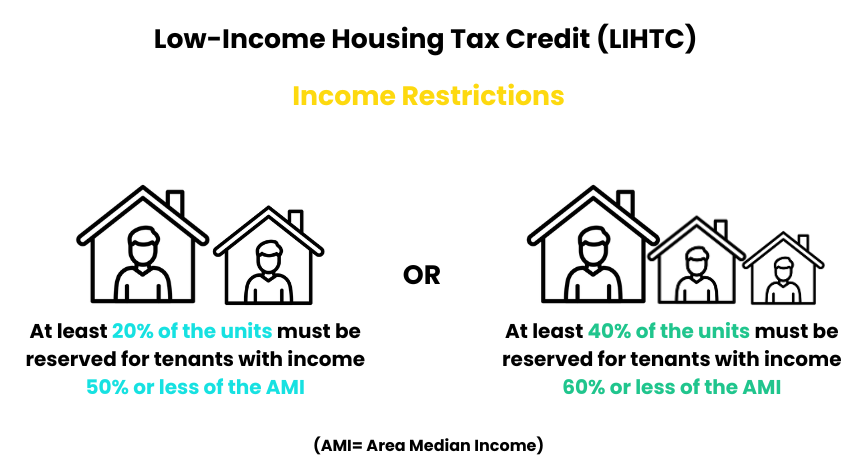
By incentivizing developers with tax credits, the program helps reduce construction costs, making it financially viable to build housing for people who might otherwise struggle to afford a place to live.
For more details about the specific rules for LIHTC, you can check out resources like the[ National Council of State Housing Agencies](https://www.ncsha.org/).
## Who is eligible for the Low-Income Housing Tax Credit (LIHTC)?
LIHTC housing is designed to assist low-income households, but the exact eligibility criteria depend on the area’s median income and the specific requirements of the development. Generally, tenants must meet the following criteria:
- **Income Limits**: Tenants must earn no more than 60% of the median income for the area in which they live. For example, in a high-cost urban area, the income limits might be higher, while in rural or less expensive areas, they could be lower.
- **Affordability Requirements**: Rent must be affordable, generally capping out at 30% of the tenant's income.
Local housing authorities and developers are responsible for determining whether an individual qualifies for a specific LIHTC unit. For a more detailed understanding of income limits and eligibility, visit the [U.S. Department of Housing and Urban Development (HUD)](https://www.hud.gov/) website.
## How is the LIHTC different from other housing programs?

Unlike other federal housing programs like Section 8, which provides direct rental assistance to eligible households, the LIHTC focuses on creating affordable housing units through tax incentives for private developers. While both programs aim to address the affordable housing shortage, they operate differently:
- **Direct Assistance**: Programs like Section 8 provide direct rental assistance to individuals or families to make their current housing more affordable. LIHTC focuses on increasing the supply of affordable rental housing.
- **Private Sector Involvement**: LIHTC relies on the private sector (developers and investors) to create affordable housing, while other programs may involve more direct government management and funding.
- **Rent and Income Limits**: LIHTC housing sets both income and rent restrictions, whereas other programs might only set rent limits or focus on direct subsidies for renters.
## What are the benefits of the Low-Income Housing Tax Credit?
The LIHTC program has numerous benefits for both developers and low-income renters. Here are the key advantages:
- **Increased Affordable Housing Supply**: By offering developers an incentive to build or rehabilitate rental properties, the LIHTC program helps address the ongoing shortage of affordable housing in many parts of the U.S.
- **Private Sector Involvement**: Since the program involves private developers and investors, it reduces the financial burden on local governments, making it a more sustainable model for long-term housing solutions.
- **Economic Growth**: The construction and rehabilitation of affordable housing create jobs in the construction industry and stimulate local economies. In addition, the affordable housing sector often leads to increased demand for goods and services, benefiting surrounding communities.
- **Community Revitalization**: LIHTC properties often transform underdeveloped or blighted areas into vibrant, livable neighborhoods. This revitalization can have far-reaching social and economic benefits for the surrounding community.
For further insight on how LIHTC fosters economic development, you can explore articles from organizations such as the [Affordable Housing Tax Credit Coalition](https://www.taxcreditcoalition.org/).
## What are the challenges of the LIHTC program?

While the Low-Income Housing Tax Credit has been successful in promoting affordable housing development, there are some challenges to the program:
- **Competition for Tax Credits**: The number of tax credits available each year is limited, and developers often face stiff competition to secure credits. This means that not all affordable housing projects that apply for LIHTC funding are approved.
- **Local Market Conditions**: The success of the LIHTC program depends on the market conditions in specific areas. In regions where housing demand is low or where rent levels are too low to make projects financially feasible, the program may be less effective.
- **Long-Term Affordability**: While the affordability requirements are meant to last for at least 15 years, some critics argue that long-term affordability may not be guaranteed beyond the compliance period, especially as housing markets change over time.
For more information on challenges and solutions in the LIHTC program, visit resources like the[ National Low Income Housing Coalition](https://nlihc.org/).
## How can I apply for LIHTC housing?
To apply for a Low-Income Housing Tax Credit unit, you must contact the property management or developer directly, as they are responsible for determining eligibility and managing applications. You can typically find LIHTC housing options listed on:
- Local housing authority websites
- Affordable housing search platforms, such as [Affordable Housing Online](https://affordablehousingonline.com/)
Be prepared to provide documentation of your income, household size, and any other information required to determine if you meet the program’s eligibility criteria.
***For more ways to find affordable housing for you and your family, check out this ******[Guide to the Most Accessible Low Income Housing Programs](/articles/housing-essentials/a-guide-to-the-most-accessible-low-income-housing-programs)******.***
## The fight against the affordable housing crisis
The Low-Income Housing Tax Credit (LIHTC) is a vital tool in the fight against the affordable housing crisis in the United States. By incentivizing private developers to build and maintain affordable rental housing, the program has helped create thousands of affordable homes for low-income individuals and families. While there are challenges in ensuring the continued success of the program, LIHTC remains a powerful mechanism for increasing the availability of affordable housing across the country.
If you’re in need of affordable housing, it’s worth exploring the opportunities provided by LIHTC projects in your area. To learn more about LIHTC, visit government resources like the [IRS LIHTC page](https://www.irs.gov/pub/irs-utl/IRC42%20Low%20Income%20Housing%20Credit%20ATG%20Part%201.pdf) or [local housing agencies](https://www.hud.gov/program_offices/public_indian_housing/pha/contacts).
#### **Unlock your disability benefits with confidence! **Join our community to access all the benefits you're eligible for. Don’t miss out — [sign up now](https://benefitkarma.com/) and start maximizing your savings today!
---
type: article
title: How SBA Loans Maximize Your Business Growth
url: https://benefitkarma.com/articles/income-employment/sba-loans
updated: 2026-05-19
---
# How SBA Loans Maximize Your Business Growth
Recent data from the U.S. Small Business Administration highlights an impressive statistic: [33.3 million businesses](https://advocacy.sba.gov/wp-content/uploads/2023/11/2023-Small-Business-Economic-Profile-US.pdf) in the United States are classified as small businesses, accounting for 99.9% of all businesses in the country.
As a small business owner, securing capital can be an overwhelming hurdle. Whether you need funds to expand your operations, buy equipment, or cover operational expenses, traditional loans can be hard to come by—especially if your business doesn’t have a long credit history or substantial collateral. The stress of searching for financing options can be frustrating, and in many cases, can even stall your growth. **That’s where SBA loans come in**.
Backed by the U.S. government, these loans are designed to help small business owners like you access the capital you need to succeed, with lower interest rates and longer repayment terms than traditional loans. In this blog, we’ll guide you through everything you need to know about SBA loans, from eligibility to the application process, and help you understand how this valuable resource can help your business thrive.
> **Key Takeaways:**
- **SBA loans** are government-backed loans designed to help small businesses with funding needs such as working capital, real estate purchases, and equipment.
- There are several types of SBA loans, including the** 7(a) Loan Program**, **504 Loan Program**, and **Microloan Program**.
- SBA loans offer **low-interest rates**,** longer repayment terms**, and **flexible use of funds**.
- **Eligibility** depends on factors like business size, location, creditworthiness, and ability to repay.
- The** application process** involves gathering necessary documentation and working with an SBA-approved lender. The approval process typically takes **30 to 60 days**.
- SBA loans may be available to those with less-than-perfect credit, but a** credit score of at least 620 is often required** for approval.
## What are SBA Loans?
SBA loans are loans that are partially guaranteed by the **U.S. government**. The SBA works with approved lenders, such as banks and credit unions, to offer loans to small businesses that might not be able to qualify for traditional bank loans. The SBA doesn’t lend money directly, but it provides a guarantee that reduces the risk for lenders, making it easier for small businesses to access capital.
## Types of SBA Loans
The SBA offers several loan programs, including:
- **7(a) Loan Program**: This is the SBA’s most common and flexible loan, which can be used for working capital, equipment purchases, and even debt refinancing.
- **504 Loan Program**: These loans are typically used for purchasing real estate or large equipment.
- **Microloan Program**: These loans are smaller, typically under $50,000, and can be used for a variety of purposes including working capital and inventory.
- **Disaster Loans**: Offered in response to natural disasters, these loans help businesses recover.
For more detailed information on each program, visit the official [SBA website](https://www.sba.gov/funding-programs/loans).
> ***Looking for tax relief for your small business? Discover the******[ Ultimate Guide to Tax Relief for Small Business Owners](/articles/income-employment/tax-relief)******.***
## Who is eligible for an SBA Loan?
The eligibility criteria for SBA loans can vary depending on the specific loan program, but here are the basic requirements:
- **Business Size**: Your business must be considered "small" according to SBA standards. Generally, this means having fewer than 500 employees, though the definition can vary by industry.
- **Location**: The business must be based in the U.S. or its territories.
- **Ability to Repay**: The business must demonstrate its ability to repay the loan.
- **Creditworthiness**: While SBA loans are more accessible than traditional loans, lenders will still review your personal and business credit history.
- **Business Type**: SBA loans are available for most types of businesses, but some businesses, such as gambling or speculative enterprises, are excluded.
## What are the benefits of SBA Loans?
SBA loans come with several benefits that make them attractive to small business owners:
- **Lower Down Payments**: SBA loans generally require lower down payments than traditional loans, making them easier to access.
- **Lower Interest Rates**: Since these loans are partially government-backed, lenders can offer competitive interest rates.
- **Longer Repayment Terms**: The repayment terms for SBA loans can be longer than those for traditional loans, reducing your monthly payments.
- **Flexible Use of Funds**: SBA loans can be used for a wide range of purposes, from buying equipment to expanding your business.
## How long does it take to get an SBA Loan?
The timeline for getting an SBA loan can vary. On average, it can take **30 to 60 days** for your loan to be processed and approved. Some loans, such as the **SBA Express Loan**, may be approved more quickly, within 36 hours. However, the process can take longer if additional documentation is needed.
Access a curated list of SBA-approved lenders to streamline the process with the [U.S. Small Business Administration](https://www.sba.gov/funding-programs/loans/lender-match-connects-you-lenders).
## What are the costs of SBA Loans?
The cost of an SBA loan includes the interest rate, which is typically lower than other types of loans, but still depends on the specific loan type and the lender. Additionally, SBA loans may come with fees such as:
- **Loan Guaranty Fee**: A fee that the SBA charges to guarantee the loan.
- **Origination Fees**: Some lenders charge fees to cover the costs of processing the loan.
- **Closing Costs**: These can include administrative fees or third-party fees for services such as appraisals.
Make sure to carefully review any fees associated with your SBA loan and compare them with other financing options before deciding.
## Can I apply for an SBA Loan if I have bad credit?
While **bad credit** can make it more difficult to qualify for an SBA loan, it’s not an automatic disqualification. The SBA does not have a minimum credit score requirement, but lenders typically look for a personal credit score of at least 620.
If your credit is lower than this, you may still be eligible, but you might need to offer collateral or find a co-signer. Additionally, improving your credit score before applying may increase your chances of getting approved.
## How do I apply for an SBA Loan?
The process for applying for an SBA loan generally involves the following steps:
- **Prepare Your Documentation**: This includes your business plan, financial statements, tax returns, and personal financial information.
- **Find a Lender**: You can apply for an SBA loan through participating SBA lenders, which include banks, credit unions, and online lenders.
- **Submit Your Application**: Complete the SBA loan application form and submit it with your documentation.
- **Wait for Approval**: Your lender will assess your application and determine whether you qualify for the loan.
## Fund and grow your small business
SBA loans offer a valuable option for small business owners looking for funding to grow or sustain their businesses. With favorable terms and a variety of loan programs available, an SBA loan could be the key to unlocking the capital you need. Be sure to explore your options, meet the eligibility criteria, and work with a trusted lender to make the application process as smooth as possible.
If you're ready to get started, visit the official [SBA loan portal](https://www.sba.gov/about-sba/open-government/about-sbagov-website/sba-account-login-registration-portals) to learn more about specific loan programs and find an SBA-approved lender near you.
## Frequently asked questions
### What is the maximum amount I can borrow with an SBA loan?
Each loan program has specific terms, so it's important to choose the one that best fits your business needs. For more details, visit [SBA loan limits](https://www.sba.gov/partners/lenders/7a-loan-program/terms-conditions-eligibility).
### Can I use an SBA loan for working capital?
Yes! SBA loans, especially the 7(a) Loan Program, are designed to be versatile. You can use the funds for working capital, paying off existing debt, purchasing equipment, or even expanding your business. The flexibility of SBA loans is one of the key advantages. Learn more about acceptable uses for [SBA loans here](https://www.sba7a.loans/).
### How do SBA loan interest rates compare to traditional loan rates?
SBA loan interest rates are generally lower than those of traditional bank loans. The exact rate will depend on the loan type, the size of the loan, and the lender. Typically, SBA loans offer fixed rates between 5% and 8% for the 7(a) loan, making them a more affordable option compared to many commercial loans.
### Unlock Your Disability Benefits with Confidence!*Join our community to access all the benefits you're eligible for. Don’t miss out — **[sign up now](https://benefitkarma.com/)** and start maximizing your savings today!*
---
type: article
title: Small Business Retirement Plans: Complete Guide + Free Setup Checklist
url: https://benefitkarma.com/articles/income-employment/small-business-retirement-plan
updated: 2026-07-01
---
# Small Business Retirement Plans: Complete Guide + Free Setup Checklist
As a small business owner, you understand the importance of providing retirement plans for your employees, but navigating through the maze of options can be overwhelming. With so many plans available — each with different contribution limits, tax advantages, and administrative requirements—choosing the right one for your business can feel like an impossible task. This uncertainty could lead to missed opportunities to attract and retain top talent, or worse, non-compliance with complex regulations.
However, the solution is simple: understanding the benefits, contribution options, and setup processes of small business retirement plans will help you make an informed decision that benefits both you and your employees, while ensuring your business stays on the right track for future growth.
Key Takeaways:
- Plan Variety: Small businesses can choose from several retirement plans, including 401(k)s, SEP IRAs, and SIMPLE IRAs, each offering distinct benefits.
- Tax Benefits: Offering a retirement plan provides valuable tax deductions for businesses, and employees benefit from tax-deferred savings.
- Employer Contributions: Small business owners have flexibility in contributing to retirement plans, with options for matching or employer-only contributions, depending on the plan type.
- Employee Attraction & Retention: Retirement benefits are a powerful tool for attracting top talent and enhancing employee satisfaction, which can reduce turnover and increase loyalty.
- Contribution Limits: Different plans offer varying contribution limits—401(k) allows for higher contributions compared to SIMPLE IRAs and SEP IRAs.
- Plan Setup and Management: Understanding the administrative costs and compliance requirements of each retirement plan is crucial for selecting the best option.
## What are small business retirement plans?

Small business retirement plans are employer-sponsored retirement savings plans that allow business owners and their employees to save for retirement. These plans help employees build retirement funds while offering business owners tax advantages. The most common types of retirement plans for small businesses include:
- 401(k) Plans
- SEP IRAs (Simplified Employee Pension)
- SIMPLE IRAs (Savings Incentive Match Plan for Employees)
- Profit-Sharing Plans
Each plan comes with different contribution limits, eligibility requirements, and tax advantages, so it's important to understand which one works best for your business.
Learn more about retirement plans for small businesses from the IRS.
## Which small business retirement plan is best for my business?
The "best" retirement plan depends on factors such as the size of your business, the number of employees, and how much you're willing to contribute. Here's a quick overview:
- 401(k) Plans: A 401(k) is a popular choice for many small businesses, offering flexibility in contributions and investment options. Both the employer and employees can contribute, and there are options for matching contributions.
- SEP IRA: Ideal for businesses with few or no employees, the SEP IRA allows employers to contribute a significant percentage of their income toward retirement funds. Contributions are tax-deductible for the business.
- SIMPLE IRA: This plan is designed for businesses with fewer than 100 employees. It’s easier to set up and manage compared to a 401(k) but still allows both employee and employer contributions.
Explore more options and guidelines at the U.S. Small Business Administration.
## Veteran business-owner? Discover your advantages.
Explore The Big Benefits of Veteran-Owned Businesses and learn how to take full advantage of exclusive opportunities, tax breaks, and resources available to veteran entrepreneurs.
## What are the benefits of offering a retirement plan to employees?

Offering a retirement plan can benefit your business in several ways:
- Attract and Retain Talent: Competitive benefits such as retirement plans can help you stand out as an employer, making it easier to attract and retain top talent.
- Tax Deductions: Contributions made by the business to employee retirement plans are generally tax-deductible.
- Employee Satisfaction: Retirement plans contribute to employee satisfaction and can improve morale and loyalty to the company.
According to a study by the Society for Human Resource Management, 60% of employees are more likely to stay with employers who offer retirement benefits, making it a smart investment for business owners.
## How much can I contribute to a small business retirement plan?
Contribution limits depend on the type of plan you choose:
- 401(k): Employers can contribute up to $66,000 (or $73,500 if age 50 or older) for 2023. Employees can also contribute up to $22,500 ($30,000 if age 50+).
- SEP IRA: The maximum contribution is the lesser of $66,000 or 25% of an employee's compensation.
- SIMPLE IRA: Employers can contribute up to $15,500 for 2023, with an additional $3,500 catch-up contribution if the employee is 50 or older.
For more information on contribution limits, refer to this guide from the IRS.
## Are there any tax benefits for small business retirement plans?

Yes, one of the key advantages of small business retirement plans is the tax benefits. Contributions made to these plans are generally tax-deductible for your business. Additionally, the retirement funds grow tax-deferred until they are withdrawn in retirement.
- For the Business: Contributions you make to your employees' retirement plans are tax-deductible.
- For Employees: Employees won’t pay taxes on their contributions or earnings until they withdraw the funds in retirement.
- Roth Options: Some plans, like Roth 401(k)s, allow employees to contribute post-tax dollars, which means they can withdraw the funds tax-free in retirement.
Read more about tax advantages for small businesses from the Congressional Research Service.
## Find tax relief. Maximize your savings.
Discover the Ultimate Guide to Tax Relief for Small Business Owners and learn how you can reduce your tax burden while boosting your retirement plan benefits. Don't leave money on the table—get expert tips and strategies today!
## How do I set up a small business retirement plan?
Setting up a retirement plan for your business involves a few key steps:
- Evaluate Your Needs: Assess your business’s size, budget, and goals for employee retirement benefits.
- Choose the Right Plan: Based on your evaluation, choose the most appropriate plan (e.g., 401(k), SEP IRA, SIMPLE IRA).
- Choose a Plan Provider: You can set up your plan through a financial institution, such as a bank or brokerage firm, or through a third-party administrator (TPA) that offers plan management services.
- Ensure Compliance: Make sure your retirement plan complies with federal regulations and guidelines, including contribution limits and reporting requirements.
Get detailed instructions on setting up a retirement plan from the IRS.
## When should I start offering a retirement plan?

The earlier you start offering a retirement plan, the better. Not only does it provide long-term benefits for your employees, but it can also help you attract talent and reduce turnover. Additionally, offering a retirement plan can help you build a more attractive business profile, which may be advantageous if you plan to sell or bring in investors in the future.
## Ready to set up your small business retirement plan?
Download the FREE Small Business Retirement Plan Setup Checklist to get started today!
Download Your FREE Checklist Here
## Secure your business’s financial future
Choosing the right retirement plan is an important decision that impacts your business’s ability to attract and retain employees while securing their financial futures. Consider factors like the number of employees, cost of administration, contribution flexibility, and long-term business goals to make the best decision for your small business.
---
type: article
title: Unlock Affordable Housing with Project-Based Rental Assistance (PBRA)
url: https://benefitkarma.com/articles/housing-essentials/project-based-rental-assistance
updated: 2026-05-19
---
# Unlock Affordable Housing with Project-Based Rental Assistance (PBRA)
Finding affordable housing is one of the biggest challenges facing low-income families in the U.S. With rising rental costs and limited availability of affordable units, many families struggle to secure safe and stable housing. The lack of affordable options can lead to housing instability, stress, and financial strain. Thankfully, programs like [Project-Based Rental Assistance](/glossary/project-based-rental-assistance) (PBRA) offer a lifeline by providing long-term rental subsidies that keep housing costs manageable for eligible families. In this post, we’ll dive into how PBRA works, its benefits, and how you can apply to take advantage of this essential program.
> **Key Takeaways:**
- **What PBRA is**: Project-Based Rental Assistance (PBRA) is a HUD program that offers rental subsidies to specific housing projects, ensuring affordability for low-income families.
- **Eligibility**: To qualify, your income must be below 50% of the area median income, with eligibility criteria varying by property.
- **Application Process**: Applications are submitted directly to the property management or through your local [Public Housing](/glossary/public-housing) Agency (PHA).
- **Benefits**: PBRA provides long-term stability, allowing tenants to pay affordable rent based on their income, with the government covering the remaining cost.
- **Long-Term Assistance**: PBRA contracts typically last 20 years, ensuring that rental assistance is available over the long term.
## What is Project-Based Rental Assistance (PBRA)?
Project-Based Rental Assistance (PBRA) is a program overseen by the U.S. Department of Housing and Urban Development (HUD) that helps ensure affordable housing by providing rental subsidies to specific properties. The subsidies are attached to the property itself rather than the individual tenant, meaning that qualifying tenants pay a reduced rent based on their income, while the government covers the remaining portion.
- **Government Subsidies**: The government pays a portion of the rent directly to the property owner.
- **Rent Adjustments**: Tenants are required to pay the balance, which is typically calculated at 30% of their adjusted household income.
- **Long-Term Contracts**: The rental assistance is typically provided under long-term contracts lasting up to 20 years, ensuring stability for both tenants and landlords.
To learn more, visit HUD's PBRA overview.
## How does PBRA work?
Project-Based Rental Assistance helps low-income individuals access affordable housing by directly linking rental assistance to specific housing projects. Here’s a breakdown of how PBRA works:
- **Eligibility Verification**: Tenants must meet income qualifications, usually having an income below 50% of the area median income (AMI).
- **Subsidy Payment**: HUD pays a portion of the rent directly to the landlord. The tenant pays the remainder, based on their income.
- **Property-Based Assistance**: The rental subsidy is tied to the property, meaning tenants must reside in that specific building or housing development.
- **Landlord Participation**: Property owners must enter into an agreement with HUD to participate in PBRA, and they must maintain the property and provide a certain level of services to tenants.
For more details, visit the [National Counsel of State Housing Agencies](https://www.ncsha.org/wp-content/uploads/Project-Based-Section-8-Rental-Assistance-FAQs-2024.pdf) page.
## What are the benefits of PBRA?
PBRA offers several key benefits, both for tenants and property owners. Some of the most notable advantages include:
- **Affordable Housing**: Ensures long-term affordability for tenants, preventing excessive rent increases.
- **Stable Housing**: Helps families maintain stable housing by linking their rent to their income rather than market fluctuations.
- **Preserves Affordable Housing**: Encourages property owners to maintain their buildings in good condition and continue offering affordable units.
- **Incentivizes Landlords**: Property owners are incentivized to participate by guaranteed payments from the government, helping them maintain financial stability.
Learn more about the benefits of PBRA on the [National Housing Trust](https://nationalhousingtrust.org/sites/default/files/page_file_attachments/Benefits%20of%20PBRA_0.pdf) page.
## Who is eligible for PBRA?
Eligibility for PBRA depends on several factors, including income, family size, and the specific property’s requirements. Typically, the program is designed for individuals and families whose income is below 50% of the median income for their area. Key eligibility criteria include:
- **Income Limits**: Families must have an income below 50% of the area median income (AMI). However, some properties may allow tenants with higher incomes to apply if the property has available units.
- **Family Size**: Eligibility also depends on family size, as larger families may qualify for larger units.
- **Other Requirements**: Each property may have specific eligibility criteria based on factors like age, disability status, or special housing needs.
For a more in-depth guide on eligibility, visit the [Center on Budget and Policy Priorities](https://www.cbpp.org/research/housing/section-8-project-based-rental-assistance) page.
## How do you apply for PBRA?
Applying for Project-Based Rental Assistance typically involves contacting the property or development offering the assistance. Each participating property will have its own application process, but the general steps are detailed below. To find available properties, check out [HUD’s PHA locator.](https://www.hud.gov/program_offices/public_indian_housing/pha/contacts)
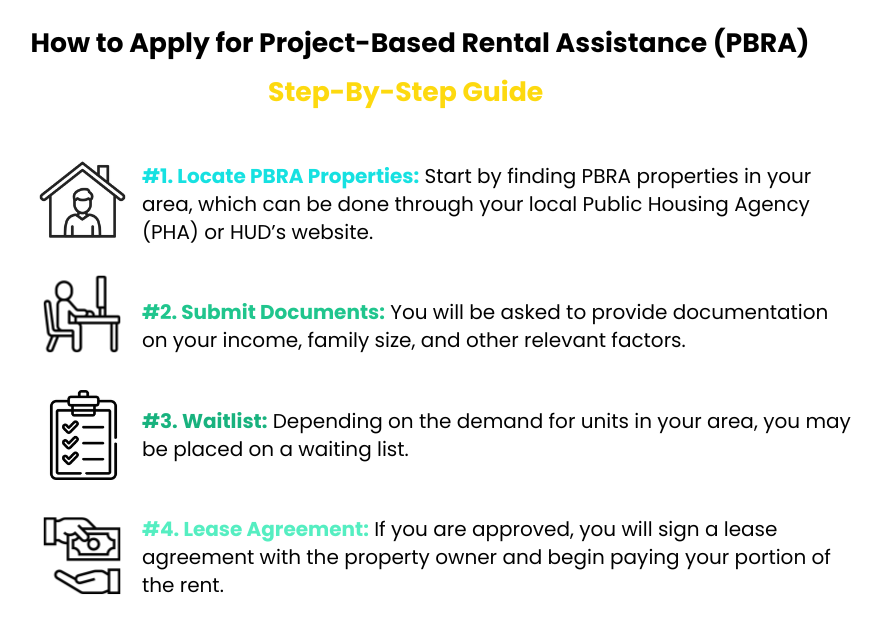
## How long can you stay in a PBRA property?
The length of your stay in a Project-Based Rental Assistance property can vary. Generally, you can live in a PBRA unit for as long as you meet the eligibility criteria and comply with the lease agreement. Some key factors include:
- **Eligibility**: If your income exceeds the allowable limits or other circumstances change, you may need to leave the property or transition to another form of housing assistance.
- **Lease Terms**: PBRA housing contracts usually last for 1 year, but you can typically renew the lease each year as long as you remain eligible.
- **Changes in Housing Assistance**: If your income increases, you may no longer qualify for PBRA assistance, and you may need to find alternative housing.
For more information, visit HUD’s Tenant Rights and Lease information.
## What are the differences between Project-Based Rental Assistance and Housing Choice Vouchers?
While both PBRA and Housing Choice Vouchers (Section 8) are government programs designed to provide affordable housing, they have key differences:
- **PBRA**: Assistance is tied directly to specific properties. Tenants must live in a designated building or development.
- **Housing Choice Vouchers**: Tenants can choose their own housing (as long as it meets HUD standards), and the voucher is used to help cover rent in private housing.
Learn more about Housing Choice Vouchers at [Housing Choice Voucher Program Overview](https://www.hud.gov/topics/housing_choice_voucher_program_section_8).
## Can PBRA housing be used in rural areas?
Yes, PBRA housing is available in both urban and rural areas. However, the availability of PBRA units may be more limited in rural locations. Some important points to consider:
- **Rural Availability**: While fewer PBRA properties are available in rural areas, there are still affordable options.
- **Partnerships with USDA**: In rural areas, PBRA often works in partnership with the USDA Rural Development program, which helps to provide affordable housing for rural families.
For information about rural housing, visit [USDA Rural Development Housing Assistance](https://www.rd.usda.gov/programs-services/all-programs/housing-programs).
## What happens if the landlord decides to end the PBRA contract?
If the landlord decides to terminate their PBRA contract, the following may occur:
- **Notice to Tenants**: The landlord must provide notice to HUD and tenants before ending the contract.
- **Alternative Housing**: Tenants may be given time to find alternative housing if the contract is terminated.
- **Possibility of Continuation**: In some cases, tenants may be able to continue their stay if the landlord agrees to renew the contract or transfer to another PBRA property.
For more information on the contract termination process, check out this [National Low Income Housing Coalition](https://nlihc.org/resource/hud-proposes-rule-requiring-30-day-notice-tenants-termination-lease-non-payment-rent) article.
## Are there any costs for tenants in Project-Based Rental Assistance housing?
While PBRA is designed to [make housing affordable](/articles/housing-essentials/public-housing-programs), tenants are still required to pay a portion of the rent. The cost to tenants typically includes:
- **Income-Based Rent**: Tenants pay 30% of their adjusted income toward rent.
- **Utilities**: Tenants may also be responsible for paying some utilities, depending on the lease agreement.
- **Other Fees**: Additional fees may apply for things like parking, pets, or community amenities, depending on the property.
For more details on tenant costs, visit [HUD's Fair Housing and Equal Opportunity](https://www.hud.gov/fairhousing) page.
## How can I find Project-Based Rental Assistance (PBRA) housing in my area?
To find PBRA housing in your area:
- **HUD’s Website**: You can find a list of available properties through HUD’s affordable housing search tool.
- **Local Public Housing Agencies (PHAs)**: Your local PHA can also provide information on PBRA properties and how to apply.
Start your search with HUD’s affordable housing search toolkit.
## Affordable housing for you and your family
Project-Based Rental Assistance (PBRA) plays a critical role in providing affordable housing for low-income individuals and families across the country. Understanding how PBRA works, who is eligible, and how to apply can help you take advantage of this valuable program. Whether you're seeking stable housing or trying to navigate the world of affordable housing programs, we hope this FAQ has provided you with helpful answers.
For additional resources on PBRA and other housing assistance programs, visit[ A Guide to the Most Accessible Low Income Housing Programs](/articles/housing-essentials/a-guide-to-the-most-accessible-low-income-housing-programs)[.](/articles/housing-essentials/a-guide-to-the-most-accessible-low-income-housing-programs)
### Unlock Your Disability Benefits with Confidence! *Join our community to access all the benefits you're eligible for. Don’t miss out — **[sign up now](https://benefitkarma.com/)** and start maximizing your savings today!*
---
type: article
title: 7 Proven Tips for Senior Property Tax Relief
url: https://benefitkarma.com/articles/seniors-special-groups/senior-property-tax-relief
updated: 2026-05-20
---
# 7 Proven Tips for Senior Property Tax Relief
According to a recent study by the [National Council of Aging](https://www.ncoa.org/article/get-the-facts-on-older-americans/), there are 57.8 million adults age 65+ living in the U.S. As a senior, managing finances in retirement can be a real challenge, especially when it comes to property taxes.
Many seniors worry about losing their homes or being unable to keep up with these rising costs. The good news is that there are several property tax [relief programs](/articles/housing-essentials/disaster-relief-programs) available to help, including exemptions, deferrals, and specialized [benefits for veterans](/articles/family-education/unlocking-the-gi-bill-your-guide-to-education-benefits-for-veterans). In this post, we’ll share 7 actionable tips to help you reduce your property tax burden and keep more money in your pocket.
> **Key Takeaways**
- **Eligibility:** Senior property tax relief programs vary by state and locality, with most requiring you to be 65 or older. Income and property value limits may apply.
- **Exemptions:** Look for senior property tax exemptions or homestead programs in your state, which can significantly reduce your taxable property value.
- **Deferrals:** Consider property tax deferral programs if you need to postpone payment without penalties, especially if you’re on a fixed income.
- **Veterans’ Benefits: **Many states offer additional senior property tax relief for [veterans and their](/articles/military-veterans/va-pension-a-financial-safety-net-for-veterans-and-their-families) surviving spouses. Check with local veterans’ offices for specific programs.
- **State-Specific Programs**: Each state offers unique relief opportunities, including income tax deductions and local rebates—explore [what’s available](/articles/seniors-special-groups/essential-elder-services-available) in your area.
- **Application:** Be proactive in applying for senior property tax relief programs. Ensure all documentation is submitted on time to take full advantage of available benefits.
## What is senior property tax relief?
Try it: [Benefit Eligibility Screener](/benefit-eligibility-screener)
Check senior benefits and tax-relief programs you may qualify for.
Senior property tax relief refers to various programs, exemptions, and deductions designed to reduce the property tax burden for eligible seniors. These programs are offered by state and local governments and often target individuals over a certain age, typically 65 or older. The goal is to ensure that seniors, particularly those on fixed incomes, are not overwhelmed by rising property taxes.
### Eligibility for senior property tax relief: 7 key factors to know
**Tip #1: Understand the eligibility requirements**

The first step in qualifying for senior property tax relief is understanding the eligibility requirements. These can vary by state and locality, but some common factors include:
- **Age Requirement**: Seniors generally need to be 65 or older.
- **Income Limits**: Some programs are designed for seniors with lower annual income.
- **Property Value**: Certain relief programs are tied to the value of the property you own.
- **Primary Residence**: Many tax relief programs only apply to your primary residence, not vacation homes or rental properties.
**Actionable Tip**: Review your state’s property tax exemption programs to determine if you meet the eligibility criteria. Local government websites often have resources and application forms available online. You can find more information on eligibility requirements for state-specific programs through the [National Conference of State Legislatures (NCSL)](https://www.ncsl.org/fiscal/state-tax-actions-2024).
### How can seniors save money with property tax exemptions?
**Tip #2: Look for property tax exemptions for seniors**
Many states offer **property tax exemptions** for senior homeowners, reducing the amount of property taxes owed. These exemptions can take several forms:
- **Homestead Exemptions**: A reduction in the taxable value of your home, meaning you pay less property tax.
- **[Senior Property Tax Exemptions](https://themortgagereports.com/63473/how-to-claim-senior-property-tax-exemption)**: These provide a specific amount of exemption based on age and income.
- **Circuit Breaker Programs**: Some states offer programs that freeze property taxes or offer rebates for seniors with limited income.
**Actionable Tip**: Check with your local assessor’s office or tax department to see if your state offers specific property tax exemptions for seniors. Filing for exemptions can result in significant savings.
### What is a property tax deferral program?
### **Tip #3: Consider property tax deferral programs**
A **property tax deferral** program allows seniors to delay paying property taxes until they sell their home or pass away. These programs are usually available for seniors with limited income or financial hardship. The taxes are deferred (or postponed) without accruing penalties, and in some cases, interest is minimal. For more information on property tax deferrals, visit the [Department of Revenue](https://www.revenue.state.mn.us/property-tax-deferral-senior-citizens).
**Actionable Tip**: If you’re struggling to pay property taxes but want to stay in your home, inquire about property tax deferral programs in your area. Be sure to understand the terms and any potential interest charges before enrolling.
### Are there any federal tax relief programs for seniors?
### **Tip #4: Take advantage of federal tax relief opportunities**
While federal property tax relief specifically for seniors is limited, there are some **federal tax benefits** that could indirectly reduce your overall tax burden:
- **Senior Tax Credits**: Seniors may qualify for tax credits like the **[Earned Income Tax Credit](/glossary/eitc) (EITC)**, which can provide financial relief for those with modest incomes.
- **Standard Deductions for Seniors**: Seniors 65 or older can take advantage of an increased standard deduction on their federal income taxes.
- The IRS provides comprehensive information on tax deductions and credits for seniors. Learn more about federal tax credits and standard deductions for seniors on the [IRS website](https://www.irs.gov/credits-deductions/individuals/credit-for-the-elderly-or-the-disabled).
**Actionable Tip**: Consult with a tax advisor or use online tax software to determine if you qualify for any federal tax credits or deductions that could supplement property tax savings.
### Can veterans receive special property tax benefits?
### **Tip #5: Look into veterans’ property tax benefits**

Many states and localities offer **property tax relief** specifically for military veterans. If you’re a senior veteran, you may qualify for additional property tax exemptions or credits. Some of these benefits include:
- **Veterans’ Property Tax Exemptions**: Reductions in property taxes for veterans, often based on disability status or service-connected injuries.
- **Surviving Spouse Benefits**: Many states offer property tax benefits to the surviving spouses of veterans.
- For information on veterans’ property tax benefits, visit the [U.S. Department of Veterans Affairs (VA)](https://news.va.gov/115594/in-tax-season-veterans-maximize-tax-benefits/) to explore resources and eligibility for veteran-specific property tax exemptions and credits.
**Actionable Tip**: Check with your local veterans’ affairs office or tax assessor to see what specific property tax benefits are available to veterans or their surviving spouses.
### What other state-specific programs can seniors explore?
### **Tip #6: Explore state-specific senior tax relief programs**
In addition to federal exemptions and deferrals, many states offer unique **senior property tax relief programs** tailored to their residents. These may include:
- **State Income Tax Deductions for Seniors**: Some states allow seniors to deduct property taxes paid from their state income taxes.
- **Local Tax Relief Programs**: Municipalities may offer tax rebates, caps on property tax increases, or tax credits for seniors.
- For a comprehensive list of senior tax relief programs by state, [Senior Living](https://www.seniorliving.org/finance/state-taxes-seniors/) offers state-by-state resources on property tax relief and other senior benefits.
**Actionable Tip**: Visit your state’s department of revenue or taxation website to explore local and state-specific property tax relief programs for seniors. You might be eligible for programs that aren’t widely advertised.
### How do I apply for senior property tax relief?
### **Tip #7: Be proactive in applying for tax relief programs**
Applying for senior property tax relief typically involves submitting an application or form to your local tax authority or government office. Be sure to:
- **Gather Required Documentation**: This could include proof of age, income statements, tax returns, and property ownership.
- **File on Time**: Many tax relief programs have specific deadlines, so it’s important to apply well in advance.
- **Follow Up**: Once you’ve submitted your application, check back to confirm it has been processed.
- For help navigating the application process, the [Taxpayer Advocate Service](https://www.irs.gov/taxpayer-advocate) provides assistance to those dealing with tax issues, including property tax relief.
**Actionable Tip**: Set reminders on your calendar for application deadlines. Working with a local tax professional or financial advisor can help ensure you’ve completed all necessary paperwork and submitted it on time.
### Take action: your path to senior property tax relief
Property tax relief for seniors can offer significant financial savings and peace of mind, especially in retirement. By understanding the various programs available, from exemptions and deferrals to veterans’ benefits, you can reduce your property tax burden and keep more money in your pocket. Don’t hesitate to explore both federal and state-specific programs to take full advantage of the tax relief options available to you.
**Bonus Tip**: Stay up-to-date with changes in property tax laws in your area, as new programs and relief measures may become available over time.
### Frequently asked questions (FAQ) about senior property tax relief
###
**1. What are property tax exemptions for seniors?**
Property tax exemptions for seniors typically reduce the taxable value of your home, lowering your overall property tax bill. These can include [homestead exemptions](https://smartasset.com/taxes/what-is-a-homestead-tax-exemption) (which offer a flat reduction in taxable value) and[ senior-specific exemptions](https://www.realtor.com/advice/finance/senior-property-tax-exemptions-101-how-you-can-save-big/?msockid=1bf47af314b3617a12ae6fd715d26067) based on income and age.
### 2. How do I qualify for senior property tax relief?
Eligibility generally depends on age (usually 65 or older), income limits, and sometimes the value of your home. Specific requirements vary by state and locality, so it’s best to check with your local tax authority to see if you meet the criteria.
### 3. Can veterans receive property tax benefits?
Yes, many states offer [special property tax exemptions](https://www.veteransunited.com/futurehomeowners/veteran-property-tax-exemptions-by-state/?msockid=1bf47af314b3617a12ae6fd715d26067) or discounts for veterans, particularly those with service-connected disabilities. These benefits can also extend to surviving spouses of veterans. Contact your local veterans’ office or tax assessor to learn about the benefits available to you.
### 4. How do property tax deferral programs work?
A [property tax deferral](https://www.revenue.state.mn.us/property-tax-deferral-senior-citizens) allows seniors to delay paying property taxes until they sell their home or pass away. These programs can be especially helpful for seniors on fixed incomes. However, the deferred taxes typically accrue interest, so it’s important to understand the terms before enrolling.
### 5. Are there federal programs that can help with property taxes?
While there are no direct federal property tax relief programs, seniors can benefit from [increased standard deductions](https://www.kiplinger.com/taxes/the-new-standard-deduction-is-here#:~:text=There%27s%20an%20additional%20standard%20deduction%20for%20taxpayers%2065,to%20the%20regular%20amount%20for%20their%20filing%20status.) on their federal income taxes. Additionally, some federal tax credits, like the [Earned Income Tax Credit (EITC)](https://www.irs.gov/credits-deductions/individuals/earned-income-tax-credit-eitc), can provide financial relief that may indirectly assist with property tax burdens.
### 6. What should I do if I need help applying for tax relief?
If you’re unsure how to apply for property tax relief programs, many states offer assistance through tax offices or local financial advisors. [Professional tax preparers](https://www.irs.gov/individuals/free-tax-return-preparation-for-qualifying-taxpayers) and resources like the [Taxpayer Advocate Service](https://www.irs.gov/taxpayer-advocate) can help you navigate the application process and ensure you don’t miss important deadlines.
### 7. How can I stay informed about property tax relief opportunities?
To stay updated, regularly check your local tax authority’s website, sign up for relevant newsletters, or consult with a tax advisor who can inform you about new or changing tax relief programs. You can also contact your state’s department of revenue to inquire about the latest relief options available to seniors.
---
type: article
title: Senior Energy Assistance: Keep Your Home Comfortable & Affordable
url: https://benefitkarma.com/articles/housing-essentials/senior-energy-assistance
updated: 2026-05-19
---
# Senior Energy Assistance: Keep Your Home Comfortable & Affordable
The U.S. Census reports that the population of adults age 65 and over grew at the fastest rate since 1880, reaching [55.8 million](https://www.census.gov/topics/population/older-aging.html#:~:text=The%20U.S.%20population%20age%2065%20and%20over%20grew,million%2C%20a%2038.6%25%20increase%20in%20just%2010%20years.) by 2020—a 38.6% increase in just 10 years. As this population continues to grow, many seniors face significant financial challenges, particularly when it comes to paying their utility bills. On fixed incomes, rising energy costs force many to choose between heating their homes and covering other essential needs, leading to increased stress and vulnerability to service disruptions.
Senior energy assistance programs can provide much-needed relief, offering discounts, payment plans, and even emergency funds to ensure they can stay comfortable and secure in their homes. In this guide, we’ll explore energy assistance programs for seniors, including air conditioner and furnace assistance, and explain how you can access support to keep your utilities affordable.
***For additional support on senior well-being, discover ******[Essential Elder Services: What’s Available and How They Help](/articles/seniors-special-groups/essential-elder-services-available)******.***
> **Key Takeaways:**
- Senior energy assistance programs can help seniors reduce utility costs and avoid service disruptions.
- Air conditioner and furnace programs provide support to ensure seniors stay safe during extreme temperatures.
- [LIHEAP](/glossary/liheap) and EHEAP offer federal grants for heating and cooling assistance, with emergency options available.
- WAP ([Weatherization Assistance Program](/glossary/wap)) improves home energy efficiency to lower long-term utility costs.
- Apply for senior energy assistance through local utility companies, community action agencies, and state programs.
## Air conditioner programs for seniors: stay cool in the summer
During hot summer months, seniors are particularly vulnerable to heat-related illnesses. Many low-income seniors face difficulties in affording air conditioning, which can lead to dangerous situations. Fortunately, senior energy assistance programs can help with [air conditioning ](https://lawguideline.org/free-air-conditioners-for-seniors/)costs. These programs often provide grants or subsidies to help seniors purchase or maintain air conditioning units. Some local utility companies also offer cooling assistance during extreme heat waves to ensure seniors can stay safe and comfortable.
## Furnace assistance programs for seniors: stay warm in the winter
Just as summer heat can be dangerous, the cold of winter can pose serious risks for seniors. [Furnace assistance programs](https://www.growingfamilybenefits.com/government-grants-hvac-systems/) for seniors are available to ensure that seniors can afford the heating necessary to keep their homes warm. These programs may offer financial aid for repairs, replacements, or even free furnaces for those in need. Additionally, some programs provide subsidies for heating bills, helping seniors stay warm without the fear of disconnection.
## Who can help with my energy bill?
If you’re a senior struggling to pay your energy bills, you may be wondering, “Who can help with my energy bill?” Several organizations and programs can offer assistance, including:
- **Local utility companies:** Many offer discount programs for low-income seniors.
- **Community Action Agencies:** These [non-profits](https://nonprofitpoint.com/charities-that-help-with-energy-bills/#:~:text=8%20Best%20Charities%20that%20Help%20with%20Energy%20Bills,Oil%20Heat%20Program%20...%208%208.%20Operation%20Fuel) often provide energy assistance and can help you apply for federal and state aid.
- **State and local government programs:** Many states have their own energy assistance programs specifically for seniors.
Additionally, you can apply for federally funded programs like [LIHEAP](https://liheapch.acf.hhs.gov/Disconnect/disconnect.htm) (Low Income Home Energy Assistance Program), which provides financial support for heating and cooling costs.
## Can I get senior energy assistance if my utilities were disconnected?
If your utilities have already been disconnected due to nonpayment, you may still be eligible for assistance. Some programs, such as [LIHEAP](https://liheapch.acf.hhs.gov/Disconnect/disconnect.htm) and local utility companies, offer emergency assistance to restore services. It’s important to contact your energy provider or a local community action agency as soon as possible to discuss your situation and explore available options for reconnection. Visit [usa.gov](https://www.usa.gov/help-with-energy-bills) to learn more.
## Federally funded senior energy assistance programs
There are several federally funded programs designed to assist seniors with their energy bills.
The most common programs are:
- **[Low Income Home Energy Assistance Program (LIHEAP)](https://www.acf.hhs.gov/ocs/programs/liheap)****: **Provides grants to help low-income households pay for heating and cooling costs. Eligibility is based on income and family size, and the program offers both regular and emergency assistance.
- **[Emergency Home Energy Assistance Program](https://allianceforaging.org/consumers/get-help-information/eheap)**[ (](https://allianceforaging.org/consumers/get-help-information/eheap)**[EHEAP)](https://allianceforaging.org/consumers/get-help-information/eheap)****:** A related program offering emergency assistance specifically for heating and cooling during extreme weather conditions.
- **[WAP (Weatherization Assistance Program)](https://www.energy.gov/scep/wap/how-apply-weatherization-assistance)**: A valuable resource for seniors looking to reduce their energy bills. Unlike direct financial assistance for utility costs, WAP focuses on improving the energy efficiency of your home.
These programs can provide financial relief, covering a portion of your heating or cooling costs and helping to prevent utility shutoff.
## Comparing WAP, LIHEAP, and EHEAP: which program is right for you?
[Three key programs](https://www.caring.com/resources/energy-assistance-benefits-for-seniors/) can assist seniors with energy costs: WAP, LIHEAP, and EHEAP. Here’s how they compare:
- **WAP:** Focuses on improving the energy efficiency of your home, such as insulating walls, sealing leaks, and upgrading heating systems. This can reduce your overall energy consumption and lower your bills in the long term.
- **LIHEAP:** Provides direct financial assistance for heating and cooling costs. It is available to low-income seniors and can help pay your energy bills directly.
- **EHEAP:** Offers emergency assistance to seniors facing energy-related crises, such as extreme heat or cold. This program can help restore services or pay for unexpected utility costs.
All three programs aim to reduce the financial burden of energy costs, but they work in different ways. Depending on your needs, you may be eligible for one or more of these programs.
## Are there benefits from home energy assistance?
Yes! Home energy assistance programs provide a [range of benefits to seniors](https://www.ncoa.org/article/energy-assistance-benefits/), including:
- Reduced energy costs through direct financial assistance or rebates.
- Improved home energy efficiency, leading to lower long-term utility bills.
- Protection against utility shutoffs, ensuring access to essential services year-round.
- Emergency assistance during extreme weather conditions to keep seniors safe.
By participating in these programs, seniors can alleviate the stress of rising utility bills and ensure their homes remain comfortable and safe throughout the year.
***To learn more about energy efficiency, discover the EECB grant that is making energy cleaner and more affordable in the U.S.: ******[Understanding the Energy Efficiency and Conservation Block Grant](/articles/housing-essentials/understanding-the-energy-efficiency-and-conservation-block-grant)****.*
## How to apply for senior energy assistance programs

Applying for energy assistance is often straightforward. Here’s how to get started:
- **Contact your local utility company**: Inquire about senior discount programs or assistance options they may offer.
- **Visit your state’s LIHEAP or EHEAP website:** Each state has its own application process for federal energy assistance programs.
- **Reach out to local community organizations:** Non-profits or community action agencies can help you apply for various programs and guide you through the process.
- **Check eligibility:** Most programs require proof of income, household size, and residency. Make sure to gather necessary documentation to speed up the application process.
## Gain the peace of mind you deserve with senior energy assistance
For many seniors, managing energy costs is a constant concern, but energy assistance programs can provide much-needed relief. Whether it’s through air conditioner or furnace assistance, or programs like LIHEAP and WAP, there are resources available to help you stay comfortable, safe, and financially secure. If you’re struggling with high utility bills, don’t hesitate to explore these programs and apply for the support you deserve.
---
type: article
title: Affordable Public Housing Programs: 8 Common Questions Answered
url: https://benefitkarma.com/articles/housing-essentials/public-housing-programs
updated: 2026-05-19
---
# Affordable Public Housing Programs: 8 Common Questions Answered
The Center on Budget and Policies Priority reports that federal rental assistance programs enable about 5 million low-income households in the United States to rent modest housing at an affordable cost.
Exploring [public housing](/glossary/public-housing) programs can be overwhelming, with complex eligibility requirements, long waiting lists, and a lack of clear information. Without a clear understanding of how these programs work, many individuals and families miss out on affordable housing opportunities, leading to ongoing housing instability and financial stress.
This blog breaks down the key aspects of public housing programs—eligibility, application processes, waiting lists, and benefits—to help you access stable, affordable housing and take advantage of available assistance.
> ***Key Takeaways:***
- *Public housing is an affordable housing option for low-income individuals and families.*
- *Eligibility depends on income, family size, and other criteria set by local public housing authorities.*
- *The application process typically includes completing paperwork, submitting documentation, and waiting for approval.*
- *Waiting lists can be long due to high demand, but priority is given to those in the greatest need.*
## 1. What is the public housing program?
The Public Housing Program is a government-run initiative designed to provide affordable housing to low-income families, seniors, and people with disabilities. These programs are typically administered at the local or regional level by public housing authorities (PHAs), and they offer rental assistance to eligible applicants. Public housing may include apartment complexes, single-family homes, or other types of rental units, depending on the area.
Public housing units are subsidized by the government to ensure that rent remains affordable, often based on a percentage of the tenant’s income. This helps reduce the financial strain on households that might otherwise struggle to find stable and affordable housing. For a more detailed overview of public housing in the U.S., check out [HUD's Public Housing Program](https://www.hud.gov/topics/rental_assistance/phprog) (U.S. Department of Housing and Urban Development).
***To find safe, affordable housing check out this ******[Guide to the Most Accessible Low Income Housing Programs](/articles/housing-essentials/a-guide-to-the-most-accessible-low-income-housing-programs)******.***
## 2. Who is eligible for public housing programs?
Eligibility for public housing programs depends on several factors, including income, family size, and the specific guidelines set by the local housing authority. Generally, to qualify for public housing, you must:
- **Meet income limits**: Public housing is intended for low-income individuals or families. Income limits vary by location and are typically set as a percentage of the area median income (AMI). Generally, applicants must earn no more than 80% of the AMI for their area, though some programs prioritize households with even lower income levels.
- **Pass background checks**: Many PHAs conduct background checks to assess criminal history, prior evictions, and other factors. Certain criminal convictions, particularly for violent crimes or drug-related offenses, may disqualify you from receiving assistance.
- **Meet residency requirements**: You may need to be a U.S. citizen or legal resident, and some housing authorities may prioritize local residents or those who have lived in the area for a certain period.
- **Meet family composition guidelines**: Public housing programs often have specific rules regarding who can apply, including family size, age, and whether the household includes seniors or people with disabilities.
For more specific eligibility information, visit HUD's Eligibility Requirements.
## 3. How do I apply for public housing programs?
The application process for public housing varies by location, but typically involves the following steps:
- **Complete an application**: You can usually download an application from your local PHA's website or pick one up in person. The application will require basic information about your household, income, family size, and contact details.
- **Provide documentation**: Be prepared to submit supporting documents, such as proof of income, identification, Social Security numbers for all household members, and any relevant medical or disability records (if applicable).
- **Submit the application**: Once completed, you can submit your application to your local PHA. Depending on the area, you may be able to apply online, by mail, or in person.
- **Wait for approval**: After submission, the PHA will review your application and determine your eligibility. If approved, you may be placed on a waiting list. Unfortunately, due to high demand, waiting lists for public housing programs can be long.
- **Get placed in housing**: If you are selected from the waiting list, you will be offered a housing unit that fits your household size and income level. Once you accept the unit, you'll sign a lease agreement and rent payments will be based on your income.
For more detailed information, visit the [National Low Income Housing Coalition](https://nlihc.org/rental-assistance).
## 4. What is the waiting list for public housing programs?
One of the most common challenges for those seeking public housing is the waiting list. Due to limited availability and high demand, many housing authorities have long waiting lists, and it may take months or even years before you are offered a unit.
Factors that can influence your place on the waiting list include:
- **Priority status**: Some applicants receive priority based on need. For example, families with children, seniors, people with disabilities, or those who are homeless may be placed higher on the waiting list.
- **Local demand**: Areas with high demand for affordable housing will naturally have longer waiting lists. Conversely, rural or less densely populated areas may have shorter wait times.
- **Income limits**: Applicants with extremely low incomes or those who are considered “over-income” for the program may face longer wait times, depending on the priorities set by the local housing authority.
Some PHAs may offer “emergency housing” for people who are homeless or at risk of homelessness, which could result in faster placement. For more information about waiting lists and tips for navigating them, refer to [HUD’s FAQ on Waiting Lists](https://www.hud.gov/topics/housing_choice_voucher_program_section_8#hcv04).
## 5. What are the benefits of public housing programs?
Public housing programs provide several benefits, including:
- **Affordable rent**: Rent is typically based on a percentage of your income, ensuring it remains affordable even for families facing financial challenges.
- **Stability**: Public housing can provide a long-term solution to housing instability. Many programs offer leases that allow tenants to stay for as long as they meet eligibility criteria, providing security and peace of mind.
- **Improved quality of life**: Living in public housing can help families save money, reduce stress, and access better educational and healthcare opportunities. Some programs also provide supportive services such as job training, child care, and financial literacy education.
- **Community resources**: Public housing projects are often located in areas close to public transportation, schools, grocery stores, and healthcare facilities, which can improve the overall quality of life for tenants.
To learn more about the broader benefits of affordable housing programs, check out this article from [Habitat for Humanity](https://www.habitat.org/stories/reinforcing-importance-of-our-work).
## 6. How long does it take to move into public housing?
The time it takes to move into public housing varies based on your local area’s demand and the availability of housing units. As mentioned earlier, many PHAs have long waiting lists, and it can take anywhere from a few months to several years to be selected for a unit.
You can check the status of your application by contacting your local PHA. It’s important to keep your contact information updated to ensure you don’t miss any notifications about your status or housing offers. For tips on managing the waiting list process, read [Affordable Housing Online](https://affordablehousingonline.com/).
## 7. What happens if my income changes after I move into public housing?
If your income changes after you move into public housing, your rent may be recalculated based on your new income. Public housing rents are typically set at a percentage of your income, so an increase in income may lead to higher rent payments. Conversely, if your income decreases, your rent may be reduced. It's important to report any income changes to your local Public Housing Authority (PHA) as soon as possible to make sure your rent is calculated correctly. Failing to report income changes can result in penalties or eviction.
## 8. What if I am no longer eligible for public housing?
If you become ineligible for public housing (e.g., due to a significant increase in income), the Public Housing Authority (PHA) will typically notify you of the change and give you a specific amount of time to find alternative housing. During this period, they may provide assistance in transitioning to another housing option or program, such as the [Housing Choice Voucher Program](/glossary/section-8-hcv) (Section 8). It's important to communicate with your PHA to understand your options.
For more information on the Housing Choice Voucher Program (Section 8), visit [HUD's website](https://www.hud.gov/topics/housing_choice_voucher_program_section_8).
## Access safe, affordable housing
Public housing plays a critical role in helping millions of low-income individuals and families access safe, affordable housing. While the application process can be complex and the waiting lists long, the benefits of stable housing can be life-changing. If you or someone you know is interested in applying for public housing, it’s important to gather the right information and understand your local housing authority’s specific requirements. Reach out to your local public housing authority for guidance, and don’t hesitate to explore other housing assistance programs if you don’t qualify for public housing programs.
By staying informed and following the necessary steps, you can increase your chances of finding affordable housing and creating a stable living environment for you and your family.
## **Frequently asked questions**
### Can I apply for public housing if I am unemployed?
Yes, you can still apply for public housing if you are unemployed, as eligibility primarily depends on your income level. Public housing is intended for low-income individuals and families, and income limits vary by location. Even if you are unemployed, as long as your income is within the designated range, you may qualify for assistance. Be prepared to provide documentation of your income status when applying.
### Can undocumented immigrants apply for public housing?
Public housing programs generally require applicants to be U.S. citizens or legal resident. Undocumented immigrants are not eligible for public housing, but some states or local programs may offer other housing assistance options, such as emergency rental assistance. It’s important to check with your local Public Housing Authority (PHA) for specific eligibility requirements.
### Is there a limit to how long I can stay in public housing?
There is no set time limit for how long you can stay in public housing as long as you continue to meet eligibility requirements. As long as you comply with lease terms, your income remains below the required threshold, and your household size remains consistent, you can stay in public housing indefinitely. However, PHAs may periodically reassess your eligibility.
---
type: article
title: 8 Smart Tax Breaks Retirees Can Use to Save More in Retirement
url: https://benefitkarma.com/articles/seniors-special-groups/8-smart-tax-breaks-retirees-can-use-to-save-more-in-retirement
updated: 2026-05-20
---
# 8 Smart Tax Breaks Retirees Can Use to Save More in Retirement
Retirees often face higher tax bills due to limited income streams and a lack of tax planning. Without knowledge of available tax breaks, you might pay more than necessary, cutting into your retirement savings. This guide highlights key tax-saving opportunities for retirees, from Social Security exemptions to strategic retirement account withdrawals, helping you keep more of your hard-earned money in retirement.
> ***Key Takeaways:***
- **Standard Deduction:** Higher deduction for those 65+ (2024: $28,500 for couples, $14,250 for singles).
- **Tax-Free Social Security:** Benefits may be untaxed below income thresholds.
- **Roth Accounts:** Tax-free withdrawals from Roth IRAs/401(k)s.
- **Medical Deductions:** Deduct healthcare costs over 7.5% of AGI; use HSAs tax-free.
- **Pension Exclusion:** Some states exempt pension income, especially for military/government retirees.
- **RMD Strategy:** Minimize taxes on Required Minimum Distributions with smart withdrawals.
- **Capital Gains Break:** 0% tax on long-term gains if income is low enough.
- **State Benefits:** States like Florida and Texas don’t tax retirement income.
## 1. Maximize the standard deduction for retirees
One of the simplest ways to reduce taxable income in retirement is by utilizing the standard deduction. If you’re over 65, the IRS offers a higher deduction compared to younger taxpayers.
**For 2023:**
- **Married couples filing jointly:** $27,700 (increased by $1,500 per spouse over 65)
- **Single filers:** $13,850 (increased by $1,850 if over 65)
**For 2024 (estimated):**
- **Married couples filing jointly:** The standard deduction is expected to increase to around $28,500. If either you or your spouse is over 65, the deduction may increase by approximately $1,500 per person.
- **Single filers: **The standard deduction is expected to rise to about $14,250. If you’re 65
By claiming this deduction, you lower the amount of income subject to taxation, potentially reducing your overall tax bill.
## 2. Take advantage of tax-free social security benefits
Try it: [Benefit Eligibility Screener](/benefit-eligibility-screener)
Check senior benefits and tax-relief programs you may qualify for.

Not all [Social Security benefits](/articles/income-employment/avoid-losing-social-security-benefits) are taxed. The taxability of your [Social Security income](https://turbotax.intuit.com/tax-tips/retirement/tax-tips-after-you-retire/L6DBVFZ25) depends on your combined income (adjusted gross income, nontaxable interest, and half of your [Social Security benefits](/articles/income-employment/social-security-foreign-enforcement-questionnaire)). Here’s how the tax rate breaks down:
- If combined income is under $25,000 (single) or $32,000 (married), Social Security is not taxable.
- Income between $25,000–34,000 (single) or $32,000–44,000 (married) may tax up to 50% of benefits.
- Income over $34,000 (single) or $44,000 (married) may tax up to 85% of benefits.
Being strategic about withdrawals from other retirement accounts can help reduce taxes on your [Social Security benefits](/articles/benefits-in-the-news/will-social-security-run-out-of-money).
***Looking for ways to take better care of yourself as you age? Explore this Quick List of Available Elder Services to help you navigate this important stage of life.***
## 3. Tax-exempt Roth IRAs & Roth 401(k)s
Retirees can take advantage of Roth IRAs and Roth 401(k)s for [tax-free withdrawals](https://turbotax.intuit.com/tax-tips/retirement/tax-tips-after-you-retire/L6DBVFZ25) in retirement, provided you meet the necessary conditions:
- **Roth IRA:** Tax-free withdrawals after age 59½ and at least 5 years in the account.
- **Roth 401(k): **Similar benefits, but check your plan for specific conditions.
This strategy ensures that your retirement income is predictable, tax-free, and reduces your taxable income in retirement.
## 4. Deduct medical expenses

[Healthcare costs](https://www.ssa.gov/prepare/plan-retirement?utm_medium=cpc&utm_source=bing&utm_content=calculator-ad1&utm_campaign=cm-retirement-branded&msclkid=7fc17a453747190bc2971d6fa61ab6e9) typically rise with age, but retirees can deduct some of these expenses if they exceed 7.5% of your adjusted gross income (AGI). This includes:
- **Medicare premiums**
- **Long-term care insurance**
- **Prescription medications**
- **Other out-of-pocket medical expenses**
Additionally, [Health Savings Accounts](https://www.aarp.org/money/taxes/info-2024/retiree-tax-breaks.html?msockid=1bf47af314b3617a12ae6fd715d26067) (HSAs) allow tax-free withdrawals for qualified medical expenses after age 65, making healthcare costs more manageable in retirement.
## 5. Exclusion of pension income for tax breaks
Many states offer exclusions or credits on [pension income](https://www.thebalancemoney.com/taxes-in-retirement-how-much-will-you-pay-2388987), especially for military and government employees. Some states fully exempt pension income from state income taxes, significantly reducing tax liability. For example:
- **Military pensions:** Many states exempt military pensions from state taxes or offer significant deductions.
- **State-specific exclusions:** Check with your state’s tax agency to understand whether your pension income is tax-exempt.
This can be a huge tax break if your pension is a significant part of your retirement income.
## 6. Managing Required Minimum Distributions (RMDs)
At age 73, retirees must begin taking Required Minimum Distributions (RMDs) from traditional IRAs and 401(k)s. These withdrawals are taxed as ordinary income, but there are ways to [minimize the impact](https://www.investopedia.com/retirement/tax-strategies-your-retirement-income/):
- **Strategic RMD withdrawals:** Spread withdrawals over several years to stay in a lower tax bracket.
- **Charitable Giving:** Use [Qualified Charitable Distributions (QCDs)](https://www.aarp.org/money/taxes/info-2024/retiree-tax-breaks.html?msockid=1bf47af314b3617a12ae6fd715d26067) to donate directly from your IRA, satisfying your RMD while avoiding taxable income.
These strategies help manage the tax impact of RMDs and keep your retirement income tax-efficient.
## 7. Capital Gains tax breaks

Retirees may benefit from long-term capital gains tax breaks on investments like stocks, bonds, and real estate. If you’ve held an asset for over a year, your profit may be taxed at a lower rate than ordinary income. The tax rates are:
- 0% if your taxable income is below $44,625 (single) or $89,250 (married).
- 15% or 20% for higher income brackets.
Utilizing these tax breaks on your investments allows your savings to grow while minimizing taxes in retirement.
## 8. State-specific retirement tax breaks
Beyond federal tax breaks, many states offer their own [set of retirement tax benefits](https://www.kiplinger.com/retirement/602202/taxes-in-retirement-how-all-50-states-tax-retirees). Here’s a quick overview:
- **States without income tax: **Florida, Texas, and Nevada don’t tax retirement income, so you keep more of your money.
- **[Senior property tax relief](/articles/seniors-special-groups/senior-property-tax-relief): **Some states provide property tax exemptions or reductions for retirees.
- **Partial retirement income exemptions:** States like Pennsylvania and New York offer partial exemptions on retirement income.
Be sure to check your state’s tax laws to maximize these local benefits.
## Frequently Asked Questions
###
Do retired people have to file taxes?
Yes, retirees may still need to file taxes if their combined income exceeds the filing threshold, or if they’re taking required minimum distributions (RMDs) that push them above the threshold. Always consult the IRS guidelines based on your income.
### Do all states tax retirement income?
No, some states, such as Florida and Texas, do not impose a state income tax, meaning retirees can keep all their income. Other states, like California and New Jersey, tax Social Security, pensions, and retirement income.
### How do I reduce taxes on my retirement income?
Reduce taxes by [maximizing tax-advantaged accounts](https://smartasset.com/taxes/retirement-tax-breaks), delaying Social Security benefits, strategically withdrawing from retirement accounts, and taking advantage of deductions like healthcare or charitable giving.
### How do I plan for taxes in retirement?
To plan for taxes, estimate your total retirement income, work with a tax professional, and develop strategies for minimizing taxes, including managing RMDs and considering tax-efficient withdrawals from retirement accounts.
### Maximize your tax breaks in retirement
With proactive tax planning, retirees can significantly reduce their tax liability, leaving more money for living expenses, travel, and enjoyment. By understanding the tax implications of Social Security, Roth IRAs, RMDs, and state-specific tax breaks, you can make the most of your retirement income and save more throughout your retirement years.
Plan ahead, stay informed, and use these tax breaks to maximize your savings and enjoy a more comfortable retirement.
---
type: article
title: Finding and Using Early Intervention Programs for Your Child’s Growth
url: https://benefitkarma.com/articles/family-education/early-intervention-programs
updated: 2026-05-13
---
# Finding and Using Early Intervention Programs for Your Child’s Growth
As a parent, it’s natural to wonder if your child might need a little [extra help](/glossary/extra-help-lis). So if you notice something's a little off — maybe your child isn't able to do the kinds of things other kids can do — early intervention programs can be a massively important resource. These programs exist to support children in reaching important developmental milestones, especially in those first few years when their brains are growing so quickly.
These programs aren’t just about therapy sessions; they’re a way to help kids build skills for life, and they can be a lifeline for parents who may feel unsure of what to do next. Through early intervention, families can learn practical ways to support their child’s growth every day. But what exactly are early intervention programs, and how can they help? Let’s dive into what they offer and how they work.
***To learn more about all the benefits available to you and your family, sign up now for BenefitKarma!***
## **What are early intervention programs?**
Early intervention programs provide specialized services to help young children from birth to age three who may be showing signs of developmental delays or disabilities. They’re designed to support growth and learning during a time when children’s brains are still developing fast.
These services are often personalized, meaning they’re tailored to the unique needs of each child and family. Through speech therapy, occupational therapy, and family education, early intervention helps children work on essential skills in a way that fits their specific challenges.
The main goal? To give children the best possible start by focusing on areas like:
- **Communication:** Speech therapy helps kids develop the language skills to understand and communicate with others.
- **Motor skills**: Physical and occupational therapy focus on movements — building strength and coordination for activities like playing, walking, and self-feeding.
- **Social and emotional skills: **Programs support children in learning to interact with others, handle emotions, and build relationships.
Early intervention also empowers parents, giving them strategies and tools to use at home so they can support their child’s development in everyday moments. By catching and addressing delays early, these programs aim to help kids reach their full potential, giving them and their families a stronger start.
## **Who qualifies for early intervention programs?**
Early intervention programs are typically available to children from birth until they turn three, but eligibility requirements can vary by state. Generally, a child may qualify if they have:
- A diagnosed condition with a high probability of developmental delays, such as Down syndrome or cerebral palsy
- Existing developmental delays in areas like communication, motor skills, or social-emotional growth
- Medical conditions that could lead to developmental issues, such as low birth weight or certain genetic disorders
Most states require an evaluation to confirm that a child meets these criteria. You can start by contacting your local early intervention program to schedule an assessment, where professionals will determine your child’s eligibility based on specific developmental guidelines.
## **What types of services do early intervention programs provide?**
Early intervention programs offer a range of services tailored to each child’s needs. These services are designed to support overall development and help children reach critical milestones. Common early intervention services include:
- **Speech and language therapy**: Helps children improve communication skills, focusing on language development and speech clarity.
- **Occupational therapy**: Supports fine motor skills and helps children learn daily activities, like feeding or dressing.
- **Physical therapy**: Aims to improve strength, balance, and coordination, especially for children with mobility challenges.
- **Behavioral therapy**: Provides strategies for managing emotions, interacting with others, and handling challenging behaviors.
- **Family counseling and training**: Offers guidance to parents on how to support their child’s development at home.
A multidisciplinary team — typically including therapists, psychologists, and social workers — collaborates to create a personalized development plan, ensuring the support provided is both effective and practical. Programs may use specific therapeutic methods, like play therapy or sensory integration, tailored to each child’s unique needs.
## **How do I apply for early intervention services for my child?**
To apply for early intervention services, start by contacting your state’s early intervention program. In most states, the program is managed under the [Individuals with Disabilities Education Act](/glossary/idea) (IDEA) Part C, which mandates funding for eligible children. Here’s the typical application process:
- **Initial contact**: Reach out to your local early intervention office or school district to express interest in the program.
- **Evaluation**: Schedule an assessment to determine your child’s eligibility. A team of specialists will assess your child’s development in areas such as motor skills, communication, and social interactions.
- **Individualized Family Service Plan (IFSP)**: If your child qualifies, the program team will create an IFSP, which outlines the specific services your child will receive and sets development goals based on their unique needs.
- **Start of services**: Once the IFSP is in place, services will typically begin soon afterward, either in your home or at a local center.
Each state’s application process may differ slightly, so it’s a good idea to check with your local program for specific details.
## **What are the benefits of early intervention?**
Early intervention provides targeted support that can have lasting benefits for children. Some of the key benefits include:
- **Improved communication skills**: Speech and language therapy can help children learn to express themselves more effectively.
- **Enhanced motor skills**: Physical and occupational therapy help children develop the strength and coordination needed for activities like walking, playing, and handling objects.
- **Better social and emotional skills**: Behavioral therapy and family counseling can assist children in forming healthy relationships, managing emotions, and adapting to different social settings.
- **School readiness**: Early support can set the stage for success in preschool and beyond, helping children to build confidence and independence in a structured learning environment.
Research shows that children who participate in early intervention are more likely to achieve positive outcomes, with many able to enter school on par with their peers.
## **How much do early intervention services cost?**
Early intervention services are often funded by a mix of federal and state programs, so families sometimes don’t have to pay out-of-pocket. However, costs vary quite a bit depending on where you live, so it’s important to know the rules in your state.
Some states offer these services at no charge, while others have a sliding fee scale based on income. If you have private insurance, some states may also ask you to use that first, or require you to cover a portion of the costs.
Here’s a closer look at how some states handle costs:
- **California**: Early intervention services are provided at no cost to eligible families, covering these costs through federal and state funding.
- **New York**: New York offers free services to qualifying families, but may ask higher-income families to contribute based on a sliding fee scale.
- **Florida**: Florida’s Early Steps program offers free services for low-income families, while higher-income families may pay a fee.
- **Texas**: Texas has a sliding fee scale based on family income and size; private insurance may be used if available.
- **Pennsylvania**: Services are typically free, but some families may have co-pays if they use private insurance.
- **Illinois**: Illinois requires families to pay based on a sliding scale that considers income and family size, billing private insurance when available.
- **Ohio**: Early intervention services are typically free for qualifying families, though there may be fees for families with private insurance.
- **Georgia**: Georgia’s Babies Can’t Wait program charges based on income, with Medicaid accepted for eligible families.
- **North Carolina**: North Carolina provides services for free to Medicaid-eligible families, with sliding fees for others.
- **Michigan**: Michigan offers early intervention services at no cost, funded through federal, state, and local sources.
## **How can I find an early intervention program in my area?**
Finding an early intervention program close to you can start with a call to your state’s Department of Health or Department of Education, as they often oversee these services and can connect you to local options. The Early Childhood Technical Assistance Center (ECTA) is also a helpful resource, offering a list of contacts for each state. Additionally, your child’s pediatrician may have recommendations for programs in your area.
Here’s a list of the early intervention program information for the 10 most populous states:
- **California**: The Early Start program, coordinated through the Department of Developmental Services. Visit [Early Start](https://www.dds.ca.gov/services/early-start/) for more information.
- **Texas**: Texas Health and Human Services oversees the Early Childhood Intervention (ECI) program. Check the [ECI website](https://www.hhs.texas.gov/services/disability/early-childhood-intervention-services) for local providers.
- **Florida**: Early Steps, administered by the Florida Department of Health, provides information and referrals. More details are available on the [Early Steps ](https://floridaearlysteps.com/)website.
- **New York**: Managed by the New York Department of Health, the Early Intervention Program offers resources and referrals through their [Early Intervention Program page](https://www.health.ny.gov/community/infants_children/early_intervention/).
- **Pennsylvania**: The Office of Child Development and Early Learning (OCDEL) oversees early intervention. Learn more through [Pennsylvania's Early Intervention program](https://www.education.pa.gov/Early%20Learning/Early%20Intervention/Pages/default.aspx).
- **Illinois**: Illinois Early Intervention is managed by the Department of Human Services. Visit [Illinois' Early Intervention](https://www.dhs.state.il.us/page.aspx?item=30321) for contacts and program details.
- **Ohio**: Early Intervention services are provided through the Department of Developmental Disabilities. More information is available on [Early Intervention](https://ohioearlyintervention.org/).
- **Georgia**: Babies Can’t Wait, managed by the Georgia Department of Public Health, coordinates the state’s early intervention services. Find more details on: [Babies Can’t Wait](https://dph.georgia.gov/babies-cant-wait).
- **North Carolina**: The Infant-Toddler Program, overseen by the North Carolina Department of Health and Human Services, provides services for children and families. See their [Infant-Toddler Program](https://beearly.nc.gov/) for information.
- **Michigan**: Michigan’s Early On program, coordinated by the Michigan Department of Education, offers resources and service referrals. Visit Michigan [Early On](https://www.1800earlyon.org/) to learn more.
Each state’s program has different contact options and resources, so reaching out directly is often the best way to get the help you need.
## **How is early intervention different from Early Head Start?**
Early intervention targets young children with developmental delays or disabilities, offering specialized services like speech and physical therapy to support specific developmental needs. [Early Head Start](/articles/family-education/headstart-and-pre-kindergarten-programs), a federal program, serves low-income families with children up to age three, focusing on general school readiness and health support rather than targeted developmental services. While Early Head Start doesn’t specifically serve children with disabilities, it can refer them to early intervention if needed.
### **Key Differences**
- **Purpose**: Early intervention provides specialized support for developmental delays, while Early Head Start promotes overall school readiness.
- **Eligibility**: Early intervention focuses on children with diagnosed developmental needs; Early Head Start is income-based.
## **What other resources are available for young children with developmental needs?**
Beyond early intervention, many other programs and resources are available to support young children with developmental needs and their families. Here are some key resources:
- **Medicaid and [CHIP](/glossary/chip)**: [Medicaid](/articles/health-disability/understanding-medicaid-what-it-is-and-how-it-works/) and the [Children’s Health Insurance Program (CHIP)](/articles/health-disability/chip-childrens-health-insurance-program/) often cover medical treatments and therapies for eligible children with disabilities, such as speech and occupational therapy. Many states offer Medicaid Waivers that fund in-home or community-based services tailored to children with developmental needs.
- **Supplemental Security Income (SSI)**: SSI provides monthly financial support to low-income families of [children with disabilities](/articles/health-disability/understanding-ssi-child-disability-benefits/). If a child’s condition significantly impacts daily life, families can receive financial assistance to cover living and care expenses. There are also lots of [SSI resources for disabled children](/articles/health-disability/ssi-benefits-for-autistic-children) available.
- **Social Security Disability Insurance (SSDI)**: [SSDI](/articles/health-disability/understanding-ssdi-disability-your-questions-answered/) is another federal program that can benefit children with disabilities, primarily if one or both parents are disabled, retired, or deceased and have contributed to Social Security. In these cases, children may qualify for dependent benefits under SSDI, providing additional support for medical and therapy needs.
- **Community-based therapy services**: Many local clinics and organizations offer therapy services specifically for young children with developmental needs, such as speech, occupational, and physical therapy. Some of these services may be covered by Medicaid or private insurance.
- **Special Education Preschool Programs**: Through the Individuals with Disabilities Education Act (IDEA), children aged three and up may qualify for special education preschool programs, which offer individualized educational support to help children progress developmentally.
- **Parent support groups**: Many communities and online networks have support groups for parents of children with developmental needs, offering emotional support, resources, and practical advice from other parents with similar experiences.
---
type: article
title: Understanding ABLE Accounts: How They Work and How They Can Benefit You
url: https://benefitkarma.com/articles/health-disability/able-accounts-how-they-work
updated: 2026-05-19
---
# Understanding ABLE Accounts: How They Work and How They Can Benefit You
Managing finances can be tricky for [individuals with disabilities](/articles/family-education/individuals-with-disabilities-education-act-idea), especially when saving might risk vital government benefits like Medicaid and [SSI](/glossary/essential-person). That’s where ABLE accounts come into play. These special savings accounts allow individuals with disabilities and their families to save for qualified expenses without jeopardizing essential benefits.
In this article, we’ll explore how ABLE accounts work, who qualifies, and the types of expenses they cover. Understanding these accounts can empower you to secure your financial future while maintaining access to critical public support.
***For more insights on benefits for you and your family, don’t forget to sign up for BenefitKarma!***
## **What is an ABLE account?**
An ABLE ([Achieving a Better Life Experience](/glossary/able-account)) account is a tax-advantaged [savings account](/articles/health-disability/health-savings-account) specifically for people with disabilities. Created under the 2014 ABLE Act, these accounts allow individuals to save money for disability-related expenses without affecting their eligibility for public benefits. ABLE accounts grow tax-free, and as long as funds are spent on qualified expenses, withdrawals are also tax-free.
The goal of ABLE accounts is simple: to [help people with disabilities](/articles/health-disability/understanding-healthcare-and-disability-benefits-a-simple-guide) achieve financial independence by allowing them to save for the future without impacting access to essential government programs.
## **Who is eligible for an ABLE account?**
Try it: [Benefit Eligibility Screener](/benefit-eligibility-screener)
Find disability and healthcare programs you may qualify for.
To qualify for an ABLE account, there are two main requirements:
- **Age of onset**: The individual must have become disabled before the age of 26. This doesn’t mean they have to open an account by that age, but the disability must have started by then.
- **Disability criteria**: The person must meet the [Social Security](/articles/health-disability/should-you-enroll-in-medicare-at-65-but-wait-on-social-security) Administration's definition of “disability” or have a qualifying condition confirmed by a licensed physician.
If someone meets these requirements, they’re eligible to open an ABLE account, regardless of their current age.
## **What expenses can ABLE account funds cover?**
ABLE account funds can be used for a wide range of disability-related expenses, often called “qualified disability expenses.” These include but aren’t limited to:
- **Housing**: Rent, mortgage payments, utility bills, and property taxes
- **Education**: Tuition, tutoring, job training, and educational materials
- **Healthcare**: Medical expenses, therapies, and assistive devices
- **Transportation**: Costs related to public transit, vehicle modifications, and maintenance
- **Employment support**: Job coaching, counseling, and related expenses
- **Basic living expenses**: Groceries, personal care, and other essential items
These broad categories mean individuals have the flexibility to use ABLE account funds on almost any necessary expenses that help improve their quality of life.
## **How much can you contribute to an ABLE account?**
The annual contribution limit for ABLE accounts is currently set at $17,000 (as of 2024), which includes contributions from the account holder, family members, and friends. However, individuals who are employed and do not participate in an employer-sponsored retirement plan can contribute additional income under the ABLE to Work Act. This allows extra contributions up to the [federal poverty level](/glossary/federal-poverty-level), giving individuals more room to grow their savings.
While contributions are limited each year, ABLE accounts themselves can grow up to the state’s maximum limit for 529 plans (usually around $235,000-$500,000). For individuals receiving [Supplemental Security Income](/articles/health-disability/what-is-supplemental-security-income-ssi-what-you-need-to-know) (SSI), benefits will remain unaffected as long as the ABLE account balance is under $100,000.
## **Does having an ABLE account affect public benefits?**
One of the biggest benefits of an ABLE account is that it has minimal impact on eligibility for federal programs like Medicaid and SSI:
- **SSI**: ABLE account balances up to $100,000 do not affect [SSI benefits](/articles/health-disability/what-is-supplemental-security-income-ssi-what-you-need-to-know). If the account exceeds this amount, SSI payments may be temporarily suspended but can resume when the balance is reduced below $100,000.
- **Medicaid**: ABLE accounts do not impact Medicaid eligibility, regardless of balance. This is an important feature for individuals who rely on [Medicaid for healthcare](/articles/health-disability/understanding-medicaid-what-it-is-and-how-it-works).
This flexibility makes ABLE accounts an excellent way for people with disabilities to save without worrying about losing essential benefits.
## **How do you open an ABLE account?**
Opening an ABLE account is straightforward, and each state typically offers its own ABLE program. Here’s how to get started:
- **Choose a state program**: You don’t have to open an account in your home state. Some states allow out-of-state residents to join, so it’s worth shopping around for the best terms and fees.
- **Gather documents**: Prepare documentation showing that you meet the eligibility requirements, such as medical records or a Social Security Administration disability certification.
- **Complete the application**: Most ABLE programs have an online application process. You’ll need to provide identification, proof of eligibility, and set up your contributions.
- **Start contributing**: Once your account is open, you can begin contributing and using funds for qualified expenses. You’ll have the flexibility to manage your account, track expenses, and withdraw funds as needed.
## **Are there state-specific differences in ABLE programs?**
While all ABLE accounts share the same basic structure, some details vary by state, such as:
- **Fees**: Monthly or annual fees may vary based on the state’s program, so compare a few options if you’re not tied to a specific state.
- **Investment options**: States offer different investment choices within their ABLE programs. Options may range from conservative (like bonds) to growth-oriented investments, giving you control over how the funds grow.
- **Residency requirements**: Not all states allow out-of-state residents to open accounts, so double-check residency policies.
By exploring these options, you can find an ABLE program that best suits your financial goals and budget.
## **How do ABLE accounts compare to special needs trusts?**
Both ABLE accounts and special needs trusts are tools for people with disabilities to save money while protecting their benefits. However, each has unique advantages:
- **Special needs trusts** have no contribution limits and no age restriction, making them suitable for individuals with larger assets or those who became disabled after age 26.
- **ABLE accounts** are simpler to set up and manage, and funds can be used more flexibly for a broad range of expenses, including housing. They’re also more affordable and allow the account holder more direct control.
Many families use both an ABLE account and a special needs trust to maximize financial support, tailoring each to specific needs and long-term goals.
---
type: article
title: Unlocking Tax Benefits: A Guide to Savings You Might Be Missing
url: https://benefitkarma.com/articles/income-employment/unlocking-tax-benefits-a-guide-to-savings-you-might-be-missing
updated: 2026-05-19
---
# Unlocking Tax Benefits: A Guide to Savings You Might Be Missing
Taxes can be daunting, but the good news is that there are several tax benefits designed to help you save money. The complex forms, confusing terminology, and endless paperwork can make tax season overwhelming, but understanding these benefits can significantly reduce your tax burden. Whether you’re a homeowner looking to maximize deductions, a parent seeking credits for your kids, or someone just starting out on your financial journey, these benefits can make a noticeable difference in how much you owe — or how much you get back.
By taking the time to familiarize yourself with the right credits and deductions, you can lower your tax bill and possibly even receive a refund. Knowledge is key when it comes to taxes, and knowing which benefits apply to you can translate into substantial savings. So, before you file, take a moment to explore some of the most common and accessible tax benefits available to most people.
***To learn more about all the benefits available to you and your family, sign up now for BenefitKarma!***
## 1. The Earned Income Tax Credit helps low to moderate-income workers reduce their tax burden.
The [Earned Income Tax Credit](/articles/income-employment/earned-income-tax-credit) is a benefit for low to moderate-income workers, particularly those with children. This credit can reduce the amount of tax you owe and may even result in a refund. The amount you can claim depends on your income, filing status, and the number of qualifying children you have.
- **[Who qualifies](/articles/benefits-in-the-news/no-tax-on-overtime-deduction)?** Single or married individuals who earn less than a certain threshold, with a higher income limit for those with children.
- **How much?** The credit can be worth up to $7,000 for families with three or more children.
- **How to claim?** You must file a tax return, even if you owe no tax or aren't required to file, and complete Schedule EIC.
## 2. The Child Tax Credit provides financial relief to parents or guardians with children under 18.
Try it: [Find Benefits](/find-benefits)
Explore income, employment and tax benefits available to you.
If you have children under 18, the [Child Tax Credit](/articles/family-education/understanding-the-child-tax-credit-what-you-need-to-know) is another valuable benefit. This credit directly reduces your tax bill and is partially refundable, meaning you could receive money back even if you owe no taxes.
- **Who qualifies?** Parents or guardians with children under 18 who meet income requirements.
- **How much?** The credit is up to $2,000 per child, with $1,600 potentially refundable for each qualifying child.
- **How to claim? **File Form 1040 or 1040-SR and complete the [Child Tax Credit](/glossary/ctc) section.
## 3. The Retirement Savings Contributions Credit encourages saving for retirement by offering a tax credit.
[The Saver’s Credit](/articles/income-employment/maximize-the-savers-credit) encourages low to moderate-income taxpayers to save for retirement by offering a credit based on your contributions to a retirement plan like an IRA or 401(k).
- **Who qualifies?** Individuals earning under $36,500 or married couples earning under $73,000.
- **How much?** The credit is worth up to 50% of your contributions, with a maximum of $2,000 ($4,000 for married couples).
- **How to claim?** Complete Form 8880 and include it with your tax return.
## 4. The American Opportunity Tax Credit and Lifetime Learning Credit reduce education costs through tax relief.
These credits are designed to offset the cost of higher education by providing [tax relief](/articles/income-employment/tax-relief) for tuition, fees, and course materials.
### American Opportunity Tax Credit (AOTC)
- Up to $2,500 per student for the first four years of college.
- 40% of the credit is refundable.
### Lifetime Learning Credit (LLC)
- Up to $2,000 per tax return for tuition and fees, available for an unlimited number of years.
- Not refundable but can reduce your tax liability.
## 5. The Mortgage Interest Deduction allows homeowners to reduce taxable income by deducting mortgage interest.
Homeowners can deduct the interest paid on their mortgage from their [taxable income](/articles/military-veterans/va-benefits-taxable-income). This benefit is particularly valuable in the early years of a mortgage when interest payments are highest.
- **Who qualifies?** Homeowners who itemize deductions on their tax returns.
- **How much?** Deduct interest paid on mortgages up to $750,000 ($1 million if the mortgage was taken out before December 15, 2017).
- **How to claim?** Itemize deductions on Schedule A of your tax return.
## 6. The State and Local Tax Deduction lets taxpayers reduce their federal tax bill by deducting state and local taxes.
This deduction allows taxpayers to deduct up to $10,000 of state and local taxes paid, including property taxes and state income or sales taxes.
- **Who qualifies?** Taxpayers who itemize deductions.
- **How much?** Up to $10,000.
- **How to claim?** Itemize deductions on Schedule A of your tax return.
## 7. The Medical Expense Deduction offers relief for those with significant unreimbursed medical costs.
If your unreimbursed medical expenses exceed 7.5% of your adjusted gross income, you may be able to deduct them. This can include everything from doctor visits to prescription medications and even some insurance premiums.
- **Who qualifies?** Taxpayers with significant medical expenses who itemize deductions.
- **How much?** The deduction is for expenses exceeding 7.5% of your AGI.
- **How to claim?** Itemize deductions on Schedule A of your tax return.
---
type: article
title: Senior Housing Assistance Made Easy
url: https://benefitkarma.com/articles/housing-essentials/senior-housing-assistance
updated: 2026-05-19
---
# Senior Housing Assistance Made Easy
By 2050, it is projected that more than [22% of the U.S. population](https://www.statista.com/statistics/457822/share-of-old-age-population-in-the-total-us-population/) will be 65 years or older, up from 16.5% in 2020.
As your loved ones age, ensuring they have a safe, comfortable, and supportive living environment becomes a top priority. However, finding the right senior housing solution can be a complicated and overwhelming process. With so many options available—ranging from independent living communities to nursing homes—it’s difficult to know where to start. The anxiety of navigating these choices can leave families feeling unsure and stressed.
Fortunately, understanding the different types of senior housing and the assistance programs available can help simplify the decision-making process, ensuring your loved one receives the care and comfort they deserve. In this blog, we’ll walk you through the various senior housing options and how to choose the best one for your needs.
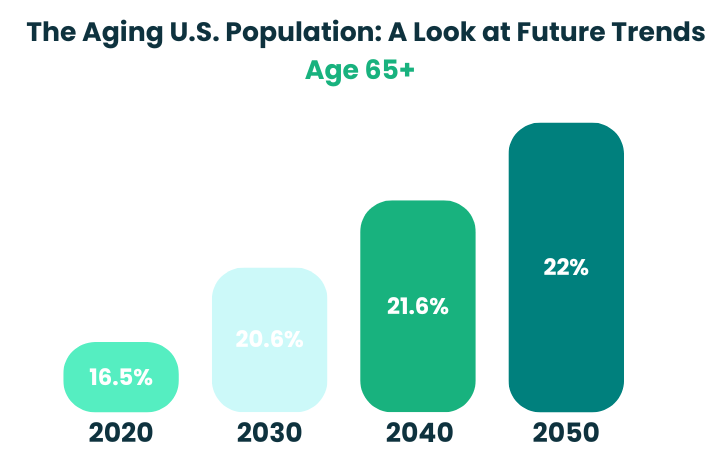
> **Key Takeaways:**
- **Variety of Options**: Senior housing offers various living options, including independent living, assisted living, nursing homes, and memory care facilities, each tailored to different needs.
- **Senior Housing Assistance**: Programs such as Medicaid, Section 202 Housing, and state-specific services provide financial assistance to make senior housing more affordable.
- **Choosing the Right Fit**: Understanding your loved one’s health, preferences, and financial situation is crucial when selecting the most suitable housing option.
- **Benefits of Senior Housing**: Senior housing not only provides specialized care but also offers safety, socialization, maintenance-free living, and peace of mind for family members.
- **Cost Factors**: The cost of senior housing can vary greatly based on location, level of care, and facility type, with resources available to help offset expenses.
## **What are the different types of senior housing options?**
When it comes to senior housing, there are several options available depending on the individual's needs, health status, and personal preferences. The main types of senior housing include:
- **Independent Living**: Ideal for seniors who are largely independent but may want to downsize or live in a community that provides amenities like housekeeping, meals, and social activities. Independent living communities offer private apartments or homes with support services available.
- **Assisted Living**: For seniors who need help with daily activities such as bathing, dressing, and medication management, but do not require full-time medical care. Assisted living communities offer a higher level of support while allowing residents to maintain some independence.
- **Nursing Homes**: Also known as skilled nursing facilities, these are designed for seniors with significant health care needs, including those requiring constant medical care or rehabilitation. Nursing homes provide 24-hour nursing care, meals, and assistance with daily activities.
- **Memory Care**: A specialized form of assisted living for individuals with Alzheimer's disease or other forms of dementia. Memory care units provide secure environments and specialized care to ensure residents' safety and well-being.
- **Continuing Care Retirement Communities (CCRCs)**: These communities offer a continuum of care, from independent living to skilled nursing care, allowing seniors to stay in the same community as their care needs change over time.
For more detailed information about senior housing options, you can refer to resources like the [National Institute on Aging](https://www.nia.nih.gov/).
***Related Article: ******[Essential Guide to Senior Food Assistance](/articles/seniors-special-groups/senior-food-assistance)***
## **What are the benefits of senior housing?**
Choosing senior housing assistance offers numerous benefits, especially for older adults who may need help with daily tasks, medical care, or simply want to live in a more community-oriented setting. Here are some of the key benefits of senior housing:
### 1. Access to specialized care
In many senior housing communities, residents have access to on-site medical and personal care. This can include assistance with daily activities, medication management, and health monitoring. For seniors who need [extra help](/glossary/extra-help-lis) but don’t require a nursing home, assisted living facilities offer a great balance of independence and care. Specialized services, such as physical therapy, rehabilitation, or memory care, are also available in some communities.
### 2. Enhanced safety and security
Senior housing communities often have built-in safety features such as handrails, emergency call systems, and 24-hour security to ensure residents' safety. In facilities like memory care units, the environment is specifically designed to prevent wandering and other risks associated with dementia and Alzheimer’s disease.
### 3. Socialization opportunities
Living in a senior housing community provides opportunities for socialization and engagement with others in similar age groups. Many communities offer organized activities like exercise classes, movie nights, and outings, which can help combat loneliness and promote mental well-being. Staying socially active has been shown to improve quality of life and reduce feelings of isolation.
### 4. Maintenance-free living
One of the biggest benefits of senior housing is the freedom from home maintenance. Whether it's lawn care, housekeeping, or repairs, many communities take care of these responsibilities, allowing seniors to enjoy their time without worrying about everyday chores. This makes living in a senior housing community convenient and hassle-free.
### 5. Access to amenities
Many senior living communities offer a range of amenities that cater to seniors’ preferences and needs. These can include on-site fitness centers, beauty salons, libraries, and even community gardens. For those who enjoy outdoor activities, some facilities have walking trails, swimming pools, and other recreational spaces.
### 6. Peace of mind for family members
Senior housing provides families with peace of mind, knowing their loved ones are living in a safe, well-maintained environment with access to care when needed. Families can feel confident that their seniors are receiving the appropriate level of assistance while still enjoying independence and a fulfilling lifestyle.
For a more in-depth look at the benefits of senior living communities, you can visit [AARP's Senior Housing Resource](https://my.aarpfoundation.org/article/affordable-senior-housing/).
## **How do I know which senior housing assistance program is right for my loved one?**

Choosing the right senior housing option depends on several factors, including health conditions, independence, budget, and personal preferences. Here are some key points to consider when making a decision:
- **Health Needs**: If your loved one requires help with activities of daily living (ADLs) such as dressing or eating, assisted living or a nursing home might be the best option. If they need specialized care for memory loss, memory care units should be considered.
- **Budget**: Senior housing costs vary greatly depending on the type of care needed and the location. Independent living is generally more affordable, while nursing homes and memory care facilities are more expensive due to the higher level of medical care provided. It's essential to review financial resources, including insurance, Medicare, and Medicaid.
- **Personal Preferences**: Some seniors prefer a more social environment, while others may want privacy and independence. Take your loved one's preferences into account, as this can impact their overall satisfaction in the chosen facility.
For further insights into how to choose the right senior housing assistance program, visit the [AARP Guide to Senior Housing](https://www.aarp.org/caregiving/basics/info-2022/housing-options.html?msockid=1bf47af314b3617a12ae6fd715d26067).
## **What is senior housing assistance and how can I apply?**
Senior housing assistance refers to financial support or programs designed to help older adults find affordable housing or pay for housing costs. Several programs and resources are available to help seniors access housing options:
- **Medicaid**: For low-income seniors, Medicaid may cover the cost of care in nursing homes or assisted living facilities. Medicaid also provides funding for in-home care services for seniors who qualify.
- **Section 202 Housing for the Elderly**: This program provides rental assistance for low-income seniors. It’s a federally funded program that helps subsidize rent for seniors living in affordable housing communities.
- **[Low-Income Energy Assistance Program (LIHEAP)](/articles/housing-essentials/senior-energy-assistance)**: This program helps low-income seniors with their utility bills, which can be particularly helpful for those living on a fixed income.
- **State and Local Housing Programs**: Many states and municipalities offer rental assistance programs, property tax relief, and other services for senior citizens. It's essential to research available options in your area.
To learn more about senior housing assistance programs, visit the [U.S. Department of Housing and Urban Development (HUD)](https://www.hud.gov/).
## **How much does senior housing assistance cost?**
The cost of senior housing varies significantly depending on the type of care and the location. On average, here are the costs associated with different types of senior living:
- **Independent Living**: Costs range from $1,500 to $4,000 per month, depending on the location and the amenities offered.
- **Assisted Living**: The average cost is about $4,300 per month, but this can rise depending on the level of care and geographic location.
- **Nursing Homes**: Nursing home costs are higher, averaging $7,500 per month for a semi-private room and up to $8,500 for a private room.
- **Memory Care**: Memory care units typically cost between $4,500 and $7,500 per month.
If you’re looking for financial assistance, many seniors qualify for Medicaid or other government programs to help cover some of these costs.
For a detailed breakdown of senior living costs by state, you can check out the [Genworth Cost of Care Survey](https://www.genworth.com/aging-and-you/finances/cost-of-care).
## **How can I find senior housing assistance near me?**
To find senior housing assistance options in your area, you can use online directories, consult local agencies, or get in touch with senior housing referral services. Websites like [A Place for Mom](https://www.aplaceformom.com) and[ ](https://www.seniorliving.org)[SeniorLiving.org](https://www.seniorliving.org) allow you to search for housing by location, type of care, and budget.
Additionally, consulting with a healthcare professional or social worker can help identify appropriate options based on your loved one’s needs.
***Related Article: ******[Navigating Senior Healthcare: An Essential Resource](/articles/health-disability/senior-healthcare)***[ ](/articles/health-disability/senior-healthcare)
##
**Find the best living solution for your loved ones**
Choosing the right senior housing assistance option requires careful consideration of the individual’s health needs, preferences, and financial resources. With the various types of senior housing available and the assistance programs designed to make these options more accessible, families can feel more confident about finding the best living situation for their loved ones.
If you're still uncertain, don't hesitate to reach out to professional senior housing advisors, who can guide you through the process of selecting and applying for the right living option. By researching the available resources and understanding your loved one's needs, you can ensure they live their golden years with dignity, comfort, and care.
For additional resources on senior housing assistance, visit the [National Council on Aging](https://www.ncoa.org).
### ***Unlock Your disability benefits with confidence! ****Join our community to access all the benefits you're eligible for. Don’t miss out—**[sign up now](https://benefitkarma.com/)** and start maximizing your savings today!*
---
type: article
title: The Saver’s Credit: 9 Tips on How It Works and How to Unlock the Value
url: https://benefitkarma.com/articles/income-employment/maximize-the-savers-credit
updated: 2026-05-19
---
# The Saver’s Credit: 9 Tips on How It Works and How to Unlock the Value
If you're looking to save for retirement and want to maximize your tax benefits, the **Saver’s Credit** (also known as the **[Retirement Savings Contributions Credit](https://www.irs.gov/newsroom/savers-credit-can-help-low-and-moderate-income-taxpayers-to-save-more-in-2024)**) is a valuable opportunity. It can help reduce your tax bill and reward you for contributing to retirement savings accounts like a 401(k), IRA, or other qualified plans. But what exactly is the [Saver's Credit](/glossary/savers-credit)? How do you qualify? And how do you claim it?
In this post, we'll answer the most frequently asked questions about the Saver’s Credit to give you the information you need to take full advantage of this tax-saving opportunity.
> **Key Takeaways:**
- The Saver’s Credit rewards low- to moderate-income taxpayers for contributing to retirement savings.
- It can reduce your tax bill by 10% to 50% of your contributions, depending on your income.
- Eligible retirement accounts include IRAs, 401(k)s, and more.
- To claim the credit, file **Form 8880** with your tax return.
## 1. What is the Saver’s Credit?
The Saver's Credit is a tax credit designed to help low- and moderate-income individuals save for retirement. If you contribute to an eligible retirement plan, you may qualify for a credit of up to 50% of your contributions, which directly reduces the amount of tax you owe.
Unlike a tax deduction, which reduces your taxable income, a tax credit reduces the amount of tax you owe on a dollar-for-dollar basis. This means that this credit can significantly lower your tax liability if you qualify. [Learn more about the Saver’s Credit from the IRS](https://www.irs.gov/retirement-plans/plan-participant-employee/retirement-savings-contributions-credit-savers-credit).
## 2. Who qualifies for the Saver’s Credit?
To qualify for the Saver’s Credit, you must meet a few key requirements:
- **Age**: You must be 18 years or older and not claimed as a dependent on someone else’s tax return.
- **Income Limits**: Your income must fall below certain thresholds. These limits vary each year, but for the 2023 tax year, the income limits are as follows:
**Single filers**: Up to $36,500
- **Married filing jointly**: Up to $73,000
- **Head of household**: Up to $54,750
- **Retirement Contributions**: You must contribute to a retirement plan, such as a 401(k), 403(b), IRA, SIMPLE IRA, or a similar plan. Contributions to pensions or other retirement plans may also qualify.
- **Tax Filing Status**: You need to file taxes as single, married filing jointly, or head of household to be eligible.
Check the [IRS guidelines](https://www.irs.gov/help/ita/do-i-qualify-for-the-retirement-savings-contributions-credit) for the most up-to-date eligibility requirements.
## 3. How much can you get from the Saver’s Credit?
The Saver’s Credit is worth between 10% and 50% of your eligible contributions, depending on your income. Here’s how the percentage works:
- **50% Credit**: If your income is at or below the lowest income threshold, you could receive up to 50% of your retirement contributions as a credit.
- **20% Credit**: For those with slightly higher incomes, you may qualify for a 20% credit.
- **10% Credit**: For individuals who have incomes closer to the upper limits of the qualification range, you might receive a 10% credit.
For example, if you contribute $2,000 to an eligible retirement account and are in the 50% credit bracket, you could receive a $1,000 Saver’s Credit. This credit will directly reduce your tax bill.
## 4. What retirement accounts qualify for the Saver’s Credit?
The Saver’s Credit applies to contributions made to various retirement savings accounts, including:
- **401(k) plans** (including Roth 401(k)s)
- **403(b) plans**
- **Traditional IRAs** (Individual Retirement Accounts)
- **Roth IRAs**
- **SIMPLE IRAs**
- **[SEP](/glossary/special-enrollment-period) IRAs**
- **Government Thrift Savings Plans (TSPs)**
- Other employer-sponsored retirement plans
The key here is that the money must be contributed to an eligible plan. Contributions made to regular savings accounts, CDs, or other non-retirement investments do not qualify.
***Want to learn about other tax credits that could boost your savings? Check out our guide on ******[Understanding the Child Tax Credit: What You Need to Know](/articles/family-education/understanding-the-child-tax-credit-what-you-need-to-know)****** to see if you're eligible for even more benefits!***
## 5. Can you claim the Saver’s Credit if you contribute to a Roth IRA?
Yes, **Roth IRAs** are eligible for the Saver’s Credit just like Traditional IRAs. The important thing to note is that Roth IRA contributions are made with after-tax dollars, meaning you won’t get a tax deduction in the year you contribute, but you could still claim the Saver's Credit.
## 6. How do you claim the Saver’s Credit?
To claim the Saver’s Credit, you need to file **Form 8880**, Credit for Qualified Retirement Savings Contributions, with your tax return. This form will help you determine how much credit you’re eligible for based on your income and contributions.
Here’s a quick rundown of the process:
- **Make Eligible Contributions**: Contribute to a qualified retirement account during the tax year.
- **Fill Out Form 8880**: Report your contributions and income on Form 8880.
- **File Your Tax Return**: Attach Form 8880 to your **Form 1040**, **Form 1040-SR**, or **Form 1040-NR** when you file your taxes.
You can find **Form 8880** on the [IRS website here](https://www.irs.gov/forms-pubs/about-form-8880).
## 7. Can you use the Saver’s Credit in addition to other tax benefits?
Yes! The Saver’s Credit is a nonrefundable tax credit, meaning it can only reduce your tax liability to zero, but it won’t provide you with a refund if the credit exceeds your tax liability. However, it works alongside other retirement-related tax benefits.
For example, you can still benefit from:
- **Tax deductions** for your IRA or 401(k) contributions.
- **Employer matching contributions** to your 401(k).
- **Other tax credits** you may qualify for, like the **[Earned Income Tax Credit](/glossary/eitc) (EITC)**.
For more information on combining tax credits and deductions, visit the [IRS tax credits and deductions](https://www.irs.gov/credits-and-deductions-for-individuals?os=apprefdapp&ref=app) page.
## 8. Can you claim the Saver’s Credit if you don’t owe taxes?
Since the Saver’s Credit is a nonrefundable credit, it can only reduce your tax liability to zero. If you don’t owe any taxes, you won’t be able to claim the credit. However, if you are due for a refund, the Saver’s Credit will not provide you with additional funds beyond your tax refund.
## 9. Common mistakes to avoid when claiming the Saver’s Credit
- **Missing the Income Limits**: Always double-check the income thresholds for the tax year you’re filing for. If your income is above the limit, you won’t be eligible.
- **Not Contributing Enough**: The credit is based on the amount you contribute. To maximize your benefit, contribute as much as you can to eligible retirement accounts.
- **Incorrect Form Submission**: Ensure you file Form 8880 correctly to claim the credit. Missing forms or incorrect entries can delay your refund or cause you to miss out on the credit.
##
## Lower your tax bill and boost retirement savings
The **Saver’s Credit** is a great way for individuals and families with lower and moderate incomes to get a little extra help for saving for retirement. By making eligible contributions to your retirement accounts, you could lower your tax bill and boost your retirement savings in the process.
If you think you might qualify, don’t forget to check the income limits, confirm your eligible contributions, and file the necessary forms with your tax return. The Saver’s Credit can help you start saving for your future while reducing your current tax liability.
For more personalized advice on how the Retirement Savings Contributions Credit applies to your situation, [consult with a tax professional or financial advisor](https://www.nerdwallet.com/article/investing/how-to-choose-a-financial-advisor?msockid=1bf47af314b3617a12ae6fd715d26067).
## FAQs on the Retirement Savings Contributions Credit
### Can a married couple each claim the Retirement Savings Contributions Credit?
Yes, if both spouses make eligible contributions to retirement accounts and meet the income and filing requirements, each spouse can claim the Saver's Credit separately. The credit amount will depend on each individual's contribution and income level.
### Can I still claim the Saver's Credit if my employer offers a retirement plan, but I don’t contribute to it?
No, you must personally contribute to an eligible retirement plan, such as an IRA or 401(k), to qualify for the Saver’s Credit. Contributions to employer plans only count if they come directly from your paycheck.
### What retirement accounts are ineligible for the Retirement Savings Contributions Credit?
While many retirement accounts qualify, pensions or other non-qualified retirement accounts do not. The credit is only applicable to contributions made to eligible accounts like 401(k)s, IRAs, SIMPLE IRAs, and similar plans.
---
type: article
title: Homeowner Deductions for Supercharged 2024 Tax Savings
url: https://benefitkarma.com/articles/income-employment/homeowner-deductions
updated: 2026-05-19
---
# Homeowner Deductions for Supercharged 2024 Tax Savings
As a homeowner, you likely know that owning a home involves significant costs, from mortgage payments to maintenance expenses. However, what many homeowners don’t realize is that there are multiple [tax deductions](/articles/military-veterans/military-tax-deductions) available that can help reduce your tax bill and make homeownership more affordable.
Unfortunately, navigating the world of tax deductions can be confusing, and it’s easy to miss out on potential savings. Are you unsure which deductions apply to you? **You’re not alone**.
The good news is, with the right knowledge, you can take advantage of various homeowner tax breaks and keep more of your money in your pocket. In this guide, we’ll answer your most frequently asked questions about homeowner tax deductions and show you how to make the most of them.
> ***Key Takeaways:***
- **Mortgage Interest Deduction**: Homeowners can deduct interest on mortgage payments up to a cap of $750,000 for loans taken after 2017.
- **[Property Tax](/articles/seniors-special-groups/senior-property-tax-relief) Deductions**: Deduct property taxes, with a cap of $10,000 for state and local taxes (SALT).
- **Home Office Deductions**: If you work from home, you can claim a percentage of your home’s expenses for business use.
- **Energy-Efficient Upgrades**: Certain home improvements, like installing solar panels, may qualify for tax credits.
- **Home Equity Loan Interest**: The interest is deductible only if the funds are used for home improvements.
- **Organize Your Records**: Keep detailed records of expenses, such as mortgage statements and home improvements, to ensure you maximize your deductions.
## What tax deductions are available for homeowners?
As a homeowner, you can benefit from several tax deductions related to your property. The most common ones include:
- **Mortgage Interest Deduction**: One of the most well-known deductions, homeowners can deduct the interest paid on their mortgage for their primary residence and, in some cases, a second home. The deduction is capped at $750,000 of mortgage debt for loans taken after December 15, 2017. For mortgages prior to that date, the cap is $1 million.
- **Property Taxes**: Homeowners can deduct state and local property taxes on their homes. However, there is a cap of $10,000 ($5,000 if married and filing separately) on the total deduction for state and local taxes, which includes both property and income taxes.
- **Home Equity Loan Interest**: If you have a home equity loan or line of credit, the interest on the loan is deductible, but only if the funds are used for home improvements. It’s important to note that interest on home equity loans used for non-home-related expenses is no longer deductible under the Tax Cuts and Jobs Act (TCJA) of 2017.
For further details, check out the [IRS guidelines on home mortgage interest deductions](https://www.irs.gov/publications/p936).
***Ready to save even more this tax season? Check out ******[The Saver’s Credit: 9 Tips on How It Works and How to Unlock the Value](/articles/income-employment/maximize-the-savers-credit)******.***
## Can I deduct the cost of home improvements?
Try it: [Find Benefits](/find-benefits)
Explore income, employment and tax benefits available to you.
While home improvements themselves are not directly deductible, certain improvements can potentially [save you money](/articles/housing-essentials/how-the-weatherization-assistance-program-wap-can-save-you-money-this-winter-summer) in other ways:
- **Energy-Efficient Upgrades**: If you’ve made energy-efficient upgrades to your home, you may qualify for tax credits, not deductions. For example, installing solar panels or energy-efficient windows could qualify you for credits such as the Residential Energy Efficient Property Credit or the Nonbusiness Energy Property Credit.
- **Capital Improvements and Capital Gains**: If you sell your home in the future, the costs of home improvements (such as adding a new roof or remodeling a kitchen) can be added to your home's "basis," potentially lowering your capital gains tax when you sell.
Learn more about home improvement credits on the [Energy Efficient Home Improvement Credit page](https://www.irs.gov/credits-deductions/energy-efficient-home-improvement-credit).
## Are there deductions for home office expenses?
For homeowners who work from home, there may be additional deductions available related to your home office. The IRS allows you to deduct a portion of your home expenses if you use part of your home exclusively and regularly for business.
The IRS offers two methods to calculate this deduction: the simplified method and the regular method, where you’ll have to calculate the percentage of your home used for business and apply that percentage to various expenses.
For more details on home office deductions, visit the [IRS home office deduction page](https://www.irs.gov/businesses/small-businesses-self-employed/simplified-option-for-home-office-deduction).
## What are the limitations for homeowner deductions?
While tax deductions for homeowners can be substantial, there are limitations:
- **Standard vs. Itemized Deductions**: The tax reform introduced by the TCJA significantly raised the standard deduction. For 2024, the standard deduction is $27,700 for individuals and $55,400 for married couples filing jointly. If your total itemized deductions, including mortgage interest and property taxes, are lower than the standard deduction, it may be better to take the standard deduction instead.
- **SALT Deduction Cap**: The deduction for state and local taxes (SALT), including property taxes, is limited to $10,000 ($5,000 if married filing separately). This means that if you live in a high-tax state, your deduction for property taxes may be limited.
To learn more about the latest [tax changes](/articles/benefits-in-the-news/tax-changes-2025-2026), refer to [IRS updates](https://www.irs.gov/newsroom/irs-provides-tax-inflation-adjustments-for-tax-year-2024).
## Do I need to keep records for homeowner deductions?
Yes! To claim any tax deductions related to your home, it’s important to keep thorough records. This includes:
- Mortgage statements
- Property tax bills
- Receipts for home improvements
- Insurance premiums
- Documents showing home office expenses
The IRS requires that you maintain records for at least three years after the date you file your tax return. Keeping organized records will make the tax filing process much easier and will help if you’re ever audited.
## Can I claim a deduction for renting out my home?
If you rent out part or all of your home, you may be eligible for deductions related to the rental portion. These could include:
- A portion of your mortgage interest
- Property taxes
- Utilities
- Repairs and maintenance specific to the rental area
- Depreciation on the rental portion of the home
Be aware that rental income must be reported to the IRS, and you’ll only be able to deduct expenses for the portion of the property used for rental purposes.
For more information on renting out your home and the related tax implications, check out the [IRS guidelines on rental income](https://www.irs.gov/taxtopics/tc414).
## Maximize your financial advantage this tax season
Homeownership can come with many financial advantages, and understanding the tax deductions available to you is key to maximizing your savings. Be sure to consult with a tax professional to ensure you’re taking full advantage of the deductions you qualify for and to stay up to date on the latest tax laws and guidelines.
For more tax tips, visit [IRS.gov](https://www.irs.gov).
## **Frequently Asked Questions**
### What is the mortgage interest tax deduction and how does it work?
The **[mortgage interest tax deduction](https://www.irs.gov/publications/p936)**** **allows homeowners to deduct interest paid on mortgages for their primary and, in some cases, secondary homes.
-** Limits:** For loans taken after December 15, 2017, the deduction applies to mortgages up to $750,000 ($1 million for loans before that date).
- **How to Claim:** To claim the deduction, itemize your deductions on Schedule A using IRS Form 1098, which reports the mortgage interest paid.
### How can homeowners claim the property tax deduction?
Homeowners can deduct property taxes paid on their homes, as part of the State and Local Tax (SALT) deduction.
- **SALT Cap:** The total deduction is capped at $10,000 ($5,000 if married filing separately), which includes property, state, and local taxes.
- **How to Claim:** To claim, itemize your deductions on Schedule A of Form 1040.
For more details, visit the[ ](https://www.irs.gov/publications/p530)**[IRS Property Tax page](https://www.irs.gov/publications/p530)****.**
### Can homeowners deduct homeowners insurance on their taxes?
Typically, homeowners cannot deduct homeowners insurance premiums for personal residences. However, there are exceptions:
- **Home Office:** If you use part of your home for business, you can deduct a portion of your insurance premiums related to the business use of your home.
- **Rental Properties**: If you rent out your property, you may be able to deduct the full cost of homeowners insurance as a business expense.
For more details on insurance deductions, visit the **[IRS website](https://www.irs.gov/credits-and-deductions-for-individuals)****.**
### Unlock Your Disability Benefits with Confidence!
### *Join our community to access all the benefits you're eligible for. Don’t miss out — **[sign up now](https://benefitkarma.com/)** and start maximizing your savings today!*
---
type: article
title: Affordable Senior Housing: HUD Section 202 and Other Key Programs
url: https://benefitkarma.com/articles/seniors-special-groups/affordable-senior-housing
updated: 2026-05-19
---
# Affordable Senior Housing: HUD Section 202 and Other Key Programs
As seniors age, finding affordable housing becomes an increasingly difficult challenge. Fixed incomes, rising rental prices, and limited availability of suitable housing options make it harder for many older adults to secure a safe and comfortable home. The fear of being unable to afford housing or being forced into substandard living conditions can lead to stress and uncertainty. However, there is a solution.
The U.S. government offers various affordable senior housing programs, such as the **[HUD Section 202](/glossary/hud-section-202) Program**, that provide much-needed financial assistance and resources to help seniors live independently in safe, affordable environments. In this guide, we'll explore these programs, eligibility criteria, and application processes, helping you navigate the complex world of senior housing assistance with ease.
> ***Key Takeaways:***
- **HUD Section 202**: Provides affordable housing for low-income seniors, including support for independent living.
- **Eligibility**: Applicants must be 62+ years old, meet income requirements, and be able to live independently.
- **Application Process**: Apply to available properties, but be aware of long waitlists due to high demand.
- **Other Programs**: Consider Section 8, [LIHTC](/glossary/lihtc), and Section 811 for additional assistance.
- **Overcoming Challenges**: Apply to multiple programs, stay organized, and seek help from housing counselors to navigate the process.
## What is the HUD Section 202 Program?
The **HUD Section 202 Supportive Housing for the Elderly Program** is a federal program that provides affordable housing options to low-income seniors. It helps fund the construction, rehabilitation, and operation of rental housing specifically designed for elderly individuals. This program is administered by the U.S. Department of Housing and Urban Development (HUD) and aims to reduce housing costs for seniors while also offering supportive services to help them maintain their independence.
For more information about HUD Section 202, visit the [HUD Official Page](https://www.hud.gov/).
## Who is eligible for the HUD Section 202 Program?
To qualify for HUD Section 202 housing, applicants must meet certain eligibility requirements:
- **Age**: Applicants must be 62 years of age or older.
- **Income**: The income level must be below the median for the area. Section 202 is designed for low-income seniors, and the exact income limits vary depending on the location and the size of the household.
- **Ability to live independently**: The program targets seniors who can live independently but may need some assistance with daily activities.
If you're unsure whether you qualify, you can check income limits in your area by visiting [HUD's Income Limits](https://www.huduser.gov/portal/datasets/il.html).
## How do I apply for HUD Section 202 housing?
Applying for HUD Section 202 housing involves a multi-step process:
- **Find Available Properties**: HUD doesn’t directly manage the properties. Instead, the program funds private non-profit organizations and local [public housing](/glossary/public-housing) agencies. You can find Section 202 properties near you by visiting the HUD website or contacting a local housing authority.
- **Submit an Application**: Once you've identified a property, you will need to submit an application to the property management or housing authority. They will evaluate your eligibility based on income, age, and other criteria.
- **Waitlist**: Many HUD Section 202 properties have waitlists due to the high demand for affordable housing. The waitlist time can vary from months to years, depending on the location.
To get started, you can find Section 202 properties in your area through the[ ](https://affordablehousingonline.com)[Affordable Housing Online](https://affordablehousingonline.com) website.
## Are there other affordable housing programs for seniors?
In addition to the Section 202 program, several other housing assistance programs are available to help seniors find affordable housing. Here are some of the most common options:
## 1. Housing Choice Voucher Program (Section 8)
The Housing Choice Voucher Program, commonly known as Section 8, helps low-income individuals and families, including seniors, pay for housing in the private rental market. Participants receive a voucher to cover part of their rent, while they pay the remainder. To qualify, applicants must meet income and other requirements set by their local Public Housing Agency (PHA).
To learn more about Section 8, visit the [HUD Housing Choice Voucher Program Page](https://www.hud.gov/topics/housing_choice_voucher_program_section_8).
## 2. Low-Income Housing Tax Credit (LIHTC)
The Low-Income Housing Tax Credit (LIHTC) program provides tax incentives to private developers who build or rehabilitate affordable rental housing, including for seniors. Although it is not a direct subsidy for renters, it does help lower-income seniors access affordable rental options. Many senior housing complexes across the country use LIHTC financing.
For more information about LIHTC, you can visit the[ ](https://www.ncsha.org)[National Council of State Housing Agencies (NCSHA)](https://www.ncsha.org).
## 3. Supportive Housing for Persons with Disabilities (Section 811)
For seniors with disabilities, the Section 811 Program provides rental assistance to help them live independently in the community. While this program is designed specifically for individuals with disabilities, it can also benefit seniors who need supportive services in addition to affordable housing.
Find more details about Section 811 at the [HUD Section 811 Page](https://www.hud.gov/program_offices/housing/mfh/progdesc/disab811).
## 4. State and Local Programs
In addition to federal programs, many states and local governments offer their own senior housing programs and rent subsidies. These programs may vary widely based on your location, so it’s important to contact your local housing authority to inquire about available resources. To find your local housing authority, visit the [HUD Local Office Locator](https://www.hud.gov/local).
***Check out the ultimate guide to ******[Senior Housing Assistance Made Easy](/articles/housing-essentials/senior-housing-assistance)******[.](/senior-housing-assistance/)***
## What other types of housing options are available for seniors?
While programs like HUD Section 202 and Section 8 are great options for affordable rental housing, seniors may also want to consider other types of housing that are more suitable for their changing needs:
- **Assisted Living**: For seniors who need help with daily activities, assisted living facilities offer housing and supportive services. These facilities often charge on a sliding scale based on income.
- **Independent Living Communities**: These are housing options for seniors who can live independently but prefer a community setting with social and recreational opportunities.
- **Continuing Care Retirement Communities (CCRCs)**: CCRCs provide a continuum of care, from independent living to assisted living and skilled nursing care. These communities are ideal for seniors who want to age in place.
## Common challenges and tips for navigating senior housing assistance programs
Navigating affordable housing programs can be challenging for seniors, but understanding the common obstacles and knowing how to overcome them can make the process much easier. Below are some of the most frequent challenges and helpful tips for each.
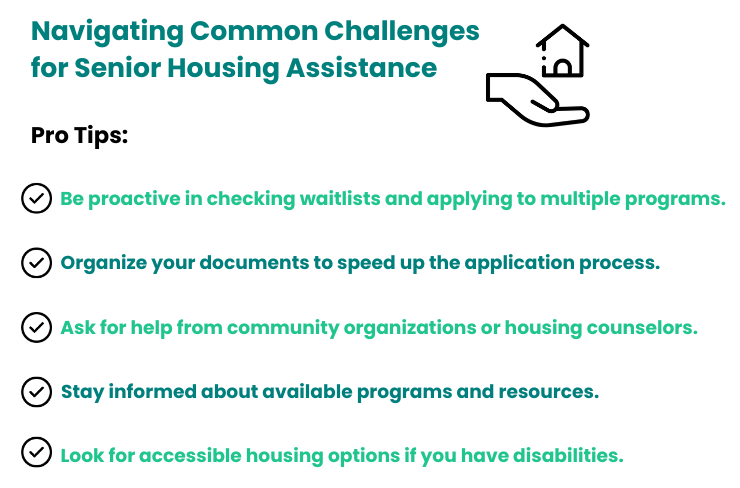
## 1. Long Waitlists for HUD Section 202 Housing
**Challenge:** Demand for affordable senior housing often exceeds supply, leading to long waitlists for HUD Section 202 properties.
**Tip:**
- Apply to multiple programs: Don’t limit yourself to just one option. Applying to several programs can increase your chances of getting placed sooner.
- Stay proactive: Contact housing authorities regularly to check your application status or find out about new openings.
## 2. Income and Eligibility Verification
**Challenge:** Income limits and eligibility requirements can be hard to meet or difficult to verify, especially if your income fluctuates.
**Tip:**
- Be organized: Gather necessary documents in advance, including tax returns, pay stubs, and Social Security statements.
- Update as needed: If your income changes after submitting an application, inform the housing authority right away. Changes might affect eligibility.
## 3. Understanding the Application Process
**Challenge:** The application process can be complex, and some seniors may struggle to fill out forms or navigate online systems.
**Tip:**
- Seek help: Reach out to senior service organizations, housing counselors, or social workers for guidance through the process.
- Request assistance: Don’t hesitate to ask housing authorities for clarification if you’re unsure about any part of the application.
## 4. Limited Awareness of Available Programs
**Challenge:** Many seniors are unaware of the full range of housing assistance programs, which can result in missed opportunities.
**Tip:**
- Stay informed: Regularly check online resources like[ ](https://affordablehousingonline.com)[Affordable Housing Online](https://affordablehousingonline.com) and the[ ](https://www.hud.gov)[HUD website](https://www.hud.gov) for program updates.
- Attend events: Participate in senior fairs or housing expos to meet representatives from housing authorities and learn more about available programs.
## 5. Finding Accessible Housing for Seniors with Disabilities
**Challenge:** Seniors with disabilities may struggle to find housing that meets their accessibility needs, such as ramps or wider doorways.
**Tip:**
- Look for specialized housing: Consider properties specifically designed for seniors with disabilities or inquire about accessibility features.
- Explore Section 811: The Section 811 Program provides housing with supportive services for individuals with disabilities. Check out more details on the [HUD Section 811 ](https://www.hud.gov/program_offices/administration/hudclips/handbooks/hsgh/4571.2)page.
##
## Get the support you need
Affordable senior housing programs like HUD Section 202 and other government-assisted options offer a vital resource for seniors seeking safe and affordable living spaces. These programs help reduce the financial burden of housing costs while ensuring seniors have access to necessary services and support.
### Unlock Your Disability Benefits with Confidence!*Join our community to access all the benefits you’re eligible for. Don’t miss out — **[Sign Up Now](/)** and start maximizing your savings today!*
---
type: article
title: Meals on Wheels: Nourishing Seniors One Meal at a Time
url: https://benefitkarma.com/articles/seniors-special-groups/meals-on-wheels-nourishing-seniors-one-meal-at-a-time
updated: 2026-05-19
---
# Meals on Wheels: Nourishing Seniors One Meal at a Time
Meals on Wheels is a lifeline for seniors who find cooking and grocery shopping challenging. This essential service delivers nutritious meals right to their doorstep, helping seniors maintain their health and independence. But Meals on Wheels does [more than](/articles/income-employment/state-unemployment-benefits-in-2026) just provide food — it plays a crucial role in reducing food insecurity among [older adults](/articles/health-disability/medicaid-work-requirements-affect-older-adults), improving overall well-being, and even lowering hospital visits. Plus, the social interaction that comes with each delivery offers companionship and a friendly check-in, which is especially important for those living alone.
Meals on Wheels is more than just a meal delivery program; it’s a key resource that strengthens community connections and ensures no senior goes hungry. By ensuring regular meals, the [program helps](/articles/family-education/how-the-summer-food-service-program-helps-families-through-the-summer) reduce the risk of malnutrition and related health problems. The social interaction from volunteers helps combat feelings of loneliness and isolation, which can lead to depression and anxiety in older adults.
These friendly check-ins also provide peace of mind, knowing someone is looking out for them regularly. If you or someone you know could benefit from Meals on Wheels, read on to learn about how the program works.
***To learn more about all the benefits available to you and your family, sign up now for BenefitKarma!***
## What is Meals on Wheels?
Think of it like free or cheap Doordash for seniors only (and with homecooked meals)! Meals on Wheels is a community-based program that provides home-delivered meals to seniors who may have difficulty preparing meals for themselves. Volunteers deliver these meals, ensuring that seniors receive not just nourishment but also a friendly face and a moment of social interaction. This program is a lifeline for many, helping them stay nourished and connected.
## Who can access Meals on Wheels?
Try it: [Benefit Eligibility Screener](/benefit-eligibility-screener)
Check senior benefits and tax-relief programs you may qualify for.
Meals on Wheels is available to seniors aged 60 and older who struggle with grocery shopping or cooking due to health or mobility issues. Eligibility varies by location, and many programs also serve individuals with [disabilities](/articles/health-disability/understanding-ssdi-disability-your-questions-answered) or those recovering from illness. Since services and availability differ by community, it’s best to contact your local Meals on Wheels office for details on qualifying and what’s offered in your area.
## How do people sign up for Meals on Wheels?
Signing up for Meals on Wheels is usually straightforward. Interested seniors or their family members can visit the Meals on Wheels website or contact their local office directly. A simple application process is often involved, where they'll provide some basic information about dietary needs and delivery preferences.
## What kinds of meals are provided?
Meals on Wheels offers a variety of nutritious meals, often tailored to meet specific dietary needs. This can include options for low-sodium diets, diabetic-friendly meals, and more. Each meal typically consists of a balanced portion of protein, vegetables, and grains, ensuring seniors receive the nutrients they need.
**Note:** Meals on Wheels offers meals that meet dietary needs like low-sodium, with some programs also accommodating cultural or religious preferences. Check with your local office for options.
## Does Meals on Wheels offer more than just meals?
Yes! Many Meals on Wheels programs go beyond delivering food. In some areas, they provide wellness checks, where volunteers or staff briefly check in on the senior’s health and well-being. This can be especially helpful for those who live alone or have limited social interaction.
Additionally, some programs offer pet food deliveries for seniors with pets, ensuring their furry companions are also taken care of. In certain regions, Meals on Wheels even helps with home safety assessments or minor repairs, making sure seniors live in safe environments.
## Does Meals on Wheels cost anything?
While many Meals on Wheels programs operate on a donation basis, some may have a small fee for meals. Seniors are encouraged to contribute if they can, but no one is turned away for lack of funds. This flexible payment model helps ensure that everyone can access the meals they need.
## How often are meals delivered?
Delivery schedules can vary by location, but many Meals on Wheels programs deliver meals once a week or several times a week. Some programs may offer a choice between hot meals delivered daily or frozen meals that can be reheated later. This flexibility allows seniors to choose what works best for their lifestyle.
---
type: article
title: Senior Discounts: 7 Tips to Find Deals & Save More
url: https://benefitkarma.com/articles/seniors-special-groups/senior-discounts
updated: 2026-05-19
---
# Senior Discounts: 7 Tips to Find Deals & Save More
As seniors face the realities of fixed incomes, budgeting becomes a top priority. The good news is that there are countless ways to save money through senior discounts—on everything from groceries to travel. However, with so many options available, it can be overwhelming to know where to find these discounts, how to claim them, and which ones are worth your time.
The frustration of missing out on savings or simply not knowing where to start is real. But don’t worry: In this guide, we’ll show you exactly how to unlock senior discounts, making it easier to find deals and enjoy your retirement without breaking the bank.
> *** ******Key Takeaways:***
- **Wide Variety of Discounts:** Seniors can access discounts in areas such as groceries, travel, entertainment, and health services.
- **Finding Deals:** Local stores, online resources like AARP, and senior discount apps are excellent ways to uncover savings.
- **AARP Membership:** Joining AARP opens the door to numerous exclusive senior discounts across various sectors.
- **Age Requirements:** Senior discount age requirements often begin at 50, but it varies by business, so always check ahead.
- **International Deals:** Many countries offer senior travel and leisure discounts, including in Europe, making global savings possible.
- **Maximizing Discounts:** Some senior discounts can be combined with other sales, but always check store policies for restrictions.
## 1. What types of discounts are available for seniors?

Seniors can enjoy a variety of discounts across many sectors, including:
- **Groceries:** Many grocery stores offer senior discounts on specific days or a percentage off select items. For example, stores like **[Kroger](https://www.seniorstrong.org/grocery/how-do-you-get-the-senior-discounts-on-your-kroger-plus-card/)** and **[Safeway](https://www.seniorstrong.org/grocery/safeway-senior-discount/)** have senior discount programs (check local locations for specific offers).
- **Travel:** Seniors can save money on flights, hotels, and rental cars. Major airlines such as **[American Airlines](https://www.seniorstrong.org/transportation/american-airlines-senior-discount/)** and **[Delta](https://thediscountsguy.com/seniors/airlines/delta/)** offer senior fares.
- **Restaurants:** Chain restaurants like **[McDonald’s](https://www.theseniorlist.com/senior-discounts/restaurants/mcdonalds/)** and **[Applebee’s](https://www.theseniorlist.com/senior-discounts/restaurants/applebees/)** offer senior discounts on meals. Even local spots may offer special pricing for older customers.
- **Entertainment & Services:** Museums, movie theaters, and even gyms often offer senior discounts. For example, **[AMC Theaters](https://thediscountsguy.com/seniors/entertainment/amc-theatres/)** has a senior discount program, and some fitness chains offer special memberships for seniors.
- **Health and Wellness:** Many pharmacies, including **[Walgreens](https://www.seniorstrong.org/retail/walgreens-senior-discount/)** and[ ](https://www.cvs.com/content/senior-wellness)**[CVS](https://www.cvs.com/content/senior-wellness)**, offer senior discounts on medications and over-the-counter products.
***Looking for more meal deals? Check out the ******[Essential Guide to Senior Food Assistance](/articles/seniors-special-groups/senior-food-assistance)******.***
## 2. How do I find senior discounts near me?
Finding senior discounts can be as easy as doing a quick online search or asking businesses directly. Here are some steps to help you locate deals:
- **Local Store Websites:** Many grocery stores and retailers offer senior discounts on specific days. Check your local store's website or visit in person to inquire.
- **Online Discount Websites:** Websites like **[AARP](https://www.aarp.org/)**, **[SeniorDiscounts.com](http://seniordiscounts.com)**, and **[The Senior List](https://www.theseniorlist.com/)** maintain lists of stores, restaurants, and services that offer discounts to seniors. These sites can be a goldmine for finding new deals.
- **Apps:** Some apps, like AARP and [SeniorDays](https://play.google.com/store/apps/details?id=com.mecenat.seniordays&hl=en-US&pli=1), allow you to search for senior discounts by location.
***Need help paying your utility bills? Discover******[ Senior Energy Assistance: Keep Your Home Comfortable & Affordable](/articles/housing-essentials/senior-energy-assistance)******.***
## 3. What is the AARP membership and how does it help with senior discounts?
The AARP (American Association of Retired Persons) is a membership organization that advocates for the needs of seniors. An [AARP membership](https://www.aarp.org/membership/lp/bf-a/?cmp=KNC-MIV-sb_b_Membership&loc_id=103138&campaign=sb_b_Membership&adgroup=Membership&kw=aarp%20membership-e&device=c&gclid=7a5d47ff6f111e3fecbd20c0ccffb06a&gclsrc=3p.ds&ds_rl=1055550&msclkid=7a5d47ff6f111e3fecbd20c0ccffb06a&tc_tm_xg=bf24jsembing&tc_campaign=BF24JSEMBING&rd=60&rt=so&defaultoffer=60&campaignid=UBF24P10&tc_channel=paidsearch&tc_vendor=Bing) provides access to a range of discounts, including:
- **Travel deals**: Senior discounts on car rentals, cruises, and airfare.
- **Health and wellness**: Discounts on health insurance, prescriptions, and dental services.
- **Shopping**: Deals on electronics, clothing, and other products from major retailers.
AARP members can access these discounts either through their membership card or by logging into the AARP website for personalized offers.
## 4. Are senior discounts only available in the U.S.?
No! Senior discounts are available worldwide, though they can vary greatly depending on the country and type of service. Many countries in Europe, such as England and France, have similar senior discount programs. For example, **[Eurostar](https://www.ncesc.com/is-there-a-senior-discount-on-eurostar/)** offers discounts for seniors traveling on high-speed trains, and European museums often have reduced or free admission for seniors.
## 5. Are there age restrictions for senior discounts?
Age requirements for senior discounts generally start at 50, but they can vary by business. Some restaurants and stores may offer discounts to those over 55, while others reserve senior deals for those 60 or 65 and older. Always verify the age threshold by asking at the point of service or checking online.
For example, Walgreens offers senior discounts to customers who are 55 or older, while **[Denny’s](https://www.theseniorlist.com/senior-discounts/restaurants/dennys/)** offers a discount for those aged 55 and up on certain menu items.
## 6. Do I need a special card or membership to access senior discounts?
While some senior discounts are available simply by mentioning your age, many require a membership card or proof of age. The AARP membership card is one of the most popular ways to access senior deals, but other stores or services may issue their own senior discount cards.
It’s important to keep your ID or AARP card handy to ensure you get the best possible discount at restaurants, stores, or while booking travel.
***Our FREE membership community helps you discover all the benefits you may be eligible for and gives you access to exclusive offers and discounts. Sign up for******[ ](/)******[Benefit Karma ](/)******today to get started.***
## 7. Can senior discounts be combined with other promotions?
In most cases, senior discounts cannot be combined with other promotions, but there are exceptions. Some retailers and travel services will allow seniors to apply their discount on top of sales or coupon deals. Always read the terms and conditions or ask the business before finalizing a purchase.
For example, **[Target](https://seniordiscount.modern60.com/seniors/retail/target/)** offers **Veteran’s Day senior discounts**, but they often exclude certain items like sale items or clearance products. It’s worth checking the fine print.
## Senior discount resources
To help you get started, here’s a list of websites where you can find verified senior discounts across a range of services and industries:
- [AARP Senior Discounts](https://www.aarp.org/)
Offers discounts on travel, shopping, dining, and healthcare for members.
- [SeniorDiscounts.com](https://www.seniordiscounts.com/)
A comprehensive list of senior discounts at national and local businesses.
- Find discounts on various services, including travel, dining, and health.
- [The Senior List](https://www.theseniorlist.com/)
A trusted resource offering a wide range of senior discounts and advice.
- **National Park Service – **[Senior Pass](https://www.nps.gov/planyourvisit/passes.htm)
A lifetime pass for free access to national parks and discounted services.
- [YMCA Senior Discounts](https://greatsenioryears.com/is-the-ymca-free-for-senior-citizens-find-out-here/)
Offers senior discounts across multiple categories like exercise classes tailored to seniors.
- [Amazon Senior Discounts](https://www.theseniorlist.com/senior-discounts/retail/amazon/)
Senior-specific promotions during events like **Prime Day**.
- [Senior Planet](https://www.seniorplanet.org/)
Offers senior discounts, tech tips, and more resources for older adults.
### Get more for your money with exclusive deals
Senior discounts are a great way to stretch your budget, whether you’re grocery shopping, traveling, or enjoying a meal out. By knowing where to look and what to ask for, you can unlock savings that make a big difference. From AARP to local store promotions, there are numerous opportunities for seniors to save across a variety of services. So next time you head out, don’t forget to ask about senior discounts!
---
type: article
title: Unlock All the Tax Savings Available to You
url: https://benefitkarma.com/articles/income-employment/tax-savings-guide
updated: 2026-07-01
---
# Unlock All the Tax Savings Available to You
Tax season can be overwhelming, but understanding the various tax benefits and deductions available to you can help you maximize your savings. Whether you're a homeowner, a retiree, a service member, or someone living with a disability, there are specific tax breaks designed to reduce your financial burden. This comprehensive guide covers how you can access all the tax benefits available to you, ensuring you don’t miss out on potential savings.
To learn more about all the benefits available to you and your family, sign up now for BenefitKarma (click the link in the blue box)!
## Homeowner deductions for tax savings
As a homeowner, you have access to a variety of tax deductions that can significantly lower your taxable income. These deductions can help reduce the amount of taxes you owe, increasing your overall savings. Here are some key tax deductions homeowners can take advantage of:
### 1. Mortgage interest deduction
One of the biggest benefits for homeowners is the ability to deduct the interest paid on your mortgage. If you itemize your deductions, you can deduct interest on up to $750,000 of mortgage debt ($375,000 if married and filing separately). This can result in substantial tax savings, especially during the early years of your mortgage when the majority of your payments go toward interest.
### 2. Property tax deduction
Homeowners can also deduct the property taxes they pay on their primary residence and, in some cases, on additional properties. The Tax Cuts and Jobs Act limited this deduction to $10,000 ($5,000 for married couples filing separately) for both state and local property taxes, but it’s still a valuable way to reduce your taxable income.
### 3. Home equity loan interest deduction
If you have a home equity loan or a home equity line of credit (HELOC), you may be able to deduct the interest you pay, as long as the loan is used to improve your home. This deduction applies to both the primary home and a second home, depending on your circumstances.
### 4. Energy-efficient home tax credits
Investing in energy-efficient home improvements can also lead to tax savings. The IRS offers various tax credits for homeowners who install solar panels, energy-efficient windows, or insulation. These credits can reduce the upfront costs of making green improvements to your home and result in long-term savings on your energy bills.
By taking advantage of these homeowner deductions, you can significantly lower your tax burden and keep more of your hard-earned money.
Helpful Resource: Homeowner Deductions for Supercharged 2024 Tax Savings
## The Saver’s Credit for tax savings

The Saver’s Credit is a tax benefit designed to encourage low- and moderate-income individuals to save for retirement. This credit, also known as the Retirement Savings Contributions Credit, is available to taxpayers who contribute to retirement accounts such as an IRA, 401(k), or other qualified retirement plans.
### How it works
The Saver’s Credit provides a percentage-based credit on contributions to retirement accounts, depending on your income and filing status. The credit can be worth up to $1,000 for individuals and $2,000 for married couples filing jointly. To qualify, you must meet income requirements, and the amount of the credit you receive is based on your adjusted gross income (AGI).
For example, in 2023, if you are a single filer with an AGI of $20,500 or less, you could qualify for a 50% credit on contributions, up to the maximum amount.
### Why it’s beneficial
The Saver’s Credit is a valuable tool for increasing retirement savings, especially for lower-income individuals who may not otherwise have access to employer-sponsored retirement plans. In addition to helping you save for the future, the credit directly reduces your tax liability, which can provide immediate relief.
To maximize this credit, make sure to contribute to a retirement account before the tax filing deadline and keep track of the necessary documentation to claim the credit.
Helpful Resource: The Saver’s Credit: 9 Tips on How It Works and How to Unlock the Value
## Tax breaks for retirees

Retirement can be a time of financial uncertainty, but several tax breaks exist to help retirees make the most of their savings. From deductions on retirement income to credits for healthcare expenses, retirees have a range of tax benefits at their disposal.
### 1. Tax deductions for retirement income
If you receive income from retirement accounts, such as a 401(k) or IRA, it may be subject to taxation. However, many states offer tax deductions on retirement income, which can help reduce your overall tax liability. These deductions vary by state, so it’s important to understand your state's tax laws to ensure you’re getting all the breaks available to you.
### 2. Standard seduction for seniors
Seniors over the age of 65 can benefit from a larger standard deduction. The IRS offers an additional standard deduction for taxpayers who are 65 or older, which increases the amount of income that is not subject to tax. For example, in 2023, the standard deduction for single filers over 65 is $1,850 more than the standard deduction for younger taxpayers.
### 3. Medical expense deductions
Healthcare costs can be significant in retirement, but you may be able to deduct a portion of these expenses if they exceed 7.5% of your adjusted gross income. This includes costs like long-term care, prescription medications, and premiums for Medicare or supplemental insurance.
By planning ahead and taking advantage of tax breaks, retirees can ensure their income stretches further in their later years.
Helpful Resource: 8 Smart Tax Breaks Retirees Can Use to Save More in Retirement
## Tax deductions for military service members

Active-duty military personnel and veterans are eligible for a range of tax benefits designed to ease the financial burden of their service. These tax breaks apply to both federal and state taxes, depending on your situation.
### 1. Combat pay exclusion
One of the most notable benefits for military service members is the exclusion of combat pay from taxable income. If you're serving in a designated combat zone, your pay is not subject to federal income tax, which can result in significant savings.
### 2. Deductions for military-related expenses
Military members may also be eligible to deduct certain unreimbursed expenses related to their service. This can include costs for uniforms, travel, and professional training. Additionally, reservists who travel more than 100 miles away from home for drills may be able to deduct travel expenses.
### 3. Tax-free housing allowance
For service members who receive a housing allowance, this income is generally not subject to tax. This is a significant benefit that reduces your overall taxable income and can provide financial relief, especially if you’re stationed in an area with high living costs.
By understanding and utilizing these tax breaks, military service members can ensure they maximize their tax savings and keep more of their income.
Helpful Resource: Exclusive Tax Deductions for Military Service Members
## HSA tax advantages for the disabled

A Health Savings Account (HSA) is a powerful tool for individuals with high-deductible health plans (HDHPs) to save for medical expenses. For individuals with disabilities, HSAs offer additional benefits that can help reduce out-of-pocket healthcare costs.
### 1. Tax savings advantage of HSAs
One of the most compelling reasons to open an HSA is the tax benefits it provides. Contributions to an HSA are tax-deductible, reducing your taxable income in the year you contribute. Additionally, the funds in the account grow tax-free, and withdrawals used for qualified medical expenses are also tax-free.
### 2. Special needs and disability-related expenses
For individuals with disabilities, HSAs can be used to pay for a wide range of medical expenses, including those related to mobility aids, therapy, and other disability-specific needs. This makes an HSA an ideal way to save for healthcare costs that are not covered by traditional insurance plans.
### 3. Flexibility and long-term savings
Unlike Flexible Spending Accounts (FSAs), which have a "use-it-or-lose-it" policy, HSA funds roll over year after year. This means you can save for long-term healthcare expenses, which can be especially helpful for those with chronic conditions or disabilities who require ongoing care.
HSAs offer a triple tax advantage, making them a valuable tool for anyone, but particularly for individuals with disabilities looking to manage their healthcare costs efficiently.
Helpful Resource: Health Savings Account Advantages for the Disabled
## Take control of your future
Maximizing your tax savings is crucial for maintaining financial health, and there are numerous tax benefits available to individuals in different life circumstances. Whether you’re a homeowner, a retiree, a service member, or someone with a disability, taking full advantage of the deductions and credits available to you can lead to significant tax savings. Make sure to stay informed and consult with a tax professional to ensure you're accessing all the tax benefits available to you. By doing so, you can secure your financial future and take control of your tax obligations.
---
type: article
title: Essential Guide to Senior Food Assistance
url: https://benefitkarma.com/articles/seniors-special-groups/senior-food-assistance
updated: 2026-05-13
---
# Essential Guide to Senior Food Assistance
Many seniors face food insecurity due to fixed incomes, limited access to affordable groceries, and health challenges, making it difficult to maintain a nutritious diet. Without proper nutrition, seniors risk worsening health conditions, reduced quality of life, and increased healthcare costs, which further strain their limited financial resources.
Food assistance programs for seniors, such as the [Supplemental Nutrition Assistance Program](/glossary/snap) ([SNAP](/articles/housing-essentials/understanding-snap-your-guide-to-supplemental-nutrition-assistance)) and local food banks, provide essential support, helping ensure that older adults can access the nutritious meals they need to live healthy, independent lives. In this blog post, we'll explore some of the best options for food assistance for seniors.
## What is senior food assistance?
Food assistance for seniors includes government programs and local services designed to provide nutritious meals at little or no cost to older adults. Programs like the Supplemental Nutrition Assistance Program (SNAP), local food banks, and home-delivered meal services help seniors meet their nutritional needs without compromising their budgets.
## How to find senior food assistance in my area
Finding food assistance in your local area is easier than ever. Many community organizations, senior centers, and government agencies provide resources for seniors seeking food assistance. You can start by:
- **Contacting ****[local food banks](https://www.feedingamerica.org/find-your-local-foodbank)** or pantries to inquire about available services.
- **Reaching out to local ****[Area Agencies on Aging](https://acl.gov/programs/aging-and-disability-networks/area-agencies-aging)** (AAAs), which often coordinate meal programs and provide information on food assistance.
- **Visiting government websites**, such as **[your state’s SNAP website](https://www.fns.usda.gov/snap/state-ebt-websites)****,** or using resources like the[ ](https://www.fns.usda.gov/contact-us)**[National Hunger Hotline](https://www.fns.usda.gov/contact-us)** to find food assistance programs near you.
- **Exploring online resources** like the **[Meals on Wheels America](https://www.mealsonwheelsamerica.org/find-meals)** website to see if you qualify for home-delivered meals.
## Types of senior food assistance programs
Below are specific programs designed to help serve seniors with their nutritional needs:
- **[Supplemental Nutrition Assistance Program (SNAP)](https://www.fns.usda.gov/snap/supplemental-nutrition-assistance-program)**: Provides monthly benefits to purchase groceries at participating stores. Eligible seniors can use SNAP to buy a variety of foods, including fruits, vegetables, and dairy.
- **[Meals on Wheels](https://www.mealsonwheelsamerica.org/find-meals)**: Delivers prepared, nutritious meals to homebound seniors. This program is especially beneficial for those who cannot shop or cook due to age, illness, or disability.
- **[Commodity Supplemental Food Program (CSFP)](https://www.fns.usda.gov/csfp/commodity-supplemental-food-program)**: Provides low-income seniors with monthly packages of nutritious food, such as canned vegetables and dairy products.
- **[Senior Farmers' Market Nutrition Program (SFMNP)](https://www.fns.usda.gov/sfmnp/senior-farmers-market-nutrition-program)**: Offers coupons for fresh produce at local farmers' markets.
- **[Local Food Banks and Pantries](https://www.feedingamerica.org/find-your-local-foodbank)**: Many community-based food banks cater to seniors, offering free groceries or prepared meals.
## How can seniors apply for food assistance?
Individuals can apply for senior food assistance programs like SNAP through their state’s office or online portal. Additionally, they can access home-delivered meals via programs like Meals on Wheels by contacting their local provider. Many community-based organizations also offer assistance, and it's easy to find information online or at senior centers.
## Are there income limits for senior food assistance?
Yes, food assistance programs like SNAP have income eligibility requirements. To qualify, seniors must meet specific income thresholds, which are adjusted annually based on the [federal poverty level](/glossary/federal-poverty-level). Other programs, such as CSFP or local food banks, may have different criteria, so it's important to check with local providers.
## What food is covered by senior assistance programs?
Food assistance programs like SNAP cover a wide range of food items, including:
- Fruits and vegetables
- Dairy products
- Meat, poultry, and fish
- Cereal, bread, and grains
- Snacks and non-alcoholic beverages
However, certain items are [not covered](https://ask.usda.gov/s/article/What-foods-are-eligible-for-purchase-with-Supplemental-Nutrition-Assistance-Program-benefits), such as alcohol, tobacco, vitamins, and non-food items like cleaning products. It's essential to know what can and can't be purchased with food assistance benefits to make the most out of the available support.
## Can a person qualify for senior food assistance if they are living with someone?
Yes, [SNAP eligibility for seniors](https://benefitscheckup.org/article/snap-benefits-find-out-if-you-qualify) takes household size into account. If a senior is living with someone, such as a spouse or caregiver, the total household income will be considered when determining eligibility. However, seniors may still qualify for assistance if their income is below the threshold set for their household size. In addition to SNAP, many local food assistance programs may have their own eligibility criteria, which could vary based on location and available funding.
## Are there any income limits for senior food assistance?
Yes, most food assistance programs for seniors, such as SNAP, have income eligibility requirements. For example, in order to qualify for SNAP, seniors typically need to have an income below a certain threshold, which is adjusted annually based on the federal poverty level. Seniors who are 60 years or older may also be eligible for [deductions](https://www.usa.gov/senior-food-programs) for certain expenses, such as housing and utilities, which can help increase their eligibility for benefits. The specific limits vary by state, so it’s important for seniors to check the requirements for their local area.
***Looking for more nutritious options? Find Out ******[How the CSFP Provides Nutritious Food to Keep Seniors Healthy.](/articles/seniors-special-groups/how-the-csfp-keeps-seniors-healthy-with-nutritious-food)***
## Access to nutritious food with senior food assistance
Food assistance programs for seniors are essential in helping older adults combat food insecurity and maintain a healthy, independent lifestyle. From government programs like SNAP to community-based initiatives like Meals on Wheels, there are numerous resources available to ensure that seniors can access the food they need. If you or a senior loved one is struggling with food access, consider reaching out to local food assistance programs or government resources to find the support you need.
By understanding the types of food assistance available and the eligibility requirements, seniors can take advantage of the resources that best meet their needs and help them stay nourished and healthy.
---
type: article
title: 2025 VA Disability Pay Rates: The Latest Information on VA Compensation Rates and COLA Adjustments
url: https://benefitkarma.com/articles/military-veterans/va-disability-pay-rates
updated: 2026-06-03
---
# 2025 VA Disability Pay Rates: The Latest Information on VA Compensation Rates and COLA Adjustments
In 2025, the VA disability pay rates saw an increase due to the **Cost of Living Adjustment ([COLA](/glossary/cola))**, impacting veterans' benefits across various disability ratings and dependent categories. This annual adjustment helps veterans keep up with inflation and reflects the increased cost of living. The COLA increase is crucial for ensuring that veterans and their families do not face a loss of purchasing power due to rising costs.
The **2025 VA Disability Pay Rates** provide compensation based on the severity of the veteran's disability rating and whether they have dependents. These rates are structured to ensure veterans receive appropriate financial support in line with their service-connected disabilities. This annual update serves as a reminder of the ongoing commitment to veterans and their families, ensuring that their needs are met in a way that reflects current economic realities.
## 2025 VA disability pay chart: key adjustments
Below is a breakdown of the 2025 VA disability pay rates, including the updated compensation rates for veterans with various disability ratings. The updated rates are an important step in supporting veterans as they transition back into civilian life and cope with the physical, emotional, and psychological challenges of service-related injuries.
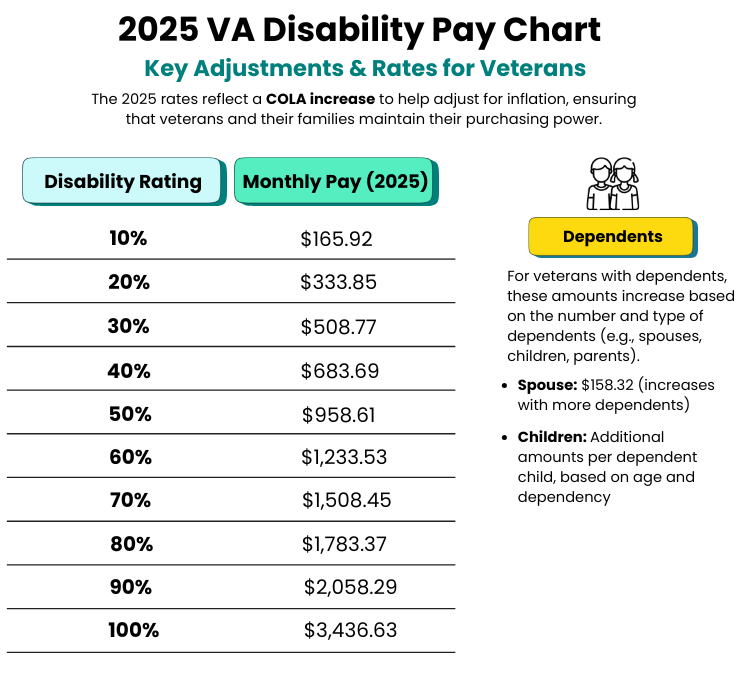
## **The importance of the COLA increase**
The **COLA adjustment** is a vital part of maintaining the purchasing power of veterans. Without this increase, the value of their monthly compensation would diminish over time due to inflation. This annual increase is based on the Consumer Price Index for Urban Wage Earners and Clerical Workers (CPI-W), which tracks inflationary trends in the economy. The **2025 rates** reflect the most recent inflation trends, offering veterans financial stability during uncertain economic times.
***Helpful Resource:**** **[Understanding VA Disability Benefits: A Simple Guide for Veterans](/articles/military-veterans/understanding-va-disability-benefits-a-simple-guide-for-veterans)*
## **Historical VA disability pay rates**
Understanding the historical VA disability pay rates provides valuable context to the ongoing efforts to improve veterans' benefits. By looking at the past few years, we can see the progression of compensation and the adjustments made in response to economic factors.
Here’s a look at the historical [VA disability compensation](/glossary/va-disability-compensation) rates from previous years, showing how VA pay rates have evolved:
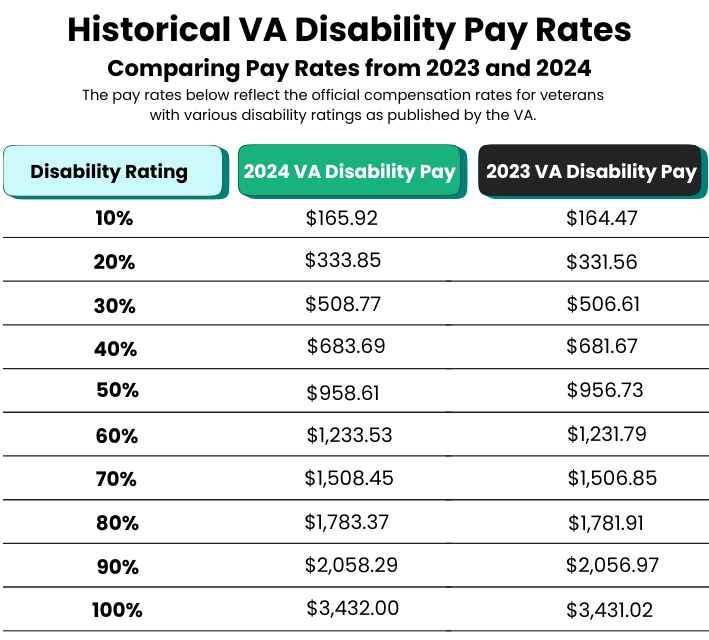
As you can see, **2024 rates** show a slight increase over **2023 rates** across all disability ratings, reflecting the COLA adjustments made for inflation.
## **Looking ahead: the future of VA disability pay**
The 2025 VA Disability Pay Rates set the stage for continued improvements in veterans' compensation. As the economy evolves, future pay rates will likely continue to reflect cost-of-living adjustments to ensure that veterans and their families can meet their financial needs. These increases also reflect the ongoing commitment to supporting those who have served our country.
For veterans, these adjustments are a critical part of ensuring financial stability in an ever-changing economic landscape. While compensation rates fluctuate based on inflation, the VA’s commitment to veterans remains steadfast, ensuring that they are supported throughout their lives.
## **Where to find more information**
For more detailed information on the 2025 VA disability pay rates, check out the[ ](https://www.va.gov/disability/compensation-rates/veteran-rates/)[U.S. Department of Veterans Affairs](https://www.va.gov/disability/compensation-rates/veteran-rates/), which provides up-to-date information on compensation, benefits, and more. Additionally, veterans can use resources like the [Veterans Benefits Administration (VBA)](https://benefits.va.gov/benefits/) and legal services to navigate their claims and ensure they are receiving the full benefits they are entitled to.
## **Maximize your VA benefits today**
Are you curious about how much you could be eligible for in VA disability compensation? Use our **Smart VA Disability Calculator** to quickly estimate your benefits based on your disability rating and dependents. Take the guesswork out of your VA claims process and plan your future with confidence.
**[Try the Smart VA Disability Calculator Now](/va-calculator)**
It’s free, easy to use, and tailored to give you the most accurate estimate of your monthly compensation!
---
type: article
title: Veteran Housing Assistance Programs: A Guide to Finding Stable Housing After Service
url: https://benefitkarma.com/articles/military-veterans/veteran-housing-assistance
updated: 2026-05-19
---
# Veteran Housing Assistance Programs: A Guide to Finding Stable Housing After Service
According to the Department of Housing and Urban Development, the number of veterans experiencing homelessness in 2023 [rose by 7.4%](https://www.military.com/daily-news/2024/01/31/va-sets-annual-record-placing-homeless-veterans-housing-sheltering-more-46000-people.html#:~:text=According%20to%20the%20results%20of%20HUD%27s%202023%20Point-in-Time,by%207.4%25%20from%20the%20previous%20year%20to%2035%2C574.) from the previous year, reaching a total of 35,574.
For many veterans, transitioning from military to civilian life can be a difficult and overwhelming process. One of the most pressing challenges they face is finding affordable, stable housing. Veterans often experience unique barriers, including financial constraints, discrimination, and a lack of resources.
Fortunately, there are several veteran housing assistance programs designed to provide the support needed to secure permanent, dignified housing. In this guide, we’ll outline these programs, eligibility criteria, and how they can help.
> **Key Takeaways:**
- **Overview of Housing Programs**: Learn about key housing assistance programs available to veterans, including VA loans, [HUD-VASH](/glossary/hud-vash), and SAH grants.
- **Eligibility Information**: Understand the eligibility requirements for each program based on factors like veteran status, disability, and income.
- **Application Guidance**: Get step-by-step instructions on how to apply for housing assistance and connect with the right resources.
- **Additional Resources**: Discover local VA centers, VSOs, and nonprofits that offer further support and financial aid for veterans in need.

## How veteran housing assistance programs help prevent homelessness
Homelessness among veterans is a significant issue, but veteran-specific housing assistance programs play a critical role in reducing the number of homeless veterans.
These programs offer several benefits:
- **Providing Stable Housing**: Financial aid, subsidies, and programs like HUD-VASH help veterans secure permanent residences, reducing reliance on shelters or living on the streets.
- **Support Services**: Many programs offer case management, [mental health services](/articles/military-veterans/various-va-health-benefits-va-health-insurance), and job placement assistance to address the root causes of homelessness, such as mental health or substance abuse issues.
- **Financial Assistance**: Emergency financial aid through programs like TFA can prevent eviction and ensure veterans maintain stable housing.
- **Specialized Housing Solutions**: Programs like the [SAH grant](/glossary/sah-grant) ensure veterans with disabilities can live in homes suited to their needs, preventing situations where they might be forced into inadequate housing.
## What veteran housing assistance programs are available?
There are several key housing assistance programs tailored specifically to veterans, each offering unique benefits based on eligibility:
- **VA Home Loan Program**: Offers home loans with no down payment and lower interest rates, even for veterans with less-than-perfect credit.
- **[Housing and Urban Development-Veterans Affairs Supportive Housing (HUD-VASH)](https://www.va.gov/HOMELESS/housing.asp)**: Combines Housing Choice Vouchers with supportive services from the VA, aimed at homeless veterans or those at risk.
- **[Supportive Services for Veteran Families (SSVF)](https://www.va.gov/homeless/ssvf/index.html)**: Helps low-income veterans and their families at risk of homelessness, offering financial and case management support.
- **[Temporary Financial Assistance (TFA)](https://www.legion.org/get-involved/community-programs/temporary-financial-assistance)**: Offered by organizations like the American Legion, this program provides emergency aid for rent, utilities, and other expenses.
- **[Specially Adapted Housing (SAH) Grants](https://www.military.com/money/va-loans/veterans-guide-to-specially-adapted-housing-grants.html)**: Provides grants to veterans with disabilities to modify their homes to meet their needs, such as installing ramps or widening doorways.

## How do I qualify for veteran housing assistance?
Eligibility requirements for veteran housing assistance programs can vary depending on the specific program, but some general criteria typically include:
- **Veteran Status**: Most programs require veteran or active-duty status, though some extend to National Guard and Reservists.
- **Disability Status**: Programs like the SAH grant specifically assist veterans with service-connected disabilities.
- **Income Level**: Many programs are income-based, requiring veterans to meet specific financial thresholds.
- **Homelessness or At-Risk Status**: Some programs, like HUD-VASH, target homeless veterans or those at risk. A referral from the VA or a social service provider may be necessary.
To learn more about specific eligibility requirements, it’s important to contact the VA or the program administrator for detailed guidance.
## How do I apply for veteran housing assistance?
The process for applying for veteran-specific housing assistance varies depending on the program. Here’s a general overview of how to get started:
- **[VA Home Loan](https://www.va.gov/housing-assistance/home-loans/home-buying-process/)**: To apply, you’ll need a Certificate of Eligibility (COE) from the VA, which you can get online through the VA’s [eBenefits portal](/glossary/ebenefits-portal) or via paper application. Afterward, work with a VA-approved lender to secure the loan.
- **[HUD-VASH](https://veteransnavigator.org/article/63483/hud-and-va-supportive-housing-hud-vash-program)**: You must be referred by a VA social worker, who will assess your eligibility and help you obtain housing vouchers.
- **[SSVF](https://www.veteransoffgrid.org/blog/understanding-the-vas-ssvf-program)**: Apply through local non-profits or a case manager with proof of veteran status (e.g., [DD214](https://www.military.com/benefits/records-and-forms/dd214.html) Form or[ VHIC](https://www.va.gov/resources/whats-a-veteran-health-id-card-vhic-and-how-do-i-get-one/)).
- **Temporary Financial Assistance**: Contact organizations like the [American Legion](https://www.legion.org/contact) or [VFW](https://www.vfw.org/contact-us) with proof of service and financial hardship.
- **[SAH Grants](https://www.benefits.va.gov/homeloans/sah.asp)**: Apply through the VA, which will determine eligibility and grant amounts.

## Are there other resources available for veterans struggling with housing?
In addition to federal programs, local and nonprofit organizations offer housing assistance:
- **[Local VA Centers](https://www.va.gov/find-locations/)**: Provide housing referrals and support services.
- **[Veteran Service Organizations (VSOs)](https://www.va.gov/get-help-from-accredited-representative/find-rep/)**: Groups like the American Legion and [Disabled American Veterans](https://www.dav.org/) offer financial aid and housing assistance.
- **Nonprofits**: Organizations like [Volunteers of America](https://www.voa.org/services/supportive-services-for-veterans-and-their-families/) and [Habitat for Humanity](https://www.habitat.org/volunteer/near-you/veterans-build/home-depot-repair-corps-program) provide temporary housing and financial aid.
- **State Programs**: Some states have their own housing programs that offer additional support.
## How can I ensure I get the most out of veteran housing assistance programs?
To maximize the benefits of veteran-specific housing assistance programs, consider the following:
- **Stay Organized**: Keep records of your military service, income, and medical history to streamline the application process.
- **Seek Help from a ****[Veteran Service Officer (VSO)](https://www.mass.gov/info-details/find-a-veterans-service-officer-near-you)**: VSOs can help guide you through the process and connect you with additional resources.
- **Be Persistent**: The process can take time, and there may be waiting lists. Don’t get discouraged—continue following up and exploring multiple options.
- **Explore ****[Additional Resources](https://www.voa.org/services/supportive-services-for-veterans-and-their-families/)**: Many programs also offer job training, healthcare, and financial counseling, all of which contribute to long-term stability.
***Unlock exclusive military discounts with this ******[ultimate guide](/articles/military-veterans/military-discounts-a-guide-for-how-to-find-and-use-them)****** to finding and using your benefits. ***
## Empowering veterans with the support they deserve
Veterans have sacrificed a great deal for their country, and it’s essential that they receive the support they need to thrive in civilian life. Veteran housing assistance programs are a vital resource that can help veterans find safe, affordable housing and avoid the pitfalls of homelessness. If you’re a veteran in need of housing assistance, take advantage of the programs available, reach out to the VA, and explore local and national resources. You don’t have to face this challenge alone—help is available, and a stable home is within reach.
---
type: article
title: Understanding VA Disability Benefits: A Simple Guide for Veterans
url: https://benefitkarma.com/articles/military-veterans/understanding-va-disability-benefits-a-simple-guide-for-veterans
updated: 2026-05-19
---
# Understanding VA Disability Benefits: A Simple Guide for Veterans
If you’re a veteran living with a disability caused by your military service, [VA disability benefits](/articles/military-veterans/overview-of-adding-a-dependent-to-your-va-disability-benefits) offer essential [financial support](/articles/military-veterans/va-pension-a-financial-safety-net-for-veterans-and-their-families) and healthcare resources. These benefits are designed to help you manage your health conditions and improve your quality of life, all while easing the financial burden that can come with medical treatments or daily living needs.
Whether your disability stems from a physical injury, illness, or mental health condition like [PTSD](/glossary/ptsd), VA disability benefits ensure that your service-related challenges are recognized and compensated.
Navigating VA disability benefits might feel overwhelming, but the process doesn’t have to be. In this guide, we’ll break down everything you need to know, from the different types of benefits available to how to apply and what to expect in terms of monthly compensation.
***To learn more about the kinds of life-improving benefits you qualify for, subscribe to BenefitKarma for free!***
## Types of VA Disability Benefits
There are a few types of benefits available, depending on your situation:
- **Disability compensation**: Monthly payments for veterans whose disabilities are linked to their service.
- **[Dependency and Indemnity Compensation](/guides/dependency-and-indemnity-compensation-dic) ([DIC](/glossary/dic))**: Payments for families of veterans who passed away due to service-related conditions.
- **[Special Monthly Compensation](/glossary/smc) (SMC)**: Extra payments for veterans with more severe disabilities, like needing help with daily activities.
- **Vocational Rehabilitation and Employment (VR&E)**: Job training and [career services for veterans](/articles/income-employment/unlocking-your-future-career-services-for-veterans) with service-connected disabilities.
## How VA Disability Compensation Works
Try it: [Smart VA Disability Calculator](/va-calculator)
Estimate your combined VA rating in under 2 minutes.
Disability compensation is a tax-free monthly payment, which can help cover medical bills, daily living costs, and other expenses. The amount you get depends on the severity of your disability, which is rated by the VA. Ratings range from 0% to 100%, and the higher the rating, the more money you’ll receive.
For example, as of 2024:
- A **10% disability rating** might get you around $165 per month.
- A **50% rating** could pay about $1,041 per month.
- A **100% rating** can bring in over $3,600 per month.
**Note:** The cost-of-living adjustment (COLA) ensures VA disability benefits increase annually to keep up with inflation, maintaining the value of payments over time.
## When do you start getting paid?
When your [VA disability claim](/articles/military-veterans/va-disability-claim-process) is approved, the effective date is crucial because it determines when your payments start. Generally, the effective date is either the date the VA received your claim or the date your disability began — whichever is later.
If your claim takes months to process, the VA may issue retroactive payments for the time between your effective date and the date your claim is approved. For example, if your claim took six months to get approved and your effective date was set when you filed, you’ll receive a lump sum covering those six months of missed payments.
It’s important to file your claim as soon as possible to ensure you don’t miss out on any potential back pay.
## What is a Service-Connected Disability?
A service-connected disability is a condition caused or made worse by your military service. It could be a physical injury, like a broken bone, or a mental health condition like PTSD. Illnesses linked to your service, such as diabetes from exposure to chemicals, also count.
### Common Examples of Service-Connected Disabilities
- **Physical Injuries**: Things like hearing loss, chronic back pain, or even amputations.
- **Mental Health Issues**: PTSD, depression, and anxiety are all common service-connected conditions.
- **Service-Related Illnesses**: Exposure to harmful substances, like Agent Orange, can lead to illnesses that qualify as service-connected disabilities.
## How to Apply for VA Disability Benefits
Applying for VA disability benefits may seem complicated, but here’s a quick rundown:
- **Check Your Eligibility**: Make sure your disability is related to your service.
- **Gather Your Documents**: You’ll need medical records, service records, and any other documents that support your claim.
- **Submit Your Application**: You can apply online through the VA’s website, by mail, or in person at a VA office.
- **Complete a C&P Exam**: The VA might schedule a Compensation & Pension (C&P) exam to evaluate your disability.
Need help with your application? Veterans Service Organizations (VSOs) like the American Legion or VFW offer free assistance in filing your VA disability claim. They can guide you through the process and help gather the necessary documents. You can also visit a local VA office for in-person support.
## Appeals Process for Denied Claims
If your VA disability claim is denied, you have the right to appeal the decision. There are three main ways to file an appeal:
- **File a Supplemental Claim**: This is for submitting new and relevant evidence that wasn't included in your initial claim. The VA will review the new information and reconsider the original decision.
- **Request a Higher-Level Review**: If you believe the VA made an error in reviewing your claim, you can request that a senior VA reviewer take a fresh look at your application without any new evidence.
- **Appeal to the Board of Veterans’ Appeals**: If you’re not satisfied with the first two options, you can appeal to the Board of Veterans’ Appeals. This involves a more formal process and might include a hearing.
The appeals process can take time, but Veterans Service Organizations (VSOs) or VA-accredited attorneys can guide you through it, ensuring your case is presented as strongly as possible.
---
type: article
title: eBenefits VA: How to Use www.ebenefits.va.gov After the Move to VA.gov
url: https://benefitkarma.com/articles/military-veterans/how-to-use-the-va-gov-ebenefits-portal
updated: 2026-07-01
---
# eBenefits VA: How to Use www.ebenefits.va.gov After the Move to VA.gov
## eBenefits VA: How to Use www.ebenefits.va.gov After the Move to VA.gov
If you've been searching for the **eBenefits VA** portal at **www.ebenefits.va.gov**, you're in the right place — and you're not alone. The VA retired the old eBenefits site in 2022 and moved everything to [VA.gov](https://www.va.gov). This guide explains what changed, how to log in today, and exactly where to find every task that used to live on eBenefits.
**Common spellings and search terms:** If you searched for *e benifits*, *ebenfits*, *ebenifits*, *ebenefits ebenefits*, or *www ebenefits va gov* — you're in the right place. All of those terms point to the same VA benefits portal, now located at VA.gov.
- [What Happened to the Old eBenefits Portal?](#what-happened)
- [From eBenefits to VA.gov: What Changed](#ebenefits-to-vagov)
- [Logging In to eBenefits / VA.gov Today](#logging-in)
- [Common eBenefits Tasks (and Where They Live Now)](#common-tasks)
- [What Does VA.gov Offer?](#what-vagov-offers)
- [Sections of the VA.gov Portal](#sections)
- [What Is Not Available on VA.gov?](#not-available)
- [What If You Get Locked Out?](#locked-out)
## Is eBenefits / VA.gov a Safe Official Website?
Yes. VA.gov is the **official website** of the U.S. Department of Veterans Affairs — the United States government agency that runs every federal veterans service. A few quick ways to confirm you are on the real site before you sign in or share family members' information:
- **The address ends in .gov.** Federal government websites often end in .gov. If gov means it's official, you know the United States government — not a copycat — runs the site.
- **The connection is secure.** Your browser shows a lock icon, which means data is encrypted and sent securely between you and VA.gov.
- **You can talk to the veterans help line.** If anything looks off, talk to the Veterans Benefits hotline at 1-800-827-1000 before entering personal details.
Only share sensitive information — Social Security numbers, banking details, medical records — on the official website (VA.gov) or through a trusted Veterans Service Officer. Never type those details into a link sent by email or text.
## What Happened to the Old eBenefits Portal?
The eBenefits portal served veterans for over a decade as the main hub for filing disability claims, checking claim status, and managing benefits. As the site aged, the VA decided to consolidate everything into a single, more modern platform.
The VA completed the transition to VA.gov in 2022. The goal was simple: instead of jumping between eBenefits, My HealtheVet, and other separate sites, veterans now have one place for everything. VA.gov also brought stronger security — including two-factor authentication — that the old eBenefits system could not match.
If you still have the old **www.ebenefits.va.gov** URL bookmarked, it redirects you to VA.gov. You have not lost access to your benefits — they are all still there, just at a new address.
## From eBenefits to VA.gov: What Changed
The core features veterans relied on in eBenefits all moved to VA.gov, but the navigation looks different. Here is a quick comparison so you know what to expect:
Old eBenefits locationWhere it lives now on VA.gov
File a disability claimVA.gov → Disability → File a claim (VA Form 21-526EZ)
Check claim or appeal statusVA.gov → Disability → Check your VA claim or appeal status
View payment historyVA.gov → Records → View your VA payment history
Update direct depositVA.gov → Profile → Direct deposit information
Download VA letters and award lettersVA.gov → Records → Download your VA benefit letters
Manage dependentsVA.gov → Disability → Add or remove a dependent (VA Form 21-686c)
GI Bill enrollment and statusVA.gov → Education → Check Post-9/11 GI Bill enrollment status
Request a Certificate of Eligibility (COE) for home loansVA.gov → Housing → Request a VA home loan COE
Veteran Readiness and Employment (VR&E)VA.gov → Careers → Apply for Veteran Readiness and Employment
Order hearing aid batteries or prosthetic socksVA.gov → Health care → Order hearing aid batteries and accessories
The single biggest practical change: **DS Logon and My HealtheVet credentials no longer work** as of their respective sunset dates (see the login section below). You must sign in with Login.gov or ID.me.
## Logging In to eBenefits / VA.gov Today
VA.gov currently supports two login methods. Both require multi-factor authentication (MFA) — an extra verification step every time you sign in.
### Option 1 — Login.gov (Recommended)
Login.gov is the VA's preferred option. It works across dozens of federal government sites, so one account gives you access to VA.gov, SSA.gov, TSA PreCheck, and more. To create an account you will need an email address, a strong password, and a phone number or authentication app for MFA. Some identity verification steps may ask for your Social Security number.
Go to [VA.gov](https://www.va.gov), click **Sign in**, and choose Login.gov to get started.
### Option 2 — ID.me
ID.me is a private identity verification service accepted by the VA. You create an account with your email, upload a government-issued ID for identity proofing, and set up MFA. ID.me is also used by many state unemployment agencies and other organizations.
### Credential Sunset Dates — Important
The older login methods that worked on eBenefits are being retired:
- **My HealtheVet credentials:** Retired January 31, 2025. No longer accepted on VA.gov.
- **DS Logon:** Retired September 30, 2025. No longer accepted on VA.gov.
If you have not yet switched to Login.gov or ID.me, do it now. Your benefits and records are not affected — only the login method changes.
## Common eBenefits Tasks (and Where They Live Now)
Once you are signed in to VA.gov, here is how to complete the tasks veterans do most often.
### Check Your Disability Claim Status
Go to **Disability → Check your VA claim or appeal status**. You will see each open claim, the current step in the process, and any action items the VA needs from you.
### File a New Disability Claim
Go to **Disability → File a disability claim (21-526EZ)**. The online form saves your progress automatically so you can return if you need to gather more records. For a complex claim, consider working with a VSO — many can file directly through the VA's system on your behalf.
### Download Your Benefit Award Letter
Go to **Records → Download your VA benefit letters**. You can download an official PDF that shows your current disability rating and monthly compensation — commonly needed for housing applications, property tax exemptions, and state benefit programs.
### Update Direct Deposit
Go to **Profile → Direct deposit information**. Changes typically take effect within one to two payment cycles.
### Add or Remove a Dependent
Go to **Disability → Add or remove a dependent**. Adding a qualifying dependent (spouse, child, or dependent parent) can increase your monthly compensation if your rating is 30% or higher.
## What Does VA.gov Offer?
VA.gov is a joint platform run by the Department of Veterans Affairs (VA) and the Department of Defense (DoD). It covers benefits and services for veterans, active-duty service members, National Guard and Reserve members, and their families. Key advantages over the old eBenefits portal include:
- **One login for everything** — no more separate accounts for eBenefits, My HealtheVet, and Vets.gov.
- **Mobile-friendly design** — the site and the VA mobile app both work on phones and tablets.
- **Stronger security** — MFA is required, and Login.gov uses NIST-compliant identity proofing.
- **Real-time claim tracking** — claim status updates faster than the old eBenefits system did.
- **Integrated health and benefits** — you can schedule a VA healthcare appointment and check a disability claim in the same session.
## Sections of the VA.gov Portal
VA.gov is organized into topic areas rather than the tool-based layout eBenefits used. Here is what each section covers:
- **Disability** — File claims, check status, manage dependents, request a decision review.
- **Health care** — Apply for VA health care, schedule appointments, refill prescriptions, send secure messages to your care team.
- **Education** — Manage GI Bill benefits, check enrollment status, apply for educational programs.
- **Housing assistance** — Apply for a VA-backed home loan, request a Certificate of Eligibility, explore adaptive housing grants.
- **Pension** — Apply for Veterans Pension or Survivors Pension.
- **Careers and employment** — Apply for Veteran Readiness and Employment (VR&E), explore job tools.
- **Life insurance** — Manage SGLI, VGLI, and other VA life insurance policies.
- **Burials and memorials** — Apply for burial benefits and pre-need eligibility.
- **Records** — Download benefit letters, request military records (DD-214), view payment history.
- **Profile** — Update contact information, direct deposit details, and connected apps.
## What Is Not Yet Available on VA.gov?
Most eBenefits features have fully migrated, but a few workflows still require a phone call, in-person visit, or separate process:
- **VA home loan servicing:** The loan application process involves your lender; only the COE request is handled on VA.gov.
- **Board of Veterans' Appeals (BVA) formal submissions:** Complex BVA filings may require additional documentation through the Appeals Management Office.
- **Community care and non-VA healthcare referrals:** Accessing care at a non-VA facility typically involves calling your VA facility's community care coordinator.
- **State-specific veterans benefits:** State-level programs — property tax exemptions, state disability pay, state veteran homes — are administered by your state's Department of Veterans Affairs, not VA.gov.
- **Mental health crisis support:** Call or text the Veterans Crisis Line at **988, then press 1**. Do not use VA.gov for emergencies.
## What If You Get Locked Out?
If you cannot sign in to VA.gov, try these steps in order:
- **Reset your password** — Go to the VA.gov sign-in page, click *Forgot password*, and follow the steps for your login provider (Login.gov or ID.me). The reset email arrives within a few minutes.
- **Check your MFA device** — If you changed your phone number or lost access to your authenticator app, log in to your Login.gov or ID.me account directly to update your MFA settings before trying VA.gov again.
- **Contact VA.gov support** — Call **1-800-698-2411** (TTY: 711), available 24/7. For Login.gov-specific issues, contact Login.gov support at [login.gov/contact](https://login.gov/contact/).
**Security tips:** Use a unique password you do not use on any other site. Enable MFA on every device you might use to sign in. Never share your credentials — VA.gov staff will never ask for your password.
**Not sure what benefits you qualify for?** Sign up for a free BenefitKarma account to discover every VA and federal benefit available to you and your family.
---
type: article
title: Understanding the DD215 Form
url: https://benefitkarma.com/articles/military-veterans/understanding-the-dd215-form
updated: 2026-05-20
---
# Understanding the DD215 Form
The DD215 form is crucial for correcting errors or making additions to a previously issued DD214 form, which summarizes a service member's active duty history. The DD215 ensures that any mistakes or missing information on the DD214 are updated accurately. These forms serve different purposes:
- The DD214 documents your entire active duty experience.
- The DD215 corrects inaccuracies, ensuring you receive the recognition and benefits you deserve.
Common corrections on the DD215 include personal details, service awards, or discharge status. You can obtain a DD215 by logging into the milConnect website or submitting a request through the National Archives, often needing supporting documents like birth certificates or marriage licenses.
## What Is a DD215 Form?
The DD215 form's primary purpose is to ensure that veterans' military records are accurate, which is crucial for accessing various benefits and services. Corrections can include:
- Fixing a misspelled name
- Adjusting service dates
- Updating discharge status and awards
To obtain a DD215, a veteran or their legal representative must submit a request with supporting documents. Once approved, the corrected information is recorded, providing accurate and complete service records.
## The Importance of the DD215 Form
Errors or omissions on the DD214 can affect your eligibility for benefits, access to services, and recognition of your service. By using the DD215 Form to amend these records, you confirm that your service history is accurate and comprehensive, which is vital for accessing the full range of benefits you are entitled to, from healthcare to educational grants and VA loans.
## Reasons You Might Need to Amend Your Papers
You might need to amend your DD214 using a DD215 for various reasons. For instance, certain awards or medals you earned might not be included or listed correctly on your DD214. Ensuring these are accurately recorded is important for receiving the full benefits and recognition you deserve proper recognition.
In other cases, you might need to update your discharge status, such as upgrading from an other-than-honorable to an honorable discharge, which can greatly affect your eligibility for benefits.
Additionally, any errors in personal information, such as your name, rank, Social Security number, or service dates, can impact your ability to secure employment, obtain medical care, or verify your service history. The DD215 Form provides a straightforward way to correct these mistakes and maintain the integrity of your personal records.
## How to Obtain and Use the DD215 Form
### How to Obtain Your DD215 Form
To request a DD215 form to correct or update information on your DD214, you can follow a few simple steps:
- Download and complete the Standard Form 180 (SF-180) from the [National Archives website](https://www.archives.gov/veterans/military-service-records/standard-form-180.html).
- Ensure all necessary information is accurately filled out to avoid any processing delays.
- Alternatively, use the [eVetRecs](https://vetrecs.archives.gov/) system on the National Archives website for an online submission, which may be quicker and more efficient.
Remember to have important details on hand, like your service number, social security number, and a copy of your discharge paperwork. Don’t forget to include any supporting documents, such as official orders or award citations, which are essential for justifying the changes you are requesting. This will help speed up the review and approval process.
### Costs Involved in Request Submission
- Generally, there are no fees charged by the National Archives or the [National Personnel Records Center (NPRC)](https://www.archives.gov/personnel-records-center) for processing your DD215 form request.
- If you require expedited services or certified copies, keep in mind that there may be additional costs.
- If you need expedited processing, you might have to use third-party services, which can charge anywhere from $60 to several hundred dollars.
- Miscellaneous expenses such as postage, obtaining certified copies of required documents, and notary services for verification purposes.
- Travel expenses if you need to visit a military records office or veteran service organization in person.
These costs can add up, especially if multiple documents are required.
### Utilizing the DD215 Form for Veteran Benefits
Using the DD215 form is an essential step for veterans seeking to access their well-deserved benefits. The DD215, which corrects any errors or omissions on the initial DD214 form, serves as a crucial component in proving veteran status.
While the DD215 alone may not always be accepted as standalone proof of service, presenting it alongside the DD214 provides a comprehensive record of your military history. It's important to check with individual benefit programs to ensure they accept the DD215 in conjunction with the DD214.
If you can't access your DD214, don't worry; other documents like military service records from the National Archives, a VA Health Identification Card, or even a Veteran Designation on your driver's license can also verify your service. In cases where the DD214 or DD215 is lost, replacements can be requested through the National Personnel Records Center, ensuring you have all the necessary proof to claim your benefits.
## Alternative Proofs of Military Service for Veteran Benefits
When a DD215 form is unavailable or insufficient to prove your military service for veteran benefits, there are other reliable documents and methods you can use.
### Official Military Personnel File (OMPF)
One key alternative is your Official Military Personnel File (OMPF), which contains a wide range of service records, including:
- Enlistment and discharge documents
- Duty assignments
- Awards or commendations you've received These files can be requested from the National Archives and Records Administration (NARA) and provide comprehensive proof of your military history.
### Additional Proofs of Service
- VA Health Care Enrollment Records: If you're enrolled in VA health care, your enrollment records can serve as proof since the [Veterans Health Administration](/glossary/va-health-care) (VHA) verifies and records your service information.
- Veteran Identification Cards: Many states offer veteran identification cards that are widely recognized by state and federal agencies. These cards generally require some form of military documentation to be issued.
- NGB Form 22: For National Guard members, the NGB Form 22 is an acceptable document.
- DD 256 Form: For those with an honorable discharge, the DD 256 Form serves as proof.
## Managing Your DD215 Form Request
When it comes to tracking the status of your DD215 form request, it's essential to utilize available resources effectively.
### Tracking the Status of Your Request
- **Online Tracking Systems:** Begin by using online tracking systems such as those offered by the National Archives or the [eBenefits portal](/glossary/ebenefits-portal), which provide real-time updates on your request.
- **Direct Contact:** If you need more specific information, don't hesitate to contact the processing office directly via phone or email. Make sure to keep a record of all communications for future reference.
### Processing Times
Be aware that processing times can vary, typically ranging from several weeks to a few months, so setting realistic expectations is key.
### Keeping a Copy for Personal Records
Once you receive your DD215 form, keep a copy for your personal records. This document not only ensures your military service records are accurate but is also vital when applying for [veteran benefits ](/articles/military-veterans/the-5-most-common-va-disability-ratings-what-they-mean)or jobs that require proof of service. Having it on hand will save you from the hassle of requesting another copy later and ensure you have the correct information readily available for any future needs.
---
type: article
title: Understanding the VA Dependent Parent Program
url: https://benefitkarma.com/articles/military-veterans/understanding-the-va-dependent-parent-program
updated: 2026-05-19
---
# Understanding the VA Dependent Parent Program
The [VA Dependent Parent Program](/glossary/va-dependent-parent-program) provides financial support to parents who depend on their veteran children for their livelihood. This benefit, offered by the Department of Veterans Affairs (VA), helps parents cover basic living expenses, medical costs, and other necessary expenditures.
To qualify, the parent must demonstrate financial dependence by having income and assets below a specific threshold.
## Key Benefits:
- Monthly financial assistance to help with living costs, medical expenses, and other essential needs.
- Alleviates financial burdens on veterans supporting their elderly parents.
- Offers peace of mind by ensuring essential needs are met.
## Eligibility Requirements:
Try it: [Smart VA Disability Calculator](/va-calculator)
Estimate your combined VA rating in under 2 minutes.
- Parents must rely on the veteran financially.
- Parent’s income and assets must meet specific criteria.
- Veterans must meet service-related requirements.
This program offers a monthly cash benefit to ease the financial burden on both you and your parent(s).
## Benefits of the VA Dependent Parent Program
The VA Dependent Parent Program offers several advantages to support [veterans and their](/articles/military-veterans/va-pension-a-financial-safety-net-for-veterans-and-their-families) parents.
### Primary Benefits:
- Financial support for everyday living and medical expenses
- Access to resources like counseling, financial planning assistance, and enhanced healthcare benefits.
- Improved quality of life and independence for dependent parents.
- Relief for veterans from costs related to:
- Assisted living
- Nursing homes
- In-home care
- Health insurance premiums
- Rent
- Utilities
Overall, this program provides a stable and comfortable living environment for dependent parents while reducing financial strain on veterans.
## Financial Aspects of the VA Dependent Parent Program
Understanding the financial benefits of the VA Dependent Parent Program can help you better support your parent(s).
### How Much Is the VA Dependent Parent Benefit?
The VA Dependent Parent Benefit is a monthly payment to help you care for a dependent parent. As of 2023, the benefit ranges from $100 to $400 per month, based on your parent's financial need and your service-connected disability rating.
### Determining the Benefit Amount:
- Subtract your parent's income and net worth from the VA's allowable income threshold.
- If your parent's financial resources are below this threshold, they may receive the maximum benefit.
- Benefit amounts adjust annually for inflation and cost-of-living changes.
## What Is Included in a Parent’s Net Worth and Income?
The VA assesses your parent's net worth and income to determine eligibility.
**Net Worth Includes:**
- Savings accounts
- Stocks
- Bonds
- Mutual funds
- Real estate (excluding primary residence)
**Income Sources Considered:**
- Earnings from employment
- [Social security benefits](/articles/income-employment/avoid-losing-social-security-benefits)
- Retirement pensions
- Dividends
- Interest from investments
Certain assets and income sources may be exempt or subject to deductions, such as the primary residence and essential living expenses like medical costs. Understanding these exemptions can help maximize the benefit.significant difference in the eligibility and amount of benefits your parent receives.
## Eligibility Requirements for the VA Dependent Parent Program
To qualify for the VA Dependent Parent Program, both veterans and their parents must meet specific criteria.
**Veteran Eligibility Requirements:**
- You need to have a disability rating of at least 30% and be receiving [VA disability](/articles/military-veterans/difference-between-diagnosis-and-service-connection-va) payments or be enrolled part-time in an educational assistance program.
- You must not have been dishonorably discharged.
**Parent Eligibility Requirements:**
- Your parent must have a legally recognized parental relationship with you—this includes biological, adoptive, foster, or step-parents, as well as anyone who acted as a parent for at least one year before you started active duty.
- They must demonstrate financial need, relying significantly on your financial support and meeting specific income and net worth criteria set by the VA.
- The parent must live in the United States, and their income and financial resources will be evaluated, with certain expenses like rent and medical costs possibly deducted to determine their countable income.
**Application Process**
- How to Apply for the VA Dependent Parent Benefit
- Gather all necessary documents, including:
- Veteran's service records
- Proof of parentage
- Evidence of the parent's financial dependence (e.g., birth certificates, tax returns, financial statements)
- Complete VA Form 21-509, which asks for detailed information about you and your dependent parent (income and net worth details).
- Submit your application through the VA's [eBenefits portal](/glossary/ebenefits-portal), by mail, or in person at a VA regional office.
- Keep copies of everything you submit for your records.
## How to Claim a Parent as Dependent for VA Disability Compensation
- Review the eligibility criteria to confirm that your parent qualifies as a dependent, focusing on their financial dependency on you and their lack of sufficient income and assets.
- Fill out [VA Form 21-686c](/glossary/adding-dependents-21-686c)
- Provide supporting evidence of your parent's financial dependency, such as:
- Tax returns
- Income statements
- Records of significant medical or care expenses
- Submit your claim to the Department of Veterans Affairs, either online or by mail, and ensure that all financial details for both you and your parent are verified.
## Utilization and Coverage
### Are There Ways to Reduce Qualifying Income?
To maximize the benefits for your dependent parent, there are a few strategies you can use to legally reduce their qualifying income:
- **Deduct unreimbursed medical expenses:** This could include costs for doctor visits, prescription medications, and any other healthcare-related expenses not covered by insurance.
- Asset reallocation: Consulting a financial advisor can help you reposition certain assets or invest in lower [taxable income](/articles/military-veterans/va-benefits-taxable-income) instruments, such as trusts or annuities.
- Gifting assets: Gifting assets to family members or charitable organizations can also reduce countable income. It's crucial to understand the legal and tax implications to avoid any penalties or eligibility issues.
### Common Uses of the VA Dependent Parent Benefit
On a day-to-day basis, this benefit can significantly ease the financial burden of essential living costs such as:
- Rent or mortgage payments
- Utilities
- Groceries
- Other necessary household expenditures
For those with elderly or disabled parents, the benefit is often directed towards long-term care services, including:
- Assisted living facilities
- Nursing home care
- In-home caregivers
- Specialized therapy services
This ensures that dependent parents receive the appropriate care and attention they need as they age or cope with chronic conditions. Finally, the benefit can be used for home safety modifications and assistive devices, which help create a safer living space for aging parents. All these uses combined make the VA Dependent Parent Benefit a comprehensive support system for veterans caring for their dependent parents.
---
type: article
title: Understanding the 2024 VA Disability Rates
url: https://benefitkarma.com/articles/military-veterans/understanding-the-2024-va-disability-rates
updated: 2026-05-19
---
# Understanding the 2024 VA Disability Rates
The 2024 VA disability rates determine the monthly compensation you receive for your service-connected disabilities. These rates help you manage your expenses and access necessary medical care, maintaining your quality of life.
Several factors influence these rates, with the Cost of Living Adjustment ([COLA](/glossary/cola)) being the primary one. COLA reflects changes in the cost of goods and services. Legislative changes, economic conditions, and shifts in veteran demographics also play roles in shaping these rates. By reviewing and adjusting the rates annually, the VA ensures they align with the economic environment and cost of living.
Comparing the 2024 rates with previous years can provide insights into trends, helping you anticipate future adjustments. In 2024, the VA disability rates saw a 3.2% increase due to high inflation from the pandemic, aiding you and your family in covering essential needs. To understand the specific benefits you're eligible for, check the VA’s compensation tables based on your disability rating and dependent status. This adjustment ensures your benefits keep pace with inflation, as mandated by federal law, linking [VA disability](/articles/military-veterans/understanding-va-disability-benefits-a-simple-guide-for-veterans) benefits with Social Security benefits adjustments.
## **Understanding Cost of Living Adjustment (COLA)**
Each year, the COLA is calculated based on the Consumer Price Index for Urban Wage Earners and Clerical Workers (CPI-W), which tracks the changes in prices for goods and services.
This adjustment is particularly significant for veterans, as it directly impacts the monthly payments they receive. For instance, if the COLA is set at 2%, a veteran who receives $1,000 per month will see an increase to $1,020.
The COLA adjustments have historically ranged between 0% and 6%, reflecting varying inflation rates. In 2022, there was a notable increase of 5.9% due to high inflation, marking the largest adjustment in nearly 40 years. The Social Security Administration sets the COLA each year, and in 2024, it increased by 3.2%. By understanding how COLA works, you can better anticipate changes in your benefits and plan your finances accordingly.
## **Determining Your Disability Payment**
Understanding how your VA disability payment is calculated can help you anticipate your monthly compensation more accurately. Your disability rating is a primary factor. It can range from 0% to 100% — with 10% increments. Higher percentages indicate more severe conditions and lead to higher payments. A thorough medical evaluation is necessary to ensure your rating truly reflects your condition.
Beyond your rating, your dependency status—whether you have a spouse, children, or dependent parents—also impacts your payment. Veterans with dependents typically receive higher payments, and the VA provides detailed charts to guide you through these variations. If you qualify for [Special Monthly Compensation (SMC)](/articles/military-veterans/understanding-the-va-special-monthly-compensation-a-guide-for-veterans) due to circumstances like the loss of a limb or the need for [aid and attendance](/glossary/aid-and-attendance), your monthly compensation can increase significantly.
Understanding these things is essential to accurately determining your expected VA disability payment and ensuring that you and your dependents are well-supported.
## **[VA Disability Rating](/guides/va-disability-ratings-explained) Process**
[The VA disability rating process](/articles/military-veterans/understanding-va-disability-benefits-a-simple-guide-for-veterans) ensures that veterans receive compensation based on the severity of their service-connected conditions. To assign these ratings, the VA uses medical evidence and results from a Compensation and Pension (C&P) exam. This exam evaluates how your disability affects daily life and your ability to work. The findings are then compared against the VA's Schedule for Rating Disabilities ([VASRD](/glossary/disability-rating)), which translates medical conditions into percentage ratings that reflect the level of impairment.
When dealing with multiple disabilities, the VA employs a special formula, often referred to as "VA Math," to combine these ratings, rather than simply adding them. For example, a veteran with 40% and 30% ratings would not have a combined rating of 70%; it would be closer to 58%. Additionally, if disabilities affect both limbs, the VA applies a bilateral factor, adding extra percentage points to account for the increased impact on your life. This approach ensures that your final combined rating accurately represents the overall effect of your disabilities, leading to appropriate compensation.
## **Benefits and Additional Compensation**
As a veteran, you have access to a range of additional benefits designed to support you and your family. The Aid and Attendance benefit, for example, offers extra financial help if you need assistance with daily activities like bathing, dressing, or eating. It can significantly boost your monthly payout if you're already receiving a VA pension or disability compensation.
If you are mostly confined to your home because of a permanent disability, you might qualify for Housebound Benefits, adding extra monthly support to cover associated costs. Special Monthly Compensation (SMC) goes beyond basic disability compensation, providing additional funds for severe disabilities or specific needs, such as the loss of use of limbs or sensory impairments.
Veterans with dependents, like a disabled spouse or children, can also receive extra compensation, which varies based on your disability rating and the VA's compensation tables.
## **Aid and Attendance Benefit**
The [Aid and Attendance](/articles/military-veterans/aid-attendance-benefit) (A&A) benefit is an additional financial assistance program designed to help veterans who need extra support with daily activities due to their health conditions. If you, as a veteran, find it challenging to manage tasks like bathing, dressing, or eating independently, or if you are bedridden or in a nursing home because of mental or physical disabilities, you might qualify for this important benefit. To be eligible, you must also be already receiving a [VA pension](/articles/military-veterans/va-pension-a-financial-safety-net-for-veterans-and-their-families).
Applying for the A&A benefit involves submitting VA Form 21-2680, filled out by your physician, along with your medical records and a personal statement. You can do this through the VA’s eBenefits platform, by mail, or with the help of a VA-accredited representative. This extra financial support can make a big difference in ensuring you get the care and assistance you need.
## **Additional Support for 100% Disability**
Veterans with a 100% rating disability have access to a range of additional support options to help improve their quality of life. First, Special Monthly Compensation (SMC) provides extra financial help for specific needs like requiring aid and attendance, or if you have lost a limb.
If something happens to you and your disability was the cause, your family can receive [Dependency and Indemnity Compensation](/guides/dependency-and-indemnity-compensation-dic) (DIC) to ensure they're financially taken care of. Additionally, you can benefit from Vocational Rehabilitation and Employment (VR&E) services, which offer career counseling and job placement to help you find work that fits your abilities.
There are also special programs for severe disabilities, or if you have a disabled spouse or dependent living with you, which could increase your monthly benefits. The VA uses a combined rating table to calculate your total disability percentage, ensuring you get the most accurate benefits possible.
---
type: article
title: Overview of Adding a Dependent to Your VA Disability Benefits
url: https://benefitkarma.com/articles/military-veterans/overview-of-adding-a-dependent-to-your-va-disability-benefits
updated: 2026-05-19
---
# Overview of Adding a Dependent to Your VA Disability Benefits
Adding a dependent to your VA disability benefits can significantly increase your monthly compensation. This extra support acknowledges the expenses of caring for your loved ones and can help ease your financial burden.
The process usually involves ensuring you qualify, submitting the required paperwork, and tracking your claim. The VA offers several ways to file, such as using the eBenefits system online, which can expedite the process. However, be aware of the specific eligibility rules and necessary documentation, as mistakes can cause delays or denials.
If you have a disability rating of at least 30%, you can add dependents like a spouse, child, or a parent who meets certain income guidelines. Scenarios for [adding dependents](/guides/adding-dependents-va-benefits) include:
- Marriage
- Having or adopting a child
- Caring for a disabled child or dependent parent
You can add dependents when you first apply for benefits or later through eBenefits. Remember, each type of dependent requires different forms and proof, so make sure you have everything in order.
## **Conditions for Adding a Dependent**
Adding a dependent to your VA disability benefits requires understanding the specific conditions and criteria set by the VA.
- **Spouse:** You can add a spouse as a dependent following your marriage—whether it’s traditional, common-law, or same-sex—by providing your marriage certificate and proof of shared financial responsibilities.
- **Children:** You can add a newborn or adopted child, or extend benefits to those under 18, full-time students between 18 and 23, or those permanently disabled before 18, with proper documentation like birth certificates or adoption papers.
Timing is crucial—you need to apply within specific windows after significant life events to avoid delays or the need for extra paperwork. If you’re the primary caregiver for a dependent parent meeting certain income criteria, they can be added, provided their income and net worth are below the VA's threshold. Meeting these conditions ensures a smoother process and helps you secure the benefits your family is entitled to.
## **Marriage and Adding a Spouse**
When you get married, you can add your spouse as a dependent to your VA disability benefits, which can increase your monthly compensation. To do this, you must provide a valid marriage certificate and complete [VA Form 21-686c](/glossary/adding-dependents-21-686c) (Declaration of Status of Dependents). Ensuring that all your documents are accurate and complete is crucial to avoid delays. By adding a spouse, you will receive a higher compensation rate.
VA acknowledges the added financial responsibilities that come with having dependents. If you get married after you start receiving VA disability benefits, you can also apply for [retroactive benefits](/glossary/retroactive-benefits). This means you could receive back pay from the date of your marriage, as long as you submit the necessary documents within one year. Filing your claim online through the eBenefits system is recommended for faster processing, but you can also use paper forms if you prefer.
## **Process for Adding a Dependent**
### **Initial Filing and Concurrent Claims**
When you’re first filing a claim to add a dependent to your VA disability benefits, start by submitting VA Form 21-686c, known as "Application Request to Add and/or Remove Dependents." Make sure to include all supporting documents like marriage certificates or birth certificates. If you're also applying for an increase in disability compensation, you can submit both claims at the same time, which can speed up the process. To help you fill out the form correctly, follow these steps:
- Provide accurate personal information for you and your dependent.
- Double-check all dates and names.
- Avoid common mistakes like forgetting to sign the form.
This will ensure your application is processed smoothly and efficiently.
### **Using the eBenefits System**
To add a dependent using [the eBenefits system](/articles/military-veterans/how-to-use-the-va-gov-ebenefits-portal), log into your eBenefits account, or create one if you haven't already. Once you're logged in, navigate to the "Apply" section and select "Add or Remove Dependents."
Follow the prompts to submit the required information and documents electronically. Depending on who you're adding, you might need to upload extra forms—like a Request for Approval of School Attendance (VA Form 21-674) for a full-time student dependent. The [eBenefits portal](/glossary/ebenefits-portal) is user-friendly and can provide quicker updates on your claim status, often within 48 hours.
Once you’ve completed the application, you’ll receive a confirmation notice and a tracking number to monitor the status. This streamlined process not only reduces processing time but also lets you track your application in real-time. Keep in mind, for special cases like adding a disabled child or dependent parents, you may need to provide additional forms. The eBenefits system is designed to make managing your benefits straightforward, but if you encounter any issues, accessing their resource section or contacting support can help resolve any pitfalls.
### **Required Documentation for Adding Dependents**
To add dependents to your [VA disability benefits](/articles/military-veterans/understanding-va-disability-benefits-a-simple-guide-for-veterans), you'll need to provide specific evidence that verifies your relationship with each dependent.
- For spouses, submit a marriage certificate—common-law and same-sex marriages are recognized by the VA.
- For biological children under 18, you’ll need birth certificates; for adopted children, adoption papers are required.
- If your child is a full-time student aged 18-23, include a Request for Approval of School Attendance (VA Form 21-674), and for children permanently disabled before 18, attach relevant medical records.
- For [dependent parents](/articles/military-veterans/understanding-the-va-dependent-parent-program), complete a Statement of Dependency of Parent(s) (VA Form 21P-509) and document their low income and dependency status.
Use VA Form 21-686c to declare the status of your dependents.
You can submit these forms and documents either online through the VA’s eBenefits system or by mail—remember to keep copies for your records. The VA will review everything for accuracy, so it's crucial to ensure all information is correct to avoid delays. Follow up if needed to make sure your dependents are added promptly.
### **Forms and Medical Records for Each Type of Dependent**
When it comes to adding dependents to your benefits, knowing the right forms and medical records to gather can make the process much smoother.
- For your spouse, you'll need to complete VA Form 21-686c (Declaration of Status of Dependents) and provide your marriage certificate alongside any divorce decrees from previous marriages.
- For biological children, the VA Form 21-686c is also required, plus the child's birth certificate.
- If your child is adopted, you'll need the final adoption decree instead.
- For stepchildren, include their birth certificate and your marriage certificate to the child's biological parent.
- If you're adding a child who is permanently disabled before turning 18, make sure to include private medical records that detail the child's disabilities.
- For full-time students aged 18-23, submit a Request for Approval of School Attendance (VA Form 21-674).
- If you're adding a dependent parent, complete VA Form 21P-509 (Statement of Dependency of Parent(s)) along with detailed financial information to prove they rely on you financially, and possibly birth certificates or other proof of relationship and dependency.
This way, you'll have all the essential documents ready for a seamless application process.
### **Submission Methods (Online and Mail)**
When it comes to adding dependents to your VA disability benefits, you have two main options: submitting your application online via the eBenefits system or sending it through traditional mail.
- If you choose the online route, the eBenefits portal offers a user-friendly interface that guides you step-by-step through the process, ensuring that all required information and documents are submitted correctly. This method is typically faster and allows you to track the status of your application in real-time, helping to avoid common pitfalls like missing paperwork or data entry errors.
- On the other hand, if you prefer to use traditional mail, you'll need to complete VA Form 21-686c, "Application Request to Add and/or Remove Dependents," and send it to the appropriate VA Regional Office. Be sure to include all necessary documentation, such as marriage certificates or birth certificates, to prevent any delays. Using certified mail with a return receipt can provide peace of mind by confirming that your application has been received.
While online submissions generally offer quicker processing times and immediate confirmation, mail submissions might be a better fit if you’re less comfortable with technology or prefer to keep physical copies of your records. By understanding these two methods, you can choose the one that best suits your needs and ensure a smoother application process.
## **Common Questions and Helpful Tips**
**How long does it take to add a dependent?**
- Generally, you can expect the VA to process your claim in about 30 to 60 days, though this can vary based on your case's complexity and the completeness of your documentation.
- To maximize your benefits and avoid delays, ensure you submit all required forms accurately and completely the first time around.
- Keeping digital copies of all submissions and correspondence will help you track your claim's progress.
**Do you receive any benefits during processing?**
- Often, the VA provides "interim" benefits if initial eligibility is confirmed, with the final amount adjusted once the dependents are verified.
- Eligibility to add a dependent generally requires a disability rating of at least 30%.
- Filing your claim online through the VA’s eBenefits website is faster and might result in receiving a decision within 48 hours.
- If you file within a year of a life event like marriage or the birth of a child, you might even qualify for back pay to the date of the event.
**Removing a Dependent and Other Life Changes**
If you need to remove a dependent from your VA disability benefits, it's crucial to act quickly to avoid complications like overpayment. Dependents can be removed if you get divorced, if a child reaches age 18 (unless they meet exceptions like being a full-time student or having certain disabilities), or if a dependent passes away. Promptly notifying the VA is key here.
- You'll need to fill out VA Form 21-686c and submit it either through the eBenefits system or by mail.
- Be ready to include necessary documents like a divorce decree or death certificate to validate your changes.
Besides removing dependents, other life changes such as marriage, divorce, birth or adoption of a child, or the death of a spouse also affect your VA benefits. Each situation requires specific documents to support the updates. The processing times may vary—removing a spouse usually happens faster than removing a child, often within 48 hours if done through the VA's automated system. Always keep your information up-to-date to ensure smooth and accurate benefits management.
---
type: article
title: Understanding SNAP: Your Guide to Supplemental Nutrition Assistance
url: https://benefitkarma.com/articles/housing-essentials/understanding-snap-your-guide-to-supplemental-nutrition-assistance
updated: 2026-05-13
---
# Understanding SNAP: Your Guide to Supplemental Nutrition Assistance
The [Supplemental Nutrition Assistance Program](/glossary/snap) (SNAP) is an important resource that helps families afford fresh fruits, vegetables, and other nutritious foods, especially as grocery prices continue to soar. With the cost of everyday staples climbing higher each year, many families find it increasingly difficult to stretch their budgets.
SNAP, commonly (and previously) known as food stamps, provides essential financial assistance to help bridge this gap, making it possible for millions of Americans to keep their kitchens stocked and maintain a balanced diet despite economic pressures. By offering support to cover part of grocery expenses, SNAP plays a vital role in ensuring that all families have access to the healthy foods they need.
In this article, we'll break down what SNAP is, who can get it, how it works, and much more.
***To learn more about all the benefits available to you and your family, sign up now for BenefitKarma!***
## What is SNAP?
SNAP stands for Supplemental Nutrition Assistance Program. It's a federal program that helps low-income families buy the food they need for good health. Think of it as a helping hand to make sure everyone has enough to eat. SNAP benefits are given out through an Electronic Benefit Transfer (EBT) card, which works like a debit card at grocery stores.
## Who is eligible for SNAP?
Eligibility for SNAP is determined by several key factors, including income, household size, and expenses. To qualify, households typically need to fall below specific income thresholds set by the federal government. For instance:
- **A family of four:** With a gross monthly income of $2,790 or less might be eligible for benefits.
- **A single individual:** With a gross monthly income of $1,133 or less could also qualify. (College students can get SNAP, but they must meet certain criteria, like working at least 20 hours a week or participating in a work-study program.)
Beyond income, SNAP eligibility takes into account various other factors:
- **Household size:** Larger families generally qualify for higher benefit amounts.
- **Expenses:** Costs like housing, utilities, and child support payments are factored into the eligibility decision. For example, if a household has high rent or mortgage payments, it might affect their qualification.
- **Savings:** Households with substantial savings may not qualify, as SNAP is intended to assist those with limited financial resources.
## How much do you receive from SNAP?
Once approved for SNAP, funds are loaded onto your [EBT card](/glossary/ebt-card) each month. The amount varies by household size and income. On average, here’s what various households receive:
- **Single person:** Approximately $200 per month.
- **Family of 2:** Around $370 per month.
- **Family of 3:** About $510 per month.
- **Family of 4:** Up to $680 per month.
- **Family of 5:** Around $820 per month.
These amounts can vary based on specific circumstances and changes in household income.
## What can you buy with SNAP?
SNAP benefits can be used to purchase a variety of nutritious foods, including:
- Fruits and vegetables
- Meat and poultry
- Dairy products
- Bread and grains
**Note:** If you have special dietary needs, don’t worry; SNAP benefits can be used to buy a variety of foods, so you can choose items that fit your dietary requirements.
SNAP benefits ***cannot*** be used to buy:
- **Non-food items:** Such as soap, paper products, and household supplies
- **Pet food:** This includes food and treats for animals
- **Hot prepared foods:** Ready-to-eat meals from restaurants (Note: Some states offer restaurant meal programs for eligible individuals)
- **Alcohol and tobacco:** These items are strictly excluded from SNAP benefits
- **Junk food and luxury items:** Such as candy, soda, and gourmet foods are generally not covered by SNAP
## How do you apply for SNAP?
Applying for SNAP is simple. Just follow these steps:
- **Choose how to apply.** You can apply online using your state’s SNAP website, by mail by sending a completed form to your local SNAP office, or in person at the local office.
- **Prepare your information.** Gather proof of your income, details on expenses like rent and utilities, and identification for all household members.
- **Submit your application.** Complete and send the form online, by mail, or in person.
- **Await the decision.** Your application will be reviewed, and you’ll be notified about your eligibility and benefit amount.
By following these steps, you can apply for SNAP and receive assistance with your food expenses.
## How long do you receive SNAP?
The length of time you can receive SNAP benefits varies; it isn’t set in stone. Some families may need assistance for just a few months, while others might need it longer.
Benefits are reassessed regularly, usually every 6 to 12 months, to ensure you still qualify. When it’s time for reassessment, you’ll need to provide current information about your income, expenses, and household size. This ensures that your benefits match your current needs. If your situation changes — such as starting a new job or having another child — your benefits might be adjusted accordingly.
To notify SNAP of changes, contact your local SNAP office or use the online portal to update your information, and provide any necessary documentation.
## What happens if you miss a SNAP recertification deadline?
If you miss a SNAP recertification deadline, your benefits may be temporarily suspended until you complete the recertification process. It’s important to contact your local SNAP office as soon as possible to explain your situation and reschedule your recertification appointment. In some cases, you might be able to receive a short-term extension to continue receiving benefits while you complete the necessary paperwork.
## Can you apply for SNAP benefits if you are unemployed?
Yes, you can apply for SNAP benefits if you are unemployed. SNAP is designed to assist individuals and families who are struggling financially, including those who are out of work.
When applying, you’ll need to provide information about your current financial situation, including any unemployment benefits you might be receiving. Your eligibility will be assessed based on your income, household size, and other factors.
## How does SNAP affect other benefits?
Receiving SNAP benefits usually doesn't impact your eligibility for other assistance programs. In fact, it can sometimes make it easier to qualify for additional help:
- **[Medicaid](/articles/health-disability/understanding-medicaid-what-it-is-and-how-it-works)****:** Many SNAP recipients also qualify for Medicaid, providing access to affordable health care.
- **Housing Aid:** SNAP benefits generally do not affect eligibility for [Section 8](/articles/housing-essentials/how-to-apply-for-section-8-to-get-some-help-with-rent) or [public housing](/glossary/public-housing) assistance.
- **Utility Assistance:** Programs like [LIHEAP](/articles/housing-essentials/everything-you-need-to-know-about-liheap-how-to-apply-and-qualify) may be easier to access if you’re approved for SNAP.
- **Childcare Assistance:** Some states offer additional childcare support to families on SNAP.
- **WIC:** SNAP recipients often qualify for [WIC](/articles/housing-essentials/what-is-wic-program), which provides extra support for women and young children.
SNAP is part of a broader safety net designed to support families in various aspects of their lives.
## SNAP vs. Food Stamps: What's the difference?
You might hear people use the terms SNAP and food stamps interchangeably, but there's a difference. Food stamps were the old paper vouchers used before the EBT card system was introduced. SNAP is the modern version of the program, using electronic cards to make the process smoother, more secure, and less stigmatized.
## Can you use SNAP benefits online?
Yes, you can use SNAP benefits to shop online at certain retailers like Amazon and Walmart. This makes it easier for families who may not have easy access to grocery stores. Just make sure the retailer accepts EBT payments before you start shopping.
## Are there specific resources for immigrants or non-citizens?
Yes, there are specific resources and eligibility guidelines for immigrants and non-citizens. The SNAP program has different rules depending on your immigration status. Some states may have additional resources and assistance programs tailored for immigrants. For more detailed information, visit the USDA SNAP website or contact your local SNAP office to understand the eligibility criteria and available resources.
Generally speaking, eligibility works like this:
### Legal Permanent Residents (Green Card Holders)
Many qualify for SNAP after five years in the U.S., though new arrivals may have a waiting period or additional requirements.
### Refugees and Asylees
Refugees and asylees are eligible for SNAP without a waiting period, provided they meet other program criteria. (Learn more about [immigrants benefits](/articles/seniors-special-groups/government-benefits-for-immigrants).)
### Other Qualified Immigrants
- [Veterans and Active Military](/articles/military-veterans/guide-to-veterans-military-benefits) Members: May qualify for benefits.
- Humanitarian Status Holders: Includes those with Temporary Protected Status (TPS) or deportation relief.
### Undocumented Immigrants
Not eligible for SNAP. However, U.S. citizen children or legal dependents in their household may qualify. (In mixed-status households, only eligible members receive benefits, based on their income and resources.)
---
type: article
title: TANF: How to Get and Use Temporary Assistance for Needy Families
url: https://benefitkarma.com/articles/housing-essentials/tanf-how-to-get-and-use-temporary-assistance-for-needy-families
updated: 2026-05-13
---
# TANF: How to Get and Use Temporary Assistance for Needy Families
[Temporary Assistance for Needy Families](/glossary/tanf) (TANF) is a key program designed to offer temporary financial support to low-income families in the U.S. When facing challenges like job loss or medical emergencies, TANF provides a helping hand to cover basic needs and promote self-sufficiency. Managed by individual states, TANF supports families with children through tough times.
Understanding TANF’s eligibility requirements, application process, and benefits can help you access the assistance you need. This guide will break down TANF essentials to help you navigate the program and work towards a more stable future.
***To learn more about all the benefits available to you and your family, sign up now for BenefitKarma!***
## What is TANF?
Temporary Assistance for Needy Families (TANF) is a federal program that helps families with dependent children who are going through tough financial times. (It was created in 1996 to replace an older program called Aid to Families with Dependent Children.)
The goal of TANF is to reduce dependency on government aid by promoting work and helping families become self-sufficient. TANF provides cash assistance, job training, and other services to help families build [income security](/articles/income-employment/fixed-income-security-benefits) and get back on their feet.
## What can TANF benefits be used for?
TANF benefits are designed to help cover essential living expenses, and recipients have to account for how they spend the money. Here’s what you can use them for:
- [Housing assistance](/articles/housing-essentials/your-guide-to-energy-and-housing-assistance-programs) (rent or mortgage payments)
- Utilities (e.g., electricity, water, heating)
- Groceries and food
- Basic household items
- Childcare expenses
**Note:** TANF benefits cannot be used for non-essential items like luxury goods, entertainment, alcohol, tobacco, or personal savings. These funds are strictly for essential living expenses such as food, housing, and utilities.
## Who is eligible for TANF?
Eligibility for TANF depends on several key factors:
- **Low income:** TANF eligibility varies by state, but generally, your family's income must be well below the federal poverty line, often less than $1,000 to $2,000 per month for a family of four.
- **Limited resources:** Savings and other resources should typically be below $2,000.
- **Citizenship:** You must be a U.S. citizen or legal resident.
- **State residency:** You must apply in the state where you live, following that state's specific rules.
## How do complete the Temporary Assistance for Needy Families application?
Applying for TANF involves a few key steps to ensure you meet the eligibility requirements:
- **Contact your local TANF office or visit their website:** Get details on the application process specific to your state.
- **Gather necessary documents:** Be prepared with proof of income, identification, and household details.
- **Submit your application:** This can typically be done online, by mail, or in person, depending on your state’s process.
- **Attend an interview:** Some states may require an interview to assess your eligibility.
- **Consult a caseworker:** You typically get assigned a TANF caseworker after your application is submitted. Once your application is processed and reviewed, the caseworker will help you with the next steps, including providing additional information, addressing any issues, and managing your benefits.
- **Wait for approval:** After your application is reviewed, you'll get a decision, and if approved, benefits will follow your state’s guidelines. Approval typically takes a few days to a few weeks, depending on your state and how fast you submit the required documents.
## How much financial assistance can you get?
The amount of TANF benefits you can receive varies based on your family size and location. Here are a few scenarios:
- **Small family in a low-cost state:** A single parent with one child might receive around $200 to $500 per month.
- **Medium family in a moderate-cost state:** A family of four could get between $300 and $800 monthly to cover basic needs.
- **Large family in a high-cost state:** A family of six might receive $700 to $1,000 per month.
Check your state’s TANF guidelines to see how much you might qualify for.
## How do you report your TANF expenditures?
To report your TANF expenditures:
- **Check requirements:** Review state guidelines for reporting procedures.
- **Gather documentation:** Collect receipts for all TANF-related expenses.
- **Complete forms:** Fill out and submit the required forms.
- **Submit reports:** Send forms and documentation to your TANF office.
- **Keep Records:** Save copies of all documents and receipts.
You generally report your expenditures monthly or quarterly, during recertification (every 6 or 12 months), and whenever requested by your TANF office.
## How long can you receive TANF benefits?
TANF benefits aren’t meant to last forever. Most states limit TANF assistance to 60 months (5 years) over your lifetime, though some states might offer extensions in special situations. This time limit is in place to encourage recipients to find work and become self-sufficient.
If you need help beyond TANF’s 60-month limit, explore other assistance programs, state extensions, job training, or consider [Social Security benefits](/articles/health-disability/what-is-supplemental-security-income-ssi-what-you-need-to-know) for additional support.
## What does TANF provide beyond financial assistance?
TANF provides more than just financial support; it also offers a range of services to help families achieve independence:
- **Job training:** Programs to build skills and improve employability.
- **Childcare assistance:** Help with paying for childcare to enable parents to work or attend training.
- **Transportation support:** Assistance with transportation costs to access work or training.
These services are designed to address immediate needs while equipping families with tools for long-term success.
## Can you receive TANF and other benefits at the same time?
Yes, you can receive TANF alongside other benefits, but it might affect how much you get from those programs. Here’s how TANF interacts with some common benefits:
- **[SNAP](/glossary/snap) (food stamps):** TANF income may lower the amount of [SNAP benefits](/articles/housing-essentials/understanding-snap-your-guide-to-supplemental-nutrition-assistance) you receive.
- **Medicaid:** TANF benefits typically do not affect your [Medicaid](/articles/health-disability/understanding-medicaid-what-it-is-and-how-it-works) eligibility.
- **Housing assistance:** TANF may reduce the amount of[ housing aid](/articles/housing-essentials/your-guide-to-energy-and-housing-assistance-programs) you qualify for.
- **Utility assistance:** TANF might impact the level of support you get for utility bills.
Understanding these interactions helps ensure you maximize the support available to you.
## What if your TANF application is denied?
If your TANF application is denied, don’t worry — you can appeal the decision. First, look over the denial notice to see why you were denied. Then, you can file an appeal by providing more documentation or fixing any errors in your application.
Make sure to act quickly, as there are often strict deadlines for appeals. You might also want to consult with a legal expert who specializes in public assistance to help guide you through the process.
## How should you report changes to your TANF case?
If there are significant changes in your life, like getting a new job or changes in your household size, you need to report them to your assigned TANF caseworker right away. Keeping your information up-to-date helps ensure that your benefits are accurate and prevents any issues.
- **New job:** Changes in employment status or income.
- **Household size:** Additions or removals of household members.
- **Income changes:** Variations in wages, benefits, or other sources of income.
- **Living situation:** Moves to a new address or changes in housing arrangements.
- **Health changes:** Significant health issues that affect your ability to work or care for dependents.
---
type: article
title: Long-Term Disability Insurance: What You Need to Know
url: https://benefitkarma.com/articles/health-disability/long-term-disability-insurance-what-you-need-to-know
updated: 2026-05-19
---
# Long-Term Disability Insurance: What You Need to Know
Life can be unpredictable, and the importance of long term disability insurance often becomes clear only when it's too late. While most of us don’t like to dwell on the possibility of becoming seriously ill or injured, the reality is that these events can and do happen. When they do, the financial impact can be devastating.
Without the ability to earn an income, how would you manage your mortgage, pay for groceries, or cover medical expenses? This is where long term disability ([LTD](/glossary/long-term-disability-insurance)) insurance comes into play.
Designed to provide a steady stream of income if you're unable to work for an extended period, LTD insurance acts as a financial safety net, ensuring that you can maintain your standard of living even in the face of life-altering circumstances.
Whether you’re just beginning to explore your options or you're reassessing your current coverage, understanding the ins and outs of long term disability insurance is crucial. In this guide, we'll break down everything you need to know to make an informed decision, from how much coverage you can expect to what the policy does (and doesn't) cover.
***To learn more about all the benefits available to you and your family, sign up now for BenefitKarma.***
## What is long term disability insurance?
Long-term disability insurance is designed to replace a portion of your income if you become disabled and are unable to work for an extended period — typically more than six months.
Unlike short-term disability insurance, which covers shorter periods, LTD insurance kicks in after you’ve exhausted other benefits, such as sick leave and short-term disability.
## How much can you get from long term disability?
Try it: [Benefit Eligibility Screener](/benefit-eligibility-screener)
Find disability and healthcare programs you may qualify for.
The amount you can receive from a long-term disability insurance policy varies based on your income and the specifics of your policy. Typically, LTD policies cover 50% to 70% of your pre-disability income.
For example, if you were earning $5,000 per month before your disability, your LTD policy might provide between $2,500 and $3,500 per month. It’s important to review your policy details, as some may have a maximum monthly benefit cap.
## What does long term disability insurance pay for?
The benefits from LTD insurance can be used to cover a wide range of living expenses. These may include:
- **Housing costs:** Mortgage or rent payments, utilities, and maintenance.
- **Daily living expenses:** Groceries, transportation, and other essential needs.
- **Medical bills:** Costs not covered by health insurance, such as copays, deductibles, or out-of-pocket expenses.
- **Debt payments: **Credit card bills, student loans, or other financial obligations.
- **Childcare and education: **Tuition or daycare costs, if applicable.
Essentially, LTD benefits help maintain your standard of living by covering the costs you would typically handle with your regular paycheck.
## What does long-term disability insurance not cover?
While long-term disability insurance offers crucial financial protection, it's important to understand its limitations. It’s essential to read the fine print of your policy to fully understand exclusions, but generally, most policies do not cover:
- **Pre-existing conditions:** Disabilities resulting from conditions that you had before purchasing the policy may be excluded, especially if the condition was treated or diagnosed within a specific time frame before coverage began.
- **Self-inflicted injuries:** Disabilities caused by self-harm or suicide attempts are generally not covered.
- **Work-related injuries:** These are typically covered by workers’ compensation insurance, not LTD.
- **Short-term disabilities: **Disabilities lasting less than the policy's waiting period (usually a few months) won’t be covered by LTD insurance.
- **Specific exclusions: **Some policies exclude coverage for certain high-risk activities, such as extreme sports or substance abuse-related disabilities.
## How do I choose an LTD plan?
When evaluating long-term disability insurance policies, you’ll want to compare the various components that make up each policy:
- **Coverage Limits:** For example, some policies might offer coverage up to $5,000 per month, while others may cap benefits at $3,000.
- **Elimination Period:** Check the elimination period (waiting period before benefits start); options might range from 30 to 180 days. Shorter waiting periods often come with higher premiums, so balance your budget and coverage needs.
- **Exclusions: **Review the exclusions carefully — some policies might exclude conditions like pre-existing medical issues or high-risk activities.
- **Riders:** Look for policies with riders that fit your lifestyle, such as a [cost-of-living adjustment](/glossary/cola) (COLA) to keep pace with inflation or a future purchase option that allows you to increase coverage without additional medical underwriting.
- **Customer Service:** Investigate the insurer’s customer service track record by reading reviews and checking ratings from organizations like J.D. Power or the Better Business Bureau.
## How do you apply for long-term disability insurance?
Applying for long-term disability insurance typically involves several steps:
- **Research and compare policies:** Start by researching different insurance providers and comparing their policies. Look for coverage amounts, premium costs, benefit periods, and policy exclusions.
- **Underwriting process:** Once you’ve selected a policy, you’ll need to complete an application. This often involves providing medical history and may include a physical exam. The insurance company uses this information to assess your risk and determine your premium.
- **Approval: **After underwriting, the insurance company will either approve, deny, or modify your application. If approved, you’ll begin paying premiums to keep the policy active.
- **Filing a claim:** If you become disabled, you’ll need to file a claim with your insurance company. This process usually requires medical documentation of your disability and proof of your inability to work.
## How long do you have to wait before benefits start coming in?
The waiting period, also known as the elimination period, is the time you must wait after becoming disabled before you start receiving long-term disability (LTD) benefits. This period typically ranges from 30 to 180 days, depending on your policy.
During this time, you’ll need to rely on other sources of income, such as savings, sick leave, or short-term [disability benefits](/articles/health-disability/understanding-healthcare-and-disability-benefits-a-simple-guide). The length of the waiting period is a crucial factor to consider when selecting a policy, as shorter waiting periods usually come with higher premiums, while longer periods result in lower costs but delay the onset of benefits.
## How long do I get my benefits once they’re approved?
“Benefit duration” refers to the length of time you will receive long-term disability payments once you qualify for them. This period can vary widely depending on the terms of your policy.
Some plans may provide benefits for a set number of years, such as 2, 5, or 10 years, while others may continue until you reach retirement age, often around 65. The longer the benefit duration, the more expensive the policy tends to be. It’s important to choose a duration that aligns with your financial needs and retirement plans, ensuring you have sufficient income support for as long as you might need it.
## Are long term disability insurance payments taxable?
The taxability of long-term [disability benefits](/articles/health-disability/ssa-blue-book) depends largely on who pays the premiums and how they are paid. If your employer pays the premiums and does so with pre-tax dollars, the benefits you receive will generally be taxable.
However, if you pay the premiums yourself with after-tax dollars, the benefits are typically tax-free. Consulting a tax advisor can help you understand the specific tax consequences based on your policy’s structure.
## What happens if my long term disability claim is rejected?
If your claim for long-term disability benefits gets denied, don’t panic — you’ve still got options. You can appeal the decision, which usually means sending in more medical evidence, clarifying your situation, or fixing any mistakes from the original claim.
Time is of the essence here since appeals often have strict deadlines, so you’ll want to act quickly. It might also be worth getting an attorney who specializes in disability insurance to help you navigate the process and boost your chances of success.
Knowing your rights and understanding the appeals process outlined in your policy can make a big difference in getting the benefits you deserve.
## How is long-term disability insurance different from TDI and workers’ comp?
Long-term disability insurance, [temporary disability insurance](/glossary/temporary-disability-insurance) (TDI), and workers’ compensation all provide financial support if you’re unable to work due to a disability, but they differ in key ways:
- **Long-term disability insurance (LTD):** Covers disabilities that last for an extended period, usually after a waiting period of several months. It applies regardless of whether the disability is work-related or not.
- **[Temporary disability insurance](/articles/income-employment/temporary-disability-insurance-how-it-works) (TDI):** Provides short-term benefits, typically for up to six months. It’s meant for temporary conditions and is often provided by state programs.
- **Workers’ compensation:** Covers only work-related injuries or illnesses. It provides benefits for medical expenses and lost wages but doesn’t apply to disabilities that occur outside of work.
## How does long-term disability insurance work with other benefits?
If you qualify for other benefits, such as Social Security Disability Insurance (SSDI) or Veterans Affairs (VA) disability benefits, your long-term disability insurance may interact with these programs:
- **SSDI:** Many LTD policies are designed to integrate with SSDI benefits. If you receive SSDI, your LTD benefits might be reduced by the amount of SSDI you receive. This is known as an “offset” provision.
- **VA disability:** [VA disability benefits](/articles/military-veterans/understanding-va-disability-benefits-a-simple-guide-for-veterans) generally do not affect your LTD benefits, allowing you to receive both in full.
- **Other insurance:** If you have multiple disability insurance policies, one policy may reduce its benefits based on the amount you receive from another, depending on the terms of your policies.
## How can I customize my long-term disability plans?
Your long-term disability insurance isn’t set in stone — you can often customize it with optional riders and add-ons. For example, a cost-of-living adjustment (COLA) rider increases your benefits over time to keep pace with inflation. The future purchase option allows you to boost your coverage later without more medical checks as your income grows. Other riders can cover partial disabilities or specific situations not included in standard policies.
Though these options may increase your premiums slightly, they offer added flexibility and peace of mind as your needs change.
---
type: article
title: Understanding Workers' Compensation: Your Guide to Benefits and Claims
url: https://benefitkarma.com/articles/income-employment/understanding-workers-compensation-your-guide-to-benefits-and-claims
updated: 2026-05-19
---
# Understanding Workers' Compensation: Your Guide to Benefits and Claims
If you’ve ever been injured or fallen ill because of your job, you might be wondering about [workers' compensation](/glossary/workers-compensation). This safety net is designed to support you when work-related issues impact your health or ability to earn a living.
Understanding Workers' Compensation can provide peace of mind during these stressful times. It’s designed to protect you by covering medical expenses and providing income replacement if you’re unable to work. This system ensures that you don’t have to bear the financial burden alone while you recover.
Workers' Compensation serves as a safety net for employees who are hurt or become ill because of their job. In this article, we'll break down what Workers' Compensation is, how it works, the benefits it offers, and how to file a successful claim.
***To learn more about all the benefits available to you and your family, sign up now for BenefitKarma!***
## What Is Workers' Compensation?
Workers' compensation is a system that provides financial and medical benefits to employees who suffer work-related injuries or illnesses. It covers a range of scenarios, from minor injuries like sprains to serious conditions like chronic illnesses caused by job duties. The primary goal is to ensure that injured workers receive the care they need without bearing the financial burden themselves.
Workers Comp is generally required by law for employers with a certain number of employees, though specifics can vary by location and industry. Failure to comply with these regulations can result in legal penalties for employers.
## What does Workers' Comp pay for?
Try it: [Find Benefits](/find-benefits)
Explore income, employment and tax benefits available to you.
Workers Comp doesn’t just cover your lost wages. Here are all the things addressed by these benefits:
- **Medical Coverage:** Workers' comp usually covers medical expenses related to the injury or illness. This includes hospital visits, surgery, medications, and sometimes even physical therapy.
- **Lost Wages:** If you’re unable to work because of your injury, workers' comp can provide wage replacement benefits. This typically amounts to a percentage of your normal wages, often around 66.7% in many states.
- **Rehabilitation Services:** If you need to undergo rehabilitation to return to work, workers' comp often covers these services, including therapy and vocational training if necessary.
- **[Disability Benefits](/articles/health-disability/understanding-healthcare-and-disability-benefits-a-simple-guide):** If your injury results in a temporary or permanent disability, you may be eligible for additional benefits based on the severity and impact of your condition.
- **Death Benefits:** In tragic cases where a worker dies due to a work-related incident, workers' compensation can provide benefits to the deceased worker's dependents or family.
## How much can you get from Workers Comp?
The amount you can receive from workers' compensation varies based on several factors, including the nature of your injury, your average wage, and your state's compensation rates.
- **Medical Expenses:** Workers' comp generally covers all necessary medical treatments related to your injury. This includes hospital stays, doctor visits, prescriptions, and rehabilitative services.
- **Wage Replacement:** Typically, workers' comp provides wage replacement benefits equal to a percentage of your average weekly wage. This percentage is often around 66.7%, but it can vary by state. For example, if you normally earn $800 per week, you might receive around $533 per week in benefits.
- **[Disability Benefits](/articles/military-veterans/understanding-va-disability-benefits-a-simple-guide-for-veterans):** If your injury results in temporary disability, you usually receive benefits for the duration of your inability to work. For permanent disabilities, benefits are based on the severity of the disability and how it affects your ability to work. States often have a schedule or formula to determine these amounts.
- **Death Benefits:** If a worker dies from a work-related incident, death benefits typically cover funeral expenses and provide compensation to the worker’s dependents. The amount varies by state and is often calculated based on the worker’s earnings and the number of dependents.
## How long does it take for Workers Comp benefits to start?
The timing for benefits to kick in can vary, but here’s a general outline of what to expect:
- **Medical Benefits:** These benefits usually start immediately after your injury is reported and your claim is accepted. Medical bills related to your injury should be covered as soon as your claim is processed.
- **Wage Replacement:** Most states have a waiting period before wage replacement benefits begin. This waiting period is typically 3 to 7 days from the date you become unable to work. However, if your disability lasts beyond this initial period, you may be eligible for retroactive payment for those initial days.
- **Disability Benefits:** For [temporary disability benefits](/articles/health-disability/understanding-temporary-disability-benefits), payments generally start after the waiting period, once your claim is approved. If you are deemed permanently disabled, benefits may be adjusted based on the severity and duration of your disability.
- **Appeals and Delays:** If there are any disputes or issues with your claim, it may take longer for benefits to start. In such cases, staying organized and in communication with your employer and insurance provider can help expedite the process.
## How do you file a Workers' Compensation claim?
To increase your chances of a successful Workers Comp claim, you’ll want to follow these steps in this order:
- **Report the Injury:** As soon as you’re injured or become ill, inform your employer. Most states require you to report the injury within a specific timeframe (often within 30 days) to qualify for benefits.
- **Seek Medical Attention:** Get a medical evaluation to document your injury. Make sure your healthcare provider is aware that your condition is work-related, as this will be crucial for your claim.
- **Complete the Claim Form:** Fill out the workers' compensation claim form provided by your employer or your state’s workers' comp board. This form will detail your injury and the benefits you’re requesting.
- **Submit Documentation:** Provide all required documentation, including medical reports, incident reports, and any other necessary forms. Keep copies for your records.
- **Follow Up:** Stay in touch with your employer and the insurance company handling your claim. Track your claim’s progress and ensure that all paperwork is processed in a timely manner.
## What if your Workers' Comp claim is denied?
If your workers' compensation claim is denied, don’t panic — you have options. First, carefully review the denial letter to understand the specific reasons behind the decision. Common reasons for denial include:
- Insufficient evidence of the injury's work-related nature
- Missed deadlines
- Incomplete documentation
Once you identify the issue, gather additional evidence, such as medical records or witness statements, to address the concerns raised. You have the right to appeal the decision, and it’s often beneficial to consult with the government’s Workers' Compensation Board or a workers' compensation attorney who can help navigate the appeal process and represent your interests. Keep detailed records of all communications and documentation related to your claim to support your case during the appeal.
**Important: **To navigate workers' compensation, address claim delays or denials promptly by appealing if needed, report any illegal retaliation, and keep detailed records of all communications and expenses.
## How is Workers' Comp different from other disability benefits?
Understanding the differences between workers' compensation, long-term disability (LTD) insurance, and [temporary disability insurance](/glossary/temporary-disability-insurance) helps in navigating available benefits:
- **Workers' Compensation** covers work-related injuries or illnesses, including medical expenses and wage replacement.
- **[Long-Term Disability Insurance](/glossary/long-term-disability-insurance) (LTD)** provides financial support for non-work-related conditions, often after a short-term period, and may extend until retirement.
- **[Temporary Disability Insurance](/articles/income-employment/temporary-disability-insurance-how-it-works) (TDI)** offers short-term income replacement for non-work-related issues, starting after a brief waiting period.
---
type: article
title: Temporary Disability Insurance: How it Works When You Can't
url: https://benefitkarma.com/articles/income-employment/temporary-disability-insurance-how-it-works
updated: 2026-05-19
---
# Temporary Disability Insurance: How it Works When You Can't
[Temporary disability insurance](/glossary/temporary-disability-insurance) can be a lifesaver when life throws you an unexpected curveball. Picture this: You get into a minor car accident on your way home from work. Even though the collision isn't severe, you end up with whiplash and a mild concussion, and your doctor orders you to rest for a few weeks. Suddenly, you're faced with the stress of missing work and figuring out how to pay your bills without your usual paycheck.
That's where [temporary disability](/articles/health-disability/understanding-temporary-disability-benefits) insurance steps in. It’s designed to be your financial lifeline when injuries keep you from working. In this article, we’ll explain how temporary disability insurance can help you cover your expenses while you heal, what it typically covers, and how you can get it before you need it.
***To learn more about all the benefits available to you and your family, sign up now for BenefitKarma!***
## What is temporary disability insurance?
Temporary disability insurance (TDI) is a type of insurance that provides you with income if you can't work due to a short-term illness or injury. Think of it as a financial cushion that helps you stay afloat while you recover. Unlike [long-term disability insurance](/glossary/long-term-disability-insurance), which covers more severe and long-lasting conditions, TDI is designed for temporary situations.
TDI ensures that you won't have to worry about money while on the mend. It's especially useful for people who don't have a lot of savings and/or who are the main breadwinners in their families.
## Who is eligible for TDI?
Try it: [Find Benefits](/find-benefits)
Explore income, employment and tax benefits available to you.
To be eligible for Temporary Disability Insurance (TDI), you typically need to meet specific criteria:
- **Work History:** You must have a certain amount of recent work history or earnings, which can vary by state or insurer.
- **Income Requirements:** Some TDI programs require a minimum level of earnings or employment for eligibility.
- **Medical Certification:** A healthcare provider must certify that you are unable to work due to a temporary illness or injury.
- **Employment Status:** You need to be employed or recently employed and unable to perform your job duties due to a qualifying condition.
## What are the most popular types of temporary disability insurance?
There are several types of TDI policies to choose from. Some of the most popular include:
- **Employer-Sponsored Plans:** Many companies offer TDI as part of their [employee benefits](/articles/income-employment/worker-and-employee-benefits) package. These plans are often more affordable because the employer covers part of the cost.
- **Individual Plans:** If your employer doesn't offer TDI, you can purchase an individual plan. These plans are customizable to fit your needs.
- **State-Sponsored Plans:** Some states offer TDI programs. If you live in a state with such a program, you might be automatically enrolled or have the option to sign up.
## What does temporary disability insurance cover?
Temporary disability insurance (TDI) covers:
- **Partial Wage Replacement:** Provides income replacement for a percentage of your lost wages, typically around 50% to 60%, while you’re unable to work due to a temporary disability.
- **Essential Living Expenses:** Helps cover essential costs such as rent, utilities, groceries, and transportation while you’re unable to earn your regular income.
- S**hort-Term Illnesses and Injuries:** Covers disabilities resulting from short-term illnesses or injuries that prevent you from performing your job duties.
- **Recovery Period:** Supports you financially during the recovery period as you heal and regain the ability to return to work.
Temporary disability insurance (TDI) does not cover:
- **Work-Related Injuries:** Injuries or illnesses sustained on the job are generally covered by [workers' compensation](/glossary/workers-compensation) rather than TDI.
- **Long-Term Disabilities:** Conditions expected to last beyond the temporary period covered by TDI are not included; [long-term disability insurance](/articles/health-disability/long-term-disability-insurance-what-you-need-to-know) is needed for such cases.
- **Non-Medical Issues:** TDI does not cover disabilities related to non-medical reasons, such as voluntary absences or personal leave.
- **Medical Expenses:** TDI benefits do not directly pay for medical expenses like hospital bills, doctor visits, or prescription medications.
- **Pre-Existing Conditions:** Some TDI programs may not cover pre-existing conditions that existed before the policy began, depending on state regulations and policy specifics.
- **Partial Disabilities:** If you are able to work part-time or with restrictions but not fully incapacitated, TDI may not cover situations where you can still perform some job duties.
## How do you file a TDI claim after injury?
Filing a claim for TDI involves several steps. Here’s a straightforward guide to help you through the process:
- **Notify Your Employer:** Inform your employer about your inability to work due to a temporary disability as soon as possible. Follow any specific procedures your employer requires for disability leave.
- **Obtain Claim Forms:** Get the necessary TDI claim forms from your state’s disability office, your employer, or directly from your insurance provider. Forms are often available online or through your HR department.
- **Complete the Forms:** Fill out your section of the claim form. Provide personal details, employment information, and specifics about your disability. Be accurate and thorough to avoid delays.
- **Medical Documentation:** Have your healthcare provider complete their portion of the form. This section should include information about your diagnosis, treatment plan, and how your condition affects your ability to work.
- **Submit the Claim:** Submit the completed forms to the appropriate office or provider. This can usually be done online, by mail, or sometimes in person. Ensure that you keep copies of everything you submit.
- **Follow Up:** After submission, check the status of your claim regularly. Be prepared to provide additional documentation or information if requested by the TDI office or insurance provider.
- **Receive and Review Benefits:** Once your claim is approved, review your benefit details carefully, including the payment schedule and amounts. Report any changes in your condition or employment status to ensure continued accuracy of your benefits.
## How long does it take to get paid after making a claim?
Once you submit your TDI claim, it generally takes about 1 to 2 weeks for the claim to be processed. This timeframe can vary based on the state or insurance provider. After processing, there is often a waiting period of around 7 days before benefits are paid out.
You can expect to receive your first payment within 2 to 3 weeks after submitting your claim, though this may vary if additional information is required.
## How much does temporary disability insurance cost?
The cost of TDI varies depending on several factors, including your age, occupation, and the level of coverage you choose. On average, you might pay between 1-3% of your annual salary for a policy.
The average salary in the U.S. is $63,795, according to the latest data from the [Social Security](/articles/income-employment/extension-for-fairness-act-payouts) Administration — so at that pay rate, TDI would cost, on average, between $638 and $1913 per year.
## How do you sign up for temporary disability insurance?
Signing up for TDI is straightforward. If your employer offers a plan, you can usually enroll during your company's open enrollment period. For individual plans, you can contact an insurance provider directly. You'll need to provide some basic information, such as your age, occupation, and income. Some plans might also require a medical exam.
### What do you need to sign up?
To sign up for TDI, you'll typically need:
- Proof of income (like pay stubs or tax returns)
- Personal identification (like a driver's license or passport)
- Medical history (for some plans)
Once you have all the necessary documents, the application process is usually quick and easy.
## Where do you find a TDI provider?
State-sponsored TDI programs provide wage replacement and financial support for workers who are temporarily unable to work due to non-work-related injuries or illnesses, and are administered by individual states like California, New York, and New Jersey.
To find out if your state offers temporary disability insurance (TDI) and details about it, check your state’s labor or employment website, contact the state’s disability office, or consult your employer’s human resources department. You can also look for information on official online resources like the U.S. Department of Labor or the National Conference of State Legislatures (NCSL).
Private companies offering temporary disability insurance include:
- The Hartford
- Prudential Financial
- Aflac
- MetLife
---
type: article
title: Understanding SSDI Disability: Your Questions Answered
url: https://benefitkarma.com/articles/health-disability/understanding-ssdi-disability-your-questions-answered
updated: 2026-05-19
---
# Understanding SSDI Disability: Your Questions Answered
Life can throw some unexpected curveballs, especially when a serious health condition forces you to stop working. That’s where [Social Security Disability Insurance](/glossary/social-security-disability-insurance) (SSDI) comes in — a program designed to catch you when you need it most.
If you’ve been paying into Social Security through your work, [SSDI](/glossary/5-month-waiting-period) is like your safety net, ready to provide financial support when you can’t work due to a disability.
But what exactly is SSDI, and how does it work? Whether you're exploring your options or just curious about how it stacks up against other benefits like [SSI](/glossary/essential-person) or Social Security retirement, this guide has you covered. We’ll break down the essentials, answer your burning questions, and help you understand what SSDI can do for you.
***To learn more about all the benefits available to you and your family, sign up now for BenefitKarma!***
## What is SSDI?
Social Security Disability Insurance (SSDI) is a federal program that provides financial support to individuals who are unable to work due to a severe and long-term medical condition.
SSDI works like an insurance policy that you’ve paid into through your Social Security taxes over the years. The amount of benefits you receive is based on your earnings history and contributions to the Social Security system. It's designed to help cover your living expenses, medical bills, and other costs when you're no longer able to work due to your health. After receiving SSDI for two years, beneficiaries may also become eligible for Medicare, regardless of age.
The program helps millions of Americans by providing essential financial assistance when they need it most, ensuring that a sudden medical condition doesn't lead to complete financial hardship.
## Who is eligible for SSDI?
Eligibility for SSDI hinges on two main factors: your work history and the severity of your medical condition. You need to have worked long enough and recently enough, having earned enough work credits by paying Social Security taxes.
Additionally, your medical condition must be severe enough to prevent you from working for at least a year or be expected to result in death.
## How do you apply for SSDI?
Applying for SSDI is a straightforward process, but it requires careful preparation. You can apply in three ways:
- **Online:** Start the application on the SSA’s [website](https://www.ssa.gov/). This method allows you to save your progress and complete it at your own pace.
- **By phone:** Call the SSA’s toll-free number. A representative will guide you through the application process and answer your questions.
- **In-person:** Visit a local Social Security office. Make an appointment for personal assistance with your application.
### What information do I need to apply for SSDI?
- **Medical records:** Detailed information about your medical condition, including diagnoses, treatment history, and contact information for your healthcare providers.
- **Work history:** A record of your past employment, including job titles, duties, and the dates you worked. This helps the SSA verify your work credits.
- **Personal information:** Your Social Security number, birth certificate, and contact information.
### How long does it take to process my SSDI application?
The application review process can take several months. On average, it takes about 3 to 5 months to get an initial decision. If your application is denied, appeals can extend the process further.
## What happens if your SSDI application is denied?
If your SSDI application is denied, don’t panic — many people are rejected at first. You have the right to appeal, which lets you provide more information to support your case.
To begin, you’ll need to request a reconsideration, where a new reviewer will take a fresh look at your application. This request must be made within 60 days of receiving your denial notice. You can do this by filling out the appeal form online at the Social Security Administration’s website or submitting the paperwork by mail. Be sure to include any additional medical records, updated doctor’s statements, or other evidence showing how your condition limits your ability to work.
If reconsideration is denied, you can request a hearing with an Administrative Law Judge (ALJ) to present more evidence. If the judge denies your claim, you can appeal to the Appeals Council or federal court, submitting additional documentation at each stage.
## How much can you receive from SSDI, and when?
The amount you receive from SSDI varies depending on your average lifetime earnings before your disability. In 2024, the average monthly SSDI payment is around $1,537, but your benefit could be more or less depending on your earnings history.
The Social Security Administration (SSA) uses a specific formula based on your covered earnings — the wages on which you've paid Social Security taxes throughout your life — to calculate your benefit amount.
Need more info? We've got an [SSDI benefits pay chart](/articles/health-disability/understanding-ssd-benefits-pay-chart) to help simplify your estimate.
## When can you start receiving benefits?
Once your application is approved, there’s a mandatory five-month [SSDI waiting period](/articles/health-disability/the-ssdi-waiting-period-how-long-until-you-re-approved) before you can start receiving payments. This means you'll begin receiving benefits in the sixth full month after the SSA determines your disability started.
For example, if your disability began in January and your claim is approved, your first SSDI payment would typically be issued in July.
## When do you get paid your SSDI benefits, and how often?
SSDI payments happen once a month, and are usually made on the same day each month, depending on your birth date:
- **If you were born on the 1st-10th:** Payments are made on the second Wednesday of the month.
- **If you were born on the 11th-20th:** Payments are made on the third Wednesday of the month.
- **If you were born on the 21st-31st:** Payments are made on the fourth Wednesday of the month.
Your SSDI benefits are typically paid electronically. You can choose to receive your payments either via direct deposit to your bank account, or through a Direct Express® debit card if you don’t have a bank account.
Direct deposit is the fastest and safest way to receive your benefits, ensuring that your payments arrive on time every month.
## Are SSDI benefits taxable?
Whether or not your SSDI benefits are taxable depends on your total income, including any other forms of income you may have. If your total income exceeds a certain threshold, a portion of your SSDI benefits may be subject to federal income tax.
For individuals, if your combined income (which includes half of your SSDI benefits plus any other income) is more than $25,000, you may have to pay taxes on up to 50% of your benefits. For married couples filing jointly, this threshold increases to $32,000.
However, if your income is below these thresholds, your SSDI benefits are generally not taxable. It’s a good idea to consult with a tax professional to understand how your benefits may be impacted.
## How is SSDI different from SSI?
SSDI and [Supplemental Security Income (SSI)](/articles/health-disability/what-is-supplemental-security-income-ssi-what-you-need-to-know) often get mixed up, but they serve different purposes. SSDI is for people with a substantial work history who have paid into Social Security. It’s an insurance program, while SSI is a needs-based program designed to assist low-income individuals who are elderly, blind, or disabled, regardless of their work history.
## How is SSDI different from Social Security retirement benefits?
SSDI and Social Security retirement benefits are both managed by the Social Security Administration, but they cater to different groups. SSDI is for individuals who can’t work due to a disability, regardless of their age, while Social Security retirement benefits are for those who have reached retirement age and have chosen to stop working.
Once you reach full retirement age, your SSDI benefits automatically convert to Social Security retirement benefits.
## Can you collect SSDI and SSI simultaneously?
Yes, you can receive both SSDI and SSI at the same time, a situation known as "concurrent benefits." This typically occurs when your SSDI payment is relatively low due to limited work history or low earnings. If you meet SSI’s income and resource limits, SSI can supplement your SSDI benefits.
## Can you receive SSDI and Social Security retirement benefits at the same time?
No, you can’t receive SSDI and Social Security retirement benefits at the same time. When you reach full retirement age, your SSDI benefits will automatically change over to retirement benefits.
The amount you receive generally stays the same, but the source of your benefits changes.
## What are the work incentives with SSDI?
If you’re thinking about returning to work, SSDI offers several work incentive programs. The Trial Work Period allows you to work for up to nine months without losing your benefits, no matter how much you earn. After that, the Extended Period of Eligibility lets you keep receiving benefits during any month your earnings fall below a certain threshold.
## How long do SSDI benefits last?
SSDI benefits continue as long as you’re unable to work due to your disability. The SSA will conduct periodic Continuing Disability Reviews (CDRs) to check if you still meet the criteria for disability.
The frequency of these reviews varies based on the nature of the condition:
- If improvement is expected, reviews may occur every 6 to 18 months
- If improvement is possible, every 3 years
- If improvement is unlikely, every 5 to 7 years.
During a CDR, the SSA will review updated medical records, and you may need to undergo a new medical examination. If the SSA determines that you no longer meet the disability criteria, your benefits may be reduced or terminated, but you can appeal such decisions. Keeping your medical records current and responding promptly to SSA requests can help ensure that your benefits continue without interruption.
## How does SSDI impact Medicare eligibility?
A major benefit of receiving SSDI is that it makes you eligible for [Medicare](/articles/health-disability/what-is-medicare-parts-a-b-c-and-d-breaking-it-down), regardless of your age. After 24 months of SSDI benefits, you’ll automatically qualify for Medicare, which can be a crucial resource for managing your healthcare needs.
---
type: article
title: What Is SSI (Supplemental Security Income)? Eligibility, Payments & How to Apply
url: https://benefitkarma.com/articles/health-disability/what-is-supplemental-security-income-ssi-what-you-need-to-know
updated: 2026-07-01
---
# What Is SSI (Supplemental Security Income)? Eligibility, Payments & How to Apply
## What Is SSI (Supplemental Security Income)? Eligibility, Payments & How to Apply
If you or a loved one has a disability, limited income, or is 65 or older, you may qualify for **Supplemental Security Income (SSI)** — a federal cash program run by the Social Security Administration (SSA). This guide covers SSI meaning, who qualifies, how much you can receive, state add-ons, and how to apply step by step.
- [What Is SSI?](#what-is-ssi)
- [SSI Meaning vs. SSDI](#ssi-vs-ssdi)
- [Supplemental Security Income Eligibility](#eligibility)
- [2026 SSI Payment Amounts](#payment-amounts)
- [State Supplementary Payment Add-On](#state-supplementary-payment)
- [How to Apply for SSI](#how-to-apply)
- [Can You Work While Receiving SSI?](#working)
- [How Often Does the SSA Review Cases?](#reviews)
- [What If Your Application Is Denied?](#denied)
- [Common Questions](#faq)
## What Is SSI?
**SSI** stands for **Supplemental Security Income**. The **SSI program** is a needs-based federal benefit that pays monthly cash to people who are aged 65 or older, blind, or have a qualifying disability — and who also have very limited income and resources.
SSI is not the same as regular Social Security retirement or workers' benefits. You do not need a work history to qualify. The money comes from general federal tax revenue, not from Social Security payroll taxes.
Some people search for *social security income*, *social security supplemental income*, or *social supplemental income* when they mean SSI. All of those terms point to this same program. See our [SSI glossary entry](/glossary/ssi) for a plain-language definition of every term the SSA uses.
## SSI Meaning vs. SSDI: What Is the Difference?
The programs people confuse most are **SSI (Supplemental Security Income)** and **SSDI (Social Security Disability Insurance)**. Here is a quick side-by-side.
Feature
SSI
SSDI
Full nameSupplemental Security IncomeSocial Security Disability Insurance
Work history required?NoYes — work credits needed
Based on financial need?Yes — income & resource limits applyNo income or resource test
Funded byGeneral federal tax revenueSocial Security payroll taxes
Health coverageMedicaid (automatic in most states)Medicare after 24-month waiting period
Who can qualifyAdults, children, aged 65+Adults with enough work credits
Some people qualify for both programs at the same time — called *concurrent benefits*. SSI may supplement a low SSDI payment if your total income stays within the SSI limit.
Social Security *retirement* benefits are a third, separate program for retirees who have paid Social Security taxes. SSDI automatically converts to retirement benefits at full retirement age, so you cannot receive both SSDI and Social Security retirement benefits simultaneously.
Not sure which program fits? [Use our SSDI Benefit Estimator](/tools/ssdi-benefit-estimator) to check your SSDI picture, or visit the [Learn center](/learn) for a full SSDI explainer.
## Supplemental Security Income Eligibility
To receive SSI, you must meet **all three** tests below. The SSA reviews each one when you apply.
### 1. Age, Blindness, or Disability
You must be at least one of the following:
- **Age 65 or older** — regardless of disability status.
- **Legally blind** — vision no better than 20/200 in your better eye, even with glasses.
- **Disabled** — a physical or mental condition that prevents substantial work and is expected to last at least 12 months or result in death. Children qualify under a separate standard.
### 2. Limited Income
Income includes wages and other earned income, Social Security benefits, pensions, and even free food or shelter. Not all income counts — the SSA ignores the first $20 of most income and the first $65 of earned wages each month. Your countable income must fall below the Federal Benefit Rate (see payment amounts below).
### 3. Limited Resources
Resources are things you own: cash, bank accounts, stocks, and real property other than your primary home. The resource limit is **$2,000 for an individual** and **$3,000 for a couple**. Your home, one vehicle, and personal belongings generally do not count.
### Citizenship and Residency
You must live in the United States, the District of Columbia, or the Northern Mariana Islands. Most U.S. citizens qualify. Certain non-citizens with qualifying immigration status may also be eligible.
**Note:** Always confirm the latest income and resource limits at SSA.gov — they can change annually.
## 2026 SSI Payment Amounts
The SSA adjusts SSI payments each January with a cost-of-living adjustment (COLA). The 2026 Federal Benefit Rate (FBR) is:
- **Individual:** $967 per month
- **Couple (both eligible):** $1,450 per month
- **Essential person add-on:** $484 per month
Your actual payment may be lower if you have countable income. The formula is simple: *FBR minus your countable income equals your monthly SSI payment*. Payments arrive on the 1st of each month. If the 1st falls on a weekend or holiday, payment arrives the prior business day.
You can receive SSI by direct deposit to a bank account or via a Direct Express debit card.
## State Supplementary Payment Add-On
Most states add extra money on top of the federal SSI benefit. This is called a **state supplementary payment**. Amounts vary widely — from a few dollars to over $100 per month depending on where you live.
Some states administer their own supplement and send a separate check. Others have the SSA fold it into one combined payment. A few states — including Arkansas, Georgia, Kansas, Mississippi, North Dakota, Tennessee, and West Virginia — do not currently offer a state supplement.
Here are a few examples of what *social security SSI* state add-ons look like in practice:
- **California** — offers a combined SSI/SSP (State Supplementary Payment) that meaningfully raises the monthly benefit.
- **New York** — provides an Optional State Supplement (OSS) added to the federal amount.
- **Texas** — offers a state supplement that boosts the federal SSI payment for residents.
- **Florida** — does not offer a cash supplement, but SSI recipients automatically qualify for Medicaid and may qualify for SNAP food assistance.
Ask the SSA about your state's add-on when you apply — getting the supplement is not always automatic.
## How to Apply for SSI (Application Walkthrough)
Starting the **SSI application process** as soon as possible matters. Your potential benefit start date is tied to when you first contact the SSA — not when your paperwork is complete.
### Step 1 — Contact the SSA
Call **1-800-772-1213** (TTY: 1-800-325-0778) or go to SSA.gov to schedule an appointment. Adults aged 18–65 who have never been married can start online. Everyone else applies by phone or in person at a local SSA office.
### Step 2 — Gather Your Documents
Have these ready before your interview:
- Social Security card or proof of your SSN
- Birth certificate or proof of age
- Proof of citizenship or immigration status
- Bank statements (last 2–3 months)
- Proof of income (pay stubs, award letters)
- Medical records, doctor names, and treatment history (disability claims)
- Proof of living arrangements (lease, mortgage, or utility bill)
### Step 3 — Complete the Interview
An SSA representative will walk through the application with you. Be thorough and honest — incomplete answers are the most common cause of delays. The interview usually takes 1–2 hours.
### Step 4 — Medical Review (Disability Cases)
If applying based on disability, the SSA sends your file to your state's Disability Determination Services (DDS) office. They review your medical records. This step can take 3–6 months. Submitting complete records upfront speeds it up.
### Step 5 — Decision and First Payment
The SSA mails a decision letter. If approved, your first payment usually arrives within 30 days of the decision. If denied, you have 60 days to request an appeal — do not miss that window.
## Can You Work While Receiving SSI?
Yes. Working does not automatically disqualify you. The SSA uses income exclusions to soften the impact of earnings on your benefit.
The SSA excludes the first $20 of most income and the first $65 of earned wages each month. After that, only half of your remaining earned income counts against the benefit. This means you can earn a modest income and still receive a partial SSI payment.
The SSA also offers **work incentive programs** — such as the Plan to Achieve Self-Support (PASS) — that let you set aside income for a work goal without having it count against your benefit. Ask about these when you apply.
## How Often Does the SSA Review Cases?
The SSA periodically reviews your case to confirm you still meet eligibility requirements. The schedule depends on how likely your condition is to improve:
- **Conditions expected to improve:** Review every 6–18 months.
- **Conditions not expected to improve:** Review every 3–7 years.
You must report changes in income, resources, living situation, or medical status to the SSA right away. Unreported changes can lead to overpayments you will need to repay.
## What Happens If Your SSI Application Is Denied?
A denial is not the end. Most SSI decisions that are ultimately approved went through at least one appeal. There are four levels:
### Step 1 — Reconsideration
Request within 60 days of the denial notice. File online, using Form SSA-561, or at a local SSA office. The SSA reviews your case again, including any new evidence you submit.
### Step 2 — Hearing by an Administrative Law Judge (ALJ)
If denied again, request a hearing within 60 days using Form HA-501. You present your case directly to an ALJ, who issues a new written decision.
### Step 3 — Appeals Council Review
If you disagree with the ALJ's decision, request a review within 60 days using Form HA-520. The Appeals Council reviews the decision but does not hold a new hearing.
### Step 4 — Federal Court Review
If the Appeals Council denies your request, you can file a lawsuit in federal district court within 60 days. Keep detailed records and submit new supporting evidence at every stage.
## Common Questions About SSI
### Is the state supplement different from regular SSI?
The phrase you sometimes see online — "SSI supplement" — usually refers to the state supplementary payment described above — extra money your state adds on top of the federal benefit. It is not a separate federal program. The amount and rules vary by state.
### Can I receive SSI and SSDI at the same time?
Yes — if you meet the qualifications for both. SSI can supplement a low SSDI payment if your total income stays within the SSI limit. This is called concurrent benefits.
### Does SSI count as Social Security income?
SSI is administered by the Social Security Administration, which is why people refer to it as *social security income* or *social security SSI*. Technically it is a separate program funded by general tax revenue — not payroll taxes. SSI payments are generally not taxable income.
### How is supplemental security income eligibility confirmed after approval?
The SSA confirms ongoing *supplemental security income eligibility* through periodic Continuing Disability Reviews (CDRs) and redeterminations of your income and resources. Respond promptly to all SSA requests to keep your benefits active.
**Not sure what you qualify for?** Sign up for BenefitKarma to discover every benefit available to you and your family — including SSI, SSDI, housing assistance, food programs, and more.
### What is the difference between SSI and SSDI?
Supplemental Security Income (SSI) and Social Security Disability Insurance (SSDI) are both run by the Social Security Administration, but they are separate programs with different qualifying rules. SSI is a needs-based program funded by general tax revenue — your countable income and resources have to fall below strict limits, and the maximum payment is set by the Federal Benefit Rate (FBR), which Congress adjusts each year. SSDI, by contrast, is an earned benefit funded by payroll taxes — you qualify based on your work credits and prior earnings, regardless of current income or resources. Many people receive both at the same time (called concurrent benefits) when their SSDI payment falls below the FBR.
---
type: article
title: Understanding Medicaid: What It Is and How It Works
url: https://benefitkarma.com/articles/health-disability/understanding-medicaid-what-it-is-and-how-it-works
updated: 2026-05-19
---
# Understanding Medicaid: What It Is and How It Works
Medicaid is a joint federal and state program that provides health coverage to individuals and families with low income and limited resources. Unlike Medicare, which primarily serves older adults and those with disabilities, Medicaid is designed to assist a broader group, including low-income adults, children, pregnant women, elderly adults, and people with disabilities.
In this guide, we'll explore what Medicaid is, how it works, who qualifies, and what it covers. We'll also discuss how it interacts with Medicare for those who qualify for both programs. By the end, you'll have a clear understanding of how Medicaid can provide essential health coverage for you or your loved ones.
***To learn more about all the benefits available to you and your family, sign up now for BenefitKarma!***
## What is Medicaid?
Medicaid is a state and federal program that offers health coverage to low-income individuals and families. Eligibility is based on income, household size, disability, family status, and other factors. Each state administers its own Medicaid program within federal guidelines, leading to variations in coverage and eligibility from one state to another.
Medicaid covers a wide range of medical services, including hospital stays, doctor visits, long-term care, and in some cases, dental and vision care. It’s a crucial resource for those who may not be able to afford [health insurance](/articles/health-disability/how-to-sign-up-for-cobra) otherwise.
## What Does Medicaid Cover?
Try it: [Benefit Eligibility Screener](/benefit-eligibility-screener)
Find disability and healthcare programs you may qualify for.
Medicaid provides comprehensive health coverage, including but not limited to:
- **Inpatient and Outpatient Hospital Services:** Coverage for hospital stays, surgeries, and emergency care.
- **Doctor Visits and Preventive Services:** Regular check-ups, immunizations, and screenings.
- **Long-Term Care: **Coverage for nursing home care and, in some states, home-based care services.
- **Prescription Drugs: **Medicaid often covers the cost of medications, though coverage can vary by state.
- **Dental and Vision Care: **Some states offer additional benefits for dental and vision services.
- **Mental Health Services: **Access to counseling, therapy, and other mental health treatments.
## Who Qualifies for Medicaid?
Medicaid income eligibility limits vary significantly by state and depend on factors such as household size and specific Medicaid program categories (e.g., pregnant women, children, elderly, or disabled individuals). However, here are general ranges based on the [Federal Poverty Level](/glossary/federal-poverty-level) (FPL), which states use as a benchmark for determining eligibility:
- **Low-Income Adults:** Income thresholds vary by state and household size. Typically, states set eligibility at 100% to 138% of the FPL. For a single adult, this could range from approximately $14,580 to $20,120 of income per year.
- **Children and Pregnant Women:** Many states offer Medicaid to pregnant women with low income. Medicaid and the Children’s [Health Insurance Program](/articles/health-disability/chip-childrens-health-insurance-program) ([CHIP](/glossary/chip)) provide coverage for children in low-income families. Eligibility limits often extend to 200% or even higher, with some states covering up to 300% of the FPL. For a family of three, this could range from about $41,600 to $62,760 of income per year.
- **Elderly and Disabled Individuals:** Medicaid covers many long-term care services that Medicare does not. Income limits can be stricter, generally set at around 75% to 100% of the FPL. For a single elderly or disabled individual, this could be between $10,935 and $14,580 in income per year.
These figures are approximate and can vary based on state-specific rules and the specific Medicaid program applied for.
## How Much Does Medicaid Cost?
Medicaid is generally very affordable, with most costs being minimal or even non-existent for those who qualify. Here’s a more detailed breakdown:
### Premiums
In many states, Medicaid beneficiaries pay no monthly premiums at all. However, in some states, certain groups (like higher-income families within Medicaid's coverage limits) might pay a small premium, typically ranging from $0 to about $20 per month.
### Copayments
For services where copayments apply, the amounts are usually quite low. For example:
- Doctor visits: Copays might range from $1 to $5 per visit.
- Prescription drugs: Generic medications might have copays of $0 to $4, while brand-name drugs could be $8 to $10.
- Emergency room visits: Copays can range from $3 to $8, though some states may charge more if the visit isn’t an emergency.
- Hospital stays: A small daily copayment might apply, often around $50 per day, capped at a certain amount.
These costs can vary based on income, the specific Medicaid program, and the state’s rules, but overall, Medicaid is structured to minimize financial barriers to accessing healthcare.
## How do I sign up for Medicaid?
To [sign up for Medicaid](/articles/health-disability/how-to-sign-up-for-medicaid), follow these steps:
- **Check Eligibility**: First, determine if you qualify for Medicaid based on your income, household size, age, disability status, and other factors. Each state has different eligibility requirements, so visit your state's Medicaid website or use the online eligibility tool at HealthCare.gov.
- **Gather Necessary Documents**: You’ll need to provide proof of identity, income, residency, and other information. Common documents include a [Social Security number](/articles/income-employment/can-you-get-a-new-social-security-number), proof of income (like pay stubs), and identification (like a driver's license or birth certificate).
- **Apply Online, by Mail, or in Person**:
**Online**: Visit your state's Medicaid website or go to HealthCare.gov to fill out an application.
- **By Mail**: Download a paper application from your state’s Medicaid website, fill it out, and mail it to the appropriate address.
- **In Person**: Visit your local Medicaid office or a designated assistance site for help with your application.
- **Submit Your Application**: After completing your application, submit it along with the required documents. If you apply online, you can upload documents directly; if applying by mail or in person, include copies of the necessary paperwork.
- **Wait for a Decision**: Once submitted, the Medicaid office will review your application. This process may take several weeks. You’ll receive a notification by mail or email regarding your approval status.
- **Enroll and Choose a Plan (if applicable)**: If approved, you may need to choose a [Medicaid managed care](/glossary/medicaid-managed-care) plan offered in your state. Some states automatically enroll you in a plan, while others allow you to select one based on your healthcare needs.
If you're unsure about any part of the process, contact your state’s Medicaid office or a local assistance organization for guidance.
## How do Medicaid and Medicare work together?
For those who qualify for both Medicare and Medicaid, known as "dual eligibles," the two programs work together to provide comprehensive coverage. Medicare covers primary services like hospital stays and doctor visits, while Medicaid helps with costs Medicare doesn’t cover, such as premiums, deductibles, and long-term care. This combination often results in minimal out-of-pocket expenses and may include additional benefits like dental and vision care.
## What does Medicaid not cover?
Medicaid coverage varies by state, but there are some services it typically doesn’t cover, such as elective procedures and over-the-counter medications.
Other exclusions might include alternative therapies like acupuncture or chiropractic care.
When Medicaid doesn’t cover certain services, beneficiaries may need supplemental insurance or other assistance programs to fill the gaps. It’s important to know what your state’s Medicaid plan covers and explore other options if needed.
---
type: article
title: What Is Medicare Parts A, B, C, and D? Breaking it Down
url: https://benefitkarma.com/articles/health-disability/what-is-medicare-parts-a-b-c-and-d-breaking-it-down
updated: 2026-05-19
---
# What Is Medicare Parts A, B, C, and D? Breaking it Down
Understanding Medicare, including its Parts A, B, C, and D, is essential as you plan for your healthcare needs in later life. Medicare is a federal health insurance program that provides coverage for hospital stays (Part A), medical services like doctor visits (Part B), prescription drugs (Part D), and more comprehensive plans through private insurers (Part C, also known as Medicare Advantage).
In this guide, we'll explore what Medicare is, how each part works, eligibility requirements, and what each part covers. We'll also discuss costs, enrollment periods, and other key details, giving you a clear understanding of how Medicare can support your health as you age.
To learn more about all the benefits available to you and your family, sign up now for BenefitKarma!
## What is Medicare?
Medicare is a federal health insurance program for people aged 65 and older, as well as some younger individuals with disabilities or specific conditions like End-Stage Renal Disease. It helps cover various medical costs, including hospital stays (Part A), outpatient care and doctor visits (Part B), and prescription drugs (Part D).
Medicare also includes preventive services like screenings and vaccines at no cost, helping you stay healthy and catch issues early. Additionally, Medicare Advantage (Part C) plans offer extra benefits like vision, dental, and hearing coverage through private insurers.
## What Are Medicare Parts A, B, C, and D?
Try it: Benefit Eligibility Screener — Find disability and healthcare programs you may qualify for.
Medicare is divided into four parts, each covering different types of healthcare services. They each have their own eligibility criteria, costs, and coverage specifics. Here's a breakdown:
### Part A: Hospital Insurance
Covers inpatient hospital stays, skilled nursing facility care, hospice care, and some home health care.
- Eligibility:
- Generally, you're eligible if you're 65 or older and either you or your spouse worked and paid Medicare taxes for at least 10 years (40 quarters).
- If you're under 65, you may qualify if you have a disability, End-Stage Renal Disease (ESRD), or Amyotrophic Lateral Sclerosis (ALS).
- Costs:
- Premiums: Most people don't pay a premium for Part A if they meet the work requirement. If you don't qualify for premium-free Part A, you can buy it, and the premium can be up to $506 per month (in 2024).
- Deductibles and Coinsurance: There is a deductible for each benefit period ($1,632 in 2024). Coinsurance costs apply for extended hospital stays (e.g., $0 for the first 60 days, then $408 per day for days 61–90).
### Part B: Medical Insurance
Covers certain doctors' services, outpatient care, medical supplies, and preventive services.
- Eligibility:
- Available to all Medicare-eligible individuals (typically those 65 or older, or younger individuals with disabilities).
- Enrollment is usually automatic if you’re receiving Social Security benefits.
- Costs:
- Premiums: Most people pay a standard monthly premium ($174.70 in 2024). Higher-income individuals may pay more (Income-Related Monthly Adjustment Amount, or IRMAA).
- Deductibles and Coinsurance: There is an annual deductible ($240 in 2024). After meeting the deductible, you typically pay 20% of the Medicare-approved amount for services.
### Part C: Medicare Advantage
An alternative to Original Medicare, offered by private companies. It includes Part A and Part B coverage, and often Part D.
- Eligibility:
- Must be enrolled in both Medicare Part A and Part B.
- Must live in the service area of the Medicare Advantage plan you wish to join.
- Costs:
- Premiums: Varies by plan; you continue to pay your Part B premium, and some Medicare Advantage plans may have an additional premium.
- Out-of-Pocket Costs: Vary widely based on the specific plan (e.g., copayments, coinsurance, deductibles).
- Coverage: Medicare Advantage plans often include additional benefits like vision, dental, and hearing, which are not covered by Original Medicare.
### Part D: Prescription Drug Coverage
Helps cover the cost of prescription drugs.
- Eligibility:
- Available to anyone enrolled in Medicare Part A and/or Part B.
- Costs:
- Premiums: Varies by plan and income; higher-income individuals may pay an IRMAA (Income-Related Monthly Adjustment Amount).
- Deductibles and Copayments: Plans have different cost structures, including annual deductibles, copayments, and coinsurance. There’s also a coverage gap (the “donut hole”), after which catastrophic coverage kicks in.
- Penalty: A late enrollment penalty applies if you go without creditable prescription drug coverage for 63 days or more after your Initial Enrollment Period.
## When are the enrollment periods?
Knowing when to enroll in Medicare is crucial to avoid penalties and ensure you have coverage when you need it:
- AEP (Annual Enrollment Period): The period from Oct. 15 to Dec. 7 each year when you can review, switch, or join new Medicare plans. This is the ideal time to make any necessary changes to your Medicare Advantage (Part C) or Part D (prescription drug) plan, or to switch between Original Medicare and Medicare Advantage.
- IEP (Initial Enrollment Period): The 7-month window around your 65th birthday to sign up for Medicare. This includes the 3 months before, the month of, and the 3 months after your 65th birthday.
- GEP (General Enrollment Period): A period from January 1 to March 31 each year for those who didn’t sign up for Medicare during their IEP and aren’t eligible for a SEP. Coverage begins on July 1 of the same year.
- SEP (Special Enrollment Period): A time outside the usual enrollment periods when you can sign up for Medicare due to specific life events, such as losing employer coverage, moving out of your plan’s service area, or qualifying for Medicaid.
Note: Late enrollment in Part B or Part D can result in lifelong penalties, increasing your premium. It's important to enroll on time to avoid these extra costs.
## How much does Medicare cost?
Medicare isn't free, and costs can vary. The following figures for each part are approximate and subject to change, so it's always a good idea to verify with the latest information from Medicare or consult with a Medicare advisor for the most accurate and personalized details.
### Medicare Part A
- Premium: Still generally premium-free if you or your spouse paid Medicare taxes for at least 10 years. If not, the premium can be up to approximately $506 per month, depending on your work history.
- Deductible: The inpatient hospital deductible is around $1,632 per benefit period.
### Medicare Part B
- Premium: The standard monthly premium for 2024 is approximately $174.70. Higher-income beneficiaries pay more, with premiums ranging from about $243 to over $560 per month.
- Deductible: The annual deductible is around $240.
### Medicare Part C (Medicare Advantage)
- Premium: Varies widely depending on the plan and location. Some plans have premiums as low as $0, but others can be over $100 per month. You must also pay the Part B premium.
### Medicare Part D
- Premium: Varies based on the plan and coverage chosen. Premiums can range from about $12 to over $100 per month. Higher-income beneficiaries may pay an additional surcharge.
## What things does Medicare not pay for?
Medicare does not cover everything. Some services, like long-term care, most dental care, hearing aids, and vision care, are not included. To cover these gaps, you might consider supplemental insurance like Medigap.
## What’s the difference between Medicare and Medicaid?
It's easy to confuse Medicare with Medicaid, but they are different programs. Medicare is a federal program primarily for seniors, while Medicaid is a state and federal program for those with low income.
People can qualify for both Medicare and Medicaid, known as "dual eligibles." These individuals are typically seniors or those with disabilities who meet the income and asset limits for Medicaid.
Dual eligibles benefit from both programs, with Medicare covering services like hospital stays and outpatient care, while Medicaid helps with costs Medicare doesn’t cover, such as premiums, deductibles, and long-term care. This combination often leads to lower out-of-pocket expenses and access to additional services like dental, vision, and hearing care.
---
type: article
title: Ultimate Guide to Health Reimbursement Arrangements (HRAs): Types and Benefits
url: https://benefitkarma.com/articles/health-disability/health-reimbursement-arrangement
updated: 2026-06-03
---
# Ultimate Guide to Health Reimbursement Arrangements (HRAs): Types and Benefits
According to the [Society for Human Resource Management](https://www.shrm.org/topics-tools/news/benefits-compensation/employers-consider-hra-based-alternatives-to-group-health-plans), the average age of employees covered by an HRA is younger than the typical Healthcare.gov enrollee, indicating that HRAs are attracting a younger and healthier demographic to the [ACA marketplace](/glossary/aca-marketplace). This trend reflects a growing preference for flexible, cost-effective healthcare options.
Many employers, however, face challenges in providing affordable and tax-advantaged healthcare benefits without stretching their budgets. Traditional group [health insurance](/articles/health-disability/chip-childrens-health-insurance-program) plans can be expensive and inflexible, leaving both employers and employees dissatisfied with their options. Health Reimbursement Arrangements (HRAs) present a customizable solution, allowing employers to offer valuable healthcare benefits while maintaining cost control and maximizing tax advantages for both parties.
In this blog, we'll explore how HRAs work, their benefits for both employers and employees, and how they can be a game-changer in managing healthcare expenses.
> **Key Takeaways:**
- HRAs provide tax-free reimbursements
- Different types of HRAs to suit various needs
- Advantages and limitations for employers and employees
- What’s covered and what’s not
## What is a Health Reimbursement Arrangement (HRA)?
A [Health Reimbursement Arrangement](/glossary/hra) (HRA) is an employer-funded health benefit plan that [allows employees to be reimbursed](https://www.investopedia.com/terms/h/hra.asp) for qualified medical expenses. Unlike traditional [health insurance](/articles/health-disability/how-to-sign-up-for-cobra), an HRA is designed to help employees cover healthcare costs while giving employers flexibility and cost control. HRAs are typically offered in addition to, or in place of, group [health insurance](/articles/health-disability/cobra-alternatives-health-insurance) and provide tax-free reimbursement for out-of-pocket medical expenses.
## How does a Health Reimbursement Arrangement (HRA) work?
Try it: [Benefit Eligibility Screener](/benefit-eligibility-screener)
Find disability and healthcare programs you may qualify for.
HRAs work by allowing your employer to contribute a fixed amount of money to your account. You can then use these funds to pay for qualified medical expenses such as doctor’s visits, prescription medications, and other health-related costs. Employers set a specific annual limit for contributions, and any unused funds may roll over to the following year (depending on the plan). The beauty of an HRA is that the funds are tax-free, both for the employee and the employer, making it a highly cost-effective benefit. For more details, visit the IRS page on [HRAs](https://www.irs.gov/newsroom/health-reimbursement-arrangements-hras).
## What are the different types of HRAs?
There are several types of HRAs designed to meet different employee needs and employer structures. These include:
- **Individual Coverage HRA (ICHRA):** This type of HRA allows employees to purchase their own [health insurance](/articles/income-employment/affordable-health-insurance-small-business) (such as through the Health Insurance Marketplace) and then get reimbursed for premiums and other medical expenses.
- **Qualified Small Employer Health Reimbursement Arrangement (QSEHRA):** Aimed at small businesses with fewer than 50 employees, this HRA allows employers to provide tax-free reimbursements for employees' health insurance premiums and qualifying medical expenses.
- **Excepted Benefit HRA (EBHRA):** This allows employers to offer reimbursements for limited medical expenses, such as dental and vision care, without needing to offer a full health insurance plan.
- **Group Coverage HRA (GCHRA):** The Group Coverage HRA works alongside a traditional employer-sponsored group health plan. Employers can reimburse employees for their out-of-pocket medical expenses, such as co-pays, deductibles, and prescriptions, on top of their existing group health insurance.
- **Retiree HRA:** A Retiree HRA is designed specifically for retirees who are no longer eligible for employer-sponsored health insurance. Employers can use this type of HRA to provide tax-free reimbursements for healthcare costs incurred after retirement, such as premiums, prescription medications, and medical treatments.
- **Dental/Vision HRA:** This type of HRA allows employers to offer reimbursements for dental and vision care expenses, such as check-ups, glasses, and other related treatments. It is often paired with a traditional health insurance plan but is more focused on specific health needs.
Each HRA type is governed by specific rules and restrictions, so it’s important to understand which one is best suited for your needs. [Click here](https://www.cms.gov/files/document/overview-new-health-reimbursement-arrangements-part-one-slides.pdf) to learn more about each type.
## Key considerations for Health Reimbursement Arrangements
- **HRAs Are Not Traditional Health Coverage: **Unlike a typical employer-sponsored health plan, an HRA is an [employer-funded account ](https://www.healthcare.gov/job-based-help/)that reimburses employees for qualifying medical expenses up to a set dollar amount each year. Unused funds may carry over from year to year.
- **You Must Have Health Coverage to Use the HRA: **To access HRA funds, you must have qualifying health coverage. This can include plans purchased through the Marketplace or other qualified sources.
- **HRAs May Help Pay Premiums: **For [certain types of HRAs](https://www.dol.gov/sites/dolgov/files/ebsa/about-ebsa/our-activities/resource-center/faqs/health-reimbursement-arrangements.pdf), you can use the funds to pay monthly premiums for a health plan you purchase on your own.
## Are HRA reimbursements tax deductible?
Yes, HRA reimbursements are tax-deductible for both employers and employees. For employees, reimbursements are considered tax-free income, which means they won’t have to pay federal income tax or payroll taxes on the funds used for qualified medical expenses. For employers, contributions to the HRA are deductible as a business expense, offering significant tax advantages for both parties.
***Searching for more savings this tax season? Check out this article on ******[How to Claim the Earned Income Tax Credit for Extra Savings](/articles/income-employment/earned-income-tax-credit)******.***
## Pros and cons of Health Reimbursement Arrangements (HRAs)
Pros:
- **Cost Control for Employers**: Employers can set annual contribution limits for HRAs, helping to keep healthcare costs predictable and manageable.
- **Tax-Free Reimbursements**: Employees can receive tax-free reimbursements for qualifying medical expenses, which can reduce their overall tax liability.
- **Flexibility for Employees**: HRAs offer employees flexibility, as they can use the funds to cover a variety of out-of-pocket healthcare expenses, and in some cases, premiums for individual health plans (such as under ICHRAs or QSEHRAs).
- **Carryover of Funds**: Unused HRA funds may roll over into the next year, allowing employees to accumulate savings for future medical expenses.
Cons:
- **Employer-Dependent**: HRAs are only available if the employer offers them. This means not all employees will have access to this benefit.
- **Requires Qualifying Health Coverage**: Employees must have qualifying health insurance (either through an employer, the Marketplace, or another qualifying plan) in order to use HRA funds for reimbursement.
- **Complex for Employers**: Different types of HRAs (e.g., ICHRA, QSEHRA, EBHRA) come with specific rules and regulations, which can make HRA management and compliance complex for employers.
- **Limited Awareness for Employees**: Some employees may not fully understand how HRAs work, what expenses are eligible for reimbursement, or how to properly use their HRA funds, leading to underutilization of the benefit.
HRAs can provide valuable benefits for both employers and employees, but they also come with certain complexities. Understanding the pros and cons is crucial for both parties to ensure the HRA is used effectively and in compliance with regulations.
## What expenses are covered by a Health Reimbursement Arrangement?
**Covered Expenses:**
HRAs typically cover a wide range of qualified medical expenses, including:
- **Doctor’s Office Visits and Co-pays**
- **Prescription Medications**
- **Medical Supplies** (e.g., bandages, syringes, glucose test strips)
- **Hospital and Surgery Expenses**
- **[Dental and Vision Care](https://www.irs.gov/publications/p502)** (in some cases, depending on the HRA type and specific plan rules)
*Note: Not all HRAs, such as Excepted Benefit HRAs (EBHRAs), may cover dental and vision care. Be sure to check your specific HRA’s guidelines.*
## What expenses are not covered by a Health Reimbursement Arrangement?
**Not Covered Expenses:**
While HRAs offer flexibility, there are still certain medical costs they do not cover. Common exclusions include:
- **Health Insurance Premiums** (except for **Individual Coverage HRAs (ICHRA)** and **Qualified Small Employer HRAs (QSEHRA)**)
- **Over-the-Counter Medications** (unless prescribed by a doctor)
- **Cosmetic Treatments** (e.g., plastic surgery, cosmetic dentistry, or elective procedures not medically necessary)
- **General Wellness Expenses** (e.g., gym memberships, vitamins, or weight loss programs not prescribed by a doctor)
*Note: Different types of HRAs may have specific rules on what’s covered. Always review your plan's details to ensure you're reimbursing eligible expenses.*
## Can you use marketplace coverage with an HRA?
Yes, you can use [Marketplace coverage](https://www.healthcare.gov/job-based-help/marketplace/) with certain types of HRAs, specifically Individual Coverage HRAs (ICHRA). If your employer offers an ICHRA, you can use the funds to reimburse yourself for the premiums you pay for a Marketplace health plan. This is especially beneficial for employees who do not have access to traditional group insurance or want the flexibility to choose their own health plan through the Marketplace.
However, to qualify for ICHRA reimbursement, you must be enrolled in a Marketplace plan or other qualifying health coverage. Make sure to verify your eligibility and plan details to avoid complications when filing for reimbursements.
## Why should employers consider offering HRAs?
HRAs can be a game-changer for employers looking to offer healthcare benefits without the high costs and administrative complexity of traditional group health plans. By providing employees with a fixed allowance to cover their medical expenses, employers can better control their healthcare budgets while still offering valuable benefits to their workforce. HRAs are also a great option for small businesses, as they can be tailored to fit the company’s financial situation and employee needs.
## Is a Health Reimbursement Arrangement the right choice for you?
Health Reimbursement Arrangements (HRAs) offer a flexible, tax-efficient way to help cover medical costs. Whether you're an employee seeking reimbursement for healthcare expenses or an employer considering offering this benefit, understanding the ins and outs of HRAs is crucial. By exploring the different types of HRAs and knowing the rules for reimbursement, you can maximize the value of this benefit, reduce healthcare costs, and make informed decisions about your health coverage options.
For more information and to determine if an HRA is right for you, consult with a benefits advisor or review the plan options provided by your employer.
---
type: article
title: A Comprehensive Overview of Flexible Spending Accounts (FSAs)
url: https://benefitkarma.com/articles/health-disability/flexible-spending-accounts
updated: 2026-05-19
---
# A Comprehensive Overview of Flexible Spending Accounts (FSAs)
Managing healthcare and dependent care costs can be overwhelming, especially with unexpected expenses that strain your budget. Without the right savings strategy, you may find yourself scrambling to cover out-of-pocket costs, potentially missing out on tax benefits or facing high expenses at the worst time.
A Flexible Spending Account (FSA) can help you save pre-tax dollars for eligible healthcare and dependent care expenses, offering a smart way to reduce your taxable income and cover costs more easily. In this blog, we’ll outline the key considerations when it comes to FSAs.
> **Key Takeaways:**
- FSAs allow you to save pre-tax dollars for eligible healthcare and dependent care expenses, reducing your taxable income.
- They offer tax savings, convenience, and cover a wide range of medical, dental, vision, and dependent care costs.
- Contributions are made through payroll deductions, but unused funds may be forfeited at the end of the year (use-it-or-lose-it rule).
- FSAs are ideal for those with predictable expenses, but may not be the best choice if costs are uncertain.
- Always consider your estimated annual expenses to determine the right contribution amount and avoid forfeiting funds.
## What is a Flexible Spending Account (FSA)?
The Bureau of Labor Statistics estimates that 43% of private industry workers and 71% of state and government workers had [access to an FSA in 2021](https://www.forbes.com/advisor/health-insurance/what-is-fsa/#:~:text=There%20were%20over%202.4%20million%20flexible%20spending%20accounts,workers%20had%20access%20to%20an%20FSA%20in%202021.). A Flexible Spending Account (FSA) is a special account offered by employers that allows employees to set aside pre-tax dollars to cover qualifying out-of-pocket expenses. The funds in an FSA are not subject to federal taxes, which helps reduce your taxable income and can ultimately save you money.
## How does a Flexible Spending Account work?
An FSA (also called a “[flexible spending arrangement](https://www.healthcare.gov/have-job-based-coverage/flexible-spending-accounts/)”) works by letting you contribute a portion of your paycheck to an account before taxes are deducted. These funds can then be used to pay for eligible expenses, such as medical, dental, or vision costs. Contributions are made through payroll deductions, and the amount is available for use throughout the year. However, it’s important to note that FSAs typically have a “use-it-or-lose-it” rule, meaning unused funds may be forfeited by the end of the plan year.
## What can I use my Flexible Spending Account for?
FSAs can be used for a variety of eligible expenses, including:
- **Healthcare costs:** Copayments, prescriptions, dental and vision care, over-the-counter medications, and more.
- **Dependent care:** Expenses related to the care of children or dependents, such as daycare, after-school programs, or eldercare.
Always check with your employer or plan administrator for a full list of eligible expenses.
## What are the benefits of a Flexible Spending Account?
There are several key benefits to using an FSA:
- **Tax savings:** Contributions are made pre-tax, reducing your taxable income.
- **Convenience:** Funds are automatically deducted from your paycheck, so saving is easy and automatic.
- **Broad coverage:** As stated previously, FSAs can cover a wide range of medical, dental, vision, and dependent care expenses.
## Can a Flexible Spending Account save money on healthcare expenses?
Yes! By using pre-tax dollars to pay for [qualified healthcare costs](https://www.fsafeds.gov/support/faq/hcfsa), an FSA can reduce your overall tax burden. This means you effectively pay less for your medical expenses since you're using untaxed money to cover them. For example, if you're in the 25% tax bracket, a $1,000 expense paid through an FSA will only cost you $750 after tax savings.
## Flexible Spending Account pros and cons
Like any financial tool, FSAs come with their [pros and cons](https://www.investopedia.com/terms/f/flexiblespendingaccount.asp). Here's a quick rundown:
### Pros:
- Pre-tax contributions reduce your taxable income.
- Can cover a wide range of health and dependent care expenses.
- Funds are automatically deducted from your paycheck, making saving easy.
### Cons:
- **Use-it-or-lose-it rule:** Unused funds are forfeited at the end of the year.
- Limited contribution limits: FSAs have annual contribution limits (for 2024, the limit is $3,050 for healthcare FSAs).
- Contributions may be challenging to estimate if expenses are unpredictable.
## What are the types of Flexible Spending Accounts
There are [several types](https://www.forbes.com/advisor/health-insurance/what-is-fsa/) of FSAs, each designed to meet different needs:
- **Healthcare FSA:** Covers medical, dental, vision, and sometimes over-the-counter medications.
- **[Dependent Care FSA](/glossary/dependent-care-fsa):** Used for dependent care expenses, such as daycare or after-school care for children.
- **Limited Purpose FSA:** Often paired with a [Health Savings Account](/glossary/hsa) (HSA), this type is for dental and vision expenses only.
***Looking for more savings options and have a disability? Explore this article on ******[tax-advantaged savings accounts](/articles/health-disability/able-accounts-how-they-work)****** designed specifically for people with disabilities.***
## How much should I contribute to my Flexible Spending Account?
Determining the [right amount to contribute](https://www.nerdwallet.com/article/health/right-amount-fsa?msockid=1bf47af314b3617a12ae6fd715d26067) to your FSA requires careful planning. Consider your expected out-of-pocket healthcare and dependent care costs for the year. Review past medical bills and daycare expenses to estimate how much you typically spend. Keep in mind the contribution limit for the year (in 2024, the maximum contribution for healthcare FSAs is $3,050), and try to contribute as close to your expected expenses as possible to avoid over-contributing or losing unused funds.
## Is a Flexible Spending Account worth it?
Flexible spending accounts can be a great tool for many people, especially if you have predictable healthcare or dependent care expenses. However, they may not be suitable for everyone. If your expenses are uncertain or fluctuate greatly, you may risk losing unused funds at the end of the year.
## Flexible Spending Account vs. Health Savings Account
- **Eligibility: **FSAs are employer-provided; [HSAs](https://www.fidelity.com/learning-center/smart-money/what-is-an-hsa) require a High Deductible Health Plan (HDHP).
- **Contribution Limits:** FSAs have a lower limit ($3,050 for 2024), while HSAs allow higher contributions ($4,150 individual, $8,300 family in 2024).
- **Tax Benefits:** Both offer tax savings, but HSAs provide a triple tax advantage (tax-free growth and withdrawals for medical expenses), while FSAs only offer tax savings on contributions.
- **Rollover:** HSA funds roll over indefinitely; FSA funds typically must be used by the end of the year, with limited carryover options.
In summary, FSAs are great for short-term savings, while HSAs offer more flexibility and long-term benefits.
## Feel empowered by your options
Flexible Spending Accounts can be a valuable tool for managing healthcare and dependent care costs, especially if you have predictable expenses. They offer tax savings, convenience, and broad coverage, but also come with the risk of losing unused funds. To decide if an FSA is right for you, assess your needs and consider how much you typically spend on eligible expenses each year.
By choosing the right type of FSA and contributing wisely, you can maximize the tax benefits and make your healthcare costs more manageable.
---
type: article
title: Exclusive Tax Deductions for Military Service Members
url: https://benefitkarma.com/articles/military-veterans/military-tax-deductions
updated: 2026-05-19
---
# Exclusive Tax Deductions for Military Service Members
With over 2 million personnel, including 1.1 million active-duty service members stationed domestically, the United States has a lot of people in the military (plus their families!). However, service members often face unique tax challenges, navigating unclear guidelines about the deductions they’re eligible for. This confusion can result in missed opportunities, higher tax bills, and added stress, especially during deployments or frequent relocations.
This article highlights the key tax deductions available to military personnel, helping you to potentially maximize savings and avoid common pitfalls. With the right knowledge, service members can make tax season simpler and more beneficial.
## What are military tax deductions?
Military [tax deductions](https://blog.turbotax.intuit.com/deductions-and-credits/what-are-tax-deductions-4318/#what-are-tax-deductions) are specific expenses that service members can subtract from their income to reduce their taxable earnings. These deductions are designed to offset the unique costs incurred while serving in the armed forces and supporting their families. Understanding these deductions is key to maximizing tax savings.
## Are military expenses tax deductible?
Not all military expenses are automatically deductible, but certain out-of-pocket expenses incurred as a [result of your service](https://www.irs.gov/newsroom/helpful-information-for-military-personnel) may qualify for tax deductions. These are typically expenses that are necessary and directly related to performing your military duties.
- **Unreimbursed Travel Expenses:** If you are required to travel for work but don’t receive reimbursement, you may be able to deduct things like lodging, meals, and transportation costs.
- **Home Office Deduction: **In limited cases, if you are required to maintain a home office for military-related duties, you might qualify for a deduction.
## Types of military tax deductions
Here are some of the most common tax deductions available to military personnel:
**Standard Deduction vs. Itemized Deductions**
Military members can choose between taking the standard deduction (a set amount based on your filing status) or itemizing deductions (if it results in a higher benefit). For many service members, itemizing can help account for expenses like moving costs and unreimbursed travel.
**Tax-Free Combat Pay**
If you're deployed in a designated combat zone, the pay you earn while serving in that area is typically not taxable. This can result in significant tax savings, depending on your income level and the length of your deployment. Combat pay exclusions can reduce your overall taxable income, leaving more in your pocket.
**Moving Expenses for Permanent Change of Station (PCS)**
Military members who receive orders to move (PCS orders) can deduct certain expenses related to relocating, including moving company costs, travel, and lodging. This deduction can help offset the financial burden of frequent moves.
## Are uniforms tax deductible?
Yes, under certain conditions, military uniforms are tax deductible. If you are required to purchase and maintain a uniform that is not suitable for everyday wear, you can claim the costs as an expense.
- **Deductible Uniform Costs:** This includes the cost of uniforms, dry cleaning, and alterations.
- **Non-Deductible Costs:** Uniforms that are suitable for everyday wear (such as a camouflage-pattern jacket that could also be worn casually) are not deductible.
## Mastering tax deductions for military service
The U.S. tax code provides a range of tax benefits specifically designed for military members. These benefits can reduce your taxable income, resulting in lower taxes owed or higher refunds.
- **Combat Zone Tax Exclusion: **Income earned in a designated combat zone is not subject to federal income tax.
- **Tax-Free Allowances:** Allowances for housing (BAH), subsistence (BAS), and family separation may be exempt from federal taxes.
- **[Earned Income Tax Credit](/glossary/eitc) (EITC):** Service members can claim the EITC, which can result in a larger refund for lower-income military families.
***Looking for more guidance on your military benefits? Discover ******[A Simple Guide to Veterans & Military Benefits](/articles/military-veterans/guide-to-veterans-military-benefits)******.***
## How military service affects taxes
Military service can have a [significant impact on your taxes](https://www.aarp.org/home-family/voices/veterans/info-2021/maximize-tax-benefits.html?cmp=KNC-DSO-VMF-Veterans-Benefits-NonBrand-Exact-26880-Bing-Maximize-Tax-Benefits-Exact-NonBrand&gclid=c300ce49335e15cc6eaea96370421656&gclsrc=3p.ds&msclkid=c300ce49335e15cc6eaea96370421656&utm_source=bing&utm_medium=cpc&utm_campaign=Veterans-Benefits-NonBrand-Exact&utm_term=military%20taxes&utm_content=Maximize-Tax-Benefits). Depending on where you're stationed, whether you’ve served in a combat zone, and your overall pay, your tax situation will differ from that of a civilian. Here are key factors to keep in mind:
- **Combat Pay Exclusion:** As mentioned earlier, if you serve in a combat zone, your income earned during that time is tax-exempt.
- **State Residency Issues:** If you're stationed in a different state from where you live, you may still be considered a resident of your home state for tax purposes, potentially making you eligible for state tax exemptions or credits.
- **Deployment-Related Tax Deadlines:** Military members serving in designated combat zones or hazardous duty areas may qualify for extended tax filing deadlines.
## Do military members get tax breaks?
Yes, military service members do receive several tax breaks that can help reduce their overall tax burden. These breaks are designed to acknowledge the sacrifices made by service members and their families.
- **Special Tax Breaks for Combat Zones:** As mentioned, combat pay is typically not taxed, and you may be eligible for a variety of other tax breaks during active service in a combat zone.
- **Deduction for Reservists:** If you're a member of the Reserves, you may be able to deduct unreimbursed travel expenses related to training, including mileage and meals.
## Can a military member deduct unreimbursed travel expenses?
Active-duty military members who incur travel expenses while on duty may be eligible to deduct them, provided the expenses are not reimbursed by the military. However, veterans who are no longer on active duty are generally not eligible for these travel deductions, although there may be some exceptions for medical travel expenses related to VA care.
Here’s a breakdown:
### Active-Duty Military Personnel
- Travel expenses for official duties (such as temporary duty assignments or training) that are not reimbursed by the military can be deducted.
- This includes lodging, meals, transportation, and other related expenses while on official military travel.
### Veterans
- Travel expenses for veterans (after they’ve left active duty) are not typically deductible in the same way as they are for active-duty service members.
- Veterans who are no longer serving cannot claim deductions for travel related to military duties, as they are not incurring those expenses in the course of military service anymore.
### Exceptions and other deductions that could apply to veterans
- Travel expenses related to receiving medical care from a VA hospital or clinic can sometimes be deductible.
- Mileage deductions for travel related to VA medical appointments are often available.
- Veterans with service-connected disabilities may also qualify for other specific tax benefits, such as disability-related deductions.
## How to claim military tax deductions and write-offs
In addition to the deductions mentioned above, there are a few other tax write-offs available to military service members. These can further reduce your taxable income.
- **Student Loan Interest Deduction:** If you’re paying off student loans while serving, you can deduct up to $2,500 of interest on your student loans, subject to income limits.
- **Education Benefits:** The [GI Bill](/glossary/gi-bill) and other education-related benefits can also impact your taxes, especially if you use them to pay for school-related costs.
## How do military pay allotments affect my tax deductions?
[Military pay allotments](https://www.militaryonesource.mil/military-basics/new-to-the-military/military-pay-deductions-and-allotments/)—automatic deductions from your paycheck—don’t generally affect your taxable income. However, if you use these allotments to contribute to tax-deferred accounts like retirement savings plans (e.g., Thrift Savings Plan), they may reduce your taxable income for the year.
- **Tax-Deferred Savings:** Contributions to retirement accounts or certain other savings plans are not taxed until you withdraw them, potentially lowering your tax bill now.
- **Non-Taxable Allotments:** Some allotments, like those for life insurance or health benefits, may be tax-free, depending on the circumstances.
## How to file military tax claims for deductions or refunds
A military tax claim typically refers to a service member’s efforts to claim military-related tax benefits or file for a refund on overpaid taxes. These claims might arise if you qualify for additional deductions or credits after filing your tax return.
- **Combat Pay Claims:** If you didn't initially exclude combat pay from your taxes, you can file an amended return to claim the exclusion.
- **Refunds for Overpaid State Taxes:** If your home state doesn't offer tax exemptions for military service, you can claim a refund for any taxes that were incorrectly withheld.
## Is military disability income taxable?
[Military disability pay](https://www.moneygeek.com/financial-planning/taxes/military-and-veterans/) is generally not taxable, provided it is related to injuries sustained in the line of duty. However, there are some exceptions, depending on the specific nature of your disability.
- **Non-Taxable Disability Pay:** Disability payments for service-connected injuries are typically not taxed by the federal government.
- **Taxable Disability Pay:** If you receive disability benefits from the Department of Veterans Affairs (VA), those benefits are usually not taxable. However, if you receive disability pay from the military for non-service-related conditions, it may be subject to tax.
Navigating taxes as a military service member can be complex, but understanding the deductions and benefits available can help you reduce tax burden and maximize savings. Whether an individual is stationed domestically or deployed abroad, knowing what you can and can’t deduct is key to making the most of your financial situation. Always consult with a tax professional familiar with military tax laws to ensure you're taking full advantage of your entitlements.
---
type: article
title: Health Savings Account Advantages for the Disabled
url: https://benefitkarma.com/articles/health-disability/health-savings-account
updated: 2026-06-03
---
# Health Savings Account Advantages for the Disabled
According to the U.S. Census Bureau, approximately [13.9% of the U.S. population](https://www.researchondisability.org/sites/default/files/media/2024-03/2024-annual-report-a11y-1.pdf)—about 46 million people—report having a disability. This statistic highlights the significant portion of the population that may benefit from financial tools like Health Savings Accounts (HSAs) to manage their healthcare costs effectively.
Navigating healthcare costs can be overwhelming, especially for [individuals with disabilities](/articles/health-disability/understanding-healthcare-and-disability-benefits-a-simple-guide) who often face higher medical expenses. Many struggle to manage these costs while maximizing savings and minimizing tax burdens. Without a solid financial strategy, expenses can quickly spiral out of control, adding to the stress.
Fortunately, tools like Health Savings Accounts (HSAs) can help ease this burden. In this blog, we'll explore the tax advantages of HSAs and how they can serve as a valuable resource for managing healthcare expenses. By understanding HSAs, individuals with disabilities may save money and take control of their financial futures, ensuring they can access necessary care without the added stress.
***To explore all the benefits available to you and your family, be sure to sign up for BenefitKarma!***
## What is an HSA?
A Health Savings Account (HSA) is a tax-advantaged savings account designed to help you pay for qualified medical expenses. To be eligible for an HSA, you must be enrolled in a high-deductible health plan (HDHP). HSAs provide a way to set aside pre-tax money to cover healthcare costs, making them a valuable tool for individuals looking to manage their medical expenses more effectively.
## How does an HSA work?
An HSA allows you to contribute money that can be used tax-free for qualified medical expenses, such as doctor visits, prescriptions, and even dental and vision care. Contributions can be made by you, your employer, or both, up to a certain annual limit. The funds in your HSA roll over year to year, meaning you don’t lose your contributions if you don’t use them within the calendar year. This makes HSAs an excellent long-term savings vehicle for healthcare costs.
## Does a Health Savings Account pay for medical expenses?
Yes, Health Savings Accounts (HSAs) can be used to cover a [wide range of medical expenses](https://communications.fidelity.com/pdf/wi/pay-with-hsa.pdf). These accounts are designed to help individuals save money for healthcare costs, allowing for tax-free withdrawals when used for qualified expenses. Here’s a list of what HSAs can typically cover:
- **Qualified emergency care**
- **Dental care (including treatments like fillings and cleanings)**
- **Vision care (such as eye exams and glasses)**
- **Over-the-counter medications (including allergy, cough, and cold medications)**
- **Copays for doctor visits or hospital stays**
- **Prescription drugs**
- **Travel expenses for trips to and from medical appointments**
- **Some over-the-counter drugs that are prescribed by a healthcare provider**
By utilizing an HSA, individuals can manage their healthcare expenses more effectively, ensuring they have access to the care they need while maximizing their savings.
## Health savings account advantages for the disabled
For individuals with disabilities, HSAs can provide crucial financial relief. Many people with disabilities face ongoing healthcare needs that can lead to significant out-of-pocket costs. By utilizing an HSA, they can set aside funds specifically for these expenses, benefiting from tax deductions and tax-free growth. This financial strategy not only helps manage current costs but also prepares for [future medical needs](https://www.fidelity.com/bin-public/060_www_fidelity_com/documents/Fidelity-HSA-disabilities.pdf), ensuring that individuals can focus on their health without the constant worry of financial strain.
***Ready to discover the amount of disability benefits you may be entitled to? Check out our ******[Smart VA Disability Calculator](/va-calculator)****** today!***
## Does an HSA offer a triple tax advantage?
One of the most compelling features of an HSA is its [triple tax advantage](https://www.morganstanley.com/articles/health-savings-account-retirement-tax-advantages):
- **Tax-Deductible Contributions:** Contributions to your HSA are tax-deductible, which can lower your taxable income.
- **Tax-Free Growth: **The money in your HSA can be invested, and any earnings grow tax-free.
- **Tax-Free Withdrawals:** Withdrawals for qualified medical expenses are also tax-free.
This triple tax benefit makes HSAs an incredibly effective tool for managing healthcare costs, especially for those facing ongoing medical needs.
## Should I get a high-deductible medical plan with an HSA?
To open an HSA, you must be enrolled in a [high-deductible health plan (HDHP)](https://www.healthcare.gov/glossary/high-deductible-health-plan/). While these plans have higher deductibles than traditional insurance, they typically come with lower monthly premiums. This combination allows you to save money on premiums while still having a safety net for unexpected medical expenses. The HDHP and HSA work together, giving you more control over your healthcare spending and allowing you to build savings for future medical costs.
## Health savings account pros and cons
Like any financial tool, HSAs come with their own set of advantages and disadvantages:
Pros:
- **Tax Advantages:** As discussed, HSAs offer significant tax benefits.
- **Flexibility: **Funds can be used for a wide range of medical expenses, including some not covered by traditional insurance.
- **Long-Term Savings:** Money in the account can be invested, allowing for potential growth over time.
Cons:
- **High Deductibles: **The requirement for a high-deductible health plan can be a barrier for some individuals.
- **Limited Contributions: **There are annual contribution limits, which might not cover all medical expenses for some.
- **Potential Penalties: **Withdrawals for non-qualified expenses before age 65 incur penalties and taxes.
## Does my HSA expire?
No, the money in your Health Savings Account (HSA) does not expire. Contributions to your HSA have [no expiration date](https://www.investopedia.com/articles/personal-finance/090814/pros-and-cons-health-savings-account-hsa.asp) and remain in your account indefinitely, even after retirement. Any unspent funds will roll over at the end of the year, making them available for future healthcare expenses.
## How to file taxes for an HSA
When it comes time to file your taxes, you’ll need to complete [Form 8889](https://www.irs.gov/instructions/i8889) to report your HSA contributions and distributions. This form helps the IRS track your HSA activity and ensures you’re utilizing the tax benefits correctly. Here are some key points to remember when filling out Form 8889:
- **Part I:** Report your HSA contributions, including any made by your employer.
- **Part II:** Report any distributions you took from your HSA and whether they were used for qualified medical expenses.
- **Part III:** Calculate any additional tax owed if you took distributions for non-qualified expenses.
Make sure to keep receipts for all your qualified medical expenses, as you may need to provide documentation if requested by the IRS.
## Unlocking a powerful financial tool
Health Savings Accounts (HSAs) present an incredible opportunity for individuals managing healthcare costs, particularly those with disabilities. With their triple tax advantages, flexibility, and potential for long-term savings, HSAs can be a powerful financial tool.
By understanding how HSAs work and how to leverage them effectively, you can take significant steps toward better financial health and peace of mind in your healthcare journey. If you’re considering opening an HSA or want to learn more about its benefits, consult with a financial advisor to ensure it aligns with your healthcare and financial goals.
---
type: article
title: The Big Benefits of Veteran-Owned Businesses
url: https://benefitkarma.com/articles/income-employment/veteran-owned-businesses
updated: 2026-05-20
---
# The Big Benefits of Veteran-Owned Businesses
Veteran-owned businesses make up about [5.9% of all U.S. businesses](https://www.census.gov/newsroom/press-releases/2021/annual-business-survey.html#:~:text=Veteran-owned%20businesses%20made%20up%20about%205.9%25%20%28337%2C934%29%20of,employees%2C%20and%20about%20%24177.7%20billion%20in%20annual%20payroll.), totaling around 337,934, according to the U.S. Census Bureau. Despite their significant presence, many face challenges in gaining visibility and accessing essential resources and funding.
This lack of recognition limits opportunities for veteran entrepreneurs and prevents consumers from supporting businesses that bring unique perspectives and resilience to the marketplace. Many are also unaware of the valuable tax advantages and benefits that can enhance the growth potential of these enterprises.
In this blog, we’ll provide a concise overview of the advantages of [veteran-owned businesses](https://business.defense.gov/Socioeconomic-Programs/SDVOSB/), their contributions to economic growth and community strength, and outline the resources available to veteran entrepreneurs. By supporting these businesses, everyone can help foster a more inclusive and robust economy.
## What qualifies as a veteran-owned business?
A veteran-owned business is a company that is at least 51% owned, operated, and controlled by one or more veterans who have served in the U.S. military. Being a veteran-owned small business comes with numerous benefits that can enhance growth and success. These advantages include:
- **Access to Government Contracts:** Eligibility for special contracting opportunities reserved for veteran-owned businesses.
- **Tax Incentives:** Potential tax deductions and credits that can improve financial performance.
- **Networking Opportunities:** Access to veteran-focused organizations and resources that foster connections with other entrepreneurs.
- **Increased Credibility:** The veteran status can enhance trust and appeal to consumers who prioritize supporting those who have served.
- **Support Programs: **Availability of specialized training, mentorship, and funding programs through organizations like the SBA.
These benefits not only help veteran-owned businesses thrive but also contribute positively to the economy and community.
## What are the tax benefits for veteran-owned businesses?
Veteran-owned businesses can access a range of tax benefits that enhance their financial stability and growth potential. These may include:
- **Deductions for Business Expenses:** Reduce taxable income by deducting eligible business costs.
- **Hiring Credits:** Receive tax credits for [hiring veterans](https://www.debt.org/veterans/business-incentives-hiring/), incentivizing employment opportunities.
- **Special Loan Programs:** [Access loans](https://www.sba.gov/business-guide/grow-your-business/get-more-funding) with favorable terms designed specifically for veterans.
- **State Incentives:** Benefit from state-specific tax exemptions or incentives for veteran-owned businesses.
##
## What are the requirements for veteran small business loans?
To qualify for veteran small business loans, applicants must meet [several key requirements](https://www.sba.gov/partners/lenders/7a-loan-program/terms-conditions-eligibility). These typically include:
- **Veteran Status:** Proof of service, such as a [DD-214](/glossary/dd-214) form, to verify veteran status.
- **Business Structure:** The business must be at least 51% owned and operated by veterans.
- **Business Plan:** A comprehensive business plan outlining objectives, market analysis, and financial projections.
- **Creditworthiness**: A solid credit history and score to demonstrate financial responsibility.
- **Collateral:** Depending on the lender, collateral may be required to secure the loan.
By meeting these requirements, veteran entrepreneurs can access funding opportunities that support their business growth and sustainability.
## Does the SBA support veterans?
Yes, the [Small Business Administration (SBA)](https://www.sba.gov/business-guide/10-steps-start-your-business) offers numerous resources and programs specifically for veterans, including mentorship, training, and funding opportunities. These initiatives are designed to help veterans navigate the challenges of entrepreneurship.
## How can an SBA program help a veteran business?
SBA programs provide vital support to veteran entrepreneurs through various initiatives, including business counseling, access to capital, and assistance with regulatory requirements. These resources can significantly increase the chances of success for veteran-owned businesses. For more helpful resources, check out [this article](https://www.usaa.com/inet/wc/advice-military-resources-for-veteran-owned-businesses?akredirect=true).
##
## How to qualify for a veteran-owned small business certification
Veterans can [apply for certification](https://veterans.certify.sba.gov/) as a veteran-owned small business (VOSB) through the SBA. This certification can open doors to new opportunities, including eligibility for certain government contracts. Understanding the qualifications and application process is essential for veterans looking to take advantage of this status.
## Can a veteran-owned small business get a VA contract?
Yes, veteran-owned businesses can [compete for contracts ](https://www.va.gov/osdbu/)with the Department of Veterans Affairs (VA). This can be a significant opportunity for growth, as the VA is committed to supporting veteran entrepreneurs through various procurement initiatives.
## What is the Veterans Small Business Enhancement Act?
The [Veterans Small Business Enhancement Act](https://www.sba.gov/document/information-notice-veterans-small-business-enhancement-act-2018-faq) aims to provide veteran-owned businesses with increased access to government contracting opportunities and other resources. This legislation plays a crucial role in promoting economic empowerment for veterans.
## Should I own a business as a veteran?
Ultimately, whether to own a business as a [veteran](/articles/military-veterans/understanding-va-disability-benefits-a-simple-guide-for-veterans) is a personal decision that depends on your unique circumstances, skills, and passions. With the right resources and determination, starting a business can provide a fulfilling opportunity to contribute to your community while honoring your service.
- **Assess Your Skills and Experience:** Leverage valuable skills from military service, such as leadership and strategic thinking.
- **Understand Your Passion:** Choose a business that aligns with your interests to maintain motivation and commitment.
- **Evaluate the Risks:** Consider your financial situation, market conditions, and personal circumstances before starting.
- **Access Resources and Support:** Take advantage of veteran-specific resources, including mentorship programs and funding opportunities.
- **Long-Term Commitment:** Be prepared for the time and effort required; entrepreneurship demands perseverance and dedication.
***Related Article: ******[Unlocking Your Future: Career Services for Veterans](/articles/income-employment/unlocking-your-future-career-services-for-veterans)***
## Why should you support veteran-owned businesses?
[Supporting veteran-owned businesses](https://handmadebyheroes.com/blogs/features/the-advantages-and-benefits-of-supporting-a-veteran-owned-business) is a meaningful way to honor the sacrifices made by those who have served in the military. These businesses often embody values such as discipline, leadership, and resilience, which can lead to unique and high-quality products and services.
By choosing to support veteran entrepreneurs, consumers not only help [stimulate local economies](https://missionrollcall.org/veteran-voices/articles/the-success-of-veteran-owned-businesses-and-ways-to-support-them/) but also contribute to the growth of diverse perspectives in the marketplace.
Overall, many veteran-owned businesses offer special programs and initiatives that benefit the community, making individuals’ support a direct investment in a stronger and more inclusive society. In essence, by supporting veteran-owned businesses, one is making a conscious choice to uplift those who have dedicated their lives to serving others.
---
type: article
title: Ultimate Guide to Tax Relief for Small Business Owners
url: https://benefitkarma.com/articles/income-employment/tax-relief
updated: 2026-05-19
---
# Ultimate Guide to Tax Relief for Small Business Owners
The U.S. Small Business Administration reports that there are [31.7 million](https://advocacy.sba.gov/wp-content/uploads/2020/06/2020-Small-Business-Economic-Profile-US.pdf) small businesses in America. However, many business owners miss out on valuable tax-saving opportunities due to a lack of understanding of the complex tax benefits available to them. Without proper knowledge, you could be overpaying on taxes, which can impact your cash flow and hinder business growth. By leveraging the right tax deductions and credits, small businesses can significantly reduce their tax burden and reinvest those savings to fuel growth and success.
In this blog, we’ll explore key tax questions, deductions, and credits that could save you money and help your business thrive.
> **Key Takeaways:**
- **Track Business Expenses:** Maintain detailed records of business-related costs to maximize deductions.
- **Maximize Deductions and Credits:** Leverage deductions (e.g., office supplies, travel, home office) and tax credits (e.g., Work Opportunity Credit, health insurance).
- **Contribute to Retirement Plans:** Deduct retirement account contributions to lower your taxable income.
- **Consider S-Corp Status:** S-corp election can help reduce self-employment taxes.
- **Stay Organized:** Accurate record-keeping ensures you claim all eligible tax savings.
## Do small businesses pay taxes?
Yes, small businesses are required to pay taxes, but the type and amount of tax depend on the business structure (sole proprietorship, [LLC](/glossary/lifetime-learning-credit), corporation, etc.). Understanding your obligations is the first step in effective tax planning.
## What do you need to know about tax relief if you run a business?
Running a business means more than just generating revenue. You’ll need to track income, expenses, and deductions carefully. Key tax obligations for small business owners include income tax, self-employment tax, payroll tax (if you have employees), and sales tax (if applicable).
## What expenses are tax-deductible for small business tax relief?
Small businesses can deduct a variety of expenses, including operating costs, equipment, supplies, and marketing. However, it’s crucial to understand which expenses qualify for deductions—some of which may not be immediately obvious, like business use of personal vehicles, education or training, business meals, or software and subscriptions.
## What is a tax deduction?
- A tax deduction is an expense that reduces your taxable income.
- It lowers the amount of income that is subject to tax, which can reduce the overall tax you owe.
- Common small business tax deductions include office supplies, employee wages, and business-related travel.
A tax deduction is any expense that the [IRS](https://www.irs.gov/credits-deductions/businesses) allows you to subtract from your total income before calculating the taxes you owe. Essentially, deductions reduce the amount of income that is "taxable." For small businesses, this can include a wide variety of expenses, such as operating costs, business travel, marketing, and equipment. The more deductions you can claim, the lower your taxable income, and thus the less you pay in taxes.
## What tax deductions can small businesses use for tax relief?
Some of the most common tax deductions for small businesses include:
- Office supplies and equipment
- Employee wages
- Vehicle expenses
- Business travel
- Marketing and advertising
- Health insurance premiums for employees
## Tax relief for small business owners
Reducing your small business taxes is about making smart financial decisions and leveraging available tax-saving opportunities. Here are some effective strategies to help you lower your tax burden:
### Maximize Deductions and Credits
- *Maximize Deductions:* Take advantage of tax deductions available to small businesses, such as [home office expenses](https://www.forbes.com/sites/davidrae/2021/03/04/the-19-most-valuable-tax-deductions-for-your-small-business/), employee wages, and business vehicle costs.
- *Utilize Tax Credits:* Tax credits, such as the Work Opportunity Credit or credits for offering health insurance, directly reduce the amount of tax you owe.
### Consider S-Corp Status
- If eligible, electing [S-corp status](https://www.irs.gov/businesses/small-businesses-self-employed/s-corporations) for your business can help you avoid self-employment taxes on a portion of your income.
### Other Considerations
- *Track All Business Expenses:* Keep detailed records of all business-related expenses, from office supplies to travel costs. The more you can deduct, the lower your taxable income will be.
- *Contribute to Retirement Plans:* Contributing to retirement accounts like a [SEP](/glossary/special-enrollment-period) IRA or 401(k) can reduce your taxable income and help you save for the future.
- *Stay Organized:* Keeping accurate, up-to-date records will help you claim all eligible deductions and credits, ensuring you don't miss out on savings.
By implementing these strategies, you can reduce your tax liability, improve cash flow, and keep more money to reinvest in your business.
***Learn ******[How to Claim the Earned Income Tax Credit (EITC)](/articles/income-employment/earned-income-tax-credit)****** and boost your savings!***
## What is the role of Form 2553 for small business tax relief?
[Form 2553](https://www.irs.gov/forms-pubs/about-form-2553) is used by small businesses to elect S corporation status. Choosing S-corp taxation can allow you to avoid double taxation and pay yourself a reasonable salary while potentially saving on self-employment taxes.
## What business tax credits are available to small businesses?
Small businesses can take advantage of various [tax credits](https://www.irs.gov/credits-and-deductions-for-individuals) to reduce their tax liability. Some common credits include:
- **Work Opportunity Credit (WOTC):** For hiring employees from certain target groups (e.g., veterans, long-term unemployed).
- **Research & Development Credit:** For businesses involved in qualifying research activities.
- **Health Insurance Credits:** For providing health insurance to employees.
- **Other Credits:** Depending on your business type and location, you may qualify for additional credits, such as those for renewable energy initiatives or hiring employees in certain regions.
## How to claim small-business tax credits
To claim tax credits, you’ll need to file the appropriate forms, such as [Form 5884](https://www.irs.gov/forms-pubs/about-form-5884) for the Work Opportunity Credit, and maintain the necessary documentation to prove eligibility. Each credit has specific rules, so it’s essential to do your research or consult with a tax professional.
## What is the Cost of Goods Sold formula for tax relief?
The [Cost of Goods Sold (COGS)](https://mycpacoach.com/blog/small-business-tax-deductions/#elementor-toc__heading-anchor-29) formula calculates the direct costs of producing goods sold by your business, helping you lower your taxable income.
*COGS = Beginning Inventory + Purchases – Ending Inventory.*
By properly accounting for your COGS, you can reduce your taxable income and save on taxes.
## Do small business owners get tax relief through refunds?
While small business owners don’t typically receive tax refunds like individual taxpayers, if you overpay your estimated taxes or qualify for refundable credits, you may be eligible for a refund.
## Understanding tax relief can reduce your small business tax burden
Understanding the tax benefits available to small businesses is vital for maximizing savings and ensuring compliance. From deductions to credits, there are numerous opportunities for small business owners to reduce their tax burdens. Make sure to keep accurate records, consult a tax professional when needed, and stay informed on the latest tax laws to make the most of these benefits.
### Unlock Your Disability Benefits with Confidence! *Join our community to access all the benefits you're eligible for. Don’t miss out — **[sign up now](https://benefitkarma.com/)** and start maximizing your savings today!*
---
type: article
title: Understanding Bereavement Leave: The Essential Guide to Employee Rights and Benefits
url: https://benefitkarma.com/articles/income-employment/understanding-bereavement-leave
updated: 2026-05-19
---
# Understanding Bereavement Leave: The Essential Guide to Employee Rights and Benefits
Losing a loved one is never easy, and dealing with that grief while trying to maintain your work responsibilities can feel overwhelming. Many employees find themselves unsure of what support they’re entitled to during this difficult time — whether it’s how much time off they can take, what benefits they’re eligible for, or what steps to follow in the [bereavement leave](/glossary/bereavement-leave) process.
In this blog, we’ll break down everything you need to know about bereavement leave: what you’re entitled to, how to navigate the process, and what steps you can take to ensure you get the support you need. Understanding your rights and options can help you focus on healing without the added worry of workplace complications.
> ***Key Takeaways:***
- *Bereavement leave provides employees time off after a loss, typically 3-5 days.*
- *Paid or unpaid leave depends on the employer’s policy.*
- *Immediate family is usually covered, but some policies include extended family or close friends.*
- *Clear policies help employees understand their rights and options, while employers benefit from maintaining employee morale.*
- *Support options for those without leave include using PTO or unpaid time off.*
## What is bereavement?
Bereavement refers to the [period of grief and mourning](https://www.dictionary.com/browse/bereavement) that follows the death of a loved one. It is an emotionally challenging time, and taking time off from work can help individuals process their loss and manage their personal affairs during this period.

## What is bereavement leave (grievance leave)?
Bereavement leave, also known as grievance leave, is a type of leave offered to employees following the death of a close relative or loved one. This leave allows employees to take time away from work to grieve, attend funeral services, and manage any necessary arrangements during a time of loss.
## What are the laws?
In the U.S., there is no federal law requiring employers to provide bereavement leave, though certain states or jurisdictions may have [specific laws regarding leave](https://www.postercompliance.com/blog/understanding-state-bereavement-leave-laws/). Employers who offer bereavement leave must comply with applicable labor laws, including those related to pay, non-discrimination, and [family leave](/articles/health-disability/family-and-medical-leave-act-fmla-what-you-need-to-know).
## Who can take bereavement leave?
Most employees who have suffered the loss of a loved one are eligible to take bereavement leave. However, the eligibility and amount of leave granted can [depend on factors](https://www.business.com/articles/bereavement-leave/) such as the company’s policies, length of employment, and whether the employee is full-time or part-time.
## How many days can an employee take off?
The number of days an employee is entitled to for bereavement leave can vary widely depending on the employer’s policy, industry, and location. Typically, employees are given between [3 to 5 days of leave](https://www.employmentlawhandbook.com/employment-and-labor-laws/topics/leave-laws/bereavement-leave/), but this may be extended based on the relationship to the deceased or company practices.
## What is bereavement pay?
Bereavement pay is the compensation provided to an employee while they are on bereavement leave. Some employers offer paid leave, while others may only provide unpaid leave. The pay structure is typically outlined in the company’s leave policy or employment contract.
## Is leave paid or unpaid?
Whether bereavement leave is paid or unpaid [depends on the employer’s policies](https://www.indeed.com/career-advice/career-development/bereaved-leave), and in some cases, on local laws. Many companies provide paid leave for a set number of days, but if the leave extends beyond that or if the employer doesn’t have a formal policy, the time off may be unpaid.
## Who is considered immediate family?
Immediate family typically includes the employee’s spouse or partner, children, parents, siblings, and sometimes grandparents or in-laws. However, the exact definition can vary by employer, so it’s important to check the company’s specific policy for clarification.
## What are the options for workers without bereavement leave?
For employees whose employers don’t offer bereavement leave, there are [alternative options](https://www.cnbc.com/2024/01/26/what-to-know-about-bereavement-leave-at-work-when-someone-you-love-dies.html?msockid=1bf47af314b3617a12ae6fd715d26067):
- Use of vacation or paid time off (PTO)
- Taking unpaid leave
- Leveraging family and medical leave, if applicable
- Negotiating flexible work arrangements, such as remote work or flexible hours, to accommodate grieving and funeral obligations
## What should be included in a bereavement leave policy?
A comprehensive bereavement leave policy should include:
- [Eligibility requirements](https://www.paychex.com/articles/human-resources/bereavement-leave-policy) (who is covered)
- The number of paid or unpaid days off allowed
- Whether leave can be extended or taken intermittently
- How bereavement leave interacts with other types of leave (e.g., sick leave or vacation time)
- Any special circumstances that may affect the policy (such as extended travel for a funeral)
- Optionally, [documentation or proof](https://www.paychex.com/articles/human-resources/bereavement-leave-policy) (e.g., a death certificate or obituary)
## How can employers support grieving employees?

[Supporting grieving employees](https://aspe.hhs.gov/reports/overview-bereavement-grief-services-us) goes beyond offering leave. Here are key ways employers can provide meaningful help:
- Offer flexible leave
- Provide paid leave or supplemental benefits
- Create a compassionate environment
- Offer [mental health resources](https://mhanational.org/im-looking-mental-health-help-someone-else)
- Respect privacy
- Adjust workloads
- Communicate policies clearly
- Foster a supportive culture
By offering flexibility, compassion, and resources, employers can help grieving employees navigate their loss while maintaining a supportive workplace.
---
type: article
title: Military Discounts: A Guide for How to Find and Use Them
url: https://benefitkarma.com/articles/military-veterans/military-discounts-a-guide-for-how-to-find-and-use-them
updated: 2026-05-19
---
# Military Discounts: A Guide for How to Find and Use Them
Military discounts offer a valuable way for service members, veterans, and [their families](/articles/military-veterans/va-pension-a-financial-safety-net-for-veterans-and-their-families) to stretch their budgets and enjoy savings on a wide range of products and services. Whether you’re outfitting your home, grabbing a meal on the go, planning your next big adventure, or simply staying connected with loved ones, these discounts can provide significant financial relief.
But with so many options available, it can be overwhelming to know [where to start](/articles/housing-essentials/disaster-relief-programs) or how to ensure you’re getting the best deals. Fortunately, navigating the world of military discounts doesn’t have to be complicated. With a little knowledge and the right resources, you can unlock savings across various categories—from retail and dining to travel and entertainment.
In this article, we’ll guide you through the essential steps to finding and accessing military discounts, ensuring you can take full advantage of the benefits you’ve earned through your service. Whether you're an active-duty service member, a veteran, or a family member, read on to discover how to [save more](/articles/seniors-special-groups/8-smart-tax-breaks-retirees-can-use-to-save-more-in-retirement) on your everyday purchases and special occasions.
### First: Verify your military ID ahead of time to make military discounts easier.
When you verify your military ID via online services like [ID.me](https://www.id.me/) and [SheerID](https://www.sheerid.com/), you make it easy to get gobs of military discounts. You can confirm your status from home, granting you access to a range of discounts at participating retailers.
Additionally, consider joining membership programs like WeSalute (formerly Veterans Advantage) for exclusive savings, which can be especially valuable if you shop frequently at these stores.
## Retailer Military Discounts
Many retailers offer special discounts to military personnel, making it easier to save on everything from home goods to clothing. To access these discounts, be sure to bring your military ID or sign up for online verification services like ID.me or SheerID when shopping online.
You can find discounts at many national retailers, including Academy Sports, Ace Hardware, Advance Auto Parts, Apple, AT&T, AutoZone, Banana Republic, Bass Pro Shops, Best Buy, Cabela's, Cinemark Theatres, CVS, Dell, Dick's Sporting Goods, Foot Locker, Gap, Hobby Lobby, Home Depot, JCPenney, Joann Fabrics, Kohl's, Lowe's, Macy's, Michael's, Microsoft, Nike, O'Reilly Auto Parts, Old Navy, Petco, PetSmart, Regal Cinemas, Rite Aid, Sprint, T-Mobile, Under Armour, Verizon, and Walgreens.
## Dining Military Discounts
Try it: [Smart VA Disability Calculator](/va-calculator)
Estimate your combined VA rating in under 2 minutes.
Eating out is another area where military discounts can come in handy. Many restaurants offer discounts or even free meals on certain days for military members. When dining out, ask about military discounts before placing your order, and always have your military ID ready to show.
You can find discounts at many national dining establishments, including Applebee's, Arby's, Baskin-Robbins, Ben & Jerry's, Buffalo Wild Wings, Burger King, Carrabba's Italian Grill, Chili's, Cold Stone Creamery, Cracker Barrel, Denny's, Domino's, Dunkin' Donuts, Golden Corral, Hooters, IHOP, KFC, Little Caesars, Longhorn Steakhouse, McDonald's, Olive Garden, Outback Steakhouse, O'Charley's, Papa John's, Red Lobster, Red Robin, Ruby Tuesday, Starbucks, Subway, Taco Bell, TGI Fridays, Texas Roadhouse, and Wendy's.
## Entertainment Military Discounts
Military discounts aren’t just limited to shopping and dining; they extend to entertainment as well. Movie theaters like AMC and Regal Cinemas offer discounted tickets for military members. If you’re planning a day at a theme park, both Disney and Six Flags offer special admission rates for military personnel and their families.
To get these discounts, simply present your military ID at the ticket counter or check online for special offers available through programs like Veterans Advantage.
Participating entertainment options include AMC Theatres, Busch Gardens, Cinemark Theatres, Disneyland, Hersheypark, Knott’s Berry Farm, LEGOLAND, Regal Cinemas, SeaWorld, Six Flags, Universal Studios, and Walt Disney World.
## Travel Discounts for Military Personnel
Traveling can get expensive, but military discounts can help reduce the cost. Many airlines waive checked bag fees for military personnel, and hotels often offer discounted rates. Before booking a flight or hotel, check with the airline or hotel chain to see what military discounts are available.
You can also use online services like Military.com to find and compare travel discounts specifically for military members.
National airlines and travel companies offering discounts include Alaska Airlines, Allegiant Air, American Airlines, Amtrak, Best Western, Choice Hotels, Delta Air Lines, Greyhound, Hilton Hotels, Hyatt Hotels, IHG Hotels (Holiday Inn), Marriott Hotels, Southwest Airlines, United Airlines, and Wyndham Hotels.
## Electronics Discounts for Military
If you’re looking to save on electronics, companies like Verizon and AT&T provide special pricing on phone plans and devices for military members. These discounts can be accessed by verifying your military status through ID.me or SheerID during the sign-up process.
Top national electronics sellers with military discounts include Apple, AT&T, Best Buy, Dell, HP, Microsoft, Motorola, Samsung, Sprint, T-Mobile, and Verizon.
## Fitness/Gym Military Discounts
Staying fit is important, and many gyms offer reduced or free memberships to active military and veterans. For example, 24 Hour Fitness and YMCA provide military discounts that can help you stay in shape without breaking the bank. To sign up, visit your local gym and inquire about their military discount programs.
National fitness chains participating in military discounts include 24 Hour Fitness, Anytime Fitness, Crunch Fitness, Gold's Gym, LA Fitness, Planet Fitness, Snap Fitness, The YMCA (YMCA), and Total Woman Gym + Spa.
## Banking Military Discounts
Many banks offer special rates and services tailored for military personnel. Navy Federal Credit Union and USAA are two popular options that provide exclusive benefits, including lower interest rates on loans and discounted insurance premiums. Signing up for these services can lead to significant savings over time.
You’ll find banking discounts from American Express, Bank of America, Navy Federal Credit Union, USAA, and Wells Fargo, for starters.
## WeSalute (formerly known as Veterans Advantage)
WeSalute memberships offer a variety of benefits designed to maximize savings for military members, veterans, and their families. Membership options include:
- 30-day introductory trial for $4.95, which renews to a 12-month plan at $59.95 if not canceled
- 12-month membership costs $59.95 per year, plus a $4.95 processing fee
- 3-year plan for $149.95
- 5-year plan for $199.95, each with a $4.95 processing fee.
Memberships provide access to exclusive discounts at numerous retailers, restaurants, travel services, and entertainment venues. Benefits include a physical WeSalute+ card for in-store discounts or a digital card for online savings. Optional travel protection is available with most plans. Members can also enjoy significant savings on additional household memberships, with discounts ranging from 50% to 83%. Whether choosing a short-term trial or a longer commitment, WeSalute offers a range of perks to enhance the value of military service.
## Bonus: Veterans Day, Memorial Day & Seasonal Discounts
Seasonal and special promotions often bring extra savings, especially around holidays like Memorial Day and Veterans Day. During these times, businesses nationwide show their appreciation for [military service members](/articles/military-veterans/military-tax-deductions) and veterans by offering exclusive deals such as free meals, significant discounts, and complimentary admission to various attractions.
These special events provide an excellent opportunity for substantial savings beyond regular military discounts. Whether you're dining out, shopping, or planning a fun outing, keeping an eye out for these promotions can help you maximize your benefits and enjoy extra perks.
---
type: article
title: Understanding VA Survivor Benefits: A Guide for Families
url: https://benefitkarma.com/articles/military-veterans/understanding-va-survivor-benefits-a-guide-for-families
updated: 2026-05-19
---
# Understanding VA Survivor Benefits: A Guide for Families
VA [survivor benefits](/glossary/survivor-benefits) can be a crucial lifeline for families who have lost a loved one who served in the military. Coping with such a loss is already incredibly difficult, and the last thing you need is the added stress of figuring out what support is available.
Thankfully, there are a variety of benefits designed to help ease the financial burden and provide long-term stability for surviving family members. From monthly payments to educational opportunities, these benefits can make a significant difference during a challenging time.
In this article, we’ll walk you through the key [VA survivor benefits](/articles/military-veterans/va-survivors-changes-in-2025), explaining who qualifies, how to apply, and what kind of support you can expect.
***To learn more about all the benefits available to you and your family, sign up now for BenefitKarma!***
## 1. [Dependency and Indemnity Compensation](/guides/dependency-and-indemnity-compensation-dic) (DIC)
- **What It Is:** A monthly tax-free benefit for surviving spouses, children, and parents of [service members](/articles/military-veterans/military-tax-deductions) who died in the line of duty or from a service-related injury or illness.
- **Who Qualifies:** Surviving spouses, children under 18 (or 23 if in school), and dependent parents.
- **How to Apply:** Submit VA Form 21-534EZ online, by mail, or in person at a VA office.
- **How Much You Can Receive:** The amount varies, but as of 2024, surviving spouses can receive around $1,562 per month, with additional amounts for dependent children.
## 2. Survivors Pension
Try it: [Smart VA Disability Calculator](/va-calculator)
Estimate your combined VA rating in under 2 minutes.
- **What It Is:** A needs-based benefit for low-income, unremarried surviving spouses and unmarried children of deceased wartime veterans.
- **Who Qualifies:** Surviving spouses who have not remarried, and unmarried children with limited income.
- **How to Apply:** Complete VA Form 21P-534EZ and submit it online, by mail, or at a VA office.
- **How Much You Can Receive:** The amount depends on your income, but it can be up to $1,432 per month for a surviving spouse with no dependents.
## 3. Educational Assistance (Chapter 35)
- **What It Is:** Provides up to 45 months of education and training benefits to eligible dependents of veterans who are permanently and totally disabled due to a service-related condition or who died while on active duty.
- **Who Qualifies:** Spouses and children of eligible veterans.
- **How to Apply:** Fill out VA Form 22-5490 and submit it online, by mail, or at a VA office.
- **How Much You Can Receive:** Up to $1,401 per month for full-time students.
## 4. VA Home Loan Guaranty
- **What It Is:** Helps surviving spouses of veterans obtain a home loan with no down payment and favorable loan terms.
- **Who Qualifies:** Surviving spouses of veterans (not remarried) who died in service or from a service-connected disability.
- **How to Apply:** Obtain a Certificate of Eligibility (COE) through the VA's [eBenefits portal](/glossary/ebenefits-portal).
- **How Much You Can Receive:** The VA guarantees a portion of the loan, which can help you get better terms from lenders.
## 5. The Civilian Health and Medical Program of the Department of Veterans Affairs (CHAMPVA)
- **What It Is:** A health care program for spouses and children of veterans who are permanently and totally disabled due to a service-connected disability or who died from a service-connected condition.
- **Who Qualifies:** Spouses and children who are not eligible for TRICARE.
- **How to Apply:** Complete VA Form 10-10d and submit it online, by mail, or at a VA office.
- **How Much You Can Receive:** [CHAMPVA](/glossary/champva) covers a significant portion of your medical expenses, similar to a health insurance plan.
## 6. Burial Benefits
- **What It Is:** Includes burial in a VA national cemetery, a government-furnished headstone or marker, a burial flag, and a Presidential Memorial Certificate. A burial allowance may also be available to help cover burial and funeral costs.
- **Who Qualifies:** Veterans who were discharged under conditions other than dishonorable, and their eligible family members.
- **How to Apply:** Contact the National Cemetery Scheduling Office or submit VA Form 21P-530 for burial allowances.
- **How Much You Can Receive:** The burial allowance can be up to $2,000 for service-related deaths.
## 6. Survivor Benefits Plan (SBP) Annuity
- **What It Is:** A monthly annuity paid to surviving spouses and/or children of retired service members who elected to participate in the SBP.
- **Who Qualifies:** Surviving spouses and children of service members who opted into the SBP.
- **How to Apply:** Contact the Defense Finance and Accounting Service (DFAS) to start the [claim process](/articles/military-veterans/va-disability-claim-process).
- **How Much You Can Receive:** The amount varies based on the service member's retirement pay and the elected coverage.
## 7. Aid and Attendance Benefits
- **What It Is:** Additional financial assistance for surviving spouses and veterans who require the aid of another person to perform daily activities, are bedridden, or are residing in a nursing home.
- **Who Qualifies:** Surviving spouses and veterans who meet the medical criteria.
- **How to Apply:** Submit VA Form 21-2680 along with medical evidence.
- **How Much You Can Receive:** The amount varies, but it can significantly increase your monthly pension.
## 8. Veterans’ Group Life Insurance (VGLI) Death Benefit
- **What It Is:** A death benefit paid to the beneficiaries of veterans who had VGLI coverage at the time of their death.
- **Who Qualifies:** Beneficiaries named by the veteran.
- **How to Apply:** Contact the Office of Servicemembers' Group [Life Insurance](/articles/military-veterans/military-life-insurance-inexpensive-coverage-to-protect-your-family) (OSGLI) to file a claim.
- **How Much You Can Receive:** The benefit amount depends on the coverage selected by the veteran, up to $400,000.
## 9. State-Specific Survivor Benefits
- **What It Is:** Some states offer additional benefits for survivors, such as educational assistance, tax exemptions, or additional financial aid. Benefits vary by state.
- **Who Qualifies:** Eligibility varies by state and benefit type.
- **How to Apply:** Check with your state's Veterans Affairs office for specific application procedures.
- **How Much You Can Receive:** Varies widely depending on the state and the specific benefit.
---
type: article
title: Grants for Adult Learners: Here’s What’s Available
url: https://benefitkarma.com/articles/family-education/grants-for-adult-learners
updated: 2026-05-13
---
# Grants for Adult Learners: Here’s What’s Available
Thinking about going back to school as one of the millions of adult learners attending universities across the country? The good news is there are a lot of grants out there specifically designed to help adult learners cover educational costs.
Unlike loans, grants don’t need to be repaid, which means they can provide a big financial boost for those looking to continue their education or train for a new career. In this article, we’ll explore different types of grants, how to apply for them, and some tips for maximizing your funding options.
If you’re ready to find out how to make adult education more affordable, keep reading to discover all the available grant options that could be a game-changer for your educational journey.
***To learn more about all the benefits available to you and your family, sign up now for BenefitKarma!***
## What kinds of grants are available for adult learners?
Grants for adult learners come from federal and state governments as well as private organizations. Here are some major options to consider:
- **[Federal Pell Grant](/articles/family-education/understanding-pell-grants)**: Available to adult learners with financial need who are pursuing undergraduate degrees. The maximum award amount is around $7,395 per academic year. To see if you qualify, you’ll need to complete the [FAFSA](/articles/family-education/navigating-fafsa-student-loans-funding-your-education) (see below for details).
- **State-Based Grants**: Many states offer grant programs specifically for adult learners and career-changers. Check your state’s higher education website for options or contact your school’s financial aid office to ask if they participate in any state-specific grant programs for adults.
- **Private and Career-Specific Grants**: Look for private grants offered by nonprofits, trade organizations, and companies in your industry. For example, healthcare organizations may offer grants for nursing students, while tech companies might provide funding for IT certifications. Search for grants in your field or ask local industry associations for suggestions.
## How do you apply for adult learner grants?
Here’s a step-by-step guide to getting started with grant applications:
- **Complete the [FAFSA](/glossary/fafsa)**: The Free Application for Federal Student Aid (FAFSA) is your first stop for federal and many state grants. You’ll need details about your financial situation and personal information. Submit the FAFSA online, and aim to apply as early as possible, since some grants are awarded on a first-come, first-served basis.
- **Explore State Resources**: After completing the FAFSA, visit your state’s higher education website to see if they offer grants or scholarships for adult learners. Contact your school’s financial aid office to discuss additional options they may offer based on state funding.
- **Research Private Grants**: Search online for private grants that cater to adult learners in your field. Use keywords like “grants for adult learners,” “career change grants,” or “[specific industry] grants” (e.g., “healthcare grants”). Check industry association websites, and create a checklist of grants that seem like a good fit for your goals.
- **Prepare Applications**: Some private grants may require separate applications with essays, recommendation letters, or statements about your career plans. Make a list of application requirements for each grant, along with deadlines, and try to start early to avoid last-minute stress.
## Will educational grants affect any other benefits?
Receiving grants might impact your eligibility for other benefits like [SNAP](/glossary/snap) ([food assistance](/articles/housing-essentials/understanding-snap-your-guide-to-supplemental-nutrition-assistance)) or [housing support](/articles/housing-essentials/your-guide-to-energy-and-housing-assistance-programs), depending on the amount you receive and local policies. Here’s what to do:
- **Consult Your Benefits Office**: Contact the agency managing your current benefits to ask if receiving grant aid could impact your eligibility. They can clarify how your total income, including grants, might affect your benefits.
- **Plan with a Financial Advisor**: Some benefits, especially needs-based ones, may be adjusted based on your educational funding. A financial advisor or benefits counselor can give you personalized advice, especially if you rely on multiple assistance programs.
## Are there special grants for career changers?
Yes! Certain grants are designed to help adult learners switch to high-demand fields. Here’s how to find these options:
- **Workforce Innovation and Opportunity Act (WIOA)**: If you’re switching to a career in fields like healthcare, IT, or skilled trades, WIOA grants can help cover training costs. Visit your local workforce development center or career center to learn more and apply.
- **Professional Organization Grants**: Many trade unions and professional organizations provide grants for adults entering specific fields. For example, some nursing associations offer grants for adults going into healthcare. Contact associations in your field of interest for application details.
## What are some tips for maximizing grant opportunities?
To increase your chances of receiving grants, follow these tips:
- **Apply Early and Stay Organized**: Begin by submitting your FAFSA as soon as possible, and keep a list of other grant application deadlines. Some funds are limited and awarded on a first-come, first-served basis, so early applications can give you a better shot.
- **Leverage Your School’s Resources**: Many schools have grant and scholarship databases that may include options specific to adult learners. Talk to your school’s financial aid office or check their website for additional opportunities.
- **Consider Smaller, Niche Grants**: Smaller grants often have fewer applicants, and applying to several could increase your total funding. Look into local community foundations, alumni organizations, or small companies offering scholarships in your area.
---
type: article
title: Education Benefits & Tuition Assistance Programs
url: https://benefitkarma.com/articles/family-education/education-benefits-tuition-assistance-programs
updated: 2026-05-13
---
# Education Benefits & Tuition Assistance Programs
Education can be the key to unlocking new opportunities, but navigating financial aid and [tuition assistance](/glossary/tuition-assistance) programs often feels overwhelming. Luckily, there are numerous resources available to help ease the financial burden of education for you and your family.
Whether you're looking to fund your child’s college education, need assistance with school supplies and services, or are considering a career change, this guide will walk you through the educational benefits designed to support families like yours.
***To learn more about all the benefits available to you and your family, sign up now for BenefitKarma!***
## What kinds of tuition assistance programs are available to help pay for a college education?
There are several types of financial aid available to help cover the cost of college, including loans, grants, scholarships, and work-study programs. These tuition assistance benefits can reduce out-of-pocket expenses and make higher education more affordable.
### FAFSA & Student Loans
The [Free Application for Federal Student Aid](/glossary/fafsa) ([FAFSA](/articles/family-education/navigating-fafsa-student-loans-funding-your-education)) is the starting point for accessing tuition assistance programs for college. Submitting the FAFSA can make you eligible for:
- **Federal student loans:** Borrowed funds you repay after graduation. Loan amounts vary based on financial need and can range from $5,000 to over $20,000 annually.
- **State and school-specific aid:** Some states and colleges use FAFSA data to offer additional grants or scholarships.
> **Pro Tip:** FAFSA applications typically open on Oct. 1 each year. Completing it as early as possible can maximize your financial aid opportunities.
### Pell Grants
Unlike loans, [Pell Grants](/articles/family-education/understanding-pell-grants) don’t need to be repaid. They’re awarded based on financial need, with annual amounts of up to $7,395 (as of 2024). These grants can cover tuition, textbooks, and other education-related expenses.
### Federal Work-Study
For students with financial need, the[ Federal Work-Study program](/articles/family-education/understanding-federal-work-study) offers part-time jobs to help cover education costs. Jobs often pay a few thousand dollars annually and accommodate students’ class schedules. Common roles include library assistants, research aides, and tutoring positions, which can also help build professional skills.
### Scholarships and Local Grants
Many community organizations and state governments offer scholarships or grants for K-12 students, adult learners, and underserved groups. Examples include:
- **Scholarships** for STEM fields or other in-demand industries.
- **Financial aid** for students with disabilities or those from military families.
## What kinds of special educational resources are available for students?
There are numerous resources designed to support students from various backgrounds and academic paths, including vocational training, internet access programs, and assistance for nontraditional or special needs students.
### Free or Low-Cost Internet Access
Programs like the Affordable Connectivity Program offer discounted internet and devices to qualifying families. This ensures students can access online learning resources, which are increasingly critical in today’s education environment.
### Vocational and Trade Education Benefits
For students pursuing career paths outside of traditional four-year colleges, trade schools and apprenticeships offer affordable educational opportunities with the potential for lucrative careers. Fields like welding, healthcare, and electrical work are supported by scholarships and grants. These benefits provide students with a viable and cost-effective education route.
### Benefits for Nontraditional Students
- **Tuition Reimbursement Programs:** Many employers offer tuition reimbursement for employees seeking to further their education through degrees or certifications. This support can ease the financial burden of continuing education while maintaining employment.
- **Veterans’ Education Benefits:** Programs like the [GI Bill](/articles/family-education/unlocking-the-gi-bill-your-guide-to-education-benefits-for-veterans) help military veterans and their families with tuition, housing, and books. The [GI Bill](/glossary/gi-bill) offers various education benefits, including:
**Post-9/11 GI Bill:** Covers full in-state tuition at public colleges or up to $26,000 per year for private colleges, plus housing and book stipends.
- **Montgomery GI Bill:** Provides a set monthly benefit for veterans attending school.
- **Vocational Rehabilitation & Employment:** Assists veterans with disabilities in pursuing education or [career-focused training](/articles/income-employment/unlocking-your-future-career-services-for-veterans).
### Support for Students with Disabilities
Students with special needs can access resources like Individualized Education Plans (IEPs) and 504 Plans to ensure they receive the necessary academic support. There are also scholarships specifically tailored for students with disabilities, designed to make higher education more accessible and inclusive.
## How to Get Started with Education Benefits
Navigating education benefits starts with understanding eligibility and deadlines. Here’s how to begin:
- Complete the FAFSA early to maximize your financial aid options.
- Contact your child’s school for free meal programs, tutoring services, and local grants.
- Research scholarship opportunities through your state or community organizations.
- Explore local community colleges for cost-effective education and transfer pathways.
Education is an investment in the future, and these programs can help lighten the financial load, ensuring you and your family have the resources to thrive academically.
---
type: article
title: VA Pension: A Financial Safety Net for Veterans and Their Families
url: https://benefitkarma.com/articles/military-veterans/va-pension-a-financial-safety-net-for-veterans-and-their-families
updated: 2026-05-19
---
# VA Pension: A Financial Safety Net for Veterans and Their Families
The Veterans Affairs (VA) pension is a crucial financial benefit for eligible wartime veterans and their families. Designed to provide support during times of economic hardship, this program can be a lifeline for many. However, understanding its details can be challenging.
This guide aims to clarify the [VA pension](/glossary/va-pension) program, covering eligibility, application processes, and answering common questions. Whether you’re a veteran or a family member, we’ll provide the essential information you need to navigate this important benefit.
Let’s explore the VA pension and how it might benefit you or your loved ones.
***To learn more about all the benefits available to you and your family, sign up now for BenefitKarma!***
## What is the VA pension?
The VA pension is a tax-free monetary benefit provided to eligible wartime veterans and their survivors who meet certain income and net worth limits. It’s designed to supplement the income of veterans who are:
- 65 years or older, or
- Totally and permanently disabled, or
- A patient in a nursing home receiving skilled nursing care, or
- Receiving [Social Security Disability Insurance](/glossary/social-security-disability-insurance) or [Supplemental Security Income](/articles/health-disability/what-is-supplemental-security-income-ssi-what-you-need-to-know)
## When do you receive it?
Try it: [Smart VA Disability Calculator](/va-calculator)
Estimate your combined VA rating in under 2 minutes.
You can start receiving the VA pension as soon as your application is approved. The VA processes applications in the order they’re received, so the time frame can vary.
Once approved, payments are typically made monthly.
## Who receives it?
The VA pension is available to:
- Veterans who served at least 90 days, at least 1 day during a wartime period
- Surviving spouses of deceased wartime veterans
- Unmarried dependent children of deceased wartime veterans (in some cases)
Wartime service periods include:
- World War II: December 7, 1941 – December 31, 1946
- Korean Conflict: June 27, 1950 – January 31, 1955
- Vietnam Era: February 28, 1961 – May 7, 1975 for veterans who served in Vietnam; August 5, 1964 – May 7, 1975 for veterans who served elsewhere
- Gulf War: August 2, 1990 – present (This includes ‘War on Terror’ veterans; for example, Afghanistan veterans are considered part of the Gulf War era for VA benefit purposes. Veterans who served in Afghanistan after September 19, 2001, are eligible to apply for VA pension benefits, provided they meet other eligibility criteria.)
To qualify for VA pension based on wartime service, a veteran generally must have:
- Served at least 90 days of active [military service](/articles/military-veterans/military-tax-deductions), with at least one day during one of these wartime periods.
- Been discharged under conditions other than dishonorable.
## How much do they receive?
The amount of pension benefit depends on several factors, including:
- The recipient’s income
- Number of dependents
- Whether the recipient qualifies for additional benefits like [Aid and Attendance](/glossary/aid-and-attendance) or Housebound status
As of 2024, the maximum annual pension rates (MAPR) for veterans with multiple children and/or a spouse are as follows:
- Veteran with one dependent child (no spouse): $22,036/year
- Veteran with spouse and one child: $26,923/year
- For each additional child: Add $2,681 to the annual rate
So, for example:
- Veteran with spouse and two children: $29,604/year
- Veteran with spouse and three children: $32,285/year
These rates also apply to veterans who have dependent parents. The VA considers parents as dependents if they rely on the veteran for support.
**Note:** These are the maximum possible rates. The actual amount a veteran receives depends on their countable income and net worth.
## How do you sign up for it?
To apply for VA pension, you can:
- Apply online through the VA website
- Mail a completed VA Form 21-527EZ
- Work with an accredited representative or agent
- Go to a VA regional office and have a VA employee assist you
## Does it change from year to year?
Yes, the VA pension rates are typically adjusted annually to account for cost-of-living increases. The VA announces these changes, usually in December, for the upcoming year.
## How does it transfer to family members?
The VA pension doesn’t directly transfer to family members. However, eligible surviving spouses and dependent children may qualify for the Survivors Pension, also known as the Death Pension. This benefit helps maintain financial support for eligible families of wartime veterans after the veteran’s passing.
Eligibility:
- Surviving spouses that haven’t remarried
- Unmarried children under 18 (or 23 if in school)
- The deceased veteran must have met the same wartime service requirements as for the VA pension
Rates (as of 2024):
- Surviving spouse, no dependents: $11,576/year
- Surviving spouse with one child: $15,145/year
- Each additional child: Add $2,681/year
Key Points:
- Based on survivor’s income and net worth
- Can’t receive both this and [Dependency and Indemnity Compensation](/guides/dependency-and-indemnity-compensation-dic)
Application: Use VA Form 21P-534EZ, available online or at VA offices.
### Additional FAQs:
**Q: How much is the VA widow's pension?**
A: As of 2024, the maximum annual pension rate for a surviving spouse with no dependents is $11,576. This amount can increase if the spouse qualifies for [Aid and Attendance](/articles/military-veterans/aid-attendance-benefit) or Housebound status.
**Q: What is the income limit for VA pension?**
A: The income limit varies based on your situation. In 2024, the Maximum Annual Pension Rate (MAPR) serves as the income limit. Your countable income must be less than the MAPR for your category to qualify.
**Q: Do medically retired people get disability and pension?**
A: Generally, veterans can't receive both VA disability compensation and VA pension at the same time. However, if a veteran is eligible for both, the VA will pay whichever benefit is greater.
**Q: Can I get VA pension and Social Security?**
A: Yes, you can receive both VA pension and [Social Security benefits](/articles/income-employment/avoid-losing-social-security-benefits). However, your Social Security income may affect the amount of your VA pension.
**Q: Is VA pension taxable?**
A: No, VA pension benefits are not taxable. You don't need to report these benefits as income on your tax return.
Remember, the VA pension program is designed to provide financial support to eligible veterans and their families. If you think you might qualify, it's worth exploring this benefit further. The VA website and local Veterans Service Organizations can provide more detailed information and assistance with the application process.
---
type: article
title: Senior & Retirement Benefits: What You Need to Know
url: https://benefitkarma.com/articles/seniors-special-groups/senior-retirement-benefits
updated: 2026-05-13
---
# Senior & Retirement Benefits: What You Need to Know
Senior benefits and retirement benefits are packed with opportunities to make life easier, more affordable, and even more enjoyable. From snagging senior discounts to tapping into programs that boost your health and finances, knowing what’s out there can make all the difference in your golden years.
In this article, we’re going to take you on a tour of some of the most popular and widely used benefits available to seniors and retired folks. We’ll break down common questions and cover everything from government programs and financial assistance to the many money-saving options available. By the end, you’ll feel ready to take full advantage of these resources and make your retirement as stress-free as possible.
***To learn more about all the benefits available to you and your family, sign up now for BenefitKarma!***
## What government benefits are available to seniors?
First of all, you’re going to want to be aware of the biggest-name programs the government offers to support seniors:
- **Social Security: **The [SSDI monthly income benefit](/articles/health-disability/understanding-ssdi-disability-your-questions-answered) is available to retirees and those with disabilities. Eligibility depends on your work history and contributions during your career.
- **Medicare:** This [federal health insurance program](/articles/health-disability/what-is-medicare-parts-a-b-c-and-d-breaking-it-down) covers hospital stays (Medicare Part A), medical services (Part B), and prescription drugs (Part D). Some seniors may also qualify for [Medicare Advantage](/glossary/medicare-advantage) (Part C), which bundles these services.
- **[Supplemental Security Income](/glossary/ssi) (SSI):** For seniors with limited income and resources, [SSI offers additional financial assistance](/articles/health-disability/what-is-supplemental-security-income-ssi-what-you-need-to-know) to cover basic needs.
## Are there financial assistance programs for low-income seniors?
Yes! Seniors with limited income have access to additional programs to help with healthcare, housing, and daily living expenses:
- **Medicaid: **For those who meet income requirements, [Medicaid ](/articles/health-disability/understanding-medicaid-what-it-is-and-how-it-works)offers comprehensive health coverage beyond Medicare.
- **Housing Assistance: **[HUD’s Section 202 program](/articles/seniors-special-groups/affordable-senior-housing) supports affordable housing options tailored to low-income seniors.
- **[Supplemental Nutrition Assistance Program](/glossary/snap) (SNAP): **[SNAP](/articles/housing-essentials/understanding-snap-your-guide-to-supplemental-nutrition-assistance) provides funds to help cover grocery costs, ensuring access to healthy meals.
- **Energy Assistance:** Programs like the [Low-Income Home Energy Assistance Program](/articles/housing-essentials/everything-you-need-to-know-about-liheap-how-to-apply-and-qualify) (LIHEAP) help with utility bills to keep seniors warm in winter and cool in summer.
## What about tax benefits for seniors?
Yes, there are some important tax benefits for seniors who qualify. These valuable tax deductions and credits include:
- **Credit for the Elderly or Disabled: **This credit is available to low-income seniors aged 65 or older or those with a permanent disability.
- **Property Tax Exemptions:** Many states offer property tax reductions or exemptions for seniors.
- **Medical Expense Deductions:** Seniors can deduct certain medical expenses that exceed a percentage of their adjusted gross income.
Check with a tax professional or use free resources from the IRS to ensure you’re not missing out on these opportunities.
## What retirement benefits are available to seniors?
When it comes to retirement benefits, there are several options available to help you stay financially secure after you stop working:
- **401(k) Plans:** If you worked for an employer that offered a 401(k), you’ve likely contributed a portion of your income to this retirement account. Employers may also match your contributions, helping you grow your savings. After retirement, you can begin withdrawing from your 401(k) according to your needs.
- **IRAs (Individual Retirement Accounts): **If you didn’t have access to a 401(k) through your employer or you want to supplement your retirement savings, an IRA is a great option. IRAs allow you to save money for retirement with tax advantages, either through pre-tax contributions (Traditional IRA) or tax-free growth (Roth IRA).
- **Pension Plans: **While less common today, some seniors may still receive pension benefits, which provide a monthly income after retirement based on your work history with certain employers.
### Required Minimum Distributions (RMDs)
If you’ve saved for retirement through tax-advantaged accounts like a 401(k) or traditional IRA, you must begin taking withdrawals from those accounts once you reach age 73. These distributions ensure the government collects taxes on your savings since these accounts were funded with pre-tax dollars.
Missing your RMD deadline can result in hefty penalties, so plan carefully. Consider using a financial advisor or online tools to help calculate your required amounts and meet deadlines.
## What VA benefits are available for seniors?
Veterans and their families have access to a range of benefits through the Department of Veterans Affairs (VA) that are especially helpful during retirement years:
- **VA healthcare services:** Seniors who are veterans can access comprehensive [healthcare through the VA](/articles/military-veterans/various-va-health-benefits-va-health-insurance), including preventative care, specialized treatments, and assistance with long-term care needs.
- **Aid and Attendance benefits:** The [Aid & Attendance](/articles/military-veterans/aid-attendance-benefit) program provides additional financial support to veterans and their surviving spouses who need help with daily activities like bathing, dressing, or managing medications.
- **VA pensions:** Low-income wartime veterans may qualify for monthly [VA pension](/articles/military-veterans/va-pension-a-financial-safety-net-for-veterans-and-their-families) payments to help cover living expenses. Surviving spouses of eligible veterans may also qualify for survivor pensions.
- **Veteran-directed care programs:** These allow seniors to hire and manage their own caregivers, giving them more flexibility and control over their care.
- **Housing grants:** Seniors with service-connected disabilities may qualify for housing adaptation grants to make their homes more accessible, ensuring safety and comfort as they age.
These VA benefits can help seniors live more comfortably and independently, providing financial and medical support tailored to their unique needs.
## What about senior discounts?
Many businesses offer [discounts specifically for seniors](/articles/seniors-special-groups/senior-discounts). These perks can help stretch your retirement dollars:
- **Retail and groceries:** Stores like Kohl’s, Ross, and some local grocery chains provide percentage discounts on certain days for those 60 or older.
- **Restaurants:** Chains like IHOP, Denny’s, and local diners often have senior menus or discounts.
- **Travel and entertainment: **Airlines, hotels, and attractions, including national parks, frequently offer reduced rates for seniors.
- **Membership programs: **Organizations like the AARP and AAA provide members with access to discounts on everything from dining to car rentals.
## What other benefits help seniors thrive?
There are plenty of resources available to ensure seniors can enjoy a fulfilling and comfortable life:
- **Meals on Wheels:** The [Meals on Wheels](/articles/seniors-special-groups/meals-on-wheels-nourishing-seniors-one-meal-at-a-time) program delivers nutritious meals directly to seniors’ homes, providing both sustenance and a friendly check-in.
- **Community programs:** Many senior centers offer free or low-cost services like health screenings, social events, and recreational activities designed to keep seniors engaged and connected.
- **Technology assistance:** Programs like the Affordable Connectivity Program provide discounted internet access and devices, ensuring seniors can stay in touch with loved ones and access vital online resources.
- **Transportation services:** Some local organizations and government programs offer free or low-cost transportation options to help seniors get to medical appointments, grocery stores, and other essential locations.
---
type: article
title: How to Apply for Section 8
url: https://benefitkarma.com/articles/housing-essentials/how-to-apply-for-section-8-to-get-some-help-with-rent
updated: 2026-05-13
---
# How to Apply for Section 8
Finding safe, affordable housing is tough, especially if you’re already juggling bills, groceries, and other essentials. The Section 8 [Housing Choice Voucher Program](/glossary/section-8-hcv) is one of the main ways the federal government helps families with low incomes keep a roof overhead. These vouchers help pay rent in privately owned apartments and homes, giving you more flexibility than traditional public housing.
But here’s the catch: applying for Section 8 isn’t always simple. Each local housing authority manages its own waiting list, and demand is usually much higher than available spots. Knowing the steps and what to expect can save you a lot of stress and help you stay ready when an opportunity opens up.
If you’re thinking about applying for Section 8, here’s how to get started.
***Stay in the know on housing benefits and other government programs by signing up for BenefitKarma today.***
> **Key Takeaways:**
- Section 8 vouchers help pay rent in private housing, but demand is high.
- Apply through your local housing authority, not a national office.
- Keep documents like proof of income, IDs, and rental history ready.
- Expect long waiting periods, and update your contact info regularly.
- If denied, you can appeal the decision.
## Who can qualify for Section 8?
Eligibility for [Section 8 Housing Choice Voucher Program](/articles/housing-essentials/section-8-housing) is based on a few key factors:
- **Income level**: Generally, your household income must be below 50% of the median income in your area (sometimes 30% for priority cases).
- **Household size**: Larger families have different income limits than smaller ones.
- **Citizenship status**: You must be a U.S. citizen or eligible non-citizen.
- **Rental history**: Housing authorities may review past evictions or criminal background.
Because Section 8 is locally administered, the exact requirements vary slightly depending on where you live.

## How do you sign up for Section 8 housing?
Now that you know who qualifies, here's what you have to do in order to sign up for Section 8:
### Step 1: Locate your local housing authority
Section 8 applications are handled by [public housing](/glossary/public-housing) authorities (PHAs), not a single national office. To apply, find the housing authority in your city or county. You can usually search “[your city] housing authority Section 8” to get the official site.
### Step 2: Check if the waiting list is open
Most PHAs keep a waiting list because there aren’t enough vouchers for everyone who qualifies. Some lists are open year-round, while others only open during certain enrollment periods. If the list is closed, you’ll need to check back periodically.
### Step 3: Prepare your documents
When applying, you’ll need:
- Proof of income for all household members (pay stubs, benefit letters, tax returns)
- Social Security numbers and IDs for everyone in your household
- Current rental history and landlord contact info
- Birth certificates or legal documents showing household makeup
### Step 4: Submit your application
Applications are typically filed online through your housing authority’s website, but some may still accept paper forms or in-person applications. Fill everything out carefully, since missing information can delay your placement on the list.
### Step 5: Wait for selection
Once you’re on the list, you may wait months or even years before your name comes up. Some PHAs use a lottery system, while others go strictly in order of application. Make sure to keep your contact information up to date so you don’t miss notifications.
### Step 6: Complete eligibility screening
If you’re selected, the housing authority will schedule an interview and request documentation to verify your income, family size, and other details. They may also check your rental history.
### Step 7: Receive your voucher
If approved, you’ll get a Housing Choice Voucher. This voucher covers a portion of your rent, paid directly to the landlord, while you pay the rest. You’ll need to find a landlord who accepts vouchers, and the unit must pass a housing authority inspection before move-in.
## What if you’re denied?
If your application is denied at any stage, you’ll get a written notice explaining why. You have the right to request an informal hearing or [make an appeal](/articles/income-employment/how-to-appeal), usually within 30 days.
---
type: article
title: How Does Unemployment Work? A Guide to These Crucial Benefits
url: https://benefitkarma.com/articles/income-employment/how-does-unemployment-work-a-guide-to-these-crucial-benefits
updated: 2026-05-19
---
# How Does Unemployment Work? A Guide to These Crucial Benefits
Unemployment Insurance (UI) can be a crucial lifeline if you’ve lost your job due to circumstances beyond your control, like company restructuring or economic downturns. This financial assistance helps you cover essential expenses while you search for new employment.
However, the process of applying for Unemployment and understanding whether you qualify can feel complex and nerve-wracking. That’s why we’ve put together this comprehensive guide to simplify everything for you. We’ll walk you through the eligibility requirements, explain how benefits are calculated and distributed, and address common questions about the application process.
Whether you’re applying for the first time or just need a refresher, this guide will provide the clarity you need to navigate Unemployment Insurance with confidence.
***To learn more about all the benefits available to you and your family, sign up now for BenefitKarma!***
## What is Unemployment Insurance?
Unemployment Insurance provides financial support to workers who have lost their jobs and are actively seeking new employment. Here’s a quick overview:
- **How it helps:** UI offers temporary financial assistance to help cover living expenses while you look for a new job. Benefits are usually paid weekly or bi-weekly.
- **What it covers:** The amount you receive is based on your previous earnings and varies by state. It’s designed to replace a portion of your lost income, though it typically doesn’t cover your entire salary.
## How much can you receive from Unemployment?
The amount of [fixed income security benefits](/articles/income-employment/fixed-income-security-benefits) you can receive from Unemployment Insurance depends on several factors:
- **Benefit calculation:** Your weekly benefit amount is usually based on a percentage of your previous earnings. For example, if your weekly earnings were $800, you might receive 50% of that amount, so around $400 per week.
- **Maximum limits:** Each state has its own maximum benefit amount and duration. For instance, benefits might range from $200 to $600 per week, depending on your state.
Unemployment Insurance (UI) benefits can vary widely between states. Here's a general range of weekly benefit amounts across different states:
- **Lowest benefits:** Some states offer a minimum weekly benefit of around $50 to $100. For example, Louisiana has a minimum weekly benefit of approximately $10, while Hawaii offers around $5.
- **Average benefits:** Most states provide an average weekly benefit of about $300 to $450. States like Texas, Ohio, and New York typically fall within this range, offering benefits around $350 to $450 per week.
- **Highest benefits:** In some states, the maximum weekly benefit can reach $700 to $900. For instance, Massachusetts offers up to around $1,200 per week for claimants with dependents, and Washington state provides up to about $1,000 per week.
Keep in mind that these amounts are just a general range, and the actual benefit you receive depends on your previous earnings and the specific guidelines in your state. Additionally, some states offer additional benefits if you have dependents.
## Who is eligible for Unemployment Insurance?
To qualify for Unemployment Insurance, you must meet certain criteria:
- **Employment history:** You need to have worked for a certain period and earned a minimum amount of wages during that time. This period is known as the "base period."
- **Reason for job loss:** You must have lost your job through no fault of your own, such as due to layoffs or company closures. If you were fired for misconduct or quit voluntarily, you may not be eligible.
- **Active job search:** You must be actively seeking new employment and able to work. Some states require you to provide proof of job searches.
## What employment situations don’t receive Unemployment Insurance?
Here are some employment situations where you typically wouldn’t receive Unemployment Insurance (UI) benefits:
- **Voluntary resignation:** Quitting your job without a valid reason, such as personal preference or dissatisfaction.
- **Misconduct:** Being fired for reasons like violating company policies, poor performance, or engaging in illegal activities at work.
- **Independent contracting:** Working as a freelancer, independent contractor, or gig worker without being classified as an employee.
- **Seasonal work:** Employment that is limited to specific seasons or events, where the end of work is expected.
- **Insufficient work history:** Not having worked long enough or earned enough during your base period to qualify for benefits.
- **Refusal of suitable work:** Declining a job offer that is considered suitable based on your skills, experience, and previous wages.
- **Strike or labor dispute:** Losing your job due to participation in a strike or labor dispute, depending on state laws.
## How to sign up for Unemployment?
Applying for UI is a straightforward process, but it’s important to follow the steps carefully:
- **Gather documentation:** You’ll need to provide information about your employment history, such as W-2 forms, pay stubs, and details about your last employer.
- **File your claim:** You can usually apply online through your state’s unemployment website or by phone. Fill out the application with accurate information about your job history and reasons for unemployment.
- **Submit proof of job search:** Some states require you to show evidence of your job search efforts. This might include job application records or interview schedules.
**Pro tip:** Apply as soon as you become unemployed to avoid delays. There may be a waiting period before benefits start, so the sooner you apply, the better.
## What happens after you apply?
After submitting your application, here’s what to expect:
- **Application review:** Your state’s unemployment office will review your application and determine your eligibility. This typically takes 2-3 weeks, but varies by state.
- **Benefits approval:** If approved, you’ll receive a notification with details about your benefit amount and payment schedule.
- **Weekly claims:** To continue receiving benefits, you’ll need to file weekly or bi-weekly claims, reporting any income earned and confirming your job search activities.
**Note: **If there’s a delay in your payments, contact your state’s unemployment office to check the status of your claim.
## How long do benefits last?
Unemployment benefits are typically available for a limited period:
- **Standard duration:** Most states provide benefits for up to 26 weeks. However, during periods of high unemployment, extended benefits may be available.
- **Extensions:** In times of economic downturns, additional federal or state-funded extensions may be offered, allowing you to receive benefits for a longer period.
## What happens if your Unemployment application is rejected?
If your Unemployment Insurance (UI) application is denied, you can take the following steps:
- **Review the denial notice:** Carefully read the letter explaining why your application was denied and the steps for appealing the decision.
- **Identify potential errors:** Common reasons for erroneous denials include incorrect reporting of your employment history, mistakes in your wage records, or miscommunication about the reason for your job loss (e.g., if you were laid off but your employer reported you as having quit).
- **File an appeal:** Submit an appeal request within the specified timeframe, usually 10 to 30 days after receiving the denial notice. Follow the instructions provided to ensure your appeal is filed correctly.
- **Gather supporting documents:** Collect any documents that support your case, such as proof of employment, pay stubs, termination letters, or correspondence with your employer that clarify your situation.
- **Attend the appeal hearing:** Present your case to a hearing officer, explaining why you believe the denial was incorrect. Bring your supporting documents and be prepared to answer questions.
- **Follow up:** After the hearing, keep an eye on any communication from the unemployment office regarding the decision on your appeal.
## Do you get taxed on Unemployment benefits?
Yes, Unemployment Insurance (UI) benefits are considered taxable income. You are required to report them on your federal tax return, and depending on your state, you may also need to report them on your state tax return. You can choose to have taxes withheld from your unemployment benefits to avoid a large tax bill later on, or you can pay estimated taxes throughout the year.
## Does receiving Unemployment affect any other benefits you could receive?
Unemployment Insurance (UI) can affect other benefits in various ways. Here’s a list of benefits that might be impacted:
- **Social Security benefits:** UI benefits can potentially affect your [Social Security Disability Insurance](/glossary/social-security-disability-insurance) (SSDI) if your total income exceeds certain limits.
- **[Supplemental Security Income](/glossary/ssi) (SSI):** UI benefits can count as income, which may reduce your [SSI](/glossary/essential-person) benefits since SSI is needs-based.
- **Food assistance (SNAP):** Receiving UI benefits might increase your overall income, which could affect your eligibility or benefit amount for Supplemental Nutrition Assistance Program (SNAP) benefits.
- **Medicaid or CHIP:** Increased income from UI benefits might impact your eligibility for Medicaid or the Children's Health Insurance Program (CHIP), as these programs have income-based eligibility criteria.
- **Housing assistance:** If you receive housing benefits such as Section 8, UI benefits could affect your eligibility or the amount of assistance you receive, as it may be considered part of your income.
- **State or local assistance programs:** Various state or local assistance programs might have income limits that could be affected by receiving UI benefits, potentially impacting the level of support you receive.
Always check with the relevant agency for how UI benefits might specifically impact your other benefits.
---
type: article
title: How to Claim the Earned Income Tax Credit for Extra Savings
url: https://benefitkarma.com/articles/income-employment/earned-income-tax-credit
updated: 2026-05-19
---
# How to Claim the Earned Income Tax Credit for Extra Savings
The [Earned Income Tax Credit](/glossary/eitc) (EIC) is basically like getting a surprise bonus just for working hard and earning a paycheck. Sounds great, right? The EIC is a special tax benefit that can put extra money in your pocket if you qualify.
But the EIC is [more than](/articles/income-employment/state-unemployment-benefits-in-2026) just a tax break; it’s a valuable financial boost that can significantly lighten the load for working families. Whether you're a single parent, married with children, or even childless, understanding how this credit works can make a big difference when it comes time to file your taxes. By taking advantage of the EIC, you could see a substantial increase in your [tax refund](/articles/benefits-in-the-news/tax-refund-season-2026), which can help cover essential expenses or provide a little extra cushion throughout the year.
In this article, we'll break down what the EIC is, who can get it, how much you can receive, and how to claim it. We'll also look at common scenarios and explain how the EIC is calculated.
***To learn more about all the benefits available to you and your family, sign up now for BenefitKarma!***
## What is the Earned Income Tax Credit (EIC)?
The Earned Income Tax Credit (EIC) is a tax break for low to moderate-income workers, reducing what you owe and sometimes even giving you a refund. It’s a financial boost that rewards hard work, helping cover essential expenses and promoting economic stability.
The EIC exists to encourage work and reduce poverty by easing the burden of living expenses and stimulates the economy by increasing disposable income for those who need it most.
## How does the tax credit work?
Try it: [Find Benefits](/find-benefits)
Explore income, employment and tax benefits available to you.
The EIC is like a coupon you can apply to taxes you owe. Here’s how it works in simple terms:
- **First, you claim the credit.** When you file your taxes, you fill out a special form to claim the EIC.
- **The IRS calculates credit amount.**: The IRS figures out how much credit you get based on how much money you earned, your filing status, and how many kids you have.
- **Taxes lowered, and a possible refund.** The EIC lowers the amount of taxes you owe. If the credit is more than what you owe, you get the extra money back in a tax refund. For example, if you owe $2,000 in taxes but get a $4,000 EIC, that becomes a $2,000 [tax refund](/articles/income-employment/unlocking-tax-benefits-a-guide-to-savings-you-might-be-missing).
## How do you qualify for the EIC?
To qualify for the EIC, you need to meet specific eligibility criteria:
- **Earned income:** You must have earned income from a job, self-employment, or other taxable income sources. Investment income must be $11,000 or less for the 2024 tax year.
- **[Social Security number](/articles/income-employment/can-you-get-a-new-social-security-number):** You need a valid [Social Security](/articles/income-employment/extension-for-fairness-act-payouts) number for yourself, your spouse (if filing jointly), and any qualifying children.
- **Filing status:** You can’t file your taxes as "Married Filing Separately." This is to prevent income manipulation and ensure the credit goes to those who genuinely qualify based on combined household income.
- **Residency:** You must be a U.S. citizen or a resident alien for the entire tax year.
- **Income limits:** Your income must fall within the EIC income limits, which vary based on your filing status and the number of qualifying children. Here are the limits for the 2024 tax year:
Single with no children: $16,000
- Single with one child: $47,000
- Married with three or more children: $57,000
> RELATED: [What You Need to Know About the Child Tax Credit](/articles/family-education/understanding-the-child-tax-credit-what-you-need-to-know)
## How much do you receive?
The amount of EIC you can receive depends on your income, filing status, and the number of qualifying children. Here’s a breakdown for the 2024 tax year:
- **No children: **Maximum credit of $600.
- **One child:** Maximum credit of $4,000.
- **Two children:** Maximum credit of $6,600.
- **Three or more children: **Maximum credit of $7,000.
### Common scenarios for EIC
- **Single parent working full-time**: A single parent earning between $30,000 and $40,000 with two children may qualify for an EIC ranging from $2,500 to $5,500.
- **Married couple, both working part-time**: A married couple with a combined income of $40,000 to $50,000 and two children could receive an EIC of $3,000 to $6,000.
- **Self-employed individual**: A self-employed person earning between $15,000 and $25,000 with one child may qualify for an EIC of $1,500 to $3,500.
## How do you receive the EIC?
You can receive the EIC by following these steps:
- **File your tax return:** Even if you don’t owe any taxes, you must file a tax return to claim the EIC.
- **Claim the EIC:** On your tax return, fill out the necessary sections to claim the EIC.
- **Use a calculator:** To ensure accuracy, use an earned income tax credit calculator to estimate how much you can receive and make sure you’re getting the most out of the credit.
## How do I find/use an EIC calculator?
To find an Earned Income Tax Credit (EIC) calculator:
- **Tax Preparation Software**: Many tax filing programs like TurboTax, H&R Block, or TaxAct include built-in calculators for the EIC when you prepare your return.
- **Search Online**: Use Google or another search engine and type in "EIC calculator" or "Earned Income Tax Credit calculator." Popular websites include the IRS EITC Assistant, TurboTax EIC Calculator, H&R Block EIC Calculator, TaxAct EIC Calculator, and SmartAsset EIC Calculator.
- **IRS Website**: Check the [IRS website](http://www.irs.gov) for official resources or links to reliable calculators. They sometimes provide tools or guides for estimating tax credits.
- **Tax Professionals**: You can also ask a tax advisor or accountant for help. They can use their tools to calculate the credit for you.
These calculators are easy to use and will ask for your income details, filing status, and number of children to give you an estimate of your EIC.
---
type: article
title: What is WIC Program? Here’s What It’ll Buy...
url: https://benefitkarma.com/articles/housing-essentials/what-is-wic-program
updated: 2026-05-19
---
# What is WIC Program? Here’s What It’ll Buy...
The WIC program, which stands for [Women, Infants, and Children](/glossary/wic), is like a helping hand for families who want to make sure their kids are healthy and strong. If you’re pregnant, just had a baby, or have kids under five, WIC offers access to healthy foods, advice on nutrition, and tips on where to find healthcare services. It’s all about giving your family the best start possible.
WIC isn’t just about food — it’s about making a healthy lifestyle possible. The program connects you with nutrition experts who guide you in making smart [food choices](/articles/benefits-in-the-news/snap-hot-foods-act), helping your little ones grow up strong and healthy. Whether you need support with groceries or valuable advice on feeding your family, WIC is here to help.
***To learn more about all the benefits available to you and your family, sign up now for BenefitKarma!***
## What is WIC?
The Women, Infants, and Children (WIC) program is a federal [assistance program](/articles/housing-essentials/understanding-tefap-how-free-food-assistance-can-support-your-family) that provides nutritional support to low-income pregnant women, new mothers, and young children up to age five. WIC helps makes sure families have access to healthy foods and nutritional counseling to support the health and development of both mothers and their children.
## Who is eligible for WIC?
Try it: [Benefit Eligibility Screener](/benefit-eligibility-screener)
Discover housing assistance programs in your area.
Eligibility for WIC is determined by several factors:
- **Income:** Your family's income must be at or below 185% of the [federal poverty level](/glossary/federal-poverty-level) (FPL). For a family of four in 2024, this means a gross monthly income of $3,485 or less, based on guidelines from the U.S. Department of Health and Human Services (HHS).
- **Nutritional risk:** You must demonstrate a need for nutritional assistance, usually assessed through a health screening. This could include concerns like low iron levels, a poor diet, or other health-related issues.
- **Residency:** You must live in the state where you’re applying for WIC benefits. Residency is required to qualify for assistance.
## What can you buy with WIC?
WIC provides benefits for specific nutritious foods, including:
- Fruits and vegetables (fresh, frozen, or canned)
- Whole grain products (bread, pasta, brown rice, tortillas)
- Milk and dairy products (cheese, yogurt)
- Eggs
- Peanut butter and legumes
- Canned fish (for breastfeeding mothers)
- Iron-fortified adult cereal
- 100% fruit or vegetable juice
- Infant formula
- Infant cereals and baby foods
The exact quantity and types of foods provided depend on your participant category (pregnant, postpartum, breastfeeding woman, infant, or child) and individual nutritional needs as determined by a WIC nutritionist. Special dietary needs are also considered, and alternative food options may be available upon request.
## How are WIC benefits provided?
WIC benefits are distributed through an Electronic Benefit Transfer (EBT) card, similar to a debit card. Here’s how it works:
- Participants use the WIC [EBT card](/glossary/ebt-card) at authorized retailers.
- At checkout, they swipe their EBT card.
- The cost of eligible items is automatically deducted from their WIC balance.
- Your store receipt will show your remaining balance, which can be used for future purchases within the benefit period.
Some states may still use paper vouchers, but most have transitioned to the EBT system for ease and efficiency.
## Where can you use your WIC benefits?
WIC benefit cards can be used at various locations:
- **Grocery stores:** Major chains like Walmart, Kroger, Safeway, and Publix accept WIC benefit cards. Check with your local store to confirm.
- **Farmers' markets:** Many farmers' markets accept WIC benefits for fresh produce and other eligible items. Look for markets approved by your state’s WIC program.
- **Online retailers:** Some online retailers like Amazon accept WIC benefits depending on your state’s program. Check with the retailer and your state’s WIC program for details.
- **Convenience stores:** Some convenience stores accept WIC cards, but selection may be limited compared to larger grocery stores.
- **Pharmacies:** Certain pharmacies, such as Walgreens and CVS, may accept WIC benefits for eligible food items. Confirm with your local pharmacy.
Always check with the retailer beforehand to ensure they accept WIC benefits and verify eligible items.
## How long do you receive WIC benefits? Do they expire?
WIC benefits are generally provided for six-month periods. Here’s how it works:
- **Certification period:** Benefits are available for up to six months. To continue receiving benefits, you must complete a recertification process at the end of this period.
- **Eligibility:** Benefits are provided to pregnant women, new mothers, and children up to age five. They end when your child turns five or if you no longer meet the program’s income and nutritional criteria.
- **Recertification:** To maintain benefits, you need to attend regular recertification appointments to update your information and confirm ongoing eligibility.
Benefits typically run out at the end of the certification period but may end sooner if your circumstances change, such as exceeding income limits or if your child reaches the age limit. Keep track of your certification dates and any eligibility changes to avoid interruptions.
## How to apply for WIC
Applying for WIC is straightforward:
- **Find your local WIC office:** Locate your nearest WIC office through the state’s WIC website or by calling a local health department.
- **Prepare your documents:** Gather proof of income, residency, and nutritional risk.
- **Apply:** Visit the WIC office or use the state’s online application portal to submit your application.
- **Attend an appointment:** Complete a health and nutrition assessment to determine eligibility.
**Note:** Fathers can apply on behalf of their children if the mother is unavailable.
## How does WIC affect other benefits?
Receiving WIC benefits generally does not impact other [assistance programs](/articles/housing-essentials/your-guide-to-energy-and-housing-assistance-programs):
- **SNAP:** You can use both WIC and [SNAP](/articles/housing-essentials/understanding-snap-your-guide-to-supplemental-nutrition-assistance). WIC provides specific nutritious foods, while SNAP covers a broader range of groceries.
- **Medicaid:** WIC benefits do not affect your Medicaid coverage. Medicaid provides healthcare, and WIC offers additional nutritional support.
- **Other programs:** WIC does not interfere with other assistance like [housing and energy assistance programs](/articles/housing-essentials/your-guide-to-energy-and-housing-assistance-programs), providing extra help with food and nutrition.
## How is WIC different from SNAP?
WIC and SNAP both provide nutritional support but have distinct differences:
- **Target population:** WIC supports pregnant women, new mothers, and young children up to age five, while SNAP assists low-income individuals and families of all ages.
- **Benefit structure:** WIC offers specific food packages (e.g., fruits, vegetables, dairy) through vouchers or EBT cards, while SNAP provides a flexible monthly benefit for a wide range of food items.
- **Eligibility:** WIC is based on income (up to 185% of poverty level), nutritional need, and demographic criteria, while SNAP is based on income (up to 130% of poverty level), household size, and expenses.
- **Application process:** WIC requires a health and nutrition assessment at local clinics, whereas SNAP applications can be submitted online, by mail, or in person at local offices.
- **Benefit duration:** WIC benefits are assessed every six months, while [SNAP benefits](/articles/housing-essentials/reimbursement-for-stolen-snap-benefits) are provided monthly and reassessed every 6 to 12 months.
---
type: article
title: VA Burial Benefits: Honoring Our Heroes
url: https://benefitkarma.com/articles/military-veterans/honoring-our-heroes-a-comprehensive-guide-to-va-burial-benefits
updated: 2026-05-19
---
# VA Burial Benefits: Honoring Our Heroes
When a veteran passes away, their service to our nation deserves to be honored with dignity and respect. Veterans Burial Benefits, provided by the Department of Veterans Affairs (VA), offer a way to do just that while also providing financial support to families during a difficult time.
These benefits go beyond mere monetary assistance. They represent our country's commitment to honoring its heroes in their final farewell. From covering funeral expenses to providing a resting place in national cemeteries, these benefits ensure that every veteran receives a tribute befitting their service.
Navigating these benefits can be challenging, especially during a time of loss. This guide aims to simplify that process. We'll explore what benefits are available, who's eligible, how much financial support you can expect, and how to apply. Whether you're planning ahead or facing an immediate need, this information will help you make informed decisions to honor your loved one's legacy.
Let's dive into the details of how our nation pays its respects to those who have served, ensuring their final journey reflects the honor they've earned.
## Understanding veterans burial benefits
Veterans burial benefits are [more than](/articles/income-employment/state-unemployment-benefits-in-2026) just financial assistance; they're a nation's gesture of gratitude. These benefits include:
### Burial allowance
The government provides financial aid for funeral and burial expenses.
- For service-connected deaths: Up to $2,000
- For non-service-connected deaths:
Up to $796 for deaths in a VA facility
- Up to $300 for deaths outside a VA facility
### Plot allowance
Veterans' families are given assistance with burial plot costs.
- Free burial plots in a national cemetery
- Up to $796 for a plot not in a national cemetery
### Headstones and markers
The VA provides free grave markers to honor the veteran's service.
- Value varies, but can be worth several hundred dollars
### Presidential memorial certificates
The government gives family members official documents recognizing the veteran's contribution. Although it doesn't have any intrinsic monetary value, it's deeply meaningful to many families.
## Eligibility criteria
Try it: [Smart VA Disability Calculator](/va-calculator)
Estimate your combined VA rating in under 2 minutes.
To qualify for any of these benefits, the deceased must be:
- A veteran discharged under conditions other than dishonorable
- A service member who died on active duty
- An eligible spouse or dependent child of a veteran
## Navigating the application process
While paperwork may seem daunting during a time of grief, the VA has streamlined the process. Here's all you need:
- Gather essential documents (DD214, death certificate, funeral expense receipts)
- Complete VA Form 21P-530, Application for Burial Benefits
- Submit the application and supporting documents to the VA
## National and state veterans cemeteries
[Veterans and their families](/articles/military-veterans/va-pension-a-financial-safety-net-for-veterans-and-their-families) have the option of burial in national or state veterans cemeteries, which offer:
- Free burial plots (a significant savings, as private plots can cost thousands)
- Ongoing site maintenance
- Military honors, including flag ceremonies and the playing of "Taps"
## Military funeral honors
These solemn ceremonies pay tribute to the veteran's service through:
- Flag presentation to next of kin
- "Taps" played by a bugler
- Ceremonial salute by an honor guard
While these services don't have a direct monetary value, they provide a dignified tribute that would otherwise be costly to arrange privately.
---
type: article
title: Military Life Insurance: Inexpensive Coverage to Protect Your Family
url: https://benefitkarma.com/articles/military-veterans/military-life-insurance-inexpensive-coverage-to-protect-your-family
updated: 2026-05-19
---
# Military Life Insurance: Inexpensive Coverage to Protect Your Family
If you’re a veteran or currently serving in the military, you’ve already done so much to protect our country — and now you have the opportunity to protect your loved ones with VA life insurance. These policies, available exclusively to those who've served, are designed to give you peace of mind, knowing that your family will be taken care of if something happens to you.
Understanding the different VA life insurance options might feel overwhelming, but it doesn’t have to be. Each program has its own unique benefits, and knowing which one is right for you is the first step towards making sure your family is covered. Whether you’re a young service member just starting out in the military or a longtime veteran, there’s a VA life [insurance program](/articles/health-disability/chip-childrens-health-insurance-program) tailored to your needs.
In this guide, we’ll walk you through the key types of VA life insurance, explain who’s eligible, and break down the benefits of each program. By the end, you’ll have a clearer picture of which insurance option might be the best fit for you and your family. Let's dive in and explore how the various types of VA life insurance can help you secure your family's future.
***To learn more about all the benefits available to you and your family, sign up now for BenefitKarma!***
## 1. Veterans Affairs Life Insurance (VALife)
VALife is a relatively newer program designed specifically for veterans with service-connected disabilities. This whole life insurance policy offers coverage that lasts your entire lifetime, as long as premiums are paid.
**Eligibility:** Veterans with service-connected disabilities, aged 80 or younger. There are special provisions for those 81 or older.
**Coverage:** Up to $40,000, available in $10,000 increments.
**Key Features:**
- Coverage begins two years after enrollment, assuming premiums are paid.
- Builds cash value after two years, which you can borrow against or use to pay premiums.
- No medical exam required, making it accessible for many veterans.
- Premiums remain constant for life, providing predictable costs.
VALife doesn't offer policy loans or premium waivers, which are features available in some other types of life insurance. To apply, you can submit an application online through VA.gov or by mail using VA Form 29-0991.
## 2. Servicemembers' Group Life Insurance (SGLI)
Try it: [Smart VA Disability Calculator](/va-calculator)
Estimate your combined VA rating in under 2 minutes.
SGLI is a term life insurance policy designed for active duty [service members](/articles/military-veterans/military-tax-deductions). It provides coverage for a specific period, typically during your time in service.
**Eligibility:** Most active duty service members, Ready Reserve, National Guard members, and some others are automatically enrolled.
**Coverage:** Up to $400,000.
**Key Features:**
- Low-cost premiums, making it an affordable option for service members.
- Automatic enrollment for most eligible individuals, ensuring widespread coverage.
- Can be extended for up to two years if you're totally disabled when leaving service.
You can manage your SGLI policy through the SGLI Online Enrollment System (SOES). This system allows you to designate beneficiaries and adjust your coverage amount as needed.
## 3. Veterans' Group Life Insurance (VGLI)
VGLI allows veterans to continue life insurance coverage after leaving the military. It's a term life insurance policy that can be renewed for your lifetime.
**Eligibility:** Veterans who had SGLI can convert to VGLI within 1 year and 120 days after leaving service.Coverage: Can match SGLI coverage amount, up to $400,000.
Key Features:
- No medical exam if applied for within 240 days of leaving service, making it accessible for many veterans.
- Opportunity to increase coverage by $25,000 every five years, up to $400,000, allowing your coverage to grow with your needs.
- Premiums increase every five years based on age, so costs will change over time.
You can apply for VGLI online through VA.gov or by mail using VA Form SGLV 8714. It's important to note that while premiums start low, they can become quite expensive in later years.
## 4. Family Servicemembers' Group Life Insurance (FSGLI)
FSGLI extends life insurance coverage to the families of service members who have SGLI. This ensures that not only the service member but also their loved ones are protected.
**Eligibility:** Spouses and dependent children of service members with full-time SGLI coverage.
**Coverage:**
- Up to $100,000 for spouses (not to exceed the service member's SGLI coverage amount)
- $10,000 for dependent children
**Key Features:**
- Automatic coverage for dependent children at no cost, providing peace of mind for parents.
- Spouse coverage is optional and payable by the service member, allowing flexibility in family coverage.
FSGLI can be managed through the SGLI Online Enrollment System (SOES), making it easy to adjust coverage as family circumstances change.
## 5. Service-Disabled Veterans Life Insurance (S-DVI)
S-DVI offers life insurance for veterans with service-connected disabilities. It's designed to provide coverage for those who might have difficulty obtaining commercial life insurance due to their disabilities.
**Eligibility:** Veterans with service-connected disabilities who received a rating within the last two years.Coverage: Basic coverage up to $10,000, with potential supplemental coverage up to $30,000.
**Key Features:**
- Premiums may be waived if the veteran is totally disabled, making it more affordable for those unable to work.
- No cash value, meaning it functions purely as a death benefit without a savings component.
You can apply for S-DVI online through VA.gov or by mail using VA Form 29-4364. It's important to apply within two years of receiving your disability rating to ensure eligibility.
## 6. Veterans' Mortgage Life Insurance (VMLI)
VMLI is a unique program designed to help pay off the home mortgage of severely disabled veterans. This ensures that [their families](/articles/military-veterans/va-pension-a-financial-safety-net-for-veterans-and-their-families) can remain in their adapted homes even after the veteran's death.
**Eligibility:** Veterans who have received a [Specially Adapted Housing](/articles/military-veterans/sah-grant-specially-adapted-housing) (SAH) grant and have a mortgage on the adapted home.
**Coverage:** Up to $200,000 or the amount of your mortgage, whichever is less.
**Key Features:**
- Paid directly to the mortgage holder, not to a beneficiary, ensuring the funds are used as intended.
- Coverage decreases as the mortgage balance decreases, matching the outstanding debt.
To apply for VMLI, you'll need to work with your Specially Adapted Housing agent. They can guide you through the process and help determine the appropriate coverage amount.
### How to Apply and Manage Your Policy
- How to Apply: Most applications are online, and for VALife, you’ll need to make your first premium payment when you apply.
- How Your Family Gets the Benefits: Your beneficiaries (the people you leave your insurance to) will need to fill out a Claim for One Sum Payment using VA Form 29-4125. They can send this form online or by mail.
- Managing Your Policy: You can easily manage your policy online. This includes checking the status, updating your information, and paying your premiums.
- Review Your Policy Often: Remember, your life insurance needs may change over time, so it's wise to review your coverage periodically and adjust as necessary.
---
type: article
title: VA Housing Benefits: Affordable Housing for Veterans
url: https://benefitkarma.com/articles/military-veterans/va-housing-benefits-affordable-housing-for-veterans
updated: 2026-05-19
---
# VA Housing Benefits: Affordable Housing for Veterans
Imagine having the keys to your dream home without the usual stress or high costs. For veterans, active-duty [service members](/articles/military-veterans/military-tax-deductions), and eligible surviving spouses, this isn’t just a fantasy — it’s a reality, thanks to the Department of Veterans Affairs (VA).
Whether you’re looking to buy a new home, make your current one more accessible, or refinance to save money, the VA has programs designed to help you every step of the way. In this article, we’ll dive into the essential VA housing benefits, including home loan guarantees and adapted housing grants, that can make homeownership a real possibility.
Getting started is straightforward — applicants just need to confirm their eligibility and obtain a Certificate of Eligibility (COE) from the VA. While each program has its own application process, it typically involves working with the VA or VA-approved lenders. Since details can change, it’s always smart to check the [latest information](/articles/military-veterans/va-disability-pay-rates) on the VA’s official site or speak with a VA representative to ensure you’re making the most of your benefits.
***To learn more about all the benefits available to you and your family, sign up now for BenefitKarma!***
## 1. The VA Home Loan Guarantee lets veterans buy homes with no down payment and lower interest rates.
The [VA Home Loan Guarantee](/glossary/va-home-loan-guarantee) program is one of the most significant housing benefits available to veterans. This program works with lenders to help eligible veterans obtain mortgages with favorable terms:
- No down payment required for loans up to the conforming loan limit
- Lower interest rates compared to conventional loans
- No private mortgage insurance required
- Limitation on closing costs
There are no specific monetary limits on the loan amount itself for those with full entitlement, as the VA no longer imposes loan limits. Borrowers can finance 100% of their home's value, subject to lender approval and county loan limits if entitlement is not fully restored.
**Eligibility:** Generally, veterans who have served at least 90 consecutive days during wartime, or 181 days during peacetime, are eligible. National Guard and Reserve members typically need 6 years of service.
**How to apply:** Veterans must obtain a Certificate of Eligibility (COE) through the VA's eBenefits [portal](https://www.va.gov/) or through a VA-approved lender. Then, they can apply for a VA-backed loan through any VA-approved lender.
## 2. Adapted Housing Grants help modify homes for veterans with disabilities.
Try it: [Smart VA Disability Calculator](/va-calculator)
Estimate your combined VA rating in under 2 minutes.
For veterans with disabilities, the VA offers Adapted Housing Grants to help modify homes. These grants help veterans with certain service-connected disabilities live independently by helping them buy or renovate a home that provides a barrier-free environment:
- **[Specially Adapted Housing](/articles/military-veterans/sah-grant-specially-adapted-housing) (SAH) Grant:** Up to $101,754 (FY 2023) for constructing or modifying a home
- **Special Housing Adaptation (SHA) Grant:** Up to $20,387 (FY 2023) for adapting an existing home
- **Temporary Residence Adaptation (TRA) Grant:** Up to $40,983 (FY 2023) to adapt a family member's home where the veteran is temporarily residing
- **Home Improvements and Structural Alterations (HISA) Grant:** Up to $6,800 for service-connected disabilities or $2,000 for non-service-connected disabilities
**Eligibility:** Veterans with specific severe service-connected disabilities.
**How to apply:** Apply through the eBenefits [portal](https://www.va.gov/) or with VA Form 26-4555.
## 3. The Native American Direct Loan Program offers favorable home loans for veterans on federal trust lands.
[Native American](/articles/seniors-special-groups/how-fdpir-supports-and-feeds-native-american-communities) veterans can benefit from the Native American Direct Loan Program, which provides home loans on federal trust lands. This program helps eligible Native American veterans buy, build, or improve a home on federal trust land.
- Direct financing from the VA
- No down payment required
- Low interest rate (often lower than standard VA loans)
**Eligibility: **Native American veterans or veterans married to Native Americans.
**How to apply:** Contact the VA's Native American Direct Loan Program [office](https://www.va.gov/housing-assistance/home-loans/loan-types/native-american-direct-loan/).
## 4. The Interest Rate Reduction Refinance Loan (IRRRL) program makes mortgage payments cheaper.
If you already have a VA loan, the Interest Rate Reduction Refinance Loan (IRRRL) program can help you refinance at a lower interest rate. Also known as the "Streamline Refinance," the IRRRL allows veterans to refinance an existing VA loan to a lower interest rate with minimal paperwork.
IRRRL benefits include:
- Lower interest rate or switch from adjustable to fixed-rate
- No appraisal or credit underwriting package required in most cases
- Can be done with "no out-of-pocket costs"
**Eligibility:** Must have an existing VA loan.
**How to apply:** Contact a VA-approved lender.
## 5. The VA-Backed Cash-Out Refinance Loan converts home equity into cash.
Need cash for home improvements or other expenses? The VA-Backed Cash-Out Refinance Loan allows you to take cash out of your home equity. With this option, homeowners:
- Can borrow up to 100% of the home's value in some cases
- Can use cash for any purpose
**Eligibility: **Must meet VA loan eligibility requirements.
**How to apply:** Apply through a VA-approved lender.
## 6. Foreclosure Avoidance Assistance helps veterans manage mortgage payments and avoid foreclosure.
Struggling with mortgage payments? The VA offers Foreclosure Avoidance Assistance to help veterans keep their homes. They do this by offering:
- Special forbearance (extra time to pay)
- Loan modification
- Additional time to arrange a private sale
**Eligibility:** Veterans with VA-backed loans who are having difficulty making payments.
**How to apply:** Contact the VA's home loan [center](https://www.benefits.va.gov/homeloans/) or your mortgage servicer.
---
type: article
title: Unlocking Your Future: Career Services for Veterans
url: https://benefitkarma.com/articles/income-employment/unlocking-your-future-career-services-for-veterans
updated: 2026-05-19
---
# Unlocking Your Future: Career Services for Veterans
Making the switch from military to civilian life can feel like a rollercoaster of excitement and uncertainty. As you gear up for a new career, it’s totally normal to feel both pumped and a bit unsure about what’s next. But here’s the good news: there are tons of resources out there designed just for veterans like you, ready to help you crush it in this next chapter.
Whether you’re thinking about going back to school, learning a new skill, starting your own business, or finding a job that’s the right fit, these programs have your back. They’re all about giving you the tools, guidance, and support you need to succeed. Plus, they’ll help you make the most of the skills and experiences you gained during your time in the military. So, let’s dive in and check out the key programs that can help you hit the ground running on your new career path.
**To learn more about all the benefits available to you and your family, sign up now for BenefitKarma!**
## TAP helps you transition from military to civilian life.
The Transition [Assistance Program](/articles/housing-essentials/understanding-tefap-how-free-food-assistance-can-support-your-family) (TAP) is the first step for many service members as they prepare to leave the military. TAP is a mandatory program that begins up to two years before separation and continues for up to a year after. It offers workshops on career exploration, resume writing, and interview skills, along with [information on VA](/articles/military-veterans/va-disability-pay-rates) benefits, financial planning, and educational opportunities. The goal is to ensure you’re well-prepared for your next chapter, whether that involves further education or entering the civilian workforce.
**How to apply:** You can sign up for TAP through your military base’s Transition Office or by contacting your unit’s career counselor.
## VETS provides employment and training services for veterans.
Try it: [Find Benefits](/find-benefits)
Explore income, employment and tax benefits available to you.
The Veterans’ Employment and Training Service (VETS), run by the Department of Labor, is dedicated to helping veterans find meaningful careers. VETS provides resources like job training and employment services, and it enforces laws that protect veterans’ employment rights. Key programs under VETS include the Jobs for Veterans State Grants program, which funds employment services for veterans, and the Homeless Veterans’ Reintegration Program, which offers job training for homeless veterans.
**How to apply:** Access VETS services by visiting your local American Job Center or the Department of Labor’s VETS [website](https://www.dol.gov/agencies/vets).
## VR&E helps veterans with disabilities find suitable employment.
If you have a service-connected disability, the VA’s Vocational Rehabilitation and Employment ([VR&E](/glossary/vre-chapter-31)) program, also known as Chapter 31, can help. VR&E offers personalized services to help you prepare for, find, and maintain suitable employment. This includes vocational counseling, job training, and even resume development. For veterans unable to work due to severe disabilities, VR&E provides support to help you live as independently as possible.
**How to apply:** Apply for VR&E benefits online through the VA’s eBenefits [portal](https://www.va.gov/) or by completing VA Form 28-1900 and submitting it to your local VA regional office.
## The GI Bill offers education benefits to veterans.
The GI Bill is one of the most well-known [benefits for veterans](/articles/family-education/unlocking-the-gi-bill-your-guide-to-education-benefits-for-veterans), offering substantial financial support for education and training. Whether you’re interested in attending college, learning a new trade, or pursuing on-the-job training, the GI Bill can cover tuition, housing, and other expenses. The [Post-9/11 GI Bill](/glossary/gi-bill), for instance, provides full tuition coverage at public schools, a housing allowance, and a stipend for books and supplies. There are also other versions of the GI Bill, like the Montgomery GI Bill, that offer different benefits.
**How to apply:** You can apply for the GI Bill online through the VA’s [website](https://www.va.gov/education/benefit-rates/), using VA Form 22-1990, or by submitting a paper application.
## Troops to Teachers helps veterans transition into teaching careers.
If you’re interested in a career in education, the Troops to Teachers program can help you transition into teaching. The program offers counseling and referral services to help you meet the necessary education and licensing requirements. It also assists with job placement, particularly in schools that serve low-income families. By leveraging your military experience, you can make a positive impact in the classroom.
**How to apply:** Sign up for Troops to Teachers by visiting the program’s official [website](https://www.dantes.mil/ttt/) and completing the registration form.
## Veterans’ Preference gives you an advantage in federal employment.
Veterans’ Preference gives eligible veterans an edge in the federal hiring process. This preference applies to most federal jobs and can mean additional points added to examination scores or special consideration in hiring. Disabled veterans often receive the highest preference, making it easier to secure a federal position.
**How to apply: **To use Veterans’ Preference, include your [DD-214](/glossary/dd-214) and any other relevant documentation when applying for federal jobs through [USAJOBS.gov](http://www.usajobs.gov/).
## SBA offers programs to support veteran entrepreneurs.
For veterans interested in starting their own business, the [Small Business](/articles/income-employment/small-business-benefits) Administration (SBA) offers a range of programs. The Boots to Business program provides entrepreneurship education and training, while the Veterans Advantage Guaranteed Loans program offers special loan options. The SBA’s Office of Veterans Business Development (OVBD) also provides business training, counseling, and mentoring to help you succeed as an entrepreneur.
**How to apply:** Enroll in the Boots to Business program or access other SBA veterans services by visiting the [SBA’s website](http://www.sba.gov/) and registering for the relevant program.
### General tips for finding a job as a veteran:
Finding a job as a veteran can be different from a civilian job search. Here are a few tips:
- Leverage Your Network: Connect with fellow veterans and military organizations for job leads and advice.
- Highlight Transferable Skills: Emphasize skills like leadership, teamwork, and problem-solving that are valuable in any job.
- Use Veteran-Specific Resources: Take advantage of services and programs designed specifically for veterans.
---
type: article
title: Unlocking the GI Bill: Your Guide to Education Benefits for Veterans
url: https://benefitkarma.com/articles/family-education/unlocking-the-gi-bill-your-guide-to-education-benefits-for-veterans
updated: 2026-05-13
---
# Unlocking the GI Bill: Your Guide to Education Benefits for Veterans
Imagine this: You’ve just finished your service in the military, and now you’re thinking about what comes next. Maybe you want to go to college, learn a new trade, or even start a business. But how do you pay for it? That’s where the [GI Bill](/glossary/gi-bill) comes in.
This program has helped millions of veterans like you get the education and training they need to succeed in civilian life. In this article, we’ll break down [everything you need](/articles/housing-essentials/everything-you-need-to-know-about-liheap-how-to-apply-and-qualify) to know about the GI Bill, from what it is to how you can use it.
***To learn more about all the benefits available to you and your family, sign up now for BenefitKarma!***
## What is the GI Bill?
The GI Bill is a comprehensive education benefit program for U.S. military [veterans and their](/articles/military-veterans/va-pension-a-financial-safety-net-for-veterans-and-their-families) dependents. It has gone through several iterations since it began in 1944, with each version expanding or modifying the benefits offered. The main programs within the GI Bill include:
- The original GI Bill (Servicemen’s Readjustment Act of 1944; no longer active)
- The Montgomery GI Bill (MGIB)
- The Post-9/11 GI Bill
These programs provide financial support for education and training, including college tuition, vocational training, and in some cases, housing and living expenses.
## Who is eligible for the GI Bill?
Try it: [Find Benefits](/find-benefits)
Explore education and family-support programs you may qualify for.
Eligibility for the GI Bill varies depending on the specific program, but generally includes:
- Active duty service members who have served for a specified period
- Veterans who were honorably discharged
- Selected Reservists and National Guard members
- In some cases, dependents of eligible veterans or service members
The Post-9/11 GI Bill, for instance, requires at least 90 days of active duty service after Sept. 10, 2001, or 30 days of continuous active duty service if discharged due to a service-connected disability.
## Who isn’t eligible?
While the GI Bill aims to be inclusive, certain individuals are not eligible for benefits:
- Those who received a dishonorable discharge
- Service members who have not met the minimum service requirements
- Individuals who have already used their full GI Bill benefits
- Those who are currently serving but have not fulfilled their initial service obligation
- In some cases, reservists or National Guard members who have not been activated for federal service
## How much do you receive?
The amount received through the GI Bill varies based on several factors:
- The specific GI Bill program being used
- Length of service
- Type of education or training program
- Full-time or part-time student status
- Location of the school
The best way to figure out what you’d receive is to use the GI Bill calculator at the [VA’s website](https://www.va.gov/education/benefit-rates/post-9-11-gi-bill-rates/).
Generally speaking, here’s what people are receiving based on two programs:
### The Montgomery GI Bill (MGIB)
- **[Monthly Benefits](/articles/benefits-in-the-news/safe-social-security-bill):** As of 2023, the Montgomery GI Bill (MGIB) provides a monthly benefit of $2,358 for eligible veterans attending school full-time. This benefit is available for up to 36 months and is designed to help cover education and training costs. The amount is tiered for students enrolled in less-than-full-time programs, meaning that those attending three-quarter time, half-time, or less-than-half-time receive reduced benefits proportional to their enrollment status.
- **Eligibility:** Active duty members had to forfeit $100 per month for 12 months to qualify, and the benefits could be used for degree and certificate programs, flight training, apprenticeship/on-the-job training, and correspondence courses.
### The Post-9/11 GI Bill
- **Tuition and Fees:** Covers the full cost of in-state tuition and fees at public schools. For private or foreign schools, there is a cap (e.g., $27,120.05 for the 2023-2024 academic year).
- **Monthly Housing Allowance:** Based on the Basic Allowance for Housing (BAH) for an E-5 with dependents, adjusted for the school’s location.
- **Books and Supplies Stipend:** Up to $1,000 per year.
- **Additional Benefits:** Includes the [Yellow Ribbon Program](/glossary/yellow-ribbon-add) for higher tuition costs, a one-time rural relocation payment of $500, and the ability to transfer benefits to family members.
**Note:** The exact amounts can change yearly, so it’s essential to check the current rates with the Department of Veterans Affairs.
## How do you receive the benefit?
GI Bill benefits are typically disbursed as follows:
- Tuition and fees are paid directly to the educational institution
- Housing allowance is paid monthly to the student
- Books and supplies stipend is paid at the beginning of each term
- Some programs may offer a lump sum payment option
The VA processes payments after receiving certification from the school that the student is enrolled and attending classes.
## How do you sign up?
To sign up for GI Bill benefits:
- Determine your eligibility and which GI Bill program best suits your needs
- Gather necessary documents ([DD-214](/glossary/dd-214), education records, etc.)
- Apply online through the VA’s website (va.gov) or eBenefits portal
- Alternatively, submit a paper application (VA Form 22-1990) by mail
- If you’re a dependent, you may need to use a different form (VA Form 22-1990E)
- Once approved, you’ll receive a Certificate of Eligibility
- Submit this certificate to your school’s veterans affairs office
After enrolling in courses, ensure your school certifies your enrollment to the VA to initiate benefit payments.
## Can you transfer your GI Bill benefits?
With the Post-9/11 GI Bill, service members can transfer their [education benefits](/articles/family-education/education-benefits-tuition-assistance-programs) to family members, offering valuable financial support for schooling. To do this, they must have served at least six years and agree to serve four more. Benefits can be transferred to a spouse, children, or both.
The process, managed by the Department of Defense (DOD), must be started while the service member is still active. Spouses can use the benefits right away, whether the service member is still active or not, but children must wait until the service member has completed ten years of service and must be under 26 to use them. The benefits cover tuition, housing, books, and fees for tests and certifications. If the benefits aren’t used, they can be transferred back to the service member or another eligible dependent through the milConnect portal.
### Do GI Bill benefits expire?
Yes, GI Bill benefits expire. The expiration date for using GI Bill benefits depends on when the service member left active duty. If they separated before Jan. 1, 2013, benefits expire 15 years after their last active duty period. Veterans who separated on or after Jan. 1, 2013, have no expiration date, thanks to the Forever GI Bill. This change gives veterans more flexibility to use their benefits whenever they choose, supporting their long-term educational and career goals.
---
type: article
title: Understanding the VA Special Monthly Compensation: A Guide for Veterans
url: https://benefitkarma.com/articles/military-veterans/understanding-the-va-special-monthly-compensation-a-guide-for-veterans
updated: 2026-05-19
---
# Understanding the VA Special Monthly Compensation: A Guide for Veterans
The VA [Special Monthly Compensation](/glossary/smc) program is exactly what it sounds like — additional payments beyond your regular [VA disability](/articles/military-veterans/difference-between-diagnosis-and-service-connection-va) payments.
Imagine you’ve served your country bravely, and now you’re back home, but life isn’t quite the same. Maybe you have a disability that makes everyday tasks a challenge. The good news is that the VA offers Special Monthly Compensation (SMC) to help veterans like you.
This extra [financial support](/articles/military-veterans/va-pension-a-financial-safety-net-for-veterans-and-their-families) can make a big difference in your life. In this article, we’ll break down what SMC is, who qualifies, how much you can get, and more. By the end, you’ll have a clear understanding of how this benefit can help you or a loved one.
***To learn more about all the benefits available to you and your family, sign up now for BenefitKarma!***
## What is Special Monthly Compensation?
Special Monthly Compensation (SMC) is an additional benefit provided by the Department of Veterans Affairs (VA) for veterans with severe disabilities or special needs. Unlike regular [VA disability compensation](/glossary/va-disability-compensation), SMC offers extra financial assistance tailored specifically to those who face major challenges due to their conditions. This benefit is designed to support veterans who require more help and resources to manage daily life.
## Who is Special Monthly Compensation For?
Try it: [Smart VA Disability Calculator](/va-calculator)
Estimate your combined VA rating in under 2 minutes.
SMC is intended for veterans whose disabilities go beyond what regular [VA disability](/articles/military-veterans/understanding-va-disability-benefits-a-simple-guide-for-veterans) compensation covers. These include situations where a veteran needs assistance with daily activities, is bedridden, or has severe vision or hearing loss. SMC provides the extra support needed to address these special circumstances, ensuring that veterans receive the care they deserve.
## Who Isn’t Eligible for Special Monthly Compensation?
Not all veterans will qualify for SMC. The benefit is specifically designed for those with severe disabilities or special needs. If a veteran’s disability is less severe or does not require special assistance, they may not be eligible for this additional benefit. Veterans with milder conditions or those who do not need [extra help](/glossary/extra-help-lis) with daily activities typically do not qualify for SMC.
## How is Special Monthly Compensation different from regular VA Disability?
SMC is distinct from regular VA disability compensation because it provides additional financial support specifically for veterans with severe disabilities or special needs. While regular VA disability compensation is based on the overall level of disability, SMC focuses on specific needs that require extra help. This targeted support makes sure that veterans facing greater challenges receive the financial assistance they need.
## How to Qualify for Special Monthly Compensation
To qualify for SMC, a veteran must meet specific criteria set by the VA. This usually involves having a severe disability or special need that requires extra help. Veterans will need to provide medical evidence to support their claim. The process generally involves three steps:
- Check Eligibility: Ensure your disability or special need meets the VA’s criteria.
- Gather Medical Evidence: Collect medical records and other documentation to support your claim.
- Submit a Claim: File a claim with the VA, including all relevant medical evidence.
## How Much Can You Get?
The amount of SMC a veteran can receive depends on the severity of their disability and their specific needs.
Special Monthly Compensation (SMC) is offered at different levels based on the severity of a veteran’s disabilities and the amount of assistance needed.
### SMC Level K
SMC Level K provides $118.33 per month for specific disabilities like the loss of a hand, foot, or sensory functions.
### SMC Levels L to O
These levels provide higher payments for more severe disabilities:
- Level L ($4,130.93/month): For veterans needing regular [aid and attendance](/articles/military-veterans/aid-attendance-benefit).
- Level M ($4,460.47/month): For severe disabilities like the loss of use of both legs.
- Level N ($4,789.99/month): For extremely severe disabilities like blindness in both eyes.
- Levels O/P ($5,119.52/month): For the most severe cases, such as the loss of four limbs.
### SMC Levels R1 and R2
These are for veterans needing the highest level of care:
- Level R1 ($8,442.94/month): For daily personal healthcare.
- Level R2 ($9,535.91/month): For constant assistance and special medical care.
### SMC Level S
SMC Level S ($3,521.85/month) is for veterans who are 100% disabled and housebound.
Each level provides additional financial support to help veterans with significant challenges, and veterans may qualify for more than one level of SMC.
## How You Receive This Payment
Once a claim is approved, SMC payments are made monthly, just like regular VA disability compensation. These payments are deposited directly into the veteran’s bank account. The payments continue as long as the veteran meets the eligibility criteria, ensuring ongoing financial support.
## How Often Do You Receive VA SMC?
Veterans receive SMC payments on a monthly basis. As long as a veteran continues to meet the eligibility criteria, they will receive these payments regularly. If there are any changes in the veteran’s condition, they may need to update the VA to ensure they are receiving the correct amount.
---
type: article
title: Understanding the Child Tax Credit: What You Need to Know
url: https://benefitkarma.com/articles/family-education/understanding-the-child-tax-credit-what-you-need-to-know
updated: 2026-06-26
---
# Understanding the Child Tax Credit: What You Need to Know
## Understanding the Child Tax Credit: What You Need to Know
Raising children is expensive. The **Child Tax Credit** is one of the most valuable tax benefits the federal government offers families — it directly reduces what you owe, and in many cases it puts money back in your pocket as a refund. This guide covers 2026 credit amounts, who qualifies, how the refundable portion works, and exactly how to claim it on your return.
- [What Is the Child Tax Credit?](#what-is-ctc)
- [Refundable vs. Non-Refundable: How the Credit Works](#refundable)
- [2026 Child Tax Credit Amounts](#2026-amounts)
- [Who Qualifies for the Child Tax Credit?](#who-qualifies)
- [Who Is Not Eligible?](#who-doesnt)
- [How to Claim the Child Tax Credit on Your Tax Return](#how-to-claim)
- [How You Receive the Credit](#how-received)
- [State Child Tax Credits](#state-credits)
## What Is the Child Tax Credit?
The **Child Tax Credit (CTC)** is a federal tax benefit that lowers the amount of income tax you owe for each qualifying child you support. Congress created it to help offset the cost of raising children — things like food, clothing, childcare, and school supplies.
Here is the simplest way to understand it: when you file your federal taxes each spring, the credit subtracts a dollar amount directly from your tax bill. If the credit is larger than what you owe, part of the remaining amount may be refunded to you as cash. That refundable piece is called the **Additional Child Tax Credit (ACTC)**.
The rules — particularly the credit amounts and income limits — are set by Congress and can change year to year. The amounts below reflect current 2026 law. Always confirm the latest figures at IRS.gov before you file.
## Refundable vs. Non-Refundable: How the Credit Works
This distinction matters a lot for lower-income families, so it is worth understanding before you look at the dollar amounts.
A **non-refundable** credit can only reduce your tax bill to zero. If the credit is worth $2,000 but you only owe $800, you save $800 — but the remaining $1,200 disappears.
A **refundable** credit goes further. If the credit exceeds what you owe, the IRS sends you the difference as a refund. The CTC is *partially* refundable: up to $1,700 per child (2026 figure) can be refunded through the Additional Child Tax Credit, even if your tax bill is zero. Families with little to no income tax liability often benefit most from this portion.
To receive the refundable portion, you must have earned income of at least $2,500 for the year. The refundable amount is calculated as 15% of your earned income above $2,500, up to the per-child maximum.
## 2026 Child Tax Credit Amounts
The maximum CTC per qualifying child for 2026 is:
Child's age
Maximum credit per child
Refundable portion (max)
Under 6
$2,000
Up to $1,700
6 to 17
$2,000
Up to $1,700
**Note:** Legislation passed in 2021 temporarily raised the credit to $3,600 (under 6) and $3,000 (6–17). Those expanded amounts expired after 2021. Current law sets the credit at $2,000 per child regardless of age. Congress periodically revisits these figures — check IRS.gov for any updates before filing.
### Income Phase-Out
The full $2,000 credit is available up to these income thresholds:
- **Single filers:** Up to $200,000 in modified adjusted gross income (MAGI)
- **Married filing jointly:** Up to $400,000 in MAGI
Above those thresholds, the credit phases out by $50 for every $1,000 of income over the limit. For example, a single filer earning $202,000 with one child would see the credit reduced by $100 — from $2,000 to $1,900.
### Example: Family With Three Children
A married couple with a 4-year-old, a 9-year-old, and a 14-year-old — and income below $400,000 — can claim $2,000 per child, for a total credit of **$6,000**. If their tax bill is $4,500, the credit wipes it out and up to $1,500 more may come back as a refund through the ACTC, subject to the earned-income calculation.
## Who Qualifies for the Child Tax Credit?
To qualify for the credit, both you and the child must meet several tests.
### The Qualifying Child Tests
- **Age:** The child must be 17 or younger at the end of the tax year.
- **Relationship:** The child must be your biological child, adopted child, foster child, stepchild, sibling, half-sibling, or a descendant of any of these (grandchild, niece, nephew, etc.).
- **Residency:** The child must have lived with you for more than half the tax year.
- **Support:** You must have provided more than half of the child''s financial support during the year.
- **Dependent status:** The child must be claimed as your dependent on your tax return.
- **Social Security Number:** The child must have a valid SSN issued before the due date of your tax return.
### Your Own Requirements
- You must have a valid Social Security Number or Individual Taxpayer Identification Number (ITIN).
- You must file a federal tax return — the credit is not automatic.
- Your income must fall within the limits described above.
- You must be a U.S. citizen, U.S. national, or U.S. resident alien.
### Credit for Other Dependents
If your dependent does not meet the qualifying child tests — for example, a 17-year-old who turned 18 mid-year, an older child in college, or an aging parent you support — you may still claim the **Credit for Other Dependents**. This is a non-refundable credit worth up to $500 per qualifying dependent. It uses the same income phase-out thresholds as the Child Tax Credit (CTC), and you claim both on the same Schedule 8812 form.
## Who Is Not Eligible?
You cannot claim the Child Tax Credit if:
- The child does not have a valid SSN by the return due date (an ITIN is not sufficient for the child).
- The child lived with you for half the year or less.
- Another person is also claiming the same child as a dependent — only one taxpayer can claim each child per year.
- Your income is too high and the phase-out reduces your credit to zero.
- The child turns 18 on or before December 31 of the tax year.
## How to Claim the Child Tax Credit on Your Tax Return
The credit does not apply automatically — you claim it when you file. Here is how the process works.
### Step 1 — List Each Child as a Dependent
On Form 1040, list each qualifying child in the Dependents section. You will need their full legal name, Social Security Number, and relationship to you. Each child listed here is a potential credit claim.
### Step 2 — Complete Schedule 8812
Schedule 8812 (Credits for Qualifying Children and Other Dependents) is where the IRS calculates your exact credit amount. Tax software fills this out automatically based on your income and the number of qualifying children you enter. If you file on paper, attach Schedule 8812 to your Form 1040.
### Step 3 — Apply the Credit to Your Tax Bill
The non-refundable portion of the credit reduces your tax liability on line 19 of Form 1040. If this brings your bill to zero, Schedule 8812 calculates whether you qualify for the refundable Additional Child Tax Credit (ACTC), which appears on line 28.
### Step 4 — File and Keep Your Records
File your return by the April 15 deadline (or request an extension). Keep birth certificates, proof of residency (school records, medical records, lease agreements), and Social Security cards for each child in case the IRS asks for documentation later. You do not submit these documents with your return — they are for your records only.
**Tip:** If you use tax software like TurboTax, TaxSlayer, or FreeTaxUSA, the child tax credit questions are prompted automatically. If your income is $79,000 or below, IRS Free File offers free guided software options at IRS.gov/freefile.
## How You Receive the Credit
The non-refundable portion of the credit lowers your tax bill when you file — you simply owe less. If the credit exceeds what you owe, the refundable ACTC portion is paid out as part of your regular tax refund, deposited directly to your bank account or mailed as a check.
There are no monthly advance payments available for 2026 — the advance payment program that ran in 2021 was not extended. The full credit is received at tax filing time.
## State Child Tax Credits
More than a dozen states now offer their own version of the credit on top of the federal CTC. These vary widely in structure — some are a flat dollar amount per child, others are a percentage of the federal credit, and a few are fully refundable even for families with no state tax liability.
States with notable child tax credits as of 2026 include California, Colorado, Connecticut, Maine, Maryland, Massachusetts, Minnesota, New Jersey, New Mexico, New York, Oregon, Utah, and Vermont, among others. Each has its own age limits, income thresholds, and credit amounts.
Check your state''s department of revenue website or ask your tax preparer to confirm whether your state offers a credit and what you need to claim it.
**Not sure what other benefits you qualify for?** Sign up for a free BenefitKarma account to discover every federal and state benefit available to you and your family.
---
type: article
title: Get to Know the Various VA Health Benefits
url: https://benefitkarma.com/articles/military-veterans/various-va-health-benefits-va-health-insurance
updated: 2026-05-19
---
# Get to Know the Various VA Health Benefits
f you’re a veteran or a family member of one, you might be wondering about the healthcare benefits available to you. VA health insurance, TRICARE, and [CHAMPVA](/glossary/champva) are three key programs designed to provide top-notch medical care for those who have served our country. But figuring out who qualifies and how to apply can seem like a maze.
Don’t worry, we’ve got you covered! In this guide, we’ll break down [everything you need](/articles/housing-essentials/everything-you-need-to-know-about-liheap-how-to-apply-and-qualify) to know about these programs in simple, easy-to-understand terms. We’ll walk you through who’s eligible, how to apply, and what kind of services you can expect. Whether you’re a veteran, an active service member, or a family member, this guide will help you unlock the benefits you deserve. Let’s get started and make sure you get the healthcare you’ve earned!
***To learn more about all the benefits available to you and your family, sign up now for BenefitKarma!***
## **VA Health Insurance**
VA health insurance is available to veterans who have served in the active military, naval, or air service and were discharged under conditions other than dishonorable. Here’s a quick rundown of who might qualify:
- Veterans who served in active duty
- National Guard members and Reservists who completed the full period for which they were called to active duty
- Family members of veterans (for CHAMPVA)
### **How to Qualify for VA Health Insurance**
Qualifying for VA health insurance involves a few steps. Here’s a simple guide to help you through the process:
- **Check Your Eligibility**: Make sure you meet the basic service requirements.
- **Gather Your Documents**: You’ll need your discharge papers (DD214), [Social Security number](/articles/income-employment/can-you-get-a-new-social-security-number), and financial information.
- **Apply Online or In-Person**: You can apply online at the VA’s website or visit a local VA office.
- **Wait for Approval**: The VA will review your application and notify you of your eligibility status.
### **What You Need to Qualify**
To qualify for VA health insurance, you’ll need:
- **Discharge Papers (DD214)**: This document shows your service history and discharge status.
- **Social Security Number**: For identification purposes.
- **Financial Information**: This helps determine if you qualify for additional benefits.
### **What is Covered by VA Health Insurance?**
VA health insurance covers a wide range of services. Here’s what you can expect:
- **Primary Care**: Regular check-ups and preventive care.
- **Specialty Care**: Services like cardiology, [mental health,](/articles/military-veterans/veteran-mental-health-va-benefits) and orthopedics.
- **Hospital Services**: Inpatient and outpatient hospital care.
- **Medications**: Prescription drugs.
- **Mental Health Services**: Counseling and therapy.
- **Rehabilitation**: Physical and occupational therapy.
### **How Much Can You Receive Every Month?**
The amount you can receive every month depends on your specific situation. For example:
- **Disability Compensation**: Veterans with service-connected disabilities can receive monthly VA disability payments. The amount varies based on the severity of the disability.
- **Pension**: Low-income veterans who are permanently and totally disabled may qualify for a pension.
## **TRICARE**
Try it: [Smart VA Disability Calculator](/va-calculator)
Estimate your combined VA rating in under 2 minutes.
TRICARE is a comprehensive healthcare program for active-duty [service members](/articles/military-veterans/military-tax-deductions), retirees, and their families. Here’s who might be eligible:
- Active-duty service members and their families
- Retired service members and their families
- National Guard/Reserve members and their families
- Survivors of service members
- Medal of Honor recipients and their families
- Certain former spouses
### **How to Apply for TRICARE**
- **Determine Your Eligibility**: Check the TRICARE website to see if you meet the eligibility criteria.
- **Choose a Plan**: TRICARE offers several plans, including TRICARE Prime, TRICARE Select, and TRICARE For Life. Choose the one that best suits your needs.
- **Gather Necessary Documents**: You’ll need your military ID, proof of eligibility, and any other relevant documents.
- **Enroll Online or By Phone**: You can enroll in TRICARE through the Beneficiary Web Enrollment (BWE) portal or by calling the TRICARE regional contractor.
- **Wait for Confirmation**: Once your application is processed, you’ll receive confirmation of your enrollment and information about your coverage.
### **What Does TRICARE Cover?**
TRICARE offers a wide range of medical services, including:
- **Medical Services**: Doctor visits, specialist care, preventive services, and hospitalization.
- **Dental Services**: Routine cleanings, exams, and some procedures.
- **Prescriptions**: Prescription medications at military pharmacies, through home delivery, and at retail pharmacies.
- **Mental Health Services**: Counseling, therapy, and psychiatric care.
- **Additional Services**: Vision care, maternity care, and physical therapy.
## **CHAMPVA**
CHAMPVA provides healthcare benefits to the spouse, widow(er), and children of a veteran who meets one of the following criteria:
- The veteran is permanently and totally disabled due to a service-connected disability.
- The veteran died as a result of a service-connected disability.
- The veteran was permanently and totally disabled due to a service-connected condition at the time of death.
- The veteran died on active duty, and the dependents are not eligible for TRICARE.
### **How to Apply for CHAMPVA**
- **Check Eligibility**: Ensure you meet the basic eligibility criteria for CHAMPVA.
- **Gather Required Documents**: You’ll need your birth certificate or marriage certificate, [VA disability rating](/glossary/disability-rating) letter, Social Security numbers, and any other relevant documents.
- **Complete the Application**: Fill out the CHAMPVA Application for Benefits (VA Form 10-10d).
- **Submit Your Application**: Send your completed application and documents to the VHA Office of Community Care. This can be done by mail or fax.
- **Wait for Processing**: The VA will review your application and notify you of your eligibility and enrollment status.
### **What Does CHAMPVA Cover? **
CHAMPVA offers a variety of healthcare services, including:
- **Medical Services**: Doctor visits, specialist care, and preventive services.
- **Hospital Services**: Inpatient and outpatient care.
- **Mental Health Services**: Counseling and therapy.
- **Prescriptions**: Prescription medications.
- **Other Services**: Durable medical equipment, skilled nursing care, and some dental services.
---
type: article
title: Here’s How Head Start Preschool Programs Work
url: https://benefitkarma.com/articles/family-education/headstart-and-pre-kindergarten-programs
updated: 2026-05-13
---
# Here’s How Head Start Preschool Programs Work
If you're looking for early education options for your child, Head Start preschool programs offer a valuable opportunity for children to grow and learn in a supportive environment. Designed for children ages 3 to 5, Head Start preschool programs focus on preparing your child for school and fostering their overall development.
For families with even younger children, the Early Head Start program serves infants and toddlers, providing essential services to support early childhood growth.
In this guide, we'll explore the differences between Head Start and Early Head Start, what you can expect from these programs, and how to apply. We'll also cover the daily structure of Head Start preschool, including the duration of programs, what your child’s day might look like, and additional resources provided by these programs.
***To learn more about all the benefits available to you and your family, sign up now for BenefitKarma!***
## What is Head Start preschool?
Head Start preschool is a comprehensive program designed to prepare children aged 3 to 5 for school. The focus is on early childhood education, social skills, and health. Head Start aims to provide a nurturing environment that supports academic readiness and fosters emotional and social development. The [children's benefit program](/articles/health-disability/chip-childrens-health-insurance-program) is free to eligible families and operates through various local agencies across the country.
## What is Early Head Start?
Early Head Start offers both home-based and center-based childcare for children from birth to age 3, including regular home visits and structured childcare center curriculum. Its focus is on early childhood development and family support, aiming to build a strong developmental foundation.
## What does Head Start look like for my child?
Head Start programs offer a structured environment that varies based on your child’s age and needs. For Early Head Start (infants and toddlers), services may include home visits or center-based care. Center-based care typically runs for about 4-6 hours a day, depending on the program’s structure and your family’s needs.
For Head Start preschool (children ages 3-5), the program generally operates for around 6 hours a day. This can be set up as either morning or afternoon sessions, with some centers providing full-day options. Most programs start around 8 a.m. and finish by 2 or 3 p.m.
Head Start programs usually follow a school-year calendar, running approximately 9 months with breaks during summer, winter, and spring. Early Head Start, however, often offers year-round services, including home visits and center-based care throughout the entire year.
## Who is eligible for Head Start Preschool?
To qualify for Head Start preschool, your child must be between the ages of 3 and 5. Eligibility is primarily based on family income, with priority given to low-income families. However, if you're not considered low income, you might still be able to enroll your child, as each Head Start center may have some flexibility in their admissions process. It’s a good idea to contact your local center directly to discuss your situation and understand their specific criteria.
For Early Head Start, which serves children from birth to age 3, similar income-based criteria apply. Both programs aim to support families in need and provide a nurturing environment for children's development.
## How do families apply for Head Start Preschool?
Applying for Head Start preschool is straightforward. Follow these steps to get started:
- **Check eligibility**: Ensure your child meets the age requirements (3-5 years old) and your family qualifies based on income and other factors.
- **Gather documents**: Collect necessary documents like proof of income, your child’s birth certificate, and any other required paperwork.
- **Submit your application**: You can apply online, by mail, or in person at a local Head Start center.
- **Attend a screening**: Some programs may require a screening or interview to assess your child’s needs and confirm eligibility.
## How does Head Start Preschool impact taxes and other benefits?
Head Start preschool generally doesn’t affect your eligibility for other government benefits, as it’s designed to work alongside existing support systems. The program is usually free, so there are no direct tax implications. However, if you receive additional financial assistance, it’s wise to consult a tax professional to understand any potential impacts on your tax situation.
## What other benefits does Head Start Preschool offer?
Head Start preschool programs go beyond just education to provide a comprehensive support system for children and their families. Here’s what you can expect from a typical Head Start preschool:
- **Nutritious meals and snacks**: Head Start preschools ensure that [children receive healthy, well-balanced meals and snacks](/articles/family-education/the-national-school-lunch-program) during their time at the center. This helps promote good nutrition and supports overall well-being, which is essential for young children’s growth and development.
- **Health screenings and developmental assessments**: To support early detection and intervention, Head Start programs often provide regular children's health screenings, including vision and hearing checks. They also conduct developmental assessments to monitor your child’s progress and address any emerging needs early on.
- **Family support services**: Recognizing that family involvement is crucial to a child's success, Head Start offers various family and children's support services. These may include parenting workshops, assistance with accessing community resources like [CHIP](/articles/health-disability/chip-childrens-health-insurance-program) and [TANF](/articles/housing-essentials/tanf-how-to-get-and-use-temporary-assistance-for-needy-families), and support for addressing any challenges you might be facing.
- **Educational and enrichment activities**: Beyond the core curriculum, Head Start preschools often include additional activities designed to enrich children’s learning experiences. These may involve field trips, cultural events, and special programs aimed at enhancing social skills and creativity.
For the most accurate and detailed information about the specific resources and benefits available at your local Head Start center, it's a good idea to reach out directly to them. They can provide you with insights into their specific offerings and how they can best support your child’s needs.
---
type: article
title: Here’s How the Aid & Attendance Benefit Works for Veteran Families
url: https://benefitkarma.com/articles/military-veterans/aid-attendance-benefit
updated: 2026-05-21
---
# Here’s How the Aid & Attendance Benefit Works for Veteran Families
If you or a loved one served in the military during wartime, you might be eligible for a special benefit called [Aid and Attendance](/glossary/aid-and-attendance) Benefit (A&A). This valuable benefit can help cover the costs of daily living and medical care, providing essential support to [veterans and their families](/articles/military-veterans/va-pension-a-financial-safety-net-for-veterans-and-their-families).
In this article, we’ll break down [everything you need](/articles/housing-essentials/everything-you-need-to-know-about-liheap-how-to-apply-and-qualify) to know about the Aid and Attendance benefit: what it is, who qualifies, how much you can expect to receive, and how to apply.
Whether you’re a veteran or caring for one, understanding this benefit can make a significant difference in managing daily expenses and ensuring proper care. Let’s dive in and explore how A&A can support you and your loved ones!
***To learn more about all the benefits available to you and your family, sign up now for BenefitKarma!***
## **What is Aid and Attendance?**
Aid and Attendance (A&A) is a benefit provided by the Department of Veterans Affairs (VA) to help veterans and their families with the costs of daily living and medical care. This benefit is an addition to the regular VA pension and is specifically for those who need [extra help](/glossary/extra-help-lis) with daily tasks due to disability or age.
## **What Do A&A Benefits Pay For?**
Aid and Attendance (A&A) benefits help cover the costs of various care [services for veterans](/articles/income-employment/unlocking-your-future-career-services-for-veterans) and their surviving spouses. These benefits are typically used for:
- **Home Health Care:** Assistance with daily activities provided by a caregiver in your home.
- **Assisted Living Facilities:** Services and support in a residential setting for those who need help with daily living.
- **Nursing Home Care:** Full-time care in a facility for individuals who need extensive medical and personal assistance.
- **Adult Day Care:** Daytime care services that provide supervision and activities for adults who need support while their family caregivers are at work or away.
## **Who Qualifies for Aid and Attendance?**
Try it: [Smart VA Disability Calculator](/va-calculator)
Estimate your combined VA rating in under 2 minutes.
Veterans who served during wartime and their surviving spouses may qualify for Aid and Attendance benefits if they meet specific service, medical, and financial criteria. Surviving spouses qualify for these benefits, too, but they must have been married to the veteran for at least one year before the veteran’s death or had a child with the veteran. To qualify for VA Aid and Attendance benefits in 2024, here are the key requirements:
### **Military Service**
- The veteran must have served at least 90 days of active duty, with at least one day during a wartime period.
- The veteran must have received an honorable discharge or anything other than dishonorable.
### **Age and Disability**
- Veterans must be at least 65 years old or totally and permanently disabled if younger.
- There is no age requirement for surviving spouses.
### **Medical Needs**
- Need help with daily activities like bathing, feeding, and dressing.
- Be bedridden or spend a lot of the day in bed due to illness.
- Be in a nursing home due to mental or physical disabilities.
- Have very limited eyesight (5/200 or less in both eyes, or visual field contraction to 5 degrees or less).
### **Financial Eligibility**
- The applicant’s net worth must be below $155,356 (includes both assets and annual income).
- Income must be below the [Maximum Annual Pension Rate](/glossary/va-pension-mapr) (MAPR):
**Single Veteran: **$27,609 per year
- **Married Veteran: **$32,729 per year
- **Surviving Spouse:** $17,743 per year
Note: You can’t receive both Aid and Attendance and Housebound benefits at the same time. The VA considers unreimbursed medical expenses when calculating income, which can help some applicants qualify even if their gross income is higher.
## **How Much Can You Expect from A&A?**
The amount you can receive from the aid and attendance benefit varies based on your situation. Here’s a general idea of the VA Aid and Attendance benefit rates for 2024:
- **Surviving Spouse: **$1,478 per month ($17,743 annually)
- **Single Veteran: **$2,300 per month ($27,609 annually)
- **Married Veteran:** $2,727 per month ($32,729 annually)
- **Two Veterans Married:** $3,649 per month ($43,791 annually)
- **Veteran with a Dependent Child: **$2,727 per month ($32,729 annually)
These rates reflect a 3.2% cost-of-living increase from the previous year. These amounts can change, so it’s a good idea to check the latest rates on the VA website.
## **How is the A&A Benefit Calculated?**
The Aid & Attendance benefit is figured out based on your income and medical expenses. Here’s how it works:
- **Add Up Your Income: **Include all your income sources, like Social Security, pensions, and other earnings.
- **Subtract Medical Expenses: **Take away any out-of-pocket medical costs, such as doctor visits, medications, and home care.
- **Check Against VA Limits: **The VA compares your adjusted income to their limits to decide your benefit amount.
**Note:** If your income is over the VA’s limit, you might still qualify if you have high medical expenses, since the VA deducts these. Your benefit is the [difference between](/articles/military-veterans/difference-between-diagnosis-and-service-connection-va) the MAPR and your adjusted income. Your main home and car don’t count towards the net worth limit.
## **How and When Do You Get Paid?**
Once approved, the Aid and Attendance benefit is paid monthly, directly to your bank account. This makes it easy to manage your finances and ensure you have the funds you need for daily living and medical care.
VA Aid and Attendance benefits are typically deposited on the first business day of each month. If the first business day falls on a holiday or non-business day, the payment is made on the last business day of the prior month.
## **How do you Apply for Aid and Attendance?**
Applying for Aid and Attendance (A&A) can seem tricky, but here’s a simple breakdown:
Start by gathering all necessary documents, such as your military discharge papers, medical records, and financial info. Next, fill out VA Form 21-2680 (for medical needs) and VA Form 21P-527EZ (for pension). Then, submit these forms and your documents to your local VA office or online through the VA website.
The application process typically takes 3-6 months (although the VA can expedite applications for people over 90 and/or on hospice). If your application is denied, don’t worry — review the denial letter carefully and consider reapplying or filing an appeal.
For a smoother process, make sure your documents are complete, you can always get free help from a VA-accredited representative, and follow up with the VA if you don’t hear back in a while.
## **Are A&A Benefits Taxed?**
No, Aid and Attendance benefits are not taxed. This means you receive the full amount of the benefit to use for your care expenses without worrying about tax deductions. Additionally, since A&A benefits are considered a pension, you do not have to pay them back.
---
type: article
title: A Simple Guide to Veterans & Military Benefits
url: https://benefitkarma.com/articles/military-veterans/guide-to-veterans-military-benefits
updated: 2026-05-19
---
# A Simple Guide to Veterans & Military Benefits
Serving in the armed forces comes with a host of veteran and military benefits that can significantly enhance your quality of life. Whether you’re a veteran, active duty, or a family member, understanding and accessing these benefits is crucial.
From top-notch healthcare and educational opportunities to housing assistance and retirement plans, this guide is your go-to resource for maximizing the rewards of your service.
In the following sections, we’ll explore a variety of benefits available to you, each tailored to meet specific needs and ensure a secure, prosperous future. Your service has earned you these entitlements – now, let’s uncover how they can serve you.
***To learn more about all the benefits available to you and your family, sign up now for BenefitKarma!***
## **Burial Benefits**
Veterans can receive [burial benefits](/articles/military-veterans/honoring-our-heroes-a-comprehensive-guide-to-va-burial-benefits) that include a gravesite in a national cemetery, a headstone or marker, and a burial flag. The VA may also provide a burial allowance to help cover funeral costs, which can range from a few hundred to a couple of thousand dollars.
## **Career Services**
Veterans can get help finding a job through various [career services](/articles/income-employment/unlocking-your-future-career-services-for-veterans). Programs like the VA’s Vocational Rehabilitation and Employment ([VR&E](/glossary/vre-chapter-31)) offer job training, resume help, and more. These services aim to make the transition to civilian work as smooth as possible.
## **Disability Benefits**
If you got injured or sick because of your military service, you might be eligible for [VA disability benefits](/articles/military-veterans/understanding-va-disability-benefits-a-simple-guide-for-veterans). These benefits provide monthly payments that range from a few hundred to several thousand dollars, depending on the severity of your condition.
Additionally, the [Aid and Attendance](/glossary/aid-and-attendance) benefit offers extra financial support for veterans who need help with daily activities, such as bathing, dressing, or eating. This benefit can significantly enhance the quality of life for those with serious disabilities, ensuring they get the care and assistance they need.
## **Educational Benefits**
[The GI Bill](/articles/family-education/unlocking-the-gi-bill-your-guide-to-education-benefits-for-veterans) helps veterans pay for education and training, covering college, technical school, and even some apprenticeships. The Post-9/11 GI Bill can pay full tuition and fees, provide a monthly housing allowance, and give up to $1,000 a year for books and supplies. In addition to the GI Bill, the [Yellow Ribbon Program](/glossary/yellow-ribbon-add) can also help cover education costs, ensuring you get the education and training you need without financial stress.
## **Health Insurance**
Veterans and military members can get comprehensive [health insurance through the VA](/articles/military-veterans/various-va-health-benefits-va-health-insurance) and the Department of Defense. VA Health Care provides hospital care, outpatient services, preventive care, and specialized treatments for eligible veterans. You can enroll online, by phone, or in person at a VA medical center.
TRICARE offers several plans for active duty service members, retirees, and their families, including TRICARE Prime, TRICARE Select, and TRICARE for Life. [CHAMPVA](/glossary/champva) provides health care benefits to eligible dependents and survivors of veterans. These programs cover essential services like primary care, specialty care, mental health services, and prescriptions, ensuring you and your family get the medical care you need.
## **Housing Benefits**
The VA offers [home loan programs](/articles/military-veterans/va-housing-benefits-affordable-housing-for-veterans) that can help veterans buy, build, or improve a home. These loans often come with lower interest rates and don’t require a down payment. There are also grants available for veterans with service-connected disabilities to make their homes more accessible.
## **Life Insurance**
[VA life insurance](/articles/military-veterans/military-life-insurance-inexpensive-coverage-to-protect-your-family) programs provide financial security for veterans and their families. Options include Veterans’ Group Life Insurance (VGLI) and Service-Disabled Veterans Insurance (S-DVI). Coverage amounts can range from $10,000 to $400,000, depending on the program.
## **Medical Benefits**
Veterans can get healthcare through the VA (Veterans Affairs). This includes regular check-ups, mental health services, and specialized care. The VA covers a wide range of medical needs, often at little to no cost. Some veterans may even qualify for free healthcare based on their service and income levels.
## **Military Discounts**
Many businesses offer [discounts to veterans](/articles/military-veterans/military-discounts-a-guide-for-how-to-find-and-use-them) and active-duty military members. These can range from 10% off at restaurants to special rates on travel and entertainment. Always ask if a military discount is available when you shop or dine out.
## **Pension**
The [VA pension](/articles/military-veterans/va-pension-a-financial-safety-net-for-veterans-and-their-families) is a needs-based benefit for wartime veterans who have limited income and are either aged 65 or older or have a permanent disability. The amount you receive depends on your income and the number of dependents you have.
## **Special Monthly Compensation**
[Special Monthly Compensation](/articles/military-veterans/understanding-the-va-special-monthly-compensation-a-guide-for-veterans) (SMC) is an extra benefit for veterans who have severe disabilities. This can include loss of limbs, blindness, or the need for regular aid and attendance. SMC payments can add hundreds or even thousands of dollars to your monthly VA disability benefits.
## **Survivor Benefits**
[Survivor benefits](/articles/military-veterans/understanding-va-survivor-benefits-a-guide-for-families) help the families of deceased veterans. Programs like the [Dependency and Indemnity Compensation](/guides/dependency-and-indemnity-compensation-dic) (DIC) provide monthly payments to eligible survivors. These payments can range from a few hundred to over a thousand dollars per month.
---
type: article
title: Healthcare and Disability Benefits: A Simple Guide
url: https://benefitkarma.com/articles/health-disability/understanding-healthcare-and-disability-benefits-a-simple-guide
updated: 2026-05-19
---
# Healthcare and Disability Benefits: A Simple Guide
Facing unexpected medical expenses or adjusting to life with a disability can be daunting challenges that impact your financial stability and well-being. In this article, we'll explore the diverse landscape of healthcare and disability benefits available to you, highlighting essential resources designed to provide crucial financial support and ensure you receive necessary care without added stress.
From navigating government healthcare programs like Medicaid, which offers comprehensive coverage based on financial need, to exploring the tailored benefits of private insurance plans, understanding these avenues empowers you to make informed decisions that prioritize your health and financial security.
Whether you're seeking coverage for chronic conditions, sudden illnesses, or planning for long-term disability, this guide equips you with the knowledge to navigate these vital resources effectively, securing peace of mind and the care you deserve.
***To learn more about all the benefits available to you and your family, sign up now for BenefitKarma!***
## **Children's Health Insurance Program (CHIP)**
The [Children's Health Insurance Program (CHIP)](/articles/health-disability/chip-childrens-health-insurance-program) provides low-cost health coverage to children in families that earn too much money to qualify for Medicaid. [CHIP](/glossary/chip) covers:
- Routine check-ups
- Immunizations
- Doctor visits
- Prescriptions
- Dental and vision care
## **Long-Term Disability Insurance**
[Long-Term Disability Insurance](/articles/health-disability/long-term-disability-insurance-what-you-need-to-know) ([LTD](/glossary/long-term-disability-insurance)) helps replace a portion of your income if you become unable to work for an extended period due to a disability. This insurance is often provided by employers or can be purchased individually. Benefits usually cover 50-70% of your salary and can last for several years or until retirement.
## **Medicaid**
[Medicaid](/articles/health-disability/understanding-medicaid-what-it-is-and-how-it-works) offers healthcare benefits to low-income individuals and families. It covers a wide range of services, including doctor visits, hospital stays, and long-term care. Each state runs its own Medicaid program, so benefits can vary. Generally, Medicaid covers:
- Doctor visits
- Hospital stays
- Long-term care
- Prescription drugs
## **Medicare**
Medicare is a federal program that provides healthcare benefits mainly for people aged 65 and older, but also for some younger people with disabilities. It covers hospital stays, doctor visits, and prescription drugs. There are different parts of this program: [Medicare part A, B, C, and D](/articles/health-disability/what-is-medicare-parts-a-b-c-and-d-breaking-it-down):
- Part A: [Hospital insurance](/glossary/medicare-part-a)
- Part B: Medical insurance
- Part C: Medicare Advantage
- Part D: Prescription drug coverage
## **Social Security Disability Insurance (SSDI)**
[SSDI disability](/articles/health-disability/understanding-ssdi-disability-your-questions-answered) offers financial support to people who have worked and paid Social Security taxes but can no longer work due to a disability. The amount you receive depends on your average lifetime earnings. In 2023, the average SSDI benefit is about $1,483 per month.
## **Supplemental Security Income (SSI)**
[What is Supplemental Security Income](/articles/health-disability/what-is-supplemental-security-income-ssi-what-you-need-to-know)? SSI provides financial help to people with disabilities who have limited income and resources. The monthly benefit amount can vary, but in 2023, the federal benefit rate is $914 for an individual and $1,371 for a couple. SSI also helps children with disabilities.
## **Temporary Disability Insurance**
[Temporary Disability Insurance](/articles/income-employment/temporary-disability-insurance-how-it-works) (TDI) provides short-term financial support to workers who are temporarily unable to work due to a non-work-related injury or illness. The benefit amount and duration vary by state, but it generally covers a portion of your salary for a few weeks to several months.
## **VA Disability Benefits**
[VA Disability Benefits](/articles/military-veterans/understanding-va-disability-benefits-a-simple-guide-for-veterans) are for veterans who have disabilities related to their military service. The amount you receive depends on the severity of your disability. Benefits can range from $165.92 to over $3,621.95 per month, depending on your disability rating and number of dependents.
## **Worker’s Compensation**
[Worker’s Compensation](/articles/income-employment/understanding-workers-compensation-your-guide-to-benefits-and-claims) provides benefits to employees who get injured or sick because of their job. It covers medical expenses and a portion of lost wages. The exact benefits vary by state, but it generally includes:
- Medical treatment
- Temporary disability payments
- Permanent disability payments
- Vocational rehabilitation
---
type: article
title: Your Guide to Energy and Housing Assistance Programs
url: https://benefitkarma.com/articles/housing-essentials/your-guide-to-energy-and-housing-assistance-programs
updated: 2026-05-19
---
# Your Guide to Energy and Housing Assistance Programs
Are you finding it tough to make ends meet, whether it’s making rent or keeping the lights on (literally)? You’re not alone. With the rising cost of living, many families are feeling the pinch. But there’s hope — numerous government programs are specifically designed to provide the relief you need. This comprehensive guide will walk you through various housing and energy assistance programs that can significantly ease your financial burden.
Whether you’re dealing with a temporary setback or ongoing financial challenges, we will provide you with the information you need to take action. Discover how you can tap into these valuable resources and get the help you deserve. From securing affordable housing to ensuring your home stays warm in the winter and cool in the summer, we’ve got you covered every step of the way.
***To learn more about all the benefits available to you and your family, sign up now for BenefitKarma!***
## **1. Housing Assistance**
Navigating [housing assistance programs](/articles/military-veterans/veteran-housing-assistance) can provide vital support for those facing housing instability or financial hardship. From the Emergency Solutions Grants to Section 8 Housing Choice Vouchers, these programs offer various forms of aid, including rent subsidies, emergency shelters, and affordable housing options.
### **Emergency Solutions Grants (ESG)**
The Emergency Solutions Grants ([ESG](/glossary/emergency-solutions-grant)) program helps people quickly regain stability in permanent housing after experiencing a housing crisis or homelessness. ESG funds can be used for emergency shelter, street outreach, and homelessness prevention. The amount of assistance varies based on need and local funding.
### **Home Investment Partnerships Program (HOME)**
The [HOME Investment Partnerships](/glossary/home-program) Program provides grants to states and localities to create affordable housing for low-income households. These funds can be used for building, buying, and/or rehabilitating affordable housing or providing direct rental assistance. The amount of assistance varies by project and location.
### **Public Housing Programs**
[Public Housing](/glossary/public-housing) programs offer affordable rental homes to low-income families, the elderly, and people with disabilities. These homes are managed by local housing authorities and are available in various sizes and types. Rent is usually set at 30% of your monthly adjusted income.
### **Rent Assistance**
Rent assistance programs can help you stay in your home if you’re facing eviction or can’t afford your rent. Section 8 and Public Housing are two major programs, but there are also local and state programs that can provide temporary or ongoing rent assistance. For instance, New York’s “One Shot Deal” emergency assistance program helps residents with rent arrears to avoid eviction.
### **Section 8 Housing Choice Vouchers**
Section 8 Housing Choice Vouchers help low-income families, the elderly, and disabled individuals afford decent, safe, and sanitary housing. The program provides vouchers that cover a portion of your rent, and you pay the rest. The amount you receive depends on your income and the local cost of housing.
## **2. Energy Assistance**
Try it: [Benefit Eligibility Screener](/benefit-eligibility-screener)
Discover housing assistance programs in your area.
Energy assistance programs can significantly reduce the burden of utility costs for low-income households. Whether you need help paying your electric bill or making your home more energy-efficient, there are numerous resources available, such as utility company assistance plans and the [Weatherization Assistance Program](/articles/housing-essentials/how-the-weatherization-assistance-program-wap-can-save-you-money-this-winter-summer).
### **Electric Bill Pay**
If you’re struggling to pay your electric bill, there are programs that can help. Many utility companies offer assistance programs that provide financial help to keep your electricity on. Some programs also offer budget billing plans to spread out your payments over the year. For example, the Ohio Percentage of Income Payment Plan (PIPP) helps residents by capping monthly utility payments based on income.
### **Low Income Home Energy Assistance Program (LIHEAP)**
LIHEAP helps low-income households cover their energy expenses by offering financial aid for heating and cooling costs. Families can apply for LIHEAP benefits through their state or local office during specific application periods, helping to ensure they can maintain comfortable living conditions even with limited financial resources.
### **Energy Efficiency and Conservation Block Grant (EECBG)**
The [Energy Efficiency and Conservation Block Grant](/articles/housing-essentials/understanding-the-energy-efficiency-and-conservation-block-grant) program provides funds to local governments to develop, promote, and implement energy efficiency and conservation projects. As a private citizen, you can benefit through various local initiatives such as free or subsidized energy audits, grants or low-interest loans for energy-efficient home retrofits, and incentives for installing renewable energy technologies like solar panels. Community programs may also offer educational workshops and rebate programs for energy-efficient appliances.
### **Heating Bill Assistance**
Heating bill assistance programs can help you stay warm during the winter months. Some states, such as the Wisconsin Home [Energy Assistance Program](/articles/housing-essentials/everything-you-need-to-know-about-liheap-how-to-apply-and-qualify) (WHEAP), offer their own heating assistance programs that cover the cost of heating fuel, electricity, or gas.
### **Help with Power Bills**
If you’re having trouble paying your power bills, there are several programs that can help. Many utility companies offer assistance programs, including payment plans, discounts, and emergency assistance. For instance, Duke Energy’s Share the Light Fund provides emergency financial assistance to customers facing hardships.
### **Help with Utilities**
Utility assistance programs can help you pay for water, gas, and other essential services. Many states and local governments offer these programs, which can provide one-time or ongoing assistance depending on your needs. The California Low-Income Household Water Assistance Program (LIHWAP) is an example of such a program.
### **Weatherization Assistance Program**
The Weatherization Assistance Program helps low-income families reduce their energy bills by making their homes more energy-efficient. This can include adding insulation, sealing leaks, and installing energy-efficient heating and cooling systems. The average assistance per household is around $4,695.
For more information on these programs and how to apply, visit the following links:
- [Section 8 Housing Choice Vouchers](https://www.hud.gov/topics/housing_choice_voucher_program_section_8)
- [Public Housing Programs](https://www.hud.gov/program_offices/public_indian_housing/programs/ph)
- [Emergency Solutions Grants (ESG)](/articles/housing-essentials/esg-emergency-solutions-grant)
- [Home Investment Partnerships Program (HOME)](/articles/housing-essentials/the-home-investment-partnerships-program-a-key-to-affordable-housing)
- [Low Income Home Energy Assistance Program (LIHEAP)](https://www.acf.hhs.gov/ocs/low-income-home-energy-assistance-program-liheap)
- [Weatherization Assistance Program](https://www.energy.gov/eere/wap/weatherization-assistance-program)
- [Energy Efficiency and Conservation Block Grant](/articles/housing-essentials/understanding-the-energy-efficiency-and-conservation-block-grant)
---
type: article
title: Your Guide to Fixed Income Security Benefits
url: https://benefitkarma.com/articles/income-employment/fixed-income-security-benefits
updated: 2026-05-19
---
# Your Guide to Fixed Income Security Benefits
In life’s unpredictable journey, financial stability is essential at every turn — from starting a family and navigating career challenges to planning for retirement. Fixed income security benefits play a crucial role in providing peace of mind and financial freedom during these critical phases.
Whether you’re managing the costs of raising children, coping with a disability acquired on the job, or preparing for your golden years, there are a number of programs out there that offer vital support.
We’ll take you on a tour of a variety of income benefits, including assistance for families, disability coverage, health care support, and financial aid programs. Let’s delve into how these resources can empower you to navigate life’s challenges with confidence and security.
***To learn more about all the benefits available to you and your family, sign up now for BenefitKarma!***
## **1. Support for Families and Children**
Discover essential programs that provide financial relief and assistance to families raising children. These initiatives help ensure that families of all income levels have the support they need to thrive.
### **Child Tax Credit**
The [Child Tax Credit](/articles/family-education/understanding-the-child-tax-credit-what-you-need-to-know) offers financial relief to families with children, providing up to $2,000 per child under 17 in 2023. Low-income families may also qualify for the Additional [Child Tax Credit](/glossary/ctc), which can refund the credit amount even if no taxes are owed. To claim these credits, individuals can include them on their annual tax return using IRS Form 8812, ensuring eligible families receive the financial support they need.
### **Earned Income Tax Credit (EITC)**
Designed to assist low- to moderate-income working individuals and families, the [Earned Income Tax Credit](/articles/income-employment/earned-income-tax-credit) ([EITC](/glossary/eitc)) offers significant tax credits ranging from $600 to $7,430 for the tax year 2023. Eligible individuals can claim the EITC when filing their taxes using IRS Form 1040 or 1040-SR, supporting economic stability by reducing tax liabilities or increasing refunds.
### **Temporary Assistance for Needy Families (TANF)**
[Temporary Assistance for Needy Families](/articles/housing-essentials/tanf-how-to-get-and-use-temporary-assistance-for-needy-families) ([TANF](/glossary/tanf)) provides temporary financial assistance to low-income families with children, aiming to promote self-sufficiency. The amount of assistance varies by state and household circumstances, typically offering monthly cash benefits to eligible families. To apply, individuals can contact their state’s TANF office or visit their website to begin the application process.
### **Supplemental Nutrition Assistance Program (SNAP)**
[SNAP](/articles/housing-essentials/understanding-snap-your-guide-to-supplemental-nutrition-assistance) assists low-income families in purchasing food, with benefits based on household size, income, and expenses. Eligible individuals can apply for SNAP benefits through their state’s SNAP office or online via their website, ensuring access to essential nutrition support tailored to their financial circumstances.
### **Children’s Health Insurance Program (CHIP)**
[CHIP](/articles/health-disability/chip-childrens-health-insurance-program) provides low-cost health coverage to children in families that earn too much to qualify for Medicaid but cannot afford private insurance. Families can apply for CHIP coverage through their state’s CHIP program or the Health Insurance Marketplace, ensuring children receive essential health benefits at an affordable cost.
## **2. Health and Medical Benefits**
These programs offer crucial support to low-income individuals and families by ensuring access to essential healthcare services through Medicaid. Additionally, the [Low Income Home Energy Assistance Program](/articles/housing-essentials/everything-you-need-to-know-about-liheap-how-to-apply-and-qualify) (LIHEAP) assists in managing energy costs, promoting health and well-being.
### **Medicaid**
Medicaid offers health coverage to low-income individuals and families, covering essential health benefits with no specific monetary limit on benefits. Eligible individuals can apply for Medicaid through their state’s Medicaid office or the Health Insurance Marketplace, ensuring access to necessary medical services based on income and other eligibility criteria.
### **Low Income Home Energy Assistance Program (LIHEAP)**
[LIHEAP](/articles/housing-essentials/everything-you-need-to-know-about-liheap-how-to-apply-and-qualify) assists low-income households with energy bills, providing financial assistance to manage heating and cooling costs. Applicants can apply for LIHEAP benefits through their state or local LIHEAP office during designated application periods, ensuring households can maintain comfortable living conditions despite financial constraints.
## **3. Disability and Employment Support**
These initiatives provide vital financial aid and resources to individuals facing disabilities or job-related challenges. Programs like [Supplemental Security Income](/articles/health-disability/what-is-supplemental-security-income-ssi-what-you-need-to-know) (SSI) and [Social Security Disability Insurance](/articles/health-disability/understanding-ssdi-disability-your-questions-answered) (SSDI) offer monthly payments based on need and prior contributions, respectively. Workers’ compensation covers medical expenses and lost wages due to work-related injuries or illnesses, while [unemployment insurance](/articles/income-employment/how-does-unemployment-work-a-guide-to-these-crucial-benefits) provides temporary financial assistance during job transitions.
### **Supplemental Security Income (SSI)**
SSI provides monthly payments to aged, blind, or disabled individuals with limited income and resources, covering basic needs such as food, clothing, and shelter. Eligible individuals can apply for SSI benefits through the Social Security Administration (SSA), ensuring financial support tailored to their specific circumstances.
### **Social Security Disability Insurance (SSDI)**
SSDI offers financial support to individuals who have worked and paid into Social Security but can no longer work due to a disability. Eligible individuals can apply for SSDI benefits through the Social Security Administration (SSA), receiving monthly payments based on prior earnings and contributions to the Social Security system.
### **Temporary Disability Insurance (TDI)**
Temporary Disability Insurance (TDI) provides short-term financial assistance to workers who are unable to work due to non-work-related injuries, illnesses, or disabilities. The benefits offered by TDI vary by state but typically cover a percentage of the worker’s usual wages for a limited duration, helping to bridge the gap during recovery. Eligible workers can apply for TDI benefits through their state’s disability insurance program, ensuring financial support during periods of temporary inability to work.
### **Workers’ Compensation**
Workers’ compensation provides benefits to employees injured or sick due to their job, covering medical expenses and a portion of lost wages. Employees can initiate a workers’ compensation claim by reporting workplace injuries or illnesses to their employer, ensuring timely access to necessary benefits to support recovery and financial stability.
### **Unemployment Insurance**
Unemployment insurance offers temporary financial assistance to individuals who lose their job through no fault of their own. Eligible individuals can file a claim with their state’s unemployment insurance program promptly after job loss, receiving weekly benefits based on prior earnings and meeting state-specific eligibility requirements.
## **4. Housing and Financial Assistance**
Support programs in this category aim to ensure housing security and financial stability for individuals and families. Housing assistance programs, such as Section 8, offer rental subsidies to make housing affordable. Tax breaks, like the Saver’s Credit and American Opportunity Tax Credit, provide financial relief by reducing tax liabilities or increasing refunds for low- and moderate-income households.
### **Housing Assistance**
Housing assistance programs like Section 8 help low-income families afford safe housing through rental subsidies. Applicants can apply for [Section 8](/articles/housing-essentials/how-to-apply-for-section-8-to-get-some-help-with-rent) housing assistance through their local Public Housing Agency (PHA), ensuring access to affordable housing options that meet their family’s needs.
### **Tax Breaks Based on Income**
Various tax credits, such as the Saver’s Credit and American Opportunity Tax Credit, provide financial relief to low- and moderate-income families by reducing tax liabilities or increasing refunds. Individuals can claim these tax credits when filing their annual tax return using IRS Form 1040 or 1040-SR, ensuring maximum benefit from available tax breaks tailored to their income level and family situation.
---
type: article
title: Nutritional and Food Assistance Benefits: An Overview
url: https://benefitkarma.com/articles/housing-essentials/nutritional-and-food-assistance-benefits-an-overview
updated: 2026-05-13
---
# Nutritional and Food Assistance Benefits: An Overview
Rising food prices can put a big strain on family budgets, making it increasingly difficult to ensure everyone has access to the nutritious meals they need. The reality is that many families find themselves grappling with food insecurity, which can lead to stress, health issues, and missed opportunities for growth and development. Fortunately, there are several government programs designed to alleviate these challenges and provide essential food assistance.
There are programs out there that make it possible to feed your family three meals a day. Programs like [SNAP](/glossary/snap) help families afford groceries, making it easier to put healthy food on the table. Meanwhile, initiatives such as [the National School Lunch Program](/articles/family-education/the-national-school-lunch-program) ensure that children receive balanced meals during the school day, and the School Breakfast Program similarly supports kids by providing nutritious breakfasts.
These resources are more than just safety nets; they are pathways to healthier living and improved well-being for families in need. We’ll tell you about these programs, to empower you to take control of your family’s nutrition, enhancing overall health and quality of life.
***To learn more about benefits for you and your family, sign up now for BenefitKarma!***
## **1. Child and Adult Care Food Program**
The [Child and Adult Care Food Program](/articles/housing-essentials/how-the-cacfp-works-to-feed-all-ages) offers food assistance to children in daycare, after-school programs, and even adults in adult care centers. It ensures that participants receive nutritious meals and snacks. The program reimburses care providers for the cost of these meals, making it easier for them to offer healthy options.
To find a CACFP provider near you, visit the USDA Food and Nutrition Service website or contact your state’s Department of Agriculture or Health for a list of participating providers. Local community organizations and child care agencies can also provide information.
## **2. Commodity Supplemental Food Program (CSFP)**
Try it: [Benefit Eligibility Screener](/benefit-eligibility-screener)
Discover housing assistance programs in your area.
The [Commodity Supplemental Food Program](/glossary/csfp) (CSFP) offers monthly food packages to low-income seniors aged 60 and older. The packages include a variety of nutritious foods like canned fruits, vegetables, meats, and grains. This program helps seniors maintain a healthy diet and improve their overall well-being.
To sign up for the Commodity Supplemental Food Program (CSFP), check your eligibility as a low-income senior (60 and older) and contact your local CSFP office to complete an application. After approval, you will receive monthly food packages containing nutritious foods.
## **3. Food Distribution Program on Indian Reservations (FDPIR)**
FDPIR provides monthly food packages to low-income households on Indian reservations and nearby Native American families, ensuring access to nutritious foods.
To qualify, applicants must meet income guidelines and be enrolled in a federally recognized tribe. Interested individuals can sign up by contacting their local FDPIR office or tribal agency to complete an application and provide required documentation.
## **4. Meals on Wheels**
Meals on Wheels delivers nutritious meals directly to seniors at home, addressing food insecurity and promoting healthy eating. This service is ideal for older adults facing mobility issues or other challenges, offering balanced meals tailored to dietary needs. In addition to meal delivery, volunteers provide social interaction, helping to reduce isolation and foster community.
To qualify, individuals generally need to be seniors (60 and older) who have difficulty accessing meals. To sign up, contact your local Meals on Wheels program via the national website, complete an application, and undergo a brief eligibility assessment. Once approved, you can arrange for regular meal deliveries tailored to your needs.
## **5. National School Lunch Program**
The National School Lunch Program offers free or reduced-price lunches to children in public and nonprofit private schools, ensuring they receive nutritious meals during the school day. Eligibility is based on family income, with free meals or reduced-price meals typically costing around $0.40 available for qualifying children.
To sign up, parents or guardians can complete an application through their child’s school, usually available online or in paper form, and provide the necessary income information to determine eligibility.
## **6. School Breakfast Program**
Like the School Lunch Program, [the federal School Breakfast Program](/articles/family-education/the-federal-school-breakfast-program-starting-the-day-right) provides free or reduced-price breakfasts to children, helping them start their day right and improve focus in school. Reduced-price breakfasts typically cost around $0.30. To sign up, parents or guardians can complete an application through their child’s school, providing necessary income information to determine eligibility.
## **7. SNAP (Supplemental Nutrition Assistance Program)**
SNAP is one of the most well-known food assistance programs. It helps low-income individuals and families buy groceries, with benefits ranging from about $16 to over $200 per month, depending on household size and income. Benefits can be used to purchase fruits, vegetables, meat, dairy, and more at participating stores.
To apply, individuals can visit their state’s SNAP office or website, complete an application, and provide income and household information to determine eligibility.
## **8. Summer Food Service Program**
The [Summer Food Service Program](/articles/family-education/how-the-summer-food-service-program-helps-families-through-the-summer) provides free meals to children in low-income areas during the summer months, ensuring access to nutritious meals when school is out. Meals are often served at schools, community centers, and local sites.
To participate, families can locate nearby sites through their state’s Department of Education or the USDA website, as no application is typically required for children at these locations.
## **9. Temporary Emergency Food Assistance Program (TEFAP)**
TEFAP provides emergency food assistance to low-income Americans through local food banks and pantries. It distributes USDA foods to states, which then supply local agencies. To access TEFAP, individuals can contact local food banks or community organizations to learn about eligibility requirements and available services.
## **10. WIC (Women, Infants, and Children)**
[WIC](/glossary/wic) offers nutritional assistance to pregnant women, new mothers, and children up to age five, providing vouchers for specific foods like milk, cheese, fruits, and vegetables, along with nutrition education and breastfeeding support.
To qualify, applicants must meet income guidelines and be residents of participating states. Interested individuals can apply through their local WIC office, which will provide the necessary application and eligibility information.
---
type: article
title: Benefits for Children: Unlocking Support for Families
url: https://benefitkarma.com/articles/family-education/education-child-support-benefits
updated: 2026-05-13
---
# Benefits for Children: Unlocking Support for Families
Raising kids is no small task, and let’s face it — things can get expensive fast. The good news? There are plenty of benefits for children out there to help families with everything from food and healthcare to education and everyday expenses. These programs are designed to give kids the support they need to grow, learn, and thrive, while taking a bit of the financial stress off your plate.
Whether you’re looking for help with child care, school meals, or medical coverage, there’s likely a benefit that can make life a little easier. (And beyond that, we've got gobs of [family & education benefits](/articles/family-education/family-education-benefits) that'll keep you supported at every stage of life.)
Figuring out how to access children’s benefits doesn’t have to be complicated. We’re here to break it all down, so you know exactly what’s available and how to get started. With the right benefits in place, you’ll have more time and energy to focus on what really matters: watching your kids grow and thrive.
***To learn more about all the benefits available to you and your family, sign up now for BenefitKarma!***
## Are there programs that’ll feed my child?
Feeding your kids doesn’t have to be a source of stress, even when money is tight. There are several programs designed to make sure children have access to nutritious meals at school, during the summer, and even at home.
### **School-Based Food Programs**
The National School Lunch Program, School Breakfast Program, and Summer Food Service Program ensure kids get healthy meals regardless of family income. The Lunch Program offers free or low-cost lunches, usually around $0.40, while the Breakfast Program provides free or cheap breakfasts, typically costing about $0.30.
Parents can sign up by filling out a form at their child’s school and sharing income info to see if they qualify. The Summer Food Service Program gives free meals during summer at schools and community centers. Families can find nearby meal sites through their state’s Department of Education or the USDA website, with no application needed.
### Women, Infants, and Children (WIC)
If you’re pregnant or have little ones under five, the [Women, Infants, and Children](/glossary/wic) (WIC) program is here to help. It provides nutritious food, health screenings, and education for new mothers and young children. Monthly benefits range from $30 to $100 and cover essentials like baby formula, fruits, and vegetables.
### Supplemental Nutrition Assistance Program (SNAP)
For families needing extra help with groceries, the [Supplemental Nutrition Assistance Program](/glossary/snap) (SNAP) offers monthly benefits based on income and household size. It ensures kids have access to healthy meals at home, giving parents peace of mind.
## What benefits provide healthcare for my child?
Making sure your child has access to healthcare is vital. Programs like [CHIP](/glossary/chip) and Medicaid ensure kids can get the care they need without breaking the bank.
### Children’s Health Insurance Program (CHIP)
CHIP is designed for families who make too much to qualify for Medicaid but still need affordable health insurance. It covers doctor visits, dental care, vaccinations, and more at little to no cost.
### Medicaid for Children
For families with lower incomes, Medicaid offers comprehensive healthcare coverage, including regular check-ups, prescriptions, and hospital stays.
## What benefits are there that help preschool-age children specifically?
Young children need strong foundations to thrive, and these programs are here to give them a great start.
### Head Start and Early Head Start
Head Start and Early Head Start programs provide free early education, health, and nutrition services to children from low-income families. They focus on preparing kids for school by nurturing cognitive, social, and emotional skills.
### Child Care Subsidies
For parents balancing work or school, childcare costs can add up fast. Child care subsidies help cover the cost of daycare services, sometimes paying up to 90% of the expense.
## What financial support is available to families?
Raising kids comes with added financial pressure, but these programs can lighten the load.
### Child Tax Credit
The child tax credit helps reduce your tax bill by up to $2,000 per qualifying child, giving your family a financial boost.
### Earned Income Tax Credit (EITC)
Designed for low- to moderate-income families, the EITC can provide extra cash — anywhere from a few hundred to several thousand dollars annually—depending on your income and family size.
### Temporary Assistance for Needy Families (TANF)
For families in need, TANF offers monthly cash assistance to help with essentials like food, housing, and clothing. Benefits vary but can range from $200 to $1,000 per month.
### Child Support
Child support is money paid by a non-custodial parent to help cover the costs of raising a child. The amount varies based on income and state guidelines but can range from a few hundred to several thousand dollars per month.
## Also: Preparing for College
And once your children grow up, you’ll want to make sure you’re familiar with all of the educational benefits we’ve assembled. These are programs that help pay for college and give your child a head start for their training and career track.
---
type: article
title: Understanding Child Support Payments: A Comprehensive Guide
url: https://benefitkarma.com/articles/family-education/understanding-child-support-payments
updated: 2026-05-13
---
# Understanding Child Support Payments: A Comprehensive Guide
Ever wondered about child support payments? You're not alone! Lots of people have questions about how it all works. Maybe you're a parent who needs help, or maybe you're the one who might have to pay. Either way, it's normal to feel confused.
Child support can be pretty complicated! But don't worry; we're here to help. In this article, we'll talk about the most common things people want to know about child support payments. We'll use simple words to explain stuff like who has to pay, how much they pay, and what the money is for. By the time you're done reading, you'll understand child support a whole lot better. So, let's dive in and clear up some of the mystery around this important topic!
Here's everything you need to know about child support, from how it's calculated to its impact on taxes and other benefits.
***Learn more about these essential programs by subscribing (for free) to BenefitKarma.com!***
## What is Child Support?
Child support is a court-ordered financial contribution made by one parent to help [cover the costs of raising a child](/articles/family-education/understanding-child-support-payments) after separation or divorce. It's designed to ensure that children maintain a similar standard of living even if their parents are no longer together.
## What expenses does Child Support typically cover?
Child support is intended to cover the basic needs of the child, which may include:
- **Housing**: Rent or mortgage payments, utilities, and other housing-related costs.
- **Food and clothing**: Groceries, school uniforms, and other day-to-day necessities.
- **Education**: School supplies, tuition, and extracurricular activities.
- **[Healthcare](/articles/health-disability/understanding-healthcare-and-disability-benefits-a-simple-guide)**: Medical and dental expenses, including insurance premiums.
## Who receives Child Support?
The non-custodial parent typically pays child support to the custodial parent to share the financial responsibility of raising the child. (The parents don’t have to have been married; unmarried parents can also be required to pay child support if paternity or maternity is legally established.)
Child support payments are usually made monthly, bi-weekly, or weekly. The most common method is income withholding, where payments are automatically deducted from the paying parent's paycheck. Other options include direct deposit, state disbursement units, checks, money orders, or even apps like Venmo in some states. Automated methods are preferred to ensure on-time child support payments.
## How are Child Support payments calculated?
Child support amounts are typically calculated based on a formula that considers several factors:
- **Income of both parents**: The combined earnings of both parents are a key component in determining child support.
- **Number of children**: The more children, the higher the total support amount.
- **Custody arrangements**: If one parent has primary custody, the non-custodial parent usually pays support. Shared custody can reduce the amount owed.
- **Standard of living**: Courts try to ensure children maintain a standard of living similar to when both parents were together.
Each state or jurisdiction has its own specific guidelines for calculating child support.
## When do Child Support payments typically end?
Child support usually ends when a child reaches the age of 18 or graduates from high school, whichever is later. However, in some cases, support may be extended, such as if the child has special needs or is pursuing higher education.
### Can Child Support be required for children over 18?
In some cases, child support may be required after the child turns 18, such as if the child has special needs or is attending college. Each state has its own laws regarding extended support, and the court may require continued payments if the child still needs financial assistance.
## Can Child Support be modified after it's established?
Yes, child support can be modified after it's established if there's a significant change in circumstances. This could include major income changes, shifts in custody arrangements, or changes in the child's financial needs.
To modify, a parent must request it through court, which then evaluates the new situation and adjusts payments if necessary. If a parent loses their job, they should notify the court immediately and petition for modification. Remarriage doesn't directly affect payments, but having new children might. In such cases, the court balances the needs of all children if a modification is requested.
## How is Child Support enforced if payments are not made?
If child support payments are not made, several enforcement actions can be taken:
- **Wage garnishment**: Payments can be automatically deducted from the paying parent’s paycheck.
- **Tax refund interception**: Federal or state [tax refunds](/articles/income-employment/unlocking-tax-benefits-a-guide-to-savings-you-might-be-missing) can be seized to cover overdue child support.
- **License suspension**: Driver’s, professional, or even recreational licenses can be suspended.
- **Contempt of court**: A parent who fails to pay child support can be held in contempt of court, which may result in fines or even jail time.
## How does shared custody affect Child Support payments?
In shared custody arrangements, the amount of child support can be adjusted based on the percentage of time each parent spends with the child. The more equal the custody arrangement, the lower the child support payments tend to be, as both parents are contributing directly to the child's expenses.
## Does Child Support affect taxes and/or other benefits?
Child support payments don't affect taxes directly, but they can impact other benefits. For taxes, it's straightforward: the receiving parent doesn't count child support as taxable income, and the paying parent can't deduct it. This differs from alimony, which does have tax implications.
However, child support can influence eligibility for government assistance programs. For instance, when applying for benefits like food stamps ([SNAP](/articles/housing-essentials/understanding-snap-your-guide-to-supplemental-nutrition-assistance)) or Medicaid, child support might be considered income. This could potentially reduce the amount of assistance a parent qualifies for. So while child support doesn't complicate your tax return, it's worth considering how it might affect your overall financial picture, especially if you rely on other forms of support.
---
type: article
title: Here’s How to Apply for Military Benefits
url: https://benefitkarma.com/articles/military-veterans/how-to-apply-for-military-benefits
updated: 2026-05-19
---
# Here’s How to Apply for Military Benefits
Figuring out how to apply for military benefits can feel like a daunting challenge, but it doesn’t have to be. With the right information and preparation, you can simplify the process and ensure that you receive the [military benefits](/articles/military-veterans/guide-to-veterans-military-benefits) you deserve.
This guide will walk you through the essential steps needed to file for [VA benefits](/articles/military-veterans/understanding-va-disability-benefits-a-simple-guide-for-veterans), including the specific forms you need, the information requested, the required documentation, and how to submit everything effectively. By breaking down the process into manageable steps, you can focus on what matters most — getting the support you need.
Many veterans and service members are unaware of the wide range of benefits available to them through the Department of Veterans Affairs (VA). Whether you're applying for disability compensation, [military healthcare](/articles/military-veterans/various-va-health-benefits-va-health-insurance), [education benefits](/articles/family-education/unlocking-the-gi-bill-your-guide-to-education-benefits-for-veterans), or more, understanding the various programs can help you maximize your entitlements.
***We take the guesswork out of finding benefits and applying for them. Subscribe to BenefitKarma for free today!***
## What Exactly Am I Applying For?
When you apply for VA benefits, you're opening the door to numerous programs that can significantly improve your quality of life. These benefits may include:
- **Disability compensation**: Financial support for veterans with service-related disabilities.
- **Healthcare benefits**: Access to a network of healthcare services, including hospital stays, outpatient care, and preventive services.
- **Education benefits**: Programs like the [GI Bill](/glossary/gi-bill), which help cover tuition and fees for college or vocational training.
- **Home loan benefits**: Assistance with purchasing a home through VA-backed loans.
- **Pension benefits**: Financial support for low-income veterans and their families.
- **Vocational rehabilitation and employment**: Services aimed at helping veterans with service-connected disabilities prepare for, find, and maintain suitable employment.
- **Survivors benefits**: Support for family members of veterans who have passed away, including financial assistance and education benefits.
## Step 1: Gather Necessary Information to Apply for Military Benefits
Before you start filling out forms, gather all the information you'll need. This will make the process smoother and quicker. Here are some tips for organizing this information:
- **Personal Information**: Full name, Social Security Number, birthdate, and contact information.
- **Service Information**: Branch of service, service dates, and discharge status.
- **Medical Records**: Any medical records related to your service, including treatment records and doctor's notes.
- **Financial Information**: Income details, dependents, and any other financial information that might be relevant.
**Tip**: Consider creating a checklist or a folder to keep all this information organized and easily accessible.
## Step 2: Choose the Right Form
Different benefits require different forms. Here are some of the most common ones:
- **VA Form 21-526EZ**: For disability compensation.
- **VA Form 10-10EZ**: For [VA healthcare benefits](/articles/military-veterans/various-va-health-benefits-va-health-insurance).
- **VA Form 22-1990**: For education benefits (like the GI Bill).
Each form asks for specific information, so make sure you have everything ready before you start.
## Step 3: Fill Out the Forms
Now that you have your information and the right forms, it's time to fill them out. Here’s what you need to know about each form:
- **VA Form 21-526EZ**: This form asks for your personal information, service history, and details about your disability. Be as detailed as possible when describing your condition.
- **VA Form 10-10EZ**: This form requires your personal information, financial details, and health insurance information. You’ll also need to provide details about your military service.
- **VA Form 22-1990**: This form asks for your personal information, education history, and details about your military service. You’ll also need to specify which education benefit you’re applying for.
## Step 4: Gather Supporting Documents
You’ll need to submit various documents along with your forms. Here’s a list of what you might need:
- **[DD-214](/glossary/dd-214)**: Your Certificate of Release or Discharge from Active Duty.
- **Medical Records**: Any records from doctors, etc., that support your [VA disability ratings](/articles/military-veterans/the-5-most-common-va-disability-ratings-what-they-mean) claim.
- **Financial Documents**: Pay stubs, tax returns, or other financial documents.
- **Proof of Dependents**: Birth certificates, marriage certificates, or other documents proving your dependents.
**Tip**: Always keep copies of everything you submit. The more detailed and accurate your information, the smoother the process will be. And if you’re unsure about anything, don’t hesitate to ask for help from a VA representative or a veterans’ service organization.
## Step 5: Submit Your Application
Once you have everything filled out and all your documents ready, it’s time to submit your application. You have a few options for how to do this:
- **Online**: The easiest and fastest way is to apply online through the VA’s ['eBenefits' portal.](/articles/military-veterans/how-to-use-the-va-gov-ebenefits-portal)
- **By Mail**: You can mail your completed forms and documents to the VA regional office.
- **In Person**: Visit a VA regional office and submit your application in person.
## Step 6: Wait for Processing
After submitting your application, you can expect a waiting period before receiving a decision. This timeframe can vary widely depending on the type of benefits you applied for, generally ranging from **30 days to several months**.
**Note:** Delays can occur due to a backlog of applications, incomplete information, or the need for further verification. It’s important to stay patient and proactive during this time.
## Step 7: Follow Up
After you’ve submitted your application, it’s important to follow up. Here’s what you can do:
- **Check Status Online**: Use the [VA.gov portal](/articles/military-veterans/how-to-use-the-va-gov-ebenefits-portal) to check the status of your application.
- **Call the VA**: You can call the VA to get updates on your application.
- **Visit a VA Office**: If you have questions or need help, visit a VA office.
### What if my application is rejected?
If your application for benefits is rejected, don’t lose hope. You have the right to appeal the decision, which can typically take **3 to 12 months** to process. The appeals process involves several steps:
- **Review the denial letter**: Understand the reasons for the denial as outlined in the letter you received.
- **Gather additional evidence**: Collect any new evidence or documentation that could strengthen your case.
- **File an appeal**: You can submit your appeal through the VA's decision review process. Make sure to follow the instructions provided in your denial letter. That involves [filing a DD-215 form](/articles/military-veterans/understanding-the-dd215-form).
- **Consult a [Veterans Service Organization](/glossary/vso) (VSO)**: These organizations can provide assistance and guidance throughout the appeals process, helping you understand your rights and options.
By following these steps and staying organized, you can navigate the application process more easily and improve your chances of receiving the benefits you deserve.
---
type: article
title: Accessing Legal Assistance: What’s Available and How to Get the Help You Need
url: https://benefitkarma.com/articles/income-employment/accessing-legal-assistance
updated: 2026-05-19
---
# Accessing Legal Assistance: What’s Available and How to Get the Help You Need
Navigating legal issues can feel pretty overwhelming, right? Whether you’re dealing with an eviction, a family custody dispute, or any other legal challenge, understanding your rights and figuring out how the legal system works can be daunting — especially when hiring a lawyer can be expensive. The good news is that there are many public resources and programs out there designed to help, often at little or no cost. Everyone deserves access to the legal support they need!
In this article, we’ll explore some of the most widely available legal support programs, who they’re for, and how you can get help when you need it most. We’ll cover a range of areas, including housing, employment, immigration, and family law, so you can find the right support for your situation.
***If you want to learn more about all the benefits available to you and your family, don’t forget to sign up for BenefitKarma!***
## **Who qualifies for public legal assistance?**
Eligibility for public legal aid depends on income, case type, and sometimes additional criteria like age or disability. Most programs prioritize low-income households and focus on civil cases, covering areas like family law, housing, and public benefits. Additionally, special groups, such as veterans, domestic violence survivors, and immigrants, may receive priority assistance through various programs.
**Note:** Receiving free legal assistance typically doesn’t affect other benefits you might receive, like [SNAP](/glossary/snap), Medicaid, or [housing assistance](/articles/housing-essentials/a-guide-to-the-most-accessible-low-income-housing-programs).
## **How do you apply for legal assistance?**
If you need public legal assistance, here’s how to get started:
- **Find local resources**: Use local directories or resources like the Legal Services Corporation’s directory to locate legal aid organizations near you.
- **Check eligibility requirements**: Most organizations provide eligibility information online or during a call.
- **Submit an application**: Many programs offer online or in-person applications. You may need to provide proof of income, residency, and other documentation.
- **Attend a consultation**: Once approved, you’ll typically have a consultation where the program will outline your options and any further assistance you may need.
## **What types of legal assistance are out there?**
When facing a legal issue, there are several types of public assistance tailored to different needs and situations. Here are some of the most common options:
### **Legal Aid Societies**
Legal aid societies are nonprofit organizations funded specifically to help people with limited income navigate civil (non-criminal) legal issues. They provide free or low-cost help in areas like:
- **Housing disputes**: Handling eviction defense, landlord-tenant issues, and foreclosure.
- **Family law**: Offering support with divorce, custody battles, child support, and domestic violence cases.
- **Public benefits**: Assisting with access to programs like [SNAP](/articles/housing-essentials/understanding-snap-your-guide-to-supplemental-nutrition-assistance), [Medicaid](/articles/health-disability/understanding-medicaid-what-it-is-and-how-it-works), and [SSI](/articles/health-disability/what-is-supplemental-security-income-ssi-what-you-need-to-know).
Legal aid societies, such as the Legal Aid Foundation of Los Angeles and the Legal Aid Society in New York, are found in most large cities and often partner with other community groups to reach people in need.
### **Public Defender Services**
In criminal cases, everyone has a right to legal representation. Public defenders provide free or low-cost legal representation to those who can’t afford a lawyer in criminal proceedings. Public defenders work in areas like:
- **Criminal defense**: Representing clients facing anything from minor infractions to serious felonies.
- **Juvenile justice**: Helping minors navigate the legal system with proper representation.
- **Support for vulnerable populations**: Some public defenders specialize in cases involving vulnerable populations, such as individuals with mental health issues, to ensure they receive fair treatment.
**Note:** Public defenders are specifically for those who cannot afford legal representation and are facing criminal charges as a defendant. If you’re a plaintiff in a civil case (like a lawsuit or family court matter), public legal aid organizations, pro bono services, or law school clinics might offer assistance.
### **Immigration and Refugee Legal Assistance**
For immigrants and refugees, navigating U.S. immigration law can be incredibly complex. Many public programs and nonprofit organizations offer specialized **support to immigrants** who may face language barriers or limited resources. Options include:
- **Nonprofit immigration services**: Organizations like Catholic Charities, the International Refugee Assistance Project (IRAP), and RAICES help with:
**Asylum applications** and family reunification.
- **Deportation defense** and work permits.
- **Citizenship applications** and visa issues.
- **Pro bono immigration lawyers**: Some immigration lawyers offer free services, often through partnerships with nonprofits or local bar associations. The American Immigration Lawyers Association (AILA) is a great resource for finding volunteer lawyers to assist refugees and asylum seekers in critical legal cases.
- **Community-based organizations**: Many local groups host citizenship workshops, legal clinics, and consultations on immigration matters. These can be helpful for getting guidance on visa applications, work permits, or adjustments in legal status.
- **State and federal programs**: Some states have legal aid funds specifically for immigration cases, especially for vulnerable populations like unaccompanied minors or individuals in detention.
### **Law School Clinics**
Law schools often offer free legal clinics where students, supervised by licensed attorneys, work with clients on civil issues. These clinics are an excellent option for those who can’t afford a lawyer but need guidance in specific areas, like:
- **Family law**: Handling cases such as divorce, child custody, or protection orders.
- **Housing disputes**: Assisting clients with eviction cases and tenant rights.
- **Immigrant rights**: Many clinics focus on supporting immigrants facing deportation or seeking asylum.
You can often find law school clinics in major cities or affiliated with large universities, and they provide valuable experience for students while assisting the community.
### **Courthouse Self-Help Centers**
If you’re representing yourself in a civil case, many courthouses have self-help centers where you can access guides, forms, and instructions. These centers typically help with:
- **Small claims**: Offering information on filing small claims cases and understanding procedures.
- **Landlord-tenant disputes**: Providing resources for tenants facing eviction.
- **Consumer protection**: Guiding those dealing with debt issues, credit problems, or disputes with businesses.
Self-help centers are valuable resources, especially for those who may not qualify for full legal aid but still need some guidance navigating the legal system.
### **Online Legal Advice Platforms**
For general guidance or basic legal questions, several online platforms offer free or low-cost help. Examples include:
- **Free Legal Answers**: Sponsored by the American Bar Association (ABA), this platform allows users to post legal questions and receive answers from volunteer attorneys.
- **LawHelp.org**: LawHelp connects users with legal resources and referrals across a variety of areas, including family law, housing, and public benefits.
Online legal platforms can be a convenient first step for understanding your options and preparing for next steps in your legal issue.
### **Specialized Nonprofit Organizations**
For people with unique legal needs, there are nonprofit organizations that provide targeted support. Examples include:
- **Disability rights groups**: Offering advocacy and legal support for people with disabilities, particularly around issues of discrimination and accessibility.
- **Veterans’ organizations**: Helping veterans with legal matters related to benefits, healthcare, and employment.
- **Domestic violence shelters**: Many shelters have partnerships with attorneys or legal aid organizations to help survivors with protection orders, custody, and family law matters.
These organizations are highly knowledgeable in their area of focus and can be a valuable resource for people facing particular legal challenges.
---
type: article
title: Navigating Senior Healthcare: An Essential Resource
url: https://benefitkarma.com/articles/health-disability/senior-healthcare
updated: 2026-05-19
---
# Navigating Senior Healthcare: An Essential Resource
Did you know seniors have their own national holiday? Every year, Aug. 21 is [National Senior Citizens Day](https://nationaltoday.com/national-senior-citizens-day/) — a great reminder to celebrate this milestone with the best senior healthcare options available.
Seniors often face overwhelming choices when it comes to healthcare options, making it difficult to understand which plans best meet their unique needs. With so many plans to choose from—Medicare, supplemental insurance, and private healthcare—it’s easy to feel confused, frustrated, and unsure of where to turn for guidance. By understanding the key features of each senior healthcare option and seeking expert advice, seniors can confidently navigate their healthcare choices and find the best plan for their health and financial situation.
> **Key Takeaways:**
- Medicare covers basic healthcare, but often requires additional plans like Medigap or [Medicare Advantage](/glossary/medicare-advantage) for comprehensive coverage.
- Medicare Advantage often includes extra benefits (dental, vision, etc.) and may be a good choice for those needing more coverage.
- Costs for Medicare vary, so review plans annually to ensure the best fit for your needs and budget.
- Home health care is a good option for seniors who need assistance but want to stay at home.
## What is Medicare?
Medicare, a federal health insurance program, primarily serves individuals aged 65 and older, but it also qualifies younger individuals with certain disabilities or chronic conditions. It’s divided into four parts:
- **Part A:** [Hospital Insurance](/glossary/medicare-part-a)
- **Part B:** [Medical Insurance](/glossary/medicare-part-b)
- **Part C**: Medicare Advantage (private insurance plans approved by Medicare)
- **Part D:** Prescription Drug Coverage
Medicare helps cover many healthcare expenses, but it doesn't cover everything, which is where additional coverage options come in.
***Related Article: ******[What Is Medicare Parts A, B, C, and D? Breaking it Down](/articles/health-disability/what-is-medicare-parts-a-b-c-and-d-breaking-it-down)******.***
## What are the pros and cons of Medicare for senior healthcare?
It's important to know the pros and cons when it comes to the kind of coverage Medicare provides.
### Pros:
- **Comprehensive Coverage:**[ Medicare](https://www.medicare.gov/plan-compare/?utm_source=bing&utm_medium=paid_search&utm_campaign=pn-cmsoe2024-gm&utm_term=trafficdriving&utm_content=pn10152024_compare-medicare-plans&msclkid=af758cd820a61d6e281debf534b622d1#/?year=2025&lang=en) covers hospital stays, outpatient care, and prescription drugs.
- **Nationwide Coverage:** Medicare is accepted by a wide range of healthcare providers across the country.
- **No Medical Exam:** You don’t need to undergo a medical exam to qualify.
### Cons:
- **Costs:** Even though Medicare covers a lot, you may still have out-of-pocket costs, including premiums, deductibles, and co-pays.
- **Limited Coverage:** Medicare doesn’t cover everything—such as dental, vision, or hearing care—so you might need additional plans.
- **Complexity:** Navigating Medicare’s options, deadlines, and enrollment processes can be confusing for many seniors.
## What is Medigap?
Medigap, or [Medicare Supplement Insurance](https://www.medicareresources.org/medicare-benefits/medigap/), is a private insurance plan designed to help cover some of the out-of-pocket costs that Medicare doesn’t pay for, such as copayments, coinsurance, and deductibles. Medigap policies are standardized and vary only by the type of plan you choose (e.g., Plan A, Plan F, Plan G, etc.).
## What are the pros and cons of Medigap for senior healthcare?
Likewise, Medigap has plusses and minuses when it comes to coverage.
### Pros:
- **Extra Coverage:** Medigap fills in the gaps in Medicare, reducing your out-of-pocket costs for senior healthcare.
- **Fewer Medical Bills:** With Medigap, you're less likely to face surprise medical bills.
- **Wide Provider Acceptance:** Medigap is accepted by almost all doctors who accept Medicare for senior healthcare.
### Cons:
- **Premiums:** Medigap plans require an additional monthly premium on top of your Medicare Part B premium.
- **No Prescription Drug Coverage**: Medigap doesn’t cover prescription drugs, so you’ll need to enroll in Medicare Part D separately.
- **Limited Eligibility:** You can only buy a Medigap policy if you’re enrolled in Medicare Part A and Part B.
## How much does Medicare cost for senior healthcare?
Medicare’s costs can vary depending on the plan and income level. For most seniors:
- **[Part A](https://www.forbes.com/health/medicare/medicare-part-a/)** is usually free if you or your spouse paid Medicare taxes while working.
- **[Part B](https://medicareabc.com/medicare-part-b-premium-2025-schedule/#:~:text=The%20income%20brackets%20for%20Medicare%20Part%20B%20premiums,jointly%29%20the%20standard%20premium%20will%20be%20around%20%24174.80%2Fmonth.)** has a monthly premium that can range from $164.90 to $578.30, depending on your income, with higher premiums for those with higher income brackets.
- **[Part D](https://www.medicare.gov/health-drug-plans/part-d)** (for prescription drugs) also has a premium, which varies depending on the plan you choose.
Additionally, if you opt for Medigap or [Medicare Advantage](https://www.medicare.gov/health-drug-plans/health-plans), those plans will have separate premiums and costs.
## What is the best health insurance plan for senior healthcare?
The best health insurance for seniors and retirees depends on your health needs, budget, and whether you're still working. The main options include:
- **[Original Medicare](/glossary/original-medicare) (Parts A & B):** A good choice for seniors who need basic hospital and medical coverage. It provides flexibility but doesn't cover everything.
- **Medicare Advantage (Part C): **A more comprehensive option that often includes additional benefits such as dental, vision, and wellness programs, but may come with higher costs.
- **Medigap (Medicare Supplement):** If you prefer Original Medicare but want to reduce out-of-pocket costs, Medigap can help cover things like copayments, coinsurance, and deductibles.
- **Private Health Insurance: **For those looking for additional coverage (like prescription drugs, dental, or vision), private plans may be a good fit.
## Which health insurance plan should I choose for senior healthcare?
To choose the [best health insurance plan](https://www.valuepenguin.com/best-health-insurance-retirees-seniors), consider the following factors:
- **Your Health Needs:** If you have specific health conditions, you might need a plan with specialized coverage (e.g., chronic care management).
- **Your Budget:** Understand the costs of premiums, deductibles, and co-pays for each plan.
- **Your Desired Coverage:** Do you need prescription drug coverage, dental, vision, or hearing benefits? Make sure your plan includes those.
Other considerations:
- **Minimal out-of-pocket costs:** Medigap paired with Original Medicare may be the best option.
- **Extra benefits **like dental, vision, and wellness programs: Medicare Advantage is a good fit.
- **Prescription drug coverage:** Either choose a Medicare Advantage plan that includes drug coverage or add a standalone Medicare Part D plan to Original Medicare.
Make sure to compare your options **annually**, as your healthcare needs and available plans may change. It’s also helpful to consult a healthcare advisor or use comparison tools to evaluate different plans.
## What are the options for care for the elderly?
As seniors age, they may need varying levels of care, such as:
- **Assisted Living:** For those who need help with daily activities but do not require constant medical care.
- **Nursing Homes:** Provide more intensive medical care for seniors with serious health conditions.
- **Memory Care:** Specialized care for individuals with dementia or Alzheimer's.
- **Home Health Care:** As mentioned earlier, this allows seniors to receive care in their own homes.
Each of these options has different costs and levels of coverage, so it’s important to choose based on the senior’s health needs and financial situation.
***For more information, visit ******[A Quick List of Available Elder Services](/articles/seniors-special-groups/essential-elder-services-available)****.*
## Is at-home care a good option for seniors?
Home health care can be a great option for seniors who want to remain in the [comfort of their homes](https://health.usnews.com/senior-care/articles/understanding-the-different-senior-care-options) while receiving care. Home health services may include nursing care, physical therapy, and assistance with daily activities. However, Medicare generally covers home health services only if certain conditions are met, such as needing intermittent skilled nursing care.
## Make an informed decision when it comes to senior healthcare
Choosing the right healthcare plan for seniors can be complicated, but with the right knowledge, you can make an informed decision that meets your health and financial needs. Whether it’s deciding between Medicare, Medigap, or a private insurance plan, the key is to understand what each option covers, how much it costs, and how it fits into your lifestyle. Taking the time to compare plans, and consulting with a healthcare advisor if needed, can help ensure you find the best option for your unique situation.
---
type: article
title: Master Employee Retention Credit (ERC) with 9 Key Insights
url: https://benefitkarma.com/articles/income-employment/master-employee-retention-credit-erc-with-9-key-insights
updated: 2026-05-19
---
# Master Employee Retention Credit (ERC) with 9 Key Insights
Many business owners are unaware of the Employee Retention Credit (ERC) or unsure if they qualify, missing out on substantial financial relief. Despite the credit’s potential to cover up to $28,000 per employee in 2021, confusion around eligibility, application, and interacting with PPP loans leaves many businesses hesitant to apply.
This lack of clarity can result in businesses leaving money on the table, struggling with payroll costs, or even facing penalties for incorrect filings. Without claiming the ERC, companies risk not getting the full support they deserve, especially when recovering from pandemic-related setbacks.
By understanding the eligibility requirements, applying through Form 941-X, and ensuring proper wage reporting, businesses can claim the ERC and receive much-needed financial relief. With expert guidance or the right resources, companies can navigate the complexities and secure the credit they’re entitled to. This blog will outline nine key considerations and frequently asked questions when it comes to the Employee Retention Credit.
> **Key Takeaways:**
- **What is ERC?** A refundable tax credit to help businesses retain employees during COVID-19.
- **Eligibility**: Available to businesses with under 500 employees that faced operational disruptions or revenue decline.
- **Credit Value**: Up to **$5,000 per employee** in 2020, and **$7,000 per employee per quarter** in 2021.
- **How to Claim**: File IRS **Form 941-X** for retroactive claims.
- **PPP and ERC**: Businesses with a **PPP loan** can claim ERC but cannot use the same wages for both.
- **Avoid Mistakes**: Ensure correct wage reporting and eligibility to avoid delays.
## 1. What is the Employee Retention Credit (ERC)?
The Employee Retention Credit (ERC) is a refundable tax credit provided by the IRS to encourage businesses to keep employees on their payroll during the COVID-19 pandemic. The credit was established under the [CARES Act](https://oig.treasury.gov/cares-act) in 2020 and has been extended and modified by subsequent legislation.
For official guidance and updates on the ERC, visit the [IRS Employee Retention Credit](https://www.irs.gov/coronavirus/employee-retention-credit) page.
## 2. Who is eligible for the Employee Retention Credit?
Eligibility for the ERC varies depending on several factors, including the size of your business and the impact of the pandemic on your operations. Here are the key criteria:
- **Businesses with fewer than 500 employees**: Initially, the ERC was available to employers with fewer than 100 employees, but this threshold was increased to 500 employees in 2021.
- **Full or partial suspension of business operations**: Your business must have experienced a full or partial suspension due to government orders related to COVID-19. This includes state or local government orders to shut down, limit hours of operation, or impose restrictions that hinder business activities.
- **Significant decline in gross receipts**: If your business experienced a decline in gross receipts, typically 50% or more in 2020 compared to the same quarter in 2019, or 20% or more in 2021 compared to the same quarter in 2019, you may qualify for the credit.
- **Nonprofit organizations, including religious organizations**: Nonprofits that meet the criteria above may also be eligible.
For more details on eligibility, check the [IRS ERC Eligibility FAQ](https://www.irs.gov/coronavirus/frequently-asked-questions-about-the-employee-retention-credit#eligibility).
## 3. What wages qualify for the ERC?
Wages eligible for the **Employee Retention Credit (ERC)** include compensation paid to employees during the period of business suspension or significant revenue decline. Qualifying wages include:
- **Salaries and hourly wages**: Compensation paid to employees during the eligible period of suspension or decline in revenue.
- **Health benefits**: Employers can include the cost of health benefits provided to employees, even if the employee is not working during the suspension period.
- **Severance payments**: **Severance pay generally does not qualify** unless it is considered part of regular wages or paid in lieu of wages. Severance is only included under specific circumstances.
There are specific rules regarding how wages are calculated for the ERC:
- In **2020**, the maximum credit was **50% of up to $10,000 in qualified wages per employee for the year**, meaning the maximum credit per employee for 2020 was **$5,000**.
- In **2021**, the credit was increased to **70% of up to $10,000 in qualified wages per employee, per quarter**, resulting in a maximum credit of **$7,000 per employee per quarter** (up to **$28,000 per employee for the year** if the business qualifies for all four quarters).
## 4. How much is the Employee Retention Credit worth?
The value of the **Employee Retention Credit (ERC)** depends on the year and the wages paid to employees. Here’s how the calculation breaks down:
- **2020**: For **2020**, employers could claim **50% of the first $10,000 in qualified wages per employee** for the **entire year** (not per quarter). The maximum credit per employee for the year was **$5,000** (50% of $10,000).
- **2021**: For **2021**, the credit increased to **70% of the first $10,000 in qualified wages per employee per quarter**. This means employers could claim **up to $7,000 per employee, per quarter**, or a total of **$28,000 per employee for the entire year** (if eligible for all four quarters).
For more details on how the ERC is calculated, visit the [IRS Employee Retention Credit](https://www.irs.gov/coronavirus/employee-retention-credit) page.
## 5. Can I still apply for the ERC?
Yes, you can still apply for the ERC, even if you missed the initial deadlines. The ERC is a refundable credit, meaning that if you qualify, the IRS will issue a refund for the amount of credit you're entitled to, even if you've already filed your taxes for the year. You can claim the ERC retroactively for past quarters by filing an amended payroll tax return (Form 941-X).
The IRS allows businesses to claim the credit for the past quarters through [Form 941-X](https://www.irs.gov/forms-pubs/about-form-941-x).
## 6. Can I get the ERC if I received a Paycheck Protection Program (PPP) loan?
Yes, initially, businesses that received a Paycheck Protection Program (PPP) loan were not eligible for the ERC. However, this rule changed in December 2020, and businesses that received a PPP loan can now claim the ERC, as long as the wages used for the ERC are not the same wages used for PPP loan forgiveness.
You must carefully allocate the wages between the two programs to ensure compliance. It's a good idea to consult with a tax professional or accountant to make sure you're following the rules properly.
For more details on PPP and ERC eligibility, check the [U.S. Treasury Department’s PPP and ERC Guidelines](https://home.treasury.gov/policy-issues/coronavirus/assistance-for-small-businesses/paycheck-protection-program).
## 7. How do I apply for the Employee Retention Credit?
To apply for the ERC, businesses typically file IRS Form 941, Employer's Quarterly Federal Tax Return, which reports your payroll taxes. You will need to include information about the wages paid to employees and calculate the amount of the credit you're eligible for.
- For 2020, Form 941 can be filed quarterly, and you can claim the credit on your tax return for the quarters in which you were eligible.
- If you’re claiming the ERC retroactively, you will need to file **Form 941-X**, the Adjusted Employer's Quarterly Federal Tax Return or Claim for Refund, to amend your previous returns and receive the refund.
The IRS has a detailed guide for [filing Form 941-X](https://www.irs.gov/instructions/i941).
## 8. What are the common mistakes to avoid when claiming the ERC?
There are several common mistakes that businesses make when applying for the ERC, which could lead to delays or denial of the credit. These include:
- **Overstating the number of eligible employees**: Only employees who are actually retained and on the payroll during the applicable period qualify.
- **Incorrectly calculating gross receipts**: Ensure you have an accurate record of your revenue decline, as this is one of the primary eligibility criteria.
- **Using PPP wages for the ERC**: As mentioned earlier, businesses cannot use the same wages for both the ERC and PPP loan forgiveness.
- **Missing deadlines for retroactive claims**: If you’re claiming the ERC for past periods, you must file amended returns promptly to avoid missing the opportunity for a refund.
## 9. Do I need professional help to claim the ERC?
While it's possible to file for the ERC on your own, it is highly recommended that you consult with a tax professional, especially if you're claiming the credit retroactively or have received a PPP loan. The rules for the ERC can be complex, and an accountant or tax advisor can ensure you maximize your credit while remaining compliant with IRS regulations.
The [IRS website](https://www.irs.gov/newsroom/how-to-claim-the-credits) also offers additional insights on how to claim the credit and ensure compliance.
***Need tax guidance and have a child at home? Explore our ultimate guide to ******[Understanding the Child Tax Credit](/articles/family-education/understanding-the-child-tax-credit-what-you-need-to-know)****** and maximize your benefits.***
## Unlocking the real value
The Employee Retention Credit (ERC) is a valuable tool for businesses to offset payroll expenses during challenging economic times, particularly during the COVID-19 pandemic. If your business has been impacted by the pandemic, it’s worth taking the time to explore whether you qualify for this credit. By understanding the rules, keeping accurate records, and filing the appropriate paperwork, you can access financial relief that may be crucial to your business’s recovery and growth.
If you’re unsure about your eligibility or how to apply for the ERC, consulting a tax professional can help ensure you claim the full benefit to which you’re entitled.
---
type: article
title: A Menu of Small Business Benefits to Make Life Easier
url: https://benefitkarma.com/articles/income-employment/small-business-benefits
updated: 2026-05-19
---
# A Menu of Small Business Benefits to Make Life Easier
Running a small business comes with its challenges, but fortunately, there are many programs, benefits, and incentives available to help make things easier. From health insurance to financial support and tax incentives, small business owners can take advantage of a variety of resources to improve operations and support their employees. This guide covers key benefits and programs designed specifically for small businesses to thrive.
***To learn more about all the benefits available to you and your family, sign up now for BenefitKarma!***
## **Health insurance for small businesses: providing employees with coverage**
One of the most important benefits a small business can offer is health insurance. Not only does it help attract and retain talent, but it also promotes a healthier workforce. There are several options available to small business owners to [offer health insurance coverage: ](/articles/income-employment/affordable-health-insurance-small-business/)
### Health insurance options for small businesses:
- [Small Business Health Options Program (SHOP)](https://www.healthcare.gov/small-businesses/choose-and-enroll/shop-marketplace-overview/): This government-backed marketplace allows small businesses with fewer than 50 employees to offer group health insurance at competitive rates.
- [Health Reimbursement Arrangements (HRAs)](https://www.irs.gov/newsroom/health-reimbursement-arrangements-hras): A flexible benefit allowing small businesses to reimburse employees for their medical expenses tax-free. This option is especially valuable if you don't want to manage a group insurance plan but still want to offer support for healthcare costs.
### Small business benefits of offering health insurance:
- Attracts top talent
- Increases employee retention
- Improves productivity and job satisfaction
- Provides tax benefits for employers
## **SBA loans: financial support for small businesses**
Access to capital is a common barrier for small businesses, but the [Small Business Administration (SBA)](https://www.sba.gov/) offers several loan programs to help businesses secure the funding they need to grow. The SBA works with approved lenders to provide guaranteed loans, making it easier for businesses to [access funding](/articles/income-employment/sba-loans).
### Types of SBA loans:
- **7(a) Loan Program****: **The most common SBA loan, ideal for general business purposes such as working capital, equipment purchases, and expansion.
- **CDC/504 Loan Program****: **Designed for businesses seeking funding to purchase fixed assets like real estate and equipment.
- **Microloan Program****:** Provides smaller loans (up to $50,000) to help businesses cover startup costs or working capital needs.
### Why SBA Loans are beneficial:
- Lower interest rates than conventional loans
- Longer repayment terms
- Flexible eligibility criteria
- Reduced collateral requirements
## **Employee Retention Credits: keep your team and save on taxes**
The [Employee Retention Credit (ERC)](https://www.irs.gov/coronavirus/employee-retention-credit) is a tax credit program designed to help businesses keep employees during difficult economic times, such as the COVID-19 pandemic. The credit allows businesses to [receive a percentage of qualified wages](/articles/income-employment/master-employee-retention-credit-erc-with-9-key-insights) paid to employees.
How the Employee Retention Credit works:
- Eligibility: Small businesses that experienced a significant drop in revenue or were partially or fully shut down due to government orders may qualify for the ERC.
- Credit Amount: The ERC offers up to 70% of wages paid to eligible employees, with a maximum credit of $7,000 per employee per quarter (for 2021).
### Small business benefits of ERC:
- Helps with cash flow
- Supports employee retention
- Reduces tax liabilities for businesses
- Available even if you’ve already received PPP loans
## **Veteran-owned businesses: unique benefits and resources**
Veteran entrepreneurs have unique benefits available to help grow and sustain their businesses. From special loan programs to government contracting opportunities, [veteran-owned businesses](/articles/income-employment/veteran-owned-businesses) can leverage a variety of resources to succeed.
### Key benefits for veteran-owned small businesses:
- [Veteran-Owned Small Business Certification](https://veterans.certify.sba.gov/): This certification helps veterans access government contracts specifically set aside for veteran-owned businesses.
- [Veteran Business Outreach Center (VBOC)](https://www.sba.gov/local-assistance/resource-partners/veterans-business-outreach-center-vboc-program): A network of centers across the country that provides training, counseling, and mentoring for veterans starting or growing their businesses.
- SBA Veteran Loan Programs: The SBA offers special loan programs for veterans, including the [Veteran’s Advantage](https://www.sba7a.loans/sba-7a-loans-small-business-blog/sba-veterans-advantage-program) program, which provides reduced fees for certain SBA loans.
### Why veterans should consider entrepreneurship:
- Opportunities for government contracts
- Access to mentorship and specialized support
- Financial incentives and loan programs
## **Small business taxes: managing tax responsibilities and taking advantage of deductions**
Managing taxes is one of the most critical aspects of running a small business. However, small business owners can take advantage of [various tax benefits ](/articles/income-employment/tax-relief)to minimize their liabilities.
### Tax deductions for small businesses:
- Business Expenses: You can deduct ordinary and necessary business expenses such as office supplies, rent, utilities, and equipment.
- Home Office Deduction: If you run your business from home, you may qualify for a deduction on your home office space, utilities, and equipment.
- Depreciation: Deduct the cost of large capital purchases like equipment, furniture, and real estate over time.
### Tax credits for small business owners:
- [Research and Development (R&D) Tax Credit](https://www.irs.gov/businesses/research-credit): If your business engages in innovation or product development, you may be eligible for this credit.
- [Work Opportunity Tax Credit (WOTC)](https://www.irs.gov/businesses/small-businesses-self-employed/work-opportunity-tax-credit): A credit for hiring individuals from certain targeted groups, such as veterans, long-term unemployed, or people with disabilities.
### The importance of tax planning:
- Working with a tax professional can help you stay ahead of deadlines, manage your quarterly tax payments, and ensure you are taking advantage of every available deduction and credit.
## **Offering retirement plans: securing your employees' future**
Providing a [retirement plan](https://www.irs.gov/retirement-plans/retirement-plans-for-small-entities-and-self-employed) is a key benefit that helps attract and retain employees while securing their financial future. Small businesses have several affordable options:
### Popular retirement plan options:
- 401(k) Plans: Employees contribute a portion of their salary, and employers can match contributions.
- SIMPLE IRA: Ideal for businesses with fewer than 100 employees, offering low administration costs and required employer contributions.
- [SEP](/glossary/special-enrollment-period) IRA: Employers contribute to employees’ retirement without the need for employee participation.
- Profit-Sharing Plans: Employers contribute a percentage of profits to employees' retirement accounts.
### Benefits for employers and employees:
- Tax Advantages: Contributions are tax-deductible, lowering business taxable income, and employees benefit from pre-tax contributions.
- Employee Retention: A retirement plan boosts morale and helps attract and retain top talent.
### Government incentives:
- Small businesses can receive startup tax credits for setting up a retirement plan and additional credits for automatic enrollment in 401(k) plans.
## **Other key programs for small business benefits**
While health insurance, SBA loans, and tax incentives are vital, there are other programs that can further support the growth of your small business:
### State and local grants and incentives:
- Many states and municipalities offer grants, tax credits, and other incentives to [support small business growth](https://www.uschamber.com/co/run/business-financing/small-business-grants-and-programs). These programs vary by location, so it’s crucial to research options available in your area.
### Business mentorship and networking opportunities:
- Organizations like [SCORE](https://www.score.org/) and the [Small Business Development Centers (SBDCs)](https://www.sba.gov/local-assistance/resource-partners/small-business-development-centers-sbdc) offer free mentorship, counseling, and networking opportunities. Connecting with a mentor can help you avoid common pitfalls and develop strategies for long-term success.
### Training and development programs:
- Many organizations provide [grants](https://www.grants.gov/) or financial support for small business owners to invest in training programs for their employees. Upskilling your workforce improves productivity and overall business performance.
## **Navigating small business benefits for success**
Navigating the variety of small business benefits available can be a challenge, but taking advantage of the right programs can lead to significant advantages. Whether it's securing affordable health insurance, leveraging tax incentives, accessing SBA loans, or getting veteran-specific support, there’s a wealth of opportunities to make your small business more successful and sustainable.
By understanding these benefits and programs, you can create a solid foundation for your small business, ensuring its growth and helping you achieve your long-term goals.
---
type: article
title: Union Benefits & Collective Bargaining: The Big Impact on Workers and Employers
url: https://benefitkarma.com/articles/income-employment/union-benefits-collective-bargaining
updated: 2026-05-19
---
# Union Benefits & Collective Bargaining: The Big Impact on Workers and Employers
In today’s workforce, many employees face challenges in securing fair wages, benefits, and job security. Without the strength of a collective voice, individual workers may struggle to negotiate favorable working conditions, leaving them vulnerable to unfair practices and stagnant wages. This is where **union benefits** and **collective bargaining** come into play.
These crucial tools empower employees to advocate for better pay, enhanced benefits, and safer work environments, creating a more equitable workplace. In this blog post, we’ll explore the significant advantages of union membership and how collective bargaining can help both employees and employers navigate labor relations more effectively.
If you’re considering joining a union or simply want to understand how collective bargaining works, this guide will help clarify the key concepts and benefits.
> Key Takeaways:
- **Union Benefits:** Unionized workers enjoy higher wages, improved job security, better healthcare, retirement plans, and workplace protections.
- **Collective Bargaining:** This process allows workers and employers to negotiate essential employment terms, ensuring fair treatment and minimizing conflicts.
- **Better Working Conditions:** Unions advocate for safety standards and fair policies, improving overall work environments.
- **Employer Advantages: **Employers benefit from collective bargaining by fostering better labor relations, increasing productivity, and ensuring stability in the workplace.
## What are union benefits?
Union benefits are the advantages and protections that workers receive as part of their membership in a labor union. These benefits extend beyond the standard salary and include a wide range of protections and advantages aimed at improving workers' conditions. Here’s a closer look at some of the key union benefits:
### 1. Better pay and wage increases
One of the most well-known advantages of being in a union is the ability to negotiate higher wages. Unionized workerstypically earn higher pay than their non-union counterparts. According to the Economic Policy Institute, unionized workers earn, on average, 13.2% more than non-union workers in comparable jobs. This pay gap is a direct result of the union's ability to leverage collective bargaining to secure fair wages.
### 2. Improved job security
Unions negotiate contracts that provide employees with greater job security. This means that workers are less likely to be fired without just cause. If layoffs or terminations occur, unions ensure that there is a fair process and that workers receive the benefits they are entitled to under their agreements.
### 3. Health and retirement benefits
Many union agreements include comprehensive healthcare coverage and retirement plans, which help employees secure their long-term health and financial stability. Union-negotiated healthcare plans often provide better coverage compared to non-union employers, offering lower premiums and more comprehensive services.
### 4. Workplace protections
Unions advocate for safer working conditions, ensuring that workers are protected from unsafe environments. In industries like construction, manufacturing, and healthcare, unions help enforce safety standards that are designed to prevent workplace injuries and fatalities.
### 5. Training and development opportunities
Unions frequently offer training programs that help workers develop new skills or improve existing ones, enhancing their career prospects. These programs can be especially valuable for workers in technical fields, where keeping up with technological advancements is crucial.
[Union Plus](https://www.unionplus.org/) provides information on the types of benefits offered to union members, including health care, mortgage assistance, and more.
The [Economic Policy Institute](https://www.epi.org/publication/unions-and-well-being/) has research on wage disparities between union and non-union workers.
## What is collective bargaining?
Collective bargaining is the process in which workers, through their unions, negotiate with employers over wages, working conditions, benefits, and other employment terms. The goal is to reach an agreement (often called a collective bargaining agreement or CBA) that outlines the rights and responsibilities of both workers and employers.
### 1. How does collective bargaining work?
During collective bargaining, union representatives meet with management to discuss and negotiate key issues affecting workers. The union represents its members, while the employer is typically represented by human resources professionals or senior management. Both sides present their demands and proposals, and after negotiations, they reach an agreement that is acceptable to both parties. If an agreement cannot be reached, the union may call for a strike or other actions to pressure the employer.
### 2. Why is collective bargaining important?
Collective bargaining gives workers a unified voice when negotiating with their employers. It’s an essential tool for ensuring that workers’ concerns are taken seriously. Without it, individual employees may feel powerless to negotiate favorable terms. By banding together, workers can push for fairer wages, better benefits, and improved working conditions.
### 3. How does collective bargaining benefit employers?
Though collective bargaining is primarily seen as beneficial for workers, it can also benefit employers. Through the process, employers can help ensure labor stability by addressing workers’ concerns early and minimizing disruptions in the workplace. It can also create a more cooperative work environment by fostering better communication and mutual understanding between management and labor.
For a deeper understanding of the collective bargaining process, the [U.S. Department of Labor](https://www.dol.gov/agencies/olms/regs/compliance/cba) offers resources and guidelines that explain the legal and procedural aspects of collective bargaining.
Also, visit the [National Labor Relations Board (NLRB)](https://www.nlrb.gov/), a federal agency that oversees collective bargaining and workers' rights.
## What are the key factors that influence collective bargaining?
Several factors impact the outcome of collective bargaining, and both the employer and the union must consider these when negotiating:
### 1. Economic conditions
The state of the economy—such as inflation, employment rates, and industry growth—can significantly influence collective bargaining. During times of economic hardship, employers may have less flexibility to offer pay raises or enhanced benefits. Conversely, a booming economy may give workers greater leverage in negotiations.
### 2. Industry standards
The conditions in a specific industry also play a role in collective bargaining. For example, unions in certain sectors, such as entertainment or construction, may have more bargaining power due to the unique skills required or the demand for labor in that field.
### 3. Union strength
A strong, well-organized union can often secure better results through collective bargaining. Unions that have a large membership base and a history of successful negotiations are typically able to put more pressure on employers to meet their demands.
For a detailed look at collective bargaining and labor relations, check out the [International Labour Organization (ILO)](https://www.ilo.org/topics/collective-bargaining-and-labour-relations#:~:text=Collective%20bargaining%20is%20a%20fundamental%20right.%20It%20is,unions%20can%20establish%20fair%20wages%20and%20working%20conditions.).
## Why union benefits and collective bargaining matter
Overall, union benefits and collective bargaining are two pillars of labor relations that significantly impact the workplace. For workers, unions provide protection, fair wages, job security, and access to healthcare and [retirement benefits](/articles/seniors-special-groups/senior-retirement-benefits). For employers, fostering healthy collective bargaining relationships can lead to better labor relations, reducing conflicts and enhancing productivity.
Understanding the benefits of unions and the process of collective bargaining is essential for navigating today’s labor market. Whether you're an employee considering union membership or an employer looking to build a positive relationship with your workforce, recognizing these core concepts can pave the way for more equitable and productive workplaces.
For more information on unions, labor rights, and collective bargaining, you can visit credible sources such as the [U.S. Department of Labor](https://www.dol.gov/) and the [Economic Policy Institute](https://www.epi.org/publication/collective-bargaining-beyond-the-worksite-how-workers-and-their-unions-build-power-and-set-standards-for-their-industries/).
### Unlock Your Disability Benefits with Confidence!
*Join our community to access all the benefits you're eligible for. Don’t miss out — **[sign up now](https://benefitkarma.com/)** and start maximizing your savings today!*
---
type: article
title: Affordable Health Insurance Solutions for Small Business Owners
url: https://benefitkarma.com/articles/income-employment/affordable-health-insurance-small-business
updated: 2026-05-19
---
# Affordable Health Insurance Solutions for Small Business Owners
In 2014, the most recent data available, small businesses contributed nearly **$5.9 trillion** to the U.S. economy, according to the U.S. Chamber of Commerce. In comparison, large businesses generated **$7.7 trillion** of the national GDP that same year.
As a small business owner, providing affordable health insurance for your employees might seem like an overwhelming and expensive endeavor. You may be grappling with the challenge of navigating complex health insurance options, understanding the costs, and ensuring you comply with the latest regulations. The problem is clear: offering health coverage can strain your budget, especially if you're operating on tight margins. Without health insurance, you risk losing top talent, hurting employee morale, and even seeing productivity drop due to illness.
The good news is that there are practical solutions to these challenges. In this blog, we’ll explore affordable and effective ways to provide health insurance to your team while keeping your business financially healthy. From exploring tax credits to navigating the Health Insurance Marketplace, we’ll provide you with actionable insights to **ensure your employees — and your bottom line — stay covered**.
> **Key Takeaways:**
- **Health Insurance Options for Small Businesses**: As a small business owner, you have multiple avenues to offer health insurance, including the Health Insurance Marketplace, Small Business Health Options Program (SHOP), and private group plans.
- **Tax Incentives and Savings**: The **Small Business Health Care Tax Credit** offers up to 50% in tax savings for businesses with fewer than 25 employees who offer affordable health insurance.
- **Cost Considerations**: The cost of health insurance varies by business size, location, and plan type. Exploring group health plans or high-deductible options can help lower premiums.
- **Employee Satisfaction and Retention**: Providing health insurance not only ensures a healthy workforce but also boosts employee satisfaction, retention, and productivity.
- **Affordable Care for You as an Employer**: As a small business owner, you are eligible for many of the same health insurance options as your employees, including Marketplace plans and the potential for tax subsidies.
## What are my options for health insurance as a small business owner?
Small business owners have several options when it comes to providing affordable health insurance:
- **Health Insurance Marketplace**: You can purchase health insurance for yourself and your employees through the Health Insurance Marketplace. This option allows you to choose a plan that fits your budget and healthcare needs. If you have fewer than 50 full-time employees, you’re not required to offer insurance under the Affordable Care Act ([ACA](/glossary/aca)), but doing so can help attract talent.
- **Small Business Health Options Program (SHOP)**: The SHOP marketplace is a government-run health insurance exchange where small business owners with fewer than 50 employees can shop for affordable health plans. It also provides access to tax credits for eligible businesses.
- **Group Health Plans**: If your business is large enough (50 or more employees), you may be required to offer a group health insurance plan. Group plans can be more affordable as they spread risk across a larger pool of people.
- **Private Insurance**: You can also opt for private health insurance providers outside of the government marketplace. These plans may offer more tailored options depending on the size and nature of your business.
For more on these options, visit[ ](https://www.healthcare.gov/)[HealthCare.gov](https://www.healthcare.gov/) or the [IRS page for employers](https://www.irs.gov/affordable-care-act/employers)**.**
## What are the benefits of offering affordable health insurance to employees?
Offering health insurance can provide a variety of benefits for both your business and employees:
- **Attract and Retain Talent**: Competitive benefits like health insurance can make your business stand out in a competitive job market, attracting qualified employees.
- **Tax Benefits**: Small businesses that offer health insurance may be eligible for tax breaks, such as the Small Business Health Care Tax Credit. This credit can help offset some of the costs of providing insurance.
- **Increased Productivity and Reduced Absenteeism**: Employees with good health coverage are likely to take fewer sick days, resulting in higher productivity and fewer disruptions to business operations.
- **Improved Employee Satisfaction**: Health benefits are a significant part of employee satisfaction. Offering comprehensive healthcare options can improve overall morale and retention.
Check out the full breakdown of [IRS tax benefits for small businesses](https://www.irs.gov/publications/p334).
## How much does health insurance cost for small business owners?
The cost of health insurance for small business owners depends on several factors:
## Am I required to provide health insurance for my employees?
Under the ACA, small businesses with fewer than 50 full-time employees are not required to offer health insurance. However, offering health insurance is a good practice to stay competitive and provide for the welfare of your workforce.
Businesses with 50 or more full-time employees are considered “applicable large employers” and are required to offer affordable health insurance to full-time workers or face penalties.
For more information, check out [Small Business and the Affordable Care Act (ACA) | HealthCare.gov](https://www.healthcare.gov/small-businesses/learn-more/how-aca-affects-businesses/).
## What are the benefits of a Health Savings Account (HSA) or Flexible Spending Account (FSA) for my employees?
Health Savings Accounts (HSAs) and Flexible Spending Accounts (FSAs) can be an excellent option for small business owners who want to provide additional financial assistance to employees managing their healthcare costs.
- **[Health Savings Account](/glossary/hsa) (HSA)**: HSAs are tax-advantaged accounts that employees can use to save for medical expenses. They work in tandem with high-deductible health plans (HDHPs), allowing employees to contribute pre-tax money to their accounts, which they can use for healthcare expenses. The funds roll over year to year, providing a long-term savings option.
- **[Flexible Spending Account (FSA)](/articles/health-disability/flexible-spending-accounts)**: FSAs are similar to HSAs but with a few key differences. FSAs allow employees to set aside pre-tax money for medical expenses, but the funds typically don’t roll over, so employees need to use them within the year.
Both accounts can help employees manage their healthcare expenses while providing tax advantages to both employers and employees.
Learn more about your options with the [IRS: HSAs and Other Tax-Savings Health Plans](https://www.irs.gov/pub/irs-pdf/p969.pdf) resource.
## How can I find affordable health insurance for my small business?
To find affordable health insurance for your small business:
- **[Shop in the Marketplace](https://www.irs.gov/affordable-care-act/employers/small-business-health-care-tax-credit-and-the-shop-marketplace)**: The Health Insurance Marketplace can help you compare different plans and find one that suits your budget and business size. If your business qualifies, you may be eligible for tax credits.
- **Consult with an Insurance Broker**: An insurance broker can help you navigate the options available and recommend plans that are cost-effective and meet your needs.
- **Consider Group Plans**: Even if you have a small business, you may still be able to get group health insurance, which can be more affordable than individual plans.
## Can I offer health insurance to myself as a small business owner?
Yes, as a small business owner, you can offer health insurance to yourself and your family. If you purchase a plan through the Health Insurance Marketplace, you may qualify for subsidies based on your income, just like your employees. Offering health insurance for yourself not only provides personal health coverage but can also be a great model for your employees.
Check the [Small Business Administration (SBA)](https://www.sba.gov/) for more information on health insurance options for self-employed individuals.
## How do I navigate the health insurance tax credit for small businesses?
One of the key incentives for small businesses to offer health insurance is the **Small Business Health Care Tax Credit**. This tax credit is designed to help reduce the financial burden of offering health insurance to employees, particularly for businesses with fewer than 25 full-time employees.
### Eligibility for the tax credit
To qualify for the Small Business Health Care Tax Credit, your business must meet certain criteria:
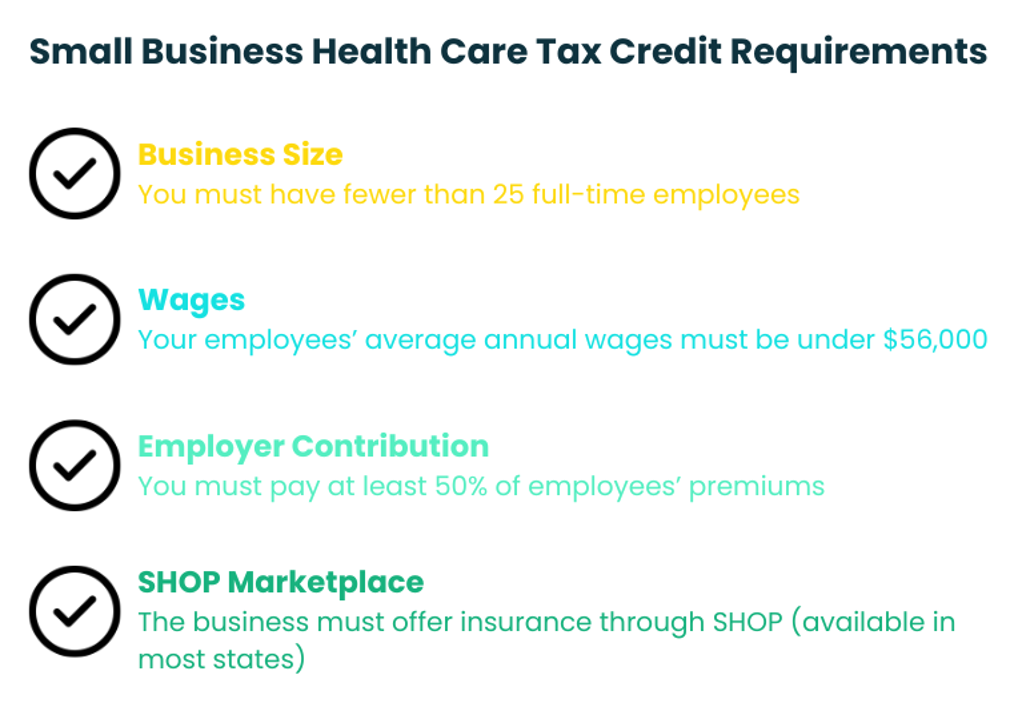
### How much can you save?
If you qualify, you can receive a tax credit worth up to **50% of your contribution to premiums** (or 35% if you are a non-profit organization). The credit is available for up to two consecutive years. This can make a substantial difference in the overall cost of providing coverage.
###
### How to claim the credit
To claim the Small Business Health Care Tax Credit, you must fill out IRS Form 8941 when you file your taxes. This form helps determine the amount of credit you are eligible for based on your number of employees, wages, and the amount you contributed to premiums.
For more detailed information about the tax credit, check out the IRS guide to the [Small Business Health Care Tax Credit](https://www.irs.gov/affordable-care-act/employers/small-business-health-care-tax-credit-and-the-shop-marketplace).
## Make coverage affordable and increase employee retention
Navigating health insurance as a small business owner can be complex, but understanding your options — like the Small Business Health Care Tax Credit — can help make providing coverage more affordable. Whether you opt for a health plan through the Marketplace, a group health plan, or another option, there are plenty of ways to ensure your employees are well taken care of. Remember, offering health insurance can not only improve the well-being of your team but also increase employee satisfaction and retention.
For more information on health insurance tax credits and other small business benefits, continue exploring updated resources from [HealthCare.gov](https://www.healthcare.gov/),[ ](https://www.irs.gov/)[IRS.gov](https://www.irs.gov/), and [SBA.gov](https://www.sba.gov/).
#### **Unlock Your Disability Benefits with Confidence! **Join our community to access all the benefits you're eligible for. Don’t miss out — [sign up now](https://benefitkarma.com/) and start maximizing your savings today!
---
type: article
title: Master Your Work Retirement Savings: 401(k)s, Pensions, IRAs, and More
url: https://benefitkarma.com/articles/income-employment/retirement-savings-through-work
updated: 2026-05-19
---
# Master Your Work Retirement Savings: 401(k)s, Pensions, IRAs, and More
Navigating the world of retirement savings can feel like a daunting task, especially when your future financial security depends on understanding complex employer-sponsored retirement plans. With so many options—401(k) plans, pension programs, and more—it’s easy to feel overwhelmed and unsure about where to start.
Many workers find themselves confused by the different types of retirement plans offered by employers, not knowing which is the best option for them or how to maximize their savings. Missing out on key opportunities, like employer matches or tax benefits, can mean the difference between a comfortable retirement and financial stress in later years.
In this comprehensive guide, we break down everything you need to know about retirement plans through work, from 401(k)s to pensions, and provide practical tips on how to make the most of each option. Whether you’re just starting out or looking to fine-tune your strategy, understanding your employer-sponsored retirement benefits is crucial to achieving a financially secure future.
> **Key Takeaways:**
- **401(k) Basics:** Understand how a 401(k) plan works, including tax-deferred contributions, employer matches, and contribution limits.
- **Pension Plans:** Learn about defined benefit pensions, their predictable payouts, and how they differ from 401(k) plans.
- **Roth 401(k):** Explore the benefits of a Roth 401(k), where after-tax contributions lead to tax-free withdrawals in retirement.
- **Retirement Savings Strategies:** Discover how contributing to both a 401(k) and a Roth IRA can maximize your retirement savings potential.
- **Job Transitions:** Know what happens to your 401(k) if you change jobs, and how to roll over your funds without penalty.
- **Tax Benefits:** Take advantage of the tax-deductible benefits of 401(k) contributions to lower your taxable income today.
## What is a 401(k) and how does it work?
A 401(k) is one of the most common employer-sponsored retirement savings plans in the United States. Named after the section of the IRS tax code that governs it, a 401(k) allows employees to contribute a portion of their pre-tax salary toward retirement savings. Some employers even offer matching contributions, which can significantly boost your retirement savings.
### How it works:
- Employees elect to contribute a percentage of their salary to the 401(k) plan.
- Contributions are tax-deferred, meaning you don’t pay taxes on the money you contribute until you withdraw it during retirement.
- Many employers offer a matching contribution, often matching a portion of what you contribute, up to a certain percentage of your salary.
### Benefits:
- Tax advantages: Contributions are made pre-tax, lowering your taxable income for the year.
- Employer match: Many employers match contributions up to a certain amount, providing "free money" for your retirement.
- **Learn more about the 401(k) plan rules and regulations on the **[IRS 401(k) Resource Page.](https://www.irs.gov/retirement-plans/401k-resource-guide)
## Can I have both a 401(k) and an IRA?
Yes, you can contribute to both a 401(k) and an IRA. While your 401(k) is employer-sponsored, an IRA (Individual Retirement Account) is a personal retirement account that you can open independently. Contributing to both allows you to maximize your retirement savings, but you must adhere to the annual contribution limits for each.
### Key Takeaways:
- 401(k): Employer-sponsored, with higher contribution limits.
- IRA: Personal account, offering tax benefits depending on the type (Traditional or Roth).
- Helpful Resource: [IRS IRA Contribution Limits](https://www.irs.gov/retirement-plans/roth-acct-in-your-retirement-plan)
## How much should I contribute to my 401(k)?
Financial experts generally recommend contributing at least enough to get your employer’s match—this is essentially "free money." After that, aim to contribute 15% of your salary toward retirement savings, including your 401(k), IRAs, or other retirement accounts. However, the amount you should contribute depends on your retirement goals, income, and the employer match.
### Key Takeaways:
- Contribute enough to get the **employer match**.
- Aim for at least **15%** of your income, but customize based on goals.
- Helpful Resource: [Fidelity's 401(k) Contribution Guide](https://www.fidelity.com/learning-center/smart-money/401k-contribution-limits)
## What happens if I take money out of my 401(k) before age 59½?
Withdrawing money from your 401(k) before you turn 59½ typically results in a 10% early withdrawal penalty on top of regular income tax. However, there are a few exceptions, such as for disability, medical expenses, or a first-time home purchase through a 401(k) loan.
### Key Takeaways:
- Early withdrawals before age 59½ incur a **10% penalty**.
- Exceptions may apply, including hardship withdrawals and loans.
- Helpful Resource: [IRS 401(k) Early Withdrawal Rules](https://www.irs.gov/retirement-plans/hardships-early-withdrawals-and-loans)
## What is a pension plan and how does it differ from a 401(k)?
A pension plan, also known as a defined benefit plan, is a retirement plan where the employer promises to pay a specified monthly benefit to the employee upon retirement, based on factors like salary and years of service.
### How it works:
- Employers fund the plan and manage the investments, ensuring employees receive a predetermined payout upon retirement.
- The amount you receive is typically based on a formula involving your final salary and years of service.
### Key differences from a 401(k):
- Employer responsibility: With a pension, the employer is responsible for ensuring that the funds are available for your retirement.
- Predictable income: Unlike a 401(k), which is based on the market performance of your investments, a pension guarantees a set income in retirement.
- Discover th**e official resource for pension-related benefits and protection: **[Pension Benefit Guaranty Corporation (PBGC).](https://www.pbgc.gov/)
## What is the difference between a 401(k) and a Roth 401(k)?
The primary difference between a traditional 401(k) and a Roth 401(k) lies in how they are taxed.
- Traditional 401(k): Contributions are made with pre-tax dollars, meaning your contributions are not taxed when they’re made. You pay taxes on the money when you withdraw it in retirement.
- Roth 401(k): Contributions are made with after-tax dollars, meaning you pay taxes upfront, but withdrawals during retirement are tax-free, provided you meet certain conditions.
### Key Considerations:
- A Roth 401(k) is ideal for individuals who expect to be in a higher tax bracket in retirement, as it allows for tax-free withdrawals.
- A traditional 401(k) may be more beneficial for those who expect to be in a lower tax bracket during retirement.
- For a d**etailed explanation of Roth 401(k) eligibility and contribution limits, visit **[IRS Roth 401(k) Rules.](https://www.irs.gov/retirement-plans/roth-acct-in-your-retirement-plan)
## Can I contribute to both a 401(k) and a Roth IRA?
Yes, you can contribute to both a 401(k) and a Roth IRA (Individual Retirement Account), but there are annual contribution limits for each.
- 401(k) Contribution Limits: For 2024, employees can contribute up to $23,000 to a 401(k) plan ($30,000 if you're 50 or older, thanks to "catch-up" contributions).
- Roth IRA Contribution Limits: For 2024, the contribution limit is $6,500 ($7,500 if you're 50 or older), but this is subject to income limits. High earners may be ineligible for Roth IRA contributions.
### Why contribute to both?
- A 401(k) allows for larger contributions and employer matches, making it a great primary retirement savings tool.
- A Roth IRA provides tax-free growth and tax-free withdrawals in retirement, which complements your 401(k).
- **Check the current contribution limits and eligibility criteria here:**** **[IRS Contribution Limits for 401(k) and Roth IRA.](https://www.irs.gov/newsroom/401k-limit-increases-to-23500-for-2025-ira-limit-remains-7000)
## What happens to my 401(k) if I change jobs?
When you leave your job, you have several options for your 401(k):
- Leave the money in your old 401(k): Most plans allow you to leave your savings in the plan, but you may not be able to make new contributions.
- Roll over to your new employer’s 401(k): If your new employer offers a 401(k), you can transfer your funds to the new plan, consolidating your retirement savings.
- Roll over to an IRA: You can transfer your 401(k) funds into an IRA, giving you more control over your investments.
### Important Considerations:
- Check for any fees or investment options that may differ between your old and new 401(k).
- Be aware of rollover rules to avoid any penalties or tax implications.
- **Learn about 401(k) rollovers and the tax implications here: **[IRS 401(k) Rollover Rules.](https://www.irs.gov/retirement-plans/plan-participant-employee/rollovers-of-retirement-plan-and-ira-distributions)
***Are you currently unemployed? Understand your essential rights and benefits through ******[this guide](/articles/income-employment/how-does-unemployment-work-a-guide-to-these-crucial-benefits)******.***
## Are 401(k) contributions tax-deductible?
Yes, 401(k) contributions are tax-deductible. Contributions are made with **pre-tax** dollars, which means the money you contribute is subtracted from your taxable income for the year. This reduces your current-year tax bill.
However, when you withdraw the funds in retirement, you will have to pay income taxes on the amount you take out.
Tip: Make sure to consult with a tax professional to understand how your 401(k) contributions affect your overall tax strategy.
Get o**fficial guidance from Charles Schwab on the tax benefits of contributing to a 401(k): **[Tax Deductions for 401(k).](https://www.schwab.com/learn/story/401k-tax-deduction-what-you-need-to-know?msockid=1bf47af314b3617a12ae6fd715d26067)
## Start planning for your future today

Retirement planning through work is one of the most effective ways to secure your financial future. Whether you have a 401(k), a pension, or both, understanding how each option works—and taking full advantage of employer-sponsored retirement benefits—can make a significant difference in your retirement savings.
Don’t forget to take advantage of your employer's matching contributions, and always seek professional advice to ensure you're making the best decisions for your specific financial situation.
---
type: article
title: SSDI Back Pay: How It Works & When You Get It
url: https://benefitkarma.com/articles/health-disability/understanding-ssdi-back-pay
updated: 2026-05-19
---
# SSDI Back Pay: How It Works & When You Get It
Although [the SSDI waiting period](/articles/health-disability/the-ssdi-waiting-period-how-long-until-you-re-approved) can be brutal, there’s good news: SSDI [back pay](/glossary/back-pay-ssdi) can help ease the financial strain you may have faced while awaiting your payments.
If you’ve been waiting for your disability claim to be approved by the [Social Security](/articles/health-disability/should-you-enroll-in-medicare-at-65-but-wait-on-social-security) Administration (SSA), back pay can be a real lifeline. It covers the time from when your disability began until your application gets the green light.
Understanding [SSDI](/glossary/social-security-disability-insurance) back pay is essential because it can provide you with a significant financial boost right when you need it most. In this guide, we'll break down what SSDI back pay is, how it's calculated, and what you need to know to make sure you receive every penny you’re entitled to. Let’s dive in and take the mystery out of this crucial aspect of your SSDI benefits!
***Want to become fluent in the language of benefits? Sign up for a free BenefitKarma.com account!***
## What is SSDI back pay?
So, what exactly is SSDI back pay? Think of it as compensation for the time you were eligible for benefits but hadn’t started receiving them yet. Basically, it’s money for the period when you were waiting for your claim to be processed. To be eligible for back pay, you’ll need to show that your disability meets the SSA’s requirements and has kept you from working.
## How is SSDI back pay calculated?
Try it: [Benefit Eligibility Screener](/benefit-eligibility-screener)
Find disability and healthcare programs you may qualify for.
When it comes to calculating SSDI back pay, the Established Onset Date (EOD) is the determining factor. Your EOD is the date the Social Security Administration (SSA) determines your disability began, and it plays a crucial role in how much back pay you can receive. Essentially, your back pay is compensation for the period when you were eligible for benefits but hadn’t yet received them.
Calculating your back pay is simpler than it sounds. Here’s how it works:
- **Understand the waiting period**: Back pay starts counting from your EOD, but there’s a five-month waiting period during which you won’t receive any payments. So, the real count starts six months after your EOD.
- **Figure out the duration**: Your back pay will be based on the time from the end of the waiting period until your claim is approved.
- **Know your monthly benefits**: This is determined by your average lifetime earnings. To find your total back pay, multiply your monthly benefit by the number of months from the end of the waiting period to your approval date.
For example, let’s say your EOD is January 1, 2020, and your claim gets approved on January 1, 2021. You’d skip the first five months, meaning you’re counting the remaining seven months. If your monthly benefit is $1,000, then you’d get $7,000 in back pay, usually as a lump sum. This can be a big help as you start receiving your regular monthly benefits!
## What’s the difference between back pay and retroactive pay?
It's easy to mix up back pay and retroactive pay, but they actually mean different things:
- **Back pay** covers the time you were waiting for your claim to be processed — basically, the benefits you missed while waiting for approval.
- **Retroactive pay** is for the time you were disabled before you even applied for SSDI, based on your EOD.
The EOD is key here because it determines how far back your [retroactive benefits](/glossary/retroactive-benefits) can go, usually up to 12 months before your application date. Back pay calculations are pretty straightforward, but retroactive pay requires solid documentation to prove your disability started before you applied.
## What are the limitations and eligibility requirements for SSDI retroactive back pay?
When it comes to retroactive pay, keep these points in mind:
- **Maximum of 12 months:** You can receive retroactive benefits for up to 12 months before your application date, regardless of how long your disability has been affecting you.
- **Compelling medical evidence:** You’ll need strong medical documentation showing that your disability started before you applied. This might include medical records, doctors’ statements, and test results.
- **Unique circumstances:** Sometimes, administrative delays or other factors might affect your eligibility and the amount of retroactive pay you can get. The SSA evaluates these situations individually.
## How and when do you get paid by SSDI?
Once your SSDI claim is approved, you have a couple of options for getting your back pay:
- **Direct deposit:** This is the fastest and most secure method. Your funds go straight to your bank account.
- **Direct Express Debit Card:** If you don’t have a bank account, this card ensures you have reliable access to your money.
Depending on the total amount, your back pay might come as a single lump sum or in smaller payments, which can make it easier to manage your finances. Generally, you can expect to see your first payment within 60 to 90 days after approval. Keep in mind this can vary based on how complicated your claim is and the SSA’s workload. To avoid any hiccups, double-check that your banking details are up to date and stay in touch with the SSA for any updates.
## Does SSDI back pay impact your taxes?
Receiving disability back pay can affect your overall income and tax situation. If you get a lump-sum payment, it might temporarily increase your household income, which could impact your eligibility for other income-based [assistance programs](/articles/family-education/education-benefits-tuition-assistance-programs) like Medicaid or SNAP ([Supplemental Nutrition Assistance](/articles/housing-essentials/understanding-snap-your-guide-to-supplemental-nutrition-assistance) Program).
For tax purposes, SSDI back pay could also be taxable if your total income—including half of your SSDI benefits—exceeds certain limits:
- $25,000 for single filers
- $32,000 for married couples filing jointly
Also, you might be able to allocate this back pay to the years it was meant to cover. This could lower your taxable income for the year you received the payment and spread your tax liability over several years. Consulting with a tax professional can help you navigate these issues and ensure you meet all reporting requirements, so you don’t run into any unexpected tax surprises.
---
type: article
title: Navigating the SSDI Pay Chart to Determine Your Benefits
url: https://benefitkarma.com/articles/health-disability/understanding-ssd-benefits-pay-chart
updated: 2026-05-19
---
# Navigating the SSDI Pay Chart to Determine Your Benefits
If you're trying to figure out the sometimes-complex world of [Social Security Disability Insurance](/glossary/social-security-disability-insurance) (SSDI) benefits, you'll want to become acquainted with the SSDI pay chart. This handy tool is your go-to guide for understanding your potential benefits and planning your financial future. It breaks down your monthly payments based on your work history and current financial needs, helping you budget for everything from bills to groceries.
Navigating life with a disability can come with its own set of challenges, and understanding your [SSDI](/glossary/5-month-waiting-period) benefits is a crucial step in ensuring you have the financial support you need. Whether you're just starting this journey or looking to clarify your current situation, this chart is essential for managing your finances effectively.
So, let’s dive in and explore what the SSDI pay chart is all about, how it works, and how it can help you make sense of your SSDI benefits!
***Want to become fluent in the language of benefits? Sign up for a free BenefitKarma.com account!***
## What exactly is the SSDI pay chart?
So, what exactly is the SSDI pay chart? Think of it as a roadmap provided by the Social Security Administration (SSA) that outlines your monthly payment amounts. It’s packed with details about your benefits, any cost-of-living adjustments ([COLA](/glossary/cola)), and potential deductions. Having this information at your fingertips can really help you manage any changes in your benefits, whether they're due to income shifts, marital status changes, or other qualifying factors. You can easily find your personalized pay chart on the SSA’s official [website](http://www.ssa.gov/) or by reaching out to them directly.
## How have SSDI payments changed over the last five years?
Try it: [Benefit Eligibility Screener](/benefit-eligibility-screener)
Find disability and healthcare programs you may qualify for.
Let’s take a look at how SSDI payments have been trending over the past five years. Thanks to those annual cost-of-living adjustments (COLA), you've probably noticed some steady increases:
- **2018**: The average SSDI payment was around **$1,197**.
- **2019**: It climbed to approximately **$1,223**.
- **2020**: The average rose to **$1,265**.
- **2021**: It reached **$1,277**.
- **2022**: The average payment was about **$1,364**.
- **2023**: It jumped to approximately **$1,483**.
As of 2024, the average SSDI benefit ranges from $800 to $1,800, with an estimated average of around $1,537. These increases are all about keeping up with inflation and changes in national wage indexes.
## How are your SSDI payments determined?
Understanding how your SSDI payments are calculated is key to managing your finances. The biggest factor is your **Primary Insurance Amount (PIA)**, which is based on your average lifetime earnings before your disability kicked in. Here’s how it works:
- **Average Indexed Monthly Earnings (AIME)**: This number is calculated using up to 35 of your highest-earning years.
- **Benefit Formula**: The SSA then applies a formula to your AIME to determine your PIA.
Keep in mind that other income sources, like workers’ compensation or other public [disability benefits](/articles/health-disability/understanding-healthcare-and-disability-benefits-a-simple-guide), can affect your SSDI amount. And remember, after 24 months on SSDI, you become eligible for Medicare, which can also impact your overall financial situation.
## What factors influence your payment amounts?
Several factors can influence how much you receive in SSDI payments. Here’s a breakdown:
- **Earnings History:** This is all about your average lifetime earnings. The more you earned while working, the higher your payments may be. Essentially, your past income sets the stage for what you can expect.
- **Work Credits:** Think of work credits as a way to measure your work history. You earn these credits by paying Social Security taxes on your income. Typically, you need at least 20 work credits from the last 10 years to qualify for SSDI. If you have more credits, you may receive higher benefits.
- **Cost-of-Living Adjustments (COLAs):** These are annual increases to your payments designed to keep up with inflation. So, as the cost of living goes up, your SSDI payments may increase, too.
- **Other Government Benefits:** If you’re receiving benefits from state disability programs or workers' compensation, this can affect how much you get from SSDI. However, benefits from private [disability insurance](/articles/health-disability/long-term-disability-insurance-what-you-need-to-know) or Veterans Affairs typically won’t impact your SSDI amount.
## How do you apply for SSDI?
Applying for Social Security [Disability Benefits](/articles/health-disability/understanding-temporary-disability-benefits) can feel a bit overwhelming, but breaking it down into simple steps can make it easier:
- **Gather Necessary Documentation**: This includes your Social Security number, birth certificate, medical records, employment history, and medication details.
- **Provide Detailed Evidence**: Collecting medical evidence, like doctors' reports or test results, can really strengthen your application.
- **Complete the Application**: You can apply online through the SSA website, by phone, or in person at your local SSA office. Just make sure to follow the instructions carefully to avoid any delays.
- **Seek Professional Help**: If you’re feeling unsure, consider reaching out to a Social Security Disability attorney or advocate. They can guide you through the process and represent your interests.
## What non-medical requirements must you meet for SSDI?
To qualify for SSDI, you’ve got to meet some non-medical criteria:
- **Work Credits**: You earn these by paying Social Security taxes on your income. For 2023, you get one work credit for every **$1,640** you make, with a maximum of four credits per year.
- **Income Limits**: You can’t earn more than a specific amount each month (that’s the [Substantial Gainful Activity](/guides/earnings-limits-explained) limit) and must show that your disability prevents you from doing substantial work.
- **Periodic Reviews**: Even after you’re approved, the SSA conducts periodic reviews (usually every 3 to 7 years) to confirm you still meet non-medical requirements.
## How can you manage your SSDI payments?
Understanding the payment schedule and methods can help you keep your finances in check:
- **Payment Schedule**: SSDI payments are typically sent out monthly, based on your birthdate:
If you were born between the 1st and 10th: Payments are issued on the second Wednesday of each month.
- If you were born between the 11th and 20th: Payments are issued on the third Wednesday.
- If you were born between the 21st and 31st: Payments are issued on the fourth Wednesday.
- **Payment Methods**: Direct deposit into your bank account or using a Direct Express® Debit MasterCard® is recommended for secure transactions.
- **Interactions with Other Benefits**: Keep in mind that workers' compensation and public [disability benefits](/articles/health-disability/ssa-blue-book) can reduce your SSDI if the total income exceeds 80% of your average earnings before your disability.
## Why is understanding the SSDI pay chart important?
Understanding the Social Security Disability Benefits Pay Chart is vital for navigating your finances while receiving SSDI. Familiarizing yourself with the pay chart and the factors that affect your benefits can help you plan for your financial future. For more detailed information and to access your personalized pay chart, be sure to check out the official SSA website. You've got this!
---
type: article
title: Here's How Temporary Disability Benefits Help During Short-Term Hardships
url: https://benefitkarma.com/articles/health-disability/understanding-temporary-disability-benefits
updated: 2026-05-19
---
# Here's How Temporary Disability Benefits Help During Short-Term Hardships
Temporary disability benefits can be a lifeline when an illness or injury prevents you from working for a short period. These benefits provide financial support, helping to replace a portion of your lost wages while you focus on recovery.
Whether you're dealing with a physical injury, a mental health condition, or even pregnancy-related complications, temporary disability benefits can ease the burden of day-to-day expenses during this challenging time. Understanding how to qualify and apply for these benefits ensures you have the necessary financial safety net in place.
***Looking for more ways to manage your benefits? Sign up with BenefitKarma for expert advice and easy access to resources that help you navigate temporary disability and other important benefits.***
## What are temporary disability benefits?
Temporary disability benefits provide money when you can’t work because of a short-term illness or injury. They replace a portion of your income while you’re recovering, so you can still pay for things like rent, bills, and groceries. The benefits usually last from a few weeks to several months, depending on how long it takes for you to get better.
To qualify, you'll need medical proof of your condition and an estimated recovery time from your doctor. These benefits are distinct from long-term programs like[ Social Security Disability Insurance (SSDI)](/articles/health-disability/understanding-ssdi-disability-your-questions-answered) or [Supplemental Security Income (SSI)](/articles/health-disability/what-is-supplemental-security-income-ssi-what-you-need-to-know) which cover longer-lasting issues, temporary disability is for shorter recoveries and won’t qualify for [SSDI](/glossary/social-security-disability-insurance) or SSI.
## What are some examples of temporary disabilities?
Temporary disabilities include a range of conditions that keep you from working for a short period. These can be:
- Physical injuries like broken bones, surgeries, or illnesses like pneumonia
- Pregnancy and recovery from childbirth
- Mental health issues like depression or anxiety that need treatment
- Non-work injuries like sprains or concussions
Temporary benefits can come from:
- Short-term disability insurance, often provided by employers or bought individually
- [Workers' compensation](/articles/income-employment/understanding-workers-compensation-your-guide-to-benefits-and-claims), which covers job-related injuries or illnesses
Understanding these examples can help clarify when temporary disability benefits might apply.
## Who is eligible for temporary disability benefits (and how do you apply)?
Applying for temporary disability benefits involves meeting certain rules. You often need to have worked a set number of hours and provide a doctor’s note about your condition and how long you’ll be unable to work.
To start the application, get the right forms from your employer or state agency and fill them out carefully. Make sure to include:
- Medical release forms
- Proof of your diagnosis
- Work history
- Your ID
In some states, employers are required to offer short-term disability insurance that can replace part of your paycheck. You can either use the employer’s plan or buy one on your own. Typically, this insurance will pay 50-60% of your wages while you’re off. It’s important to check your policy to understand how long you’ll be covered, as it can range from a few weeks to up to a year.
**Note:** Before applying for short-term disability, it’s essential to check your policy’s eligibility requirements, including any waiting periods. You’ll also want to understand how these benefits work alongside other forms of compensation like sick leave, vacation days, or workers’ comp.
## How long does short-term disability insurance last?
The length of time short-term disability insurance lasts depends on the policy. It usually covers you for 3-6 months, but some plans might offer up to a year if your recovery takes longer. The exact duration depends on your medical needs and your insurance company’s guidelines.
For instance, if you had surgery that requires months of recovery, your insurance might cover you for the entire time. Less serious conditions might only be covered for a few weeks. Knowing how long your coverage will last helps you plan your finances while you’re out of work.
Most policies provide around 50% to 60% of your weekly earnings, so it's essential to plan accordingly while you're on leave.
## How can you tell if your short-term disability insurance is approved?
Once you’ve applied, you’ll be notified if your claim is approved. Here’s how to check:
- Look for an official letter or email from your insurance provider with the approval details and next steps.
- Check your insurance company’s online portal for claim updates.
- Ask your HR department for confirmation, as they may have details from the insurance provider.
Usually, you’ll hear back from the insurance company within 2-6 weeks.
## Can you be rejected for temporary disability benefits?
Yes, you can be rejected for temporary disability benefits. There are several reasons why this might happen:
- **Insufficient medical documentation**: If you don’t provide enough medical evidence to support your claim or if the documentation doesn’t clearly explain your condition and its impact on your ability to work, your application may be denied.
- **Ineligibility**: Each state and insurance policy has specific eligibility requirements. If you haven’t worked the required number of hours or if your job doesn’t offer short-term disability coverage, you may be ineligible.
- **Exclusions in your policy**: Some policies have exclusions for certain conditions or pre-existing conditions, meaning that if your disability is related to a condition that existed before you applied, your claim could be denied.
- **Failure to follow procedures**: If you don’t complete the application process correctly, such as missing deadlines or not filling out forms accurately, it could lead to a rejection.
- **Length of recovery**: Temporary disability benefits are designed for short-term conditions. If your condition is expected to last longer than what qualifies for temporary benefits (typically over a year), your application might be denied.
If your claim is denied, you usually have the right to appeal the decision. It's important to carefully review the reason for the denial and gather any additional documentation needed to support your case.
## What happens if your condition ends up being long-term?
If your condition turns out to be more long-term than expected, consider the following steps:
- **Review Your Benefits**: Check if your temporary disability benefits can be extended or transitioned to long-term benefits.
- **Gather Updated Medical Documentation**: Obtain new medical records from your healthcare provider detailing your ongoing condition and its impact on your work ability.
- **Consult Your Insurance Provider**: Contact your insurance company to discuss extending benefits or switching to long-term disability coverage.
- **Explore [Long-Term Disability Insurance](/glossary/long-term-disability-insurance)**: Review your employer’s long-term disability policy or private options to see if you qualify.
- **Consider Social Security Disability Insurance (SSDI)**: If your condition is expected to last at least 12 months, you may qualify for SSDI. Research the application process and eligibility criteria.
- **Seek Professional Guidance**: Consult with a disability lawyer or benefits advisor for help with navigating the process and filing claims.
- **Keep Your Employer Informed**: Communicate with your employer about your situation to explore additional support.
- **Understand the Impact on Other Benefits**: Be aware of how transitioning to long-term benefits may affect other programs, like Medicaid or [SSI](/glossary/essential-person).
Taking these steps can help you manage the transition and ensure you receive the necessary assistance.
---
type: article
title: Bank Account Monitoring for SSI Recipients: Why They Do It
url: https://benefitkarma.com/articles/health-disability/understanding-ssi-and-bank-account-monitoring
updated: 2026-05-19
---
# Bank Account Monitoring for SSI Recipients: Why They Do It
Receiving benefits from [Supplemental Security Income](/glossary/ssi) (SSI) is an important part of people’s financial well-being, which is why it’s important to keep those benefits once you’ve received them.
One of the ways the SSA makes it easy to monitor your current financial situation is by monitoring your bank account. It’s totally legal, and it’s pretty important that [SSI](/glossary/essential-person) recipients keep tabs on their income and assets to make sure they stay within the program’s parameters.
We’ll tell you all about the SSA’s bank account monitoring program: How it works, what to expect, and how to remain compliant (even when you’ve received a little too much income for a short stint).
***Want to become fluent in the language of benefits? Sign up for a free BenefitKarma.com account!***
## Why does the SSA monitor bank accounts?
To qualify for [Supplemental Security Income (SSI)](/articles/health-disability/what-is-supplemental-security-income-ssi-what-you-need-to-know), your resources must stay below specific thresholds — $2,000 for individuals and $3,000 for couples. These limits include cash, bank accounts, and personal property. More on that in a minute.
The SSA regularly checks your financial situation using the Access to Financial Institutions (AFI) program, which allows them to verify your account balances electronically. Staying within the resource limits and reporting any changes in your financial situation promptly will help you avoid penalties and the potential loss of your benefits.
## How does the SSA monitor bank accounts?
The SSA uses various methods to ensure your bank account stays within the resource limits. Here’s how they keep track:
- **Electronic verification system (EVS)**: Through the AFI program, the SSA can electronically access your bank account details to verify balances and locate hidden accounts.
- **Periodic redeterminations**: The SSA may request financial documents like bank statements, typically during annual or six-year reviews, or when significant life changes occur.
- **Reporting requirements**: You must report changes in your income or resources—such as receiving new assets or earnings — within 10 days after the end of the month when the change occurred.
The automated AFI system helps reduce errors and ensures your account balances align with the resource limits. Staying transparent and keeping your financial details up-to-date will help you avoid overpayments and suspension of benefits.
## What are the SSI income and resource limits?
Understanding the SSI income and resource limits is essential to maintain your eligibility for benefits. In 2023, the SSA’s resource limits are $2,000 for an individual and $3,000 for a couple. These limits cover assets such as:
- Cash
- Bank accounts
- Stocks and bonds
- Real estate (excluding your primary residence and one vehicle)
SSI also has income limits, which include both earned income (like wages) and unearned income (like Social Security benefits or gifts). The maximum monthly benefit in 2023 is $914 for individuals and $1,371 for couples.
These figures may vary if you receive state supplements or qualify for work incentives. Keeping a close eye on your bank balances and promptly reporting any changes to the SSA will help ensure you remain eligible for benefits.
## How do bank balances affect SSI eligibility?
Your bank account balance plays a significant role in your SSI eligibility. If your balance exceeds the set resource limits, even temporarily, you may lose your benefits or have to repay any overpayments. However, not all funds in your bank account are counted as resources. For instance, money set aside for burial expenses (up to $1,500) and the value of your primary home or vehicle are exempt from the resource limits.
It’s important to keep track of what counts toward your resources and report changes promptly to avoid penalties. The SSA reviews your bank account regularly to ensure your balance stays within the limits, helping you avoid overpayments or benefit suspensions.
> RELATED: Learn about [SSI child disability benefits](/articles/health-disability/ssi-benefits-for-autistic-children).
## How should you report assets and income to the SSA?
When you receive SSI, staying compliant means keeping the SSA updated on any changes to your financial situation. You must report new income, changes in assets, or shifts in living arrangements within 10 days after the end of the month in which the change occurred. Here’s what you’ll need to provide:
- Pay stubs
- Bank statements
- Property records
Using the AFI tool, the SSA verifies your financial information automatically, but you are responsible for reporting any changes to ensure your benefits remain accurate. Staying on top of your financial reporting helps prevent overpayments and ensures you continue to meet the SSI eligibility criteria.
## What should you expect during an SSI redetermination?
SSI redetermination reviews are routine but can feel overwhelming. Being prepared will make the process much smoother. Here’s what you need:
- **Proof of income and resources**: Bring recent pay stubs, bank statements, and documentation of other income, such as pensions.
- **Medical records**: If your benefits are based on a disability, have up-to-date medical information to support your claim.
- **Living arrangements**: Keep leases and utility bills handy to verify your household expenses.
By staying organized and prepared for redeterminations, you can ensure your benefits remain uninterrupted.
---
type: article
title: SSI Benefits for Children: Who Is Eligible?
url: https://benefitkarma.com/articles/health-disability/understanding-ssi-child-disability-benefits
updated: 2026-05-19
---
# SSI Benefits for Children: Who Is Eligible?
Navigating [Supplemental Security Income](/glossary/ssi) (SSI) benefits for children with disabilities can be a daunting process, but it opens the door to crucial financial assistance for families. SSI is designed to support children under 18 with significant physical or mental impairments, such as autism, cerebral palsy, and Down syndrome, that severely limit their ability to perform age-appropriate activities. While the eligibility criteria and application process may seem overwhelming, understanding these steps can help you secure the support your family needs.
In this article, we’ll break down the qualifications for [SSI](/glossary/essential-person), the importance of medical documentation, the financial eligibility requirements, and tips for maintaining benefits once they’re granted.
***To stay updated on benefit programs, subscribe to BenefitKarma.com for free.***
## What disabilities qualify for SSI benefits for children?
The Social Security Administration (SSA) recognizes a wide range of conditions that may qualify children for [SSI benefits](/articles/health-disability/what-is-supplemental-security-income-ssi-what-you-need-to-know). Common qualifying disabilities include:
- Autism spectrum disorder
- Cerebral palsy
- Down syndrome
- Severe intellectual disability
For your child to be eligible for SSI, their condition must significantly limit their ability to perform typical daily activities for their age group. The disability must also be expected to last at least 12 months or result in death. These strict criteria ensure that only children with marked and severe functional limitations are approved for SSI benefits.
## How does the SSA determine SSI eligibility for children?
The SSA uses specific guidelines to assess whether a child qualifies for SSI benefits. The child must have a medically determinable physical or mental impairment—or a combination of impairments — that results in marked and severe functional limitations. The condition must:
- Last, or be expected to last, for at least 12 months or result in death.
- Significantly affect the child’s ability to complete age-appropriate tasks, such as walking, learning, or socializing.
The SSA relies heavily on medical evidence when making eligibility decisions, including diagnostic reports, treatment records, and evaluations from healthcare professionals such as doctors, psychologists, and therapists.
## Why is medical evidence crucial for SSI benefits for children?
Providing detailed medical documentation is one of the most critical aspects of the SSI application process. This evidence helps prove the severity of your child’s condition and its impact on their daily life. Key documents that can strengthen your application include:
- Diagnostic tests (e.g., MRIs, X-rays)
- Lab results
- Detailed reports from healthcare professionals (doctors, psychologists)
- Therapy records
Keeping comprehensive and up-to-date medical records ensures the SSA has all the necessary information to determine your child’s eligibility.
## What are the financial eligibility requirements for SSI?
SSI benefits are not only determined by the child’s medical condition but also by the family’s financial situation. The SSA uses a process called “parental [deeming](/glossary/deeming)” to evaluate the income and resources available to the child from their parents. Here’s [how the SSA calculates financial eligibility](https://www.ssa.gov/ssi/text-eligibility-ussi.htm):
- **Income limits**: The SSA considers both earned (e.g., wages) and unearned income (e.g., interest or pensions). If the family’s income exceeds a certain threshold, the child may become ineligible for SSI benefits. These thresholds adjust yearly.
- **Resource limits**: The SSA limits the value of the family’s assets to $2,000 for a single parent or $3,000 for a couple. Excluded assets include the family home and one vehicle.
### How is deemed income calculated?
To calculate deemed income, the SSA follows a specific process:
- **Gather parental income**: This includes both earned and unearned income.
- **Identify ineligible children**: If there are other children in the household not eligible for SSI, part of the parents' income is allocated for their support.
- **Apply exclusions**: The SSA excludes certain amounts from earned income—such as $65 per month plus half of the remaining earnings — along with $20 of any other income.
For example, if the parents earn $724 in gross income, the SSA would first subtract $65 and $20, then divide the remainder by two. This results in $319.50 being counted as income when determining SSI eligibility.
## How do I apply for SSI benefits for my child?
The application process for SSI benefits can be completed online, by phone, or at your local SSA office. You will need to provide:
- Your child’s Social Security number
- Birth certificate
- Comprehensive medical records
During the application process, the SSA may conduct an interview to verify information and request additional documents if needed. The SSA will also evaluate the family’s financial situation, factoring in parental deeming.
> RELATED: [SSDI Benefits for Autistic Children](/articles/health-disability/ssi-benefits-for-autistic-children)
## What do I do if my SSI application is denied?
If your initial SSI application is denied, you have the option to appeal the decision. The appeals process starts with a reconsideration, where a new SSA representative reviews your case. If your reconsideration is denied, you can request a hearing before an administrative law judge. Be sure to gather updated medical evidence and consider seeking legal help to strengthen your case during the appeals process.
## How do I maintain SSI benefits for my child?
Once your child is approved for SSI benefits, you’ll need to provide regular updates to the SSA regarding their medical condition and your family’s financial situation. Any changes in household income, improvements in your child’s health, or changes in living arrangements should be reported to the SSA to avoid interruptions in benefit payments.
Staying organized and maintaining accurate records will help ensure your child continues to receive the support they need through SSI benefits.
---
type: article
title: SSI Back Pay: How You Get It, How It Impacts You
url: https://benefitkarma.com/articles/health-disability/understanding-ssi-back-pay
updated: 2026-05-19
---
# SSI Back Pay: How You Get It, How It Impacts You
SSI back pay is a vital financial resource for individuals waiting for [Supplemental Security Income](/glossary/ssi) (SSI) approval. It refers to a lump sum payment that covers the time between when you apply for SSI and when your application is officially approved.
This [waiting period](/articles/health-disability/the-ssdi-waiting-period-how-long-until-you-re-approved) can be lengthy, often leaving applicants struggling to cover essential expenses. Thankfully, SSI [back pay](/glossary/back-pay-ssdi) helps alleviate some of that financial strain, allowing you to pay overdue bills, medical costs, and housing expenses that may have accumulated during the wait.
Eligibility for back pay depends on the dates of your application and the establishment of your disability. If you qualify for a significant amount, the [Social Security](/articles/health-disability/should-you-enroll-in-medicare-at-65-but-wait-on-social-security) Administration (SSA) usually distributes it in installments, although those with urgent needs may receive a lump sum.
Understanding how [SSI](/glossary/essential-person) back pay is calculated and paid is crucial for navigating the application process effectively. In the following sections, we’ll explore the details of calculating your back pay, the payment procedures, and important considerations to keep in mind while awaiting your benefits.
***Want to become fluent in the language of benefits? Sign up for a free BenefitKarma.com account!***
## How is SSI back pay calculated?
Calculating your SSI back pay is straightforward once you understand the key dates involved. Your back pay will be based on the following:
- **Application date: **The date you first applied for SSI benefits.
- **Approval date: **The date your application is approved.
- **Monthly benefit amount: **This is determined by your eligibility and income limits.
To find out your total back pay, the Social Security Administration (SSA) looks at the time between your application date and your approval date. Your back pay generally covers the period from when you applied to when your benefits were approved, excluding any retroactive benefits from before your application date.
If your back pay exceeds three times the monthly federal benefit rate, the SSA will distribute it in up to three installments, typically six months apart. However, if you face financial hardship or have urgent needs, you can request a lump sum or expedited payments.
## How much back pay will you receive?
Try it: [Benefit Eligibility Screener](/benefit-eligibility-screener)
Find disability and healthcare programs you may qualify for.
The amount of SSI back pay you receive depends on the time between your application date and the approval date, along with your monthly benefit rate. Various factors can influence your total back pay, including any income earned during the waiting period and changes in your living situation.
If you received public assistance while awaiting approval, that may be deducted from your back pay. In urgent situations, such as terminal illness, you might receive a larger initial payment or a single lump sum by submitting a request with appropriate documentation. Once your local SSA office processes your paperwork, expect your first payment within a week to a month.
## How do you receive your SSI back pay installments?
Typically, the SSA disburses SSI back pay in three separate installments if the total amount exceeds three times the maximum monthly benefit. The first installment is issued shortly after the award decision, with the next two arriving at six-month intervals. This method helps ensure effective fund management and reduces the risk of misuse.
However, exceptions exist. If you're experiencing financial emergencies, such as homelessness, essential debt, or outstanding medical expenses, the SSA may release back pay in one lump sum. You’ll need to provide documentation to support your request for an exception.
Additionally, the SSA places restrictions on how back pay can be used, aiming to ensure it’s spent on basic needs like:
- Food
- Clothing
- Shelter
- Medical care
## How do you receive SSI back payments?
You have several options for receiving your SSI payments:
- Direct Deposit: The most secure and efficient method, where the money goes electronically straight into your bank account.
- Direct Express® Debit Mastercard®: If you don’t have a bank account, this card allows you to make purchases, pay bills, or withdraw cash from an ATM.
- Paper Checks: Although less common, you can choose to receive paper checks, but this method is slower and riskier due to potential fraud or theft.
Each method has its pros and cons, so consider what works best for your situation.
### What special situations could affect your SSI back pay?
Certain unique circumstances can impact how you receive and use your SSI back pay:
- **Repaying Public Assistance:** If you received other aid, like TANF or General Assistance, you might need to repay those benefits. The SSA will notify relevant agencies about any overpayments, but you can request a waiver if repayment would create financial hardship.
- **Homeless Claimants:** If you are homeless, your SSI back pay could be processed more quickly to address urgent needs. The SSA may appoint a representative payee to help manage funds for essential expenses, and you may receive a larger initial payment for immediate necessities.
- **Waiver Requests:** If repaying benefits causes significant financial strain, you might qualify for a waiver based on your circumstances and the agency that provided the initial assistance. Evidence will be required to support your claim.
- **Windfall Offset Rule:** This rule can reduce your SSI back pay if you qualify for both SSI and SSDI at the same time. If you received [SSDI back pay](/articles/health-disability/understanding-ssdi-back-pay) for overlapping months, your SSI amount will be reduced accordingly, so review your SSA letters to understand the impact on your total benefits.
## How can SSI back pay affect taxes and other benefits?
SSI back pay can significantly impact your taxes and eligibility for other [assistance programs](/articles/family-education/education-benefits-tuition-assistance-programs). Here’s what to consider:
- **Repaying Public Assistance:** If you received other public aid while waiting for SSI, the SSA will deduct those amounts from your back pay to reimburse the state. Familiarizing yourself with these repayment agreements can help streamline the process.
- **Impact on Other Benefits:** A lump sum of SSI back pay may affect your eligibility for programs like Medicaid, SNAP, and TANF, potentially requiring a benefits re-evaluation. It’s essential to review repayment agreements and consult with a benefits advisor to navigate these changes.
- **Back Pay for Homeless Claimants:** The SSA prioritizes SSI applications for homeless individuals to address urgent financial needs. They may offer alternative payment methods, such as Electronic Transfer Accounts (ETAs) or prepaid debit cards, and a representative payee can help manage funds to ensure they cover essential needs.
- **Tax Implications:** While SSI benefits, including back pay, are generally not taxable, a significant lump sum could impact your overall tax situation, especially if you have other income. Keeping records of your benefits and consulting a tax professional can help clarify any tax liabilities.
Being aware of these factors can help you effectively manage your SSI back pay and its effects on your financial situation and benefits.
---
type: article
title: SSI Benefits for Autistic Children: What's Covered
url: https://benefitkarma.com/articles/health-disability/ssi-benefits-for-autistic-children
updated: 2026-05-19
---
# SSI Benefits for Autistic Children: What's Covered
Caring for a child with autism comes with unique challenges, from managing medical appointments and therapies to covering everyday expenses like food, clothing, and shelter. [Supplemental Security Income](/glossary/ssi) (SSI) provides essential financial support to families, helping to ease the burden of these costs. If your child has autism, SSI can offer monthly payments to assist with basic needs, and qualifying for SSI often comes with additional benefits, such as automatic eligibility for Medicaid, which covers critical services like therapy and medications.
But navigating the application process and understanding [SSI](/glossary/essential-person) eligibility can feel overwhelming. Knowing what to expect and what is required will help ensure you’re prepared to get the support your family needs. From medical criteria to financial guidelines, this guide will walk you through everything you need to know about SSI benefits for children with autism.
***Sign up for a free BenefitKarma account to stay informed about the various benefits that could help your family!***
## Who qualifies for SSI if my child has autism?
To qualify for SSI, your child must meet both medical and financial criteria. The medical criteria for autism are listed under the [SSA Blue Book](/articles/health-disability/ssa-blue-book) guidelines. Your child must have significant difficulties in three main areas:
- Verbal and non-verbal communication
- Social interactions
- Repetitive patterns of behavior or narrow interests
Your child’s autism must severely limit their ability to perform everyday tasks appropriate for their age. This could include challenges with playing, socializing, or completing activities independently. The SSA will look at how autism impacts your child’s ability to function in these six areas:
- Acquiring and using information
- Attending and completing tasks
- Interacting and relating with others
- Moving and manipulating objects
- Caring for themselves
- Maintaining their health and physical well-being
Your child's condition must last for at least 12 months or be life-threatening. Also, SSI eligibility depends on your household income and resources.
## What financial assistance does SSI provide?
If your child qualifies for SSI, your family will receive monthly payments that can be used for everyday expenses like food, clothing, and housing. In addition to cash assistance, most children who qualify for SSI also get Medicaid, which covers medical care and therapies that are critical for managing autism.
Other financial support options include:
- **Medicaid Waivers**: These help cover the cost of treatments, respite care, and in-home support for families.
- **Early Intervention Programs**: Some states offer these programs under the [Individuals with Disabilities Education Act](/glossary/idea) (IDEA), providing services like speech or occupational therapy.
- **ABLE Accounts**: These savings accounts let you put aside money for long-term needs without affecting SSI benefits.
These resources can make a big difference in helping cover medical costs and supporting your child’s development.
## What are the financial criteria for SSI benefits?
To qualify for SSI, your family must meet certain financial requirements. The SSA looks at your income and assets, considering both earned and unearned income. For children under 18, the SSA uses "parental income deeming," which means they look at the parents’ income to determine eligibility. As of 2023, the household’s countable resources can’t exceed $2,000 for an individual child or $3,000 for a couple.
Here’s how the SSA views different types of income:
- **Earned income**: Wages and self-employment earnings
- **Unearned income**: Disability benefits, pensions, unemployment benefits
The maximum federal SSI payment is $914 per month for an individual in 2023, but your actual payment depends on your countable income. Certain types of income, like SNAP (food stamps) or energy assistance, don’t count toward the total.
Understanding how income and resources are evaluated can help determine whether your child qualifies for SSI.
## How does the SSA determine disability for children under 18?
For children under 18, the SSA requires extensive medical documentation to qualify for SSI. This includes detailed reports from doctors, such as developmental pediatricians or psychologists, confirming the autism diagnosis. The documentation should describe the severity of the condition, especially focusing on communication, social skills, and behavior.
The SSA reviews how autism impacts your child’s functioning in six key areas:
- Acquiring and using information
- Attending and completing tasks
- Interacting and relating with others
- Moving and manipulating objects
- Caring for themselves
- Maintaining overall health and well-being
To qualify, your child must show marked limitations in at least two of these areas or an extreme limitation in one area. This process highlights how autism affects your child's ability to perform daily activities.
## What if my SSI application is denied?
If your SSI application for your child is denied, don’t worry—you have options:
- **Review the denial letter**: Understand why the application was denied. It could be due to missing documents or a simple mistake.
- **Fix and reapply**: Correct any errors or provide additional documentation to support your child’s application, and try again.
- **File an appeal**: You have the right to appeal the decision if you believe it was incorrect. The appeal process is outlined in the denial letter.
- **Explore other programs**: If your child doesn’t qualify for SSI, other programs like Medicaid or state-funded health services might still be available.
## How often do I need to renew my child’s SSI benefits?
SSI benefits for children must be renewed regularly — usually every 1 to 3 years. The SSA will request updated information about your child’s condition and your financial situation to ensure continued eligibility. Keeping up with these renewals is important to avoid any interruptions in benefits.
## What other resources are available for autistic children?
In addition to SSI and Medicaid, there are other programs that can help families manage the costs of autism care:
- **Special education services**: Public schools are required to offer services under IDEA, such as speech therapy, occupational therapy, or special accommodations.
- **State Medicaid programs**: Some states offer additional support for autistic children, including home care services and therapies.
- **Nonprofit organizations**: Many organizations provide grants or assistance for families of children with autism, offering resources and support networks.
By combining these programs, you can ensure your child receives the care and support they need.
---
type: article
title: Think You Could Be An 'SSI Essential Person'? Think Again...
url: https://benefitkarma.com/articles/health-disability/understanding-the-role-of-an-ssi-essential-person
updated: 2026-05-19
---
# Think You Could Be An 'SSI Essential Person'? Think Again...
If you’re not familiar with the important SSI [Essential Person](/glossary/essential-person) designation, you're not alone. It's a term that doesn't get much attention, and for good reason — it's almost like a living piece of history in the world of [Social Security benefits](/articles/income-employment/avoid-losing-social-security-benefits).
An SSI Essential Person is someone who provides crucial care to a person receiving [Supplemental Security Income](/glossary/ssi) (SSI), helping them live independently instead of in a care facility. Sounds great, right? Well, here's the catch: it’s mostly obsolete. But we’ll talk about who still qualifies, and what programs have replaced this 50-year-old designation.
In this article, we're going to dive into the world of [SSI](/glossary/back-pay-ssi) Essential Persons. We'll explore what this role meant (and still means for the few who qualify), why it was created, and how caregiving support has evolved since then.
***To learn more about the ins and outs of benefit programs, subscribe for free to BenefitKarma.com!***
## What does it take to become an SSI Essential Person?
**Spoiler alert:** You must have been in this caregiving relationship since before Jan. 1, 1974. That eliminates lots of people already, so if that’s you, you might move on to learn more about SSI or other caregiver programs.
*But on the off chance that you still qualify…*
The Social Security Administration (SSA) has some specific rules about this. It's not just about being a good helper; there are some official boxes you need to tick.
- First off, you've got to be living under the same roof as the SSI recipient. No exceptions here — it's all about providing that round-the-clock care when needed.
- Next, you need to be providing essential services. This isn't just about running errands or being a friendly face (though those are important too!). We're talking about crucial stuff like daily care or making sure medications are taken correctly.
**Note: **The SSI Essential Person cannot be eligible for SSI themselves. This role is about helping someone else who receives SSI.
## Wait… so WHAT is the deal with this 1974 rule?
Try it: [Benefit Eligibility Screener](/benefit-eligibility-screener)
Find disability and healthcare programs you may qualify for.
Okay, let's talk about the elephant in the room: that 1974 rule. This is super important to understand because it's the reason why most people don't qualify as an SSI Essential Person today.
The SSI Essential Person program is kind of like a relic from the past. When the [Supplemental Security Income](/articles/health-disability/what-is-supplemental-security-income-ssi-what-you-need-to-know) (SSI) program kicked off in 1974, they included this provision for Essential Persons. But they closed the door on new Essential Persons right after the program started.
To be an SSI Essential Person, you must have been providing care to the SSI recipient since before Jan. 1, 1974. Yep, that's more than 50 years ago!
If you started caregiving after Jan. 1, 1974, you can't be classified as an SSI Essential Person. No exceptions. This rule hasn't changed, which means the number of SSI Essential Persons has been steadily decreasing over the years.
### So why keep talking about it?
Well, there are still some SSI recipients out there who have had the same Essential Person for all these years. Plus, understanding this program helps us see how support for SSI recipients has evolved over time.
## Since the SSI Essential Person program isn’t really a thing anymore, what has replaced it?
Although the Essential Persons program no longer accepts new participants, there are other programs and policies that support caregivers of individuals receiving Supplemental Security Income (SSI). These options aim to provide financial assistance, resources, or guidance for caregivers:
### 1. Supplemental Security Income (SSI) Caregiver Payments
While SSI itself does not directly pay caregivers, some recipients may use their SSI funds to compensate family members or informal caregivers for their assistance, depending on their circumstances and the state's rules.
### 2. Medicaid Home and Community-Based Services (HCBS) Waivers
Most states offer Medicaid Home and Community-Based Services (HCBS) waivers, which provide support for caregivers. These programs often allow family members to be paid caregivers for individuals who require care but wish to remain in their homes instead of entering a nursing facility. Eligibility and services vary by state.
### 3. Family Caregiver Support Programs
Federal and state Family Caregiver Support Programs provide assistance for those caring for older adults or [individuals with disabilities](/articles/family-education/individuals-with-disabilities-education-act-idea). These programs may offer respite care, counseling, training, and, in some cases, financial support for caregivers.
### 4. Paid Family Leave (PFL)
Some states, such as California and New York, offer Paid Family Leave (PFL) programs that allow caregivers to take paid time off from work to care for a loved one with a serious health condition. While this doesn’t directly connect to SSI, it benefits those balancing caregiving with employment.
### 5. Social Security Disability Insurance (SSDI) Dependent Benefits
If the person receiving care qualifies for Social Security [Disability Insurance](/articles/health-disability/long-term-disability-insurance-what-you-need-to-know) (SSDI), their caregiver (if they are a spouse or dependent child) may also be eligible for SSDI dependent benefits, which provide additional income to help support the family.
### 6. State-Specific Caregiver Programs
Some states offer additional programs to provide financial assistance or resources to family caregivers. These may include in-home support services (IHSS), cash and counseling programs, or caregiver compensation programs.
These policies and programs help bridge the gap for caregivers who may have been supported through the old SSI Essential Persons model, ensuring they have access to the resources needed to provide care.
## OK, back to the SSI Essential Person… what does that person actually do?
Well, it's a pretty big job with a lot of responsibilities. Think of it as being a personal assistant, nurse, and friend all rolled into one.
On a typical day, an Essential Person might help with:
- Getting the SSI recipient dressed and ready for the day
- Preparing meals that meet any dietary requirements
- Ensuring the living space is safe and comfortable
- Managing medications and doctor's appointments
But it's not just about the physical stuff. Essential Persons also provide crucial emotional and psychological support. They're often a lifeline to the outside world for SSI recipients who might otherwise be isolated.
## Why is this role so important?
This role goes beyond just helping with daily tasks. As an Essential Person, you're actually playing a huge part in influencing the recipient's overall well-being and quality of life. It's a big responsibility, but it can also be incredibly rewarding.
Your dedication leads to better health outcomes for SSI recipients because you offer personalized and consistent care. This personal touch ensures that the specific needs of SSI recipients are met effectively. Plus, by helping someone stay in their own home, you're often saving them (and the system) from the high costs of institutional care.
## What about living arrangements and temporary absences?
If you're getting SSI, having a stable home is super important. It could be a house, an apartment, or even a care facility - as long as it's your permanent spot. You'll need to prove where you live with things like bills or a lease agreement.
Now, what if you want to take a vacation or need to be away for a while? Don't worry, you can still do that! Here are the rules:
- You can be away for up to 30 days without affecting your benefits.
- You have to plan on coming back home. No sneaky moves to a new place!
- Always tell the SSA if you're going away, even for a short time. They like to know what's up!
## How does money affect SSI eligibility?
Here’s the deal: In 2023, if you’re single and make over $914 a month, you may not qualify for SSI. For couples, it's $1,371. Your savings can’t exceed $2,000 for singles or $3,000 for couples, but they won’t count your house or one car.
Living with family? Their income might affect yours, known as "deeming." For example, if your spouse makes $1,000 a month, the SSA ignores the first $65, then counts half of the rest—$467.50 as your income.
The key? Always update the SSA about any changes in your finances to avoid issues with your benefits.
========================================
# Glossary (340)
========================================
---
type: glossary
title: 100% Schedular vs Permanent and Total
url: https://benefitkarma.com/glossary/100-percent-scheduler
updated: 2026-07-06
---
# 100% Schedular vs Permanent and Total
**Category:** va
**Also known as:** 100% scheduler, 100% P&T, schedular vs P&T
Two ways to be rated 100% disabled by the VA — one based on the rating schedule, one marked as permanent.
A 100% schedular rating means a veteran's combined VA disability rating equals 100% based on the percentages assigned to each service-connected condition under the VA's rating schedule. A 100% Permanent and Total (P&T) rating means the VA has also decided the veteran's total disability is not expected to improve over time. Both pay the same monthly compensation, but P&T unlocks extra benefits: Chapter 35 Survivors' and Dependents' Educational Assistance (DEA) for spouses and kids, CHAMPVA health insurance for dependents, no scheduled re-examinations, federal hiring preference for veterans, and many state-level perks like property tax exemptions. A 100% schedular rating without P&T can still be subject to future re-exams and may be reduced if conditions improve. A veteran rated 100% schedular can request a P&T decision by submitting medical evidence showing the conditions are stable and not expected to improve.
---
type: glossary
title: 1915(c) HCBS Waiver
url: https://benefitkarma.com/glossary/1915c-waiver
updated: 2026-07-06
---
# 1915(c) HCBS Waiver
**Category:** medicaid
**Also known as:** HCBS waiver, Section 1915(c) waiver, home and community-based waiver
A type of Medicaid waiver that pays for home and community-based services so people can live outside an institution.
A 1915(c) waiver is a type of Medicaid waiver named after Section 1915(c) of the Social Security Act. It lets states use Medicaid dollars to pay for home and community-based services (HCBS) for people who would otherwise need care in an institution like a nursing home or intermediate care facility. Services can include personal care, respite for family caregivers, adult day health, supported employment, home modifications, assistive technology, and more — the exact menu varies by state and by waiver. Most states run several 1915(c) waivers targeted at different groups: older adults, adults with physical disabilities, people with intellectual or developmental disabilities, children with complex medical needs, and people with traumatic brain injuries. Eligibility usually requires meeting an institutional level of care plus financial limits. Many waivers have waiting lists, sometimes years long. Apply through your state Medicaid agency or Area Agency on Aging.
---
type: glossary
title: 35-Year Earnings Record Rule
url: https://benefitkarma.com/glossary/35-year-earnings-record-rule
updated: 2026-07-06
---
# 35-Year Earnings Record Rule
**Category:** social-security
The Social Security rule that bases your benefit on your highest 35 years of earnings - zeros are averaged in if you worked fewer than 35 years.
## Key facts
- Your Social Security benefit is calculated using your highest 35 years of earnings. Every year you worked and paid Social Security taxes counts. If you worked fewer than 35 years, SSA fills in the missing years with zeros — and zeros pull your average down.
- Each zero-earning year lowers your Average Indexed Monthly Earnings (AIME — SSA's measure of your lifetime income) and your Primary Insurance Amount (PIA — the base benefit SSA calculates from that average). In plain terms: more zeros = lower monthly check.
- Working an extra year to replace a zero or a very low-earning year can meaningfully raise your benefit — even late in your career.
- Years before age 22 and after age 60 still count toward your 35. However, SSA adjusts earlier earnings for inflation using the year you turn 60 as the baseline.
- This rule applies to both retirement benefits and SSDI, though SSDI uses a shorter averaging period based on your age when you became disabled.
---
type: glossary
title: 5-Month Waiting Period
url: https://benefitkarma.com/glossary/5-month-waiting-period
updated: 2026-07-06
---
# 5-Month Waiting Period
**Full form:** SSDI
**Category:** ssdi
**Also known as:** SSDI
A mandatory waiting period imposed by the SSA before SSDI benefits begin. Benefits do not start until the 6th full month after the established onset date of.
When someone is approved for [Social Security Disability Insurance](/glossary/social-security-disability-insurance) (SSDI), they must wait 5 full months before receiving any benefits. This means that even if a person is recognized as disabled, the payments will not start until the 6th month after the date their disability began.
Some medical conditions, like amyotrophic lateral sclerosis (ALS), do not require this waiting period. For these conditions, benefits begin right away.
This waiting period can affect how [back pay](/glossary/back-pay) is calculated. Back pay is the money owed for months a person was disabled before their application was approved. Only the months after the 5-month waiting period count toward back pay.
Understanding this waiting period is crucial for planning finances during the time before benefits start.
---
type: glossary
title: ABLE Account
url: https://benefitkarma.com/glossary/able-account
updated: 2026-07-06
---
# ABLE Account
**Full form:** Achieving a Better Life Experience
**Category:** ssi
**Also known as:** Achieving a Better Life Experience
A tax-advantaged savings account for individuals with disabilities that allows them to save and invest money without losing eligibility for SSI, Medicaid.
To qualify for an ABLE account, you must have a qualifying disability that was diagnosed before you turned 26 years old. This account allows you to save money without affecting your eligibility for SSI ([Supplemental Security Income](/glossary/ssi)) and Medicaid.
You can contribute up to the federal gift tax exclusion limit, which is about $18,000 per year as of 2025. The funds in your ABLE account can be used for various qualified expenses related to your disability. These include housing, education, transportation, health care, and other necessary costs. Account balances up to $100,000 do not count against the resource limits for SSI.
Each state has its own ABLE program, so you can open an account in any state that offers one. Be aware of the rules and fees associated with each state's program, as they can vary.
---
type: glossary
title: ABLE Account Tax Rules
url: https://benefitkarma.com/glossary/able-tax-rules
updated: 2026-07-06
---
# ABLE Account Tax Rules
**Category:** tax
**Also known as:** ABLE 529A, Achieving a Better Life Experience
Money in an ABLE account grows tax-free, and withdrawals for qualified disability expenses are also tax-free.
An [ABLE account](/glossary/able-account) is like a special savings account for people with disabilities. It helps them save money without losing important government benefits. Think of it like a piggy bank just for your needs. The great part is that the money you put into this account can grow over time, and you don't have to pay taxes on that growth. This means more money stays in your account to help you.
This type of account is for people who developed a disability before they turned 26. You can put money into the account, and when you take it out for things that help you live a better life - like medical care, education, job training, or even a place to live - you don't pay taxes on those withdrawals either. It's designed to make sure that the money you save genuinely goes towards your well-being.
In some states, if you or someone else puts money into your ABLE account, that person might even get a little tax break on their own taxes. This is a nice bonus that encourages people to help build these valuable savings. So, an ABLE account helps people with disabilities save money, see it grow without taxes, and use it for important needs without extra costs.
---
type: glossary
title: ACA (Affordable Care Act)
url: https://benefitkarma.com/glossary/aca
updated: 2026-07-06
---
# ACA (Affordable Care Act)
**Full form:** ACA / Obamacare
**Category:** aca
**Also known as:** ACA / Obamacare
A federal law (signed 2010) that expanded access to health insurance by creating the Health Insurance Marketplace, establishing income-based subsidies.
You can enroll in health insurance through the Affordable Care Act (ACA) during the Open Enrollment Period, which runs from November to January. If you experience a qualifying life event, like getting married or losing your job, you can sign up during a [Special Enrollment Period](/glossary/special-enrollment-period).
The ACA provides financial help through subsidies, which include Premium Tax Credits and Cost-Sharing Reductions. These subsidies are available to households earning between 100% and 400% of the [Federal Poverty Level](/glossary/federal-poverty-level) (FPL). They help lower monthly premiums and reduce out-of-pocket costs, making health insurance more affordable.
In addition, the ACA expanded Medicaid, allowing adults in participating states who earn up to 138% of the FPL to gain coverage. This means more people can access necessary health services. To find out if you qualify for these subsidies or Medicaid, use BenefitKarma's eligibility screener.
---
type: glossary
title: ACA Marketplace
url: https://benefitkarma.com/glossary/aca-marketplace
updated: 2026-07-06
---
# ACA Marketplace
**Category:** aca
**Also known as:** Healthcare.gov, Health Insurance Marketplace
The ACA Marketplace, found at HealthCare.gov, is where you can compare and buy private health plans, often with subsidies.
The ACA Marketplace is a website where people can shop for health insurance. It is also called the Health Insurance Marketplace, or just "the Marketplace." The website is HealthCare.gov. It helps people find health plans that fit their needs and budget. These plans come from private insurance companies. They are not government plans. The Marketplace is for people who do not get health insurance from their job. It is also for people who do not have government health coverage like Medicare or Medicaid. Many people can get help paying for their health insurance through the Marketplace. This help is called a subsidy. A subsidy can lower how much you pay each month for health insurance. It can also lower how much you pay when you go to the doctor.It matters because it helps millions of Americans get health insurance. Having health insurance helps you stay healthy. It also protects you from very high medical bills if you get sick or hurt. You can compare different plans side-by-side. This helps you choose the best plan for you and your family.Your next step could be to visit HealthCare.gov. There, you can see if you can get help paying for a health plan. You can also compare different health plans available in your area. See also: ACA (Affordable Care Act).
---
type: glossary
title: ACA Open Enrollment
url: https://benefitkarma.com/glossary/aca-open-enrollment
updated: 2026-07-06
---
# ACA Open Enrollment
**Category:** aca
**Also known as:** OEP
ACA Open Enrollment is the yearly window when anyone can sign up for or change a Marketplace health plan, usually from November 1 through January 15.
ACA Open Enrollment is a special time each year. It is when people in the United States can sign up for a health insurance plan. Or they can change their current health insurance plan. This happens through the Health Insurance Marketplace. The Marketplace is a website where you can compare different health plans. Open Enrollment usually runs from November 1 to January 15.Who does ACA Open Enrollment apply to?This is for anyone who needs health insurance. If you do not get health insurance from your job, you can use the Marketplace. You might be self-employed. You might not have health insurance otherwise. This is your chance to get covered. You do not need to have a special reason to sign up during Open Enrollment.Why does ACA Open Enrollment matter?It is important to have health insurance. It helps pay for doctor visits and medicine. It can also help if you get sick or hurt. If you miss Open Enrollment, you might have to wait a whole year to get a plan. You might only be able to get a plan sooner if you have a special life event. Examples include getting married or having a baby. So, Open Enrollment is a key time to make sure you have health coverage.What is one next step a reader could take?To learn more or find a plan, you can visit HealthCare.gov. This website is the official Health Insurance Marketplace. You can look at plans and see what they cover. You can also find out if you can get help paying for a plan.
---
type: glossary
title: ACA Special Enrollment Period
url: https://benefitkarma.com/glossary/aca-special-enrollment-period
updated: 2026-07-06
---
# ACA Special Enrollment Period
**Category:** aca
**Also known as:** ACA SEP
An ACA Special Enrollment Period lets you sign up for a Marketplace plan outside Open Enrollment after life events like losing a job or having a baby.
An ACA [Special Enrollment Period](/glossary/special-enrollment-period) is a time when you can sign up for health insurance. This is outside of the usual time everyone signs up. You can get health insurance if certain things happen in your life. It lets you get covered when you need it most.
Who can use a Special Enrollment Period?
This is for people who have big life changes. For example, if you lose your job. Or if you get married or have a baby. Moving to a new area might also let you use it. These events let you sign up for a health plan even if it's not the normal sign-up time.
Why does it matter?
It matters because it helps you get health insurance when you really need it. This protects you and your family. If something unexpected happens, like a sickness or accident, you can get care. It helps you avoid large medical bills when you are between health plans.
What can I do next?
If you have had a life event, visit HealthCare.gov. You can see if you can get a health plan during a Special Enrollment Period. You can also explore options for your family. You may find a plan that fits your needs.
---
type: glossary
title: ACA Subsidy / Premium Tax Credit
url: https://benefitkarma.com/glossary/aca-subsidy
updated: 2026-07-06
---
# ACA Subsidy / Premium Tax Credit
**Full form:** PTC
**Category:** aca
**Also known as:** PTC
A federal tax credit that lowers what you pay for health insurance purchased through the ACA Marketplace.
The ACA Subsidy, also known as the [Premium Tax Credit](/glossary/premium-tax-credit) (PTC), helps lower the cost of health insurance for people who buy plans through the [ACA Marketplace](/glossary/aca-marketplace). To qualify, your household income must be between 100% and 400% of the [Federal Poverty Level](/glossary/federal-poverty-level) (FPL). This income cap was raised temporarily through 2025 due to the Inflation Reduction Act.
You can use the subsidy in two ways: it can be applied directly to your monthly premium, which lowers what you pay each month, or you can claim it as a lump sum when you file your taxes.
If your income is below 250% of the FPL, you may also qualify for Cost-Sharing Reductions (CSRs), which help reduce out-of-pocket costs like deductibles and copays.
It is important to update your Marketplace application right away if your income changes during the year. This helps prevent overpaying or underpaying for your health coverage.
---
type: glossary
title: Accident Evidence Pack Builder
url: https://benefitkarma.com/glossary/accident-evidence-pack-builder
updated: 2026-07-06
---
# Accident Evidence Pack Builder
**Category:** pi
BenefitKarma's free tool that helps you build an organized, court-ready evidence pack after a car accident or other personal injury, in one sitting.
## What it does
- Walks you step by step through the categories of evidence most important to a personal injury claim's value.
- Helps you spot gaps in your documentation before they become problems during settlement or litigation.
- Lets you share the finished evidence pack with a personal injury attorney.
- Best used within days of an accident while memories and proof are still fresh.
## Who should use it
Anyone who was recently in an accident and may file an injury claim, even if they are not sure yet whether they will pursue a case.
---
type: glossary
title: Accrued Benefits
url: https://benefitkarma.com/glossary/accrued-benefits
updated: 2026-07-06
---
# Accrued Benefits
**Category:** survivor
**Also known as:** Accrued amounts due
Accrued benefits are VA payments owed to a veteran but not paid before they died. A surviving spouse, child, or dependent parent may be able to collect them.
Accrued benefits are payments the VA owes to a veteran. But the veteran passed away before the VA could pay them. These benefits were earned by the veteran during their lifetime. They are like a final payment for services or support the veteran was due. These benefits need to be claimed by someone else. A surviving spouse, child, or dependent parent might be able to get these payments. This means if you are one of these family members, you could receive money that the veteran earned but never got. It's a way for the VA to make sure the veteran's earned benefits are still paid out. Accrued benefits matter because they can provide financial support to the veteran's family. This money can help with various needs, like bills or daily living expenses. It acknowledges the service and sacrifices the veteran made. If you think you might be eligible for accrued benefits, you can contact the VA. You will need to fill out a claim form. The VA can help you understand what documents you need. You can find more information and the claim form on the VA website or by calling them directly. See also: DIC.
---
type: glossary
title: Adding Dependents to VA Disability
url: https://benefitkarma.com/glossary/adding-dependents-21-686c
updated: 2026-07-06
---
# Adding Dependents to VA Disability
**Full form:** VA Form 21-686c
**Category:** va
**Also known as:** VA Form 21-686c
The process by which a veteran with a disability rating of 30%+ adds a spouse, children, or dependent parents to their VA file to receive increased monthly.
Veterans with a disability rating of 30% or higher can increase their monthly compensation by adding dependents to their VA file. This process involves completing VA Form 21-686c. When a veteran adds a legally married spouse, their monthly compensation increases by about $192, though this amount can vary based on the veteran's disability rating. Each child added can increase compensation by approximately $103 per child.Eligible dependents include a legally married spouse, unmarried children under 18 years old, or under 23 if they are in school. Stepchildren, adopted children, and qualifying dependent parents also qualify.To file VA Form 21-686c, veterans can visit VA.gov, mail the form, or submit it in person at a VA regional office. Common pitfalls include failing to provide necessary documentation or missing the submission deadline, which can delay the increase in benefits. See also: VA Disability Compensation.
---
type: glossary
title: AFFF Firefighter Foam Lawsuit
url: https://benefitkarma.com/glossary/afff-firefighter-foam
updated: 2026-07-06
---
# AFFF Firefighter Foam Lawsuit
**Full form:** Aqueous Film Forming Foam
**Category:** mass-tort
**Also known as:** AFFF lawsuit, PFAS firefighting foam lawsuit, forever chemicals lawsuit
A nationwide lawsuit by firefighters, military members, and others harmed by toxic 'forever chemicals' in firefighting foam.
AFFF (Aqueous Film Forming Foam) is a firefighting foam used since the 1960s to put out fuel fires at military bases, airports, and refineries. AFFF contains PFAS — sometimes called 'forever chemicals' — which build up in the body and the environment and have been linked to cancers, immune problems, thyroid disease, and elevated cholesterol. Thousands of firefighters, military members, airport workers, and people who lived near bases or training sites where AFFF was used or where PFAS contaminated drinking water have filed lawsuits. Most cases are consolidated in a federal multidistrict litigation (MDL) in the District of South Carolina. Common qualifying cancers include kidney, testicular, bladder, prostate, pancreatic, leukemia, lymphoma, and others. Water-contamination cases are also being filed by water utilities and people whose drinking water tested high for PFAS. Settlements have begun for water utility cases; personal injury bellwether trials are still being scheduled.
---
type: glossary
title: Age 18 Redetermination (SSI)
url: https://benefitkarma.com/glossary/age-18-redetermination
updated: 2026-07-06
---
# Age 18 Redetermination (SSI)
**Category:** ssi
**Also known as:** SSI age 18 review, Childhood SSI adult conversion, Adult disability redetermination
When a child on SSI turns 18, SSA reviews eligibility under stricter adult disability rules. About one-third of recipients lose benefits at this review.
When a child receiving SSI turns 18, the Social Security Administration runs a full review called the Age 18 Redetermination. SSA decides whether the young adult still meets disability under adult standards, which are different and generally stricter than the rules used for children.
Children are evaluated on whether they have marked and severe functional limitations across six broad areas of life. Adults are evaluated on whether they can perform any substantial gainful work in the national economy. Many young adults who clearly could not function as children struggle to meet the adult standard, and roughly one in three lose SSI at this review.
SSA usually conducts the review around the 18th birthday but can complete it any time between ages 18 and 19. You will receive a notice with forms to complete and a request for current medical evidence.
One rule change helps: at 18, your parents' income and resources no longer count against you. SSA evaluates only your own income and resources. Some young adults who were denied as children become newly eligible at 18 for this reason.
Start preparing early. From age 16 or 17, build an adult medical record with treating doctors, document real-world limitations in school IEPs and function reports, and gather updated evaluations. If benefits are denied, file a reconsideration within 10 days of the notice to keep benefits paid during the appeal.
---
type: glossary
title: Agent Orange Presumptive Conditions
url: https://benefitkarma.com/glossary/agent-orange-presumptive
updated: 2026-07-06
---
# Agent Orange Presumptive Conditions
**Category:** va
**Also known as:** Agent Orange list, herbicide presumptives
Illnesses the VA presumes were caused by Agent Orange exposure during the Vietnam War and a few other settings.
Agent Orange was a tactical herbicide the U.S. military used to clear jungle during the Vietnam War. Decades later, many veterans developed serious illnesses tied to the chemical. To make claims easier, the VA created a list of 'automatically covered (presumptive)' conditions — illnesses the VA assumes were caused by Agent Orange exposure if a veteran served in covered locations during covered periods. The list includes several cancers (prostate, respiratory, soft tissue sarcoma, multiple myeloma, Hodgkin's disease, non-Hodgkin's lymphoma, chronic B-cell leukemias, bladder), Parkinson's disease and Parkinson-like symptoms, ischemic heart disease, type 2 diabetes mellitus, peripheral neuropathy, hypothyroidism, hypertension, and chloracne. The PACT Act expanded covered locations to include Thailand, Laos, Cambodia, Guam, American Samoa, Johnston Atoll, and parts of Korea, plus Blue Water Navy service near Vietnam. If you served in a covered place and have a listed condition, file a claim — the VA presumes the link.
---
type: glossary
title: Aid and Attendance
url: https://benefitkarma.com/glossary/aid-and-attendance
updated: 2026-07-06
---
# Aid and Attendance
**Full form:** A&A
**Category:** va
**Also known as:** A&A
A VA pension benefit that provides an additional monthly payment to veterans and surviving spouses who require the help of another person to perform daily.
Aid and Attendance (A&A) is a benefit from the VA that provides extra monthly payments to veterans and surviving spouses who need help with daily activities. To qualify for A&A, a person must already be eligible for [VA Pension](/glossary/va-pension), which is based on financial need and not linked to military service.
To meet the criteria, a veteran or spouse must have difficulty dressing, undressing, or taking care of personal needs. They may be bedridden or living in a nursing home or assisted living facility. In 2026, the maximum monthly A&A pension for a surviving spouse (no dependents) is around $1,558 (the annual MAPR is $18,697, effective December 1, 2025).
This benefit is often used to help pay for costs related to memory care, assisted living, or in-home care. A common pitfall is not providing enough documentation to prove the need for assistance, which can delay or deny the claim. It is important to gather all necessary medical records and evidence of daily care needs when applying.
---
type: glossary
title: AIME
url: https://benefitkarma.com/glossary/aime
updated: 2026-07-06
---
# AIME
**Full form:** Average Indexed Monthly Earnings
**Category:** ssdi
**Also known as:** Average Indexed Monthly Earnings
AIME is a monthly average of your highest earning years, adjusted for wage growth. Social Security uses it to figure out your SSDI or retirement payment.
AIME stands for Average Indexed Monthly Earnings. It's the number Social Security uses to measure your lifetime earnings — adjusted for inflation — before calculating your monthly benefit.
Here's how it works: SSA takes your highest 35 years of earnings, adjusts each year's income to reflect today's dollars (this is the "indexed" part), adds them all up, and divides by 420 months (35 years × 12 months). The result is your AIME.
Your AIME is then run through a formula using "bend points" to produce your Primary Insurance Amount (PIA) — the base monthly benefit you'd receive if you claimed at your Full Retirement Age.
**Why it matters practically:**
- Every year of zero earnings or very low earnings you include in your 35 pulls your AIME — and your benefit — down
- Working additional years to replace zeros or low-earning years raises your AIME and increases your benefit
- You can see your projected AIME and estimated benefit in your [Social Security Statement](/glossary/social-security-statement) at ssa.gov/myaccount
---
type: glossary
title: Airborne Hazards and Open Burn Pit Registry
url: https://benefitkarma.com/glossary/burn-pit-registry
updated: 2026-07-06
---
# Airborne Hazards and Open Burn Pit Registry
**Full form:** Airborne Hazards and Open Burn Pit Registry
**Category:** va
**Also known as:** Burn Pit Registry, AHOBPR, Open Burn Pit Registry
A free VA database where veterans can record exposure to burn pits and other airborne hazards during service.
The Airborne Hazards and Open Burn Pit Registry is a free VA tool that lets veterans and active-duty service members document their exposure to open burn pits, sand and dust storms, oil-well fires, and other airborne hazards during deployments. Joining the registry creates a record of your exposure history and can help you and your VA provider talk about possible health effects. Joining is voluntary and does not by itself file a disability claim, but the information you record can support a future claim or research. After signing up online and completing a health questionnaire, you can request a free in-person evaluation at a VA medical center. Anyone who served in the Southwest Asia theater since August 2, 1990, or in Afghanistan, Djibouti, Egypt, Jordan, Lebanon, Syria, Uzbekistan, or Yemen on or after September 11, 2001 is eligible. The PACT Act made the registry even more important by expanding automatically covered (presumptive) conditions tied to airborne hazards.
---
type: glossary
title: ALJ Hearing
url: https://benefitkarma.com/glossary/alj-hearing
updated: 2026-07-06
---
# ALJ Hearing
**Full form:** Administrative Law Judge
**Category:** ssdi
**Also known as:** Administrative Law Judge
The third level of the SSDI/SSI appeals process, in which an independent judge reviews your disability claim and holds an in-person or video hearing where.
An ALJ hearing is the third level of the Social Security disability appeals process. ALJ stands for Administrative Law Judge — an independent judge who works for Social Security but reviews your case fresh, without being bound by the earlier decisions that denied you.
You usually request an ALJ hearing after your claim is denied at the [Reconsideration](/glossary/reconsideration) stage. You have 60 days from the reconsideration denial to request one (plus 5 days for mailing).
**What the hearing looks like:**
- The hearing can be in person, by video, or by phone. Most today are done by video.
- You can bring an attorney or non-attorney representative. They work on contingency — you pay nothing unless you win.
- The ALJ will ask you questions about your condition and how it affects your daily life and ability to work.
- A vocational expert (a job specialist) almost always testifies. They describe what jobs someone with your limitations could do. Your representative can cross-examine them.
- A medical expert may also testify if the ALJ needs help interpreting your records.
**What the ALJ can decide:** Approve your claim, deny it, or ask for more information or another examination before deciding.
**Approval rates are significantly higher at this level** than at the initial application or reconsideration stages. Nationally, roughly 45–55% of ALJ hearings result in approval — compared to about 10–15% at reconsideration.
**Wait times are long.** Depending on your hearing office, it can take 12–24 months from the time you request a hearing to the actual hearing date. Requesting a hearing as soon as possible after a reconsideration denial is important.
---
type: glossary
title: Alleged Onset Date
url: https://benefitkarma.com/glossary/date-of-onset
updated: 2026-07-06
---
# Alleged Onset Date
**Category:** ssdi
**Also known as:** AOD, Onset date
Your Alleged Onset Date is the date you say your disability started. It affects when back pay begins if you are approved.
Think of your Alleged Onset Date as the day you first tell the Social Security Administration (SSA) that you couldn't work anymore because of your health problem. It's the date you believe you became too sick or injured to do your job. This date is super important because it helps decide when [Social Security Disability Insurance](/glossary/social-security-disability-insurance) (SSDI) payments might start if they say "yes" to your application. It's like marking a spot on a calendar to show when your struggles really began.
This date matters to anyone applying for SSDI benefits. When you fill out your application, you'll be asked for this specific day. The SSA will then look at all your medical records and other information to see if they agree with your date. They call this their "Established Onset Date." Sometimes your date and their date are the same, and sometimes they're a little different.
Let's say you chose January 1, 2022, as your Alleged Onset Date because that's when your doctor told you to stop working. If the SSA approves your application and agrees that your disability started around that time, your payments could begin for the months after that date. This can also affect how much "[back pay](/glossary/back-pay)" you receive, which is money for the time you were disabled but waiting for your application to be approved. So picking the right date is a big deal for your financial future.
---
type: glossary
title: Annual Notice of Change
url: https://benefitkarma.com/glossary/annual-notice-of-change
updated: 2026-07-06
---
# Annual Notice of Change
**Full form:** ANOC
**Category:** medicare
A required letter Medicare Advantage and Part D plans mail every September listing how costs, benefits, network, and drug formulary change next year.
The **Annual Notice of Change (ANOC)** is the document Medicare Advantage (Part C) and Part D plans are required to mail to every member by **September 30** each year. It summarizes how the plan will change effective **January 1**.
The ANOC compares the **current year** to the **upcoming year** for: monthly premium, deductible, copays and coinsurance, the maximum out-of-pocket limit, the prescription drug formulary, provider and pharmacy networks, and any covered extra benefits (dental, vision, hearing, OTC allowance, fitness, Part B Give-Back amount).
The ANOC matters because Medicare's **Annual Enrollment Period (AEP) runs October 15 – December 7** — that's your one yearly window to switch plans before changes take effect. Reviewing the ANOC the moment it arrives gives you weeks to compare alternatives at **Medicare.gov/plan-compare**, check whether your doctors and drugs are still covered, and switch if needed.
Common ANOC red flags worth acting on: your drug moved to a higher tier or was dropped from the formulary, your primary care doctor or hospital left the network, the plan's premium or out-of-pocket maximum increased meaningfully, or the plan's **Star Rating** dropped.
If you do nothing, you're automatically renewed in the same plan under the new rules on January 1.
---
type: glossary
title: Appeals Decision Timeline Visual
url: https://benefitkarma.com/glossary/appeals-decision-timeline-visual
updated: 2026-07-06
---
# Appeals Decision Timeline Visual
**Category:** va
A free visual of typical VA appeals timelines — Higher-Level Review, Supplemental Claim, and Board appeals — so you know what to expect.
## What it does
- Takes your appeal lane, date filed, and (for BVA) your docket choice and projects key decision milestones.
- Helps veterans and VSOs set realistic expectations and track progress against typical VA processing windows.
- Best used right after filing a VA appeal so you know what to expect and when.
## Why a timeline helps
VA appeals can take months or years. Seeing the typical milestones in one picture makes the process feel less of a black box and helps you plan check-ins, evidence updates, and follow-up.
---
type: glossary
title: Appeals Intake Summary Generator
url: https://benefitkarma.com/glossary/appeals-intake-summary-generator
updated: 2026-07-06
---
# Appeals Intake Summary Generator
**Category:** va
A free BenefitKarma tool that turns your VA appeal details into a clean intake summary you can share with a VSO, attorney, or VA-accredited rep.
## What it does
- Organizes the key parts of a VA appeal into a clear, shareable document.
- Helps when handing your case off to a new representative, preparing for a Board hearing, or just keeping a clean personal record.
- Best used at the start of an appeal to document what you filed, why, and what you expect to happen.
## Who benefits most
VSOs and attorneys taking on new clients, veterans switching representatives, and anyone going to a Board of Veterans' Appeals hearing.
---
type: glossary
title: Appeals Modernization Act
url: https://benefitkarma.com/glossary/appeals-modernization-act
updated: 2026-07-06
---
# Appeals Modernization Act
**Full form:** AMA
**Category:** va
**Also known as:** AMA
The 2019 VA reform (effective February 19, 2019) that replaced the legacy VA appeals system with three distinct lanes: Supplemental Claim.
The Appeals Modernization Act (AMA) was introduced to help veterans get faster decisions on their claims. It went into effect on February 19, 2019, and changed the way appeals are handled by the VA. The AMA created three different lanes for veterans to choose from when appealing a decision: the [Supplemental Claim](/glossary/supplemental-claim) lane, the [Higher-Level Review](/glossary/higher-level-review) lane, and the [Board of Veterans' Appeals](/glossary/board-of-veterans-appeals) lane.
The Supplemental Claim lane allows veterans to submit new evidence to support their case. The Higher-Level Review lane looks at the existing evidence to find any mistakes. This new system aims to reduce the long wait times veterans faced under the old appeals process, which was confusing and slow.
Veterans who filed appeals before the AMA can still use the old system, but they also have the choice to switch to the new AMA process. It is important for veterans to understand these options to make informed decisions about their appeals.
---
type: glossary
title: Area Agency on Aging
url: https://benefitkarma.com/glossary/aaa
updated: 2026-07-06
---
# Area Agency on Aging
**Category:** senior
**Also known as:** AAA, Eldercare Locator
An Area Agency on Aging is a local nonprofit or government office that helps adults 60+ find services like meals, rides, in-home care, and benefit help.
An Area Agency on Aging is often called an AAA. It is a local office that helps people age 60 and over. AAAs help seniors find many important services. These services include things like meals delivered to their homes. They also help with rides to appointments. AAAs can also help seniors find in-home care. This care helps them live safely and comfortably in their own homes. AAAs can also help seniors understand and apply for benefits. These benefits can help with things like health care costs or food. Most AAAs are non-profit groups or government offices. This means they are focused on helping people, not making money. The goal of an AAA is to help seniors stay healthy and independent. They want to make sure seniors have the support they need. Many seniors may not know about all the help available to them. AAAs can connect them to these important services. If you are a senior or care for one, an AAA can be a great resource. You can call your local AAA to learn more about the services they offer in your area. See also: PACE Program.
---
type: glossary
title: Back Pay
url: https://benefitkarma.com/glossary/back-pay
updated: 2026-07-06
---
# Back Pay
**Full form:** SSDI
**Category:** ssdi
**Also known as:** SSDI
The retroactive disability benefits owed to an approved SSDI claimant, covering the period from the established onset date.
Back pay refers to the money the Social Security Administration (SSA) owes you for the time between when your disability started and when your Social Security Disability Insurance (SSDI) claim was approved. Think of it as catching up on payments that were delayed.
This payment applies to people who've been approved for SSDI benefits. It covers the period from your established "onset date" (the date the SSA says your disability began) up to the month your benefits actually start. The SSA figures out how much you're owed and usually pays it in one lump sum shortly after your claim gets approval. Unlike [SSI](/glossary/ssi) back pay, which can sometimes be paid in installments, all your SSDI back pay comes to you at once.
One important thing to know is that because it takes time for the SSA to process claims, the longer your claim takes, the larger your back pay amount could be. This is because more months will have passed since your disability began, and each month adds to the total. Also, SSDI back pay does not count against any resource limit, which means it won't affect your eligibility for other programs once you receive it.
---
type: glossary
title: Back Pay (SSDI)
url: https://benefitkarma.com/glossary/back-pay-ssdi
updated: 2026-05-26
---
# Back Pay (SSDI)
**Category:** ssdi
**Also known as:** past due disability money, disability back pay, retroactive disability payments
The retroactive disability benefits owed to an approved SSDI claimant, covering the period from the established onset date.
[Back pay](/glossary/back-pay) for SSDI is the money the Social Security Administration owes you for the time between when your disability started and when your claim was approved. Think of it as catching up on payments you should have received. This money applies to people who have worked and paid Social Security taxes and are found eligible for Social Security Disability Insurance (SSDI).
Once your SSDI claim is approved, you will usually get this lump sum payment shortly after. Unlike payments for SSI (Supplemental Security Income) which can be paid in smaller, spread-out amounts, SSDI back pay is given all at once. A good thing to know is that this money will not count against any limits on how much money or how many things you own, which is often a concern for other benefits. However, keep in mind that there is a five-month waiting period after your disability began before SSDI payments, including back pay, can start. This means your back pay won't cover those first five months.
---
type: glossary
title: Back Pay (SSI)
url: https://benefitkarma.com/glossary/back-pay-ssi
updated: 2026-07-06
---
# Back Pay (SSI)
**Full form:** SSI
**Category:** ssi
**Also known as:** SSI
Retroactive SSI payments owed to an approved claimant from the date of their application (or protective filing date) through the month of approval.
[Back pay](/glossary/back-pay) for [Supplemental Security Income](/glossary/ssi) (SSI) is money owed to someone who has been approved for SSI benefits. This payment covers the time from when the person applied for SSI or filed a protective claim until their application was approved.
If the back pay amount is more than $5,445, it will be paid in installments every six months. However, if there is an urgent need, such as a large housing expense, exceptions can be made, allowing for a quicker payout.
It is important to know that SSI back pay counts as a resource for nine months. During this time, it is crucial to spend the money to keep receiving SSI benefits. One way to manage this money is by putting it into an [ABLE Account](/glossary/able-account), which is a special savings account designed for individuals with disabilities. This can help protect ongoing eligibility for SSI while allowing the person to save for future needs.
---
type: glossary
title: Bellwether Trial
url: https://benefitkarma.com/glossary/bellwether-trial
updated: 2026-07-06
---
# Bellwether Trial
**Category:** mass-tort
**Also known as:** Test trial
A bellwether trial is one of a few sample lawsuits picked from a mass tort or MDL. The result helps both sides predict how a future settlement might look.
A bellwether trial is one of the first trials in a large group of similar lawsuits. Think of it like a test case. Lawyers pick a few cases that show what most of the other cases are like. The results of these trials help everyone involved understand how stronger or weaker the full group of lawsuits might be. This helps them decide what to do next. For example, it helps decide if they should settle all the cases or go to trial.These trials are used in "mass tort" cases. A mass tort is when many people are hurt in a similar way by the same thing. This could be a bad medicine or a harmful product. Because there are so many people, it’s not practical to have a trial for every single person. So, bellwether trials give a preview of what could happen if many cases went to trial.Bellwether trials matter because they help set the stage for all the other lawsuits. The outcome of these first few trials can show if the people who were hurt have a strong case. It also shows if the company that caused the harm might have to pay a lot of money. This information often helps both sides decide to agree on a settlement for everyone, instead of having hundreds or thousands of separate trials.If you are part of a mass tort lawsuit, ask your lawyer about any bellwether trials. They can tell you if any are happening in your case and what the results mean for you. See also: MDL.
---
type: glossary
title: Bend Points
url: https://benefitkarma.com/glossary/bend-points
updated: 2026-07-06
---
# Bend Points
**Category:** ssdi
**Also known as:** PIA bend points
Bend Points are the dollar thresholds SSA uses to turn your AIME into a benefit amount. They give a higher percentage of benefits to lower lifetime earnings.
Bend points are special dollar amounts used by the Social Security Administration. The SSA uses these amounts to figure out how much your Social Security disability benefit will be. Think of them like markers on a ruler that change how much each part of your earnings counts. They make sure that people who earned less money over their lifetime get a higher percentage of their earnings back in benefits.
Bend points apply to anyone getting Social Security disability benefits. This system helps make sure benefits are fair for everyone, especially those with lower lifetime earnings. Because of bend points, somebody who earned less money might get a higher percentage of their past earnings as a benefit. People who earned more money will still get more in benefits, but the percentage of their past earnings will be smaller. This is how the system tries to balance things out.
The amounts that make up bend points usually change each year. Sometimes, these dollar amounts change with the cost of living or with how much wages have generally gone up. So, the bend points used to calculate your benefit when you apply might be different from those used when someone else applied last year. Knowing about bend points can help you understand why your potential disability benefit amount is what it is, even though the actual math is done by the [SSA](/glossary/ssa).
---
type: glossary
title: Benefit Verification Letter (SSA)
url: https://benefitkarma.com/glossary/benefit-verification-letter
updated: 2026-07-06
---
# Benefit Verification Letter (SSA)
**Full form:** Benefit Verification Letter
**Category:** social-security
**Also known as:** Proof of income letter, SSA award letter, Budget letter, Proof of award
A Benefit Verification Letter is the official SSA document that confirms your monthly benefit amount, benefit type, and Medicare status. Free online.
A Benefit Verification Letter, sometimes called a proof of income letter or award letter, is an official Social Security Administration document that confirms your monthly benefit amount, benefit type, and Medicare enrollment status. It is one of the most frequently requested SSA documents.
Landlords, banks, housing authorities, and state benefit programs commonly ask for this letter. It works as proof of income for rental applications, mortgage and loan approvals, rental assistance, and other government programs.
The fastest way to get one is online and free. Log in to your my Social Security account at ssa.gov/myaccount, choose Get a Benefit Verification Letter, and print or download it on the spot.
If you do not have an online account, call SSA at 1-800-772-1213 (TTY 1-800-325-0778) to request a letter by mail. Standard delivery takes about 10 business days.
When generating online, you can customize what the letter shows, including whether to include Medicare information and recent cost-of-living adjustments. For your full earnings record and complete Social Security history, request your Social Security Statement instead.
---
type: glossary
title: Bereavement Leave
url: https://benefitkarma.com/glossary/bereavement-leave
updated: 2026-07-06
---
# Bereavement Leave
**Category:** general
**Also known as:** grief leave, funeral leave, death in family leave, compassionate leave
Paid or unpaid time off work granted to employees following the death of a family member or close person.
Bereavement leave is a kind of time off from work given to employees when someone close to them dies. This time off can be paid or unpaid, depending on the employer's rules. While the national government doesn't make companies offer paid bereavement leave, some states like Oregon, Illinois, California, and Maryland have laws that give employees this right.When companies do offer bereavement leave, it often means an employee can take about 3 to 5 days off if an immediate family member passes away. It's important to know that bereavement leave is different from [FMLA leave](https://example.com/fmla-leave), which is used for serious illnesses. A common thing to remember is that even if a company offers bereavement leave, the specific rules about who counts as a "family member" or how much time you can take might be different for each workplace, so it's always good to check your company's policy. See also: Temporary Disability Insurance.
---
type: glossary
title: Blue Book (SSA Listing of Impairments)
url: https://benefitkarma.com/glossary/blue-book-listing-of-impairments
updated: 2026-05-26
---
# Blue Book (SSA Listing of Impairments)
**Full form:** Listing of Impairments
**Category:** ssdi
**Also known as:** Listing of Impairments
The Social Security Administration's official reference guide that lists medical conditions automatically considered severe enough to qualify for SSDI or SSI.
The Blue Book is a guide from the Social Security Administration (SSA) that lists medical conditions considered severe enough to qualify for [Social Security Disability Insurance](/glossary/social-security-disability-insurance) (SSDI) or [Supplemental Security Income](/glossary/ssi) (SSI). Conditions in the Blue Book are grouped by body systems, such as musculoskeletal, neurological, and cardiovascular. If your medical condition matches a listing in the Blue Book, it can speed up the approval process, and your claim might be approved right away.
However, if your condition is not listed or does not meet the specific criteria, you can still qualify for benefits through a medical-vocational analysis. This analysis looks at your ability to work and considers factors like your age, education, and work experience. For example, someone with a severe back injury that does not meet the Blue Book criteria may still receive benefits if they cannot perform any jobs due to their limitations.
---
type: glossary
title: Blue Book (SSA)
url: https://benefitkarma.com/glossary/blue-book
updated: 2026-07-06
---
# Blue Book (SSA)
**Full form:** Listing of Impairments
**Category:** ssdi
**Also known as:** Listing of Impairments
The Social Security Administration's official reference guide that lists medical conditions automatically considered severe enough to qualify for SSDI or SSI.
The Blue Book is SSA's official list of medical conditions that automatically qualify as disabilities if your condition meets the specific severity criteria listed. If your condition and test results match a Blue Book listing, SSA can approve your claim without going through the full five-step evaluation — this is called "meeting a listing" and it's one of the fastest paths to approval.
Even if you don't meet a specific listing, you can still be approved. SSA then evaluates your RFC — your assessed work capacity — against the demands of your past jobs and other available jobs. Most disability approvals happen this way, not through a Blue Book listing match.
The Blue Book is organized by body system: musculoskeletal, cardiovascular, respiratory, mental disorders, neurological, immune system, and others. Within each section are specific conditions with specific clinical criteria — things like test results, measurements, and documented functional limitations that must all be present to meet the listing.
[Review the BenefitKarma SSDI Filing Success Score](/glossary/ssdi-filing-success-score) to see how well your condition matches Blue Book criteria before you apply.
---
type: glossary
title: Blue Water Navy Vietnam Veterans Act
url: https://benefitkarma.com/glossary/blue-water-navy-act
updated: 2026-07-06
---
# Blue Water Navy Vietnam Veterans Act
**Category:** va
**Also known as:** Blue Water Navy Act, BWNVVA
A 2019 law extending Agent Orange presumptive benefits to U.S. Navy veterans who served on ships off the coast of Vietnam.
The Blue Water Navy Vietnam Veterans Act of 2019 fixed a long-standing gap: for years, Agent Orange automatically covered (presumptive) benefits were limited to veterans who set foot in Vietnam or served on inland waterways ('brown water'). Sailors who served on ships in the open sea offshore ('blue water') were excluded, even though many were exposed to Agent Orange through ship water systems and air drift. The 2019 law extended Agent Orange presumptive coverage to U.S. Navy and Coast Guard veterans who served within 12 nautical miles of the Vietnamese coast between January 9, 1962 and May 7, 1975. Veterans now get the same presumptive recognition for diseases like ischemic heart disease, type 2 diabetes, prostate cancer, certain leukemias and lymphomas, Parkinson's disease, and others. Survivors of Blue Water Navy veterans who died of presumptive conditions may also be eligible for Dependency and Indemnity Compensation (DIC).
---
type: glossary
title: Board of Veterans' Appeals
url: https://benefitkarma.com/glossary/board-of-veterans-appeals
updated: 2026-07-06
---
# Board of Veterans' Appeals
**Full form:** BVA
**Category:** va
**Also known as:** BVA, BVA
An independent body inside the VA that reviews disability claim appeals when a veteran disagrees with a regional office decision.
The Board of Veterans' Appeals (BVA) is like a special court within the VA that looks at cases when a veteran doesn't agree with a decision about their disability claim. If you think the VA made a mistake, you can ask the BVA to review it. This applies to veterans who have received a decision on their disability claim from a local VA office or from a [Higher-Level Review].You can appeal to the BVA in a few ways. You can choose a "Direct Review" if you don't want to add more evidence, an "Evidence Submission" if you have new information to share, or a "Hearing Request" if you want to speak directly to a Veterans Law Judge. People who work at the BVA are called Veterans Law Judges, and they are like judges in a regular court. One important thing to know is that it can take a long time for the BVA to make a decision, usually between 12 to 18 months or even longer.
---
type: glossary
title: Break-Even Analysis (Social Security)
url: https://benefitkarma.com/glossary/social-security-break-even-analysis
updated: 2026-07-06
---
# Break-Even Analysis (Social Security)
**Category:** social-security
**Also known as:** SS break-even age
A calculation that finds the age at which total lifetime Social Security from delaying your claim equals what you would have from claiming early.
## What it is
A Social Security break-even analysis compares two (or more) claiming ages — typically age 62 versus your Full Retirement Age (FRA) versus age 70 — and finds the age at which the cumulative benefits cross over.
Before the break-even age, claiming earlier has paid more in total. After the break-even age, the delayed claim has paid more.
## Why FRA and 70 matter
- Claiming at 62 cuts your monthly benefit by up to 30% compared to FRA.
- Delaying past FRA earns Delayed Retirement Credits worth 8% per year, up to age 70.
- After age 70, there is no additional credit for waiting.
## Typical break-even ages
For a person with average life expectancy, the break-even age for claiming at FRA versus 62 is usually in the **mid-to-late 70s**. For claiming at 70 versus FRA, it is typically in the **early 80s**.
## What break-even leaves out
A pure break-even chart misses:
- **Inflation and COLAs** (which apply to all benefits but in different dollar amounts).
- **Investment returns** on benefits taken early and saved.
- **Federal income taxes** on Social Security (governed by provisional income).
- **Spousal and survivor benefits**, which can dramatically tilt the math for couples.
- **Health and longevity** — a long-lived family history pushes break-even toward delaying.
## Couples: the survivor angle
When the higher earner delays to 70, the surviving spouse inherits the higher benefit. For most couples, the higher earner delaying produces the largest lifetime household income — especially when one spouse outlives the other by a decade or more.
## How to use it
Treat break-even as one input, not the answer. Combine it with:
- Health and family longevity.
- Other income sources (pension, 401(k), spouse's benefit).
- Tax situation.
- Cash flow needs in the years before delayed claiming.
---
type: glossary
title: Buddy Statement / Lay Evidence
url: https://benefitkarma.com/glossary/buddy-statement-lay-evidence
updated: 2026-07-06
---
# Buddy Statement / Lay Evidence
**Full form:** VA Form 21-10210
**Category:** va
**Also known as:** VA Form 21-10210
A written statement submitted by someone who personally observed a veteran's in-service event, symptoms.
A buddy statement is a written account from someone who has seen or experienced events related to a veteran's service. This can come from fellow service members, family members, friends, or caregivers. It is most effective when it includes specific details about what the person observed, rather than just general support.
While lay evidence, like buddy statements, is not considered as strong as medical evidence, it can still be very important, especially when official service records are limited. This type of evidence is particularly useful for claims related to PTSD ([Post-Traumatic Stress Disorder](/glossary/ptsd)) and MST ([Military Sexual Trauma](/glossary/mst)) when no formal reports exist.
For example, if a veteran claims they were injured during service, a buddy statement describing the incident can help prove the connection needed for the VA to process the claim. It is important to provide clear and detailed observations to make the statement as impactful as possible.
---
type: glossary
title: Burial Fund Exclusion (SSI)
url: https://benefitkarma.com/glossary/burial-fund-exclusion-ssi
updated: 2026-07-06
---
# Burial Fund Exclusion (SSI)
**Category:** ssi
**Also known as:** SSI burial fund
An SSI rule that lets you set aside up to $1,500 per spouse in clearly designated burial funds without that money counting toward the SSI resource limit.
## What it covers
The burial fund exclusion lets SSI recipients (and their spouses) set aside up to **$1,500 each** — up to **$3,000 for a couple** — in funds clearly designated for burial expenses, without that money counting toward SSI's $2,000 individual / $3,000 couple resource limit.
## What also gets excluded (no dollar limit)
- Burial spaces: plots, vaults, headstones, urns, caskets.
- Burial agreements: pre-paid funeral contracts that meet state law.
These exclusions stack on top of the $1,500 burial fund exclusion.
## How to designate burial funds
- Keep the money in a separate, clearly labeled account (savings, money market, or a small life insurance policy).
- Do not commingle with everyday savings.
- Notify SSA in writing of the burial designation.
## How the $1,500 limit can be reduced
The $1,500 is reduced dollar-for-dollar by:
- The face value of any life insurance policy that is owned by you.
- The value of any irrevocable burial contract you already have.
If you have a $1,000 life insurance policy, your burial fund exclusion drops to $500.
## Interest earned
Interest that stays in the burial fund account is also excluded, as long as the funds remain designated for burial.
## Why this matters
Pre-paying or setting aside burial money is one of the cleanest ways to plan for end-of-life expenses without losing SSI. Pair it with an ABLE account or special needs trust for broader resource planning.
---
type: glossary
title: C-File
url: https://benefitkarma.com/glossary/c-file
updated: 2026-07-06
---
# C-File
**Full form:** Claims File
**Category:** va
**Also known as:** Claims File
The complete official record of a veteran's VA disability claims history, including medical records, rating decisions, service records.
A C-File is the full official file of a veteran's dealings with the VA, especially about their disability claims. Think of it like a personal history book kept by the VA, detailing everything they have on you regarding your service and any disabilities you claim. It includes all your medical records related to your time in service and your VA claims, decisions made about your disability ratings, and other important papers from your service.Anyone who has filed a disability claim with the VA has a C-File. This file is the main record the VA uses every time you make a claim or an appeal. You have the right to ask for a free copy of your C-File. Getting and looking through your C-File is really important because it can show you if there are mistakes, if some papers are missing that could help your claim, or if a decision about your rating could be questioned. A common mistake is not reviewing your C-File closely, as it often holds clues to strengthen a current claim or appeal. BenefitKarma offers a [VA Records Request](https://www.benefitkarma.com/blog/how-to-request-your-c-file/) helper to make it simpler for you to ask for your C-File. See also: DD-214.
---
type: glossary
title: C&P Exam
url: https://benefitkarma.com/glossary/cp-exam
updated: 2026-07-06
---
# C&P Exam
**Full form:** Compensation and Pension Exam
**Category:** va
**Also known as:** Compensation and Pension Exam
A medical examination ordered by the VA to evaluate the nature and severity of a veteran's claimed disability.
A C&P exam, or Compensation & Pension exam, is a medical check-up the VA asks you to go to. Its main goal is to figure out how bad your health problem is and if it's connected to your military service. This helps the VA decide on your disability rating and how much money you might get.
The exam applies to any veteran who has filed a claim for a service-connected disability. During the exam, a doctor or other medical expert will look at your body, ask you questions, and review your medical records. They will compare your symptoms and how they affect your life to the VA's rules for rating disabilities, called the VA Schedule for Rating Disabilities ([VASRD](/glossary/disability-rating)).
It's super important to go to your scheduled C&P exam. If you miss it without good reason and don't reschedule, the VA might say no to your claim. You can ask for a copy of the exam results to see what the doctor wrote by requesting it through your [C-File](/glossary/c-file). This file holds all your VA records.
---
type: glossary
title: C&P Exam Paperwork (DBQ)
url: https://benefitkarma.com/glossary/dbq
updated: 2026-07-06
---
# C&P Exam Paperwork (DBQ)
**Full form:** Disability Benefits Questionnaire
**Category:** va
**Also known as:** DBQ, Disability Benefits Questionnaire
A standardized VA form completed by a licensed physician documenting the diagnosis, severity, and functional impact of a veteran's condition.
A Disability Benefits Questionnaire (DBQ) is a special form from the VA that doctors fill out. It helps explain a veteran's health problem, how bad it is, and how it affects their daily life. Each DBQ is for a specific health issue, like PTSD, trouble sleeping, knee problems, or hearing loss. Any licensed doctor, even one who doesn't work for the VA, can complete a DBQ for a veteran.
Having your own doctor fill out a good DBQ can be very helpful, especially if a VA exam (called a "[C&P exam](/glossary/cp-exam)") doesn't fully capture your condition or gives a less favorable opinion. A key thing to know is that not all doctors are familiar with these forms, so you might need to guide them on how to fill it out accurately and completely, focusing on how your condition affects your ability to work and live. A well-done DBQ can greatly strengthen a veteran's claim for benefits.
---
type: glossary
title: Camp Lejeune Justice Act
url: https://benefitkarma.com/glossary/camp-lejeune-justice-act
updated: 2026-07-06
---
# Camp Lejeune Justice Act
**Category:** va
**Also known as:** CLJA, Camp Lejeune Act, Camp Lejeune lawsuit
A 2022 federal law that lets people harmed by contaminated water at Camp Lejeune file a lawsuit for compensation.
The Camp Lejeune Justice Act of 2022 (part of the PACT Act) lets veterans, family members, civilian workers, and others who were exposed to contaminated drinking water at Marine Corps Base Camp Lejeune, North Carolina between August 1, 1953 and December 31, 1987 file a lawsuit in U.S. federal court for harm caused by the contamination. The water at Lejeune was tainted with industrial solvents, benzene, vinyl chloride, and other chemicals tied to many cancers (kidney, liver, bladder, esophageal, breast, lung, leukemias, multiple myeloma, non-Hodgkin's lymphoma), Parkinson's disease, kidney failure, miscarriage, infertility, birth defects, and other illnesses. People must have been at Lejeune for at least 30 days during the covered period. Claims first go through a claims review process with the Navy JAG Corps with the Navy; if not resolved in six months, claimants can sue in the Eastern District of North Carolina. VA disability benefits for Camp Lejeune presumptive conditions remain available separately.
---
type: glossary
title: Camp Lejeune Water Contamination Lawsuit
url: https://benefitkarma.com/glossary/camp-lejeune-water
updated: 2026-07-06
---
# Camp Lejeune Water Contamination Lawsuit
**Category:** mass-tort
**Also known as:** CLJA lawsuit, Camp Lejeune lawsuit, Lejeune water claim
A lawsuit filed under the Camp Lejeune Justice Act for people harmed by toxic drinking water at Camp Lejeune from 1953 to 1987.
A Camp Lejeune Water Contamination Lawsuit is a federal civil claim brought under the Camp Lejeune Justice Act of 2022 by people who were exposed to toxic drinking water at Marine Corps Base Camp Lejeune, North Carolina between August 1, 1953 and December 31, 1987. The water was contaminated with industrial solvents (TCE, PCE), benzene, vinyl chloride, and other hazardous chemicals. People exposed for at least 30 days during the covered period — including service members, family members who lived on base, civilian employees, and contractors — can file a claim if they later developed conditions tied to the contamination. Common qualifying conditions include kidney, liver, bladder, esophageal, breast, lung, and other cancers, leukemia, multiple myeloma, non-Hodgkin's lymphoma, Parkinson's disease, kidney failure, miscarriage, infertility, and birth defects. Claims start with a government review submitted to the Department of the Navy; if the Navy does not resolve within six months, claimants can sue in the Eastern District of North Carolina. CLJA recoveries are separate from VA disability and health care benefits.
---
type: glossary
title: CAVC
url: https://benefitkarma.com/glossary/cavc
updated: 2026-07-06
---
# CAVC
**Full form:** Court of Appeals for Veterans Claims
**Category:** va
**Also known as:** Court of Appeals for Veterans Claims
An independent federal court that reviews final Board of Veterans' Appeals decisions when a veteran believes the BVA made a legal error in their VA.
The U.S. Court of Appeals for Veterans Claims, or CAVC, is a special court in the federal government. It's not part of the Department of Veterans Affairs (VA) but acts like a fairness check. If a veteran disagrees with a decision from the [Board of Veterans' Appeals](/glossary/board-of-veterans-appeals) (BVA) – perhaps they feel the BVA made a mistake applying the law to their claim for benefits – they can ask the CAVC to look at their case.
The CAVC doesn't usually hear new evidence or ask for more details about a veteran’s medical condition. Instead, it mainly checks if the BVA followed the law correctly and if its decisions were fair based on the information it had. If the CAVC finds that the BVA made a legal error, it can send the case back to the BVA with instructions to fix the mistake. This means the veteran might get another chance for their claim to be reviewed properly.
A common thing to know about the CAVC is that there are strict deadlines for filing an appeal. Veterans usually have 120 days from the BVA's decision to appeal to the CAVC. Missing this deadline can mean losing the chance to have their case reviewed by the court.
---
type: glossary
title: CCDF
url: https://benefitkarma.com/glossary/ccdf
updated: 2026-07-06
---
# CCDF
**Full form:** Child Care and Development Fund
**Category:** family
**Also known as:** Child Care and Development Fund
A federal program that provides subsidies to help low- and moderate-income families pay for child care while parents work, attend school.
The Child Care and Development Fund (CCDF) is a federal program that helps low- and moderate-income families pay for child care while parents work or go to school. Each state runs its own CCDF program, so eligibility and the amount of help can be different depending on where you live.
Families usually need to pay a small part of the child care cost, called a co-payment, which is based on their income. The CCDF then pays the rest of the cost directly to the child care provider. Families that have the most need, such as those experiencing homelessness, children in foster care, or families receiving [Temporary Assistance for Needy Families](/glossary/tanf) (TANF), get priority for these funds.
To find out if you qualify and to learn more about the benefits available in your area, contact your state child care agency or use BenefitKarma's Find Benefits tool for local resources.
---
type: glossary
title: CHAMPVA
url: https://benefitkarma.com/glossary/champva
updated: 2026-07-06
---
# CHAMPVA
**Full form:** Civilian Health and Medical Program of the Department of Veterans Affairs
**Category:** va
**Also known as:** CHAMPVA insurance, VA family insurance
A VA-run health insurance program for the spouses and children of certain disabled or deceased veterans.
CHAMPVA is a comprehensive health care benefits program in which the VA shares the cost of covered services and supplies with eligible beneficiaries. CHAMPVA covers spouses, surviving spouses, and children of veterans who are rated permanently and totally disabled by the VA, who died of a service-connected condition, or who died on active duty. It is similar to TRICARE but is not the same program — eligible family members of disabled or deceased veterans use CHAMPVA, while military families generally use TRICARE. CHAMPVA covers most medically necessary inpatient and outpatient care, prescriptions, mental health, durable medical equipment, ambulance services, and family planning. There is an annual deductible, cost-shares, and a yearly catastrophic cap. Beneficiaries can use almost any licensed provider that accepts Medicare or CHAMPVA. Apply with VA Form 10-10d, and renew eligibility each year if circumstances change. Children generally lose CHAMPVA at age 18 (or 23 if a full-time student).
---
type: glossary
title: CHAMPVA for Survivors
url: https://benefitkarma.com/glossary/champva-survivor
updated: 2026-07-06
---
# CHAMPVA for Survivors
**Category:** survivor
**Also known as:** CHAMPVA
CHAMPVA for survivors is a VA health insurance program for the spouse and children of veterans who died from a service-connected condition or were rated.
CHAMPVA for Survivors is a special health program for families of veterans who have passed away. It works like health insurance and helps pay for doctor visits, hospital stays, prescription drugs, mental health care, and many other covered services. The program is run by the U.S. Department of Veterans Affairs (VA) and is designed to ease the financial burden on surviving spouses and children when a veteran's death is connected to military service — or when the VA had already rated the veteran as permanently and totally disabled from a service-connected condition before they passed away.
### Who qualifies as a CHAMPVA survivor
You may qualify if you are the surviving spouse or dependent child of a veteran who meets at least one of the following:
- Died in the line of duty (and the death was not due to misconduct).
- Died from a VA-rated service-connected disability.
- At the time of death, was permanently and totally disabled from a service-connected condition — even if they later died from something else.
Children generally qualify until age 18, or up to age 23 if enrolled full-time in an approved school. Adopted children and stepchildren who lived with the veteran can also be eligible. Surviving spouses keep eligibility unless they remarry before age 55.
### How CHAMPVA for Survivors differs from regular CHAMPVA
Regular CHAMPVA covers the spouse and children of a living veteran who has a 100% permanent and total service-connected disability rating. CHAMPVA for Survivors covers the same family members after the veteran's death, as long as the service-connection rules above are met. The covered services and cost-sharing rules are the same — the difference is the qualifying event.
### What CHAMPVA does not cover and the TRICARE rule
You generally cannot use CHAMPVA at the same time as TRICARE. If a surviving spouse or child is eligible for TRICARE (for example, the veteran was retired military), TRICARE is the primary coverage and CHAMPVA does not apply. CHAMPVA also does not cover most dental care, eye refractions for glasses, or services considered experimental.
### How to apply
To enroll, submit VA Form 10-10d (Application for CHAMPVA Benefits) along with a copy of the veteran's death certificate, marriage certificate (for spouses), birth or adoption records (for children), and any VA award letters showing the service-connected rating. Most decisions take six to eight weeks. Once approved, you receive a CHAMPVA Authorization Card and can begin using providers who accept CHAMPVA.
Surviving families who lose CHAMPVA eligibility due to a remarriage or a child aging out may want to review related survivor benefits, including DIC (Dependency and Indemnity Compensation), Chapter 35 education benefits, and survivor pensions. See also: DIC.
---
type: glossary
title: Chapter 35 (DEA)
url: https://benefitkarma.com/glossary/chapter-35-dea
updated: 2026-07-06
---
# Chapter 35 (DEA)
**Full form:** Survivors and Dependents Educational Assistance
**Category:** va
**Also known as:** DEA, Chapter 35, Survivors Educational Assistance
Chapter 35 DEA pays for school or job training for the spouse and children of veterans who are permanently and totally disabled or who died from a.
Chapter 35 DEA is a benefit for family members of some veterans. It helps pay for school or job training. DEA stands for Dependents’ Educational Assistance. This help is for spouses and children of veterans. Chapter 35 DEA is for families of veterans who became totally and permanently disabled because of their military service. It is also for families of veterans who died from a service-connected condition. The Department of Veterans Affairs, or VA, decides if a condition is service-connected. This benefit matters because it helps families get an education or learn new job skills. This can help them find good jobs and support themselves. It is a way to honor the veteran’s service and sacrifice. If you think you might be able to get this benefit, you can apply. You can apply online through the VA website. You can also call the VA to ask questions. See also: DIC.
---
type: glossary
title: Child Tax Credit
url: https://benefitkarma.com/glossary/ctc
updated: 2026-07-06
---
# Child Tax Credit
**Category:** family
**Also known as:** CTC
The Child Tax Credit lowers your federal income tax for each qualifying child under 17. Some lower-income families can also get part of it as a refund.
The Child Tax Credit is a special helper from the government for families. It means you pay less in taxes for each child you have, as long as they are under 17 years old by the end of the tax year. Think of it like a discount on the money you owe the government. This credit can make a real difference in your family's budget, helping you afford things your kids need.This credit is for moms, dads, and other guardians who have children they support. Your child needs to live with you for more than half the year, be younger than 17, and be claimed as a dependent on your tax forms. There are also rules about how much money you earn each year; if you earn too much, the credit might be smaller.In real life, when you do your taxes each year, you'll fill out some extra forms. These forms will ask about your children and their ages. Based on this information, the government adds up the credit you get. This amount then makes the total taxes you owe go down. If you don't owe a lot of taxes, or you have a lower income, you might even get some of this money back as a refund check - imagine getting money back just for having kids! It's designed to give families a little extra help with the costs of raising children.
---
type: glossary
title: CHIP
url: https://benefitkarma.com/glossary/chip
updated: 2026-07-06
---
# CHIP
**Full form:** Children's Health Insurance Program
**Category:** medicaid
**Also known as:** Children's Health Insurance Program
A federal-state partnership that provides low-cost health insurance to children in families who earn too much to qualify for Medicaid but cannot afford.
The Children's Health Insurance Program, or CHIP, helps families get affordable health insurance for their kids. It's a program run by both the national government and each state. It's for families who make too much money to get Medicaid but can't afford private health insurance.
In most states, children can get CHIP if their family earns up to two or three times the [Federal Poverty Level](/glossary/federal-poverty-level). This means families with incomes around $50,000 to $75,000 for a family of four might qualify, depending on the state. CHIP covers important things like regular doctor visits, shots, medicines, dental care, and eye care. Some states even offer CHIP to pregnant women.
A good thing about CHIP is that you can sign up for it at any time of year; there are no special enrollment periods. One important thing to know is that CHIP rules, like income limits and what services are covered, can be a little different from state to state. So, it's best to check with your state's health department to see exactly what your family qualifies for.
---
type: glossary
title: Clear and Convincing Evidence (VA)
url: https://benefitkarma.com/glossary/clear-and-convincing-evidence-va
updated: 2026-07-06
---
# Clear and Convincing Evidence (VA)
**Category:** va
**Also known as:** Clear and Convincing Evidence, CCE, heightened VA standard
A higher VA proof standard used in some appeals — stronger than 'preponderance' but lower than 'beyond a reasonable doubt.'
Clear and Convincing Evidence is a heightened VA proof standard that sits between the usual 'preponderance of the evidence' standard and the criminal-law 'beyond a reasonable doubt' standard. The VA usually decides claims with the benefit-of-the-doubt rule: when evidence is roughly balanced for and against a claim, the veteran wins. But for certain issues — such as some retroactive effective dates, severance of service connection (the VA's official finding that a disability is linked to military service), and rebutting the presumption of soundness — the VA requires evidence that is highly and substantially more likely to be true than not. Clear and Convincing is also a key concept in revising decisions for Clear and Unmistakable Error (CUE), a separate doctrine that lets a final decision be reopened only when an undebatable, outcome-changing error is shown. Veterans facing a clear-and-convincing question should focus on strong, well-documented medical and lay evidence and consider help from a free accredited Veterans Service Officer (VSO) or attorney.
---
type: glossary
title: COBRA
url: https://benefitkarma.com/glossary/cobra
updated: 2026-07-06
---
# COBRA
**Full form:** Consolidated Omnibus Budget Reconciliation Act
**Category:** aca
**Also known as:** Consolidated Omnibus Budget Reconciliation Act
A federal law that allows workers and their families to continue employer-sponsored health insurance coverage for a limited period after losing a job or.
COBRA is a federal law that allows workers and their families to keep their employer-sponsored health insurance for a limited time after certain events. These events can include losing a job (unless it was due to gross misconduct), having hours reduced, getting divorced, the death of the covered employee, or a dependent aging out of the plan.
Typically, COBRA coverage lasts for 18 months, but it can be extended to 36 months in some situations. While this option helps maintain health coverage, it can be costly. Individuals must pay the entire premium, which includes both the employer's and the employee's share, plus an additional 2% for administrative fees.
Worth checking alternatives first —, as options like [ACA Marketplace](/glossary/aca-marketplace) plans, Medicaid, or short-term coverage might be cheaper. Understanding these choices can help make informed decisions about health insurance after a qualifying event.
---
type: glossary
title: COLA
url: https://benefitkarma.com/glossary/cola
updated: 2026-07-06
---
# COLA
**Full form:** Cost-of-Living Adjustment
**Category:** social-security
**Also known as:** Cost-of-Living Adjustment
An annual percentage increase applied to Social Security, SSI, VA disability, and other federal benefit payments to help keep pace with inflation.
COLA stands for Cost-of-Living Adjustment. It is an annual increase in benefits like Social Security, [Supplemental Security Income](/glossary/ssi) (SSI), and VA disability payments. This adjustment helps these payments keep up with inflation, which is the rise in prices over time.
Each October, the Social Security Administration (SSA) announces the COLA for the following year, and it takes effect on January 1. For example, the COLA for 2026 is 2.8% (the 2025 COLA was 2.5%). Projections for 2027 suggest a smaller increase, estimated to be between 1.2% and 3.1%.
[VA disability compensation](/glossary/va-disability-compensation) also receives a COLA adjustment based on the same inflation index. However, for higher-income beneficiaries, the [Income-Related Monthly Adjustment Amount](/glossary/irmaa) (IRMAA) can reduce the benefits of the COLA by increasing Medicare premiums. This means that some individuals may not see the full benefit of the COLA increase in their payments.
---
type: glossary
title: Combined Rating (VA)
url: https://benefitkarma.com/glossary/combined-rating
updated: 2026-07-06
---
# Combined Rating (VA)
**Full form:** VA Combined Rating
**Category:** va
**Also known as:** VA Combined Rating
The method the VA uses to calculate a veteran's total disability percentage when they have multiple service-connected conditions.
The Combined Rating (VA) is a special way the Department of Veterans Affairs figures out your total disability percentage if you have more than one health problem linked to your military service. It's for any veteran who has been granted service-connected disability for multiple conditions. Unlike simple addition, the VA doesn't just add up your percentages. Instead, they start by thinking of you as a "whole person" at 100%. They then subtract the impact of each disability, one by one, typically starting with the most severe.Here's how it works: Imagine you have a 50% disability and a 30% disability. The VA doesn't see this as 80%. They take that 50% from your 100% "whole person," leaving you with 50% of your body's "efficiency" remaining. Then, they apply the 30% disability to that remaining 50%. So, 30% of 50% is 15%. When you add that 15% to your original 50%, you get 65%.After all disabilities are factored in, the VA uses a specific rounding rule. If the final percentage has a decimal of .5 or higher, it rounds up to the nearest 10%. If it's below .5, it rounds down. So, our 65% would round up to 70%.A common thing to know is that because of this unique calculation, having multiple disabilities doesn't mean your total percentage will simply be the sum of each individual rating. This often leads veterans to get a lower combined percentage than they might expect. To get an estimate of your combined rating, you can use a tool like [BenefitKarma's free VA Disability Calculator](/va-disability-calculator). See also: SMC.
---
type: glossary
title: Comparative Negligence
url: https://benefitkarma.com/glossary/comparative-negligence
updated: 2026-07-06
---
# Comparative Negligence
**Category:** pi
**Also known as:** Pure comparative fault, Modified comparative fault
Comparative negligence is a rule that lowers your accident payment by the percentage you were at fault.
Comparative negligence is a legal rule. It looks at how much each person in an accident was at fault. If you were partly to blame for an accident, the money you get for your injuries might be less. The amount it is lowered depends on how much of the accident was your fault. This rule makes sure that everyone takes some responsibility for their actions. It is used in many personal injury cases, like car accidents. It helps decide how much money an injured person can get. Different states have different rules about comparative negligence. In some states, if you are more than half at fault, you might not get any money at all. You could also get less money even if you were only a little bit at fault. This is why it's important to understand this rule. It can change how much money you receive after an accident. If you are ever in an accident, learn about the specific comparative negligence laws in your state. You can look up your state's rules online or talk to a legal expert. See also: Statute of Limitations.
---
type: glossary
title: Compassionate Allowances
url: https://benefitkarma.com/glossary/compassionate-allowances
updated: 2026-07-06
---
# Compassionate Allowances
**Full form:** CAL
**Category:** ssdi
A federal program that fast-tracks Social Security disability decisions for people with certain severe conditions, often in weeks instead of months.
## How it works
- Conditions include ALS (Lou Gehrig's disease), early-onset Alzheimer's, pancreatic cancer, inflammatory breast cancer, and many rare childhood cancers and disorders.
- You do not need to take any special step. SSA flags Compassionate Allowance conditions automatically from the medical evidence you send in.
- CAL approvals can happen in as few as 10 business days from the date you apply.
- The CAL list is updated regularly. Check SSA.gov/cal for the current list.
- Even with a CAL condition, gather thorough medical records. The diagnosis still has to be clearly documented.
## Why it matters
For people with very serious illnesses, every week of waiting matters. Compassionate Allowances exist so the system does not make terminal or rapidly progressing conditions wait in the regular queue.
---
type: glossary
title: Concurrent Receipt
url: https://benefitkarma.com/glossary/concurrent-receipt
updated: 2026-07-06
---
# Concurrent Receipt
**Full form:** CRDP / CRSC
**Category:** va
**Also known as:** CRDP / CRSC
The right of military retirees with VA disability ratings to receive both military retirement pay and VA disability compensation simultaneously.
CRDP ([Concurrent Retirement and Disability Pay](/glossary/crdp)): phases out the offset for retirees with a combined [VA rating](/glossary/radiculopathy) of 50%+ or P&T status.
CRSC ([Combat-Related Special Compensation](/glossary/crsc)): for combat-related disabilities only; available at any VA rating; tax-free.
The Major Richard Star Act (2023) extended CRDP to Chapter 61 (medically-retired) veterans with fewer than 20 years of service.
You cannot receive both CRDP and CRSC simultaneously — the VA pays whichever is higher.
→ BenefitKarma's military retirement guide explains whether CRDP or CRSC is better for your situation.
---
type: glossary
title: Consultative Examination
url: https://benefitkarma.com/glossary/consultative-examination
updated: 2026-07-06
---
# Consultative Examination
**Full form:** Consultative Examination (CE)
**Category:** ssdi
**Also known as:** CE, SSA Consultative Exam
A medical exam SSA sets up and pays for when your records aren't enough to decide your disability claim. The doctor is hired by SSA, not by you.
## When SSA orders a CE
The state Disability Determination Services (DDS) office orders a Consultative Examination (CE) when:
- Your treating doctor will not send records.
- Existing records are too old or incomplete.
- SSA needs a specialist opinion (for example, a psychiatric evaluation or a memory test).
## What to expect
CEs are short — often 15 to 30 minutes. The doctor is paid by SSA and may have a long line of claimants that day. They are not your treating doctor and will not provide ongoing care.
## How CEs go wrong
A CE report that understates your symptoms is one of the leading causes of initial disability denials. Common problems:
- The doctor does not have your full medical history.
- The exam is too short to capture the real limitations.
- The report misses key symptoms you forgot to mention under pressure.
## How to prepare
- Bring a written list of your symptoms, medications, and how the condition limits daily life.
- Bring a friend or family member who can witness the exam.
- Be specific about pain levels, frequency of symptoms, and what you cannot do.
- After the exam, write down what was tested and how long it took.
## Comparable to the VA C&P Exam
A CE is SSA's version of the VA C&P exam. Both are arranged by the agency, not the claimant, and both can make or break a claim.
---
type: glossary
title: Contingency Fee
url: https://benefitkarma.com/glossary/contingency-fee
updated: 2026-07-06
---
# Contingency Fee
**Category:** pi
**Also known as:** No win no fee
A contingency fee is a payment arrangement where your lawyer only gets paid if they win your case. The fee is a percentage of the money you recover.
A contingency fee means your lawyer only gets paid if you win your case. If you do not win, you do not pay your lawyer's fees. This payment is usually a portion of the money you get from winning the case. It is a common way for people to pay for a lawyer, especially in personal injury cases or [workers' compensation](/glossary/workers-compensation) claims. It helps people get legal help even if they do not have a lot of money upfront. Most lawyers will not ask for a contingency fee in family law or criminal cases.
This fee matters because it makes getting a lawyer more accessible. You do not have to pay hourly rates or a large amount of money before your case starts. The lawyer takes a risk with you. They only get paid if they succeed for you. This often means your lawyer will work hard to win your case. They want to get money for you, so they can get paid too.
If you are thinking about hiring a lawyer, ask them if they work on a contingency fee basis. You should also ask what percentage of your winnings they would take. Make sure you understand how costs such as court fees or other expenses would be handled. This way, you know what to expect and can make a good choice about your legal help.
---
type: glossary
title: Continuing Disability Review (CDR)
url: https://benefitkarma.com/glossary/cdr
updated: 2026-07-06
---
# Continuing Disability Review (CDR)
**Full form:** Continuing Disability Review
**Category:** ssdi
**Also known as:** medical CDR, disability review, SSA review
A regular check by Social Security to see if a person on SSDI or SSI is still disabled and qualifies for benefits.
A Continuing Disability Review (CDR) is the Social Security Administration's periodic check to see whether a person who gets SSDI or SSI still meets the medical and (for SSI) financial rules to receive benefits. SSA schedules CDRs every 3, 5, or 7 years depending on the chance of medical improvement: conditions expected to improve get reviews every 3 years, conditions where improvement is possible every 5 to 7 years, and conditions not expected to improve every 7 years. SSA mails one of two forms: the short-form SSA-455 (most common) or the long-form SSA-454-BK (more detailed when improvement is more likely). To pass a CDR, you generally need to show that your condition has not medically improved enough for you to do substantial work. Continued treatment, current medical records, and prompt return of forms are key. If SSA decides you no longer qualify, you can appeal — and request continued benefits during the appeal.
---
type: glossary
title: Cost-Sharing Reduction
url: https://benefitkarma.com/glossary/aca-csr
updated: 2026-07-06
---
# Cost-Sharing Reduction
**Category:** aca
**Also known as:** CSR, Silver plan savings
A Cost-Sharing Reduction lowers the deductible, copays, and coinsurance on a Silver ACA Marketplace plan for people with lower income.
Cost-sharing reductions are like a special discount that makes your health insurance cheaper to use. If you have a health insurance plan from the Affordable Care Act (ACA) marketplace, and your income is not very high, you might qualify for this discount. It helps you pay less when you go to the doctor, get prescriptions, or have a hospital stay. This is different from a [premium tax credit](/glossary/premium-tax-credit), which helps you pay for the monthly cost of your insurance.
Here's how it works: these reductions are only for plans in the "Silver" category on the marketplace. If you pick a Silver plan and you qualify based on your income, the government helps pay for parts of your medical bills. This means your deductible, which is what you pay before insurance starts helping, will be lower. Your copayments, which are the small fees you pay for a doctor visit or medicine, will also be less. And your coinsurance, which is a percentage of the cost you pay, will be smaller too.
In real life, this means if you have a medical emergency or need ongoing care, you won't have to worry as much about the immediate costs at the doctor's office or pharmacy. For example, if your plan usually has a $1,000 deductible, with a cost-sharing reduction, it might only be $250. This can make a big difference in how affordable healthcare feels, especially if you have an unexpected illness or injury.
---
type: glossary
title: Coverage Gap (Donut Hole)
url: https://benefitkarma.com/glossary/donut-hole
updated: 2026-07-06
---
# Coverage Gap (Donut Hole)
**Category:** medicare
**Also known as:** Part D donut hole, coverage gap, Medicare drug gap
A phase in older Medicare Part D plans where members pay more for drugs after hitting an initial spending limit.
The 'donut hole' was a coverage gap in Medicare Part D where members had to pay a larger share of drug costs after they and their plan together spent a set initial amount but before catastrophic coverage kicked in. Thanks to the Inflation Reduction Act, the donut hole is essentially closed for plan year 2025 and beyond. Medicare Part D introduced a $2,000 annual out-of-pocket cap on covered drugs in 2025; the cap is $2,100 in 2026. Once you hit the cap, Part D pays 100% of covered drug costs for the rest of the year. Members can also choose the new Medicare Prescription Payment Plan to spread that out-of-pocket spending across monthly installments. The familiar phases — deductible, initial coverage, coverage gap, and catastrophic — have been simplified into three phases (deductible, initial coverage, catastrophic) for 2025. Anyone confused by an old plan's donut hole language should compare current plans during AEP using Medicare.gov's Plan Finder.
---
type: glossary
title: CRDP
url: https://benefitkarma.com/glossary/crdp
updated: 2026-07-06
---
# CRDP
**Full form:** Concurrent Retirement and Disability Pay
**Category:** va
**Also known as:** Concurrent Retirement Disability Pay
CRDP lets eligible military retirees receive both their full retirement pay and their full VA disability pay at the same time.
The CRDP is a special rule for military retirees. It lets them get all of their military retirement pay and all of their VA disability pay. Normally, these two payments might be reduced if you get both. CRDP stops that from happening. It makes sure you get every dollar you have earned from your service. This is important for veterans who have served for many years and also have disabilities. It means they get the money they deserve for their service and for their health. Some veterans do not get to keep all of their retirement pay and disability pay. This is because of a rule called "VA waiver." The CRDP helps certain veterans avoid this waiver. It means more money in their pocket each month. This extra money can help with bills, daily needs, or unexpected costs. It gives veterans more financial security after their time in the military. You can get CRDP if you retired from the military with 20 or more years of service. You also need to have a [VA disability rating](/glossary/disability-rating) of 50% or higher. It is for veterans who have serious health issues because of their service. If you think you might qualify, you should check your VA disability rating. You can also talk to a veteran service officer. They can help you understand if you can get CRDP and how to apply.
---
type: glossary
title: Creditable Coverage (Medicare)
url: https://benefitkarma.com/glossary/medicare-creditable-coverage
updated: 2026-07-06
---
# Creditable Coverage (Medicare)
**Category:** medicare
Health or prescription drug coverage at least as good as Medicare's — letting you delay Medicare enrollment without a Late Enrollment Penalty.
**Creditable coverage** is health insurance or prescription drug coverage that Medicare considers at least as good as its own. Maintaining creditable coverage lets you **delay Medicare Part B or Part D enrollment without owing a Late Enrollment Penalty (LEP)** when you eventually sign up.
**Part B creditable coverage** generally means group health insurance based on **current active employment** — your own job or your spouse's. **COBRA, retiree coverage, VA health care, TRICARE, and Marketplace plans are NOT creditable for Part B** for the purposes of avoiding the Part B late penalty.
**Part D creditable coverage** is prescription drug coverage that is at least as generous as Medicare's standard Part D benefit. Employer plans, retiree plans, VA pharmacy benefits, and TRICARE prescription coverage are usually creditable — but the employer must notify you in writing each year.
Employers and plan sponsors are required to send a **Notice of Creditable Coverage** to Medicare-eligible members every September. **Keep these letters** — when you eventually enroll in Medicare, you may need to show them to SSA to prove you had creditable coverage during the gap, which avoids the LEP.
When you do switch from creditable coverage to Medicare, you'll generally have an **8-month Special Enrollment Period (SEP) for Part B** and a **63-day SEP for Part D** to sign up without penalty.
---
type: glossary
title: CRSC
url: https://benefitkarma.com/glossary/crsc
updated: 2026-07-06
---
# CRSC
**Full form:** Combat-Related Special Compensation
**Category:** va
**Also known as:** Combat Related Special Compensation
CRSC is a tax-free monthly payment from the Department of Defense for retired service members whose disabilities are tied to combat.
CRSC is a special monthly payment from the Department of Defense. It is for retired service members. These service members must have disabilities that are from combat. This payment is tax-free. It helps to replace retirement pay that was lost because of VA disability pay.
CRSC is for veterans who have retired from the military. They must have a disability rating from the VA. Also, their disability must be linked to combat. This means the injury or illness happened because of war or other combat-related duties. It helps these veterans get both their military retirement pay and their [VA disability compensation](/glossary/va-disability-compensation) without one reducing the other.
This payment is important because it can give more money to eligible veterans. It makes sure that retired service members are fairly paid for both their years of service and their combat-related disabilities. It helps improve their financial well-being and recognize their sacrifices. Without CRSC, many veterans would see their military retirement pay lowered by the amount of their VA disability compensation.
If you think you might qualify for CRSC, you can learn more on the Department of Defense website. You can also talk to a veterans service officer. They can help you understand the rules and apply for this benefit.
---
type: glossary
title: CSFP
url: https://benefitkarma.com/glossary/csfp
updated: 2026-07-06
---
# CSFP
**Full form:** Commodity Supplemental Food Program
**Category:** food
**Also known as:** Commodity Supplemental Food Program
A USDA program that provides monthly food packages to low-income seniors age 60 and older, supplementing their diets with shelf-stable commodity foods.
The Commodity Supplemental Food Program (CSFP) helps low-income seniors aged 60 and older by providing monthly food packages. These packages contain shelf-stable foods that can help improve their diets. To qualify, seniors must have an income at or below 130% of the [Federal Poverty Level](/glossary/federal-poverty-level).
CSFP does not replace the [Supplemental Nutrition Assistance Program](/glossary/snap) (SNAP). Seniors can receive both CSFP and SNAP benefits at the same time, which can help them get more food support.
Local agencies manage CSFP, so the availability of the program can vary based on state and local resources. It is important for seniors to check with their local Area Agency on Aging or food bank to find out where they can get CSFP food packages. This program can be a valuable resource for seniors looking to improve their nutrition and food security.
---
type: glossary
title: CUE
url: https://benefitkarma.com/glossary/cue
updated: 2026-07-06
---
# CUE
**Full form:** Clear and Unmistakable Error
**Category:** va
**Also known as:** Clear and Unmistakable Error
A specific type of VA claim that challenges an old, final VA rating decision by arguing it contained an undebatable legal or factual error that.
CUE is not an appeal — it is a motion to revise a final decision at any point in time, even decades later.
The error must be: (1) undebatable, not merely a matter of judgment; (2) present in the record at the time of the decision; and (3) outcome-determinative.
If CUE is granted, the [effective date](/glossary/effective-date) goes back to the original erroneous decision — potentially years of retroactive [back pay](/glossary/back-pay).
CUE has a high bar — disagreement with how the VA weighed evidence does NOT constitute CUE.
→ CUE motions require careful legal analysis; consult an accredited VA attorney before filing.
---
type: glossary
title: Date Last Insured
url: https://benefitkarma.com/glossary/date-last-insured
updated: 2026-07-06
---
# Date Last Insured
**Full form:** DLI
**Category:** ssdi
**Also known as:** DLI
The last date a person met the Social Security work credit requirements to be insured for SSDI benefits.
The "Date Last Insured," or DLI, is super important for anyone hoping to get Social Security Disability Insurance (SSDI). It's essentially a deadline. It's the last date Social Security decides you worked enough and paid enough taxes to be covered by SSDI if you were to become disabled.
Think of it like this: to get SSDI, you need to have a certain number of "work credits" from jobs where you paid Social Security taxes. Most adults need 20 work credits in the 10 years right before they become disabled. Your DLI is the date your work credits would 'run out' if you stopped working. If you become disabled *after* your DLI has passed, you generally won't be able to get SSDI benefits, even if you were disabled right after that date.
A common pitfall is that many people stop working due to a health problem, but don't apply for benefits right away. If too much time passes, and your DLI has already come and gone, you might lose your chance for SSDI. In that situation, you might still be able to get Supplemental Security Income ([SSI](/glossary/ssi)), which is a different government program based on financial need, not work history. You can use BenefitKarma's Work Credits & DLI Check to figure out your own insured status.
---
type: glossary
title: DD-214
url: https://benefitkarma.com/glossary/dd-214
updated: 2026-07-06
---
# DD-214
**Full form:** Certificate of Release or Discharge from Active Duty
**Category:** va
**Also known as:** Certificate of Release or Discharge from Active Duty
The official document issued to veterans upon separation or discharge from active military service, summarizing their service history.
The DD-214 is a very important paper that all service members get when they finish their time in the military or leave active duty. This paper shows key details about their military service, like when they served, where they served, their rank, and any awards they received. It’s like a report card for their military career.
This document is essential for almost all benefits veterans can receive. For example, without it, veterans can't get help with medical care, education money, disability payments, or even loans to buy a house. Because it holds so much personal information, it's a private document. It’s not something just anyone can look up. If a veteran needs a copy, they have to ask for it themselves from the National Archives. If there's ever a mistake on the DD-214, or if some information is missing, it can be fixed with a [DD-215](/glossary/dd-215). Often, finding your DD-214 is the first step to getting the support you've earned.
---
type: glossary
title: DD-215
url: https://benefitkarma.com/glossary/dd-215
updated: 2026-07-06
---
# DD-215
**Full form:** Correction to DD-214
**Category:** va
**Also known as:** Correction to DD-214
An official form issued by the Department of Defense to correct errors or add missing information to a veteran's DD-214 discharge document.
The DD-215 is an official form provided by the Department of Defense. It is used to correct mistakes or add missing information to a veteran's [DD-214](/glossary/dd-214) discharge document. Common reasons for using a DD-215 include correcting the character of discharge, updating medals and awards, or fixing service dates and personal information.
The DD-215 is attached to the original DD-214 and should be read together with it. It does not replace the DD-214. Veterans who need a correction must fill out a DD Form 149 and submit it to the Discharge Review Board of their military branch.
It is important to ensure that all information is accurate on the DD-215, as this document can affect benefits and services for veterans. For example, if a veteran's discharge status is incorrect, it may impact their eligibility for VA benefits. Following the correct process and providing all necessary information can help avoid delays in receiving the needed corrections.
---
type: glossary
title: Deeming
url: https://benefitkarma.com/glossary/deeming
updated: 2026-07-06
---
# Deeming
**Category:** ssi
**Also known as:** Income deeming
Deeming is when SSA counts part of a spouse's or parent's income and resources as if they belong to you when deciding SSI eligibility.
Deeming is when the Social Security Administration (SSA) looks at some of your spouse's or parent's money and things, and pretends it is yours. They do this when they are deciding if you can get [Supplemental Security Income](/glossary/ssi) (SSI). SSI is a program that gives money to people with low income and few resources. Deeming makes it seem like you have more money or things than you really do. This can affect if you can get SSI or how much money you get. It can also affect children and people who live with their parents. Some of their parents' income and resources might be "deemed" to them. This means the SSA pretends that money and things belong to the child even if they do not. This can make it harder for children to get SSI. If you live with your parents and you are a child, or if you are married, deeming might affect your SSI. You can talk to someone at the Social Security Administration if you want to know how deeming might affect you. They can explain your specific situation and help you understand what you need to do.
---
type: glossary
title: Delayed Retirement Credits
url: https://benefitkarma.com/glossary/delayed-retirement-credits
updated: 2026-07-06
---
# Delayed Retirement Credits
**Category:** social-security
**Also known as:** DRC
Delayed Retirement Credits raise your Social Security retirement benefit by about 8% per year for each year you wait past Full Retirement Age, up to age 70.
Each year you wait to claim Social Security benefits past your [Full Retirement Age](/glossary/full-retirement-age) (FRA) makes your monthly payment bigger. These bigger payments are called Delayed Retirement Credits (DRCs). You can earn DRCs until you turn 70 years old. After age 70, your payments will not get any bigger, even if you wait to claim them. Your FRA is based on your birth year. For most people, FRA is between 66 and 67 years old. Your monthly payment will be about 8% higher for each year you wait past your FRA. For example, if your FRA is 67 and you wait until 68 to claim benefits, your monthly payment will be about 8% higher. If you wait until 69, it will be about 16% higher. If you wait until 70, it will be about 24% higher than your payment would have been at your FRA. This can add up to a lot more money over time. It is a way to get more out of your Social Security benefits, especially if you can afford to wait. Anyone who is eligible for [Social Security retirement benefits](/glossary/social-security-retirement-benefits) and waits to claim them past their FRA can earn DRCs. This includes workers, their spouses, and their survivors. It is important to know your FRA and how delaying your claim can affect your monthly payments. You can find your FRA and estimate your future benefits on the Social Security Administration (SSA) website. Their website has a calculator that shows how much more money you could get by waiting.
---
type: glossary
title: Demand Letter
url: https://benefitkarma.com/glossary/demand-letter
updated: 2026-07-06
---
# Demand Letter
**Category:** pi
**Also known as:** Settlement demand
A demand letter is a formal written request for money or action sent before filing a lawsuit. It explains the claim and what you want.
A demand letter is a written message. It asks for money or for someone to do something. You send it before you start a lawsuit. It tells the other person why you are asking for these things. It also says what you want them to do.Demand letters are used in many common situations. For example, if someone owes you money, or if a company did not provide a service they promised. It applies to situations where you believe someone has wronged you and you want them to fix it without going to court right away. Many people, including veterans, seniors, and low-income families, might use one to solve problems.This letter is important because it can help you avoid going to court. Lawsuits can take a long time and cost a lot of money. A demand letter shows the other person you are serious. It gives them a chance to fix the problem quickly before a judge gets involved. It can also be proof that you tried to solve the problem peacefully if you do end up in court.If you think you might need to send a demand letter, you can search online for "demand letter samples" or "how to write a demand letter." These resources can help you understand the parts of a good letter and how to write your own. See also: Statute of Limitations.
---
type: glossary
title: Dependent Care Assistance Program
url: https://benefitkarma.com/glossary/dcap
updated: 2026-07-06
---
# Dependent Care Assistance Program
**Category:** family
**Also known as:** DCAP
A Dependent Care Assistance Program is the formal name for an employer-funded benefit, including a Dependent Care FSA.
A Dependent Care Assistance Program is often called a DCAP. It is a special spending account for people who work. They can put money into this account from their paycheck before taxes. This money helps pay for care for children or adults who depend on them. This includes things like daycare, after-school programs, or care for an elderly parent or disabled adult dependent. Your employer sets up and manages the program.This program helps families pay for care for their loved ones. It can save you money because the money you put in the account is not taxed. This means you do not pay federal income tax or Social Security and Medicare taxes on that money. This makes the cost of care cheaper for you. Both parents must be working, looking for work, or going to school full-time to use this benefit.The money in a DCAP can be used for many kinds of care. For children, it covers day care, preschool, or a nanny. For adults, it can help pay for home care or adult day care. The person receiving care must live with you and be claimed as a dependent on your taxes. The care must be needed so you can work.Ask your employer if they offer a Dependent Care Assistance Program. If they do, they can tell you how to sign up and what care expenses are covered. See also: Dependent Care FSA.
---
type: glossary
title: Dependent Care FSA
url: https://benefitkarma.com/glossary/dependent-care-fsa
updated: 2026-07-06
---
# Dependent Care FSA
**Category:** family
**Also known as:** DCFSA, Dependent Care Flexible Spending Account
A Dependent Care FSA is a job-based account that lets you set aside pre-tax money to pay for child care or care for an adult dependent.
A Dependent Care Flexible Spending Account (FSA) is a special account offered by some employers. It lets you put money aside from your paycheck before taxes are taken out. You can use this money to pay for care for certain family members.This account is for people who work and have children under age 13. It can also be for a spouse or other adult who cannot care for themselves. The child or adult must live with you and be claimed as a dependent on your taxes. This means the account helps families pay for things like daycare, preschool, or care for an elder who needs supervision while you work.Using a Dependent Care FSA can save you money. The money you put into the account is not taxed. This lowers how much you pay in taxes each year. It helps make child care or adult care more affordable for your family.To see if a Dependent Care FSA is right for you, check with your employer's human resources department. They can tell you if they offer this benefit and how to sign up. See also: CCDF.
---
type: glossary
title: Diabetes Mellitus Type II (VA Rating)
url: https://benefitkarma.com/glossary/diabetes-va-rating
updated: 2026-07-06
---
# Diabetes Mellitus Type II (VA Rating)
**Full form:** Diabetes Mellitus Type II (VA Rating, Diagnostic Code 7913)
**Category:** va
**Also known as:** DC 7913, Type 2 Diabetes, Diabetes Type II
Type II diabetes is rated by the VA under DC 7913 from 10% to 100% based on insulin needs, activity limits, and hospital visits.
Type II diabetes is a condition where your body does not manage blood sugar properly. The VA rates it under Diagnostic Code 7913 at five levels, from 10% to 100%, based on how much medication you need, how much it limits your daily activity, and how often it sends you to the hospital. Vietnam-era veterans with diabetes automatically qualify through Agent Orange presumptive service connection, with no proof of cause required.
The tiers are: 10% ($180.42 per month in 2026) when you manage diabetes with a special diet alone, no insulin or daily pills; 20% ($356.66) when you need insulin or daily medication plus a restricted diet; 40% ($795.84) when you need insulin and a restricted diet and your activities are limited by the condition; 60% ($1,435.01) when you need insulin, your activities are limited, and you have been hospitalized for blood sugar emergencies once or twice a year or see your doctor at least twice a month; and 100% ($3,938.58) when you need multiple daily insulin injections, strict diet and activity limits, and three or more hospitalizations a year or significant weight and strength loss.
Complications are rated separately and add on top of the base diabetes rating. If diabetes has caused nerve damage in your legs (peripheral neuropathy or radiculopathy), kidney problems, vision loss, or cardiovascular disease, each gets its own VA rating. Your total combined rating can be significantly higher than the diabetes percentage alone.
If you served in or near Vietnam, including Blue Water Navy veterans, Type II diabetes is an Agent Orange presumptive condition. You do not need a Nexus Letter proving your service caused your diabetes. Just file the claim with your DD-214 and current medical records.
---
type: glossary
title: DIC
url: https://benefitkarma.com/glossary/dic
updated: 2026-07-06
---
# DIC
**Full form:** DIC
**Category:** survivor
**Also known as:** DIC
A tax-free monthly benefit paid by the VA to eligible surviving spouses, dependent children.
DIC stands for Dependency and Indemnity Compensation. It's a special payment from the VA that helps families of service members who died from a service-related cause, or veterans who died from service-related causes, or who were totally disabled for a long time before they passed away.
This money is for surviving spouses and dependent children. It's paid every month and you don't pay taxes on it. For example, effective December 1, 2025, a surviving spouse base rate is $1,699.36 each month. The cool thing about DIC is that it's not based on how much money you earn or how much you need. It's paid no matter what your financial situation is.
There's one important rule: if a surviving spouse gets married again, they usually stop getting DIC payments. There are a few rare exceptions to this, but mostly, remarriage means the payments stop. It's good to remember that DIC is different from VA [Survivors Pension](/glossary/survivor-pension), which *does* look at how much money you have when deciding if you can get payments.
---
type: glossary
title: DIC for Parents
url: https://benefitkarma.com/glossary/dic-parents
updated: 2026-07-06
---
# DIC for Parents
**Category:** survivor
**Also known as:** Parents DIC
DIC for parents is a tax-free monthly VA payment to a low-income parent of a service member who died in the line of duty or from service.
[DIC](/glossary/dic) for Parents is a monthly payment from the Department of Veterans Affairs (VA). It goes to parents whose child died while serving in the military. It also goes to parents whose child died later because of a sickness or injury from their military service.
Parents must have low income to qualify. The VA looks at your income to see if you can get it. Both birth parents, adoptive parents, and even foster parents might be able to get it. Your child must have died in the line of duty. Or, their death must be linked to their military service.
This payment is important because it gives money to parents who have lost a child who served our country. This payment is tax-free. This means you do not pay taxes on it. It can help parents with their living costs after a great loss.
If you think you might be able to get this payment, you can apply. You can visit the VA website. You can also call the VA. They can help you learn more and fill out an application.
---
type: glossary
title: Disability Determination Services
url: https://benefitkarma.com/glossary/disability-determination-services
updated: 2026-07-06
---
# Disability Determination Services
**Full form:** Disability Determination Services (DDS)
**Category:** ssdi
**Also known as:** DDS, state DDS
The state agencies that make the medical disability decision for SSA. DDS handles your initial SSDI or SSI application and the reconsideration appeal.
## Who they are
Disability Determination Services (DDS) are **state agencies, funded by SSA**, that make the medical disability decision on every SSDI and SSI claim at the first two levels of the process:
- **Initial application**
- **Reconsideration**
If you are denied at both levels, your case leaves the DDS and moves to an Administrative Law Judge (ALJ) hearing, which is handled by SSA's Office of Hearings Operations.
## Who works at the DDS
- **Disability Examiners (DEs)** — case managers who gather records, send forms, and write the decision.
- **Medical Consultants (MCs)** — physicians and psychologists who review the file and assess severity, listings, and Residual Functional Capacity (RFC).
- **Psychological/Psychiatric Consultants (PCs)** — mental health specialists who handle psychiatric and cognitive claims.
DDS staff almost always work from records — they rarely examine claimants in person. When the file is incomplete, they order a Consultative Examination (CE).
## How long DDS takes
In 2026, average DDS initial processing time runs **3 to 6 months**, depending on:
- State backlog.
- Complexity of the medical record.
- Whether a CE is needed.
- Volume of claims in your region.
## Why this matters to you
Most claimants think SSA itself denies their initial claim. In reality, the DDS in your state writes the denial. That means:
- Sending records and Function Reports directly to your state DDS office (not SSA) speeds processing.
- Following up on missing evidence with the DDS examiner is the most effective way to keep your file moving.
- Understanding that the DDS only sees what is in the file underscores why **complete medical evidence** is the single biggest factor in approval rates.
## After reconsideration
If the DDS denies you at reconsideration, your case leaves the DDS entirely. The next stop is an ALJ hearing — a different system with much higher approval rates and the chance to testify and present new evidence.
---
type: glossary
title: Disabled Adult Child Benefits
url: https://benefitkarma.com/glossary/disabled-adult-child-benefits
updated: 2026-07-06
---
# Disabled Adult Child Benefits
**Full form:** DAC
**Category:** ssdi
Monthly Social Security benefits for an adult child who became disabled before age 22, based on a parent's Social Security work record.
## Who qualifies
- The DAC benefit is up to 50% of the parent's full retirement or disability benefit, or up to 75% as a survivor benefit after the parent passes away.
- The adult child must be unmarried, with a narrow exception for marriage to another DAC beneficiary.
- The disability must have started before the child's 22nd birthday, but the claim can be filed at any age after the parent starts collecting.
- This is one of the most overlooked Social Security benefits. Many eligible adults never apply.
## How to apply
Call SSA at 1-800-772-1213 or visit your local Social Security office. You will need medical evidence showing the disability began before age 22 and proof of the parent's Social Security record.
---
type: glossary
title: Divorced Spouse Benefits (Social Security)
url: https://benefitkarma.com/glossary/divorced-spouse-benefits
updated: 2026-07-06
---
# Divorced Spouse Benefits (Social Security)
**Category:** social-security
Social Security benefits you may be able to claim on your ex-spouse's work record after a divorce, if your marriage lasted at least 10 years.
## Requirements
- You were married at least 10 years, are currently unmarried, are age 62 or older, and your own retirement benefit is less than 50% of your ex's full retirement benefit.
- If you have been divorced at least 2 years, you can collect even if your ex has not yet filed for their own benefit.
- Deemed filing rules: if you file before your own full retirement age, you are deemed to have also filed for your own retirement benefit and you receive the higher of the two.
- If your ex-spouse dies, you may qualify for Surviving Divorced Spouse benefits (the 10-year marriage rule still applies).
- This benefit does NOT reduce your ex's benefit. It is paid in addition, from their earnings record.
## Why this matters
Many divorced people assume they lost any claim on their ex's Social Security. They often did not.
---
type: glossary
title: Dual Eligible
url: https://benefitkarma.com/glossary/dual-eligible
updated: 2026-07-06
---
# Dual Eligible
**Category:** medicaid
**Also known as:** Medi-Medi, Dual eligible beneficiary
A dual eligible is a person enrolled in both Medicare and Medicaid. The two programs work together to lower out-of-pocket costs.
Being "dual eligible" means you get health insurance from two very important programs: Medicare and Medicaid. Think of Medicare as a big federal program, like a national health plan for older folks and some people with disabilities. Medicaid, on the other hand, is a joint program between the federal government and each state. It helps people with lower incomes. When you're dual eligible, it means you qualify for both of these programs because you meet the rules for each one.This is a really helpful situation because Medicare and Medicaid work together to cover your healthcare costs. Medicare usually pays first for things like doctor visits, hospital stays, and prescriptions. Then, Medicaid steps in to help pay for things Medicare doesn't fully cover, like deductibles, copayments, and coinsurance. It can also cover things Medicare generally doesn't, like long-term care services at home or in a nursing facility. This teamwork makes healthcare much more affordable and accessible for you.So, in real life, being dual eligible means less money out of your pocket when you go to the doctor or need medicine. You might pay very little, or even nothing, for covered services. It takes a lot of stress out of getting the medical care you need, ensuring you can focus on staying healthy without worrying so much about the bills. It's like having extra financial support for your health journey. See also: Medicare Part A.
---
type: glossary
title: eBenefits Portal
url: https://benefitkarma.com/glossary/ebenefits-portal
updated: 2026-07-06
---
# eBenefits Portal
**Full form:** VA.gov / eBenefits
**Category:** va
**Also known as:** VA.gov / eBenefits
The VA's online platform (being migrated to VA.gov) that allows veterans to manage disability claims, view payment history, access service records.
The eBenefits Portal used to be the main place for veterans to handle their VA benefits online. Think of it as a personal website where you could do many important things, like filing new disability claims, checking how your claim was progressing, seeing your payment history, and even accessing your military service records.
However, as of 2024-2025, the VA is moving all these services from eBenefits to a newer, easier-to-use website called VA.gov. This means that if you're a veteran looking to manage your benefits now, you'll actually go to VA.gov instead of eBenefits. On VA.gov, you can still do all the important tasks you used to do on eBenefits, such as adding family members to your benefits or changing where your direct deposit goes.
A common thing to know is that while eBenefits still exists for some older records, most active benefit management now happens on VA.gov. If you're looking for help navigating the new system, resources like [BenefitKarma's eBenefits guide](/glossary/ebenefits-guide) can walk you through how to use VA.gov to manage your VA benefits.
---
type: glossary
title: EBT Card
url: https://benefitkarma.com/glossary/ebt-card
updated: 2026-07-06
---
# EBT Card
**Full form:** Electronic Benefits Transfer
**Category:** food
**Also known as:** Electronic Benefits Transfer
A debit-style card issued to recipients of SNAP (food stamps) and in some states cash assistance (TANF).
An EBT card is a debit-style card that helps people access benefits from SNAP ([Supplemental Nutrition Assistance Program](/glossary/snap)) and sometimes cash assistance programs like TANF ([Temporary Assistance for Needy Families](/glossary/tanf)). Most grocery stores, farmers markets, and some online retailers, such as Amazon and Walmart, accept EBT cards for eligible purchases.
To qualify for an EBT card, you must meet certain income and resource limits set by your state. After applying and being approved, you will receive your card in the mail. It is important to keep your card safe and report any theft immediately. If your EBT card is stolen and someone uses your benefits without permission, you may be able to get your money back through the SNAP Stolen Benefits program.
Remember, WIC ([Women, Infants, and Children](/glossary/wic)) benefits are different and come on a separate card in most states. Always check where you can use your EBT card to make the most of your benefits.
---
type: glossary
title: Effective Date
url: https://benefitkarma.com/glossary/effective-date
updated: 2026-07-06
---
# Effective Date
**Category:** va
**Also known as:** VA Effective Date
The date from which a VA disability rating or benefit is effective, determining how far back retroactive payments go.
The effective date is important because it tells you when your [VA disability rating](/glossary/disability-rating) or benefit starts. This date can be as early as the day after you leave the military if you file your claim within one year of your discharge. If you file an [Intent to File](/glossary/intent-to-file) (ITF), it can help you keep that earlier date while you collect the necessary documents and evidence for your claim.
It is common for mistakes to happen when setting the effective date. These errors can lead to [Clear and Unmistakable Error](/glossary/cue) (CUE) claims, where you ask for a review of the decision due to a mistake.
Having an earlier effective date can be very helpful. It means you may receive a larger amount of back pay, which is money owed to you for the time before your claim was approved. For example, if your effective date is set to a time when you first applied, you could receive payments from that date, not just from when the VA approved your claim.
---
type: glossary
title: EITC
url: https://benefitkarma.com/glossary/eitc
updated: 2026-07-06
---
# EITC
**Full form:** Earned Income Tax Credit
**Category:** general
**Also known as:** Earned Income Tax Credit
A refundable federal tax credit for working individuals and families with low-to-moderate income.
The Earned Income Tax Credit (EITC) is a special tax credit from the government for people who work and have low to moderate incomes. It helps reduce the amount of tax you owe, and can even give you a refund if you don't owe any tax! For tax year 2024, some families with three or more children could get around $7,830 back. The amount of EITC you get depends on things like how much money you earn, whether you have children, and how many children you have. To get the EITC, you need to file a tax return, even if you don't usually have to. One common thing to know is that if your income is too high, or if you don't have any earned income (like wages from a job), you might not qualify. It's important to make sure all your information is correct when you file so you get the most credit you're due. You can use the IRS EITC Assistant or BenefitKarma's tools to help you figure out how much you might get. See also: Federal Poverty Level.
---
type: glossary
title: Emergency Solutions Grant
url: https://benefitkarma.com/glossary/emergency-solutions-grant
updated: 2026-07-06
---
# Emergency Solutions Grant
**Full form:** ESG
**Category:** housing
**Also known as:** ESG
A federally-funded HUD program that provides funding to states and localities for emergency shelter, homeless prevention, rapid re-housing.
The Emergency Solutions Grant (ESG) is a program from the U.S. government that helps people experiencing homelessness or who are at risk of becoming homeless. It gives money to states and towns, and they then give it to local groups and government offices. These local helpers then use the money to provide many important services.ESG funds can help pay for temporary shelter, like a bed for the night. They can also help people stay in their homes by covering things like overdue rent or deposits for electricity and water. Another important use is helping people move quickly into new housing, and providing support like connecting them with job training or healthcare.It's important to know that you can't get ESG money directly from the government. Instead, you need to contact a local organization or agency that receives these funds. A common pitfall is not knowing where to go for help. You'll need to find a local group that offers services through the ESG program. See also: LIHEAP.
---
type: glossary
title: Essential Person
url: https://benefitkarma.com/glossary/essential-person
updated: 2026-07-06
---
# Essential Person
**Full form:** SSI
**Category:** ssi
**Also known as:** SSI
An individual who lives with an SSI recipient and provides essential care that the recipient would otherwise need to pay for from a care facility.
An "essential person" is someone who lives with a person getting Supplemental Security Income (SSI) and helps them with important daily tasks. This help is often things like cooking, cleaning, or personal care that the SSI recipient might otherwise need to pay a nursing home or other facility for.
When an essential person lives with an SSI recipient, it changes how the SSI payment is figured out. The government assumes that because someone is living with and caring for the SSI recipient, the recipient is getting some financial help, even if it's not cash. This is called “[in-kind support and maintenance](/glossary/in-kind-support-and-maintenance)”. Because of this, the SSI payment is often reduced.
This concept of an "essential person" is an old rule that the Social Security Administration still uses. It's not about giving extra money, but rather about how benefits are calculated. One important thing to know is that this rule affects the SSI payment amount; it doesn't give extra money to the essential person. Also, the special SSI $30 payment limit applies to people who are in a nursing home or similar facility, which is a different situation than having an essential person live with you at home.
---
type: glossary
title: Established Onset Date
url: https://benefitkarma.com/glossary/established-onset-date
updated: 2026-07-06
---
# Established Onset Date
**Full form:** Established Onset Date (EOD)
**Category:** ssdi
**Also known as:** EOD
The date SSA officially decides your disability began. It can differ from the date you claimed and controls how far back your SSDI back pay goes.
## EOD vs AOD
When you apply for SSDI or SSI, you give SSA an Alleged Onset Date (AOD) — the date you say your disability started. After reviewing your medical records, SSA sets an Established Onset Date (EOD), which is the date SSA officially accepts.
If SSA's EOD is later than your AOD, your back pay shrinks — sometimes significantly.
## Why EOD disputes are common
The EOD is one of the most-appealed issues at Administrative Law Judge (ALJ) hearings. Common reasons SSA sets a later EOD:
- Gaps in your medical records around your claimed onset date.
- A diagnosis that came later than your symptoms.
- A Consultative Examination that downplayed early severity.
## How to support an earlier EOD
- Submit records from every treating doctor, hospital, and therapist.
- Include a detailed Function Report describing daily limitations.
- Ask treating providers for a written statement linking the onset of severe symptoms to a specific date.
- At a hearing, your representative can argue for an amended EOD based on the full record.
## Why this matters in dollars
Every month of earlier EOD can add to your back pay — and SSDI back pay is paid as a lump sum. An EOD moved earlier by 12 months can mean tens of thousands of dollars more.
---
type: glossary
title: Expedited Reinstatement
url: https://benefitkarma.com/glossary/expedited-reinstatement
updated: 2026-07-06
---
# Expedited Reinstatement
**Category:** ssdi
**Also known as:** EXR
Expedited Reinstatement lets you restart SSDI or SSI quickly if your benefits stopped because of work but the same condition keeps you from working again.
Expedited Reinstatement is a way to get your Social Security disability benefits (SSDI or [SSI](/glossary/ssi)) started again without going through the whole application process. This can happen if your benefits stopped because you went back to work, but then you could not work anymore because of the same health problem. You must ask for Expedited Reinstatement within five years after your benefits stopped. If more than five years have passed, you will need to apply for benefits again. This program helps people who truly need their benefits back quickly. It can help you avoid long wait times and financial hardship. If you think you might qualify for Expedited Reinstatement, you should contact the Social Security Administration right away. You can call them or visit your local Social Security office. Explain your situation and ask about Expedited Reinstatement.
---
type: glossary
title: Extended Period of Eligibility
url: https://benefitkarma.com/glossary/extended-period-of-eligibility
updated: 2026-07-06
---
# Extended Period of Eligibility
**Category:** ssdi
**Also known as:** EPE
The Extended Period of Eligibility is a 36-month window after your Trial Work Period when SSDI checks your earnings each month and pays you in months you.
The Extended Period of Eligibility (EPE) is a special time for people who get [Social Security Disability Insurance](/glossary/social-security-disability-insurance) (SSDI). It starts after you have used up your [Trial Work Period](/glossary/trial-work-period). The EPE lasts for 36 months, which is three years.
During these 36 months, Social Security will look at how much money you earn each month from working. If you earn less than a certain amount, called the [Substantial Gainful Activity](/glossary/sga) (SGA) limit, you can still get your full SSDI payment for that month. If you earn more than the SGA limit in a month, you will not get an SSDI payment for that month.
This period is important because it helps you try working again without losing your SSDI benefits right away. It gives you a safety net as you try to earn more money. If you stop working or your earnings drop below the SGA limit during the EPE, you can usually start getting your SSDI payments again without reapplying.
If you are in your Extended Period of Eligibility and have questions about how your work might affect your benefits, you can contact Social Security directly. They can help you understand your specific situation.
---
type: glossary
title: Extra Help (Low-Income Subsidy)
url: https://benefitkarma.com/glossary/extra-help-lis
updated: 2026-07-06
---
# Extra Help (Low-Income Subsidy)
**Category:** medicare
**Also known as:** LIS, Low Income Subsidy
Extra Help, also called the Low-Income Subsidy, is a Medicare program that lowers Part D drug plan costs for people with limited income and resources.
Extra Help is a plan that helps people pay for their [Medicare Part D](/glossary/medicare-part-d) drug costs. It is also called the Low-Income Subsidy. This help is for people who have low income and not many resources. This means they do not have a lot of money in the bank or valuable items. Extra Help can make your prescription drugs much cheaper. It can also help you avoid paying a penalty if you join a Medicare drug plan late. This penalty is called the late enrollment penalty. Many people who have Medicare also qualify for Extra Help. It is important to know if you can get this help. Applying for Extra Help is a good [idea](/glossary/idea) if you think you might qualify. This is true even if you are not sure. You can apply for Extra Help at any time online. You can also apply by mail or at a Social Security office.
---
type: glossary
title: Extraschedular Rating
url: https://benefitkarma.com/glossary/extraschedular-rating
updated: 2026-07-06
---
# Extraschedular Rating
**Category:** va
**Also known as:** VA
A VA disability rating granted outside the normal rating schedule when a veteran's service-connected condition causes exceptional disability not adequately.
An extraschedular rating is a special VA disability rating reserved for veterans whose conditions are so unusual or so severe that the standard VA rating system doesn't do justice to how much their disability actually affects their life and ability to work.
**The normal rating system has limits.** The VA rates most conditions using a set schedule of percentages tied to specific clinical findings — things like range of motion measurements or blood pressure readings. But some veterans have conditions that cause extreme difficulty even when the clinical numbers don't capture it. Extraschedular ratings exist for those situations.
**To get an extraschedular rating, you generally need to show:**
1. Your case is exceptional — the standard rating criteria don't adequately describe your situation
2. Your disability causes significant impact on your ability to hold a job or function in daily life that goes beyond what the assigned rating percentage reflects
**How it works:**
Your regional VA office submits a referral to the Director of Compensation Service in Washington. The Director reviews whether the standard rating is "inadequate" given your individual case. If approved, you get a rating above what the schedule would normally allow.
This path is harder than a standard rating and less common — but for veterans with complex conditions that cause unusual impairment, it can result in a significantly higher rating and benefit amount. Talk to a VSO or VA-accredited attorney before pursuing this route.
---
type: glossary
title: FAFSA
url: https://benefitkarma.com/glossary/fafsa
updated: 2026-07-06
---
# FAFSA
**Full form:** Free Application for Federal Student Aid
**Category:** education
**Also known as:** Free Application for Federal Student Aid
The form students must complete each year to determine eligibility for federal financial aid, including Pell Grants, federal student loans, work-study.
The FAFSA is like your special ticket to getting help paying for college or career school. It stands for Free Application for Federal Student Aid. Think of it as a form you fill out to let the government know you might need some extra money for your schooling. Many schools also use the information from this form to see if they can offer you their own scholarships or grants. Almost everyone who wants to go to college or a trade school should fill out this form, no matter how much money your family makes. You will fill it out every year you are in school to see what kind of help you can get.
Here's how it works in real life: You go to the FAFSA website and fill out questions about yourself and your family's money situation. Don't worry, it's safe and private. Based on what you share, the government figures out how much help you might need. This help can come in different forms. You might get money you don't have to pay back, like a [Pell Grant](/glossary/pell-grant). Or, you might get a low-interest loan that you do pay back later, but it helps a lot while you're in school. You could also get "work-study," which means you get a special job on campus to earn money for your school costs.
So, if you're dreaming of going to college or a trade school, filling out the FAFSA is a super important first step. It's truly free to fill out, and it opens the door to lots of ways to make your education more affordable. Just remember to do it each year you're enrolled to keep that help coming!
---
type: glossary
title: Fair Housing
url: https://benefitkarma.com/glossary/fheo
updated: 2026-07-06
---
# Fair Housing
**Full form:** Fair Housing Act
**Category:** housing
**Also known as:** Fair Housing Act, FHA discrimination
Fair Housing rules ban housing discrimination based on race, color, religion, national origin, sex, disability, or family status. HUD enforces them.
The Fair Housing Act is a super important law that helps make sure everyone has a fair shot at finding a home. It means that when you're looking for an apartment, trying to buy a house, or even just renting a room, people can't treat you differently because of things like your skin color, where you were born, your religion, or if you're a boy or a girl. It also protects people with disabilities and families with children. This law is all about making sure everyone gets treated fairly when it comes to housing.So, how does it work in real life? Imagine you're a mom with two kids, and you see a "for rent" sign. The landlord can't tell you the apartment is suddenly unavailable just because you have children. Or, if you use a wheelchair, a landlord can't say you can't live there because they think your wheelchair will be a problem. This law makes it illegal for landlords, sellers, or even banks to unfairly say no to you, charge you more, or treat you badly because of these protected reasons.The government agency called HUD is like the referee for these rules. If you feel like you've been discriminated against when looking for a home, you can reach out to HUD for help. They will look into what happened and try to make sure things are made right. It's all about making sure everyone has an equal chance to find a safe and comfortable place to live. See also: Section 8 / HCV.
---
type: glossary
title: Family and Medical Leave Act (FMLA)
url: https://benefitkarma.com/glossary/fmla
updated: 2026-07-06
---
# Family and Medical Leave Act (FMLA)
**Full form:** Family and Medical Leave Act
**Category:** family
**Also known as:** FMLA, Family Medical Leave Act
A federal law giving eligible employees up to 12 weeks of unpaid, job-protected leave each year for family or medical reasons.
The Family and Medical Leave Act (FMLA) is a federal labor law that lets eligible employees take up to 12 weeks of unpaid, job-protected leave in a 12-month period for specific family and medical reasons — including the birth or adoption of a child, caring for a spouse, child, or parent with a serious health condition, the employee's own serious health condition, or qualifying military family-leave needs. Eligible service members' families can take up to 26 weeks of military caregiver leave in a single 12-month period. FMLA covers private employers with 50 or more employees within a 75-mile radius, all public agencies, and all public and private elementary and secondary schools. To be eligible, an employee must have worked for the employer at least 12 months and at least 1,250 hours in the 12 months before leave starts. Employers must keep group health insurance and restore the employee to the same or equivalent job afterward. Many states have stronger paid leave programs that work alongside FMLA.
---
type: glossary
title: Family Maximum Benefit
url: https://benefitkarma.com/glossary/family-maximum
updated: 2026-07-06
---
# Family Maximum Benefit
**Category:** social-security
**Also known as:** Family Max, FMAX, Family maximum
The most a family can get each month from Social Security based on one worker's record.
The Family Maximum Benefit is the cap Social Security puts on the total monthly amount that can be paid to one worker and their dependents based on a single earnings record. It usually applies when a retired, disabled, or deceased worker has a spouse and one or more children getting checks on the same record. The cap is generally between 150% and 188% of the worker's Primary Insurance Amount (PIA) for retirement and survivor cases, and a different formula (usually 100% to 150% of PIA) for disability cases. If the total of everyone's benefits would top the cap, Social Security cuts the dependents' checks proportionally — the worker's own benefit is not reduced. The family max can affect SSDI families with several minor children, surviving families with multiple kids, or retirees with a spouse and dependent grandchildren. Knowing the cap helps families plan and avoid surprises when a new dependent files.
---
type: glossary
title: Federal District Court (Social Security Appeals)
url: https://benefitkarma.com/glossary/federal-district-court-social-security
updated: 2026-07-06
---
# Federal District Court (Social Security Appeals)
**Category:** ssdi
**Also known as:** SSDI federal court appeal, civil action under 42 USC 405(g)
The fourth and final level of SSA's appeals process: a civil lawsuit in federal court after the Appeals Council denies your disability claim.
## Where it fits in the appeals process
The four levels of Social Security disability appeals are:
1. Reconsideration
2. Administrative Law Judge (ALJ) hearing
3. SSA Appeals Council
4. Federal District Court
Federal court is the last step. You can file a civil lawsuit within 65 days of the Appeals Council denial notice (60 days plus 5 for mailing).
## What the court reviews
The federal court reviews whether SSA's decision was supported by substantial evidence in the existing record. The court does not:
- Hold a new hearing.
- Take new medical evidence.
- Re-weigh the facts.
The most common outcomes:
- **Remand** — the case is sent back to SSA for further proceedings (often a new hearing).
- **Affirmance** — the denial is upheld.
- **Reversal with award** — rare; the court orders SSA to pay benefits.
## Why representation matters
Federal court filings require an attorney admitted to that court. Many SSDI lawyers handle federal court appeals on contingency (no fee unless you win).
## Why it can still be worth it
- Less than 5% of all SSDI denials reach federal court.
- Of those, a meaningful share are remanded for further review.
- Filing also tolls the statute of limitations and preserves your protective filing date.
## Cost considerations
There is a federal court filing fee (waivable for low-income claimants). Attorney fees in successful federal court cases are governed by the Equal Access to Justice Act (EAJA) and 42 U.S.C. § 406(b).
---
type: glossary
title: Federal Poverty Level
url: https://benefitkarma.com/glossary/federal-poverty-level
updated: 2026-07-06
---
# Federal Poverty Level
**Full form:** FPL
**Category:** general
**Also known as:** FPL
An income measure published annually by the U.S. Department of Health and Human Services (HHS).
The Federal Poverty Level (FPL) is a set of income numbers that the U.S. government puts out each year. It helps decide who can get help from certain programs. For example, in 2026, if you are a single person and make about $15,960 or less in a year (48 contiguous states), you are at the FPL.
Many programs use the FPL to decide if you can join. Some help is for people at 100% of the FPL, while others might help families making up to 400% of the FPL. For instance, Medicaid often helps people earning up to 138% of the FPL, and subsidies for health insurance through the Affordable Care Act (ACA) help those making between 100% and 400% of the FPL. [CHIP] (the [Children's Health Insurance Program](/glossary/chip)) helps kids in families earning between 200% and 300% of the FPL.
It's important to know that the FPL numbers are a little different for families in Alaska and Hawaii because things cost more there. A common issue is that these levels are nationwide, so they don't always match the actual cost of living in your specific town. BenefitKarma’s Benefit Eligibility Screener uses FPL calculations to help you find programs you might qualify for.
---
type: glossary
title: Federal Work-Study
url: https://benefitkarma.com/glossary/federal-work-study
updated: 2026-07-06
---
# Federal Work-Study
**Full form:** FWS
**Category:** general
**Also known as:** FWS
A federally funded program providing part-time jobs for undergraduate and graduate students with financial need.
Federal Work-Study is a special program that helps college students pay for their education by offering part-time jobs. These jobs are usually on campus, like working in the library or a school office, or sometimes with approved non-profit groups in the community. To get these jobs, you need to show you have financial need, which is often decided when you fill out your [FAFSA](/glossary/fafsa) form.
When you earn money through Work-Study, you get regular paychecks, just like any other job. This money does not automatically go towards your tuition bill. A great thing about Work-Study earnings is that they won't count against your income when you apply for financial aid in the future. To be considered for Work-Study, you must check the box on your FAFSA that says you're interested. Your school then decides if you qualify and how much you can earn through the program. A common mistake students make is thinking the funds are guaranteed; you still need to find an approved job and often apply for it like any other position.
---
type: glossary
title: FEMA Disaster Relief
url: https://benefitkarma.com/glossary/disaster-relief-fema
updated: 2026-07-06
---
# FEMA Disaster Relief
**Full form:** Individual Assistance
**Category:** general
**Also known as:** Individual Assistance
Emergency financial assistance provided by the Federal Emergency Management Agency to individuals and families affected by presidentially declared major.
Individual Assistance (IA) grants help people affected by disasters declared by the President. For fiscal year 2025 (Oct 1, 2024 – Sep 30, 2025), the maximum was $43,600 each for Housing Assistance and Other Needs Assistance. FEMA adjusts these caps annually; check fema.gov/assistance/individual/program for the current fiscal year amount. In addition to IA grants, the Small Business Administration (SBA) offers low-interest disaster loans for homeowners, renters, and businesses to help them recover financially.To apply for assistance, visit DisasterAssistance.gov or call 1-800-621-FEMA within 60 days after the disaster declaration. It is important to remember that FEMA assistance is not a replacement for insurance. If you receive an insurance settlement, that amount will be deducted from your FEMA grant.Veterans can also find specific disaster assistance through the Department of Veterans Affairs at their regional offices. Make sure to explore all available resources to aid in recovery. See also: LIHEAP.
---
type: glossary
title: First 48 Hours Guide (Personal Injury)
url: https://benefitkarma.com/glossary/first-48-hours-guide
updated: 2026-07-06
---
# First 48 Hours Guide (Personal Injury)
**Category:** pi
A plain-language guide for the first 48 hours after a personal injury accident - what to document, who to call, and which mistakes to avoid.
## What it covers
- Getting prompt medical care and keeping records of every visit.
- Documenting the scene with photos, video, and notes while the details are fresh.
- Collecting witness names and contact info.
- Notifying the right insurance companies, and avoiding statements that hurt your claim.
## Why timing matters
What you do (or do not do) in the first 48 hours after an accident is often used later by defense attorneys to lower settlement offers. A clean record from the start protects your case even if you decide much later that you want to file a claim.
---
type: glossary
title: Form 1095-A
url: https://benefitkarma.com/glossary/form-1095-a
updated: 2026-07-06
---
# Form 1095-A
**Category:** tax
**Also known as:** Health Insurance Marketplace Statement
Form 1095-A is the tax form sent by the ACA Marketplace that shows what you paid for coverage and any Premium Tax Credits you received during the year.
Think of Form 1095-A like a special report card for your health insurance. If you got your health insurance through the Health Insurance Marketplace (sometimes called the exchange) that was set up by the Affordable Care Act, then this form is for you. It tells you and the tax office important details about the health insurance plan you had during the year. This form helps make sure you get the right tax help.
The form shows how much you paid each month for your health insurance. It also tells you if the government helped you pay for some of that insurance through something called a "[premium tax credit](/glossary/premium-tax-credit)." This credit is like a discount that helps make your health insurance more affordable. You'll need this form when you do your taxes. When you fill out your tax return, you'll use the information from Form 1095-A to show how much health insurance cost you and how much help you received.
When you do your taxes, you'll look at the numbers on your Form 1095-A. Based on what you planned to pay and what the government actually helped with, you might get more money back, or you might need to pay back a small amount. Don't worry, the instructions with your tax forms will help you figure it out. Just remember to keep this form safe until tax time!
---
type: glossary
title: Foster Youth Education Benefits
url: https://benefitkarma.com/glossary/foster-youth-education-benefits
updated: 2026-07-06
---
# Foster Youth Education Benefits
**Category:** general
**Also known as:** College help for foster kids, Free college for foster youth, School money for foster children, Financial aid for former foster kids
A range of state and federal education benefits for current and former foster youth, including tuition waivers at public colleges.
Foster youth education benefits include various programs that help current and former foster youth pay for college and other education-related costs. One key benefit is the Education and Training Voucher (ETV), which provides up to $5,000 each year for eligible foster youth until they turn 26. This can help cover tuition, books, and other expenses.
Another important program is the Chafee Independent Living Program, which offers funds for services and support to youth who are aging out of foster care. Many states also provide free tuition at public colleges for current and former foster youth, often up to a certain age.
Foster youth automatically qualify as independent students when filling out the [Free Application for Federal Student Aid](/glossary/fafsa) (FAFSA), which can improve their chances of receiving financial aid. To learn more about available benefits, contact the state child welfare agency or the financial aid office at the college of interest.
---
type: glossary
title: Fry Scholarship
url: https://benefitkarma.com/glossary/fry-scholarship
updated: 2026-07-06
---
# Fry Scholarship
**Category:** survivor
**Also known as:** Fry, Marine Gunnery Sergeant John David Fry Scholarship
Free college and housing money for children and surviving spouses of service members who died in the line of duty after Sept 10, 2001.
The Marine Gunnery Sergeant John David Fry Scholarship gives Post-9/11 GI Bill education benefits to the children and surviving spouses of active-duty service members who died in the line of duty on or after September 10, 2001. Eligible survivors get up to 36 months of benefits — full in-state tuition and fees at public schools (or up to a national cap at private and foreign schools), a monthly housing allowance based on the school's location, and a books and supplies stipend up to $1,000 per year. Children can use the scholarship between ages 18 and 33; surviving spouses have 15 years from the service member's death and lose eligibility if they remarry (a spouse who chooses Fry Scholarship cannot also receive Chapter 35 DEA). Apply online at va.gov using VA Form 22-5490, and your school's certifying official can help with enrollment certifications.
---
type: glossary
title: Full Retirement Age
url: https://benefitkarma.com/glossary/full-retirement-age
updated: 2026-07-06
---
# Full Retirement Age
**Category:** social-security
**Also known as:** FRA, Normal retirement age
Full Retirement Age is the age you can claim 100% of your Social Security retirement benefit. It is 67 for people born in 1960 or later.
Full Retirement Age is a very important age when it comes to your Social Security money. Think of Social Security as a piggy bank that everyone puts a little money into while they are working. When you get older and stop working, this piggy bank sends you money every month to help you live comfortably. Full Retirement Age is the special age when you can start taking all the money you're promised from that piggy bank each month, without any part of it being held back.This special age is mostly for people who have worked and paid into Social Security, which is most grown-ups in our country. So, if you've been working a job, you're likely someone who will get Social Security when you get older. For many people today, especially if you were born in 1960 or later, your Full Retirement Age is 67. If you were born earlier, it might be a little younger.In real life, this means that if you decide to start taking your Social Security money exactly when you hit your Full Retirement Age, you get the biggest monthly check you're meant to receive. If you start taking it earlier, like at age 62, your monthly checks will be a bit smaller. If you wait until after your Full Retirement Age, your monthly checks will actually get a little bigger each year you wait, up until age 70. So, knowing your Full Retirement Age helps you decide the best time to start getting your money. See also: Social Security Retirement Benefits.
---
type: glossary
title: Fully Developed Claim
url: https://benefitkarma.com/glossary/fully-developed-claim
updated: 2026-07-06
---
# Fully Developed Claim
**Category:** va
**Also known as:** FDC, Fully Developed Claim Program
A Fully Developed Claim, or FDC, is a faster way to file a VA claim. You submit all your evidence up front so the VA does not need to gather records.
A Fully Developed Claim, or FDC, is like telling the whole story from the start when you ask for benefits from the VA. Imagine you're showing a teacher all your homework at once instead of having them ask for each piece one by one. This way, the VA has everything they need right away to understand your situation without having to go searching for more information.This way of claiming benefits is for any veteran who has medical records, service records, or other papers that tell about their health problems or injuries from their time in the military. You gather all these important papers yourself and send them in with your claim. Because the VA doesn't have to spend a lot of time finding these documents themselves, they can usually make a decision about your benefits much faster. It's about helping the VA help you more quickly.In real life, this means filling out the right forms, getting copies of all your military service records, and asking your doctors for copies of your medical files. You then submit it all together to the VA. Because you provided everything upfront, the VA can review your claim much sooner, often getting you a decision in months instead of years. See also: Intent to File.
---
type: glossary
title: Function Report (SSA-3373)
url: https://benefitkarma.com/glossary/function-report-ssa-3373
updated: 2026-07-06
---
# Function Report (SSA-3373)
**Full form:** Adult Function Report
**Category:** ssdi
The Adult Function Report (Form SSA-3373) SSA uses to learn how your condition affects your daily life when deciding your disability claim.
## What it asks
- Your ability to take care of personal needs like dressing and bathing.
- How you prepare meals, do housework, go outside, and use transportation.
- How you socialize, focus, follow instructions, and handle stress.
## How to answer well
- Inconsistencies between your Function Report and your medical records are one of the top reasons for disability denials.
- A third-party Function Report (SSA-787) from a caregiver or family member adds powerful support.
- Answer every question honestly and describe your worst days, not your average or best days.
## Need help?
BenefitKarma has a free [Function Report Helper](/tools/ssdi-function-report-helper) that walks you through each section.
---
type: glossary
title: Function Report Helper
url: https://benefitkarma.com/glossary/function-report-helper
updated: 2026-07-06
---
# Function Report Helper
**Category:** ssdi
A free BenefitKarma tool that walks you through SSA's Adult Function Report (SSA-3373) in plain English so your answers fully describe your limits.
## What it does
- Walks through each section of the Function Report with prompts that help you describe your limits accurately and completely.
- Flags common errors like understating limitations, contradicting your medical records, and leaving out mental health impacts.
- Generates a draft response you can review and edit before you send it to SSA.
## When to use it
Use it right after SSA mails you the Function Report. Take your time. A careful answer set can make the difference between an approval and a denial.
---
type: glossary
title: GI Bill
url: https://benefitkarma.com/glossary/gi-bill
updated: 2026-07-06
---
# GI Bill
**Full form:** Post-9/11 GI Bill (Chapter 33)
**Category:** va
**Also known as:** Post-9/11 GI Bill, Chapter 33
A series of VA education benefit programs that help veterans, service members, and in some cases dependents pay for college, vocational/technical training.
The Post-9/11 GI Bill (Chapter 33) is a program that helps veterans and service members pay for education after serving at least 90 days of active duty after September 11, 2001. It covers 100% of in-state tuition and fees at public colleges and universities. It also provides a [monthly housing allowance](/glossary/mha) and a stipend for books and supplies.
To qualify, you must have an honorable discharge and meet the service time requirement. Benefits can be transferred to dependents if the service member is still on active duty.
One common limitation is the 36-month cap on benefits, so it is important to plan your education carefully. Many people use this program to cover their entire college education, making it a valuable resource for those who served.
For more details on eligibility, enrollment, and tips to maximize benefits, check out BenefitKarma's GI Bill guide.
---
type: glossary
title: Government Pension Offset (GPO)
url: https://benefitkarma.com/glossary/gpo
updated: 2026-07-06
---
# Government Pension Offset (GPO)
**Full form:** Government Pension Offset
**Category:** social-security
**Also known as:** GPO, Government Pension Offset rule
A rule that used to reduce Social Security spouse or survivor benefits for people who got a government pension from non-covered work.
The Government Pension Offset (GPO) was a Social Security rule that lowered the spouse or survivor benefit a person could collect if they also got a pension from a federal, state, or local government job that did not pay Social Security taxes. The cut was usually two-thirds of the government pension, which often wiped out the spouse benefit completely. Many widows of teachers, police officers, and firefighters lost most or all of their survivor checks because of GPO. The Social Security Fairness Act, signed January 5, 2025, repealed GPO. People whose spouse or survivor benefits were cut by GPO are now eligible for the full amount, and Social Security is paying back pay to January 2024. SSA is processing the changes automatically — you do not need to file a new claim — but if you never applied for spouse or survivor benefits because GPO would have zeroed them out, you should apply now. Adjustments are being mailed in batches and may take several months to fully process.
---
type: glossary
title: Grievance Pay
url: https://benefitkarma.com/glossary/grievance-pay
updated: 2026-07-06
---
# Grievance Pay
**Category:** general
**Also known as:** wronged worker pay, unfair treatment money, settlement for lost wages
Compensation owed to an employee for wages lost due to an employer's violation of a labor agreement, workplace policy, or employment law.
Grievance pay is money an employer owes you. This happens when your employer breaks a work rule or law. The rule or law might be in your work contract. It could also be a company policy. You get this pay because you lost money when they broke the rule. This often happens after you follow a formal process to complain.Grievance pay is for workers who have lost money because their employer did something wrong. This can include many types of workers. For example, it could be someone who was not paid correctly. Or someone who missed out on work hours they should have had. Anyone who has a work agreement or is protected by a work law could get it.Grievance pay matters because it helps make things fair. It makes sure employers follow their own rules and the law. It also helps workers get back money they should have earned. This can be very important for a family’s budget. It is about being treated fairly at work.If you think you are owed grievance pay, look at your employee handbook. It might have information about how to file a complaint. You can also talk to your union representative if you have one. They can help you understand your rights and what steps to take. See also: MDL.
---
type: glossary
title: Gulf War Illness
url: https://benefitkarma.com/glossary/gulf-war-illness
updated: 2026-07-06
---
# Gulf War Illness
**Category:** va
**Also known as:** Gulf War Syndrome, Chronic Multisymptom Illness, Undiagnosed Illness
A group of unexplained chronic symptoms — like fatigue, joint pain, and memory issues — affecting many Gulf War veterans.
Gulf War Illness — also called Chronic Multisymptom Illness or Undiagnosed Illness — is a group of unexplained chronic health problems that many veterans developed after serving in the Gulf War region. The VA automatically covers it for qualifying veterans, meaning you don't need to prove your service caused it — you just need to show you have the symptoms and served in the right locations.
**Who qualifies:**
Veterans who served in the Southwest Asia theater from August 2, 1990 to the present — including Operations Desert Shield, Desert Storm, Iraqi Freedom, and New Dawn — and veterans who served in Afghanistan, Syria, Djibouti, and several other locations. Your symptoms must have appeared during service or before December 31, 2026, and must have lasted (or be expected to last) at least six months.
**Common Gulf War Illness symptoms:**
Fatigue that doesn't go away, joint and muscle pain, headaches, sleep problems, memory and concentration trouble, stomach and digestive issues, skin rashes, and breathing problems. You may have some but not all of these.
**Why "undiagnosed" matters:**
Gulf War Illness is unique because it covers conditions that don't have a clear medical explanation — and the VA accepts that as a recognized condition rather than requiring a specific diagnosis. If doctors can't identify the exact cause of your symptoms, that doesn't disqualify you.
**Filing your claim:**
Report all your symptoms in detail on your VA claim. A VSO can help you document them correctly. The more thorough the symptom picture, the more accurately the VA can rate your condition.
---
type: glossary
title: Hair Relaxer MDL
url: https://benefitkarma.com/glossary/hair-relaxer-mdl
updated: 2026-07-06
---
# Hair Relaxer MDL
**Category:** mass-tort
**Also known as:** chemical hair straightener lawsuit, relaxer cancer lawsuit, MDL 3060
A federal multidistrict litigation by women who developed uterine and ovarian cancers after long-term use of chemical hair relaxers.
The Hair Relaxer MDL is a federal multidistrict litigation in the Northern District of Illinois (MDL 3060) consolidating thousands of lawsuits by women — disproportionately Black women — who used chemical hair relaxers and straighteners for years and later developed uterine cancer, endometrial cancer, ovarian cancer, or uterine fibroids. Plaintiffs cite a 2022 NIH-led Sister Study finding that frequent users of chemical hair straighteners had roughly double the risk of uterine cancer. Defendants include L'Oreal, Soft Sheen-Carson, Strength of Nature, Namaste, and Dabur. Plaintiffs allege the products contained endocrine-disrupting chemicals (including phthalates and parabens) and that manufacturers failed to warn of cancer risks despite knowing or having reason to know. Bellwether trials are being prepared. Women who used chemical hair relaxers regularly and were later diagnosed with covered cancers may have a claim. Statutes of limitations vary by state, so timely consultation with a contingency-fee attorney is important.
---
type: glossary
title: HCBS
url: https://benefitkarma.com/glossary/hcbs
updated: 2026-07-06
---
# HCBS
**Full form:** Home and Community-Based Services
**Category:** medicaid
**Also known as:** Home and Community-Based Services
HCBS are Medicaid-paid services delivered at home or in the community, like personal care, day programs, and respite, instead of in a nursing facility.
Home and Community-Based Services (HCBS) help people get the care they need in their own homes or communities. These services are paid for by Medicaid, a health insurance program. This means people can live at home instead of moving to a nursing home or other facility. HCBS offers different types of help, like personal care, which can include help with bathing or dressing. It also includes day programs, where people can go during the day for activities and support. Respite care is another HCBS. This gives family caregivers a break.HCBS is for people who need long-term care. This includes seniors, people with disabilities, and those with certain health conditions. It allows them to stay connected to their families and friends. Many people prefer to live at home. HCBS makes this possible by providing support services right where they live. It helps people keep their independence and have a better quality of life.HCBS is important because it gives people choices about where they receive care. It helps them stay in familiar surroundings. This can make a big difference in someone's well-being. It also helps manage Medicaid costs by keeping people out of more expensive facilities. By offering care in the community, HCBS supports a person's dignity and ability to live fully.If you think you or a loved one might need HCBS, you can start by contacting your state's Medicaid office. They can tell you about the specific services available in your area. They can also help you understand how to apply and what steps you need to take. See also: Medicaid Waiver.
---
type: glossary
title: Head Start / Early Head Start
url: https://benefitkarma.com/glossary/head-start
updated: 2026-07-06
---
# Head Start / Early Head Start
**Category:** general
**Also known as:** preschool for kids, early learning programs, child development services, government preschool
Federally funded early childhood programs that provide comprehensive education, health, nutrition.
Head Start serves children ages 3 to 5, while Early Head Start supports pregnant women and children from birth to age 3. These programs are designed for families with low incomes, specifically those at or below 100% of the [Federal Poverty Level](/glossary/federal-poverty-level) (FPL). Up to 35% of the spots can be filled by families earning between 100% and 130% of the FPL. Children in foster care, those receiving [Supplemental Security Income](/glossary/ssi) (SSI), or families facing homelessness automatically qualify for these programs.
Head Start and Early Head Start offer a variety of services. These include classroom education, home visits, dental and medical screenings, nutrition assistance, and ways for parents to get involved.
To find a program near you, use the Head Start Program Locator available at eclkc.ohs.acf.hhs.gov. It is important to apply early, as spots can fill quickly, and not all families may receive services if demand exceeds availability.
---
type: glossary
title: Hearing Loss (VA Rating)
url: https://benefitkarma.com/glossary/hearing-loss-va-rating
updated: 2026-07-06
---
# Hearing Loss (VA Rating)
**Full form:** Service-Connected Hearing Loss (VA Rating, Diagnostic Code 6100)
**Category:** va
**Also known as:** DC 6100, Service-Connected Hearing Loss, Sensorineural Hearing Loss
The VA rates service-connected hearing loss under DC 6100 from 0% to 100% based on an audiologist's pure-tone and Maryland CNC speech tests.
The VA rates service-connected hearing loss under Diagnostic Code 6100 using a hearing test done by a licensed audiologist. Your results for each ear are matched to a VA chart to find your rating, which can range from 0% to 100% depending on how much hearing you have lost and how well you can understand speech.
The test has two parts. First, a pure-tone hearing test measures how faint a sound needs to be before you can hear it at four different pitches. Second, the Maryland CNC word recognition test measures how well you understand speech. The basic hearing screening at MEPS does not count. You need a full audiologist exam for a VA rating.
How the math works: each ear gets a Roman numeral score from I (near-normal hearing) to XI (profound loss). The VA then cross-references the two scores on a second chart to get your final disability percentage. A 0% rating still matters because you stay service-connected, which means you can get a higher rating later as your hearing gets worse without having to prove service connection all over again.
Tinnitus is always rated separately. If you have both hearing loss and ringing in your ears, you can get a separate 10% tinnitus rating on top of your hearing loss rating. File for both at the same time. Hearing loss is the second most-claimed VA disability in the country, with noise from guns, aircraft, tanks, and machinery during service the most common cause.
---
type: glossary
title: Higher-Level Review
url: https://benefitkarma.com/glossary/higher-level-review
updated: 2026-07-06
---
# Higher-Level Review
**Full form:** HLR
**Category:** va
**Also known as:** HLR
One of three VA appeals lanes introduced by the Appeals Modernization Act (AMA) in 2019, in which a more senior VA claims processor reviews the original.
A Higher-Level Review (HLR) is one of three ways to appeal a decision from the Department of Veterans Affairs (VA) if you disagree with it. It's best to choose an HLR if you think the VA made a mistake based on the information they already had in your file. A more experienced VA claims worker will look at your case again from the beginning. They won't look at any new evidence that wasn't submitted before. If you have new evidence, you should file a [Supplemental Claim](/glossary/supplemental-claim) instead.
During an HLR, you can ask for an informal conference. This is a phone call with the senior reviewer to talk about your case and explain why you think the original decision was wrong. The reviewer can agree with your request, deny it, or send it back for more work if they find a mistake. It typically takes about 4 to 5 months for the VA to make a decision on an HLR. Remember, you can't add new evidence yourself during an HLR, so be sure all the details you want the reviewer to see are already part of your original claim file.
---
type: glossary
title: HOME Program
url: https://benefitkarma.com/glossary/home-program
updated: 2026-07-06
---
# HOME Program
**Full form:** HOME Investment Partnerships
**Category:** housing
**Also known as:** HOME Investment Partnerships
The largest federal block grant program dedicated to creating affordable housing for low-income households.
The HOME Program is the biggest helper from the government to make sure people with lower incomes can find good homes. It's like a big pot of money that local cities and counties use to offer different kinds of housing help.This program helps families who need to rent a home, people who want to buy their first home but need help with the down payment, and even homeowners who need to fix up their house. To get help, your family's income usually needs to be at or below 80% of what most other families in your area earn.If you think you might qualify, you need to get in touch with your local city or county housing office. They are called Participating Jurisdictions, or PJs for short. They are the ones who decide how to use the HOME money in your specific area and can tell you how to apply. A common thing to know is that because every local area gets to decide how they use the money, the exact type of help and rules can be a little different from one place to another. You'll need to ask your local PJ for the details. See also: USDA Rural Housing Loan.
---
type: glossary
title: HRA
url: https://benefitkarma.com/glossary/hra
updated: 2026-07-06
---
# HRA
**Full form:** Health Reimbursement Arrangement
**Category:** general
**Also known as:** Health Reimbursement Arrangement
An employer-funded account that reimburses employees for out-of-pocket medical expenses and individual health insurance premiums on a tax-free basis.
An HRA, or Health Reimbursement Arrangement, is a special kind of bank account for healthcare that your boss sets up and puts money into for you. You don't put any of your own money in it. The main idea is to help you pay for medical costs without having to pay taxes on that money.
Here's how it works: When you have a medical bill or pay for your own health insurance, you can ask your boss to pay you back from your HRA. As long as it's for approved medical stuff, that money you get back is completely tax-free for you. This is a big help because it means more money stays in your pocket. There are different kinds of HRAs. For example, some, like the [QSEHRA](https://www.peoplekeep.com/glossary/qsehra) and [ICHRA](https://www.peoplekeep.com/glossary/ichra), can even pay you back for your monthly health insurance bills.
One important thing to remember is that if you leave your job, you usually lose the money left in your HRA. It doesn't typically follow you to a new job like a 401(k) might.
---
type: glossary
title: HSA
url: https://benefitkarma.com/glossary/hsa
updated: 2026-07-06
---
# HSA
**Full form:** Health Savings Account
**Category:** general
**Also known as:** Health Savings Account
A tax-advantaged savings account available to individuals enrolled in a High-Deductible Health Plan (HDHP).
A Health Savings Account (HSA) is like a special piggy bank for your health care costs. You can only open an HSA if you have a **High-Deductible Health Plan (HDHP)**, which is a type of health insurance that has lower monthly payments but requires you to pay for more of your medical care yourself before the insurance starts paying a lot.Here's how an HSA works: You can put money into this account, and the money you put in isn't taxed. That means you get a tax break for saving for your health. Once the money is in your HSA, it can grow without being taxed, too! Even better, when you use the money from your HSA to pay for approved medical bills, like doctor visits or prescriptions, you don't pay any taxes on those withdrawals either. That's three ways you save on taxes!Each year, there's a limit to how much money you can put in. For 2026 (per IRS Rev. Proc. 2025-19), you can contribute up to $4,400 if it's just for you, or $8,750 if it's for your whole family. Catch-up contribution for age 55+ is $1,000. A great thing about HSAs is that any money you don't use rolls over to the next year and never expires. You can even invest the money in your HSA, helping it grow even more over time for future health needs, even in retirement.One important thing to know is that if you use the money for things that aren't approved medical expenses, you might have to pay taxes on that money and even a penalty fee. So, always make sure your spending is for qualified health costs. See also: HRA.
---
type: glossary
title: HUD Section 202
url: https://benefitkarma.com/glossary/hud-section-202
updated: 2026-07-06
---
# HUD Section 202
**Full form:** Supportive Housing for the Elderly
**Category:** housing
**Also known as:** Supportive Housing for the Elderly
A federal HUD program that funds the development and operation of affordable, accessible rental housing specifically for very low-income seniors age 62 and.
HUD Section 202 is a program from the government that helps create and run affordable apartments especially for seniors. To qualify, you must be at least 62 years old and have a very low income. This program helps older adults find a safe and stable place to live. When you live in a Section 202 building, your rent is usually set at about 30% of what you earn after some deductions, and HUD pays the rest. Many of these apartments also offer extra services that can make life easier for seniors, such as meals, rides to appointments, and help arranging health care. While this program provides much-needed housing, it can be hard to get in. In many places, there are long waiting lists, sometimes lasting one to three years or even longer, because so many seniors need this type of housing. BenefitKarma's Senior Housing guide talks about Section 202 along with Section 8 and [LIHTC](/glossary/lihtc) options.
---
type: glossary
title: HUD-VASH
url: https://benefitkarma.com/glossary/hud-vash
updated: 2026-07-06
---
# HUD-VASH
**Category:** housing
**Also known as:** HUD VASH, Housing First voucher
HUD-VASH is a joint program between HUD and the VA that gives homeless veterans a Section 8 voucher plus VA case management and clinical support.
This program helps veterans who do not have a home. It gives them a special rent payment helper called a Section 8 voucher. This voucher helps pay for a safe place to live.Besides help with rent, veterans in this program also get support from the VA. This means they can get help with their health and other needs. This support helps veterans stay housed and live healthier lives.This matters because it helps veterans who have served our country find a stable home. It also gives them the care they need. This program helps many veterans get back on their feet.If you are a homeless veteran or know one, you can contact the VA National Call Center for Homeless Veterans. Call them at 1-877-4AID-VET (1-877-424-3838) to learn more. See also: Section 8 / HCV.
---
type: glossary
title: Hypertension (VA Rating)
url: https://benefitkarma.com/glossary/hypertension-va-rating
updated: 2026-07-06
---
# Hypertension (VA Rating)
**Full form:** Hypertension (VA Rating, Diagnostic Code 7101)
**Category:** va
**Also known as:** DC 7101, High Blood Pressure, HTN
Hypertension is rated by the VA under DC 7101 at 10%, 20%, 40%, or 60%. Daily blood pressure medication alone qualifies for 10%.
Hypertension means high blood pressure. The VA rates it under Diagnostic Code 7101 at 10%, 20%, 40%, or 60% based on how high your readings are. Even when daily medication keeps your numbers normal, you still qualify for at least a 10% rating ($180.42 per month in 2026) as long as you need that medication every day.
Here are the tiers. A 10% rating ($180.42) applies when your diastolic (bottom number) is usually 100 or higher, or your systolic (top number) is usually 160 or higher, or you take daily medication to control your blood pressure (even if it works perfectly). A 20% rating ($356.66) applies when your diastolic is usually 110 or higher, or your systolic is usually 200 or higher. A 40% rating ($795.84) applies when your diastolic is usually 120 or higher. A 60% rating ($1,435.01) applies when your diastolic is usually 130 or higher.
The VA needs to see readings taken on at least three separate days. One high reading at a single appointment is not enough. Keep a blood pressure log and bring it to your C&P exam so the examiner can include it in the report.
PACT Act update: if you were exposed to burn pits, Agent Orange, or certain other hazardous materials during service, hypertension may now be a presumptive condition for you, meaning you do not have to prove your military service caused it. Hypertension also commonly qualifies as a secondary condition to PTSD, sleep apnea, or kidney disease. If you are already service-connected for one of those, file hypertension as a secondary claim.
---
type: glossary
title: IDEA
url: https://benefitkarma.com/glossary/idea
updated: 2026-07-06
---
# IDEA
**Full form:** Individuals with Disabilities Education Act
**Category:** general
**Also known as:** Individuals with Disabilities Education Act
A federal law ensuring that children with disabilities (ages 3-21) receive a free appropriate public education (FAPE) in the least restrictive environment.
The Individuals with Disabilities Education Act (IDEA) is a very important federal law that makes sure kids with disabilities get a good, free public education, just like all other kids. This law helps children from age 3 to 21. It means schools must give them the right support and learning in a place where they can be with kids who don't have disabilities as much as possible.IDEA protects kids with 13 different types of disabilities, like autism, learning disabilities, hearing problems, and emotional challenges. If a school thinks a child might have a disability, they have to check carefully, figure out what help the child needs, and then provide those services without charging the family any money. A special plan called an IEP (Individualized Education Program) is created for each child. This is a written agreement made by the school and the parents together. It explains the child's learning goals and all the help they will get.It's good to know that sometimes, even with IDEA, it can be tricky for families to make sure their child gets all the services they need. Sometimes parents might feel like they have to fight to get the school to provide what's best for their child. Also, a common misunderstanding is that IDEA only covers public schools, but it also applies to private schools if those private schools receive money from the government. See also: SSI.
---
type: glossary
title: IMO
url: https://benefitkarma.com/glossary/imo
updated: 2026-07-06
---
# IMO
**Full form:** Independent Medical Opinion
**Category:** va
**Also known as:** Independent Medical Opinion
A formal written opinion from a private physician (not the VA) providing an expert medical assessment of the nature, cause, or severity of a disability.
An IMO — Independent Medical Opinion — is a written medical report from a private doctor (not a VA doctor) that supports your VA disability claim. It's often the most powerful tool veterans have when the VA's own exam gives them a bad result.
**Why veterans get IMOs:**
The VA assigns C&P examiners to evaluate your condition. If that examiner gives an opinion that doesn't support your claim — or misses important information — you can counter it with your own expert's opinion. A strong IMO from a qualified specialist often outweighs a negative C&P report.
**What a good IMO must do:**
- Confirm your current diagnosis
- State that it is "at least as likely as not" (50% or greater probability) that your condition is connected to your military service or worsened by it
- Explain the medical reasoning in detail
- Be written by a doctor who has reviewed your full service and medical records
The "at least as likely as not" standard is VA's legal bar — your doctor doesn't have to say your service definitely caused your condition, just that it's at least as probable as not.
**What it costs:** IMOs typically run $500–$2,500 depending on the specialty and complexity. Some telemedicine services offer IMOs at lower cost points. The investment is often worth it — a single rating point improvement can mean tens of thousands of dollars in lifetime benefits.
An IMO is particularly valuable for secondary connection claims, complex conditions like TBI or PTSD, and any claim where the initial C&P exam result was unfavorable.
---
type: glossary
title: In-Kind Support and Maintenance
url: https://benefitkarma.com/glossary/in-kind-support-and-maintenance
updated: 2026-07-06
---
# In-Kind Support and Maintenance
**Category:** ssi
**Also known as:** ISM
In-Kind Support and Maintenance is free food or shelter you get from someone else. It can lower your SSI payment because SSA treats it as income.
In-Kind Support and Maintenance is free food or a free place to live that you get. Someone else gives it to you. This can be a friend, a family member, or a charity. For example, if your friend lets you live in their spare room for free, that is in-kind support. Or if your family regularly buys your groceries, that is also a type of in-kind support.
This applies to people who get [Supplemental Security Income](/glossary/ssi) (SSI). SSI is a payment from the government. It helps people who are older, blind, or have disabilities. These people also must have low income and few resources. The government looks at all your income and resources to decide how much SSI you get.
This matters because the Social Security Administration (SSA) counts in-kind support as income. Even though it is not money, SSA sees it as something valuable you are getting. Because of this, getting free food or a free place to live can make your SSI payment smaller. This is because SSA thinks you need less money if you are already getting help with food or shelter.
If you get SSI and someone gives you free food or a free place to live, tell the Social Security Administration. You can call them or visit your local SSA office. It is important to report changes in your living situation. This helps make sure you get the right amount of SSI each month.
---
type: glossary
title: Intent to File
url: https://benefitkarma.com/glossary/intent-to-file
updated: 2026-07-06
---
# Intent to File
**Full form:** ITF
**Category:** va
**Also known as:** ITF
A formal notice submitted to the VA indicating that a veteran intends to file a disability claim.
An Intent to File (ITF) is like reserving your spot in line for a VA disability claim. It tells the VA you're planning to ask for benefits. This is super important because it holds your [effective date](/glossary/effective-date) for up to one year from when you submit it. That means if your claim is approved, your payments can start from this early date, even if it takes you a while to gather all your paperwork.
Anyone who plans to file a new claim for disability compensation, or ask for more money for an existing condition, should use an ITF. You can file it easily online at VA.gov, by calling the VA, or by visiting a VA office. It’s especially helpful if you have a complicated claim with lots of medical records to gather or many different health problems to report.
A key thing to remember is that you still need to actually submit your full claim within one year of filing your ITF. If you don't, your ITF will expire, and you'll lose that early effective date. So, while it gives you time, don't wait too long to complete your application! To learn more, check out BenefitKarma's Intent to File guide.
---
type: glossary
title: IRMAA
url: https://benefitkarma.com/glossary/irmaa
updated: 2026-07-06
---
# IRMAA
**Full form:** Income-Related Monthly Adjustment Amount
**Category:** medicare
**Also known as:** Income-Related Monthly Adjustment Amount
IRMAA (Income-Related Monthly Adjustment Amount) is an extra Medicare Part B and Part D premium for higher-income beneficiaries above set income thresholds.
For 2026, the Income-Related Monthly Adjustment Amount (IRMAA) adds extra costs to [Medicare Part B](/glossary/medicare-part-b) and Part D premiums for individuals with modified adjusted gross income above $109,000, or $218,000 for married couples filing jointly. This means that if your income is above these amounts, you will pay more for your Medicare coverage than those with lower incomes.
IRMAA can take away some of the benefits of Social Security cost-of-living adjustments ([COLA](/glossary/cola)) for retirees with higher incomes. It is important to know that if your income has gone down significantly, such as from retiring or going through a divorce, you can appeal the IRMAA decision.
To do this, you need to fill out a form called the SSA-44, which reports your life-changing event. This can help reduce or even eliminate the IRMAA surcharge if your income has dropped. It is crucial to keep track of your income and understand how IRMAA may affect your Medicare costs.
---
type: glossary
title: IRMAA Appeal (Life-Changing Event)
url: https://benefitkarma.com/glossary/irmaa-appeal
updated: 2026-07-06
---
# IRMAA Appeal (Life-Changing Event)
**Full form:** IRMAA Life-Changing Event Appeal (Form SSA-44)
**Category:** medicare
**Also known as:** SSA-44 appeal, IRMAA LCE appeal
A request asking SSA to lower your IRMAA Medicare surcharge after a life event like retirement or losing a spouse cuts your income below the year SSA used.
## Why you might owe IRMAA
The Income-Related Monthly Adjustment Amount (IRMAA) is an extra charge added to Medicare Part B and Part D premiums for higher-income beneficiaries. SSA bases IRMAA on your tax return from **two years earlier** — so 2026 IRMAA uses 2024 income.
In 2026, IRMAA surcharges begin at incomes above **$109,000 individual / $218,000 married filing jointly**, adding **$70.00 to $443.90 per month** to the standard Part B premium of **$202.90**, plus a Part D surcharge.
## When you can appeal
You can request an IRMAA reduction using **Form SSA-44** if you have had a qualifying life-changing event (LCE):
- Marriage
- Divorce or annulment
- Death of a spouse
- Work stoppage (full retirement)
- Work reduction
- Loss of income-producing property
- Loss of pension income
- Employer settlement payment
Choosing to take a lower-paying job voluntarily usually does **not** qualify.
## How the appeal works
1. Download **Form SSA-44** from ssa.gov.
2. Document the life-changing event (marriage certificate, death certificate, retirement letter, divorce decree, etc.).
3. Estimate your current and future income.
4. Submit the form and documentation to your local Social Security office (by mail, in person, or by fax).
5. SSA reviews and issues a written decision.
## What happens if approved
SSA recalculates your IRMAA using your projected current-year income, often eliminating or reducing the surcharge. The change applies going forward and can sometimes be retroactive to the start of the year.
## What happens if denied
You can request reconsideration in writing. If still denied, you can appeal to an Administrative Law Judge, the Medicare Appeals Council, and federal court — the same process used for other Medicare appeals.
## Tip
File the appeal as soon as the life event happens. Do not wait for the IRMAA notice — early filing avoids months of overpayment that you'd then need to recover.
---
type: glossary
title: IRWE
url: https://benefitkarma.com/glossary/irwe
updated: 2026-07-06
---
# IRWE
**Full form:** Impairment Related Work Expenses
**Category:** ssdi
**Also known as:** Impairment Related Work Expenses
Out-of-pocket costs you pay because of your disability that are needed to work. SSA subtracts these from your earnings before comparing to the SGA limit.
## What qualifies as an IRWE
Impairment Related Work Expenses (IRWEs) are costs you pay out of pocket that are both:
1. Related to your impairment, AND
2. Necessary for you to work.
Common examples:
- Prescription medications and copays for your condition.
- Medical devices (braces, hearing aids, CPAP machines).
- Specialized transportation when you cannot use public transit.
- Attendant care to help you get ready for work.
- Disability-related software, screen readers, or workstation modifications.
Ordinary commuting costs, regular clothes, and meals do not qualify.
## How IRWEs help you keep benefits
For SSDI: SSA subtracts IRWEs from your gross monthly earnings before comparing them to Substantial Gainful Activity (SGA). In 2026, SGA is $1,690/month for non-blind workers and $2,830/month for blind workers. If your earnings minus IRWEs fall below SGA, your SSDI continues.
For SSI: IRWEs are deducted from earned income before SSA calculates your reduced SSI benefit, so you keep more cash benefit.
## How to claim IRWEs
- Save every receipt, prescription label, and invoice.
- Keep written justification from your doctor that the item is needed because of your impairment.
- Report IRWEs to SSA in writing whenever you have new work activity.
- Track them in a simple spreadsheet you can submit to SSA on request.
## Why this matters
For a working SSDI recipient with $300/month in IRWEs in 2026, the SGA ceiling effectively rises from $1,690 to $1,990 in gross earnings — a real, sometimes benefit-saving difference.
---
type: glossary
title: Lifeline Program
url: https://benefitkarma.com/glossary/lifeline-program
updated: 2026-07-06
---
# Lifeline Program
**Category:** general
**Also known as:** free government phone, discount internet, affordable phone service, help with phone bill
A federal FCC program that provides discounts on monthly phone and broadband internet service for eligible low-income consumers.
The Lifeline Program helps people with low incomes pay for their phone or internet service each month. It's run by the government so more people can stay connected. You can get a discount on your bill if your household income is low enough (at or below 135% of the federal poverty guidelines) or if you are part of certain government programs like Medicaid, [SNAP](/glossary/snap) (food stamps), or [SSI](/glossary/ssi).
To get the discount, you need to apply through a phone or internet company that offers Lifeline. They will check if you qualify. You can get a discount on either a landline phone, a cell phone, or internet service, but not usually on more than one type of service per household. It's important to know that the Affordable Connectivity Program (ACP), which also helped with internet bills, stopped in June 2024. So, if you were getting a discount from ACP, you might need to check if Lifeline can still help or if your bill amount will change. Keep in mind that you need to use your Lifeline service regularly to keep your discount.
---
type: glossary
title: Lifetime Learning Credit
url: https://benefitkarma.com/glossary/lifetime-learning-credit
updated: 2026-07-06
---
# Lifetime Learning Credit
**Full form:** LLC
**Category:** general
**Also known as:** LLC
A federal tax credit of up to $2,000 per tax return (20% of up to $10,000 in qualified education expenses) for taxpayers who pay tuition and fees for higher.
The Lifetime Learning Credit (LLC) helps taxpayers pay for higher education costs. It offers a tax credit of up to $2,000 per tax return, which is 20% of up to $10,000 in qualified education expenses. This credit is useful for those taking graduate courses or professional development classes, unlike the American Opportunity Credit, which is only for the first four years of college.To qualify for the LLC, your income must be below certain limits. For the tax year 2025, the income phase-out starts at $80,000 for single filers and $160,000 for married couples filing jointly. If your income exceeds these limits, the credit may be reduced or eliminated.You cannot claim the LLC in the same year as the American Opportunity Credit for the same student. Additionally, the LLC is not refundable, meaning it can only lower your tax bill to zero but will not result in a refund. For example, if you owe $1,500 in taxes, the LLC can reduce your bill to zero, but you will not receive any money back. See also: FAFSA.
---
type: glossary
title: LIHEAP
url: https://benefitkarma.com/glossary/liheap
updated: 2026-07-06
---
# LIHEAP
**Full form:** Low Income Home Energy Assistance Program
**Category:** housing
**Also known as:** Low Income Home Energy Assistance Program
A federal program that helps low-income households pay for heating and cooling costs, energy crisis assistance.
LIHEAP stands for the Low Income Home Energy Assistance Program. It's a special program from the government to help families who don't have a lot of money pay for their heating and cooling bills, like electricity or gas. It also helps if there’s an energy emergency, like your heat going out in winter.To get help, your family's income usually needs to be below a certain amount, often around 150% of the federal poverty line or 60% of what most families in your state earn. Not everyone who qualifies will get help though, because there’s only a limited amount of money each year, and it’s different in each state. It's really important to apply as soon as you can, usually in the late summer or early fall.States are in charge of giving out LIHEAP money through local groups that help people in the community. One thing to know is that in some years, the government has talked about cutting back on this program's funding. So, always check to see if LIHEAP is still available and what the rules are where you live. See also: SNAP.
---
type: glossary
title: LIHTC
url: https://benefitkarma.com/glossary/lihtc
updated: 2026-07-06
---
# LIHTC
**Full form:** Low-Income Housing Tax Credit
**Category:** housing
**Also known as:** Low-Income Housing Tax Credit
A federal tax incentive program that encourages private investment in the construction and rehabilitation of affordable rental housing for low-income.
The Low-Income Housing Tax Credit (LIHTC) is a special program that helps build and fix up homes so they can be rented at lower prices to people who don't earn much money. It's not like getting money directly. Instead, the government gives tax breaks to companies that build or improve these homes. Because these companies get tax breaks, they can afford to charge less for rent.To live in a LIHTC home, your household’s income usually can't be more than 60% of what most people in your area make. Also, the rent you pay for these homes is set at a maximum amount, which is generally 30% of that 60% income level for your area. This helps make sure the rent is truly affordable. A common thing to know is that while LIHTC homes are cheaper, there might be a waiting list to get in because many people need affordable places to live. To find these homes, you can search affordable housing listings through your local housing authority.
---
type: glossary
title: Listing 12.04 (Depressive Disorders)
url: https://benefitkarma.com/glossary/listing-1204
updated: 2026-07-06
---
# Listing 12.04 (Depressive Disorders)
**Category:** ssdi
**Also known as:** 12.04, depression listing, bipolar listing
The SSA Blue Book listing for depressive, bipolar, and related disorders that can lead to a finding of disability.
Listing 12.04 in the Social Security Administration's Blue Book covers depressive, bipolar, and related disorders. To meet the listing, a claimant must show medical documentation of the disorder (Paragraph A) — like depressed mood, anhedonia, sleep disturbance, energy changes, feelings of guilt or worthlessness, suicidal thoughts, or manic episodes — plus extreme limitation in one, or marked limitation in two, of four broad areas (Paragraph B): understanding and applying information; interacting with others; concentrating and maintaining pace; and adapting and managing oneself. There is also a 'serious and persistent' alternative (Paragraph C) for claimants with at least two years of medical treatment showing continued limitation despite ongoing treatment. Most strong claims combine consistent psychiatric care, hospitalizations or crisis events, mental status exams, function reports, and a supportive medical source statement from the treating psychiatrist or therapist. A claimant who does not 'meet' 12.04 may still 'equal' it or win at the Mental RFC (your assessed work capacity) step.
---
type: glossary
title: Long-Term Disability Insurance
url: https://benefitkarma.com/glossary/long-term-disability-insurance
updated: 2026-07-06
---
# Long-Term Disability Insurance
**Full form:** LTD
**Category:** general
**Also known as:** LTD
Insurance — typically employer-sponsored — that replaces a portion of your income (usually 50%–70%) if you become unable to work for an extended period.
Long-Term Disability (LTD) insurance is like a financial safety net. If you get sick or hurt and can't work for a long time, this insurance helps replace some of your regular income. This way, you can still pay your bills and take care of your needs while you're recovering.
Many people get LTD through their job – their employer might even pay for some or all of it. If your employer pays the premiums, the money you receive from the insurance might be taxed. If you buy a policy on your own with after-tax money, the benefits you receive are usually tax-free.
LTD insurance generally starts paying out after you've been unable to work for a certain period, often three to six months. It's important to know that LTD is different from [Social Security Disability Insurance](/glossary/social-security-disability-insurance) (SSDI). In fact, many LTD policies require you to apply for SSDI too. A common thing to know is that if you recover and can work again, your LTD benefits will stop.
---
type: glossary
title: LTSS
url: https://benefitkarma.com/glossary/ltss
updated: 2026-07-06
---
# LTSS
**Full form:** Long-Term Services and Supports
**Category:** medicaid
**Also known as:** Long Term Services and Supports, LTC
LTSS are services that help people with daily living tasks like bathing, dressing, or cooking, paid for by Medicaid in homes, communities, or nursing homes.
Long-Term Services and Supports, or LTSS, are special services. They help people with everyday tasks. These tasks can be things like bathing, getting dressed, or cooking meals. People can get these services in their own homes, in their communities, or in nursing homes. Medicaid can help pay for these services. This helps people live as independently as possible. It also helps families who care for them. Some people call these services "long-term care." But LTSS is a broader term. It includes more than just care in a nursing home. It covers many kinds of help to live a good life. It helps with things like going to the doctor or managing money. It helps people stay healthy and safe. It makes sure people can get to places they need to go, like the store. It also helps people stay connected to their friends and family. This means people can get the right support in the right place. Medicaid can help pay for these services. This is important for many people. It includes older adults. It also includes people with disabilities. It helps people of all ages who need extra support. These services help people live with dignity. They also help people stay in their homes if they want to. This can be better than moving to a nursing home. If you think you or a loved one might need LTSS, you can check with your local Medicaid office or your state's Department of Health and Human Services. They can tell you more about what is available in your area. See also: Medicaid Waiver.
---
type: glossary
title: Lumbar Spine / Lower Back (VA Rating)
url: https://benefitkarma.com/glossary/lumbar-spine-va-rating
updated: 2026-07-06
---
# Lumbar Spine / Lower Back (VA Rating)
**Full form:** Lumbar Spine and Lower Back Conditions (VA Rating, DC 5237 and DC 5243)
**Category:** va
**Also known as:** DC 5237, DC 5243, Lower Back, Lumbosacral Strain, IVDS
The VA rates lower back conditions under DC 5237 and 5243 from 10% to 100% based on forward bending range of motion and incapacitating episodes.
Lower back conditions, including muscle strain, disc problems, and degenerative changes, are among the most commonly rated VA disabilities. The VA rates them mainly under Diagnostic Codes 5237 and 5243 by measuring how far you can bend forward, with ratings from 10% to 100% depending on your range of motion, pain, and how often the condition puts you completely out of commission.
Here is how bending forward translates to a rating. Normal forward bending goes to about 90 degrees. A 10% rating ($180.42 per month in 2026) applies when you can bend past 60 degrees but it causes pain. A 20% rating ($356.66) applies when you can only bend between 30 and 60 degrees. A 40% rating ($795.84) applies when you can only bend 30 degrees or less. Higher ratings apply when your spine has lost all movement (ankylosis).
The repetition rule (the DeLuca criteria) is critical. The examiner measures your bending before and after you repeat it three times. Pain, fatigue, and weakness after repetition often produce a higher rating than the first measurement alone. Make sure your examiner follows this step. Many do not. Flare-ups can also get you a higher rating: if your condition involves episodes where you are completely unable to function and your doctor has told you to rest in bed, those incapacitating episodes can be used instead of the bending test, whichever method gives you the higher rating.
Leg pain gets rated separately and adds on top of your back rating. If your back condition pinches a nerve and causes pain, weakness, or numbness shooting down your leg (radiculopathy), that is a separate VA rating you can get in addition to the back rating. File both at the same time. Back claims are among the most disputed. Bring a pain diary, lay statements from people who see your limitations daily, and documentation of every flare-up to your C&P exam.
---
type: glossary
title: Lump Sum Death Benefit
url: https://benefitkarma.com/glossary/lump-sum-death-benefit
updated: 2026-07-06
---
# Lump Sum Death Benefit
**Category:** survivor
A one-time Social Security payment of $255 made to an eligible surviving spouse or dependent child when a worker who paid into Social Security passes away.
## Who can get it
- The surviving spouse receives the $255 payment if they were living with the deceased or already receiving benefits on the deceased's record.
- If there is no eligible spouse, an eligible child who was receiving benefits on the deceased's record at the time of death may receive it.
- Apply within 2 years of the worker's death by calling SSA at 1-800-772-1213.
- This is separate from ongoing monthly survivor benefits. Apply for both if you may qualify.
## A note on the amount
The $255 amount has not been adjusted since 1954 and was never meant to cover the full cost of a funeral.
---
type: glossary
title: MAGI Medicaid
url: https://benefitkarma.com/glossary/magi-medicaid
updated: 2026-07-06
---
# MAGI Medicaid
**Full form:** Modified Adjusted Gross Income Medicaid
**Category:** medicaid
**Also known as:** MAGI-based Medicaid, Adult expansion Medicaid
The Medicaid eligibility rules used for most adults under 65, kids, pregnant people, and parents — based on tax income.
MAGI Medicaid uses Modified Adjusted Gross Income — based on your federal tax return — to decide eligibility for most non-elderly, non-disabled Medicaid groups. The Affordable Care Act standardized MAGI rules so that eligibility for adults under 65, children, pregnant people, and parents follows a single income definition across all states. MAGI does not count assets like savings or a car, which is a major difference from non-MAGI Medicaid (used for older adults, people with disabilities, and long-term care). Income limits are set as a percentage of the Federal Poverty Level (FPL); in most expansion states adults are covered up to 138% FPL, while children and pregnant people are usually covered at higher levels (often up to 200% FPL or more). Households apply through the state Medicaid agency or Healthcare.gov, and eligibility is rechecked at least once a year. People who lose MAGI Medicaid often qualify for Marketplace subsidies.
---
type: glossary
title: Mass Tort
url: https://benefitkarma.com/glossary/mass-tort
updated: 2026-07-06
---
# Mass Tort
**Category:** mass-tort
A type of large-scale lawsuit where many people harmed by the same product, drug, or event sue together but keep their own individual claims.
## Common types
Most mass tort cases involve defective drugs, medical devices, toxic exposures, or unsafe consumer products.
## How it differs from a class action
- Each plaintiff in a mass tort keeps an individual case with their own damages. Settlements are not the same for everyone.
- Multi-District Litigation (MDL) is a federal procedure that puts related cases before one judge for pretrial efficiency, while preserving individual claims.
- Bellwether trials are a small set of representative cases tried first to help set settlement ranges for the broader MDL.
- Most mass tort attorneys work on contingency, meaning no upfront fees and the attorney receives a percentage of any settlement.
## How BenefitKarma can help
Try the [Mass Tort Match Screener](/mass-tort-screener) to see if your situation may fit an active case.
---
type: glossary
title: Mass Tort Compensation Factors Explorer
url: https://benefitkarma.com/glossary/mass-tort-compensation-factors-explorer
updated: 2026-07-06
---
# Mass Tort Compensation Factors Explorer
**Category:** tool
A free BenefitKarma tool that explains the main factors lawyers use to estimate what a mass tort claim may be worth, in plain English.
## Key facts
- Helps plaintiffs and attorneys see which parts of a case carry the most value.
- Draws on settlement data from comparable MDL cases for context on expected ranges.
- Use it before or during an attorney consultation so you are an informed participant in your case.
---
type: glossary
title: Mass Tort Evidence Checklist Builder
url: https://benefitkarma.com/glossary/mass-tort-evidence-checklist-builder
updated: 2026-07-06
---
# Mass Tort Evidence Checklist Builder
**Category:** tool
A free BenefitKarma tool that helps you build the evidence list a mass tort attorney is likely to need to evaluate your potential claim.
## Key facts
- Organizes evidence by category: medical records, product documentation, exposure proof, financial harm, and expert evidence.
- Aligned with the kinds of discovery requests typical in major MDL cases.
- Complete this before meeting with a mass tort attorney to show your case is well prepared.
---
type: glossary
title: Mass Tort Match Screener
url: https://benefitkarma.com/glossary/mass-tort-match-screener
updated: 2026-07-06
---
# Mass Tort Match Screener
**Category:** tool
A free screener that checks whether your situation may fit one of the major active mass torts and connects you with a vetted law firm.
## Key facts
- Covers major active litigation including defective drugs, implants, toxic exposures like PFAS, Camp Lejeune, and AFFF, and consumer product harm.
- Asks targeted questions about product use, exposure history, and diagnosed conditions.
- If a likely match is found, explains the litigation and how to connect with qualified counsel.
- Screening takes about 2 to 3 minutes and is confidential.
---
type: glossary
title: Mass Tort Timeline Visual
url: https://benefitkarma.com/glossary/mass-tort-timeline-visual
updated: 2026-07-06
---
# Mass Tort Timeline Visual
**Category:** tool
A free visual that walks you through the typical stages of a mass tort case - from intake and discovery to bellwether trials and settlements.
## Key facts
- Helps you understand where your case stands in the overall litigation lifecycle.
- Useful for tracking statute of limitations and upcoming filing deadlines.
- Use it to set realistic expectations on the time from filing to resolution.
---
type: glossary
title: MDL
url: https://benefitkarma.com/glossary/mdl
updated: 2026-07-06
---
# MDL
**Full form:** Multidistrict Litigation
**Category:** mass-tort
**Also known as:** Multidistrict Litigation
Multidistrict Litigation is when many similar lawsuits across the country are sent to one federal judge for early steps. It speeds up large mass tort cases.
What is multidistrict litigation? It is when many similar lawsuits from all over the country get sent to just one federal judge. This judge helps with the first parts of these cases. This makes big lawsuits, like those about many people hurt by the same thing, move faster. Imagine a lot of people suing a company because a product made them sick. Instead of hundreds of different judges hearing the same early arguments, one judge handles them all at once. This saves time and money for everyone involved. It also helps make sure that similar cases are treated in a fair and even way in the beginning stages. This is important for cases called "mass torts" where many people are hurt by the same problem. These cases can be very big and complicated. Many people may have similar problems because of a product or action. This type of litigation helps organize these cases. It makes the court process smoother and faster. It is used when cases share common questions of fact. This means that the main facts of why people are suing are the same, even if each person's situation is a little different. Who does this apply to? It applies to anyone who is part of a large lawsuit where many people have been harmed in similar ways. This often happens with defective products, medicines, or environmental problems. If you are part of a group of people suing the same company for the same reason, your case might become part of multidistrict litigation. It matters because it can make the justice system work better for large groups of people. It helps make sure that the beginning parts of many similar cases are handled in a fair and quick way. One concrete next step you could take is to talk to a lawyer if you think you have been harmed by a product or action that has affected many other people. They can tell you if your case might be part of a larger multidistrict litigation. They can also help you understand your options. See also: Bellwether Trial.
---
type: glossary
title: Medicaid
url: https://benefitkarma.com/glossary/medicaid
updated: 2026-07-06
---
# Medicaid
**Category:** medicaid
**Also known as:** Title XIX, Medical Assistance
Medicaid is a joint federal-state health program that helps people with limited income pay for doctor visits, hospital care, medicine, and long-term care.
Medicaid is health coverage for people who meet certain rules.
For many people, the main rule is income. For others, the rules may depend on age, disability, pregnancy, family size, or whether they receive another benefit like SSI.
Medicaid is not the same as Medicare. Medicare is mostly based on age or certain disabilities. Medicaid is usually based on financial need and state rules.
Because states run their own Medicaid programs, one person may qualify in one state but not in another. Your state decides many details, including covered services, income limits, and renewal rules.
**Who may qualify for Medicaid?**
You may qualify if you are a child, a pregnant person, a parent or caregiver, an adult with low income, a senior, a person with a disability, a person who receives SSI, or a person who needs long-term care. Eligibility rules vary by state. The safest next step is to check with your state Medicaid office or use an official benefits finder at [Medicaid.gov](https://www.medicaid.gov/).
**What Medicaid may cover**
Medicaid may help pay for doctor visits, hospital care, lab tests and X-rays, home health services, prescription medicine, long-term care, nursing home care, preventive care, mental health care, and in some cases transportation to care. Some benefits are required by federal law. Other benefits are optional, so states may handle them differently.
**Medicaid vs Medicare**
Medicaid is often based on income or need; Medicare is often based on age 65+ or certain disabilities. Medicaid is run by states with federal rules; Medicare is run by the federal government. Medicaid may cover long-term care; Medicare does not cover most long-term care. Some people have both — this is sometimes called "dual eligible." See our [Medicare Enrollment Guide](/guides/medicare-enrollment) and [Government Benefits Guide](/guides/government-benefits) for related programs.
**How to apply for Medicaid**
You can usually apply through your state Medicaid website, or through [HealthCare.gov](https://www.healthcare.gov/) and get routed to the right program. Before you apply, gather Social Security numbers, income information, tax or pay records, household information, immigration or citizenship documents if needed, and any current health insurance information.
---
type: glossary
title: Medicaid Estate Recovery
url: https://benefitkarma.com/glossary/estate-recovery
updated: 2026-07-06
---
# Medicaid Estate Recovery
**Category:** medicaid
**Also known as:** MERP
Medicaid Estate Recovery is when a state collects what it spent on long-term care for a person from their estate after death, usually from a home.
Medicaid Estate Recovery is when the state tries to get back money it spent on your health care. This happens after you die. The state can try to get this money from your property, like your house. This usually happens if you received long-term care paid for by Medicaid. Long-term care can include nursing home care or care at home.Medicaid Estate Recovery mainly applies to people who got Medicaid long-term care benefits. These benefits help with things like nursing home costs. If you are under 55 and received Medicaid for other types of care, this usually does not apply to you. Some states may try to recover costs from people who got any Medicaid benefits, even if they were not for long-term care. This is why it is important to know your state's rules.Estate recovery matters because your home or other property could be taken to pay back the state. This could mean your family does not inherit your home. There are some ways to protect your property. For example, if you have a spouse who is still alive, the state usually cannot take your home. If you have a child who is disabled or under 21 and lives in your home, the state also usually cannot take your home.A good next step is to learn more about your state's rules for Medicaid Estate Recovery. Each state has different laws about this. You can look at your state's Medicaid website. Or you can talk to an elder law attorney. They can help you understand your choices and protect your home and other property. See also: Medicaid Waiver.
---
type: glossary
title: Medicaid Five-Year Look-Back Period
url: https://benefitkarma.com/glossary/medicaid-five-year-look-back
updated: 2026-07-06
---
# Medicaid Five-Year Look-Back Period
**Category:** medicaid
**Also known as:** 60-month look-back, Medicaid look-back rule, Medicaid asset transfer penalty
When you apply for nursing home Medicaid, the state reviews 60 months of financial transfers. Gifts or below-market transfers can trigger a coverage penalty.
When you apply for Medicaid to cover nursing home care, the state reviews your financial transactions for the prior 60 months. This Five-Year Look-Back is designed to prevent people from giving away assets shortly before applying in order to qualify faster.
Any gift, transfer, or sale of cash, real estate, investments, or other property for less than fair market value during the 60-month window can trigger a penalty. The penalty is not a fine. Instead, Medicaid delays coverage for a calculated number of days, during which you must pay privately.
The penalty period is calculated by dividing the total disqualifying transfers by the state's average daily nursing home cost. If you gave away $60,000 and the state's daily rate is $300, the penalty is 200 days during which Medicaid will not pay for your care.
Important exceptions exist. Transfers to a spouse are never penalized. Transfers to a disabled child are protected. Transfers to a caregiver adult child who lived with you and kept you out of a nursing home for at least two years may also be protected. Most states apply the look-back only to nursing home Medicaid, not to home and community-based services waivers.
If long-term care is on the horizon, talk to an elder law or Medicaid planning attorney well before the five-year window. Assets transferred, placed in compliant trusts, or spent on exempt items more than five years before application are fully protected.
---
type: glossary
title: Medicaid Managed Care
url: https://benefitkarma.com/glossary/medicaid-managed-care
updated: 2026-07-06
---
# Medicaid Managed Care
**Category:** medicaid
**Also known as:** MCO, Medicaid MCO, managed Medicaid
A way states deliver Medicaid services through private health plans paid a set rate per member each month.
Medicaid Managed Care is the most common way states now deliver Medicaid benefits. Instead of paying providers fee-for-service, states contract with managed care organizations (MCOs) — usually private health plans — and pay them a set monthly rate per enrolled member (a 'capitation' payment). The MCO is then responsible for arranging covered care through its provider network. About three-quarters of Medicaid enrollees nationwide are in some form of managed care. Models include comprehensive managed care for medical and behavioral health, primary care case management (PCCM), and managed long-term services and supports (MLTSS). Each state's program has its own enrollment process, plan choices, and grievance and appeal rights. New members usually get a short window to pick a plan, after which the state may auto-assign one. Members can switch plans during open enrollment or for cause, and can appeal coverage decisions to the plan first and then to the state.
---
type: glossary
title: Medicaid Spend-Down
url: https://benefitkarma.com/glossary/medicaid-spend-down
updated: 2026-07-06
---
# Medicaid Spend-Down
**Category:** medicaid
**Also known as:** Share of cost, Medically needy
A Medicaid spend-down lets people with too much income or assets qualify for Medicaid by using the excess on medical costs first.
A Medicaid "spend-down" helps people get Medicaid. Medicaid is a health care program for people with low income. To get Medicaid, your income and the things you own must be below certain amounts. If your income or what you own is slightly too high, a spend-down can help.Here is how a spend-down works. You use your extra income or money to pay for medical bills. These bills must be for care that Medicaid would usually cover. Once you have paid enough medical bills, your income or assets will be low enough for you to get Medicaid. Think of it like meeting a deductible for your health insurance. After you pay a certain amount, your insurance starts to cover costs.This matters because it makes health care affordable for more people. Without a spend-down, some people would not get Medicaid. They would have to pay full price for their medical care. This can be very costly. A spend-down can help people get the medical care they need. This can help many people, including seniors, people with disabilities, and families with high medical costs.If you think a Medicaid spend-down might help you, contact your state Medicaid office. They can tell you if you qualify. They can also explain exactly how a spend-down works in your state. See also: Medicaid Waiver.
---
type: glossary
title: Medicaid Waiver
url: https://benefitkarma.com/glossary/medicaid-waiver
updated: 2026-07-06
---
# Medicaid Waiver
**Category:** medicaid
**Also known as:** 1915(c) waiver, HCBS waiver
A Medicaid waiver lets a state pay for home and community services for people who would otherwise need a nursing home or institution.
A Medicaid waiver helps people get the care they need to stay in their homes and communities. This means they can get services like help with daily tasks or therapy outside of a nursing home. Medicaid usually pays for care in institutions. But a waiver lets it pay for care at home instead. This allows people to live more independently. It also helps them stay connected to their families and friends.These waivers are for people who need a high level of care. Without a waiver, these people would have to go to a nursing home or other institution to get their care covered by Medicaid. This includes seniors, people with disabilities, and those with long-term illnesses. Each state has different waivers. They also have different rules about who can get help and what services they cover.Medicaid waivers are important because they give people choices. They can choose to get care in a place that feels more like home. This can improve their quality of life. It also helps manage healthcare costs. Getting care at home can be less expensive than staying in a nursing home. This helps both individuals and the state.If you think you or a family member might need help with care at home, contact your state's Medicaid office. They can tell you about the waivers available in your state. They can also help you understand how to apply for them. See also: HCBS.
---
type: glossary
title: Medical Lien
url: https://benefitkarma.com/glossary/medical-lien
updated: 2026-07-06
---
# Medical Lien
**Category:** pi
**Also known as:** Hospital lien, Provider lien, Statutory medical lien
A medical lien is a provider's legal claim to be paid from your personal injury settlement before you receive your share. Liens are usually negotiable.
A medical lien is a legal claim filed by a hospital, doctor, or other health care provider that gives them the right to be paid from your personal injury settlement before you receive your share. Unlike subrogation, which involves an insurer seeking reimbursement, a medical lien usually comes directly from providers who treated you on credit while your case was pending.
In practice, a patient is injured in a car accident, has no insurance or no coverage for accident-related care, and a hospital treats them. Instead of sending the bill to collections, the hospital files a lien against any future settlement. When the case settles, the hospital is paid from the proceeds.
Hospitals, emergency rooms, surgeons, chiropractors, physical therapists, and ambulance companies are the most common lien holders in personal injury matters.
Liens must be addressed at settlement. Before your attorney distributes funds, all valid liens must be paid or formally resolved. You cannot pocket the settlement and ignore a lien, because the provider can sue you for the full amount plus interest. Lien amounts are usually negotiable, and providers frequently accept 30 to 60 cents on the dollar rather than wait or risk getting nothing.
A medical lien is different from subrogation, but they often appear together in the same case. Subrogation involves an insurer that already paid bills, while a lien involves a provider that has not been paid. Both must be identified, validated, and resolved before a settlement is finalized. State laws vary widely on which liens are enforceable and how they can be negotiated.
---
type: glossary
title: Medical-Vocational Grids
url: https://benefitkarma.com/glossary/medical-vocational-grids
updated: 2026-07-06
---
# Medical-Vocational Grids
**Category:** ssdi
**Also known as:** The Grids, Grid rules
The Medical-Vocational Grids are SSA tables that combine your age, education, work history, and physical limits to decide if you should be approved for SSDI.
The Medical-Vocational Grids are special rules from the Social Security Administration (SSA). They help decide if you can get [Social Security Disability Insurance](/glossary/social-security-disability-insurance) (SSDI). These rules look at many things about you. They check your age, how much schooling you have, and what kind of jobs you've had before. They also look at physical or mental problems that limit what you can do. The SSA uses these grids to see if you can still do other types of work given your health problems. If the grids show you cannot do other work, you may get SSDI benefits. Applying for disability benefits can be a long process. The Medical-Vocational Grids are just one part of how the SSA decides. It is important to know that these grids are mostly for people who are 50 years old or older. If you are younger, the SSA will look at your case differently. The SSA will try harder to find other jobs you might be able to do. If you are 50 or older, the rules make it a little easier to get approved. This is because the SSA knows it can be harder for older people to learn new jobs when they have health problems. If you want to learn more, you can visit the Social Security Administration's website. There, you can find more details about how they make disability decisions.
---
type: glossary
title: Medicare Advantage
url: https://benefitkarma.com/glossary/medicare-advantage
updated: 2026-07-06
---
# Medicare Advantage
**Full form:** Medicare Part C
**Category:** medicare
**Also known as:** Medicare Part C
A private health plan that combines Medicare Part A and Part B coverage and often includes Part D (prescription drugs).
Medicare Advantage, sometimes called "Part C," is a type of [health insurance](/glossary/health-insurance) plan offered by private companies that have been approved by Medicare. These plans bundle your Medicare Part A (hospital insurance) and Part B (medical insurance) coverage into one plan. Many plans also include prescription drug coverage (Part D) and extra benefits that Original Medicare doesn't cover, like vision, dental, hearing, or even gym memberships. While many Medicare Advantage plans have no monthly premium, they often have network rules, meaning you might need to see doctors or hospitals that are in the plan's network, like an HMO or PPO. These plans are for people eligible for Medicare. It's smart to compare different plans because costs you pay yourself and network limitations can be very different from one plan to another.
---
type: glossary
title: Medicare Advantage Open Enrollment Period
url: https://benefitkarma.com/glossary/medicare-oep
updated: 2026-07-06
---
# Medicare Advantage Open Enrollment Period
**Full form:** Medicare Advantage Open Enrollment Period
**Category:** medicare
**Also known as:** MA OEP, Medicare Advantage OEP
A January 1 to March 31 window when Medicare Advantage members can switch plans or go back to Original Medicare.
The Medicare Advantage Open Enrollment Period (MA OEP) runs every year from January 1 through March 31. It is open only to people already enrolled in a Medicare Advantage (Part C) plan as of January 1. During this window, an MA member can switch to a different Medicare Advantage plan (with or without prescription drug coverage) or drop Medicare Advantage entirely and return to Original Medicare — and pick up a stand-alone Part D drug plan when doing so. Each MA member can make one change during this period. New coverage starts the first day of the month after the change is made. The MA OEP does not let people enroll in Medicare Advantage for the first time, switch from Original Medicare to Medicare Advantage, or change stand-alone Part D plans. Those changes wait for the Annual Enrollment Period (AEP) in the fall, or a Special Enrollment Period (SEP) if a qualifying life event happens.
---
type: glossary
title: Medicare Annual Enrollment Period
url: https://benefitkarma.com/glossary/medicare-aep
updated: 2026-07-06
---
# Medicare Annual Enrollment Period
**Full form:** Annual Enrollment Period
**Category:** medicare
**Also known as:** AEP, Medicare Open Enrollment, Fall Open Enrollment
The yearly window from October 15 to December 7 when Medicare beneficiaries can change their coverage for the next year.
The Medicare Annual Enrollment Period (AEP), also called the Open Enrollment Period for Medicare Advantage and Part D, runs every year from October 15 to December 7. During AEP, anyone with Medicare can switch from Original Medicare to a Medicare Advantage (Part C) plan or vice versa, change Medicare Advantage plans, join a stand-alone Part D prescription drug plan, drop a drug plan, or switch drug plans. Coverage choices made during AEP take effect January 1 of the next year. Beneficiaries should review their Annual Notice of Change (ANOC) — mailed by their current plan in late September — for changes to premiums, deductibles, copays, drug formularies, and provider networks. AEP is different from Medicare's Initial Enrollment Period (IEP) for new enrollees, the General Enrollment Period (GEP) for late enrollees, and the Medicare Advantage Open Enrollment Period (MA OEP, January 1 to March 31), which only allows changes within Medicare Advantage.
---
type: glossary
title: Medicare as Secondary Payer
url: https://benefitkarma.com/glossary/medicare-as-secondary-payer
updated: 2026-07-06
---
# Medicare as Secondary Payer
**Full form:** Medicare Secondary Payer (MSP)
**Category:** medicare
**Also known as:** MSP, Medicare Secondary Payer
Federal rules deciding when Medicare pays second after another insurance pays first. Common with employer coverage at 65+, workers' comp, or auto claims.
## What MSP means
Medicare Secondary Payer (MSP) is the set of federal rules that decide whether Medicare or another insurer pays first for a given service. Getting this wrong leads to denied claims, Medicare liens, and surprise bills.
## When Medicare is **secondary**
- You are 65+, still working, and covered by an employer group health plan from a company with **20+ employees**.
- You are on SSDI and covered by a large group health plan (generally 100+ employees) through your own or a family member's job.
- You have workers' compensation for a work-related injury.
- You have auto insurance, liability insurance, or no-fault insurance for an accident.
- You have black lung benefits or VA care for a service-connected condition.
## When Medicare is **primary**
- Your employer has fewer than 20 employees.
- You are retired (no current employer coverage).
- You have individual (non-group) insurance only.
- TRICARE for inactive duty members in most cases.
## Why this matters
Submitting a claim to Medicare when it should be secondary is a violation of the Medicare Secondary Payer Act. Medicare can demand repayment, sometimes years later, via a **Medicare lien**.
## Personal injury settlements
If you have a personal injury settlement (auto accident, slip and fall), Medicare has a right to recover what it paid for injury-related care from your settlement proceeds. Your attorney should:
- Obtain a conditional payment letter from the Benefits Coordination & Recovery Center (BCRC).
- Resolve the Medicare lien before disbursing the settlement.
- Consider whether a Medicare Set-Aside is required for future care.
## Working past 65
If you keep employer coverage at 65, talk with HR before declining Part B. Decline only if:
- Your employer has 20+ employees, AND
- The plan provides creditable coverage.
Otherwise, you may face a late enrollment penalty when you do sign up for Part B.
---
type: glossary
title: Medicare Deductibles
url: https://benefitkarma.com/glossary/medicare-deductibles
updated: 2026-07-06
---
# Medicare Deductibles
**Category:** medicare
The amount you must pay out of pocket each year before Medicare Part A, Part B, or Part D begins paying its share — set annually by CMS.
A **Medicare deductible** is the amount you pay before Medicare starts covering its share of costs. Each part of Medicare has its own deductible, and they reset on different schedules.
**Part A (hospital) deductible — 2026: $1,736 per benefit period.** Unlike a calendar-year deductible, the Part A deductible resets every "benefit period," which begins the day you're admitted as an inpatient and ends 60 days after discharge. If you're re-admitted after that 60-day window, a new deductible applies.
**Part B (medical) deductible — 2026: $283 per calendar year.** After you meet it, Medicare typically pays 80% of approved costs and you (or your Medigap plan) pay the remaining 20%.
**Part D (prescription drug) deductible — 2026: up to $615 per calendar year**, set by each plan. Some plans waive the deductible on lower tiers.
**Medicare Advantage (Part C):** deductibles and out-of-pocket maximums are set by each plan, not by CMS. Unlike Original Medicare, Advantage plans must cap your annual in-network out-of-pocket spending.
**Important 2025 change for Part D:** a new **$2,100 annual out-of-pocket cap** for covered drugs applies after the deductible — once you've paid $2,000 in true out-of-pocket costs, the plan covers the rest for the year.
---
type: glossary
title: Medicare General Enrollment Period
url: https://benefitkarma.com/glossary/medicare-gep
updated: 2026-07-06
---
# Medicare General Enrollment Period
**Category:** medicare
**Also known as:** GEP
The General Enrollment Period runs January 1 to March 31 each year. People who missed earlier Medicare windows can enroll then, but late penalties may apply.
The General Enrollment Period is a time each year when people can sign up for Medicare. It runs from January 1 to March 31. This is for people who did not sign up for Medicare when they first became eligible. Usually, this means when they turned 65 years old. If you miss your first chance, this period gives you another chance to get coverage. If you sign up during the General Enrollment Period, your coverage will start on July 1. You might have to pay a late enrollment penalty. This means your monthly Medicare payment could be higher. The penalty usually lasts as long as you have Medicare. Because of this, it is important to try and sign up for Medicare when you first can. This enrollment period matters because it allows people to get Medicare even if they missed their initial sign-up time. Having health insurance is very important. It helps pay for doctor visits, hospital stays, and medicine. Not having Medicare could mean large medical bills if you get sick or hurt. If you think you need to sign up for Medicare during the General Enrollment Period, you should visit the official Medicare website at Medicare.gov. You can find more information there about how to enroll and what penalties might apply. See also: Medicare Initial Enrollment Period.
---
type: glossary
title: Medicare Hospice Benefit
url: https://benefitkarma.com/glossary/medicare-hospice-benefit
updated: 2026-07-06
---
# Medicare Hospice Benefit
**Category:** medicare
**Also known as:** Hospice care, End-of-life care under Medicare
Medicare's Hospice Benefit covers comfort care for people with a terminal illness and a life expectancy of 6 months or less, at very low out-of-pocket cost.
The Medicare Hospice Benefit is a Part A program that covers comfort-focused care for people with a terminal illness. The goal shifts from curing disease to managing pain, supporting quality of life, and helping families.
To qualify, a doctor must certify that the illness is terminal with a life expectancy of six months or less if the disease follows its normal course. You agree to focus on comfort care rather than curative treatment for that terminal condition. You can leave hospice at any time and resume regular Medicare coverage.
Hospice covers nursing visits and 24-hour phone support, doctor services tied to the terminal diagnosis, pain and symptom medications, durable medical equipment, home health aide visits, social work, spiritual counseling, and bereavement support for the family. It does not cover treatments aimed at curing the terminal illness, room and board in a nursing home, or care unrelated to the terminal diagnosis.
Coverage runs in two 90-day benefit periods followed by unlimited 60-day periods, as long as the doctor recertifies eligibility. There is no lifetime limit on hospice days.
Costs are minimal. There is no deductible or coinsurance for most hospice services. You may pay up to $5 per prescription for comfort medications and 5% of the Medicare-approved amount for inpatient respite care that gives family caregivers a short break.
---
type: glossary
title: Medicare Initial Enrollment Period
url: https://benefitkarma.com/glossary/medicare-iep
updated: 2026-07-06
---
# Medicare Initial Enrollment Period
**Category:** medicare
**Also known as:** IEP
The Initial Enrollment Period is a 7-month window around your 65th birthday when you can first sign up for Medicare without a late penalty.
This is a special time when you can first sign up for Medicare. It lasts for seven months. It includes the month you turn 65, the three months before you turn 65, and the three months after you turn 65. If you do not sign up for [Medicare Part B](/glossary/medicare-part-b) during this time, you might have to pay a penalty later.
Who should care about it?
This period is important for most people turning 65. It applies to you if you are becoming eligible for Medicare. If you are already getting Social Security or Railroad Retirement benefits when you turn 65, you will likely be signed up for Medicare automatically. If not, you will need to sign up yourself.
Why does it matter?
Signing up during your Initial Enrollment Period helps you avoid problems. If you miss this time, you might have to wait to sign up for Medicare. You might also have to pay more for your Medicare Part B every month for the rest of your life. This extra cost is called a late enrollment penalty.
What can you do?
Visit the official Medicare website to learn more about when your Initial Enrollment Period starts and what steps you need to take. This will help you get your Medicare benefits on time and avoid penalties.
---
type: glossary
title: Medicare Late Enrollment Penalty
url: https://benefitkarma.com/glossary/medicare-lep
updated: 2026-07-06
---
# Medicare Late Enrollment Penalty
**Category:** medicare
**Also known as:** LEP, Part B late penalty, Part D late penalty
Medicare's Late Enrollment Penalty is an extra monthly cost added to your Part B or Part D premium for life if you sign up late without other valid coverage.
The Medicare Late Enrollment Penalty is an extra amount you pay each month. This amount is added to your [Medicare Part B](/glossary/medicare-part-b) or Part D bill. You get this penalty if you do not sign up for Medicare when you first can. This extra cost stays with you for as long as you have Medicare.
This penalty applies to people who wait to sign up for Medicare Part B or Part D. You might have to pay it if you did not have other good health coverage when you could have signed up for Medicare. For example, if you stopped working and lost your health insurance, but waited many months to sign up for Medicare, you could get this penalty.
It is important because it makes your Medicare more expensive. This extra payment is added to your regular Medicare payment every month. Over time, these extra costs can add up to a lot of money. The penalty is meant to encourage people to sign up for Medicare right away when they are first able to.
If you are worried about a late enrollment penalty, you can contact Medicare directly. They can help you understand your options. You can call them at 1-800-MEDICARE (1-800-633-4227).
---
type: glossary
title: Medicare Out-of-Pocket Maximum (MOOP)
url: https://benefitkarma.com/glossary/medicare-moop
updated: 2026-07-06
---
# Medicare Out-of-Pocket Maximum (MOOP)
**Full form:** Maximum Out-of-Pocket
**Category:** medicare
**Also known as:** MOOP, Out-of-pocket maximum, Annual out-of-pocket limit
Medicare MOOP is the yearly out-of-pocket spending cap on Medicare Advantage plans. In 2026 the in-network cap is $9,250.
The Medicare Out-of-Pocket Maximum, or MOOP, is a yearly limit on what you pay for covered Part A and Part B services inside a Medicare Advantage plan. Once you hit that limit, your plan pays 100% of covered care for the rest of the calendar year.
Original Medicare does not have a MOOP. If you stay in Original Medicare without a Medigap policy, your share of hospital and doctor costs can keep adding up with no ceiling. That open-ended risk is the main reason many people add Medigap or choose Medicare Advantage.
For 2026, the federal cap a Medicare Advantage plan can set is $9,250 for in-network services. Many plans set their actual MOOP lower, often between $3,000 and $5,500, to attract enrollees. Plans with a separate out-of-network MOOP can charge a higher combined limit.
Premiums, Part D drug costs, and services your plan does not cover do not count toward the MOOP. The 2026 Part D true out-of-pocket cap is a separate $2,100 limit.
If you are healthy and rarely use care, a higher MOOP may be fine. If you have chronic conditions, a hospital stay on the horizon, or expensive specialty drugs, a lower MOOP, or Original Medicare with Medigap, often gives stronger protection.
---
type: glossary
title: Medicare Part A
url: https://benefitkarma.com/glossary/medicare-part-a
updated: 2026-07-06
---
# Medicare Part A
**Full form:** Hospital Insurance
**Category:** medicare
**Also known as:** Hospital Insurance
The component of Original Medicare that covers inpatient hospital care, skilled nursing facility care (following a hospital stay), hospice care.
Medicare Part A is like the hospital insurance part of Original Medicare. It helps pay for big medical bills if you need to stay in a hospital, get care in a [skilled nursing facility](/glossary/skilled-nursing-facility) after a hospital stay, or receive help for a serious illness (called [hospice care](/glossary/hospice-care)).
Most people don't pay a monthly fee for Part A if they or their spouse worked and paid Medicare taxes for at least 10 years (40 quarters). If you worked less, you might pay a monthly premium.
When you go to the hospital, Part A usually pays for most of your stay after you pay a certain amount first, called a [deductible](/glossary/deductible). For example, in 2026, this deductible is around $1,736 for each benefit period. After a hospital stay, if you need care in a skilled nursing facility, Part A covers the first 20 days fully. For days 21 to 100, you pay a daily amount. After 100 days, you pay for all costs. Most people turning 65 who are already getting Social Security retirement benefits automatically get signed up for Part A.
One important thing to know is that Part A does NOT pay for doctor visits or most prescription drugs. These are covered by other parts of Medicare.
---
type: glossary
title: Medicare Part B
url: https://benefitkarma.com/glossary/medicare-part-b
updated: 2026-07-06
---
# Medicare Part B
**Full form:** Medical Insurance
**Category:** medicare
**Also known as:** Medical Insurance
The component of Original Medicare that covers outpatient care, doctor visits, preventive services, ambulance services, and durable medical equipment.
Medicare Part B helps pay for visits to the doctor, outpatient care from hospitals, and other medical services and supplies like medical equipment or ambulance rides. Most people age 65 or older who get Social Security can get Part B. It also covers some people with disabilities. After you pay a yearly deductible (about $283 in 2026), Medicare generally pays 80% of the cost for approved services, and you pay the remaining 20%. The standard monthly cost for Part B is around $202.90 in 2026, but some people pay more based on their income ([IRMAA](/glossary/irmaa)). A common mistake is not signing up for Part B when you first become eligible. If you don't have other health insurance that Medicare considers "creditable," you could face a permanent penalty of 10% added to your monthly premium for every 12 months you delay enrollment. You usually need to sign up for Part B; it doesn't always start automatically.
---
type: glossary
title: Medicare Part B Give-Back Benefit
url: https://benefitkarma.com/glossary/medicare-part-b-give-back
updated: 2026-07-06
---
# Medicare Part B Give-Back Benefit
**Category:** medicare
A Medicare Advantage feature that reimburses part or all of your Part B premium, reducing the amount taken from your Social Security check.
A **Part B Give-Back** (officially the **Part B Premium Reduction Benefit**) is a feature offered by some Medicare Advantage (Part C) plans. The plan rebates a portion — sometimes all — of the standard Medicare Part B monthly premium, which is **$202.90/month in 2026**.
The rebate is not a check from the plan. Instead, CMS reduces the Part B premium that is normally withheld from the member's Social Security retirement, SSDI, or RRB payment. The Social Security deposit goes up by the give-back amount.
Give-back plans are usually $0-premium Medicare Advantage plans, often HMOs, with narrower provider networks and specific service areas. The available rebate varies by ZIP code and plan, and not every county has a give-back plan available.
**Trade-offs to weigh before enrolling:** narrower networks, prior-authorization rules, possible higher cost-sharing on hospital stays or specialty care, and the loss of guaranteed-issue Medigap rights if you later try to switch back to Original Medicare in many states.
Give-back plans can only be joined during the **Initial Enrollment Period**, the **Annual Enrollment Period (Oct 15 – Dec 7)**, the **Medicare Advantage OEP (Jan 1 – Mar 31)**, or a qualifying **Special Enrollment Period**.
---
type: glossary
title: Medicare Part C
url: https://benefitkarma.com/glossary/medicare-part-c
updated: 2026-07-06
---
# Medicare Part C
**Category:** medicare
**Also known as:** Medicare Advantage
Medicare Part C, also called Medicare Advantage, is a private plan that bundles Part A, Part B.
Medicare Part C is a type of Medicare health plan. It is also called [Medicare Advantage](/glossary/medicare-advantage). These plans are offered by private companies. They include all the benefits of Medicare Part A ([hospital insurance](/glossary/medicare-part-a)) and Medicare Part B (medical insurance). Most also include Medicare Part D ([prescription drug coverage](/glossary/medicare-part-d)). Some plans offer extra benefits. These can include dental, vision, or hearing coverage. Sometimes, plans also include gym memberships or help with transportation to doctor visits.
Medicare Part C plans are for people who qualify for Medicare. This generally means people age 65 or older. It also includes some younger people who have certain disabilities. To join a Medicare Part C plan, you must have Medicare Part A and Part B. You must also live in the plan's service area.
Choosing a Medicare Part C plan is important because it changes how you get your Medicare benefits. You will get your healthcare through the private company, not directly from Original Medicare. These plans can offer more benefits than Original Medicare. But they may have different costs and rules. You might have to use certain doctors or hospitals that are in the plan's network.
If you are interested in Medicare Part C, you can compare plans in your area. You can look at the costs, benefits, and doctors that each plan offers. The official Medicare website has a tool to help you compare plans. This can help you find a plan that fits your healthcare needs.
---
type: glossary
title: Medicare Part D
url: https://benefitkarma.com/glossary/medicare-part-d
updated: 2026-07-06
---
# Medicare Part D
**Full form:** Prescription Drug Coverage
**Category:** medicare
**Also known as:** Prescription Drug Coverage
The component of Medicare that provides prescription drug coverage through private plans approved by Medicare.
Stand-alone Medicare Part D plans are available for people who have Original Medicare. Many [Medicare Advantage](/glossary/medicare-advantage) plans also include Part D coverage. To qualify for Part D, you must be enrolled in Medicare. If your income is higher than a certain level, you may have to pay an [Income-Related Monthly Adjustment Amount](/glossary/irmaa) (IRMAA), which adds to your monthly premium.
Starting in 2025, the Inflation Reduction Act capped annual out-of-pocket costs for prescription drugs under Medicare Part D. The cap is $2,100 per year in 2026 (up from $2,000 in 2025). This change helps protect beneficiaries from high drug costs.
It is important to enroll in Part D when you first become eligible. If you wait and sign up later, you may face a late enrollment penalty, which can increase your monthly premium. For example, if you are eligible at age 65 but wait until you are 70 to enroll, you could pay more each month for your coverage.
---
type: glossary
title: Medicare Part D Formulary
url: https://benefitkarma.com/glossary/medicare-formulary
updated: 2026-07-06
---
# Medicare Part D Formulary
**Category:** medicare
**Also known as:** drug list, Part D drug list, formulary
The list of prescription drugs that a Medicare Part D plan covers, organized into cost tiers.
A Medicare Part D formulary is the list of prescription drugs a particular Part D plan covers. Medicare requires every plan to cover at least two drugs in most therapeutic classes and to include all or substantially all drugs in six 'protected classes' (antidepressants, antipsychotics, anticonvulsants, immunosuppressants, antineoplastics, and antiretrovirals). Drugs are organized into tiers — generics on lower tiers cost less, while brand-name and specialty drugs sit on higher tiers and cost more. Plans can use utilization tools like prior authorization, step therapy, and quantity limits. Formularies can change during the plan year for safety, generic introductions, or FDA decisions; plans must give 30 days' notice or refill at the old level. If a needed drug is not on the formulary, a member can request an exception with a doctor's statement, switch to a covered alternative, or change plans during AEP. Compare formularies before enrolling using Medicare.gov's Plan Finder.
---
type: glossary
title: Medicare Part D Insulin Cap
url: https://benefitkarma.com/glossary/medicare-insulin-cap
updated: 2026-07-06
---
# Medicare Part D Insulin Cap
**Category:** medicare
**Also known as:** $35 insulin cap, IRA insulin cap, Part D insulin cost cap
Under the Inflation Reduction Act, Medicare caps insulin at $35 per month per covered product across Part D and Medicare Advantage drug plans.
The Medicare Part D insulin cap limits what you pay out of pocket for insulin to $35 per month for each covered insulin product. The cap applies no matter the drug's list price and no matter where you are in your plan's coverage phases.
This rule came from the Inflation Reduction Act and now applies across stand-alone Part D plans, Medicare Advantage prescription drug plans, and insulin used with a traditional pump covered under Part B.
The Part D deductible does not apply to insulin. Even early in the year, you pay no more than $35 per 30-day supply per covered insulin from day one.
Insulin sits inside a broader 2026 Part D protection: a $2,100 annual out-of-pocket cap on all covered drugs. After you spend $2,100 on covered medications, your plan pays 100% of additional drug costs for the rest of the year.
If you are still rationing insulin because of cost, you do not have to. Call your Part D plan to confirm which insulin products on their formulary are subject to the $35 cap and whether the Medicare Prescription Payment Plan can spread your costs across the year.
---
type: glossary
title: Medicare Prior Authorization
url: https://benefitkarma.com/glossary/medicare-prior-authorization
updated: 2026-07-06
---
# Medicare Prior Authorization
**Full form:** Medicare Prior Authorization (PA)
**Category:** medicare
**Also known as:** PA, Prior Auth
A rule used by Medicare Advantage and some Part D plans that requires plan approval before certain services, drugs, or equipment are covered.
## What it is
Prior Authorization (PA) is a process where a Medicare Advantage (Part C) plan or Part D plan must approve a service, procedure, drug, or device before it will pay. Original Medicare does not use PA for most services.
## Where PA usually applies
- Specialist visits (some plans).
- Outpatient procedures such as colonoscopies or pain procedures.
- Inpatient hospital admissions.
- Imaging (MRI, CT, PET scans).
- Durable Medical Equipment (DME) like power wheelchairs or hospital beds.
- Specialty medications and biologics.
- Skilled nursing facility admissions.
## 2026 rules speeding things up
Under CMS rules strengthened in recent years, Medicare Advantage plans must respond:
- Within **72 hours** for expedited (urgent) requests.
- Within **7 days** for standard (non-urgent) requests.
Plans that miss these deadlines must approve the request automatically in many cases.
## How to appeal a PA denial
1. Request a **peer-to-peer review**: your doctor talks directly with the plan's medical reviewer.
2. File a **reconsideration** with the plan in writing.
3. If denied, escalate to an **Independent Review Entity (IRE)**.
4. Further appeals go to an Administrative Law Judge (ALJ), the Medicare Appeals Council, and federal court.
## Why this matters when choosing a plan
If you have complex or chronic conditions, heavy PA requirements can delay care. Many people with serious health needs prefer Original Medicare plus a Medigap plan because PA is rare in Original Medicare.
## Tip
Ask the plan for a written list of services that require PA before you enroll. Compare across plans during the Annual Enrollment Period (AEP).
---
type: glossary
title: Medicare Savings Programs
url: https://benefitkarma.com/glossary/medicare-savings-programs
updated: 2026-07-06
---
# Medicare Savings Programs
**Full form:** QMB / SLMB / QI / QDWI
**Category:** medicare
Federal programs (QMB, SLMB, QI, QDWI) that help pay Medicare premiums and other costs for people with limited income and resources.
## Key facts
- QMB (Qualified Medicare Beneficiary): income near 100% of the federal poverty level; pays Part A and B premiums, deductibles, and copays. Providers cannot bill QMB members for Medicare cost sharing.
- SLMB (Specified Low-Income Medicare Beneficiary): income about 100% to 120% of poverty; pays the Part B premium only.
- QI (Qualifying Individual): income about 120% to 135% of poverty; pays the Part B premium. Funded first come, first served each year.
- QDWI (Qualified Disabled and Working Individuals): pays the Part A premium for certain working people with disabilities.
- Apply through your state Medicaid office, not through SSA or Medicare.gov.
---
type: glossary
title: Medicare Savings Programs
url: https://benefitkarma.com/glossary/msp
updated: 2026-07-06
---
# Medicare Savings Programs
**Category:** medicare
**Also known as:** MSP
Medicare Savings Programs are state-run programs that help pay Medicare premiums and sometimes deductibles and copays for people with limited income.
Medicare Savings Programs are special programs from your state. They help people with Medicare pay for some of their healthcare costs. This includes your monthly payments for Medicare, called premiums. For some people, these programs can also help pay for other costs like deductibles and copays. A deductible is an amount you pay before Medicare starts to pay. A copay is a small payment you make each time you get a medical service. This means you have more money to spend on important things like food and housing. These programs are for people who have Medicare and also have a low income. This means how much money you make each month is below a certain amount. They can also help if you have some money saved, but not a lot. Each state has its own rules for how much income and savings you can have to get help. If you qualify, these programs can save you a lot of money on your healthcare. This makes it easier to get the medical care you need. You can find out more by contacting your local [State Health Insurance Assistance Program](/glossary/ship), or SHIP. They can tell you if you qualify and how to apply.
---
type: glossary
title: Medicare Skilled Nursing Facility (SNF) Coverage
url: https://benefitkarma.com/glossary/medicare-snf-coverage
updated: 2026-07-06
---
# Medicare Skilled Nursing Facility (SNF) Coverage
**Full form:** Skilled Nursing Facility
**Category:** medicare
**Also known as:** SNF coverage, Skilled nursing facility benefit, Medicare rehab coverage
Medicare Part A covers up to 100 days in a skilled nursing facility after a 3-day inpatient hospital stay. Days 21–100 cost $217/day in 2026.
Medicare Part A pays for short-term skilled nursing facility, or SNF, care after a qualifying hospital stay. It is meant for rehabilitation and skilled medical care, not long-term custodial help with bathing or dressing.
To qualify, you must spend at least three consecutive days as a formal inpatient in a hospital before transferring to the SNF. Time spent under observation status does not count, even if you sleep in a hospital bed for several nights. Always ask whether you are admitted as an inpatient.
Coverage tiers in 2026: Days 1 through 20 cost you $0. Days 21 through 100 cost $217 per day in coinsurance, which many Medigap plans cover in full. Beginning on day 101 you pay the full cost, which often runs $300 to $500 or more per day.
You must need daily skilled nursing or therapy services such as IV medications, wound care, or physical therapy. Once your need drops to custodial care only, Medicare coverage ends.
After you have been out of a hospital or SNF for 60 days in a row, a new benefit period begins. That resets the 20 free days and the 100-day cap the next time you need skilled care.
---
type: glossary
title: Medicare Special Enrollment Period
url: https://benefitkarma.com/glossary/medicare-sep
updated: 2026-07-06
---
# Medicare Special Enrollment Period
**Category:** medicare
**Also known as:** Medicare SEP
A Medicare Special Enrollment Period lets you sign up for Medicare outside the usual windows because of life events like losing job-based coverage.
What is a Medicare [Special Enrollment Period](/glossary/special-enrollment-period)? It is a time when you can sign up for Medicare. You can sign up outside the normal times. This happens when certain life changes occur. For example, if you lose health coverage from your job, you may get one. Another reason could be moving to a new place. These special times help you get health coverage when you need it most.
Who can get one? These special enrollment times are for people who have certain life events. It is not for everyone. Losing your insurance from work is a common reason. Moving to a new service area is another. If you get help from Medicaid, that is also a reason. If your health plan makes a mistake, you might also get one. These events allow you to change your Medicare plans.
Why does it matter? It matters because it helps you keep your health insurance. Life changes can impact your health coverage. These special times make sure you do not go without insurance. This way, you can continue to see doctors and get medicine. It helps you stay healthy and get care when you need it.
What can you do? If you think you might be able to get a Medicare Special Enrollment Period, call Medicare. You can also talk to an insurance company. They can help you understand your choices and sign up.
---
type: glossary
title: Medicare Special Needs Plan
url: https://benefitkarma.com/glossary/medicare-snp
updated: 2026-07-06
---
# Medicare Special Needs Plan
**Full form:** Medicare Special Needs Plan (SNP)
**Category:** medicare
**Also known as:** SNP, D-SNP, C-SNP, I-SNP, Dual Eligible Special Needs Plan
A Medicare Advantage plan built for people with specific conditions, most often a D-SNP for people enrolled in both Medicare and Medicaid.
## What an SNP is
A Special Needs Plan (SNP) is a Medicare Advantage (Part C) plan that limits enrollment to people with a particular condition, characteristic, or eligibility. SNPs must include Part D drug coverage and must coordinate care for the populations they serve.
## The three SNP types
- **D-SNP (Dual-Eligible Special Needs Plan)** — for people enrolled in both Medicare and Medicaid. Often $0 premium, with extras like dental, vision, hearing, transportation, and over-the-counter (OTC) allowances. The most widely available SNP type.
- **C-SNP (Chronic Condition Special Needs Plan)** — for people with one or more qualifying chronic conditions, such as diabetes, COPD, heart failure, or end-stage renal disease.
- **I-SNP (Institutional Special Needs Plan)** — for people who live in a skilled nursing facility or an institutional setting for at least 90 days.
## How D-SNPs work with Medicaid
D-SNPs coordinate your Medicare and Medicaid benefits, often using a single care team. Many D-SNPs offer:
- $0 premium and $0 copays for most services.
- Extra benefits not in Original Medicare.
- Care managers who help with transportation, food, and housing referrals.
## Special enrollment for dual eligibles
People with both Medicare and Medicaid can usually change D-SNPs once per quarter in the first three quarters of the year — not just during Medicare Annual Enrollment (AEP).
## Where to shop
- Use Medicare.gov plan compare to see SNPs in your county.
- Not every county has every SNP type.
- A licensed broker can compare D-SNPs in your area.
## What to watch for
- Provider networks vary widely. Confirm your doctors are in-network.
- Drug formularies differ. Check that your medications are covered.
- Some D-SNPs require both Medicare and full Medicaid; others accept partial dual-eligibles.
---
type: glossary
title: Medicare Star Ratings
url: https://benefitkarma.com/glossary/medicare-star-ratings
updated: 2026-07-06
---
# Medicare Star Ratings
**Category:** medicare
**Also known as:** CMS Star Ratings, Plan Star Ratings, Medicare quality stars
A 1-to-5 star quality score Medicare gives to Medicare Advantage and Part D plans each year.
Medicare Star Ratings are CMS's annual quality scores for Medicare Advantage (Part C) and Part D prescription drug plans. Plans get an overall rating from 1 to 5 stars, plus separate scores for areas like staying healthy, managing chronic conditions, member experience, member complaints, customer service, and drug plan performance. Ratings come out each fall and apply to the next plan year. Higher-rated plans usually have better access to preventive care, smoother claims, and stronger member satisfaction. A 5-star plan also unlocks a special 5-Star Special Enrollment Period: anyone in the plan's service area can switch into a 5-star plan once between December 8 and November 30. CMS uses Star Ratings to award bonus payments to high-performing Medicare Advantage plans, and many plans reinvest those bonuses into extra benefits. Star Ratings are a quick first filter when choosing or comparing plans on Medicare.gov.
---
type: glossary
title: Medigap
url: https://benefitkarma.com/glossary/medigap
updated: 2026-07-06
---
# Medigap
**Full form:** Medicare Supplement Insurance
**Category:** medicare
**Also known as:** Medicare Supplement Insurance
Private insurance policies that fill the 'gaps' in Original Medicare coverage — paying for Part A and B deductibles, coinsurance, copayments.
Medigap, also called Medicare Supplement Insurance, helps pay for healthcare costs that Original Medicare (Parts A and B) doesn't cover. These plans are sold by private insurance companies and help with things like your Medicare deductibles, copayments, and coinsurance. There are ten standard types of Medigap plans, labeled A through N, each offering different benefits.The best time to buy a Medigap plan is during your [Medigap Open Enrollment](glossary/medigap-open-enrollment). This is a 6-month period that begins when you are 65 or older and enrolled in [Medicare Part B](glossary/medicare-part-b). During this time, insurers cannot deny you coverage or charge you more based on your health. If you miss this enrollment period, you might have to answer health questions, and your application could be denied or cost more. It's important to know that Medigap plans do not cover prescription drugs, so you'll need to get a separate [Part D plan](glossary/medicare-part-d-prescription-drug-plans) for that.
---
type: glossary
title: Medigap Plan G and Plan N
url: https://benefitkarma.com/glossary/medigap-plan-g-and-n
updated: 2026-07-06
---
# Medigap Plan G and Plan N
**Category:** medicare
**Also known as:** Plan G, Plan N, Medicare Supplement Plan G, Medicare Supplement Plan N
Two top Medigap plans for new enrollees since 2020. Plan G covers nearly all gaps except the Part B deductible; Plan N has copays for a lower premium.
## Why these two plans
Medigap Plan F was the most comprehensive Medigap before 2020, but federal law closed Plan F to people newly eligible for Medicare on or after January 1, 2020. For new enrollees, **Plan G** is now the top-of-the-line option, and **Plan N** is the most popular lower-premium alternative.
## What Plan G covers
- Part A hospital coinsurance and 365 additional hospital days after Medicare benefits end.
- Part B coinsurance (the 20% Original Medicare does not pay).
- First three pints of blood.
- Part A hospice care coinsurance.
- Skilled nursing facility coinsurance.
- Part A deductible.
- Part B excess charges (when a doctor bills more than Medicare's approved amount).
- 80% of foreign travel emergency care (up to plan limits).
What Plan G does **not** cover: the **Part B annual deductible** ($283 in 2026). You pay that once a year before Medigap kicks in.
## What Plan N covers
Plan N covers the same as Plan G, except:
- You pay up to a **$20 copay** for most office visits.
- You pay up to a **$50 copay** for ER visits that do not lead to inpatient admission.
- Plan N does **not** cover Part B excess charges.
In exchange, Plan N premiums are usually meaningfully lower than Plan G.
## High-deductible options
Both Plan G and the now-closed Plan F have high-deductible (HD) versions. HD-G keeps the Plan G benefit structure but only kicks in after you pay an annual deductible (set by CMS each year). HD-G can dramatically lower the monthly premium for low-utilization beneficiaries.
## When to buy
Your Medigap Open Enrollment Period is the **6 months after you first enroll in Part B at age 65 or older**. During this window:
- You have guaranteed issue rights.
- Insurers cannot deny you or charge more for pre-existing conditions.
Outside this window, in most states, insurers can medically underwrite — and may decline coverage entirely.
## How to shop
- Medigap benefits are standardized by federal law — Plan G from one insurer covers the same things as Plan G from another insurer.
- Premiums vary widely. Always compare quotes from multiple companies in your ZIP code.
- Pair Medigap with a stand-alone Part D drug plan, since Medigap does not include drug coverage.
---
type: glossary
title: Mental Residual Functional Capacity
url: https://benefitkarma.com/glossary/mental-rfc
updated: 2026-07-06
---
# Mental Residual Functional Capacity
**Category:** ssdi
**Also known as:** MRFC, mental RFC assessment, mental capacity
SSA's evaluation of how much you can mentally do at work despite a mental health condition.
RFC stands for Residual Functional Capacity — it's Social Security's measure of what you can still do at work despite your health condition. A Mental RFC specifically covers how your mental health condition affects your ability to work.
SSA evaluates your mental abilities across four areas:
- **Understanding and memory:** Can you understand and follow work instructions? Can you remember tasks?
- **Concentration and pace:** Can you focus long enough to complete tasks during a full 8-hour workday? Can you keep up with the pace of a regular job?
- **Social interaction:** Can you get along with coworkers and supervisors without significant problems?
- **Adaptation:** Can you handle normal workplace stress, adjust to changes in routine, and maintain regular attendance?
Each area is rated from "not significantly limited" to "markedly limited." Marked or extreme limitations — especially in finishing a workday without unscheduled breaks, dealing with workplace stress, or maintaining attendance — are strong evidence of disability.
Your Mental RFC comes from your medical records, your treating doctor's opinions, your own reported limitations (Function Report), and sometimes an SSA-ordered mental examination.
The Mental RFC works alongside the [Medical-Vocational Grids](/glossary/medical-vocational-grids) and the vocational expert's testimony to determine whether any jobs exist that you can actually do. If your mental limitations rule out all work you've done before and all other jobs, you meet the disability standard.
---
type: glossary
title: MGIB-AD
url: https://benefitkarma.com/glossary/mgib-ad
updated: 2026-07-06
---
# MGIB-AD
**Full form:** Montgomery GI Bill Active Duty
**Category:** education
**Also known as:** Chapter 30, Montgomery GI Bill
MGIB-AD is the older active duty Montgomery GI Bill that pays a monthly education benefit to veterans who paid into it during their first year of service.
This is a benefit that helps pay for school. It is for veterans who served in the military. These veterans paid money while they were in the military. This money helps them go to college or get job training. The government sends them money each month to help with school costs. Think of it like a rainy-day fund for education.
Who can get MGIB-AD?
This money is for veterans who joined the military before July 1, 1985. They also had to pay into the program for their first year. There are other rules, too. These rules about how long you served and if you finished high school. It is an older program. Most veterans today use a different [GI Bill](/glossary/gi-bill).
Why does MGIB-AD matter?
This benefit helps veterans learn new skills. It can help them get a better job. It also helps pay for college. This means veterans can get a degree without going into a lot of debt. It is a way to thank them for their service.
What is one next step I can take?
Go to the Department of Veterans Affairs (VA) website. You can look up "MGIB-AD" there. This will show you how to apply for the benefit. You can also see if you meet all the rules to get the money.
---
type: glossary
title: MGIB-SR
url: https://benefitkarma.com/glossary/mgib-sr
updated: 2026-07-06
---
# MGIB-SR
**Full form:** Montgomery GI Bill Selected Reserve
**Category:** education
**Also known as:** Chapter 1606
MGIB-SR is the Montgomery GI Bill for Reserve and Guard members who commit to a 6-year term. It pays a smaller monthly stipend than active duty programs.
The MGIB-SR is a program that helps members of the Reserve and National Guard pay for school or job training. It gives money each month to eligible service members. This money can help cover costs like tuition, books, and living expenses while they are studying.Who can get MGIB-SR benefits? You can get these benefits if you are in the Army, Navy, Air Force, Marine Corps, or Coast Guard Reserve. You can also get them if you are in the Army or Air National Guard. You must agree to serve for six years to be eligible. You also need to have finished your initial active duty training.Why is the MGIB-SR important? This benefit helps Reserve and Guard members go to college, trade school, or get other job training. It helps them improve their skills and get better jobs. This can lead to a better future for them and their families. It is a way to say thank you for their service.What can I do next? If you are a Reserve or Guard member, you can talk to your unit's education officer. They can help you find out if you qualify for MGIB-SR benefits. They can also help you apply for the program. See also: GI Bill.
---
type: glossary
title: Migraine Headaches (VA Rating)
url: https://benefitkarma.com/glossary/migraine-va-rating
updated: 2026-07-06
---
# Migraine Headaches (VA Rating)
**Full form:** Migraine Headaches (VA Rating, Diagnostic Code 8100)
**Category:** va
**Also known as:** DC 8100, Headaches, Chronic Migraine
The VA rates migraines under DC 8100 from 0% to 50% based on how often you have prostrating attacks that stop you from functioning.
The VA rates migraine headaches under Diagnostic Code 8100 based on how often you have prostrating attacks, meaning migraines so bad they force you to stop everything and lie down. Ratings go from 0% to 50%, with the 50% rating ($1,132.90 per month in 2026) reserved for migraines that are very frequent, severe, and seriously affect your ability to work.
The tiers are simple to remember. A 0% rating means you have diagnosed migraines but they do not happen often enough to meet the 10% threshold. A 10% rating ($180.42) applies when you have at least one prostrating attack every two months on average. A 30% rating ($552.47) applies when you have at least one prostrating attack per month on average. A 50% rating ($1,132.90), the maximum, applies when migraines are very frequent, completely knock you out, and make it hard or impossible to work.
The word "prostrating" matters. It means the migraine stops you in your tracks: you have to lie down, you cannot concentrate, you cannot work, you cannot function. Nausea, vomiting, light sensitivity, and visual disturbances all count. Make sure your C&P examiner documents every symptom, not just the headache pain. A migraine diary or work absence log strengthens the claim.
You may qualify through a secondary connection. Migraines are commonly linked to TBI, PTSD, neck injuries, and sinus problems. If you are already service-connected for one of those, file your migraines as a related secondary condition. If migraines prevent you from holding a job, also file for TDIU, which can pay at the 100% rate even when your schedular rating is lower.
---
type: glossary
title: Military Tax Deductions and Exclusions
url: https://benefitkarma.com/glossary/military-tax-deductions-and-exclusions
updated: 2026-07-06
---
# Military Tax Deductions and Exclusions
**Category:** va
**Also known as:** military tax breaks, soldier tax help, veteran tax savings, armed forces tax perks
Federal tax benefits available to active duty service members, veterans, and their families, including combat pay exclusions, moving expense deductions.
Combat Pay Exclusion: all pay earned in a designated Combat Zone is excluded from federal income tax for enlisted members.
Military Moving Expense Deduction: active duty members ordered on a PCS move can deduct unreimbursed moving costs (preserved for military when suspended for civilians in 2018).
[VA Disability Compensation](/glossary/va-disability-compensation): entirely tax-free at the federal level and in most states.
MilTax: free tax prep software and filing assistance offered by the DoD for service members and veterans.
→ Veterans should NOT report VA disability compensation on their federal tax return -- it is not reportable income.
---
type: glossary
title: MST
url: https://benefitkarma.com/glossary/mst
updated: 2026-07-06
---
# MST
**Full form:** Military Sexual Trauma
**Category:** va
**Also known as:** Military Sexual Trauma
The VA's term for sexual assault or sexual harassment that occurred during military service.
Veterans who experienced [Military Sexual Trauma](/glossary/military-sexual-trauma) (MST) can receive free mental health counseling from the VA. This is available even if they do not qualify for other VA health care services. It is important to know that veterans do not need to have reported the incident while in service to file a claim for PTSD related to MST. The VA will accept different types of evidence, such as changes in behavior, medical treatment records, and statements from fellow service members.
Veterans should also note that their discharge status does not prevent them from getting MST-related mental health care. This means that even if a veteran has a less than honorable discharge, they can still seek help. For immediate support, veterans can reach out to the VA MST Support Team or call the Veterans Crisis Line at 988 and press 1. Seeking help is a brave step towards healing.
---
type: glossary
title: my Social Security Account (mySSA)
url: https://benefitkarma.com/glossary/myssa-account
updated: 2026-07-06
---
# my Social Security Account (mySSA)
**Full form:** my Social Security
**Category:** social-security
**Also known as:** mySSA, my Social Security account, SSA online account, SSA portal
my Social Security at ssa.gov/myaccount is the free SSA portal to view earnings, estimate benefits, manage payments, and download official letters.
my Social Security, often shortened to mySSA, is the Social Security Administration's free online account portal. It lets you view your earnings record, estimate future benefits, manage your current payments, and download official documents without waiting on hold or visiting an SSA office.
With an account you can see your Social Security Statement and earnings history, download a Benefit Verification Letter, change direct deposit, update your address, request a replacement Medicare card, check disability claim status, and opt in or out of paper mail.
Anyone 18 or older with a Social Security number, a U.S. mailing address, and an email address can create an account. You do not need to be receiving benefits yet.
Identity verification matters. In 2025 SSA strengthened identity verification for new online accounts. New users typically verify through Login.gov or ID.me, or in person at a local SSA office. Existing accounts continue to work normally.
Even if you are years away from claiming, create your account now. It lets you check your earnings record annually for errors that can lower future benefits, and it prevents someone else from creating an account in your name to redirect benefits.
---
type: glossary
title: NEC Baby Formula Lawsuit
url: https://benefitkarma.com/glossary/nec-baby-formula-lawsuit
updated: 2026-07-06
---
# NEC Baby Formula Lawsuit
**Full form:** Necrotizing Enterocolitis
**Category:** mass-tort
**Also known as:** Similac NEC lawsuit, Enfamil NEC lawsuit, Necrotizing enterocolitis formula lawsuit
The NEC baby formula MDL alleges cow's-milk hospital formulas like Similac and Enfamil increase the risk of necrotizing enterocolitis in premature infants.
Necrotizing enterocolitis, or NEC, is a severe intestinal disease that most commonly affects premature babies. Tissue in the intestine becomes inflamed and can die, leading to long-term disability, the need for major surgery, or death. It is most common in infants born before 28 weeks or weighing under about 3.5 pounds.
The NEC baby formula lawsuits target Abbott, maker of Similac, and Mead Johnson, maker of Enfamil. The cases allege that cow's-milk-based hospital formulas significantly increase the risk of NEC in premature infants and that the companies failed to provide adequate warnings to parents and medical providers.
The scientific basis comes from peer-reviewed studies showing premature infants fed cow's-milk-based formula are more likely to develop NEC than those fed human breast milk or pasteurized donor milk.
As of 2026 there are roughly 800 active cases in the federal MDL in the Northern District of Illinois. A jury in April 2026 awarded $70 million to four families. The first federal Enfamil bellwether trial is scheduled for July 2026 and the Similac bellwether for August 2026. These outcomes will shape settlement frameworks for the remaining cases.
Parents of premature infants who were given Similac, Enfamil, or other cow's-milk-based hospital formula and later developed NEC may be eligible. Cases involving infant death also qualify. Statute of limitations rules vary by state, so families should not delay an evaluation.
---
type: glossary
title: Nexus Letter
url: https://benefitkarma.com/glossary/nexus-letter
updated: 2026-07-06
---
# Nexus Letter
**Category:** va
**Also known as:** VA medical opinion, Service connection letter, Disability doctor's note
A written medical opinion from a qualified healthcare provider that establishes a link ('nexus') between a veteran's current medical condition and their.
A nexus letter is a written medical opinion from a doctor — usually your own treating physician or a hired specialist — that connects your current health condition to your military service. "Nexus" is Latin for link or connection. In simple terms: the letter says your military service caused, contributed to, or worsened your disability.
**Why nexus letters matter:**
To get service-connected for a disability, the VA needs to see three things: proof of an in-service event, a current diagnosis, and a link between the two. The nexus letter provides that link. Without it, even veterans with obvious conditions often get denied because the connection to service isn't officially documented.
**What a strong nexus letter must say:**
- Your doctor's credentials and review of your military and medical records
- A clear statement that your condition is "at least as likely as not" connected to your service (this exact wording meets the VA's legal standard — 50% or greater probability)
- The medical reasoning behind that conclusion
**When you need one:**
Nexus letters are especially important when the VA's own C&P exam gives a negative result, when you're filing a secondary service connection claim, or when your condition has a delayed onset after service (common with PTSD, hearing loss, and degenerative conditions).
**Cost:** Nexus letters from independent doctors typically cost $500–$2,000. Telemedicine services often offer lower-cost options. Given that a single extra rating point can mean years of higher monthly payments, many veterans find the investment worthwhile.
---
type: glossary
title: Non-Covered Employment (Social Security)
url: https://benefitkarma.com/glossary/non-covered-employment
updated: 2026-07-06
---
# Non-Covered Employment (Social Security)
**Category:** social-security
**Also known as:** non-covered work, non-FICA employment
Work in a job that does not withhold Social Security taxes, usually some state, local, or federal roles. Builds no SS credits and once triggered WEP/GPO.
## What it means
Non-covered employment is any job where Social Security (FICA) tax is **not** withheld from your wages. You do not earn Social Security work credits for this work, even though you may be earning a pension from it.
## Where it is common
- Some state and local government jobs in California, Colorado, Illinois, Louisiana, Massachusetts, Missouri, Nevada, Ohio, and Texas.
- Federal employees hired **before 1984** under the Civil Service Retirement System (CSRS). Federal employees hired in 1984 or later are under FERS and are in covered employment.
- Certain public school teachers (e.g., CalSTRS in California, STRS in Ohio).
- Some police officers and firefighters covered by separate pension systems.
## The historical WEP and GPO problem
Until recently, workers with a mix of covered and non-covered employment faced two pay cuts when they claimed Social Security:
- **Windfall Elimination Provision (WEP)** — reduced the worker's own Social Security retirement or disability benefit.
- **Government Pension Offset (GPO)** — reduced spousal and survivor benefits by 2/3 of the non-covered pension.
## What the Social Security Fairness Act changed
The **Social Security Fairness Act** (signed January 5, 2025) **repealed both WEP and GPO**. SSA began adjusting benefits and issuing back pay throughout 2025-2026. Workers and surviving spouses affected by WEP or GPO now receive their full Social Security benefit alongside their non-covered pension.
## What to verify
- Check your Social Security Statement at **ssa.gov/myaccount** to confirm your credit count.
- If you previously had WEP or GPO reductions, confirm SSA has adjusted your benefit.
- Look for retroactive back pay covering the months since January 2024 (the effective date of the repeal).
---
type: glossary
title: Notice of Disagreement (Legacy)
url: https://benefitkarma.com/glossary/notice-of-disagreement-legacy
updated: 2026-07-06
---
# Notice of Disagreement (Legacy)
**Full form:** Notice of Disagreement
**Category:** va
**Also known as:** NOD, Legacy NOD
A Notice of Disagreement was the old way to start a VA appeal for claims decided before February 19, 2019.
A Notice of Disagreement was how veterans told the VA they disagreed with a decision before February 19, 2019. This was the first step in the old appeal process. If a veteran's claim was decided before this date, they would have filed a Notice of Disagreement to start their appeal. Only claims decided before this date can use the old system. Claims decided after this date use the new appeal system.
This matters because the VA changed how appeals work. If your claim was decided a long time ago, you might be in the old system. If your claim was decided recently, you will be in the new system. Knowing which system you are in helps you understand your appeal options.
If you have a Notice of Disagreement in the old system, you might be able to get help with your appeal. You can contact a [Veterans Service Organization](/glossary/vso) (VSO). They can explain your options and help you with the next steps for your appeal.
---
type: glossary
title: On-The-Record Decision
url: https://benefitkarma.com/glossary/on-the-record-decision
updated: 2026-07-06
---
# On-The-Record Decision
**Full form:** On-The-Record (OTR) Decision
**Category:** ssdi
**Also known as:** OTR, OTR decision, On-The-Record favorable decision
A favorable SSDI or SSI decision issued by a judge based on your written file alone — no hearing needed — when the evidence clearly supports approval.
## What it is
An On-The-Record (OTR) decision is a favorable disability decision an Administrative Law Judge (ALJ) issues without holding a hearing. It is based entirely on the written record.
OTRs are also called pre-hearing briefs or requests for an on-the-record favorable decision.
## When OTR works
Strong OTR candidates usually have:
- A clear match to a Blue Book listing.
- A medical-vocational grid rule that directs a finding of disabled.
- Overwhelming Residual Functional Capacity (RFC) evidence from treating physicians.
## Why it is worth trying
- OTR decisions typically arrive in one to three months.
- ALJ hearings in 2026 can take a year or longer to schedule.
- You skip the stress of testifying.
## How to request one
Your representative submits a brief to the ALJ after the hearing is scheduled, summarizing the evidence and asking for an OTR favorable decision. The judge can:
- Grant it (you win without a hearing).
- Deny it and proceed with the scheduled hearing.
## Why this is underused
Many claimants and inexperienced representatives skip the OTR option. A representative who knows how to write a strong OTR brief can shave many months off your wait.
---
type: glossary
title: Original Medicare
url: https://benefitkarma.com/glossary/original-medicare
updated: 2026-07-06
---
# Original Medicare
**Category:** medicare
**Also known as:** Traditional Medicare, Fee-for-service Medicare, Parts A and B
The traditional fee-for-service Medicare made up of Part A (hospital) and Part B (medical) coverage.
Original Medicare is the traditional, fee-for-service Medicare program run directly by the federal government. It is made up of Part A (hospital insurance) and Part B (medical insurance). Original Medicare lets members use any doctor or hospital in the United States that accepts Medicare — there is no network. Members pay a Part B premium, an annual Part B deductible, and 20% of most medical costs after the deductible. There is no annual out-of-pocket maximum, which is why most Original Medicare members buy a Medigap (Medicare Supplement) policy to cover deductibles and coinsurance and add a stand-alone Part D plan for prescriptions. Original Medicare is the alternative to Medicare Advantage (Part C); a beneficiary chooses one or the other. People who travel often, want broad provider choice, or live in areas with limited Medicare Advantage networks tend to prefer Original Medicare paired with Medigap and Part D.
---
type: glossary
title: P&T (Permanent and Total Disability)
url: https://benefitkarma.com/glossary/p-and-t
updated: 2026-07-06
---
# P&T (Permanent and Total Disability)
**Full form:** Permanent and Total
**Category:** va
**Also known as:** Permanent and Total
A VA designation assigned when a veteran is rated at 100% disabled (or TDIU-equivalent) and the condition is considered static with no likelihood of.
P&T stands for Permanent and Total — a VA designation that means your service-connected disability or disabilities are both permanent (not expected to improve) and total (rated at or equivalent to 100%).
This designation is important because it unlocks several benefits beyond the standard 100% monthly payment.
**Benefits that come with P&T status:**
- **Property tax exemptions** in many states — some states eliminate property tax entirely for P&T veterans
- **Commissary and exchange access** (for veterans who would not otherwise qualify)
- **Dependents' Education Assistance** (DEA / Chapter 35) — education benefits for your spouse and dependent children
- **CHAMPVA** — free or low-cost health coverage for your eligible dependents
- **SBA Veteran Advantage loans** and other federal contractor set-aside programs
- **Expedited reinstatement** of benefits in some circumstances
- **Protection from future rating reductions** — the VA needs strong evidence of sustained improvement to reduce a P&T rating, making it more stable than a non-permanent rating
**How to know if you're P&T:** Your VA decision letter will state that your disability is "permanent." If it doesn't say that explicitly, or if your rating letter includes a future exam date (called a "future exam" or "reexamination"), your rating may not yet be considered permanent. You can request a P&T determination or have your representative submit evidence that your condition is unlikely to improve.
[TDIU](/glossary/tdiu) recipients are also paid at the 100% level but do not automatically receive P&T status — these are two separate designations.
---
type: glossary
title: PACE Program
url: https://benefitkarma.com/glossary/pace-program
updated: 2026-07-06
---
# PACE Program
**Full form:** Programs of All-Inclusive Care for the Elderly
**Category:** senior
**Also known as:** PACE, Programs of All-Inclusive Care for the Elderly
PACE is a Medicare and Medicaid program that lets seniors get medical and personal care at home or in a day center instead of a nursing home.
P.A.C.E. stands for Programs of All-Inclusive Care for the Elderly. It is a special healthcare choice for older people. It helps them get the medical care and support they need while living at home or in their community. This program is for people who are old enough to need nursing home care but can safely live at home with help.
To join P.A.C.E., you must be 55 years or older. You also need to live in an area that has a P.A.C.E. program. A special team of doctors and nurses will decide if you need care that is like what you would get in a nursing home. You must also be able to live safely in your community with the help of the P.A.C.E. program. Both Medicare and Medicaid can help pay for P.A.C.E. services.
P.A.C.E. matters because it helps older people stay in their homes and communities for as long as possible. Many people prefer to live at home instead of moving to a nursing home. P.A.C.E. provides all the care you might need, like doctor visits, medicine, and rides to appointments. It also helps with daily tasks such as bathing and eating. This way, you get full support to live well at home.
If you think P.A.C.E. might be right for you or someone you care about, you can use the official Medicare website to find a program near you. Look for the "PACE program directory" online. You can also call your local [Area Agency on Aging](/glossary/aaa) for more information about programs in your community.
---
type: glossary
title: PACT Act
url: https://benefitkarma.com/glossary/pact-act
updated: 2026-07-06
---
# PACT Act
**Full form:** Honoring our PACT Act of 2022
**Category:** va
**Also known as:** Honoring our PACT Act of 2022
A landmark 2022 federal law that dramatically expanded VA health care and disability benefits eligibility for veterans exposed to burn pits, Agent Orange.
Burn Pit / Airborne Hazard Presumptives: veterans who served post-9/11 in Southwest Asia are now presumed exposed if they served in designated locations. Added 23+ automatically covered (presumptive) cancers and 11 rare cancers to the VA's qualifying conditions list. Expanded Agent Orange presumptives to include veterans who served in Korea (1967–1971) and Blue Water Navy veterans. Extends [VA health care](/glossary/va-health-care) eligibility (10-year enrollment window) for post-9/11 veterans.
→ Even if you were previously denied for a toxic-exposure condition, file again under the PACT Act — the law is retroactive.
---
type: glossary
title: PACT Act Presumptive Conditions
url: https://benefitkarma.com/glossary/pact-act-presumptive-list
updated: 2026-07-06
---
# PACT Act Presumptive Conditions
**Category:** va
**Also known as:** PACT Act conditions, PACT presumptives, toxic exposure presumptives
A list of more than 20 illnesses the VA now presumes are linked to toxic exposure during military service.
The PACT Act of 2022 expanded the list of illnesses the Department of Veterans Affairs presumes were caused by exposure to burn pits, Agent Orange, radiation, and other military hazards. If a veteran served in a covered location during a covered period and is later diagnosed with a presumptive condition, the VA assumes the illness is service-connected — the veteran does not have to prove it. The list includes many cancers (lung, brain, kidney, head and neck, gastrointestinal, melanoma, pancreatic, and others), respiratory illnesses (asthma diagnosed after service, chronic bronchitis, chronic sinusitis, COPD, emphysema, granulomatous disease, interstitial lung disease, pleuritis, pulmonary fibrosis, and constrictive bronchiolitis), and several others such as hypertension for Vietnam-era Agent Orange veterans. New conditions get added over time. Eligible veterans should file a disability claim or get a free toxic exposure screening at any VA medical center. Surviving spouses, children, and dependent parents may also qualify for benefits.
---
type: glossary
title: Paid Family Leave
url: https://benefitkarma.com/glossary/paid-family-leave
updated: 2026-07-06
---
# Paid Family Leave
**Category:** family
**Also known as:** PFL
Paid Family Leave is wage replacement from a state or employer for time off to bond with a new child or care for a seriously ill family member.
Paid Family Leave is money you get when you take time off work. This time off is for important family reasons. You might take time off to care for a new baby or an adopted child. You could also take time off to help a family member who is very sick. Some states and employers offer this benefit. It helps you keep some of your pay while you are not working. This means you do not lose all your income when you need to be with your family. It is different from vacation time or sick leave. It is specifically for family events like a new child or a sick loved one.Paid Family Leave helps many different people. It can be for new parents, both mothers and fathers. It can also be for people caring for an ill parent, spouse, or child. Each state or employer has its own rules about who can get it and for how long. Usually, you need to have worked a certain amount of time to qualify. It helps families stay strong when big life changes happen. It lets you focus on your family without worrying as much about money.This benefit matters because it gives families peace of mind. It allows you to be there for your loved ones during important times. For example, new parents can spend time bonding with their baby during their first few weeks. Or, you can care for a sick family member without losing all your wages. This support can make a big difference for your family's health and money. It helps you balance work and family life.To find out if you can get Paid Family Leave, check your state's labor department website. You can also ask your employer's human resources department. They can tell you about the programs available where you live or through your job. This is the best way to learn about the specific rules and how to apply. See also: Bereavement Leave.
---
type: glossary
title: Paraquat MDL
url: https://benefitkarma.com/glossary/paraquat-mdl
updated: 2026-07-06
---
# Paraquat MDL
**Category:** mass-tort
**Also known as:** Paraquat lawsuit, Paraquat litigation, Paraquat Parkinson's lawsuit
A federal multidistrict litigation by farmers and others who developed Parkinson's disease after exposure to the herbicide paraquat.
Paraquat is a powerful herbicide used widely on U.S. farms since the 1960s, especially before planting and to kill weeds resistant to glyphosate. Studies have linked long-term paraquat exposure to a significantly higher risk of Parkinson's disease. Thousands of farmers, agricultural workers, mixers, applicators, and people who lived near sprayed fields have filed lawsuits against paraquat makers Syngenta and Chevron. Cases are consolidated in MDL 3004 in the Southern District of Illinois. Plaintiffs allege the manufacturers knew or should have known of the Parkinson's risk and failed to warn users. The litigation has had a complex procedural history, including dismissed bellwether trials and ongoing court rulings on expert evidence. People who used or were heavily exposed to paraquat and later developed Parkinson's disease may have a claim. Statutes of limitations vary by state, so timely consultation with an attorney matters.
---
type: glossary
title: Parent PLUS Loan
url: https://benefitkarma.com/glossary/parent-plus-loan
updated: 2026-07-06
---
# Parent PLUS Loan
**Category:** general
**Also known as:** loan for parents, college loan for moms and dads, parent student loan
A federal Direct PLUS Loan available to parents of dependent undergraduate students to help pay for college costs not covered by other financial aid.
A Parent PLUS Loan is a federal loan that helps parents pay for their dependent undergraduate child's college expenses that other financial aid does not cover. The interest rate is fixed at 7.54% for loans first disbursed in the 2025-26 school year (through June 30, 2026), and rises to 9.07% for loans first disbursed in the 2026-27 school year (July 1, 2026 onward). PLUS loan rates are usually higher than undergraduate Direct Loan rates. There is no income limit to qualify, but parents must not have a bad credit history.Repayment starts right after the loan is given, but parents can choose to defer payments while their child is still enrolled in school. Parent PLUS Loans cannot be transferred to the student, meaning the parent is responsible for repayment.If a parent consolidates their loans, they may qualify for an Income-Contingent Repayment plan, which adjusts monthly payments based on income. Parents should consider their financial situation carefully before taking out this loan, as it can add to their debt. See also: FAFSA.
---
type: glossary
title: PASRR Screening
url: https://benefitkarma.com/glossary/pasrr
updated: 2026-07-06
---
# PASRR Screening
**Full form:** Preadmission Screening and Resident Review
**Category:** medicaid
**Also known as:** PASRR Level I, PASRR Level II, Pre-admission screening
A federally required screening to make sure nursing home residents with mental illness or developmental disabilities get the right care.
Preadmission Screening and Resident Review (PASRR) is a federal Medicaid requirement that helps ensure people with serious mental illness or intellectual or developmental disabilities are placed and served correctly in Medicaid-certified nursing facilities. Every applicant for a Medicaid-certified nursing facility — regardless of whether Medicaid pays — must go through a Level I screening. If Level I flags possible serious mental illness or intellectual or developmental disability, a Level II evaluation determines whether nursing facility care is appropriate and whether the person also needs specialized services for their condition. PASRR aims to prevent inappropriate placement in nursing homes and to make sure residents who are placed there get specialized mental health or developmental disability services in addition to nursing facility services. Hospital discharge planners, nursing facilities, and state PASRR offices handle the screenings. Failures to comply can lead to denied admissions and recoupments.
---
type: glossary
title: PASS Plan
url: https://benefitkarma.com/glossary/pass-plan
updated: 2026-07-06
---
# PASS Plan
**Full form:** Plan to Achieve Self-Support
**Category:** ssi
**Also known as:** Plan to Achieve Self-Support
A PASS Plan lets SSI recipients set aside income or resources to reach a work goal, like school or starting a business, without losing their SSI.
A PASS Plan is a special program. It helps people who get [Supplemental Security Income](/glossary/ssi) (SSI). SSI helps people who are older, blind, or have disabilities and have little money.
With a PASS Plan, you can save money for a work goal. This could be going to school, getting job training, or starting your own small business. The money you save will not count against your SSI benefits. This means your SSI payments will not go down while you save. The goal is to help you earn more money and become more independent.
This plan is important because it lets you invest in yourself. You can get the education or training you need. This helps you get a good job. You can reach your work goal without losing the financial help you need each month. It is a way to move forward and improve your life.
If you want to learn more, you can contact your local Social Security office. They can tell you if a PASS Plan is right for you. They can also help you apply.
---
type: glossary
title: Pell Grant
url: https://benefitkarma.com/glossary/pell-grant
updated: 2026-07-06
---
# Pell Grant
**Category:** general
**Also known as:** school money help, college grant, free money for college
A federal need-based educational grant available to undergraduate students who have not yet earned a bachelor's degree.
The Pell Grant is money given by the government to help students pay for college. You don't have to pay this money back! It's mainly for students who truly need financial help, usually from families earning less than about $60,000 per year. To get it, you must be working towards your first bachelor's degree. The most you can get for the 2025–26 school year is $7,395, but how much you receive depends on your family's income, how much your school costs, and if you're a full-time or part-time student. You can get Pell Grant funding for up to 12 semesters, which is about six years. A crucial tip: filling out the [FAFSA](/glossary/fafsa) form as soon as it opens is very important, because funds can run out.
---
type: glossary
title: Personal Injury Value Breakdown
url: https://benefitkarma.com/glossary/personal-injury-value-breakdown
updated: 2026-07-06
---
# Personal Injury Value Breakdown
**Category:** tool
A free BenefitKarma tool that breaks down the parts of a personal injury claim - medical bills, lost wages, pain and suffering, and more.
## Key facts
- Looks at economic damages (medical bills, future care, lost income) and non-economic damages (pain and suffering, loss of enjoyment).
- Explains how injury type, fault clarity, and insurance policy limits affect settlement ranges.
- Not a legal prediction. It is designed to help you have informed conversations with a personal injury attorney.
- Use it before an attorney consultation to understand your case's key value drivers.
---
type: glossary
title: PFAS / Forever Chemicals
url: https://benefitkarma.com/glossary/pfas-forever-chemicals
updated: 2026-07-06
---
# PFAS / Forever Chemicals
**Full form:** Per- and Polyfluoroalkyl Substances
**Category:** mass-tort
**Also known as:** Forever chemicals, Per- and polyfluoroalkyl substances, AFFF firefighting foam chemicals
PFAS are man-made forever chemicals linked to cancer and other illnesses. Active MDLs include AFFF firefighting foam with over 15,000 pending cases.
PFAS, short for per- and polyfluoroalkyl substances, are a family of thousands of man-made chemicals that do not break down in the environment or in the human body. That persistence is why they are called forever chemicals. PFAS have been found in drinking water, firefighting foam, non-stick cookware, food packaging, and stain-resistant fabrics.
Health conditions linked to PFAS exposure include kidney cancer, testicular cancer, thyroid disease, high cholesterol, immune system effects, and developmental problems in children. Research on additional conditions is ongoing.
The EPA set the first binding federal maximum contaminant levels for PFAS in drinking water in 2024 and continues to update regulations. Many states have set their own, sometimes stricter, standards.
The largest PFAS litigation centers on aqueous film-forming foam, or AFFF, the firefighting foam used at military bases and airports. As of 2026 the AFFF MDL in South Carolina includes more than 15,000 pending cases, and water utility plaintiffs received settlements totaling roughly $13.6 billion from manufacturers such as 3M and DuPont.
Individual personal injury claims are tracked separately from utility settlements. Veterans stationed at AFFF-impacted bases, residents of contaminated communities, firefighters, and airport workers who developed linked cancers or other conditions may have separate claims worth evaluating.
---
type: glossary
title: PIA
url: https://benefitkarma.com/glossary/pia
updated: 2026-07-06
---
# PIA
**Full form:** Primary Insurance Amount
**Category:** ssdi
**Also known as:** Primary Insurance Amount
PIA is the base monthly Social Security benefit you would get at full retirement age. SSDI payments are also based on the PIA.
PIA stands for Primary Insurance Amount. It's the monthly Social Security benefit you'd receive if you claim at exactly your Full Retirement Age — and it's the starting point for calculating every type of Social Security benefit tied to your record, including retirement, SSDI, spousal benefits, and survivor benefits.
SSA calculates your PIA by running your AIME (Average Indexed Monthly Earnings — your lifetime earnings average, adjusted for inflation) through a formula with three percentage brackets called bend points. The formula is designed so that lower-lifetime earners get back a higher percentage of what they earned — a feature called progressive replacement.
**Why PIA matters:**
- Claiming before your Full Retirement Age reduces your monthly payment below your PIA (as much as 30% lower at age 62)
- Claiming after your Full Retirement Age increases your payment above your PIA (8% per year, up to age 70)
- Your PIA is the number used to calculate what your spouse and survivors would receive based on your record
You can see your estimated PIA in your [Social Security Statement](/glossary/social-security-statement) at ssa.gov/myaccount.
---
type: glossary
title: Post-9/11 GI Bill Transferability
url: https://benefitkarma.com/glossary/post-9-11-transferability
updated: 2026-07-06
---
# Post-9/11 GI Bill Transferability
**Category:** education
**Also known as:** TEB
Post-9/11 GI Bill transferability lets eligible service members give some or all of their unused GI Bill education benefits to a spouse or child.
What is Post-9/11 [GI Bill](/glossary/gi-bill) Transferability? This benefit lets military service members share their education money with family. They can give some or all of their unused GI Bill education benefits to a husband or wife, or to a child. This means a family member can use the money to pay for college or job training instead of the service member. Only the Post-9/11 GI Bill has this option. Other GI Bills do not. Military members must meet certain rules to do this. They must have served for a certain number of years. They also need to agree to serve more time in the military after they transfer the benefits. The Department of Defense website has a tool to help them figure out if they can transfer their benefits. It is important to know if you can transfer GI Bill benefits because it helps families plan for the future. It can help a spouse or child go to school without having to pay for it all themselves. This can save a family a lot of money. It also gives the service member another way to support their family. If you are a service member and think you might want to transfer your Post-9/11 GI Bill benefits, you should visit the Department of Defense (DoD) website. They have a special online tool to check if you are eligible. You can find this tool by searching for "Post-9/11 GI Bill Transferability" on the DoD website.
---
type: glossary
title: Premium Tax Credit
url: https://benefitkarma.com/glossary/premium-tax-credit
updated: 2026-07-06
---
# Premium Tax Credit
**Category:** tax
**Also known as:** PTC, APTC, Advance Premium Tax Credit
The Premium Tax Credit lowers monthly health insurance premiums on the ACA Marketplace. You can take it in advance or claim it at tax time.
The Premium Tax Credit helps people pay for health insurance. This credit lowers your monthly payment if you buy health insurance through the Affordable Care Act (ACA) Marketplace. It makes health insurance more affordable for many families. You can get help paying for your insurance each month, or you can get the money back when you do your taxes. It's your choice. Some people get the money ahead of time to lower their monthly bill. Others pay their full bill each month and then get the credit back as a refund when they file their taxes. The Premium Tax Credit is for people who buy their own health insurance. It is for people who do not get health insurance from a job or from programs like Medicare or Medicaid. You must also have an income that is within certain limits. These limits change each year. The Premium Tax Credit matters because it helps families afford health insurance. Health insurance can be expensive. This credit can make it much easier to protect your family's health without spending too much money. It helps make sure more people can get the care they need. If you think you might be able to get this credit, visit Healthcare.gov. You can learn more about how to sign up for health insurance and how to get help paying for it.
---
type: glossary
title: Presumptive Condition
url: https://benefitkarma.com/glossary/presumptive-condition
updated: 2026-07-06
---
# Presumptive Condition
**Full form:** VA Presumptive
**Category:** va
**Also known as:** VA Presumptive
A medical condition the VA automatically assumes was caused by military service for veterans who meet specific criteria.
A presumptive condition is a medical issue that the Department of Veterans Affairs (VA) automatically believes was caused by military service. This applies to veterans who meet certain criteria. For example, Vietnam veterans exposed to Agent Orange may have certain cancers or illnesses recognized as presumptive. Gulf War veterans may experience illnesses related to their service that are also considered presumptive. The [PACT Act](/glossary/pact-act), passed in 2022, greatly increased the number of presumptive conditions for veterans who served after September 11, 2001, including those exposed to burn pits.
To qualify, veterans must have a current medical diagnosis and must show that they experienced an in-service event related to their condition. Even though the VA presumes a link between the condition and military service, veterans still need to file a claim and provide their diagnosis to receive benefits. A common pitfall is thinking that a diagnosis alone is enough; proper filing is essential for approval.
---
type: glossary
title: Project-Based Rental Assistance
url: https://benefitkarma.com/glossary/project-based-rental-assistance
updated: 2026-07-06
---
# Project-Based Rental Assistance
**Full form:** PBRA
**Category:** housing
**Also known as:** PBRA
A HUD program in which rental subsidies are attached to specific housing units rather than to a tenant via a voucher.
Project-Based Rental Assistance (PBRA) is a government program that helps people afford housing. Instead of giving money directly to a person, this program provides a subsidy for a specific apartment or house. This means the rent for that particular home is lower because the government helps pay a portion of it directly to the landlord.This program helps individuals and families who qualify for rental assistance based on their income and other factors. It’s often found in certain apartment complexes, housing for seniors, and places that offer extra support services. If you live in a PBRA unit, your rent stays affordable as long as you live there.To get into a PBRA property, you apply directly to the management of that building, not through a separate government agency. A key thing to remember is that this help is tied to the home itself. So, if you decide to move, the rental assistance doesn't move with you to your new place. You would have to find a new way to pay rent at your next home. You can [search HUD's Multifamily Housing property database](https://www.hud.gov/program_offices/housing/mfh/s8pbrapin) to find PBRA properties in your area. See also: Public Housing.
---
type: glossary
title: Protective Filing Date
url: https://benefitkarma.com/glossary/protective-filing-date
updated: 2026-07-06
---
# Protective Filing Date
**Category:** ssdi
**Also known as:** PFD
The earliest date SSA will use to start your SSDI or SSI benefits, set when you first tell SSA you intend to file, before turning in the full application.
## What it means
Your protective filing date is the date the Social Security Administration (SSA) treats as the official start of your claim. It is set the moment SSA receives a written statement that you intend to file, an oral inquiry about SSI, or your completed application — whichever comes first.
## Why it matters for back pay
For SSDI, back pay is calculated from your protective filing date, minus the five-month waiting period. For SSI, back pay starts the month after your protective filing date.
The gap between when you first contact SSA and when you actually submit a full application can be weeks or months. That gap can be worth thousands of dollars in back pay.
## How to lock it in
- For SSI: an oral inquiry can set your protective filing date, as long as you turn in a full application within 60 days.
- For SSDI: a written statement of intent (a letter, online statement, or in-person note) is required.
- Always ask SSA for written confirmation of your protective filing date and keep a copy.
## How it compares to VA claims
The VA has a parallel concept called the Intent to File. The two systems are separate, but the idea is the same: stake your claim early so your back pay reaches further back.
---
type: glossary
title: Provisional Income
url: https://benefitkarma.com/glossary/provisional-income-social-security-taxation
updated: 2026-07-06
---
# Provisional Income
**Full form:** Combined Income
**Category:** tax
A measure of your income that the IRS uses to decide whether - and how much of - your Social Security benefits are taxable each year.
## Key facts
- Below $25,000 single or $32,000 married filing jointly: none of your Social Security benefit is taxable.
- Between $25,000 and $34,000 single, or $32,000 and $44,000 married: up to 50% of benefits may be taxable.
- Above $34,000 single or $44,000 married: up to 85% of benefits may be taxable.
- These thresholds were set in 1984 and 1993 and have never been adjusted for inflation, so more retirees fall into the taxable range each year.
- VA disability compensation does not count toward provisional income. It is fully tax-free.
---
type: glossary
title: PTSD (VA Rating)
url: https://benefitkarma.com/glossary/ptsd
updated: 2026-07-06
---
# PTSD (VA Rating)
**Full form:** Post-Traumatic Stress Disorder
**Category:** va
**Also known as:** Post-Traumatic Stress Disorder
A mental health condition resulting from traumatic military service events -- among the most commonly service-connected VA disabilities -- rated under.
Rating levels for PTSD range from 0% to 100%. A 0% rating means the veteran has symptoms but they do not interfere with daily life. A 10% rating indicates mild symptoms that may come and go. A 30% rating shows occasional problems with work efficiency. A 50% rating reflects reduced reliability and productivity. A 70% rating means the veteran has significant difficulties in most areas of life. A 100% rating indicates total impairment in social and work situations.To qualify for a PTSD rating, veterans must show that their condition is connected to specific stressful events during military service. These events can include combat, military sexual trauma (MST), personal assaults, being a prisoner of war (POW), training accidents, or other non-combat traumas.Veterans do not need formal military documentation to support their claims. A credible personal statement about their experiences can often be enough to establish the connection needed for a rating.
---
type: glossary
title: Public Housing
url: https://benefitkarma.com/glossary/public-housing
updated: 2026-07-06
---
# Public Housing
**Category:** housing
**Also known as:** government housing, low-income housing, housing projects, the projects
Federally funded rental housing managed by local Public Housing Authorities (PHAs), providing safe and affordable housing to low-income families, elderly.
Public housing offers homes for rent that are paid for by the government. These homes are managed by local groups called Public Housing Authorities (PHAs). The goal is to provide safe and affordable places to live for people with low incomes, senior citizens, and those with disabilities.The rent you pay is usually about 30% of your household's adjusted monthly income. To live in public housing, your family’s income must be low, typically less than 80% of what the average family in your area earns. Your family must also meet other rules about who can live there and be a U.S. citizen or eligible non-citizen.To apply, you need to contact your local PHA. They handle their own applications and keep their own lists of people waiting for housing. A big challenge for many people is the long wait time. Some cities have so many people needing housing that their waiting lists are closed for a very long time, or even forever, because there aren't enough homes for everyone who needs one. See also: HOME Program.
---
type: glossary
title: QMB, SLMB, and QI
url: https://benefitkarma.com/glossary/qmb-slmb-qi
updated: 2026-07-06
---
# QMB, SLMB, and QI
**Category:** medicare
**Also known as:** Qualified Medicare Beneficiary, Specified Low-Income Medicare Beneficiary, Qualifying Individual
QMB, SLMB, and QI are three types of Medicare Savings Programs. Each one helps pay different Medicare costs based on your income level.
QMB, SLMB, and QI are programs that help people pay for Medicare. Medicare is health insurance for people 65 or older, some younger people with disabilities, and people with End-Stage Renal Disease. These programs can help you pay for your Medicare premiums and other costs. This can save you a lot of money on your healthcare. Each program has different rules about how much money you can make to qualify. The QMB program (Qualified Medicare Beneficiary) helps pay for [Medicare Part A](/glossary/medicare-part-a) and Part B premiums, deductibles, and coinsurance. The SLMB program (Specified Low-Income Medicare Beneficiary) helps pay for [Medicare Part B](/glossary/medicare-part-b) premiums. The QI program (Qualified Individual) also helps pay for Medicare Part B premiums. You can only get help from the QI program if you do not get other Medicaid benefits. These programs are important because they make healthcare more affordable. They can help you keep your health insurance and get the medical care you need without worrying as much about the cost. If you think you might qualify for one of these programs, you should contact your state Medicaid office. They can tell you more about the programs and help you apply.
---
type: glossary
title: Quarters of Coverage
url: https://benefitkarma.com/glossary/quarters-of-coverage
updated: 2026-07-06
---
# Quarters of Coverage
**Category:** ssdi
**Also known as:** QC, Work credits
Quarters of Coverage are the work credits Social Security uses to decide if you have worked enough to qualify for SSDI or retirement benefits.
Quarters of Coverage are also called "work credits." You earn them by working and paying Social Security taxes. Each year, you can earn up to four work credits. The amount of money you need to earn for one credit changes each year. For example, in 2024, earning $1,730 gets you one work credit. If you earn $6,920 in 2024, you get the maximum of four credits for that year.
These work credits decide if you can get Social Security benefits like [Social Security Disability Insurance](/glossary/social-security-disability-insurance) (SSDI) or retirement money. Most people need 40 work credits to get retirement benefits. For SSDI, the number of credits you need depends on how old you are when you become disabled. Younger people may need fewer credits.
It is important to know about Quarters of Coverage because they decide if you can get money when you retire or if you become too sick or hurt to work. Without enough work credits, you may not be able to get these benefits. These benefits can help you pay for your living costs when you can no longer work.
You can check how many work credits you have earned. Go to the Social Security Administration website, ssa.gov, and create an account. You can see your full work history and how many credits you have.
---
type: glossary
title: Radiculopathy
url: https://benefitkarma.com/glossary/radiculopathy
updated: 2026-07-06
---
# Radiculopathy
**Full form:** VA Rating
**Category:** va
**Also known as:** VA Rating
Damage or irritation to a nerve root, typically causing pain, numbness, tingling, or weakness that radiates along the nerve's path.
Radiculopathy means a nerve root in your spine is being irritated or compressed, causing pain, numbness, tingling, or weakness that radiates along that nerve's path. In simpler terms: it's nerve pain that travels — from the neck down the arm, or from the lower back down the leg.
The VA rates radiculopathy based on which nerve root is affected and how severe your symptoms are. Ratings range from 10% for mild symptoms up to 60% for severe loss of function or near-paralysis. If both sides of your body are affected (bilateral radiculopathy), you can receive a combined rating that's higher than a single-side rating.
**Most common locations:**
- **Cervical (neck):** Pain, numbness, or weakness in the shoulder, arm, or hand
- **Lumbar (lower back):** Pain, numbness, or weakness in the hip, thigh, knee, or foot — commonly called sciatica
**Why radiculopathy matters for your VA claim:**
Radiculopathy is almost always filed as a secondary condition connected to a service-connected back or neck condition. If you already have a lower back rating, any nerve pain running down your legs is likely ratable separately on top of it — giving you a higher combined rating. File for both conditions together.
To get a rating, you need medical evidence showing that nerve root compression is causing your symptoms, and that it's connected to your service-connected spinal condition or directly to your military service.
---
type: glossary
title: Radiculopathy (VA Rating)
url: https://benefitkarma.com/glossary/radiculopathy-va-rating
updated: 2026-05-26
---
# Radiculopathy (VA Rating)
**Full form:** Nerve Root Damage
**Category:** va
**Also known as:** Nerve Root Damage
Damage or irritation to a nerve root, typically causing pain, numbness, tingling, or weakness that radiates along the nerve's path.
The VA rates radiculopathy — nerve pain that travels from the spine into the limbs — based on how severe the symptoms are and which side of the body is affected. Ratings are assigned under the diagnostic codes for peripheral nerve conditions (38 CFR Part 4, DCs 8510–8730).
**Rating tiers by severity:**
- **10%–20%:** Mild symptoms — pain, occasional numbness, or slight weakness that doesn't significantly affect your ability to use the limb
- **20%–40%:** Moderate symptoms — noticeable weakness, persistent numbness, or sensory changes that affect daily function
- **40%–60%:** Severe symptoms — significant loss of function, near-complete weakness, or partial paralysis of the affected limb
**Bilateral bonus:** If you have radiculopathy in both arms or both legs, the VA applies a combined rating calculation that produces a higher combined total than rating each side alone.
**File radiculopathy separately from your spine rating:** Many veterans with a service-connected back or neck condition miss this. The underlying spine condition (such as a lumbar strain or disc disease) and the nerve pain traveling down your leg or arm are rated under different diagnostic codes. You can — and should — claim both. They combine under the VA rating formula to give you a higher overall total.
---
type: glossary
title: Reconsideration
url: https://benefitkarma.com/glossary/reconsideration
updated: 2026-07-06
---
# Reconsideration
**Full form:** SSA
**Category:** ssdi
**Also known as:** SSA
The first level of appeal for denied SSDI or SSI claims, in which a different SSA examiner reviews all evidence from the original decision plus any new.
Reconsideration is the first step you take when Social Security denies your disability claim. A different examiner — not the one who denied you the first time — reviews everything in your file, plus any new medical evidence you submit.
**File within 60 days.** You have 60 days from the date on your denial letter to request reconsideration, plus 5 extra days to account for mailing time. If you miss this window, you generally have to start a brand new application.
**Be honest about approval rates.** Reconsideration has a low success rate — historically around 10–15%. Most people who are eventually approved for disability win at the next step: an [ALJ Hearing](/glossary/alj-hearing) before an independent judge. That doesn't mean you should skip reconsideration — you must go through it to get to the hearing level. But don't get discouraged if you're denied again.
**What you should do at the reconsideration stage:**
- Submit any new or updated medical records, test results, or doctor's notes
- If your condition has gotten worse since you first applied, document that
- Consider getting help from a disability attorney or advocate — many don't charge unless you win
If reconsideration is also denied, you have 60 days to request an ALJ hearing. That's where most successful claims are decided.
---
type: glossary
title: Representative Payee
url: https://benefitkarma.com/glossary/representative-payee
updated: 2026-07-06
---
# Representative Payee
**Category:** social-security
A person or organization the SSA appoints to receive and manage Social Security or SSI payments for a beneficiary who cannot manage their own benefits.
A **Representative Payee** is someone the Social Security Administration (SSA) names to handle benefit payments on behalf of a beneficiary who is unable to manage the money themselves — usually because of age, disability, or a serious mental impairment.
The payee receives the benefits in a separate account titled for the beneficiary, then uses the funds for the beneficiary's current needs (food, housing, medical care, clothing, personal items) and saves anything left over. Payees must keep records and file an annual accounting report with SSA.
The payee can be a family member, a friend, a social service agency, a nursing home, or — in some cases — an SSA-approved organizational payee. SSA reviews the appointment and can replace the payee at any time.
Important: **SSA does not honor a general Power of Attorney (POA).** Even with a valid POA, a family member must apply through SSA to become the formal Representative Payee to manage another adult's Social Security or SSI benefits.
If you believe a payee is misusing benefits, report it to SSA immediately. Misuse of payee funds is a federal crime, and SSA will investigate, replace the payee, and may pursue restitution.
---
type: glossary
title: Retroactive Benefits
url: https://benefitkarma.com/glossary/retroactive-benefits
updated: 2026-07-06
---
# Retroactive Benefits
**Category:** va
**Also known as:** back pay, old payments, catch-up money, delayed payments
Benefit payments covering a past period when you were eligible but not yet receiving benefits. Common in VA disability, SSDI, and SSI approvals.
For Social Security Disability Insurance (SSDI), retroactive benefits, often called back pay, cover the period from 12 months before the application date until the approval date. However, there is a 5-month waiting period during which no benefits are paid.For Veterans Affairs (VA) claims, retroactive pay goes back to the effective date, which is usually the date of the application or the Intent to File (ITF) date. Retroactive benefits are typically paid in a lump sum for SSDI and VA claims. In contrast, large awards for Supplemental Security Income (SSI) may be paid in installments.It is important to preserve an early effective date when filing VA claims. This can be done through the Intent to File, which is a strategy that can significantly increase the amount of retroactive benefits received. Common pitfalls include delays in filing or not understanding the effective date, which can reduce the amount of benefits received.
---
type: glossary
title: RFC
url: https://benefitkarma.com/glossary/rfc
updated: 2026-07-06
---
# RFC
**Full form:** Residual Functional Capacity
**Category:** ssdi
**Also known as:** Residual Functional Capacity
SSA's assessment of the maximum amount of work-related physical and mental activity a person can do consistently over a full workday despite their.
RFC stands for Residual Functional Capacity — Social Security's formal assessment of what you can still do in a work setting despite your health condition. Think of it as your "work ability rating."
SSA evaluates two types of RFC:
**Physical RFC** covers what your body can do: How long can you sit, stand, and walk? How much weight can you lift and carry? Can you bend, stoop, reach overhead, use your hands for fine motor tasks?
**Mental RFC** covers what your mind can handle: Can you concentrate for a full workday? Follow instructions? Get along with coworkers? Handle the normal stress of a job?
RFC is rated across several levels: sedentary work (mostly sitting, light lifting), light work, medium work, heavy work, and very heavy work. If your RFC limits you to sedentary work and you're over a certain age, the [Medical-Vocational Grids](/glossary/medical-vocational-grids) may direct a finding of disabled even if you're not fully incapacitated.
Your RFC comes from your medical records, your doctor's opinions, your own reported symptoms, and sometimes an SSA examination. It's one of the most important documents in any disability case — if the RFC doesn't accurately capture your real limitations, your claim is at risk. Make sure your treating doctors document every limitation in writing.
---
type: glossary
title: Roundup / Glyphosate Lawsuit
url: https://benefitkarma.com/glossary/roundup-glyphosate-lawsuit
updated: 2026-07-06
---
# Roundup / Glyphosate Lawsuit
**Category:** mass-tort
**Also known as:** Roundup cancer lawsuit, Glyphosate non-Hodgkin's lymphoma lawsuit, Bayer Roundup settlement
Roundup lawsuits allege the glyphosate weedkiller made by Monsanto (now Bayer) causes non-Hodgkin's lymphoma. A proposed $7.25B settlement is under review.
Roundup is a widely used weedkiller originally made by Monsanto and now owned by Bayer. Its active ingredient, glyphosate, has been linked to non-Hodgkin's lymphoma, a type of blood cancer. Tens of thousands of users have filed lawsuits claiming the manufacturer knew about the cancer risk and failed to warn.
The International Agency for Research on Cancer classified glyphosate as probably carcinogenic to humans in 2015. Bayer disputes that conclusion and points to other regulatory reviews. Litigation across federal and state courts has continued for nearly a decade.
As of 2026, Bayer announced a proposed $7.25 billion settlement to resolve current and future Roundup claims. A federal judge is reviewing objections and is expected to decide on final approval in July 2026. Separately, the U.S. Supreme Court is expected to rule by late June 2026 on whether federal pesticide law blocks state failure-to-warn claims, a decision that could reshape future filings.
Eligible claimants generally include people who used Roundup regularly, such as farmers, landscapers, groundskeepers, golf course workers, and homeowners, and were later diagnosed with non-Hodgkin's lymphoma. Surviving family members of those who have died may also qualify.
Exposure history matters. Cases typically involve repeated use over months or years, not a single application. The more thorough the documentation of product, frequency, and time period, the stronger the claim. Statutes of limitations vary by state, so claimants should not delay an evaluation.
---
type: glossary
title: SAH Grant
url: https://benefitkarma.com/glossary/sah-grant
updated: 2026-07-06
---
# SAH Grant
**Full form:** Specially Adapted Housing Grant
**Category:** va
**Also known as:** Specially Adapted Housing Grant
A VA grant program for veterans with certain severe service-connected disabilities that funds modifications to their home or help purchasing/building an.
The SAH Grant, or Specially Adapted Housing Grant, provides financial help to veterans with severe service-connected disabilities. This includes veterans who have lost the use of their legs or arms or are permanently bedridden. For FY 2026, the grant can provide up to about $126,526 to modify an existing home or to help purchase or build a new one that meets their needs.There is also the SHA, or Special Home Adaptation Grant, which offers up to about $25,350 for veterans with less severe disabilities. Veterans can use these grants up to three times in their lifetime, allowing them to access remaining benefits as needed.To qualify, veterans must meet specific criteria related to their disabilities. The application process involves submitting forms and documentation to the VA. Common pitfalls include not providing enough medical evidence or missing deadlines. For more details on qualifying disabilities and application steps, consult BenefitKarma's SAH guide. See also: SMC-N.
---
type: glossary
title: Saver's Credit
url: https://benefitkarma.com/glossary/savers-credit
updated: 2026-07-06
---
# Saver's Credit
**Category:** tax
**Also known as:** Retirement Savings Contributions Credit
The Saver's Credit is a federal tax credit worth up to $1,000 ($2,000 for couples) for low- and moderate-income workers who save for retirement.
The Saver's Credit is a special tax credit from the government. It helps people who are saving money for when they stop working, also called retirement. If you put money into a retirement account like a 401(k) or an IRA, you might get some money back on your taxes. This credit can be up to $1,000 for single people. Couples who save for retirement could get up to $2,000 back. This helps make saving for the future a little easier. This credit is for people with low to moderate incomes. This means it's for workers who don't earn a lot of money but are still trying to save. It helps these families get a tax break for being responsible. The government wants to encourage everyone to save for their future. This credit is one way they do that. Saving for retirement is very important. It helps you have money to live on when you are older and no longer working. The Saver's Credit makes it more affordable to save. It puts more money back in your pocket. This extra money can help you reach your savings goals faster. It can also help you pay bills or save for other things. To find out if you can get the Saver's Credit, you can look at the instructions for IRS Form 8880. This form helps you see if your income is low enough to qualify. You can also talk to a trusted tax preparer. They can help you figure out if you are eligible and how to claim the credit when you file your taxes. See also: EITC.
---
type: glossary
title: SCSEP
url: https://benefitkarma.com/glossary/scsep
updated: 2026-07-06
---
# SCSEP
**Full form:** Senior Community Service Employment Program
**Category:** senior
**Also known as:** Senior Community Service Employment Program, Title V
SCSEP is a federal job training program that places low-income adults 55+ into part-time community service jobs to build skills for paid work.
SCSEP stands for the Senior Community Service Employment Program. It is a program from the United States government. The program helps people who are 55 years or older and have a low income. It offers training for jobs. The jobs are part-time and help the community. This helps people get new skills. These skills can help them find paying jobs and support themselves. SCSEP is important because it helps older adults stay active and learn new things. It gives them a chance to work and earn money. It also helps them connect with their community. The program helps people find jobs that fit their skills and give them new ones. This makes it easier to find steady work. If you are 55 or older, have a low income, and want to work, SCSEP might be for you. You can learn job skills and help your community. To learn more, you can visit the U.S. Department of Labor's Employment and Training Administration website. See also: Area Agency on Aging.
---
type: glossary
title: SDVOSB / VOSB
url: https://benefitkarma.com/glossary/sdvosb-vosb
updated: 2026-07-06
---
# SDVOSB / VOSB
**Full form:** Service-Disabled Veteran-Owned Small Business
**Category:** va
**Also known as:** Service-Disabled Veteran-Owned Small Business
Federal small business certifications that give service-disabled veteran-owned businesses (SDVOSBs) and veteran-owned businesses.
SDVOSB and VOSB are special badges the government gives to businesses. SDVOSB means Service-Disabled Veteran-Owned Small Business, and VOSB means Veteran-Owned Small Business. These badges help businesses owned by veterans get government work.If you have an SDVOSB badge, it means a veteran who was hurt while serving in the military owns at least 51% of your business and runs it. For a VOSB badge, any veteran must own and run at least 51% of the business. The "small business" part means your business meets certain size rules set by the government.Here's how it helps: the government wants to give some of its contracts, which are like big work agreements, to these veteran-owned businesses. They set aside some work just for SDVOSBs, meaning only businesses with that badge can bid on it. This gives them a better chance to win contracts. VOSBs also get certain benefits.One important thing to know is that getting these badges isn't automatic. You have to apply and prove your business meets all the rules. This can take time and careful work to gather all the right papers. If you don't keep good records, you might have trouble proving you qualify. See also: Extraschedular Rating.
---
type: glossary
title: Section 1619(a)
url: https://benefitkarma.com/glossary/section-1619a
updated: 2026-07-06
---
# Section 1619(a)
**Category:** ssi
**Also known as:** 1619(a), SSI work incentive 1619(a)
An SSI work incentive that lets you keep a smaller SSI payment even when earnings go above SGA, as long as you still meet SSI's disability and income rules.
## What it does
Section 1619(a) of the Social Security Act lets SSI recipients keep a reduced cash benefit when their earnings exceed the Substantial Gainful Activity (SGA) threshold ($1,690/month in 2026 for non-blind workers).
Without 1619(a), going over SGA would normally end SSI eligibility. With it, your cash payment is reduced using SSI's standard income exclusions instead of being cut off entirely.
## How the math works
SSA uses the SSI countable income formula:
- Subtract the $20 general income exclusion.
- Subtract the $65 earned income exclusion.
- Divide remaining earned income by 2.
- Subtract any IRWEs.
The result reduces your federal SSI payment ($994/month for an individual in 2026; $1,491 for a couple).
When earnings rise high enough to reduce your cash payment to $0, you usually transition to Section 1619(b), which preserves your Medicaid coverage even with no cash benefit.
## Who it helps
- SSI recipients returning to work part-time or full-time.
- People who want to test their ability to earn without immediately losing benefits.
- Workers building toward financial independence with an ABLE account.
## What stays the same
- You must still meet SSI's disability requirements.
- You must still meet SSI's resource limit ($2,000 for an individual in 2026).
- You must still report income and changes to SSA each month.
## What is different from SSDI
Section 1619(a) applies only to SSI. SSDI workers use a different set of incentives — the Trial Work Period, Extended Period of Eligibility, and IRWEs.
---
type: glossary
title: Section 1619(b)
url: https://benefitkarma.com/glossary/section-1619b
updated: 2026-07-06
---
# Section 1619(b)
**Category:** ssi
**Also known as:** 1619b
Section 1619(b) lets people on SSI keep their Medicaid coverage when they start earning too much for an SSI cash payment.
What is Section 1619(b)? It is a special rule. It helps people who get [Supplemental Security Income](/glossary/ssi), or SSI. It lets these people keep their health insurance through Medicaid. They can keep it even if they start making more money from a job. This is important because usually, if you make too much money, you lose your SSI cash payments and your Medicaid. Section 1619(b) helps you keep your healthcare. It also helps you work and earn more money. This rule applies to people who get SSI and also have a job. You can keep your Medicaid if your work income is below a certain limit. This limit changes based on the state where you live. This rule matters a lot. It helps people with disabilities work without worrying about losing their health insurance. Health insurance can be very expensive. Keeping Medicaid means you can still get the care you need. It helps you stay healthy while you work and earn money. If you think Section 1619(b) might help you, you can contact your local Social Security office. You can ask them about how much you can earn in your state and still keep your Medicaid. They can tell you exactly what your state's income limit is.
---
type: glossary
title: Section 8 / HCV
url: https://benefitkarma.com/glossary/section-8-hcv
updated: 2026-07-06
---
# Section 8 / HCV
**Full form:** Housing Choice Voucher Program
**Category:** housing
**Also known as:** Housing Choice Voucher Program
The federal government's primary program for assisting very low-income families, elderly, and disabled persons to afford safe.
Tenants in the Housing Choice Voucher Program, also known as Section 8, pay 30% of their adjusted gross income toward rent. The voucher covers the rest of the rent, up to a local payment standard. This program helps very low-income families, elderly individuals, and disabled persons afford safe housing.
Local [Public Housing](/glossary/public-housing) Authorities (PHAs) manage the program, but waitlists can be very long, often lasting 1 to 5 years or more. It is a good idea to apply to multiple PHAs in your area to increase your chances of receiving assistance.
There are also Project-Based Vouchers (PBVs), which are linked to specific housing units rather than to the family. This means that if a family moves, they may not take the voucher with them. A recent court ruling clarified when landlords must accept Section 8 vouchers in certain areas, which can help more families find housing.
---
type: glossary
title: Sequential Evaluation (5-Step Test)
url: https://benefitkarma.com/glossary/sequential-evaluation-5-step-test
updated: 2026-07-06
---
# Sequential Evaluation (5-Step Test)
**Full form:** SSA Sequential Evaluation Process
**Category:** ssdi
The five-step test SSA uses to decide whether someone is disabled under the Social Security Act. Steps are evaluated in order; any step can end review.
## Key facts
- Step 1: Are you working above SGA (Substantial Gainful Activity)? If yes, you are not disabled.
- Step 2: Is your impairment severe and expected to last 12 months or more or result in death? If no, you are not disabled.
- Step 3: Does your condition meet or medically equal a Blue Book listing? If yes, you are disabled.
- Step 4: Can you do your past relevant work given your residual functional capacity? If yes, you are not disabled.
- Step 5: Can you do any other work that exists in significant numbers in the national economy? If no, you are disabled. At this step, the burden shifts to SSA.
---
type: glossary
title: Service Connection
url: https://benefitkarma.com/glossary/service-connection
updated: 2026-07-06
---
# Service Connection
**Category:** va
**Also known as:** VA
The legal finding that a veteran's disability was incurred or aggravated during military service.
Service connection is the VA's official finding that your disability is related to your military service. It's the foundation of every VA disability claim — without it, you can't get a rating or compensation.
**There are three types of service connection:**
- **Direct:** Your disability was directly caused by something that happened during your military service. For example, a back injury from a training accident, or hearing loss from repeated weapons fire.
- **Secondary:** A condition you developed because of a service-connected disability you already have. For example, if your service-connected knee injury caused you to walk differently for years and that led to hip problems — the hip problems can be secondarily connected.
- **Aggravation:** You had a condition before you joined the military, but your service made it significantly worse.
**To prove service connection, you generally need three things:**
1. Evidence of an in-service event or exposure that could have caused or contributed to your condition
2. A current diagnosis from a doctor
3. A medical link — often called a nexus — showing that the in-service event caused or worsened your current condition
For some conditions, the VA automatically grants service connection without you needing to prove the link. These are called **presumptive conditions**. If you were exposed to Agent Orange, burn pits, or other hazardous materials, many conditions are presumptively covered — meaning the VA assumes service caused them.
Service connection is different from your disability rating. Once you're service-connected, the VA assigns a percentage rating (0%–100%) that determines your monthly benefit amount.
---
type: glossary
title: Settlement Matrix
url: https://benefitkarma.com/glossary/settlement-matrix
updated: 2026-07-06
---
# Settlement Matrix
**Category:** mass-tort
**Also known as:** Tier matrix, Settlement grid
A settlement matrix is a chart used in mass torts that lists payment amounts based on the type and severity of the plaintiff's injury.
A settlement matrix is a chart. It shows how much money people might get in a mass tort case. A mass tort is when many people are hurt by the same thing. The chart lists different injuries and how much money each injury is worth. This helps make sure everyone with similar injuries gets a similar amount of money. Lawyers who work on mass tort cases use a settlement matrix a lot. They use it to figure out fair payments for their clients. It helps speed up the process of paying people who were hurt. It also helps attorneys explain to their clients why they are getting a certain amount of money.If you are part of a mass tort case, ask your lawyer about the settlement matrix. They can explain how it applies to your specific injuries and what it means for your possible payment. See also: MDL.
---
type: glossary
title: SGA
url: https://benefitkarma.com/glossary/sga
updated: 2026-07-06
---
# SGA
**Full form:** Substantial Gainful Activity
**Category:** ssdi
**Also known as:** Substantial Gainful Activity
The earnings threshold used by the SSA to determine whether a person is engaging in work that disqualifies them from SSDI or SSI benefits.
SGA stands for Substantial Gainful Activity — it's the monthly earnings threshold Social Security uses to decide whether you're working too much to qualify for disability benefits. If you earn above this amount, SSA may decide you're not disabled enough to receive SSDI.
**2026 SGA thresholds:**
- **$1,690/month** for most people
- **$2,830/month** for people who are blind
**What counts toward SGA:**
Gross wages from employment. Self-employment income (calculated differently, based on the value of your services to the business). SSA looks at average monthly earnings over a period of time, not just one good month.
**What can lower your countable income:**
- [Impairment-Related Work Expenses (IRWE)](/glossary/irwe) — costs you pay because of your disability in order to work (medications, transportation, equipment) are deducted before comparing earnings to SGA
- Subsidies and special conditions — if your employer gives you special accommodations or more support than a non-disabled worker would get, the value of those extras can be subtracted
**Testing your ability to work — Trial Work Period:**
If you're already receiving SSDI, you can test whether you can work without immediately losing benefits. During a [Trial Work Period](/glossary/trial-work-period) of up to 9 months, you can earn any amount without your benefits being affected. After the Trial Work Period, the SGA threshold kicks in.
SGA does not apply to SSI in the same way — SSI uses a different income-counting formula rather than a hard monthly cutoff.
---
type: glossary
title: SGA Work Check Tracker
url: https://benefitkarma.com/glossary/sga-work-check-tracker
updated: 2026-07-06
---
# SGA Work Check Tracker
**Category:** tool
A free BenefitKarma tool that helps you track work activity against SSA's Substantial Gainful Activity (SGA) limits while on SSDI.
## Key facts
- Uses 2026 SGA (Substantial Gainful Activity) thresholds — $1,690/month non-blind; $2,830/month blind — to check whether your reported earnings would count as "too much work" under SSA's rules.
- Counts allowable deductions like IRWE (Impairment-Related Work Expenses — things like medications or equipment you need specifically to work) and employer subsidies that can lower your countable income below the SGA limit.
- Tracks how many Trial Work Period (TWP) months you've used, and flags when a new month is triggered. You get 9 TWP months total before SGA rules fully apply.
- Explains how the Ticket to Work program and Extended Period of Eligibility (EPE) rules protect you during the return-to-work process.
- A good fit if you're on SSDI and considering part-time work and want to check whether your earnings are safe before you start.
---
type: glossary
title: SHIP
url: https://benefitkarma.com/glossary/ship
updated: 2026-07-06
---
# SHIP
**Full form:** State Health Insurance Assistance Program
**Category:** senior
**Also known as:** State Health Insurance Assistance Program
SHIP is a free counseling program in every state that helps people with Medicare understand their coverage choices, costs, and rights.
What is SHIP? It stands for State Health Insurance Assistance Program. SHIP is a program in every state. It gives free help to people with Medicare. SHIP helps people with their health insurance plan choices. SHIP also helps with costs. And it helps people know their rights. This service is for people who have Medicare. These are usually people age 65 or older. It also helps some younger people with disabilities. People with low incomes who have Medicare can also get help.
Why does SHIP matter? Medicare can be confusing. There are many plans and rules. SHIP counselors are trained. They give unbiased advice. This means they do not favor any certain insurance company. They help you understand your choices clearly. This can save you money. It can also help you get the right health care.
You can find your state's SHIP program. A good place to start is the official SHIP national website. You can also call your local [Area Agency on Aging](/glossary/aaa). They can connect you to free help in your state.
---
type: glossary
title: Sleep Apnea (VA Rating)
url: https://benefitkarma.com/glossary/sleep-apnea-va-rating
updated: 2026-07-06
---
# Sleep Apnea (VA Rating)
**Full form:** Obstructive Sleep Apnea (VA Rating, Diagnostic Code 6847)
**Category:** va
**Also known as:** OSA, Obstructive Sleep Apnea, DC 6847
Sleep apnea is rated by the VA under DC 6847. A prescribed CPAP machine usually means a 50% rating worth $1,132.90 a month in 2026.
Sleep apnea is a condition where your breathing stops and starts while you sleep. The VA rates it under Diagnostic Code 6847, and your rating depends mostly on what kind of treatment you need. If a doctor has prescribed a CPAP machine, an oral appliance, or another breathing device, you almost always qualify for the 50% rating, which pays $1,132.90 per month in 2026.
Here is how the rating tiers work. A 0% rating means you have a sleep study diagnosis but no current symptoms and no breathing device. You are still service-connected, which protects you if things get worse later. A 30% rating ($552.47 per month) applies when daytime sleepiness gets in the way of your daily life but you do not yet use a CPAP. A 50% rating ($1,132.90 per month) is the most common paid rating and applies whenever a doctor has prescribed a breathing device. A 100% rating ($3,938.58 per month) applies when sleep apnea has caused serious heart or lung problems, or you need a surgical opening in your throat (tracheostomy) to breathe.
You may qualify even without a direct service connection. Sleep apnea is often caused or made worse by PTSD, TBI, sinus conditions, weight gain from psychiatric medication, or chronic pain. If one of those is already service-connected, you can file sleep apnea as a secondary condition. A Nexus Letter from a treating provider that ties the two together carries a lot of weight at the C&P exam.
Heads up for 2026: the VA has proposed changing how sleep apnea is rated, shifting from "do you use a CPAP?" to "how well does your treatment work?" As of May 2026 that change is not final. The current CPAP-based rules still apply, so file under the current criteria.
---
type: glossary
title: SMC
url: https://benefitkarma.com/glossary/smc
updated: 2026-07-06
---
# SMC
**Full form:** Special Monthly Compensation
**Category:** va
**Also known as:** Special Monthly Compensation
Additional tax-free VA compensation paid on top of regular disability compensation to veterans with specific severe disabilities or combinations of.
SMC levels range from [SMC-K](/glossary/smc-k) (loss of use of a creative organ) to SMC-T (traumatic brain injury requiring daily nursing care).
SMC-S (Housebound): for veterans rated 100% with an additional 60% rating; pays ~$4,667/month (2025).
[SMC-L](/glossary/smc-l) ([Aid and Attendance](/glossary/aid-and-attendance)): for veterans requiring the daily help of another person; pays ~$4,998/month (2025).
SMC-R1 and SMC-R2: the highest levels, for veterans needing full-time regular or specialized nursing care.
→ SMC is paid IN ADDITION to your regular disability compensation, not instead of it.
---
type: glossary
title: SMC-K
url: https://benefitkarma.com/glossary/smc-k
updated: 2026-07-06
---
# SMC-K
**Full form:** Special Monthly Compensation Level K
**Category:** va
**Also known as:** SMC K, Special Monthly Compensation K, loss of use SMC
SMC-K is an extra monthly VA payment added on top of your regular disability pay when you have lost the use of certain body parts, like a hand, foot.
What is [SMC](/glossary/smc)-K? This is an extra payment from the VA. It is added to your normal disability pay. This payment is for veterans who have lost the use of certain body parts. For example, if you lost a hand, a foot, or a reproductive organ. Losing the use means you can no longer use it as you normally would. These situations can make daily life harder. This extra money helps with those challenges. You can receive more than one SMC-K payment. Each payment is for a different loss. Think of it like getting a separate award for each specific loss. The VA pays this monthly. It's part of your total disability compensation. It helps make up for your loss. It also helps with the special care you might need. If you believe you qualify for SMC-K, you can take a step to learn more. You can visit the VA website. Search for "SMC-K". You can also call the VA directly. They can explain how to apply. They can also help you understand the process.
---
type: glossary
title: SMC-L
url: https://benefitkarma.com/glossary/smc-l
updated: 2026-07-06
---
# SMC-L
**Full form:** Special Monthly Compensation L
**Category:** va
**Also known as:** SMC L, Aid and Attendance level SMC
SMC-L is a higher VA monthly payment for veterans who need regular help with daily activities like bathing, dressing.
What is SMC-L? It is extra money the VA pays to some veterans every month. This money is for veterans who need help doing everyday things. These can be things like taking a bath, getting dressed, or eating food. You might need this help because of an illness or injury from your time in the military. This payment is added to your regular VA disability pay. It helps you pay for the care you need. It is officially called "[Special Monthly Compensation](/glossary/smc) Level L."
Who can get SMC-L? This extra payment is for veterans with very serious service-connected conditions. These conditions must make it hard for them to do basic things on their own. For example, if you cannot feed yourself or get out of bed without help, you might be able to get SMC-L. The VA looks at each veteran's situation to decide if they qualify.
Why does SMC-L matter? It matters because it helps veterans pay for the special care they need. This can make a big difference in their daily lives. Getting regular help can make living at home easier and more comfortable. It can also help veterans and their families afford the support they need to live independently.
What can you do next? If you think you might qualify for SMC-L, you should talk to the VA. You can contact them by visiting their website or calling their main phone number. Ask them about Special Monthly Compensation (SMC) and how to apply for it. They can tell you what paperwork you need and what steps to take.
---
type: glossary
title: SMC-M
url: https://benefitkarma.com/glossary/smc-m
updated: 2026-07-06
---
# SMC-M
**Full form:** Special Monthly Compensation M
**Category:** va
**Also known as:** SMC M
SMC-M is a higher VA monthly payment above SMC-L for veterans with very serious disabilities, like loss of use of both hands or being permanently bedridden.
What is SMC-M? It is a special extra payment from the VA. This payment is for veterans who have very serious health problems from their time in service. It means they get more money each month than other veterans with disabilities. This extra money helps a lot with their daily care. So, it is a higher level of [Special Monthly Compensation](/glossary/smc) (SMC). The "M" stands for a specific level of need. Other letters like "L" are for other levels. This shows SMC-M is for the highest needs. It is important because it gives more money to veterans who need the most help. This extra money helps them live better lives. It can help if they need someone to help them at home. It also helps if they have very serious injuries.
Who does SMC-M help? It helps veterans with very serious health issues. These might be problems from their time in the military. For example, a veteran might need daily help with personal care. Or, they might have lost the use of both hands. Another example is if a veteran cannot get out of bed on their own. These are just some examples of serious health problems. The VA looks at each veteran's situation. They check how bad their health problems are. This payment is mainly for those who need a lot of support.
Why does SMC-M matter? It matters because it gives more money to veterans with the worst injuries. This extra money helps them pay for special care. It can help them live more comfortably. This support is very important for their well-being. It helps cover costs that other benefits might not. It also shows the VA is trying to help veterans with the highest needs. It helps them get the care they deserve. This extra support can make a big difference in a veteran's life. It helps them deal with the costs of their serious health problems.
How do you learn more? If you think you might qualify for SMC-M, you can talk to a Veterans Service Officer. This person works to help veterans get their benefits. They can tell you more about SMC-M. They can also help you with the paperwork. You can find a Veterans Service Officer near you by searching online. Just type "Veterans Service Officer" and your city or state. Talking to them is a good first step to see if you can get this extra payment. They can help you understand all your options.
---
type: glossary
title: SMC-N
url: https://benefitkarma.com/glossary/smc-n
updated: 2026-07-06
---
# SMC-N
**Full form:** Special Monthly Compensation N
**Category:** va
**Also known as:** SMC N
SMC-N is a higher VA payment above SMC-M for veterans with extreme disabilities, such as loss of use of both arms at or above the elbow.
What SMC-N is. SMC-N stands for [Special Monthly Compensation](/glossary/smc), Category N. It is a higher payment amount given to veterans by the Department of Veterans Affairs (VA). This extra money is for veterans who have very serious disabilities. These disabilities make it very hard for them to live. For example, a veteran might have lost the use of both arms at or above the elbow. This payment helps them with the extra costs that come with such severe conditions. Being homebound can also be a factor. This means they cannot leave their home or place of care due to their disabilities.
Who SMC-N applies to. SMC-N is for veterans who have disabilities that are extremely severe. It is for those whose health problems are so great that they need a lot of help. The VA decides who gets SMC-N based on specific rules for very serious injuries or illnesses. These conditions must be permanent. They must greatly affect a veteran's daily life. This compensation is for the highest levels of disability.
Why SMC-N matters. SMC-N matters because it gives more financial support to veterans with the most challenging disabilities. This extra money can help pay for things like special home changes, medical care not covered by other benefits, or daily living assistance. It helps veterans and their families manage the high costs that come with extreme health problems. This makes a big difference in their quality of life. The VA provides this benefit to help veterans who have sacrificed so much.
Next steps for SMC-N. If you think you might be eligible, you should talk to a veteran service officer ([VSO](/glossary/vso)). A VSO is a person who helps veterans understand and apply for benefits. They can look at your specific situation. They can tell you if you meet the rules for SMC-N. You can find a VSO at your local VA office or by searching online.
---
type: glossary
title: SMC-O
url: https://benefitkarma.com/glossary/smc-o
updated: 2026-07-06
---
# SMC-O
**Full form:** Special Monthly Compensation O
**Category:** va
**Also known as:** SMC O
SMC-O is one of the highest VA monthly payment levels, paid to veterans with multiple severe disabilities, such as being both blind and missing both legs.
SMC-O stands for [Special Monthly Compensation](/glossary/smc), type O. It is a very high payment given to veterans by the Department of Veterans Affairs (VA). This payment is for veterans who have very serious health problems because of their military service. It helps veterans pay for the extra care they need.
SMC-O applies to veterans with more than one severe disability. For example, a veteran might be unable to see and also be missing both legs. Another example could be a veteran who is bedridden and also needs help with daily tasks like eating or bathing. These serious conditions need a lot of support, and SMC-O helps provide that.
This payment matters because it provides financial support for veterans with the most severe service-connected disabilities. It helps them live with dignity and get the care they need. It can help pay for things like special equipment, in-home care, or other important services that make life easier and safer.
If you think you or a veteran you know might qualify for SMC-O, you should contact the VA directly. You can also talk to a veterans service officer. They can help you understand the rules and apply for the benefits you deserve.
---
type: glossary
title: SMC-P
url: https://benefitkarma.com/glossary/smc-p
updated: 2026-07-06
---
# SMC-P
**Full form:** Special Monthly Compensation P
**Category:** va
**Also known as:** SMC P
SMC-P is an intermediate VA payment level between two other SMC tiers, used when a veteran has a combination of disabilities that fall between standard.
What is SMC-P? It is a special extra payment from the VA. SMC stands for [Special Monthly Compensation](/glossary/smc). The "P" means it is an in-between payment level. It helps veterans who have very serious health problems from their time in the military. These problems are called disabilities. SMC-P gives more money than some other SMC payments. But it is less than the highest SMC payments. It is for veterans whose disabilities are very bad, but do not fit perfectly into other payment groups. This extra money helps them pay for their daily needs. It helps them live a better life. Without it, some veterans might not get enough help for their unique health situations. Applying for SMC-P starts with applying for VA disability benefits. You can work with a veterans service officer. This person can help you understand your benefits. They can also help you fill out the right forms. You can find a service officer through the VA website or by calling the VA.
---
type: glossary
title: SMC-R
url: https://benefitkarma.com/glossary/smc-r
updated: 2026-07-06
---
# SMC-R
**Full form:** Special Monthly Compensation R
**Category:** va
**Also known as:** SMC R, SMC-R1, SMC-R2
SMC-R is the highest level of VA disability pay, given to veterans who need full-time aid and attendance from another person.
VA disability pay helps veterans with injuries or illnesses from their military service. SMC-R is a special, higher kind of VA disability pay. It's for veterans who need a lot of help every day for their health problems. This help often comes from another person, like a family member or a paid helper. The "R" in SMC-R means "[aid and attendance](/glossary/aid-and-attendance)," which is the care someone gives. This extra pay helps cover the costs of that care. Even though it is the highest level of pay, it makes sure veterans get the support they need. It helps them live as comfortably and safely as possible at home.
SMC-R is for veterans with the most serious service-connected injuries or illnesses. These conditions often make it hard to do daily tasks like eating, bathing, or dressing without help. It means a medical professional has said they need someone there all the time to make sure they are safe and cared for. There are other kinds of [special monthly compensation](/glossary/smc) (SMC) for different needs, but SMC-R is for those who need constant, in-person assistance.
SMC-R matters because it helps veterans pay for the critical care they need. Without it, many veterans and their families would struggle to afford the full-time help. It tells veterans that their service and sacrifices are still remembered. It provides a way for them to get the support they deserve as they manage very serious health challenges. It leads to a much better quality of life for veterans and their families.
If you think you or a veteran you know might qualify for SMC-R, you can learn more. Visit the VA's website for Special Monthly Compensation. You can also talk to a veterans service officer. They can help you understand the rules and fill out the forms to apply.
---
type: glossary
title: SMC-S
url: https://benefitkarma.com/glossary/smc-s
updated: 2026-07-06
---
# SMC-S
**Full form:** Special Monthly Compensation S
**Category:** va
**Also known as:** SMC S, Housebound benefit
SMC-S is an extra VA monthly payment for veterans who are housebound or have one 100% disability plus other ratings totaling at least 60%.
SMC-S stands for [Special Monthly Compensation](/glossary/smc), level S. It is an extra payment that the Department of Veterans Affairs (VA) gives to certain veterans each month. This money is added to your regular disability pay. It is for veterans who have very serious health problems because of their military service.
Who can get SMC-S?
You might get SMC-S if you are housebound. This means your disability is so bad that you have to stay in your home or in a care facility. You can also get it if you have one disability that the VA rates as 100% disabling, and other disabilities that add up to at least 60% disabling. The VA looks at all your service-connected conditions to see if you qualify.
Why does SMC-S matter?
This extra money helps veterans with severe disabilities pay for their needs. It can help with daily living costs or special care. It makes a big difference for veterans who face challenges because of their health. It helps them live with more comfort and support.
What is one next step?
If you think you might qualify for SMC-S, you should contact the VA directly. You can also talk to a veterans service officer ([VSO](/glossary/vso)). A VSO can help you understand the rules and fill out the forms. You can find a VSO by searching online or asking at your local VA office.
---
type: glossary
title: SMC-T
url: https://benefitkarma.com/glossary/smc-t
updated: 2026-07-06
---
# SMC-T
**Full form:** Special Monthly Compensation T
**Category:** va
**Also known as:** SMC T, TBI SMC
SMC-T is a VA payment for veterans with severe traumatic brain injury who need regular aid and attendance and would otherwise need to be hospitalized.
SMC-T is a special payment from the Department of Veterans Affairs (VA). It is for veterans who have a very bad traumatic brain injury (TBI). A TBI is a brain injury caused by a bump, blow, or jolt to the head. This payment helps veterans who need a lot of help each day. Without this help, they would have to stay in a hospital or nursing home.
This payment is important because it helps veterans get the care they need at home. It means they can live in their own homes or with family instead of a hospital. This can make a big difference in their quality of life. It also helps their families who care for them.
SMC-T stands for [Special Monthly Compensation](/glossary/smc) - Traumatic Brain Injury. It is extra money that the VA pays on top of other disability payments. The amount of money depends on how much care the veteran needs.
If you are a veteran with a severe traumatic brain injury, or you care for one, you can learn more. Contact the VA directly or visit their website. They can help you understand if you can get SMC-T or other benefits.
---
type: glossary
title: SNAP
url: https://benefitkarma.com/glossary/snap
updated: 2026-07-06
---
# SNAP
**Full form:** Supplemental Nutrition Assistance Program
**Category:** food
**Also known as:** Food Stamps & EBT Benefits, Supplemental Nutrition Assistance Program
SNAP (food stamps or EBT) is the largest U.S. food assistance program, providing monthly EBT card benefits so low-income households can buy groceries.
Eligibility for SNAP is based on several factors, including gross and net income, household size, and resources. Generally, gross income must be at or below 130% of the [Federal Poverty Level](/glossary/federal-poverty-level) (FPL), while net income should be at or below 100% of the FPL. For fiscal year 2026 (effective October 1, 2025), the maximum monthly benefit in the 48 contiguous states is $298 for a single person and $994 for a family of four.
### How SNAP EBT works
Benefits load to a **SNAP EBT card** (Electronic Benefits Transfer) on the same day each month. The SNAP EBT card looks and works like a debit card — you swipe it at checkout and enter a PIN. It is accepted at most grocery stores, farmers markets, and many online retailers (Amazon, Walmart, and others). Eligible purchases include bread, produce, meat, dairy, and seeds. The card cannot be used for hot prepared foods, alcohol, tobacco, vitamins, or non-food items.
### Who qualifies to receive SNAP
To receive SNAP, your household's monthly income and resources must fall under federal limits. People with disabilities and adults aged 60+ get more flexible income rules and a higher resource limit. Work requirements apply to able-bodied adults without dependents (ABAWDs) aged 18 to 54 in many states — they must work or join a SNAP Employment & Training work program to keep benefits beyond a three-month window.
### How monthly income changes your benefit
Your benefit shrinks as your monthly income grows. The formula starts with the maximum allotment for your household size, then subtracts 30% of your countable net income. Higher earners get a smaller benefit but may still qualify; very low income households usually receive the maximum.
### Big Beautiful Bill and recent SNAP changes
The 2025 federal law sometimes called the "Big Beautiful Bill" expanded work requirements and shifted some administrative costs to states. Check your state SNAP agency for current local rules — eligibility and benefit math can change as state plans update.
SNAP is not the same as the [Women, Infants, and Children](/glossary/wic) (WIC) program. They are separate programs with different eligibility criteria and types of food that can be purchased.
### Household size matters
SNAP looks at your whole household — everyone who buys and prepares food together. Larger households qualify at higher income levels because both the income limit and the maximum monthly benefit scale with household size. A four-person household, for example, can have substantially more monthly income than a single applicant and still qualify.
State rules vary on items like vehicle limits, expedited service, and broad-based categorical eligibility. See the [state benefit guides](/resources/states) for the rules and application links where you live.
---
type: glossary
title: Social Security Benefits Taxability
url: https://benefitkarma.com/glossary/social-security-taxability
updated: 2026-07-06
---
# Social Security Benefits Taxability
**Category:** social-security
**Also known as:** Taxation of Social Security benefits, Are Social Security benefits taxable, Federal tax on Social Security
Up to 85% of Social Security benefits can be taxable at the federal level, based on provisional income thresholds of $25K/$34K single and $32K/$44K joint.
Social Security benefits can be subject to federal income tax, but most people pay tax on only part of their benefits, and many pay nothing at all. Whether you owe depends on your total income for the year.
The IRS uses a figure called provisional income to decide. Provisional income equals your adjusted gross income plus tax-exempt interest plus 50% of your annual Social Security benefits. The more income outside Social Security, the more of your benefits become taxable.
If you file as single or head of household: under $25,000 of provisional income, no benefits are taxed; between $25,000 and $34,000, up to 50% of benefits may be taxed; above $34,000, up to 85% may be taxed. If you file married filing jointly: under $32,000, no tax; $32,000 to $44,000, up to 50%; above $44,000, up to 85%.
Supplemental Security Income, or SSI, is never taxable. The thresholds above are not adjusted for inflation, so over time more retirees cross them.
You can ask SSA to withhold federal income tax from your monthly benefit using Form W-4V at 7%, 10%, 12%, or 22%. Thirteen states also tax Social Security benefits in some form, including Colorado, Connecticut, Kansas, Minnesota, Missouri, Montana, Nebraska, New Mexico, Rhode Island, Utah, Vermont, and West Virginia, with exemptions that vary by state and income.
---
type: glossary
title: Social Security Disability Insurance
url: https://benefitkarma.com/glossary/social-security-disability-insurance
updated: 2026-07-06
---
# Social Security Disability Insurance
**Full form:** SSDI
**Category:** ssdi
**Also known as:** SSDI
A federal insurance program that provides monthly income to workers who become disabled and can no longer engage in substantial gainful activity.
To qualify for Social Security Disability Insurance (SSDI), a person must have a disability that is expected to last for at least 12 months or lead to death. Additionally, they need to have enough work credits, usually 40, with 20 of those earned in the last 10 years.There is a mandatory waiting period of five months from when the disability starts before benefits can begin. This means that if someone becomes disabled, they will not receive any payments until five months have passed.After receiving SSDI benefits for 24 months, individuals automatically qualify for Medicare, which helps cover healthcare costs.As of 2025, the average monthly SSDI benefit is around $1,580. It is important to check your claim readiness before filing. Tools like BenefitKarma's SSDI Filing Success Score can help assess your chances of approval.
---
type: glossary
title: Social Security Earnings Record Correction
url: https://benefitkarma.com/glossary/earnings-record-correction
updated: 2026-07-06
---
# Social Security Earnings Record Correction
**Category:** social-security
**Also known as:** SSA earnings correction, Form SSA-7008
Fixing missing or wrong earnings in your Social Security record. Uncorrected errors can permanently lower your retirement, SSDI, and survivor benefits.
## Why your earnings record matters
Your Social Security benefits — retirement, SSDI, and survivor — are calculated directly from your earnings record. A single year of missing or under-reported earnings can lower your monthly benefit by hundreds of dollars for the rest of your life.
## The 3 year, 3 month, 15 day rule
Generally, SSA accepts straightforward corrections for earnings within **3 years, 3 months, and 15 days** of the original tax year. Beyond that window, corrections require substantial proof — W-2s, pay stubs, tax returns, or a letter from the employer.
There are exceptions for fraud, employer error confirmed by the IRS, and certain other situations.
## Common causes of errors
- Name changes (marriage, divorce) without an updated Social Security card.
- Employer W-2 errors (wrong SSN or wrong wage amount).
- Self-employment income not reported to SSA.
- Employer never paid in payroll taxes.
- Wages reported under the wrong Social Security number.
## How to check your record
- Create or sign in at **ssa.gov/myaccount**.
- Review your year-by-year earnings.
- Compare each year to your W-2s and tax returns.
Do this **annually**. The closer to the tax year, the easier the fix.
## How to correct an error
1. Gather proof: W-2s, pay stubs, tax returns, or a written statement from the employer.
2. Contact SSA online, by phone, or in person at a local office.
3. File **Form SSA-7008** (Request for Correction of Earnings Record) with your evidence.
4. Follow up — SSA may take several months to research older records.
## When to escalate
If SSA cannot match your records and the employer cannot help, you can submit the corrected information directly. SSA's wage investigation unit can subpoena employer records when needed.
---
type: glossary
title: Social Security Earnings Test
url: https://benefitkarma.com/glossary/earnings-test
updated: 2026-07-06
---
# Social Security Earnings Test
**Category:** social-security
**Also known as:** Annual earnings test
The earnings test reduces Social Security retirement benefits if you claim early and earn over a yearly limit. The reduction ends at Full Retirement Age.
Hey there! Let's talk about something called the Social Security Earnings Test. It sounds a bit complicated, but it's really about how much you can earn from a job while also getting your Social Security retirement money. This test is important for people who decide to start taking their Social Security benefits before they reach what's called their "[Full Retirement Age](/glossary/full-retirement-age)." Everyone has a Full Retirement Age, and it's usually between 66 and 67 years old, depending on the year you were born.
So, how does it work? Well, if you're taking your Social Security early, and you're still working and earning money, there's a certain limit to how much you can make each year. If you earn more than that limit, your Social Security benefit for that year might be a little bit smaller. It's not that they take away all your benefits, just a part of them. The good news is that once you reach your Full Retirement Age, this test stops completely. You can earn as much as you want from your job then, and it won't affect your Social Security retirement checks at all.
Think of it like this: Social Security wants to help you when you're older. If you're still working a lot and making good money before your Full Retirement Age, they figure you might not need your full Social Security payment just yet. But once you hit that special age, they consider you fully retired, even if you choose to keep working, and your Social Security payments are all yours, no matter how much you earn from other jobs.
---
type: glossary
title: Social Security Fairness Act
url: https://benefitkarma.com/glossary/social-security-fairness-act
updated: 2026-07-06
---
# Social Security Fairness Act
**Category:** social-security
**Also known as:** SSFA, Fairness Act, WEP/GPO repeal
A 2025 federal law that repealed WEP and GPO, raising Social Security checks for millions of public workers and their families.
The Social Security Fairness Act became law on January 5, 2025. It ended two long-standing rules — the Windfall Elimination Provision (WEP) and the Government Pension Offset (GPO) — that had reduced or eliminated Social Security checks for people who also earned a pension from federal, state, or local government work that did not pay into Social Security. About 3.2 million people are affected, including teachers, firefighters, police officers, postal workers under older retirement systems, and their spouses and survivors. The Social Security Administration is recalculating monthly benefits and paying back pay covering missed amounts back to January 2024. The work is automatic — most people do not need to apply — but anyone who never filed for a spouse or survivor benefit because GPO would have wiped it out should apply now. Processing is happening in stages, so checks and lump-sum back payments may arrive over several months in 2025. Watch your mySSA account for updates.
---
type: glossary
title: Social Security for the Self-Employed
url: https://benefitkarma.com/glossary/social-security-self-employed
updated: 2026-07-06
---
# Social Security for the Self-Employed
**Full form:** Self-Employment (SE) Tax
**Category:** social-security
**Also known as:** SE Tax, self-employment Social Security
Self-employed workers pay both the employee and employer share of Social Security and Medicare tax (15.3% on net earnings) and earn full benefit credits.
## The SE tax breakdown
Self-employed workers pay Self-Employment (SE) tax instead of having FICA withheld by an employer. The rate is:
- **12.4%** for Social Security, on net self-employment earnings up to the **annual taxable wage base** ($176,100 in 2026).
- **2.9%** for Medicare, with **no income cap**.
- **Total: 15.3%** on net earnings.
High earners also pay an extra **0.9% Additional Medicare Tax** on earnings above $200,000 (single) / $250,000 (married filing jointly).
## You get a partial deduction
When you calculate your federal income tax, you can deduct **one half of your SE tax** from your adjusted gross income. This roughly offsets the "employer half" you are paying.
## Earning Social Security credits
You earn Social Security work credits the same way wage workers do:
- **$1,890 per credit in 2026**, up to 4 credits per year ($7,560).
- Self-employment earnings count toward credits as long as you file Schedule SE.
## The temptation that hurts you later
Some self-employed workers report low income to cut SE tax. Doing this also:
- Lowers future SSDI and retirement benefits (because your average indexed monthly earnings drop).
- Can leave you short on work credits when you need them.
- Can disqualify you from SSDI entirely if your DLI (Date Last Insured) expires.
## What to file
- **Schedule C** (or Schedule F for farming) for net business profit.
- **Schedule SE** to calculate SE tax.
- Pay estimated taxes quarterly (Form 1040-ES) to avoid penalties.
## Tip for solo workers
Track every receipt. Legitimate business deductions lower SE tax, but be careful not to under-report — the long-term cost in lost benefits can outweigh short-term tax savings.
---
type: glossary
title: Social Security Retirement Benefits
url: https://benefitkarma.com/glossary/social-security-retirement-benefits
updated: 2026-07-06
---
# Social Security Retirement Benefits
**Category:** social-security
**Also known as:** Social Security checks, retirement money, government pension, old age benefits
Monthly cash benefits paid by the SSA to workers who have earned sufficient work credits and choose to begin collecting retirement benefits.
[Full Retirement Age](/glossary/full-retirement-age) (FRA): 66-67 depending on birth year (67 for those born 1960 or later).
Claiming at 62 reduces the benefit by up to 30% permanently. Claiming at 70 increases the benefit by 8%/year beyond FRA.
Spousal benefits: a non-working or lower-earning spouse can receive up to 50% of the higher earner's FRA benefit.
[Survivor benefits](/glossary/survivor-benefits): a surviving spouse can receive up to 100% of the deceased spouse's benefit (subject to age rules).
→ Use the SSA's my Social Security account (ssa.gov/myaccount) to see your projected benefit at each claiming age.
---
type: glossary
title: Social Security Statement
url: https://benefitkarma.com/glossary/social-security-statement
updated: 2026-07-06
---
# Social Security Statement
**Category:** social-security
A personalized SSA record showing your lifetime earnings, projected retirement and disability benefits, and survivor benefits. Free at ssa.gov/myaccount.
Your **Social Security Statement** is SSA's personalized record of your work history and a forecast of the monthly benefits you and your family could receive. SSA stopped mailing paper statements to most workers in 2011 — today you access it online through your free **my Social Security** account at ssa.gov/myaccount.
The statement includes: your year-by-year **earnings history**, your **projected retirement benefit** at age 62, your **Full Retirement Age**, and at age 70, your **SSDI benefit** if you became disabled today, the **survivor benefits** your spouse and children could receive, and your **Medicare eligibility** date.
Reviewing your statement once a year is one of the highest-leverage moves a worker can make. SSA bases your eventual benefit on your top **35 years** of indexed earnings — a missing year, an unreported W-2, or an employer reporting error can lower your benefit for life. Errors get harder to fix as time passes; corrections must generally be requested within 3 years, 3 months, and 15 days.
The statement also shows your **Medicare-taxed earnings** separately, which matters for Medicare eligibility and IRMAA calculations later.
If any year of earnings looks wrong, gather your W-2, tax return, or pay stubs for that year and contact SSA at 1-800-772-1213 to start a correction.
---
type: glossary
title: Social Security Survivor Benefit
url: https://benefitkarma.com/glossary/survivor-benefit-ssa
updated: 2026-07-06
---
# Social Security Survivor Benefit
**Category:** social-security
**Also known as:** Widow benefit, Widower benefit
Social Security survivor benefits pay a monthly amount to a widow, widower, child, or some parents after a worker dies.
The Social Security Administration (SSA) has a program called [survivor benefits](/glossary/survivor-benefits). These benefits pay money every month to certain family members after a worker who earned Social Security dies. This money can help families when they lose a loved one's income.
Survivor benefits are for more than just a spouse. Children, and sometimes even parents, can get these payments. The SSA looks at how much the deceased worker paid into Social Security through taxes. This helps them decide how much money family members can receive.
These benefits are very important for families who have lost someone who provided for them. It can help pay for housing, food, and other important things. It can also help children continue their education and have a more stable life.
If you think you might be able to get these benefits, or if someone in your family has passed away, you should contact the Social Security Administration. You can visit their website or call them to learn more and apply.
---
type: glossary
title: Special Enrollment Period
url: https://benefitkarma.com/glossary/special-enrollment-period
updated: 2026-07-06
---
# Special Enrollment Period
**Full form:** SEP
**Category:** aca
**Also known as:** SEP
A window of time outside of the annual Open Enrollment Period during which individuals can enroll in or change ACA Marketplace health insurance coverage.
A Special Enrollment Period (SEP) is a specific time outside the yearly Open Enrollment when you can sign up for health insurance through the [ACA Marketplace](/glossary/aca-marketplace) or make changes to your existing plan. This special time is only for people who have experienced certain major life events. Think of it like getting a second chance to pick a health plan when something big changes in your life.
Some common reasons you might get a SEP include losing your job-based health insurance, getting married, getting divorced, having a baby, adopting a child, moving to a new area where your old plan doesn't cover you, or becoming a U.S. citizen. Most SEPs last for 60 days from the date of your qualifying event. It's really important to act quickly during this time.
For Medicare, a SEP works a little differently. It mainly helps people who delayed signing up for Part B because they were covered by their employer's health insurance. This SEP allows them to sign up for [Medicare Part B](/glossary/medicare-part-b) without penalties once their employer coverage ends.
A common pitfall is missing your SEP window. If you don't sign up or make changes during your Special Enrollment Period, you might have to wait until the next Open Enrollment Period to get health insurance coverage, which could mean a gap in your coverage. So, if a major life event happens, check right away if you qualify for a SEP!
---
type: glossary
title: Special Needs Trust
url: https://benefitkarma.com/glossary/special-needs-trust
updated: 2026-07-06
---
# Special Needs Trust
**Full form:** SNT
**Category:** ssi
A legal trust that holds assets for a person with disabilities without disqualifying them from SSI, Medicaid, or other means-tested benefits.
A **Special Needs Trust (SNT)** — sometimes called a Supplemental Needs Trust — is a trust funded for the benefit of a person with disabilities. Because the assets are owned by the trust (not the beneficiary), they do not count toward the **$2,000 SSI resource limit** or Medicaid asset limits.
There are three common types: a **first-party SNT** (funded with the beneficiary's own money, such as a personal-injury settlement; requires Medicaid payback at death), a **third-party SNT** (funded by parents, grandparents, or other family members; no payback required), and a **pooled SNT** (administered by a nonprofit for many beneficiaries).
SNT funds can pay for "supplemental" needs that SSI and Medicaid do not cover — things like therapies, education, travel, recreation, electronics, vehicle modifications, and a personal attendant. They generally cannot pay directly for food or shelter without reducing SSI.
SNTs are often used alongside an **ABLE account**, which offers more flexibility for everyday expenses but is capped at $19,500/year in contributions (2025) and $100,000 in total balance before affecting SSI.
Setting up an SNT requires a qualified special-needs attorney — the trust language must meet federal and state Medicaid rules to preserve benefit eligibility.
---
type: glossary
title: Spousal Benefit
url: https://benefitkarma.com/glossary/spousal-benefit
updated: 2026-07-06
---
# Spousal Benefit
**Category:** social-security
**Also known as:** Spouse benefit
A spousal benefit is up to half of your spouse's Social Security retirement amount, paid to you if it is more than your own benefit.
A spousal benefit is money from Social Security. It can be up to half of what your spouse gets for their retirement. You get this money if it is more than what you would get from your own Social Security benefits. This helps make sure you have enough income in retirement.This benefit is for people who are married to someone getting Social Security retirement money. It also applies to people who used to be married. You might be able to get a spousal benefit even if your spouse is still working and not yet taking their own benefits. There are rules about how long you must have been married and how old you need to be.Spousal benefits matter because they can provide important financial support. They can help increase your total household income after you or your spouse stops working. This can make a big difference in being able to pay for daily needs and maintain your standard of living. It helps protect you if your own work history leads to a small Social Security payment.If you think you might be able to get a spousal benefit, you should contact the Social Security Administration. You can visit their website or call them to learn more. They can tell you exactly what you need to do to apply and what information you should have ready.
---
type: glossary
title: Spousal Impoverishment Protection (Medicaid)
url: https://benefitkarma.com/glossary/spousal-impoverishment-protection
updated: 2026-07-06
---
# Spousal Impoverishment Protection (Medicaid)
**Full form:** Community Spouse Resource Allowance / Minimum Monthly Maintenance Needs Allowance
**Category:** medicaid
**Also known as:** CSRA, Community Spouse Resource Allowance, MMMNA, Spousal allowance Medicaid
Federal Medicaid rules let the at-home spouse keep up to $162,660 in assets and at least $2,555/month in income when the other spouse needs nursing home care.
Spousal Impoverishment Protection is a federal Medicaid rule that protects the spouse who stays at home, called the community spouse, when the other spouse enters a nursing home and applies for Medicaid. The community spouse keeps a meaningful share of the couple's assets and income so they are not left with nothing.
The Community Spouse Resource Allowance, or CSRA, is the amount of assets the community spouse can keep. For 2026, federal law sets the range between $32,532 and $162,660. Each state picks its own figure inside that range. Assets above the allowance generally must be spent down before Medicaid begins paying for the institutionalized spouse.
Most financial assets count toward the CSRA, including bank and investment accounts and second homes. The primary residence is generally exempt and the community spouse can keep it indefinitely.
Income is protected separately. The Minimum Monthly Maintenance Needs Allowance, or MMMNA, lets the community spouse keep at least $2,555 per month in 2026 and up to $3,854. If the community spouse's own income is below the state's MMMNA, some of the nursing home spouse's monthly income can be redirected to the community spouse to bring them up to the threshold.
These protections are not automatic. The community spouse must request the resource and income allowances as part of the Medicaid application. An elder law or Medicaid planning attorney can help document assets and income accurately so the maximum allowed protection is claimed.
---
type: glossary
title: SSA Appeals Council
url: https://benefitkarma.com/glossary/appeals-council
updated: 2026-07-06
---
# SSA Appeals Council
**Category:** ssdi
**Also known as:** AC, SSA Appeals Council review, Council review
The third level of SSA's appeals process, after a hearing with an Administrative Law Judge.
The SSA Appeals Council is the step after an [ALJ Hearing](/glossary/alj-hearing). If the Administrative Law Judge denied your claim, you have 60 days from that decision to ask the Appeals Council in Falls Church, Virginia to review it.
**What the Appeals Council can do:**
- **Deny review** — the most common outcome. The ALJ's decision stands and becomes final.
- **Grant review and issue its own decision** — the Council takes over and decides your case directly.
- **Remand** — send your case back to the ALJ for a new hearing. This is actually a good outcome if it happens; remands often lead to approval.
- **Dismiss** — if your request was filed late or for other procedural reasons.
**Most requests for review are denied.** But a meaningful share — roughly 15–20% — result in remands, often because the ALJ failed to properly consider all medical evidence, didn't explain the reasoning clearly, or made errors in evaluating your ability to work.
**What makes a good appeal to the Council:**
Pointing to specific legal or factual errors in the ALJ's decision — not just saying you disagree with the outcome. New evidence is allowed in limited circumstances.
**If the Appeals Council denies your case:** Your final option within the Social Security system is [federal district court](/glossary/federal-district-court-social-security) — filing a lawsuit challenging the decision as unsupported by substantial evidence. Most people at that point hire an attorney if they don't already have one.
---
type: glossary
title: SSA Overpayment
url: https://benefitkarma.com/glossary/ssa-overpayment
updated: 2026-07-06
---
# SSA Overpayment
**Category:** social-security
When SSA pays more benefits than a recipient was due, triggering a written notice and repayment demand the beneficiary can appeal or seek a waiver for.
An **SSA Overpayment** happens when Social Security or SSI pays a beneficiary more than they were entitled to. Common causes include unreported earnings above the SGA (Substantial Gainful Activity) limit, a delayed report of marriage or household changes, a missed Continuing Disability Review, or an SSA calculation error.
SSA mails a **Notice of Overpayment** that states the amount owed, the cause, and the proposed collection method. By default SSA will recover the money by withholding future benefits — historically up to 100% of the monthly SSDI check, though SSA's 2024 policy lowered the default withholding rate for new overpayments to **10% of the monthly benefit** for most cases.
Beneficiaries have three options once they receive a notice: **request reconsideration** (Form SSA-561 — argue the overpayment is wrong or the amount is wrong), **request a waiver** (Form SSA-632 — argue the overpayment was not your fault and repaying would be a hardship), or **request a different repayment rate** (Form SSA-634).
Filing within **30 days** of the notice pauses collection while SSA reviews the request. After 60 days, SSA may proceed with collection even if an appeal is pending.
Unresolved overpayments can be referred to the Treasury Offset Program, where SSA collects from tax refunds, federal payments, and even future Social Security retirement benefits.
---
type: glossary
title: SSA-1099
url: https://benefitkarma.com/glossary/ssa-1099
updated: 2026-07-06
---
# SSA-1099
**Category:** tax
**Also known as:** Social Security Benefit Statement
Form SSA-1099 reports the Social Security benefits you received during the year. You use it when filing your federal tax return.
The SSA-1099 form tells you how much money you got from Social Security. This form comes in the mail each January. It shows the total amount of benefits you received in the past year. Families and people who get Social Security benefits will get this form. This includes money received for retirement, as a survivor, or for disability. For instance, if you are a senior citizen getting retirement payments, you will get an SSA-1099. If you are a veteran with a disability, and you get Social Security Disability payments, you will get this form. Children who get [survivor benefits](/glossary/survivor-benefits) also get an SSA-1099. The SSA-1099 form is important for filing your taxes. The money you get from Social Security might be taxed. This form helps you figure out how much Social Security income to report on your tax return. If you do not report it correctly, you could have problems with the IRS. Keep this form with your other important tax papers. If you get Social Security benefits, look for your SSA-1099 form in the mail in January. Keep it safe with your other tax documents. You will need it to fill out your income tax return.
---
type: glossary
title: SSDI Appeal Options Explorer
url: https://benefitkarma.com/glossary/ssdi-appeal-options-explorer
updated: 2026-07-06
---
# SSDI Appeal Options Explorer
**Category:** tool
A free BenefitKarma tool that maps your situation to the right SSDI appeal step - Reconsideration, ALJ hearing, Appeals Council, or federal court.
## Key facts
- Covers all four appeal levels: Reconsideration, ALJ (Administrative Law Judge) Hearing, Appeals Council, and Federal District Court.
- Explains which level is most likely to succeed for your situation.
- Highlights the 60-day appeal deadline. Missing it usually means starting over.
- Use it right after a denial so you know your options before the clock runs out.
---
type: glossary
title: SSDI Benefit Estimator
url: https://benefitkarma.com/glossary/ssdi-benefit-estimator
updated: 2026-07-06
---
# SSDI Benefit Estimator
**Category:** tool
A free BenefitKarma tool that estimates your monthly SSDI payment based on your Social Security earnings history.
## Key facts
- Uses SSA's earnings-to-benefit formula — called the AIME-to-PIA calculation — with current bend points to produce a monthly benefit estimate. (AIME = your lifetime earnings average; PIA = your base monthly benefit.)
- Helps you understand the financial impact of an SSDI approval before you apply.
- Also estimates back pay based on your onset date and application date.
- For the most precise figure, check your official Social Security Statement at ssa.gov/myaccount — it shows SSA's own estimate based on your actual earnings record.
---
type: glossary
title: SSDI Evidence Checklist Builder
url: https://benefitkarma.com/glossary/ssdi-evidence-checklist-builder
updated: 2026-07-06
---
# SSDI Evidence Checklist Builder
**Category:** tool
A free BenefitKarma tool that builds a tailored evidence checklist for your SSDI claim based on your condition and work history.
## Key facts
- Organized by evidence type: medical records, treating physician statements, functional assessments, work history, and third-party observations.
- Flags the most common evidence gaps that lead to initial denials.
- Tailored by condition. A PTSD checklist looks different from a musculoskeletal claim.
- Use it before your initial application or a Supplemental Claim to make sure nothing is missing.
---
type: glossary
title: SSDI Filing Success Score
url: https://benefitkarma.com/glossary/ssdi-filing-success-score
updated: 2026-07-06
---
# SSDI Filing Success Score
**Category:** tool
A free BenefitKarma tool that scores how strong your SSDI claim looks before you file - and shows the gaps to fix first.
## Key facts
- Produces a readiness score with specific recommendations to improve your claim before you file.
- Identifies conditions that are automatically covered under SSA's rules (called presumptive or compassionate allowance conditions) and flags the evidence that matters most for your specific situation.
- Helps you prioritize which conditions to list and in what order.
- Higher readiness scores are associated with faster approvals and more accurate initial ratings — a well-prepared claim is one of the most important factors in getting approved the first time.
---
type: glossary
title: SSI
url: https://benefitkarma.com/glossary/ssi
updated: 2026-07-06
---
# SSI
**Full form:** Supplemental Security Income
**Category:** ssi
**Also known as:** Benefits & SSA Income for Disabled & Low-Income Adults, Supplemental Security Income
SSI is a needs-based monthly Social Security payment for adults and children with disabilities and very limited income or resources. Separate from SSDI.
SSI, or Supplemental Security Income, is a federal program that helps people with disabilities or blindness by providing monthly cash payments. Unlike SSDI, which depends on work history, SSI is funded through general tax revenues.
As of 2026, the maximum federal payment is $994 per month for individuals and $1,491 for couples. Some states may offer additional payments. To qualify for SSI, individuals must have limited resources, which means they cannot have more than $2,000 in assets, or $3,000 for couples. However, certain items like a primary home, one vehicle, and [ABLE accounts](/glossary/able-account) do not count toward these limits.
Most people who receive SSI also qualify for Medicaid, which helps with medical costs. It is important to keep track of bank accounts and resources, as the Social Security Administration (SSA) checks to ensure that recipients stay within the required limits.
---
type: glossary
title: SSI for Children
url: https://benefitkarma.com/glossary/ssi-for-children
updated: 2026-07-06
---
# SSI for Children
**Category:** ssi
**Also known as:** childhood SSI, child SSI
A federal SSI cash benefit for children under 18 with a qualifying disability and limited household income. SSA decides using six functional domains.
## How children qualify medically
A child must have a medically determinable physical or mental impairment that causes **marked and severe functional limitations** and is expected to last (or has lasted) at least 12 months or to result in death.
## The six functional domains
SSA evaluates childhood disability across six domains:
1. **Acquiring and using information**
2. **Attending and completing tasks**
3. **Interacting and relating with others**
4. **Moving about and manipulating objects**
5. **Caring for yourself**
6. **Health and physical well-being**
A child must have a **marked** limitation in two domains, or an **extreme** limitation in one domain, to be found disabled.
## Income and resource rules (deeming)
Because children cannot earn meaningful income, SSA looks at the parents' income and resources and "deems" a portion to the child. The household must meet SSI's income and resource limits ($2,000 for the child after deeming).
## 2026 federal maximum
The 2026 federal SSI maximum for an eligible child is **$994 per month** (the same as the adult individual rate). Some states add a state supplement.
## Medicaid eligibility
Children approved for SSI are typically automatically eligible for Medicaid in their state, which usually covers therapy, medical equipment, and specialty care.
## Age 18 redetermination
When a child on SSI turns 18, SSA must re-evaluate the case under **adult disability standards**. This is called an Age 18 Redetermination. Parental income is no longer deemed at 18, so household income stops counting, but the medical standard becomes the stricter adult test.
## What documentation helps
- All medical and therapy records.
- IEPs and school evaluations.
- Statements from teachers and treating providers.
- Function reports describing how the child handles daily activities compared to typical peers.
---
type: glossary
title: SSI Resource Limit
url: https://benefitkarma.com/glossary/ssi-resource-limit
updated: 2026-07-06
---
# SSI Resource Limit
**Category:** ssi
**Also known as:** SSI asset limit, Countable resources
The SSI resource limit is the most you can have in countable assets, like cash or a second car, and still get SSI.
What is the SSI resource limit? The SSI resource limit is the highest amount of "countable resources" you can own and still get [Supplemental Security Income](/glossary/ssi) (SSI). Countable resources are things like money in a bank account or extra cars. Your home and one car usually do not count. Many household goods also do not count. The limit is $2,000 for a single person and $3,000 for a married couple. People who get SSI use this money for basic needs like food and a place to live. It is important to know this limit.
Who does the SSI resource limit apply to? This limit applies to almost everyone who wants to get SSI. If you are applying for SSI, the Social Security Administration (SSA) will check your resources. If your resources are over the limit, you will not be able to get SSI. This rule helps make sure SSI goes to those who need it most.
Why does the SSI resource limit matter? The resource limit matters because it can stop you from getting SSI. If you have too many countable resources, you will not receive payments. This is true even if you meet other SSI rules, like income rules. It is a key part of qualifying for help. Understanding this limit helps you plan so you can get the benefits you need.
What is one next step? If you are worried about reaching the SSI resource limit, you can talk to an expert. A trusted financial advisor or a benefits counselor can help you. They might suggest ways to use your resources that do not count against the limit. For example, some things like a special savings account for disability-related expenses might not count.
---
type: glossary
title: SSI Tax Treatment
url: https://benefitkarma.com/glossary/ssi-tax-treatment
updated: 2026-07-06
---
# SSI Tax Treatment
**Category:** tax
**Also known as:** SSI taxes
Supplemental Security Income payments are not taxable. You do not list SSI as income on your federal tax return.
[Supplemental Security Income](/glossary/ssi) (SSI) is money from the government. It helps people who are aged, blind, or have a disability. It also helps people who have little or no money or things of value. SSI is not the same as Social Security. Social Security benefits can be taxed. SSI payments are never taxed. You do not need to report SSI as income when you do your federal taxes.
This matters because you can keep all of your SSI money. You do not have to pay a part of it to the government for taxes. This can be very helpful if you have a low income. It makes sure you get the full amount of help you need.
To learn more about SSI, you can visit the Social Security Administration website. You can also call them or visit a local office. They can tell you if you can get SSI or if you are already getting it.
---
type: glossary
title: SSI vs SSDI
url: https://benefitkarma.com/glossary/ssi-vs-ssdi
updated: 2026-07-06
---
# SSI vs SSDI
**Category:** ssi
**Also known as:** SSDI vs SSI, SSI versus SSDI, disability program comparison
Two different Social Security disability programs — SSI is need-based; SSDI is based on your work history.
SSI and SSDI are both Social Security disability programs that pay monthly cash benefits to people with disabilities — but they work in completely different ways and serve different groups of people.
**SSDI — Social Security Disability Insurance:**
SSDI is based on your work history. To qualify, you need to have worked and paid Social Security taxes for enough years. Most adults need about 5 years of work in the last 10 years to qualify (younger workers need less). Your monthly benefit amount is based on your past earnings — the more you earned over your career, the higher your SSDI check. After 24 months of receiving SSDI, you're automatically enrolled in Medicare.
**SSI — Supplemental Security Income:**
SSI is based on financial need, not your work history. You don't need any work history to qualify. Instead, you must have very limited income and resources — in 2026, your countable resources can't exceed $2,000 if single or $3,000 if married. The monthly payment is a flat federal rate ($994/month in 2026 for an individual), plus whatever your state adds. SSI recipients are usually enrolled in Medicaid.
**Can you receive both?**
Yes — this is called concurrent benefits. If you qualify for SSDI but your benefit is low (below the SSI limit), you may receive SSI to top it up. Receiving both is common for people with limited work history and low lifetime earnings.
**The quick way to tell them apart:** Ask yourself, "Do I have a work history with Social Security taxes paid?" If yes, SSDI is the main program for you. If no, SSI is likely what applies.
---
type: glossary
title: SSVF
url: https://benefitkarma.com/glossary/ssvf
updated: 2026-07-06
---
# SSVF
**Full form:** Supportive Services for Veteran Families
**Category:** housing
**Also known as:** Supportive Services for Veteran Families
SSVF gives short-term help, like rent, utility, or moving costs, to very low-income veteran families who are homeless or about to lose housing.
SSVF stands for Supportive Services for Veteran Families. It's a special program made to help veterans who are having a really tough time with their housing. Maybe they don't have a home right now, or they're in danger of losing the one they have very soon. This program steps in to offer a helping hand, but it's meant to be short-term support, not a forever fix.
This program is for veterans and their families who are struggling with housing and don't make a lot of money. If you or a veteran you know is homeless, or close to it, and also has a very low income, SSVF might be able to help. The [idea](/glossary/idea) is to make sure veterans and their loved ones have a safe and stable place to live.
In real life, SSVF can help in different ways. For instance, if you're behind on your rent and facing eviction, the program might be able to help pay for some of that rent. Or if your electricity or gas is about to be shut off, they could help with those bills. They can also assist with things like security deposits or moving costs if you're trying to find a new, affordable place to live. It's all about providing that temporary boost to get back on your feet and keep a roof over your head.
---
type: glossary
title: Statement of the Case
url: https://benefitkarma.com/glossary/statement-of-the-case
updated: 2026-07-06
---
# Statement of the Case
**Category:** va
**Also known as:** SOC
A Statement of the Case is a VA document that explains the evidence, laws, and reasons used to deny a claim. It is part of the legacy appeals process.
The Department of Veterans Affairs (VA) sends you a Statement of the Case if you appeal a decision. It is a long document. It tells you why the VA said no to your claim. It lists the facts, rules, and reasons the VA used.This statement is part of an old way of appealing. Not everyone gets one now. You get one if you started your appeal before February 2019. If you started your appeal after that, you are in the new appeals system. That system has different steps.Getting this document is important. It helps you understand what you need to do next. You can see what information the VA used. You can also see where they think your claim is weak. This helps you plan your next move in the appeal.If you get a Statement of the Case, read it carefully. Then, you can fill out a VA Form 9. This form is called a "Substantive Appeal." It lets you tell the VA why you disagree with their decision. You can also send in new evidence to support your claim. See also: Notice of Disagreement (Legacy).
---
type: glossary
title: Statute of Limitations
url: https://benefitkarma.com/glossary/statute-of-limitations
updated: 2026-07-06
---
# Statute of Limitations
**Category:** pi
**Also known as:** Filing deadline
A statute of limitations is the time limit for filing a lawsuit. If you wait too long, the court will not hear your case.
A statute of limitations is a rule about time. It sets a deadline for starting a court case. If you want to sue someone, you must do it before this deadline. If you wait too long, the court will not listen to your case. This rule helps make sure legal problems are handled fairly and quickly. It also prevents people from bringing very old cases to court, when it might be hard to find evidence or witnesses.These time limits apply to many kinds of legal problems. This includes things like getting hurt, contracts, or even some crimes. The deadline can be different for different types of cases. For example, the time limit to sue someone for a car accident might be different from the time limit to sue a business.Knowing about these time limits is important. It means you need to act fast if you think you have a reason to go to court. If you miss the deadline, you lose your chance to have a judge decide your case. This is true even if you have a very strong case. The court can throw out your case just because you filed it too late.If you think you have a legal case, find out the statute of limitations for your specific situation. You can do this by talking to a lawyer. A lawyer can tell you what the deadline is and help you understand your options. See also: Contingency Fee.
---
type: glossary
title: Student Earned Income Exclusion
url: https://benefitkarma.com/glossary/student-earned-income-exclusion
updated: 2026-07-06
---
# Student Earned Income Exclusion
**Full form:** Student Earned Income Exclusion (SEIE)
**Category:** ssi
**Also known as:** SEIE
An SSI rule that lets students under 22 exclude a large share of their earnings from the SSI calculation, so working in school does not cut their check.
## What the SEIE does
The Student Earned Income Exclusion (SEIE) lets SSI recipients under age 22 who are regularly attending school exclude a major chunk of their earned income before SSA calculates the SSI benefit reduction.
In 2026, the SEIE allows up to **$2,290 per month** of earned income to be excluded, up to an annual maximum of **$9,230**.
## Who qualifies
You must be:
- An SSI recipient.
- Under age 22.
- Regularly attending school, meaning:
- At least 8 hours/week in college or vocational training, OR
- At least 12 hours/week in grades 7 through 12, OR
- Supervised home schooling that meets state requirements.
## How it stacks
The SEIE is applied **before** the standard SSI income exclusions, which makes it especially powerful. After the SEIE, SSA still applies:
- $20 general income exclusion.
- $65 earned income exclusion.
- The 50% earned income disregard on what remains.
A young SSI recipient earning $1,500/month in 2026 can often keep their full SSI check thanks to the SEIE.
## Why it matters
The SEIE removes the biggest disincentive for SSI youth to take a first job, an internship, or a summer position. Early work experience boosts long-term outcomes.
## What to report
- Earnings each month.
- Proof of school enrollment and attendance.
- Any changes to your school status.
---
type: glossary
title: Subrogation
url: https://benefitkarma.com/glossary/subrogation
updated: 2026-07-06
---
# Subrogation
**Category:** pi
**Also known as:** Subrogation claim, Insurer reimbursement claim, Insurance recovery right
Subrogation is the right of your health insurer, Medicare, or Medicaid to be repaid from your personal injury settlement for accident-related medical bills.
Subrogation is the legal right of a health insurer, Medicare, Medicaid, or another payer to be repaid from your personal injury settlement for medical bills they covered related to your injury. In plain terms, if someone else's negligence caused your injury and your insurer paid your medical bills, they want their money back when you settle.
Almost every personal injury settlement involves a subrogation issue. If health insurance, Medicaid, Medicare, or VA coverage paid any accident-related bills, expect a subrogation or recovery claim at settlement time.
Recovery rights differ by payer. Medicare has the strongest rights under federal law and strict procedures must be followed, or penalties can apply. Medicaid is also required by federal law to seek recovery in most states. ERISA plans, the kind offered by many large employers, have strong federal subrogation rights that can override state limits. Private health insurance is governed by state law and policy terms, and some states limit or prohibit subrogation.
The good news is that subrogation amounts are usually negotiable. An experienced personal injury attorney negotiates with insurers and federal payers to reduce the recovery, often by 30% to 50% or more, which increases the net amount the injured client keeps.
Never ignore subrogation. Unresolved claims can follow you, threaten future coverage, and lead to legal action against you. Liens and recovery claims should be identified, validated, and resolved before or at the time of settlement.
---
type: glossary
title: Substantial Gainful Activity (Current Limit)
url: https://benefitkarma.com/glossary/substantial-gainful-activity-2025
updated: 2026-07-06
---
# Substantial Gainful Activity (Current Limit)
**Category:** ssdi
**Also known as:** SGA limit, Monthly SGA
Substantial Gainful Activity is the monthly earnings limit SSA uses to decide if you are working too much to qualify for SSDI.
[Substantial Gainful Activity](/glossary/sga), or SGA for short, is how the Social Security Administration (SSA) decides if your work is considered "too much" for you to get disability benefits. Think of it like a monthly limit on how much money you can earn from working while still being considered disabled by the SSA. If you earn more than this limit in a month, the SSA might say that you are able to do enough work to support yourself, and you might not qualify for disability benefits, or your benefits could stop.
This limit applies to people who are applying for [Social Security Disability Insurance](/glossary/social-security-disability-insurance) (SSDI) benefits, or those who are already receiving them. The whole [idea](/glossary/idea) is that if you can work and earn a certain amount of money, you're probably not disabled enough to need the SSA's help. The amount of money that counts as SGA can change each year, so it's good to keep up with the current number.
In real life, this means if you're trying to get or keep your SSDI benefits, you need to be mindful of how much you're earning each month from your job. For example, if the SGA limit is $1,550 a month (this is just an example, the real number changes!), and you earn $1,600 in a month, that would likely be considered substantial gainful activity, and it could affect your benefits. It's a way for the SSA to make sure benefits go to those who truly can't work enough to support themselves.
---
type: glossary
title: Summer EBT (SUN Bucks)
url: https://benefitkarma.com/glossary/summer-ebt
updated: 2026-07-06
---
# Summer EBT (SUN Bucks)
**Category:** food
**Also known as:** SUN Bucks, S-EBT, Summer Electronic Benefits Transfer
A summer grocery benefit of about $40 per child per month for kids who get free or reduced-price school meals.
Summer EBT, also called SUN Bucks, is a federal grocery benefit that helps families with children who get free or reduced-price school meals buy food during the summer when school is out. Eligible families typically get $40 per eligible child per summer month — about $120 per child for the summer — loaded onto an EBT card or to their existing SNAP EBT card. Children are usually automatically enrolled if they participate in SNAP, TANF, Medicaid (in some states), or are directly certified for free school meals through their school. Families whose children attend schools in the National School Lunch Program but who are not auto-enrolled can apply through their state agency. SUN Bucks can be used at SNAP-authorized retailers to buy the same foods SNAP allows. The program is permanent (not temporary like the COVID-era Pandemic EBT) and started nationwide in summer 2024, though some states have not yet opted in.
---
type: glossary
title: Supplemental Claim
url: https://benefitkarma.com/glossary/supplemental-claim
updated: 2026-07-06
---
# Supplemental Claim
**Category:** va
**Also known as:** VA
One of three VA appeals lanes under the AMA in which a veteran submits new and relevant evidence to support a previously denied claim -- allowing the VA to.
New and relevant means any evidence not previously submitted that relates to an unresolved issue -- a relatively low bar.
If a Supplemental Claim results in a grant, the [effective date](/glossary/effective-date) can go back to the original claim date if filed within one year of the prior denial.
No time limit: unlike the HLR, there is no deadline for filing a Supplemental Claim.
Common new evidence: a private [C&P exam](/glossary/cp-exam) paperwork, an [independent medical opinion (IMO)](/glossary/imo), new medical records, or a buddy statement.
→ The Supplemental Claim is the right lane when you have new evidence; HLR is better when you believe there was a legal error.
---
type: glossary
title: Survivor Benefit Plan (SBP)
url: https://benefitkarma.com/glossary/sbp
updated: 2026-07-06
---
# Survivor Benefit Plan (SBP)
**Full form:** Survivor Benefit Plan
**Category:** survivor
**Also known as:** SBP, Survivor Benefit Plan annuity
A military retirement option that pays a monthly check to a spouse or child after a service member dies.
The Survivor Benefit Plan (SBP) is a Department of Defense program that lets active-duty, Reserve, and retired military members provide a monthly annuity to an eligible survivor after they die. Without SBP, military retired pay stops at the retiree's death. With SBP, an eligible spouse, former spouse, or child can receive up to 55% of the retiree's chosen base amount each month for life (or, for children, until they age out). Members elect SBP at retirement, and the cost is automatically deducted from retired pay; spouse coverage is presumed unless the spouse signs a waiver. SBP is paid by DFAS, lasts for life, and includes annual cost-of-living adjustments (COLAs). It is separate from VA Dependency and Indemnity Compensation (DIC), though they sometimes interact. Active-duty deaths can also trigger SBP under different rules. Surviving spouses must apply for SBP through DFAS.
---
type: glossary
title: Survivor Benefits
url: https://benefitkarma.com/glossary/survivor-benefits
updated: 2026-07-06
---
# Survivor Benefits
**Category:** va
**Also known as:** VA
A range of VA benefits available to surviving spouses, children, and parents of veterans who died in service or as a result of a service-connected condition.
Survivor benefits are a range of financial aids provided by the Department of Veterans Affairs (VA) for the families of veterans who have died in service or from a service-related condition.
One key benefit is [Dependency and Indemnity Compensation](/glossary/dic) (DIC). This is a monthly payment for surviving spouses, children, and sometimes parents. It is not based on income, meaning that families can receive this benefit regardless of their financial situation.
Another benefit is the VA Survivors Pension, which is designed for low-income surviving spouses and children of wartime veterans. This pension helps families who may be struggling financially.
Additionally, there is an Aid and Attendance Enhancement. This is for survivors who require help with daily activities, such as bathing or eating.
To access these benefits, survivors must apply separately for each type. Common pitfalls include missing deadlines or not providing enough documentation, which can delay or deny benefits. It is important for families to gather all necessary information and submit applications on time.
---
type: glossary
title: Survivors Pension
url: https://benefitkarma.com/glossary/survivor-pension
updated: 2026-07-06
---
# Survivors Pension
**Category:** survivor
**Also known as:** Death pension
The Survivors Pension is a tax-free monthly VA payment to low-income surviving spouses and unmarried children of wartime veterans.
The Survivors Pension is money paid each month by the Department of Veterans Affairs. This money goes to spouses and children of veterans who served during wartime. It helps families who have a low income.To get this pension, the veteran must have served during a time of war. The surviving spouse must have been married to the veteran. Also, the family's income must be below a certain amount set by the VA. This pension is tax-free money.This pension is important because it gives financial help to families after a veteran has passed away. It can help cover living costs. It provides a steady income for those who need it most.If you think you might be able to get the Survivors Pension, you can visit the VA website. You can also call your local VA office. They can tell you more about how to apply. See also: DIC.
---
type: glossary
title: Talc Ovarian Cancer Lawsuit
url: https://benefitkarma.com/glossary/talc-ovarian-cancer
updated: 2026-07-06
---
# Talc Ovarian Cancer Lawsuit
**Category:** mass-tort
**Also known as:** Johnson's Baby Powder lawsuit, talc lawsuit, talcum powder ovarian cancer
A nationwide lawsuit alleging that talc-based body powder products like Johnson's Baby Powder caused ovarian cancer or mesothelioma.
Talc Ovarian Cancer Lawsuits are personal injury claims filed by women who used talc-based body powder products — most prominently Johnson's Baby Powder — for years and later developed ovarian cancer or mesothelioma. Plaintiffs allege talc can be contaminated with asbestos and that long-term genital use can travel into the ovaries and trigger cancer. Most cases were consolidated in MDL 2738 in the District of New Jersey, though a sizable number remain in state courts after various jurisdictional moves. Johnson & Johnson stopped selling talc-based baby powder in North America in 2020 and worldwide in 2023. The company has tried multiple bankruptcy-based settlement strategies, including a much-discussed 'Texas two-step.' People who used talc-based powder regularly and later developed ovarian cancer or mesothelioma may have a claim. Statutes of limitations and damages vary widely by state, so timely consultation with an attorney is important.
---
type: glossary
title: TANF
url: https://benefitkarma.com/glossary/tanf
updated: 2026-07-06
---
# TANF
**Full form:** Temporary Assistance for Needy Families
**Category:** housing
**Also known as:** Temporary Assistance for Needy Families
A federal block grant program that provides states with funding for cash assistance, childcare, job training.
TANF, or Temporary Assistance for Needy Families, is a federal program that gives states money to help families in need. This program provides cash assistance, childcare support, and job training to help families become self-sufficient.To qualify for TANF, families must meet certain income and resource limits, which can vary by state. Cash assistance recipients usually have to meet work requirements, meaning they must either work or participate in job training programs. There are also lifetime limits on how long families can receive benefits, typically set at 60 months, but some states have shorter limits.The amount of cash assistance families receive can differ greatly from one state to another, ranging from a few hundred dollars to over $1,000 each month for a family of three. TANF funds can also be used for other support services, such as transportation or housing assistance.To apply for TANF, families should contact their state's TANF or social services agency for more information and guidance on the application process. See also: SNAP.
---
type: glossary
title: TDIU
url: https://benefitkarma.com/glossary/tdiu
updated: 2026-07-06
---
# TDIU
**Full form:** Total Disability Based on Individual Unemployability
**Category:** va
**Also known as:** Total Disability Based on Individual Unemployability
A VA benefit that allows a veteran to be compensated at the 100% disability rate even if their combined disability rating is less than 100%.
TDIU stands for Total Disability based on Individual Unemployability. It's a VA benefit that pays you at the 100% disability rate — even if your official combined disability rating is less than 100% — as long as your service-connected conditions make it impossible for you to hold a steady job.
**The basic eligibility requirements:**
- You have one service-connected condition rated at **60% or higher**, OR
- You have multiple service-connected conditions that combine to **70% or more**, with at least one of those rated at 40% or higher
**If you don't meet those percentages but still can't work:** There's a path called extraschedular TDIU — which means outside the normal rating schedule. If your conditions are so uniquely severe that they prevent employment even though the percentages don't technically add up, you can still apply. This path requires more evidence and is less common, but it exists.
**What TDIU does and doesn't do:**
- TDIU raises your monthly payment to the 100% level ($3,938.58/month in 2026 for a veteran alone)
- It does NOT change your official disability rating percentage on your record
- If your rating eventually reaches 100% on its own, TDIU is no longer needed
**Work and TDIU:** If you earn more than the [Substantial Gainful Activity](/glossary/sga) (SGA) threshold from work — $1,690/month in 2026 — the VA may question whether TDIU is still appropriate. Marginal or protected work (like a family business job created specifically for you) is treated differently than competitive employment.
Apply for TDIU using VA Form 21-8940. A VSO or VA-accredited attorney can help you build the strongest possible case.
---
type: glossary
title: Temporary Disability Insurance
url: https://benefitkarma.com/glossary/temporary-disability-insurance
updated: 2026-07-06
---
# Temporary Disability Insurance
**Full form:** TDI
**Category:** general
**Also known as:** TDI
State-run insurance programs that provide partial wage replacement to workers who are temporarily unable to work due to a non-work-related illness, injury.
Temporary Disability Insurance (TDI) helps workers who get sick or hurt outside of work and can't do their job for a short time. It pays them a portion of their regular wages while they are recovering. This protection is currently required in a few states: California ([SDI](/glossary/state-disability-insurance)), New York ([DBL](/glossary/disability-benefits-law)), New Jersey ([TDI](/glossary/temporary-disability-insurance)), Rhode Island ([TDI](/glossary/temporary-disability-insurance)), Hawaii ([TDI](/glossary/temporary-disability-insurance)), and Washington ([PFML](/glossary/paid-family-and-medical-leave)).
When you qualify, TDI usually pays you about 60% to 70% of your normal weekly pay, up to a certain maximum amount set by the state. You often have to wait about 7 days after you stop working before these payments start. It’s important to know that TDI is different from worker's compensation, which is for injuries that happen on the job. It's also different from FMLA, which can give you time off but doesn't usually pay you. A common thing to remember is that TDI only covers non-work-related issues, so if you get hurt at work, a different insurance program will apply.
---
type: glossary
title: Thrifty Food Plan
url: https://benefitkarma.com/glossary/thrifty-food-plan
updated: 2026-07-06
---
# Thrifty Food Plan
**Category:** food
**Also known as:** food stamp budget, SNAP food budget, low-cost food plan
The USDA's estimate of the cost of a nutritious, budget-conscious diet for a reference family of four, used as the basis for calculating SNAP benefit amounts.
The Thrifty Food Plan is created by the USDA to show how much it costs for a family of four to eat a healthy diet on a budget. This plan is updated regularly to keep up with changing food prices and the latest nutrition advice. For fiscal year 2026 (effective October 1, 2025), the maximum monthly cost for a reference family of four in the 48 contiguous states is $994, used to set the SNAP max allotment.
SNAP, or the [Supplemental Nutrition Assistance Program](/glossary/snap), uses the Thrifty Food Plan to decide how much help a family can get for buying food. The maximum SNAP benefit for a family of four is based on 100% of the Thrifty Food Plan cost.
In 2021, the Thrifty Food Plan was changed significantly for the first time since 1975, which resulted in higher SNAP benefits. It is important for families to understand this plan, as it helps them budget for healthy meals while receiving assistance.
---
type: glossary
title: Ticket to Work
url: https://benefitkarma.com/glossary/ticket-to-work
updated: 2026-07-06
---
# Ticket to Work
**Category:** ssi
**Also known as:** TTW
Ticket to Work is a free SSA program that helps SSDI and SSI recipients try working, get job training, or find a job without instantly losing their benefits.
Vets and seniors may worry about losing their Social Security benefits. The Ticket to Work program can help. It lets people try working again without instantly losing their disability payments. This free program helps you get job training and find a job. This way, you can slowly depend less on your benefits. You can also earn more money over time. Eligibility to the Ticket to Work program requires that you receive [Social Security Disability Insurance](/glossary/social-security-disability-insurance) (SSDI) or [Supplemental Security Income](/glossary/ssi) (SSI). It also requires that you be between 18 and 64 years old. The program works with groups that help people find jobs and get training. These groups are called Employment Networks. They can help you with things like writing a resume and practicing for interviews. They can also help you find a job that fits your skills and health needs. You can talk to a benefits counselor. They can help you understand how working might change your specific benefits. To learn more or to find an Employment Network, you can visit the official Social Security Administration website.
---
type: glossary
title: Tinnitus (VA Rating)
url: https://benefitkarma.com/glossary/tinnitus-va-rating
updated: 2026-07-06
---
# Tinnitus (VA Rating)
**Full form:** Tinnitus (VA Rating, Diagnostic Code 6260)
**Category:** va
**Also known as:** Ringing in the ears, DC 6260
Tinnitus is rated by the VA at a flat 10% under DC 6260, worth $180.42 a month in 2026, whether the ringing is in one ear or both.
Tinnitus is a ringing, buzzing, or hissing sound in your ears that other people cannot hear. The VA rates it under Diagnostic Code 6260 at a single flat 10%, worth $180.42 per month in 2026. It does not matter whether the noise is in one ear or both. You get one 10% rating, period.
Tinnitus is one of the most commonly service-connected disabilities in the country. Noise exposure during military service is the usual cause: weapons fire, aircraft engines, heavy machinery, generators, and explosions. If your ears started ringing during or after service, you have a strong factual basis for a claim, especially with a buddy statement describing the noisy environments you worked in.
Many veterans use tinnitus as a starter rating and stack it with other conditions like hearing loss, PTSD, or TBI to build a higher combined rating. Because tinnitus is rated separately from hearing loss, you can and should file for both at the same time. The C&P examiner will typically run a Maryland CNC speech test and a pure-tone audiogram for the hearing portion, then ask about tinnitus separately.
Heads up for 2026: the VA has proposed eliminating tinnitus as a standalone 10% condition and replacing it with a broader functional evaluation. As of May 2026 that change is not final. The flat 10% rating still applies, so file now under the current rules.
---
type: glossary
title: Traumatic Brain Injury (VA Rating)
url: https://benefitkarma.com/glossary/tbi-va-rating
updated: 2026-07-06
---
# Traumatic Brain Injury (VA Rating)
**Full form:** Traumatic Brain Injury (VA Rating, Diagnostic Code 8045)
**Category:** va
**Also known as:** TBI, DC 8045, Brain Injury
TBI is rated by the VA under DC 8045 by the most affected area of function, with levels of 0%, 10%, 40%, 70%, and 100%.
A traumatic brain injury, or TBI, happens when a blow, jolt, or blast damages the brain. The VA rates TBI under Diagnostic Code 8045 by looking at how much the injury affects ten areas of daily life: memory and attention, judgment, social behavior, knowing where and when you are, motor control, ongoing physical symptoms (such as headaches or sleep trouble), emotional and behavioral changes, communication, and level of consciousness.
Rating levels are 0% (no functional impact), 10% ($180.42 per month in 2026) for mild impact on at least one area, 40% ($795.84) for moderate impact, 70% ($1,808.45) for severe impact, and 100% ($3,938.58) for total impairment. The rule that surprises most veterans is the "worst single area" rule. The VA bases your rating on the single most affected area, not an average of all ten. If you have moderate problems in five areas but no severe area, you may only get 40%. This is one of the most common rating disputes in TBI claims.
Related conditions are rated separately and add on top of your TBI rating. TBI often causes or worsens headaches, PTSD, sleep apnea, depression, and anxiety. Each can be rated separately and combined with your TBI rating, often producing a much higher total than the TBI rating alone.
Blast exposure from IEDs, mortars, and artillery is the leading cause of TBI in post-9/11 veterans. A Nexus Letter connecting an in-service event to your current diagnosis is one of the most important pieces of evidence you can submit. If your TBI symptoms keep you from holding steady work, also file for TDIU, which can pay at the 100% rate even with a lower combined rating.
---
type: glossary
title: Trial Work Period
url: https://benefitkarma.com/glossary/trial-work-period
updated: 2026-07-06
---
# Trial Work Period
**Full form:** TWP
**Category:** ssdi
**Also known as:** TWP
A 9-month window during which SSDI recipients can test their ability to work and earn any amount without affecting their SSDI eligibility.
A Trial Work Period (TWP) is a special time for people who receive [Social Security Disability Insurance](/glossary/social-security-disability-insurance) (SSDI) benefits. It lasts for 9 months, allowing recipients to try working and earn any amount without losing their SSDI benefits. A "service month" is any month where earnings exceed $1,210 in 2026. The 9 months do not need to be in a row; they are counted within a rolling 60-month period.
After the TWP ends, benefits may continue for 36 months during the [Extended Period of Eligibility](/glossary/extended-period-of-eligibility). During this time, benefits are paused in any month where earnings go above the [Substantial Gainful Activity](/glossary/sga) (SGA) limit.
This program helps SSDI recipients explore work options while having a safety net. However, it is important to keep track of earnings to avoid surprises. For example, if someone earns over the limit for too many months, they might lose their benefits.
---
type: glossary
title: Tuition Assistance (Military)
url: https://benefitkarma.com/glossary/tuition-assistance
updated: 2026-07-06
---
# Tuition Assistance (Military)
**Full form:** TA
**Category:** general
**Also known as:** TA
A DoD education benefit that funds up to 100% of tuition costs (up to $250/credit hour; $4,500/year) for active duty service members taking college courses.
Tuition Assistance (TA) is an education benefit provided by the Department of Defense (DoD) for active duty service members. It covers up to 100% of tuition costs for college courses, with a limit of $250 per credit hour and a maximum of $4,500 per year. This program is open to all active duty branches, while Reserve and National Guard members have their own TA programs with different limits.
To use TA, service members must apply through their branch's education portal, such as GoArmyEd for the Army or AFVEC for the Air Force. It is important to check with your education office to see how TA can work alongside other benefits, like the [GI Bill](/glossary/gi-bill), as they can sometimes be used together.
Keep in mind that using TA may come with a service obligation, meaning you might need to serve longer in the military after using this benefit. If you leave the service early, you may have to repay the funds. Always read the guidelines carefully to avoid any surprises.
---
type: glossary
title: USDA Rural Housing Loan
url: https://benefitkarma.com/glossary/usda-rural-housing
updated: 2026-07-06
---
# USDA Rural Housing Loan
**Category:** housing
**Also known as:** USDA Section 502, Rural Development loan
USDA Rural Housing Loans are zero-down-payment home loans for low- and moderate-income buyers in eligible rural and small-town areas.
USDA Rural Housing Loans help people buy homes in the countryside and small towns. These loans do not need a down payment. A down payment is money you pay upfront when you buy a home. This can make it easier to afford a home. The loans are for people who have low to medium incomes. This means they do not earn a lot of money, but not too little either. These loans are also called USDA Rural Development Guaranteed Housing Loans or Section 502 loans.These loans are important because they help families own a home. Owning a home can be a good way to build wealth. It can also give families a stable place to live. The loans help communities in rural areas grow. They make it possible for more people to live and work there.Only certain areas are eligible for these loans. These are usually places with fewer people. You can check if the home you want to buy is in an eligible area. You can also see if your income meets the rules. The United States Department of Agriculture (USDA) backs these loans. This means the government helps make sure the loans are safe for lenders to give out.If you think a USDA Rural Housing Loan might be right for you, you can visit the USDA Rural Development website. You can find more information there. You can also look for a local lender who offers these loans. See also: VA Home Loan Guarantee.
---
type: glossary
title: VA Appeal Back Pay and Benefits Estimator
url: https://benefitkarma.com/glossary/va-appeal-back-pay-benefits-estimator
updated: 2026-07-06
---
# VA Appeal Back Pay and Benefits Estimator
**Category:** tool
A free BenefitKarma tool that estimates the back pay and ongoing monthly benefits a winning VA appeal could be worth.
## Key facts
- Compares your current rating to the rating you are claiming across every dependent scenario.
- Estimates retroactive pay from the earliest defensible effective date (intent to file or application date) to today.
- Helps veterans and representatives see what is financially at stake.
- Use it alongside the VA Appeal Options Explorer to decide whether the appeal effort is worth it.
---
type: glossary
title: VA Appeal Options Explorer
url: https://benefitkarma.com/glossary/va-appeal-options-explorer
updated: 2026-07-06
---
# VA Appeal Options Explorer
**Category:** tool
A free BenefitKarma tool that explains the three VA decision-review lanes - Higher-Level Review, Supplemental Claim, and Board appeal.
## Key facts
- Explains the key differences between the three AMA appeal lanes in plain language.
- Helps you understand which lane is and is not available given your current claim status.
- Factors in timing, evidence, and complexity.
- Choosing the wrong appeal lane is one of the most common VA mistakes. This tool helps you avoid it.
---
type: glossary
title: VA Appeals Strength Signals Score
url: https://benefitkarma.com/glossary/va-appeals-strength-signals-score
updated: 2026-07-06
---
# VA Appeals Strength Signals Score
**Category:** tool
A free BenefitKarma tool that scores how strong the key signals in your VA appeal look - nexus, evidence, and rating criteria.
## Key facts
- Produces a readiness score that reflects how well-positioned your appeal is under VA evidence standards.
- Identifies the most important evidence gaps to address before filing.
- Compares your claim to typical approval criteria for the conditions at issue.
- Use it before filing any VA appeal so you can fix weaknesses proactively.
---
type: glossary
title: VA Burial Benefits
url: https://benefitkarma.com/glossary/va-burial-benefits
updated: 2026-07-06
---
# VA Burial Benefits
**Category:** survivor
**Also known as:** Burial allowance, Headstone benefit
VA Burial Benefits help pay for burial, funeral, and headstone costs for eligible veterans. They can include a partial allowance and a free grave marker.
VA Burial Benefits help families pay for costs when a veteran dies. These benefits can help with funeral and burial costs. They can also help pay for a headstone or grave marker.These benefits are for veterans who did not receive a dishonorable discharge. This means they left the military honorably. There are also rules about when and how a veteran served. The veteran's family can apply for these benefits. The money helps families during a sad and difficult time.Paying for a funeral can be expensive. VA Burial Benefits can help ease this cost for families. It is a way to honor the veteran's service and make sure they have a proper burial. This support is very important for many families.To learn more or apply for these benefits, visit the Department of Veterans Affairs (VA) website. You can also call the VA directly. They can help you understand all the rules and steps. See also: Survivor Benefits.
---
type: glossary
title: VA Caregiver Support Program
url: https://benefitkarma.com/glossary/va-caregiver-support-program
updated: 2026-07-06
---
# VA Caregiver Support Program
**Full form:** PCAFC / PGCSS
**Category:** va
**Also known as:** PCAFC / PGCSS
VA programs providing financial stipends, health insurance, respite care, mental health services.
The PCAFC, or Program of Comprehensive Assistance for Family Caregivers, helps caregivers of veterans who have serious injuries from their service on or after May 7, 1975. This program offers a monthly stipend, health insurance, and respite care, which allows caregivers to take a break while ensuring their loved ones receive care.The PGCSS, or Program of General Caregiver Support Services, is open to caregivers of veterans from all eras. This program provides coaching, peer support, and referrals to resources, but it does not include a stipend.In 2018, the MISSION Act expanded the PCAFC to include veterans who served before September 11, 2001, in a phased approach.To apply for these programs, visit VA.gov or contact your local VA Caregiver Support Program coordinator. It is important to know that eligibility requirements may vary, so checking the specific criteria is essential. See also: VA Health Care.
---
type: glossary
title: VA Dependent Parent Program
url: https://benefitkarma.com/glossary/va-dependent-parent-program
updated: 2026-07-06
---
# VA Dependent Parent Program
**Category:** va
**Also known as:** VA money for parents, VA payments for my mom or dad, VA extra pay for parents, VA parent support money
A VA compensation add-on that provides additional monthly disability compensation to veterans who financially support a parent -- separate from adding a.
To qualify for the VA Dependent Parent Program, a veteran must have a disability rating of 30% or higher. The parent being supported must be financially dependent on the veteran, meaning they have limited income. The amount of extra monthly compensation depends on the parent's income; the lower the income, the higher the benefit the veteran can receive. If both parents meet the criteria for dependency and income, they can both be added to the veteran's compensation.To apply for this benefit, the veteran needs to file VA Form 21-509, which is called the Statement of Dependency of Parent. It is important to include all necessary documentation to show the parent's income and dependency status. Common pitfalls include not providing enough proof of the parent's financial situation or failing to file the form correctly. For example, if a veteran supports a parent who has a low income from Social Security, they can receive additional compensation to help with their parent's needs. See also: VA Disability Compensation.
---
type: glossary
title: VA Disability Claim Builder
url: https://benefitkarma.com/glossary/va-disability-claim-builder
updated: 2026-07-06
---
# VA Disability Claim Builder
**Category:** tool
A guided VA disability claim builder that walks you through service connection, conditions, and evidence before you file with VA.
## Key facts
- Walks you through every major part of your claim: the list of conditions, the basis for connecting each one to your service, the medical evidence you have, the nexus documentation (the medical link between service and condition), and supporting statements.
- Flags the most common mistakes that lead to initial denials or lower-than-deserved ratings.
- Generates a claim summary you can review with a VSO (Veterans Service Organization representative) or VA-accredited attorney before submitting.
- A complete, well-documented initial claim is the most important step toward getting a fair rating. Fixing mistakes after the fact takes much longer than getting it right before you file.
---
type: glossary
title: VA Disability Compensation
url: https://benefitkarma.com/glossary/va-disability-compensation
updated: 2026-07-06
---
# VA Disability Compensation
**Category:** va
**Also known as:** VA disability pay, Veterans' disability benefits, Military disability money, VA compensation
Tax-free monthly payments made by the VA to veterans who have a service-connected disability.
VA Disability Compensation is a monthly payment from the VA to veterans who got sick or hurt because of their military service. These payments are free from federal taxes. The amount you get each month depends on two main things: how bad your service-connected sickness or injury is (called a disability rating), and if you have family members who depend on you, like a spouse, children, or parents.For example, effective December 1, 2025, monthly payments are $180.42 at a 10% rating and $3,938.58 at a 100% rating for a veteran with no dependents (2.8% COLA applied). If you have dependents, your payment will be higher. A common thing to know is that if you already get military retirement pay, your VA disability compensation might affect it. You generally can't get both at the full amount unless you qualify for special rules. To get a good idea of what you might receive, you can use a tool like BenefitKarma's [VA Disability Calculator](/va-disability-calculator). See also: Combined Rating (VA).
---
type: glossary
title: VA Disability Rating
url: https://benefitkarma.com/glossary/disability-rating
updated: 2026-07-06
---
# VA Disability Rating
**Full form:** VASRD
**Category:** va
**Also known as:** VASRD
A percentage assigned by the VA that represents the severity of a veteran's service-connected condition, ranging from 0% to 100% in increments of 10%.
The VA Disability Rating is a percentage from 0% to 100% that shows how severe a veteran's service-connected condition is. This rating comes from the VA Schedule for Rating Disabilities (VASRD), which looks at specific symptoms and how they affect daily life.
A rating of 0% means the condition is recognized as connected to military service, but no monthly payments are given. Ratings of 10% or higher result in monthly compensation. Veterans can receive additional benefits if they have a combined rating of 100% or if they qualify for [Total Disability based on Individual Unemployability](/glossary/tdiu) (TDIU), which provides compensation for those unable to work due to their conditions.
It is important to keep in mind that not all conditions are rated the same way, and some veterans may feel their rating does not fully reflect their situation. Understanding the rating process can help veterans advocate for themselves and ensure they receive the benefits they deserve.
---
type: glossary
title: VA Discharge Upgrade / Character of Discharge
url: https://benefitkarma.com/glossary/discharge-upgrade
updated: 2026-07-06
---
# VA Discharge Upgrade / Character of Discharge
**Full form:** Discharge Upgrade and VA Character of Discharge Determination
**Category:** va
**Also known as:** COD, Character of Discharge, Discharge Upgrade, DRB, BCMR, BCNR
A discharge upgrade or VA character of discharge determination can open VA benefits to veterans who left service with a less-than-honorable discharge.
If you left the military with a less-than-honorable discharge, you may still be able to get VA benefits. You can either upgrade your discharge through the military, or ask the VA to make its own determination that your service qualifies for benefits. Hundreds of thousands of veterans were given bad discharges because of PTSD, TBI, military sexual trauma, or discriminatory policies. Many are now eligible for benefits they were previously denied.
Why your discharge type matters: most VA benefits, including disability pay, health care, education, and home loans, require a discharge that is honorable, general (under honorable conditions), or other than honorable. A bad conduct or dishonorable discharge typically blocks access. Three routes exist for fixing or working around a problematic discharge.
Route 1 is the military Discharge Review Board (DRB). You apply within 15 years of leaving the military. The board reviews whether your discharge was fair and can change the characterization on your record. This is the faster path for recent veterans. Route 2 is the Board for Correction of Military Records (BCMR or BCNR). There is no time limit, and this board has broader authority. It is the better route when your discharge was tied to PTSD, TBI, MST, or a mental health condition that was not properly considered at the time. Route 3 is the VA's own character of discharge determination. The VA can decide on its own that your service qualifies you for specific benefits even without a military upgrade. This does not change your DD-214; it just opens the door to VA care and compensation.
A major VA rule update effective June 2024 removed several barriers. It eliminated old restrictions against veterans discharged for being LGBTQ and created new exceptions for veterans whose misconduct was connected to mental health, combat trauma, MST, age, or other circumstances. The VA's online tool at va.gov/discharge-upgrade-instructions walks you through your specific situation and tells you which steps to take.
---
type: glossary
title: VA Fiduciary Program
url: https://benefitkarma.com/glossary/va-fiduciary-program
updated: 2026-07-06
---
# VA Fiduciary Program
**Full form:** VA Fiduciary Program (Financial Management for Veterans Unable to Manage Funds)
**Category:** va
**Also known as:** VA Fiduciary, Federal Fiduciary, VA Financial Management
The VA Fiduciary Program appoints a trusted person to manage VA payments for veterans who cannot handle their own finances due to injury, illness, or age.
The VA Fiduciary Program protects veterans who cannot manage their own money because of injury, illness, or age. If the VA decides you need help, it appoints a trusted person, called a fiduciary, to receive and manage your VA payments on your behalf. You stay in control of your benefits; the fiduciary just handles the financial side.
How it starts: the VA opens a fiduciary review when it receives a doctor's statement or court ruling saying you cannot manage your finances. A family member, your doctor, or a VA clinician may also flag the need. The VA then investigates and makes its own determination.
Who gets appointed: the VA prefers someone you know and trust, such as a spouse, adult child, or close friend. That person goes through a background check, credit review, and interview. If no suitable personal fiduciary is available, a professional fiduciary or approved organization can be appointed. The fiduciary receives your VA payments, uses the money for your care and needs, and files an annual report with the VA showing how the money was spent. A professional fiduciary can charge up to 4% of your annual VA benefit. Family members typically serve without charge.
Your rights matter. You can appeal the fiduciary appointment, ask for a different fiduciary if things are not working, and request a written accounting of your funds at any time. The VA supervises the fiduciary and can remove them for mismanaging your money. This program is not the same as the SSA Representative Payee program. They run separately, so if you receive both VA and Social Security benefits you may have a VA fiduciary and an SSA Representative Payee at the same time under different agencies.
---
type: glossary
title: VA Filing Success Score
url: https://benefitkarma.com/glossary/va-filing-success-score
updated: 2026-07-06
---
# VA Filing Success Score
**Category:** tool
A free BenefitKarma tool that scores how ready your VA disability claim is before you file - and flags what to fix first.
## Key facts
- Scores how well-prepared your VA disability claim is — before you file — and gives specific steps to improve it.
- Identifies conditions that are automatically covered (called presumptive conditions) based on your service history and exposures, and flags the supporting evidence that matters most.
- Helps you decide which conditions to file first for the fastest and most accurate rating decision.
- Veterans with higher filing readiness scores get approved faster and more often receive accurate ratings on the first try.
---
type: glossary
title: VA Health Care
url: https://benefitkarma.com/glossary/va-health-care
updated: 2026-07-06
---
# VA Health Care
**Full form:** Veterans Health Administration
**Category:** va
**Also known as:** Veterans Health Administration
A comprehensive national health care system operated by the VA providing medical, surgical, mental health, dental.
Eligibility for VA Health Care is based on several factors, including service history, disability rating, income, and other criteria. Most honorably discharged veterans qualify for care. Veterans who have service-connected disabilities receive priority for treatment and do not have to pay copays for related services.The VA also offers a Community Care Network (CCN), which allows eligible veterans to receive care from community providers approved by the VA when local facilities cannot provide timely services. This can be especially helpful for veterans living in rural areas or those needing specialized care that is not available nearby.To access VA health care, veterans can enroll online at VA.gov or visit their nearest VA Medical Center (VAMC). It is important to keep personal information updated to ensure access to the benefits and services available. See also: VA Disability Compensation.
---
type: glossary
title: VA Home Loan Guarantee
url: https://benefitkarma.com/glossary/va-home-loan-guarantee
updated: 2026-07-06
---
# VA Home Loan Guarantee
**Category:** va
**Also known as:** military home loan, veteran home loan, VA loan, government home loan for vets
A VA benefit allowing eligible veterans, active duty service members, and surviving spouses to purchase a home with no down payment.
To qualify for a VA Home Loan Guarantee, veterans, active duty service members, and surviving spouses must obtain a Certificate of Eligibility (COE). This certificate can be accessed through VA.gov or by working with a lender.One of the key advantages of this benefit is that it allows eligible individuals to buy a home without making a down payment, as long as the loan amount is within the conforming loan limit for most counties. However, there is a VA Funding Fee, which is a one-time cost ranging from 1.4% to 3.6% of the loan amount. This fee is paid at closing but can be waived for veterans with a service-connected disability rating of 10% or higher, which can save thousands of dollars.This benefit can be used multiple times, including for refinancing through an Interest Rate Reduction Refinance Loan (IRRRL). It is important to keep in mind that while the VA Home Loan Guarantee offers many benefits, borrowers should be aware of the funding fee and ensure they meet eligibility requirements to maximize their savings. See also: DD-214.
---
type: glossary
title: VA Lifetime Benefit Estimator
url: https://benefitkarma.com/glossary/va-lifetime-benefit-estimator
updated: 2026-07-06
---
# VA Lifetime Benefit Estimator
**Category:** tool
A free BenefitKarma tool that projects the lifetime value of your VA disability compensation at your current or target rating.
## Key facts
- Models total compensation at the current rating versus higher possible ratings to show the long-term financial impact of appealing.
- Includes COLA projections and changes in dependents over time.
- The lifetime difference between a 70% and 100% rating can exceed $500,000.
- Use it alongside the VA Appeal Back Pay and Benefits Estimator to see both retroactive and future value.
---
type: glossary
title: VA Mental Health Benefits
url: https://benefitkarma.com/glossary/va-mental-health-benefits
updated: 2026-07-06
---
# VA Mental Health Benefits
**Category:** va
**Also known as:** VA therapy for vets, Help for veterans' minds, Military mental help, Veteran counseling
Free or low-cost mental health services available to eligible veterans through the VA health care system, including treatment for PTSD, MST, depression.
Veterans can access VA mental health services even if not enrolled in full [VA health care](/glossary/va-health-care) when the need is related to military service.
[MST](/glossary/mst)-related mental health care is available to all veterans who experienced MST, regardless of discharge character or income.
Same-day mental health services: VA medical centers must offer same-day access to mental health care for veterans in crisis.
Veterans Crisis Line: dial 988 then press 1, text 838255, or chat at VeteransCrisisLine.net.
→ BenefitKarma's guide covers all VA mental health programs including Vet Centers and the Veterans Crisis Line.
---
type: glossary
title: VA Overpayment / Debt Waiver
url: https://benefitkarma.com/glossary/va-overpayment-debt-waiver
updated: 2026-07-06
---
# VA Overpayment / Debt Waiver
**Category:** va
**Also known as:** VA debt forgiveness, VA debt appeal, VA debt relief, VA payment mistake
When the VA pays a veteran more than they are entitled to receive (often due to rating reductions, dependent changes, or administrative errors).
Veterans have 30 days from the date they receive a notice of overpayment to take action. They can request a waiver, a compromise, a repayment plan, or dispute the debt.A waiver means the VA can forgive the debt if paying it back would cause financial hardship and if the overpayment was not the veteran's fault. For example, if a veteran was overpaid due to a formal error and cannot afford to repay it, they may qualify for a waiver.A compromise allows the veteran to offer a lump sum payment that is less than the total amount owed to settle the debt.A hardship repayment plan lets the veteran repay the debt over a period of up to five years or longer if they can provide a good reason.It is important to contact the VA Debt Management Center (DMC) at 1-800-827-0648 right away after receiving an overpayment notice to discuss options. See also: VA Disability Compensation.
---
type: glossary
title: VA Pay Schedule
url: https://benefitkarma.com/glossary/va-pay-schedule
updated: 2026-07-06
---
# VA Pay Schedule
**Category:** va
**Also known as:** VA Pay Dates 2026, VA payment dates, when does the VA pay, VA direct deposit dates
The monthly payment schedule on which the VA distributes disability compensation, pension, and other recurring benefit payments -- typically the first.
The VA Pay Schedule tells you when the Department of Veterans Affairs sends out payments for things like disability compensation, pensions, and survivor benefits. Most veterans and their families who receive these payments can expect them on the first day of each month. Knowing this schedule helps you plan your finances.
If the first day of the month lands on a Saturday, Sunday, or a federal holiday (like New Year's Day or Christmas), the VA will send your payment on the last business day *before* that. So, if January 1st is a Saturday, you'd get paid on Friday, December 31st. Any [COLA](/glossary/cola) (cost-of-living) increases to your benefits start on January 1st and will be included in that first payment of the new year.
To get your money faster and more safely, you can set up direct deposit through VA.gov. This sends your payment straight to your bank account instead of a paper check. A common thing to know is that if you recently started receiving benefits or changed your bank, it might take one payment cycle for the direct deposit to fully kick in. It's always a good idea to keep an eye on your bank account around the payment date. You can also use VA.gov or the VA mobile app to check your payment history and see when your next payment is coming.
---
type: glossary
title: VA Pension
url: https://benefitkarma.com/glossary/va-pension
updated: 2026-07-06
---
# VA Pension
**Category:** va
**Also known as:** VA Aid and Attendance, Veterans Aid, Military Pension for Vets, Wartime Veteran Benefits
A needs-based, tax-free benefit for wartime veterans and their surviving families with limited income and assets who are permanently and totally disabled or.
VA Pension is a needs-based benefit for wartime veterans and their surviving families who have limited income and assets. It is tax-free and does not require a service-connected disability, unlike VA Disability Compensation. There are three levels of VA Pension: Basic Pension, Housebound, and [Aid and Attendance](/glossary/aid-and-attendance). Each level provides different amounts of monthly income, with Aid and Attendance offering the highest support.
To qualify, veterans must meet certain income and asset limits. For 2026 (effective December 1, 2025 through November 30, 2026), the net worth threshold is about $163,699. The 3-year look-back rule, which can penalize individuals who transfer assets to meet these limits. This means that if a veteran gives away assets to qualify for the pension, they may face a penalty that delays their benefits.
For more information on eligibility, rates, and how to apply, consult BenefitKarma's VA Pension guide.
---
type: glossary
title: VA Pension MAPR
url: https://benefitkarma.com/glossary/va-pension-mapr
updated: 2026-07-06
---
# VA Pension MAPR
**Full form:** Maximum Annual Pension Rate
**Category:** va
**Also known as:** MAPR, Maximum Annual Pension Rate
MAPR is the most VA Pension you can receive in a year. The VA subtracts your countable income from the MAPR.
MAPR stands for Maximum Annual Pension Rate. It is the highest amount of [VA Pension](/glossary/va-pension) money you can get in one year. The Department of Veterans Affairs (VA) sets this rate. Think of it as a limit for how much pension money you can receive.
Who does MAPR apply to?
MAPR applies to veterans who get a VA Pension. This pension helps veterans who have low income and are considered disabled or are age 65 or older. It also helps surviving spouses and children of these veterans. The VA uses MAPR to figure out how much money to send them each month.
Why does MAPR matter?
MAPR matters because it helps the VA decide your monthly pension check. The VA looks at your yearly income. Then, they subtract your income from the MAPR. The amount left over is divided by 12. This gives you your monthly VA Pension payment. It ensures that veterans with lower income get more help. It also makes sure no one gets more than the maximum amount allowed.
What is a next step for the reader?
If you want to know your specific MAPR, you can visit the VA's website. You can also call the VA directly to ask. They can tell you the current rates and help you understand how your income might affect your pension amount.
2026 MAPR amounts (effective December 1, 2025 through November 30, 2026)
For a veteran with no dependents: $17,441 (basic), $21,313 (Housebound), $29,093 (Aid and Attendance). For a veteran with one dependent: $22,839 (basic), $26,710 (Housebound), $34,488 (Aid and Attendance). Add $2,984 for each additional dependent. Source: U.S. Department of Veterans Affairs, va.gov/pension/veterans-pension-rates/.
---
type: glossary
title: VA Priority Groups
url: https://benefitkarma.com/glossary/va-priority-groups
updated: 2026-07-06
---
# VA Priority Groups
**Full form:** VA Health Care Priority Groups (1 through 8)
**Category:** va
**Also known as:** VA Health Care Priority Groups, Priority Group 1, Priority Group 8
VA Priority Groups (1 to 8) decide how fast you get VA health care and how much you pay in copays. Higher disability ratings move you to a better group.
When you enroll in VA health care, the VA places you in one of eight priority groups. Group 1 is highest priority and Group 8 is lowest. Your group decides how quickly you get care, how much (if anything) you pay in copays, and in some cases whether you can enroll at all. Getting a higher disability rating can move you to a better group and lower or eliminate your out-of-pocket costs.
Group 1 covers veterans rated 50% or higher, anyone approved for TDIU, and Medal of Honor recipients, with no copays. Group 2 is for ratings of 30% or 40% with no copays. Group 3 includes ratings of 10% or 20%, Purple Heart or Medal of Honor recipients, former prisoners of war, and veterans discharged because of a service-connected disability, also with no copays. Group 4 covers veterans whose disability the VA has determined is catastrophic, with no copays.
Group 5 is for veterans without a compensable service-connected rating whose household income is below the VA hardship threshold, plus veterans receiving VA pension, with reduced copays. Group 6 includes 0% service-connected veterans, certain hazardous-exposure veterans, and post-9/11 combat veterans within 10 years of discharge, with no copays for service-connected conditions. Groups 7 and 8 are for veterans with income above the thresholds, with standard copays.
The takeaway is simple: raising your disability rating, even from 0% to 10%, can move you up a group, lower your copays, and save you real money on VA health care every year. If you have not enrolled, do it now: enrollment in any group locks in your eligibility even if Congress later limits new sign-ups.
---
type: glossary
title: VA Secondary Service Connection
url: https://benefitkarma.com/glossary/va-secondary-condition
updated: 2026-07-06
---
# VA Secondary Service Connection
**Category:** va
**Also known as:** secondary service connection, secondary VA claim, secondary condition
A way to get a higher VA rating by linking a new health problem to a service-connected condition you already have.
A VA secondary service connection lets you add a new disability to your VA rating by showing that it was caused — or made significantly worse — by a condition you're already service-connected for.
**How it works in practice:**
If your service-connected knee injury changed how you walk, and those changes caused hip and lower back problems over the years — those new problems can be filed as secondary conditions. You're not starting from scratch proving military service caused them. You're showing that your military injury caused a chain reaction.
**Common secondary connections:**
- Sleep apnea secondary to PTSD (stress and sleep disruption often co-occur)
- Depression or anxiety secondary to chronic pain
- Diabetes complications (nerve damage, vision loss, kidney disease) secondary to service-connected diabetes
- Migraines secondary to TBI
- High blood pressure secondary to PTSD or sleep apnea
- Hip or back problems secondary to a service-connected knee or ankle injury
**What you need to file a secondary claim:**
1. An already-established service-connected primary condition
2. A current diagnosis of the secondary condition
3. A medical opinion linking the two — a statement from a doctor saying the primary condition "caused or aggravated" the secondary one. This is often called a nexus letter or an Independent Medical Opinion (IMO).
The VA's own C&P exam may provide this link, but if it doesn't — or if the examiner gives a negative opinion — a private nexus letter from your own doctor is often the most important thing you can get for a secondary claim.
Secondary conditions are rated on their own separate scale, and those ratings combine with your existing ratings to increase your overall compensation.
---
type: glossary
title: VA Survivor COLA
url: https://benefitkarma.com/glossary/va-survivor-cola
updated: 2026-07-06
---
# VA Survivor COLA
**Category:** survivor
**Also known as:** Survivor cost-of-living adjustment, DIC COLA, VA pension COLA
The yearly cost-of-living raise that keeps VA survivor benefits like DIC and Survivors Pension up with inflation.
The VA Survivor COLA (cost-of-living adjustment) is the yearly raise applied to monthly VA survivor benefits — including Dependency and Indemnity Compensation (DIC), Survivors Pension, parents' DIC, and the SMC tiers paid to surviving spouses. By law the VA matches the same percentage Social Security uses for its annual COLA, which is calculated from the Consumer Price Index (CPI-W). The raise takes effect every December 1 and shows up in the January payment. The Maximum Annual Pension Rate (MAPR) used for Survivors Pension also goes up by the COLA percentage. Survivors do not need to apply for the increase — it is automatic. Always check the VA's compensation rate tables each January to see the new monthly amounts and update household budgets, especially if a survivor uses Aid and Attendance or Housebound benefits, which also rise with the COLA.
---
type: glossary
title: VA Tax-Free Status
url: https://benefitkarma.com/glossary/va-tax-free-status
updated: 2026-07-06
---
# VA Tax-Free Status
**Category:** va
**Also known as:** VA benefits not taxed, untaxed VA money, tax-exempt VA pay, no tax on VA checks
VA disability compensation and most other VA benefits are excluded from federal gross income and are not reportable as taxable income.
[VA disability compensation](/glossary/va-disability-compensation): entirely federal income tax-free regardless of rating or dollar amount.
[VA pension](/glossary/va-pension): also tax-free. VA education benefits ([GI Bill](/glossary/gi-bill)): not taxable as income.
Military retirement pay is NOT tax-free unless it is CRSC (which is tax-free for combat-related conditions).
Most states exempt VA disability compensation from state income tax; property tax exemptions vary by state.
→ Veterans should NOT include VA disability compensation on their federal tax return -- it is not reportable income.
---
type: glossary
title: VA Transportation Benefits
url: https://benefitkarma.com/glossary/va-transportation-benefits
updated: 2026-07-06
---
# VA Transportation Benefits
**Full form:** Beneficiary Travel
**Category:** va
**Also known as:** Beneficiary Travel
VA programs that reimburse eligible veterans for the cost of travel to and from VA medical appointments, including mileage reimbursement.
Journeys to and from VA medical appointments can be expensive for veterans. The VA helps with these costs. This is called VA transportation benefits. It helps veterans pay for their travel.These benefits are for veterans who need help getting to their VA doctor visits. This could be for regular check-ups or other medical care like physical therapy. The VA may pay you back for gas money (mileage). It can also help with rides like taxis or special medical transport if you need it. The VA might also pay for bus or train tickets if you have to travel farther.This benefit matters because it makes it easier for veterans to get the medical care they need. It can lower the cost of going to appointments. This means veterans are more likely to get their health looked after. It helps them stay healthy without worrying as much about travel costs.If you think you might be able to get these benefits, you should call your local VA medical center. They can tell you more. They can help you understand if you can get money back for your travel costs. See also: SMC-N.
---
type: glossary
title: VEAP
url: https://benefitkarma.com/glossary/veap
updated: 2026-07-06
---
# VEAP
**Full form:** Veterans Educational Assistance Program
**Category:** education
**Also known as:** Chapter 32
VEAP is an older voluntary GI Bill program for service members who served between 1977 and 1985. The VA matches contributions $2 for every $1.
VEAP stands for the "Veterans' Educational Assistance Program." It's a program that helps service members pay for school. If you put money into the program, the government added more money to it. This extra money helped pay for classes, books, and other school costs. You could use it for college degrees, job training, and even some flying courses.
Who does VEAP help?
VEAP is for people who joined the military between January 1, 1977, and June 30, 1985. You had to choose to put money into the program while you were serving. The government would then add two dollars for every one dollar you saved. You could also get money from this program if you had a service-connected disability. This program stopped letting new people join in 1985.
Why does VEAP matter?
VEAP helped thousands of veterans go to school and get job training. It gave them a way to pay for their education after they left the military. This helped them get good jobs and build better lives. Even though it's an older program, it was an important step in helping veterans get an education. It was replaced by newer [GI Bill](/glossary/gi-bill) programs that help today's service members and veterans.
What can I do if I think I have VEAP benefits?
If you think you might have VEAP benefits, you can check with the Department of Veterans Affairs (VA). You can visit the VA website or call them to ask about your education benefits. They can tell you if you have money left in your VEAP account and how to use it. You can also talk to an education counselor at the VA to learn more about your options.
---
type: glossary
title: Vet Center
url: https://benefitkarma.com/glossary/vet-center
updated: 2026-07-06
---
# Vet Center
**Category:** va
**Also known as:** Vet Centers, Readjustment Counseling Service, RCS
A community-based VA counseling center offering free, confidential mental health and readjustment support to combat veterans and their families.
Vet Centers are small, neighborhood-based offices run by the VA that provide free, confidential counseling and readjustment services to combat veterans, sexual assault survivors, military families, and bereaved families of service members who died on active duty. Services include individual, group, marriage, and family counseling; PTSD treatment; military sexual trauma (MST) counseling; bereavement counseling; substance use referrals; help with VA benefit claims; community outreach; and a 24/7 Vet Center Call Center (1-877-WAR-VETS). Eligibility is broader and easier than VA medical eligibility — you do not need to enroll in VA health care, and there is no fee. Many Vet Centers are open evenings and Saturdays, and Mobile Vet Centers travel to rural areas. Records stay separate from your VA medical record, which often makes Vet Centers a comfortable first step for veterans who want low-pressure help.
---
type: glossary
title: Veterans' Preference (Federal Hiring)
url: https://benefitkarma.com/glossary/veterans-preference-hiring
updated: 2026-07-06
---
# Veterans' Preference (Federal Hiring)
**Category:** va
**Also known as:** Vet Pref, federal vet preference, 5-point preference, 10-point preference
A federal hiring rule that gives qualifying veterans extra points and priority when applying for federal jobs.
Veterans' Preference is a federal hiring rule that gives eligible veterans an advantage when applying for most federal civilian jobs. It does not guarantee a job, and it does not apply to internal promotions or to the Senior Executive Service. There are two main point levels: 5-point preference for most veterans who served on active duty during a war, in a campaign or expedition, or for more than 180 consecutive days after September 10, 2001; and 10-point preference for veterans with a service-connected disability, Purple Heart recipients, certain spouses, widows or widowers, and mothers of disabled or deceased veterans. Veterans with a 30% or greater disability rating get even stronger protections, including special non-competitive appointment authority. To claim preference, list it on your USAJOBS application and attach your DD-214, VA disability letter, and SF-15 if applicable. Federal agencies must follow strict order-of-selection rules when preference is claimed.
---
type: glossary
title: Vocational Expert
url: https://benefitkarma.com/glossary/vocational-expert
updated: 2026-07-06
---
# Vocational Expert
**Category:** ssdi
**Also known as:** VE
A Vocational Expert is a job market specialist who testifies at SSDI hearings about whether you can do your past work or any other work given your limits.
A Vocational Expert is a person who knows a lot about jobs and the job market. They go to hearings for [Social Security Disability Insurance](/glossary/social-security-disability-insurance) (SSDI) to help decide if you can still work. They look at your past jobs and what you can do now with your health problems.
This expert helps people who are applying for SSDI benefits. If you can't do your old job because of a medical condition, the expert looks at other jobs you might be able to do. They think about your skills, education, and how your health problems limit you. They want to see if there are any jobs in the national economy you could do.
The Vocational Expert is important because their opinion helps the judge make a decision about your SSDI claim. Their testimony can show if you are able to work or not. This affects whether you get approved for benefits.
If you have an SSDI hearing, your lawyer can help you understand what the Vocational Expert does. Your lawyer can also help you prepare for any questions that might be asked about your work history and abilities.
---
type: glossary
title: Voluntary Suspension of Benefits
url: https://benefitkarma.com/glossary/voluntary-suspension-of-benefits
updated: 2026-07-06
---
# Voluntary Suspension of Benefits
**Category:** social-security
**Also known as:** benefit suspension, SS suspension
A Social Security option for someone at Full Retirement Age or older to stop monthly benefits so Delayed Retirement Credits keep building 8% a year to age 70.
## What it does
Once you reach Full Retirement Age (FRA), you can ask SSA to **voluntarily suspend** your retirement benefits. While suspended:
- You receive no monthly benefit.
- Your future monthly benefit grows by Delayed Retirement Credits at **8% per year** (about 2/3 of 1% per month) until age 70.
- At age 70, suspension automatically ends.
## When it makes sense
- You filed at 62 or before FRA, your situation changed, and you no longer need the income.
- You went back to work and don't need the benefit.
- You want to boost the eventual survivor benefit for a spouse who will outlive you.
A 2-year suspension between FRA and 70 raises your benefit by **16%** for life.
## Who else is affected
When you suspend, benefits paid to others on your record (spouse, dependent children) generally also stop — with one exception: **divorced spouses** can continue receiving their benefit during your suspension.
## How it differs from "file and suspend"
Before 2016, married couples used a "file and suspend" strategy where one spouse filed and immediately suspended so the other could collect spousal benefits while the first kept earning credits. The Bipartisan Budget Act of 2015 eliminated that loophole. Today's voluntary suspension does **not** allow others (other than divorced spouses) to collect on your record while you are suspended.
## How to do it
- Request the suspension in writing or by phone with SSA.
- Specify the month you want benefits to stop (no earlier than the month after your request).
- You can restart anytime — suspension also ends automatically at 70.
---
type: glossary
title: VR&E (Chapter 31)
url: https://benefitkarma.com/glossary/vre-chapter-31
updated: 2026-07-06
---
# VR&E (Chapter 31)
**Full form:** Veteran Readiness and Employment
**Category:** va
**Also known as:** VR&E, Chapter 31, Voc Rehab, Vocational Rehabilitation
VR&E helps veterans with service-connected disabilities prepare for, find, and keep a good job.
VRE, or Veteran Readiness and Employment, is a program for veterans. It used to be called Voc Rehab. This program helps veterans who have a disability from their time in the military. It helps them get ready for a job, find a job, and keep a job. This can include finding a new career or going back to a past job. The goal is to help veterans with service-connected disabilities live on their own and be successful. This means helping them get good training and find work that fits their skills and disability. Sometimes, it can even help veterans start their own business. The program can pay for many things. This includes training for a new job or going to school. It can also pay for special equipment a veteran might need because of their disability. Another benefit is a monthly payment to help with housing costs while in the program. This support is very important. It helps veterans become independent and use their talents in the civilian world. To learn more or apply, veterans should visit the VA website or contact their local VA office. See also: GI Bill.
---
type: glossary
title: VSO
url: https://benefitkarma.com/glossary/vso
updated: 2026-07-06
---
# VSO
**Full form:** Veterans Service Organization
**Category:** va
**Also known as:** Veterans Service Organization
A nonprofit organization that advocates for veterans' rights and provides free assistance with VA disability claims, appeals, and other benefits.
Veterans Service Organizations (VSOs) are nonprofit groups that help veterans understand and access their benefits. Major VSOs include the Disabled American Veterans (DAV), Veterans of Foreign Wars (VFW), American Legion, and Paralyzed Veterans of America (PVA). These organizations provide free assistance with VA disability claims, appeals, and other benefits.VSO representatives, known as VSORs, are accredited by the VA. They can file claims on your behalf without charging you anything. This can be especially helpful for initial claims, as they know the process well. However, if your claim is complex or if you need to appeal a decision, you might want to consider hiring an attorney or an agent who specializes in these cases.You can choose your own VSO at any time. To do this, you need to fill out and submit a VA Form 21-22. Remember, having support from a VSO can make navigating the benefits system easier, but it is important to find one that fits your needs. See also: Notice of Disagreement (Legacy).
---
type: glossary
title: WAP
url: https://benefitkarma.com/glossary/wap
updated: 2026-07-06
---
# WAP
**Full form:** Weatherization Assistance Program
**Category:** housing
**Also known as:** Weatherization Assistance Program
A U.S. Department of Energy program that provides no-cost home energy efficiency improvements (insulation, air sealing, furnace repairs.
The Weatherization Assistance Program (WAP) helps improve home energy efficiency at no cost. This program is for low-income households, specifically those with incomes at or below 200% of the [Federal Poverty Level](/glossary/federal-poverty-level) (FPL). It also includes people who are currently receiving benefits like [SNAP](/glossary/snap) (food assistance), [TANF](/glossary/tanf) (cash assistance), or SSI (disability benefits).
Eligible homeowners and renters can receive services, but renters must get permission from their landlords. The program offers improvements such as insulation, air sealing, and furnace repairs, which can lead to average energy cost savings of about $372 per year for each household after the work is done.
To apply for WAP, contact your local community action agency. Be aware that there may be a waitlist, so it is good to reach out early. This program can make medicine more comfortable and help save money on energy bills.
---
type: glossary
title: WEP and GPO
url: https://benefitkarma.com/glossary/wep-gpo
updated: 2026-07-06
---
# WEP and GPO
**Full form:** Windfall Elimination Provision and Government Pension Offset
**Category:** social-security
**Also known as:** WEP, GPO, Social Security Fairness Act
WEP and GPO are old rules that reduced Social Security for some workers with public pensions. The Social Security Fairness Act repealed both starting in 2024.
The Windfall Elimination Provision (WEP) and Government Pension Offset (GPO) were old rules that could make your Social Security checks smaller. These rules affected people who also got a pension from a job where they did not pay Social Security taxes. This often included teachers, police officers, and other public workers. Before 2024, if you had one of these pensions and also earned Social Security benefits, WEP or GPO might have lowered your Social Security payment. This happened so you would not get what the government saw as an unfair advantage from having two types of benefits. The GPO rule meant your own Social Security benefit could be lowered if you got a government pension. It also lowered spousal or [survivor benefits](/glossary/survivor-benefits) if your spouse received certain government pensions. The WEP rule could reduce your Social Security check if you received a pension from a job that did not pay Social Security taxes. These rules often made it harder for affected workers and their families to get the full Social Security benefits they expected. If you were affected by WEP or GPO before 2024, you might have received less money each month. In 2024, the Social Security Fairness Act got rid of both WEP and GPO. This means they no longer apply. If you retired after 2024, these rules will not affect your Social Security. If you had your benefits reduced by WEP or GPO before 2024, your Social Security checks may now be larger. You can check your Social Security statement online to see your updated benefits. Go to the Social Security Administration website and create an account or log in. This will show you how much money you can expect to get each month.
---
type: glossary
title: WIC
url: https://benefitkarma.com/glossary/wic
updated: 2026-07-06
---
# WIC
**Full form:** Women, Infants, and Children
**Category:** food
**Also known as:** Women, Infants, and Children
A federal nutrition assistance program providing supplemental foods, nutrition education, breastfeeding support.
WIC, which stands for Women, Infants, and Children, is a federal program that helps families with nutrition. To qualify, your household income must be at or below 185% of the [Federal Poverty Level](/glossary/federal-poverty-level) (FPL). If you are already enrolled in Medicaid, SNAP ([Supplemental Nutrition Assistance Program](/glossary/snap)), or TANF ([Temporary Assistance for Needy Families](/glossary/tanf)), you may automatically qualify for WIC.
WIC provides specific food packages that include items like infant formula, cereal, eggs, milk, and juice. It is important to note that WIC is not a general grocery benefit like SNAP. Instead, it focuses on providing nutritious foods to support the health of pregnant women, new mothers, and young children.
WIC and SNAP can be used at the same time since they serve different needs. Enrollment in WIC is managed through state and local health departments, so it is best to contact them for more information on how to apply.
---
type: glossary
title: Widow(er) Benefits (Social Security)
url: https://benefitkarma.com/glossary/widow-er-benefits-social-security
updated: 2026-07-06
---
# Widow(er) Benefits (Social Security)
**Category:** survivor
Monthly Social Security benefits paid to the surviving spouse of a worker who has died, based on the worker's Social Security record.
## Key facts
- Reduced benefit: claiming at age 60 results in a permanent reduction of up to about 28.5% of the deceased's benefit.
- Full survivor benefit: available at the survivor's Full Retirement Age (66 to 67 depending on birth year).
- Disabled widow(er) benefit: available as early as age 50 if the survivor became disabled within 7 years of the worker's death.
- Remarrying before age 60 (or 50 if disabled) generally ends survivor benefits. Remarrying at 60 or later does not affect eligibility.
- Strategy: a surviving spouse can claim their own reduced retirement benefit first, then switch to the full survivor benefit at FRA, or vice versa.
- Surviving divorced spouses who were married 10 or more years generally have the same rights as a current spouse.
---
type: glossary
title: Windfall Elimination Provision (WEP)
url: https://benefitkarma.com/glossary/wep
updated: 2026-07-06
---
# Windfall Elimination Provision (WEP)
**Full form:** Windfall Elimination Provision
**Category:** social-security
**Also known as:** WEP, Windfall Elimination
A rule that used to lower Social Security benefits for people who also got a pension from work that did not pay into Social Security.
The Windfall Elimination Provision (WEP) was a Social Security rule that used to reduce retirement or disability benefits for people who also received a pension from a job where they didn't pay Social Security taxes — like many teachers, police officers, and firefighters in certain states.
**WEP has been repealed.** The Social Security Fairness Act, signed into law on January 5, 2025, permanently eliminated WEP along with the related Government Pension Offset (GPO). If WEP previously reduced your Social Security check, your benefit should now be higher.
**What this means for you if WEP affected your benefit:**
- Your monthly payment should have increased automatically
- You may also be owed back pay going back to January 2024 (when the law's effective date starts)
- The Social Security Administration is processing these increases in batches — if you haven't seen your increase yet, check your mySSA account or call SSA directly
**If you were previously denied Social Security or chose not to apply because WEP made benefits too small to bother:** It's worth reapplying or checking your estimated benefit now. WEP's elimination can restore thousands of dollars per year to affected workers and their families.
---
type: glossary
title: Work Credits (Social Security)
url: https://benefitkarma.com/glossary/work-credits
updated: 2026-07-06
---
# Work Credits (Social Security)
**Full form:** Quarters of Coverage
**Category:** survivor
**Also known as:** Quarters of Coverage
Units of credit earned through taxable employment or self-employment, used to determine eligibility for Social Security retirement, disability (SSDI).
Work Credits (Social Security) are like points you earn by working and paying Social Security taxes. These points help decide if you can get money from Social Security when you retire, if you become disabled, or if your family needs help after you pass away.Most people need to earn 40 credits to get retirement benefits, which usually means working for at least 10 years. Younger people who become disabled might need fewer credits. You can earn up to 4 credits each year. In 2026, you get one credit for every $1,890 you earn (up to four per year). You need to earn $7,560 in a year to get all 4 credits.It's important to know that even if you earn a lot of money in a year, you can still only get a maximum of 4 credits. A common mistake is to think you'll automatically get a certain amount of benefits just because you've worked. The number of credits you have is key, along with how much you earned over your lifetime. You can check how many credits you have by looking at your [Social Security statement](https://www.ssa.gov/myaccount/) online at SSA.gov.
---
type: glossary
title: Workers' Compensation
url: https://benefitkarma.com/glossary/workers-compensation
updated: 2026-07-06
---
# Workers' Compensation
**Category:** general
**Also known as:** work injury benefits, on-the-job insurance, job accident pay, employee injury pay
State-mandated insurance that provides wage replacement, medical benefits, and rehabilitation to employees injured on the job or who develop occupational.
Workers' compensation is a type of insurance required by state law. It helps employees who get hurt at work or become sick due to their job. Benefits usually include medical treatment for injuries, wage replacement for time off work, and help with job training if they cannot return to their old job. Wage replacement is often about two-thirds of the employee's regular pay.To qualify, an employee must show that the injury or illness happened while doing their job. By accepting workers' compensation benefits, the employee usually gives up the right to sue their employer for the same injury.It is important to file a workers' comp claim right away. Delays can weaken the case and make it harder to get benefits. Additionally, receiving workers' comp can affect Social Security Disability Insurance (SSDI) benefits due to a rule known as the "workers' comp offset." For example, if someone receives workers' comp payments, their SSDI payments may be reduced.
---
type: glossary
title: Yellow Ribbon Program
url: https://benefitkarma.com/glossary/yellow-ribbon-program
updated: 2026-07-06
---
# Yellow Ribbon Program
**Category:** va
**Also known as:** GI Bill extra money, college help for vets, VA tuition fund
A VA-approved agreement between the VA and participating private colleges and universities that supplements the Post-9/11 GI Bill to cover tuition costs that.
The Post-9/11 [GI Bill](/glossary/gi-bill) covers 100% of tuition for in-state public colleges and universities. However, private colleges can have much higher tuition costs. The Yellow Ribbon Program helps with these costs. It is an agreement between the Department of Veterans Affairs (VA) and private colleges. Under this program, the college contributes a specific amount toward tuition, and the VA matches that amount dollar-for-dollar.
To qualify, veterans must have 100% eligibility under the Post-9/11 GI Bill, which means they need to have served at least 36 aggregate days of active duty after September 10, 2001. Not every private school takes part in the Yellow Ribbon Program, and each school decides how much it will contribute and how many students it will support each year.
Before enrolling, it is important to check the Yellow Ribbon agreement for the specific school on VA.gov. This will confirm if the school participates and what funding amounts are available.
---
type: glossary
title: Yellow Ribbon Program (Schools)
url: https://benefitkarma.com/glossary/yellow-ribbon-add
updated: 2026-07-06
---
# Yellow Ribbon Program (Schools)
**Category:** education
**Also known as:** Yellow Ribbon
The Yellow Ribbon Program is a Post-9/11 GI Bill benefit where schools and the VA share the cost of tuition that goes above the GI Bill cap.
The [Yellow Ribbon Program](/glossary/yellow-ribbon-program) helps veterans pay for college. It is part of the Post-9/11 [GI Bill](/glossary/gi-bill). This program helps when college costs more than the GI Bill covers. The school and the Department of Veterans Affairs (VA) share these extra costs. This means veterans can go to more expensive schools or programs without paying a lot more themselves.
This program is for veterans who qualify for the maximum Post-9/11 GI Bill benefit. This usually means you served at least 36 months on active duty. Your school must also choose to be part of the Yellow Ribbon Program. Not all schools offer it, and those that do might limit how many students can get it. Also, the schools decide how much extra money they will contribute.
The Yellow Ribbon Program matters because it helps veterans get a good education. It can make college more affordable. This can open doors to better jobs and a brighter future. It helps veterans use their education benefits to the fullest.
If you think you might qualify, contact your school's financial aid office or veteran services office. Ask if they participate in the Yellow Ribbon Program. They can tell you if you meet the school's requirements and if funding is available.
========================================
# State Resources (51)
========================================
---
type: state
title: Alabama benefits resources
url: https://benefitkarma.com/resources/states/alabama
updated: 2025-12-19
---
# Alabama benefits resources
Find food assistance, healthcare, housing help, and veteran services in Alabama. Connect with state agencies and local resources.
## Frequently asked questions
### What's the fastest way to get help?
Start with the Quick Start buttons above. Each one takes you to the official state agency. Alabama also has 211 for immediate assistance.
### Do I need to apply online?
Most programs offer online applications through MyDHR, but you can also apply by phone or in person.
### What if I'm denied?
You have the right to appeal. The denial letter explains the process.
---
type: state
title: Alaska benefits resources
url: https://benefitkarma.com/resources/states/alaska
updated: 2025-12-19
---
# Alaska benefits resources
Find food assistance, healthcare, housing help, and veteran services in Alaska. Connect with state agencies and local resources.
## Frequently asked questions
### What's the fastest way to get help?
Start with the Quick Start buttons above. Alaska also has 211 for immediate assistance.
### What about rural areas?
Many services are available remotely or through regional offices.
---
type: state
title: Arizona benefits resources
url: https://benefitkarma.com/resources/states/arizona
updated: 2026-05-20
---
# Arizona benefits resources
Arizona benefits can help you with food and healthcare. HEAplus is the state website to apply for Nutrition Assistance (SNAP) and medical care (AHCCCS).
## Frequently asked questions
### How do I apply for benefits online in Arizona?
The fastest way to apply for many benefits is online. Go to the Health-e-Arizona PLUS website, also called HEAplus. There you can apply for Nutrition Assistance, which is food help (it is called SNAP in other states). You can also apply for medical insurance through the Arizona Health Care Cost Containment System (AHCCCS), which is Arizona's Medicaid program. The website will guide you through the steps to see what help you can get. You can also upload the documents needed for your application.
### How long does it take to get food or medical benefits in Arizona?
For Nutrition Assistance (SNAP), it can take up to 30 days to hear back. If you have very little money, you may be able to get help in 7 days. For AHCCCS medical insurance, it can take up to 45 days to find out if you are approved. The Arizona Department of Economic Security (DES) will send you a letter in the mail with their decision. Check your mail and your HEAplus account so you do not miss any messages or letters.
### What can I do if my application for benefits is denied in Arizona?
If your application is denied, you have the right to ask for a second look. This is called an appeal. Your denial letter will tell you why you were not approved. The letter will also give you instructions on how to ask for a Fair Hearing. You only have a limited time to ask for a hearing, so you must act quickly. You can have a friend, family member, or a legal helper guide you through the process.
---
type: state
title: Arkansas benefits resources
url: https://benefitkarma.com/resources/states/arkansas
updated: 2025-12-19
---
# Arkansas benefits resources
Find food assistance, healthcare, housing help, and veteran services in Arkansas. Connect with state agencies and local resources.
## Frequently asked questions
### What's the fastest way to get help?
Start with the Quick Start buttons above. Arkansas also has 211 for immediate assistance.
---
type: state
title: California benefits resources
url: https://benefitkarma.com/resources/states/california
updated: 2025-12-19
---
# California benefits resources
If you live in California, this page is your quick map to benefits help—state agencies, local contacts, and programs that may be available near you.
## Frequently asked questions
### What's the fastest way to get help?
Start with the Quick Start buttons above. Each one takes you to the official state agency that handles that program.
### Do I need to apply online?
Most programs offer online applications, but you can also apply by phone or in person.
### What if I'm denied?
You usually have the right to appeal. The denial letter will explain why and how to appeal.
---
type: state
title: Colorado benefits resources
url: https://benefitkarma.com/resources/states/colorado
updated: 2025-12-19
---
# Colorado benefits resources
Find food assistance, healthcare, housing help, and other support programs available to Colorado residents. We help you navigate state and federal benefits.
## Frequently asked questions
### What's the fastest way to get help?
Start with the Quick Start buttons above. Each one takes you to the official state agency that handles that program. Colorado also has 211 hotlines for immediate assistance.
### Do I need to apply online?
Most programs offer online applications, but you can also apply by phone or in person. Check the agency website for all available options.
### What if I'm denied?
You usually have the right to appeal. The denial letter will explain why you were denied and how to appeal.
---
type: state
title: Connecticut benefits resources
url: https://benefitkarma.com/resources/states/connecticut
updated: 2025-12-19
---
# Connecticut benefits resources
Find food assistance, healthcare, housing help, and veteran services in Connecticut. Connect with state agencies and local resources.
## Frequently asked questions
### What's the fastest way to get help?
Start with the Quick Start buttons above. Connecticut also has 211 United Way.
---
type: state
title: Delaware benefits resources
url: https://benefitkarma.com/resources/states/delaware
updated: 2025-12-19
---
# Delaware benefits resources
Find food assistance, healthcare, housing help, and veteran services in Delaware. Connect with state agencies and local resources.
## Frequently asked questions
### What's the fastest way to get help?
Start with the Quick Start buttons above or call Delaware 211.
---
type: state
title: District of Columbia benefits resources
url: https://benefitkarma.com/resources/states/district-of-columbia
updated: 2025-12-19
---
# District of Columbia benefits resources
Find food assistance, healthcare, housing help, and veteran services in Washington, DC. Connect with District agencies and local resources.
## Frequently asked questions
### What's the fastest way to get help?
Start with the Quick Start buttons above or call DC 211.
---
type: state
title: Florida benefits resources
url: https://benefitkarma.com/resources/states/florida
updated: 2025-12-19
---
# Florida benefits resources
If you live in Florida, this page is your quick map to benefits help—state agencies, local contacts, and programs that may be available near you.
## Frequently asked questions
### What's the fastest way to get help?
Start with the Quick Start buttons above. Each one takes you to the official state agency that handles that program.
### Do I need to apply online?
Most programs offer online applications, but you can also apply by phone or in person.
### What if I'm denied?
You usually have the right to appeal. The denial letter will explain why and how to appeal.
---
type: state
title: Georgia benefits resources
url: https://benefitkarma.com/resources/states/georgia
updated: 2026-05-20
---
# Georgia benefits resources
Georgia benefits can help with food and healthcare costs. You can use the Georgia Gateway portal to apply for programs like Food Stamps and Medicaid.
## Frequently asked questions
### How long does it take to get approved for benefits in Georgia?
After you apply, it can take about 30 days to get approved for food assistance, also called SNAP. In an emergency, you might get help in just 7 days. For Medicaid, the wait is usually around 45 days. The fastest way to apply is online using Georgia Gateway. You can also use your Georgia Gateway account to check the status of your application. If you have questions, you can contact your local Division of Family and Children Services (DFCS) office for updates about your case.
### What do I do if my Georgia benefits application is denied?
If your application is denied, you will get a letter in the mail from the Georgia Division of Family and Children Services (DFCS). This letter will tell you why you were not eligible and explain how to appeal the decision. You have the right to ask for a fair hearing if you disagree with the denial. It is important to act quickly because there are deadlines for filing an appeal. The instructions for how to appeal will be in your denial letter. You can also contact your local DFCS office for help.
### Where can I apply for Georgia benefits in person?
If you want to apply for benefits in person, you can visit your local county Division of Family and Children Services (DFCS) office. They have staff who can help you fill out an application and answer your questions. You can find the address of your nearest office by searching online for your county's DFCS office. Remember, you can also apply online through the Georgia Gateway website, which is often faster. You don't need to go to an office to apply for help.
---
type: state
title: Hawaii benefits resources
url: https://benefitkarma.com/resources/states/hawaii
updated: 2025-12-19
---
# Hawaii benefits resources
Find food assistance, healthcare, housing help, and veteran services in Hawaii. Connect with state agencies and local resources.
## Frequently asked questions
### What's the fastest way to get help?
Start with the Quick Start buttons above or call Aloha United Way 211.
---
type: state
title: Idaho benefits resources
url: https://benefitkarma.com/resources/states/idaho
updated: 2025-12-19
---
# Idaho benefits resources
If you live in Idaho, this page is your quick map to benefits help—state agencies, local contacts, and programs that may be available near you.
## Frequently asked questions
### What's the fastest way to get help?
Start with the Quick Start buttons above. Each one takes you to the official state agency that handles that program.
### Do I need to apply online?
Most programs offer online applications, but you can also apply by phone or in person.
### What if I'm denied?
You usually have the right to appeal. The denial letter will explain why and how to appeal.
---
type: state
title: Illinois benefits resources
url: https://benefitkarma.com/resources/states/illinois
updated: 2026-05-20
---
# Illinois benefits resources
Illinois benefits can help you get food and health care. Apply for SNAP and Medicaid through the ABE (Application for Benefits Eligibility) website.
## Frequently asked questions
### How long does it take to get approved for benefits in Illinois?
The time it takes to get approved for benefits in Illinois depends on the program. For food assistance (SNAP) and cash assistance, the Illinois Department of Human Services (IDHS) usually takes about 30 days. For medical assistance (Medicaid), it can take up to 45 days. If you have an urgent need, you may be able to get expedited SNAP benefits in just a few days. You can check the status of your application online through the ABE (Application for Benefits Eligibility) portal or by calling the IDHS help line for updates.
### What if my application for benefits is denied in Illinois?
If your application for benefits is denied, the Illinois Department of Human Services (IDHS) will send you a letter explaining the reason. You have the right to appeal this decision if you disagree. The denial letter will tell you how to file an appeal and the deadline to do so. You can request a fair hearing to present your case. It is often helpful to get free legal aid from a local organization to help you with the appeal process. Don’t be afraid to ask for help or to appeal a decision you believe is unfair.
### Where can I apply for benefits in person in Illinois?
Yes, you can apply for benefits in person in Illinois. You can visit a local Illinois Department of Human Services (IDHS) Family Community Resource Center. There are offices in every county. You can find the one closest to you by visiting the IDHS website and using their office locator tool. A caseworker at the office can help you fill out your application. Remember to bring important papers with you, like your ID, proof of income, and Social Security cards for everyone in your household. This will help make your application process faster.
---
type: state
title: Indiana benefits resources
url: https://benefitkarma.com/resources/states/indiana
updated: 2025-12-19
---
# Indiana benefits resources
Find food assistance, healthcare, housing help, and other support programs available to Indiana residents. We help you navigate state and federal benefits.
## Frequently asked questions
### What's the fastest way to get help?
Start with the Quick Start buttons above. Each one takes you to the official state agency that handles that program. Indiana also has 211 hotlines for immediate assistance.
### Do I need to apply online?
Most programs offer online applications, but you can also apply by phone or in person. Check the agency website for all available options.
### What if I'm denied?
You usually have the right to appeal. The denial letter will explain why you were denied and how to appeal.
---
type: state
title: Iowa benefits resources
url: https://benefitkarma.com/resources/states/iowa
updated: 2025-12-19
---
# Iowa benefits resources
Find food assistance, healthcare, housing help, and veteran services in Iowa. Connect with state agencies and local resources.
## Frequently asked questions
### What's the fastest way to get help?
Start with the Quick Start buttons above or call Iowa 211.
---
type: state
title: Kansas benefits resources
url: https://benefitkarma.com/resources/states/kansas
updated: 2025-12-19
---
# Kansas benefits resources
Find food assistance, healthcare, housing help, and veteran services in Kansas. Connect with state agencies and local resources.
## Frequently asked questions
### What's the fastest way to get help?
Start with the Quick Start buttons above or call Kansas 211.
---
type: state
title: Kentucky benefits resources
url: https://benefitkarma.com/resources/states/kentucky
updated: 2025-12-19
---
# Kentucky benefits resources
Find food assistance, healthcare, housing help, and veteran services in Kentucky. Connect with state agencies and local resources.
## Frequently asked questions
### What's the fastest way to get help?
Start with the Quick Start buttons above through kynect or call Kentucky 211.
---
type: state
title: Louisiana benefits resources
url: https://benefitkarma.com/resources/states/louisiana
updated: 2025-12-19
---
# Louisiana benefits resources
Find food assistance, healthcare, housing help, and other support programs available to Louisiana residents. We help you navigate state and federal benefits.
## Frequently asked questions
### What's the fastest way to get help?
Start with the Quick Start buttons above. Each one takes you to the official state agency that handles that program. Louisiana also has 211 hotlines for immediate assistance.
### Do I need to apply online?
Most programs offer online applications, but you can also apply by phone or in person. Check the agency website for all available options.
### What if I'm denied?
You usually have the right to appeal. The denial letter will explain why you were denied and how to appeal.
---
type: state
title: Maine benefits resources
url: https://benefitkarma.com/resources/states/maine
updated: 2025-12-19
---
# Maine benefits resources
Find food assistance, healthcare, housing help, and veteran services in Maine. Connect with state agencies and local resources.
## Frequently asked questions
### What's the fastest way to get help?
Start with the Quick Start buttons above or call Maine 211.
---
type: state
title: Maryland benefits resources
url: https://benefitkarma.com/resources/states/maryland
updated: 2025-12-19
---
# Maryland benefits resources
Find food assistance, healthcare, housing help, and other support programs available to Maryland residents. We help you navigate state and federal benefits.
## Frequently asked questions
### What's the fastest way to get help?
Start with the Quick Start buttons above. Each one takes you to the official state agency that handles that program. Maryland also has 211 hotlines for immediate assistance.
### Do I need to apply online?
Most programs offer online applications, but you can also apply by phone or in person. Check the agency website for all available options.
### What if I'm denied?
You usually have the right to appeal. The denial letter will explain why you were denied and how to appeal.
---
type: state
title: Massachusetts benefits resources
url: https://benefitkarma.com/resources/states/massachusetts
updated: 2025-12-19
---
# Massachusetts benefits resources
Find food assistance, healthcare, housing help, and other support programs available to Massachusetts residents. We help you navigate state and federal benefits.
## Frequently asked questions
### What's the fastest way to get help?
Start with the Quick Start buttons above. Each one takes you to the official state agency that handles that program. Massachusetts also has 211 hotlines for immediate assistance.
### Do I need to apply online?
Most programs offer online applications, but you can also apply by phone or in person. Check the agency website for all available options.
### What if I'm denied?
You usually have the right to appeal. The denial letter will explain why you were denied and how to appeal.
---
type: state
title: Michigan benefits resources
url: https://benefitkarma.com/resources/states/michigan
updated: 2026-05-20
---
# Michigan benefits resources
Michigan benefits can help you with food and healthcare. MI Bridges is the state's website to apply for Food Assistance Program (FAP) and Medicaid.
## Frequently asked questions
### What is MI Bridges?
MI Bridges is the State of Michigan's website where you can apply for benefits, manage your case, and explore resources. You can use it to apply for the Food Assistance Program (FAP) to buy groceries and for healthcare coverage through Medicaid. The site also lets you apply for cash assistance and other state emergency relief programs. You can create an account to track your application, report changes in your household, and renew your benefits. It is the main place to manage your Michigan benefits online.
### How long does it take to get benefits in Michigan?
The time it takes to get benefits in Michigan depends on the program. For the Food Assistance Program (FAP), the Michigan Department of Health and Human Services (MDHHS) usually processes applications within 30 days. You may get your food benefits in 7 days if you have very little income. Health care applications for Medicaid can also take up to 45 days. You will get a letter in the mail with the state's decision. You can check your application status online using your MI Bridges account.
### What should I do if my Michigan benefits application is denied?
If your application for benefits in Michigan is denied, you have the right to appeal the decision. You will get a letter from the Michigan Department of Health and Human Services (MDHHS) that explains why you were denied and how to ask for a hearing. You must request a hearing within 90 days of the date on the decision notice. You can request a hearing online through your MI Bridges account, by mail, or by calling the MDHHS help desk for assistance with the process.
---
type: state
title: Minnesota benefits resources
url: https://benefitkarma.com/resources/states/minnesota
updated: 2026-05-18
---
# Minnesota benefits resources
Find food assistance, healthcare, housing help, and other support programs available to Minnesota residents. We help you navigate state and federal benefits.
## Frequently asked questions
### What's the fastest way to get help?
Start with the Quick Start buttons above. Each one takes you to the official state agency that handles that program. Minnesota also has 211 hotlines for immediate assistance.
### Do I need to apply online?
Most programs offer online applications, but you can also apply by phone or in person. Check the agency website for all available options.
### What if I'm denied?
You usually have the right to appeal. The denial letter will explain why you were denied and how to appeal.
---
type: state
title: Mississippi benefits resources
url: https://benefitkarma.com/resources/states/mississippi
updated: 2025-12-19
---
# Mississippi benefits resources
Find food assistance, healthcare, housing help, and veteran services in Mississippi. Connect with state agencies and local resources.
## Frequently asked questions
### What's the fastest way to get help?
Start with the Quick Start buttons above or call Mississippi 211.
---
type: state
title: Missouri benefits resources
url: https://benefitkarma.com/resources/states/missouri
updated: 2025-12-19
---
# Missouri benefits resources
Find food assistance, healthcare, housing help, and other support programs available to Missouri residents. We help you navigate state and federal benefits.
## Frequently asked questions
### What's the fastest way to get help?
Start with the Quick Start buttons above. Each one takes you to the official state agency that handles that program. Missouri also has 211 hotlines for immediate assistance.
### Do I need to apply online?
Most programs offer online applications, but you can also apply by phone or in person. Check the agency website for all available options.
### What if I'm denied?
You usually have the right to appeal. The denial letter will explain why you were denied and how to appeal.
---
type: state
title: Montana benefits resources
url: https://benefitkarma.com/resources/states/montana
updated: 2025-12-19
---
# Montana benefits resources
Find food assistance, healthcare, housing help, and veteran services in Montana. Connect with state agencies and local resources.
## Frequently asked questions
### What's the fastest way to get help?
Start with the Quick Start buttons above or call Montana 211.
---
type: state
title: Nebraska benefits resources
url: https://benefitkarma.com/resources/states/nebraska
updated: 2025-12-19
---
# Nebraska benefits resources
Find food assistance, healthcare, housing help, and veteran services in Nebraska. Connect with state agencies and local resources.
## Frequently asked questions
### What's the fastest way to get help?
Start with the Quick Start buttons above or call Nebraska 211.
---
type: state
title: Nevada benefits resources
url: https://benefitkarma.com/resources/states/nevada
updated: 2025-12-19
---
# Nevada benefits resources
Find food assistance, healthcare, housing help, and veteran services in Nevada. Connect with state agencies and local resources.
## Frequently asked questions
### What's the fastest way to get help?
Start with the Quick Start buttons above or call Nevada 211.
---
type: state
title: New Hampshire benefits resources
url: https://benefitkarma.com/resources/states/new-hampshire
updated: 2025-12-19
---
# New Hampshire benefits resources
Find food assistance, healthcare, housing help, and veteran services in New Hampshire. Connect with state agencies and local resources.
## Frequently asked questions
### What's the fastest way to get help?
Start with the Quick Start buttons above or call 211 NH.
---
type: state
title: New Jersey benefits resources
url: https://benefitkarma.com/resources/states/new-jersey
updated: 2026-05-20
---
# New Jersey benefits resources
New Jersey benefits can help you with food and healthcare. NJHelps is the fastest way to apply for NJ SNAP and NJ FamilyCare for health insurance.
## Frequently asked questions
### Is there help with prescription costs in New Jersey?
Yes, New Jersey has a program called Pharmaceutical Assistance to the Aged and Disabled (PAAD). If you are a New Jersey senior or an adult with a disability and meet the income limits, PAAD can help you pay for your medicine. The program lowers your copayments for prescription drugs. To get this help, you will need to fill out an application. You can find the application on the New Jersey Department of Human Services website or by calling their information line. This program can be a big help if you have high medication costs.
### What do I do if my application for New Jersey benefits is denied?
If your application is denied, you have the right to appeal that decision. You will get a letter in the mail explaining why you were not found eligible. This letter will also give you instructions on how to ask for a "fair hearing." You have a limited time to request a hearing, so it's important to act quickly. This hearing is your opportunity to explain why you think the decision was wrong. You can find more information about the process on the NJHelps website or by calling your County Board of Social Services.
### How long does it take to get benefits in New Jersey?
The time it takes to approve your application depends on the program. For NJ SNAP (food stamps), it usually takes up to 30 days. If you have very little money, you might get emergency SNAP in 7 days or less. For NJ FamilyCare (health insurance), it can also take several weeks to get approved. You can check the status of your application by logging into your account on the NJHelps website. If you submitted an application and have not heard back after 30 days, you can call your County Board of Social Services.
---
type: state
title: New Mexico benefits resources
url: https://benefitkarma.com/resources/states/new-mexico
updated: 2025-12-19
---
# New Mexico benefits resources
Find food assistance, healthcare, housing help, and veteran services in New Mexico. Connect with state agencies and local resources.
## Frequently asked questions
### What's the fastest way to get help?
Start with the Quick Start buttons above or call New Mexico 211.
---
type: state
title: New York benefits resources
url: https://benefitkarma.com/resources/states/new-york
updated: 2026-05-20
---
# New York benefits resources
New York benefits like Medicaid and SNAP can help you with healthcare and food. Apply for many programs online through ACCESS HRA or your myBenefits account.
## Frequently asked questions
### What do I do if my application for benefits is denied in New York?
If your application is denied, you have the right to appeal. This is called a 'Fair Hearing.' Your denial letter must tell you why you were denied and the deadline to ask for a hearing. You can request a Fair Hearing online through the New York State Office of Temporary and Disability Assistance (OTDA) website. You can also do it by phone, mail, or fax. It is important to ask for a hearing before the deadline listed in your letter so you do not lose your right to appeal the decision.
### How long does it take to get approved for benefits in New York?
Application processing times can vary. For SNAP (food stamps), a decision is usually made within 30 days. If you have very little money, you may get emergency SNAP within 5 days. For Medicaid, applications are also typically processed within 30 days (or longer if a disability determination is needed). For Temporary Assistance, a decision is usually made within 30 days. You can check the status of your application online through the ACCESS HRA or myBenefits portals, or by calling your local Department of Social Services office.
### Where can I apply for benefits in person in New York?
You can apply for benefits in person at your county's Department of Social Services (DSS) office. If you live in New York City, you can visit a Human Resources Administration (HRA) Job Center near you. Staff at these locations can help you fill out paper applications for programs like SNAP and Temporary Assistance. It is a good idea to bring important documents with you, such as your photo ID, proof of address, and papers showing your income. This will help make the application process go more smoothly.
---
type: state
title: North Carolina benefits resources
url: https://benefitkarma.com/resources/states/north-carolina
updated: 2026-05-20
---
# North Carolina benefits resources
North Carolina benefits like Food and Nutrition Services (FNS) and Medicaid can help. Apply for many programs online through the ePASS and NC FAST portal.
## Frequently asked questions
### Where can I apply for benefits in person in North Carolina?
You can apply for benefits and get help in person at your county’s Division of Social Services (DSS) office. Every county in North Carolina has a DSS office that can help you with your application. They can answer your questions about programs like Food and Nutrition Services (FNS) or Medicaid. You can also turn in your paper application there. Find your local DSS office address on the North Carolina Department of Health and Human Services website.
### How long will it take to get my benefits in North Carolina?
The wait time depends on the benefit. For Food and Nutrition Services (FNS), you should get a decision in 30 days. If you have very little income, you may get help in just 7 days. Medicaid can take longer, often 45 days or more. You can check the status of your application by calling your county's Division of Social Services (DSS). You will get a letter in the mail when they make a decision.
### What should I do if my application for NC benefits is denied?
If your application is denied, you have the right to appeal the decision. The denial letter you get from the Division of Social Services (DSS) will tell you why you were denied and how to appeal. You must ask for an appeal before the deadline listed in your letter. You can send your appeal request to your county DSS office. It is a good idea to get help with your appeal from a legal aid office.
---
type: state
title: North Dakota benefits resources
url: https://benefitkarma.com/resources/states/north-dakota
updated: 2025-12-19
---
# North Dakota benefits resources
Find food assistance, healthcare, housing help, and veteran services in North Dakota. Connect with state agencies and local resources.
## Frequently asked questions
### What's the fastest way to get help?
Start with the Quick Start buttons above or call FirstLink 211.
---
type: state
title: Ohio benefits resources
url: https://benefitkarma.com/resources/states/ohio
updated: 2025-12-19
---
# Ohio benefits resources
If you live in Ohio, this page is your quick map to benefits help—state agencies, local contacts, and programs that may be available near you.
## Frequently asked questions
### What's the fastest way to get help?
Start with the Quick Start buttons above. Each one takes you to the official state agency that handles that program.
### Do I need to apply online?
Most programs offer online applications, but you can also apply by phone or in person.
### What if I'm denied?
You usually have the right to appeal. The denial letter will explain why and how to appeal.
---
type: state
title: Oklahoma benefits resources
url: https://benefitkarma.com/resources/states/oklahoma
updated: 2025-12-19
---
# Oklahoma benefits resources
Find food assistance, healthcare, housing help, and veteran services in Oklahoma. Connect with state agencies and local resources.
## Frequently asked questions
### What's the fastest way to get help?
Start with the Quick Start buttons above or call Oklahoma 211.
---
type: state
title: Oregon benefits resources
url: https://benefitkarma.com/resources/states/oregon
updated: 2025-12-19
---
# Oregon benefits resources
Find food assistance, healthcare, housing help, and veteran services in Oregon. Connect with state agencies and local resources.
## Frequently asked questions
### What's the fastest way to get help?
Start with the Quick Start buttons above through ONE or call Oregon 211.
---
type: state
title: Pennsylvania benefits resources
url: https://benefitkarma.com/resources/states/pennsylvania
updated: 2026-05-20
---
# Pennsylvania benefits resources
Pennsylvania benefits help you get food and healthcare. Find help with food stamps and Medicaid, and apply for programs online through the COMPASS portal.
## Frequently asked questions
### How do I apply for benefits on Pennsylvania's COMPASS website?
You can apply for many Pennsylvania benefits online using the COMPASS website. First, you will need to create an account. The site will then guide you through the application for programs like food stamps (SNAP) and health care. You will need to provide information about yourself and your family, like income. Make sure you have documents like pay stubs and ID cards ready. After you submit your application, you can use COMPASS to check your status or report changes to your case.
### What should I do if my Pennsylvania benefits application is denied?
If your application for benefits is denied, you have the right to appeal. The denial letter from the County Assistance Office will explain the reason and tell you how to file an appeal. You must request a hearing within a certain time limit, usually 30 days for SNAP and 90 days for most other benefits. You can ask for a hearing by mail, phone, or in person at your local County Assistance Office. It may be helpful to get free legal help from your local legal aid office.
### How long will it take to get my benefits in Pennsylvania?
The time it takes to get approved for benefits in Pennsylvania depends on the program. For food stamps (SNAP), the County Assistance Office must process your application within 30 days. If you have very little income, you might get emergency SNAP in just 5 days. For Medicaid, it can take about 30 days to get a decision. You can check the status of your application online through your COMPASS account or by calling your local County Assistance Office.
---
type: state
title: Rhode Island benefits resources
url: https://benefitkarma.com/resources/states/rhode-island
updated: 2025-12-19
---
# Rhode Island benefits resources
Find food assistance, healthcare, housing help, and veteran services in Rhode Island. Connect with state agencies and local resources.
## Frequently asked questions
### What's the fastest way to get help?
Start with the Quick Start buttons above through HealthyRhode or call United Way 211.
---
type: state
title: South Carolina benefits resources
url: https://benefitkarma.com/resources/states/south-carolina
updated: 2025-12-19
---
# South Carolina benefits resources
Find food assistance, healthcare, housing help, and other support programs available to South Carolina residents. We help you navigate state and federal benefits.
## Frequently asked questions
### What's the fastest way to get help?
Start with the Quick Start buttons above. Each one takes you to the official state agency that handles that program. South Carolina also has 211 hotlines for immediate assistance.
### Do I need to apply online?
Most programs offer online applications, but you can also apply by phone or in person. Check the agency website for all available options.
### What if I'm denied?
You usually have the right to appeal. The denial letter will explain why you were denied and how to appeal.
---
type: state
title: South Dakota benefits resources
url: https://benefitkarma.com/resources/states/south-dakota
updated: 2025-12-19
---
# South Dakota benefits resources
Find food assistance, healthcare, housing help, and veteran services in South Dakota. Connect with state agencies and local resources.
## Frequently asked questions
### What's the fastest way to get help?
Start with the Quick Start buttons above or call Helpline Center 211.
---
type: state
title: Tennessee benefits resources
url: https://benefitkarma.com/resources/states/tennessee
updated: 2025-12-19
---
# Tennessee benefits resources
Find food assistance, healthcare, housing help, and other support programs available to Tennessee residents. We help you navigate state and federal benefits.
## Frequently asked questions
### What's the fastest way to get help?
Start with the Quick Start buttons above. Each one takes you to the official state agency that handles that program. Tennessee also has 211 hotlines for immediate assistance.
### Do I need to apply online?
Most programs offer online applications, but you can also apply by phone or in person. Check the agency website for all available options.
### What if I'm denied?
You usually have the right to appeal. The denial letter will explain why you were denied and how to appeal.
---
type: state
title: Texas benefits resources
url: https://benefitkarma.com/resources/states/texas
updated: 2025-12-19
---
# Texas benefits resources
If you live in Texas, this page is your quick map to benefits help—state agencies, local contacts, and programs that may be available near you.
## Frequently asked questions
### What's the fastest way to get help?
Start with the Quick Start buttons above. Each one takes you to the official state agency that handles that program.
### Do I need to apply online?
Most programs offer online applications, but you can also apply by phone or in person.
### What if I'm denied?
You usually have the right to appeal. The denial letter will explain why and how to appeal.
---
type: state
title: Utah benefits resources
url: https://benefitkarma.com/resources/states/utah
updated: 2025-12-19
---
# Utah benefits resources
Find food assistance, healthcare, housing help, and veteran services in Utah. Connect with state agencies and local resources.
## Frequently asked questions
### What's the fastest way to get help?
Start with the Quick Start buttons above through myCase or call Utah 211.
---
type: state
title: Vermont benefits resources
url: https://benefitkarma.com/resources/states/vermont
updated: 2025-12-19
---
# Vermont benefits resources
Find food assistance, healthcare, housing help, and veteran services in Vermont. Connect with state agencies and local resources.
## Frequently asked questions
### What's the fastest way to get help?
Start with the Quick Start buttons above or call Vermont 211.
---
type: state
title: Virginia benefits resources
url: https://benefitkarma.com/resources/states/virginia
updated: 2026-05-20
---
# Virginia benefits resources
Virginia benefits can help you get healthcare and buy food. CommonHelp is Virginia's online portal to apply for help like Medicaid and food assistance.
## Frequently asked questions
### How do I apply for benefits in Virginia?
The fastest way to apply for benefits like food stamps (SNAP) or healthcare (Medicaid) is online through Virginia CommonHelp. You can also apply for health insurance through Cover Virginia. If you need in-person help, you can visit your local Department of Social Services office. Be ready to share information about your income, housing, and family members. Applying online is usually the quickest way to get your application processed and receive a decision about your eligibility.
### What happens if my Virginia benefits application is denied?
If your application for benefits is denied, you will get a letter in the mail explaining the reason. You have the right to appeal this decision if you disagree with it. The letter will give you instructions on how to file an appeal and the deadline you must meet. You can represent yourself in an appeal, or you can have a lawyer, a friend, or a relative help you. Make sure you submit your appeal on time.
### How long will it take to get a decision on my Virginia benefits application?
The time it takes to review your application can vary depending on the program. For SNAP (food assistance), you will usually get a decision within 30 days. For Medicaid, the state generally has 45 days. You can check your application status online through your Virginia CommonHelp account. If the state needs more information from you, they will send a letter. Responding quickly will help you get your decision faster.
---
type: state
title: Washington benefits resources
url: https://benefitkarma.com/resources/states/washington
updated: 2026-05-20
---
# Washington benefits resources
Washington benefits can help you with food and healthcare. Washington Connection is the state's website to apply for programs like Basic Food and Apple Health.
## Frequently asked questions
### How do I apply for benefits on Washington Connection?
You can apply for many state benefits online using the Washington Connection website. After you create an account, the system will ask you questions to see what programs you might be able to get. These programs include Basic Food (also called SNAP) or Apple Health for medical care. You can save your application and finish it later. If you want help, you can also apply over the phone or go to a local Community Services Office to apply in person.
### What should I do if my benefits application is denied?
If the Department of Social and Health Services (DSHS) denies your application, they will mail you a letter explaining why. If you believe the decision is wrong, you can ask for a 'fair hearing' to appeal it. Your denial letter will give you a deadline for filing an appeal and tell you exactly what steps to take. It is very important to ask for a hearing before the deadline. You can have a friend, family member, or a legal professional help you with this process.
### How long does it take to get approved for benefits in Washington?
The time it takes to approve an application can be different for each program. For Basic Food (SNAP), you should get a decision in 30 days, but you could get help in 7 days if you have little to no income. For Apple Health (Medicaid), it could take up to 45 days. The state may ask you for more information to finish reviewing your case. You can check your application's status on your Washington Connection account or by calling DSHS.
---
type: state
title: West Virginia benefits resources
url: https://benefitkarma.com/resources/states/west-virginia
updated: 2025-12-19
---
# West Virginia benefits resources
Find food assistance, healthcare, housing help, and veteran services in West Virginia. Connect with state agencies and local resources.
## Frequently asked questions
### What's the fastest way to get help?
Start with the Quick Start buttons above or call WV 211.
---
type: state
title: Wisconsin benefits resources
url: https://benefitkarma.com/resources/states/wisconsin
updated: 2025-12-19
---
# Wisconsin benefits resources
Find food assistance, healthcare, housing help, and other support programs available to Wisconsin residents. We help you navigate state and federal benefits.
## Frequently asked questions
### What's the fastest way to get help?
Start with the Quick Start buttons above. Each one takes you to the official state agency that handles that program. Wisconsin also has 211 hotlines for immediate assistance.
### Do I need to apply online?
Most programs offer online applications, but you can also apply by phone or in person. Check the agency website for all available options.
### What if I'm denied?
You usually have the right to appeal. The denial letter will explain why you were denied and how to appeal.
---
type: state
title: Wyoming benefits resources
url: https://benefitkarma.com/resources/states/wyoming
updated: 2025-12-19
---
# Wyoming benefits resources
Find food assistance, healthcare, housing help, and veteran services in Wyoming. Connect with state agencies and local resources.
## Frequently asked questions
### What's the fastest way to get help?
Start with the Quick Start buttons above or call Wyoming 211.