21st Century ROAD to Housing Act Could Expand Housing Assistance Nationwide

Free DIY tool
Benefit Eligibility Screener
What benefits might I qualify for? Answer a few questions and see VA, disability, food, housing, and health programs that may fit you.
Try the free toolA sweeping new federal housing law could eventually make it easier for some Americans to repair their homes, find affordable rentals, finance manufactured homes and use housing assistance — but most of those changes will not happen overnight.
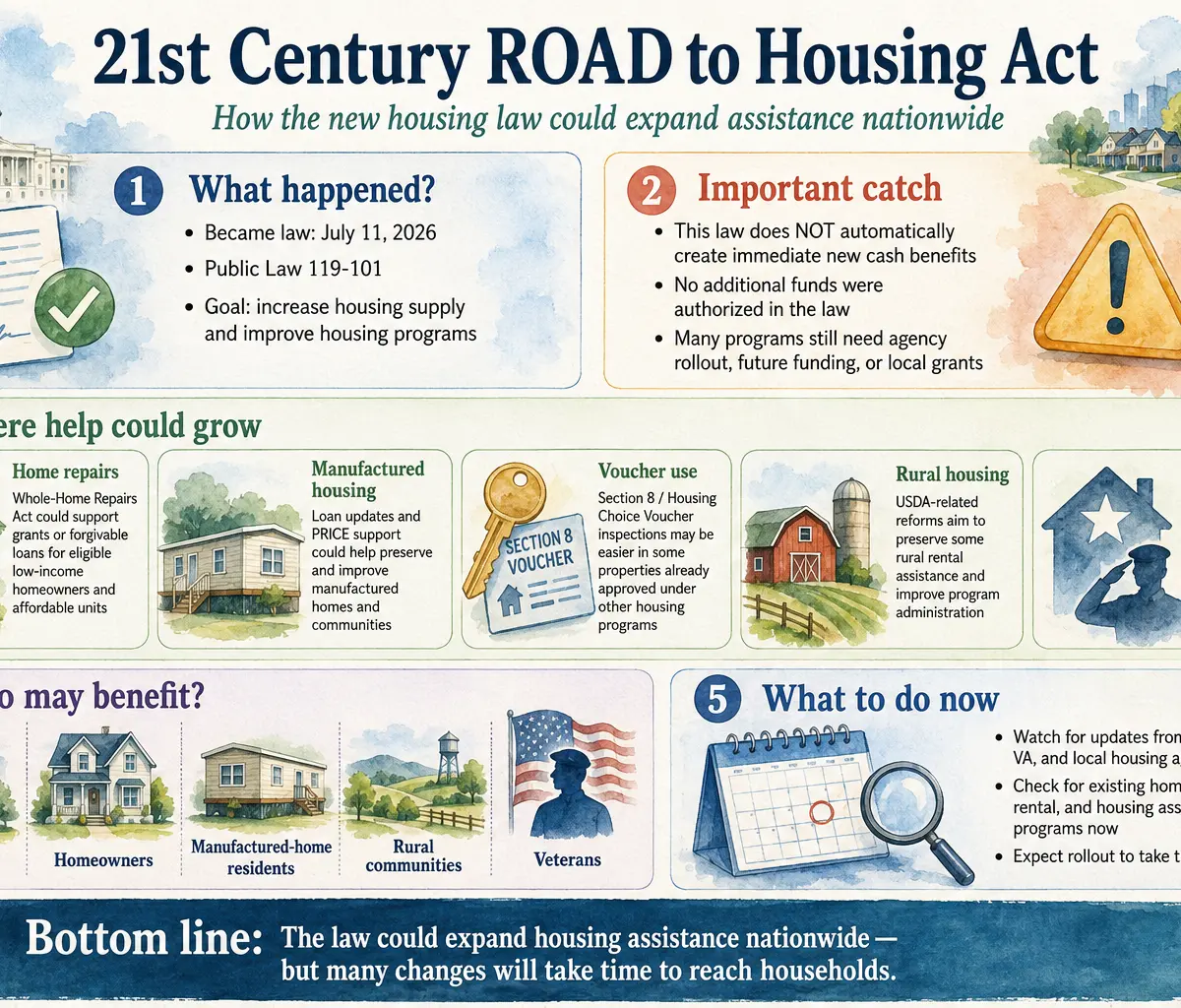
The 21st Century ROAD to Housing Act became law on July 11, 2026, after passing Congress with unusually broad bipartisan support. The Senate approved the final package 85-5, while the House passed it 358-32. The National League of Cities has described it as the first comprehensive federal housing package in decades.
Rather than creating one large new housing benefit, the law changes or establishes dozens of programs intended to increase the supply of homes, make existing federal housing programs work more efficiently and expand financing options.
For renters, homeowners and people hoping to buy a home, there are several provisions worth watching.
Home repair assistance could expand
One of the most directly relevant provisions for lower-income homeowners is the Whole-Home Repairs Act included in the larger law.
It establishes a pilot program through the Department of Housing and Urban Development (HUD) that can support state, local and tribal programs offering grants or forgivable loans for home repairs and modifications.
That could ultimately help qualifying households pay for repairs that are often difficult to cover out of pocket, such as major systems, safety improvements or modifications needed to keep a home livable.
Importantly, however, the new federal law does not mean there is now a nationwide home-repair application that homeowners can submit.
The National League of Cities notes that several programs created by the legislation still depend on future congressional appropriations. Local governments may also need to compete for federal grants before assistance becomes available in a particular community.
Manufactured-home financing and repairs get attention
The law also includes a significant set of changes involving manufactured and modular housing.
Among them, the legislation increases loan limits for certain FHA-insured manufactured-home loans and reauthorizes the Preservation and Reinvestment Initiative for Community Enhancement (PRICE) grant program for seven years. PRICE funding can be used to preserve and improve manufactured homes and manufactured-home communities.
The law also directs HUD to examine barriers to financing modular housing and makes accessory dwelling unit construction an eligible use of certain FHA-insured property improvement loans.
Those changes won't solve affordability problems by themselves, but they could expand financing and development options in areas where manufactured or modular homes are an important source of lower-cost housing.
Housing Choice Voucher users could get more options
The law also attempts to address a persistent problem for people using Housing Choice Vouchers, commonly called Section 8 vouchers: finding a landlord willing and able to accept them.
Under the new law, some properties that have already passed inspections through programs such as the Low-Income Housing Tax Credit, HOME or USDA Rural Housing Service may be able to satisfy voucher inspection requirements without going through a duplicative inspection.
Landlords will also be able to request advance inspections in some circumstances.
The goal is to reduce delays and encourage more property owners to participate in the voucher program, potentially giving families more places to use their assistance.
Rural housing programs are changing, too
For people living in rural communities, the law makes several changes to USDA housing programs.
Those include reforms intended to preserve federally supported rental housing when existing mortgages mature, as well as improvements to technology and staffing within USDA's Rural Housing Service. The law also calls for HUD and USDA to better coordinate environmental reviews and other requirements.
Another housing construction program reserves 10% of its funding for rural areas. It is intended to help communities adopt pre-reviewed designs for housing such as duplexes, townhomes and accessory dwelling units, potentially reducing the time and cost required to build them.
Veterans could see several changes
The legislation includes a separate section focused on veterans.
Free DIY tool
Benefit Eligibility Screener
What benefits might I qualify for? Answer a few questions and see VA, disability, food, housing, and health programs that may fit you.
Try the free toolMortgage applications will eventually include information telling borrowers they may qualify for a VA Home Loan, and FHA mortgage disclosures will provide additional information allowing eligible veterans to compare VA financing with other mortgage options.
The law also changes how disability benefits are counted when determining eligibility for the HUD-Veterans Affairs Supportive Housing (HUD-VASH) program. Veterans' disability compensation will no longer be included when calculating income eligibility for that program.
That provision could be especially meaningful for disabled veterans who previously had difficulty qualifying for housing assistance because their disability benefits pushed their calculated income above program limits.
The law could also affect the overall housing supply
Many of the law's biggest provisions won't provide money directly to households.
Instead, they are designed to make it easier for communities and developers to build more housing.
For example, the law creates incentives for local governments to speed up permitting, approve additional housing and adopt pre-approved building designs. It allows Community Development Block Grant funds to be used for new affordable-housing construction and creates a pilot program for turning vacant commercial or industrial buildings into affordable housing.
The theory is straightforward: if communities can build and preserve more homes, increased supply could eventually relieve some of the pressure pushing rents and home prices higher.
But those are longer-term changes, not immediate rent reductions.
So when will these programs actually become available?
This is the biggest caveat.
Although the 21st Century ROAD to Housing Act is now law, it is largely a policy and authorization bill, rather than a package that immediately sends billions of dollars to states and cities.
The legislation specifically does not provide additional funding for its implementation, meaning Congress will need to make funding decisions through the appropriations process for many of the new programs.
Federal agencies also have substantial work ahead. According to the National League of Cities, many provisions give agencies 12, 18 or 24 months to write rules or otherwise put the changes into effect.
That means some of the most promising programs could take months — or even years — before applications begin appearing at the state or local level.
What you can do now
If one of these programs sounds like it could help you, don't assume you need to wait for the new law to be fully implemented before looking for assistance.
Many communities already operate home-repair grants, housing rehabilitation programs, down-payment assistance, Housing Choice Vouchers and other housing programs using existing federal, state and local funding.
Over the next year, it will also be worth watching announcements from HUD, USDA, your state housing agency and your local city or county housing department as the ROAD to Housing Act moves from legislation into actual programs.
At BenefitKarma, we'll continue tracking those changes — especially when new funding or applications become available to individuals and families.
The bottom line
The 21st Century ROAD to Housing Act is a major rewrite of federal housing policy, with provisions touching everything from home repairs and manufactured housing to Section 8 vouchers, rural housing and VA loans.
But passage of the law is only the beginning.
For households struggling with housing costs today, the most important thing to understand is that many of these programs aren't available yet. Federal agencies now have to build the rules, Congress may need to provide funding, and states and local governments will ultimately determine how many of these opportunities reach people in their communities.
Source: National League of Cities, “Where to Start Now That the 21st Century ROAD to Housing Act Has Passed,” Aug. 20, 2026. Additional legislative details from Public Law 119-101 and the Bipartisan Policy Center.
Not sure what you qualify for?
A quick conversation can help you understand your options.
Optional — no obligation, fees may apply
Want help figuring out your next step?
Optional — fees may apply depending on your situation.
Some people choose to talk to a professional before taking their next step.
This might sound familiar:
You're not sure what to do next
You want someone to walk through your options
The process feels overwhelming
If that sounds like you, this might be worth a quick look.
Takes less than a minute
We only share your info with a service provider if you say yes.
Recommended Tools
Take action with our free tools
Get More from BenefitKarma
Create a free account to unlock all features
- Access premium benefit tools
- Personalized benefit matching
- Your personalized dashboard
Common questions about this guide
Get more from BenefitKarma
Free tools, personalized dashboard & more
